
Information and guidance on the testing of milk for antibiotic residues
Published 26 January 2018
Applies to England, Northern Ireland and Wales

© Crown copyright 2018
This publication is licensed under the terms of the Open Government Licence v3.0 except where otherwise stated. To view this licence, visit nationalarchives.gov.uk/doc/open-government-licence/version/3 or write to the Information Policy Team, The National Archives, Kew, London TW9 4DU, or email: psi@nationalarchives.gov.uk.
Where we have identified any third party copyright information you will need to obtain permission from the copyright holders concerned.
This publication is available at https://www.gov.uk/government/publications/milk-hygiene-and-antibiotic-residues/information-and-guidance-on-the-testing-of-milk-for-antibiotic-residues
| Intended audience | Interested parties along the milk production chain – farmers, milk purchasers and processors, and the enforcement authorities. |
|---|---|
| Regional coverage | UK |
| Legal Status | Guidance to accompany EC Regulation. |
| Purpose | This Guidance advises on the implementation of Regulation (EC) No 853/2004 as regards the testing of milk for antibiotic residues. In particular, the requirements at Annex III, Section IX, Chapter I.III.4 that food business operators must initiate procedures to ensure that raw milk is not placed on the market if it contains antibiotic residues in excess of regulated limits. |
| Key words | - Dairy products and vegetable oils |
| - Food law, monitoring and controls | |
| -Hygiene and food safety |
If you require this information in an alternative format – such as audio, large print, Braille – please contact us.
Contact telephone 020 7276 8987
0.1 Revision history
This guidance follows the Government Code of Practice on Guidance. If you believe this guidance breaches the Code for any reason, please let us know by emailing betterregulation@foodstandards.gsi.gov.uk. If you have any comments on the guidance itself, please call us using the contact number above.
1. Intended audience
This Guidance is intended for the information of all interested parties along the milk production chain – milk producers, milk purchasers and processors (including SMEs) and the enforcement authorities.
2. Purpose of guidance
2.1 Guidance on regulation
This Guidance provides informal, non-binding advice on the legal requirements of Regulations (EC) 853/2004 and 854/2004 and should be read in conjunction with the legislation itself. The Guidance relates specifically to the requirements for the testing of milk for antibiotic residues - in particular those at Annex III, Section IX, Chapter I.III.2, 4 and 5 of Regulation (EC) 853/2004 and Annex IV of Regulation (EC) 854/2004. The text of the Guidance will be subject to review if further advice is issued by the European Commission on the implementation of these provisions.
3. Legal status
These guidance notes have been produced to explain the legal requirements of;
-
Regulation (EC) No 853/2004, laying down specific hygiene rules for food of animal origin.
-
Regulation (EC) No 854/2004, laying down specific rules for the organisation of official controls on products of animal origin intended for human consumption
-
Regulation (EC) No 1069/2009 laying down health rules concerning animal by-products and derived products not intended for human consumption and repealing Regulation (EC) No 1774/2002.
-
The Veterinary Medicines Regulations 2013 08 (SI 2013/2033 2297)
-
Veterinary Medicines (Amendment) Regulations 2014 (VMR) (SI 599)
-
Council Directive 96/23/EC on measures to monitor certain substances and residues thereof in live animals and animal products.
-
Regulation (EC) No 470/2009 of the European Parliament and of the Council of 6 May 2009 laying down Community procedures for the establishment of residue limits of pharmacologically active substances in foodstuffs of animal origin, repealing Council Regulation (EEC) No 2377/90 and amending Directive 2001/82/EC of the European Parliament and of the Council and Regulation (EC) No 726/2004 of the European Parliament and of the Council
-
Commission Regulation (EU) No 37/2010 of 22 December 2009 on pharmacologically active substances and their classification regarding maximum residue limits in foodstuffs of animal origin
The guidance notes cannot cover every situation and you may need to consider the relevant legislation itself to see how it applies in your circumstances. If you do follow the guidance notes they will help you to comply with the law. Businesses with specific queries may wish to seek the advice of their local enforcement agency, which will usually be the trading standards/environmental health department of the local authority (or in Northern Ireland, the Department of Agriculture and Rural Development’s Agri-food Inspection Branch (DARD AfIB))
Note: testing under Council Directive 96/23 is carried out by the Animal and Plant Health Agency (APHA) (DARD in NI) from bulk tanks on farm on behalf of the Veterinary Medicines Directorate (VMD) as the Central Competent Authority (CCA) for residues controls. This testing is not included in the scope of this guidance.
4. Information and guidance on the requirements of hygiene legislation for the testing of milk for antibiotic residues
5. Summary
The approach to the control of antibiotic residues in milk is multifaceted. The primary control is on farm and begins with the correct prescription and administration of the antibiotics and the careful adherence to withdrawal periods. In short, milk producers must ensure that milk from animals under treatment or in the withdrawal period does not enter the food chain. The primary controls are complemented by the testing of milk for antibiotics, undertaken by food businesses at various points in the supply chain, including on farm. It is up to individual food business operators (including milk producers) to determine their own sampling and testing regime, taking account of other testing undertaken in the distribution chain, including any testing carried out on their behalf.
Sampling frequency for monitoring antibiotic residues in raw milk should be determined by the food business operator on a risk basis, with reference to specific requirements in Regulation (EC) No 853/2004. Where non-compliant results are identified, corrective action should include follow up investigations on-farm to determine the cause of contamination and an increased sampling and testing frequency, until such times as it can be demonstrated that the situation has been rectified.
Regulation (EC) No 853/2004, (Annex III, Section IX, Chapter I.III.2, 4 and 5) requires that:
-
food business operators must initiate procedures to ensure that raw milk is not placed on the market if it contains antibiotic residues in excess of regulated limits (Maximum Residue Limit – MRL)
-
a representative number of random samples of raw milk collected from milk production holdings be tested for compliance with the regulated limits
-
food business operators must inform the competent authority where the milk does not meet the regulated and take corrective measures
Thus, there is no requirement to test all raw milk collected from milk production holdings but food business operators should ensure that appropriate testing is in place to meet the regulated limits and also the requirements in article 9 2 (b) of Council Directive 96/23/EC (see paragraph 14). Such testing may be undertaken by food businesses at various points in the supply chain, including on farm.
Regulation (EC) No 854/2004 Annex IV requires that the Competent Authority shall carry out official controls to verify that health requirements and hygiene requirements for raw milk and colostrum are complied with and monitor the checks carried out for plate count, somatic cell count and residues of antibiotic substances in accordance with Regulation (EC) No 853/2004[footnote 1]. For LAs and in the context of antibiotics this means verification that the FBO has appropriate controls and testing in place to prevent milk with prohibited levels of antibiotics being placed on the market.
The sampling and testing mentioned at 1(ii) above may be carried out by, or on behalf of, producers, collectors or processors of milk. It may also be undertaken by, or on behalf of, groups of producers or in the context of a national or regional control scheme. It is not envisaged that this requirement applies to the milk of animals that have not undergone antibiotic treatment, unless such milk is mixed with milk from animals that have been treated with antibiotics. It is emphasised that the MRLs relate to raw milk, not to processed milk or to dairy products.
There are a number of rapid screening tests currently available on the market that can be used to determine the presence of antibiotics in milk. They fall into one of two types:
-
immune-receptor tests whose spectrum of detection is normally limited to β-lactam antibiotics and give a result within 5-10 minutes; and
-
microbial inhibitor tests which detect a wider range of antimicrobial substances, including β-lactams, and give a result within 3 hours or less.
The most appropriate screening test to use will depend on the specific circumstances, for example which antibiotics have been administered on farm. The test kit should ideally operate at or near to the MRL for the antibiotics that have been used. Advice should be sought from the test kit manufacturer, if necessary.
Figures 1 and 2 illustrate the marketing and disposal requirements following the testing of milk for antibiotic residues. Figure 3 illustrates how a food business operator should determine the outcome of antibiotic testing.
6. Part A: General guidance
7. Testing of Milk at the Production Holding
See Figure 1
Milk producers may test the milk of individual animals which have been treated with antibiotics, and/or they may test milk from the farm bulk tank. Antibiotics may be administered to animals ‘on-label’ (which means the dose administration and withdrawal period instructions appearing on the manufacturer’s label are followed), or ‘off-label’ (i.e. as directed by a veterinarian).
8. Antibiotics used On-Label
There is no requirement to test the milk of treated animals at the end of the ‘on-label’ withdrawal period. Some producers however may choose to undertake such testing for precautionary or commercial reasons. In cases where antibiotics used ‘on-label’ have been correctly administered and the withdrawal period followed but milk fails an antibiotic test, milk from the affected animal must continue to be withheld from the food chain for a further period. Producers should not place milk on the market or process it for sale for human consumption until a test from subsequent milking has achieved a pass result.
Producers are encouraged to report cases where antibiotic test failures have occurred after the withdrawal period for correctly administered on-label antibiotic use. These Adverse Events should be reported, either directly or via your veterinary surgeon, to the Pharmacovigilance Unit of the Veterinary Medicines Directorate (VMD). Although the reporting of these cases is voluntary, the reports are essential for the effective monitoring of Adverse Events following the use of veterinary medicines. All reports are followed up and could, for example, lead to a review of the MRL or the withdrawal period. More information may be found at: http://www.vmd.defra.gov.uk/fsf/adverse.aspx
9. Antibiotics used Off-Label
Where antibiotics are used ‘off-label’ there is a minimum withdrawal period, for milk, of 7 days, at the end of which the milk of individual animals should be tested. In cases where the milk fails the test, milk from the affected animal must continue to be withheld from the food chain for a further period. Producers should not place milk on the market or process it for sale for human consumption until a test from subsequent milking has achieved a pass result. It should be noted that the 7 day withdrawal period is only a statutory minimum and the prescribing veterinary surgeon can specify a longer period if it is considered necessary.
10. Disposal of Failed Milk at the Production Holding
Milk which has failed an antibiotic test at the production holding of origin does not fall within the scope of animal by-products legislation and therefore may be disposed of at the farm, for example in the slurry tank or by spreading on the land. It must not be placed on the market or processed for human consumption. Although not a legal requirement it is recommended that milk from cows treated with antibiotics should not be fed to calves. Producers who process their own milk and do not buy in any other milk can also dispose of any milk by these methods. However, producer-processors who buy in raw milk from elsewhere must dispose of any such milk which fails an antibiotic test (together with any milk with which it may have been mixed) in line with the disposal rules set out in Paragraph 18 below. Their HACCP-based procedures should make clear which disposal routes are to be followed.
11. Record Keeping
In addition to keeping records of all medicines purchased and medicines administered to dairy animals, milk producers should keep records of the results of all antibiotic testing they undertake and make them available for inspection by the competent authority on request. This will allow producers to demonstrate the controls they have in place to comply with the legislative requirements. The Veterinary Medicines Regulations 2013 require milk producers to keep records of antibiotics administered to their animals for 5 years. It is good practice to communicate the name(s) of the antibiotic(s) used to milk purchasers if requested to do so. More information can be found at: http://www.vmd.defra.gov.uk/pdf/vmgn/VMGNote14.pdf
12. On Farm Test Failures which do not need to be notified
Antibiotic test failures from samples taken on farm do not need to be notified to the competent authority in respect of –
- milk from an individual animal which has been tested to determine its suitability for inclusion in the bulk tank;
- milk from the bulk tank which has not left the production holding.
In both cases, this is because such testing is integral to the routine control of antibiotics and does not involve the milk being placed on the market or its use for human consumption.
13. Testing of Road Tanker Loads and Storage Silos of Milk by Milk Purchasers and/or Processors (other than producers who only process their own milk)
See Figure 2
Although Regulation (EC) 853/2004 does not have a specific requirement for milk purchasers/processors to test milk for antibiotics, Article 9 (2)(b) of Council Directive 96/23/EC requires that initial processors of Products of Animal Origin (POAO) have checks in place to ensure that residues are not present in excess of permitted levels and prohibited substances are not present:
the owners or persons in charge of the establishment of initial processing of primary products of animal origin take all necessary measures, in particular by carrying out their own checks, to satisfy themselves that the products brought into the establishment:
do not contain residue levels which exceed maximum permitted limits;
do not contain any trace of prohibited substances or products;
This is implemented in the UK by Part V of the Animals and Animal Products (Examination for Residues and Maximum Residue Limits) Regulations 1997 (as amended).[footnote 2]
Milk purchasers/processors and manufacturers of dairy products must therefore ensure that they have procedures in place to test milk samples arriving at the processing establishments, prior to acceptance, in addition to any sampling in place once they have taken delivery of the milk e.g. in silo. This will include road tankers delivering milk to a processing establishment, raw milk delivered to cheese manufacturers and so on.
The sampling frequency for monitoring antibiotic residues in raw milk should be determined by the food business operator on a risk basis. Where non-compliant results are identified, corrective action should include an increased sampling and testing frequency, until compliance has been achieved. Where FBOs already test 100% of incoming tankers, an increase in sampling and testing frequency is not possible, however, other corrective actions should be carried out on farm to ensure that the issue is resolved.
Milk purchasers/processors may find that the tanker test shows a failure for antibiotics, while the result in respect of the silo into which the tanker load has been offloaded shows a pass result. In these circumstances, milk purchasers /processors holding any milk in the knowledge that it has failed either a road tanker or silo antibiotic test may not place that milk on the market or use it for human consumption. This applies also to any milk with which it may have been mixed, and any processed products derived from such milk.
In all circumstances, milk purchasers/processors should ensure that their HACCP-based procedures and purchase specifications make clear what actions should follow when milk fails an antibiotic test.
It is not lawful to place unsafe or unfit milk on the market for human consumption. As regards milk which fails a primary screening test[footnote 3], such milk may not be sold or transferred on. Any steps to verify the result of the primary screening test must therefore be taken with these constraints in mind.
14. Disposal of Failed Milk – After leaving the Production Holding
Where milk has failed a rapid screening test for antibiotics and has left the production holding of origin, and no further steps are to be taken to identify and quantify the antibiotic present, outside the farm of origin, the only option is to dispose of the milk as Category 2 animal by-product in accordance with animal by-products legislation. Arrangements for disposal should be made in co-operation with the owner whose milk was responsible for the failure. Further information about animal by-products legislation requirements may be found on the Defra, Scottish Government and Department of Agriculture and Rural Development (DARD) websites:
-
https://www.gov.uk/government/publications/controls-on-animal-by-products
-
https://www.gov.scot/policies/animal-health-welfare/animal-by-products
-
http://www.dardni.gov.uk/index/animal-health/animal-by-products.htm
15. Notifying the Competent Authority of Test Failures
Regulation (EC) No 853/2004 specifies that food business operators are responsible for notifying antibiotic test failures to the competent authority. The Annex to this Guidance sets out the relevant competent authorities in the various devolved administrations.
Purchasers/processors should arrange to notify antibiotic test result failures on milk samples taken from road tankers or silos to the competent authority[footnote 4] as soon as reasonably practicable and at least on a monthly basis. The owner should be responsible for reporting the failure to the competent authority. Notification should generally be made by the food business operator’s office which is responsible for follow up action and arranging disposal of the milk – this may be at the testing site, but more usually an Operational Office or the Head Office. See contact details below and Figure 2 for more detail of where returns should be sent. The competent authority is responsible for monitoring the corrective follow-up action taken by the food business operator in such cases, including the disposal of animal by-products in accordance with the legislation. FBOs must ensure that details of follow up action taken are made available to the competent authority on request.
In addition, the purchaser/processor or owner, as appropriate, should promptly identify the milk production holding which is the source of any antibiotic test failure and inform the producer of the failure. This is in keeping with the requirement that producers must take steps to correct the situation. On a monthly basis, the purchaser/processor (or owner) of the milk should also notify the relevant competent authority responsible for checking that the appropriate corrective actions have been taken at the production holding. Purchasers/processors should ensure that no further milk is accepted from the relevant producer(s) until it can be shown that the problem has been rectified.
FBOs should ensure that they notify their Competent Authority of the following:
- Monthly reports of non-compliant antibiotic levels or nil return
- Monthly reports of all incidents of tanker failures, due to high levels of antibiotic residues, or nil return
- Disposal of non-compliant milk in accordance with Regulation (EC) 1069/2009
For England and Wales, returns should be sent to the FSA Central Operations Hub mailbox: [contact:dairyhygienedata@foodstandards.gov.uk]
And copied to their Local Authority for any follow up action at a local level.
For Northern Ireland, returns should be sent to DARD [contact:afib.admin@dardni.gov.uk]
A copy of the template for monthly returns is contained in the Annex to this guidance.
16. Part B: Guidance on the actions to be taken following an antibiotic screening test failure
This guidance applies in relation to the testing of milk in road tankers or in storage silos (i.e. away from the farm of production). However, the verification procedures in respect of antibiotic test failures are also relevant to on farm producer-processors. Refer to procedure as illustrated at Figure 3.
To determine the absence of antibiotic residues in milk, a rapid test (which may also referred to as a “screening”) using an appropriate test kit should initially be performed on a sample of milk. This first sample may also be referred to as the “primary sample”. The primary sample should ideally include use of what are known as negative and positive control samples (where practical and available, or as instructed by the test kit manufacturer). Controls are used to ensure that test kits are working correctly.
16.1 Controls explained:
Negative controls are a sort of “dummy sample” which should show as a “pass” when the test kit is used. This provides reassurance that milk without antibiotics in it should pass when it is tested.
Positive controls are used to make sure that the chemicals in the test kits which detect antibiotics are working properly. They are samples which are known to contain antibiotics or other substances so that when put through a test kit, the result will show as a “fail”. This provides reassurance that milk with antibiotics in it should fail when tested.
You should refer to the test kit instructions or contact the manufacturer for more details.
In the event that a sample fails the primary screening test using a rapid method, it is referred to as a presumptive fail) because the test indicates that the milk may have failed to comply with requirements due to presence of antibiotics. It is only presumptive at this stage as rapid tests are not as sensitive or specific as laboratory tests. At this stage, the food business operators have three options for dealing with the tanker or silo of milk from which the sample failed:
- Verify the result of the primary screening test using a second sample following the identical procedure to that followed in the primary screening test using a fresh sample of milk from the same bulk source. The verification should also include negative and positive controls and these should be shown to give the expected results as above. If the result of the verification test, complete with positive and negative controls confirms the presence of antibiotics then further testing as described in 23(b) or the disposal of milk as at 23(c) should be carried out. See the verification section below for further details on positive and negative controls.
or
- Identify and quantify the antibiotic(s) by sending the sample to a suitable (ideally accredited) laboratory for chemical testing. If the residue is above the relevant MRL(s) the milk should be disposed of as a Category 2 animal by-product according to Regulation (EC) No 1069/2009. If the residue is at or below the relevant MRL(s) for that substance the milk may be considered as meeting the requirements of Regulation (EC) No 853/2004 and may therefore be used for human consumption.
or
- Treat the result of the primary screening test as a failure and dispose of the milk as a Category 2 animal by-product according to Regulation (EC) No 1069/2009.
17. Verification: Interpretation of results using positive and negative controls
The results of the verification should be interpreted as follows:
-
If the negative control sample shows a test ‘pass’ result, and the positive control shows a test ‘fail’ result, and the second test on a milk sample also fails the test, then it must be concluded that the consignment contains one or more antibiotics.
-
If the negative control sample shows a test ‘pass’ result, and the positive control shows a test ‘fail’ result, and the second test sample passes the test, then it should be concluded that the primary test result was unreliable and that the consignment contains no detectable antibiotics.
-
If the negative control sample shows a test ‘fail’ result and/or the positive control shows a test ‘pass’ result, then it must be concluded that the reagents or the test conditions are unreliable. A new test using reagents[footnote 5] and materials from a different production batch should be used, or the milk can disposed as described in the third bullet under Controls explained above. The retest should again incorporate appropriate positive and negative controls and the results of the testing assessed as above
-
Where negative and positive controls are not available and a verification test carried out without using them shows a pass result, then it must be concluded that either the primary screening test result or the verification test result was unreliable. In these circumstances, it is recommended that either milk is disposed of or further investigation be carried out, such as the use of a new reagent batch or the testing of farm traceability samples[footnote 6], before a decision is taken on the suitability of the tested milk for human consumption.
18. Sample storage
The time between the primary and verification tests should be less than 24 hours. During this period, all milk samples should be kept at or below 6°C.
19. Staff training
Staff carrying out the screening and verification tests should be competent to perform the methods correctly.
20. Laboratory procedures
Testing sites should be able to demonstrate that laboratory quality control procedures are in operation. It is recommended that they participate in an appropriate external proficiency testing scheme(s), have comprehensive documented procedures and maintain appropriate records. They should be accredited to a recognised laboratory accreditation scheme, ideally to ISO 17025 and analytical methods should be validated to the standards required by Commission Decision 2002/657.
21. Annex: Competent Authority to be notified of antibiotic test failures
(See also paragraphs 18-20)
21.1 England & Wales
- Results from farm bulk tank samples which have been tested by milk purchasers/processors and monthly returns for tanker and silo failures should be reported to:
Competent authority / England & Wales
Central Operations Hub
Food Standards Agency York
Foss House, Kings Pool
1-2 Peasholme Green
York YO1 7PR
[contact:dairyhygienedata@foodstandards.gov.uk]
- Results from road tanker/silo sample failures should be sent to:
The Local Food Authority – either the Trading Standards Department or the
Environmental Health Department, dependent on local practice, or;
The Primary Authority Partner, where appropriate
Monthly returns are used by the FSA Dairy Hygiene Inspectors to monitor compliance of dairy farms or production. Failures of tankers and silos need to be notified to the relevant LA(s) or PA so that they can verify that follow up action is taken which ensures that non-compliant milk is disposed of accordingly.
Scotland
All samples –
Local Authority, Environmental Health
Local Authority contact details available at: http://www.cosla.gov.uk/scottish-local-government
-
Results from farm bulk tank samples should be reported to the authority local to farm.
-
Results from road tanker/silo samples should be reported to the authority local to the food business operator responsible for follow up action and disposal of the milk.
Northern Ireland
All samples –
The Department of Agriculture and Rural Development (DARD)
Quality Assurance Branch (QAB)
Room 1019
Dundonald House
Belfast
BT4 3SB
Tel: 02890 525001
Fax: 02890 524671
Email: [contact:qab.admin@dardni.gov.uk]
22. Cross Border movement of milk
When milk is moved between devolved administrations the same basic principles should be applied - the responsibility will rest with the owner of the milk at the time the failure is detected (who will be responsible for arranging disposal of the milk).
As an example, milk collected from a farm in Scotland but processed/tested as part of a tanker load owned by a company in England should be reported as follows-
- to the local authority (in England) which is local to the food business operator’s office responsible for follow up action and arranging disposal of the milk; and
- where the farm which is the source of the failure is identified, to the local authority for that farm (in Scotland).
23. Figure 1: Testing of Milk at Production Holdings by the Producer

24. Figure 2: Testing of Milk by Milk Purchasers and Processors
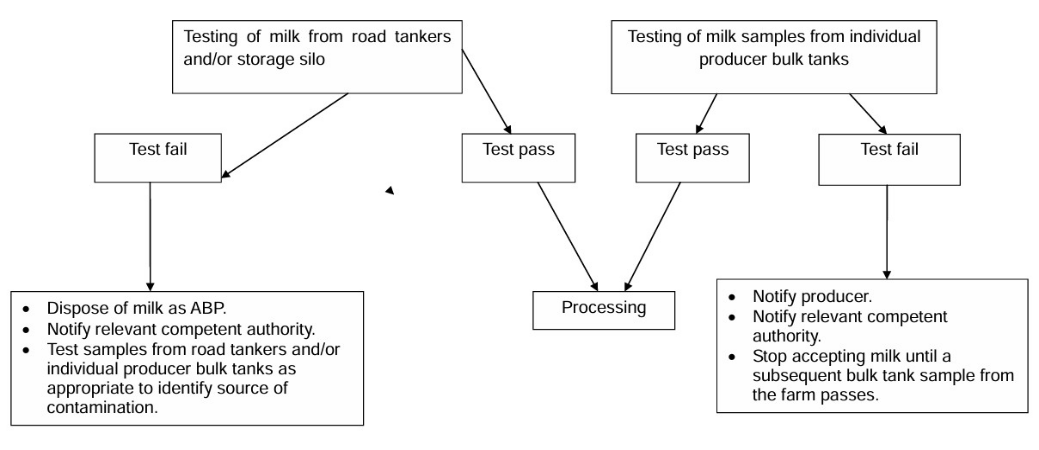
25. Figure 3: Decision tree to illustrate the testing of road tanker/storage silo milk

26. Glossary of terms
| Antibiotics used on-label | Antibiotics administered in accordance with manufacturers instructions. |
|---|---|
| Antibiotics used off-label | Antibiotics administered outside the terms of their marketing authorisation according to instructions by a veterinarian. |
| MRL | Maximum Residue Limit as laid down in EU legislation. MRLs are published as Council Regulation 2377/90 EC. This can be found on : http://ec.europa.eu/enterprise/pharmaceuticals/mrl/mrl_key.htm. Advice may also be sought on the VMD website: http://www.vmd.defra.gov.uk/fsf/vmr.aspx |
| Negative control | A sample of similar type milk from healthy animals that is known to be free of inhibitory substances. |
| Positive control | A sample containing a known concentration of an antibiotic. The choice of antibiotic should be appropriate to the type of rapid test being used. The concentration of this antibiotic should be at or above the MRL. |
| Primary screening test | The initial test on the first sample taken from the batch of milk being screened. |
| Rapid test | A commercial screening test that is designed to be performed for quality control or assurance purposes, normally not quantitative. |
| SMEs | Small and medium sized enterprises. |
| Verification test | A repeat of the primary screening test using positive and negative control samples (where practical and available or as instructed by the test kit manufacturer). |
27. Contact details
Any questions about this guidance should be addressed to:
Hygiene Delivery Branch
Food Standards Agency
Foss House
Kings Pool
1-2 Peasholme Green
York
Y01 7PR
Telephone: 020 7276 8180
E-mail: lahygieneenquiries@foodstandards.gsi.gov.uk
Wales: Local Authority Delivery and Support Team on tel: 02920 678927; email: Delyth.Murray-Lines@foodstandards.gsi.gov.uk
-
Annex III, Section IX, Chapter I, part III of Regulation 853/2004 – criteria for raw milk and colostrum. ↩
-
Statutory Instrument No. 1729 The Animals and Animal Products (Examination for Residues and Maximum Residue Limits) Regulations 1997 ↩
-
The initial test on the first sample taken from the batch of milk being screened. ↩
-
In England & Wales monthly reports should be submitted to the FSA. In Northern Ireland these will be submitted to DARD ↩
-
Reagents are the substances or chemicals used in a test kit which react in the presence of antibiotics to produce a “fail” result. ↩
-
In some cases a test failure may indicate the presence of substances other than antibiotics. ↩