MHCLG Accounting Officer System statement
Updated 17 July 2026

© Crown copyright 2026
This publication is licensed under the terms of the Open Government Licence v3.0 except where otherwise stated. To view this licence, visit nationalarchives.gov.uk/doc/open-government-licence/version/3 or write to the Information Policy Team, The National Archives, Kew, London TW9 4DU, or email: psi@nationalarchives.gov.uk.
Where we have identified any third party copyright information you will need to obtain permission from the copyright holders concerned.
This publication is available at https://www.gov.uk/government/publications/mhclg-accounting-officer-system-statement-2026/mhclg-accounting-officer-system-statement
1. Introduction
1.1.1. Principal Accounting Officers in government departments are accountable to Parliament for the proper stewardship of the resources allocated to their departments. Details of the requirement to ensure regularity and value for money are set out in the HM Treasury guidance on Managing Public Money. The Accounting Officer System Statements guidance sets out how central government departments should construct an Accounting Officer System Statement, including details of the accountability relationships and processes within their department. This should include relationships with Arm’s Length Bodies (ALBs) and third-party delivery partners.
1.1.2. The Ministry of Housing, Communities and Local Government (MHCLG) has documented and published details of its local accountability systems since 2012.
1.1.3. The purpose of this Accounting Officer System Statement is to provide Parliament with a single statement setting out all accountability relationships and processes within MHCLG and across the system for which the department is responsible. It charts the accountability relationships in place now and for the future and will be reviewed at the beginning of the financial year, alongside the publication of the Annual Report and Accounts, and updated as required.
1.1.4. A review of the department’s governance structures and performance takes place annually and is published in the Governance Statement within the department’s Annual Report and Accounts. The annual Governance Statement sets out how the Permanent Secretary, in the role of Principal Accounting Officer, has carried out responsibilities to manage and control the resources used in the department over the course of the latest financial year.
2. Statement of Accounting Officer responsibilities
2.1.1. I am the Principal Accounting Officer for MHCLG. This system statement sets out the accountability relationships and processes within the department, making it clear who is accountable at all levels of the system.
2.1.2. My department has policy responsibility for:
- housing and planning, including (but not limited to) housing supply, social and affordable housing, leasehold, and the private rented sector
- homelessness and rough sleeping, including (but not limited to) providing financial support to local authorities to reduce rough sleeping levels and providing coordinated support for those that experience multiple disadvantage
- building and fire safety, including (but not limited to) remediation, regulatory oversight, fire, and responding to the Grenfell Inquiry
- local government, including local government finance and structures, and devolution;
- local and regional growth, such as helping to deliver regeneration projects which boost regional economies
- communities and faith including (but not limited to) promoting community cohesion and integration, strengthening social infrastructure, and supporting faith-based initiatives
- democracy and elections which includes ensuring the integrity of local elections and democratic processes
2.1.3. As Principal Accounting Officer, I am personally responsible for safeguarding the public funds for which I have been given charge under the MHCLG Estimate and the Business Rates Retention and Non-Domestic Rates Trust Statement. Where I have appointed additional Accounting Officers, their responsibilities are also set out in this system statement.
2.1.4. This system statement covers the core department, its ALBs and other arm’s length relationships, including local authorities. It describes accountability for all expenditure of public money through the department’s Estimate, all public money raised as income, and the management of shareholdings, financial investments, and other publicly owned assets for which I am responsible. This statement describes the system which I apply to fulfil my responsibilities as an accounting officer, in accordance with Treasury guidance set out in Managing Public Money, and ensure that spending is carried out with regularity, propriety and achieves value for money.
2.1.5. This system statement describes the accountability system which is in place at the date of this statement, and which will continue to apply until a revised statement is published.
Sarah Healey CB CVO
Principal Accounting Officer and Permanent Secretary
15 July 2026
3. The Accountability System
3.1.1. There are two distinct accountability systems within the department:
- funding distributed directly through MHCLG and our ALBs;
- the Local Government Accountability System.
3.1.2. The department has two finance directors. The Finance Director is responsible for spending through the core department and ALBs, reporting to the Chief Finance Officer. The Local Government Finance Director is responsible for overseeing the funding provided to local government, reporting to the Director General for Local Government, Growth and Communities.
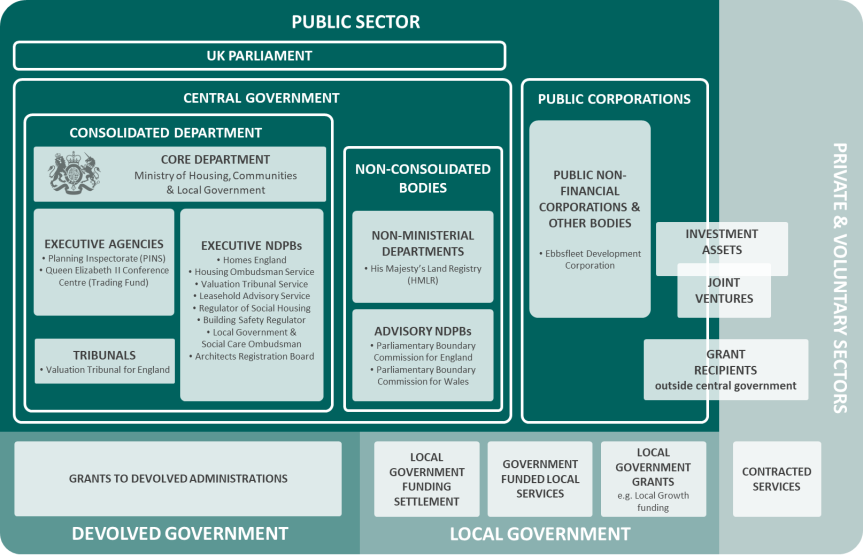
3.1.3. A diagram showing all parts of the MHCLG system is included at Figure 1.
Figure 1: The MHCLG Accountability System
4. Responsibilities within the Core Department
4.1. The Governance Framework
4.1.1. MHCLG’s governance framework has been designed in line with established good practice, including as set out in the Corporate governance code for central government departments and the Orange Book.
4.1.2. The Permanent Secretary, appointed by HM Treasury as the department’s Principal Accounting Officer, has personal responsibility for maintaining a sound system of internal control that supports the delivery of the department’s policies, aims and objectives, whilst safeguarding public funds and departmental assets.
4.1.3. The department operates a board and committee model of corporate governance. The Departmental Board, chaired by the Secretary of State, provides overall leadership for the department’s business, as well as advice, support and challenge on the delivery and performance of key policy areas and programmes. The Board provides delegated authority for departmental governance, assurance and oversight – including escalation of core risks and decisions – to the Executive Team and Audit and Risk Assurance Committee (ARAC), supported by the Senior Talent and Pay Committee (STPC) and core executive sub-committees.
4.1.4. Under MHCLG’s governance framework, regular governance and oversight is managed at a portfolio level and Directors General are responsible for ensuring effective arrangements are in place for their areas, in the discharge of their delegated authority and responsibilities. Cross-departmental assurance and oversight is managed at an executive level by the Executive Team and its core and ancillary sub-committees, alongside the MHCLG Audit and Risk Assurance Committee.
Table 1: The department’s governance framework remit and attendees
Non Executive committees
| Forum | Remit | Attendees |
|---|---|---|
| Departmental Board | The Departmental Board is responsible for providing overall leadership for the department’s business, as well as advice, support and challenge on the delivery and performance of key policy areas and programmes. |
Chair: Secretary of State Membership: Ministers, Permanent Secretary, Chief Finance Officer, Directors General and Non-Executive Directors |
| Audit and Risk Committee (ARAC) | The Audit and Risk Committee (ARAC) is responsible for reviewing assurance on governance, risk, internal controls and the integrity of accounting and reporting procedures. |
Chair: Designated non-executive director Membership: Designated non-executive directors and independent external member(s) |
Executive committees
| Forum | Remit | Attendees |
|---|---|---|
| MHCLG Executive Team (ET) | The Executive Team is responsible for the strategic leadership of the department, including consideration of corporate issues, and the oversight of performance, delivery, risk, governance, and business planning. |
Chair: Permanent Secretary Membership: Directors General, Director of People, Capability and Change, Director of Strategy, Director of Finance and Director of Communications. |
| Senior Talent and Pay Committee | The Senior Talent and Pay Committee is responsible for Senior Civil Service performance, talent, succession planning and pay. |
Chair: Permanent Secretary Membership: Directors General and Director of People, Capability and Change |
Executive sub-committees
| Forum | Remit | Attendees |
|---|---|---|
| Delivery Sub-Committee | The Delivery Sub-Committee is responsible and accountable as a decision-making forum for ensuring MHCLG’s portfolios, programmes and projects are successfully delivering departmental outcomes. |
Chair: Director General, Regeneration, Housing and Planning Membership: Director-level representation from across all portfolios and representative from the National Infrastructure and Service Transformation Authority (NISTA) |
| Finance Sub-Committee | The Finance Sub-Committee is responsible for taking decisions and making recommendations to the Executive Team on management of the department’s finances. |
Chair: Chief Finance Officer Membership: Director-level representation from across all portfolios |
| People and Operations Sub-Committee | The People and Operations Sub-Committee is responsible for making recommendations to the Executive Team about people and operational matters. |
Chair: Chief Finance Officer Membership: Director-level representation from across all portfolios |
| Risk Sub-Committee | The Risk Sub-Committee is responsible for reviewing corporate risk and overseeing the enterprise risk framework. | Chair: Chief Finance Officer |
| Membership: Director-level representation from across all portfolios, Legal Directors, and Government Internal Audit Agency (GIAA). | ||
| Investment Sub-Committee (ISC) | The Investment Sub-Committee is responsible for the scrutiny and approval of investment proposals and financial transactions for the department, including ensuring value for money and that Managing Public Money requirements are met. |
Chair: Chief Finance Officer Membership: Senior Civil Servant- level representation |
Portfolios
| Forum | Remit | Attendees |
|---|---|---|
| Portfolio Boards | The Portfolio Boards are responsible for making key decisions relating to the strategic delivery of the department’s priority outcomes. |
Chair: Director General Membership: Director-level representation, Portfolio Management Offices and other key subject matter experts (i.e., finance, commercial, risk etc.) |
4.1.5. Alongside the Board structures set out above, ministers and the Permanent Secretary have clearly defined responsibilities that support good governance within the departmental group through parliamentary accountability:
- The Secretary of State is responsible and answerable to Parliament for the exercise of the powers on which the administration of the department depends. They have a duty to Parliament to account, and to be held to account, for the policies, decisions, and actions of the department.
- The Principal Accounting Officer may be called to account in Parliament for the stewardship of the resources within the department’s control and the system of accountability for funding devolved to the local level.
4.2. The Financial Control Framework: principles
4.2.1. For each financial year, HM Treasury agrees budget control totals and issues ‘Delegation Limits’ to each department. This gives the department’s Principal Accounting Officer standing authorisation to commit resources or incur expenditure from money voted by Parliament without specific approval from HM Treasury, within the agreed framework. This includes a delegation for expenditure on new projects, programmes, policy proposals and financial transactions. These are set out in table 2, below. The table also shows ‘disclosure thresholds’; new projects or programmes above these limits must be disclosed to HM Treasury.
4.2.2. Other delegated authorities include those for write-offs and impairments; claims waived or abandoned; and special payments. HM Treasury specifies those types of expenditure where delegated authority does not apply and approval should be sought (for example, any novel and contentious expenditure).
4.2.3. The Principal Accounting Officer delegates responsibility through the department’s financial delegation framework. This provides a structure for control and compliance throughout the organisation. It ensures that the roles and responsibilities of staff in relation to resources, expenditure and financial transactions are clear. Guidance on resource management and corporate governance responsibilities is refreshed annually and circulated to all senior staff alongside formal delegations.
4.2.4. There are 3 types of financial delegation that operate within the department:
- Budget Delegation: Administration and Programme budgets are delegated from the Accounting Officer to the Directors General and directors at the start of the financial year. All budgets must be managed in accordance with HM Treasury’s guidance on Managing Public Money and budgets cannot be delegated below director-level.
- Approval Delegation: Before spending against budgets can be authorised, business case approval is required through a Director General, Senior Responsible Officer (SRO) or the Investment Sub-Committee (ISC). This includes any investment proposal or financial transaction with total costs of over £12,000 (inc. VAT). Any commitments below £12,000 can be authorised by the budget holder without Director General, SRO or ISC approval. This is described in table 3, in section 4.4.
- Spend Delegation: Once a business case is approved, spend delegations set out who is approved to commit funds and make payments within agreed limits. Spend delegations are issued by directors to deputy directors and grades 6/7. These are managed within a standard framework, except when an exceptional spend delegation is required for staff to commit higher levels (for example, authorising regular grant in aid payments).
4.2.5. These financial delegations are described in more detail in sections 4.3, 4.4 and 4.5(https://www.gov.uk/government/publications/mhclg-accounting-officer-system-statement-2025/mhclg-accounting-officer-system-statement-2025#spend-delegation).
Table 2: Recently updated MHCLG Delegation Limits
All projects and programmes and announcements and policy proposals within a defined lifetime
| Nature of delegation | Delegated limit | |
|---|---|---|
| Resource | £250 million | |
| Capital – grant | £750 million* |
Financial transactions
| Nature of delegation | Delegated limit | |
|---|---|---|
| AAA-CCC counterparty credit rating | £100 million | |
| CC-D counterparty credit rating | £0 |
*Existing project or programme (subject to the project programme meeting the conditions placed on funding and there not being any substantial changes) is one that:
- has received consent from HM Treasury ministers, or
- where the Investment Sub-Committee has signed off the project or programme when it was within MHCLG’s previous delegated authority (as a full business case, including overarching programme business cases)
4.3. Budget delegation
4.3.1. Resource and capital programme budgets for which the Principal Accounting Officer is responsible as part of the Supply Estimate, are delegated to Directors General. Directors General then sub-delegate resource and programme budgets to directors (who may also hold the role of Senior Responsible Officer (SRO)) in their group and portfolios.
4.3.2. At the start of the financial year, all directors and SROs are issued with a delegation letter setting out their accountabilities and responsibilities in relation to resource and programme budgets. Budgets are monitored by directors and SROs throughout the financial year, with Finance Business Partners providing appropriate challenge to the budget holder, where necessary, ensuring budget control is not compromised. Budgets may not be delegated below director-level unless in exceptional circumstances and must be agreed by the Principal Accounting Officer.
4.4. Approval delegation
4.4.1. Teams must prepare a business case to inform decisions on investment proposals above £12,000 (inc. VAT), to ensure all business cases receive the appropriate level of scrutiny before spending is approved. This gives assurance that investments the department makes are value for money, well-designed and any assumptions are tested.
4.4.2. All business cases should follow HM Treasury’s five case model and should be completed based on the stage of the project or the nature of the investment. This will determine whether a Strategic Outline Case (SOC), Outline Business Case (OBC) or Full Business Case (FBC) should be completed.
4.4.3. Business case approval depends on the nature and size of spend, as shown in table 3. The department has separate processes for decisions about financial transactions such as loans or guarantees – these are set out in Section 9.
4.4.4. Before approval, each business case must be signed off by the SRO to demonstrate that funding can be used from within their delegated budget. Subject Matter Experts should provide functional expertise and advice to support development of the business case and inform the SRO’s final decision. Relevant experts may include colleagues from across Finance, the AI and Advanced Analytics Directorate, Counter Fraud, Legal, Commercial Procurement/Grants, Digital, Funding Service, Programme/Portfolio Management Offices and other supporting subject matter experts such as Evaluation, Risk and Funding Simplification teams, Arm’s Length Bodies and other government departments. The extent of their involvement will depend on the whole life cost of the case.
4.4.5. Significant changes to the scope, cost and/or time of a project or programme require consultation with the Investment Sub-Committee (ISC) Secretariat and Finance Business Partner(s) to consider if reapproval at ISC is required.
4.4.6. The ISC is a sub-committee of the Executive Team responsible for scrutinising and approving investment proposals for the department (including Arm’s Length Bodies) to ensure they achieve value for money. ISC membership consists of:
- Chief Finance Officer (Chair)
- Finance Director (Vice-Chair)
- Commercial Director (Deputy Vice-Chair)
- Chief Economist
- Legal Director
- Chief Digital Officer
- Central Delivery Unit Deputy Director
4.4.7. Additional members, if called upon, consist of:
- Chief Economist
- Director of Local Government Finance
- Director of Strategy
- Peer Director / Senior Responsible Owner
4.4.8. Mandatory attendees for the ISC meeting, in addition to the committee members, are as follows:
- Senior Responsible Officer (SRO)
- the SRO may also bring members of their team who have written elements of the business case for support
- ISC Secretariat, and relevant Central Delivery Unit Delivery Lead
- Finance Business Partner who has been advising the Project/Programme team throughout the development of the business case
4.4.9. The National Infrastructure and Service Transformation Authority (NISTA), HM Treasury, GIAA or any other external parties may be invited to the meetings at the ISC Chair’s discretion, as observers to the discussion on specific business cases.
Table 3: MHCLG Business Case Approval Process
| Type of business case | Approvals Process | HM Treasury Approval |
|---|---|---|
| The proposal is novel, potentially contentious, sets precedent, could cause repercussions elsewhere in the public sector, or requires specific HM Treasury consent because of legislation | Investment Sub-Committee (ISC) | HMT approval required |
| The Whole Life Cost (WLC) is equal to or above: - £10 million for RDEL programmes - £30 million for CDEL or £50m CDEL Financial Transactions - £1m RDEL Admin |
New or standalone projects or programmes – ISC *OR projects or programmes that have been agreed to be delegated by ISC, via an approved programme or full business case – Director General (DG) |
HMT approval required if - RDEL (including admin) above £250m CDEL above £750m CDEL FT above £100m |
| The Whole Life Cost request is greater than £2m but below the ISC thresholds outlined above. | New or standalone projects or programmes – Director General * OR - Projects or programmes that have been agreed to be delegated by ISC or DG, via previously approved programme business case – Senior Responsible Officer |
HMT approval NOT required |
| The Whole Life Cost is lower than £2 million and does not include Admin | Project or Programme Senior Responsible Officer | HMT approval NOT required |
| Explicitly related to and executed by Homes England | Projects or programmes that have been agreed to be delegated by ISC, via an approved programme business case – Homes England | HMT approval NOT required, unless - - RDEL, including admin, above £250m - CDEL above £750m - CDEL FT above £100m |
4.5. Spend delegation
4.5.1. Once the decision to spend has been made following business case approval, officials in the department can commit funds and make payments within agreed limits. Spend delegations set out who is approved to carry out these processes.
4.5.2. Spend delegations are issued in line with a standard framework across the department, as per table 4, below. They are reviewed annually and adjusted in line with changing business need.
Table 4: Spend delegation limits
| Grade | Maximum Limit per transaction |
|---|---|
| Accounting Officer | Any amount |
| Director General | Any amount up to and within their delegated budget |
| Director | Any amount up to and within their delegated budget |
| Deputy Director | £5m CDEL £1m RDEL |
| Grade 6 | £500,000 CDEL £250,000 RDEL |
| Grade 7 | £100,000 CDEL £50,000 RDEL |
4.5.3. Directors are responsible for sub-delegating their spend delegations to deputy directors and other grades below this level, where appropriate. Directors are supported by Finance Business Partners in managing their spend delegations. Compliance with the delegation framework is reviewed annually as part of the Governance Assurance Exercise described at section 4.9.
4.5.4. Further delegations are issued during the year as needed, such as temporary delegations when senior members of staff are on leave, and exceptional delegations above the standard spend delegation limits where business circumstances dictate. Sub-delegation is permitted only in instances where a director needs to depart from their standard role. Finance Business Partners provide the necessary support and advice to the nominated deputy, with a delegation letter issued clearly setting out the roles and responsibilities that come with such budget delegation. A central log of instances where budget has been sub-delegated is maintained and reviewed every three months to ensure the arrangements are still required.
4.5.5. The standard spend delegations apply to grants and contracts. These do not apply to payments for goods and services through the ‘Purchase to Pay’ (P2P) system, which has its own integrated controls. hey also do not apply to special payments set out in table 5, which lists the category of special payments and the limit delegated to the Accounting Officer by HM Treasury.
4.5.6. The potential risks of financial mismanagement are mitigated by MHCLG’s financial control framework. The framework provides robust assurance and protection by segregating the steps and responsibilities for delegating budgets, committing funds, and making payments. This ensures that individuals and teams are deprived the breadth of authority unilaterally to commit payments or carry out fraudulent activity.
Table 5: Special Payments Delegation Limits
| Description | Delegated Limit |
|---|---|
| Extra-contractual payments involving departmental default and made on appropriate legal or other professional advice | Main DAL limits apply if within HMT guidance. Nil for above |
| Ex Gratia payments These are payments made by departments on the basis that, while there is no legal liability, statutory obligation or administrative rule that requires payment, and no specific liability exists or is mitigated, the payment represents the ‘right thing to do’ on the judgement of the Accounting Officer. | Nil |
| Other Ex-gratia payments | Nil |
| Compensation payments (solitary/outside statutory schemes) This includes redress for personal injuries (except for payments under the Civil Service Injury Benefits Scheme), traffic accidents, damage to property etc. suffered by civil servants or others. They include payments to those in the public service outside statutory schemes or outside contracts. | £150,000 (Personal injury) £200,000 in personal injury cases related solely to historic asbestos exposure causing asbestosis or mesothelioma £100,000 (Other) |
| Extra-statutory and extra- regulatory payments (as defined by Managing Public Money Box A4.13A) | Main DAL limits apply if within HMT guidance. Nil for above |
| Consolatory payments (These are a subset of ex-gratia payment made to individuals to recognise and apologise for distress or minor inconvenience caused by a department, but where there would be no legal claim or other duty to compensate.) | £500 |
| Special severance payments | Nil if NCR |
4.6. Capital flexibilities
4.6.1. HM Treasury has granted MHCLG additional flexibilities to support delivery of our capital programmes. These flexibilities principally apply where the annual budget profile needs adjusting to reflect changes in the pace of delivery, but the lifetime cost remains the same. The detail of these flexibilities is typically reviewed as part of the Spending Review process. Following cross-governmental reforms to the public spending framework in Spring 2026, work to review the flexibilities is ongoing.
4.6.2. The flexibilities are based on groupings of programmes or ‘umbrellas’ that were agreed with HM Treasury at the Spending Review 2025 (SR25) and the next review point will be the Spending Review 2027 (SR27). At present, we have 4 umbrellas: Regeneration, Housing and Planning, Social and Affordable Homes Programme, Local Government, Growth and Communities and Buildings, Fire and Resilience.
There are 2 main flexibilities that apply:
- Over-programming: the Principal Accounting Officer can make a risk-based decision to allocate higher working budgets to SROs to deliver programmes than the total SR settlement, in order to boost delivery and mitigate against underspends that often arise when delivering complex capital programmes. MHCLG monitors this risk centrally through monthly financial reporting to ensure the department does breach control totals at year-end. The Principal Accounting Officer determines the level of over-programming and is responsible for managing this risk.
- MHCLG also has the ability to manage specific programmes on a lifetime basis. This is subject to an HMT agreed business case, while remaining within the department’s overall control total and the agreed lifetime budget for those programmes.
4.7. Performance and planning
4.7.1. MHCLG updates its single departmental plan on an annual cycle as a minimum. This sets out the department’s strategic business plan over an agreed period, providing detail of MHCLG’s priority outcomes, activity and programmes, alongside how and when the department will deliver these. The business planning process includes specific consideration of the department’s organisational structures, timelines, evaluation strategies and risk management structures, to support and enable delivery.
4.7.2. Under the departmental plan, MHCLG’s work is organised into Director General-led portfolios with responsibility for providing management oversight of, and accountability for, delivery of MHCLG’s priority outcomes. Departmental priority outcomes and metrics to measure progress are typically agreed between the department and HM Treasury via the Spending Review process.
4.7.3. Delivery of the departmental plan is managed at an executive level via a quarterly stocktake process. This enables the Executive Team and core sub-committees to monitor delivery of the plan and track progress against key milestones and priority outcomes, iterating it as needed during the course of the year. This process provides assurance to the Principal Accounting Officer regarding departmental performance and delivery.
4.7.4. Alongside these overarching business planning and review processes, MHCLG has a number of further assurance mechanisms designed to provide confidence to the Accounting Officer, Departmental Board and Executive Team that projects and programmes are being delivered as planned. The primary sources of departmental assurance are:
- Performance reporting: The Executive Team and departmental non-executive directors receive quarterly updates on performance against the ministerial priority outcomes. The Executive Team and Delivery Sub-Committee also receive regular reports on portfolio priorities, key risks, resourcing and finances.
- Governance: Directors General are responsible for chairing regular meetings of their group’s Portfolio Board, to oversee delivery progress, risks, and interdependencies across work areas. In accordance with the department’s governance framework, specific risks and opportunities may be escalated to the executive and/or ministerial level for discussion or awareness, as required.
- Project and programme assurance: The Finance directorate, Central Delivery Unit, Strategy directorate and Portfolio Management Offices (PMOs) provide guidance and support to project and programme managers to apply consistent approaches to project delivery and assurance.
- Financial management: The Finance Directorate tracks MHCLG’s financial performance and position, reporting into the Finance Sub-Committee. Detailed reports covering spend and forecast data for both administration and programme budgets are produced monthly, with headline data incorporated into the quarterly Stocktake process.
- Resource management: The People and Operations Sub-Committee has delegated authority to consider and decide on a range of people issues, including delivery of the departmental People Plan. It regularly receives a wide variety of metrics and key performance indicators covering all aspects of people and resource management at the department, and reports progress to the Executive Team as required.
4.8. The Risk Management Framework
4.8.1. MHCLG’s Risk Management Framework is designed to support effective decision making, enabling the department to achieve its strategic and operational objectives. The framework sets out the department’s overarching approach to risk, including arrangements for managing and escalating risks, and is aligned with the methodology set out in The Orange Book.
4.8.2. The Framework reinforces the importance of managing risk proactively, empowering teams and individuals to take responsibility, and fostering a culture where consideration of risk is integral to delivery of the department’s activities. This is underpinned by a structured approach to risk ownership and awareness across MHCLG.
4.8.3. MHCLG operates the “three lines of defence” model to manage risks holistically in an integrated and mutually supportive manner, with each of the lines of defence contributing to overall assurance:
- First line of defence: Each team has primary ownership, responsibility, and accountability for identifying, assessing, and managing the risks relevant to their business activities.
- Second line of defence: Consists of a ‘second opinion’ / layer to monitor, challenge and facilitate effective risk management and co-ordinate the reporting of risk information. The department’s Enterprise Risk team is a core part of the second line of defence.
- Third line of defence: Consists of audit activity, which is primarily undertaken by the GIAA.
- External assurance: Outside of the ‘3 lines of defence’ model, MHCLG also draws on sources of external assurance, including the Government Functional Standards, the National Infrastructure and Service Transformation Authority (NISTA), the National Audit Office (NAO) and the Government Security Group (GSG).
4.8.4 The department operates in a complex and evolving environment, influenced by a range of external factors. The Department’s principal risks reflect the most significant risks to the delivery of its objectives during the year and are informed by ongoing risk identification and assessment activity across the organisation.
During 2025/26, the Department reviewed its approach to identifying and articulating principal risks to ensure they accurately reflected the key challenges associated with delivering ministerial priorities.
Each principal risk is escalated to the departmental level by a member of the Executive Team, when identified by the Portfolio Boards as having a significant impact on the delivery of departmental objectives. Each principal risk is owned and managed within the relevant area, with Portfolio Boards providing oversight of risk management arrangements, including the effectiveness of controls and mitigating actions. This is supported by director members of the Risk Sub-Committee and the central Enterprise Risk team.
Principal risks are reviewed regularly through established governance arrangements, including the Risk Sub-Committee, Executive Team and the Audit and Risk Assurance Committee. These forums provide oversight of the Department’s risk profile and assurance on the effectiveness of risk management arrangements. A programme of deep dives and horizon scanning helps identify opportunities to strengthen risk management, maintain visibility of emerging issues and ensure risks remain reflective of the department’s dynamic operating environment.
As of March 2026, the department identified twelve principal risks which have a direct and significant impact on delivery of our priorities and reflect the interconnected nature of the risks faced in our complex operating environment.
4.8.5 The departmental-level risk register comprises the most significant key risks reported by the department’s five Director-General led portfolios. The key risks escalated by the five portfolios are subject to a calibration and moderation exercise, following which those which represent the most significant threat to the department’s strategic objectives are included on the departmental risk register for that quarter and are subject to review and discussion at the department’s Risk Sub-Committee. The Risk Sub-Committee is Chaired by the department’s Chief Finance Officer. In order to provide further assurance to the department’s Principal Accounting Officer, a summary of the Risk Sub-Committee’s discussion of the risks on the risk register is reported to the Audit & Risk Assurance Committee, so that its members have the opportunity to provide opinions, challenge the discussion conclusions and/or make recommendations in relation to any of the risks.
4.8.6 The risks on the departmental risk register are aggregated by strategic objective, so that the risk profile facing each objective can be better understood and considered. Individual risks on the risk register may be subject to a ‘deep dive’ review, either at Risk Sub-Committee or at the Audit & Risk Assurance Committee. As part of its risk review process, the department seeks to understand if there are any cross-cutting themes spanning multiple of its risks and which warrant additional consideration in view of their potential aggregate impact.
4.9. Governance assurance exercise
4.9.1. At the end of each financial year, the department undertakes a governance assurance exercise to reflect on the effectiveness of the governance arrangements, internal controls and risk management implemented by Directors General and directors in the discharge of their delegated authority and responsibilities. This informs the Governance Statement, included in the department’s Annual Report and Accounts.
4.9.2. The governance assurance process considers a range of evidence across core areas of control, including structures, governance, risk, ALB governance, portfolio management, people finance, knowledge and information, counter-fraud and audit and external review. Evidence reviewed includes key departmental risk reporting, finance assessments, audit reports, reporting from executive sub-committees and Portfolio Boards, alongside self-assessments by Directors General. This exercise is focused on the effectiveness of internal governance arrangements and controls towards the department’s priority outcomes and strategic objectives, and to safeguard the department’s assets. It does not scrutinise the department’s policies.
4.9.3. This exercise provides proportionate assurance to the Principal Accounting Officer and Audit and Risk Assurance Committee on the effectiveness of MHCLG’s internal governance arrangements, controls and risk management.
5. Relationships with Arm’s Length Bodies
5.1.1. The department currently sponsors 14 Arm’s Length Bodies (ALBs). The Principal Accounting Officer (the Permanent Secretary) is responsible for ensuring that the departmental ALBs operate effectively and to a high standard of probity. This responsibility is fulfilled through proportionate and effective arrangements for working in partnership with our ALBs. A list of current ALBs, their designated Accounting Officer and a short description of their responsibilities is included at table 6.
5.1.2. Each ALB has an agreed framework document or equivalent in place between the department and the body. This sets out roles and responsibilities and secures propriety, regularity, and value for money in accordance with Managing Public Money. The framework documents are reviewed periodically, and cover all aspects of the ALB partnership including:
- departmental priorities relating to the ALB
- strategic aims of the ALB
- lines of accountability between the department and the ALB
- governance arrangements within the ALB
5.1.3. The Principal Accounting Officer is responsible for appointing the Accounting Officers of the department’s ALBs. Each Accounting Officer takes personal responsibility for ensuring that the resources under their remit are managed in accordance with the standards and policies set out by HM Treasury’s Managing Public Money.
5.1.4. Primary responsibility for managing the department’s relationship with each ALB, and ensuring each ALB delivers against its objectives, sits with a designated Senior Sponsor – typically a policy director or Director General within the department. Senior Sponsors are responsible for oversight of ALBs, including managing day-to-day relationships and delegating capital, administrative and programme budgets to ALBs from their own delegated budgets (where applicable). Regular Accounting Officer meetings are held between the ALB Accounting Officer and the Senior Sponsor to review performance, hold the ALB to account and escalate any key issues/risks. Senior Sponsors ensure that there is strategic consistency between ALB activities and the government’s wider agenda, and that the ALBs fulfil expectations on operational performance.
5.1.5. The degree of oversight is regularly reviewed through engagement with the ALB, taking into account any relevant developments within the organisation’s operating environment. This ensures that the department’s resources are targeted effectively, and that each ALB has an appropriate and proportionate degree of oversight.
5.1.6 The department gains assurance through regular Accounting Officer meetings, financial and performance reporting, sponsor engagement and attendance at Audit and Risk Assurance Committee meetings, which together provide a proportionate basis for oversight and escalation where issues arise.
The department’s Director General for Strategy and Communications sets the overall governance and assurance framework for ALBs, within which other Director Generals and Senior Sponsors carry out their responsibilities for individual bodies.
5.1.7. The department’s Strategy and Finance Directors are responsible for ensuring that:
(i) the department has an appropriate framework to manage and escalate risk in our ALBs.
(ii) there is sound financial management across the Group.
(iii) ALBs have effective assurance arrangements in place.
(iv) the Group’s financial position, which includes all ALBs as well as the core department, is reported to the Delivery Sub Committee on a regular basis; and
(v) MHCLG publicly reports the group’s financial position in our Annual Report and Accounts.
5.1.8. The department’s Director of People, Capability and Change (PC&C) team meet regularly with the Human Resources (HR) Directors of the largest ALBs as calculated in terms of employees. These are Homes England, the Planning Inspectorate (PINS) and HM Land Registry (HMLR). The department’s PC&C team provides assurance on key areas – including pay and reward issues, the pay remit, upper pay controls and voluntary exit schemes – and provides advice on legal requirements such as whistleblowing and IR35 legislation. MHCLG’s Public Appointments team provides support with appointments and manages the process of recruitment of board members (note, ALB non-executive Board Members are normally appointed by the department’s ministers and hold the Chief Executive to account for the ALB’s performance).
5.1.9. Members of the department’s ALB sponsor team attend the ALBs’ ARAC meetings as observers, as appropriate for the agreed level of oversight required for the ALB. This provides assurance for the Principal Accounting Officer and Senior Sponsor that risks are being escalated appropriately, and that corporate governance is effective. A representative from the relevant policy sponsor team may also attend the ALB board meeting as an observer, if appropriate. For the Planning Inspectorate, the department’s Planning Director is a formal member of its Board. Similarly, a senior official sits on the Homes England’s Board and represents the department’s interest in the effective management and performance of the organisation.
5.1.10. ALBs are required to provide the department with monthly financial forecasts, which provide detail on the financial performance of the ALB against its budget. ALBs that are solely self-funded (such as the Architects Registration Board and Queen Elizabeth II Conference Centre) do not provide monthly financial performance reports to the department.
5.1.11. Each ALB has key performance indicators which it reports on, and these are monitored by the ALB’s Senior Sponsors. The department receives assurance from ALBs on specific issues (such as workforce planning) where periodic returns to Cabinet Office are required. ALBs also require departmental approval for the creation of any new senior civil servant roles and the majority of ALBs are subject to pay remit constraints.
5.1.12. All of the department’s ALBs are subject to scrutiny by the Housing, Communities and Local Government Select Committee and the Public Accounts Committee.
Table 6: MHCLG ALBs
| ALB | Accounting Officer | Policy responsibilities |
|---|---|---|
| Architects Registration Board (Public Corporation) | Hugh Simpson | Regulates architects in the UK to ensure good standards are maintained in the profession |
| His Majesty’s Land Registry, HMLR (Non-ministerial department) | Ian Banfield | Maintains the definitive and guaranteed record of property ownership in England and Wales, allowing property to be transacted securely. |
| Local Government and Social Care Ombudsman (Executive NDPB) | Julie Odams | Conducts the final stage of investigations into complaints about councils and certain other organisations providing local services |
| Ebbsfleet Development Corporation (Urban Development Corporation) | Sara Waller | Develops plans for a new garden city at Ebbsfleet, Kent, operating within governance requirements |
| Homes England (Executive NDPB) | Amy Rees | Government body responsible for delivering housing ambitions |
| Regulator of Social Housing, RSH (executive NDPB) | Jonathan Walters | Regulates registered providers of social housing to promote a viable, efficient, and well-governed social housing sector able to deliver homes that meet a range of needs. RSH became a standalone organisation on 1 October 2018, with the function previously part of Homes and Communities Agency (now known as Homes England) |
| Housing Ombudsman Service (Corporation Sole and Executive NDPB) | Richard Blakeway | Investigates disputes made by tenants against social landlords in England. |
| Leasehold Advisory Service (Executive NDPB) | Kion Ahadi | Provides free information, initial advice, and guidance to members of the public on residential leasehold and park homes law |
| Planning Inspectorate, PINS (Executive Agency) | Graham Stallwood | Deals with planning appeals, national infrastructure planning applications, examinations of local plans and other planning-related and specialist casework in England and Wales |
| Queen Elizabeth II Conference Centre, QEII (Executive Agency / Trading Fund) | Saf Ismail | The largest dedicated conference, events, and exhibition service in central London, providing a high-quality service and facilities |
| Valuation Tribunal for England (Executive NDPB) | Lee Anderson | Independent appeals tribunal, which hears council tax and rating appeals in England. It provides a free service and local hearings |
| Building Safety Regulator (Executive NDPB) | Charlie Pugsley | Oversees building safety, especially for higher-risk residential buildings (HRBs), ensuring standards are met from design through construction and occupation, regulating professionals. |
| Boundary Commission for England (Advisory NDPB) | Tom Jenkins | Reviews the parliamentary constituencies in England every 5 years. |
| Boundary Commission for Wales (Advisory NDPB) | Sheeren Williams | Reviews the parliamentary constituencies in Wales every 5 years. |
6. Local funding arrangements
6.1. Overview
6.1.1. England’s local government system includes multiple tiers.
6.1.2. Local authorities (LAs) remain a core tier of local government, delivering a wide range of services and accountable through well-established statutory and democratic mechanisms.
6.1.3. In addition, the government is expanding the footprint of devolution in England, creating a new category of local government: the Strategic Authority (SA). This category consists of combined and combined county authorities (whether mayoral or non-mayoral), the Greater London Authority, and certain unitary authorities. The English Devolution and Community Empowerment Act 2026 provides the framework of powers and responsibilities for SAs, ensuring their role in delivering place-based growth and reform.
6.1.4. This chapter sets out details of the funding and accountability arrangements for both tiers.
6.2. Local Authority Accountability
6.2.1. The department has published a Local Government Accountability System Statement since 2012. As the department’s Principal Accounting Officer, I am responsible for the core local government accountability framework for England and for ensuring that it is effective as a national system within which local governments take their own decisions. More detail is provided at Annex A.
6.2.2. Local authorities are core-funded through the annual Local Government Finance Settlement, managed by MHCLG. This includes the Revenue Support Grant and other grants (some of which are ringfenced), as well as top-up payments and retained business rates. The settlement also factors in the expected level of council tax raised locally.
6.2.3. Most areas operate under a two-tier structure comprising county and district councils, while others have a single-tier unitary authority that are responsible for all local services. In some areas, local authorities have formed combined or combined county authorities, often with directly elected mayors, to coordinate delivery across a wider geography (see section 6.3 for more detail).
6.2.4. The core local authority accountability system is underpinned by statutory duties, transparency requirements, and democratic oversight. Councils are accountable to local electorates through regular elections, scrutiny processes and public meetings. Their financial and resource management is subject to external audit, as well as statutory duties under the Local Government Act 1999, including the duty to deliver Best Value.
6.2.5. In addition to the core accountability system overseen by MHCLG, other departments that fund or oversee local government services publish statements setting out their grant allocations to local authorities and relevant legislation or regulations. These include the Department for Education (DfE), Department of Health and Social Care (DHSC), Department for Transport (DfT) and Department for Business and Trade (DBT).
6.3. Strategic Authority accountability
6.3.1. As part of the English Devolution and Community Empowerment Act 2026, the government has established a category of local authority known as the strategic authority (SA). The 2026 Act provides a devolution framework, which outlines the powers and responsibilities of SAs, as well as defining the different types of SAs:
(i) Foundation Strategic Authority: This type automatically includes non-mayoral combined and combined county authorities, and any local authority designated as a strategic authority without a mayor.
(ii) Mayoral Strategic Authority: All mayoral combined and combined county authorities will automatically begin as mayoral strategic authorities (MSAs).
(iii) Established Mayoral Strategy Authority: The Greater London Authority, as well as MSAs that meet specified eligibility criteria, will be designated as established mayoral strategic authorities.
Integrated Settlements
6.3.2. Central government primarily funds Established Mayoral Strategic Authorities through Integrated Settlements, which consolidate funding from multiple policy areas and departments and provide eligible MSAs with greater flexibility over spending (though Mayoral Combined Authorities with Police and Crime Commissioner and/or Fire and Rescue Authority functions are funded for these separately). The settlements are supported by a streamlined, overarching, single assurance framework coordinated by MHCLG, rather than multiple frameworks administered by different departments.
6.3.3. I serve as the “Systems” Accounting Officer for the Integrated Settlement and am responsible for overseeing the approach to securing value for money by ensuring institutional propriety, upholding governance structures, and approving local assurance frameworks. As such, I assume responsibility for Integrated Settlement policy design, processes and spending controls to Parliament.
6.3.4. My role is supported by central government department Permanent Secretaries as “thematic” Accounting Officers who are responsible for agreeing and monitoring outcomes and targets associated with their departments’ policy functions, where these are devolved via the Integrated Settlement. I also sign off the outcomes and targets related to MHCLG’s functions and funds covered by the Settlement.
6.3.5. Within Established Mayoral Strategic Authorities in receipt of an Integrated Settlement, core accountability processes are carried out by the Chief Executive. The Chief Executive is responsible for agreeing outcomes with central government and ensuring local outcome delivery and value for money, as well as upkeep of their local assurance framework, internal processes, and capability resourcing. More information is available in the Integrated Settlement policy document on Gov.uk.
6.3.6. In addition to the Accounting Officer responsibilities set out above, the Integrated Settlement assurance framework includes:
- An outcomes framework, which defines the desired outcomes and metrics for monitoring and assessing Strategic Authority delivery across the functions devolved through the Integrated Settlement.
- MHCLG-coordinated governance and reporting arrangements, with delivery overseen by a Programme Board and regular MSA reporting on progress towards achieving the agreed outcomes. In the event of delivery challenges or wider concerns around failure to deliver value for money, central government can implement mitigations.
- A single spending controls framework, overseen by the Programme Board. Government reserves the right to reduce the level of flexibility and apply other mitigating measures, such as an escalation in reporting requirements, if needed to safeguard delivery.
6.4. Accountability for fraud in local government
6.4.1. The Local Government Accountability Framework as set out at Annex A requires local authorities to ensure robust checks and balances related to counter fraud as part of their accountabilities for regularity, propriety and value for money in the use of their resources.
6.4.2. MHCLG has committed to take the following additional steps, to support local counter fraud response:
- Exploring how standard counter fraud expectations can be more clearly articulated in grant agreements and related documents, to support local authorities to maintain robust, well-governed approaches to countering fraud, bribery, and corruption.
- For the grant schemes that are assessed to have a significant risk of fraud, or where the department is introducing significant new activities, MHCLG will seek to provide additional guidance and expectations on how these can be delivered in a way that minimises the risk of fraud and error. MHCLG will also encourage other departments to do the same in any grants they allocate to the sector.
- MHCLG recognises the need for greater collaboration and collective action between local authorities and central government in our common goal of fighting fraud against the public purse, including the sharing of best practice. The Public Sector Fraud Authority (PSFA) leads on this, and local authorities are eligible to be members of its PSFA-led Community of Practice, which is a knowledge and advice sharing forum for counter fraud experts, to include local authorities. MHCLG will also work with PSFA and HMT, alongside the Local Government Association (LGA) and other interested parties, such as the Chartered Institute of Public Finance and Accountancy (CIPFA), to better understand local authority arrangements for fraud and error reporting, standards, and compliance, including identifying where capability gaps exist.
- MHCLG will keep this approach under review to ensure it remains aligned with any future significant policy decisions affecting local authority grant funding arrangements, including funding simplification.
7. Third party delivery arrangements
Any significant third-party delivery arrangements that the department has in place are managed within our management of grants in section 7, the contract relationships described in section 8 or the credit risk function described in section 9.
Grants to private and voluntary sectors
7.1. Grant award
7.1.1. The department awards grants to the private and voluntary sectors. The Finance Director and Commercial Director are both responsible for oversight of compliance with the department’s processes. Any new grant funding requires ministerial approval. Grant funding can only be awarded after funding for the project is approved, as set out in section 4.4.
7.1.2. The department follows a single set of principles and processes for all grants to the private and voluntary sectors. We evaluate project costs, value for money and compliance with relevant regulations as part of the business case approval process. As part of the project approval the department agrees milestones, outcomes and outputs which grant recipients must meet in order to receive funding.
7.1.3. The department draws up a grant funding agreement with the grant recipient. This includes conditions that ensure the grant has been used for the purposes intended, that the grant recipients retain records which enable them to demonstrate compliance, and that the use of the funds complies with HM Treasury requirements in accordance with the department’s delegated spending authorities.
7.1.4. The department distinguishes between grants which are awarded to local authorities and other organisations. Accountability for grants to local authorities is explained in Annex A.
7.2. Monitoring and compliance
7.2.1. The department agrees measurable outputs and milestones which are set out in the Schedule to the Grant Funding Agreement to enable effective monitoring.
7.2.2. The department requires every grant recipient to produce a statement of grant usage in the year following the funding period. Where the grant is over £20,000 this should be audited by an independent reporting accountant paid for by the grant recipient. If grant money is used for ineligible purposes or the grant recipient fails in any other way to comply with the terms on which grant is paid, the department will seek to recover an amount or to withhold or reduce payment, using legal powers if necessary.
7.2.3. Policy leads in the department are responsible for ensuring that the statement of grant usage is completed and retained for audit purposes. We will recover any ineligible expenditure or unspent funds.
7.2.4. The department actively engages with the Cabinet Office best practice networks and the Cabinet Office Grants Centre of Excellence via departmental grants champions.
7.3. UK-wide funding programmes
7.3.1. The department awards grants to local authorities, private, and voluntary sectors across the United Kingdom. This is reflective of section 50 of the UK Internal Markets Act (UKIM S50) which enables the provision of financial assistance UK wide within a defined set of parameters.
7.3.2. The department utilises reciprocal assurance statements, where responsibility of a fund is shared with other government departments.
7.3.3. Funding programmes utilising UKIM S50 can be of a hybrid nature, with public and private organisation grant recipients.
7.3.4. For local authority grant recipients, the department secures assurance of UK wide funds through fund specific assurance frameworks describing the cycle of assurance appropriate for either MOU or GFA.
7.3.5. For private and voluntary sector recipients of grants via UKIM S50, the department draws up a grant funding agreement with the grant recipient. This includes conditions that ensure the grant has been used for the purposes intended, and that the grant recipients retain records which enable it to demonstrate compliance, and that the use of the funds complies with HM Treasury requirements in accordance with the department’s delegated spending authorities.
7.3.6. The department implements sample testing and deep dives to secure assurance from private and voluntary sector organisations in receipt of UK wide funds in scope of UKIM S50. Deep dives review governance, transparency, and accountability processes of the grant recipient.
7.3.7. As of 30 September 2021, the Government Grant Functional Standard (GovS 015) became mandatory for all grant programmes and aims to ensure that departments deliver consistency, regularity and propriety in administering government grant funding and provide value for money through high quality delivery. In the 2024 Grant Continuous Improvement Assessment, mandated by Cabinet Office, MHCLG demonstrated a significant improvement in grants maturity with the assessment moving from ‘developing’ to ‘good’.
7.4. Buildings Remediation Programme
7.4.1. MHCLG is responsible for building safety in England, leading the activity to address life safety fire risks associated with cladding on residential buildings over 11 metres in height.
7.4.2. While MHCLG does not directly carry out remediation works, it funds, oversees, and monitors cladding remediation by building owners and developers. It also supports enforcement actions to ensure compliance. Legal responsibility for remediation lies with entities such as freeholders, head leaseholders, or management companies.
7.4.3. To protect leaseholders from bearing remediation costs, MHCLG has established several programmes. Where developers or building owners are financially capable, the department monitors their remediation efforts. Fifty-four developers have signed the Developer Remediation Contract, committing to remediate buildings they developed or refurbished and reimburse public funds. Compliance is enforced through the contract and the statutory Responsible Actors Scheme (RAS).
7.4.4. Registered providers of social housing (housing associations and local authorities) have, in the absence of government funding historically, funded remediation from their own budgets; they can now access government funding where eligible, while continuing to pursue cost recovery from developers, warranty providers or insurers where appropriate.
7.4.5. Where self-remediation is not feasible, MHCLG provides grant funding through Government Functional Standard for Grants (GovS15) compliant grant funding agreements that include strict usage and record-keeping conditions. The government has committed to ensuring that all residential buildings with cladding fire safety risks, over 11 metres are remediated. Funding is demand-led and the government contribution is capped at £5.15 billion, with excess costs recovered from developers via reimbursement or via a building safety levy (planned commencement in October 2026) on new developments. Local authorities will collect this levy, with administrative costs initially covered by New Burdens funding and subsequently by deduction from levy receipts.
7.4.6. Applicants to all government funded schemes must supply an independent Fire Risk Appraisal of External Walls (FRAEW) carried out in accordance with PAS9980 standard, which is reviewed to check it meets funding requirements. They are also responsible for selecting and managing contractors, while MHCLG employs external auditors to verify compliance with fire safety standards.
7.4.7. All new applications for government funding are now through the Cladding Safety Scheme (CSS) administered by Homes England who have also been tasked with identifying undeclared high-risk buildings. Alongside CSS, the department MHCLG funds two additional schemes, which are now closed to applications: ACM remediation initiative (launched 2018) and the Building Safety Fund (launched 2020), both for 18 metre plus buildings, delivered by the Greater London Authority (GLA) in London, and Homes England elsewhere in England.
7.4.8. Enforcement powers are shared among local authorities (under the Housing Act 2004), Fire and Rescue Services, the Regulator of Social Housing, and the Building Safety Regulator, which oversees buildings over 18 metres. In exceptional cases, the Secretary of State may initiate legal proceedings against a non-compliant freeholders/ landlord/ developer.
8. Major contracts and outsourced services
The Commercial Director is responsible for oversight of procurement and the department’s contracts. Before starting a procurement (valued at over £12,000 including VAT), a business case must be approved as set out in section 4.4.
8.1. Procurement
8.1.1. The department’s policy is that all contracts over £12,000 (inclusive of VAT) must be competed and awarded either through advertised competition, through a pre-competed form of agreement including Frameworks, Dynamic Purchasing Systems or Dynamic Markets or through targeted Requests for Quotations.
8.1.2. Procurements for contracts above £12,000 (including VAT) must be undertaken through the department’s Commercial Directorate. All contracts above £12,000 (including VAT) must be approved and signed by a member of Commercial Directorate staff holding appropriate delegation from the Commercial Director. The department has a contractual delegation which rests with the in-house procurement team, and individual delegations are assigned based on suitable qualifications and experience.
Table 7: MHCLG Procurement Policy
| Amount (including VAT) | Treatment |
|---|---|
| Below £1,000 | One quotation must be obtained |
| £1,000-£12,000 | At least three quotations must be obtained |
| Above £12,000 | Procurements must be dealt with by MHCLG procurement team |
8.1.3. The department makes use of any existing central government contracts for common commodities to meet departmental needs.
8.1.4. All of the department’s senior procurement staff are employees of the Government Commercial Organisation (GCO). They are required to undertake the GCO Assessment and Development Centre and maintain accreditation through completion of Continuous Professional Development.
8.1.5. The department only uses direct awards of contracts without competition (single tender action) in exceptional circumstances with the approval of senior staff who have appropriate delegated authority.
8.2. Contract management
8.2.1. The department follows best practice Cabinet Office processes and controls for managing contracts, with relevant application of Government Functional Standard 008: Commercial (PDF, 929KB), which covers contract management.
8.2.2. The department’s large and/or complex contracts are assigned a dedicated Senior Responsible Owner in accordance with the Cabinet Office standards. All contracts are managed by an individual within the business area whose responsibility is to measure supplier performance and ensure value for money is achieved throughout the life of the contract.
9. Investments, joint ventures and other assets
9.1.1. The department designs and oversees several programmes that expose it to credit risk and potential financial loss. This includes programmes underpinned by financial instruments, such as loans, equity investments and guarantees, as well as land sale agreements that give rise to credit risk (for example, where payment is deferred).
9.1.2. The department’s portfolio consists of programmes primarily delivered by Homes England and its subsidiary the National Housing Bank (explained in section 9.2) or by devolved bodies such as the Greater London Authority (section 9.3).
9.1.3. The Principal Accounting Officer for the Group’s investment portfolio is ultimately accountable for oversight of the department’s financial exposures and is supported by:
- A Senior Responsible Owner who oversees the overall delivery of the individual programmes and manages and escalates any risks identified by the department and its delivery partners.
- Where Homes England or its subsidiary the National Housing Bank is responsible for the delivery of a fund within a departmental programme or work package, oversight of its delivery is managed either through a Delivery Board within Homes England with representation from the relevant departmental officials, as well as HM Treasury and the National Infrastructure and Service Transformation Authority (NISTA), or in the case of the National Housing Bank oversight of its delivery is managed by its independent Board of Directors, onto which a UKGI Director has been appointed as the department’s Shareholder Director. Homes England Delivery Boards and the National Housing Bank Board will also escalate any issues to the department through their main Board and through key sponsorship meetings.
- The Homes England Accounting Officer, who is accountable for the day-to-day management of the delivery of programmes including taking decisions on investments up to delegated levels, having accountability for the onward recommendation of decisions outside of delegation, and ensuring appropriate management of risk with oversight from the Homes England Board. As Group Accounting Officer, they retain overall responsibility for ensuring that the activities of the National Housing Bank are conducted in accordance with the principles of Managing Public Money, including regularity, propriety, value for money and feasibility. The Homes England Accounting Officer holds a non-Executive role on the National Housing Bank Board.
- The National Housing Bank Additional Accounting Officer, who has been appointed with specific responsibility for the Bank’s financial transaction investment decisions. This is to ensure conditions applied to the designation of the National Housing Bank Limited as a Public Financial Institution, requiring investment decisions to operate independently from Homes England and Government, are met, and ensures clear accountability for those investment decisions as required under Managing Public Money.
- Homes England’s Audit Assurance and Enterprise Risk Committee (AAERC) reviewing risk management processes across both the agency and Bank and provides assurances over their operation. The Chair of Homes England AAERC also attends the department’s ARAC.
- A Senior Sponsor from the department who oversees the relationship with Homes England group as set out in section 5.
- The overarching approach to management of risk within the department, as described in section 4.8.
9.2. Investment programmes: Homes England
9.2.1. For the majority of our investment programmes, the responsibility for delivery sits with Homes England and its subsidiary the National Housing Bank with oversight and approval from the department and, where appropriate, HM Treasury.
9.2.2. Delegations are in place between HM Treasury, the department, and Homes England to manage the day-to-day delivery of the individual transactions that make up the department’s loan and guarantee portfolio and are applied in conjunction with financial risk appetite thresholds set up by the department. Help to Buy and land transactions have their own delegation arrangements that are managed through the processes set out in section 4.
9.2.3. As a general rule, Homes England and the National Housing Bank have final approval of individual transactions that fall within their delegation and designated risk appetite and are not considered novel or contentious. For transactions outside of delegation, risk appetite or those considered novel or contentious, the department has in place appropriate governance arrangements to consider these prior to onward recommendation to HM Treasury for final approval.
9.2.4. The Homes England group operates a ‘three lines of defence’ model. Programme delivery staff own and manage risk within the business conducting due diligence, credit assessment and conforming to its agreed governance processes. It has a dedicated risk function providing second line risk assurance and challenge, and credit approvals. The third line of defence is made up of internal audit and external programme reviews.
9.2.5. Where a transaction breaches delegations and/or risk appetite, while reliance is placed on Homes England or the National Housing Bank’s recommendation, final approval is provided by the department and HM Treasury. The department and HM Treasury assure that there are no wider portfolio-level issues that need to be taken into account, and that the impact on the departments overarching risk profile is understood.
9.3. Investment programmes: devolved funding
9.3.1. The department currently provides funds to the Greater London Authority (GLA) and Greater Manchester Combined Authority (GMCA) for recoverable investment in housing, and is in discussions with other MSAs about for recoverable investments in housing. Departmental funds are typically provided on the basis that operational responsibility is passed to the authority. This is set out in a legally binding contract. It is the receiving authority’s responsibility to ensure that appropriate governance over credit risk approval and management is in place. Authorities must ensure that they meet a minimum recovery rate and repayment schedule agreed with the department, but there are no requirements for transaction review or approvals from the department.
9.3.2. Authorities provide ongoing assurance through the annual reporting statement provided to the department. At the outset, the department collaborated with these authorities to promote appropriate controls for the risk management of their investment portfolio.
9.3.3. The department also holds authorities to account for delivery of housing units through clear expectations set out in contracts and accompanying documents, as well as regular engagement on delivery progress.
Annex A: Local Government Accountability System
Introduction
Local government, through elected councillors (and, where applicable, mayors), is accountable to its local communities for the proper stewardship of all of its resources.
Nevertheless, there remains a role for Accounting Officers in government to maintain the statutory framework of legal duties and financial controls on local authorities, to ensure proper democratic accountability, transparency, public scrutiny, and audit.
The Accounting Officer for MHCLG is responsible for the core Local Government Accountability Framework for local authorities and for ensuring that it is working and contains the right checks and balances.
This statement sets out the core Local Government Accountability Framework. It covers:
- the overall scope of accountability in relation to local government funding and spending
- how the core accountability system for local government works
- how the system responds to failure
- how the department gets assurance and information on financial sustainability and effectiveness
- how the framework applies and is being adapted in the light of devolution agreements within England, in the context of the Cities and Local Government Devolution Act 2016 (including the arrangements for London), the Levelling Up and Regeneration Act 2023 and the English Devolution and Community Empowerment Act 2026. See the English Devolution Accountability Framework, for further detail on how areas with devolution agreements will be scrutinised and held to account through local scrutiny, by the public and by government.
A1. The overall scope of accountability
A1.1. This section explains the scope of accountability in relation to local government funding and spending. Specifically, it covers:
- the issues for which local authorities are directly accountable
- the scope of accountability for local government funding and spending
- responsibility for coordinating advice to ministers on the overall position of local government
- accountability for the overall core Local Government Accountability Framework, and its maintenance, review, and amendment
- the role of other government departments
Local authorities’ accountability
A1.2. Local authorities’ budgets comprise money from a number of sources. This includes general funding from MHCLG on behalf of government, specific funding from other government departments via Section 31 payments and locally raised sources (principally council tax and locally retained business rates). These resources are pooled at the local level.
A1.3. Individual councils and strategic authorities are responsible for their own financial performance. This comprises a number of different responsibilities including delivering a balanced budget, providing statutory services (such as adult social care or children’s services) and securing value for money and propriety in spending decisions. In two tier areas, functions provided by unitary councils elsewhere are split between county and district councils. Councils have a ‘general power of competence’ from 2011 Localism Act which increases discretion over the range of services they provide.
A1.4. Within the framework of statutory duties, councillors are free to set their own priorities and determine outcomes. They make decisions about how to allocate resources to competing priorities, such as the amount of spending on services and the level of council tax.
A1.5. The direct democratic accountability of councillors and elected mayors to the electorate is an important assurance that they will manage spending and services effectively. Assurance for the taxpayer is reinforced by the Best Value Duty on local and strategic authorities. Under the Local Government Act 1999, a council must “make arrangements to secure continuous improvement in the way in which its functions are exercised, having regard to a combination of economy, efficiency and effectiveness”. They must consult local people on how they should fulfil this duty.
A1.6. Local authorities have an important role in making their decisions on resourcing transparent. Effective scrutiny by councillors and the public requires the availability of comparable information on spending and the outcomes achieved. All local authorities produce public accounts, have open meetings and are required to consult the public, and all are subject to the Freedom of Information Act 2000. The public is also entitled to have access to documents relating to council meetings and documents relating to executive decisions made by executive members or officers.
The scope of accountability for funding
A1.7. MHCLG’s Principal Accounting Officer is accountable for two budgets which provide funding for local government:
- The Local Government Departmental Expenditure Limit is the budget for local authority core funding, which the MHCLG Principal Accounting Officer manages on behalf of the government.
- The budget for MHCLG’s own policies. This budget is to support the implementation of departmental priorities such as housing, planning and local growth.
A1.8. MHCLG’s Principal Accounting Officer is accountable for ensuring regularity, propriety, and value for money in the distribution of these two revenue budgets to local authorities. Accounting Officers of other departments are accountable for distribution of grants from their own budgets to local government to support delivery of other policy areas.
A1.9. MHCLG’s Principal Accounting Officer is also accountable for the framework that determines the sums payable to and from local authorities under business rates retention and for those funds from business rates which pass through government accounts. Since April 2013, the government has allowed the local authority sector to retain a share of the business rates that they collect locally. In 2013–14, local government’s share was set at 50%. In each year since 2017–18 a number of authorities have been permitted to retain higher shares as pilots for increased local retention. The share of locally collected business rates is surrendered to central government. It is used for the benefit of local government to provide funding to local authorities in England.
Providing comprehensive advice to ministers
A1.10. MHCLG is also responsible for ensuring that ministers have comprehensive advice in order to make decisions on the level and distribution of local government funding. Other government departments that rely on local authorities to deliver policy objectives or services are responsible for understanding demand, costs, and the scope for efficiency in those policy areas for which they are accountable. The Principal Accounting Officer’s responsibilities include ensuring that the government has an overview of the expected spending power of local government, the overall cost pressures arising from its various statutory and policy delivery responsibilities, and the opportunities for savings.
A1.11. To provide full and adequate advice to ministers, MHCLG coordinates work across government departments that brings different analysis together on a common basis to understand the overall fiscal position of local authorities, and particular risks and opportunities.
A1.12. The process by which the department does this has been strengthened in recent years, in part reflecting recommendations from the National Audit Office studies on the Financial Sustainability of Local Authorities. For example, departmental analysis now considers in more detail the potential impact of policy options on different types of local authorities.
A1.13. The analysis the department develops across government is then central to the advice the department provides to ministers to enable discussions about spending allocations with departments and, crucially, HM Treasury. It is the responsibility of the Principal Accounting Officer with responsibility for local government overall, to provide clear and honest advice if they have significant concerns. Ultimately, however, it is for ministers to make final decisions on funding allocations both for the sector as a whole and for individual councils.
A1.14. As set out in the Local Government Finance Act 1988, the government must consult on the proposed annual distribution between individual councils of both government grant and revenue from business rates. This Local Government Finance Settlement is then approved by the House of Commons through the Local Government Finance Report before councils set final budgets. Key data, including breakdowns of funding assessments and calculations, are published on Gov.uk.
Responsibility for the accountability system for local government
A1.15. To discharge the responsibilities set out above, MHCLG’s Principal Accounting Officer is responsible for maintaining the overall accountability system for local government. The specific aspects of this system are set out in section A2. An overview of the whole local government accountability system is also available.
A1.16. Once decisions and allocations are made by ministers and Parliament, MHCLG’s Principal Accounting Officer is accountable for ensuring that this system ensures local authorities are accountable for acting with regularity, propriety, and value for money in the use of their resources.
A1.17. MHCLG’s Principal Accounting Officer is accountable for maintaining the effectiveness of the system framework (as set out in section A2 (below) and publishing highlights of how the framework has worked over the previous year in the Governance Statement of the department’s Annual Report and Accounts. Should there be concerns that the framework is failing to provide the necessary assurances, MHCLG’s Principal Accounting Officer is responsible for making the appropriate recommendations for change to ministers.
A1.18. Central government departments can rely on this framework for accountability arrangements for un-ringfenced funds allocated to local authorities. Whilst MHCLG’s Principal Accounting Officer is responsible for the financial framework for local government and for developing an overview of the overall service cost pressures faced by local government, responsibility for statutory services delivered by local authorities is spread across government departments. Each department is responsible for establishing its own arrangements to ensure that services remain sustainable and that statutory responsibilities are being met. These departments are also responsible for giving MHCLG the necessary data and analysis to support the department’s work in producing analysis to understand the overall position that local authorities are in, primarily but not exclusively as part of a spending review.
A1.19. Where departments, including MHCLG, have specific ringfenced grants which have additional accountability measures put in place by the relevant Accounting Officer, these additional measures are described in the relevant department’s system statement. Departments are responsible for regularly revising and publishing their own system statements on Gov.uk.
A1.20. While the majority of funding made available through the annual Local Government Finance Settlement (LGFS) is not ringfenced, a large number of central government grants awarded to local authorities impose conditions on what the money is spent on and how it is spent. This includes major areas of spend such as schools funding and the Public Health Grant. It is for the department that owns the relevant policy to judge whether any additional measures, beyond those set out in this statement, are necessary to ensure that grants are spent according to the conditions. Where relevant, departments set out the arrangements in their respective accountability statements.
A1.21. The government has delivered radical simplification of the local government funding landscape. We have simplified an unprecedented 38 revenue funding streams worth nearly £57 billion over three years through the 2026–27 to 2028–29 LGFS. This will provide greater certainty and flexibility to local authorities, helping them set forward-looking budgets and deliver much-needed public service reform. MHCLG is continuing to lead work across government to consolidate revenue funding streams for local authorities into the LGFS, reduce the overall number of grants to local authorities, end competitive bidding processes and cut burdensome reporting requirements. A key next step will be to simplify the capital grant landscape.
A2. How the core accountability system works
A2.1. This section covers the essential elements of the core Local Government Accountability Framework. It shows how the elements work together and relate to each other to ensure local government acts with regularity, propriety, and value for money in the management of its resources.
A2.2. Key elements of the framework are:
- clarity about who is responsible for resources
- a set of statutory codes and rules which require authorities to act prudently in their spending
- a framework of internal and external checks and balances, including audit and whistleblowing
- transparency and publication of data
- requirements to have strategies and action plans on fraud
A2.3. There are legal and formal controls in place to ensure that it is clear who is accountable for money at the local level. Ultimate accountability lies with the full council (elected members of the council collectively). The relevant legislation is at Part 1A of the Local Government Act 2000 (“the 2000 Act”) which sets out the forms of governance arrangements available to councils (an executive, either the mayor and cabinet executive or leader and cabinet executive, or, in certain cases, the committee system). The 2000 Act also enables local people to hold councils and their officials to account for their spending decisions through public scrutiny via overview and scrutiny arrangements.
A2.4. For executive forms of governance, the 2000 Act (and underpinning secondary legislation) provides that the full council sets the budget and policy framework. The executive implements that budget and policy framework. The executive is responsible for proposing the policy framework and budget to full council. Councils that operate the committee form of governance, may make decisions in full council or delegate decision making to committees, sub-committees, other local authorities, or officers. The council must make it clear in standing orders how and by whom decisions will be taken. Secretary of State may also, by regulation, provide that certain matters are reserved for the full council to decide.
A set of statutory codes and rules which require councils to act prudently in their spending
A2.5. A system of legal duties requires councillors to spend money with regularity and propriety. Under section 151 of the Local Government Act 1972, “every local authority shall make arrangements for the proper administration of their financial affairs and shall secure that one of their officers [the section 151 officer or Chief Finance Officer] has responsibility for the administration of those affairs”. The section 151 officer is an important mechanism for holding councils to account and has duties and powers to alert councillors and the auditor in the case of unlawful expenditure. This role is complemented and reinforced by authorities’ duty under section 5 of the Local Government and Housing Act 1989 to appoint a monitoring officer, who must report to the council when any proposal, decision or omission is likely to lead to contravention of any enactment, rule of law or statutory code.
A2.6. In handling the routine management of their budgets, local authorities must set their council tax at a level which will balance their budget (Part 1 of the Local Government Finance Act 1992 and, for the Greater London Authority, Part 3 of the Greater London Authority Act 1999). Under section 25 of the Local Government Act 2003, the section 151 officer must report to the council when the council tax is being set on the robustness of the estimates and the adequacy of the reserves allowed for in the budget. Elected members must have regard to the report.
A2.7. Authorities must restrict borrowing to what is affordable (section 2 and section 3 of the Local Government Act 2003). They must have regard to the statutory codes issued by the Chartered Institute of Public Finance and Accountancy (CIPFA) and MHCLG when making borrowing or investment decisions. This requirement covers county councils, unitary councils, district councils, and parish councils. Similar provisions in the Greater London Authority Act 1999 apply for the Greater London Authority and in the Local Government and Housing Act 1989 for the Common Council and certain other authorities.
A2.8. Since 2017-18 all four statutory codes covering affordability of borrowing, treasury management, investment and the duty to set aside money to repay debt (Minimum Revenue Provision, MRP) have been updated to respond to changes in patterns of local authority behaviour. The overarching aims of the updates are to ensure that the objectives of the Prudential Framework of prudence, sustainability and affordability are met while preserving the benefits of local decision making. This has included strengthening the duty to make MRP, improving guidance to improve transparency and consideration of risk and clarify that authorities should not make investments where the primary objective is financial return. MHCLG has recently introduced new capital powers through the Levelling Up and Regeneration Act 2023 to allow government to take direct action where local authorities take excessive risk with investment and borrowing. MHCLG is consulting on bringing into operation statutory capital powers using the 2023 Act that allow Government to take action where councils have excessive risk from capital practices.
A2.9. The Accounts and Audit Regulations 2015 require that authorities maintain a sound system of internal control including arrangements for the management of risk, an effective internal audit, and that local authorities prepare annual accounts which are subject to external audit.
A system of internal and external checks and balances including audit and whistleblowing
A2.10. There are mechanisms in place for occasions when routine processes fail. The Local Government Finance Act 1988 requires the section 151 officer to issue a report (a section 114 notice) to all councillors if there is unlawful expenditure or an unbalanced budget. The authority’s full council must meet within 21 days of the issuing of the section 114 notice to consider it, and during that period the authority is prohibited from either pursuing the course of action which is the subject of the report (in the case of unlawful expenditure) or entering into new agreements involving the incurring of expenditure (in the case of an unbalanced budget).
A2.11. The system includes external audit of a local authority’s annual accounts. The independent auditor is required to give an opinion on whether the financial statements of the audited body give a true and fair view, and whether all statutory provisions relating to the accounts have been complied with. They are also required to satisfy themselves that proper arrangements are in place to achieve effectiveness, efficiency, and economy in the use of resources.
A2.12. Auditors have a number of additional powers and duties. The auditor is under a duty to consider making “a report in the public interest” on any significant matter coming to their notice during an audit. Any public interest report must be considered by the full council within one month and be published. The auditor is also required to share the report with the Secretary of State. Auditors are also required to consider whether the audited body should consider formally, and respond to in public, recommendations made in an audit report, as well as give electors the opportunity to raise questions about a local authority’s accounts and consider and decide upon objections received from electors in relation to the accounts. External auditors can also pursue action in the courts where they believe that either elements of the accounts, the actions or decisions of an authority, or the authority’s failure to act, are unlawful (sections 28 and 31 of the Local Audit and Accountability Act 2014). The auditor can also apply for judicial review with respect to a decision of an audited body or a failure of an audited body to act, which it is reasonable to believe would have an effect on the accounts of that body.
A2.13. The National Audit Office currently produces the Code of Audit Practice and supporting guidance, which sets out what auditors are required to do in order to fulfil their statutory responsibilities in carrying out the audit of local authorities. Responsibility for the oversight of auditors currently sits with the Financial Reporting Council and professional bodies. From Autumn 2026 responsibility for oversight will transfers to the Local Audit Office and in Spring 2027, responsibility for producing the Code and supporting guidance will also move to the Local Audit Office.
A2.14. External auditors, the NAO, Members of Parliament and (where appropriate) commissioners nominated under section 15(6) of the Local Government Act 1999 are prescribed persons under the Public Interest Disclosure Act 1998, to which employees may make protected ‘whistle blowing’ disclosures.
A2.15. Councils are strongly recommended to have whistleblowing arrangements in place as recommended in the Chartered Institute of Public Finance and Accountancy / Society of Local Authority Chief Executives Delivering Good Governance in Local Government: Framework (2016).
The English Devolution and Community Empowerment Act 2026 mandates authorities to have an audit committee including at least one independent member.
Transparency and publication of data
A2.16. As part of the overall core accountability framework, the Local Government Transparency Code 2015 requires principal local authorities to publish, on a regular basis, certain information about their expenditure, procurement and assets. Access by the public to this data is intended to allow local people to hold their local authority to account, contribute to the local decision-making process, and help shape public services.
Requirements to have strategies and action plans in place on fraud
A2.17. The Accounting and Audit Regulations 2015 require authorities to maintain effective internal control, accounting systems and internal audit. While these requirements are not expressed specifically in terms of fraud prevention or detection, they contribute to mitigating risks, including the risk of fraud. The above mentioned 2015 Transparency Code sets out the specific counter fraud requirements they must publish annually. Local authorities are required to comply with Part 2 of the Code.
A2.18. Local authorities should ensure they have a clear counter fraud policy embedded into their systems and follow the recommendations set out in the latest Local Government Counter Fraud and Corruption Strategy, initially published by the sector in March 2016, and funded by MHCLG, and updated in March 2020. A practitioner’s guide, also funded by the department and published by the Chartered Institute of Public Finance and Accountancy, sets out the practical measures local authority counter fraud staff should take to identify and detect fraud.
A2.19. In summary, the core Local Government Accountability Framework for which Principal Accounting Officer is accountable, has roles for the public, the council executive, councillors, the sector, and auditors in ensuring that value for money is achieved. For many services, this provides sufficient assurance.
A2.20. As stated above, departments have put additional accountability arrangements in place for some specific services to provide additional assurance. This may be because a service is high risk or because the service is being used by vulnerable people who are less able to influence service delivery through choice and voice. One example is children’s safeguarding, where universal inspection is in place to ensure that children are protected. These decisions are the responsibility for those departments which are accountable for the relevant services.
A3. How the accountability system responds to failure
A3.1. This section describes what happens when councils do not meet the statutory requirements for which they are responsible to deliver adequate services or value for money in their local communities.
A3.2. There are a range of external systems in place should councils fail to fulfil their functions, and which contribute to the maintenance of regularity, propriety, and value for money. These are summarised below.
A3.3. For any case of service failure affecting an individual (including all council services), the Local Government and Social Care Ombudsman provides an independent route of complaint and redress. The Ombudsman reports annually on complaints investigated, with published data available for each English local authority.
A3.4. For service-specific failure, where the safeguarding of vulnerable people may be at stake, the relevant government department has in some cases put in place specific failure and improvement regimes. Accountability arrangements for tackling these cases are covered under separate system statements (e.g., the DfE system statement). Actions which may be taken on failure may include improvement activity from the local government sector, led by the Local Government Association (LGA); programmes of inspection to identify failure and make recommendations; and powers for central government to intervene.
A3.5. To help build overall capacity, capability and corporate performance of councils across the sector, funds are provided from Local Government Departmental Expenditure Limit to the LGA to run a universal programme of sector support for all local authorities. The 2026–27 programme focuses on areas including oversight and assurance, governance, finance, leadership and workforce. It also includes corporate peer challenge, a tool providing insight into local authority performance alongside identifying opportunities for improvement. The LGA identifies those councils that could benefit from sector support, based on data and conversations with the sector and the department.
A3.6. The department also has internal risk monitoring of the sector in place via the local government stewardship function. This group continually reviews the health of local authorities’ governance, financial management processes, including commercial operations and the sustainability of authorities’ medium-term financial outlooks, and delivery of corporate and key services. They work closely with local government finance, audit, and place engagement teams to understand where issues may be emerging and put in place enhanced monitoring, such as issuing a Best Value Notice (BVN) and/or commissioning further reviews and inspections as appropriate to better understand the level of risk that a council is working under. These can be statutory or non-statutory depending on need. The Stewardship team also works closely with sector bodies such as the LGA to target improvement support where this is needed.
A3.7. Where there is evidence of Best Value failure in an authority, and as a last resort, the government has powers to intervene based on councils’ Best Value Duty. If the Secretary of State considers that an authority is not complying with their Best Value Duty under section 15 of the Local Government Act 1999, they have powers to intervene. Under section 15(5) they can direct an authority to take any action which they consider necessary or expedient to secure compliance. The government has issued statutory guidance on best value standards and intervention which includes examples of some different models for this, dependent on the severity of the situation and the responsiveness of the council involved, up to and including the ability for the Secretary of State to direct that any (or all) functions of the authority be exercised by the Secretary of State or a nominee (e.g., a commissioner or envoy). MHCLG is in the process of issuing updated statutory guidance this year.
A3.8. Though intervention in a local authority is rare, MHCLG has experience of doing this where necessary, including in Birmingham, Croydon, Doncaster, Liverpool, Northamptonshire, Nottingham, Rotherham, Sandwell, Slough, Spelthorne, Thurrock, Tower Hamlets, Warrington and Woking. We also work closely with colleagues in the DfE and the DHSC who have their own service-specific inspection regimes and means of intervention. We can also intervene without recourse to statutory powers with the agreement of the authority.
A3.9. It is the responsibility of the Principal Accounting Officer to ensure that advice is given to the Secretary of State about the relative merits and risk of statutory and non-statutory intervention in particular cases, based on evidence and the department’s own analysis and risk assessment of the issues, to maintain the integrity of the overall accountability system.
A4. How the Department gets assurance
A4.1. This section describes how the department collects and analyses information to provide assurance that the core Local Government Accountability Framework is working and to assess risk.
A4.2. The department collects and analyses information from a wide range of sources. This includes financial data, information on outcomes, information relating to specific services as well as soft intelligence. All financial data is taken from one or a combination of Office for National Statistics data, the publicly available statistical returns provided by local authorities to the department, or from authorities’ Whole of Government Account Returns submitted to HM Treasury. Other information including soft intelligence is primarily gained from our interaction with authorities, other sector stakeholders (like the Local Government Association, local auditors and the Chartered Institute of Public Finance and Accountancy) and from other government departments.
A4.3. The main sources of financial data available annually are:
- income data published December / January as part of the Local Government Settlement
- expenditure data published in the autumn
- reserves level and liquidity data published in the autumn
A4.4. Other sources of information include:
- the department’s local intelligence collected through relationships built with authorities by teams in the department
- the LGA, especially through their regional Principal Advisers and from their sector support work, including Corporate Peer Challenges.
- DfE, including Ofsted reports
- DHSC, including Care Quality Commission reports and Better Care Fund plans
- Findings from other inspectorates, regulators and ombudsmen
- Department for Business and Trade local leads across England, who provide local intelligence on leadership, local relationships, and progress on devolution agreements
- notifications received of public interest reports, statutory recommendations and annual data on the work of auditor’s information published on local authorities’ websites, for example, recordings and minutes of Council meetings and Annual Governance Statements.
- media reporting focused on the sector and generally
- assurance arrangements put in place for specific councils, e.g. external assurance reviews commissioned as part of the Exceptional Financial Support process.
- The Local Outcomes Framework, including a new digital tool which will publish performance data on the outcomes in the framework, due to launch in Summer 2026
A4.5. The department considers and analyses these data and intelligence sources to provide indications of which local authorities or groups of authorities are at highest risk of financial distress, service failure or other inability to meet statutory duties. The NAO’s 2025 report on Local Government and Financial Sustainability (PDF, 695KB) recognised that the department has both reviewed and refined based on learning from councils that have sought Exceptional Financial Support, and in response to sector risks has strengthened its oversight of capital borrowing linked to commercial investment. This information is analysed and utilised to inform an ongoing assessment of the levels of risk in individual local authorities to help determine any specific actions or advice to ministers in the department; and consider any trends e.g., risk for particular types of local authorities.
A4.6. This forms part of the wider programme of work to strengthen the department’s assurance framework, including:
- committing to update legislation to strengthen the local government standards regime
- publication of the Local Outcomes Framework, setting out key national priority outcomes delivered at the local level and driven by councils as local leaders of place. The government will use the Framework to understand the national priority outcomes achieved in a local area, identifying examples of success and targeting improvement support and challenge
- publication of a clearer overview of the whole local government accountability system, including a plain English summary
- introducing new oversight arrangements for local audit, including the creation of a Local Audit Office for England through the English Devolution and Community Empowerment Act
- launching a consultation, due to conclude August 2026, on bringing into operation statutory capital powers that allow Government to take action where councils have excessive risk from capital practices. The powers are usable where councils breach specific risk metrics designed to identify where financial sustainability is at risk from borrowing and investment practices. We are consulting on the detail of how the risk metrics are calculated, and how the powers will operate in practice.
A4.7. In addition, the Accounting Officer holds a quarterly stocktake with senior officials on local government sustainability, risk and emerging issues. These discussions are informed by departmental analysis and intelligence from across the system. They provide ongoing assurance and inform decisions on whether further action or adjustments to the system are needed.
A4.8. The Principal Accounting Officer also meets with Accounting Officers from the DfE and the DHSC to discuss the analysis described above, alongside any specific pressures on children’s services and adult social care. This ensures both that the department’s analysis reflects a cross-government approach and also that other Accounting Officers with responsibilities for particular services have the benefit of a broad assessment of the sector.
A4.9. The significant backlog of local audits continues as a major challenge to the local audit system. In December 2024, the government announced its intention to overhaul the local audit system, acknowledging that the current arrangements were not working. A new statutory and independent Local Audit Office for England will be established in autumn 2026 to oversee and streamline the system and to simplify local government accounting practices. Following the introduction of a series of statutory backstop dates by which audits for specified years must be published, the backlog has now been cleared. The Local Audit Office will promote effective and timely local audit and put the system back onto a secure and reliable footing.
A4.10. The department continues to work with system partners to support local authorities and auditors to rebuild assurance where auditors have modified their opinion as a result of the backstop measures. A4.11. The combination of all of these sources of information and activities above mean that the department is well-placed to understand risk, both across the system and in relation to individual councils.
A5. The accountability framework and devolution agreements
A5.1. This section explains how the core Local Government Accountability Framework applies in the light of devolution agreements in England, in the context of the Cities and Local Government Devolution Act 2016 (the 2016 Act), the Levelling Up and Regeneration Act 2023 (the 2023 Act) and the English Devolution and Community Empowerment Act 2026. This section also covers the separate devolution to London, setting out the accountability arrangements for the Greater London Authority (GLA).
Devolution in England
A5.2. This accountability system applies to all local authority bodies. This includes combined authorities and combined county authorities, and other governance structures in local government.
A5.3. The government has set out a clear aim of devolving powers and budgets to local areas through devolution agreements. In response to this the department has taken steps to strengthen the accountability system, to allow a greater variety of local governance arrangements while ensuring that there is clear and strong accountability, particularly where the government is devolving the most powers. This includes the publication of the English Devolution Accountability Framework, and more recently, the announcement of Local Scrutiny Committees for Mayoral Strategic Authorities.
A5.4. The 2016 Act enables the government to create mayoral combined authorities consisting of all principal councils in an area. The 2023 Act enables creation of county combined authorities consisting of unitary and upper tier councils in an area, where groups of local authorities agree locally that they wish to work together to deliver particular functions across the combined area, which can be led by a directly elected mayor. Directly elected mayors enhance accountability by providing clear and visible leadership and by being directly and personally accountable to the local electorate at the ballot box through regular elections. The establishment of each mayoral combined authority or combined county authority is subject to statutory local consultation, local consent and the Parliamentary approval of relevant regulations or orders. The 2026 Act establishes a statutory framework for devolution in England. It also creates in law a category of local authorities to be classified as strategic authorities, including combined and combined county authorities and the Greater London Authority.
A5.5. Combined authorities and combined county authorities are, like local authorities, bound by the legal and technical requirements set out in this statement. The 2016 Act sets out that, in addition, all combined authorities and combined county authorities (including mayoral) must have at least one overview and scrutiny committee and an audit committee to hold both the authority and the mayor to account.
AS.6. The 2026 Act establishes Local Scrutiny Committees, which will replace Overview and Scrutiny Committees in Mayoral Combined and Combined County Authorities, commencing with Established Mayoral Combined and Combined County Authorities in 2027, followed by all other Mayoral Combined and Mayoral Combined County Authorities in 2028. The system will not apply to the Greater London Authority. Local Scrutiny Committees will provide an enhanced regime with stronger oversight, commensurate with greater Mayoral responsibilities. These committees will be able to shape early decision-making and assess the value for money across the full scope of functions carried out by the Mayor and the Mayoral Authority. To ensure that scrutiny is driven by local concerns, residents will be able to petition the Local Scrutiny Committee to consider specific issues. Statutory guidance on Local Scrutiny Committees will be published in 2026.
A5.7. In addition to the existing statutory requirements on Best Value, new combined authorities and combined county authorities must put in place a Local Assurance Framework that is agreed with the department. This must be done before new devolved funds are made available. In addition, for the new investment funds (which provide 30-year funding from government through MHCLG) combined authorities and combined county authorities will be subject to scrutiny via a Gateway Review process to assess progress and decide on releasing the next five-year tranche of funding. The purpose of the Gateway Review is to evaluate the impact of locally appraised interventions funded by each Investment Fund on local economic growth, and the process by which these interventions were agreed and implemented. We have removed gateway reviews for Established Mayoral Strategic Authorities in receipt of or planning for an Integrated Settlement which have passed Gateway One or equivalent and are replacing this with a lighter-touch model.
A5.8. Finally, the government will lay before both Houses of Parliament an Annual Report on Devolution, pursuant to the provisions of section 1 of the Cities and Local Government Devolution Act 2016. This will contain a range of information, specified in Section 1 of the 2016 Act, on the progress of English devolution to inform MPs and others of the latest developments. The latest such Annual Report was laid before Parliament on 22 April 2025.
Devolution in London
A5.9. The Greater London Authority Act 1999 established a strong mayoral model in London with a directly elected Mayor responsible for decision-making and a 25-member elected body, the London Assembly, responsible for holding the mayor to account and examining decisions.
A5.10. The Greater London Authority (GLA) publishes and maintains a detailed framework within which Mayoral decisions are taken (‘Mayoral Decision-Making in the Greater London Authority’ (PDF, 888KB)).
A5.11. Local expenditure is approved at a high level through the GLA’s annual budget setting process, which establishes a spending envelope for the authority each year. The GLA Group Budget is prepared in compliance with the CIPFA Financial Management Code and approved by the Mayor and Assembly under the relevant sections of the GLA Act 1999.
A5.12. The core aspects of the local government accountability system apply to the Greater London Authority in addition to the processes and mechanisms detailed in the English Devolution Accountability Framework, unless stated otherwise.