Protecting your baby against meningitis and septicaemia caused by meningococcal B bacteria guide (plain text)
Updated 30 September 2026

© Crown copyright 2026
This publication is licensed under the terms of the Open Government Licence v3.0 except where otherwise stated. To view this licence, visit nationalarchives.gov.uk/doc/open-government-licence/version/3 or write to the Information Policy Team, The National Archives, Kew, London TW9 4DU, or email: psi@nationalarchives.gov.uk.
Where we have identified any third party copyright information you will need to obtain permission from the copyright holders concerned.
This publication is available at https://www.gov.uk/government/publications/menb-guidance-for-parents-on-meningitis-and-septicaemia/protecting-your-baby-against-meningitis-and-septicaemia-caused-by-meningococcal-b-bacteria-guide-plain-text
A vaccine to help protect against meningococcal group B (MenB) disease is given as part of the routine immunisation programme in the UK. This guide includes information about the MenB vaccine and the disease that it helps protect against. It also includes information about the use of paracetamol after vaccination.
What is meningitis?
Meningitis is swelling of the lining of the brain and spinal cord. This causes pressure on the brain resulting in symptoms such as severe headache, stiff neck, dislike of bright light, drowsiness and convulsions or fits. Meningitis can progress very rapidly and can lead to deafness, blindness, epilepsy and brain damage and or developmental issues. It can even lead to death.
What is septicaemia?
Septicaemia (blood poisoning) is a serious, life-threatening infection that gets worse very quickly and the risk of death is higher compared with meningitis.
What are the symptoms of meningitis and septicaemia?
The symptoms and signs of meningitis and septicaemia can include:
- refusing feeds, vomiting
- feeling drowsy and not responding to you, or being difficult to wake
- being floppy and having no energy, or being stiff with jerky movements
- being irritable when picked up
- a high-pitched moaning cry
- grunting
- rapid or unusual patterns of breathing
- fever (high temperature)
- cold hands and/or feet
- skin that is pale, blotchy or turning blue
- shivering
- spots or a rash that does not fade under pressure
- convulsions or seizures
- a bulging fontanelle (the soft patch on the top of the baby’s head)
- a stiff neck
- disliking bright lights
Symptoms can occur in any order and some may not appear at all. If you are concerned and in any doubt about the health of your baby, trust your instincts and get advice urgently by contacting your doctor or call the NHS on 111.
The typical rash of meningococcal septicaemia does not fade under pressure. You can test for it by pressing the side of a clear glass firmly against the skin as shown below in the picture of the glass test.
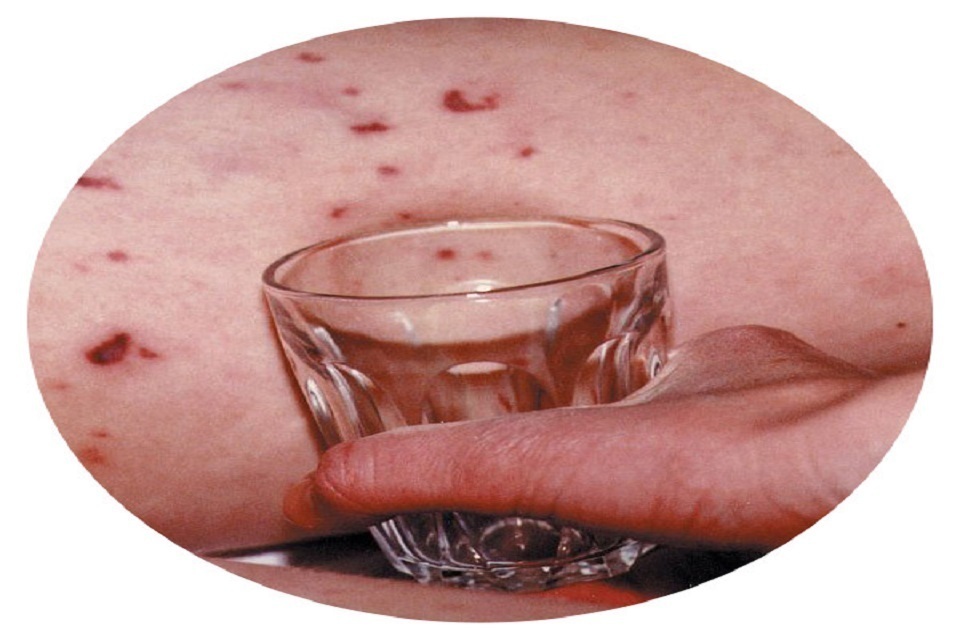
Image shows a hand pressing a clear glass on a rash on a leg which does not blanche.
The rash usually starts as small pinpricks but spreads rapidly to form deep purple blotches. Not all children get this rash so you should not wait for this before seeking help.
How are the meningococcal bacteria spread?
The bacteria live in the throats of about 10% of healthy people without causing any problems at all . In fact, they help build up immunity. The bacteria can spread to other people through close prolonged contact, for example within families, probably by coughing, sneezing or kissing.
How do the meningococcal bacteria cause serious illness?
Sometimes the bacteria in the throat get into the bloodstream and cause septicaemia (blood poisoning). They can also get to the brain and cause swelling which leads to meningitis. The bacteria can cause septicaemia only, meningitis only, or both at the same time.
How many different kinds of meningococcal bacteria are there?
There are many different kinds of meningococcal bacteria, but MenB is responsible for most cases of meningococcal disease in young children and teenagers. MenC disease is now rare as a result of highly successful vaccination programmes and an ongoing teenage MenACWY vaccination programme.
How common is MenB disease?
MenB causes around 300 to 400 cases of meningococcal disease each year in England. About 1 in every 5 cases is in a child aged under 5 years. MenB disease is the most common cause of bacterial meningitis in children and is extremely serious. If it is not treated quickly, it can cause permanent disability and death. The meningococcal bacteria can also cause local outbreaks in nurseries, schools and universities.
Who is most at risk of getting meningococcal disease?
Meningococcal disease occurs most commonly in infants and young children. This is because their immune systems aren’t yet fully developed to fight off serious infections.
Meningococcal disease can occur at any age but, the vaccine is given at 8 and 12 weeks of age to provide early protection against MenB disease in infancy. The next most vulnerable group is teenagers and young adults because of increased social mixing at these ages leading to increased spreading of the bacteria. But meningitis and septicaemia can strike at any age, so it’s important to know the signs and symptoms listed above and to get vaccinated on time wherever possible.
Can meningococcal disease be treated?
Meningitis and septicaemia caused by meningococcal bacteria or any other bacteria need urgent admission to hospital and rapid treatment with antibiotics. If treatment is started quickly, then it is much less likely to be life-threatening or cause permanent disability.
Why is my baby being offered a MenB vaccine?
Since 2015 babies have been offered a vaccine that helps protect them against MenB disease, which is a major cause of meningitis and septicaemia in infants and young children. The Men B vaccine should be given with the other routine vaccinations at:
- 8 weeks
- 12 weeks
- 1 year
Vaccinating babies at these times helps protect them when they are most at risk of developing MenB disease. The MenB vaccine will not protect against other bacteria and viruses that can cause meningitis and septicaemia. So if you are at all concerned about your baby at any time, then trust your instincts and speak to your GP or call NHS 111.
Is this this vaccine safe?
The MenB vaccine has been thoroughly tested and meets strict safety criteria. It has been given to babies in the UK as part of the routine immunisation programme since 2015 and there have been no concerns about the safety of the vaccine.
This means my baby will need to have three vaccines in each session. Is that OK?
Yes it is. From birth, babies’ immune systems are exposed to the tens of thousands of bacteria and viruses that cover their skin, nose, throat and intestines. This helps to build up their immunity which carries on throughout life. Studies have shown that the MenB vaccine (Bexsero) can be given at the same time as the other routine vaccines used in the UK. So, although this may mean that your baby will require 3 vaccines at the same appointment, your baby will be getting protection from all these serious infections as early as possible.
Does the MenB vaccine have any side effects?
Some babies may:
- have a temperature (fever)
- have redness, swelling or tenderness where they had the injection
- be a bit irritable and lose their appetite
These normally clear up within one or 2 days following vaccination.
Why do I need to give my baby paracetamol after the 8 and 12 week vaccinations?
Fever can occur after any vaccination, but it is more common when the MenB vaccine (Bexsero) is given to babies with the other routine vaccines at 8 and 12 weeks of age. In studies when the vaccines were given to infants without paracetamol, more than half of them developed a fever. The fever peaks around 6 hours after vaccination but is nearly always gone within 2 days.
The fever shows the baby’s body is responding to the vaccine, although the level of fever will depend on the individual child and does not indicate how well the vaccine will protect your baby. Giving paracetamol reduces the chances of getting fever to fewer than one in five babies, and nearly all these fevers are mild (below 39°C). Paracetamol also reduces the risk of irritability and discomfort (such as pain at the injection site) after vaccination.
How much paracetamol should I give my baby?
After the 8 and 12 week vaccination appointments, you will need to give your baby a total of 3 doses of paracetamol to prevent and treat any potential fever. You should give the first dose at the time of vaccination or as soon as possible after the vaccination visit, ideally within an hour. Don’t give the first dose before your vaccine visit because your nurse will first need to check that your child doesn’t have signs of an existing infection, which can sometimes be a reason to delay your baby’s vaccinations. You should then give the second and third doses of paracetamol at 4 to 6 hourly intervals (see table below).
If you do not have any oral paracetamol suspension for infants at home you should get some from your local pharmacy or supermarket in preparation for your 8 week vaccination appointment. You will need to follow the same process when your baby has their routine vaccinations at 12 weeks of age.
Table. Dosage and timing of infant paracetamol suspension
(120mg/5ml) for use after vaccination at 8 weeks/12 weeks
| Age of baby | 8 weeks or 12 weeks |
|---|---|
| Dose 1 | One 2.5ml dose as soon as possible after vaccination |
| Dose 2 | One 2.5ml dose 4-6 hours after first dose |
| Dose 3 | One 2.5ml dose 4-6 hours after second dose |
Is it OK for small babies to have paracetamol?
Paracetamol is approved for managing fever in children from the age of 2 months. Large clinical studies involving hundreds of infants have shown that giving 3 doses of paracetamol to 2 month old infants from the time of their routine vaccinations was safe and significantly reduced the risk of fever after vaccination.
Although paracetamol can be safely used in children from 2 months of age, the patient information leaflet that comes with the pack may say that no more than two doses should be given to children aged 2 to 3 months without talking to a doctor or pharmacist.
This is recommended because fevers in young children can be caused by an infection, and giving too many doses of paracetamol for unexplained fever could cause a delay seeking medical help for diagnosis and treatment of a serious infection.
However, experts have advised that, after the vaccines given at 8 and 12 weeks of age it is safe to give paracetamol for up to 48 hours (leaving at least 4 hours between doses and without giving more than 4 doses each day). This is because it is much more likely that any mild fever within this time was caused by the vaccine, rather than by an infection, and the paracetamol will make your child feel better.
It is important to remember however that when a 2 to 3 month old child develops a fever but has not just received a vaccine, parents should not give more than 2 doses of paracetamol without talking to a doctor or pharmacist.
What if my baby still has a fever after having had the 3 doses of paracetamol?
Some babies may still develop fever after vaccination, even after taking paracetamol. If your baby still has a fever after the first 3 doses of paracetamol but is otherwise well, you can continue giving your baby paracetamol for up to 2 days after vaccination. You should always leave at least 4 hours between doses and never give more than 4 doses in a day. You should also keep your child cool by making sure they don’t have too many layers of clothes or blankets on, and giving them plenty of fluids. If you are concerned about your baby at any time then trust your instincts and speak to your GP or call 111.
Paracetamol is recommended for the prevention and treatment of fever after immunisation as there is evidence that it is safe and effective. If 48 hours after vaccination your baby still has a fever you should speak to your GP or call NHS 111 for advice.
Does my baby need paracetamol with the third set of vaccinations at 16 weeks?
Your baby does not need the 3 doses of paracetamol with the third set of immunisations at 16 weeks because MenB vaccine is not given at this appointment. The risk of fever is lower when the routine infant vaccinations are given without the MenB vaccine. However, if your baby does get fever at home or appears to be in discomfort, you can give your baby paracetamol at that time. If your baby is unwell at any time, with or without a fever, then trust your instincts and speak to your GP or call the NHS on 111.
Does my baby need paracetamol with the booster vaccinations at one year of age?
At one year, the risk of fever after routine vaccinations with or without the MenB vaccine is similar. So, your baby does not need 3 doses of paracetamol with their routine one-year vaccinations. However, if your baby does get fever at home or appears to be in discomfort, you can give your baby paracetamol at that time.
Are there any babies who should not have the vaccination?
The vaccine should not be given to babies who have had:
- a severe allergic (anaphylactic) reaction to a previous dose of the vaccine
- a severe allergic (anaphylactic) reaction to any of the ingredients of the vaccine
An anaphylactic reaction is an immediate and severe allergic reaction that needs urgent medical attention.
What if my baby is ill on the day of the appointment?
If your baby has a minor illness without a fever, such as a cold, the vaccinations can be given as normal. If your baby is ill with a fever, you can put off the immunisation until your baby has recovered. This is to prevent your baby feeling worse than he or she already feels and gives them a chance to recover from their illness.
If your baby has a bleeding disorder (for example, haemophilia, where the blood doesn’t clot properly), or you are concerned, speak to your doctor, practice nurse or health visitor before your child has any vaccination.
What if babies miss their MenB vaccinations when they were due?
It is important that babies get their MenB vaccines on time, or soon after, wherever possible to benefit the most. Children can only catch up missed MenB vaccines before their second birthday.
Where can I get more information?
The following charities provide information, advice and support:
Meningitis Research Foundation
Free helpline 080 8800 3344
Meningitis Research Foundation
Meningitis Now
Freephone Meningitis Helpline 0808 80 10 388
9am to 4pm Monday to Thursday and 9am to 1pm Friday
Meningitis Now
Or go to:
Vaccinations – NHS