Local news provision and local public service performance
Updated 7 April 2026

© Crown copyright 2026
This publication is licensed under the terms of the Open Government Licence v3.0 except where otherwise stated. To view this licence, visit nationalarchives.gov.uk/doc/open-government-licence/version/3 or write to the Information Policy Team, The National Archives, Kew, London TW9 4DU, or email: psi@nationalarchives.gov.uk.
Where we have identified any third party copyright information you will need to obtain permission from the copyright holders concerned.
This publication is available at https://www.gov.uk/government/publications/local-news-provision-and-local-public-service-performance/local-news-provision-and-local-public-service-performance
Executive summary
Local journalism is under significant pressure. In recent years, print circulation has declined sharply, accompanied by a substantial drop in advertising revenue for print newspapers. Although digital media has expanded and shown promising signs of innovation, many local news brands struggle to secure stable and sustainable funding through online revenue, whether from advertising or subscriptions.
Despite these challenges, local journalism remains vital to local democracy. It provides essential information that national news outlets and other sources cannot. The concern is that as local news coverage diminishes, so too does its influence on democracy—potentially weakening the effectiveness of public services and reducing community engagement in decision-making.
Despite broad recognition of its importance, little research has explored the direct impact of local journalism on local democracy and governance in the UK. However, some exceptions exist. A recent quantitative study, Research into recent press sector dynamics, commissioned by DCMS found a strong link between access to local news and democratic participation, showing that an increase in local news provision correlates with higher voter turnout in local elections.
This research seeks to address part of this evidence gap by exploring the role of local news in supporting local government administrations. In particular, it examines how local journalism promotes transparency and accountability, ultimately contributing to more effective local governance. To explore this question, the study adopts both qualitative and quantitative approaches.
The qualitative analysis draws on insights from more than 30 local journalists, editors, and local authority officials, gathered through semi-structured interviews exploring their perspectives on the relationship between local journalism and local authority performance and governance. This analysis revealed several notable insights.
Qualitative evidence was found that supports the hypothesis that local news provision is conducive to more effective local governance. Three sub-hypotheses for how local news can strengthen public service delivery were raised during the research, and these are outlined below.
Local news can strengthen public service delivery by highlighting new challenges to local authorities of which they were not previously aware.
Local journalists and authorities identified many specific examples (such as informing on potholes or fly-tipping) and a smaller number of highly significant or strategic examples (such as raising awareness of specific local drivers of homelessness). A slight majority of local authority interviewees stated that local newspapers can make them aware of new issues, with one highlighting a local newspaper informing the council of misinformation that would have otherwise caused a riot. A minority of local authority officials stated that local news does not increase the authorities’ awareness of key issues, but some of these recognised that local news coverage can provide an early indication of public mood, which can strengthen policy implementation and the relationship between councils and residents.
Local news can hold local authorities accountable for decisions and increase transparency.
A large majority of journalists and around half of the officials interviewed stated that local news provision increases the transparency and accountability of local government, with many journalists arguing that news coverage and scrutiny “trains” local authorities to be more proactively transparent. A slight majority of local authority interviewees stated that local newspapers holding councils accountable can increase transparency and policy development and implementation, while a minority of others argued that local news provision does not necessarily make councils more transparent as transparency is intrinsic to the local authority.
Local news can produce in-depth scrutiny of public service delivery.
The majority of journalists interviewed stated that their title or organisation conducts scrutiny of local government and provided examples of investigations or in-depth reporting. Yet, a slight majority of local authority officials said that they are not often subject to in-depth reporting or scrutiny of their work. Some journalists echoed this view, stating that the local newspaper market is currently under severe financial pressure which limits the resources available for detailed scrutiny. This could help explain the decline in the intensity of scrutiny, a view shared by many local authority officials and some journalists. However, a significant number of interviewees stated that the BBC’s Local Democracy Reporting Service is crucial for scrutinising local democracy, and some proposed that it should be expanded to cover councils in greater depth and perhaps additional public services. The Local Democracy Reporting Service was also widely praised for ensuring that local council meetings and decisions are reported, particularly in areas where traditional local journalism has declined.
Interviewees expressed universal concern that should the financial precarity of local newspapers continue to worsen in the coming years, the risk of news deserts – local authority areas without a dedicated local news outlet – would increase. There was universal agreement among all local authorities and journalists interviewed that ‘news deserts’ are a growing risk, and their proliferation would have detrimental effects on communities, local businesses, democratic participation, and the effectiveness with which public money is spent.
Additionally, there was a strong view that local journalism cannot be replaced by non-journalistic online media, and that more local journalism is necessary to address misinformation and the community tensions fuelled by the rise of social media. This was supported by a substantial number of journalists and some local authority officials stating that local journalism can foster more engaged and cohesive communities, including by reducing local tensions through the provision of platforms for constructive political debate.
In addition to financial challenges outlined above, journalists highlighted the significant barriers that prevent effective local news reporting of local authorities and public service delivery more broadly. Chief among these was the lack of resources within the industry, with obstructive behaviour of press officers a secondary concern, and inefficient use of resources within the industry highlighted as a third key barrier.
The quantitative analysis uses historical data and statistical techniques to assess how changes in local authority performance indices are influenced by variations in local news provision. The underlying hypothesis is that local authorities with higher levels of local news provision or a stronger local news presence also demonstrate more effective governance. However, the quantitative analysis did not find evidence to support this hypothesis.
The discrepancy between the qualitative and quantitative analyses may stem from data limitations, particularly the inability to adequately measure local governance performance and local news provision. Local governance performance is unobserved and approximated through local authority indicators, which may serve as a weak proxy for actual performance. Local news provision was approximated using the number of outlets and print circulation volume, which could be an imperfect proxy for the influence of local news outlets. As interview findings suggest, local newspaper circulation or the number of local newspapers are not necessarily the best indicators of any local media influence over how local authorities make decisions. One local authority official noted that a long-established corporate title has “a massive, outsized influence on our behaviour than the actual size of their readership.”
1. Introduction
1.1 Challenges impacting the local news sector
As more people rely on online and social media for their news, print circulation has experienced a sharp decline, posing significant challenges for news publishers. The Cairncross Review highlights that these challenges are particularly pronounced at the local level. Between 2005 and 2022, at least 271 local print newspaper titles have been lost, resulting in news deserts in 38 Local Authorities (LAs) across the UK according to the Public Interest News Foundation’s Local News Map.
The shift to digital has forced news publishers, both national and local, to adopt new business models, often relying on online advertising, digital subscriptions, or a combination of both. Between September 2020 and July 2022, 41 new local digital news outlets were launched, with only three closing. However, many local publishers struggle to sustain themselves due to smaller audiences, limited reach compared to national outlets, and restricted resources. This challenge is highlighted by recent [advertising data revealing a 10% drop in ad revenues] for regional news brands in 2023, with online revenue accounting for 8% of the decline.
Furthermore, the long-term financial outlook for online news brands appears uncertain. This is based on a number of trends noted in the Reuters Institute Digital News Report 2024, including: (i) a continued shift toward visual and video-led social media platforms such as TikTok, Instagram, and YouTube, especially among younger audiences; and (ii) a loss of interest in news, with recent data showing that only 38% of the UK population is extremely or very interested in news, down from 70% in 2015. [footnote 1]
1.2 Local journalism, scrutiny and democracy: International evidence
International studies highlight that local journalism plays a crucial role in supporting democracy. [footnote 2] Gentzkow et al., (2011), in a widely cited U.S. study, found that newspapers positively influence political participation, with each additional newspaper boosting electoral turnout by about 0.3 percentage points. Shaker (2014) examined the impact of two major local newspaper closures in Denver and Seattle, finding that civic engagement in these cities dropped significantly after the closures. [footnote 3]
In a seminal study, Ferraz and Finan (2011) showed that local politicians in Brazil who were revealed as corrupt were less likely to be re-elected, an effect particularly pronounced in areas with more radio coverage. Gao et al. (2018) examined the impact of local newspaper closures on public finance outcomes for local governments in the US. They found that, following a newspaper closure, municipal bond offering yields increased significantly, resulting in an additional cost of $650,000 per bond issue for the municipality. The authors suggest that the rise in borrowing costs is linked to increased government inefficiencies resulting from the loss of a watchdog role after a newspaper closure. This finding is consistent with the premise that media monitoring improves local government performance.
In a recent study, Matherly and Greenwood (2024) explored the impact of major daily newspaper closures across the US on federal corruption rates. They found a significant positive correlation between newspaper closures and federal corruption charges. Notably, the study provided no evidence that the rise of online news vendors counteracts the effects of these closures.
Heese et al., (2022) found that the closure of a local newspaper in the US is associated with a 1.1% and 15.2% increase in local corporate violations and penalties, respectively, suggesting that local journalism does not only constrain political corruption and inefficiencies, but also tackles private company misconduct.
Another interesting US study, Do newspapers reduce toxic emissions?, analysed plant-level toxic emissions data from 1996 to 2009, along with information on the location of newspapers. The study found that the likelihood of a plant’s emissions being reported increases as the plant gets closer to the newspaper’s headquarters. Most importantly, the study demonstrated that when newspapers report on the emissions of consumer goods manufacturers, these companies reduce their emissions by 29%.
1.3 Motivation for this research
There is broad consensus that democracies function best when the public has sufficient access to information, enabling informed civic choices. Local media play an essential role in this by providing vital information that cannot be supplied by national news providers or other sources. Furthermore, local news outlets can act as watchdogs, holding LAs accountable for their public service delivery. Thus, the reduction or loss of local news coverage could, in principle, undermine the effectiveness and quality of local governance, directly impacting communities.
The importance of local news provision has been recognised by the Cairncross Review which calls for an expansion of local news financial support including refinement and extension of the Local Democracy Reporting Service (LDRS). The LDRS involves up to 165 journalists, funded by the BBC and employed by local news organisations, aimed at enhancing coverage of LA decision-making and, ultimately, improving local democracy. [footnote 4]
Although the importance of local news is widely acknowledged and the decline in its provision well-documented, there is limited evidence on how this decline affects local democracy in the UK. A few studies offer exceptions, however. For instance, a recent quantitative study, Research into recent press sector dynamics, identified a significant positive relationship between the availability and consumption of local news and local democratic participation, showing that the reduction in local news provision is associated with reduced participation in local elections. Furthermore, a qualitative study, Examining the democratic deficit in a town with no newspaper, in Port Talbot, Wales, found that the closure of local news outlets has resulted in a lack of coverage on key issues, such as the demolition of one of the town’s oldest buildings to make way for a block of flats and the closure of police stations. This information gap has not been adequately addressed by alternative sources, like social media.
This research aims to address part of the evidence gap by providing insights into the potential importance of local news provision for local government administration, with a particular focus on how local news supports LAs and promotes transparency and accountability, ultimately contributing to more effective governance. This research is especially important in light of the decline in local news provision, which has left many LAs without a dedicated local news source, and the risk that increased digitisation could lead to the emergence of more local news deserts. [footnote 5]
The study focuses primarily on local print and online news outlets, given their role as the primary providers of local news and journalism within communities in comparison with local TV and radio. According to the Cairncross Review, although news can be found on television and radio, written journalism supplies the largest quantity of original journalism and is most at risk. Also, local TV and radio tend to offer a broader range of content beyond local journalism. Notwithstanding this, recognising the importance of the wider local media environment, the analysis also considers the impact of local TV and radio.
The remainder of the report is organised as follows: Section 2 outlines the methodology; Section 3 presents the qualitative insights; Section 4 discusses the quantitative findings; and the Appendix includes methodological details, data and additional insights.
2. Methodology
This study aims to explore how local news provision affects local government performance, using a mixed-methods approach that combines qualitative and quantitative analyses. The qualitative analysis includes interviews with journalists, editors, and local government officials to gather insights and narratives on how local journalism supports governance and accountability, potentially leading to more effective local governance. The quantitative analysis employs statistical methods, primarily regression techniques, to estimate the impact of local news outlet presence on LA performance.
2.1 Theoretical framework
There are three main mechanisms through which local news provision could affect LA performance.
Accountability mechanism
Local news coverage can hold LAs accountable by informing residents of decisions, outcomes, and issues within their area. A lack of scrutiny may reduce incentives for optimal performance.
Civic engagement mechanism
An informed public, driven by local news, is more likely to participate in civic activities, such as attending council meetings or voting, which could pressure LAs to improve their performance.
Reputation mechanism
LAs are sensitive to their public image; consistent media coverage can act as a motivator to improve performance indicators.
The effectiveness of news coverage hinges on both the type and quality of reporting. Investigative journalism, which delves deeply into specific issues and exposes inefficiencies or mismanagement, is seen as particularly impactful, as noted in the Cairncross Review. However, even without active scrutiny, the mere presence of local news can act as a scarecrow, where the potential for media oversight may deter poor performance.
2.2 Qualitative analysis
We conducted 30 in-depth, semi-structured interviews with journalists, editors, and LA officials. To recruit participants for the interviews, we used multiple channels. We issued a call for participation, which was distributed by DCMS, MHCLG, and PINF, the latter having recently engaged in work related to LAs. We then contacted individual journalists and LA officials to ensure our sample was representative.
In particular, we created four clusters of LAs based on demographic, social, and economic characteristics. [footnote 6] Within these, we cross-referenced the LAs with the list of media deserts, drylands, and oases identified by PINF. To achieve a more balanced and representative group of stakeholders, we directly reached out to LAs and media organisations in areas under-represented in our call for participation.
Local authorities and local journalists were asked questions on a series of areas, including the role of local newspapers in: (1) promoting community engagement with local matters; (2) raising awareness of local matters within local government; (3) fostering transparency and accountability in local administration; (4) scrutinising LA actions and performance; and (5) serving the wider community, particularly in areas with limited local reporting (news deserts). The scope of the interviews with local news outlets is similar, focusing on their perspectives regarding the role of local journalism in local governance and community engagement. Additionally, we explored potential barriers to effective reporting within local journalism. The full fieldwork materials for engaging with these two groups of stakeholders are provided in the Appendix.
2.3 Quantitative analysis
2.3.1. Model and data
Our quantitative approach relies primarily on a cross-sectional [footnote 7] regression model designed to estimate the impact of local news presence on an index of LA performance, as depicted in the figure below. A key element of the model is the inclusion of control variables—exogenous factors that may influence LA performance, such as LA size and population composition—which must be accounted for to identify the causal impact of local news provision. [footnote 8] We also carry out sensitivity analysis to assess the robustness of the results. Furthermore, regression models utilising time-series [footnote 9] data were also estimated—these are further discussed at the end of this section.
Figure 1. Regression model
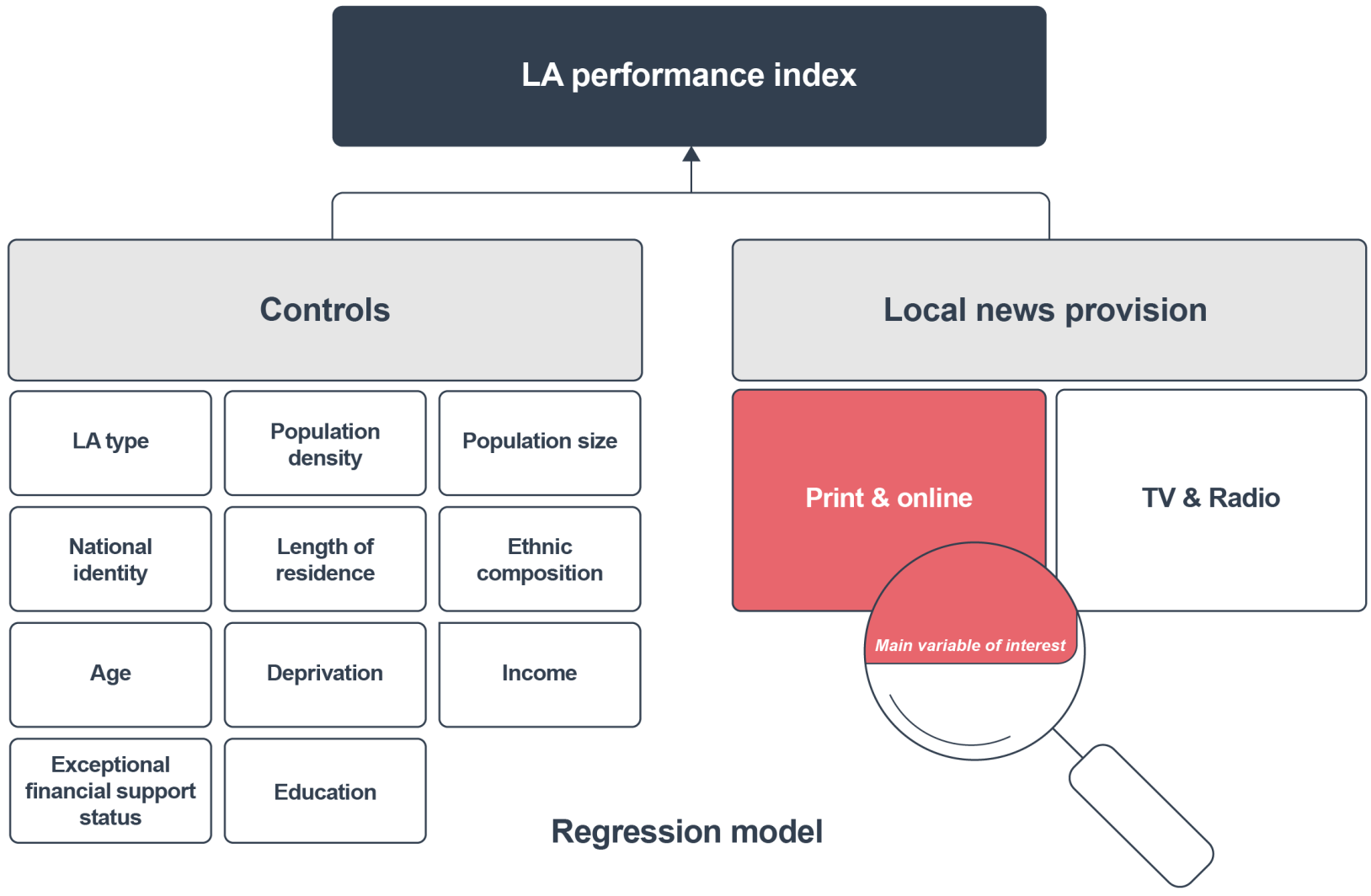
The model is estimated using data from up to 289 English LAs. [footnote 10] The sample varies for different LA performance indices due to varying levels of data availability—not all indices are available for all LAs.
Local news provision
Local news provision is approximated by the number of local news outlets, provided by the Public Interest News Foundation (PINF). Since 2023, PINF has tracked local news outlets across the UK, mapping them to LAs, thereby offering a valuable resource for understanding local news provision at a detailed geographical level. PINF categorises media outlets by type as follows: (i) print, (ii) online, (iii) print and online, (iv) radio, and (v) TV. Our analysis focuses on print and online outlets (grouping categories (i) - (iii)), while also controlling for the presence of local TV and radio news outlets. Additionally, PINF classifies media outlets by ownership, distinguishing between independent and corporate. An independent outlet is typically a small organisation, operates as a limited company, and is not part of a larger corporate group. PINF also classifies some LAs as “news deserts”, “oases” and “drylands”, indicating a very low, high, or relatively limited presence of local news outlets, respectively.
The variable of interest is the number of print and online news outlets in the LA, with various transformations of this measure used to test for non-linear effects. For instance, we applied a binary transformation to examine how LA performance differs between news deserts and other LAs with at least some local news presence. We also investigated whether the impact is driven by the presence of independent local news outlets.
LA performance index
LA performance is primarily measured using metrics provided by the Office for Local Government (Oflog) through their Local Authority Data Explorer. [footnote 11] The Oflog Data Explorer was developed to offer comparative metrics that enable performance comparison between LAs across a range of services, including adult social care, planning and housing services, waste management, and corporate services. Additional data were sourced from other providers, including complaint data from the Local Government & Social Care Ombudsman and road condition data from the Department for Transport. In total, we have used 35 metrics that capture various aspects of LA performance. [footnote 12]
It is recognised that analysing LA performance is quite challenging, as LA performance depends on various factors, such as the size and demographic composition of the LA. In other words, numerous factors outside the LA’s control can influence its performance score captured by quantitative data. To try to mitigate this, we have:
- Selected metrics that we expect LAs to have some control over—details on the data and justification for metric selection are provided in the Appendix;
- Included control variables in the model to account for differences in LA size and demographic composition that are likely to influence how an LA scores on a particular performance index; and
- Combined multiple metrics into composite indices. A composite index aims to approximate average LA performance across multiple areas, recognising that an LA may excel in one area while underperforming in another. [footnote 13] Our approach to constructing the composite index is discussed below and in the Appendix.
Furthermore, there are delays in data reporting, along with gaps, as several LAs fail to report data on all indicators or for all time periods.
Controls
We have considered several variables to control for differences in the size of the LA (population), LA type (London borough, Combined Authority), population density, socio-demographic composition of the LA (e.g., income, deprivation, proportion of persons over 65, ethnicity, education level) and LA financial health (Exceptional Financial Support Status [footnote 14]). All the control variables, along with their definitions and sources, are provided in the Appendix.
2.3.2 Composite indices of LA performance
Our analysis has focused on ten composite indices. The first seven are service-specific (e.g., adult social care), while the last two are aggregate indices that capture performance across multiple services. There is one Other index made of three measures that could not be grouped into any of the service-specific indices. These ten composite indices, along with their components, are shown below.
Our primary approach to constructing the total index involves combining all the indicators through a simple, unweighted average across the 35 measures. We explore alternative approaches in our sensitivity analysis.
Table 1. LA Performance composite indicators [footnote 15]
Composite index (number of measures; LA sample size):
- Adult Social Care
- 8 measures
- 123 LAs
Composite index components and measures:
1. Workforce turnover rate
2. People in adult social care quality of life
3. People who use services who found it easy to find information
4. Requests resulting in a service
5. Short-term service provision
6. Carers of people in adult social care quality of life
7. Carers who found it easy to find information about services
Composite index (number of measures; LA sample size):
- Corporate and Finance
- 5 measures
- 279 LAs
Composite index components and measures:
1. Council tax collection rates
2. Non-domestic rates collection rates
3. Non ring-fenced reserves as percentage of service spend
4. Total debt as percentage of core spending power
5. Benefits and Tax Complaints
Composite index (number of measures; LA sample size):
- Planning
- 5 measures
- 289 LAs
Composite index components and measures:
1. Percentage of major planning applications decided on time
2. Percentage of non-major planning applications decided on time
3. Percentage of major planning applications overturned on appeal
4. Percentage of non-major planning applications overturned on appeal
5. Planning and Development Complaints
Composite index (number of measures; LA sample size):
- Roads and Public Transport
- 3 measures
- 68 LAs
Composite index components and measures:
1. Percentage of LA B and C roads determined as Red category
2. Percentage of LA motorways and A roads determined as Red category
3. Highways and Transport Complaints
Composite index (number of measures; LA sample size):
- Environmental services and Waste management (including fly-tipping)
- 4 measures
- 288 LAs
Composite index components and measures:
1. Household waste recycling rate
2. Recycling contamination rate
3. Fly-tipping actions per incident
4. Environmental services, public protection and regulation complaints received
Composite index (number of measures; LA sample size):
- Children social care and SEND (Special Educational Needs and Disability)
- 5 measures
- 121 LAs
Composite index components and measures:
1. Turnover in the children’s social care workforce
2. Percentage of children with 3 or more placements
3. SEND tribunal appeal rate
4. Number of complaints for education and children social care
Composite index (number of measures; LA sample size):
- Homelessness
- 2 measures
- 296 LAs
Composite index components and measures:
1. Number of households with children in temporary accommodation
2. Number of people sleeping rough over the course of the month
Composite index (number of measures; LA sample size):
- Other measures
- 3 measures
- 293 LAs
Composite index components and measures:
1. Total Complaints received
2. Cases where LA successfully implemented recommendations to remedy the complaint (compliance rate) (%)
3. Publishing of LGA Corporate Peer Challenge progress reports over the past 5 years
Composite index (number of measures; LA sample size):
- Total Index 1
- 35 measures
- 62 LAs
Composite index components and measures:
All measures across the eight service areas above
Composite index (number of measures; LA sample size):
- Total Index 2
- 35 measures
- 110 LAs
Composite index components and measures:
All measures across the eight service areas above except Roads and Public Transport (due to sample size considerations)
2.3.3 Regression analysis using time-series data
In addition to the cross-sectional data mentioned above, we also estimated models using time-series data.
The Audit Bureau of Circulations (ABC) collects press circulation data for various local news titles over an extended period. These data were used to estimate regression models that examine the relationship between changes in the LA performance index and corresponding changes in circulation volume. [footnote 16]
This approach has three advantages. First, it eliminates the need to control for differences in the LA characteristics, as these typically remain constant over time and do not influence changes in the LA performance. Second, it accounts for time lags in the relationship between the variables of interest. If local news coverage affects LA performance, there is likely to be a delay between a newspaper closure or a decline in coverage and any resulting impact on LA performance. These dynamic effects are captured, at least partly, within the model that utilises time-series data. Third, it captures the “intensity” of local news presence using circulation statistics, which, in principle, provides a more accurate measure of local news provision than the number of outlets used in the cross-sectional analysis.
Two types of performance indicator variables were used in this analysis: one based on the mean growth rates of individual performance indicators and another based on their median growth rate. [footnote 17] Due to data availability, the mean and median growth rates were calculated using a specific set of performance indicators, as outlined below. Additionally, some indicators were only available for the period from 2017 to 2022. As a result, two sets of models were estimated for each measure (mean and median): one using data from 2017 to 2022 and another using data from 2017 to 2023. All models were estimated using the delta in growth rates from 2017 to 2022 or 2017 to 2023, reducing the potential influence of COVID-19 on the LA indicators, which was primarily expected in 2020 and 2021.
Table 2. Performance indicators available in the time-series analysis
| Number | LA performance indicators | Time period | Policy area |
|---|---|---|---|
| 1 | Total complaints | 2017-2023 | All |
| 2 | People in adult social care quality of life | 2017-2022 | Adult social care |
| 3 | Council tax collection rates | 2017-2023 | Corporate Finance |
| 4 | Nondomestic rates collection rate | 2017-2023 | Corporate Finance |
| 5 | Non-ringfenced reserves as percentage of service spend | 2017-2022 | Corporate Finance |
| 6 | Total debt as percentage of core spending power | 2017-2022 | Corporate Finance |
| 7 | Household waste recycling rate | 2017-2022 | Environment and Waste management |
| 8 | Recycling contamination rate | 2017-2022 | Environment and Waste management |
| 9 | Percentage of major planning applications decided on time | 2017-2023 | Planning |
| 10 | Percentage of non-major planning applications decided on time | 2017-2023 | Planning |
| 11 | Percentage of non-major planning applications overturned on appeal | 2017-2022 | Planning |
3. Qualitative insights
3.1 Interviewee composition
30 interviews were conducted with local journalists and LA officers from December 2024 to February 2025. The majority of these interviews were conducted one-on-one, although some included groups of interviewees. An outline of the interview and interviewee details can be seen in the table below.
Table 3. Number of interviews and interviewees
| Category | Sub-category | Number of interviews | Number of interviewees |
|---|---|---|---|
| Officials | Local or regional authority officials | 10 | 15 |
| Journalists | Journalists – independent titles | 13 | 14 |
| Journalists | Journalists – corporate titles | 7 | 9 |
| Total | 30 | 38 |
Of the ten interviews with local or regional authority officials, one was conducted with a combined authority and the remaining nine were conducted with LAs. These interviews spanned the diversity of LAs in the UK, including unitary, county, metropolitan, London borough, and district councils. [footnote 18] Officials from LAs from England, Scotland, and Wales – including authorities from the south, north, and midlands of England – took part in interviews. Every interview with officials included at least one representative of an authority’s press office, with a Head of Communications or Head of Media (and equivalent roles) present in all interviews.
Of the 20 interviews with journalists, 13 were conducted with journalists working for independent titles and 7 with journalists employed by corporate titles. Journalists working for English, Scottish, and Welsh titles were interviewed as part of this project. Extensive use of quotations has been used in the report to allow interviewees to describe the impacts of local news in their own words; these have been edited for clarity and to preserve anonymity where necessary.
3.2 Qualitative findings
3.2.1 Summary
Interviewees were asked to discuss the impact of local news on communities and LAs, with a focus on making LAs aware of new issues, holding LAs accountable for decisions, and in-depth scrutiny of LAs. They were also asked to discuss the role of the BBC’s LDRS and identify barriers to continued local journalism.
The insights are organised into eight key topic areas, summarised in this section, with more detailed insights provided in the following section. [footnote 19] The first three topic areas focus on the role of local news in LA administration, while topics four and five address the risks posed by news deserts and the benefits of LDRS, respectively. Topics six and seven explore the impact of local news on communities and civic engagement, and the final topic area related to the barriers faced by local journalism.
1. Impact of local news provision upon LA awareness of key issues: An overwhelming majority of journalists and a slight majority of local officials interviewed stated that local newspapers inform LAs of challenges of which they otherwise would not be aware. Local authority officials tended to highlight examples in housing quality, road maintenance, and waste management rather than more strategic issues – although a small number of local journalists highlighted more strategic examples such as a special report on local drivers of homelessness. A particularly strong example was identified by an LA official who credited their local newspaper Editor with making the authority aware of misinformation during the riots of July and August 2024 and leading to the prevention of a riot in their local area. However, a significant minority of LA officials stated that local news does not improve their awareness of key issues, but some of these argued that local newspapers can provide an early indication of public mood which can strengthen policy implementation and the relationship between councils and residents.
2. Impact of local news provision upon LA transparency and accountability: A large majority of journalists and around half of the officials interviewed stated that local news provision increases the transparency and accountability of local government, with many journalists arguing that news coverage and scrutiny “trains” LAs to be more proactively transparent. A slight majority of LA interviewees stated that local newspapers holding councils accountable can increase transparency and policy development and implementation (“Local media does keep people’s feet to the fire, it improves policy – 100% – it keeps people honest, it makes people have an eye on the residents and how it will affect them and how they’ll think about it.”). However, some LA officials proposed that local news provision does not necessarily make councils more transparent, partly because these are already core values of LAs.
3. Impact of local news scrutiny upon LA operations and the delivery of public services: The majority of journalists interviewed stated that their title or organisation conducts scrutiny of local government and provided examples of investigations or in-depth reporting while also noting that the level of scrutiny varies significantly between local newspapers and organisations. Some, however, argued that it can be even more important to hold LAs accountable through daily reporting rather than longer-form investigations. Yet, a slight majority of LA officials said that they are not often subject to in-depth reporting or scrutiny of their work (“I can’t remember the last time I’ve seen an FOI [Freedom of Information Request] from the local paper to be honest with you and that’s purely down to the fact that they just don’t have the time to invest and to do proper investigative journalism”). Some journalists echoed this view, stating that the local newspaper market is currently under severe financial pressure (“There are huge areas of the country that I think don’t have adequate scrutiny because of the broken market – this is about what happened when print advertising went online but it’s also about big tech.”). A majority of LA officials noted that the intensity of scrutiny has decreased significantly over time, a view that was also acknowledged by some journalists.
4. Risks and consequences of ‘news deserts’: The report underscores the risks of ‘news deserts’, areas with no local newspapers. It was universally stated by interviewees from both local newspapers and local authorities stated that ‘news deserts’ are a risk in the UK and – where they exist – result in negative outcomes for the public including misinformation, increased community tensions, reduced civic engagement, lower economic growth, and a lack of accountability and scrutiny of LAs. However, there was disagreement as to the extent to which ‘news deserts’ currently exist. There was also a strong view that local journalism cannot be replaced by non-journalistic social media and that more local journalism is needed to combat misinformation and the community tensions driven by the rise of social media.
5. The role of the Local Democracy Reporting Service (LDRS): The LDRS was widely welcomed by a large majority of LA officials and local news journalists, with a broad impression that the LDRS is effective and necessary. The LDRS was also widely praised for ensuring that local council meetings and decisions are reported, particularly in areas where traditional local journalism has declined. However, concerns were raised about the scheme’s limited resourcing, particularly in London boroughs. There were also calls for enhanced training for Local Democracy Reporters, closer oversight of their management by local newspapers from the BBC, and improved career progression opportunities.
6. Impact on communities: Local journalists often emphasised their impact in strengthening a sense of community among readers across class-based, geographic, and racial divisions. They emphasised how local newspapers can create forums for contentious debate to be held constructively and tackle misinformation, both of which were identified as resulting in reduced community tensions.
7. Promoting civic and local government engagement: A majority of LA officials identified the trust placed in local newspapers, to tell the truth and their reach as a key asset and stated that local newspapers are a key part of their communication strategies. Nonetheless, a minority stated that they believe the impact and reach of local newspapers in their communities has declined over recent years and that local newspapers now play only a secondary role in their communication strategies relative to alternatives such as social media.
8. Barriers to effective local journalism: These were raised only by local journalists who highlighted in approximate order the following barriers: a) the difficult financial position of many local newspapers, especially with a reliance on social media corporations and large search engines for revenue; b) difficult relationships with press officers and a general imbalance in the resources of public sector press officers and local journalism; c) poor use of resources within the industry, with editors of independent newspapers calling for more funding to be directed towards independent titles, for example, by awarding a greater proportion of LDRS or Public Notice contracts to independent titles; and d) difficulties accessing press passes for independent newspapers.
Other insights:
-
Some LA officials and newspaper editors suggested that the impact of local newspapers is somewhat independent of their circulation. These officials and journalists propose that LA councillors can be impacted far more by stories in local newspapers – especially those from titles long-standing – than their circulation figures would suggest (“our elected members will respond to what’s on the front page of the [daily local newspaper, corporate] - so they do have a massive, outsized influence on our behaviour than the actual size of their readership”). This is consistent with the scarecrow hypothesis, whereby the mere presence of local news can enhance the effectiveness of local governance.
-
Some LA officials often disagreed with the local news categorisation described within the PINF Local News Map. Some of these referred to newspapers that are active in the region but not included in the map, while others stated that the many local newspapers in their area are titles with little original journalism or circulation.
-
Others argued that scrutiny from organisations such as the BBC, ITV, and national newspapers should also be considered for the purpose of this research.
3.2.2 Detailed insights
Topic 1: Impact of local news provision upon LA awareness of key issues
One way that local news reporting may improve the delivery of public services is through journalists highlighting key issues to LAs that they otherwise would not be aware of. This would then allow the council to remedy the problem more quickly, thus improving services and quality of life for residents. The degree to which LA officials and journalists agreed or disagreed with the statement that local reporting can make authorities aware of challenges varied significantly. On the whole, LAs and journalists who stated they have a constructive and open relationship tended to be the ones stating that local newspapers make authorities aware of new issues. In cases where this does happen, however, most raised examples of specific challenges in the delivery of routine public services – such as a particularly dangerous pothole or significant case of fly-tipping – rather than broader or systemic challenges.
Views of interviewees stating that local news impacts a council’s awareness of issues
An overwhelming majority of journalists interviewed stated that they often inform councils of issues that they otherwise would not be aware of, with some stating that this happens on a daily or hourly basis. Meanwhile, a slight majority of LA officials stated that local newspapers do highlight new issues and challenges to the LA.
Among those stating that local newspapers often make councils aware of challenges, officials tended to highlight examples in housing quality, road maintenance, and waste management.
I think residents have got to grips now with contacting the [largest local title] or contacting local media as a mechanism to get a result that they’re after. We certainly see that in housing. So if somebody makes a complaint about our housing provision and don’t get the response that they want, rather than coming through our channels or raising a further complaint, they’ll just go straight to the [largest local title] and try and get it in the newspaper and put pressure on us through that as well.
– Local authority official, metropolitan or borough council, PINF Desert
We tend to periodically get lots of inquiries through about potholes, in particular, and then fly-tipping is another one where local residents will contact the local paper to highlight issues. That does prompt a response from the council because part of my job is to try and minimise the negative publicity towards the council. If there is fly-tipping, we get out there and clear it up as quickly as possible to minimise the risk of the paper running out and taking a picture of it.
– Local authority official, unitary authority, PINF Middling [footnote 20]
A particularly strong example from an LA referred to the riots that took place across the UK in July and August 2024, with the official arguing that the local newspaper highlighted misinformation to the authorities and helped prevent a riot. They described this as one of “multiple examples of them providing a really helpful early warning service.
The [local independent newspaper] contacted us to say that they’d had a couple of contacts from the public asking them to do a story about a ‘migrant camp’ being built in [town]. […] We were quickly able to contact our planning department and establish what was actively happening there. The planning department sent out an enforcement officer to find out what was happening. It was a development entirely unrelated to migrant accommodation. Around the same time, we were starting to see the first flurries of activity on social media [regarding the building site]. And, as our officer got there, there was already a gathering of 10-12 people outside with placards. […] As a result of that, we put a message out on all our channels to tell people that we had seen some misinformation about activities happening on this particular road and we set out very clearly what was happening there. We wouldn’t have done any of that if it hadn’t been for the Editor of the [local independent newspaper] sensing there was something brewing and wanting to come to us to inform us. And we received thanks from the local police because they’d had to send officers down there; they said our actions had been really helpful in preventing a riot.
– Local authority official, metropolitan or borough council, PINF Middling
Journalists responding to this question often raised similar themes – such as councils not being aware of the specific parking charges, waste collection challenges, licencing breaches, and so forth. These focused on a lack of council awareness of specific and localised issues rather than strategic, authority-wide issues.
We’re often the first to know about something because we’re all over social media and have people on the ground, so people contact us with their challenges. The council can seem a bit faceless, but you can drop us a message on any of our platforms and be sure it will be read. For example, a significant problem was that school buses were late. We did three pieces talking about children missing school and being left freezing while standing at the bus stop for buses that didn’t arrive. The council were not aware of it, but they sorted it out after our reporting.
– Editor, Corporate newspaper
The council increased their parking charges […] and the price of the season ticket went up by thousands of pounds overnight. They took the money from people’s bank accounts in the next payment without telling them in advance, which was obviously a mistake. I saw this in the council papers and mentioned it in my article that this particular [season] ticket will be going up by that much. When they were next putting up the parking charges again [in the following year], they mentioned in the council report that these changes were being rolled out carefully given the reaction and press coverage from when they were increased last time.
– Local Democracy Reporter, Corporate newspaper
There was one recently in [town] for example, where there were illegal vapes being sold. Our readers complained to our editor and said that nothing was being done about these illegal shops and illegal vapes. That led to closures by the authorities after our intervention. But there are loads of similar examples, including ones about planning and housing, recycling, tips, dangerous roundabouts, and so on.
– Senior official, Corporate news organisation
In addition to the specific and localised policy issues brought to the attention of LAs discussed above, some local news organisations highlighted more strategic aspects of policy areas that they had brought to the attention of LAs.
We did a big investigation into what was driving high homelessness numbers in [local area]. I think that some of the public officials we spoke to from the council were effectively not very aware of what the drivers were, and we were able to show through our investigation that there were some interesting drivers of local homelessness that had not been well-covered previously.
– Editor, Independent newspaper
We read a report in the Guardian about ‘left-behind areas’ in around 2018 and we picked up that some of those areas were in our county. We had a year-long focus on those super-output areas with issues like a lack of community infrastructure and high child poverty. We reported on issues and spoke to residents and did some FOIs. We brought those areas up to public consciousness, which did work because both councils which cover these areas have set-up specific projects about those areas. They’ve had more grant funding go into them. It was almost shaming the local authorities because they were areas that had been neglected for years. Local government doesn’t move very quickly, but at least our reporting brought a focus to the area.
– Editor, Independent newspaper
Views of interviewees stating that local news does not impact councils’ awareness of issues
Among LA officials who stated that local news does not significantly improve the council’s awareness of key issues, there were two streams of opinion. Among one group, authorities were not made aware of any key issues by local journalism.
I don’t think that we’ve been in a position where we’ve had to make any kind of U-turn on policy because of a story that’s been written by a local newspaper. We are massive beasts and so I think - and I’m saying this as an ex-journalist, by the way - I think it’s rather pompous to say: ‘we raised an issue that the Council was unaware of.’ […] We don’t make decisions [based] on how policy will be reported, we make decisions based on what’s best for residents and the reputation of the council. The way we communicate may be adapted by what we think the news agenda, but we don’t create policy to suit the agenda of a local newspaper that would be ridiculous.
– Local authority official, metropolitan or borough council, PINF Dryland
I’ve been here at [local authority name] for 7 years, I can’t recall any examples of this. No, I would not say that any papers in our area are issue-based campaigning publications at all. I don’t think they have the resources for it. I don’t think they know the area. They’ve got a lot of young journalists.
– Local authority official, unitary authority, PINF Oasis
We normally know about things first and we’re normally waiting to see whether [name of the area’s Local Democracy Reporter] spots it or not.
– Local authority official, metropolitan or borough council, PINF Desert
However, another group of interviewees stated that while local news did not bring new topics or challenges to the attention of authorities, it could provide an early indication of public mood regarding policy implementation. This creates opportunities for policies to be adapted in ways that improve the policy, but also improve the relationship between councils and residents.
I really don’t think so [that local newspapers have highlighted new topics or issues to the council]. But, what it will do is … it will give you a hint of the fights that you’re going to need to have, right? So, it will be a straw in the wind.
– Local authority official, unitary authority, PINF Oasis
What they do quite often is to make us aware. For example, we’ve got an issue with a boatyard in [area] at the moment. So, from an officer’s standpoint, that’s very much a licencing issue because the people repairing the boats don’t have permission to do that. The community group and the fishermen’s group are getting in touch with the local paper to say, well, ‘we’re not [allowed to be] repairing our boats, this is attacking our heritage’. So, then it becomes a heritage issue for the council [not just a licencing one]. It’s quite important for us to get a little bit of that feedback [from local media] because we’re not always made aware of what the noise is on the ground.
– Local authority official, metropolitan or borough council, PINF Desert
Topic 2: Impact of local news provision upon LA transparency and accountability
Interviewees were asked to discuss the link between the provision of local news and the corresponding degree of transparency and accountability displayed by LAs. A large majority of journalists and around half of the officials interviewed stated that local news provision increases the transparency and accountability of local government, with many arguing that news coverage and scrutiny “trains” LAs to be more proactively transparent.
In one obvious sense, local media makes authorities more transparent because it’s forcing councils and LAs to hand over information and put it into the public domain that they were not doing. If we do a Freedom of Information Request, we are getting information out into the public domain that wasn’t there. […] And the worst look for them is when they’re covering something up, so it does probably make them more transparent eventually.
– Editor, Independent newspaper
When you come across a council that hasn’t had a lot of scrutiny they are much, much less likely to give you what you want just because they’re not used to the questions. Whereas when you deal with a council that has a lot of scrutiny, […] where there are more reporters and more media interests because they’re dealing with bigger issues, you tend to be dealing with press offices that are much more accustomed to what information they should release, don’t have to release, have to tell you to FOI. Regular scrutiny does make a huge difference to transparency.
– Editor, Corporate newspaper
Furthermore, some LA officials and journalists argued that this increased transparency and accountability directly improves LA performance and the civility of local democracy.
If it wasn’t for the local democracy reporter being good, I think there would be a risk that some of the things which are rightly out in the public domain which, because we know that it will get out, we engage with it, we’re proactive, we will put our hands up if there is an issue. We look to be showing what we’re doing about something rather than trying to hide that there’s a problem. If there wasn’t that local democracy reporter there, would we act in that in that same way? I’d kind of hope we would from a kind of moral point of view but from a practical one … I don’t know if we would. It’s hard to say.
– Local authority official, county council, PINF N/A [footnote 21]
Local media does keep people’s feet to the fire, it improves policy – 100% – it keeps people honest, it makes people have an eye on the residents and how it will affect them and how they’ll think about it. Otherwise, we’re sat in an ivory tower.
– Local authority official, district council, PINF Middling
I spoke to one of my LDRs who mentioned an e-mail she’d got from someone earlier this week, where one of the councillors writes: ‘The Clerk and the council are determined to keep things hidden for fear of being the next parish under the spotlight of the [corporate paper].’ And I think that is telling because … because we’re there those councils act differently as they’re aware that there’s an added level of scrutiny. Their name is going to appear in a newspaper and that, inherently, means they behave better.
– Editor, Corporate newspaper
However, when asked to discuss this topic, some LA officials emphasised their inherent commitment to principles of accountability and transparency, arguing that local news provision does not necessarily make councils more transparent nor accountable because these are fundamental values of LAs.
One of our core values as an organisation is that we’re honest – and sitting within that is openness and transparency. So, I’d like to say we are very transparent as an organisation […] I’d tend to think no [local media does not increase transparency] because we’d have a policy of openness regardless. Practically speaking, there are some things which come public, certainly sooner than they might have been on occasions, and local media might draw more attention to things than we might have naturally done ourselves.
– Local authority official, metropolitan or borough council, PINF Middling
Topic 3: Impact of local news scrutiny upon LA operations and the delivery of public services
Interviewees were asked to describe the role of local news in scrutinising the actions of local government and the delivery of public services, and to provide examples where possible.
Perspectives on the extent and importance of scrutiny
The majority of journalists interviewed stated that their title(s) does conduct scrutiny of local government and provided examples of investigations or in-depth reporting, while also noting that the level of scrutiny varies significantly between local newspapers and organisations. The majority also stated that scrutiny is highly important to the delivery of local news, with this view especially prominent among editors of independent newspapers. A slight minority of LA interviewees reported having been subjected to significant scrutiny, although many noted that its intensity had decreased considerably over time. This decline in scrutiny has also been acknowledged by some journalists.
I would say probably 98% of the stories that we write about local councils and local politics are in and out of the newsroom door within a day. Our reporters are [looking at the council website] and then highlight it. Yes, there are deeper, longer investigations but they are few and far between. But I think it’s just as important - if not even perhaps more important - that we’re there every single day saying: ‘look what’s happening at the end of your road, look what’s happening in the city centre, look how your money’s being spent’.
– Senior official, Corporate news organisation
Scrutiny takes time. It takes going to meetings, it takes dealing with doors slammed in my face. I spend all of my time going: ‘Right, somebody said no to me here. What’s the next question, who’s the next person? That takes time. Regional and local newsrooms – and even national newsrooms – are not really resourced well enough for that, whether they’re big or small. And, yes, I do think this does have an impact on our scrutiny of local councils.
– Editor, Corporate newspaper
A slight minority of LA interviewees also stated that they had been subjected to significant scrutiny or in-depth investigative reporting in recent years, but with many noting that the degree to which newspapers are able to conduct time-consuming scrutiny has decreased significantly over recent years and decades.
The kind of personal stories that get played out through local media about people’s experiences of a system - whether it’s being unable to access the services as quickly as they need to, whether they’re to take us to a tribunal, for example, when we need to pay out because we’ve not done our statutory duty. I think that definitely then gets played back to those networks of concerned [service users] by local media and I think that builds pressure on us to up our performance. […] So whether it’s fixing the roads or social care or special educational needs, scrutiny might result in that particular case being fast-tracked a bit. But in the round, I think, you know, those big strategic issues we’re aware of what they are, we’re taking practical steps to deal with them anyway. I think the media probably just shines a light on it a bit more.
– Local authority official, County council, PINF N/A
I’ll struggle for anything I’d consider major or a major policy change. But, we’ve certainly had stories or investigations or viewpoints that certainly have an impact on Cabinet and their thoughts about policies they are bringing forward. […] And of course, you know, if we get a constant amount of stories on the roll-out of a new recycling system or something – stories where people are unhappy, then of course it will push the Council to look at what it’s doing. Politicians will think: ‘well, hang on, we’re getting all these stories but the service area tells me everything’s okay and not to panic. Well, why are we getting all these stories?’. They will then push back on the service area and the service area will have to come up with solutions to try and fix things. So, I think it all works – there’s a virtuous circle […], but this happens most with litter and clean streets.
– Local authority official, Unitary authority, PINF Middling
The resources of local newspapers are diminished hugely to what they were only 5-10 years ago. […] I think local newspapers, probably across the country, are living a lot more hand-to-mouth. I think stories come through each day they bang it out online, if you know particularly sort of the big groups of banging things out online constantly. It’s a churn. In our own area here it is less driven by clicks. They do have a bit more time to put into a story, but certainly they just don’t have the bodies and the hours the man hours to give over to sort of very lengthy investigative pieces anymore. But, [independent newspaper] do challenge, and they do continually pick up things we are doing from cabinet papers, budget papers, and they will ask us questions on things which may not be very prominent to the public. They do still probe into and scrutinise the business of the council, I would say, very well.
– Local authority official, metropolitan or borough council, PINF Middling
A slight majority of LA officials said that they are not often subject to in-depth reporting or scrutiny of their work, but they often explained that they used to face greater and more frequent scrutiny in previous years and decades.
We receive far less scrutiny than we used to. If you go into our council chamber, along one side there are what we call the press benches – that’s where [Head of Communications] and I sit lonely and alone during council meetings with just one or two Local Democracy Reporters. […] You used to have, I don’t know, 20 journalists on those benches when we were a really big story.
– Local authority official, Unitary authority, PINF Oasis
I can’t remember the last time I’ve seen an FOI [Freedom of Information Request] from the local paper, to be honest with you, and that’s purely down to the fact that they just don’t have the time to invest and to do proper investigative journalism that we would have had in the past when we have more resources, more reporters, more staff.
– Local authority official, Unitary authority, PINF Middling
Some journalists also echoed the view that local news outlets conduct less in-depth reporting and scrutiny than they used to. Some described the local news market as currently broken, with a severe lack of scrutiny in certain regions and localities, which some argued amounted to these areas being de-facto news deserts. This view was significantly more common among Editors of independent newspapers.
There are huge areas of the country that I think don’t have adequate scrutiny because of the broken market – this is about what happened when print advertising went online but it’s also about big tech. […] And I want to highlight as loud as I can with a big claxon: I don’t think it’s impossible that we won’t have regional and local news in a decade. If Google and Facebook decided not to serve local news, I’d have to at least halve this newsroom.
– Editor, Corporate newspaper
The biggest problem is the fact that in many areas there is a newspaper that looks like it’s still operating but actually is not doing any original journalism or scrutiny. I’m much more concerned about my parents’ town which has a local newspaper that has the same masthead but now has only one page of local news about the area - and normally that’s not even original reporting; it’s a press release. […] I actually think that’s more concerning in a way than a news desert. At least in a complete news desert, it creates a sense of urgency - and a local journalist may start a local newsletter to combat that. To have areas that feel like they have local news but actually don’t is a much bigger and wider problem. A large minority of UK local communities now have a local newspaper in name but not a local newspaper in practice.
– Editor, Independent newspaper
I think it’s important to realise how stark the situation is. Like, outside the Local Democracy Reporting Scheme, and certainly in organisations such as [list of corporate outlets] – the local coverage is just rehashed council press releases. There isn’t much scrutiny going on. You might have local outlets that exist in theory, but in practice they aren’t fulfilling that traditional role of journalism to hold those in power to account. If you are just rehashing council or local transport authority press releases, is there really much of a public service in that?
– Editor, Independent newspaper
Examples of scrutiny
Journalists were asked to describe examples of their title scrutinising the delivery of public services and the work of LAs. Many provided examples of scrutiny. These included long-running investigations but also smaller examples of scrutiny, such as targeted Freedom of Information requests.
We’ve had insiders at hospitals tell us about the really bad moments in A&Es and that probably does help to improve public services directly when you do that reporting because it puts pressure on. We’ve also had whistleblowers inside the [local] mental health service. They’ve given us really strong information about how they’re struggling to deal with certain types of psychological episodes that people have and the lack of funding they face. I think that probably focuses the minds of the local health boards to put more money into those things.
– Editor, Independent newspaper
We’re talking about a council that will delay things for years and years as a tactic. But, a success story of ours. There was a neighbourhood forum that was created – it started off eight years ago – they developed a plan, which went to referendum, and got a ‘yes’ vote. That gave the neighbourhood the authority to weigh in on local planning issues. Then, just as the new council leader came in, the forum’s constitution had to be redesignated, as it does every few years. Without it being redesignated, they couldn’t weigh in on local planning matters. It took him three years to make a decision on the re-designation, absolutely ignoring all government timelines on that. It was our reporting, every single time, on this issue […] that pushed him to look at it. It was successfully redesignated a few months ago, and the forum felt that it would never have happened without our support.
– Editor, Independent newspaper
Our Chief Reporter is particularly good at going into something in granular detail and picking out elements that are going to be important to people. For example, whenever a draft budget comes out, he will go through the revenue and capital expenditure. […] There are things that get mentioned in budgets that spiral into a much bigger story – for example, a single line mentioning that a small community theatre could be sold becomes a story and spirals into a petition and a campaign to keep it open and save it.
– Editor, Independent newspaper
The year before last, we asked a disabled person to go around the Christmas Markets and tell us how accessible they were. The Christmas Markets take up the whole of the centre, so if you can’t go around them you can’t go out. And, they were absolutely terrible – and meant they couldn’t enjoy them. As a result of that, this year the council ensured that they were more accessible. We went around with a wheelchair user again the next year and it was brilliant.
– Editor, Corporate newspaper
Topic 4: The risks and consequences of News Deserts
Interviewees were asked to describe the consequences of existing ‘news deserts’ and the risks of additional ones being created. Chief among these concerns was the fear that news deserts would lead to significantly more disinformation and misinformation, resulting in a less-informed electorate, increased community tensions, and corruption.
There was also a view that the rise of online and social media cannot replace local journalism; on the contrary, it underscores the need for more local journalism to counter misinformation and the community tensions it creates. However, a small number of interviewees stated that news deserts do not, in fact, exist within the UK.
News deserts are a real concept. That’s down to the structural challenge within the industry, [which is that] it only works at scale. If you’re digital-only, you can charge but most people can’t afford to pay. News deserts occur because we need scale, and there are some small areas where there isn’t scale in terms of page views - the model’s broken there
– Editor, Corporate newspaper
With more news deserts, you’ll see more waste of taxpayer’s money. You’ll see more schemes and programmes by local authorities that don’t work. You’ll see more corruption. And, you’ll see more people who don’t feel connected to the places they live - they won’t know about the local events or local businesses, and you will see less economic growth in these areas because local businesses grow by getting publicity - you can’t get publicity in a vacuum.
– Editor, Independent newspaper
It would be devastating [to have more news deserts]. Your local council is making decisions on a daily basis that directly affects you probably more than your local MP is doing in Parliament. So, from really simple things that matter a lot like whether you’re having weekly or biweekly bin collections, to much bigger issues, such as whether enough funding is there for when you might end up going into a home or something like that. That’s all coming down to local councils and the funding they receive – and to not know what’s going on and what effect that will have on you would be bad for democracy. It would affect how you’re going to vote in future or whether you’re going to decide to vote at all.
– Editor, Independent newspaper
The public would be instantly less informed [if the area became a news desert]. There would be lots of ways of getting our messages out there, with bloggers and such, but we would be poorer for it. Again, that transparency and scrutiny and keeping us on our toes is really, really valuable. You know there’s a raft of FOIs that come in from the press all over all sorts of tricky issues – and they should be asking those questions on behalf of the public.
– Local authority official, district council, PINF Middling
I think it would be a great loss in the area [if it became a news desert]. I would say that several channels where we wouldn’t be accessing people – particularly older people – and there’s an impact on the local economy as well because the local papers take advertising revenue. It’s not just the council, businesses would feel that impact if we didn’t have a newspaper. […] Would we then just be reliant on huge social media platforms which we know are not great?
– Local authority official, unitary authority, PINF Oasis
I can imagine that in news deserts, local Facebook groups and forums and pages have a much greater role in informing – and often misinforming – local people. […] We might have put something out on the council’s social media channel […] but it’s often a link to the local media website that makes people go: “Ah right, that draws a line under that – here’s the real version of what’s going on. […] If the local media that we have here in [area] wasn’t there, the online forums which we see - which sometimes have some really worrying content – would become even more of a wild west and untamed theatre for misinformation and disinformation. I would genuinely fear for community tensions if we didn’t have the [independent newspaper].
– Local authority official, metropolitan or borough council, PINF Middling
While the vast majority of interviewees stated that news deserts do exist, a small minority of interviewees representing corporate titles stated that news deserts do not exist within the UK because the Local Democracy Reporting Service covers all LAs.
Thanks to the LDRS there isn’t a news desert anywhere in the UK when it comes to council coverage. What there is, is not as many places for that content to be aired. […] But, the risk of news deserts is significant – and this is where the Government could act urgently – because we’re not many years away from lots of small newspapers going out of business. […] The Government could solve this tomorrow by saying: ‘we spend £40m a year via Facebook and Twitter, we are going to come up with a way to make sure that money finds its way into places like the [corporate newspaper] and the [independent newspaper] to help sustain that journalism.’ Because the thing both those papers have in common, is that they are absolutely on the front line of the fight against disinformation.
– Senior official, Corporate news organisation
Topic 5: The role of the Local Democracy Reporting Service
While not the primary focus of this review, it is widely recognised that the BBC-funded LDRS plays a crucial role in supporting local news coverage of how LAs operate and deliver public services. Interviewees were therefore asked to discuss the impact of the scheme.
Strengths of the LDRS
The vast majority of LA officials and local news journalists were very positive about the LDRS. The LDRS was widely praised for ensuring that local council meetings and decisions are reported, particularly in areas where traditional local journalism has declined.
The only serious local news [in our area] is coming from the LDR. […] “We look to be showing what we’re doing about something rather than trying to hide that there’s a problem. If there wasn’t that local democracy reporter there, would we act in that in that same way?
– Local authority official, County council, PINF N/A
I think it’s a really valuable resource and I’d wonder if local government – certainly in other parts of the country – would get covered at all if it wasn’t there. Without the LDRS, I don’t think local audiences would be served properly - I don’t think they would have a good idea of what is going on. I think the services is really, really important and really valuable.
– Local authority official, unitary authority, PINF Middling
It’s important that you’ve got somebody who is across all the committee meetings, across all the papers and agendas, asking questions. Because, if you didn’t have that, then you would have nobody looking at the council or covering the council’s work apart from when local residents ring up the paper or e-mail the paper about potholes in their streets or fly-tipping in their local park. […] Bearing in mind the state that local journalism is in, with all the cuts and the fact that they don’t have many resources, it’s definitely needed because otherwise you would get no scrutiny at all.
– Local authority official, unitary authority, PINF Middling
Local authority officials were particularly appreciative of their ability to simultaneously share information across multiple news organisations in more fragmented media markets. They do this by making use of the ‘feed’ that LDRs public copy into, which multiple news organisations can use in their own print or online publications.
If I want to get a story out there, if I get it to the LDRS reporter that will get it to many newspapers.
– Local authority official, district council, PINF Middling
It’s useful for us because we know if [name of Local Democracy Reporter] is going to do a story for us, that will probably then get syndicated around all of the local outlets as well, which is great.
– Combined authority official, PINF N/A
Furthermore, some journalists claimed that the presence of LDRs had a direct impact on how local democracy functions and its civility.
When we started, the council leader at the time said: ‘Just so you know, you should know there are local democracy reporters in the room’ which means ‘you need to behave yourselves’. Because, what used to happen at [council] it was very bantery, combative, and quite spiteful bullying behaviour. I think that’s receded and there’s more civility – at least in public – even if the [LDR] stories are not interrogative and investigative, there’s more awareness that there are stories being written about them.
– Editor, Independent newspaper
A journalist working for a community radio station stated that the LDRS is used by some local community radio stations, but that there are opportunities to expand the reach of LDRs through greater engagement and collaboration between radio stations and LDRs.
Limitations of the LDRS
Some interviewees also highlighted limitations inherent to the LDRS, including a lack of resources, limited oversight of LDRs by the BBC, and limited options for career progression within the scheme.
In London, you have one Local Democracy Reporter per three boroughs – that is insane. You need one per borough. They’re just under-resourced because you’ve got the travel time for one Local Democracy Reporter to go from one town hall to another – and it’s evenings. You know, it’s not brilliantly paid, the work is at unsocial hours, and there’s no career structure or ladder or prospect of promotion or anything – so it’s a bit of a weird job that will attract entry-level journalists, but the skillset you need to do properly, I think is way over that.
– Editor, Independent newspaper
Our Local Democracy Reporter is stretched very thinly.
– Local authority official, Unitary authority, PINF Oasis
The LDR are a useful resource but there are too many restrictions on how they can operate. For example, what they do is ‘clean reporting’. They can’t do analysis or write opinions – which limits what they can achieve. That’s quite limiting. […] If I’ve got something robust that I need to do - such as a campaign or investigation - it’s not going to go to an LDR because they can’t do anything other than report. […] That means, if an LDR wants to progress, they have to come into the main newsroom and leave the LDR at some point – there should be options for progression within the scheme.
– Editor, Corporate newspaper
Some Editors of independent newspapers highlighted their concerns that the LDRS often funds corporate titles rather than independent newspapers – and warned that the usefulness of copy from LDRs can vary.
I’m very lucky that [name of Local Democracy Reporter] is a really good reporter. However, I have seen from colleagues of mine what it’s like to have a really bad LDR reporter. I think the employers – like [corporate newspaper] – don’t have such a high standard for content. All they want is more content, not better-quality content. They want to scoop up the money from the BBC for managing this person, they want to have this person creating 10 stories a week from them and they don’t necessarily put the effort into mentoring those young journalists and bringing them up to par.
– Editor, Independent newspaper
Some LA officials suggested that more training, resources, and oversight from the BBC were needed to ensure consistency across the scheme.
I’ve always wondered why the BBC don’t have a more active role with these Local Democracy Reporters. They’re paid for by the BBC, so they should have BBC standards of objectivity. […] Even now, LDRs are not as objective as I’d like them to be – I’d prefer them to have more BBC-style objectivity, more BBC training, and a clearer connection to the BBC than they currently do – because they can get very used very easily by politicians and that like.
– Local authority official, unitary authority, PINF Middling
Our LDR is quite an experienced journalist anyway, he’s been reporting for quite a while now. So we’re quite lucky in that respect and he’s quite reasonable. And, you know, I can have decent conversations with them and tell him things on and off the record. […] You may not have LDRs who are as experienced. […] More resources and training would be welcome.
– Local authority official, unitary authority, PINF Middling
Other interviewees stressed the importance of the LDRS for scrutiny of LAs, but called for the scheme to be expanded to scrutinise other public bodies. A number of calls were made for the LDRS to cover the NHS and its local health trusts, some calls for the LDRS to expand to report on the police (but not crime), and a handful of calls for the LDRS to be expanded to include court or crime reporting – although others stated that crime reporting is well-covered already by local and other newspapers.
Topic 6: Impact on communities
All interviewees were asked to describe the importance of local news in generating public interest and engagement in civic life and issues within their locality or community. Responses to this question focused on two key topics – first, the role of local media in fostering a stronger and more cohesive sense of community and, second, the role of local news in raising public awareness of matters relevant to local government (Topic 7). Note that an indicative list of policy areas and themes raised most frequently by local newspapers can be found in Appendix A.
Facilitating stronger and more cohesive communities
All journalists interviewed for this research project stated that local news is important for generating interest within communities regarding key issues, but a large number also highlighted the importance of local journalism for facilitating stronger, more connected communities, and more cohesive communities.
Connecting communities
In interviews, journalists often highlighted the importance of local newspapers in creating and strengthening a sense of community in their area. This theme tended to be raised more often by journalists representing independent titles, with some independent local newspaper editors stating that their primary role is to “connect” people and communities. Often, this framing of the purpose of local news highlighted the importance of strengthening social ties and understanding between racial, economic, and social groups.
Our focus particularly is on community. We see our role as informing and connecting people - and breaking down barriers that do exist, platforming marginalised voices, and helping people to understand their neighbours and their neighbourhood better.
– Editor, Independent newspaper
If you feel like you’ve read about people in your area, who you can connect with, it’s going to increase your sense of solidarity with the other people who live in your area or community who you might not normally have interacted with. I think that means people can feel a connection across class lines and racial or ethnic lines. That’s very important.
– Editor, Independent newspaper
A lot of what affects most people’s well-being and outlook on life is about the local community they live in. Having advocates for those people and those communities is utterly invaluable.
– Editor, Corporate newspaper
Promoting community cohesion
A contentious political issue identified by some local newspapers was that of low-traffic and liveable neighbourhoods [footnote 22], with journalists highlighting the importance of local newspapers in presenting factual information and allowing differing views to be aired constructively. This, they argued, created a forum for public debate to be held that rivalled – and reduced – the vitriolic debate on social media groups.
Low-traffic neighbourhood […] we have a pro-car and anti-car groups at loggerheads […] it was very emotional and very divisive. We asked some of the noisiest voices on Facebook – people we’d had to moderate and block – to come and speak, we interviewed them and gave them a platform. That worked really well. Since then, in fact, I don’t think there’s been anything as vicious [on social media].
– Editor, Independent newspaper
Liveable neighbourhoods have been a massively controversial issue. It’s quite a tricky one to report on as well because that particular issue has a culture online, very opposed to these things. That’s a topic where it’s not that people wouldn’t be talking about it [without the local newspaper] but I think we can get a lot more facts and proper information out there into a debate that often doesn’t necessarily […] get the full picture out there usually.
– Local Democracy Reporter, Corporate newspaper
Similarly, a number of interviewees referred explicitly to the role of local news within the context of the riots across the UK between 30 July 2024 and 5 August 2024. They described the role of local news in tackling misinformation on social media during the riots. The role of national media in correcting misinformation regarding the stabbing in Southport was referred to, as was the role of local media in correcting misinformation regarding the use of properties as accommodation for asylum-seekers or the extent of riots in some towns and cities.
There were the riots that we covered, but there were also riots which were not as bad as everybody thought. At the start of our live coverage, which had thousands on it, we said ‘if you see anything, let us know and we will verify it’. If you watched TikTok or Instagram, you would have thought that [city name] was a warzone. People were saying: “Get down to [area] now, it’s all kicking off. [Building] is on fire.” We sent people out and said: “No, it’s not on fire, look, this is a live video.” We worked with the police, who told us there was nothing happening. We verified the video and said: “No, this [viral video on social media] was Rotherham five days ago, this isn’t [city name].” So, there’s a tackling misinformation role that we have.
– Editor, Corporate newspaper
Strengthening civic life
In addition to contentious issues, local newspaper journalists highlighted their ability to improve the quality of life and support community events in “softer” ways, including by highlighting local events and the services of local businesses. In addition to this, some local newspapers have diversified by offering additional services to their community including providing spaces for community organisations to meet, hosting local awards ceremonies, and hosting online and in-print ‘noticeboards’ for charities, businesses, and communities to raise awareness of their events and services.
There’s a completely human example of a guy who’s really lonely, a widower, and wanted to know if anyone in his local area had dogs he could walk. We wrote about it, and loads of people came forward, it went big on social. We have a nice picture of him now and he’s got ten different dogs in the area that he goes and walks every day. So, we connect people in communities, and it’s really hard to put a value on that.
– Editor, Corporate newspaper
The local community centre that serves the second-most deprived area in [town] was doing a family fun day for free to try and, you know, support their local community. Off the back of coming on and talking on air about the fun day, they had a face painter come forward and offer to come and do some face painting for free.
– Editor, Independent community radio station
Empowering communities
Furthermore, a minority of interviewees highlighted examples of when reporting had empowered communities to make societal changes that improved their lives. These emphasised the potential for local newspapers to drive positive changes for communities without engaging LAs. The most frequent examples included efforts to strengthen awareness of tenants’ rights in the private rental and social housing sectors, alongside promoting community-based solutions to climate change and promoting dialogue and connection in multicultural communities.
We do solutions journalism, so the idea is we want to inspire people to make change happen. So, we do lots of: ‘Here’s how one group of residents banded together to transform their shared space. Here’s how they did, here’s how you could do it.
– Editor, Independent newspaper
We did a story about [company name]. Lots of tenants were complaining about being ripped-off. So we ran a number of stories about them and […] we have helped tenants get some of their deposits back or a majority of their deposits back.
– Editor, Independent newspaper
Because [area] is very multicultural, there’s a lot of people who don’t have English as their first language. What I found quite frustrating a lot of the time is how the council don’t do enough to inform people about what to do with their different waste and recycling, where to put the rubbish, or how to get bulk uplift done. So, we’ve produced posters in different languages that we’ve put in the magazine for people to cut out and stick in their communal space.
– Editor, Independent newspaper
Topic 7: Promoting civic and local government engagement
When asked to describe the impact of local news in terms of generating public awareness and interest in local matters, all journalists and a majority of LA officials stated that local news plays an important role in informing communities. The majority of LA interviewees emphasised the importance of local newspapers in informing the public of key issues within their communities and the high degree of public trust in local newspapers relative to other institutions and communication channels.
Role of local news in civic and political engagement
When describing the role of local news, some journalists emphasised the role of local newspapers in fostering a sense of community and the positive implications of this for civic engagement that can flow from this.
There are a lot of people who feel less bought into the place they live now than they did in previous generations because of the ability to live more separate lives as a result of technology. I think, when done well, local journalism can make people feel more connected to their neighbourhood, more connected to their city or area. I think that has quite profound implications because people who feel more connected will be more likely to vote, more likely to go to public meetings, more likely to object to things or promote things, and ultimately more likely to take part in other forms of local civic life such as by joining organisations.
– Editor, Independent newspaper
I’ve really noticed that in my newspaper when we put direct links to, say, consultations or like the Film Festival programme […] they end up being the most clicked. I think that people want to be engaged but it’s just not made very easy for them.
– Journalist, Corporate newspaper
There are loads of instances we can think of where someone read an article in our [monthly hyperlocal] magazine and then started volunteering at a charity or they started a local litter pick or made some other positive changes happen in the local community.
– Editor, Independent newspaper
Similarly, when asked to discuss the role and importance of local media, the majority of LA interviewees emphasised the importance of local newspapers in informing the public of key issues within their communities. They identified the core of local newspapers’ importance being the higher degree of public trust in local newspapers relative to other institutions and communication channels.
I think having an established brand that we know employs professional journalists who are able to accurately and carefully disseminate information has never been more important in my view in terms of the amount of misinformation, disinformation, and just not very high-quality reporting of what is happening in the world that we see on social media.
– Local authority official, metropolitan or borough council, PINF Middling
It’s an issue of trust, it’s about having a publication that is trustworthy and seen as being balanced and answers the questions that residents are asking. Social media is obviously incredibly important, but ultimately you will hear and see what you want to hear and see on social media.
– Local authority official, metropolitan or borough council
There’s probably 10 or 15 stories a week in the local press which touch on the council.
– Local authority official, district council, PINF Dryland
In that emergency response situation where there’s a big fire, for example, absolutely the local media are there – and their online presence is really important for us in actually warning and informing people, keeping them safe, and telling them what they need to do to protect themselves.
– Local authority official, county council, PINF N/A
On the other hand, a minority of LA officials expressed greater scepticism about the reach and trust of local newspapers. An official in a rural LA, which is categorised as an ‘Oasis’ in the Local News Map, stated that local papers have declined significantly in recent years and decades and have a far weaker physical presence in communities and the halls and chambers of local government. Other officials and journalists echoed this view but also emphasised that local newspapers can still have a strong impact on public services with low readership, as they are well-read among elected members within LAs.
Our communities tell us it’s not the biggest place they get information about the council, it’s more word of mouth and a lot on digital media. […] Local reporting in [area] is really on the slide, there’s much less of it than there used to be. […] However, our elected members will respond to what’s on the front page of the [daily local newspaper, corporate] - so they do have a massive, outsized influence on our behaviour than the actual size of their readership.
– Local authority official, unitary authority, PINF Oasis
Role of local media in council communications strategies
Perhaps sparked by this differing interpretation of the strength of local newspapers within communities, LA officials described wide-ranging strategies for communicating their key messages and the role of local media in that effort. A minority of officials stated that social media channels are their primary method of distributing the council’s messages, with local newspapers playing a secondary role in communications strategies relative to alternatives such as social media.
We are not blessed with a really strong local media ecosystem. So, for me, yes it’s important. Yes, we’ll put stuff out to media but social media is still huge for us when leveraging our stakeholder networks.
– Local authority official, county council, PINF N/A
If you’re looking at the numbers, if you need people to take a course of action and if you need some behaviour change, it [local media] is certainly not going to deliver it for you completely. But there are all sorts of questions in terms of social media just now I think.
– Local authority official, unitary authority, PINF Oasis
However, the majority of LA officials who were asked this question stated that local newspapers are an important part of their communications strategies, especially when seeking to explain complex or nuanced information.
The local newspaper is critical, really, to getting our message across whenever we are planning any campaign or announcement or project. They’re always a stakeholder.
– Local authority official, metropolitan or borough council, PINF Dryland
We definitely, in some instances, bring in key journalists and give them briefings on stuff that we think is important and stuff that we want to get out to a wider audience – and on stuff that could be misunderstood or portrayed in the wrong way, which can happen really easily if you don’t bring people in and brief them.
– Local authority official, unitary authority, PINF Middling
Topic 8: Barriers to effective journalism
Journalists were asked to identify the barriers they and the sector face, which make the reporting of local government affairs more challenging than it needs to be. Four key categories of barriers were identified, with these outlined in approximate order of the frequency with which they were raised by interviewees.
1. A lack of financial resources was identified by a large number of both independent and corporate local news organisations as the key barrier they face, attributing this to the decline in advertising revenue and increased competition for online page views. Some editors cited stated that there are many more stories they could write on issues of local democracy with a larger team of journalists.
This is a blockquote - I really enjoyed it!
– Member of public
This is a blockquote - I really enjoyed it!
– Member of public
This is a blockquote - I really enjoyed it!
– Member of public
2. Difficulties with press officers and FOI requests were identified as a key barrier by some journalists. Some argued that the disparities in the number of press officers relative to journalists were the key issue, with five or ten times more press officers than journalists creating an imbalance in power. Others stated that press officers are too focused on a council’s reputation rather than transparency. Furthermore, some journalists stated that FOI requests are answered too slowly – often beyond the legal limit of 20 working days.
In the past 20 years, I’ve seen a big change. [Press officers] used to be the conduit between the council and the newspaper, and therefore the public. There is an element of – not all of them, by any means – the aggressive press officer, who sees it as their job to protect the information and protect the councillors as well – not just the council. […] There are occasions where we are seeing council press officers advising councillors not to speak to the press or giving them lines to take. […] I think council press offices have become public relations departments in too many parts of the country. It’s about managing the council’s image rather than the free flow of information. I think. I think there are a lot of councils that try to control the narrative rather than actually helping inform the public. I think that’s a huge issue and I think that manifests itself in lots of different ways right through to the fact that council-run newspapers still exist in some places. I think some councils publish as little information as possible, which means that it’s very hard to report every story.
– Editor, Corporate newspaper
I think the training of press officers in public bodies is weak. A lot of public bodies - and I would include the NHS, locally and nationally - are more concerned with reputation management than accountability.
– Editor, Corporate newspaper
The council press office has ten staff. If I message them, I never get a response the same day. It takes 48 to 72 hours. I’ve told them that’s not good enough […] they can move faster. I now leave 5 days if I need to get comment – that’s not an effective working relationship.
– Editor, Independent newspaper
Some local authorities are appalling at getting back to FOI requests. They will just flout the law.
– Editor, Independent newspaper
The organisation we have the most difficulty with is the police because they hide behind something called a ‘service level agreement.’ That means they can define what they think is newsworthy – and if they don’t think it’s newsworthy, they will say: ‘this does not comply with our service level agreement and, therefore, we will not be offering comment.’
– Editor, Independent newspaper
3. Poor use of resources within the industry was highlighted as a key barrier by many editors of independent newspapers and some journalists working within corporate newspapers. The interviewees highlighted a prioritisation of algorithm or search-engine-driven engagement (or ‘clicks’ and ‘hits’) over public interest journalism and building communities of readers as a key risk. They often included calls for more funding to be directed towards independent titles, such as through awarding a greater proportion of LDRS or Public Notice contracts to independent newspapers.
Local news has undoubtedly suffered because of corporate ownership. The website interfaces are the tip of the iceberg. It’s about hits, hits, hits - that’s all that matters to head office in some cases. And they’ve completely lost sight that local news is a service - it’s about community building, it’s about fostering connection. […] It’s become “put the vaguest possible title and then have the central news team clone the story” and they’re not even about [location]. For example, why are there ten stories about [name of TV show] on the [corporate newspaper] website? […] And, you know, the only people that get patted on the back are the ones that get a million hits every month
– Journalist, Corporate newspaper
The lack of resources and priorities of existing corporate news owners who are just in a death spiral and trying to get clicks are the biggest barriers, rather than anything councils are doing.
– Editor, Independent newspaper
It’s mystifying to me why these local Public Notices are still restricted from loads of kinds of journalism. There are loads of operators which are not backed by massive companies, they don’t publish a newspaper every week, and they are effectively not able to get the Public Notice cash – which is £40m a year. There’s a huge bias in UK law which means the large publishers – the ones that have been cutting all the jobs – can get public money from councils. It’s created a very turgid market where there just isn’t much competition or innovation. […] If you were to ask: ‘How can we unleash a lot more innovation in UK local news to do the kind of journalism that people actually read?’ You would obviously say remove the need to publish a newspaper every 26 days. […] You’ve got to be able to put Public Notices in digital-only publications because a lot of innovative local news is digital-only. […] If the Public Notices are about allowing local people to get the information they need to know about […] they need to go into the local journalistic outlets that have the best engagement with people, not the ones that happen to print every week.
– Editor, Independent newspaper
4. Difficulty accessing press cards for independent news organisations was highlighted by some independent journalists. They stated that press cards, regulated by the UK Press Card Authority, cannot be accessed by independent journalists – which makes accessing courts, the police, and some press conferences challenging.
Access to the police and other emergency services is quite hard, and quite hard for smaller independent journalists. We don’t have access to NUJ Cards, so even when getting access to courts there’s just more of an obstacle. It takes more time, which is just a drain on your resources. If we could have something that made communications smoother and have less friction – with police, hospitals, fire services, and the courts – that would be good for our reporting.
– Editor, Independent newspaper
4. Quantitative findings
4.1 Hypotheses and model specifications
This section presents the results of the (cross-sectional) regression analysis discussed in Section 2.2.1. We have tested five alternative hypotheses in relation to print and online local news provision corresponding to five different model specifications.
- Specification 1 (Linear): Local news provision is positively associated with a higher-than-average LA performance index, following a linear relationship. An increase in the number of news outlets corresponds to an increase in the LA performance index.
- Specification 2 (News desert): LAs with some or significant presence of local news outlets have a higher LA performance index compared to those with no news outlets. -Specification 3 (Non-linear): Local news provision is positively associated with a higher-than-average LA performance index; however, the relationship is non-linear, showing diminishing returns. As the number of local news outlets increases, their relative impact on the LA performance index decreases. -Specification 4 (Independent outlets): Local news provision by independent news outlets is positively associated with a higher-than-average LA performance index, with a linear relationship. An increase in the number of independent news outlets corresponds to an increase in the LA performance index. -Specification 5 (Independent outlets news desert): LAs with some or significant presence of independent news outlets have a higher LA performance index compared to those with no independent news outlets.
The results of our regression analysis are summarised in the table below, with a sample of regression outputs provided in the Appendix. We ran 50 regressions, one for each of the ten composite performance indices and five specifications/hypotheses. In only about half of the cases (25 out of 50 regression models), we find a positive effect of local news provision on LA performance. Furthermore, in most cases, these effects are statistically insignificant, with only two instances showing both positive and statistically significant effects. Overall, this empirical analysis does not support the hypothesis that local news provision is associated with improved LA performance.
Table 4. Regression analysis summary output
| Performance index | Specification 1 (Linear) | Specification 2 (News Desert) | Specification 3 (Non-linear) | Specification 4 (Independent outlets) | Specification 5 (Independent outlets news desert) |
|---|---|---|---|---|---|
| Adult Social Care | Negative, significant | Negative, insignificant | Negative, insignificant | Negative, insignificant | Negative, insignificant |
| Corporate & Finance | Positive, insignificant | Negative, insignificant | Positive, insignificant | Negative, insignificant | Positive, insignificant |
| Planning | Negative, insignificant | Negative, insignificant | Positive, insignificant | Negative, insignificant | Positive, insignificant |
| Roads and Public Transport | Negative, insignificant | Negative, insignificant | Negative, insignificant | Negative, insignificant | Positive, insignificant |
| Waste management | Positive, insignificant | Positive, insignificant | Positive, weakly significant | Positive, significant | Positive, insignificant |
| Children’s social care | Positive, insignificant | Positive, insignificant | Positive, insignificant | Positive, insignificant | Negative, weakly significant |
| Homelessness | Negative, insignificant | Negative, significant | Negative, insignificant | Negative, weakly significant | Negative, insignificant |
| Others | Negative, insignificant | Positive, insignificant | Positive, insignificant | Positive, insignificant | Positive, insignificant |
| Total Index 1 | Negative, insignificant | Positive, insignificant | Negative, insignificant | Positive, insignificant | Positive, insignificant |
| Total Index 2 | Negative, insignificant | Positive, insignificant | Positive, insignificant | Positive, insignificant | Positive, insignificant |
Note: Positive indicates that a higher number of news outlets is associated with higher LA performance; Weakly significant (insignificant) means that the coefficient of local news provision is statistically significant (insignificant) at the 10% level, while significant (insignificant) indicates it is statistically significant (insignificant) at the 5% level. Source: Alma Economics analysis.
4.2 Sensitivity analysis
To understand how specific methodological choices affect the regression results presented in the previous section, we conducted several sensitivity checks. This involved exploring how model or composite index variations, such as the type of control variables included in the regression model, influenced the estimated coefficients and their statistical significance.
1. Variation of control variables: We examined the sensitivity of our findings to changes in the set of control variables, adding or removing specific variables to gauge their influence on the estimated effects. This ensures that the results are not being driven by any potential inter-correlation or multi-collinearity between the variables in the model.
2. Alternate constructions of the total composite index: For example, to maximise the use of data and increase the sample size, we created an index that included all LAs, regardless of whether some performance indicators were missing. This resulted in some LAs using 10 indicators to construct an index, while others used 20.
3. Use of a weighted index: Our primary approach to creating the total composite index assigns equal weight to all indicators of LA performance. However, an alternative approach involves weighting the indicators based on the relative importance of each area, as measured by LA expenditure. Using budgetary data [footnote 23] for specific services such as highways, social care, and environmental services, we constructed a weighted composite index.
4. Using only high-relevance indicators: We also ran the analysis with a shorter list of indicators that can be considered as more relevant to LA performance to focus on the indicator variables we believe are highly correlated with LA performance.
5. Test the joint significance of print, online, TV and radio: While print and online news have traditionally been the primary providers of local journalism in communities, local TV and radio can also play a significant role. We combined the number of print, online, TV, and radio outlets into a single variable and tested them jointly in the regression model.
Our sensitivity analysis shows that the use of different methods and constructions of variables produce very similar results to the baseline analysis presented in the previous section. While there were a few results with statistical significance, the vast majority of estimates were statistically insignificant. [footnote 24]
4.3 Regression results using time-series data
The results of our baseline regression model using time-series data is depicted in the plot below. [footnote 25] There appears to be no correlation between changes in local news circulation and the LA performance measure. The data points are scattered, leading to a statistically insignificant coefficient and a low R-squared.
Figure 2. Regression results using time-series data
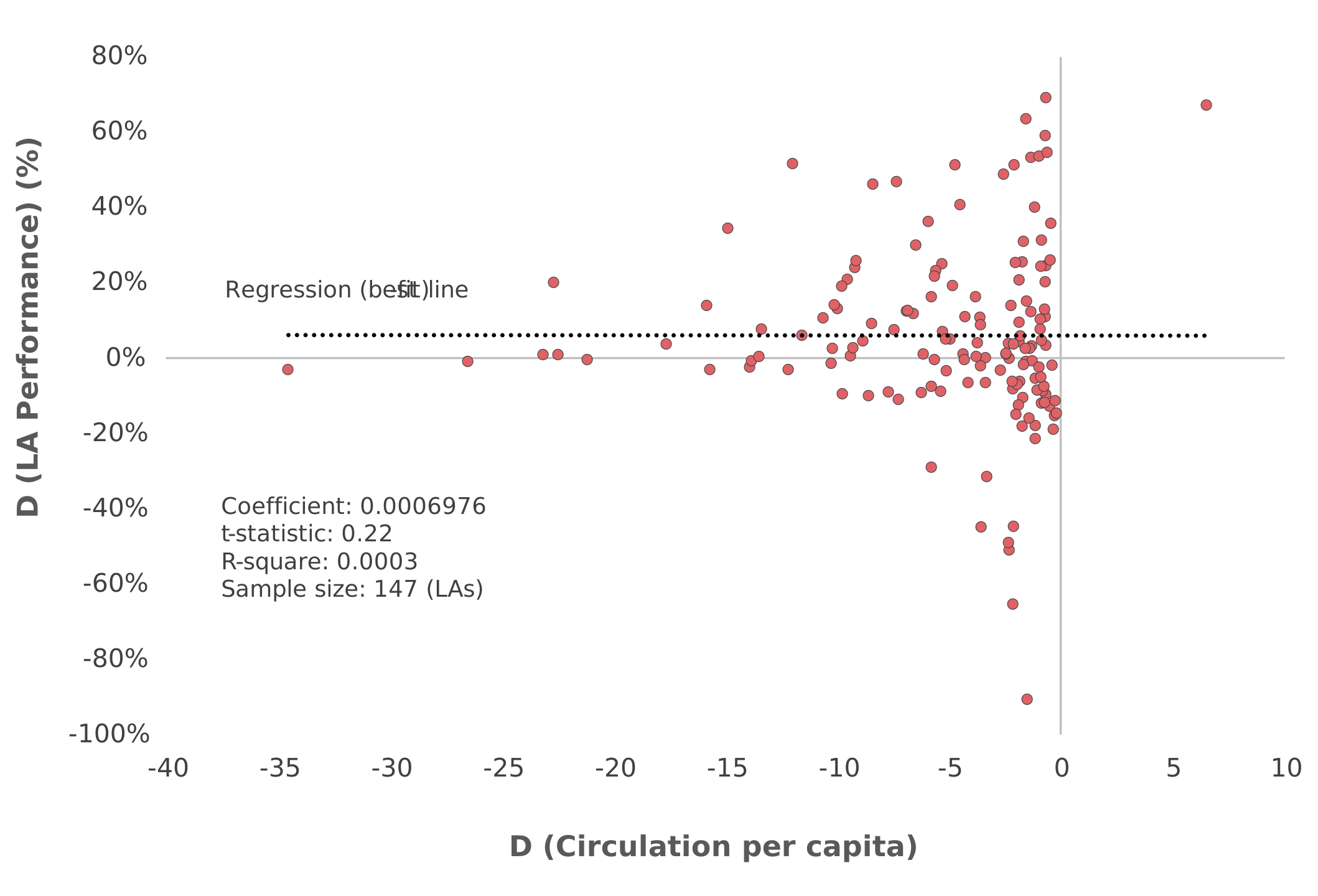
Note: D(LA Performance) (%): The mean in growth rate of all 11 performance indicators between 2017 and 2022; D(circulation per capita): change in circulation per capita between 2017 and 2022; data are reported by LA; Performance indicators have been adjusted so that an increase in their values always indicate an improved performance—the relationship should be positive and statistically significant if the analysis could find a link between local news provision and LA performance. Source: Alma Economics analysis.
We examined the sensitivity of the results using different approaches.
- Using median growth rates instead of mean growth rates to estimate average LA performance.
- Using a subset of indicators available between 2017 and 2023 to estimate the models, thereby increasing the sample by one year.
- Excluding outlying observations, such as extreme changes in LA performance indices.
- Running regressions for each performance indicator separately instead of averaging multiple indicators.
- Testing the relationship based on different types of LAs (e.g., rural vs. urban).
- Using the number of titles instead of the volume of circulation.
In all cases, the models had a poor fit and yielded statistically insignificant results.
4.4 Limitations
The quantitative findings do not support the hypothesis that the presence of local news outlets and/or local news coverage improves LA performance. However, this finding should be interpreted cautiously due to data limitations - the absence of statistically significant impacts may reflect the limitations of the data rather than an actual lack of impact.
- Imperfect performance measures: While we used data from a large number of LA indicators, we recognise that LA performance is difficult to measure, to some extent remains unobserved, and that observed measures imperfectly capture performance.
- Imperfect local news provision measures: The news coverage measures from PINF and ABC are also imperfect. The PINF data measures the number of news outlets, not their penetration. [footnote 26] Additionally, qualitative fieldwork insights suggest that circulation and the number of newspapers may have little correlation with their impact on local authority decision-making. The influence of local news may depend more on the type of journalism and the reputation of local outlets, which may not necessarily correlate with newspaper reach.
- Sample size and statistical power: Several LA performance indicators are missing for many LAs, and others have not been updated recently. This affects the sample size, particularly for the aggregate composite indices, which are available for only a small number of LAs, typically ranging from 60 to 150. As a result, the analysis has, in some cases, been conducted with relatively small samples, reducing the statistical power to identify significant relationships.
5. Conclusion and future research
This study presents mixed evidence regarding the impact of local news provision on the performance and effectiveness of local administration. While the qualitative analysis supports the hypothesis that local news provision contributes to more effective local governance, the quantitative analysis fails to validate it. As discussed in the previous section, this discrepancy may be attributed to data limitations, particularly the challenges in accurately measuring both local authority performance and local news provision. Another explanation is that local news functions like a scarecrow, meaning its influence is relatively independent of circulation or reach. It is primarily the potential for scrutiny that impacts the effectiveness of local governance.
This study contributes to the broader evidence base examining the impact of local news provision on the health of democracy. There are at least two directions—qualitative and quantitative—that could be pursued to expand and strengthen the evidence base.
The qualitative approach could involve a systematic review or Rapid Evidence Assessment (REA) of existing international literature, reviewing the academic and grey literature on the impact of local news on local democracy outcomes such as electoral participation, local government effectiveness, government spending efficiency, and corruption. To the best of our knowledge, there is no systematic study organising and summarising the diverse literature in this area. The learnings from this review could be applied to the UK.
The quantitative approach could be based on more targeted data that measures LA performance, such as the cost-effectiveness of local government operations and projects, or how promptly decisions are made. A review of the literature could help identify and shortlist potential performance measures. The data needed to develop these measures may already be available or could be gathered, for instance, through surveys.
Additionally, the quantitative approach could be enhanced with more data on local news provision. At least two aspects could improve this study. First, the inclusion of online engagement, and second, the nature of local news provision, such as measures that approximate the intensity of scrutiny in the delivery of local services.
Appendix A: Qualitative analysis
A1. Fieldwork material
Box 1: Fieldwork material for engagement with LAs
1. Community engagement: How important do you believe local news reporting is in generating public interest and engagement with community matters?
a. Follow-up: Could you share examples where local news reporting in your area has significantly raised public awareness or interest in matters of local importance?
b. Follow-up: Are there particular types of community matters (e.g., planning permissions, road maintenance, social care quality, financial management) that local journalism commonly highlights in your local area?
c. Follow-up: If not, what are other channels that help raise awareness within local government (i.e., social media, TV, radio)?
2. Local governance support: Do you think local news reporting aids LAs in becoming aware of community challenges or other issues that might not be visible through other channels? In other words, do local news outlets raise awareness not only among the public but also within local government?
a. Follow-up: Could you provide examples of times when your LA became aware of specific matters through local news reporting?
b. Follow-up: Could you share instances when your LA responded to issues brought up by local news outlets?
c. Follow-up: If not, what are other channels that help raise awareness within local government (i.e., social media, TV, radio)?
3. Transparency and Accountability: In your view, does the presence of local journalism increase accountability and transparency within local government? Why yes or why not?
a. Follow-up: Are there specific areas of LA service delivery (or specific themes) that are more responsive to journalism or public feedback?
b. Follow-up: Do specific kinds of local news outlets have different impacts? For example, are there noticeable differences between the impact of titles established in print compared to online-only publishers, multi-title publishers compared with smaller ones with fewer resources, and does closer proximity to the community play a role?
c. Follow-up: Does the size of the news outlet and type of news coverage impact the outcomes?
4. Scrutiny: Some people argue that a key role of local news outlets is to scrutinise the actions and decisions of local government, leading to more effective governance. Do you agree?
a. Follow-up: Why do you agree or disagree with this statement?
b. Follow-up: Could you share examples of when local news reporting influenced decisions or actions taken by your LA?
c. Follow-up: Are there examples of journalism that, in your opinion, directly improved your LA’s performance?
d. Follow up: Does the presence of a local news outlet have an impact even if does very little active scrutiny?
e. Follow-up: On the contrary, could you think of any examples where local news coverage may have obstructed the decision-making and/or actions within local government?
5. News Desert implications: Local journalism has experienced significant declines over the past 10-20 years, with a net loss of at least 271 local print newspaper titles between 2005 and 2022 in the UK, leaving 38 LAs with no or very few local news outlets, also known as news deserts. In your view, what are the risks of existing news deserts, as well as from the creation of additional news deserts?
6. If LA is one of the local news deserts: According to data from the Public Interest News Foundation, which has mapped local news outlets to LAs across the UK, your LA is among the 38 news deserts, where no local news outlets operate. How do you think the absence of local journalism affects your authority’s ability to connect with and serve the community?
7. LDRS: The BBC’s Local Democracy Reporting Service (LDRS) funds local journalists to report on decision making processes at the LA level. Are you familiar with the initiative, and do you have views on its impact?
8. Additional insights: Before we conclude, are there any other relevant topics or insights you would like to discuss?
Box 2: Fieldwork material for engagement with news outlets (journalists / editors)
1. Community engagement: How important do you believe local news reporting is in generating public interest and engagement with community matters?
- Follow-up: Could you share examples where local news reporting in your area and/or by your news outlet has significantly raised public awareness or interest in matters of local importance?
- Follow-up: Are there particular types of community matters (e.g., planning permissions, road maintenance, social care quality, financial management) that local journalism and/or your news publication commonly highlights in your local area?
- Follow-up: How do you measure success of your news stories in keeping the public engaged on local issues?
2. Local governance support: Do you think local news reporting aids LAs in becoming aware of community challenges or other issues that might not be visible through other channels? In other words, do local news outlets raise awareness not only among the public but also within local government?
- Follow-up: Could you provide examples of times when your LA became aware of specific matters through your local news reporting?
- Follow-up: Could you share instances when your LA responded to issues brought up by yours or other local news outlets?
3. Transparency and Accountability: In your view, does the presence of local journalism increase accountability and transparency within local government? Why yes or why not?
- Follow-up: Are there specific areas of LA service delivery (or specific themes) that are more responsive to journalism or public feedback?
- Follow-up: Does the size of the news outlet and type of news coverage impact the outcomes?
4. Scrutiny: Some people argue that a key role of local news outlets is to scrutinise the actions and decisions of local government, leading to more effective governance. Do you agree?
- Follow-up: Why do you agree or disagree with this statement?
- Follow-up: Could you share examples of when local news reporting by your organisation or other news outlets influenced decisions or actions taken by your LA?
- Follow-up: Are there examples of journalism from your news organisation or other local news outlet that, in your opinion, directly improved your LA’s performance?
- Follow up: Does the presence of a local news outlet have an impact even if does very little active scrutiny?
- Follow-up: On the contrary, could you think of any examples where local news coverage may have obstructed the decision-making and/or actions within local government?
5. News Desert implications: Local journalism has experienced significant declines over the past 10-20 years, with a net loss of at least 271 local print newspaper titles between 2005 and 2022 in the UK, creating news deserts in 38 LAs. In your view, what risks might arise from the existing and the creation of additional news deserts?
6. Barriers to effective reporting: What challenges or barriers does your team or organisation encounter when delivering news coverage on local government matters?
- Follow up: Are there specific obstacles, such as limited access to information, resource constraints, or other factors, that impact your ability to report effectively on local government actions and decisions? How could these barriers be removed?
- Follow-up: Can the nature of local news coverage (e.g., content, frequency, detail) affect the impact of local news journalism on the community? If so, to what extent/how?
7. LDRS: The BBC’s Local Democracy Reporting Service (LDRS) funds local journalists to report on decision making processes at the LA level. Are you familiar with the initiative, and do you have views on its impact?
8. Additional insights: Before we conclude, are there any other relevant topics or insights you would like to discuss?
9. Snowball recruitment: Can you think of any colleagues who might be willing to participate in our study and could help us explore some of the research topics we discussed today?
A2. Themes that local news frequently highlights within communities
Local news journalists and LAs were asked to describe the themes and types of stories that are most frequently highlighted in local newspapers and cause interest among readers and wider communities. They expressed remarkably similar responses, with LA officials and journalists describing similar themes and topics. The most frequently raised were:
1. Planning and development emerged as one of the most frequently reported topics across both urban and rural areas. All types of interviewees highlighted how local journalism often focuses on housing developments, planning permissions, and controversies surrounding the use of greenbelt sites.
A big issue that is a constant talking point for us is planning. We live in an area with a lot of Greenbelt and there is a proposal that’s getting voted on next month for 1500 homes right in the centre of [town] that has been one that we’ve talked about over and over again.
– Editor, Independent newspaper
Any development, such as housing or commercial or industrial, near to residents is aired very regularly in the local paper. This can be a source of tension between us as an organisation and residents.
– Local authority official, metropolitan or borough council, PINF Middling
2. Transport-related issues were also raised frequently. This included road maintenance, traffic management, cycle lanes, and public transport cuts. This theme was raised often in areas with significant commuting populations or trunk roads. Interviewees representing rural areas stated that local newspapers often report on cuts to rural bus services.
When these villages lost their buses, we talked to people about what that was going to mean. […] If you live in that village, you know it’s a massive issue that the bus has been cut. People in the council would be aware of that, but helping to put that face on it definitely makes people aware of the impact of their decision.
– Local Democracy Reporter, Corporate newspaper
3. Housing and homelessness were highlighted often by journalists and LA officials, especially those representing urban areas. Some local journalists stated that the quality and affordability of housing – including the management of social housing – is the largest campaign of their newspaper.
The [local corporate newspaper] is doing a really good local campaign just now about homelessness and our use of hostels and hotels to put up homeless people and homeless families. But it would be wrong to say that has made it more of an issue for us in the council because we already know it’s an issue in the council - it’s costing us a fortune.
– Local authority official, unitary authority, PINF Oasis
4. Waste management – including bin collection services, litter, and fly-tipping – was a distinct and frequently raised theme, particularly from interviewees operating in urban areas.
People care about their parking issues, they care about their rubbish being collected, and they care about fly-tipping and dog poo being picked up. All the really day-to-day stuff, the quality-of-life issues, and people use the press to come to us about it.
– Local authority official, district council
5. Closures of public amenities and services - such as libraries, playgrounds, and care homes - were identified as a recurring theme in local journalism over recent years. It was remarked that these stories can spark significant public debate, campaigns, and policy changes.
6. Anti-social behaviour and crime were highlighted as being frequently covered by local media. It was also emphasised that local media often work in collaboration with LAs to address community safety concerns.
Local papers do powerful reporting on criminal cases because they will be aware of victims and speak to families. It’s very strong emotional reporting that we are very conscious of and aware of. […] And, local media is still the best way for us to get our messages out there about community reassurance and supporting young people.
– Combined Authority official, PINF N/A
7. Financial management was highlighted as a key theme by some journalists, especially those working in areas that have declared de-facto bankruptcy through a Section 114 notice of the Local Government Finance Act 1988. [footnote 27]
Our council issued a Section 114 a few years ago. I think raising that issue with members of the public and making them understand where the cuts are going to fall and how it affects them is incredibly important.
– Editor, Independent newspaper
I’ve done a lot with sales of assets, and there’s a regular pattern which upsets people. For example, the council bought an old [redacted] factory and sold it on the same day to a multinational company for a £1,000,000 loss. […] They didn’t do anything with it, the price doubled, and the council bought it back recently. So, it’s cost the taxpayer millions of pounds for no asset and the only people who made a profit out of that are the multinational company.
– Editor, Independent newspaper
Appendix B: Quantitative analysis
B1. Data description
This section provides details about the performance indicators and control variables, including variable descriptions and sources.
Table 5. Performance measures
Adult Social Care
| Indicator | Description | Source |
|---|---|---|
| Workforce turnover rate | This indicator is a proxy for the continuity of care and an indicator of the working conditions needed to foster a workforce capable of delivering high-quality care. Lower turnover should correlate with more effective continuity of care, retention of skills and better working conditions. Workforce turnover is also affected by the conditions in local labour markets. This may mean that achieving a lower level of workforce turnover will be more challenging in some LA areas than in others. | Oflog |
| People in adult social care quality of life | This metric is an average of self-reported scores that rate the quality of life of people who receive care through council-funded services. | Oflog |
| People who use services who found it easy to find information | This metric measures the views of council-funded service users on how easy it is to find information and advice on their care and services. A higher score indicates a more positive experience. | Oflog |
| Requests resulting in a service | This metric provides a measure of the volume of care services being accessed in an area. It is also a measure of local need. This is a contextual metric rather than an explicit measure of performance. It will be affected by demographic factors, such as the average care needs, wealth and age of the population. This is a measure of the total volume of care provided in an area. | Oflog |
| Short term service provision | This metric measures the number of service users who receive short-term services and do not then require long-term support. It provides an indication of the level of independence achieved by users of council-funded short-term services, and of the effectiveness of prevention, as service users’ care needs might otherwise develop to the point that they require long-term support. | Oflog |
| Carers of people in adult social care quality of life | This metric is an average of self-reported scores that rate the quality of life of unpaid carers for people with care needs. We would expect that more effective service provision by a council would reduce the burden of care provision on unpaid carers and therefore correlate with a higher quality of life score. | Oflog |
| Carers who found it easy to find information about services | This metric measures the views of unpaid carers for users of council-funded services on how easy it is to find information and advice about care and services. A higher score indicates a more positive experience. | Oflog |
| Adult Social Care Complaints received | Complaints data about all adult social care complaints, including care arranged and paid for privately without the council being involved. | Ombudsman |
Environment and Waste management (including fly-tipping)
| Indicator | Description | Source |
|---|---|---|
| Household waste recycling rate | This metric shows how much of total household waste the LA has recycled, including household waste and waste from street bins/parks but excluding metals recovered from incinerator bottom ash. Higher recycling rates lead to better environmental outcomes with less waste going to landfill. It should be noted that this metric will be affected by the demography and environment the LA covers. | Oflog |
| Recycling contamination rate | This metric gives the proportion of household waste sent for recycling that is rejected. A lower contamination rate may indicate more effective processing of recyclable waste. Since LAs can deliver recycling services in different ways at different costs, contamination rate is an important metric for adding context. | Oflog |
| Fly-tipping actions per incident | Constructed measures of LA action on fly-tipping, including any enforcement or investigative action taken. | Oflog |
| Environmental Services, Public Protection and Regulation Complaints received | Complaints data about flooding and land drainage issues, memorial safety in cemeteries, neighbour nuisance and anti-social behaviour, noise nuisance, nuisance from dust or smoke, nuisance from smells, taxi and private hire vehicle licensing, trading standards, waste and refuse (including bin collections) | Ombudsman |
Corporate and Finance
| Indicator | Description | Source |
|---|---|---|
| Council tax collection rates (in year) | This metric shows LA in-year collection rates of council tax. Council tax is one source of income for LAs. | Oflog |
| Non-domestic rates collection rates (in year) | This metric covers LA in-year collection rates for non-domestic properties, better known as business rates. Business rates is one source of income for LAs. | Oflog |
| Non-ringfenced reserves as percentage of service spend | This metric provides insight into an LA’s financial position and its ability to fund future projects or respond to unexpected events. A higher percentage may indicate that an authority has greater resources available to fund future projects, mitigate specific risks and cushion against unexpected expenditures. Lower percentages may indicate that an authority has lower resources available to invest and less ability to absorb financial shocks. | Oflog |
| Total debt as percentage of core spending power | This metric is intended to be a proxy of the affordability of an LA’s debt. It gives a measure of the costs to service debt, standardised by a financial measure of size to allow the metric to be comparable across authorities. | Oflog |
| Benefits and Tax Complaints received | Complaints data about council tax, bailiffs, housing benefit claims, business rates, bankruptcy. | Ombudsman |
Adult Social Care
| Indicator | Description | Source |
|---|---|---|
| Percentage of major planning applications decided on time | Authorities have a statutory 13 weeks to make major decisions, but some decisions have an agreed time of 16 weeks if the case involves a planning performance agreement, environmental impact assessment or agreed extension time. Decisions made within the agreed time frame are classified as decided on time and presented in this metric as a % of all major decisions. | Oflog |
| Percentage of non-major planning applications decided on time | Authorities have a statutory 8 weeks to make minor decisions, but this can be extended subject to a performance agreement. Decisions made within the agreed time frame are classified as decided on time and presented in this metric as a % of all non-major decisions. | Oflog |
| Percentage of major planning applications overturned on appeal | The metric covers the percentage of planning applications for major development that have been overturned at appeal, once nine months have elapsed following the end of the assessment period. | Oflog |
| Percentage of non-major planning applications overturned on appeal | The metric covers the percentage of planning applications for major development that have been overturned at appeal, once nine months have elapsed following the end of the assessment period. | Oflog |
| Planning and Development Complaints received | Complaints data about neighbour’s planning application, planning applications, planning obligations, planning enforcement, building control, conservation areas, listed buildings, trees. | Ombudsman |
Roads and Public Transport
| Indicator | Description | Source |
|---|---|---|
| Percentage of LA B and C roads determined as Red category | Surface condition overview as determined by Red, Amber and Green (RAG) categories for surveyed B and C roads, by LA, England. The Road Condition Indicator (RCI) an indication of the condition of the road surface. These are grouped into ‘green’ or ‘good’ (i.e. no further investigation or work is needed to bring it up to standard), ‘amber’ (i.e. may need work sometime soon), and ‘red’ or ‘poor’ (i.e. further investigation is required to ascertain if work is needed immediately). | DfT |
| Percentage of LA motorways and A roads determined as Red category | Surface condition overview as determined by Red, Amber and Green (RAG) categories for surveyed motorways and A roads. The Road Condition Indicator (RCI) an indication of the condition of the road surface. These are grouped into ‘green’ or ‘good’ (i.e. no further investigation or work is needed to bring it up to standard), ‘amber’ (i.e. may need work sometime soon), and ‘red’ or ‘poor’ (i.e. further investigation is required to ascertain if work is needed immediately). | DfT |
| Highways and Transport Complaints received | Complaints data about damage to property or personal injury due to poorly maintained highways (including potholes), parking enforcement (including Penalty Charge Notices), moving traffic offences, Transport for London and London TravelWatch, enforcement of road charging schemes (including London’s congestion charge and Low Emission Zones), footpaths and rights of way, bus stops and shelters | Ombudsman |
Children’s Social Care and Special Educational Needs and Disabilities (SEND)
| Indicator | Description | Source |
|---|---|---|
| Education and Children’s Services Complaints received | Complaints data about school transport, delayed entry, education other than at school, and special educational needs. | Ombudsman |
| Children and family social workers - Turnover rate (FTE) | This indicator is a proxy for the continuity of care and an indicator of the working conditions needed to foster a workforce capable of delivering high-quality care. Lower turnover should correlate with more effective continuity of care, retention of skills and better working conditions. Workforce turnover is also affected by the conditions in local labour markets. | LGInform/CLA |
| Percentage of looked after children with three or more placements during the year | This measure looks at the stability of placements of children within the care system, reflecting an LA’s capacity to provide suitable and high-quality care | LGInform/CLA |
| Special Educational Needs and Disability (SEND) tribunal appeal rate (calendar year) | This is the total number of Special Education Needs and Disability appeals registered with the Tribunal in the calendar year, expressed as a proportion of appealable decisions. | Tribunal Data |
Homelessness
| Indicator | Description | Source |
|---|---|---|
| Number of households with children in temporary accommodation | Measure of LA response to homelessness where households with children are involved | MHCLG |
| Number of people sleeping rough over the course of the month | Metric shows the number of persons experiencing homelessness who were rough sleeping in a single month by LA. | MHCLG |
Others
| Indicator | Description | Source |
|---|---|---|
| Total Complaints received | Total volume of complaints received | Ombudsman |
| Cases we were satisfied the authority successfully implemented our recommendations to remedy the complaint (compliance rate) (%) | Measure of LA response to Ombudsman recommendations to remedy complaints. | Ombudsman |
| Peer Challenge | Indicator variable for an LGA (Local Government Association) scheme where leaders from other LAs provide peer review for an LA. While the challenge is optional, LAs are expected by the LGA to have one every five years, and publish a follow-up report 12 months later. This suggests good performance. | LGA |
Table 6. Control variables
| Variable | Description | Source |
|---|---|---|
| Population | Mid-year population estimates | ONS |
| Share of the population identifying as White British | Estimates that classify usual residents by ethnic group | Census 2021 |
| Share of population with a college degree or higher | Based on estimates that classify usual residents aged 16 years and over by their highest level of qualification | Census 2021 |
| Mean Income | Annual estimates of earnings for UK employees | ONS (Annual Survey of Hours and Earnings) |
| Index of multiple deprivation (rank) | LA rank of IMD (discrete value showing the rank of each LA compared to all other LAs) | Consumer Data Research Centre |
| Share of the population aged 65 and over | Derived from mid-year population statistics | ONS |
| Length of residence | Measures the length of residence in the UK derived from the date that a person most recently arrived to live in the UK. Usual residents born in the UK recorded in the category “born in the UK. | Census 2021 |
| National identity | Self-determined assessment of their own identity | Census 2021 |
| Population density | Number of usual residents per square kilometre | Census 2021 |
| London indicator variable | Binary variable (0/1) indicating whether an LA is located in London or not | ONS (Geoportal statistics) |
| Metropolitan LA indicator variable | Binary variable (0/1) indicating whether an LA is a metropolitan borough | ONS (Geoportal statistics) |
| Combined Authority indicator variable | Binary variable (0/1) indicating whether an LA is part of a combined LA | ONS (Geoportal statistics) |
| Exceptional financial support indicator variable | Binary variable (0/1) indicating whether an LA received financial support under the Exception Financial Support scheme in the last 5 years. | MHCLG |
B2. Normalisation methods
The table below summarises common approaches for normalising or standardising variables measured on different scales, with the aim of constructing composite indices. When combining different measures into a single index, it is essential to transform all measures to a consistent scale.
We have chosen Z-score normalisation due to its properties: it is particularly suitable for continuous variables with an approximately normal distribution, it emphasises the actual magnitude of scores rather than just their order, and it is relatively robust to outliers. This method is widely used; for instance, the Organisation for Economic Co-operation and Development (OECD) employs it to construct its composite index of leading indicators.
Table 7. 1. Normalisation methods summary
| Method | Formula | Result | Best for |
|---|---|---|---|
| Z-Score Normalisation | (Value−Mean)/Standard Deviation | Transforms data to have a mean of 0 and a standard deviation of 1 | Indicators with normal (or approximately normal) distributions. When you want to interpret values in terms of their actual score magnitude as opposed to their order. Data with outliers, as it reduces the impact of extreme values. |
| Min-Max Normalisation | (Value−Min)/(Max−Min) | Scales all values between 0 and 1 (or another range, e.g., 0 to 100) | Data with consistent ranges where outliers are limited. Cases where you want to interpret the score relative to observed minimums and maximums. |
| Ranking | Assigns a rank to each observation (e.g., 1 for highest, 2 for second highest) | Ordinal scale where values reflect rank rather than absolute differences | Data with non-linear distributions or categorical indicators. When absolute differences between values are less meaningful than their order. |
| Percentile Transformation | Converts values into percentiles, assigning a rank-based percentile (e.g., 0–100) to each observation | Standardises data on a 0–100 scale, capturing the relative position of each value within the distribution | Data with many outliers or non-normal distributions. When you want to interpret values in terms of their relative position rather than actual score magnitude. |
B3. Regression output
The table below sets out the regression output from Specification 1, described in section 3.1. The remaining model outputs are available upon request.
| Adult Social Care | Corporate & Finance | Planning | Roads and Public Transport | Environment and waste management | Children’s social care | Homelessness | Others | Total Index 1 | Total Index 2 | |
|---|---|---|---|---|---|---|---|---|---|---|
| Number of print and online local news outlets | -0.026** | 0.005 | -0.004 | -0.035 | 0.021 | 0.027 | -0.012 | -0.013 | -0.006 | 0 |
| Number of TV and radio local news outlets per 100,000 population | 0.024 | -0.061 | -0.053 | 0.359** | -0.027 | 0.036 | -0.028 | -0.041 | 0.034 | -0.004 |
| Population | -0.000*** | -0.000*** | 0 | 0 | 0 | 0 | 0 | -0.000*** | -0.000* | -0.000** |
| Share of the population identifying as White British | 0.42 | 0.407 | 0.446 | -0.068 | -0.484 | -0.269 | 1.408*** | -0.29 | 0.503 | 0.346 |
| Share of population with a college degree or higher | -0.34 | -0.703 | -1.904* | -8.716*** | 0.558 | -0.047 | 0.481 | -1.286 | -1.770* | -1.288*** |
| Average income | 0.000*** | 0.000*** | 0 | 0 | 0 | 0 | 0 | 0 | 0 | 0 |
| Index of Multiple Deprivation (LA rank) | -0.001 | 0.003*** | 0 | 0.003 | 0.001** | -0.001 | 0.001 | 0.001** | 0.001 | 0.001** |
| Share of the population aged 65 and over | 0.024* | -0.007 | -0.033** | 0.007 | 0.001 | -0.002 | -0.019 | 0.019* | -0.016 | -0.006 |
| Population density | -0.000* | 0 | 0 | 0 | -0.000*** | 0 | -0.000** | 0 | -0.000** | 0 |
| London indicator variable | -0.104 | -0.132 | 0.106 | 0.422 | -0.305 | 0.101 | 0.353 | -0.634*** | 0.497** | 0.015 |
| Combined Authority indicator variable | 0.129 | -0.092 | -0.124 | 0.113 | 0.009 | 0.231* | -0.032 | -0.006 | -0.003 | 0.017 |
| Metropolitan LA indicator variable | -0.16 | -0.067 | 0.441*** | 0.165 | 0.115 | 0.066 | 0.029 | -0.098 | 0.121 | 0.064 |
| Exceptional Financial Support Status | -0.284*** | -0.255*** | 0.061 | -0.589 | 0.029 | -0.035 | -0.137 | -0.269*** | -0.105 | -0.113* |
| Constant | -0.613** | -0.624** | 0.910** | 1.526 | -0.173 | 0.091 | -0.226 | 0.532 | 0.147 | 0.045 |
| Observations | 123 | 279 | 289 | 68 | 288 | 122 | 296 | 293 | 62 | 111 |
| R-squared | 0.49 | 0.56 | 0.16 | 0.51 | 0.24 | 0.12 | 0.36 | 0.42 | 0.51 | 0.56 |
B4. Audit Bureau of Circulations data
The table below summarises the number of titles covered by the Audit Bureau of Circulations (ABC) and the data used in the analysis.
Table 8. 1. Number of titles (ABC)
| Number of titles | |
|---|---|
| ABC universe (2017-2023) | 525 |
| English titles | 385 |
| Registered | 304 |
| No longer registered | 81 |
| Sufficient data | 237 |
| Registered | 166 |
| No Longer Registered | 71 |
The ABC universe denotes all titles reported by ABC for one or more years between 2017 and 2023. Registered titles are those still in operation, while ‘no longer registered’ refers to titles that have ceased to exist.
Some titles report circulation statistics intermittently, meaning there are gaps in the data, and as such some of these titles cannot be included in our sample. Our final dataset (‘sufficient data’) includes (i) registered titles that report circulation statistics for both 2017 and 2023 (or 2022); and (ii) titles that are no longer registered, with no data gaps.
-
On the positive side, interest in local news in the UK is among the highest in the western world. ↩
-
Much of this evidence is published in leading academic journals, such as the American Economic Review and the Journal of Financial Economics, underscoring the quality and significance of this research. ↩
-
Also, Green et al., (2023) observed that an abrupt expansion in the reach of an independent Tanzanian radio station, which focused on current affairs, led to a marked increase in citizens’ political interest. ↩
-
To be awarded the democracy reporter contracts, the successful news organisations had to pass stringent criteria which included financial standing and a strong track record of relevant journalism in the area they were applying to cover. ↩
-
The study could also contribute to the debate surrounding LA efficiency and management in light of the increased frequency of issuing Section 114 (bankruptcy) notices. Of the 14 LAs that have issued Section 114 notices since 2000, 10 did so between 2021 and 2024. ↩
-
We used k-means clustering to identify these four categories. We carried out the clustering analysis using population, income, rank on the index of multiple deprivation, median age, population density, and metropolitan status. We examined the characteristics of the clusters and identified the categories, as i) Low deprivation, high density areas ii) high deprivation, high density areas, iii) high deprivation, high population, mid-density areas, iv) low deprivation, high population and mid-density areas. ↩
-
Cross-sectional data refer to data that include observations across entities (e.g., LAs) at a specific point in time. ↩
-
In addition, factors such as income and attachment to the local community may be correlated with both news provision and LA performance. For instance, if the local population has a strong attachment to their community, civic engagement and scrutiny of local administration may be higher. Similarly, heightened interest in local politics could increase demand for local news outlets. Failing to account for this factor could lead to finding a significant impact of local news outlets on LA performance when, in fact, the observed relationship is driven by local attachment, which is correlated with both the number of news outlets and LA performance. Community attachment and interest in local politics were approximated using several factors, including age—older individuals are more likely to have a strong attachment to their local communities—length of residence, national identity, and population density. It is plausible that people in smaller, rural areas have closer attachments to their communities. ↩
-
Time-series data refer to data that include observations over multiple time periods. ↩
-
These variables are only available for England, with limited counterparts in Wales and Scotland. Our quantitative analysis focuses on England, while the other devolved nations will be included in the qualitative analysis. ↩
-
We began with a long list of hundreds of indicators, primarily sourced from Oflog, which we reviewed to create a shorter list of potentially relevant indicators. This shorter list was then reviewed in more detail to understand each indicator’s scope and definition, further refining it to a final list of relevant indicators. Some indicators were subsequently dropped due to a lack of sufficient data. The main selection criteria were the extent to which each metric is at least partially within the control of the LA, assessed using judgment and qualitative information, as well as data availability. ↩
-
There are additional advantages to using composite indices. First, they reduce the “noise” present in single metrics, enhancing the power of statistical tests in identifying significant impacts. Second, it is impractical to run and interpret, say, 50 separate statistical models—one for each performance index. Composite indices allow for summarising a large amount of information into a limited number of indices, facilitating the implementation of the analysis. ↩
-
Since 2020, the government has agreed to provide a number of LAs with support via the Exceptional Financial Support framework, following requests from these councils for assistance to manage financial pressures that they considered unmanageable. ↩
-
All indicators are expressed as shares (e.g., complaints per capita) to eliminate the effect of LA size. ↩
-
The print circulation includes paid copies, free copies and subscriptions. We have adjusted the circulation data by the LA population, using circulation per capita, so that the metric is comparable across LAs of different sizes. Not all publishers submit data to ABC. For example, Reach plc does not submit their data to ABC. The data are self-reported by publishers, making it difficult to confirm their accuracy, despite ABC conducting an audit. There are gaps in the reporting, particularly around 2020, which may be related to COVID-19. However, this does not affect the analysis as we calculate the difference in circulation between 2017 and 2022 or 2023. ↩
-
The median growth rate is useful because it is less affected by outliers and skewed data. ↩
-
Throughout this section, metropolitan borough councils and London borough councils are identified as “metropolitan or borough councils” to reduce attributability of quotations and preserve anonymity. ↩
-
The insights are arranged by topic area. The topics are not necessarily ordered by the frequency with which they were raised by interviewees, but by their relevance to the research questions and for coherence of reading. ↩
-
PINF Middling refers to councils which are included in the Public Interest News Foundation Local News Map and ‘Deserts, Oases, and Drylands’ report but which are categorised as between ‘Dryland’ and ‘Oasis’ status. ↩
-
PINF N/A refers to councils or areas which are not included in the Public Interest News Foundation Local News Map and ‘Deserts, Oases, and Drylands’ report. It includes county councils and combined authorities. ↩
-
The controversy surrounding low traffic neighbourhoods is also documented in a recent report. ↩
-
We use data on LA revenue expenditure and financing (available here, for Highways and transport services, Children’s Social Care services, Adult Social Care services, Homelessness, Environmental services (for waste management) and Planning and development services. ↩
-
We also experimented with Propensity Score Matching as an alternative statistical method, but the results remained qualitatively similar. ↩
-
Since we are using models with only one independent variable, we can present the regression model visually. ↩
-
Notwithstanding this, insights from the qualitative fieldwork suggest that circulation and number of newspapers has little correlation with the impact of newspapers upon local authority decision-making. ↩
-
For more information, please read: https://www.instituteforgovernment.org.uk/explainer/local-authority-section-114-notices ↩