Local Growth Fund (England): technical document
Published 28 May 2026
Applies to England

© Crown copyright 2026
This publication is licensed under the terms of the Open Government Licence v3.0 except where otherwise stated. To view this licence, visit nationalarchives.gov.uk/doc/open-government-licence/version/3 or write to the Information Policy Team, The National Archives, Kew, London TW9 4DU, or email: psi@nationalarchives.gov.uk.
Where we have identified any third party copyright information you will need to obtain permission from the copyright holders concerned.
This publication is available at https://www.gov.uk/government/publications/local-growth-fund-england-technical-document/local-growth-fund-england-technical-document
1. Overview
The Local Growth Fund introduces a long-term, flexible settlement for selected Mayoral Strategic Authorities (MSAs), consolidating fragmented funding into a single, locally led pot aligned with Local Growth Plans.
The Local Growth Fund is designed to equip mayors in the North and Midlands to boost regional productivity by focusing on three interconnected themes:
- Infrastructure investment: expanding labour market reach and enabling agglomeration benefits across functional economic areas.
- Business support: strengthening regional clusters and increasing innovation and investment to drive firm-level competitiveness and sectoral growth.
- Skills development: providing the human capital aligned to priority sectors and emerging technologies.
The fund has been designed to operate within the landscape of wider funding and complement other sources of finance to get projects off the ground. For relevant MSAs, the Local Growth Fund will be delivered through the integrated settlement. Further detail is set out in the Local Growth Fund policy statement.
The fund will be allocated to the following 11 MSAs:
- East Midlands
- Greater Lincolnshire
- Greater Manchester
- Hull and East Yorkshire
- Liverpool City Region
- North East
- South Yorkshire
- Tees Valley
- West Midlands
- West Yorkshire
- York and North Yorkshire
The approach to allocating £902 million in England over the next 4 years is outlined in the methodology note. Allocations are as follows:
Figure 1: Final allocations for eligible Mayoral Strategic Authorities (rounded to the nearest £million)
| RDEL | CDEL | TDEL | |||||||||
|---|---|---|---|---|---|---|---|---|---|---|---|
| Mayoral Strategic Authority | 26/27 | 27/28 | 28/29 | 26/27 | 27/28 | 28/29 | 29/30 | 26/27 | 27/28 | 28/29 | 29/30 |
| East Midlands | £18 | £16 | £13 | £6 | £9 | £18 | £27 | £24 | £25 | £31 | £27 |
| Greater Lincolnshire | £9 | £8 | £6 | £3 | £4 | £9 | £13 | £12 | £12 | £15 | £13 |
| Greater Manchester | £24 | £21 | £17 | £8 | £12 | £24 | £36 | £32 | £33 | £41 | £36 |
| Hull and East Yorkshire | £5 | £4 | £4 | £2 | £2 | £5 | £7 | £7 | £7 | £9 | £7 |
| Liverpool City Region | £13 | £11 | £9 | £4 | £6 | £13 | £19 | £17 | £18 | £22 | £19 |
| North East | £16 | £14 | £12 | £5 | £8 | £16 | £24 | £22 | £23 | £28 | £24 |
| South Yorkshire | £11 | £10 | £8 | £4 | £6 | £11 | £17 | £15 | £16 | £20 | £17 |
| Tees Valley | £6 | £5 | £4 | £2 | £3 | £6 | £8 | £8 | £8 | £10 | £8 |
| West Midlands | £24 | £21 | £18 | £8 | £12 | £24 | £36 | £32 | £33 | £42 | £36 |
| West Yorkshire | £19 | £17 | £14 | £6 | £10 | £19 | £29 | £26 | £27 | £33 | £29 |
| York and North Yorkshire | £7 | £6 | £5 | £2 | £3 | £7 | £10 | £9 | £9 | £12 | £10 |
| Total | £151 | £135 | £111 | £50 | £76 | £151 | £227 | £202 | £211 | £262 | £227 |
2. Outcomes and outputs
The Local Growth Fund is designed to help mayors to deliver growth across the three interconnected themes of infrastructure investment, business support and skills development, operating within the landscape of wider funding and complementing other sources of finance to deliver key projects.
For the six MSAs with an integrated settlement, the Local Growth Fund will be delivered through that settlement. MSAs with an integrated settlement have agreed an Outcomes Framework as part of that process and the Local Growth Fund should be used in delivering those outputs and outcomes.
For the five MSAs without an integrated settlement, there is a Local Growth Fund Outcomes Framework (Annex A) to support co-agreement of outputs and outcomes.
As set out in the policy statement, the fund’s high-level logic model (Figure 2) frames the fund’s aims around intermediate and long-term outcomes. This model is a guide, not a prescription, and local leaders should integrate other funding streams and tailor interventions to local contexts. The fund design recognises that activities and outputs will differ between places and should be developed by local leaders in line with their Local Growth Plans. For this reason, recipients do not need to pursue all outcomes and are encouraged to make place-informed prioritisations across the outcomes.
Figure 2: High-level logic model for the Local Growth Fund
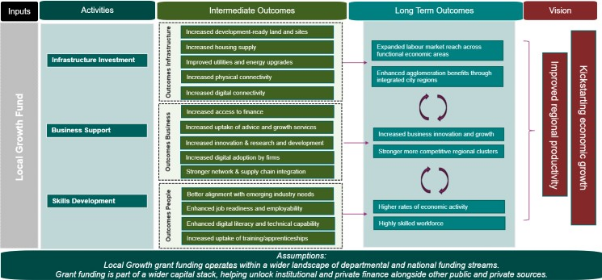
Figure 2: High-level logic model for Local Growth Fund (accessible version)
Inputs
- Local Growth Fund
Activities
- Infrastructure investment
- Business support
- Skills development
Intermediate outcomes
Infrastructure outcomes:
- Increased development-ready land and sites
- Increased housing supply
- Improved utilities and energy upgrades
- Increased physical connectivity
- Increased digital connectivity
Business outcomes:
- Increased access to finance
- Increased uptake of advice and growth services
- Increased innovation and research and development
- Increased digital adoption by firms
- Stronger network and supply chain integration
Skills outcomes:
- Better alignment with emerging industry needs
- Enhanced job readiness and employability
- Enhanced digital literacy and technical capability
- Increased uptake of training/apprenticeships
Long term outcomes
- Expanded labour market reach across functional economic areas
- Enhanced agglomeration benefits through integrated city regions
- Increased business innovation and growth
- Stronger more competitive regional clusters
- Higher rates of economic activity
- Highly skilled workforce
Vision
- Kickstarting economic growth
- Improved regional productivity
Assumptions
- Local Growth grant funding operates within a wider landscape of departmental and national funding streams
- Grant funding is part of a wider capital stack, helping unlock institutional and private finance alongside other public and private sources
Infrastructure investment means targeted capital interventions into enabling works and physical and digital capital assets that support agglomeration and economic activity. For example, this could include brownfield land remediation; improvements to public transport routes; and improving accessibility at stations and urban centres. While public realm spending is permitted under the Outcomes Framework, this should only be where there is a demonstrable impact on local economic growth.
Business support means targeted, growth focused interventions that strengthen firm productivity, competitiveness and scalability. For example, this could include increasing investment in research and development; providing specialist advice for start-ups and scale-ups; and supporting SMEs to implement digital technology solutions such as artificial intelligence.
Skills development means targeted interventions supporting skills development and labour market interventions that respond to the needs of emerging and priority industries, improve job readiness and employability, and raise workforce productivity. For example, this could include skills training for priority sectors, including those within the Industrial Strategy; improvements to educational facilities; and support to further in-work training and apprenticeship offers for local employers.
The Local Growth Fund is intended for growth maximising interventions on infrastructure, business support and skills. Funding should not be spent on activities that do not show similarly clear and direct impacts on local economic growth – this includes activities related to community wellbeing or social cohesion. For these, local areas will instead be able use the £5.8 billion Pride in Place Programme for such activities, along with other funding streams.
3. Assurance and risk
Each delivery body is expected to have the necessary governance and assurance arrangements in place to ensure that all legal and other statutory obligations and consents will be adhered to.
Delivery bodies will be required to confirm in each monitoring report and as part of their annual review that these arrangements are working adequately. As part of this, delivery bodies may be asked to respond to further questions addressing the delivery of the Local Growth Fund and cooperate with MHCLG in any enquiries regarding the fund.
Risk and issues
Local Growth Fund delivery will be managed by the accountable body. It is crucial that all risks relevant to the successful delivery of the Local Growth Fund and agreed outcomes are identified, evaluated and controlled in a transparent, consistent and systematic manner.
Any issues should be reported via agreed governance arrangements. Where issues remain unresolved, and/or where progress, delivery or performance is deemed inadequate, there must be a clear route for escalation, and MHCLG must be informed as appropriate. A ‘lessons learned’ exercise should be undertaken for each significant issue encountered.
4. Programme management
Investment Framework
For the five MSAs in receipt of the fund without an integrated settlement, delivery and programme management priorities will be articulated through completion of an Investment Framework template (Annex B). This framework is intended to provide shape and direction for how an MSA will deliver the Local Growth Fund, in line with the programme objectives and local priorities.
MSAs completing an Investment Framework will be expected to articulate their proposed vision for their funding and set out governance and decision-making arrangements. To support effective programme management, the Investment Framework forms the basis for co-agreeing outcomes and reporting baselines for these five MSAs and its development is designed to be iterative with MHCLG. Upon completion, the framework will identify strategic alignment with the MSA’s Local Growth Plan and other activity, as well as identifying risks and dependencies. The framework also seeks confirmation relating to statutory duties (e.g., Public Sector Equality Duty) and statutory and non-statutory targets (e.g., net zero). It also asks MSAs to identify known and potential communications opportunities.
Reporting
For the six MSAs with an integrated settlement, the Local Growth Fund will be delivered and monitored via that settlement.
For the five MSAs without an integrated settlement, MHCLG requires formal reporting on delivery every six months via the Local Growth Fund data collection tool. Delivery reports are to be submitted by 31 October at the 6-month reporting point and by 30 April at the 12-month reporting point. Accountable bodies should consider how to secure local agreement to the contents of delivery reports in line with their governance arrangements. Each delivery report requires sign off by the accountable body’s Chief Financial Officer.
The Local Growth Fund reporting and monitoring approach reflects the devolved delivery model of the programme. Performance data is collected at a strategic level, rather than at a project level. However, accountable bodies are asked to provide updates on how key projects are progressing. The data collected will be used for the following purposes:
- programme level oversight of the progress of the Local Growth Fund to assure MHCLG, the Accounting Officer, ministers, and Parliament
- support evaluation of the programme, the principles of which are set out in the evaluation section
- monitor that Local Growth Fund monies are being spent on local priorities as set out in the Investment Framework and in line with Local Growth Plans
- enable performance management of spend and outcomes, and identify any material changes
Reporting via the data collection tool includes:
- RAG-rated progress towards delivering long-term outcomes
- progress with delivering the year’s key projects, activities and milestones
- financial delivery – forecast (mid-year report) and actual (end-year report) spend on activity undertaken in the financial year
Performance management
The Local Growth Fund is designed to offer MSAs flexibility across financial years to support long-term strategic planning and delivery. For the six MSAs with an integrated settlement, the Local Growth Fund will be delivered through that settlement and performance management, including expenditure and delivery of outputs against the agreed baseline, will be monitored through that process.
For the five MSAs without an integrated settlement, performance management of accountable bodies will focus on expenditure against the baseline profile set out above, unless otherwise agreed. To ensure that accountable bodies have flexibility in changing local priorities and plans in line with the responsibilities delegated to them, whilst ensuring an appropriate level of control, the programme will apply the following threshold to performance:
- A reprofiling of more than 30% of the relevant financial year’s budget into the next financial year, compared to the proposal baseline. MHCLG approval is required where accountable bodies wish to reprofile more than 30% of the current financial year’s total allocation (CDEL (capital) and RDEL (revenue)) into the next financial year. The ‘proposal baseline’ is the latest approved funding profile, unless otherwise agreed. The threshold applies to the total year’s allocation, not to CDEL or RDEL separately.
RDEL must be spent by March 2029 and CDEL must be spent by March 2030. All profiling and any proposed reprofiling should be managed within these final end dates.
The annual grant determination letters accountable bodies receive set out a CDEL and RDEL allocation. MHCLG will not consider in-year requests to change the amount of funding to be used in that year. Should accountable bodies wish to change their funding profile for subsequent years, this will be considered in line with the reprofiling and change control processes detailed below.
Changes to spend profiles below the threshold above will not require MHCLG agreement, though accountable bodies will be expected to provide an explanation of the cause(s) and set out how they will recover delivery in the subsequent year as part of their reporting, signed off by their Chief Financial Officer. This could include changes to key projects, to manage or mitigate risks and issues, or to respond to local developments in order to maximise the impact of the Local Growth Fund. Such changes do not constitute a revised baseline against which future performance will be assessed. Should a plan for recovery not be considered adequate, MHCLG reserves the right to amend a future year’s allocation, pay in tranches, or, at programme close, consider clawback with decisions made by the MHCLG programme SRO.
Material Change Control
Where annual reporting shows that the above thresholds have been exceeded, that change will require specific approval under material change control arrangements. To initiate a change control, MHCLG will require accountable bodies to provide a rationale for underspend/reprofile and to submit a credible plan outlining how delivery will be recovered in subsequent years. This may involve re-planning projects and interventions that are behind schedule or identifying new projects to replace activities that the accountable body decides to discontinue. The plan should include details of interventions, planned projects/project pipelines, and key activities and milestones, demonstrating a strong approach to delivery and risk management. All material change requests must be approved by the accountable body’s Chief Finance Officer.
Material change requests can be submitted throughout the year before the end of February for them to be considered ahead of end-year reporting. We recommend reporting any likely material changes as early as possible to allow for timely consideration of their impact, discussion of the best approach, and swift decision-making. Accountable bodies must complete a Material Change Request Form, with appropriate sign-off by the Chief Finance Officer. Where a material change request is not highlighted until very late in the delivery year, this may result in a delay releasing subsequent grant funding tranches.
If material change requests are approved, MHCLG will send formal notification via email, along with revised documentation reflecting the changes to the agreed baseline.
Should end-year reporting identify a material change threshold has been breached, we will consider the material change request as part of our review of these returns. This will require accountable bodies to have submitted all relevant information, including sign-off by the Chief Finance Officer. Please note that material changes requested during the year-end reporting may result in delay of the payment of the following year’s grant.
5. Evaluation
Proposed scope of evaluation
The evaluation of the Local Growth Fund will be part of the wider programme of evaluation of devolution within England. We propose to evaluate the Local Growth Fund in England through conducting place-level case studies of a selection of MSAs. Different categories of intervention delivered through the fund will be evaluated. The findings will contribute to learning more about the outcomes and value for money achieved by different interventions in a place, and how they interact with other parts of the devolution agenda, building the evidence base on activity to increase productivity and address regional economic imbalances.
Each case study will also include evaluation of the local system e.g., how a programme of growth interventions is delivered in a place. This will explore enablers and barriers at a system level to delivering different types of interventions together.
Collaboration with places
MSAs are expected to collaborate with MHCLG (and contracted evaluation partners, where relevant) and participate in activities to evaluate the programme. This could include facilitating access to sites, identifying and supporting access to stakeholders for study teams, and/or participation in focus groups or interviews.
Local evaluation
MSAs are encouraged to undertake their own evaluations of interventions which are not included in the MHCLG-led evaluation, to further their own understanding of what works, and why, in their local area. Evaluation is central for generating learning which can improve future project design and delivery. However, it is not mandatory for MSAs to conduct evaluations. Where MSAs do conduct evaluations, they will be encouraged to collaborate with MHCLG on relevant methods, share evaluation outputs and data with the department, and to publish findings. The standard output and outcome framework can be used for evaluation purposes. Plans for project evaluations should be proportionate to the scale of the project.
6. Subsidy control
The Subsidy Control Act 2022 requires public authorities to consider the subsidy control principles and ensure that their subsidy or scheme is consistent with those principles before giving an individual subsidy or making a subsidy scheme. Public authorities should use the subsidy control principles assessment template to ensure that their subsidies and subsidy schemes are consistent with the subsidy control/State aid principles.
The Department for Business and Trade (DBT) has published the Statutory Guidance for the United Kingdom Subsidy Control Regime. This should be the first point of reference for public authorities awarding subsidies. DBT has also published a Subsidy Control rules: quick guide to key requirements for public authorities alongside this. For information on what public authorities need to consider in relation to the Windsor Framework, please refer to the Guidance on the scope and application of Article 10 of the Windsor Framework.
The accountable body must consider whether the Local Growth Fund proposals will involve providing a subsidy and, if so, will need to comply with Subsidy Control Act 2022 and the UK’s international obligations on subsidy control, including the Windsor Framework.
This guidance does not constitute legal advice and should not be used in isolation when designing subsidies. Those responsible for giving subsidies should always ensure that they fully understand the subsidy control requirements and satisfy themselves that their policies or projects are compliant. Public authorities should also seek their own legal advice if, and where, they are unsure of their legal obligations or the lawfulness of a proposed subsidy or scheme.
7. Procurement
All spend associated with the programme must be assessed by the accountable body (the MSA) in advance to ensure that proposed investment is compliant with Public Contracts Regulations 2015 and follows local constitution, grant rules, processes, and procedures, as and where relevant. This will be subject to monitoring by the department, in collaboration with relevant organisations as appropriate.
MSAs are best placed to decide the most beneficial approaches to maximise the impact of the Local Growth Fund within their local area. Accountable bodies have the necessary experience and knowledge of delivering such projects in a legally compliant way. Accountable bodies should use any opportunities to undertake competitions for grant funding, commissioning, and procurement activities, or use in-house teams to achieve objectives if their Chief Finance Officer is assured that the minimum standards and legal obligations will be compliant in delivery of this programme:
- constitution of the authority including any local grant/contract rules, processes or procedures.
- Public Contracts Regulations (PCR) 2015 including any amendments or any subsequent legislation that replaces the Act.
- all other applicable legislation to activity undertaken, such as Modern Slavery Act 2015, IR35 (Intermediaries Legislation), Equality Act 2010, Subsidy Control Act 2022.
- the government Grants Functional Standard with specific focus to compliance on following areas:
- Fraud Risk Assessment (FRA) – pages 15-19.
- Due Diligence – pages 20-24.
8. Equalities
In Great Britain, the public sector equality duty (PSED) under the Equality Act 2010 (“the Act”) requires public authorities in exercising their functions to have due regard to the need to: eliminate discrimination, harassment, victimisation, and any other conduct that is prohibited by or under the Act; advance equality of opportunity between persons who share a relevant protected characteristic and persons who do not share it; foster good relations between persons who share a relevant protected characteristic and persons who do not share it.
Accountable bodies in Great Britain are required to comply with the PSED when carrying out their duties related to the Local Growth Fund.
As part of the PSED, the Government has conducted a programme level equality impact assessment and an environmental impact assessment. Accountable bodies will be responsible for their own compliance with the PSED duties.
9. Branding
Branding and publicity play a key role in ensuring effective promotion and acknowledgement of the wider local growth agenda and as part of the Local Growth Fund programme.
Accountable bodies are required to comply with the requirements of the Branding Manual in relation the Funded Activities and must cease use of the Funded by UK Government logo on demand if directed to do so by the Secretary of State.
Branding Manual means the HM Government of the United Kingdom of Great Britain and Northern Ireland ‘Funded by UK Government branding manual’, first published by the Cabinet Office in November 2022. This may be updated from time to time.
The requirements relate to all communications materials and public facing documents relating to funding activity – including print and publications, through to digital and electronic materials. This includes any preparatory activity linked to the programme.
10. Approach in Scotland, Wales and Northern Ireland
The approach in Scotland, Wales and Northern Ireland is being developed collaboratively with the Office for the Nations, working with the devolved governments and local partners where appropriate. This will ensure that this funding is spent on projects that matter to the people of Scotland, Wales, and Northern Ireland, and will drive productivity and growth across the UK.
Details on the administration of local growth funding in Scotland, Wales and Northern Ireland will be set out separately.