Finance and economics annual statistical bulletin: international defence 2025
Published 4 December 2025

© Crown copyright 2025
This publication is licensed under the terms of the Open Government Licence v3.0 except where otherwise stated. To view this licence, visit nationalarchives.gov.uk/doc/open-government-licence/version/3 or write to the Information Policy Team, The National Archives, Kew, London TW9 4DU, or email: psi@nationalarchives.gov.uk.
Where we have identified any third party copyright information you will need to obtain permission from the copyright holders concerned.
This publication is available at https://www.gov.uk/government/publications/international-defence-expenditure-2025/finance-and-economics-annual-statistical-bulletin-international-defence-2025
The Finance and Economics Statistical Bulletin series provides figures on the composition and scope of the Department’s expenditure, information on the impact of defence spending on the wider economy, and compares Ministry of Defence (MOD) spending to that of other departments and countries.
International Defence presents comparative information on UK defence spending and that of other countries. This includes the defence expenditure of NATO member states in constant US$ and as a percentage of their GDP and how much of their defence expenditure is spent on equipment. A comparison of two international defence spending data sources, the Stockholm International Peace Research Institute (SIPRI) and the International Institute for Strategic Studies (IISS), is provided, focusing on top spenders. Trends for the UK, Germany, France and the USA are given particular focus at the end of the bulletin.
1. Key Points
| $1,451 billion | Total military expenditure of NATO members in 2024. |
| An increase of $127 billion since 2023 when adjusted for inflation. This is the biggest annual increase in defence spending since our time series began in 2014. | |
| 18 | NATO countries meeting the guideline to spend 2% of GDP on defence in 2024. |
| An additional eight countries met the guideline when compared to the previous year. These countries were Czechia, France, Germany, Netherlands, Norway, Romania, Sweden and Turkey. | |
| 2.33% | UK expenditure on defence as a percentage of national GDP in 2024. |
| The UK has met NATO’s 2% target every year since its introduction in 2006, and is a slight increase from the previous year (2.25%). | |
| 5th | The UK’s position in global defence expenditure rankings in 2024, according to IISS. |
| This is the same ranking as in 2023. SIPRI, who include expenditure on state paramilitary forces in their estimates, rank the UK 6th globally (also the same as last year). | |
| 24% | The rise in Germany’s defence expenditure in 2024 compared to the previous year. |
| This equates to an additional $18.2 billion spent on defence in 2024. Germany’s large increase in defence expenditure has resulted in them overtaking the UK into being the second highest spender in NATO (behind the USA), while allowing them to meet the 2% NATO target for the first time. |
Responsible statistician: Analysis-Expenditure Head of Branch
Telephone: 0303 378 6554
Further information/mailing list: Analysis-Expenditure-PQ-FOI@mod.gov.uk
Background quality report: Background Quality Report
Would you like to be added to our contact list, so that we can inform you about updates to these statistics and consult you if we are thinking of making changes? You can subscribe to updates by emailing Analysis-Publications@mod.gov.uk.
2. Introduction
This bulletin provides information on defence spending by NATO member states, top military spenders globally, as well as trends in defence spending and strategic posture for the UK, USA, France and Germany. It is produced as part of the transparency and accountability of the Ministry of Defence to Parliament and the public. Detailed statistics and historic time series can be found in the supporting data tables.
2.1 Context
The information in this bulletin has a wide range of users including the media, politicians, academic researchers and the general public who use the information to:
- Set the context for other information on Defence;
- Assist in understanding the impact of changes in Defence policy;
- Make comparisons of countries’ defence spending both over time and against other countries;
- Help assess the relative position of the UK’s defence expenditure in terms of other NATO members, and globally.
This bulletin is not an Official Statistics publication.
The United Kingdom Statistics Authority can designate statistics as Official Statistics, in accordance with the Statistics and Registration Service Act 2007 and signifying compliance with the Code of Practice for Official Statistics.
Designation can be broadly interpreted to mean that the statistics:
- meet identified user needs;
- are well explained and readily accessible;
- are produced according to sound methods; and
- are managed impartially and objectively in the public interest.
However, as the statistics contained within this bulletin have already been published by either NATO, SIPRI or IISS, they are not being published as Official Statistics.
Further information about the limitations of International Defence data can be found in the Methodology section, and the sources of the information contained within the bulletin can be found referenced within the tables and in the footnotes.
3. NATO Countries’ Defence Expenditure 2024
This section describes defence expenditure of NATO countries and outlines differences in expenditure between the USA and the other NATO countries.
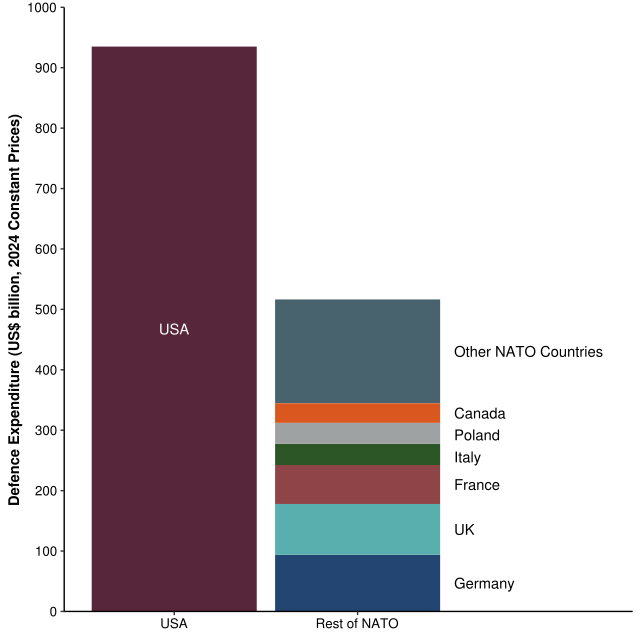
Germany’s defence expenditure increased by 24% in 2024, reaching $93.7 billion.
The USA maintains its position as the largest defence spender in NATO, with expenditure of $935 billion, representing 3.21% of their GDP. The USA spent nearly twice as much on defence in 2024 than the rest of NATO combined. The UK was the third highest spender in NATO, spending $84.2 billion on defence. This is the first year since 2014 where the UK has not been the second highest spender in NATO, being behind the USA and Germany. Germany spent an additional $18.2 billion in 2024 when adjusted for inflation, which is the biggest increase from the previous year among European NATO countries.
Figure 1: NATO countries defence expenditure (constant 2024 prices and exchange rate (US$)), 2024[footnote 1]
Source: NATO Defence Expenditures of NATO Countries (2014 to 2024), 28 August 2025
Description of Figure 1: Bar chart of defence expenditure of NATO members during 2024 in US$ billion. The USA is shown on the left of the chart, with the rest of NATO shown on the right. Countries that spent more than $30 billion on defence are listed separately and all other NATO countries are grouped together.
4. NATO Countries’ Defence Expenditure 2014 to 2024
This section describes defence expenditure of NATO countries since 2014 and differences in expenditure in the USA and other NATO countries over time.
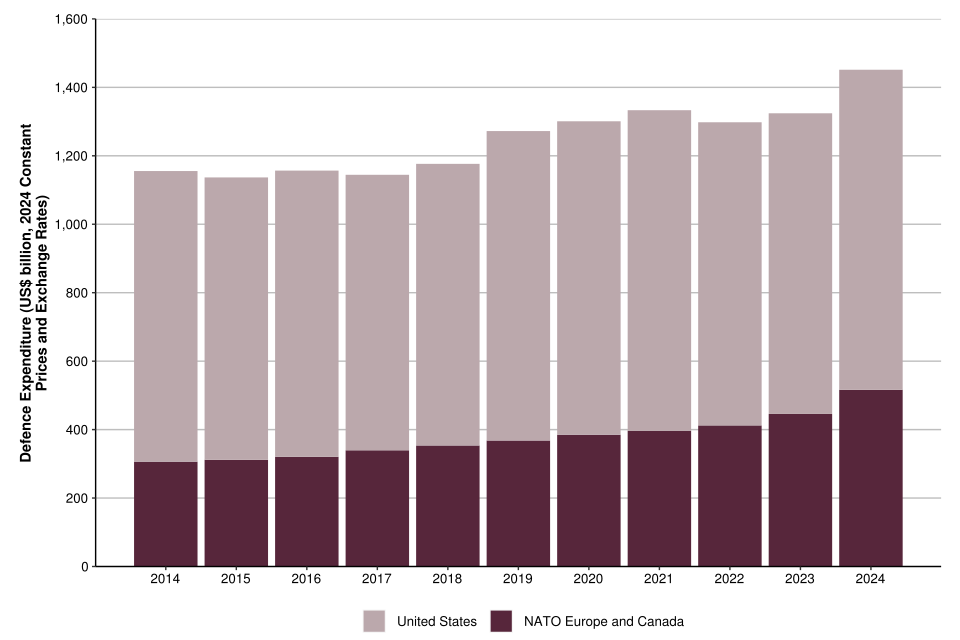
Total NATO spending has shown a 10% increase in real terms compared to 2023.
Between 2014 and 2024, total NATO spending has increased by $296 billion. In 2024, defence spending increased by $127 billion from the previous year, representing the biggest annual increase over the time series from 2014. NATO expenditure remains heavily influenced by the USA who alone accounted for 64% of the total in 2024, with an increase in USA spending of $56.5 billion. This brought the USA total defence expenditure up to $935 billion.
NATO Europe and Canada has shown a continued increase in defence expenditure since 2014, with an increase of 16% between 2023 and 2024. This is the largest year-on-year percentage increase since 2014. During this period they increased their spending by $70.7 billion.
Figure 2: NATO defence expenditure 2014 to 2024 (2024 constant prices and exchange rate (US$))[footnote 1]
Source: NATO Defence Expenditures of NATO Countries (2014 to 2024), 28 August 2025
Description of Figure 2: Stacked bar chart for comparison of USA defence expenditure compared to NATO Europe and Canada combined.
Germany, the UK and France are the three largest contributors to spending in NATO Europe and Canada.
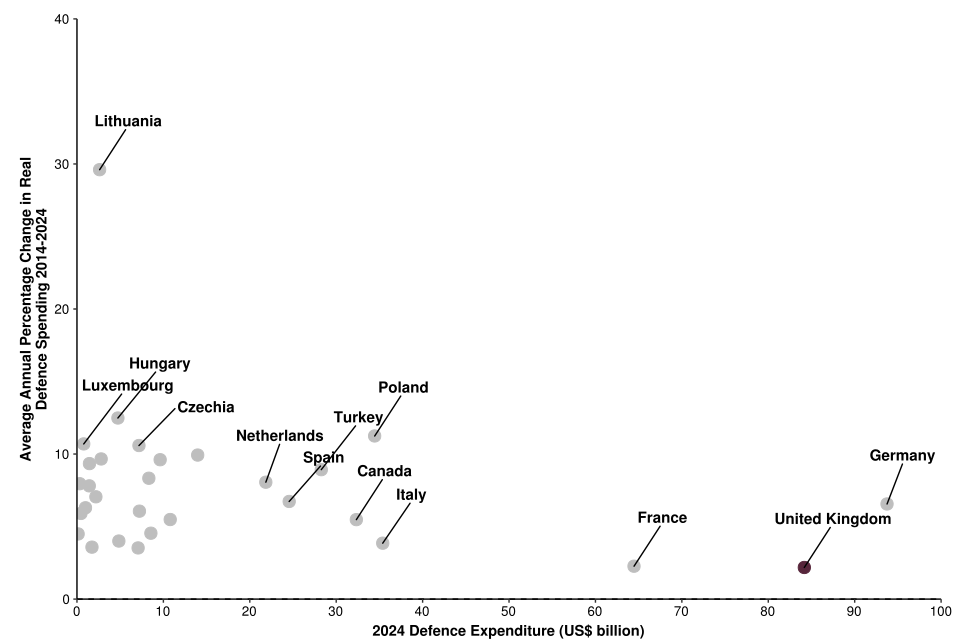
The chart below shows how the defence spending of NATO Europe countries changed between 2014 and 2024, in the context of their overall 2024 expenditure. Germany’s increase in expenditure is notable as it allows their defence spending to exceed that of the UK’s. Germany recently released its first national security strategy, which primarily aims to address military threats by playing a more central role in the security of the continent, particularly in NATO’s eastern flank.
While some European countries showed significant percentage growth, they have generally been the countries with a low level of defence expenditure. To demonstrate this, the UK showed an average increase of 2.2% between 2014 and 2024 which translates to an extra $16.3 billion. Meanwhile, Lithuania’s 29.6% increase during the same period only represents around $2.4 billion. This is why, despite some significant changes in spending patterns at a national level, the European total only increased slightly over this period.
Figure 3: Average percentage change in real defence spending of NATO Europe and Canada countries, 2014 to 2024[footnote 1]
Source: NATO Defence Expenditures of NATO Countries (2014 to 2024), 28 August 2025
Description of Figure 3: Scatter plot of changes in defence spending for NATO Europe countries between 2014 and 2024, in the context of their overall 2024 expenditure.
5. NATO Countries’ Defence Expenditure as a Percentage of GDP
This section describes defence expenditure of NATO countries as a percentage of GDP and outlines the countries which meet the NATO guideline for defence expenditure.
An additional eight countries are meeting the NATO target in comparison to the previous year.
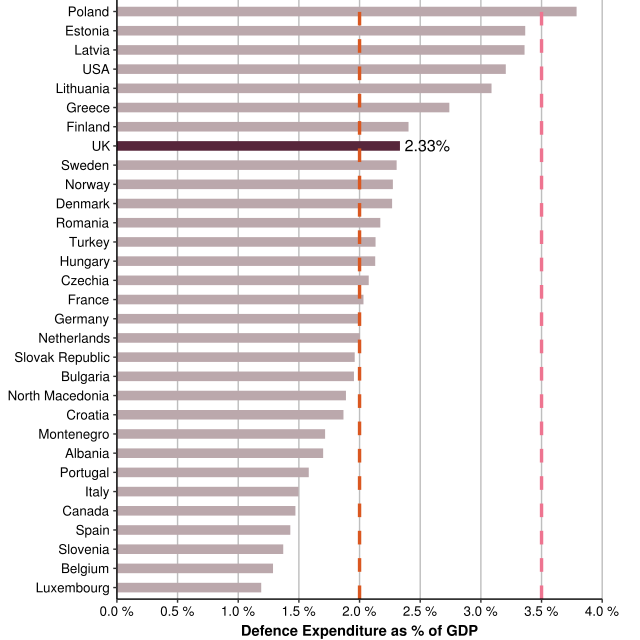
NATO sets a guideline for its members to spend at least 2% of national GDP on defence annually. The UK spent 2.33% of their GDP on defence in 2024, making the UK one of the 18 NATO members to meet the NATO guideline, as shown in Figure 4. The UK has met the NATO guideline every year since its introduction in 2006.
Poland remain first in the NATO rankings, spending 3.79% of GDP on defence. The main reasons for this include increased protection of borders, strengthening their industrial base, delivering armour and anti-armour systems to support Ukraine and the arrival of F-35 aircraft during an ongoing modernisation plan.
Czechia, France, Germany, the Netherlands, Norway, Romania, Sweden and Turkey have all surpassed the 2% target for the first time since 2014.
Luxembourg consistently spends the lowest percentage of GDP on defence, averaging just under 0.6% from 2014 through to 2024. However, they are expected to meet the 2% target next year based on current estimates.
At the 2025 NATO Summit in The Hague, allies made a commitment to allocate at least 3.5% of GDP annually based on the agreed definition of NATO defence expenditure by 2035 to resource core defence requirements and to meet the NATO capability targets. In 2024, Poland was the only country to meet this future target.
Figure 4: NATO countries’ defence expenditure as a percentage of GDP (2021 prices), 2024[footnote 1][footnote 2]
Source: NATO Defence Expenditures of NATO Countries (2014 to 2024), 28 August 2025
Description of Figure 4: Horizontal bar chart of defence expenditure as a proportion of GDP in NATO countries. Expenditure is arranged in descending order. Dashed lines at 2.0% and 3.5% highlight NATO’s current guideline for percentage of national GDP on defence and the 2035 future commitment, respectively.
6. NATO Countries’ Equipment Expenditure
This section describes equipment expenditure of NATO countries as a percentage of defence expenditure and outlines the countries which meet the NATO guideline for equipment expenditure.
Czechia moves from 23rd to fifth following its latest national security strategy.
NATO sets a guideline that its members should spend at least 20% of their defence budget on equipment. In 2024, the UK was one of 28 countries to meet this target, spending 33.36% of its defence expenditure on equipment. This is a continuing trend of the UK spending more on equipment in recent years and they have shown significantly high increases since 2020, only decreasing slightly between 2022 and 2023. The only countries not to meet the 20% NATO target in 2024 are Belgium, Canada and Portugal.
Luxembourg topped the equipment expenditure rankings with 51%, however this is inflated due to their low total spend.
Czechia’s proportion of defence expenditure on equipment expenditure increased from 23% in 2023 to 38% in 2024. This increase takes their equipment percentage spend from 23rd to fifth in NATO rankings, and was primarily driven by its recent national security strategy, aimed at enhancing cyber security, military modernisation and international crisis-management operations.
Denmark spent 31% of their defence expenditure on equipment, allowing them to surpass the NATO target for the first time since before 2014. This is more than double the proportion of expenditure they spent on equipment compared to 2023 and was mainly due to current defence modernisation priorities, including F-35A procurements, new ocean patrol vessels, upgrading the mechanised brigades’ armoured vehicles and the acquisition of short and long range air defence. This caused them to move from the bottom of the equipment expenditure rankings in 2023 to 12th in 2024.
France, Turkey, the UK, the USA, Norway, Sweden and Luxembourg are the seven countries to have consistently met the 20% target since 2014.
Figure 5: NATO countries’ equipment expenditure as a percentage of defence expenditure 2024[footnote 1][footnote 2]

Source: NATO Defence Expenditures of NATO Countries (2014 to 2024), 28 August 2025
Description of Figure 5: Horizontal bar chart of equipment expenditure as a proportion of overall defence expenditure in NATO countries. Expenditure is arranged in descending order. The dashed line at 20% highlights NATO’s current guideline for proportion of defence expenditure spent on equipment.
7. International Defence Expenditure Comparisons
This section provides an international comparison of defence expenditure using estimates from the Stockholm International Peace Research Institute (SIPRI) and the International Institute for Strategic Studies (IISS).
The UK remains fifth in the IISS rankings. Whilst the UK defence expenditure increased by $7.6 billion and surpassed India, it is outranked by Germany who’s spend increased by $22.3 billion between 2023 and 2024.
Comparisons of international defence expenditure are challenging due to the varying definitions of defence expenditure employed by the different organisations which publish estimates. Some widely used estimates of global defence spending are produced by the Stockholm International Peace Research Institute (SIPRI) and the International Institute for Strategic Studies (IISS). However, estimates and global rankings differ even between these sources, as can be seen in Table 1.
Table 1: Comparison of IISS and SIPRI total defence spending based on top 10 IISS countries, 2024 (US$)
| IISS Rank | Country | IISS Expenditure (US $billions) | SIPRI Rank | Country | SIPRI Expenditure (US $billions) |
|---|---|---|---|---|---|
| 1 | USA | 968.0 | 1 | USA | 997.3 |
| 2 | China | 235.0 | 2 | China | 313.7 |
| 3 | Russia | 145.9 | 3 | Russia | 149.0 |
| 4 | Germany | 86.0 | 4 | Germany | 88.5 |
| 5 | UK | 81.1 | 5 | India | 86.1 |
| 6 | India | 74.4 | 6 | UK | 81.8 |
| 7 | Saudi Arabia | 71.7 | 7 | Saudi Arabia | 80.3 |
| 8 | France | 64.0 | 9 | France | 64.7 |
| 9 | Japan | 53.0 | 10 | Japan | 55.3 |
| 10 | South Korea | 43.9 | 11 | South Korea | 47.6 |
Source: IISS Military Balance 2025, and SIPRI Military Expenditure Database 1949 to 2024
Description of Table 1: Table of the estimates of defence expenditure of NATO and non-NATO countries differ between IISS and SIPRI. The UK has a notable difference as they would be considered fifth or sixth on the global scale. To note, the country that ranked eighth using the SIPRI data was Ukraine with $64.7 billion spend.
China, whose armed forces remain the largest in the world, has substantially different estimates between the two sources. This is to be expected due to the absence of reliable, openly available figures for Chinese defence expenditure. The UK was considered the fifth largest global defence spender in 2024 according to IISS, and the sixth largest defence spender according to SIPRI.
India continue to upgrade their naval capability and security in the Indian Ocean, but drop to sixth in the IISS rankings. There was a difference of $0.7 billion in UK spend between IISS and SIPRI in 2024. The UK was considered the fifth largest global defence spender in 2024 according to IISS, and the sixth largest defence spender according to SIPRI.
8. Worldwide Military Expenditure 2024
This section provides an overview of countries defence expenditure as a percentage of global military expenditure.
NATO continues to outspend Non-NATO members.
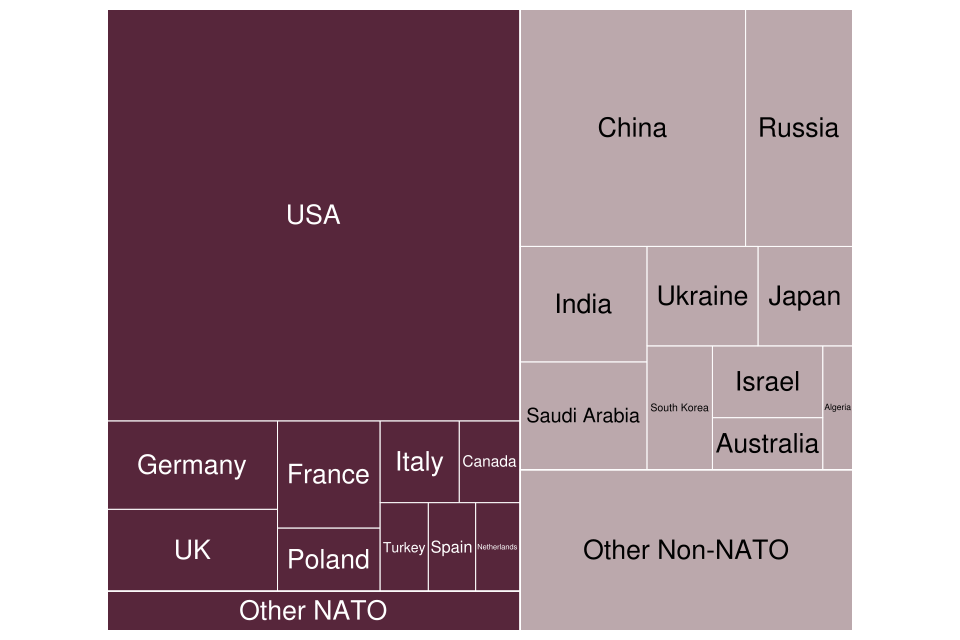
SIPRI provides global estimates of defence spending which are displayed as a proportion of total global spending below. Global military expenditure in 2024 was estimated by SIPRI to be $2,718 billion, an increase of $275 billion in nominal terms since 2023. Spending by NATO members made up 55% of all global military expenditure, which is consistent when compared to 2023.
Figure 6: Global military expenditure based on Market Exchange Rates (MER), 2024[footnote 3] [footnote 4]

Source: SIPRI Military Expenditure Database 1949 to 2024
Description of Figure 6: Tree map of the top ten military spenders for each of NATO and non-NATO according to SIPRI. Also displayed are the proportional splits of each.
The USA remained the largest spender in 2024, accounting for more than the rest of the top ten largest spenders combined and making up 37% of total global military expenditure. The UK increased their spend by $2.0 billion from 2023 according to revised SIPRI figures but drop down to third among the NATO members, having been overtaken by Germany. France remain beneath both of them in fourth.
In 2024, Ukraine stayed in fifth among the Non-NATO members and continued to rank eighth overall, spending approximately $64.7 billion on defence in 2024, principally to reinforce their counter-offensive to Russia’s ongoing invasion.
SIPRI has not published figures for the United Arab Emirates since 2014, but based on the last recorded figure of $27.4 billion, which is $37.5 billion when adjusted for inflation, they would have been in the top 20 highest spenders shown above, ranking between Australia and Italy.
9. Focus on NATO Allies 1980 to 2024
The following charts present a range of defence comparators for the UK, USA, France and Germany since 1980. These nations have been selected on the basis that they either have similar strategic postures, capabilities or force structures to the UK, or that the relative size of their respective defence budgets are comparable.
Definitions of defence expenditure have changed over time and differ between countries; this makes detailed comparisons between countries difficult. Considering this fact, data should only be used as an indication of trends and not as a definitive time series. From 2009 French defence expenditure excludes the Gendarmerie which is now financed separately by the Ministry of the Interior. This change more accurately reflects the NATO definition for defence expenditure, but has led to lower levels of defence spending, both in total and as a percentage of GDP.
9.1 Percentage of GDP
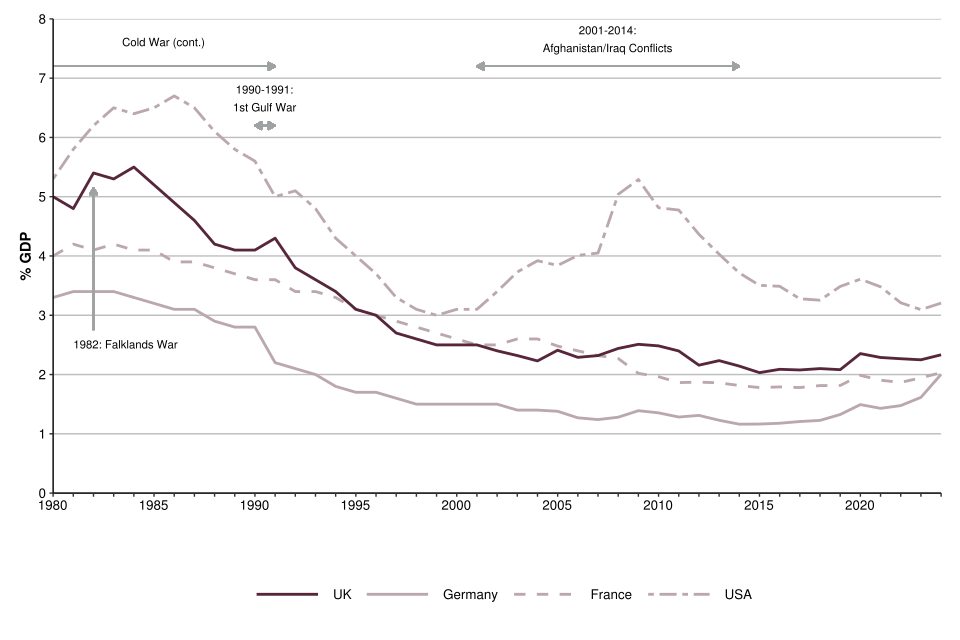
All four nations are now meeting NATO’s 2006 spending target of 2% of GDP for the first time.
Defence spending as a percentage of GDP began decreasing for all four nations in the early to mid-1980s as the Cold War drew to a close. This decrease continued throughout the 1990s after the end of the Cold War, with a brief increase in the UK and USA as a result of the first Gulf War. This decrease ended in the early 2000s because of military activity in Iraq and Afghanistan.
While spending as a percentage of GDP has remained relatively stable since 2000 in the UK and France, Germany have shown a more sustained increase in recent years and is reflective of a trend of spending more on defence. This trend is likely to continue in the coming years. USA defence spending as a percentage of GDP has been more variable. As a result of military activity in the Middle East, USA expenditure rose sharply to peak at over 5% of GDP in 2009 before then falling rapidly to 3.21% in 2024.
Figure 7: Defence spending as a percentage of GDP (constant prices), 1980 to 2024[footnote 1][footnote 5]
Source: NATO Defence Expenditures of NATO Countries (2014 to 2024), 28 August 2025
Description of Figure 7: Time series of defence spending as a percentage of GDP for the UK, France, Germany and the USA.
With Germany surpassing 2% of GDP in defence spending in 2024, all four nations are meeting the NATO target for the first time since its introduction at NATO’s 2006 Riga Summit. Germany saw their highest defence spending as a proportion of GDP since 1993, while France moved above the 2% target for the first time since 2009 when French defence expenditure began to exclude spending on its Gendarmerie.
9.2 Spending per Capita
UK spending per capita reached $1,216 in 2024, the highest UK spend in 37 years.
Spending per capita was relatively stable throughout the 1980s for most countries considered except the USA, whose spending increased during the first half of the decade, and then decreased during the latter. UK spending per capita was $1,216 in 2024, the highest figure seen in the UK since 1987.
Figure 8: Real Defence spending per capita (constant 2024 prices), 1980 to 2024[footnote 1]

Source: NATO Defence Expenditures of NATO Countries (2014 to 2024), 28 August 2025, and IMF World Economic Outlook Database (accessed 22 April 2025)
Description of Figure 8: Time series of defence spending per capita in constant prices for the UK, France, Germany and the USA.
9.3 Military Personnel by Population
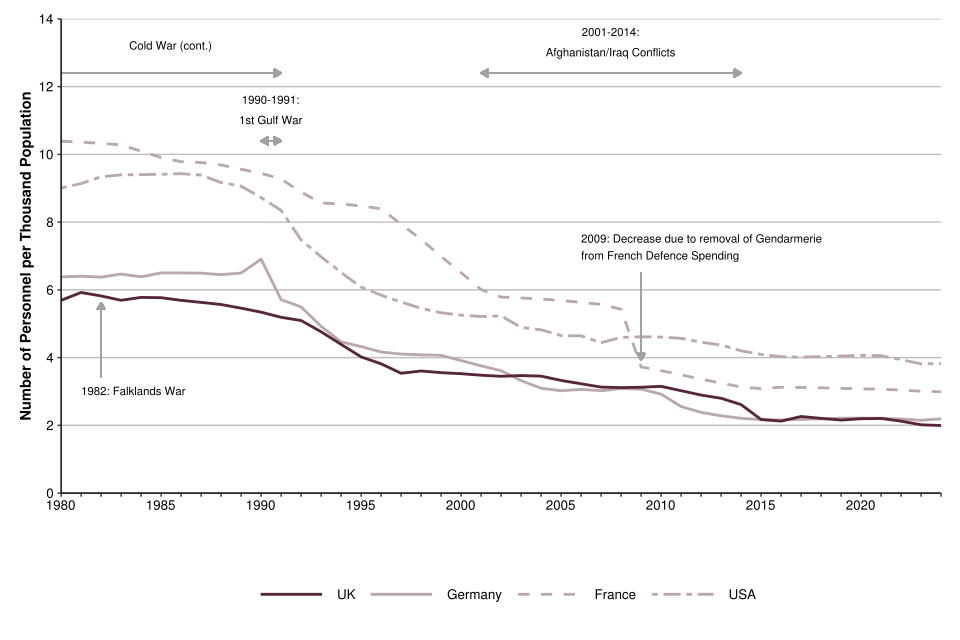
The UK has the lowest number of military personnel per thousand relative to the population since the time series started in 1980.
All four countries have seen a gradual decrease in the number of military personnel as a proportion of the total population since 1980. For all countries apart from Germany, these numbers were highest in the early 1980s. German estimates peaked in 1990, coinciding with reunification following the end of the Cold War, before undergoing a rapid decrease because of restrictions on the size of Germany’s military, a condition of reunification[footnote 6].
Figure 8 showed that USA expenditure per person increased substantially between 1999 and 2009. However, the actual number of military personnel per thousand population in Figure 9 shows a decrease over the same period. This would indicate that this additional finance was more likely spent on resources rather than on personnel.
Figure 9: Number of military personnel per thousand population, 1980 to 2024[footnote 1][footnote 7]
Source: NATO Defence Expenditures of NATO Countries (2014 to 2024), 28 August 2025, and IMF World Economic Outlook Database (accessed 22 April 2025)
Description of Figure 9: Time series of military personnel per thousand population for the UK, France, Germany and the USA.
As mentioned earlier, France updated its definition of defence expenditure in 2009 to exclude that on the Gendarmerie. The result was a dramatic decrease in French personnel per thousand population that year. Germany saw a similar, though much smaller, decrease after 2010 due to the abolition of conscription. The UK witnessed a fall in the number of military personnel per thousand population in 2014. This dropped further in 2015 and has remained at a low level ever since. The approach to recruiting, educating, training and retaining the people needed for defence is one of the key issues considered in the Strategic Defence Review 2024/25.
9.4 Spending per Service Person
Spending per service person has increased for all four countries since 2022.
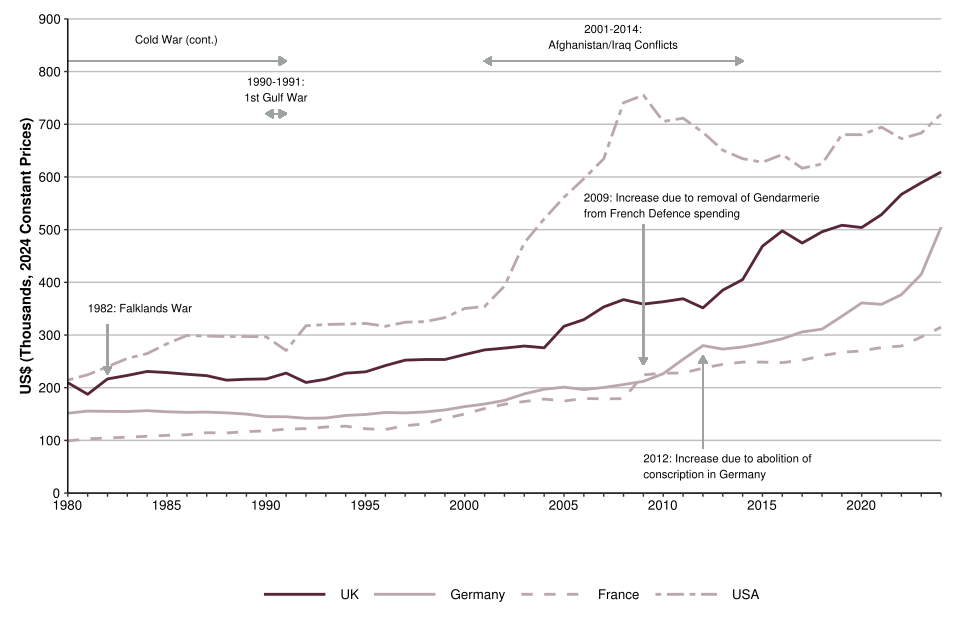
Military expenditure per service person was relatively consistent from 1980 to 2000 for all four nations (the USA and UK only undergoing very gradual increases). Since 2000 all four countries have increased their spending per Service person. This increase has been relatively gradual in France; spurred on by the reclassification of the Gendarmerie. Germany, however, has shown a more sustained level of annual increases in recent years (following a more similar trend to the UK).
The UK has increased spending per service person by $105,000 between 2020 and 2024. This is due to a combination of a decrease in military personnel by 9,000 as well as a large increase in defence spending over this period of $396.8 billion, due to the multi-year budget settlement announced for Defence in November 2020. This is a similar explanation for France and Germany’s increase during these years.
Figure 10: Real defence spending per service person (constant 2024 prices), 1980 to 2024[footnote 1]
Source: NATO Defence Expenditures of NATO Countries (2014 to 2024), 28 August 2025
Description of Figure 10: Time series of defence spending per service person in constant prices for the UK, France, Germany and the USA.
Expenditure per service person in the USA ceased its considerable rise in 2009 after peaking at $755,000 per person. From 2010 to 2016 its military personnel reduced by 126,000, and over the same period US expenditure fell by a total of $170 billion (in constant 2024 prices). The drop in expenditure greatly outweighed the falling personnel numbers causing the decrease shown in Figure 10. Since 2017, the reverse is true whereby military personnel has decreased by 0.4% relative to a 16% increase in total defence expenditure.
10. Methodology
10.1 Data Quality
This short section on methodology sets out some simple processes and methods used in the compilation of some of the tables and charts used in this bulletin. More detailed explanations of the data sources and methodologies used can be found in the related data tables and Background Quality Reports.
10.2 Sources of International Defence Data
International Defence Statistics are available in a variety of publications and on a substantial number of websites. The UK Ministry of Defence has no control over the quality, reliability and coverage of data contained within these sources and does not endorse any specific output.
Data provided in this publication fall outside the scope of Official Statistics and as such, must be regarded as illustrative only.
10.3 Limitations of International Defence Data
Making international comparisons of defence presents a number of widely documented issues relating to the comparability and granularity of the international source data. Making direct comparisons will never be straightforward because:
- Defence expenditure data are merely input measures which give them only limited usefulness as an indicator of military strength, capability or burden.
- Whilst there are standardised definitions of defence spending and accounting conventions used by international organisations, principally the UN and NATO, not all countries record and publish their defence spending in accordance with such definitions and conventions.
- Some countries’ actual defence expenditure may be very different from their budgeted expenditure.
- Differences in national tax regimes and the treatment of pension contributions can lead to significant distortions in expenditure.
- Departments other than defence departments may be deemed to contribute to defence whilst some spending by defence departments can be categorised as supporting other activities.
- The choice of conversion method (for example, Market Exchange Rates (MER) or Purchasing Power Parity (PPP)) used to convert to a common currency or from current to constant (real terms) prices can result in significantly different rankings of global defence spending (see Figure 8). Using MER for instance tends to undervalue the currency and hence the scale of expenditure of lower income countries. Attempts are often made to circumvent this problem using PPP rates. These use currency conversion rates which equalise the overall price of a bundle of goods and services in each country. However PPP rates can be highly inaccurate because of the difficulty of allowing for differences in quality and devising appropriate and relevant “weighting” of individual goods and services. Civilian based PPPs may also not be representative of defence goods and services.
While these problems are less significant in relation to the comparison of defence spending between NATO members, they are substantial in relation to global comparisons.
10.4 Note on NATO definition
NATO publishes an annual compendium of financial, personnel and economic data for all member countries. The NATO definition of defence expenditure differs from national definitions so the figures quoted may diverge considerably from those presented in national budgets. More information relating to the revised NATO definition can be found on the NATO website.
10.5 NATO Expenditure – Constant Prices and Exchange Rates
The estimates presented in Figure 2 are based on constant 2024 prices and, as far as possible, constant 2024 exchange rates.
The deflators used to convert current price totals into 2024 constant figures were inferred from the NATO release using the current price estimates and the constant 2021 price estimates. Exchange rates are inferred from US$ and local currency totals reported in the NATO press release.
The estimates presented in Figure 2 are the sums of the national totals calculated as above.
11. Glossary
Constant Prices (Real Values) are price values expressed in the currency value of a particular period (usually a single year). Typically used when comparing spending across a time series, in order to ensure that any changes are due to actual changes in expenditure, rather than factors such as shifts in currency value or inflation.
Current Prices (Outturn Prices) are the prices of the period when the expenditure actually occurred.
Gendarmerie (National) is one of the two national police forces of France along with the National Police. It is a branch of the French Armed Forces placed under the jurisdiction of the Ministry of the Interior with additional duties to the Ministry of Defence.
Gross Domestic Product (GDP) (at market prices) is the value of goods and services produced within a country’s borders in a year. Economic data are often quoted as a percentage of GDP to give an indication of trends through time and to make international comparisons easier.
Gross Domestic Product Deflator is an implicit price deflator for the Gross Domestic Product and is derived by dividing the estimate of GDP at current prices by the estimate of GDP at constant prices. The GDP Deflator is commonly used as a measure of inflation in the economy for the country to which it refers.
IISS stands for the International Institute for Strategic Studies, which is a global think tank that researches political and military conflict.
Market Exchange Rate (MER) is a currency exchange rate determined largely by market forces.
Ministry of Defence (MOD) is the United Kingdom Government Department responsible for implementation of Government defence policy and is the headquarters of the British Armed Forces. The principal objective of the MOD is to defend the United Kingdom and its interests. The MOD also manages day to day running of the armed forces, contingency planning and defence procurement.
NATO stands for North Atlantic Treaty Organisation. An alliance whose purpose is to guarantee the freedom and security of its members through political and military means.
Nominal Terms is a year-on-year comparison of current prices, not adjusted for the effects of inflation.
Purchasing Power Parity (PPP) is a method of measuring the relative purchasing power of different countries’ currencies over the same types of goods and services. Because goods and services may cost more in one country than in another, PPP allows us to make more accurate comparisons of standards of living across countries. The estimates use price comparisons of comparable items but since not all items can be matched exactly across countries and time, the estimates are not always “robust.”
SIPRI stands for the Stockholm International Peace Research Institute, which is an international institute that researches conflict, armaments, arms control and disarmament.
12. Further Information
12.1 Rounding
Where rounding has been used, totals and sub-totals have been rounded separately and so may not equal the sums of their rounded parts.
12.2 Revisions
Corrections to the published statistics will be made if errors are found, or if figures change as a result of improvements to methodology or changes to definitions. When making corrections, we will follow the Ministry of Defence Statistics Revisions and Corrections Policy. All corrected figures will be identified by the symbol “r”, and an explanation will be given of the reason for and size of the revision. Corrections which would have a significant impact on the utility of the statistics will be corrected as soon as possible, by reissuing the publication. Minor errors will also be corrected, but for convenience these corrections may be timed to coincide with the next annual release of the publication.
12.3 Contact Us
The Analysis Directorate welcomes feedback on our statistical products. If you have any comments or questions about this publication, or about our statistics in general, you can contact us as follows:
Analysis Directorate (Analysis-Expenditure)
Telephone: 0303 378 6554
Email: Analysis-Expenditure-PQ-FOI@mod.gov.uk
If you require information which is not available within this or other available publications, you may wish to submit a Request for Information to the Ministry of Defence under the Freedom of Information Act 2000.
If you wish to correspond by mail, our postal address is:
Analysis Directorate (Analysis-Expenditure)
Ministry of Defence
Teak, Level 1, Wing 3
MOD Abbey Wood North
Bristol
BS34 8QW
For general MOD enquiries, please call: 020 7218 9000
-
Figures for 2024 are provided as estimates. ↩ ↩2 ↩3 ↩4 ↩5 ↩6 ↩7 ↩8 ↩9
-
Iceland is a member of the Alliance but has no armed forces. ↩ ↩2
-
The figures on this page have been calculated using SIPRI definitions of defence expenditure and therefore may differ from information based on the NATO or IISS definition. ↩
-
Tree map of the Top 10 military spenders for each of NATO and non-NATO according to SIPRI. Also displayed are the proportional splits of each. ↩
-
Historic figures in this chart differ from those shown in the 2024 bulletin due to exchange rate variations and updates to NATO expenditure figures that have since occurred. ↩
-
The Treaty on the Final Settlement with Respect to Germany. Relevant section is Article 3, paragraph 2. ↩
-
Historic figures in this chart, in particular the UK, may differ slightly from those shown in the 2024 bulletin due to revisions to population figures in the IMF World Economic Outlook Database and updates to NATO military personnel figures. ↩