Hybrid Working Accommodation Trial survey: report
Published 5 December 2025

© Crown copyright 2025
This publication is licensed under the terms of the Open Government Licence v3.0 except where otherwise stated. To view this licence, visit nationalarchives.gov.uk/doc/open-government-licence/version/3 or write to the Information Policy Team, The National Archives, Kew, London TW9 4DU, or email: psi@nationalarchives.gov.uk.
Where we have identified any third party copyright information you will need to obtain permission from the copyright holders concerned.
This publication is available at https://www.gov.uk/government/publications/hybrid-working-accommodation-trial-survey/hybrid-working-accommodation-trial-survey-report
1. List of abbreviations
HRG Hoggs Robinson Group
HWA Hybrid Working Accommodation
HWAT Hybrid Working Accommodation Trial
JPA Joint Personnel Administration
MOD Ministry of Defence
SSSA Substitute Service Single Accommodation
SP Service personnel
SLA Single Living Accommodation
2. Executive Summary
The Ministry of Defence (MOD) provides Service personnel (SP) and their families in the UK Armed Forces with subsidised accommodation and support to aid workforce mobility, operational readiness, and capability. To find out more about the Defence Accommodation Policy visit the MOD Tri-Service Accommodation Regulations (Joint Service Publication 464).
Over recent years, SP have had the opportunity to work more flexibly in their roles and adopt a hybrid working approach, which allows them to work both at their duty station and their home. However, there is a gap in MOD accommodation policy as there is no permanent accommodation policy to support hybrid working.
The Hybrid Working Accommodation Trial (HWAT) was launched in 2021 to create a new accommodation option for those who choose to hybrid work. Through HWAT, SP are able to stay in hotels when working at their duty station. HWAT aims to allow SP to work flexibly between their duty station and another property (family home, owned accommodation etc) to create a good work life balance.
The MOD Accommodation Policy Team wanted to understand SP experiences of HWAT and whether HWAT a) enables operational effectiveness, b) meets SP needs.
The MOD Accommodation Analysis Team therefore conducted an online survey with SP who were part of the trial to understand their experiences of HWA. 66 responses were received. The survey findings have been used to inform and shape decisions on the future design of Hybrid Working Accommodation (HWA) policy.
2.1 Key findings
Use of Hybrid Working Accommodation
-
Most (80%) respondents booked their latest hotel through the HWAT booking tool.
-
Key reasons for not using the HWAT booking tool included problems using the HWAT booking system and limited availability/ choice of hotels through HWAT.
-
Most respondents spent 2 to 3 nights a week staying in hybrid working accommodation.
-
Over half of respondents were not able to book the same hotel each time.
Lived experience of Hybrid Working Accommodation
-
Overall, most survey respondents are satisfied with all elements of HWA.
-
Respondents are most satisfied with distance from hotel to place of work and the service provided by the hotel.
-
Improvements suggested by respondents include being able to book the same hotel and have access to storage.
-
Most survey respondents (over 90%) agreed the meals provided at HWA met their dietary requirements and were good quality.
Impact of Hybrid Working Accommodation
-
Most respondents agree that the hotel provision supports their ability to hybrid work and has improved their work life balance.
-
Approximately two thirds of respondents agree that if HWA was not available, they would consider leaving the Armed Forces.
Future Hybrid Working Accommodation
-
Most respondents think HWA should be available for SP staying 1 night or more, whereas Substitute Single Service Accommodation (SSSA) should be for SP staying 3 or 4 nights. SSSA is provided to SP when there is insufficient SLA available.
-
Half of respondents would not want to share SSSA with another SP.
-
74% of respondents thought HWA would be appropriate for all Defence locations, particularly where there is insufficient Service accommodation at the base and where it works out cheaper for Defence.
-
76% of respondents feel HWA is better or the same as SSSA.
-
Most respondents (84%) would like allowances to be given to purchase meals at a location of their choice in the future, rather than provided at the hotel.
3. Introduction and purpose of the research
The Ministry of Defence (MOD) provides Service personnel (SP) and their families in the UK Armed Forces with subsidised accommodation and support to aid workforce mobility, operational readiness, and capability. To find out more about the Defence Accommodation Policy visit the MOD Tri-Service Accommodation Regulations (Joint Service Publication 464).
Over recent years, SP have had the opportunity to work more flexibly in their roles and adopt a hybrid working approach, which allows them to work both at their duty station and their home. However, there is a gap in MOD accommodation policy as there is no permanent accommodation policy to support hybrid working.
The Hybrid Working Accommodation Trial (HWAT) was initially launched in 2021. It was designed to create a new accommodation option for those who choose to hybrid work. Through HWAT, SP are able to stay in hotels when working at their duty station. SP at HWAT locations were able to join the scheme if the following conditions were met:
-
They are required to work at a duty station for less than 4 nights per week (or less than 16 nights per month) and are therefore not entitled to Substitute Single Service Accommodation (SSSA), which is often a flat or similar provided to SP when there is insufficient Single Living Accommodation (SLA) available at their duty station;
-
Their permanent home address is over 50 miles from their duty station;
HWAT was initially launched in London due to insufficient SLA to accommodate hybrid workers. Since then, it has been launched in Glasgow and Bristol, due to insufficient SLA at these locations too. There are two or more hotels available at each location, so SP have choice depending on hotel availability. Where possible, the hotels used for HWA are within 10 minutes walking distance of the duty station, to match the commute SP would have if they were accommodated in SLA. In Bristol, as the duty station is not located within the city this was not possible due to lack of hotels within walking distance.
HWAT aims to allow SP to work flexibly between their duty station and another property (family home, owned accommodation etc) to create a good work life balance. The trial is led by the MOD Accommodation Policy Team and is open to all ranks from across the three services of Royal Navy including Royal Marines, Royal Air Force and British Army including if they are working for Top Level Budgets (MOD Head Office).
There is a distinct online system for SP to book hotels when on the HWAT, referred to as the HWAT booking tool. When they book a room through this system, there is an option for SP to book their meals. However, some SP prefer not to eat at the hotels and claim costs for food outside of the hotel through subsistence instead via Joint Personnel Administration (JPA). All SP on HWAT receive home to duty allowance through JPA, which covers travel costs to and from their duty station. SP are able to use hotel storage if this is available at the hotel without a cost. If there is a cost, it is expected the SP pays for this. The facilities and services available to SP vary by hotel and location.
Prior to HWAT, SP were able to book hotels through MOD’s internal travel system (Hoggs Robinson Group (HRG) system, now AMEX Global Business Travel). However, HRG was not designed as a long-term solution, but may still be used by some SP if/when hotels are unavailable through the HWAT booking tool.
There was a lack of detailed comprehensive data on SP’s views and experiences of HWAT or booking hotels through HRG. Therefore, the Accommodation Policy Team wanted to understand SP experiences of HWAT and whether HWAT a) enables operational effectiveness, b) meets SP needs. In this context, operational effectiveness is the ability for SP to hybrid work.
The MOD Accommodation Analysis Team therefore conducted an online survey with SP to understand their experiences of HWA.
The survey findings have been used to inform and shape decisions on the future design of HWA policy.
4. Research Questions
Research questions were developed by the MOD Accommodation Analysis Team, working in collaboration with the Accommodation Policy Team, to understand the requirements for the survey.
The survey aimed to answer the following research questions:
What has been the lived experience of SP using hotels for hybrid working through the HWAT?
-
What has worked well for SP?
-
What could be improved about hybrid working accommodation?
To what extent does HWAT support people related outcomes including:
-
Meet SP expectations and needs?
-
Support operational effectiveness?
-
Support work life balance?
-
Support job satisfaction?
What are SP views on the future of hybrid working accommodation?
-
Do SP think HWAT would be beneficial in all Defence locations, or should it be limited to headquarters?
-
What do SP think the threshold number of nights required to stay per week should be for SP to be offered SLA on a temporary or permanent basis?
-
Would SP be content to share SSSA to support hybrid working?
5. Methodology
5.1 Survey design
An online survey was deemed to be the most suitable method for data collection as it allowed for larger-scale collection of data with both closed and open questions which is sufficient to answer the research questions.
A survey was selected over qualitative data collection as it was important to get a breadth of responses from as many SP on the trial as possible.
Furthermore, a survey was less burdensome for SP to complete. The survey took 10 minutes to complete, at a time and location suitable to the SP, opposed to qualitative data collection which can often take 30-45 minutes. The survey was originally designed in 2022. However, there was uncertainty on whether the trial would be possible to continue due to tax implications. Although the trial continued in the meantime, it’s longer-term future was unclear, therefore the survey was not launched. In 2023 the Armed Forces recommended the roll-out of hybrid working accommodation more widely and approval from HMRC to continue the trial whilst exploring tax considerations was received in 2024. It was therefore important to conduct the survey to understand) SP experience of HWAT ahead of any potential future roll out.
The survey questions (Annex A) were designed by badged Government Social Researchers (About Us – Government Social Research Profession – GOV.UK) in the Accommodation Analysis Team, in collaboration with the Accommodation Policy Team to ensure it met their needs and would answer the research questions.
5.2 Sample and recruitment
The survey was conducted as a census to ensure all SP who were currently or had previously been on the HWAT had the opportunity to participate. SP were eligible for HWAT if the following conditions were met:
-
They are required to work at a duty station for less than 4 nights per week (or less than 16 nights per month) and are therefore not entitled to Substitute Single Service Accommodation (SSSA), which is often a flat or similar provided to SP when there is insufficient Single Living Accommodation (SLA) available at their duty station;
-
Their permanent home address is over 50 miles from their duty station;
A census was chosen over a sample survey given the limited number of SP on the HWAT.
The survey was anonymous and response to the survey was voluntary. Participant information was provided at the start of the survey, to ensure informed consent. The survey was estimated to take approximately 10-15 minutes to complete.
5.3 Survey distribution and communications
The survey was distributed as on online survey link through an email directly to all SP who took part in the HWAT. The email addresses were provided by the Accommodation Policy Team. The email addresses of SP were not linked to their survey responses.
A follow up email was sent to SP a week before the survey deadline, to remind SP to complete the survey.
5.4 Data input
The survey was open from 28th February 2024 to 2nd April 2024. The survey responses are held securely on MOD servers.
5.5 Response rates
91 SP were invited to participate in the survey. Overall, 66 survey responses were received. This is a total response rate of 73%.
5.6 Data cleaning
All responses were downloaded from the survey platform. Manual checks were conducted by the research team to ensure the data had been downloaded accurately. All respondents gave consent to participate in the survey, so no responses were removed. Where appropriate, questions were recoded to simplify the output. For example, ‘Other’ responses were re-coded into relevant categories and 5-point Likert scale responses were recoded into a 3-point positive, neutral and negative scale.
5.7 Data analysis
Missing values, where respondents had not provided a response/valid response, were not included in the analysis. As a result, the unweighted counts (or ‘n’) varies from question to question.
The survey data was not weighted, because the Service and rank of HWAT users was not known.
Raw counts and proportions were produced for each survey question. Charts were produced from unrounded data and are presented as whole numbers. Percentages may not always equal 100 due to rounding.
Thematic analysis was used for open-ended questions. Thematic analysis is aimed at systematically describing the meaning of qualitative data by assigning codes to the data, then identifying themes that emerge from the codes. An inductive approach was used for this research, meaning the data determined the themes which emerged. The open-ended responses were coded by a Government Social Researcher. The codes were then grouped into themes. Quotes used in this report have been provided from the responses. They have only been edited for grammatical errors, clarity or brevity.
5.8 Ethics
The research was approved by the Royal Navy Scientific Assessment Committee (SAC) in December 2022. Minor revisions to the survey questions were made in January 2024 and re-submitted to the Royal Navy SAC secretariat. The revisions included removing questions no longer required for analysis (ethnic group), reducing the number of open-ended questions to reduce respondent burden, and adding a few additional response options to meet a new research aim of understanding to what extent HWA supports operational effectiveness. These revisions were not considered substantial changes, but simplifications and therefore a SAC re-review was not considered necessary by the secretariat.
Whilst undertaking the research, the following steps were taken to ensure the research was ethical:
-
Specific and informed consent was gained from respondents at the start of the survey. Respondents could not proceed until they had provided their consent. Respondents could leave the survey at any time.
-
Respondents were made aware of how their data would be stored, kept and used within the survey in line with GDPR.
-
The survey was anonymous; SP were informed their information would not be shared with their Chain of Command.
-
The survey was accessible to those without a MOD IT account.
-
To reduce burden on SP, we only asked questions which were essential to answer the research questions and streamlined the survey questions to contain as few open-ended questions as possible.
-
It was made clear to respondents that their participation was voluntary.
5.9 Quality assurance
The survey plan, including methodology and data analysis were quality assured by a Principal Social Researcher.
The quantitative analysis was quality assured by a Government Social Researcher not directly involved in the analysis. Quality assurance involved checking each formula to each question.
The qualitative analysis was quality assured by a second Government Social Researcher independently coding a sub-sample of the survey responses. Any discrepancies were discussed and resolved by checking the original responses.
The final research report was quality assured by both a Government Social Researcher within the Accommodation Analysis Team and a Government Social Researcher external to the Accommodation Team, but within MOD. This ensured the report met MOD and Government Social Research profession standards.
5.10 Limitations of the research
It is not known whether the research is reflective of the entire Armed Forces as there is limited demographic data available on HWAT users. Therefore, the findings cannot be generalised to the whole population.
Due to the size of the sample, it was not possible to explore differences in responses between Services, ranks or individual hotels.
6. Findings
6.1 Use of Hybrid Working Accommodation
This section covers survey respondents use of HWA, including how they booked the latest hotel they stayed in, where this was and how often they use HWA.
Survey respondents were asked how they booked the last hotel they used for hybrid working. Most survey respondents (80%) booked their latest hotel through the HWAT booking tool. 20% of survey respondents booked their latest hotel through HRG/AMEX global. In no particular order, key reasons these survey respondents did not use the HWAT booking tool were:
-
Issues using the HWAT booking system, such as difficulties getting an account set up, issues logging in to the system and/or finding the tool more difficult to use than HRG.
-
No hotels or suitable rooms available on HWAT and/or more choice on HRG.
-
HWAT hotels being more expensive than booking hotels through HRG.
-
No longer being eligible for HWAT, for example because they were no longer in a hybrid role.
Survey respondents were asked where the latest hotel they booked was. 67% of survey respondents most recently booked a hotel in London, 32% in Glasgow and 2% in Bristol.
Survey respondents were also asked how many nights on average, they spend a week at hybrid working hotels. The most common answer was two nights (46% of survey respondents), followed by three nights (29%), one night (17%), less than one night (6%) and 4 nights 2%).
Survey respondents were asked whether they were able to book the same hotel each time. Figure 1 shows the proportion of survey respondents who were and were not able to book the same hotel each time. The data for this graph can be found in Reference Table 5.
Figure 1: Proportion of survey respondents who were able to book the same hotel each time or not (N=65)
Caption: The pie chart shows over half of survey respondents were able to book the same hotel each time.
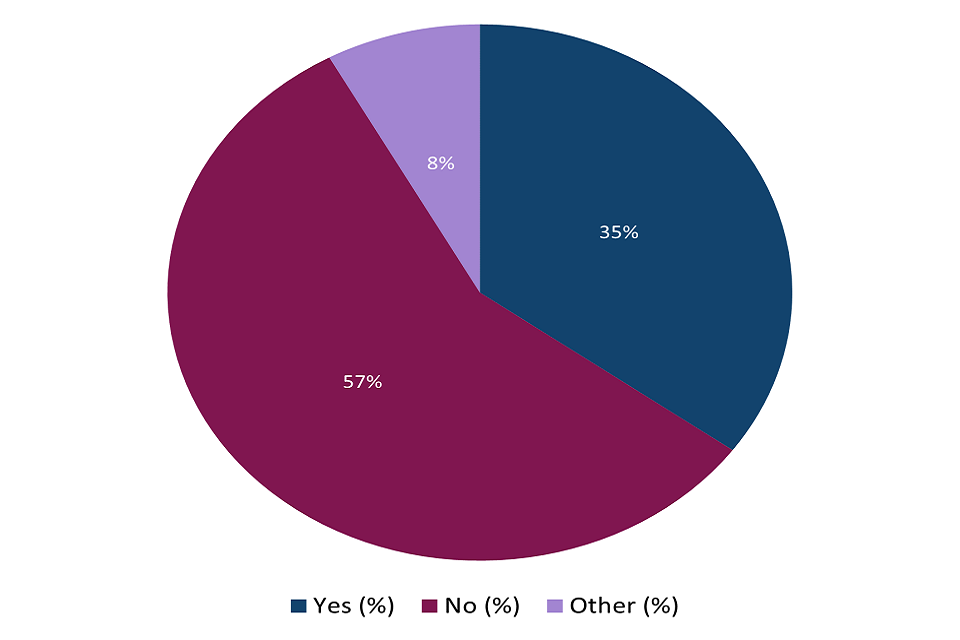
Alt text: The pie chart shows 57% of of survey respondents were able to book the same hotel each time, 35% were not able to book the same hotel each time and 8% reported other.
57% of survey respondents had not been able to book the same hotel each time, 35% had been able to book the same hotel each time and 8% of survey respondents answered ‘Other’. Most ‘Other’ responses were reporting they generally or mostly were able to book the same hotel each time.
6.2 Lived experience of HWA
This section covers survey respondents’ satisfaction with various elements of HWA.
Survey respondents were asked how satisfied they were with elements of HWA. Figure 2 shows the proportion of survey respondents who were satisfied, neither satisfied nor dissatisfied or dissatisfied with elements of HWA. The data for this figure can be found in Reference Tables 6-15.
Figure 2: Proportion of survey respondents who were satisfied, neither satisfied nor dissatisfied or dissatisfied with elements of HWA (N= 63)
Caption: The bar chart shows the majority of survey respondents are satisfied with all elements of hybrid working accommodation.
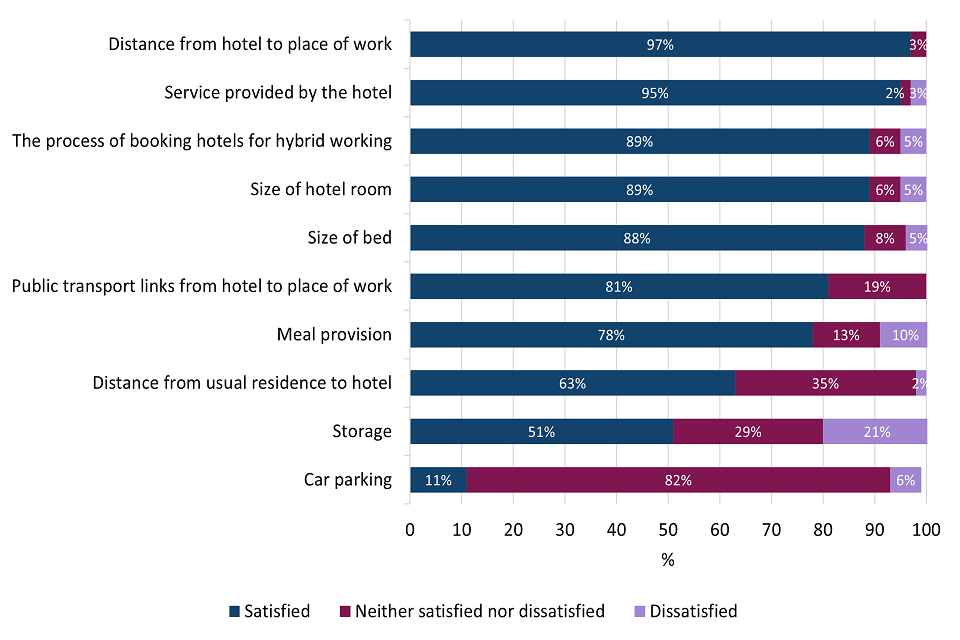
Alt text: The bar chart displays the proportion of survey respondents who were satisfied, neither satisfied nor dissatisfied or dissatisfied with elements of hybrid working accommodation. Over 90% of survey respondents were satisfied with distance from hotel to place of work and the service provided by the hotel. Over 80% were satisfied with the booking process, size of hotel room, size of bed and public transport links. Storage was the aspect survey respondents were most dissatisfied with, at 21%.
Overall, most survey respondents are satisfied with all elements of HWAT.
The entire HWAT experience has been really positive. Simple, on-demand accommodation that let’s me get on with my work. I typically use HWAT one night a week, but which night that is, and using it more than one night presents no issues. I love that it has a low burden of admin. The hotel itself is good - they are always helpful, the room is always clean and well appointed. The gym is good, the food is good. And it all just works. [Officer, Royal Navy]
Overall, 97% of survey respondents were satisfied with the distance from the hotel to their place of work. Survey respondents reported they appreciated that hotels were often within walking distance of the office and welcomed that hotels were closer to their place of work than SSSA would be.
The convenience of the hotel location makes this an extremely attractive option [Other Rank, Army]
95% of survey respondents were satisfied with the service provided by the hotel. Survey respondents were particularly satisfied with the smooth check in process and friendly/polite staff. Reasons for dissatisfaction included feeling MOD were treated less favourably than other customers, they had unexpected service charges applied to their meals provided by the hotel and/or they felt the hotel had poor processes.
89% of survey respondents were satisfied with the process of booking hotels. Respondents described this as a simple process once they had their account set up. They reported there was good availability when booking hotels in advance and liked that payments were made automatically rather than claiming back costs later.
It is easy to book (and cancel where necessary). The hotel is paid for by the bill-back process and includes an allowance for dinner. This reduces the administration burden and having to claim back expenses. [Officer, Royal Air Force]
5% of survey respondents were dissatisfied with the booking process. Reasons for this included an inability to modify bookings through the system, lack of available hotels if booking at short notice, an ability to book the same hotel consistently, HWAT showing unavailable rates and/or issues getting their account set up.
Booking the hotel through the HWAT portal is fine however making any changes to the booking is often painful, as rather than amending the booking it cancels the stay and you then have to re-book. This often results in you not being able to get a room as the prices are higher than when you book. The work around is to call HRG, they are helpful, but it takes a disproportional amount of time to make the change. Also, as the hotel is booked by HRG the hotel say they can’t amend your booking directly at reception. [Other Rank, Army]
89% of survey respondents were satisfied with the size of the hotel room.
88% of survey respondents were satisfied with the size of the bed. 5% of survey respondents were dissatisfied with the size of the bed; these respondents felt a single bed was not sufficient.
81% of survey respondents were satisfied with the public transport links to their place of work.
78% of survey respondents were satisfied with the meal provision. Respondents reported they were satisfied as they were glad meal(s) were included and that breakfast was good. 10% of survey respondents were dissatisfied with the meal provision. Key reasons for this were the cost of food at the hotel not being covered by the subsistence provided, unhealthy options and inability to aggregate subsistence over multiple days.
63% of survey respondents were satisfied with the distance from usual residence to their hotel.
51% of survey respondents were satisfied with storage and 21% of survey respondents were dissatisfied with storage. Key reasons for dissatisfaction with storage were lack of storage to store military kit and other necessities they use on a weekly basis (such as toiletries) available between visits and difficulties accessing storage when it was given. However, some survey respondents did note storage between visits was available on request.
I only just realised there was storage available downstairs which makes it even better - I don’t have to lug the same stuff back and forward each week. [Officer, Army]
82% of survey respondents were neither satisfied nor dissatisfied with car parking. This may be due to respondents not having a need for car parking due to taking public transport and the city centre location of hotels. 6% of survey respondents were dissatisfied with car parking. Key reasons for dissatisfaction were no car parking being available and relating to this, hotels in London being in a congestion zone.
Some survey respondents reported other aspects of HWA which they were particularly satisfied with. These were:
-
Positive benefits of HWA. Survey respondents reported HWA is a good value for money, dynamic working approach which provides flexibility. They reported HWA supports work-life balance, family stability and enables them to stay in the Service.
-
Standard of the room. Survey respondents reported the rooms were clean and quiet.
-
Benefits of HWA compared to SSSA. Survey respondents felt HWA is cheaper than SSSA, in a more convenient location and requires less administration.
-
Other facilities were available, including a gym, laundry and desk in room upon request.
A few survey respondents highlighted other aspects of HWA which they were particularly dissatisfied with. These were:
-
Noisy room. For example, the room being next to a train track.
-
No fridge in the room.
-
A previous hotel used in HWAT no longer being available to book.
6.3 Facilities and services at Hybrid Working Accommodation
This section covers the facilities/services survey respondents had access to at HWA and their priorities for facilities/services at HWA.
Survey respondents were asked what facilities/services they had access to, did not have access to and would have liked access to at the latest HWA they stayed at. Figure 3 shows the proportion of survey respondents who had access to, did not have access to and would have liked access to several facilities/services at HWA. The data for this figure can be found in Reference Tables 17-25.
Figure 3: Proportion of survey respondents who had access to, did not have access to or would have liked access to facilities/services at HWA (N= 61)
Caption: The bar chart shows the most common facilities respondents would have liked access to, but did not have access to were the ability to book the same hotel each time, laundry facilities and storage.
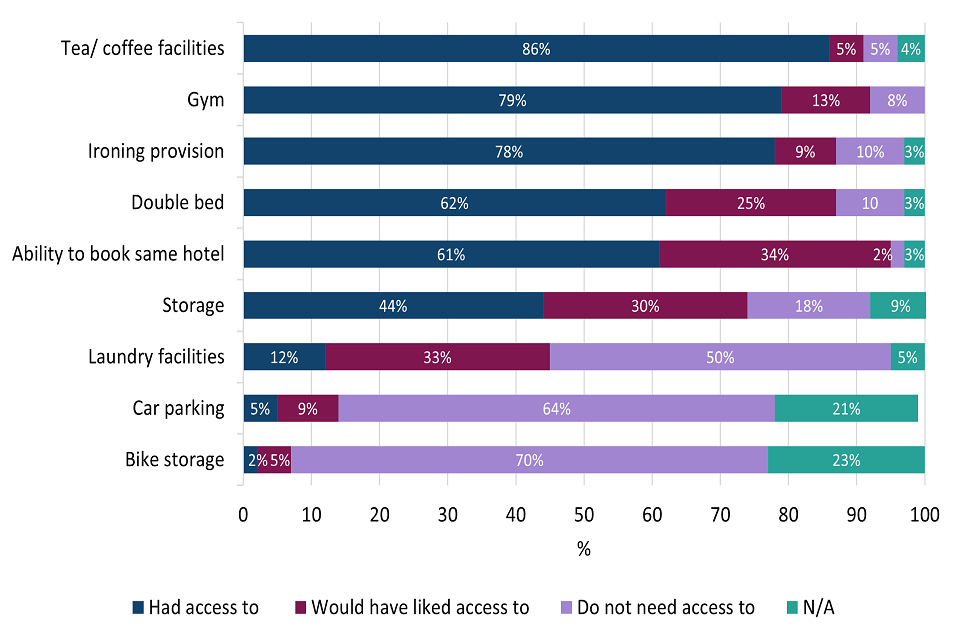
Alt text: The bar chart shows the proportion of survey respondents who had access to, did not have access to or would have liked access to facilities or services at their hybrid working accommodation. It shows more than half of survey respondents had access to tea and cofffee facilities, a gym, ironing provision, a double bed and the ability to book the same hotel each time. It shows the most common facilities respondents would have liked access to, but did not have access to were the ability to book the same hotel each time, laundry facilities and storage. It shows the three most common facilities they did not need access to were bike storage, car parking and laundry facilities.
The three most common facilities/services respondents would have liked access to, but did not have access to, were ability to book the same hotel each time (34%), laundry facilities (33%) and storage (30%). The three most common facilities/services survey respondents did not need access to were bike storage (70%), car parking (64%) and laundry facilities (50%).
Survey respondents were asked which one element of HWA was most important to them. Figure 4 shows the proportion of survey respondents who reported which facility/service is most important to them at HWA. The data for this figure can be found in Reference Table 26.
Figure 4: Proportion of survey respondents who reported each facility/service was most important to them (N= 62)
Caption: The bar chart shows distance from the hotel to place of work was the most important factor to most survey respondents.
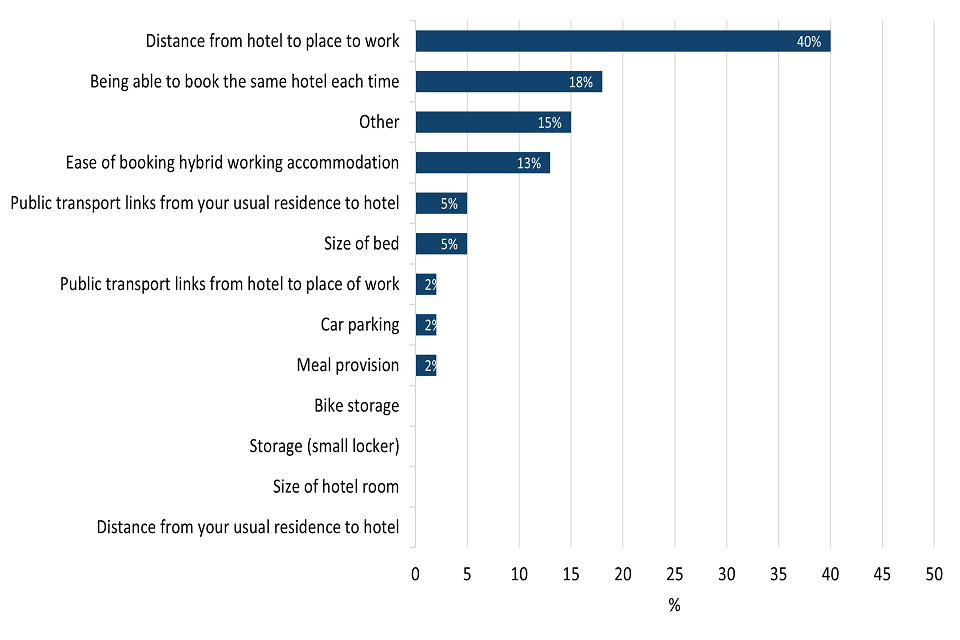
Alt text: The bar chart shows the proportion of survey respondents who reported each facilities or service was the most important to them. It shows that distance from hotel to place of work was the most common aspect reported by survey respondents as most important to them. Other aspects which were reported as most important were being able to book the same hotel each time, other aspects, ease of booking, public transport links from usual residence to hotel, size of bed, public transport links from hotel to place of work, car parking and meal provision. No survey respondents reported bike storage, storage, size of the hotel room or distance from usual residence to hotel were most important to them.
Distance from the hotel to place of work was the most important factor to survey respondents, with 40% of survey respondents reporting this as the most important factor. The second and third most important factors were being able to book the same hotel each time (18%) and ‘other’ facility/service (15%). In the ‘other’ responses, survey respondents reported they would like to select more than one factor or a balance between all factors. No survey respondents reported bike storage, storage, size of hotel room or distance from usual residence to hotel as the most important facility/service at HWA.
Survey respondents were asked which, if any, meals they were provided at HWA. 66% of survey respondents were provided only breakfast, 31% were provided breakfast and dinner and 3% were provided none.
Figure 5 shows the proportion of survey respondents who agreed, neither agreed nor disagreed or disagreed with statements relating to the meal provision at HWA. The data for this figure can be found in Reference Tables 34-39.
Figure 5: Proportion of survey respondents who agreed, neither agreed nor disagreed or disagreed with statements about HWA meal provision
Caption: The bar chart shows most survey respondents agreed the meal provision as good quality, was better than meals provided in the mess, supports their ability to hybrid work, meets their dietary requirements and gives a variety of food to choose from.
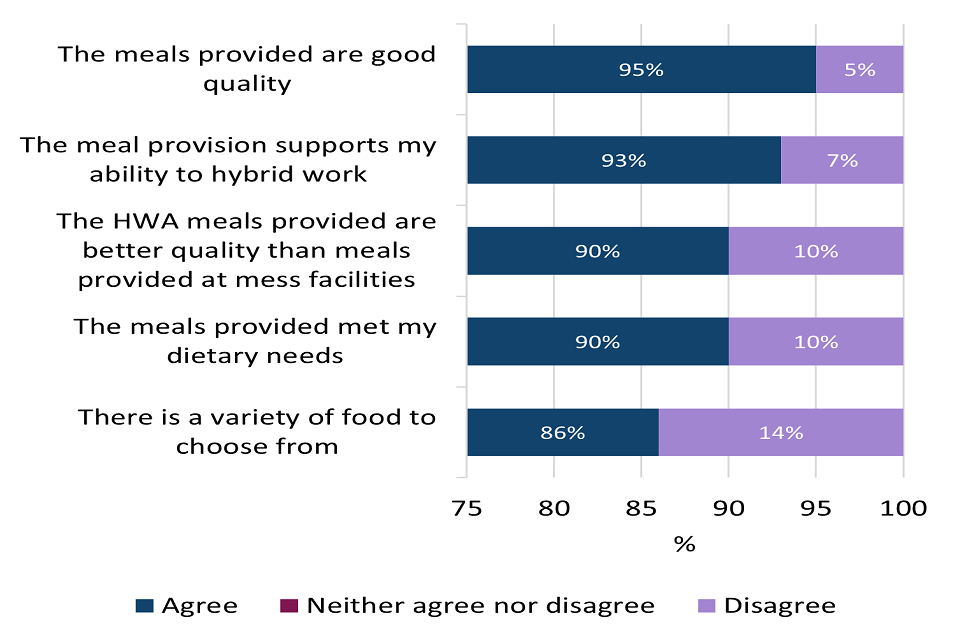
Alt text: The bar chart shows the proportion of survey respondents who agreed, neither agreed nor disagreed or disagreed with statements about hybrid working accommodation meal provision. Over 86% of survey respondents agreed with each aspect of hybrid working accommodation meal provision including that the meals provided were good quality, the meal provision supports their ability to hybrid working, the meals provided are better quality than meals at facilities, the meals met their dietary needs and there is a variety of food to choose from.
Most of survey respondents agreed the meal provision is good quality, was better quality than meals provided in the mess, supports their ability to hybrid work, meets their dietary requirements and gives a variety of food to choose from.
Survey respondents were asked if there was anything else they wanted to share about their experiences of HWA. Many survey respondents used this as an opportunity to reiterate the benefits of HWAT including, in no particular order:
-
Better work life balance.
-
Value for money for Defence, as saving money on SSSA.
-
Career benefits, such as increased job satisfaction, more focused at work, ability to work longer hours and enables them to choose a role they may otherwise couldn’t do due to location.
-
Retention, as HWA enables SP to hybrid work and therefore encourages them to stay in the Armed Forces.
-
Easy booking system.
-
Convenient location.
-
Good quality accommodation.
-
Good value for the SP, as it is cost neutral, and travel is paid for.
HWAT has meant that I can maintain stability for my family, remote work when needed and undertake a role that I have always wanted to do but not wanting to move the family. My job satisfaction is now sky high. [Officer, Army]
6.4 Impact of Hybrid Working Accommodation
This section covers the extent to which HWA supports people related outcomes.
Survey respondents were asked the extent to which they agreed or disagreed that HWA impacted elements of their work or personal life. Figure 6 shows the proportion of survey respondents who agreed, neither agreed nor disagreed or disagreed that HWA impacts different elements of their work and personal life. The data for this figure can be found in Reference Tables 27-32.
Figure 6: Proportion of survey respondents who agreed, neither agreed nor disagreed or disagreed that HWA impacts elements of their life
Caption: The majority of survey respondents agreed hybrid working accommodation supports their ability to hybrid work, meets their needs, improves their work live balance, supports their ability to hybrid work and increases their job satisfaction.
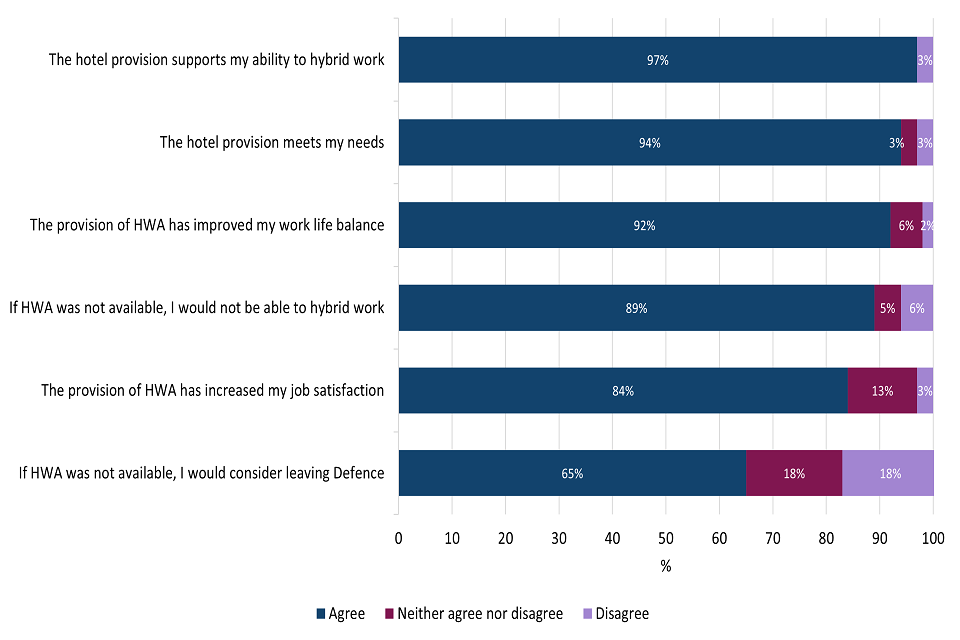
Alt text: The bar chart shows the proportion of survey respondents who agreed, neither agreed nor disagreed or disagreed that hybrid working accommodation impacts elements of their life. Over 90% agreed that hybrid working accommodation supports their ability to work, the hotel provision meets their needs and hybrid working accommodation has improved their work life balance. Over 80% agreed that if hybrid working accommodation was not avilable, they would not be able to hybrid work and the provision of hybrid working accommodation increased their job satisfaction. 65% agreed if hybrid working accommodation was not available, they would consider leaving Defence.
Over 90% agreed the hotel provision supports their ability to hybrid work, meets their needs and has improved their work life balance. Over 80% agreed that if HWA was not available, they would not be able to hybrid work and that HWA has increased their job satisfaction. 65% of survey respondents agree that if HWA was not available, they would consider leaving Defence.
6.5 Future Hybrid Working Accommodation
This section covers survey respondent views on the future of HWA.
Survey respondents were asked how many nights a week they think should be required for SP to spend at service accommodation to qualify for HWA. 71% of survey respondents felt it should be 1 night a week, 19% reported 2 nights a week and 10% reported 3 nights a week.
Survey respondents were asked how many nights a week they think should be required for SP to spend at service accommodation to qualify for SSSA. 61% of survey respondents felt it should be 4 nights a week, 30% reported 3 nights a week and 10% reported 2 nights a week.
Survey respondents were asked whether they would be willing to share SSSA or not. Figure 7 shows the proportion of survey respondents who would be willing to share SSSA and if so, who with. The data for this figure can be found in Reference Table 43.
Figure 7: Proportion of survey respondents who would be willing to share SSSA with a SP of a similar rank, would be willing to share SSSA with any SP or would not be willing to share SSSA (N= 62)
Caption: The bar chart shows half of survey respondents would not be willing to share SSSA with another Service person.
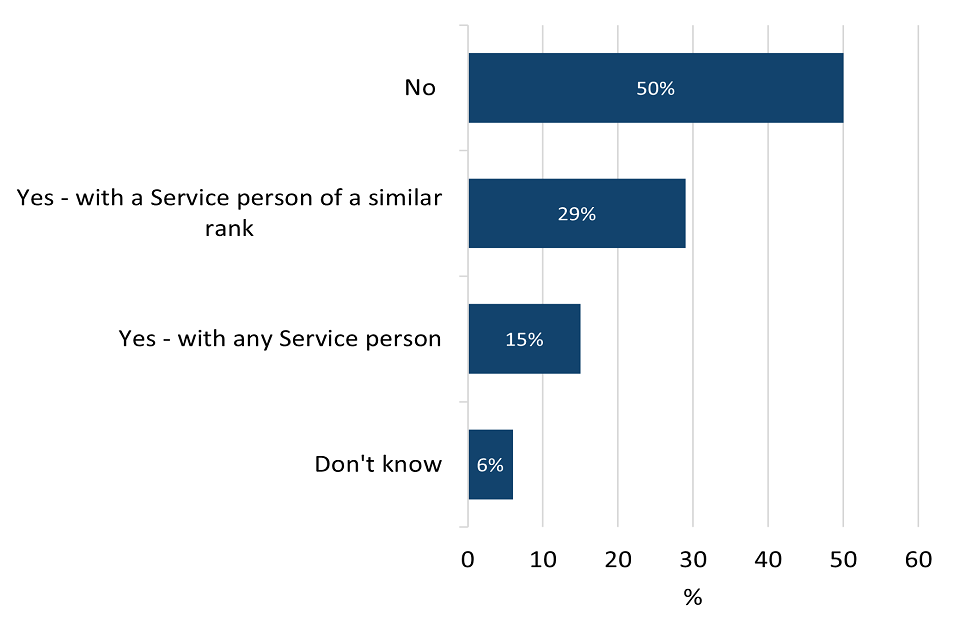
Alt text: The bar chart shows the proportion of survey respondents who would or would not be willing to share SSSA with another Service person. 50% would not be willing to share with another Service person, 29% would be willing to share with a Service person of a similar rank, 15% would be willing to share with any Service person and 6% did not know.
50% of survey respondents would not be willing to share SSSA, 29% would be willing to share with a SP of a similar rank, 15% would be willing to share with any SP and 6% did not know.
Survey respondents were asked what other forms of accommodation would meet the needs of hybrid working. The most common suggestion was serviced apartments (64% of survey respondents), followed by Airbnb (33%), no alternative (27%) and staying with family and/or friends (9%).
Survey respondents were asked what locations they think HWA would be suitable. 74% of survey respondents felt it would be appropriate for all Defence locations. Survey respondents felt this would be appropriate to ensure parity of treatment for all SP and due to the positive benefits of HWA, including better work life balance and increased job satisfaction.
Some survey respondents reported it should be available at all bases where one or more of the following conditions are met:
-
Hybrid working is available.
-
There is insufficient or unsuitable Service accommodation at the base.
-
Jobs are office based.
-
It is cheaper for Defence to use HWA than other forms of Service accommodation.
Any location which currently utilises SSSA could probably offer HWA. This would most likely be beneficial to MOD in relation to costs whilst offering greater flexibility to the SP. [Officer, Royal Air Force]
26% felt it would be appropriate for locations near headquarters. Reasons given by survey respondents for this were:
-
Only headquarter locations would have availability of suitable hotels.
-
Other bases have sufficient accommodation on site, which should be the preferred accommodation choice.
-
It is too expensive to deliver nationally.
-
HWA is only suited to office-based roles.
Survey respondents who had lived in SSSA before were asked whether their experience of HWA was better, worse or the same as SSSA. Figure 8 shows the proportion of survey respondents who think HWA is better, the same or worse than SSSA. The data for this figure can be found in Reference Table 47.
Figure 8: Proportion of survey respondents who reported HWA is better, the same, or worse than SSSA (N= 62)
Caption: The bar chart shows over half of survey respondents reported hybrid working accommodation is better than SSSA.
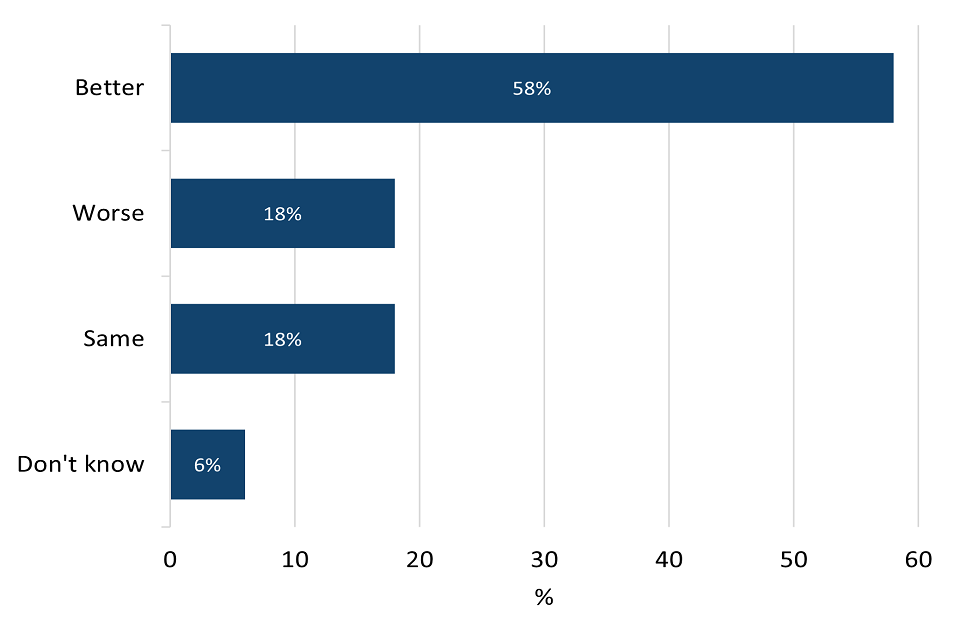
Alt text: The bar chart shows the proportion of survey respondents who reported hybrid working accommodation is better, the same or worse than SSSA. 58% reported hybrid working accommodation was btter than SSSA, 18% reported it was worse, 18% reported it was the same and 6% reported they did not know.
58% of survey respondents felt HWA is better than SSSA. Reasons for this were HWA:
-
Provides better work life balance, as it allows SP to spend more time in the office when at work and with family when at home, due to less time spent maintaining another property.
-
Provides more career options, as it allows SP to apply for job opportunities, they may have otherwise not considered due to their location.
-
Provides family stability, as it allows a SP to be mobile for work without moving their family.
-
Provides better value for money for Defence, as it is cheaper than providing SP with SSSA.
-
Is more conveniently located than SSSA, including closer to the office, transport, and places to eat.
-
Offers meals included, which would have to be cooked at SSSA.
Easier, less to worry about (cleaning SSSA, preparing meals). Allows me to focus more on outputs at work whilst I’m in London. [Officer, Royal Navy]
18% of survey respondents felt HWA is the same as SSSA. Reasons for this included:
-
It depends on whether you have a family/spouse or not. HWA was viewed as preferrable for SP with a family/spouse, whereas SSSA was viewed as preferrable for single SP.
-
It depends on how many days a week you need accommodation for.
-
It depends on how far you are from your home. HWA was viewed as preferrable when SP could commute home at weekends, whereas SSSA was viewed as preferrable when commuting at weekends was too far.
SSSA was great when I was single (albeit I maintained a private property elsewhere) and happy to move wholesale to my work location. Now that I have a family (young children), I wish to maintain their stability and I can do that if I hybrid work. If I couldn’t hybrid work I would leave the Service. Hybrid work requires me to have accommodation; I don’t need 4+ nights a week so I don’t need SSSA so the HWAT scheme is perfect. Different options for different circumstances / different stages of life is a good thing. [Officer, Royal Navy]
18% of survey respondents felt HWA was worse than SSSA. Reasons for this were SSSA:
-
Provides space to relax in the evenings, such as a living area and kitchen to prepare your own food.
-
Requires less administration, due to no claims and no checking in and out.
-
Has storage available.
-
Survey respondents were asked how they would like to access meals at HWA in the future. Most survey respondents (84%) would like allowances to be given to purchase meals at a location of their choice. 16% would like meals provided at the hotel. No other suggestions on how they would like to access meals were provided.
Impact on well-being due to lack of ability to prepare own meals and depending on which room you are allocated in hotel often have disturbed sleep. In addition, my commute involves car drive, train, tube and walk to hotel so having to carry uniform, overnight bag, work bag etc each week is not ideal. Options for relaxation time in the evening also differ as a result of not having your own space as you would do with SSSA. [Officer, Army]
Survey respondents were asked if there was anything else they wanted to share about their experiences of HWA. Some survey respondents used this as an opportunity to encourage the continuation of HWA. A few improvements to HWA were suggested for the future, including:
-
Improvements to the claims process. Survey respondents described HDT claims as time consuming, particularly with audits. They felt this could be simplified.
-
Improvements to the availability of hotels. Survey respondents wanted to be able to book accommodation at shorter notice and book the same hotel each time.
-
Availability of guidance. Survey respondents suggested being provided details on how to request storage, what the dinner rate is and how to maintain relationships with hotels would be beneficial for HWA users.
With the flexibility in what a ‘normal week’ looks like for me, HWAT provides a better work-life balance for me, as well as value for money for Defence and I would strongly encourage this scheme to continue and be opened up to new joiners to MB [Main Building, London]. [Officer, Royal Navy]
7. Annex A: Survey Questions
Section A: Participant information and consent page
Section B: Demographic questions
B1. Which Service do you serve in?
-
Royal Navy
-
Royal Marines
-
Army
-
Royal Air Force
B2. What is your current Rank?
-
Able Seaman, Marine, Private, LCpl or Air Specialist (OR1-3)
-
Junior NCO (LH or Cpl) (OR4)
-
Petty Officer, Sergeant (OR6)
-
Chief Petty Officer, Colour Sergeant, Staff Sergeant, Flight Sergeant (OR7)
-
Warrant Officer 2 (OR8)
-
Warrant Officer (OR9)
-
Sub-Lieutenant, Lieutenant, Pilot Officer (OF1)
-
Lieutenant RN, Captain, Flight Lieutenant (OF2)
-
Lieutenant Commander, Major, Squadron Leader (OF3)
-
Commander, Lieutenant Colonel, Wing Commander (OF4)
-
Captain RN, Colonel, Group Captain (OF5)
-
Commodore, Brigadier, Air Commodore (OF6)
-
Rear Admiral, Major General, Air Vice Marshall (OF7)
-
Other – please specify
B3. What is your sex?
-
Male
-
Female
-
Prefer not to say
B5: What is your Personal Status Category (PStat Cat)?
-
PStat Cat 1 - Married or civil partnered - living with spouse
-
PStat Cat 2 - Has parental responsibility
-
PStat Cat 3 - Provides financial support to spouse/former spouse or children by voluntary agreement.
-
PStat Cat 4 - Provides financial support under an order made by a court whom is not PStat 1 or 2.
-
Pstat Cat 5 - Single member of the Armed Forces
-
PStat Cat 5 - Other (Please specify)
-
Cohab long term partner/ LTRE- Living together, not married or civil partnered
B6: What is your current permanent accommodation?
-
Single Living Accommodation (SLA)
-
Substitute Single Service Accommodation (SSSA)
-
Service Family Accommodation (SFA)
-
Substitute Service Family Accommodation (SSFA)
-
Non-MOD owned/ managed accommodation
-
Other (Please specify)
B6c: What is your assigned place of duty? E.g., MOD Main Building, RAF High Wycombe
Open ended
Section C: Use of Hybrid Working Accommodation
C1. How did you book the latest hotel you stayed in for work? If you booked through Hoggs Robbin/AMEX Global Business Travel, please explain why you did not book through the hybrid working accommodation trial online booking tool within the open text box.
-
Hoggs Robinson Group (HRG) / AMEX Global Business Travel
-
Hybrid Working Accommodation Trial (HWAT) online booking tool
C2. What is the name and town/city of the hotel you have most recently stayed in or are currently staying in?
-
Glasgow – Maldron Hotel Glasgow City
-
Glasgow – Clayton Hotel Glasgow City
-
Glasgow – Leonardo Hotel Glasgow
-
London – Union Jack Club
-
London – The Strand Palace
-
Other – please specify
C3. How long have you been using hotel to support hybrid working? (Tick one)
-
Less than a month
-
Between one and three months
-
Between four and six months
-
Between seven and eleven months
-
One to two years
-
Over two years
C4. On average, how many nights do you spend in a hotel per week for hybrid working? (Tick one)
-
Less than one night
-
One night
-
Two nights
-
Three nights
-
Four nights
-
More than four nights
Section D: Lived Experience
D1. Have you been able to book the same hotel each time you use hybrid working accommodation?
-
Yes
-
No
-
Other – please specify
D2a. How satisfied are you with the following in hybrid working accommodation? Very dissatisfied – very satisfied
-
Meal provision
-
Distance from hotel to place of work
-
Distance from your usual residence to hotel
-
Car parking
-
Size of hotel room
-
Size of bed
-
Storage
-
Public transport links from hotel to place of work
-
Public transport links from your usual residence to hotel
-
The process of booking hotels for hybrid working
-
Service provided by the hotel
D2b. Why were you satisfied with the aspects of hybrid working accommodation outlined in the previous question?
D2c. Why were you dissatisfied with the aspects of hybrid working accommodation outlined in the previous question?
D3. What facility/service do you have access to/would have liked access to in hybrid working accommodation?
Had access to, would have liked access to, do not need access to, N/A
-
Gym
-
Storage (small locker e.g., for uniforms, suits)
-
Bike storage
-
Car parking
-
Double bed
-
Tea/coffee facilities
-
Laundry facilities
-
Ironing provision
-
Ability to book same hotel
Please note MOD would not be funding these facilities/services if they come at cost. If they were utilised, it would be at the expense of the SP.
D4. Please indicate what is most important to you in regard to hybrid working accommodation from the following. You can add an extra priority using the ‘other-please specify’ box. (Select one)
-
Meal provision
-
Distance from hotel to place of work
-
Distance from your usual residence to hotel
-
Car parking
-
Size of hotel room
-
Size of bed
-
Storage (small locker)
-
Bike storage
-
Public transport links from hotel to place of work
-
Public transport links from your usual residence to hotel
-
Ease of booking hybrid working accommodation
-
Being able to book the same hotel
-
Other (please specify) (open text box)
D5. To what extent do you agree or disagree with the following statements (strongly agree, agree, neither agree nor disagree, disagree, strongly agree):
-
The hotel provision meets my needs
-
If hybrid working accommodation was not available, I would not be able to hybrid work
-
If hybrid working accommodation was not available, I would consider leaving Defence
-
The hotel provision supports my ability to hybrid work
-
The provision of hybrid working accommodation has improved my work life balance
-
The provision of hybrid working accommodation has increased my job satisfaction
Section E: Meals
E1. What meals were provided to you as part of your hybrid working accommodation package at the hotel? (Tick one)
-
Only Breakfast
-
Only Dinner
-
Breakfast and Dinner
-
None
Only routed to e2 if they select an option other than none
E2. To what extent do you agree or disagree with the following statements in regard to meal provisions in hybrid working accommodation? (strongly agree, agree, neither agree nor disagree, disagree, strongly disagree) [only to be asked if respondent selected one of first 3 options from E1]
-
The meals provided met my dietary requirements
-
The meals provided are good quality
-
There is a variety of meals to choose from
-
The meal provision supports my ability to hybrid work
-
The hybrid working accommodation meals provided are equivalent quality to the meals provided at mess facilities
-
The hybrid working accommodation meals provided are better quality than meals provided at mess facilities
E3. How would you like to access meals in hybrid working accommodation in the future?
-
Meals to be provided at hotel
-
Allowances to be given to purchase meals at location of choice
-
No allowances/provision
-
Other (open text box)
Section F: Future Hybrid Working Support
F1. What should be the minimum number of nights in one week a SP is required to stay in service accommodation, to qualify for hybrid working accommodation?
-
1 night
-
2 nights
-
3 nights
F2. What should be the minimum number of nights in one week a SP is required to stay in service accommodation, to qualify for Substitute Service Single Accommodation (SSSA)
-
2 nights
-
3 nights
-
4 nights
F3. Would you be willing to share Substitute Service Single Accommodation with another Service person, to support hybrid working? Please select one option.
-
Yes – with any Service person
-
Yes – with a Service person of a similar rank only
-
No
-
Don’t know
F4. What alternate accommodation options, if any, to SSSA or hotels would meet the needs of hybrid working? (Tick all that apply)
-
No alternative
-
Serviced apartments
-
Airbnb
-
Staying with family and/or friends
-
Other (open text box)
F5. In which of the following locations do you think HWAT would be suitable? (Select one)
-
Locations near head quarters only
-
All defence locations
Why?
F6a. Have you previously stayed in SSSA?
-
Yes
-
No
-
Don’t know
[Respondents who answered yes should then answer the follow up question below]
F6b. How does your experience of staying in hotels for hybrid working accommodation compare to your experience in SSSA?
-
Better
-
Same
-
Worse
-
Don’t know
Why is this? (Open text box)
Section G: Summary
G7. Is there anything else you would like to share about your experiences of the hybrid working accommodation trial?
You may want to include details on:
-
What, if any, benefits hybrid working accommodation provides for you and why?
-
Why did/ didn’t hybrid working accommodation meet your needs?
-
What, if any, improvements you would make to hybrid working accommodation?
Thank you for taking part in the survey, your responses will help shape future hybrid working accommodation policy.