How Move to UC customers manage their UC claim: Qualitative Research
Published 28 May 2026

© Crown copyright 2026
This publication is licensed under the terms of the Open Government Licence v3.0 except where otherwise stated. To view this licence, visit nationalarchives.gov.uk/doc/open-government-licence/version/3 or write to the Information Policy Team, The National Archives, Kew, London TW9 4DU, or email: psi@nationalarchives.gov.uk.
Where we have identified any third party copyright information you will need to obtain permission from the copyright holders concerned.
This publication is available at https://www.gov.uk/government/publications/how-move-to-uc-customers-manage-their-uc-claim-qualitative-research/how-move-to-uc-customers-manage-their-uc-claim-qualitative-research
DWP research report no.1132
A report of research carried out by Ipsos on behalf of the Department for Work and Pensions.
Crown copyright 2026.
You may re-use this information (not including logos) free of charge in any format or medium, under the terms of the Open Government Licence. To view this licence, visit www.nationalarchives.gov.uk or write to:
Information Policy Team
The National Archives
Kew
London
TW9 4DU
or email psi@nationalarchives.gov.uk
This document/publication is also available on our website
If you would like to know more about DWP research, email socialresearch@dwp.gov.uk
First published in May 2026
ISBN - 978-1-78659-984-1
Views expressed in this report are not necessarily those of the Department for Work and Pensions or any other government department.
Acknowledgements
The research team wish to thank all the participants who gave their time to take part in this study. We wish to thank Katrina Leary, Mary Batley and Nazifa Uddin for their support with conducting interviews and Rebecca Paton and Jade Le Roux for their support with recruiting participants. We also wish to thank Ashley Ames, Amy Skates and Zoe Uren for their guidance and feedback during the study.
Authors
This report was written by researchers at Ipsos UK Public Affairs:
Andrew Shaw, Associate Director
Charlotte Duffy, Research Manager
Louis Falkingham, Research Executive
Glossary
| Term | Definition |
|---|---|
| Alternative Payment Arrangement | These are considered for customers who are identified as needing additional support, such as those who cannot manage their single monthly payment. The following Alternate Payment Arrangements are available: paying housing costs directly to the landlord; more frequent payments instead of once a month; and a split payment of an award between partners in a couple. |
| Conditionality | Activities a customer will be asked to complete in order to receive their full entitlement to Universal Credit |
| Claimant commitment | An agreement UC customers make with the DWP outlining the activities they must do, to receive UC payments. It is tailored to their personal circumstances and reviewed and updated on an ongoing basis. |
| Council Tax Reduction | A reduction in Council Tax for people either on a low income or in receipt of benefits. This support is administered by local authorities. |
| Enhanced Support Journey | A non-linear Universal Credit claim support process provided by the Department for Work and Pensions for Income Support and Employment Support Allowance customers who have not made a claim for Universal Credit 11 weeks after receiving their Migration Notice. The enhanced support journey starts in week 12, before the deadline date. It involves different interventions ranging from outbound calls, system checks, home visits and contact with support organisations in the local community. |
| Income-based Employment and Support Allowance | A means-tested benefit for people with disabilities or long-term health conditions that affect how much they can work. ESA is intended to support with living costs for those unable to work and support to get back into work for those able to. Customers can receive ESA if they are employed, self-employed or unemployed. The DWP is replacing income-based ESA with Universal Credit. |
| Legacy benefit customer | An individual receiving one of the six benefits that the Department for Work and Pensions is replacing with Universal Credit. The legacy benefits are income-related Employment and Support Allowance (ESA), income-based Jobseeker’s Allowance (JSA), Housing Benefit (HB), Income Support (IS), Working Tax Credit (WTC) and Child Tax Credit (CTC). |
| Means-tested benefit | A benefit where eligibility depends on the customer’s income and capital (savings). |
| Migration Notice | A letter sent by the Department for Work and Pensions to customers informing them that their current benefits are ending and inviting them to claim Universal Credit by a specified deadline (usually 3 months after the letter is sent) to continue receiving financial support. |
| Migration Notice Helpline | This is a specific telephone helpline set up by the Department for Work and Pensions for legacy customers who have received a Migration Notice informing them they need to move to Universal Credit to continue receiving financial support payments. |
| Minimum Income Floor | A threshold used to calculate Universal Credit payments for self-employed individuals. If earned income is below the Minimum Income Floor, UC payment will be calculated using this threshold instead of your actual earnings. New UC claimants were given a 12-month grace period before Minimum Income Floor was applied. |
| Universal Credit | A means-tested benefit replacing six legacy benefits, aimed at simplifying the benefits system. |
| Universal Credit Helpline | This is the telephone helpline set up by the Department for Work and Pensions, available for all those either currently claiming Universal Credit or planning to make a claim to Universal Credit and would like more information. |
Abbreviations
- CTC – Child Tax Credit
- DWP – Department for Work and Pensions
- ESA – Employment and Support Allowance
- HB – Housing Benefit
- IS – Income Support
- MIF – Minimum Income Floor
- PIP – Personal Independence Payment
- UC – Universal Credit
Research summary
Background
Universal Credit (UC) is a means-tested benefit that was introduced in the UK to replace six ‘legacy’ benefits: income-related Employment and Support Allowance (ESA), income-based Jobseeker’s Allowance (JSA), Housing Benefit (HB), Income Support (IS), Working Tax Credit (WTC), and Child Tax Credit (CTC).
Since December 2018, Universal Credit has been available across the UK to all new customers. Since then, people have been moving to Universal Credit, when their circumstances change (natural migration), or if they chose to do so (voluntary migration). Customers who do not have a change of circumstances that triggers a natural migration have been moved to UC through ‘managed migration’, also known as ‘Move to UC’. Since May 2022, households have been invited to move to UC in staggered phases. Support has been provided by the DWP to help customers with the transition to UC. This includes additional support delivered through the DWP’s ‘Enhanced Support Journey’ for customers receiving IS or ESA, involving different interventions ranging from outbound calls, system checks, home visits and contact with support organisations in the local community. Where customers have needed additional support to make a claim to UC, extensions were made available to those with good reason.
As the Move to UC process neared completion, research was required to understand the early experiences of former legacy customers who had already moved to UC (‘Move customers’), specifically to understand how they managed their account on a day-to-day basis, once claiming and in receipt of UC payments. In particular, research was needed to explore the extent to which customer support needs affect their experiences.
The research provided a valuable opportunity to gather evidence on Move customers’ experiences of claiming UC, and to explore how these compare to experiences of claiming legacy benefits. The research focused on the experiences of former tax credits (WTC and/or CTC), HB and ESA customers. As part of the ongoing research programme to support Move to UC, findings will be used to inform the DWP’s Move to UC policy team from a post-implementation perspective.
Research objectives
The key objective of this research was to better understand how Move customers manage their claim after the initial set up process has been completed, and to gather insights into the customer experience of claiming UC.
Specifically, the research sought to give insight into the following key topic areas:
- customers’ experiences of making a UC claim and processing their claim to the first statement
- identification of the support needed to manage a claim, once claiming UC, and among which types of customers
- customer experiences of UC compared to legacy benefits
Research methodology
A total of 91 qualitative interviews were conducted with Move to UC customers to allow for exploration of a broad range of customer experiences of both setting up and managing their ongoing UC claim. Interviews lasted up to 45 minutes each and were conducted via a mix of telephone and online interviewing, between 11 September 2025 and 19 January 2026.
Key findings
This chapter summarises the key findings in each section of this report.
Move to UC customer experiences of making a claim
Most participants interviewed in the research found the UC claim process smoother than expected due to DWP and external support. However, participants with a combination of challenging factors – including complex health needs, poor digital skills and limited support networks – faced significant challenges.
Although most participants had heard of UC before receiving their Migration Notice, understanding of what claiming would mean in practice varied considerably. Many found the claim process more straightforward than anticipated, particularly digitally confident participants who navigated the online system easily, while others accessed support through phone claims, Jobcentre Plus visits, Citizens Advice and housing associations. However, participants with complex health conditions, low digital confidence and an absence of existing support networks faced significant barriers to making a claim. These included difficulties providing evidence, confusion about passported benefits and housing payments, and accessibility issues, with those experiencing multiple overlapping vulnerabilities most likely to have unresolved problems that continued into ongoing claim management.
It should be noted that participants’ length of time on UC at the point of interview varied by legacy benefit group. Former tax credits customers had typically been claiming UC for longer, as their migration was completed by April 2025, whereas many former ESA and HB customers had more recently migrated. This may have influenced confidence and familiarity with UC processes, with former tax credits customers having had more time to adapt and work through initial challenges.
General experiences of managing a UC claim and support received
Participants generally had few specific expectations about day‑to‑day management; where expectations existed, they were often negative.
Most participants did not know exactly what managing a UC claim would involve. Where expectations existed, these were typically driven by negative news stories, social media and word-of-mouth, rather than DWP information. Former tax credits customers worried about losing control and predictability, while former ESA and HB customers were concerned about disruption to payment routines and managing rent directly. Many assumed UC would be difficult and time-consuming but felt they had little choice.
Once established, ongoing management required relatively little active engagement for most participants. However, this felt very different across different customer groups, with the level of digital confidence and presence of established support networks in particular influencing confidence and engagement with the UC claim.
Once claims were set up and first payments arrived, participants with and without work requirements, but particularly those without work requirements, found managing UC required less effort than expected.
Participants typically logged in only when receiving notifications or close to payment dates. Those with high digital confidence, especially when familiar with digital systems through prior employment, considered this process easy and low-effort.
Participants with lower digital confidence, sometimes compounded by mental or physical health problems, could find the process more challenging. They found simple tasks such as reading a message or updating circumstances could be overwhelming. These participants tended to rely on existing support networks to manage their claim or did not have access to a reliable support network. The former group were heavily reliant on this network (typically family, friends or an official who had worked with them for a long time such as a support worker or a housing officer) to check, update and explain changes in their claim for them. For those without access to these support networks, engagement with their claim was often particularly low due to increased anxiety or problems with mental health, which meant that messages from DWP could go unread, and issues could escalate.
Anxiety and hypervigilance persisted among those who did not feel able to manage their claim independently, even when their claim ran without problems.
This was especially evident among long-term former ESA and HB recipients with significant health conditions, who typically felt on edge about missing messages or making mistakes. Some repeatedly checked journals or contacted DWP for reassurance despite no previous issues. Limited understanding of UC rules and/or previous overpayment experiences contributed to this ongoing risk perception. Within couples, one partner often managed the claim, leaving the other with limited understanding and greater anxiety about potential solo management.
Informal support from family and friends remained the first and most common source of help for UC claim management.
Across legacy benefit cohorts, participants with informal support turned first to partners, adult children, relatives or friends for help with reading messages, completing forms, uploading evidence and budgeting. Many did not label this as “support”, describing themselves as managing “independently” when viewing receiving help as a part of everyday family life. Those who were more confident in managing their claims drew on informal support occasionally for reassurance; less confident participants, generally former ESA and HB customers, either depended on one or two trusted people regularly or relied on ad hoc, often unreliable help.
These patterns of seeking support appeared consistent with how participants had managed their legacy benefits, with a period of increased support often needed during the transition and the early period of UC management.
Formal support was used reactively for complex issues and provided a critical safety net for Move to UC customers, especially more vulnerable ones.
Formal support from DWP staff and external organisations was used when participants could not resolve issues themselves or through informal support. Participants sought help when not understanding journal requests, believing payments were wrong, or reporting complex changes. Some participants, most typically former ESA and/or HB customers, had ongoing support from Housing Officers such as receiving regular advice, helping them to communicate with DWP, and in one case actively monitoring the UC account for the participant. Even those rarely using formal support valued knowing help was available, increasing confidence.
Support needs tended to decline over time as participants became more familiar with UC, though this pattern was uneven.
Support needs generally reduced for participants as they became familiar with the rhythm of UC payments. Regular, reliable payments reinforced confidence. However, those with complex health circumstances, such as chronic illnesses or ongoing mental health issues, often maintained high support needs. For participants who struggled and did not have reliable access to informal or formal support, typically former ESA customers who had been out of work for long periods of time, early unresolved issues like rent arrears or confusion over conditionality left lasting impressions of UC as unpredictable, reinforcing anxiety and discouraging engagement. Difficulties managing claims often occurred due to their lower digital confidence and long term physical or mental health conditions. This group had often been on UC for the shortest time, which may have also contributed to difficulties with claim management.
Challenges of managing a claim and enablers and barriers to independent management
Adjusting to monthly payments was a significant challenge for many, especially long‑term ESA and HB customers.
Participants whose legacy payment schedules differed to monthly UC payments struggled, particularly former ESA and HB customers. While those more confident with managing their claim adapted and occasionally preferred monthly payments after reshaping budgeting, others who were less confident continued finding it difficult. Rising living costs added pressure. Some former HB customers reported falling into rent arrears when confusion arose about housing payment processes or when they only applied for UC after legacy payments stopped, leading to delayed rent payments. Some needed to borrow, use overdrafts or rely on other benefits. Awareness of Alternative Payment Arrangements and the ability to request alternative payment frequencies, or direct payments to a landlord, was low.
Among those in work, work-related reporting and dealing with fluctuating incomes were highlighted among the most challenging aspects.
Employed and self-employed participants described work-related reporting as demanding. Employed participants appreciated automatic earnings capture but were frustrated when pay dates misaligned with assessment periods, causing UC payment fluctuations and additional Work Coach contact. Self-employed participants found monthly income/expense reporting burdensome. Uncertainty about allowable expenses and the application of the Minimum Income Floor created confusion and pressure to change working patterns, even when impractical due to caring responsibilities.
The online journal was generally useful in supporting routine management, though less effective for complex issues.
Most journal users viewed it as useful for day-to-day management, checking payments and messaging DWP conveniently. For digitally confident users, this provided control and independence. However, for complex problems, responses could feel generic or incomplete, leading to repeated follow-ups or journal avoidance. Technical features like unclear “to-do” lists or difficulties sharing fit note information caused confusion and anxiety.
Limited understanding of certain UC system features created additional complexity and anxiety.
Participants commonly had limited understanding of UC statements and payment calculations. This contributed to uncertainty about the individual elements of UC being paid, with participants tending to focus on total amounts being as expected as the main indicator of correct functioning. Understanding of the Claimant Commitment and conditionality was poor, particularly among former ESA customers and those without work requirements. Some were unsure about their obligations on UC, worrying about inadvertent breaches. Jobcentre Plus appointments, typically linked to work requirements, were sometimes burdensome within the otherwise digital system, conflicting with work or repeating information, contributing to stress.
Digital design, payment cycles and perceived inconsistent communication created barriers to fully independent claim management.
The digital-by-default model and monthly payments supported independent management for participants who already had high digital confidence but created barriers for others. Those with low digital literacy or limited technology access relied on family or intermediaries. Participants with complex circumstances, such as those with complex health conditions or complex claims with multiple elements, reported receiving inconsistent DWP information – different answers from different staff, unanswered journal questions, unclear explanations about Council Tax support or Minimum Income Floor effects. These experiences undermined confidence and created ongoing anxiety. Limited understanding meant some remained highly vigilant, frequently checking accounts or seeking reassurance even without specific problems.
Engagement with, and experiences of, Universal Credit compared to former benefits
Levels of engagement with UC differed by former legacy benefits and digital confidence, which shaped how the system was perceived.
Engagement with UC statements was generally low across legacy benefit groups, with most struggling to explain payment calculations.
Former ESA and HB customers typically maintained minimal engagement with their UC claims, which matched their relatively low engagement with their legacy claims, primarily interacting only when issues arose. These participants appreciated more straightforward contact with UC staff compared to their legacy benefits. However, former ESA and HB customers who lacked strong existing support networks to help them manage their claim, particularly those had low digital and/or administrative confidence, and those with severe health conditions or mental health conditions, typically felt that their legacy benefit was easier to engage with, feeling that the process of engaging with their UC claim was too impersonal and confusing.
Former tax credits customers typically had a higher level of engagement with their UC claim than former ESA and HB customers, paying closer attention to communications from UC, feeling more confident using their journal, and more quickly notifying UC of changed circumstances. One driver of this difference appears to be the relatively high digital and financial confidence of former tax credits customers, which made engaging with their claim feel easier. This confidence is likely due to the fact that former tax credits customers were typically in work, or had recently been in work, helping them to develop confidence in a range of digital, financial and administrative tasks.
Payment frequency changes impacted budgeting strategies across legacy benefit groups. Former ESA and HB customers in particular struggled with the change, which disrupted established financial management strategies. The transition to monthly payments was particularly challenging for those who relied on shorter intervals to manage their finances effectively.
Self-employed former tax credits customers faced adjustment challenges with UC, especially regarding the Minimum Income Floor, which imposed financial pressure and altered their perception of self-employment support.
Compared to legacy benefits, perceptions of being better or worse off on UC were shaped as much by experiences of manageability, payment frequency and stress as by actual payment amounts.
Limited understanding of UC statements and complex interactions with other benefits made accurate income comparisons difficult. Some former ESA and HB customers reported receiving slightly more on UC than they had under their legacy benefit, but the reasons for this were typically not clear to them.
Some disabled customers felt worse off due to lost/interrupted passported entitlements or Council Tax support changes, even with higher UC payments. Customers with low digital confidence or physical or mental health issues particularly felt worse off regardless of actual amounts, because the amount of effort required to manage their claim and the anxiety this caused impacted their overall perceptions of UC.
Participants typically found adjusting to new payment schedules difficult initially. Former HB and ESA customers, especially those that either relied on or needed support to manage their claim, often preferred their previous fortnightly (ESA) or four-weekly (HB) payments, finding monthly UC payments harder to manage. This contributed to arrears for some, reinforcing legacy system preference. Participants with mental health conditions who relied on routine to manage their finances found longer payment gaps unsettling, both because they had become used to the previous system and because they struggled with longer term financial budgeting.
However, former ESA and HB customers that felt more able to manage their claim independently typically preferred the new system after a period of adjustment, finding monthly unified payments easer to budget around.
Many former tax credits customers were already used to monthly payments and therefore adapted more easily, while those who had previously received weekly tax credits payments sometimes struggled initially before adjusting over time.
Experiences of working requirements and conditionality on UC compared to legacy benefits differed by legacy benefit cohort and were not always well understood.
Experiences of UC working requirements depended on previous benefits and current circumstances. Former ESA customers without work conditions experienced little change, appreciating minimal DWP contact continuity. Self-employed participants struggled with the Minimum Income Floor and ongoing income reporting, making income less predictable than under tax credits, creating financial pressure during quiet periods. Employed former tax credits customers generally found UC work requirements similar or clearer than their previous system.
Research background and context
Universal Credit (UC) is a means-tested benefit that was introduced in the UK to replace six ‘legacy’ benefits: income-related Employment and Support Allowance (ESA), income-based Jobseeker’s Allowance (JSA), Housing Benefit (HB), Income Support (IS), Working Tax Credit (WTC), and Child Tax Credit (CTC).
Since December 2018, Universal Credit has been available across the UK to all new customers. Since then, people have been moving to Universal Credit, when their circumstances change (natural migration), or if they chose to do so (voluntary migration). Customers who do not have a change of circumstances that triggers a natural migration have been moved to UC through ‘managed migration’, also known as ‘Move to UC’.
The Department for Work and Pensions’ (DWP) strategy for moving these remaining households to UC was set out in the department’s Completing the Move to UC policy document, published in April 2022. Since May 2022, households have been invited to move to UC in staggered phases. Move to UC legacy benefit customers were sent a migration notice giving them three months to make a Universal Credit claim. The notice also explained how to access support during this process, provided by the DWP to help customers with the transition to UC. This includes additional support delivered through the DWP’s ‘Enhanced Support Journey’ for customers receiving IS or ESA, involving different interventions ranging from outbound calls, system checks, home visits and contact with support organisations in the local community. Where customers have needed additional support to make a claim to UC, extensions were made available to those with good reason. Several discovery stages were conducted to understand how the transition to UC worked in practice for different customer groups and to inform future transitions.
During the delivery of Move to UC, the DWP has published several insight documents setting out learning to date, as well as qualitative and quantitative research with cohorts invited to move to UC.
Following initial Discovery work with customers invited to move to UC in May 2022, the DWP concentrated on understanding the experiences of the move for households on tax credits, with research published in December 2024[footnote 1]. As of April 2025, DWP completed the process of managed migration for tax credits customers.
From February 2024, the DWP conducted two phases of research to capture the experiences of customers transitioning from a range of legacy benefits to UC to provide a deeper understanding of the legacy benefit customer journey, from the point of being notified of their move to UC through to either making a claim or deciding not to claim. The first phase of the research focused on the experiences of the cohort of former legacy benefit customers invited to move to UC during Discovery work in September 2023. The second phase of the research focused on specific legacy benefit cohorts who were moved onto UC from April 2024 onwards (IS, HB only, income-related ESA, income-related ESA with HB). The research report was published in July 2025.
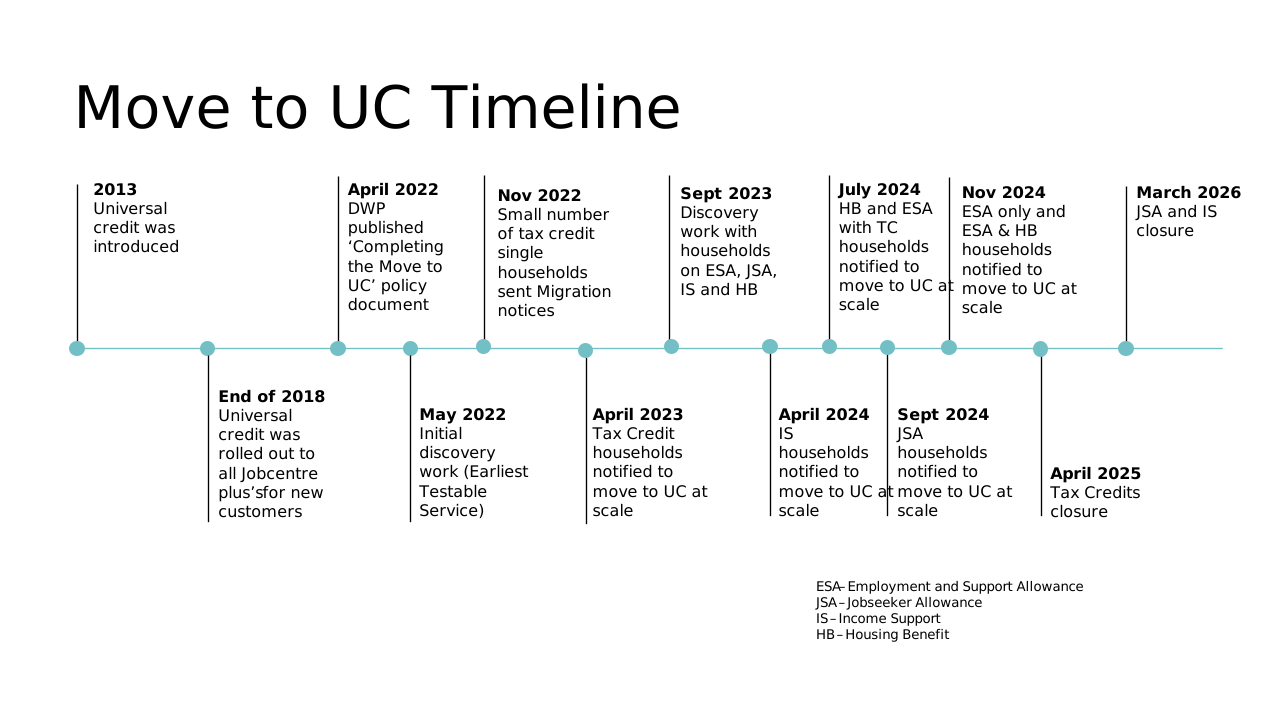
Figure 1 – UC migration timeline
- March 2012 - The Welfare Act
- April 2013 - Universal Credit was introduced
- June 2014 - Transitional regulations were introduced
- End of 2018 - Universal Credit was rolled out to all new Jobcentre Plus’s for new customers
- April 2022 - DWP published the ‘Completing the move to UC’ policy document
- May 2022 - Initial discovery work (Earliest Testable Service)
- November 2022 - small number of tax credit single households sent migration notice
- April 2023 - Tax credit households notified to move to UC at scale
- Sept 2023 - discovery work with households on ESA, JSA, IS and HB
- April 2024 - IS households notified to move to UC at scale
- July 2024 - HB and ESA with TC households notified to move to UC at scale
- September 2024 - JSA households notified to move to UC at scale
- Sept/Oct 2024 - ESA only and ESA and HB households notified to move to UC at scale
- April 2026 - Tax Credits closure
As the Move to UC process neared completion, research was required to understand the early experiences of those who had already moved to UC (‘Move customers’), specifically to understand how they managed their account on a day-to-day basis, once claiming and in receipt of UC payments. In particular, research was needed to explore the extent to which customer support needs affect their experiences.
The research provided a valuable opportunity to gather evidence on Move customers’ experiences of claiming UC, and to explore how these compare to experiences of claiming legacy benefits. The research focused on the experiences of former tax credits (WTC and/or CTC), HB and ESA customers. As part of the ongoing research programme to support Move to UC, findings will be used to inform the post-implementation evaluation and to support the future policy and design of UC.
Research objectives
The key objective of this research was to better understand how Move customers manage their UC claim after the initial set up process has been completed, and to gather insights into the customer experience of claiming UC.
Specifically, the research sought to give insight into the following key topic areas and questions:
- Move customer experiences of making a UC claim and processing their claim to the first statement – What worked well/not so well? What support was needed? To what extent were these needs met? How and where did they access support? Exploration of what challenges, if any, customers experienced when setting up their claim and whether any challenges experienced when setting up and processing the claim persisted/affected the ongoing management of the claim.
- Identification of the support needed to manage a claim, once claiming UC, and among which types of Move customers - Did those who needed support to set up their claim rely upon the same level of support to manage their claim, or did they start to manage it independently? For those with support needs, was this support available (from DWP or other external support services) and sufficient/of the quality needed to enable Move customers to manage their claim?
- Move customer experiences of UC compared to legacy benefits - Did customers understand the key elements of UC that differ to their legacy benefit? How did customers’ experience of UC differ, if at all, to their expectations? Did the move to UC have any negative/beneficial effects compared to the legacy system? To what extent did customers understand the actions/rules/features of UC needed to maintain their UC claim? Identification of the barriers/enablers to customers managing their UC claim. Exploration of differences across groups (such as legacy benefit, work status, conditionality, caring responsibilities, health status).
Overview of research methodology
A total of 91 qualitative interviews were conducted with Move to UC customers to allow for exploration of a broad range of customer experiences of both setting up and managing their ongoing UC claim. These consisted of 19 interviews with former ESA only customers, 16 with former HB only customers, 23 with former tax credits only customers (WTC and/or CTC), 17 with former ESA and HB customers, and 16 with former tax credits and HB customers.
Interviews lasted up to 45 minutes each and were conducted via a mix of telephone and online interviewing, between 11 September 2025 and 19 January 2026.
The accompanying technical report contains more detailed information about the research methodology and sample.
The Move to UC process
Figure 2 below gives an overview of the broad steps of the Move to UC process. However, there are variations in the support put in place by DWP for some benefit cohorts as a result of the higher support needs and vulnerabilities for these groups. The main focus for this report is on customer experiences of managing their UC claim after completing their application and verifying their ID (step 5).
1. All customers who were informed they needed to migrate to UC received a Migration Notice. This contained a migration deadline date, typically dated 3 months from the date the Migration Notice was sent to the notified customer.
2. For customers receiving IS or income-related ESA, additional support delivered through the DWP’s ‘Enhanced Support Journey’ (see Glossary, page 5) ensured these customers were supported to claim if help was needed (e.g., up to 3 phone calls, home visit to support with the UC claim).
3. If a UC claim was not made 7 weeks after the date of notification, then a reminder letter was sent. If the UC claim was not made after the first reminder, then a second reminder was sent in week 10 of the process. The second reminder was in the form of a SMS text message.
4. Customers were required to complete their UC claim application form online. If they were unable to do this online, customers were able to do their application via the phone using the UC telephone line. For those customers that did not make a claim by their migration deadline date (or after any extension offered to them) their former legacy benefit ceased.
5. After completing the application, customers needed to verify their ID either at the Jobcentre Plus, face-to-face or online.
6. Once the UC claim is complete (that is verified so entitlement can be paid) customers are asked to manage their UC claim. This is either via updates in the online journal if they made an online claim, or through phone calls with DWP if they made a phone claim. If a claim was made over the phone, customers can also switch to an online claim.
Figure 2 – Move to UC Process
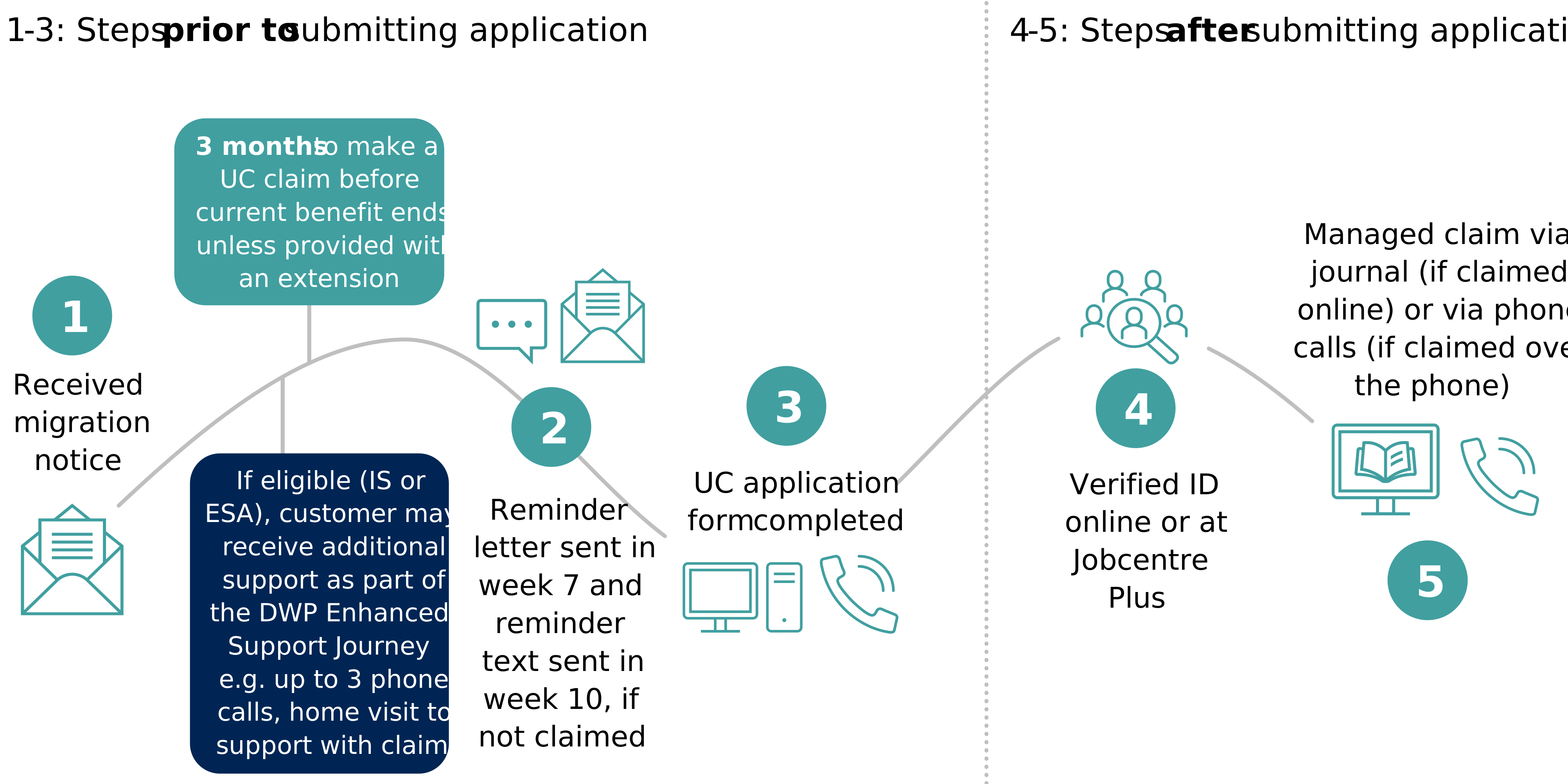
The figure above is a simplified illustration of the Move to UC customer journey.
More detailed DWP diagrams of the Move to UC customer journey can be found in the annex of this report.
Participant profiles and background
This section describes how participants’ backgrounds created different starting points which shaped their ability to effectively manage general financial and administrative tasks. It provides the context for why some participants were well equipped to handle the transition to UC, while others faced significant barriers from the outset.
Key background factors
Caring responsibilities
Caregiving duties made routine tasks more burdensome, as individuals juggled care provision with practical matters such as coordinating appointments, managing paperwork, and navigating support systems. This was particularly challenging for those caring for multiple people simultaneously, or those providing care while also managing their own health conditions.
Even going out to the shops, that has to be planned. It’s all planned around being with my son.
Female, Care Responsibilities, former WTC and CTC customer, Online claim
Digital confidence
Participants with low digital confidence relied on traditional methods such as keeping paper copies of documents or making phone calls instead of using online services. Their lack of confidence could stem from not knowing how to use online systems, but also from a lack of confidence and anxiety about making mistakes. These issues were more pronounced in participants over the age of 50, but also among those with mental health issues or neurodivergent conditions (such as dyslexia). Some regularly needed help from family, friends or community groups to complete tasks that were increasingly required to be done online. These difficulties could be compounded by low levels of digital access, with some participants needing to borrow devices from friends and family in order to complete online tasks. This dependency could delay task completion, as participants had to wait for someone to be available to help them.
In contrast, participants with higher levels of digital confidence were usually able to navigate forms and online processes independently, which reduced the effort required to manage their claims.
I just find going online very difficult. Having to do things online can be difficult for people my age.
Female, Health Condition, former WTC and CTC customer, Online claim
Health conditions
Health conditions affected participants’ ability to manage administrative tasks and finances in various ways. When health needs remained consistent, participants could plan ahead and develop reliable strategies and support systems that worked over time.
Complex, mental or degenerative health conditions created more significant complications, causing unpredictable fluctuations in participants’ ability to cope with daily tasks. Mental health conditions particularly affected concentration, motivation, and capacity to handle complex forms or attend appointments. Progressive physical conditions presented the additional challenge of gradually increasing needs while participants’ ability to manage tasks declined.
The chronic fatigue means that it’s very difficult for me to maintain any kind of schedule. I don’t know from one day to the next if I’m even going to be able to get out of bed.
Female, Health Condition, former WTC and HB customer, Online claim
Existing Support Networks
Some participants had strong support networks comprising friends, family, or formal support from professionals such as social workers, housing officers, or mental health workers. These supporters provided help with paperwork, emotional reassurance, and practical assistance such as attending appointments. Having multiple sources of support meant participants could turn to different people for different types of help.
Participants did not always describe this help as “support”. Those who regularly received assistance from partners or family members often framed it as part of everyday life rather than as something additional or exceptional. This has implications for how “independence” is understood in relation to claim management (see chapter 2 on General experiences of managing a claim and support received when on UC).
Participants without strong support networks could instead feel isolated when facing difficulties. While they might turn to formal support during crises, social isolation and unfamiliarity with support systems created additional barriers – hampering effective communication or causing anxiety about seeking help. This was particularly challenging for those with mental health conditions that affected planning, social interaction, and decision-making.
I’m alone and I don’t have no-one. So, that’s the thing. I just need someone to be kind and supportive to me, really.
Female, Health Condition, former ESA and HB customer, Phone claim
Type and duration of claim
Participants who had been claiming benefits for longer periods had developed deep familiarity with previous systems, building their routines around these established processes. This was particularly true for those on ESA, some of whom had been claiming for decades. Being out of work for extended periods meant these participants were less accustomed to managing paperwork and online systems, or meeting deadlines, and had come to depend on the predictability of their benefit system (for example, fortnightly ESA and Housing Benefit (HB) payments).
In contrast, former tax credits customers were typically in employment or had been recently, giving them greater confidence with administrative and digital tasks. Their workplace experience provided existing skills, experience and capabilities that translated well to benefit management. Having generally been in receipt of benefits for a shorter period, they tended to have less entrenched routines and could find it easier to adapt to the UC system.
It’s got to be 20 years I’ve been on ESA and HB. I could budget that, I knew when those things were coming through […] Knowing that that was coming in on a particular date was brilliant.
Female, Health Condition, former ESA and HB customer, Phone claim
As seen in previous research with Move to UC customers[footnote 2], awareness and understanding of UC before moving also varied by background. Participants who were unemployed or had long‑term health conditions, particularly former ESA customers, were less likely than others to feel they understood what UC involved or what support was available. This lower baseline understanding made some of these participants more anxious about the move and less prepared for what ongoing claim management would require.
Compounding vulnerabilities
Where multiple challenging factors converged – such as low digital confidence, significant health conditions, caring responsibilities and limited access to support – participants were often particularly vulnerable and struggled most to manage their claims. These compounded vulnerabilities increased the effort required to complete even basic administrative tasks and heightened the risk of errors, delays or missed communications. This pattern is reflected in the typology described below, with Unsupported and Struggling Managers typically facing the highest number of overlapping barriers.
Customer Management Typologies
Based on the background factors described above, the emergence of a range of commonalities in customer circumstances and characteristics allowed for the grouping of participants into broad ‘types’ and the development of three Move to UC customer management typologies. These types (each described in more detail below) highlight typical clusters of background factors rather than fixed classifications, and not all participants fit perfectly into one category. While typologies may overlap with legacy benefit groups to some degree, they are not one-to-one correlations with them, and participants from every legacy group exist within each typology.
Across the sample, Unsupported and Struggling Managers tended to face the greatest number of barriers to effective claim management. Lack of regular support was the key factor that differentiated them from Supported Managers, alongside more complex or impactful health conditions. These typologies are used throughout this report to illustrate how different participant backgrounds shaped their experiences of the transition to UC and subsequent claim management.
Type 1: Independent Manager
Independent Managers typically demonstrated high levels of digital confidence, navigating websites and online forms without requiring help from others. Where health conditions existed, they were usually stable and manageable and did not substantially interfere with day-to-day responsibilities or the ability to complete administrative tasks, without the need to seek additional support.
While they may have caring responsibilities, typically for a disabled child or family member, these duties were often shared with partners or other family members, which helped to distribute the burden.
These participants preferred handling tasks independently and did not feel they regularly needed support for managing claims, although they had the security of knowing help from family was available if needed. In practice, some did draw on this informal support for reassurance or specific tasks, but did not always describe this as “support”.
Having typically claimed CTC and/or WTC before transitioning to UC, they were usually still in employment or had recent work experience, giving them familiarity with administrative processes.
Independent Managers had typically been claiming their legacy benefits for a comparatively shorter time versus other Manager types, which meant they had fewer entrenched routines and could be more adaptable to new processes. This reflects the wider variation in claim length among legacy benefit groups, particularly former ESA and HB customers, who were often Supported Managers or Unsupported and Struggling Managers and more likely to have longer-duration claims.
I feel confident about [managing my claim]. If I have queries, I just Google and work things out myself to make sure it’s correct what they’ve [DWP staff and online sources] told me. So, I’m quite confident in doing that, yes.
Female, No Health Condition, former WTC and CTC customer, Online claim
Thankfully, we’re both [customer and their partner] quite educated people and we’re fortunate enough that we have managed to claim pretty much all of the things we’re entitled to, and we’ve claimed for those over the years.
Male, Health Condition, former HB customer, Online claim
Type 2: Supported Manager
Supported Managers had difficulty with the demands of claim management but had access to reliable, regular support that enabled them to maintain their claims despite personal limitations. They were heavily dependent on this support network, including formal help from housing officers or advice agencies and informal help from family and friends.
They experienced significant anxiety using digital and online systems and typically relied on others to help with tasks such as completing forms, checking information, or navigating websites. Their ability to manage their claim often depended on the availability of this support.
These participants generally had health conditions that significantly impacted day-to-day activities and their ability to manage administrative tasks independently. This could affect physical mobility, cognitive function, energy levels, or mental health in ways that make handling complex forms or appointments particularly challenging.
These participants were typically long‑term customers, often on ESA and/or HB for a decade or more. They were highly accustomed to the stability and predictability of their former systems, particularly fortnightly payments, and were less familiar with newer, digital ways of managing benefits.
Multiple challenging factors combined to create compounding vulnerabilities – for example, health conditions made learning digital skills harder, while poor digital skills limited access to online support. However, their established support networks usually prevented problems from escalating to point that DWP staff needed to intervene, unlike Unsupported and Struggling Managers.
Anything to do with forms, life insurance, anything like that, hospital letters and that lot, yes. I have to get my friend to come and do this for me.
Female, Health Condition, former ESA and HB customer, Online claim
My Dad’s partner, she tends to help me a wee bit [with financial management]. So, if I need money put aside for something […], sometimes it’s hard to check. I need to do telephone banking instead of internet banking. Sometimes it can be quite frustrating that way, constantly waiting to get a phone call.
Male, Health Condition, former HB customer, Telephone claim
Type 3: Unsupported and Struggling Manager
Unsupported and Struggling Managers shared many characteristics with Supported Managers – they were typically long-term customers (most often ESA or HB), had lower levels of digital confidence, managed significant health conditions and experienced compounding vulnerabilities that make claim management challenging.
However, a few key differences affected their ability to manage their claims. Health conditions, often including serious mental health issues, could directly impact decision-making capacity and cognitive function, affecting their ability to understand information, make judgments, or remember important tasks.
In contrast to Supported Managers, who had reliable support networks, these participants had little or infrequent access to help and were often socially isolated. They may be reluctant to seek help due to anxiety or poor mental health and typically seek formal support only during crises, meaning problems often escalated before being addressed.
This combination of significant challenges with limited support created a particularly precarious situation for managing claims, leaving them vulnerable to falling through gaps in the system and experiencing knock‑on effects such as arrears or interrupted payments.
It [health condition] affects the mood; it affects my drive. It’s very difficult to get motivated, it’s very difficult to interact. I have to force myself; it’s not like it’s natural to get up and go like I hope most people have. Yes, it’s very demotivating. Yes.
Male, Health Condition, former ESA and HB customer, Telephone claim
These typologies are referred to throughout Chapters one to four to explain how different participant backgrounds shaped their experiences of claiming and managing UC.
Findings
This report is divided into four sections which set out findings related to the UC customer experience. These include experiences about the initial move to UC, general experience of managing an ongoing claim, specific challenges and support requirements related to managing a claim, and experiences of managing on UC compared to participants’ former benefit claim.
1. Move to UC customer experiences of making a claim
This chapter explores customers’ initial experience of making a claim, with a particular focus on how that experience positioned them to manage their ongoing claim.
Awareness and understanding of UC
Participants were generally aware of UC prior to receiving their Migration Notice, having heard about it through media coverage, word of mouth, or conversations with other customers. Most broadly understood that UC was a new benefit that replaced their existing former benefits, though their understanding of specific details varied considerably, including how their payment amount would be calculated; how savings would be factored in; how long the wait to transition and receiving the first payment would be, and the impact this would have on meeting regular financial commitments in the short term.
Expectations of the claim process were strongly shaped by this prior exposure. Participants often anticipated a difficult and stressful transition, particularly those who had seen negative media coverage or heard what they considered to be worrying stories from friends and family. Others, particularly those with higher digital confidence, balanced these concerns with their own research (such as researching online, visiting the DWP website and contacting external organisations such as Citizens Advice) and adopted a more pragmatic, “wait and see” approach.
However, participants with low digital confidence, mental health issues, or who struggled to read or understand forms often had a very low level of awareness around UC. Some did not properly engage with their Migration Notice when it arrived, either not understanding its significance or feeling overwhelmed by the information. In some cases, particularly among long-term ESA customers with mental health issues, these participants were unaware of the move up until the point that their former payments stopped. They would then seek support either from the DWP or from their existing networks to make their claim.
I’d heard about it [UC] for years because I was on that former benefit […] that DWP basically said that they’re phasing out and I would need to move over eventually.
Female, Health Condition, former WTC, CTC and HB customer, Online claim
I had no idea, no clue about how it [UC] would work. Still don’t.
Male, Health Condition, former ESA and HB customer, Telephone claim
Case study 1: Female, former WTC, CTC and HB customer, Online Claim
Sandra (renamed for anonymity) was a former WTC, CTC and HB customer, and worked as a part-time fitness instructor. She lived with her three children in a housing association building and had another daughter at university that sometimes visited her.
She first heard about the move to UC from her housing association staff, who sent her a link explaining the move. She talked to people she knew about the move and received mixed advice and information but noticed that people who were already in work tended to think that the move was good.
I had so many different views on it. People were saying, ‘Oh, it’s really rubbish.’ Some people were saying it’s really good for them. But what I did find is people that were on straight benefits [i.e. not in work] were finding it really difficult, but people that were working, they were the people telling me it was good for them.
Despite not feeling particularly worried about the move, the uncertainty caused her to delay moving until staff at her housing association told her that her rent was changing and recommended that she moved over to UC, as they believed she would be better off under it. This advice prompted her to immediately make her application without being worried about the outcome. She found this process to be easy and was glad she had done it.
Impact of guidance and support
Despite often anxious expectations, participants generally reported that UC support systems worked effectively and made the move to UC considerably easier, with many finding the online claims process and step‑by‑step instructions straightforward once they began. Those struggling with online elements could complete the process smoothly with phone or in-person assistance at Jobcentre Plus.
Direct contact with DWP staff was reassuring for anxious participants, helping explain processes and reduce fears. This could be particularly important for participants that were not digitally confident, as staff could walk them through the process step by step. In addition, proactive communications from DWP, such as letters, texts and occasional calls, helped some participants correct claim oversights and gave reassurance that it was progressing as it should. As seen in previous research with Move to UC customers [footnote 3], for some former ESA and IS customers, this proactive contact took the form of outbound calls as part of the Enhanced Support Journey, which allowed them to ask questions about the move and, in a small number of cases, agree extensions to their migration deadline where caring responsibilities or health issues made it difficult to claim in time.
Additional support from Citizens Advice, housing associations, or welfare teams provided independent advice, form assistance, and advocacy, giving participants multiple avenues for help during the transition.
I went and spoke to the lady in the Jobcentre. She was brilliant. Yes, that really helped because she said, ‘Right, come down. Get it up on your phone, and let’s go through it’, so I did.
Female, Health Condition, former HB customer, Online claim
It only took a few phone calls to get through to someone [at DWP] who had the right answer, and the website was reasonably straight forward on the things that we needed to know and needed to have.
Male, Health Condition, former HB customer, Online claim
Case study 2: Female, Health Condition, former ESA and HB customer, Telephone claim
Prior to making a claim to UC, June (renamed for anonymity) was a HB and ESA customer and had no working requirements.
June lived alone in a privately rented studio flat and had struggled with serious depression since the death of her child and was on ‘heavy medication’. She had become estranged from her family and relied on a neighbour and the organisation ‘Disability Information and Advice Line (DIAL)’ to help manage her finances.
When she received an initial notification of the move to UC, June was initially very concerned about what it would mean for her claim. She quickly found the application process confusing and stated:
I can’t understand it and I don’t want to, like, write anything that I don’t know.
Unsure of how to fill out her information properly, she took all her documents to the DIAL offices. DIAL staff helped her to complete the entire application in one sitting, after which she experienced no further issues with making her claim.
Barriers and challenges
Despite this support, some participants faced persistent barriers throughout the UC transition.
Participants that were not confident about administrative tasks could remain anxious about providing the correct evidence documents for their claim, providing incorrect information, or receiving less money. This was particularly true of participants with severe disabilities or mental health conditions. For these participants, the claims process could feel overly rigid, with forms that did not accommodate their specific situations, which in turn created further delay and confusion. As seen in previous research with Move to UC customers[footnote 4], these uncertainties often reflected earlier confusion about which benefits UC would replace and how other entitlements, such as Council Tax Reduction or disability benefits, would interact with their new claim.
Practical barriers also existed. Jobcentre Plus offices were found to be inaccessible for some disabled customers (for example, a lack of disabled parking, or needing to travel upstairs), and ID verification for those without photo ID was stressful. In addition, those with complex circumstances sometimes received inconsistent or incomplete advice from DWP staff, who appeared to struggle with intricate queries involving multiple benefits. This could include getting different answers from different staff, leaving journal questions that remained unanswered, as well as unclear explanations about Council Tax support or Minimum Income Floor effects. These barriers compounded each other, creating particular difficulties for those already struggling with the transition.
They [DWP staff] were understanding when I was ringing up, but they did not have information I wanted to know. The right hand did not know what the left hand was doing, because they kept giving different information.
Male, Health Condition, former HB customer, Online claim
So, we have disabled badges, but there was nowhere [at the Jobcentre Plus] for that either. Nowhere to park for disabled stay.
Female, Health Condition, former ESA and HB customer, Online claim
Case study 3: Female, Health Condition, former ESA and HB customer
Prior to making a claim to UC, Jenny (renamed for anonymity) had been claiming ESA and HB for the past 15 years. She lived in a housing association flat by herself, was affected by depression and schizophrenia, had no working requirements and was also receiving Personal Independence Payments (PIP).
Jenny reported that she generally managed her finances herself. This was primarily due to her not having any regular support with financial and administrative tasks, as well as being generally socially isolated, and stated that she “doesn’t have any friends” and avoided talking to other people.
Jenny experienced significant challenges during the move to UC. She reported that she “does not read letters” and as a result missed the Migration Notice. Jenny also missed receiving reminders and potential phone calls from DWP and she only became aware of the move after her ESA payments stopped, at which point she rang the ESA helpline and was told she needed to move over to UC. This delay then meant that during the wait for her first UC payments she struggled financially having already missed a previous ESA payment and described herself as becoming “desperate for money”. She also reported that she nearly went into rent arears, and that she had tried to get in touch with DWP staff during this time but had not been able to get through to anyone. Her memory of the exact events was not clear, but she appeared to have in fact tried to contact staff at her local housing association to “get her housing benefit restarted” rather than DWP staff using the UC helpline.
Ultimately, Jenny was able to get assistance from staff at her housing association, who contacted the UC helpline themselves and were able to resolve her issues around the gap in payments. Jenny’s memory of how exactly this had been resolved was not clear, but the experience disposed her to feel negatively about UC, and her low understanding of how her claim worked left her reliant on housing association staff to help understand and manage her claim. She remained anxious that something about her payments may change in the future, such as the frequency of payments, and that this would cause serious disruptions.
Typologies
Participants belonging to the different typologies tended to experience the move differently.
Independent Managers
These participants, who were digitally confident and used to managing finances and forms, were characterised by a proactive, research driven approach to the move. They utilised online resources, such as gov.uk webpages as well as independent source of information such as Citizens Advice, to build up a clear picture of what the move was likely to involve. Though many still had negative perceptions of UC, this tendency to research, combined with their digital and administrative confidence, tended to reduce their anxiety and results in a practical ‘wait and see’ attitude to the move.
They ultimately found the move easier than they had expected and felt that the process was largely seamless, and that they could navigate it without relying on formal or informal support. Where support was used, this tended to be a short, one-off interaction, often calling the UC helpline to get clarity on a particular issue (e.g. what kind of evidence would be accepted), or contacting an external organisation such as Citizens Advice.
Supported Managers
Supported managers tended to have low levels of understanding and awareness around the move to UC. This lack of understanding, combined with low digital confidence and/or access, tended to make them fearful or anxious about the move.
The first response for these participants was to turn to their existing sources of support, which they often relied on heavily to navigate the transition. For example, this could be close family, such as a child, who knew how to use digital systems better and did most of the application for their parent. It could also be a source of formal support such as a Housing Officer, who might advise the participant on each step, and sometimes become very heavily involved in the migration process (e.g. by sitting with the participant as they made their application).
Finally, the reliance on support could also take the form of providing digital access. Some participants did not have a computer or a reliable online connection and therefore would need to use a digital device that belonged to a friend or relative. This form of support often dovetailed with low digital confidence, meaning that participants would both need to use someone else’s device, and would also require their help to complete their application on it.
Despite their low confidence and difficulty with administration and digital tasks, Supported Managers received sufficient guidance throughout their move to UC, and this left them feeling more positively about the move than they typically were before making their application.
Unsupported and Struggling Managers
These participants often lacked awareness and understanding of UC, and their engagement with the move was frequently hindered by feelings of overwhelm due to the perceived complexity and significance of the Migration Notice. They tended to put off making the move as long as possible, and in a small number of cases were not even aware of the migration until after their legacy payments had stopped.
This initial period of ‘putting off’ the move could then lead to these participants needing to quickly attempt to resolve problems and issues late in the process. For example, when legacy benefits had already stopped, participants could find themselves in financial difficulty and needed to reach out to the UC helpline for assistance during the move. In other cases, these participants made frequent attempts to claim UC but repeatedly got confused about the kind of information they needed to provide (such as which identity documents were valid). They then tended to become frustrated, making them even more negatively disposed to UC than they had been prior to making the move.
Unsupported and Struggling Managers often expressed resentment at being ‘forced’ to move away from their legacy benefits, the regular pattern of which they had often relied on to manage money and often felt that the process was ‘pointless’ or designed with hostile intentions, such as to reduce their payments or push them into work. These feelings tended to be strengthened by the difficulties they experienced making the move.
Pathways into claim management
Participants experienced different pathways into the UC system, with their background factors significantly influencing how smoothly they managed the transition, and how well positioned they were to effectively manage their ongoing claim.
Independent Managers
These participants typically came out of the claims process feeling positive about the move to UC, and in a strong position to manage their ongoing claim based on a good understanding of the new system and what was expected of them.
They were pleasantly surprised by how streamlined the process was compared to expectations, finding the online application straightforward. They appreciated the move to a digital system, which aligned with their preference for managing tasks online.
It was a lot easier than I expected. There was a lot of catastrophising in the press and stuff, but I found it a lot simpler than the way it was done before.
Female, Health Condition, former WTC and HB customer, Online claim
Supported Managers
These participants came out of the claims process feeling relieved and more confident than expected, having successfully navigated the transition with help from their support networks.
They relied on support from family, friends, or formal advisors to navigate the claims process, finding that having someone guide them through each step made the transition manageable. While they remained dependent on this assistance, they felt reassured that they could manage their ongoing claim by continuing to rely on the support structures they already had in place.
And I said to my daughter, ‘We’ve got to go online.’ Now, to her, computers are an everyday thing. So, she said, ‘Okay, no problem. Come on then. We’ll do it online.’ So, we’ve done it online. And that was fine.
Female, Health Condition, former HB customer, Online claim
Unsupported and Struggling Managers
These participants often came out of the claims process feeling overwhelmed and anxious about their ability to manage UC going forward. Without consistent help to resolve problems encountered early in the process of making their claim, they entered ongoing UC management already struggling with unresolved issues. For example, some participants moved to new payment schedules they found difficult to adapt to, without knowing they could request different arrangements. Others did not understand that payments such as rent or council tax would not be paid directly, which undermined budgeting of their initial UC payments. Some found they had lost access to additional benefits such as free school meals for their children, and struggled to understand why this had happened. These issues combined to create mounting anxieties about their financial security.
Their lack of reliable support to help them work through initial challenges meant that early issues could then snowball into more serious problems that had persistent, long-term impacts. Some former HB customers went into rent arrears, typically as a result of a participant’s low engagement meaning that they either only applied for UC after their former legacy payments had stopped, or because they missed problems during the move (such as housing payments not going through to their housing association) and then only reacted to these once they realised they could not pay rent[footnote 5]. In another similar case a participant did not realise that their council tax would no longer be paid directly, and therefore missed paying it until they were told by their local council that they would need to pay it in a lump sum. This created immediate financial crises that added to their stress and made engaging with the new system even more difficult.
Case study 4: Male, Health Conditions, HB customer, Telephone claim
Daniel (renamed for anonymity) lived alone in a housing association owned flat. He was not working, primarily due to a visual disability and mental health conditions.
Daniel could not do most digital finance related tasks and generally relied on telephone banking. He said he generally tried to manage things himself but would go to his housing officer regularly when he had problems or reach out to his father for help.
Daniel encountered several issues during the transition to UC and during the early period of managing his claim.
Daniel struggled to complete the application on his own and made three separate attempts to claim UC before being successful. Initially, he went to his local Jobcentre Plus, believing he had successfully made his claim. However, it was later revealed that his driving license, used as identification, was out of date, invalidating the claim. In his second attempt, Daniel called the UC helpline, but faced communication issues with the DWP staff member, resulting in another unsuccessful claim. He attributed this to difficulties in comprehending different regional accents and it was only during his third attempt, supported by his housing officer, that Daniel successfully completed his claim over the phone. Unfortunately, by this time, the deadline had passed, leading to a late claim.
Daniel was then under the impression that the first UC payment would be made to him, and that subsequent UC payments would be made directly to his landlord. It is unclear why he was under this impression, but his housing officer appeared to have communicated this to him.
Because of this he stopped making payments to his housing association from his bank and Daniel entered arrears without realising it. The reason he did not notice that payments were still being made to his bank account appeared to be because he did not check his account often and could not do digital banking. His housing officer later informed him that he was in 3 months of arrears. After his officer helped him to call DWP to find out what the problem was, Daniel went to make his payments but then found that the amounts were wrong. He said this was because his local council tax had increased, and that the payments no longer covered the full amount.
With the support from his housing officer, Daniel again communicated with DWP and managed to get the issue with payment amounts resolved. Daniel’s payments now go directly to the landlord. He has not encountered any further issues since resolving the payments and is no longer in arrears. He now checks with his housing officer once a month to make sure that he is not in arrears. He felt that he would not be able to manage his claim without the help of his housing officer.
I go to the housing officer, she just tells me if everything is fine, because if that happens again, I don’t end up in the same situation. It’s [direct payments to the landlord] easier for me than getting paid into the bank, at least that way I know it’s getting paid every month. I don’t have to worry about anything.
2. General experiences of managing a UC claim and support received
This chapter explores participants’ experiences of managing their UC claim on an ongoing basis, focusing on expectations of claim management, how claims were managed in practice, and the support accessed while on UC.
Expectations of managing a Universal Credit claim
Across the sample, participants commonly reported having few or no clear expectations of what managing a UC claim would involve. Where expectations did exist, and similar to the claim process (Chapter 1), they were often shaped by negative media coverage, stories from friends or family, or previous experiences of former benefits. Many assumed that managing a UC claim would be difficult, time‑consuming and prone to problems, but felt they had little choice about moving.
Among benefit cohorts, former tax credits customers, who tended to have higher digital confidence, worried about losing the sense of control and payment predictability they associated with their legacy benefits. Former ESA and/or HB customers were more likely to focus on possible disruption to their familiar payment routines, especially the move from fortnightly to monthly payments. These participants often felt stressed when changes in their situations occurred and how they would manage if they had an issue, which were linked to ongoing mental or physical health conditions. Limited informal support networks also worsened their ability to overcome any challenges they encountered. Some HB customers also expected that taking on direct responsibility for rent payments would make ongoing management more complex.
I think it is bad because you’re not getting a regular pay – well, you are getting a regular payment, but it can alter. I feel like that was the fear for me.
Female, No Health Condition, former WTC and CTC and HB customer, Online claim
Those with greater digital and administrative confidence were more likely to approach claim management with a pragmatic mindset. Former tax credits customers were typically included in this category, who had developed these skills through work. They had also often undertaken more independent research around UC and therefore had a clearer picture of what would be involved, which helped to reduce anxiety about UC. The relatively shorter amount of time that these customers had typically spent on their legacy benefits also made them more open to a change, as they were less reliant on the rhythm of their former benefit than those who had been on their legacy claim for decades. This meant that while some of these participants anticipated difficulties based on media coverage or word‑of‑mouth, they balanced this with confidence in their own administrative and digital skills and with a clearer understanding of how UC would work in practice. These experiences were typically represented through the Independent Manager typology.
Participants with compounding vulnerabilities, often former ESA and/or HB customers, were more likely to expect claim management to be difficult or stressful, reflecting lower digital confidence, poorer health or previous reliance on more predictable benefit systems. They expected issues to be time consuming and complicated to resolve and were unlikely to have the informal or formal support they needed to overcome these. The Unsupported and Struggling Manager typology generally represented these background factors.
Case study 5 (Part 1): Female, Caring Responsibilities, Health Conditions, former WTC and HB customer, Online Claim
Carol lived alone in a flat rented from a housing association. She had previously been self-employed but had been signed off from work after moving over to UC. She had formerly claimed WTC and HB. She said she was historically not confident with managing her finances and admin.
When Carol initially heard about the move she was ‘terrified’ as she assumed that management of her claim would be more complicated and stressful than her former legacy benefits and thought she might make mistakes or risk losing money. Her expectations improved after talking to a DWP staff member about her Claimant Commitment. She felt the advisor was well-informed and “really encouraging” and helped explain to her how the management process would work. However, she still worried about the complexity of the management process and the possibility of making mistakes. One of the main worries she still had was around payment frequency. She was used to getting payments once every two weeks for her HB and WTC claims, and worried about budgeting around monthly payments.
Carols experience with managing her claim is covered in Case Study 5 (Part 2).
Day-to-day management requirements and experiences
In practice, once their claim was established, participants generally found that managing UC was more straightforward and required less effort than they had anticipated. UC customers can access their online account to help them manage their claim. The journal is part of the online account and helps customers manage their claim and communicate with DWP, including to keep in touch with a work coach or case manager. The to-do list is also part of the online UC account and lets customers know if they have any actions to complete. Customers are asked to manage their claim through phone calls with DWP if they made a phone claim. UC customers are expected to check their UC account regularly.
It was common for those participants who managed their claim online to log into their account only when they received a text or journal notification, or shortly before payment dates, mainly to check that nothing had changed. This was particularly the case for those without work‑related requirements and for participants who were digitally confident or had reliable support to help them use the online system. Those who managed their claim over the telephone tended to pay less attention to their account, almost never interacting with their account unless directly asked to by DWP (usually via text), or when they noticed issues with their payments.
Across typologies, however, there were some participants who reported ongoing anxiety despite smooth claim management. This was especially evident among Supported Managers and Unsupported and Struggling Managers, who described feeling constantly alert to possible problems, particularly in the period after their first UC payment. For Supported Managers, this reflected the combination of long‑term reliance on predictable former benefits (ESA/HB), significant health conditions and low digital confidence, which meant they found online systems inherently stressful and felt dependent on others to spot and fix any issues on their behalf. For Unsupported and Struggling Managers, similar vulnerabilities were compounded by having little or no reliable support network, so they felt that if something went wrong, they might not notice it in time or know how to resolve it. Concerns about making mistakes or missing information persisted even when no issues had arisen.
It should be noted that the length of time participants had been claiming UC at the point of interview varied by legacy benefit group. Former tax credits customers had generally been claiming UC for longer periods, as tax credits migration was completed by April 2025. In contrast, many former ESA and HB customers in the sample had been claiming UC for shorter periods, as their migration occurred more recently. This difference in UC claiming duration may have influenced participants’ confidence and familiarity with UC processes, with former tax credits customers having had more time to adapt to the system and work through initial challenges.
Across all former benefit cohorts, participants valued flexibility in how they could contact DWP. Being able to choose between journal messages, phone calls or face‑to‑face contact allowed them to manage their claim in ways that accommodated fluctuating health or confidence levels. For example, some participants with mental health conditions described using the journal on days when they felt able to engage with written communication, but preferring telephone contact or in‑person appointments at other times.
Clear communication from DWP about what participants needed to do or confirmation that they did not need to do anything also helped to reduce anxiety. In some cases, participants said they needed regular reassurance from DWP about their claim status and any upcoming changes to feel confident that their claim was on track. A lack of communication, particularly when concerned customers had reached out to DWP, could cause significant anxiety due to participants not feeling confident about what would happen with their claim.
The only strange thing I’ve found was when I was in hospital and I wrote to advise them [DWP] and they didn’t write back to me saying, ‘No, your Universal Credit will not be affected,’ or anything like that. I was just wondering, you know, ‘Are they going to stop my money or cut it? What are they going to do?’ They didn’t communicate with me. It would have been courteous and it would have set my mind at ease a bit, yes, to be honest.
Male, Health Condition, former ESA and HB customer, Online Claim
Household dynamics also shaped claim management. Among couples, responsibility for managing the UC claim was often taken on by one partner—typically the person who also managed wider household finances. This often supported efficient claim management, but it also meant that the other partner was less engaged and less confident navigating the system independently. They had limited understanding of the claim, greater anxiety about potential solo management, and were more reliant on the ‘managing’ partner to notice and act on messages. In a small number of cases, differences between what each partner saw on their journal led to confusion and self‑doubt about whether actions had been completed correctly, although this did not usually result in formal problems with the claim.
I think it’s more the fact he [husband] hasn’t had to do it [manage the claim]. [But] if he had to do it, he probably would have learned quite quickly.
Female, No Health Condition, former CTC, WTC and HB customer, Online Claim
When looking at individual typologies, day-to-day claim management was typically experienced in the following ways:
- Independent Managers typically described managing their claim as low effort and largely self‑directed. They reported minimal interaction with DWP, usually limited to automated text reminders, journal messages and occasional calls when they needed to clarify an issue. They felt that, as long as they reported changes promptly, their claim would continue to run smoothly.
- Supported Managers also often found the practical aspects of managing a claim manageable, but only with ongoing help. On the surface, some appeared to be managing “independently”, but this independence was underpinned by regular support from family members, friends or professionals, who helped them log in, read and interpret messages and respond to requests. Their continued ability to manage their claim therefore depended on the availability of this support, particularly for navigating digital systems.
- Unsupported and Struggling Managers faced the greatest challenges. Although individual tasks were not always complex in themselves, managing a claim often felt overwhelming due to compounding vulnerabilities such as poor mental and physical health, low digital confidence and lack of reliable support. For these participants, even routine claim management could require significant effort and could exacerbate stress and anxiety.
Case study 5 (Part 2): Female, Caring Responsibilities, Health Conditions, former WTC and HB customer, Online Claim
After completing her claim, Carols’ initial experience with managing her claim was better than she expected. She had assumed that UC staffs’ attitude to her would be negative but found in practice that “everybody was super helpful”.
The move to monthly payments required a small period of adjustment but she ultimately found that it was an improvement over her previous arrangement. This was because most of her bills went out monthly, and she was now able to align payments with direct debits for these which made financial management easier.
She did however, find the management process was “quite a lot” early on, when she was still self-employed. She reported “constantly getting emails saying that there’s a message for you in your journal”. Prior to her capability for work assessment, she also needed to regularly provide fit notes and then have an appointment with a member of DWP staff. She also had regular meetings with her work coach around self-employment. She found the staff friendly and helpful, but because of her “quite bad anxiety” she would tend to get very stressed in the run up to any meeting. She also thought that many of these meetings were “a waste of my time”, particularly her in-person meetings with her work coach, which she had to travel a long way to get to.
It was a very long bus journey to the Jobcentre, to be sat for 30 minutes waiting for my appointment, and then sat in my appointment for five minutes, where they went “Yes, you’re doing great, bye.” So, that was a lot of travel for no reason.
Once Carol had completed the capability for work assessment, the amount she interacted with her claim dropped dramatically. She said that now “everyone has left me alone”. She said that she still had to report her income once a month, but otherwise her engagement with her claim was minimal. She said she now found her claim very easy to manage and thought monthly reporting requirements were both reasonable and beneficial because they ensured that her payments were always up to date.
Experiences of monthly payments
Participants often described initially struggling to adjust to monthly UC payments, particularly in the early stages of their claim. For those who received more frequent payments from their legacy claims, particularly former ESA and HB customers, this represented a significant change from previous benefit arrangements and required a period of adaptation.
Some participants adjusted to monthly payments relatively quickly. These participants tended to have greater confidence managing their finances or found that monthly payments aligned better with other household income and outgoings. Over time, a small number (often former WTC customers) reported coming to prefer monthly payments, citing greater predictability once they had adapted.
Yes, that [fortnightly payments] was better, we were getting it fortnightly [HB], but this [UC], it doesn’t last monthly. When you’ve got bills and food and that, it just doesn’t last.
Female, No Health Condition, former HB only customer, Telephone Claim
Work-related reporting and requirements
All UC customers are placed in a labour market regime (also known as a conditionality group) based on their individual circumstances or earnings. Legislation sets out the regimes that apply, and the specific requirements for each customer are agreed with them in their Claimant Commitment[footnote 6]. These requirements take account of health conditions, caring responsibilities, any work or volunteering, and earnings.
Customers in the Intensive Work Search, Light Touch, Work Focused Interview and Work Preparation regimes may be asked to undertake work‑related activities. Customers in the Working Enough and No Work‑Related Requirement regimes have no work‑related requirements. This includes those who are too ill to work, over State Pension age, or caring for a child under one.
Participants with work requirements described facing the greatest ongoing effort in managing their UC claim. While experiences varied by employment status, work-related reporting to DWP was consistently identified as one of the more demanding aspects of ongoing claim management.
Employed participants generally found reporting work requirements straightforward. Many valued the automatic detection of income and the minimal engagement required once their earnings were being captured correctly. This reduced the need for regular manual updates and was seen as supporting a low-effort claim management experience.
I’m not sure to be honest [if they understand their Claimant Commitment and conditionality]. I mean, I’ve been looking for work and, you know, I do tell them [DWP] that I’ve been looking for work, and if I do get an interview I let them know.
Female, No Health Condition, former WTC and CTC customer, Telephone Claim
Self-employed participants more commonly described the process as burdensome and confusing. Reporting fluctuating income and expenses on an ongoing basis was seen as time-consuming and, at times, difficult to do accurately.
It’s to do with this minimum income floor. Because I do quite a lot of driving, […] [I need] fuel for my machinery and for my vehicle, and they’ve [DWP] taken all that into consideration as a cut-off point, […] they [DWP] explained that to me directly on the phone, and they explained to my wife, she had probably about 3 calls, didn’t understand it. And I mean, I couldn’t quite work it out how it all worked, it all seemed upside down inside out to me [which was challenging to manage].
Male, Health Condition, Self-employed, former WTC and CTC customer, Online Claim
Using the online journal
The journal is part of the UC online account. The journal helps customers manage their claim and communicate with Universal Credit, including to keep in touch with a work coach or case manager. Participants generally viewed the journal as a useful and responsive tool for managing their claim. Many valued the transparency it provided, including the ability to check their account at a time that suited them and to track messages and updates. Online participants reported checking their journal regularly — often weekly — and appreciated the sense of control and autonomy this offered. For many, the journal supported independent self-service and reduced the need for phone contact. Challenges participants experienced with the online journal are explored further in Chapter 3.
[I check my UC account] probably about a week before I’m due to get my funds [UC payment], just to make sure that they [DWP] haven’t thrown me any curveballs. I mean, they do send messages to say, ‘You need to check the portal,’ if they’ve sent a message, but not day-to-day wise. So, I just go in about once a month and just check it.
Female, Health Condition, former ESA and HB customer, Online Claim
Use of informal support
Where available, participants across all former benefit cohorts tended to turn first to informal support when managing their UC claim. Informal support most often came from partners, adult children, other relatives or friends.
This informal help covered a range of tasks, including reading and explaining UC letters or journal messages, helping to complete online forms, uploading evidence and advising on which changes needed to be reported. Family and friends also supported budgeting, for example by reminding participants when payments were due and helping them decide which bills to prioritise.
They’ll help me [her family] understand something, or if I need to change something [while managing her claim].
Female, Health Condition, former ESA and HB customer, Online Claim
Many participants who received this help still described themselves as managing “independently”. They saw support from family or friends as part of everyday life rather than as “receiving support”, especially where they already depended on those people for other aspects of daily living. This was particularly the case for participants with long‑term health conditions or no caring responsibilities.
Variation across typologies
Independent Managers tended to draw on informal support occasionally, for reassurance or to sense‑check specific issues, and did not see it as central to managing their claim. Supported Managers, by contrast, relied on informal support more systematically, often involving the same trusted person in most interactions with UC.
Unsupported and Struggling Managers sometimes depended on informal help from acquaintances or other vulnerable people. This help could be unreliable or end abruptly, leaving them with little or no support to fall back on and increasing their sense of risk around claim management.
Case study 6: Female, Health Conditions, former HB customer, Online Claim
Grace lived with her daughter in a privately rented flat. She was unable to work because of her health conditions. She was not confident with online management of finances and relied on her daughter to help her with this.
Grace found the process of managing her UC claim very complicated. She said that DWP staff were helpful but that she was not confident using her journal and was frightened she “could press the wrong button and delete it all.”
As a result of her low digital confidence, she relied completely on her daughter to sit down and go through her journal with her and felt that she could not manage her claim at all without her daughters help. However, because her daughter could help her, Grace had never sought out formal assistance from DWP and felt that she was not likely to do this as long as her daughter was able to help her.
Use of formal support
Formal support was most commonly used when participants experienced complex issues that could not be resolved through informal sources, or where no informal support was available. Across the sample, participants described formal support as something they turned to reactively rather than as part of routine claim management. No participants were recorded as having an official appointee to help manage their claim.
Formal support included contact with DWP staff via the journal, telephone helplines and face‑to‑face appointments at Jobcentre Plus, as well as help from external organisations such as Citizens Advice, housing providers, local authority welfare or advice teams, and specialist mental health or disability support workers. Participants typically sought this support when they did not understand a journal request, believed their payment was wrong, or needed to report a more complex change in circumstances.
Participants who already relied on other sources of external support, such as Housing Officers or mental health workers, continued to rely on these trusted sources for more routine oversight of their claim, rather than contacting DWP directly when issues arose. In one example, a Housing Officer regularly checked the participant’s UC account and phoned when issues appeared.
For vulnerable participants with complex circumstances and limited capacity to manage their claim independently, these intermediaries acted as a point of stability – helping them interpret communications, monitor claims and intervene when problems occurred – and were particularly valued for the reassurance that potential problems would be identified and addressed promptly. By contrast, participants without access to such external support were more likely to deal with DWP directly when issues arose.
More broadly, many participants valued knowing that support — either formal or informal — was available if needed. This sense of support being available gave them confidence to manage their claim with a greater degree of independence and was considered important in maintaining a low‑effort, low‑stress experience of ongoing claim management. This pattern was particularly common among Supported Managers.
Yes, I feel alright. Because it’s [support] not really needed because it’s [UC claim] all set up and everything. If I did, obviously, I’d either ring them [DWP] up or I’d just go to the Citizens Advice or something, or I’ve got friends or family, but I don’t need it [support with UC claim].
Female, Health Condition, former ESA and HB and PIP customer, Online Claim
For many participants, support needs declined over time once their claim had been established. This often occurred once they felt they understood the “rhythm” of the UC system, including monthly payment schedules, when to check their journal and what types of messages to expect. Regular and reliable UC payments helped build confidence in the system, reducing the need for ongoing support. This pattern was most commonly reported among participants without work‑related requirements and among Independent Managers, and to a lesser extent some Supported Managers whose circumstances remained stable.
No, we managed it [ESA claim] ourselves. We’ve had support in the past from community workers and a CA [Citizens Advice] and someone at the doctors for other applications, but that wasn’t necessary for this [UC Claim] […] once it was all sorted it’s been quite easy and quiet on my part, whereas with ESA I had to check in regularly.
Male, Health Condition, former ESA and HB customer, Online Claim
3. Challenges managing a UC claim and enablers and barriers to independent management
This chapter explores the key challenges participants experienced when managing their UC claim on an ongoing basis, and identifies the main enablers and barriers shaping participants’ ability to manage their claim independently.
Key challenges in managing a UC claim
Monthly payments
While some participants adjusted to monthly payments over time, others continued to find monthly payments challenging. This meant knock-on challenges which included budgeting across the full month and managing uneven expenditure, particularly in the context of rising living costs. Former ESA and HB customers often found moving to monthly payments challenging, particularly where they had long-established routines based on fortnightly payments. In some cases, participants reported accruing debt or struggling to meet essential costs before their next payment was due.
Toward the end of the month, participants less confident managing their budget over a month relied on alternative solutions to manage shortfalls. These included borrowing money from friends or family, using overdrafts, or relying on other benefits paid more frequently to bridge gaps. Repaying existing debt was also another challenge to overcome when managing the transition to monthly payments.
Well, if I didn’t pay the arrears, like I said about my council tax, I’d have penalty notices and I’d be evicted. So, I’ve got no choice but to pay the arrears. It’s no fault of my own. But the system isn’t selectable and takes into account how my council works.
Female, Health Condition, former WTC and CTC and HB customer, Online Claim
Awareness of support options varied. Some participants described struggling with monthly payments for several months before becoming aware of Alternative Payment Arrangements (APAs) to adjust the frequency of their payments. Others highlighted practical budgeting strategies, such as setting up direct debits or standing orders, which helped them manage their finances more effectively over time.
Understanding UC obligations
The Claimant Commitment and conditionality were also not always well understood. The Claimant Commitment is the record of the responsibilities a customer has accepted in return for receiving Universal Credit, including the consequences of not meeting them. For those expected to look for work, it sets out the activities that the customer has agreed to do to prepare for and look for work, or to increase their earnings if they are already working. The Claimant Commitment is based on the individual’s personal circumstances and is reviewed and updated on an ongoing basis.
Uncertainty about these related obligations sometimes led participants to feel unsettled over the longer term, particularly where requirements were unclear or perceived to be subject to change. Those without work requirements were often most confused about what was expected of them and described checking their journals just in case there was an issue. There were also instances where former ESA customers did not know the Claimant Commitment existed at all, having signed it during their initial claim without understanding its significance or ongoing relevance. Others had only vague memories of agreeing to something, particularly those with low digital confidence who could not easily access or review the document online.
Limited understanding of UC obligations created additional anxiety and hypervigilance about whether participants were meeting requirements they could not clearly remember or articulate. Participants worried about inadvertently failing to comply, even when they were not subject to work search requirements.
Unsupported and Struggling Managers were particularly affected and more fearful of sanctions on UC than they had been on their former benefits. Without understanding what was expected of them or how to ensure compliance, they often felt that every interaction with the system carried a risk of sanction.
Work-related requirements
Challenges arose when pay dates did not align with UC assessment periods. This could result in fluctuating payments and, in some cases, unnecessary Work Coach interventions. Participants also reported technical issues where earnings were not captured correctly, requiring follow-up contact with DWP to resolve discrepancies.
Self-employed participants expressed uncertainty about what expenses were allowable, while others felt pressure to take on additional work or move into employed roles due to how their income was assessed. They highlighted a need for clearer explanations about why payment fluctuations occurred and more tailored guidance, particularly since their working patterns did not fit neatly within standard assessment cycles. This meant managing their finances could be unpredictable across the month.
Jobcentre Plus appointments, particularly in-person ones, were also sometimes perceived as an additional task that participants had to manage alongside an otherwise digital system. For some, appointments introduced complexity rather than support, particularly where they conflicted with work or required participants to repeat information already provided. Anticipation of future Jobcentre Plus appointments, typically linked to work requirements, could also generate anxiety, especially among participants with health conditions or work requirements.
I’ll be 100% honest with you, they [Jobcentre appointments] were a waste of my time because all you’re doing is showing proof of what you’re doing and then coming back out again. So, I understand why it had to happen, but it basically meant that I travelled across the city, because my local one [Jobcentre Plus] was the town centre, and I didn’t live there at the time. […] and then sat in my appointment for 5 minutes, when they [DWP staff] went, ‘Yes, you’re doing great, bye.’
Female, Health Condition, former WTC customer, Online Claim
Using the online journal
Participants with more complex issues described difficulties when using the journal to address these. In these cases, responses were sometimes perceived as generic or insufficiently tailored, which led to frustration and, in a small number of cases, disengagement. Some also reported that technical features like unclear “to-do” lists or difficulties sharing fit note information could cause confusion and anxiety. One participant described delaying engagement with the journal altogether after finding the process of reporting changes overwhelming.
There are a number of occasions where I’ve asked them [DWP] specific questions via the journal and they haven’t answered the question. There are a number of occasions where the people replying to the journal are based in my local Jobcentre, sometimes the reply comes from somebody in [a town in a different area].
Male, No Health Condition, former WTC and CTC customer, Online Claim
Participants suggested that faster response times, clearer indications of when to expect replies, and more personalised responses would help reduce anxiety and increase confidence when using the journal. Some also suggested live chat functionality as a potential improvement, citing other government systems such as the HMRC chat.
Understanding the UC statement
Beyond core claim management tasks, some aspects of the UC system created additional challenges for participants. This included UC statements which were widely reported as being poorly understood. The UC statement, provided monthly, tells customers how much they will be paid. Online customers can view their statements in their online account, while telephone customers receive printed statements by post. While most participants often lacked clarity about how their payment had been calculated, this generally did not prevent them from managing their claim day to day. Instead, most focused on the total payment amount, which provided sufficient reassurance that their claim was functioning as expected.
Case study 7: Female, Caring Responsibilities, Health Conditions, former HB customer, Online Claim
Miranda lived in private rental accommodation on her own. She had previously lived with her partner, who had passed away a year ago. She had been out of work for the past 20 years because of her health conditions and had formerly claimed HB.
Agreeing to her Claimant Commitment made Miranda very nervous, because she did not fully understand what she was agreeing to. She said she had just agreed to “whatever they [the DWP] might suggest” as she felt she just needed to get through the process so that she could get her payments.
She had found in practice that her claim required “absolutely nothing” in terms of management. She occasionally checked her journal, but primarily only paid attention to her claim to check that payments arrived on time and were the right amount of money.
However, despite being generally satisfied with the management process, the fact that she still did not understand what her obligations were had left her with a feeling of persistent anxiety. She was worried that she would one day be told “now it’s time for you to get a job”. She felt that if this were to happen, she would not be able to comply as her health conditions prevented her from being able to find work.
Enablers of independent claim management
Participants identified several factors that supported independent management of their UC claim.
- The digital system itself enabled independence for many, particularly those with higher digital confidence. The journal supported self-service and transparency, and was especially valued by former tax credits customers who felt they had better visibility of their claim with more and up-to-date information about it.
Yes, very, I’m very confident. I know I’ve spoken to them [DWP], I’ve called them over the phone, I know I can message them on my journal.
Female, No Health Condition, former CTC and HB customer, Online Claim
- Flexibility in communication channels also played an important role. The ability to choose between online, telephone and face-to-face support allowed participants to manage their claim in ways that suited their capabilities and circumstances.
- Minimal engagement requirements supported independence for those without work-related conditions. Former ESA and HB customers without work requirements often described claim management as straightforward once their claim was established.
It’s pretty bog standard online, so it’s easier to see things and look at things…Once you do it a couple of times, it’s pretty much easy.
Female, Health Condition, former ESA customer, Online Claim
- Comprehensive support at the point of claim set-up helped prevent longer-term dependence. Dedicated one-to-one support—whether from DWP or existing support networks—helped resolve early issues and build confidence, particularly among some former ESA and HB customers.
Barriers to independent claim management
At the same time, several barriers limited certain groups of participants’ ability to manage their claim independently.
- Digital requirements created new dependencies for some participants who had previously managed benefits offline. This was particularly the case for those with lower digital literacy, who came to rely on family members to manage online aspects of their claim. Additionally, some customers did not have reliable access to a computer or other digital device, and became reliant on using those belonging relatives or friends to manage their claim.
- Misalignment between pay dates and assessment periods increased effort for some participants, leading to additional contact with Work Coaches and reduced confidence in managing income changes.
- Inconsistent understanding or communication from DWP staff was also reported to undermine confidence, particularly for participants with complex circumstances. Perceived inconsistencies contributed to anxiety about how future issues would be handled.
- Limited understanding of UC obligations led some participants to remain highly vigilant, regularly checking their accounts or seeking reassurance from others, even when managing their claim without difficulty.
Case study 8: Female, Caring Responsibilities, Health Conditions, former ESA customer, Online Claim
Maryam was a former ESA customer and had been claiming ESA for decades. She lived with and cared for her father, in a home that he owned. Maryam had not been working since receiving an injury at work and now had persistent health conditions.
Maryam experienced problems early after making her UC claim, stemming from the fact she was a co-signatory to her father’s savings account. She had been assured by DWP staff that this would not affect her payments, but she reported that “their computer said, ‘No’”, and the money was considered to be her savings, meaning that she did not receive any payments until several months into her claim.
She said she had experienced significant barriers getting this resolved with DWP staff, and she had ultimately asked a local government representative to help her with the issue. Following this, the DWP issued her with an apology and compensation, and she said that her payments were now coming in as she expected.
Now that this issue was resolved she reported that managing her claim was “fine” and that she very rarely checked her journal. She felt that “putting in the pass number” to her account and checking her email was “a hassle” and instead preferred just to check her bank account to make sure the money had gone in. She never checked her UC statements feeling that “as long as the money in the end is right there doesn’t seem much point”.
She said she would only check her account if there was an issue with her payments, and that she would not have time to check because of her caring responsibilities for her father. She assumed that DWP would not give her any tasks on her journal because she had no working requirements.
4. Experience of Universal Credit compared to former benefit
This section addresses how participants typically felt about their UC claim in comparison with their legacy claim.
Participants typically noticed differences between UC and their former legacy benefits in the following areas:
- the level and type of engagement required
- changes in payment frequency and/or amount
- changes in working requirements
Whether these changes were viewed positively or negatively by participants depended upon a range of factors, which are covered in each of the below areas.
Given the significant overlap between legacy benefit groups (e.g. many of those who claimed HB also claimed ESA, or tax credits), where the experience of a specific legacy group is discussed, this is primarily in reference to participants that claimed only that legacy benefit rather than those that claimed it alongside others.
Participants that claimed multiple benefits are not excluded from analysis, but more focus has been put on those that claimed only the legacy benefit under discussion, to better draw out experiences that were specific to that group. Where participants’ past experiences claiming multiple benefits influenced their comparison of the UC and legacy systems, this has been discussed.
Level of engagement and contact with UC
Across all participants, engagement with UC statements was generally low, and most participants struggled to explain how their payments were calculated. Participants tended to pay attention to statements only if they believed they had been underpaid. Former ESA customers without working requirements tended to have low levels of engagement with their former legacy claim, primarily due to there being minimal reporting requirements associated with this.
These participants typically continued to maintain a similarly low level of engagement with their new UC claim, often not perceiving much of a difference between the two systems unless there was an issue with their payments. This was particularly the case for those who opted to manage their claim over the telephone who typically only interacted with their claim if they encountered a serious issue or had a need to report a change in circumstances.
Those former ESA customers who relied heavily on informal or formal support to manage their claims were particularly unlikely to notice any change from their legacy benefit, because they were often not the ones engaging with the claim on a regular basis.
I don’t know, I really don’t know [what’s different about UC compared to ESA]. I’d have to ask my mum all that. It’s just went from one where I was getting the money to another.
Male, Health Condition, former ESA customer, Online claim
When participants tried to make contact with DWP, they typically reported that it was relatively easy to get in touch with someone over the UC helpline, and that issues tended to be resolved quickly. Some felt that this was an improvement over the ESA system, which they felt could be difficult to navigate when trying to call for advice or trying to report problems.
It [ESA] was more bouncing between departments and trying to find the right department [to speak to]. Whereas with Universal Credit, it’s quite clean cut.
Male, Health Condition, former ESA customer, Online Claim
Attitudes towards the move to a digital system were also positive. Former ESA customers who brought this up as a difference between UC and their legacy claim tended to think it was an improvement, positively citing the ease of updating the journal, the responsiveness of DWP staff to comments, and the move away from having to fill out multiple complex physical forms or wait for long periods of time on helplines. Those with caring responsibilities appreciated being able to complete forms from home, meaning that they did not have to leave the people their cared for alone for long periods of time.
It [the digital system] is a lot easier, a lot more user-friendly. And I think the thing is if you do put a comment in your journal, it does get answered within, usually, about a day or something like that? […] It’s a lot easier and faster online, quicker than having to make a phone call and hanging on for 40 minutes, and getting frustrated and slamming the phone down.
Female, Health Condition, former ESA customer, Online claim
I can just do forms from the home and on my journal, I haven’t got to leave him [her husband] on his own for so long. I haven’t got to drag him out. That’s why it is a lot easier, with the journal online, to be honest.
Female, No Health Condition, Caring Responsibilities, former ESA and HB customer, Online claim
Former ESA customers with working requirements on UC were less typical within the sample but, where present, often felt that they engaged with the day-today management of their UC claim less than they had under ESA. This was viewed as a good thing by participants, who perceived their UC claims as requiring less regular checks than their ESA claim had and, in turn, being easier to manage.
[I don’t check my claim] on a particular schedule. I had a few extra forms to fill out, but that was within the portal at the start and once it was all sorted it’s been quite easy and quiet on my part. Whereas, with ESA, I had to check in regularly.
Male, Health Condition, former ESA customer, Online Claim
However, despite finding that their general engagement with their claim may be lower, some ESA participants with working requirements felt that interactions with DWP staff around these requirements was now more involved than it had been under their legacy system. This is covered in more detail in the section of work requirements.
There was a significant overlap between customers that has been claiming both HB and ESA, and former HB only customers. Both tended to have similar experiences when it came to engaging with their UC claim, particularly for those whose HB was still paid directly to landlords, and their engagement with the claim remained minimal. Low engagement was most typical for those former HB customers who relied on others to manage their claims, particularly those who struggled with digital literacy and confidence. These customers typically only paid attention to their claim if payments stopped being made or changed. In this regard, after the initial process of moving was complete, they tended not to notice a difference between the two systems.
However, when problems arose, some former HB customers reported that they could find the process of contacting UC staff to be more impersonal and less direct than they had experienced under the former legacy HB system, expressing a desire for a more personal form of assistance and frustration with using an online system.
[UC is] A load of hassle. I’m just a number, that’s all I feel like. I’m just a number. Housing Benefit, I got to speak to people, I could go and see somebody and sit down in front of them, which I prefer to do rather than do everything online and nothing’s personal.
Female, Health Condition, former CTC and HB customer, Online claim
Where former HB customers felt that UC was worse than their legacy system, this was most typically due to specific obstacles they had faced during and after the move, rather than because they felt the fundamental structure of the benefit system was worse.
These issues were diverse but were often compounded by low-engagement, difficulties understanding complex information, and low levels of understanding about their UC claim. Examples included: not understanding the HB payments would now be paid to them rather than a landlord, claiming only once they realised their legacy payments had stopped, struggling to adjust their budgeting strategies, and having unexpectantly lost access to other passported benefits such as Free School Meals.
In contrast to most former HB and ESA customers, former tax credits customers had typically been more engaged with their previous legacy claim, so were more immediately likely to notice the differences between the two systems. Although their overall impressions of the move were mixed, when it came to engaging with the system these participants typically found UC easier to interact with due to there being less paperwork, and a quicker and easier system for reporting changes.
Those that preferred UC tended to be digitally confident, lack serious health issues, and feel they were able to manage finances by themselves but also had access to informal family support if needed. Digital confidence was a key factor in regard to higher levels of engagement among former tax credit customers, and these participants cited the relative ease of the digital system in contrast to tax credits that tended to have more complex forms to fill out, duplication of paperwork and long waits on the phone line to get through to someone.
With UC, as soon as there may be a change, you can just go on the journal and share it with DWP. But, tax credits, phoning tax credits used to be a nightmare, you would be on the line for ages. The actual help on the phone was okay. But, actually getting through used to take a long time.
Female, Caring Responsibilities, former WTC and CTC customer, Online claim
Experience with payment amount and frequency
Payment amount
Limited understanding of UC payments meant participants’ perceptions of income often differed from the actual amounts received. Due to complex factors like lost passported benefits, reduced Council Tax support, and tax credits overpayment recovery, participants struggled to compare old and new payment amounts accurately. A few former ESA customers reported receiving more under UC, and some participants reported higher housing support on UC compared to HB. However, some disabled participants lost entitlements like free school meals or prescriptions, due to UC thresholds surpassing local limits, making them feel worse off despite higher payments. Coupled with a limited understanding of statements, they found it difficult to precisely distinguish payment amounts from external factors like rising living costs. Some participants also had difficulty understanding the extent to which their reduced payments were due to increased income.
I definitely feel that I get less. I think I do get less but I also think it’s due to my income as well. Yes, because my income’s gone up now.
Female, Health Condition, former CTC and HB customer, Online claim
Payment frequency and direct vs indirect payments
Different participant groups showed varying abilities to adjust to UC’s payment arrangements. Former HB and ESA customers often preferred their previous payment arrangements (typically every two weeks for former ESA customers and every four weeks for HB customers), which they may have been used to receiving for a long period of time.
The move to a monthly payment was the most typically commented on difference between ESA and UC, and a common reason given for former ESA customers preferring their former benefit was that the payment schedule made management of money easier. This was typically either because the participant was used to receiving money at certain intervals and had built their financial management strategy around this (for example setting up Direct Debits to coincide with payments coming in), or because they found it easier to budget over a bi-weekly, rather than a monthly, period.
I think the payments going out monthly is bad. I suspect most people who’ve been on ESA will have been on fortnightly payments, and then to get monthly payments, it is hard if you’re not used to it.
Female, Health Condition, former ESA customer, Online claim
Budgeting issues could be compounded by mental health conditions, which could impair participants long-term planning abilities and make them more likely to overspend shortly after getting paid. These participants had typically been reliant on shorter windows between payments to manage their finances, and now frequently found themselves running out of money at the end of the month. Some former ESA customers had been given APAs and were still paid fortnightly, but awareness of this option appeared low, even among those who were actively struggling with the new frequency and would potentially benefit from it.
The switch from fortnightly to monthly payments also affected former ESA customers feelings about their payments. Even when overall amounts remained unchanged, less frequent payments could feel like a loss because they disrupted established budgeting patterns linked to former benefits. Caring responsibilities could also make financial management over this longer period more difficult because carers could experience unforeseen costs related to their responsibilities (e.g. having to buy more care related supplies than usual during a month).
Former HB customers also tended to prefer their legacy system to UC. However, this was less pronounced compared to former ESA customers, likely because the move from 4-weekly to monthly payments was a less significant change than it was for ESA customers who had previously received their payments fortnightly.
More typically, former HB customers had initially struggled with the switch from direct payments to the landlord to them receiving the payments themselves.
In some cases, former HB recipients who fell into arrears during the claims process blamed UC’s payment system, reinforcing their preference for the previous arrangements.
It’s just a longer gap between money. So, at the start of the month, when I get paid, I’m like, ‘Oh, I’ve got lots of money, I’m going to be fine.’ And so, I am less careful with my spending at the start of the month, whereas when it was paid every 2 weeks in a slightly smaller account, my account did not look so full. And so, I was more careful, if that makes sense. Like, I knew my second payment of the month was for bills, my first payment was for shopping and then for myself.
Male, Health Condition, former ESA and HB customer, Online claim
However, by the time that the interviews took place many of these participants had adjusted to these changes or had been given an APA to have housing payments sent directly to their landlord. Therefore, some from this group of former HB customers viewed changes to their payments as a temporary problem, which was now dealt with, rather than an ongoing systemic problem with UC.
I did not like the initial move, with the initial 5-week wait. I had to borrow some money from my brother […] but when I’d been paid regularly for the last 3 or 4 months without any problems […] I thought, ‘This is better, because I don’t have to keep money in the bank until the end of the month to pay the rent. I just get the UC and then 2 days later the money that’s in the bank goes out.’
Male, Health Condition, former ESA and HB customer, Online claim
Participants that had been claiming both HB and ESA sometimes preferred the new payment system, because a single monthly payment was easier to manage than two separate payments. This only applied to those that had been receiving HB payments themselves, rather than having them sent directly to their landlord.
Former tax credits customers generally found adjustment easier and familiarity with monthly payments helped them adapt quickly to UC’s payment schedule. Those who had previously received weekly tax credits payments sometimes struggled initially before adjusting over time. Some former tax credits customers reported being pleased that the new UC payment system eliminated the potential for overpayment, which had been a significant issue for some on their legacy benefits.
Those who had previously been on both WTC and CTC said that they sometimes used to get these payments on different dates, and preferred this being unified into one monthly payment.
By contrast, former tax credits customers that struggled with financial management and digital administration typically preferred their legacy benefit. In particular, they had liked getting regular predictable payments even if this meant they risked overpayment, because they felt that this had made their budgeting easier in the short term. Those who struggled particularly with budgeting tended to have a strong preference for the shorter payment windows under tax credits, because they found it easier to avoid overspending during a shorter period of time.
Case study 9: Male, Caring Responsibilities, former WTC and CTC customer, Online claim
Moses (renamed for anonymity) had previously received WTC and CTC. He was a homeowner and lived with his wife and 5 children. Both he and his wife were self-employed, but his wife had mental health conditions (for which she was receiving PIP) and worked part time.
Moses felt he was good with finances, having studied economics at university, and took responsibility for all financial management in the household. However, his large family meant keeping costs down was difficult and he felt that “with a family of seven, the finances are a bit of a sieve”.
Moses generally preferred the payment system under UC than he had under his former tax credits. He felt that the way payments were calculated on UC was clearer, which made it easier to financially plan. He particularly appreciated that overpayments were no longer a problem as they had been on tax credits. He had no problems with the payment frequency, which he said he was already used to.
However, he also felt that the monthly reporting of income on UC was unreasonably granular. He had been told by his work coach that he should provide details of any bank account changes over £250 each month, which he felt was unreasonable.
Experience of working requirements
Participants’ experiences with UC’s working requirements varied significantly depending on their previous benefit and employment status. Former ESA customers without work conditions experienced little change after migration, maintaining the same minimal contact with DWP as before, which provided continuity and reduced anxiety about the transition.
A small minority of former ESA and former ESA and HB customers had requirements for work-related activity on UC, specifically in the Work Preparation regime. These customers typically reported that DWP staff were more likely to push them towards working more than they had under the old system. How participants felt about this change depended largely upon their outlook. Those that felt that claiming UC was a temporary situation and were aiming to move off it in time, tended not to mind this change.
On the other hand, those that felt they should not have working requirements resented the perceived increased expectations from DWP staff and felt that they were being unfairly pushed to find work. Given that customers within the Work Preparation regime expected to undertake work preparation activities rather than actively look for work, these perceptions were typically related to a general perception that the tone and level of involvement of DWP staff was different than on their legacy benefit. For example, some participants felt staff on ESA had been more understanding about their barriers to work, such as health conditions or neurodivergence.
In one case, a participant with work-related requirements reported being asked to search for jobs online by a member of DWP staff. In this case, the participant felt that they were not able to work due to their neurodivergent condition. It appeared that in some of these cases participants previously did have work-related requirements as part of their ESA claim for a long time, but that there had been little practical engagement with these.
It feels like they’re trying to push me in to work and stuff without much thought about my problems. [On ESA] I still had a meeting every 3 months, but they just didn’t seem to push me as much. They seemed to, sort of, understand that I wasn’t in a position to work. […] In my last interview he [the DWP member of staff] was wanting me to search for jobs on Indeed.
Female, No Health Condition, former ESA customer, Online claim
Self-employed former tax credits customers typically struggled to adjust to the UC system, particularly the Minimum Income Floor (MIF), which assumes a certain level of earnings regardless of actual income. The MIF is a threshold used to calculate UC payments for self-employed individuals. If earned income is below the MIF, the UC payment will be calculated using this threshold instead of actual earnings. New UC customers were given a 12-month grace period before the MIF was applied. For self-employed participants, this could create unwelcome financial pressure during quiet business periods, making their income less predictable than under tax credits. Some also felt there was more pressure on them to alter their working patterns or take on additional work by the Jobcentre Plus than they had experienced previously.
I’m a single mum, if you don’t have family around you, there’s no real support. So, I have to do every single thing. And, as a self-employed [person], the minimum floor is quite high [but] there aren’t many part-time jobs anyway where I could fit it in between children.
Female, No Health Condition, former WTC customer, Online claim
Some self-employed former tax credits customers also felt like there was more consistent and regular pressure on them every month to report earnings, and sometimes felt that this was designed to ‘punish’ them for being self-employed or to push them out of self-employment. Self-employed participants also reported that they were required to attend more meetings at the Jobcentre, and update DWP on their circumstances more regularly than they had been under tax credits. This could cause them additional anxiety, and they could struggle to fit in these additional requirements around their work.
With UC it’s very regimented every month. You’re being punished for being self-employed. Whereas before you were, sort of, left to your own devices to a certain degree, but the risk is that if [on tax credits] you don’t look at it yourself then you’re going to end up in a bit of trouble [i.e. have to make repayments].
Male, self-employed, former CTC customer, Online claim
For other tax credits customers, this feeling tended to depend upon what their working requirements were. Those out of work and searching for work, or in the Intensive Work Search (IWS) programme, tended to feel that the working requirements for UC were much more stringent than under their tax credits, and these requirements were typically viewed negatively, or as an imposition.
With Universal Credit, it’s not that much different [than tax credits], just more the pressure to work I feel that you get for Universal Credit […] They [DWP staff] all can be quite kind of strict and want to know this, that, and the other. Pressuring me to work more and earn more.
Female, Caring Responsibilities, former WTC and CTC customer, Online claim
Former tax credits customers in work, and with work related requirements, tended to notice less of a difference and typically felt their experience with UC was similar or better than with tax credits. For those who felt UC was better, this was typically because they felt that communication about their claim was clearer than it had been with tax credits, under which they reported only receiving irregular communications via letter which meant that any issues were more difficult to deal with or get advice on.
I felt like tax credits was just something that happened, and this is much more something where I have to prove things and be more, part of a system or something, I felt like Working Tax Credits was something that happened behind the scenes, and this is something that I have to engage in.
Female, No Health Condition, former WTC customer, Online claim
Case study 10: Female, Caring Responsibilities, former WTC, CTC and HB customer, Online claim
Mary (renamed for anonymity) was a former WTC, CTC and HB customer. She lived in a house she owned with her 5 children, one of whom is autistic and required additional care, which Mary provided. At the time of the claim to UC, she was also caring for her terminally ill mother, although she was not registered as a carer. Alongside providing care for her mother, Mary also worked part time and was in the intensive work search conditionality group.
Mary felt that her legacy benefits had been better than UC because they required much less contact with DWP, and she also felt that there had been much less pressure for her to find more work.
Well, you didn’t have meetings and them trying to pressure you into working more and, I don’t know, the constant threat of having your money stopped and stuff like that.
She felt that work requirements on UC were much more stringent, and that staff at the Jobcentre Plus had been too insistent in trying to push her into taking on more work. She felt that with her responsibilities to her child and mother she could not take on more work, and had told Jobcentre staff this frequently.
The key issue appeared to be that she was not a registered carer for her mother, but was putting in a significant amount of time to looking after her. DWP staff told her that if she wanted to be registered as a carer, then her mother would need to claim Attendance Allowance (AA), but Mary reported that her mother had since applied for AA and been refused it. She was currently in the process of appealing this refusal.
I did have one guy; he was a bit of a jobsworth and every week he was on about getting more work and harassing me about my mum claiming attendance allowance and I was trying to explain that my mum’s not well. Sitting on the phone and online trying to fill out forms and all that just wasn’t going to happen, but he eventually moved me onto somebody else, I think because he felt he was just kind of hitting his head off a brick wall.
As a result of the above issues, she strongly preferred her former legacy benefits to UC.
Conclusions
This chapter sets out the main conclusions about customers’ experiences of moving to UC, managing an ongoing claim, and how UC compared with their former benefits. It also reflects on how different participant typologies shaped these experiences.
Participants’ backgrounds strongly shaped how they approached UC and their ability to manage a claim, resulting in the emergence of three customer management typologies
Participants’ backgrounds shaped their ability to effectively manage financial and administrative tasks and created different starting points when entering the UC customer journey. Key background factors included caring responsibilities, digital confidence, health conditions, length and type of benefit history, and the availability of informal and formal support. These factors combined in different ways to influence how customers experienced both the move to UC and subsequent claim management.
Based on these, three customer management typologies emerged: ‘Independent Managers’, ‘Supported Managers’ and ‘Unsupported and Struggling Managers’. Some typologies may overlap to a degree with legacy benefit groups, and this overlap is noted below. However, participants from every legacy group could be found in each typology, and the typologies are clusters of various background factors rather than direct one-to-one correlations with legacy groups.
-
Independent Managers were typically digitally confident with no or manageable health conditions. They often had shorter benefit histories and recent or current work experience (particularly former tax credits customers). They managed claims themselves with only occasional reassurance or help. “Independent” refers to this observed pattern of low reliance on others, rather than solely to self-perception.
-
Supported Managers generally had significant or multiple health conditions and low digital confidence, often being long-term ESA and/or HB recipients. They depended on regular, trusted support from family, friends or professionals to manage most administrative aspects. UC was manageable because of this support, even if not always recognised as “receiving support”.
-
Unsupported and Struggling Managers shared vulnerabilities with Supported Managers – serious health conditions, low digital confidence, long benefit histories – but lacked reliable support networks. Often socially isolated, seeking formal help only in crises, they faced particular difficulties understanding, claiming and managing UC, being most at risk of problems like arrears.
Unsupported and Struggling Managers faced the greatest barriers to effective claim management. Lack of regular support was the key differentiator from Supported Managers, alongside more complex health conditions.
Participants’ own descriptions of “independence” did not always align with these types: some that relied heavily on family support still described themselves as independent.
Different typologies followed distinct pathways into UC, leaving some better positioned than others to manage their ongoing claim. Typically, those with higher digital confidence, more stable health and shorter benefit histories, were better equipped to adapt to UC’s digital‑by‑default and monthly payment design - these participants tended to be Independent Managers. Participants with significant health conditions and long histories of ESA and/or HB, relied heavily on formal and informal support to manage administrative tasks - these often became Supported Managers. Those with many of the same vulnerabilities but lacking consistent support were most exposed to problems at both the transition and ongoing management stages - characteristic of Unsupported and Struggling Managers.
The initial move to UC was often smoother than anticipated, but those with complex needs faced greater difficulties
Despite widespread negative expectations shaped by media coverage and word‑of‑mouth accounts, many participants said their experience of making an initial UC claim was more straightforward than expected. The online application and step‑by‑step guidance worked for those with digital confidence and some with strong support networks, and those who struggled with digital tasks were usually able to complete claims via telephone or with help from Jobcentre Plus staff.
For some ESA customers, proactive DWP contact, including letters and texts, helped to prevent or resolve errors and missed deadlines. However, people with overlapping vulnerabilities – such as serious health conditions, low digital confidence and limited support – were more likely to struggle with evidence requirements, to be confused about how UC would affect other entitlements (such as passported benefits and Council Tax Reduction), and in some cases, to experience problems such as rent arrears that continued to affect them after their claim was set up.
Once established, UC claims often required relatively little active management, but this did not always translate into a low‑stress experience
After their first UC payment, most participants found routine management involved limited interaction with DWP, with customers without work-related requirements checking their account mainly around payment dates or when prompted by notifications. Those with higher digital confidence - typically Independent Managers - described this as easy to incorporate into daily life and felt UC was more transparent than former benefits. However, those with limited understanding of UC rules - typical of Unsupported and Struggling Managers - found the same level of activity burdensome, with some remaining hypervigilant, repeatedly checking their journal even when their claim was functioning as intended.
The customer typologies revealed important differences beyond legacy benefit groups. Independent Managers engaged proactively, logging in semi-regularly, reporting changes promptly, viewing UC as more streamlined. This was driven by recent work experience and absence of barriers such as health conditions, social isolation, and low digital access. Supported Managers engaged reactively when prompted, driven by low digital confidence and existing tendencies to rely on support networks, with claims often monitored by others such as family members or housing officers.
Unsupported and Struggling Managers engaged minimally, finding the system stressful. These participants faced barriers including low digital confidence and complex health conditions but lacked reliable support networks. Their social isolation meant they carried the full weight of daily responsibilities themselves, leading to higher stress. Many had relied on the predictability of legacy benefits and found UC more burdensome and less personal, preferring face-to-face or phone contact with staff.
Informal and formal support were central to effective claim management, although support needs tended to decline over time as participants became more familiar with UC
Across all former benefit cohorts, informal support from partners, relatives and friends underpinned much of what participants described as “independent” claim management. This included help to navigate the online system, interpret journal messages, upload evidence and plan how to use UC payments. Support needs generally reduced for participants as they became familiar with the rhythm of UC payments. Regular, reliable payments reinforced confidence.
Many participants did not label this help as “support” and saw it instead as part of everyday family roles, especially where they already depended on these people for other aspects of daily living. Formal support from DWP staff, Citizens Advice, housing providers and other services was usually accessed reactively when specific issues arose, such as confusing journal requests, payment discrepancies or complex changes of circumstances.
For a small number of participants, particularly some Supported Managers with complex needs, ongoing oversight from Housing Officers or other professionals provided an important safety net. Knowing that help – formal or informal – was available if needed was itself valued and gave many participants confidence to manage their claim with relatively low stress.
Monthly payments, work‑related requirements and UC system features created new challenges for some groups
The transition from fortnightly to monthly payments posed particular difficulties for many former ESA and HB customers, especially those who had long‑established routines based on more frequent payments. While some adapted over time and came to appreciate the predictability of a single monthly payment, others continued to find budgeting across the month difficult and reported accruing arrears or borrowing to cover shortfalls. Awareness of the ability to request Alternative Payment Arrangements was limited.
Work‑related requirements, particularly for those in work or self‑employment, were widely seen as one of the more effortful elements of UC management. Pay dates that did not align with assessment periods, fluctuating earnings and the application of the Minimum Income Floor could all result in unpredictable UC payments and additional contact with Work Coaches. Limited understanding of UC statements, and of the Claimant Commitment and conditionality, contributed to longer‑term anxiety about sanctions, especially among those with complex health conditions and no support networks - typical of Unsupported and Struggling Managers. The online journal was generally appreciated for the transparency and flexibility it offered, but some participants found that it did not work as well for complex issues, reporting that responses could feel generic or unclear.
Different legacy benefit backgrounds created distinct patterns of adaptation to UC
Former ESA customers’ experiences varied significantly based on their circumstances. Those without work requirements often experienced minimal change from their legacy benefit, maintaining low engagement with their claim. The shift to monthly payments from fortnightly was their most cited challenge. However, many appreciated the digital system, finding the online journal easier than paper forms and phone calls. The small number with work-related requirements reported feeling more pressure to engage with work activities than on ESA.
Former HB customers generally adapted well to UC but faced specific transitional challenges. Many found the digital system made claim management easier, though some experienced initial difficulties when housing payments shifted from direct landlord payment to customer control. Those who had claimed HB for decades and had complex health conditions without support networks found adaptation particularly challenging.
Former tax credits customers showed the most varied responses to UC. Those with digital confidence appreciated UC’s streamlined system and elimination of overpayment risks. However, self-employed participants and those with lower digital skills often preferred tax credits’ less intensive management requirements. Self-employed customers particularly struggled with monthly income reporting and the Minimum Income Floor, finding these more burdensome than tax credits’ annual reporting system.
Experiences of UC compared to former benefits reflected both financial outcomes and how manageable the system felt
Participants’ views on whether they were better or worse off on UC were shaped by multiple interacting factors. Some, including a small number of former ESA customers, felt that they received slightly more overall, or found that having rent included in a single payment made budgeting easier once they had adapted.
Others, particularly participants with disabilities or complex circumstances, felt worse off due to the loss or interruption of passported benefits, changes in Council Tax support and the administrative effort of managing UC.
Limited understanding of payment calculations meant that many focused on overall amounts rather than the detailed breakdown and found it difficult to separate the effects of UC from rising living costs.
Those with digital confidence and strong support networks were most likely to describe UC as an improvement in terms of visibility and control over their claim - typical of Independent Managers. Participants who could rely on their support networks generally viewed UC as manageable even if they did not fully understand the system themselves - characteristic of Supported Managers. Those with complex health conditions, low digital confidence and no reliable support were most likely to experience UC as more stressful and less secure than their former benefits - typical of Unsupported and Struggling Managers.
This work was carried out in accordance with the requirements of the international quality standard for market research, ISO 20252 and with the Ipsos Terms and Conditions.
Ipsos UK Limited
Registered in England and Wales No. 1640855
-
Move to Universal Credit, non claimants, formerly Tax Credits customer research ↩
-
Move to Universal Credit DWP Legacy Benefit Customer Qualitative Research - GOV.UK ↩
-
Move to Universal Credit DWP Legacy Benefit Customer Qualitative Research - GOV.UK ↩
-
Move to Universal Credit DWP Legacy Benefit Customer Qualitative Research - GOV.UK ↩
-
To help HB customers manage the transition to monthly payments on UC, an additional HB payment is made 2 weeks after making the initial UC claim. The first UC payment includes the amount to cover housing costs for the first monthly assessment period. ↩