Safety flyer to the fishing industry – Amadeus
Published 18 June 2026

© Crown copyright 2026
This publication is licensed under the terms of the Open Government Licence v3.0 except where otherwise stated. To view this licence, visit nationalarchives.gov.uk/doc/open-government-licence/version/3 or write to the Information Policy Team, The National Archives, Kew, London TW9 4DU, or email: psi@nationalarchives.gov.uk.
Where we have identified any third party copyright information you will need to obtain permission from the copyright holders concerned.
This publication is available at https://www.gov.uk/government/publications/how-do-you-manage-the-risk-of-falling-overboard/safety-flyer-to-the-fishing-industry-amadeus
1. Summary
Fatal fall overboard from the crab potting vessel Amadeus (TH7) in the German Bight, North Sea on 13 December 2023.
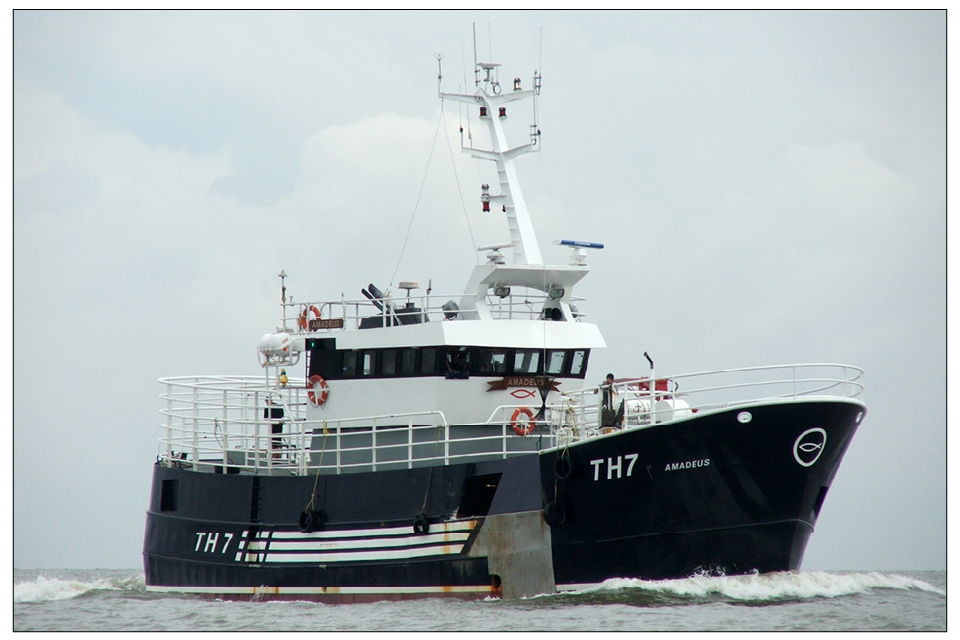
Image of Amadeus courtesy of Frits Olinga (Shipspotting.com).
2. Narrative
At about 0009 on 13 December 2023, a deckhand on the UK registered crab potting vessel Amadeus fell overboard while manually recovering crab pots in rough seas. He was leaning over the starboard side to lift the 48th pot in a string of 100 pots when the vessel lurched, causing him to lose balance and fall into the water (see figure).
The crew cut the back rope, and the vessel was manoeuvred to recover the deckhand. Although initially seen swimming, the deckhand was unable to stay afloat and became unresponsive within minutes in the 9°C water. Several attempts were made to reach him with a boat hook, but he was struck by a wave and disappeared. A major search and rescue operation ensued, but the deckhand was not found.

Figure: CCTV stills of the moment the deckhand fell overboard, courtesy of The Blue Sea Fishing Company Ltd.
3. Safety lessons
-
Leaning outboard to recover pots presents a significant risk of going overboard. Appropriate fall prevention controls must be in place if a task requires reaching over the vessel’s side. These may include safety harnesses, safety lines, or restraint systems designed to stop a person from falling into the water. Remember: a personal flotation device (PFD) does not prevent a fall, it only assists once someone is already in the water. Marine Guidance Note (MGN) 571 (F)1 offers guidance on how to prevent man overboard situations from occurring.
-
Immersion in water below 15°C triggers an immediate and severe physiological response. Cold water shock can quickly overwhelm breathing control and muscle function, even in strong swimmers. This makes it hard to keep the airway clear and greatly increases the risk of drowning within minutes. Wearing a properly fitted PFD is the most effective protection as it keeps a casualty afloat and maintains their airway when consciousness or muscle control is lost. However, the deckhand in this instance was not wearing one. This significantly reduced their survivability and removed a critical layer of protection that could have increased the time available for rescue.
-
Recovering a person from the water requires crews to be prepared and ready to put their training into practice quickly. High freeboard, darkness, poor sea conditions and recovering an unconscious person all contribute to challenging recovery methods. Regular, practical manoverboard drills in line with MGN 570 (F) Amendment No.12, clearly defined roles, and accessible, properly rigged recovery equipment are essential to ensure crews can respond quickly when every second counts.
-
The deckhand was almost certainly fatigued after weeks of demanding work with insufficient rest. Alertness, coordination, decision-making and reaction time decline as sleep debt builds, increasing the likelihood of mistakes or accidents during safety critical tasks. To prevent cumulative fatigue, work routines must provide adequate rest. Merchant Shipping Notice (MSN) 1884 (F) Amendment 13 requires a minimum of 10 hours rest in every 24-hour period and 77 hours rest in every 7-day period, and these limits must be met in practice to maintain safe performance at sea.
4. Further information
Our accident investigation report is available at: https://www.gov.uk/maib-reports/fall-overboard-from-the-crab-potting-vessel-amadeus-th7-with-the-loss-of-1-life
Extract from The United Kingdom Merchant Shipping (Accident Reporting and Investigation) Regulations 2026 – Regulation 5:
The sole objective of a safety investigation into an accident under these Regulations is the prevention of future accidents through the ascertainment of its causes and circumstances. It is not the purpose of such an investigation to determine liability nor, except so far as is necessary to achieve its objective, to apportion blame.
Note:
This safety flyer is not written with litigation in mind and, pursuant to Regulation 19(1) of The Merchant Shipping (Accident Reporting and Investigation) Regulations 2026, shall be inadmissible in any judicial proceedings concerning liability unless the Chief Inspector of Marine Accidents or a court of law determine otherwise.
Marine Accident Investigation Branch
First Floor, Spring Place
105 Commercial Road
Southampton
SO15 1GH
Email iso@maib.gov.uk
Enquiries during office hours +44 (0)23 8039 5500