HMRC and VOA gender pay report 2025
Published 16 December 2025

© Crown copyright 2025
This publication is licensed under the terms of the Open Government Licence v3.0 except where otherwise stated. To view this licence, visit nationalarchives.gov.uk/doc/open-government-licence/version/3 or write to the Information Policy Team, The National Archives, Kew, London TW9 4DU, or email: psi@nationalarchives.gov.uk.
Where we have identified any third party copyright information you will need to obtain permission from the copyright holders concerned.
This publication is available at https://www.gov.uk/government/publications/hmrc-and-valuation-office-agency-gender-pay-gap-report-and-data-2025/hmrc-and-voa-gender-pay-report-2025
Executive summary
HMRC and VOA is committed to closing the pay gap and our approach goes beyond focusing solely on pay. Our actions form part of the work we do to achieve our Public Sector Equality Duty (PSED) equality objectives
Our equality objectives support the delivery of HMRC’s strategic objectives, one of which is to build a high-performing skilled and engaged workforce by securing and retaining the best people, working in the right place, at the right time, with the right incentives for now and for the future.
In 2024 to 2025 HMRC and VOA’s mean gender pay gap decreased by 0.7 percentage points to 5.0% and the median gap decreased by 0.5 percentage points to 5.0%. The mean gender bonus gap fell by 2.8 percentage points to 17.2% in 2025. For comparison, the gap is lower than the UK overall median pay gap of 7.0% and lower than both the Civil Service median of 6.4% and mean of 6.9%.
Closing the gender pay gap is a long-term goal that we have been working towards for many years, and we have carried out deep dive analyses to understand the causes. These showed that the distribution of men and women in our workforce is the largest contributing factor:
- overall, there are more women than men in lower paid roles and more men than women in higher paid roles – for example, 66% of colleagues working in an Administrative Assistant (AA) role were women, compared to 44% women in Senior Civil Servant (SCS) roles
- if the number of men and women at each grade, work pattern and location were equal, our mean gender pay gap would shrink to 0.1% and our median gap would close altogether (0% gap)
We know there is more to do to close the gender pay gap. We continue to make progress by increasing the representation of women in senior roles. From March 2024 to March 2025, the representation of women in Grade 7 roles increased from 46% to 47% and from 44% to 45% at Grade 6. At SCS grades, it dipped from 46% to 44%. With the smaller number of colleagues at SCS grades, data are more easily skewed, and we expect that the increase at grade 7 and 6 will, in time, produce a sustained balance of men and women at SCS grades.
HMRC actions
Year-on-year actions that support a closing of the gender pay gap include:
Employment policies and processes
HMRC has a range of policies and processes in place that indirectly support the closing of our gender pay gap, such as:
- policies that recognise the many family structures and ways in which a colleague may become a parent
- a wide range of flexible working arrangements which support colleagues with parental and caring responsibilities particularly, including Carer’s Passport, Career Breaks and a Job-Share register
- menopause support for colleagues and managers via our Employee Assistance Programme (EAP) and HR Expert Advice Service and guidance to support colleagues experiencing domestic abuse
Evidence-informed approach with strong accountability and governance
We use quantitative data and insight to inform our approach to equality, diversity and inclusion and to measure progress. We monitor employee experience and outcomes by all equality protected characteristics, including sex, working pattern and carer status to measure and benchmark our progress.
We have a staff network and executive committee level champion for sex and gender and for carers to provide a platform for employee voice, engagement and peer support which feed into work to close the gender pay gap.
Progress is reported to senior boards to provide robust accountability and governance and drive progress.
Communicating our inclusive environment
We use a range of channels and activities, such as outreach campaigns, to communicate HMRC’s expectations, position and progress on equality and inclusion and celebrate our diversity internally and to attract talented people from all backgrounds to join and grow their careers at HMRC.
Learning and development opportunities
HMRC offers a wide range of learning and development opportunities, support, and career pathways that indirectly help close the gender pay gap. Some help colleagues to create an inclusive culture, some build specific skills and communities, for example our ‘Women in Tech’ group supports women into leadership.
During the financial year 2024 to 2025, we:
- Introduced new guidance and training on preventing and tackling sexual harassment and Upholding our Commitments, which reinforce the behavioural standards expected of all colleagues.
- Provided additional support on how to monitor and evaluate the impact of inclusion interventions and updated our diversity data tool to make it easier to use, completed an annual review of our equality priorities and success measures and retained improving the representation of women in our most senior roles as a priority.
- Ran a campaign of senior women sharing their career stories to inspire and support women to progress their careers within HMRC.
- Encouraged the uptake of inclusion learning and development opportunities by embedding it within Business Group People Plans and supported colleagues to implement new Civil Service guidance on equality, diversity and inclusion expenditure and impartiality guidance.
- Expanded our internal review and governance processes to ensure the value of bonuses for SCS performance was balanced and considerate of the outcomes by gender. It is pleasing to note these changes appear to be having a positive impact, with the 2.1 percentage point reduction in our bonus payment gap.
During the financial year 2025 to 2026 we will continue taking the year-on-year actions outlined above, and:
- Introduce annual Director-level preventing sexual harassment risk assessment reviews to identify improvement actions.
- Implement new legislation on menopause in the workplace under the Employment Rights Bill.
- Work with our sex and gender staff network to better understand any barriers to career progression within HMRC.
- Further embed the evaluation of our activities for impact on outcomes.
VOA actions
The VOA supports the fair treatment and reward of all colleagues, irrespective of gender. We have pay and conditions of employment that do not discriminate unlawfully and are free from bias. We use a job evaluation system to assess the relative value of jobs across the organisation, and this provides evidence in support of the allocation of jobs within our grading structure.
Recruitment
Civil Service Resourcing have direct responsibility for recruiting all VOA employees. The aim of the vacancy filling is to find the best available people for our jobs, applying the fundamental principle of selection for appointment on merit, through fair and open competition.
We promote surveying as a career for women, working with the Royal Institution of Chartered Surveyors (RICS) and the VOA’s Deputy Head of Surveying Profession to increase the percentage of women in surveying roles. More recently we have offered a returning surveyors programme. This is a new scheme to help Chartered Surveyors return to the profession after a career break. Whether due to family commitments, a career change or other personal circumstances, the programme offers a structured six to nine-month pathway back into surveying.
The programme is for Chartered Surveyors who’ve been out of the profession for 2 years or more. It’s a unique opportunity to:
- rebuild confidence
- refresh technical skills
- re-engage with the profession through hands-on experience, mentorship, and targeted training
While there is still more work to do, we compare favourably to the wider property industry in terms of female representation, where RICS’ latest data (October 2025) shows that 20% of RICS members are female. Our data for October 2025 showed that women now comprise:
- 41% of our surveyor caseworkers or specialist surveyor caseworkers
- 32% of our technical leaders
Talent and development
We recognise our people don’t all want the same things from their careers. We aim to provide everyone with opportunities to be the best they can be and to progress, whether to more senior roles, or other roles in the VOA or the wider Civil Service.
We continue to encourage colleagues to benefit from the variety of development programmes we have across the VOA, such as Future Leaders Scheme, Leap, Embrace, Ascend and Fast Stream.
Mentoring schemes
Colleagues have access to a refreshed Coaching and Mentoring Hub, run in partnership with HMRC. Coaching and mentoring empowers colleagues to work through their thinking, set goals and put a plan into action to develop themselves and/or their career.
We also promote Stride, the award winning HMRC/VOA mentoring scheme which supports social mobility.
Flexible working
We continue to support people across all grades who wish to work more flexibly. Most roles are available as job-share, reduced hours, or flexible working patterns. When we recruit to roles, these are normally advertised with the widest possible flexible working patterns to encourage those with childcare or other responsibilities to apply. The flexibilities in our hybrid working approach helps make us an employer of choice.
Leave
We have a long-standing offer of four weeks paternity leave offer to enable colleagues to increase their time at home with their children.
Diversity group
Our Gender group supports colleagues and drives action across the VOA. The group provides a space where members can reflect, share lived experiences and discuss concerns. These invaluable insights directly inform the work of the volunteers, including improving support for all people.
The Gender group also works with VOA People group, other diversity and inclusion groups and Civil Service-wide networks to link into wider Civil Service initiatives. This is with the aim of understanding the challenges colleagues may face in relation to gender and intersectional issues, share learning and provide or signpost the appropriate support.
This includes raising awareness with managers and colleagues about the impact of perimenopause and menopause by way of workshops and guidance notes.
Diversity group
We have operated a fully voucher based system for delegated grades since November 2020. This mainly consists of rewards of £25 and £50. In exceptional cases, awards of £100 may be made. Where £100 is awarded, this must be with the written approval of Grade 6 or Grade 7 (dependent on the grade of the recipient). We continue to monitor distribution of the awards to address any issues identified.
Performance awards for Senior Civil Servants
We are committed to ensuring all elements of pay are equitable, including performance bonuses. Given the higher mean bonus pay gap this year, we acknowledge that we have further work to do to ensure that financial recognition of performance at the Senior Civil Service level are balanced and considerate of the outcomes by gender. This has included expanding our internal review and governance processes with quarterly Executive Committee discussions to ensure the value of bonuses are monitored, endorsed and consistent across the department.
Raising awareness of women’s health in the workplace
We have increased awareness of women’s health conditions and how it can impact on women in the workplace. This includes videos, guidance, and toolkits for example on menopause awareness to support those directly impacted. We are also increasing the number of allies from those not directly impacted who are able to speak up on behalf of others.
Increasing visible female role models
We have showcased a number of visible female role models to help inspire the next generation. This includes two female colleagues being nominated at the October 2024 ‘Inspiring Women in Property Awards’.
Overview
In 2017, the government introduced legislation that made it a statutory requirement for organisations with 250 or more employees to report annually on their gender pay gap. Government departments are covered by the Equality Act 2010 (Specific Duties and Public Authorities) Regulations 2017, which came into force on 31 March 2017. These regulations underpin the Public Sector Equality Duty and require relevant organisations to publish their gender pay gap by 30 March annually. This includes:
- the mean and median gender pay gaps in hourly pay
- the mean and median gender bonus pay gaps
- the proportion of men and women who received bonuses
- the proportion of men and women full-pay employees in each pay quartile
The gender pay gap is a measure of the difference between the average earnings for men and women across an organisation of the labour market. It is expressed as a percentage of earnings for men.
If a workforce has a particularly high gender pay gap, this can indicate there may be several issues to deal with, and further calculations and analysis may help to identify what those issues are.
The gender pay gap is different to ‘equal pay’. Equal pay legislation deals with unlawful pay differences between men and women who do equal work, meaning they carry out the same jobs, similar jobs or work of equal value.
We have not included contractors, who are on HMRC’s payroll and provide a personal service to HMRC. Under the Equality Act 2010 (2017 Regs, Sch 1, Para 2(3), we are not required to include data relating to a relevant employee if:
- the employee is under a contract personally to do work
- the public authority does not have
- it is not reasonably practicable to obtain the data
Pay elements used in the calculation include allowances, whereas voluntary salary sacrifice deductions for childcare vouchers and cycle to work schemes are excluded.
Methodology
HMRC and VOA’s employee headcount is 70,927 as of 31 March 2025.
For the purpose of the gender pay report, and as defined by Regulation 2(1) of the Equality Act 2019 (Specific Duties and Public Authorities) Regulations 2017 and the government’s guidance for calculating the gender pay gaps, in this year’s report:
- 64,958 employees have been established to be in scope for calculation to determine the mean and median ordinary pay gaps, meaning in receipt of full pay on 31 March 2025
- 71,808 employees have been established to be in scope for the calculation to determine the gender mean and median bonus gaps, covering the 12-month period between 1 April 2024 and 31 March 2025
Our calculations followed the legislative requirements, and we confirm the data reported is accurate.
Organisation structure and pay
HMRC and VOA uses the standard Civil Service grading system ranging from Administrative Assistant (AA) to Grade 6 (G6), plus the Senior Civil Service (SCS).
Since 31 March 2024, HMRC and VOA has increased its workforce by 1,270 with the largest increase in our EO (Officer) grade. Overall, the number of women has increased by 604 and the number of men has increased by 703.
Women continue to be over-represented in administrative grades, where pay is lower, and women are under-represented in senior grades, where pay is higher.
Table 1: Employee headcount (HMRC and VOA) on 31 March 2025
| Grade (increasing seniority) | Number of men (% of men who work in this grade) | Number of women (% of women who work in this grade) | Total | % Women |
|---|---|---|---|---|
| AA/AO | 7,809 (22.8%) | 10,706 (29.2%) | 18,515 | 57.8% |
| EO | 7,617 (22.3%) | 8,382 (22.8%) | 15,999 | 52.4% |
| HEO/SEO | 13,234 (38.7%) | 12,838 (35.0%) | 26,072 | 49.2% |
| Grade 7/6 | 5,257(15.4%) | 4,542 (12.4%) | 9,799 | 46.4% |
| SCS | 303 (0.9%) | 239 (0.7%) | 542 | 44.1% |
| Total | 34,220 (100%) | 36,707 (100%) | 70,927 | 51.8% |
Delegated grades – AA to Grade 6
As a Civil Service department, HMRC is governed by public sector pay policy, as set out in the Civil Service Pay Remit guidance for delegated grades AA to Grade 6.
The pay guidance defines the overall financial parameters for Civil Service pay awards each year to ensure that these pay awards are consistent with the government’s overall objectives. The pay settlement dates for the annual pay awards used for this report are 1 June 2025 (HMRC) and 1 August 2025 (VOA).
AA and AO grades each have a single spot rate of pay, which are separate for London and National offices. Each of the remaining five grades from EO (Officer) to Grade 6 have a set pay range, which are separate for London and National offices. The pay ranges consist of a minimum and maximum rate of basic pay. There are no target rates, steps, or progression points within the pay ranges.
Movement and progression towards the maximum rate for the pay range is through the annual pay award process.
Dependant on the nature of the work undertaken in certain roles, non-consolidated allowances may also be paid.
HMRC and VOA operates a recognition scheme, which rewards colleagues with a ‘Simply Thanks’ electronic voucher for appreciation of good work and positive behaviours. For HMRC the value of the voucher is £25 and for VOA this can either be £25, £50 and £100.
HMRC does not operate any other performance or bonus scheme for employees in grades AA to Grade 6.
In addition to ‘Simply Thanks’ VOA also operates a recognition scheme, which rewards colleagues with £100 for exceptional effort. These awards are approved by Grade 7 or Grade 6 leaders.
The structure and value of the pay ranges and pay awards are negotiated with our two recognised Trade Unions; the Public and Commercial Services Union (PCS) and Association of Revenue and Customs (ARC), under the Association of First Division (FDA), who have agreed collective bargaining rights to represent HMRC employees.
Senior Civil Service
Pay and grading for the SCS across the Civil Service is governed by the Cabinet Office and managed by HMRC’s Executive Committee for HMRC and VOA SCS colleagues.
The structure consists of three grades: Deputy Director (SCS1); Director (SCS2); and Director General (SCS3), and each grade has a set pay range with a minimum and maximum rate of basic pay.
The settlement date for annual pay awards is 1 April and pay awards for 1 April 2024 have been used for this report.
Ordinary pay gap data
Mean hourly rates and pay gap percentage

The image shows mean gender pay gap in hourly pay decreased slightly this year by 0.7 percentage points to 5.0% (from 5.7% in 2024).
Median hourly rates and pay gap percentage

The image shows the median gender pay gap decreased by 8.0 percentage points to 4.7% (from 5.5% in 2024).
The gender pay gaps are based on the snapshot date of 31 March 2025 for Ordinary Pay. Any payments made after 31 March 2025 would be excluded.
Pay gaps are based on the hourly rate of pay rather than reduced take home pay for colleagues who are part-time, which ensures that the pay gaps are not further distorted.
For example, two EO (Officer) national colleagues (one full time and the other part time) with an annual salary of £29,500 on 31 March, will both have the same hourly rate of £15.28.
Whilst this does not directly impact on the hourly rates of pay for the gender pay gap, working patterns potentially impacts on employees’ career aspirations and choices as there is a high representation of part-time women (compared with men) in the AA, AO and EO (Officer) grades.
Overall, as there continues to be a higher proportion of men in the senior grades of Grade 7, Grade 6 and SCS, men continue to have higher average earnings as a group, as highlighted in Table 2, which shows the proportion of full-time men and women in each pay quartile.
Table 2: Proportion of men and women by pay quartiles
| Quartile | Female (%) | Male (%) |
|---|---|---|
| First (lower) quartile | 56.7 | 43.3 |
| Second quartile | 51.9 | 48.1 |
| Third quartile | 48.7 | 51.3 |
| Fourth (upper) quartile | 46.4 | 53.6 |
Bonus pay gap data
HMRC and VOA follows the standard public sector approach to pay and reward, and an agreed fund is reserved for payment of non-consolidated, non-pensionable awards linked to performance.
The gender bonus gaps are based on Simply Thanks vouchers and Senior Civil Service performance award data captured for the 12-month period between 1 April 2024 and 31 March 2025.
Mean bonus pay gap percentage
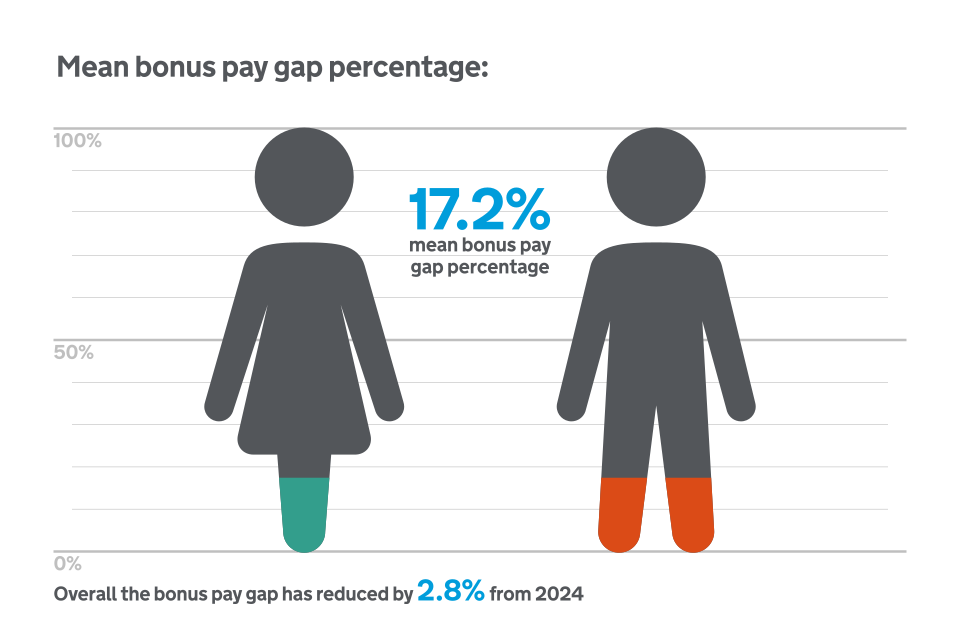
The image shows the mean bonus differed at £104.17 (male) and £86.22 (female), representing the mean bonus gap of 17.2%.
Median bonus pay gap percentage
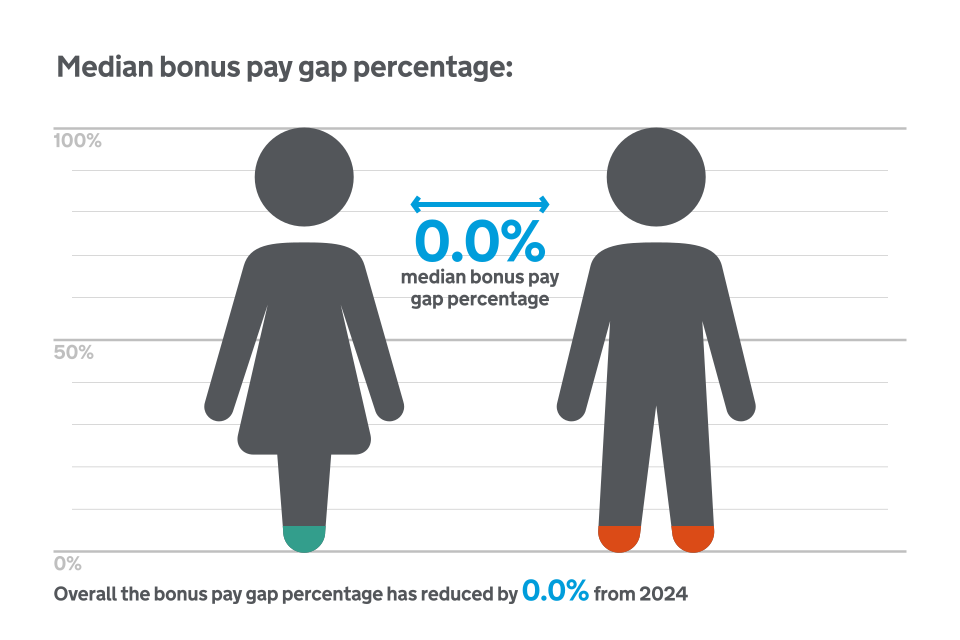
The image shows the median bonus for the workforce was £25 for both male and female, representing no bonus gap.