HMPPS Annual report and accounts 2024-25: Accountability Report (HTML)
Published 30 October 2025
Applies to England and Wales

© Crown copyright 2025
This publication is licensed under the terms of the Open Government Licence v3.0 except where otherwise stated. To view this licence, visit nationalarchives.gov.uk/doc/open-government-licence/version/3 or write to the Information Policy Team, The National Archives, Kew, London TW9 4DU, or email: psi@nationalarchives.gov.uk.
Where we have identified any third party copyright information you will need to obtain permission from the copyright holders concerned.
This publication is available at https://www.gov.uk/government/publications/hmpps-annual-report-and-accounts-2024-to-2025/hmpps-annual-report-and-accounts-2024-25-accountability-report-html
Corporate governance report
The purpose of the corporate governance report is to explain the composition and organisation of HMPPS and how these arrangements have supported the achievement of its objectives during 2024 to 2025.
Statutory background
On 1 April 2008 the National Offender Management Service (NOMS) became an executive agency of the MoJ, bringing together the Probation Service, former NOMS HQ and the Prison Service to enable more efficient and effective delivery of services.
On 1 April 2017, NOMS became HM Prison and Probation Service (HMPPS), an executive agency of the MoJ. A number of former NOMS functions transferred to the MoJ to allow HMPPS to better focus on improving operational performance in prisons, probation and youth custody.
The HMPPS Agency Board and HMPPS Leadership Team
The governance arrangements within HMPPS from 1 April 2021, as agreed by the Permanent Secretary and the HMPPS Agency Board (HAB), included:
-
a minimum of four HAB meetings per year focusing on strategic priorities including performance, risk and investment
-
a weekly HMPPS Leadership Team (HLT) meeting with a rotating focus on people, change, performance, finance and risk, and infrastructure
From January 2023, the HLT moved from weekly to fortnightly meetings, with the expectation that an increased level of business would be dealt with at sub-committee level, with only essential items requiring full team decisions being escalated to the HLT.
The HLT was supported by a range of sub‑committees and three operational management committees – for probation, prisons and the YCS – reporting to the HLT. From September 2024, the prison and probation operational management committees were replaced with the Senior Operations Leadership Team (SOLT) meeting, chaired by the Director General Operations, which reported directly to the HLT.
From January 2025, every other HLT meeting was expanded to include the SOLT membership, who were considered as full participating members of the joint HLT-SOLT meeting.
Amy Rees left her position as Chief Executive of HMPPS to become Interim Permanent Secretary of the MoJ on 11 April 2025. Phil Copple (formerly HMPPS Director General Operations) was appointed as Interim HMPPS Director General Chief Executive Officer from 1 April 2025 until James McEwen took up the position of HMPPS Director General Chief Executive Officer from 13 October 2025. The Director General Chief Executive Officer’s pay is determined under the rules set out in chapter 7.1 (Annex A) of the Senior Civil Servant Management Code. Other members of the HAB and HLT are appointed by the Director General Chief Executive Officer with the agreement of the Permanent Secretary of the MoJ. Details of the remuneration of directors of the HAB and the HLT are set out in the remuneration and staff report.
As of 31 March 2025, the structure of the HAB and HLT was as follows.
HAB
Core members:
-
Four non-executive directors (including one chairing)
-
Director General Chief Executive Officer
-
Director General Operations
-
Executive Director, YCS
-
MoJ Director, Finance Business Partnering
-
MoJ People Group Director, HR Business Partnering and People Change
In attendance:
-
Executive Director, Strategy, Planning and Corporate Delivery
-
Executive Director, Transforming Delivery
-
Executive Director, Change
-
Executive Director, Rehabilitation
-
Chief Operating Officer Prisons
-
Chief Probation Officer
-
MoJ Policy Group
-
MoJ Legal
-
Chief Executive Officer’s Office
-
Secretariat
HLT
Core members:
-
Director General Chief Executive Officer – (chair)
-
Director General Operations
-
Executive Director, YCS
-
Executive Director, Strategy, Performance and Corporate Delivery
-
Executive Director, Transforming Delivery
-
Executive Director, Change
-
Chief Operating Officer Prisons
-
Executive Director, Rehabilitation
-
Chief Probation Officer
-
MoJ Director, Finance Business Partnering
-
MoJ People Group Director, HR Business Partnering and People Change
In attendance:
-
MoJ Policy Group
-
MoJ Legal
-
Chief Executive Officer’s Office
-
Secretariat
Additional executive directors and functional lead directors are invited to attend the HAB or HLT for specific discussions related to their area.
Tajinder Singh-Matharu, Deputy Director for Performance, Assurance and Risk, attended the HLT to increase diversity of thought and perspective to discussions, as part of the business’ commitment to drive diversity and inclusion across HMPPS.
Audit and Risk Assurance Committee (ARAC), HAB and HLT members in the year to 31 March 2025
Committee key:
Gerard Lemos
Lead Non-Executive Director and Board Chair (until 20 March 2025)
HAB (7 of 7)
Nick Campsie
Non-Executive Director
HAB (7 of 7)
ARAC (6 of 6)
Nick Folland
Non-Executive Director (until 19 May 2024)
ARAC (1 of 1)
Jonathan Flory
Non-Executive Director
HAB (6 of 7)
ARAC (6 of 7)
Rommel Moseley
Non-Executive Director
HAB (5 of 7)
Mark Lloyd
Non-Executive Director
ARAC (7 of 7)
Heather Savory
Non-Executive Director (until 19 May 2024)
HAB (0 of 0)
ARAC (1 of 1)
Amy Rees
Director General Chief Executive Officer
HLT (26 of 31)
HAB (7 of 7)
ARAC 6 of 7)
Phil Copple
Director General Operations
HLT (24 of 31)
HAB (6 of 7)
ARAC (5 of 7)
Jim Barton
Executive Director, Change
HAB (26 of 31)
ARAC (5 of 7)
Ed Cornmell
Executive Director, YCS
HLT (26 of 31)
HAB (3 of 7)
Matt Grey
Executive Director, Rehabilitation
HLT (26 of 31)
Dominic Herrington
Executive Director, Transforming Delivery
HLT (29 of 31)
Michelle Jarman-Howe
Chief Operating Officer Prisons
HLT (27 of 31)
Hannah Meyer
Executive Director, Strategy, Performance and Corporate Delivery
HLT (26 of 31)
ARAC (6 of 7)
Kim Thornden-Edwards
Chief Probation Officer
HLT (20 of 31)
Caroline Patterson
MoJ Director, Finance Business Partnering (until 7 March 2025)
HLT (22 of 29)
HAB (5 of 5)
ARAC (6 of 7)
Paul Henson
MoJ Director, Finance Business Partnering (from 10 March 2025)
HLT (1 of 1)
HAB (2 of 2)
ARAC (0 of 0)
Dave Mann
MoJ Director, People Services (from 1 April 2024 to 28 July 2024)
HLT (2 of 10)
HAB (0 of 3)
Louise Alexander
MoJ Director, HR Business Partnering and People Change (from 29 July 2024)
HLT (13 of 31)
HAB (4 of 4)
From January 2025 onwards, every other HLT meeting was expanded to include the SOLT membership, as listed below. They were considered as full participating members of HLT for the expanded meetings.
Chris Jennings
Area Executive Director, South‑West, South-Central and Public Protection Group
HLT (2 of 2)
Alan Scott
Area Executive Director, North‑West and Women’s Group
HLT (1 of 2)
Sarah Coccia
Area Executive Director, London
HLT (2 of 2)
Ian Barrow
Executive Director, Wales and CAS
HLT (2 of 2)
Helen Judge
Area Executive Director, North‑East, Yorkshire, The Humber
HLT (1 of 2)
Sarah Chand
Area Executive Director, Midlands
HLT (1 of 2)
David Hood
Area Executive Director, South‑East Eastern (until 20 March 2025)
HLT (1 of 2)
Richard Vince
Executive Director, Security
HLT (2 of 2)
Robin Seaton
Interim Executive Director, Contracted Operational Delivery (until 13 April 2025)
HLT (2 of 2)
Changes, new members and departures during the reporting period
Nick Folland
Non-Executive Director (until 19 May 2024)
Heather Savory
Non-Executive Director (until 19 May 2024)
Caroline Patterson
MoJ Director, Finance Business Partnering (until 7 March 2025)
Paul Henson
MoJ Director, Finance Business Partnering (from 10 March 2025)
Gerard Lemos
Lead Non-Executive Director and Board Chair (until 20 March 2025)
Dave Mann
MoJ Director, People Services (from 1 April 2024 to 28 July 2024)
Louise Alexander
MoJ Director, HR Business Partnering and People Change (from 29 July 2024)
Changes to the ARAC, HAB and HLT since 1 April 2025
Amy Rees
Director General Chief Executive Officer (until 11 April 2025)
Phil Copple
Interim Director General Chief Executive Officer (from 1 April 2025 to 12 October 2025)
Michelle Jarman-Howe
Interim Director General Operations (from 1 April 2025)
Sarah Coccia
Interim Chief Operating Officer Prisons (from 1 April 2025)
Robin Seaton
Interim Executive Director, Contracted Operational Delivery (until 13 April 2025 and from 14 July 2025)
Neil Richards
Executive Director, Contracted Operational Delivery (from 14 April 2025 to 11 July 2025)
Gabriel Amahwe
Area Executive Director, London (from 21 April 2025)
Sara Robinson
Area Executive Director, South‑East Eastern (from 28 April 2025)
Dame Glenys Stacey
Non-Executive Director (from 19 May 2025)
Ed Cornmell
Executive Director, YCS (until 8 June 2025) and
Executive Director, Long-Term High Security Estate (from 9 June 2025)
Sonia Brooks
Interim Executive Director, YCS (from 18 June 2025 to 21 September 2025)
Ben Charnock
Interim Executive Director, Strategy, Performance and Corporate Delivery (from 8 July 2025)
Alison Clarke
Executive Director, YCS (from 22 September 2025)
James McEwen
Director General Chief Executive Officer (from 13 October 2025)
Governance statement
Introduction
HMPPS is an executive agency of the MoJ. Its duties are to implement the sentences and orders of the courts, to protect the public and rehabilitate offenders. The organisation operates in accordance with its published Framework Document which sets out the arrangements for the governance, accountability, financing, staffing and operation of the agency, agreed between the Secretary of State for Justice and the agency Chief Executive Officer and approved by the Chief Secretary to HM Treasury.[footnote 1]
As Director General Chief Executive Officer, I am the Accounting Officer for HMPPS and responsible for the day-to-day operations and administration of the agency and leadership of its staff. I am accountable to the MoJ Permanent Secretary and Principal Accounting Officer, and ultimately to Parliament.
Throughout the year the HLT and the HAB have maintained close scrutiny of day-to-day business, risk, performance and financial expenditure through formal governance arrangements. Actions have been taken to respond to issues and mitigate risks to the business as necessary. Specific actions have been taken in response to significant risks and issues, set out from the Governance report.
The remainder of this statement explains in more detail the arrangements in place to govern HMPPS from 1 April 2024.
Governance framework
Overall responsibility for HMPPS rests with me as the Director General Chief Executive Officer, supported by the HAB and HLT. I am also a member of the MoJ Departmental Board, chaired by the Secretary of State for Justice, and a member of the MoJ Executive Committee, chaired by the Permanent Secretary.
I have regular meetings with the minister with responsibility for prisons and probation and with the Secretary of State for Justice.
HMPPS governance structure as of March 2025
The HMPPS governance team undertook a governance review in 2024 of the executive-level meetings, which led to a restructure to enable faster decision making, reduce duplication and streamline governance routes. The restructure was fully effective by March 2025.
-
The Probation Operational Management Committee and the Prison Operational Management Committee were stood down and replaced with the SOLT. The SOLT brings together senior operational leaders to discuss and make decisions on cross‑cutting operational issues and reports directly to the HLT. In January 2025, every other HLT meeting was expanded to include the SOLT membership.
-
The governance review additionally established a Change Board, which replaced the Change Portfolio Board, the Commercial Sub-Committee and the Digital and Data Sub-Committee.
-
The committee known as the People Sub‑Committee was refreshed and renamed the HMPPS People Board.
The key governance structures in place as of 31 March 2025 are shown below.
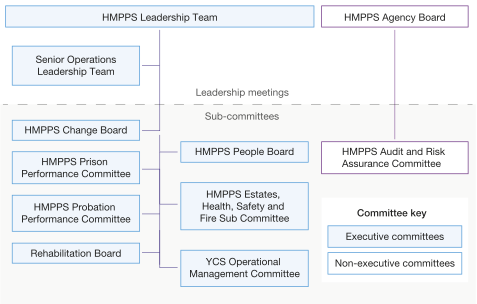
A diagram showing the key governance structures in place as of 31 March 2025.
The HMPPS Leadership Team is an executive committee that is supported by the Senior Operations Leadership Team and several executive sub-committees. These are: the HMPPS Change Board, the HMPPS Prison Performance Committee, the HMPPS Probation Performance Committee, the Rehabilitation Board, the HMPPS People Board, the HMPPS Estates, Health, Safety and Fire Sub-Committee, and the YCS Operational Management Committee.
The HMPPS Agency Board is a non-executive committee that is supported by the HMPPS Audit and Risk Assurance Committee, which is a non-executive sub-committee.
HMPPS Agency Board Chair’s report
I was appointed interim Chair of the HMPPS Board in May 2025 and begin what I hope will be the first of many annual updates by thanking my predecessor, Lord Gerard Lemos, for his two terms of leadership through often difficult times, including the COVID‑19 pandemic and the culmination of the prison capacity crisis during 2024.
Considerable challenges remain in both the prison and probation services, but we end 2024 to 2025 in a better place strategically than I have known during my years of involvement with the criminal justice system. For all that time, successive administrations have been reluctant to acknowledge the root cause of many of HMPPS’s performance challenges: more prisoners and people on probation than our supply of staff and physical infrastructure have been able to manage. Two recent developments give the Board optimism that we may in the coming years restore balance to that equation, namely the Independent Sentencing Review, which will address the growth of the prison population, and the recent Spending Review which will allow us to build new prison capacity and invest in the size and capability of our Probation Service.
Capacity has not been the only cause of our performance issues, and there are multiple other aspects of our operations that demand attention. Even with new prisons, additional probation staff, and the Independent Sentencing Review, our resources will remain stretched. But the Board are hopeful that the underlying cause of many of our challenges has been acknowledged and is now being addressed.
My colleagues and I have the privilege of spending time in our probation offices and prisons. I wish more people could see what we do: tireless, dedicated staff who go the extra mile in often trying circumstances to keep the public safe and help rehabilitate those in their charge. On behalf of the HMPPS Board, I thank you all.
Membership of HMPPS’s senior management team can be an equally thankless role. The calmness, determination, and resilience our executive team bring to one of the most demanding challenges in public service is hugely appreciated. This year marks an important leadership transition, and I am delighted to welcome James McEwen as our new Chief Executive Officer. James joins us with a strong track record and commitment to our mission, and the Board look forward to working with him as we build on recent progress.
I would also like to pay tribute to Amy Rees, whose leadership as Chief Executive Officer has left a lasting impact on HMPPS. Amy’s vision and determination strengthened our operational resilience and advanced our reform agenda. My thanks also go to Phil Copple, who stepped in as Interim Chief Executive Officer during this period of transition. Phil’s leadership, deep operational knowledge and respect from key stakeholders ensured continuity at a critical time.
The Board are realistic that the year ahead will bring further challenges. But we end this one with reasonable optimism that we have the building blocks in place to guide HMPPS to a level of performance we can all be proud of.
Nick Campsie HMPPS interim Agency Board Chair Non-Executive Director
| HMPPS Agency Board | |
|---|---|
| Chair: | HMPPS non-executive director |
| Frequency: | Twice a month |
| Composition as at 31 March 2025: | |
| By position: | Three non-executive directors (plus one vacancy), two directors general, three executive directors |
| By gender: | Two female, six male |
Role of the HAB
The HAB gave direction to, and drove achievement of, the objectives of the agency’s operations. It ensured the following were in place:
-
competent and prudent management
-
sound planning
-
proper procedures for the maintenance of adequate accounting
-
other records and systems of internal control and compliance with legislative and corporate governance requirements, including relevant sections of the Corporate Governance Code for Central Government Departments
The agendas and reports presented to the HAB ensured a strategic focus on key priorities and their delivery, and included deep dives on significant issues, such as actions to address prison capacity pressures and steps to further improve the Probation Service.
The HAB’s responsibilities included:
-
agreeing the vision and strategy of the agency and aligning the values of the agency with those of the Civil Service Code (integrity, honesty, objectivity and impartiality)
-
agreeing appropriate governance and internal controls, including processes to ensure sound financial management and good value for money
-
agreeing processes to manage financial and performance risks
-
supporting the HLT to deliver operations
Some of the key issues and reports discussed during the year included:
-
supply and demand/prison capacity – including the management and escalation of critical capacity pressures, and continued action to expand supply, reduce demand and maximise the use of the existing estate
-
a 10-year Prison Capacity Strategy to set the long-term supply line for the prison estate and its alignment with the Annual Statement on Prison Capacity, the Spending Review and the Sentencing Review
-
the future strategy to transform the Probation Service, to tackle current challenges and ensure future delivery is sustainable, high-quality and can successfully deliver the Sentencing Review outcome
-
the approach to future funding and the subsequent Spending Review, aiming to put the department in as strong a position as possible to facilitate the delivery of MoJ and HMPPS strategic objectives
-
the Independent Sentencing Review and how the MoJ will assess the potential impacts of the review’s recommendations on operational delivery partners and organise itself to oversee implementation of the recommendations
-
progress of the Independent Review of the Criminal Courts and the potential impacts on HMPPS
-
drugs in prison, including the impact of existing interventions and mitigations and the approach to managing new threats
-
regular oversight of performance, risk, finance and change – including the Audit and Risk Assurance Committee (ARAC) chair’s reports and corporate risk register, change portfolio and management accounts updates, as well as prison, probation and YCS performance packs
Managing conflicts of interest
At the beginning of every HAB meeting, all members are asked to declare any new potential conflicts of interest. These are noted in the minutes, along with the appropriate action taken to manage them such as members withdrawing from discussion relating to those interests. HAB and HLT members are also asked to review and update the conflicts of interest record at least annually.
Audit and Risk Assurance Committee chair’s report
I would like to thank my fellow committee members for their commitment and contribution throughout what has been another challenging year for the agency. I would particularly like to thank both Amy Rees and Phil Copple for their respective tenures as HMPPS Chief Executive, and for their excellent engagement with this committee.
The ARAC provides advice to the HAB and to the Chief Executive Officer in their role as Accounting Officer on governance, risk management and internal control. During the year, the Committee met formally four times, with additional extraordinary meetings where required, and continued to exercise its review, challenge and advisory functions. Members also attended briefing sessions and undertook visits to prison and probation establishments to maintain a clear understanding of operational realities.
Membership of the Committee changed during the year. We welcomed Rommel Moseley as an independent member in March 2025, joining Mark Lloyd and myself. I would like to thank Nick Campsie and Nick Folland for their contributions during their tenure. Our latest effectiveness review in November 2024 confirmed that ARAC continues to operate effectively, with improvements adopted to strengthen financial oversight and prioritise accounting expertise in future recruitment.
The operating environment for HMPPS has remained extremely demanding. Capacity pressures across prisons and probation dominated risk management discussions, alongside the need to stabilise performance and maintain safety. While the agency achieved full staffing complement in prisons, probation continues to face workload and quality challenges and current performance is unsatisfactory. Wider societal issues and rapid technological change have contributed to rising risks, including drugs ingress and violence. I commend the leadership for navigating these pressures and implementing measures such as SDS40 and Probation Reset, while recognising that overall risk levels remain too high.
The Committee has focused on supporting improvements in risk management processes, including greater consistency in regional reporting and the introduction of new strategic risks for sustainability and ingress. However, progress in reducing corporate risk remains limited, and we have urged continued prioritisation of control measures, particularly around prison security, staff safety and rehabilitation activity.
On financial stewardship, ARAC scrutinised the production of the 2024 to 2025 accounts. Delays in external audit, including dependencies on the Local Government Pension Scheme, mean that accounts will again be laid later than desirable. We hope to see a return to more timely reporting in future years. Internal audit has continued to provide valuable assurance, and we note the Head of Internal Audit’s ‘moderate’ opinion as fair in the context of the year’s challenges.
Looking ahead, our priorities include supporting the agency to stabilise probation performance, strengthen prison regimes, and deliver the remaining prison build programme. We will also maintain focus on emerging risks such as cyber threats, AI, and sustainability, and continue to challenge the agency to bring risk levels back within tolerance.
On behalf of the Committee, I would like to thank colleagues across HMPPS and our partners in internal and external audit for their support and engagement. We look forward to continuing our work in the year ahead.
Jonathan Flory Non-Executive Director, Chair of the HMPPS Audit and Risk Assurance Committee
| HMPPS Audit and Risk Assurance Committee | |
|---|---|
| Chair: | HMPPS non-executive director |
| Frequency: | Four meetings plus three extraordinary meetings during the year |
| Composition as at 31 March 2025: | |
| By position: | Three non-executive directors |
| By gender: | Three male |
Role of the ARAC
The ARAC is an advisory body providing independent advice on governance, risk management and control issues, and on the internal audit work programme. It provides scrutiny of the accounts and considers key recommendations from internal audit reports and the National Audit Office.
Key issues and reports discussed during the year included:
-
prison capacity and supply and demand – including assurance on new prison builds
-
probation performance and data measurement – including the future strategy to transform the Probation Service
-
the impact of drugs in prisons and disruptions to conveyancing routes
-
safety and violence in prisons
-
safeguarding and safer recruitment within the YCS
-
the use of artificial intelligence within HMPPS and associated cyber risks
-
regular oversight of performance, risk, finance and performance – including the corporate risk register, counter fraud, bribery and corruption updates, the annual report and accounts, and internal audit recommendations
-
climate and sustainability
Managing conflicts of interest
At the beginning of every ARAC meeting, all members are asked to declare any new potential conflicts of interest. These are noted in the minutes, along with the appropriate action taken to manage them such as members withdrawing from discussion relating to those interests.
| HMPPS Leadership Team | |
|---|---|
| Chair: | HMPPS Chief Executive Officer |
| Frequency: | Twice a month |
| Composition as at 31 March 2025: | |
| By position: | Two directors general, nine executive directors and an additional nine executive directors every other meeting when SOLT members are invited |
| By gender: | Eight female, 11 male (plus one vacancy) |
Role of the HLT
The HLT is responsible for supporting the day‑to‑day management of the business. This includes all agency-wide corporate and operational issues, as well as prison, probation and YCS performance, finance, and risk management. It is supported by the SOLT and the Youth Custody Operational Management Committee chaired by the Director General Operations and the Executive Director of the YCS respectively, and the sub-committees shown on the governance chart.
Key issues and reports discussed during the year under review included:
-
prison capacity – mitigations to address acute demand pressures across the estate, with continued action to expand supply, reduce demand and maximise the use of the existing estate
-
Our Future Probation Service programme – to shape the service going forward, including the approach to probation capacity and performance
-
security stocktake – significant security risks for the organisation, their impact on prison and probation, and strategies to address these evolving challenges
-
strategic financial planning including allocations and the corresponding financial risks and pressures
-
OneHMPPS – including HQ and area model implementation designed to improve the service quality and efficiency across all of HMPPS by joining up prison and probation operations and redefining HQ to deliver more efficient and effective support to frontline services
-
secure schools – linking to the Children and Young People in the Secure Estate Strategy
-
professional standards and behaviours guidance – to set out the clear expectations of professional standards of behaviour across HMPPS
-
digital priorities and approach to AI – progress and opportunities of digital and technology transformation initiatives
-
climate change and sustainability transition risks and opportunities
-
regular oversight of performance and assurance, risk, finance, change, security and staffing information – including the corporate risk register, change portfolio and management accounts updates, and prison, probation and YCS performance packs
Details of HAB, HLT and ARAC membership, including attendance records, can be found within the Corporate gvernance report.
HLT sub-committees as of 31 March 2025
-
Senior Operational Leadership Team – to provide oversight and take necessary decisions regarding the cross-cutting operational issues for prisons and probation.
-
YCS Operational Management Committee – to oversee and take any necessary decisions regarding the day-to-day delivery of youth custody (public and private sector) including risk, assurance and finances.
-
Probation, Prison and YCS Performance Committees – to oversee and take any necessary decisions regarding the performance of probation, prison and YCS (public and private sector), including issues that are delivered by other directorates, or the wider MoJ, which impact on performance.
-
Estates, Health, Safety and Fire Sub‑Committee – to provide strategic oversight and guidance across all prison, probation and YCS estate projects and provide direction to the management of occupational health, safety and fire across HMPPS, ensuring that strategic systems for their management are adequate.
-
HMPPS People Board – to support the HLT in its leadership and management of people strategies to improve the co-ordination of design, decisions and implementation of cross‑cutting programmes of work.
-
HMPPS Change Board – to be the decision‑making body for change activity across HMPPS, providing senior leadership and challenge to ensure that delivery and operational impact of change are effectively managed and considered.
Additional executive committees
-
Rehabilitation Board – to make cross‑cutting strategic decisions to drive the solutions and system reform required to deliver on the ambitions of the HMPPS Rehabilitation Strategy.
-
Finance Advisory Committee – to provide advice and support for financial issues and decisions due to be considered by the HLT, sub-committees and MoJ finance governance. To provide financial scrutiny of HMPPS – including financial planning, governance, monthly management accounts and wider accounting implications of investment proposals.
Business appointment rules
All officials are subject to rules on accepting outside appointments after leaving the Civil Service. The purpose of the business appointment rules is to avoid:
-
the risk that an employer might gain an improper advantage by appointing a former official who holds information about its competitors, or about impending government policy
-
any suspicion that an appointment might be a reward for past favours
-
the risk of a former official improperly exploiting privileged access to contacts in government
-
unfair questioning or criticism of the integrity of former civil servants
Full details on the business appointment rules, including when they apply and the application process, can be accessed by all employees via the intranet. All exit management letters contain wording on the business appointment rules as a reminder to employees of their obligations.
The MoJ has a clear procedure in place for considering applications under the business appointment rules from employees at grades SCS2 and below. The process is managed by the People Policy team and includes input from the individual, their line manager, the Chief Commercial Officer and the Director General People and Capability. In exceptional cases the Permanent Secretary is consulted on business appointment rule applications.
MoJ liaises with the Advisory Committee on Business Appointments for applications from ministers and directors general (SCS3) and above.
During 2024 to 2025 there were 35 exits from the department at Senior Civil Service (SCS) level. 24 business appointment rule applications were made as follows:
- Ministers:
– seven ministerial applications
- Civil servants:
– one SCS3 application
– four SCS2 applications
– three SCS1 applications
–three Grade 6 applications
– two Grade 7 applications
– four applications were below Grade 7
No applications were found to be unsuitable for the applicant to take up. All applications below SCS2 were approved with conditions set. The Advisory Committee on Business Appointments determines the outcome and any conditions set for SCS3 and above. There were no known breaches of the business appointment rules.
In compliance with business appointment rules, the department is transparent in the advice given to individual applications for senior staff, including special advisers. Advice provided by the department on specific business appointments has been published at: www.gov.uk/government/publications/moj-business-appointment-rules. The Advisory Committee on Business Appointments publishes advice on business appointment rule applications for Director General SCS3 and above at: www.gov.uk/government/organisations/advisory-committee-on-business-appointments.
Declarations of interest
MoJ’s Declaration and Management of Outside Interests Policy is based on Cabinet Office guidance and is available to all employees via the intranet. The policy sets out the expectations and process for declaring an interest. It is the responsibility of individuals to declare all interests (actual, potential or perceived) that could be relevant to their role. Failure to do so could result in action being taken against the individual in line with the relevant conduct or discipline policy.
MoJ holds a central register of declarations of interests for all members of the SCS. This includes details of any financial interests declared, secondary employment and appointments, personal interests, and any other relevant interests. There is an annual declaration of interest exercise and individuals are required to submit an updated declaration when there is a change in circumstance during the year. Declarations of interest for employees in the delegated grades are recorded and managed locally.
In line with the Declaration and Management of Outside Interests Policy, details of all SCS who have declared outside employment, work or appointment which is paid or otherwise remunerated can be found at: www.gov.uk/government/publications/ministry-of-justice-register-of-senior-civil-servant-secondary-paid-employment/ministry-of-justice-register-of-senior-civil-servant-secondary-paid-employment.
Oversight and assurance arrangements
The HAB provides scrutiny of performance, risk management, systems and financial accounts.
The HLT exercises oversight of the performance of HMPPS on behalf of the HAB by:
-
using the performance, risk and planning framework to check progress against delivery of HMPPS’ key priorities
-
receiving reports on the in-year financial position and updates on the progress of major change projects and programmes, based on agreed thresholds, on any issues that arise (for example: overspend and significant risks to delivery)
-
agreeing delegations to directorates and throughout the governance structure to ensure the right decisions are being taken by the right people in the right place, while ensuring the HAB is provided with the appropriate level of assurance
The HAB also considered information from a range of external sources which included:
-
HM Chief Inspectors of Probation and Prison and Independent Monitoring Boards
-
the Prisons and Probation Ombudsman
-
the National Audit Office
-
the Youth Justice Board
In addition, one of the key sources of independent assurance within HMPPS came from the internal audit service delivered by the Government Internal Audit Agency. Arrangements are in place to ensure that I am made aware of any significant issues which indicate that key risks are not being effectively managed.
I am assured that the internal audit service complies with the Public Sector Internal Audit Standards.
Government Internal Audit Agency
The Government Internal Audit Agency (GIAA) continues to provide a ‘moderate’ annual opinion for HMPPS, defined as “some improvements are required to enhance the adequacy and effectiveness of the agency’s framework of governance, risk management and control”.
The audit programme for the year focused on key operational processes and areas of strategic change for HMPPS. Coverage has included prison safety, workforce and skills, rehabilitation and resettlement, offender management and organisational assurance. GIAA has also provided ongoing assurance of key projects in HMPPS.
GIAA outlines that capacity continues to be the biggest risk and most pressing issue for HMPPS. Initiatives to relieve acute pressure in the adult male estate have avoided absolute capacity being reached, but this pressure has been spread across the wider system and changes in demand are still widely deemed to be required to ensure sustainable stability. Thematic consideration of the effect of prison capacity on operational activity this year found instances where activities were stretched or affected by capacity pressures, often due to disruption related to increased movement of prisoners, but did not find critical failures in key safety or security processes.
GIAA notes that despite system-wide capacity pressures, HMPPS has maintained a focus on improvement. An audit of prison officer skills found that the Enable programme set an ambitious blueprint for future skills in the service, informed by available research and the findings of previous reviews. Plans for rollout are robust but recognise the scale of intended change to culture and ways of working. SDS40 helped to ensure prison capacity did not affect wider justice and policing systems but resulted in significant increases in probation caseloads. This is turn has prompted HMPPS to review delivery models for community supervision through Probation Reset and Our Future Probation Service.
GIAA outlines that the OneHMPPS change programme has transitioned to business as usual and the area executive director operating model is established, providing geographical oversight of prisons and probation operations. A number of GIAA’s reviews covered custodial to community transitions, including domestic abuse and resettlement services. These audits found a broadly improving picture, but significant opportunities for ongoing improvement through better alignment of systems and working practices. An audit of first line assurance activities also highlighted the extent to which assurance and oversight processes in different areas of the organisation had diverged and diversified over time and made recommendations to consider them jointly in the context of a national framework in future.
GIAA attended several key change programme boards and the Portfolio Board to provide real‑time assurance on the delivery of key change activity in the organisation. GIAA has consistently found major projects and programmes to be well led and related governance arrangements to be operating effectively. Notwithstanding, external factors and challenging operating environments mean a number of key programmes relating to capacity are not expected to deliver to intended costs or timeframes. GIAA’s departmental review of the availability and prioritisation of project delivery resources found opportunities to improve early-stage evaluation of support requirements and visibility and prioritisation of needs at a portfolio level.
GIAA has continued to undertake cross‑departmental audits, covering functional areas where HMPPS works in partnership with other parts of the department. GIAA has highlighted a number of areas where controls should be strengthened or improved, including assurance of performance management activity and the implementation of improvements to address risks relating to estates asset data.
Internal assurance
As well as GIAA, sources of internal assurance from which the Accounting Officer draws include:
-
annual assurance statements from each of the directors covering the key systems for which they are responsible
-
a second line assurance function, reviewing operational delivery
-
bilateral meetings with the lead non-executive director to discuss any concerns they may have
-
regular reports from managers on the steps they are taking to manage risks in their areas of responsibility including progress reports on key projects
-
corporate oversight of high-value contracts and operational assurance activity to confirm the quality of contractual service delivery
-
a report from the chair of the ARAC
-
attendance at the ARAC
The Performance, Assurance and Risk Group, part of the Strategy, Performance and Corporate Delivery Directorate, designs, co-ordinates and carries out most of the second line assurance activity of the services managed by HMPPS to ensure a national and consistent approach to quality assurance and operational assurance. This includes adult and youth custodial establishments, both private and public, the Probation Service, electronic monitoring services, and assurance activity of other providers of some contracted services.
The schedule of delivery reflects commitments to populate the performance frameworks for prison and probation and is formally agreed at agency performance committees. The second line function works collaboratively with key stakeholders within HMPPS and with external stakeholders in the third line of assurance such as the GIAA and HM inspectorates to identify the key risk areas to be covered by audit activities. First line assurance focuses on operational day‑to‑day assurance and risk management, and is the responsibility of the frontline operational functions. The second line assurance function supports and enhances this with provision of tools and training to drive consistency and effectiveness in local assurance. The findings of the second line audits and surveys are used to provide a summary of key issues and promising practice on prison and probation performance at prison and regional probation level and to deliver aggregated national findings in thematic reports across a range of forums, boards, and meetings, identifying key issues and themes to inform commissioning, service and system development priorities. Assurance is provided to the Board and Accounting Officer through the Prisons and Probation Performance Committees. These HLT sub-committees provide regular information to HLT for oversight of operational delivery.
Independent oversight of assurance arrangements
HMPPS is subject to independent external scrutiny and oversight in a number of areas, including by the:
-
Parliamentary Public Accounts Committee and Justice Select Committee inquiries, National Audit Office reports (including value for money) and the audit report for the annual report and accounts
-
HM Chief Inspector of Prisons publications and annual report
-
HM Chief Inspector of Probation publications and annual report
-
Prisons and Probation Ombudsman
-
feedback from the Major Projects Review Group
-
Independent Monitoring Board regular reports
-
Ofsted reports
-
lay observers
Quality of information
HMPPS recognises the need to ensure the HAB, HLT and sub-committees receive sound advice and information to enable informed decisions to be made. The Board Secretariat works with teams to ensure the information provided is of a good quality, with a template used for committee papers, structured to ensure risks and resource implications are highlighted and to ensure sufficient engagement and challenge during discussions. The structure and information contained in regular agenda items has been reviewed, improved and updated over the course of the year. The HAB was content that the data it was provided with was adequate, timely and comprehensive and there were robust arrangements for reviewing and checking data.
Financial delegations
At the start of the 2024 to 2025 financial year, the Permanent Secretary provided me with a delegation letter encompassing all aspects of the agency’s spend and laying out the key conditions that I, as Accounting Officer for HMPPS, and all staff within the agency, must adhere to.
To enable efficient operational delivery, the agency operates a scheme of delegation that cascades down through the organisation from the Permanent Secretary to myself, as Chief Executive Officer, and on to all budget holders, including the frontline probation delivery units and public sector prisons. Where a full delegation is not required, a statement of financial authority and/or a manual payment authority may be issued to staff who commit expenditure on behalf of the budget holder.
The delegation letter follows a standard format that is used across the department and specifies the recipient’s responsibilities as budget holder. The delegation letter also provides details of the funding allocated at each level and although a budget may be sub-delegated, the accountability for the use of the budget remains with the main budget holder. Adherence with the terms and conditions of each delegation is monitored through the line management chain with specialist finance support provided from MoJ Finance under a functional leadership model. Cost centre budget holders are appropriately supported by finance business partners and provided with monthly management accounts to enable effective decision making. Other specialist finance support may be accessed via the finance business partners as and when required.
HMPPS is subject to a collection of spending controls, some dictated by HM Treasury, some by the Cabinet Office, with the remainder specified by the MoJ. These controls are notified via the delegation process, and the importance of compliance is reinforced via the licence to operate training.
Other controls also exist to reduce the risk of fraud or error, including system-based controls within the departmental enterprise resource planning, the Single Operating Platform and segregation of duty controls.
Value for money and financial performance
HMPPS ensures it has transparency and control over value for money and financial performance through a variety of control mechanisms. Budget holders are supported in their duties by a team of professional finance business partners who act as critical friends to the business and provide specialist advice as required. Oversight and challenge is achieved through the following arrangements.
Control frameworks
-
Detailed monthly reporting to HLT on in-year financial performance against its delegated resource and capital budgets. Corrective actions are identified and implemented if required. This is supported by regular meetings I hold with budget holders across the agency on financial performance with clear lines of accountability on budget and commercial delegations. The agency met its financial allocation on both resource and capital in 2024 to 2025, despite inflationary pressures, increased demand across the system and the challenging operating environment.
-
Budgets are agreed through an allocation process which requires HLT discussion and approval while reviewing the agency priorities and pressures including changes in prison and probation population, pay and non-pay inflation, and ministerial priorities.
-
Resource and capital budget allocations are aligned to the priorities set out in the department’s Outcome Delivery Plan and are delegated to budget holders in line with our formal processes.
-
Budgets and in year financial performance are approved and regularly monitored by the HAB, informed by timely data and insight produced by the finance function.
-
Individual decisions for approval by HLT require exposition of any financial implications including affordability.
-
The HMPPS Finance Advisory Committee identifies and initiates actions to address any financial and management accounting issues as required.
-
Formal review and oversight is provided by the ARAC. HLT continues to focus on improving financial management, to ensure spend is tracked and actively re-prioritised to maximise opportunities and mitigate risks and pressures while taking the wider MoJ financial position into account. This includes quarterly reviews of in-year and medium-term financial plans, and a continued focus on encouraging realistic and accurate forecasting.
Key changes and improvements
-
The budget framework and financial management of operational budgets are being redesigned so that they reflect and enable the new area model of delivery in regions which are now fully embedded following the completion of the OneHMPPS programme.
-
We continue to focus on capital forecasting, as part of a wider cross-government focus on ensuring we continue to improve our performance.
-
We are seeking to improve the cost estimates that inform our business cases for building on existing good practice to ensure we have confidence in our modelling and understanding of financial risk.
As well as the above, I, as HMPPS Accounting Officer, receive formal Accounting Officer advice on all major business cases such as the prison capacity programme and other significant decisions. The advice covers the four Accounting Officer responsibilities of regularity, propriety, value for money and feasibility to ensure that I discharge my responsibilities in line with HM Treasury policy.
Risk management
GIAA tests HMPPS controls and compliance through an agreed audit programme that is reviewed and approved by the HMPPS Accounting Officer, HLT and the ARAC.
The management of our capacity risk has remained a significant challenge, and responses over the course of the year included the standing up of Gold Command, the use of police cells (Operation Safeguard), and logistical flow management of prison capacity across the estate through the deployment of Operation Early Dawn. Further scenario planning was conducted to assess our resilience to capacity being reached, to enable a swift deployment of actions in that event.
In the autumn, the implementation of SDS40 resulted in temporary relief of the prison capacity crisis and the standing down of the above responses. However, HMPPS ended the year with capacity in the male estate over 99%, although the opening of HMPPS Millsike and the extension of HDC from six months to 12 months are expected to drive this figure down in the short term.
The corporate risk team now includes a resilience function, which assesses grip and readiness of teams managing risks that are approaching crystallisation. By reporting on the strength of system continuity where effective management of a risk has failed, it is expected that our organisation can gain a more informed understanding of its potential response to both chronic threats and shock events.
HMPPS has continued to develop its risk management reporting processes, and the introduction of tolerance levels in the previous year has prompted a stronger focus on how we assess our principal risks and stimulate downward pressure upon them. This is resulting in the reporting of flightpaths and the development of an action planning approach to control management that we hope stimulates improvement. We expect to see the impact of this throughout 2025 to 2026.
Information security and assurance
HMPPS is committed to ensuring effective information management and security and is alert to the risks surrounding information assets. The information security team moved from HMPPS to the MoJ in August 2023 to enable closer working with its MoJ counterparts.
The HMPPS Senior Information Risk Owner (SIRO) continues to form part of the functional and executive agency SIRO board which meets every quarter as an Information and Security Risk Board. This enables active senior monitoring of the department’s key and cross-cutting security information and personal data risks which have been captured in a department-wide information and security risk register. The board is chaired by the MoJ Director General for the Service Transformation Group, who is also the Executive Committee lead for information and security risk. The board is attended by the department’s Data Protection Officer, Chief Security Officer, Chief Information Security Officer and agency SIROs. The board is supported by sub-committees covering physical, personnel, cyber and data, and information security. The board also holds a risk register, owned by the HMPPS SIRO.
All new SIROs and information asset owners receive training to ensure they are following best practice and Cabinet Office policies. All SCS1s, governing governors, and heads of probation delivery units are information asset owners and receive guidance and training to support them in their role. A programme of work continues to review and update security policies and guidance for both technical and general users to ensure they are fit for purpose and align with the existing government functional standards. HMPPS currently holds their own policies which dovetail into and are used in conjunction with MoJ policies. In 2024 to 2025 the Security and Information Directorate reviewed 386 policy documents and developed a plan for 138 items which require updates. These updates are in progress.
The MoJ Chief Security Officer oversees the security, information management, data protection and counter fraud divisions of the MoJ to ensure it is able to meet data protection and government security obligations as well as reducing cyber threats. This also includes the responsibility for HMPPS information and security assurance, following the OneHMPPS functional change programme of 2023.
The Security and Information Directorate:
-
investigates information security-related incidents when required, as well as acting as the HMPPS liaison with the Information Commissioner’s Office (ICO) on all self-reported serious data breaches
-
oversees records management on behalf of the HMPPS estate, offering specialist information assurance advice to programmes, projects and suppliers of services to HMPPS
-
sets security and data protection standards for suppliers and partners that HMPPS works with to ensure that information and services are appropriately protected
-
provides support to ensure compliance with data protection standards, which includes reviewing and approving data protection impact assessments, assessing data sharing agreements and delivering data protection training
MoJ information security team
In October 2023, the MoJ Cyber Security Strategy was published which focussed on improving the cyber resilience of critical services. As part of the strategy implementation throughout 2024 to 2025, security assurance across HMPPS services and contracts were being enhanced. GovAssure, the new government cyber assurance framework, was being used across all critical services in the department. During 2024 to 2025 work has continued on assessing the systems HMPPS relies on via the GovAssure process, including updating the list of systems that need to be assessed. Digital Prison Services, electronic monitoring, Launchpad, NDelius, NOMIS, OAsys, Refer and Monitor an Intervention System, and Unilink have all been engaged in the GovAssure process. Additionally, key MoJ systems which HMPPS services rely on – such as the MoJ Cloud Platform and Modernisation Platform – have completed external assessments, and targeted improvement plans have been developed to address identified issues.
Work to address the risks and challenges of HMPPS’ legacy technology and siloed systems continued, with MoJ Justice Digital supporting HMPPS delivery through the functional model. A supply chain assurance framework was developed to better understand the cyber risk related to contracts and improve supplier management. Following a successful pilot of the framework with key contracts in HMPPS including electronic monitoring, this has now gone live and is being increasingly used across the department to ensure modern security clauses are used with suppliers. We assess that the threat of cyber attacks (including ransomware attacks) within the HMPPS supply chain is increasing and evolving, demonstrating the importance of further strengthening security measures in the supply chain.
Cyber risk is reported to the ARAC with a focus on key controls which will reduce the risk levels in line with the risk appetite statement.
Information and cyber security incident management has continued to improve. This included improved reporting mechanisms, an increased focus on ‘cyber exercising’ and enhanced processes for major incident management. Policies and documentation for incident management have also been improved and updated, as part of an initiative to update all our cyber security policies.
Data protection team
All security and personal related incidents are triaged by the data protection team. Incidents are reviewed, investigated and reported in a timely and efficient manner (and within the statutory deadlines).
In October 2024, the ICO conducted a consensual audit of three YOIs. The audit was exception-based looking at compliance with two domains: governance and accountability, and information and cyber security. The MoJ Security and Information Directorate has initiated a comprehensive programme, in collaboration with HMPPS, to address the issues highlighted in this audit.
A suite of bespoke documentation has been developed, which includes guidance, training materials and an assurance framework to continue improving the compliance landscape for data protection in HMPPS. This will also support the recommendations made by the ICO during the audit of the Youth Justice Service.
Personal data-related incidents
Three significant personal data incidents were reported to the ICO during 2024 to 2025.
| Date of incident | Date reported to ICO | Nature of incident | Nature of data involved | Number of people potentially affected | Notification steps |
|---|---|---|---|---|---|
| 8 June 2024 | 17 June 2024 | An observations book was left unattended in a wing office | Name, personal identifiers, intelligence information | 1 | Case closed by the ICO with no further action (18 July 2024) |
| 19 October 2023 | 5 August 2024 | A letter was left visible to offenders on the wing | Name and offence details | 1 | Case closed by the ICO with no further action (14 August 2024) |
| 9 March 2024 | 15 November 2024 | Personal details of data subjects were disclosed to an offender | Name, address and contact details | 4 | Case closed by the ICO with no further action (19 November 2024) |
Counter fraud, bribery and corruption activity
HMPPS policy on fraud, bribery and corruption is one of zero tolerance. The MoJ Chief Financial Officer has overall responsibility for counter fraud across the department. Until March 2024, the HMPPS Executive Director for Strategy, Peformance and Corporate Delivery was the nominated HMPPS counter fraud champion, supported by the HMPPS counter fraud lead. This responsibility moved to the Directorate of Security with effect from 1 April 2024.
HMPPS counter fraud activity is aligned with the MoJ Counter Fraud, Bribery and Corruption Centre of Expertise to meet the Cabinet Office Counter Fraud, Bribery and Corruption Functional Standard. HMPPS counter fraud drives a culture of awareness in order to raise the profile of the threat from fraud, ensures staff know their responsibilities, and provides practical, operational support in the event of an incident or report, with advice and guidance to ensure an appropriate response by the most appropriate authority. HMPPS investigates nearly all suspected fraud cases at a business unit level but refers complex cases to GIAA, who lead on investigations on behalf of HMPPS and support referrals to prosecuting authorities for consideration of prosecution and recovery of funds.
A programme of post-event assurance has been established to ensure any additional fraud risks are understood and remedial actions taken where appropriate.
HMPPS counter fraud is part of the work of the HMPPS Counter Corruption Unit, which tackles corruption in prisons, probation and youth custody and provides clear guidance and support for anyone in HMPPS who has concerns about wrongdoing, fraud or corruption. The Counter Corruption Unit has a clear strategy for tackling fraud, bribery and corruption through four strategic approaches:
-
protect against fraud, bribery and corruption by understanding threats, having robust policies, processes and procedures in place, and holding ourselves to account
-
prevent staff from engaging in fraud, bribery and corruption by recruiting a resilient workforce, strengthening capability and professional integrity, and managing fraud and corruption risks
-
pursue and punish those involved in fraud, bribery and corruption through disciplinary and criminal justice outcomes
-
prepare for the consequences of corrupt and fraudulent behaviour and support teams where fraud and corruption has occurred
The Counter Corruption and Reporting Wrongdoing Policy Framework is supported by the Counter Fraud and Corruption Handbook and a memorandum of understanding between HMPPS and the National Police Chiefs’ Council regarding fraud and corruption in prisons and probation. HMPPS defines corruption as a person in a position of authority or trust who abuses their position for benefit or gain for themselves or for another person. In prison and probation services, this would include the misuse of a person’s role to plan or commit a criminal act, or a deliberate failure to act to prevent criminal behaviour. HMPPS counter fraud abides by the principles of the Government Accounting Regulations as per the Government Financial Reporting Manual relating to reports of fraud or theft, including reports via the Counter Corruption Unit that meet the criteria, and provides that information to the Public Sector Fraud Authority.
HMPPS is working to strategically align counter fraud with the Counter Corruption Unit. The vision is that, in line with wider government, HMPPS will have one strategic response to counter fraud, bribery and corruption which will bring it in line with the wider functional standard. HMPPS counter fraud, bribery and corruption responsibilities contribute to creating a unified and responsive department collaborating with partners across the justice system and government. This also supports HMPPS in creating a whole-system approach to decision making, working with the MoJ and its partners in an open and outward facing way.
Whistleblowing arrangements
The MoJ implemented a comprehensive whistleblowing policy in 2021. The policy sets out effective routes and processes in place to enable an individual to raise a concern about suspected wrongdoing, risk or malpractice that affects a wider group of individuals in a supportive and protective environment. The policy was refreshed in April 2024 to improve clarity and better define roles and responsibilities. The policy is accessible to all staff on the intranet.
In response to feedback from assurance activities, MoJ’s People and Capability Directorate has strengthened awareness of the whistleblowing policy across the department through continuous improvement activities. The MoJ has engaged with and promoted the cross-government ‘Speak Up’ campaign and appointed a senior civil servant whistleblowing champion. Additional nominated officers, who provide an independent route to raise a whistleblowing concern and impartial advice to the individual, have been recruited and trained.
The MoJ is part of a cross-government network of HR professionals working to enhance whistleblowing arrangements across government departments and improve the experience of whistleblowers. The MoJ reports annually to Cabinet Office on the number of closed whistleblowing cases. In 2024 to 2025, the MoJ (including the executive agencies) reported 13 closed whistleblowing cases.
Complaints to the Parliamentary and Health Service Ombudsman
The Parliamentary and Health Service Ombudsman addresses complaints made by members of the public, brought to its attention by MPs, where there has been alleged maladministration by government departments and other bodies in their jurisdiction. The Parliamentary and Health Service Ombudsman’s annual analysis of the complaints it has received for each government department can be found at: www.ombudsman.org.uk
HMPPS’ performance for 2024 to 2025 is shown below. Where complaints are upheld or partly upheld, we review the case to ensure any learning is identified and improvements are made.
| Number of complaints accepted for investigation | Number of completed investigations | Investigations upheld or partly upheld | Investigations not upheld | Investigations resolved without a finding or discontinued | |||
|---|---|---|---|---|---|---|---|
| Number | % | Number % | Number | % | |||
| 1 | 2 | 1 | 50% | 1 | 50% | 0 | 0% |
| Complied with | Not complied with | Total | |
|---|---|---|---|
| The number of Ombudsman recommendations | 1 | 0 | 1 |
Environmental sustainability
HMPPS and the MoJ’s Climate Change and Sustainability Unit manage the governance and assurance of climate change and sustainability activity across HMPPS. Performance is overseen by MoJ’s Senior Sustainability Board, which includes senior representatives from prison and probation.
Sustainability performance data for HMPPS is collated and validated by an external data platform called Rio, and this is audited by Det Norske Veritas on behalf of the Department for Environment, Food and Rural Affairs.
We follow the MoJ’s Climate Change and Sustainability Strategy which sets out how the department embeds environmental sustainability throughout its estate, operations and procurement activity.[footnote 2]
During 2024 to 2025 we have:
-
opened our first all-electric prison, HMP Millsike, which has been designed to reduce our energy usage by 70% compared to traditionally built prisons
-
reduced our environmental impact and championed sustainability outcomes through Community Payback
-
delivered sustainability upskilling pilots to prisoners, promoting green skills and routes into green jobs on release
-
saved 205,246m3 in water and avoided £435,000 in costs through the find and fix of water leaks at two prisons
-
grown 85,000 trees at nine prison tree nurseries which were supplied to the Ministry of Defence for planting across their estate
-
delivered TV repair and in-cell phone repair prison industry workshops, where over 17,000 TVs have been repaired, saving around £750,000, and 1,300 in-cell phones have been repaired for reuse
-
hosted the first EuroPris Sustainability in Prisons Conference, focused on sharing best practice sustainability examples from across Europe
Looking forward, we will:
-
continue to embed sustainability into everything we do, use sustainability to enable justice outcomes and lead the way in greening government
-
protect and enhance nature through taking a natural capital approach to valuing our natural assets to make informed decisions on land use and adopting nature-based solutions to increase estate climate resilience wherever possible
-
work towards better understanding the vulnerabilities of the HMPPS estate and increase our resilience to climate-related events and indirect impacts
-
continue piloting innovative circular economy prison workshops and ensuring that HMPPS sites have the appropriate infrastructure, equipment and skills to effectively reduce and manage waste
-
target further prisons with high levels of water consumption to find and fix leaks and save water and money
Statement of Accounting Officer’s responsibilities
Under the Government Resources and Accounts Act 2000, HM Treasury has directed HMPPS to prepare for each financial year a statement of accounts in the form and on the basis set out in the Accounts Direction.
The accounts are prepared on an accruals basis and must give a true and fair view of the state of affairs of HMPPS and of its income and expenditure, Statement of Financial Position and cash flows for the financial year.
In preparing the accounts, the Accounting Officer is required to comply with the requirements of the Government Financial Reporting Manual and in particular to:
-
observe the Accounts Direction issued by HM Treasury including the relevant accounting and disclosure requirements, and apply suitable accounting policies on a consistent basis
-
make judgements and estimates on a reasonable basis
-
state whether applicable accounting standards as set out in the Government Financial Reporting Manual have been followed, and disclose and explain any material departures in the accounts
-
prepare the accounts on a going concern basis
-
confirm that the annual report and accounts as a whole is fair, balanced and understandable and take personal responsibility for the annual report and accounts and the judgements required for determining that it is fair, balanced and understandable
The Principal Accounting Officer of the MoJ has designated the Chief Executive Officer of HMPPS as Accounting Officer.
The responsibilities of an Accounting Officer, including responsibility for the propriety and regularity of the public finances for which the Accounting Officer is answerable, for keeping proper records and for safeguarding the assets of HMPPS, are set out in Managing Public Money published by HM Treasury.
As the Accounting Officer, I have taken all the steps that I ought to have taken to make myself aware of any relevant audit information and to establish that HMPPS’ auditors are aware of that information. So far as I am aware, there is no relevant audit information of which the auditors are unaware.
Conclusion
I am satisfied that I have effective governance arrangements and the necessary policies and procedures in place to provide a sound system of internal control to support HMPPS in delivering its statutory duties and to meet the aims and objectives set by ministers while safeguarding the public funds and assets for which I am personally responsible, in accordance with the responsibilities assigned to me in my letter of delegation and in Managing Public Money.
Climate and sustainability report 2024 to 2025
Introduction
As part of the second largest government department estate, HMPPS has responsibility to minimise its impacts on the environment as we account for the majority of the MoJ’s energy consumption, carbon emissions, water use and waste arisings. We use our climate and sustainability projects and initiatives to drive efficiency and deliver justice outcomes, while supporting the government’s environmental goals, targets and commitments.
Prisoner sustainability training pilots
In May 2024 we worked with Deloitte to deliver sustainability training pilots to 20 prisoners at HMP Hindley and HMP Risley. The training taught prisoners about climate change and sustainability and routes into further training and green jobs on release. We are now working to explore opportunities to scale up the training across other prisons.
Scope
This report is prepared in accordance with HM Treasury’s Government Financial Reporting Manual 2024 to 2025, Sustainability reporting guidance 2024 to 2025 and Task Force on Climate‑Related Financial Disclosure-aligned disclosure application guidance.[footnote 3],[footnote 4],[footnote 5]
It covers all public sector prisons in England and Wales, several privately operated prisons, probation contact centres and approved premises, as well as associated administrative buildings. The MoJ is unable to report data from locations where property operators are not obliged to provide it. Where necessary, some data has been estimated.
Performance
HMPPS tracks its progress against the Greening Government Commitment (GGC) targets for the period 2021 to 2025. This report shows our present position for 2024 to 2025, against a 2017 to 2018 baseline. 2024 to 2025 is reported using data available to December 2024, which is consistent across the MoJ Group accounts due to availability of data.
United Nations Sustainable Development Goals
The department’s efforts mainly contribute to achieving four United Nations Sustainable Development Goals: 5, 10, 13, and 16, which focus on climate action, equality, peaceful and inclusive societies, and access to justice
Tackling climate change
Climate change is having an increasing impact across our estate and operations, principally via overheating and flooding events within prisons and the transition to net zero 2050. HMPPS has taken significant action to both mitigate and adapt to climate change.
Task Force on Climate‑Related Financial Disclosure – compliance statement
HMPPS considers climate change to be a principal risk, and this report complies with HM Treasury’s Task Force on Climate-Related Financial Disclosure phased implementation timetable and recommended disclosures on climate-related governance, risk management, and metrics and targets.
Climate change governance
In 2024 to 2025 we have improved our climate governance by:
-
introducing annual HAB oversight of climate‑related risks and opportunities
-
introducing quarterly climate change and sustainability transition risk reporting to the HMPPS Risk Advisory Group, HLT and the ARAC, as described within the roles of the ARAC
-
agreeing clear lines of management accountability, with principal risk ownership held by the Executive Director for Strategy, Performance and Corporate Delivery
-
agreeing clear lines of management accountability for the National Adaptation Programme Climate Risk to Prison Services, with ownership of the risk reduction pathway held jointly by the Chief Operating Officer Prisons and Executive Director, Prison Supply
Climate-related risk management
In 2024 to 2025 we have improved our climate‑related risk management by:
-
conducting a climate change and sustainability transition risk deep dive
-
identifying and providing an initial assessment of six key physical and transitional risks, including operational resilience to the acute and chronic physical risks from the changing climate, and policy and compliance, financing, governance, delivery and technological dependency transition risks
-
capturing climate change and sustainability transition risks as a principal risk and integrating into corporate management, using the enterprise risk management methodology, as outlined within Risk Analysis
Climate-related metrics and targets
The tables below show our present position against the GGC climate-related targets and our key metrics for 2024 to 2025, against a 2017 to 2018 baseline. 2024 to 2025 is reported using data available to December 2024, which is consistent across the MoJ Group accounts due to availability of data. We have included a restatement of performance from 2023 to 2024 to standard financial year reporting.
Performance against GGC carbon reduction targets 2021 to 2025
| 2021 to 2025 GGC target | 2024-25 progress | Target achieved | Commentary |
|---|---|---|---|
| Reduce overall greenhouse gas emissions by 41% | -21% | No | Expansion of the prison estate has led to significant challenges in greenhouse gas emission reduction. We are expanding renewable energy across the estate, prioritising solar installations and assessing the potential for wind power |
| Reduce direct (scope 1) greenhouse gas emissions by 23% | -6% | No | Direct emissions continue to increase year‑on‑year due to prison expansion and the reliance on temporary generators and boiler. We have advanced decarbonisation through boiler upgrades, heat decarbonisation plans, and grant‑funded projects, with further initiatives planned |
| Reduce domestic flight emissions by 30% | -44% | Yes | Domestic flights taken continue to be considerably lower than the 2017 to 2018 baseline |
Overall greenhouse gas emission and financial costs
| Metrics | Baseline 2017‑18 | 2023-24 restated | 2024-25 |
|---|---|---|---|
| Energy consumption | |||
| Electricity use (MWh) | 342,770 | 323,545 | 327,442 |
| Renewables on site (MWh) | 29 | 1,035 | 1,712 |
| Gas use (MWh) | 748,520 | 656,656 | 692,713 |
| Other energy use (purchased heat, steam, oil, LPG, coal) (MWh) | 37,999 | 62,681 | 111,536 |
| Total energy use (MWh) | 1,129,318 | 1,043,918 | 1,133,402 |
| Energy financial expenditure | |||
| Energy expenditure (£m) | 69 | 125 | 147 |
| Official business travel (£m) | 20 | 21 | 21 |
| Carbon reduction scheme (£m) | – | – | – |
| Total energy and business travel (£m) | 89 | 146 | 168 |
| Greenhouse gas emissions | |||
| Scope 1 emissions (tCO2e) | 155,192 | 135,506 | 146,214 |
| Scope 2 emissions (tCO2e) | 120,552 | 67,180 | 68,167 |
| Scope 3 emissions from official business travel (tCO2e) | 6,845 | 8,382 | 8,620 |
| Total emissions (tCO2e) | 282,589 | 211,068 | 223,001 |
| Flights | |||
| Domestic flights (km) | 173,625 | 47,402 | 86,283 |
| Domestic flight emissions (tCO2e) | 25 | 7 | 14 |
| –Short haul economy class (km) | 999,027 | 207,027 | 645,904 |
| –Short haul business class (km) | 40,042 | – | – |
| –Long haul economy class (km) | 968,636 | 255,314 | 584,466 |
| –Long haul premium economy class (km) | 283,799 | 201,608 | 153,692 |
| –Long haul business class (km) | 212,056 | 61,509 | 83,211 |
| –Long haul first class (km) | – | – | – |
| International business flights (km) | 2,503,560 | 725,458 | 1,467,273 |
| International flight emissions (tCO2e) | 252 | 112 | 197 |
Climate-related metrics for Task Force on Climate-Related Financial Disclosure-aligned disclosure
| Climate-related risks | 2024-25 |
|---|---|
| Operational energy use intensity (kWh/m2/year)[footnote 6] | 259 |
| Operational carbon emission intensity (kg/m2/year)[footnote 7] | 51 |
| Assets reliant on coal heating | 0.2% |
| Assets reliant on oil heating | 7% |
| Assets reliant on liquified petroleum gas | 1% |
| Proportion of car/van fleet ultra-low emission vehicle | 14% |
| Proportion of car/van fleet zero emission at tailpipe | 4% |
| Proportion of prison sites at high/very high risk of flooding under 2°C warming scenario (2020 to 2039 period) | 36% |
| Proportion of prison sites at high/very high risk of flooding under 4°C warming scenario (2020 to 2039 period) | 95% |
| Proportion of probation sites at high/very high risk of flooding under 2°C warming scenario (2020 to 2039 period) | 6% |
| Proportion of probation sites at high/very high risk of flooding under 4°C warming scenario (2020 to 2039 period) | 25% |
| Proportion of prison sites at high/very high risk of overheating under 2°C warming scenario (2020 to 2039 period) | 71% |
| Proportion of prison sites at high/very high risk of overheating under 4°C warming scenario (2020 to 2039 period) | 98% |
| Proportion of probation sites at high/very high risk of overheating under 2°C warming scenario (2020 to 2039 period) | 25% |
| Proportion of probation sites at high/very high risk of overheating under 4°C warming scenario (2020 to 2039 period) | 100% |
Mitigating climate change: working towards net zero by 2050
HMPPS has continued to work towards the vision outlined in MoJ’s Net Zero Carbon Strategy to reach its carbon emission reduction targets.[footnote 8]
HMPPS overall carbon emissions have reduced by 21% from the 2017 to 2018 baseline, but representing an increase of 5.7% from 2023 to 2024. This increase can be primarily attributed to the increasing size of the prison estate. Flight‑related emissions continue to be considerably lower than the baseline year, with emissions from domestic flights being 44% lower than 2017 to 2018.
To minimise the impacts and drive carbon reduction activity in 2024 to 2025 we have:
-
continued rollout of our boiler optimisation programme, installing units on 17 boilers forecasted to save 361 tCO2e
-
produced heat decarbonisation plans across three prisons
-
continued to develop our grant funded projects at HMPs Prescoed and Featherstone
-
progressed to on-site works as part of the Public Sector Decarbonisation Scheme grant-funded decarbonisation project at HMP Eastwood Park, with further feasibility studies carried out to decarbonise the remainder of the site
-
reduced the number of diesel cars within the HMPPS fleet, with a 94% reduction from March 2024, and 14% of fleet cars now being classified as ultra-low emission vehicles
In 2025 to 2026 we will:
-
continue to develop and deploy renewable energy projects across the estate, focusing on installing more solar panels and assessing the feasibility of deploying wind assets
-
explore opportunities to connect prisons and probation assets to district heat networks
Adapting to climate change
HMPPS is committed to MoJ’s Climate Change Adaptation Strategy, and making its estate and operations more resilient to the impacts of climate change.[footnote 9] HMPPS continues to work in line with the MoJ’s commitments under the Third National Adaptation Programme.
During 2024 to 2025 we have:
-
developed an internal climate change adaptation action plan
-
commissioned flood risk assessments at 21 sites, alongside four pre-feasibility studies to assess the potential for implementing flood interventions
-
improved our research on overheating risks, completing overheating studies at six prison archetypes and investigating the impact of future warming scenarios
-
embedded extreme weather preparedness into local business continuity processes
-
embedded climate resilience in the prison expansion programme through Building Research Establishment Environmental Assessment Method (BREEAM) certification
In 2025 to 2026 we will:
-
deliver the next phase of flood risk assessments across our estate, aiming to conduct feasibility studies where possible to further scope opportunities for interventions
-
continue to enhance our evidence base by researching emerging areas of interest, such as the relationship between climate and health and wider cost implications of inaction
-
further our understanding of the impact of future climate scenarios on physical risks
Minimising waste and promoting resource efficiency
Performance against GGC waste and resource efficiency targets 2021 to 2025
| 2021 to 2025 GGC target | 2024-25 progress | Target achieved | Commentary |
|---|---|---|---|
| Reduce overall waste by 15% | +15% | No | Data quality improvements have led to an increase in total waste volume reported |
| Landfill waste to be less than 5% | 8% | No | Performance worsened over the past year. We are working with our facilities management providers to improve waste diversion from landfill |
| Recycle 70% of waste | 34% | No | The volume of recycled waste has increased, but less significantly than the total waste volume, leading to lower recycling performance than the previous year |
| Reduce paper use by 50% | -17% | No | Many processes remain paper-based, but work continues to pilot and roll out digital services across HMPPS |
| Reduce water use by 8% | +7% | No | Prison expansion and ongoing leaks and burst pipes from our aged prison water supply infrastructure have resulted in an increase in water consumption |
Waste and circular economy
Significant improvements in the quality of HMPPS’ waste data over the last year have led to an increase in total waste volume reported.
Waste generation and disposal
| Metrics | Baseline 2017-18 | 2023-24 restated | 2024-25 |
|---|---|---|---|
| Waste reused/recycled (tonnes) | 20,851 | 14,573 | 16,055 |
| Food waste (tonnes)[footnote 10] | – | 4,409 | 5,051 |
| Waste electrical and electronic equipment, including ICT (tonnes) | – | 127 | 463 |
| Waste to energy recovery (tonnes) | 14,440 | 21,587 | 24,245 |
| Waste to incineration (tonnes) | 21 | 1,031 | 789 |
| Waste to landfill (tonnes) | 5,337 | 5,390 | 3,551 |
| Total waste arisings (tonnes)[footnote 11] | 40,650 | 46,154 | 46,798 |
In 2024 to 2025 HMPPS has continued to align its activities to the MoJ’s Circular Economy Strategy, including: [footnote 12]
-
establishing a bespoke recycling process for prison textile waste and manufactured prototype furniture from prison textile waste
-
launching the MoJ’s first ‘concessions contract’ for used cooking oil from prisons, which is estimated to generate an income of £50,000 per year
-
hosting a Yorkshire waste jobs event, which has led to employment offers for prisoners, alongside the establishment of three recycling workshops, such as the IT recycling workshop in HMP Wealstun run with WasteCare
-
contracting an innovative waste training programme for waste specialist production instructors and developing a training video for prison instructors
In 2025 to 2026, we will:
-
scale and embed our circular pilot projects, including launching a groundbreaking plastics granulation workshop and vape recycling workshop at HMP Moorland
-
host regional employment events to give more prisoners the opportunity to work in the waste sector
-
launch a unique research project aiming to improve prisoner nutritional education and reduce food waste
Prison industries TV and in‑cell phone repair workshops
Prisoners are gaining valuable green skills while helping to save prisons money, reduce unnecessary waste, and offer more efficient electrical disposal services through TV and in-cell phone repair workshops across four prisons. Since January 2024 our prison industries workshops repaired approximately 17,000 TVs, avoiding £750,000 in costs, and repaired 1,300 in‑cell phones, avoiding a further £14,800 in expenditure. 50 prisoners took part in these workshops.
Community Payback national clean‑up projects
In 2024 Community Payback teams took part in two national clean-up campaigns to make a real difference to local communities through improving the local environment.
In the spring, people on probation contributed to widespread litter-picking efforts as part of a national campaign, dedicating thousands of Community Payback hours to improving public spaces.
In the autumn people on probation, in partnership with the Marine Conservation Society, took part in national beach cleans as part of the Great British Beach Clean, helping to survey and clear large areas of coastline, removing significant amounts of waste and contributing to environmental conservation.
Reducing our water use
Our water usage has increased by 7% compared to the 2017 to 2018 baseline. This is attributed to the continuing delivery of prison expansion programmes, along with continuous leaks and burst pipes from our aging water supply infrastructure.
Water consumption and financial costs
| Metrics | Baseline 2017-18 | 2023-24 restated | 2024-25 |
|---|---|---|---|
| Water use (m3) | 8,880,165 | 9,587,755 | 9,500,384 |
| Water costs (£m) | 23 | 27 | 31 |
In 2024 to 2025, we have implemented a water management strategy, focusing on making leakage detection and water loss solutions more systematic, repeatable and evidence based. In the next year, we will expand the water management strategy to ensure a more consistent and data-driven approach, as well as encouraging behavioural change through awareness campaigns to promote water saving habits among staff and facility users. We will also work closely and collaboratively with suppliers and other stakeholders to ensure water‑efficient products and practices are continually used.
Finding and fixing water leaks across the prison estate
Last year we started work to find and fix large underground water leaks across the prison estate which led to saving £435,000 in avoided costs and 205,246m3 in water at HMP Huntercombe and HMP Norwich.
The team utilised automatic meters at both prisons, which work 24 hours a day to identify water consumption and communicate usage every 15 minutes, followed by using conventional methods of leakage detection to locate exactly where the leaks were so that they could be fixed.
Sustainable construction
The MoJ’s BREEAM policy mandates that all new construction projects aim for BREEAM ‘outstanding’ (with ‘excellent’ as a minimum) and major refurbishments target BREEAM ‘excellent’ (with ‘very good’ as a minimum). We have established mandatory credits to ensure the BREEAM process achieves the desired outcomes and operational efficiencies for HMPPS.
HMP Millsike – our greenest prison yet
HMP Millsike is our first all-electric and net zero-ready prison and is our greenest prison yet – building on the sustainable progress made at HMP Fosse Way and HMP Five Wells. The prison was built using modern methods of construction and features over 130 air source heat pumps, 1,800 solar panels and 78 electric vehicle charging car parking spaces. HMP Millsike was awarded an ‘excellent’ BREEAM certificate at design‑stage, with a score of 87%, and is expected to save around 75% in carbon emissions in the first full year of operation when compared to HMP Fosse Way.
Nature recovery
The MoJ has a Nature Recovery Plan setting out nine principles of behaviour and action to restore biodiversity across the HMPPS estate and to benefit our people. In 2024 to 2025 action focused on creating or restoring habitats. 126 fruit trees were planted, 24 raised pond kits were supplied to prisons, and 4.5 hectares of protected land were sensitively grazed to support restoration to favourable condition. In the next year, a refreshed plan will be published and a programme of work will commence to assess the natural capital of the estate.
Prison tree nurseries
HMPPS secured funding from the Department for Environment, Food and Rural Affairs to establish tree nurseries across nine prisons. In 2024 to 2025, the nurseries produced and supplied 85,000 trees to the Ministry of Defence for planting across their vast estate, and a further 8,000 trees to the Environment Agency.
The nurseries provided prisoners with valuable work and an opportunity to learn green skills, with 150 formal qualifications in horticulture being awarded.
Reducing the environmental impacts from ICT and digital
HMPPS follows the Greening Government: ICT and Digital Services Strategy to ensure its digitisation and ICT initiatives minimise its environmental footprint.[footnote 13] We report ICT-related emissions to the Department for Environment, Food and Rural Affairs annually. We have:
-
collected and recycled almost 10,000 legacy pieces of technology equipment from across the probation estate
-
purchased and installed more energy-efficient equipment with improved connectivity to support prisoners to attend hearings virtually, saving on transport costs and emissions
-
introduced a requirement to calculate, and take action to reduce, the carbon footprint of the contract delivery within two key ICT procurement projects, as part of the suppliers’ social value commitment
Procuring sustainable products and services
The MoJ proactively educates, engages and embeds sustainability across our commercial landscape while considering the operational environment and whole-life value for money. Focused sustainability support is prioritised for procurements that have the greatest opportunities to embed positive environmental outcomes. Commercial teams work hand in hand with sustainability colleagues in delivering impressive outcomes from some of our largest programmes, such as the new all-electric HMP Millsike prison. The MoJ prison food contract mandates that all goods are purchased in accordance with animal welfare, fair trade or ethical standards. All animal‑derived foods are sourced from certified farms, fish and palm oil products are sustainably obtained, and over half of the produce is grown in the UK.
The Procurement Act 2023 introduces stricter measures to address environmental misconduct. It expands the grounds for exclusion from public procurement processes to include environmental violations. Specifically, suppliers may be excluded if they or their associated entities have been convicted of certain environmental offences.
The Act includes an objective to maximise public benefit. Contracting authorities are required to consider how their contracts can enhance broader public benefits. While Section 12(1) does not define ‘public benefit’ to allow flexibility, it encourages the inclusion of various factors such as environmental sustainability, social and labour considerations, where relevant to the contract. This approach aims to ensure that public contracts contribute positively to environmental sustainability by promoting practices that reduce environmental impact and support sustainable development.
The MoJ has a project assurance ‘keyholder’ process through which change projects and novel and contentious projects that have a whole-life cost of £10 million or more are assessed by a panel of specialists and experts from across the MoJ, including sustainability.
Government Buying Standards are applied where applicable in terms of our product specifications and high-level data recorded within our e-procurement system.
Remuneration and staff report
Remuneration policy
The remuneration of senior civil servants is set by the Prime Minister following independent advice from the Review Body on Senior Salaries.
In reaching its recommendations the review body is to have regard to the following considerations:
-
the need to recruit, retain and motivate suitably able and qualified people to exercise their different responsibilities
-
regional/local variations in labour markets and their effects on the recruitment and retention of staff
-
government policies for improving the public services including the requirement on departments to meet the output targets for the delivery of departmental services
-
the funds available to departments as set out in the government’s departmental expenditure limits
-
the government’s inflation target
The review body takes account of the evidence it receives about wider economic considerations and the affordability of its recommendations.
Further information about the work of the Review Body on Senior Salaries can be found at: www.gov.uk/government/organisations/review-body-on-senior-salaries
Service contracts
The Constitutional Reform and Governance Act 2010 requires Civil Service appointments to be made on merit on the basis of fair and open competition. The Recruitment Principles published by the Civil Service Commission specify the circumstances when appointments may be made otherwise.
Unless otherwise stated below, the officials covered by this report hold appointments which are open-ended. Early termination, other than for misconduct, would result in the individual receiving compensation as set out in the Civil Service Compensation Scheme.
Further information about the work of the Civil Service Commissioners can be found at: https://civilservicecommission.independent.gov.uk
Remuneration
The following sections provide details of the remuneration and pension interests of the most senior management of HMPPS (that is, members of the HAB).
Salary
‘Salary’ includes the gross salary, overtime, reserved rights to London weighting or London allowances, recruitment and retention allowances, and any other allowance to the extent that it is subject to UK taxation. This report is based on accrued payments made by HMPPS and recorded in these accounts.
Taxable benefits
Taxable benefits include all benefits in kind and taxable cash benefits. The monetary value of benefits in kind covers any benefits provided by HMPPS and treated by HMRC as a taxable emolument. Benefits recognised relate to travel and subsistence. Benefits in kind are an estimate, as the final value is to be agreed between the Secretary of State for Justice and HMRC.
Bonuses
Directors’ bonuses are determined by the MoJ SCS Pay Committees – chaired by the MoJ Permanent Secretary for SCS1 and SCS2. Bonuses for SCS3 are determined by the Permanent Secretary in line with the SCS Pay Practitioners Guide.
Working within the set parameters for the management of senior level pay, an individual can only be awarded a bonus if they have exceeded at least one finance and efficiency objective.
Bonuses are based on performance levels attained and are made as part of the appraisal process. Bonus payments made in 2024 to 2025 are for bonuses awarded in both 2023 to 2024 and 2024 to 2025. Bonus payments made in 2023 to 2024 are for bonuses awarded in both 2022 to 2023 and 2023 to 2024.
Pension benefits
The value of pension benefits accrued during the year is calculated as 20 times the real increase in pension plus the real increase in any lump sum less the contributions made by the individual. The real increases exclude increases due to inflation or any increase or decreases due to a transfer of pension rights.
Total remuneration (audited)
| 2024-25 | 2023-24 | |||||||||
|---|---|---|---|---|---|---|---|---|---|---|
| Officials | Total amount of salary and fees £’000 | All taxable benefits (to nearest £100) | Bonus payments £’000 | Pension related benefits (to nearest £1,000) | Total £’000 | Total amount of salary and fees £’000 | All taxable benefits (to nearest £100) | Bonus payments £’000 | Pension related benefits (to nearest £1,000) | Total £’000 |
| Amy Rees [footnote 14] Director General Chief Executive Officer | 175-180 | 40,200 | 15-20 | 25,000 | 255-260 | 160-165 | 33,100 | 15-20 | 23,000 | 235-240 |
| Phil Copple Director General Operations | 175-180 | – | 15-20 | 128,000 | 320-325 | 165-170 | – | 5-10 | 60,000 | 235-240 |
| Lorna Maden [footnote 15] MoJ Director, Finance Business Partnering (until 30 June 2023) | N/A | N/A | N/A | N/A | N/A | 110-115 (annualised 115-120) | – | – | (4,000) | 105-110 |
| Caroline Murray [footnote 16] Director, Business Partnering and Change, MoJ People Group (to 31 March 2024) | N/A | N/A | N/A | N/A | N/A | 105-110 | – | 5-10 | 39,000 | 155-160 |
| Ed Cornmell [footnote 17] Executive Director, Youth Custody Service | 125-130 | – | – | 75,000 | 200-205 | 120-125 | – | – | 73,000 | 195-200 |
| Caroline Patterson [footnote 18] MoJ Director, Finance Business Partnering (from 22 May 2023 to 7 March 2025) | 115-120 (annualised 120-125) | – | 10-15 | 69,000 | 195-200 | 100-105 (annualised 115-120) | – | – | 66,000 | 165-170 |
| Louise Alexander [footnote 19] MoJ Director, HR Business Partnering (from 29 July 2024) | 85-90 (annualised 125-130) | – | – | 35,000 | 120-125 | N/A | N/A | N/A | N/A | N/A |
| Dave Mann [footnote 20] MoJ Director, HR People Services (from 1 April 2024 to 28 July 2024) | 30-35 (annualised 100-105) | – | – | 33,000 | 65-70 | N/A | N/A | N/A | N/A | N/A |
| Paul Henson [footnote 21] MoJ Director, Finance Business Partnering – Interim (from 10 March 2025) | 5-10 (annualised 100-105) | – | – | 2,000 | 5-10 | N/A | N/A | N/A | N/A | N/A |
Where the pension benefits for 2024 to 2025 and 2023 to 2024 are negative we have disclosed this figure in the table above. This has had an impact on the remuneration figure by reducing the overall total remuneration banding.
Both this table and the pension benefits table within Pension benefits (audited) show directors and their relevant posts throughout the 2023 to 2024 and 2024 to 2025 financial years. Changes from 1 April 2025 onwards are described in the corporate governance report.
Fair pay disclosures (audited)
Reporting bodies are required to disclose the relationship between the remuneration of the highest paid director in their organisation and the lower quartile, median and upper quartile remuneration of the organisation’s workforce. Within the tables, salaries for agency staff that have a day rate over a certain threshold are reported at the actual rate paid to that agency worker and have not been annualised.
Percentage change from previous year in total salary and bonuses for the highest paid director and the staff average
| 2024-25 | 2023-24 | |||
|---|---|---|---|---|
| Total salary | Bonus payments | Total salary | Bonus payments | |
| Staff average | 6% | -21% | 3% | 37% |
| Highest paid director | 9% | -6% | 7% | 0% |
Ratio between the highest paid director’s total remuneration and the pay and benefits of employees in the lower quartile, median and upper quartile
| Lower quartile | Median | Upper quartile | |
|---|---|---|---|
| 2024-25 | 7.8:1 | 6.5:1 | 5.5:1 |
| 2023-24 | 7.7:1 | 6.4:1 | 5.3:1 |
Lower quartile, median and upper quartile for staff pay for salaries and total pay and benefits
| Lower quartile | Median | Upper quartile | ||||
|---|---|---|---|---|---|---|
| 2024-25 | 2023-24 | 2024-25 | 2023-24 | 2024-25 | 2023-24 | |
| Salary component of total pay and benefits | 27,670 | 25,752 | 28,472 | 27,116 | 35,130 | 33,011 |
| Total pay and benefits | 29,657 | 27,510 | 35,702 | 33,011 | 41,975 | 39,821 |
The banded remuneration of the highest paid director in HMPPS in 2024 to 2025 was £230,000-£235,000 (2023 to 2024: £210,000-£215,000). This was 6.5 times (2023 to 2024: 6.4) the median remuneration of the workforce, which was £35,702 (2023 to 2024: £33,011). The increase in highest paid director’s remuneration is due to increased benefits in kind due to additional travel required for this role in addition to a SCS pay award for 2024 to 2025.
No employees received remuneration in excess of the highest paid director in either 2024 to 2025 or 2023 to 2024. Remuneration ranged from £25,000-£30,000 to £230,000-£235,000 (2023 to 2024: £25,000-£30,000 to £210,000-£215,000).
For the purposes of fair pay disclosures, total remuneration includes salary, non-consolidated performance-related pay and benefits in kind. It does not include severance payments, employer pension contributions and the cash equivalent transfer value of pensions.
In 2024 to 2025, pay deals were implemented for HMPPS employees. The Probation Service pay award applies to former National Probation Service staff with effect from 1 April 2022 for three years (2022 to 2023, to 2024 to 2025), following approval from Cabinet Office and HM Treasury. The Prison Service pay award was implemented for 2024 to 2025 on the recommendations of the Prison Service Pay Review Body with effect from 1 April 2024, following approval from HM Treasury and ministers. The implementation of the pay awards in 2024 to 2025 increased average staff remuneration.
Non-executive directors’ remuneration (audited)
| 2024-25 | 2023-24 | |||||
|---|---|---|---|---|---|---|
| Fees (excluding bonuses paid) £’000 | All taxable benefits (to nearest £100) | Bonus payments £’000 | Fees (excluding bonuses paid) £’000 | All taxable benefits (to nearest £100) | Bonus payments £’000 | |
|
Gerard Lemos Lead Non‑Executive Director (until 20 March 2025) |
15-20 (annualised 15-20) | – | – | 15-20 | – | – |
|
Lesley King-Lewis Non-Executive Director (until 30 April 2023) |
N/A | N/A | N/A | 0-5 (annualised 10-15) | ||
|
David Bernstein Non-Executive Director (until 19 July 2023) |
N/A | N/A | N/A | 0-5 (annualised 10-15) | – | – |
|
Heather Savory Non-Executive Director (until 19 May 2024) |
0-5 (annualised 15-20) | – | – | 15-20 | 100 | – |
|
Rommel Moseley Non-Executive Director (from 9 October 2023) |
10-15 | – | – | 5-10 (annualised 10-15) | – | – |
|
Nick Campsie Non-Executive Director (from 10 October 2023) Interim Lead Non‑Executive Director (from 21 March 2025) |
10-15 | – | – | 5-10 (annualised 10-15) | – | – |
|
Jonathan Flory Non-Executive Director (from 27 November 2023) |
15-20 | – | – | 0-5 (annualised 10-15) | – | – |
*Gerard Lemos chaired the HAB meetings.
Pension benefits (audited)
Cash equivalent transfer value
A cash equivalent transfer value (CETV) is the actuarially assessed capitalised value of the pension scheme benefits accrued by a member at a particular point in time. The benefits valued are the member’s accrued benefits and any contingent spouse’s pension payable from the scheme. A CETV is a payment made by a pension scheme or arrangement to secure pension benefits in another pension scheme or arrangement when the member leaves a scheme and chooses to transfer the benefits accrued in their former scheme. The pension figures shown relate to the benefits that the individual has accrued as a consequence of their total membership of the pension scheme, not just their service in a senior capacity to which disclosure applies.
The figures include the value of any pension benefit in another scheme or arrangement which the member has transferred to the Civil Service pension arrangements. They also include any additional pension benefit accrued to the member as a result of them buying their own additional pension benefits at their own cost.
CETVs are calculated in accordance with The Occupational Pension Schemes (Transfer Values) (Amendment) Regulations 2008 and do not take account of any actual or potential reduction in benefits resulting from Lifetime Allowance Tax which may be due when pension benefits are taken.
CETV figures are calculated using the guidance on discount rates for calculating unfunded public service pension contribution rates that was extant at 31 March 2025. HM Treasury last published updated guidance on 27 April 2023. This guidance has been used in the calculation of 2024 to 2025 CETV figures.
Real increase in CETV
This reflects the increase in CETV that is funded by the employer. It does not include the increase in accrued pension benefit due to inflation, contributions paid by the employee (including the value of any benefits transferred from another pension scheme or arrangement) and uses common market valuation factors for the start and end of the period.
| Officials | Accrued pension at pension age as at 31 March 2025 and related lump sum £’000 | Real increase in pension and related lump sum at pension age £’000 | CETV at 31 March 2025 £’000 | CETV at 31 March 2024 £’000 | Real increase in CETV £’000 | Employer contribution to partnership pension account Nearest £100 |
|---|---|---|---|---|---|---|
|
Amy Rees [footnote 22] Director General Chief Executive Officer |
N/A | N/A | N/A | N/A | N/A | 24,900 |
|
Phil Copple Director General Operations |
80 - 85 plus a lump sum of 205 - 210 | 5 - 7.5 plus a lump sum of 7.5 - 10 | 1,859 | 1,671 | 110 | N/A |
|
Lorna Maden MoJ Director, Finance Business Partnering (until 30 June 2023) |
N/A | N/A | N/A | 1,010 | N/A | N/A |
|
Caroline Murray Director, Business Partnering and Change, MoJ People Group (to 31 March 2024) |
N/A | N/A | N/A | 1,231 | N/A | N/A |
|
Ed Cornmell [footnote 23] Executive Director, Youth Custody Service (from 24 October 2022) |
45 - 50 plus a lump sum of 115 - 120 | 2.5 - 5 plus a lump sum of 2.5 - 5 | 966 | 870 | 54 | N/A |
|
Caroline Patterson [footnote 24] MoJ Director, Finance Business Partnering (from May 2023 to 7 March 2025) |
25 - 30 plus a lump sum of 60 - 65 | 2.5 - 5 plus a lump sum of 2.5 - 5 | 513 | 442 | 45 | N/A |
|
Louise Alexander MoJ Director, HR Business Partnering (from 29 July 2024) |
30 - 35 | 0 - 2.5 | 494 | 465 | 22 | N/A |
|
Dave Mann MoJ Director, HR People Services (from 1 April 2024 to 28 July 2024) |
55 - 60 plus a lump sum of 150 - 155 | 0 - 2.5 plus a lump sum of 0 - 2.5 | 1,425 | 1,360 | 32 | N/A |
|
Paul Henson MoJ Director, Finance Business Partnering – Interim (from 10 March 2025) |
15 - 20 | 0 - 2.5 | 256 | 250 | 1 | N/A |
There were no employer contributions to the Local Government Pension Scheme (LGPS) in relation to HMPPS directors.
Accrued pension benefits included in the previous table for any individual affected by the Public Service Pensions Remedy have been calculated based on their inclusion in the legacy scheme for the period between 1 April 2015 and 31 March 2022, following the McCloud Judgment. The Public Service Pensions Remedy applies to individuals who were members, or eligible to be members, of a public service pension scheme on 31 March 2012 and were members of a public service pension scheme between 1 April 2015 and 31 March 2022. The basis for the calculation reflects the legal position that impacted members have been rolled back into the relevant legacy scheme for the remedy period and that this will apply unless the member actively exercises their entitlement on retirement to decide instead to receive benefits calculated under the terms of the Alpha scheme for the period from 1 April 2015 to 31 March 2022.
Civil Service pensions
Pension benefits are provided to employees of HMPPS (excluding LGPS members) through the Civil Service pension arrangements. Before 1 April 2015, civil servants participated in the Principal Civil Service Pension Scheme (PCSPS). The PCSPS has four sections: three providing benefits on a final salary basis (classic, premium or classic plus) with a normal pension age of 60, and one providing benefits on a whole career basis (nuvos) with a normal pension age of 65. From 1 April 2015 a new pension scheme for civil servants was introduced – the Civil Servants and Others Pension Scheme or alpha, which provides benefits on a career average basis. All newly appointed civil servants, and the majority of those already in service, joined the new scheme.
The PCSPS and alpha are unfunded statutory schemes with both employees and employers making contributions. Employee contributions are salary dependent and range between 4.6% and 8.05%. The balance of the cost of benefits in payment is met by monies voted by Parliament each year. Pensions in payment are increased annually in line with the pensions increase legislation.
In alpha, pension builds up at a rate of 2.32% of pensionable earnings each year, with the total amount accrued being adjusted annually in line with a pension increase rate set by HM Treasury. Members may opt to give up (commute) pension for a lump sum up to the limits set by the Finance Act 2004. All members who switched to alpha from the PCSPS had their PCSPS benefits ‘banked’, with those with earlier benefits in one of the final salary sections of the PCSPS having those benefits based on their final salary when they leave alpha.
The accrued pension figures quoted in this report are the pension the member is entitled to receive when they reach normal pension age, or immediately on ceasing to be an active member of the scheme if they are already at or over normal pension age. Normal pension age is 60 for members of classic, premium, and classic plus, 65 for members of nuvos, and the higher of 65 or state pension age for members of alpha. The pension figures in this report show pension earned in PCSPS or alpha. Where a member has benefits in both the PCSPS and alpha, the figures show the combined value of their benefits in the two schemes but note that the constituent parts of that pension may be payable from different ages.
When the government introduced new public service pension schemes in 2015, there were transitional arrangements which treated existing scheme members differently based on their age. Older members of the PCSPS remained in that scheme, rather than moving to alpha. In 2018, the Court of Appeal found that the transitional arrangements in the public service pension schemes unlawfully discriminated against younger members.
As a result, steps have been taken to remedy those 2015 reforms, making the pension scheme provisions fair to all members. The public service pensions remedy was made up of two parts.[footnote 25] The first part closed the PCSPS on 31 March 2022, with all active members becoming members of alpha from 1 April 2022. The second part removed the age discrimination for the remedy period, between 1 April 2015 and 31 March 2022, by moving the membership of eligible members during this period back into the PCSPS on 1 October 2023. This is known as ‘rollback’.
For members who were in scope of the public service pension remedy, the calculation of benefits for the purpose of calculating CETV and a single total figure of remuneration has been rolled back into the PCSPS. In due course, members will be given the option to decide whether that period should count towards PCSPS or alpha benefits.
The partnership pension account is an occupational defined contribution pension arrangement which is part of the Legal & General Mastertrust. The employer makes a basic contribution of between 8% and 14.75%, depending on the age of the member. The employee does not have to contribute but, where they do make contributions, the employer matches these up to a limit of 3% of pensionable salary, in addition to the employer’s basic contribution. Employers also contribute a further 0.5% of pensionable salary to cover the cost of centrally provided risk benefit cover (death in service and ill health retirement).
Further details about the Civil Service pension arrangements can be found at the website www.civilservicepensionscheme.org.uk.
Local Government Pension Scheme
The scheme is administered under the Local Government Pension Scheme (LGPS) 2014. Under the LGPS 2014 scheme the pension added for each member, each year, is based on 1/49th of their earnings (1/98th if opted to be a member of the 50/50 section of the scheme). Individual pension accounts are increased each year by the Consumer Price Index up to retirement providing a career average revalued earnings (CARE) pension.
This is a change from the LGPS 2008 scheme, under which benefits accrue at the rate of 1/60th of the pensionable salary for service from 1 April 2008 with no automatic lump sum. For pensionable service up to 31 March 2008, benefits accrued at the rate of 1/80th of pensionable salary for each year of service. In addition, a lump sum of three times the annual pension is payable on retirement.
For the 12 months to 31 March 2025, HMPPS paid employer pension contributions of £472.7 million to the PCSPS and £192.9 million to Greater Manchester Pension Fund (LGPS). Further details of these schemes and related costs and liabilities are in Note 18 to the accounts.
Staff costs, numbers and composition
The following sections are included to satisfy parliamentary reporting and accountability requirements.
Staff costs (audited)
| 2024-25 £’000 |
2023-24 £’000 |
|
|---|---|---|
| Permanent staff – wages and salaries | 2,537,983 | 2,394,375 |
| Permanent staff – social security costs | 274,955 | 257,193 |
| Permanent staff – pension costs | 602,211 | 538,178 |
| Agency staff costs | 38,249 | 54,802 |
| Departures and severance payments | 27,347 | 45,042 |
| Inward secondments | 4,756 | 11,715 |
| Sub-total | 3,485,501 | 3,301,305 |
| Recoveries in respect of outward secondments | (6,178) | (6,799) |
| Total net costs | 3,479,323 | 3,294,506 |
Pension costs (audited)
Details of pension costs and associated balances are in Note 18 to the accounts.
Consultancy costs
Expenditure on consultancy was £1.6 million in 2024 to 2025 (2023 to 2024: £4.1 million). Spend was higher in the prior year due to services provided relating to the expiry of certain Private Finance Initiative (PFI) contracts.
Agency costs
Agency staff costs have reduced due to successful local recruitment campaigns, particularly across the Probation Service where band 2 and 3 agency staff have been replaced with permanent staff.
Senior Civil Service (SCS) salaries
The following table shows the number of substantive SCS staff employed by HMPPS by pay range. Salary ranges represent FTE, and bonuses are not included.
| 31 March 2025 | 31 March 2024 | |||
|---|---|---|---|---|
| Salary band | Number | Percentage | Number | Percentage |
| £80,000-£89,999 | 10 | 17% | 17 | 29% |
| £90,000-£99,999 | 12 | 21% | 10 | 18% |
| £100,000-£109,999 | 11 | 19% | 13 | 22% |
| £110,000-£119,999 | 11 | 19% | 4 | 7% |
| £120,000-£129,999 | 8 | 14% | 8 | 14% |
| £130,000-£139,999 | 2 | 4% | 2 | 4% |
| £140,000-£149,999 | 1 | 2% | 1 | 2% |
| £150,000-£159,999 | – | 0% | – | 0% |
| £160,000-£169,999 | – | 0% | 2 | 4% |
| £170,000-£179,999 | 2 | 4% | – | 0% |
| Total | 57 | 100% | 57 | 100% |
Staff numbers (audited)
The average number of FTE people, including senior management, employed during the year was as follows:
| 2024-25 | 2023-24 | ||||||
|---|---|---|---|---|---|---|---|
| Permanently employed staff | Other | Total | Permanently employed staff | Other | Total | ||
| Directly employed | 64,824 | – | 64,824 | 63,974 | – | 63,974 | |
| Other | – | 957 | 957 | – | 1,134 | 1,134 | |
| Total | 64,824 | 957 | 65,781 | 63,974 | 1,134 | 65,108 |
Reporting of Civil Service and other compensation schemes – exit packages (audited)
Redundancy and other departure costs have been paid in accordance with the provisions of the Civil Service Compensation Scheme: a statutory scheme made under the Superannuation Act 1972. Where HMPPS has agreed early retirements, the additional costs are met by HMPPS and not by the Principal Civil Service Pension Scheme. Ill-health retirement costs are met by the pension scheme and are not included in the table below.
| 2024-25 | 2023-24 | |||||
|---|---|---|---|---|---|---|
| Exit package cost and band | Number of compulsory redundancies | Number of other departures agreed | Total number of exit packages by cost band | Number of compulsory redundancies | Number of other departures agreed | Total number of exit packages by cost band |
| <£10,000 | – | 196 | 196 | – | 148 | 148 |
| £10,001 – £25,000 | – | 104 | 104 | – | 116 | 116 |
| £25,001 – £50,000 | – | 83 | 83 | – | 161 | 161 |
| £50,001 – £100,000 | – | 242 | 242 | – | 301 | 301 |
| £100,001 – £150,000 | – | 35 | 35 | – | 106 | 106 |
| £150,000+ | – | 4 | 4 | – | 12 | 12 |
| Total number of exit packages | – | 664 | 664 | – | 844 | 844 |
| Total cost of exit packages (£’000) | – | 27,275 | 27,275 | – | 45,320 | 45,320 |
Exit costs are accounted for in full within the departures and severance costs table in the year in which the exit package is confirmed. These costs reflect an element of pension costs which crystallise on confirmation of departure.
In 2024 to 2025, the figures include the costs of departures for HMPPS staff members leaving under a voluntary departure scheme. Where HMPPS has early retirements, with agreed employer‑funded top-up for early access to pensions, the employer top-up costs are met by HMPPS alongside compensation for loss of office. In the interests of transparency, the figures within the above table include the employer top-up costs payable by HMPPS. The total cost to HMPPS will therefore be higher than the amounts received by individuals.
Voluntary departure schemes also ran in 2023 to 2024 and are included in the comparative figures in the table above.
Also included in the table above within ‘other departures agreed’ are efficiency departure exit packages. Efficiency departures are authorised in the interests of the continued efficiency of the service and the wellbeing of the individual, under section 6.3 of the Civil Service Management Code.
Staff diversity
As at 31 March 2025 the breakdown of employees was as follows:
Staff composition data
| Male | Female | Total | |
|---|---|---|---|
| Senior managers (Includes SCS and Band 12s but excludes executive board members) | 49 (55.1%) | 40 (44.9%) | 89 |
| Executive board members | 2 (66.7%) | 1 (33.3%) | 3 |
| All other staff | 30,960 (45.0%) | 37,858 (55.0%) | 68,818 |
| Total HMPPS staff | 31,011 (45.0%) | 37,899 (55.0%) | 68,910 |
Breakdown of employees by gender
| Employees | Male | Female | Total |
|---|---|---|---|
| Senior managers (Senior Civil Servants excluding executive board members) | 55.1 | 44.9 | 100 |
| Executive board members | 66.7 | 33.3 | 100 |
| All other staff | 45 | 55 | 100 |
Employees in post where ethnicity has been declared
| Employees | at 31 March 2023 | at 31 March 2024 | at 31 March 2025 |
|---|---|---|---|
| Ethnic minority | 12.6 | 14.2 | 16.1 |
| White | 87.4 | 85.8 | 83.9 |
Employees in post where disability status has been declared
| Employees | at 31 March 2023 | at 31 March 2024 | at 31 March 2025 |
|---|---|---|---|
| Disabled | 16.7 | 16.9 | 17.6 |
| Non-disabled | 83.3 | 83.1 | 82.4 |
Employees in post where sexual orientation has been declared
| Employees | at 31 March 2023 | at 31 March 2024 | at 31 March 2025 |
|---|---|---|---|
| LGBO (Lesbian, Gay, Bisexual or other non-heterosexual orientation) | 7.4 | 7.7 | 7.9 |
| Heterosexual | 92.6 | 92.3 | 92.1 |
Professional standards and behaviour
In the 2024 People Survey, 12% of HMPPS staff indicated that they had experienced bullying and/or harassment (no change since 2023). This compares with 8% in the Civil Service as a whole. In HMPPS, 48% said they reported it (up 3 percentage points) and 23% said appropriate action was taken (down 4 percentage points). 12% of staff reported that they had experienced discrimination in 2024, compared with 7% in the Civil Service as a whole. The most common types of discrimination reported were those based on disability, grade or responsibility level and age.
HMPPS has been driving positive culture change through the establishment of the Tackling Unacceptable Behaviours Unit in 2020 and the wider Professional Standards and Behaviour Group in 2024. The complex and challenging nature of our operational environment impacts on the nature and prevalence of unacceptable behaviour in ways that share similarities with other public sector uniformed services. This leads to disproportionately high levels of reporting compared to other Civil Service departments whose environments and cultures differ from those of HMPPS. In common with other uniformed services, we are committed to making meaningful, lasting change. Bringing in expertise and insight from outside HMPPS is an important part of this, to help us think differently and to challenge us to do better.
In 2023 HMPPS commissioned MoJ Non‑Executive Director, Jennifer Rademaker, to review its approach to improving professional standards and tackling bullying, harassment and discrimination. The Professional Standards Review report was published on 6 May 2025 and made 12 recommendations for change to improve our approach that will in turn improve confidence among our staff in speaking out and help quicken the pace of change towards a more positive culture.[footnote 26]
The report found that some unacceptable behaviour (language, attitudes, and actions) has been normalised, tolerated or accepted over time and that too many staff lacked confidence or trust in the system to report it. HMPPS has accepted all 12 recommendations from the review and has begun to implement the changes needed. Immediate action will include establishing a new unit to investigate and better respond to allegations of bullying, harassment and discrimination. It will be independent and take complaints away from the line management hierarchy to ensure they are dealt with impartially and fairly by a dedicated team of experts.
Tackling unacceptable behaviour
Our Tackling Unacceptable Behaviours Unit (TUBU) supports staff and the wider business in relation to matters of bullying, harassment, and/or discrimination. In 2024 to 2025, TUBU delivered 55 climate assessment reports, giving voice to thousands of staff and supporting senior leaders to work with their teams to address issues identified. TUBU’s confidential helpline received 516 calls in 2024 to 2025, an increase of 23% compared to the previous year.
We also launched our investigation service in December 2023, providing managers and senior leaders with access to qualified investigators to support complex bullying, harassment, discrimination, and victimisation cases. In its first full year of delivery our qualified investigators led or supported 224 bullying, harassment, discrimination, or victimisation investigations.
The unit also expanded its mediation service offer to include both group mediation and facilitated conversations. Mediation services have been delivered to 247 staff with 89% of mediations and 100% of facilitated conversations resulting in full or partial agreement between parties.
Behaviour interventions and practical support
The behaviour intervention and practical support team is a new central team which provides support in driving positive and effective professional behaviour and building local capability. For prisons and probation, we are developing the team to become the gateway for proactive and responsive interventions, providing operational leaders with evidence-based products that respond to priorities and emerging challenges.
Professional standards and behaviour guide
Our everyday behaviour underpins everything we do: from staff wellbeing and desire to come to work, to outcomes for prisoners and people on probation and our ability to protect the public. To support this, in October 2024, we launched a new professional standards and behaviour guide setting out the expected standards of behaviour for all HMPPS staff. Where these standards are not met, it is important that everyone has confidence that we can call it out and it will be fairly addressed.
The HMPPS Disparities Unit
The HMPPS Disparities Unit (HDU) is a national centre of inclusion expertise with coverage across all protected characteristics within the Equality Act 2010. The HDU work in partnership with senior leaders to boost inclusion capability and work together to tackle the most pervasive and persistent problems.
Using their expert understanding of HMPPS’ legal duties under the public sector equality duty, they provide trusted, evidence-based inclusion expertise to support leaders to unblock barriers to progress and guide decision making. The HDU provide local leaders with fast paced, targeted advice and solutions to address inclusion issues as they arise. The three HMPPS staff networks are a core part of the HDU team, and they work collaboratively to improve outcomes for ethnic minority, disabled and LGBT+ staff.
The HDU have designed and implemented three core policies (equality analysis, advancing equality for staff and advancing equality for offenders) which are underpinned by the legislation and support leaders to adhere to their obligation and work proactively to prevent discrimination and disproportionate outcomes.
In 2024, the HDU introduced the HMPPS national inclusion priorities. This small set of data-driven priorities provides national, regional and local focus to improving outcomes in areas of greatest disparity, hold senior leaders to account, share best practice and build a better understanding of what works. In 2025 to 2026, our priorities will expand to cover disability.
For people in prison, our priority is to reduce the disproportionality in use of force between white and ethnic minority people. In 2022 to 2023, prisoners of all ethnic minorities faced higher rates of force than white prisoners, with some groups nearly twice as likely to face some form of force (e.g. 409 uses per 1,000 for black prisoners compared to 209 uses per 1,000 white prisoners).[footnote 27] Disparities increased further when reviewing particular techniques (e.g. compared to white men, black men were over eight times more likely to experience a baton, and over six times more likely to experience PAVA, an incapacitant spray).[footnote 28] Our new race disproportionality measure will allow us to monitor progress and drive action amongst our prison leaders.
We have enhanced our approach to diversity and inclusion learning. Building on the success of the diversity and inclusion learning hub we have established clear governance for the approval of learning products. This approach allows us to minimise duplication to ensure our learning is of the highest standard.
In May 2024, we delivered on our commitment to create an active group of senior civil servant inclusion champions and HMPPS now, for the first time, has complete coverage across all protected characteristics. We also have coverage across a wide range of priority areas such as social mobility, wellbeing, and carers. Each area is led by an executive director working alongside deputy directors, prison group directors, and regional probation director champions. We are determined that the efforts of our champions will improve the experiences of all staff across HMPPS: we know that more engaged and motivated staff are better placed and more capable of delivering policies which build a justice system which works for all. Action lies at the heart of this ambition and each champion has committed to improve two to three areas over a 12-month period and they are held accountable for driving change which will improve experiences and outcomes across HMPPS, with our staff networks providing vital support and insight.
The Discrimination Incident Reporting Form (DIRF) root and branch review uncovered inconsistency in the management of DIRFs between prisons. Good examples generally relied on a strong commitment from the senior management team and the diversity and inclusion lead to manage the process well, providing meaningful responses and deep scrutiny. Following the review, the HDU concluded that four fundamental improvements are required to build the confidence and trust of the DIRF process. Over the following 12 months the unit will: introduce a new governance capability to provide oversight, assurance and continuous improvement of the DIRF process, improve training for prison case investigators, enhance external scrutiny and transparency of the process and outcomes, and improve the data associated with the process and outcomes.
Reporting of discrimination in the Probation Service continues to be through the probation standard complaints process.
Sick absence data
The overall rate of HMPPS staff sickness in 2024 to 2025 was 11.9 days (compared to 11.1 days in 2023 to 2024).
Staff turnover and departmental turnover
In 2024 to 2025, HMPPS staff turnover was 10.1% (2023 to 2024: 11.0%) and the departmental turnover was 10.8% (2023 to 2024: 12.2%). Transfers within the Civil Service are not included in HMPPS staff turnover but are included within department turnover.
Communications and employee involvement
The HMPPS communications team supports the agency and its senior leaders in delivering their strategic objectives. Communications can range from urgent and crisis communications and operational updates, to delivering national recruitment campaigns and providing timely information to staff, prisoners, people on probation and their families.
Messages are created for specific audiences and shared in the most effective way, using our suite of internal and external channels including the intranet, weekly senior leaders’ bulletin, global updates, a suite of social media channels, GOV.UK, launchpad and weekly probation news. We work closely with partners such as National Prison Radio, Wayout TV and prison newspaper ‘Inside Time’ to continue to inform and engage with prisoners.
Communications delivery was reshaped this year to better support HMPPS operational priorities and to mirror organisational changes brought about by the OneHMPPS programme. This saw a detailed review conducted into all communications work to ensure resources remained fully focussed on supporting the strategic aims of HMPPS and the needs of our audiences.
Areas of work through 2024 to 2025 included:
-
providing expert communications support for operational colleagues as part of the ongoing response to the prison population pressures, including communicating about End of Custody Supervised Licence, Operation Early Dawn and SDS40
-
ongoing support for the national ‘extraordinary jobs’ campaign, which promotes the variety of roles across the service to meet recruitment targets across England and Wales, while also highlighting the extraordinary job HMPPS staff do – this has included partnership content across external channels, PR promotion and organic storytelling
-
provided dedicated communications advice and support for HMPPS’ priorities for the Probation Service, including work to free up more staff time to prioritise work with highest risk cases
-
supporting HMPPS’ ongoing efforts to reduce reoffending by delivering strategic communications that promote the importance of education and purposeful activity – helping to improve prisoners’ prospects and lower the risk of reoffending after release
-
delivery of the HMPPS staff awards, which recognise the often-unseen work of frontline staff in custodial and community environments, and how they help to change lives
-
managing and issuing high volumes of operational communications, ensuring audiences are informed of the changing operational instructions and rules – this includes the use of Welsh language products and, where appropriate, management of our established Independent Advisory Forum to ensure key partners remain engaged and able to discuss issues of importance with HMPPS senior leaders
-
supporting the rollout of Launchpad (which delivers in-cell technology for prisoners) with educational and rehabilitation content which has high professional editorial standards that align with our other staff-facing channels
-
maintaining GOV.UK prison pages to support prisons and family support services in their communications with family and friends of prisoners, providing strategic advice on longer-term policy changes and projects such as the launch of the specialist foreign national offender roles, counter corruption and a change in approach to how we deal with prisoners of concern
Staff wellbeing
The HMPPS senior wellbeing champion supports the People Board in its leadership and management of the people plan objective ‘promoting wellbeing for everyone’. This is achieved by driving our four wellbeing priorities across HMPPS including promoting the wellbeing support services available to staff.
Looking ahead to the new people strategy, we recognise that working for HMPPS can be both highly rewarding and demanding, and the nature of the work can present challenges that may place significant pressure on our staff. Our ambition is to create an environment and culture that actively supports the factors driving workplace wellbeing, enabling staff to thrive and perform at their best.
Empowering our people to recognise the available support services and understand how these services can help them is one of our four priorities. Our commitment to staff wellbeing in 2024 to 2025 saw us implement a new wellbeing model that puts a staff support and wellbeing lead in every region. They are responsible for coordinating wellbeing services, overseeing volunteer peer support, providing post-incident care, and collaborating with HR and other key stakeholders to make wellbeing a collective priority. An updated HMPPS staff support directory supports this work.
Area wellbeing plans have been implemented, concentrating on workplace wellbeing interventions identified in the annual wellbeing survey, including the role of line managers in supporting wellbeing. Given the challenges of both probation and prison work, we continue to provide extensive mental health support, including a 24-hour helpline, confidential counselling, and online wellbeing services. Reflective sessions, the preventative and proactive mental health initiative, offers all HMPPS staff (including a bespoke offer for governors and deputy governors) the opportunity to reflect in the here and now. Our volunteer peer support programmes include trauma risk management practitioners and care teams providing frontline support following workplace incidents. A review of the effectiveness of these peer support programmes has been carried out and several recommendations identified. In 2025 to 2026, we will focus on implementing actions, ensuring we are supporting employees affected by traumatic events in alignment with government guidance on trauma‑informed practice.
In September 2024, the MoJ launched an updated supporting attendance policy covering workplace adjustments for employees, support guides on mental health, bereavement, stress and terminal illness, supporting long term sickness, and guidance on planning for a return to work, to ensure managers and employees work together to help an employee remain in or return to work. In addition, a new sickness dashboard has been developed to identify absence trends across HMPPS which will allow a data‑led approach and targeted interventions. Development is being delivered through the ‘people management essentials’ training, which includes management of attendance training to build confidence in the process and support a quicker resolution to individual absences.
Our broader wellbeing and staff support services include:
-
Optima Health (the occupational health provider to HMPPS) hosts a workplace wellbeing platform
-
My Physio Checker offers employees access to support without referral from a line manager
-
the Post-COVID-19 Syndrome support (Long COVID-19) occupational health service
-
My Health Condition Management – a self‑referral health management tool
-
the e-flu vaccine voucher scheme
-
trauma risk management teams at prisons and approved premises providing on-site support to help staff understand the symptoms of post-traumatic stress and offer practical self‑management and signposting advice – a pilot is currently taking place in probation and is also being scoped for roll out in HQ
-
Mental Health Allies – a peer support programme to encourage colleagues to seek help at the earliest opportunity by raising awareness and signposting to a range of support services
-
new colleague mentor roles to support the welcoming and settling in of new colleagues in prisons
HMPPS recognised trade union relationships
HMPPS recognises ten trade unions.
For prisons, YCS and HQ, these are:
-
Prison Officers Association (POA)
-
Prison Governors Association (PGA)
-
NTUS (comprising PCS, UNITE, FDA, PROSPECT and GMB
For the Probation Service, these are:
-
National Association of Probation Officers (NAPO)
-
GMB Society of Chief Officers of Probation (SCOOP)
-
Unison
A key focus of engagement with all these recognised trade unions, during 2024 to 2025, has been on managing the acute operational pressures of the prison capacity (prisoner population) situation and on delivering the additional measures to increase capacity within the Probation Service to support the early release and supervision of more offenders into the community.
All trade unions have been constructively engaged during the Independent Sentencing Review. Engagement has also focused on violence and drug reduction and enabling decent, safe and rehabilitative prison regimes. This has been during a year of increases in assaults on staff (and prisoners), prisoner self-harm rates and deaths in custody.
The final year of the 2022 Probation Service multi‑year pay deal, and a timelier 2024 Prison Service Pay Review Body outcome, were important stabilising factors against a wider backdrop of cost-of-living pressures and continuing wider public sector union pay challenge. The outcomes of forthcoming 2025 probation single year pay talks, and the Prison Service Pay Review Body outcome for prisons, will be equally important ahead of another expected year of prison and probation capacity and prison safety challenges.
HMPPS published Jennifer Rademaker’s report and recommendations to address workplace cultural concerns and engaged constructively with the trade unions as key stakeholders in taking this forward.
It remains critical that trade union relationships and levels of engagement continue to be constructive at a national and local level to support operational delivery and reform priorities. HMPPS has comprehensive engagement frameworks and dispute resolution measures in place to ensure this remains the case.
Leadership, talent and capability
Through 2024 to 2025, the leadership, talent and capability teams have designed and delivered a portfolio of programmes, initiatives and schemes that provide quality learning experiences for HMPPS staff to enable them to discover their talent, build their capability and grow their leadership.
Talent development
We have delivered several initiatives aimed at building a pipeline of future leaders within the organisation. In support of the Enable programme, we developed the Future Prison Leaders Programme which builds on the success of previous fast track programmes and aims to recruit and train the next generation of prison leaders. The three-year programme will recruit 35 talented individuals from diverse backgrounds, including successful graduates, and offers a clear career pathway to a senior leadership position in prisons.
The Spark Custodial scheme, a fast-track development offer for internal staff to become heads of function, launched its third cohort. Support continued for the current cohorts of the Unlocked Graduates programme (designed for graduate entry prison officers).
We launched Enabling Diverse Talent, a talent development programme targeted at high‑potential colleagues from an ethnic minority background and/or those who have a disability or long‑term condition.
Existing staff and new entrants were given opportunities to participate in a variety of Cabinet Office-led talent schemes, including Beyond Boundaries, Launch (Care Leavers Internship programme), Fast Stream (generalist, HR and the new operational delivery strands), Future Leaders Scheme, and Senior Leaders Scheme, all aimed at broadening the skills and perspectives of potential leaders across different levels of the organisation.
Capability enhancement
We have continued to develop a learning offer to build knowledge, skills and behaviours across the workforce.
The recommendations from the review of mandatory learning (completed in 2023 to 2024) have been embedded across the organisation and an enhanced reporting dashboard developed to help the business areas to ascertain completion levels. The HMPPS digital induction modules have been developed and published to increase consistency in content provided to new recruits.
Deployment of apprenticeships across the MoJ and HMPPS continues to be an important capability building activity. As of December 2024, there were 1,637 HMPPS colleagues working towards an apprenticeship. Work has been undertaken to design, scope and tender for a new default entry qualification for Probation Service officers and this is scheduled to launch in autumn 2025. The launch of this programme will support employees to strengthen their ability to deliver effective practice and enhance the delivery of effective probation services.
Leadership development
We delivered a diverse range of leadership development to build confidence and capability of staff across all grades in HMPPS.
-
Our annual leadership school provides an immersive mix of keynote speakers, specialist workshops and guided facilitation, this year focusing on the theme of ‘believe in people’ across two four-day events.
-
We introduced ‘learning to lead’ to support emerging leaders from grades AA to EO to grow their leadership capability.
-
The First Line Leader programme was delivered to 1,300 new line managers in HMPPS, providing them with timely and impactful knowledge, skills and behaviours that are essential to their role.
-
We launched our coaching and mentoring hub in June 2024, matching people to a coach or mentor within MoJ, supporting our ambition to enhance the coaching culture across the organisation.
-
Our ‘discover build grow’ sessions supported colleagues to develop their innovation and people manager capability in line with Civil Service-wide initiatives.
-
In support of the Enable programme, we successfully developed and tested a leadership module for custodial managers ready for wider rollout in 2025 to 2026 and are developing a leadership package for heads of function.
-
‘Leading and managing as a senior probation officer’ began national rollout in 2024 to 2025 and nearly 220 senior probation officers have already completed the six-month programme that has been designed to support the strategic outcomes of the HMPPS people strategy, with a further 450 actively engaged in sessions.
Off-payroll engagements
During the financial year 2024 to 2025, HMPPS reviewed off-payroll engagements where we are required to consider the intermediaries (IR35) legislation using HMRC’s guidance and online status indicator. We have advised our contracting body of the outcome of the status determinations so that, where appropriate, tax deductions are made at source from payments made in respect of the engagement with HMPPS. Further details of off‑payroll engagements are shown in the off‑payroll tables in the MoJ Group Annual Report and Accounts 2024 to 2025.
Parliamentary accountability
The following sections are included to satisfy parliamentary reporting and accountability requirements and are subject to audit.
Regularity of expenditure
Losses and special payments
The following losses and special payments are included within the Statement of Comprehensive Net Expenditure (SoCNE) within the Financial Statements section. Special payments are disclosed at the point that payment is made:
| 2024-25 | 2023-24 | |||
|---|---|---|---|---|
| Cases | £’000 | Cases | £’000 | |
| Cash losses | 312 | 25 | 98 | 20 |
| Losses of accountable stores | 11,035 | 2,481 | 20,584 | 3,143 |
| Fruitless payments and constructive losses | 4 | 40,791 | 1 | 5,100 |
| Claims waived or abandoned | 14 | 53 | 29 | 205 |
| Administrative write-offs | – | – | – | – |
| Losses statement | 11,365 | 43,350 | 20,712 | 8,468 |
| Special payments to staff | 561 | 8,308 | 493 | 8,570 |
| Special payments to offenders | 5,803 | 18,461 | 5,702 | 14,752 |
| Special payments to third parties | 232 | 3,544 | 166 | 5,741 |
| Special payments | 6,596 | 30,313 | 6,361 | 29,063 |
In 2024 to 2025 HMPPS made four (2023 to 2024: one) loss payments over £300,000.
During 2024 to 2025 HMPPS recognised three constructive losses arising from the prison capacity programme of £24.0 million. Losses arose from: our continued focus on delivering sites which provided greatest value for money, resulting in the write-off of construction costs incurred to date on descoped build projects within existing prison sites, and supplier failure.
In order to deliver 20,000 additional prison places by 2031, the full prison capacity portfolio is regularly evaluated to identify the optimal projects for both value for money and feasibility. Following commencement of these particular projects there have been material increases to the costs to completion, in part due to the extent of asbestos contamination, which have meant that they no longer represent value for money.
We anticipate that further losses of a similar order will be disclosed in the 2025 to 2026 annual report and accounts in relation to construction, demobilisation and remediation costs incurred after March 2025.
In order to comply with International Financial Reporting Standards, and in light of the likelihood of the continued vacant state of the prison in the short to medium term, the accounting judgement has been taken to reclassify HMP Dartmoor to surplus property. As the building is not owned by HMPPS but held on a finance lease, it holds no inherent value to HMPPS outside of its value in use. Therefore, the value of the right of use asset previously recognised has been reduced to nil, triggering recognition of an impairment loss of £16.8 million in accordance with IFRS 16. This represents the reduction in the capitalised value of the asset, based on the assumption that it is now not being used for its intended purpose. We continue to hold responsibility for future lease payments of £13.6 million.
In 2024 to 2025, HMPPS made 12 special payments over £300,000 (2023 to 2024: eight):
-
six compensation payments were made to operational members of HMPPS staff – £820,178 (in addition to £10,000 from previous financial years), £824,950, £773,647 (in addition to £36,000 from previous financial years), £604,178, £516,991, and £307,703 (in addition to £170,000 from previous financial years)
-
three payments were made to third parties – £496,067, £450,000 (in addition to £15,000 from previous financial years), and £333,008
-
two payments were made to prisoners – £5,592,353 (in addition to £351,000 from previous financial years), and £498,269 (in addition to £2,804,219 from previous financial years)
-
one payment was made to a third party as part of a contract termination – £532,962
Remote contingent liabilities
As required by Managing Public Money, in addition to contingent liabilities disclosed in accordance with IAS 37 in Note 17 to the accounts, HMPPS discloses, for parliamentary reporting and accountability purposes, certain statutory and non‑statutory contingent liabilities where the likelihood of transfer of economic benefit is remote.
HMPPS has the following remote contingent liabilities:
- The Secretary of State for Justice has given assurance to the Heathrow Airport Holdings Limited and other third parties (for example, airlines) that may be affected by our operations. This assurance covers the following amounts:
– up to £50 million for damage or injury per incident to third parties caused airside in the event of negligence by HMPPS
– up to £250 million for damage or injury to third parties per incident in the event of negligence by HMPPS while on board an aeroplane
– personal accident and/or sickness for HMPPS staff while on escorting duties
The likelihood of a liability arising from these contingencies is considered to be remote.
HMPPS would be liable as provider of last resort for continuity of service at the privately operated prisons.
James McEwen
Chief Executive Officer
21 October 2025
The certificate and report of the Comptroller and Auditor General to the House of Commons
Opinion on financial statements
I certify that I have audited the financial statements of His Majesty’s Prison and Probation Service (HMPPS) for the year ended 31 March 2025 under the Government Resources and Accounts Act 2000.
The financial statements comprise the HMPPS’
-
Statement of Financial Position as at 31 March 2025;
-
Statement of Comprehensive Net Expenditure, Statement of Cash Flows and Statement of Changes in Taxpayers’ Equity for the year then ended; and
-
the related notes including the significant accounting policies.
The financial reporting framework that has been applied in the preparation of the financial statements is applicable law and UK adopted international accounting standards.
In my opinion, the financial statements:
-
give a true and fair view of the state of HMPPS’s affairs as at 31 March 2025 and its net operating expenditure for the year then ended; and
-
have been properly prepared in accordance with the Government Resources and Accounts Act 2000 and HM Treasury directions issued thereunder.
Opinion on regularity
In my opinion, in all material respects, the income and expenditure recorded in the financial statements have been applied to the purposes intended by Parliament and the financial transactions recorded in the financial statements conform to the authorities which govern them.
Basis for opinions
I conducted my audit in accordance with International Standards on Auditing (UK) (ISAs UK), applicable law and Practice Note 10 Audit of Financial Statements and Regularity of Public Sector Bodies in the United Kingdom (2024).
My responsibilities under those standards are further described in the Auditor’s responsibilities for the audit of the financial statements section of my certificate.
Those standards require me and my staff to comply with the Financial Reporting Council’s Revised Ethical Standard 2024. I am independent of HMPPS in accordance with the ethical requirements that are relevant to my audit of the financial statements in the UK. My staff and I have fulfilled our other ethical responsibilities in accordance with these I believe that the audit evidence I have obtained is sufficient and appropriate to provide a basis for my opinion.
Conclusions relating to going concern
In auditing the financial statements, I have concluded that HMPPS’s use of the going concern basis of accounting in the preparation of the financial statements is appropriate.
Based on the work I have performed, I have not identified any material uncertainties relating to events or conditions that, individually or collectively, may cast significant doubt on HMPPS’s ability to continue as a going concern for a period of at least twelve months from when the financial statements are authorised for issue.
My responsibilities and the responsibilities of the Accounting Officer with respect to going concern are described in the relevant sections of this certificate.
The going concern basis of accounting for HMPPS is adopted in consideration of the requirements set out in HM Treasury’s Government Financial Reporting Manual, which requires entities to adopt the going concern basis of accounting in the preparation of the financial statements where it is anticipated that the services which they provide will continue into the future.
Other information
The other information comprises information included in the annual report but does not include the financial statements and my auditor’s certificate and report thereon. The Accounting Officer is responsible for the other information.
My opinion on the financial statements does not cover the other information and, except to the extent otherwise explicitly stated in my certificate, I do not express any form of assurance conclusion thereon.
My responsibility is to read the other information and, in doing so, consider whether the other information is materially inconsistent with the financial statements or my knowledge obtained in the audit, or otherwise appears to be materially misstated.
If I identify such material inconsistencies or apparent material misstatements, I am required to determine whether this gives rise to a material misstatement in the financial statements themselves. If, based on the work I have performed, I conclude that there is a material misstatement of this other information, I am required to report that fact.
I have nothing to report in this regard.
Opinion on other matters
In my opinion the part of the Remuneration and Staff Report to be audited has been properly prepared in accordance with HM Treasury directions issued under the Government Resources and Accounts Act 2000.
In my opinion, based on the work undertaken in the course of the audit:
-
the parts of the Accountability Report subject to audit have been properly prepared in accordance with HM Treasury directions issued under the Government Resources and Accounts Act 2000;
-
the information given in the Performance and Accountability Reports for the financial year for which the financial statements are prepared is consistent with the financial statements and is in accordance with the applicable legal requirements.
Matters on which I report by exception
In the light of the knowledge and understanding of HMPPS and its environment obtained in the course of the audit, I have not identified material misstatements in the Performance and Accountability Reports.
I have nothing to report in respect of the following matters which I report to you if, in my opinion:
-
adequate accounting records have not been kept by HMPPS or returns adequate for my audit have not been received from branches not visited by my staff; or
-
I have not received all of the information and explanations I require for my audit; or
-
the financial statements and the parts of the Accountability Report subject to audit are not in agreement with the accounting records and returns; or
-
certain disclosures of remuneration specified by HM Treasury’s Government Financial Reporting Manual have not been made or parts of the Remuneration and Staff Report to be audited is not in agreement with the accounting records and returns; or
-
the Governance Statement does not reflect compliance with HM Treasury’s guidance.
Responsibilities of the Accounting Officer for the financial statements
As explained more fully in the Statement of Accounting Officer’s Responsibilities, the Chief Executive as Accounting Officer is responsible for:
-
maintaining proper accounting records;
-
providing the C&AG with access to all information of which management is aware that is relevant to the preparation of the financial statements such as records, documentation and other matters;
-
providing the C&AG with additional information and explanations needed for his audit;
-
providing the C&AG with unrestricted access to persons within HMPPS from whom the auditor determines it necessary to obtain audit evidence;
-
ensuring such internal controls are in place as deemed necessary to enable the preparation of financial statements to be free from material misstatement, whether due to fraud or error;
-
preparing financial statements which give a true and fair view and are in accordance with HM Treasury directions issued under the Government Resources and Accounts Act 2000;
-
preparing the annual report, which includes the Remuneration and Staff Report, in accordance with HM Treasury directions issued under the Government Resources and Accounts Act 2000; and
-
assessing the HMPPS’s ability to continue as a going concern, disclosing, as applicable, matters related to going concern and using the going concern basis of accounting unless the Accounting Officer anticipates that the services provided by the HMPPS will not continue to be provided in the future.
Auditor’s responsibilities for the audit of the financial statements
My responsibility is to audit, certify and report on the financial statements in accordance with the Government Resources and Accounts Act 2000.
My objectives are to obtain reasonable assurance about whether the financial statements as a whole are free from material misstatement, whether due to fraud or error, and to issue a certificate that includes my opinion. Reasonable assurance is a high level of assurance but is not a guarantee that an audit conducted in accordance with ISAs (UK) will always detect a material misstatement when it exists. Misstatements can arise from fraud or error and are considered material if, individually or in the aggregate, they could reasonably be expected to influence the economic decisions of users taken on the basis of these financial statements.
Extent to which the audit was considered capable of detecting non-compliance with laws and regulations, including fraud
I design procedures in line with my responsibilities, outlined above, to detect material misstatements in respect of non-compliance with laws and regulations, including fraud. The extent to which my procedures are capable of detecting non‑compliance with laws and regulations, including fraud is detailed below.
Identifying and assessing potential risks related to non-compliance with laws and regulations, including fraud
In identifying and assessing risks of material misstatement in respect of non-compliance with laws and regulations, including fraud, I:
-
considered the nature of the sector, control environment and operational performance including the design of HMPPS’s accounting policies.
-
inquired of management, HMPPS’s and those charged with governance, including obtaining and reviewing supporting documentation relating to HMPPS’s policies and procedures on:
– identifying, evaluating and complying with laws and regulations;
– detecting and responding to the risks of fraud; and
– the internal controls established to mitigate risks related to fraud or non‑compliance with laws and regulations including HMPPS’s controls relating to HMPPS’s compliance with the Government Resources and Accounts Act 2000, Managing Public Money.
- inquired of management, HMPPS’s head of internal audit and those charged with governance whether:
– they were aware of any instances of non‑compliance with laws and regulations;
– they had knowledge of any actual, suspected, or alleged fraud,
- discussed with the engagement team and the relevant external specialists, including property valuations where specialist expertise was engaged on the audit regarding how and where fraud might occur in the financial statements and any potential indicators of fraud.
As a result of these procedures, I considered the opportunities and incentives that may exist within HMPPS for fraud and identified the greatest potential for fraud in the following areas: revenue recognition, posting of unusual journals, complex transactions, bias in management estimates including the valuation of the prison estate and the valuation of the defined benefit pension scheme. In common with all audits under ISAs (UK), I am required to perform specific procedures to respond to the risk of management override.
I obtained an understanding of HMPPS’s framework of authority and other legal and regulatory frameworks in which HMPPS operates. I focused on those laws and regulations that had a direct effect on material amounts and disclosures in the financial statements or that had a fundamental effect on the operations of HMPPS.
The key laws and regulations I considered in this context included Government Resources and Accounts Act 2000, Managing Public Money, employment law and tax legislation.
Audit response to identified risk
To respond to the identified risks resulting from the above procedures:
-
I reviewed the financial statement disclosures and testing to supporting documentation to assess compliance with provisions of relevant laws and regulations described above as having direct effect on the financial statements;
-
I enquired of management, the Audit and Risk Committee concerning actual and potential litigation and claims;
-
I reviewed minutes of meetings of those charged with governance and the Board; and internal audit reports;
-
I addressed the risk of fraud through management override of controls by testing the appropriateness of journal entries and other adjustments; assessing whether the judgements on estimates are indicative of a potential bias; and evaluating the business rationale of any significant transactions that are unusual or outside the normal course of business; and
-
I communicated relevant identified laws and regulations and potential risks of fraud to all engagement team members and remained alert to any indications of fraud or non-compliance with laws and regulations throughout the audit.
A further description of my responsibilities for the audit of the financial statements is located on the Financial Reporting Council’s website at: www.frc.org.uk/auditorsresponsibilities. This description forms part of my certificate.
Other auditor’s responsibilities
I am required to obtain sufficient appropriate audit evidence to give reasonable assurance that the expenditure and income recorded in the financial statements have been applied to the purposes intended by Parliament and the financial transactions recorded in the financial statements conform to the authorities which govern them.
I communicate with those charged with governance regarding, among other matters, the planned scope and timing of the audit and significant audit findings, including any significant deficiencies in internal control I identify during my audit.
Report
I have no observations to make on these financial statements.
Gareth Davies
Comptroller and Auditor General
22 October 2025
National Audit Office
157–197 Buckingham Palace Road
Victoria, London, SW1W 9SP
-
Ministry of Justice (2022), Ministry of Justice: arm’s length bodies framework documents, available at: www.gov.uk/government/publications/ministry-of-justice-arms-length-bodies-framework-documents ↩
-
Ministry of Justice (2024), Climate Change and Sustainability Strategy, available at: www.gov.uk/government/publications/climate-change-and-sustainability-strategy-moj ↩
-
HM Treasury (2023), Government Financial Reporting Manual 2024-2025, available at: www.gov.uk/government/publications/government-financial-reporting-manual-2024-25 ↩
-
HM Treasury (2024), Sustainability reporting guidance 2024 to 2025, available at: www.gov.uk/government/publications/sustainability-reporting-guidance-2024-25 ↩
-
HM Treasury (2024), Task Force on Climate-Related Financial Disclosure-aligned disclosure guidance for public sector annual reports, available at: www.gov.uk/government/publications/tcfd-aligned-disclosure-application-guidance ↩
-
Calculated using performance data for 2024 to 2025, normalised with the latest available gross internal area data, which is from 2023 to 2024. ↩
-
Calculated using performance data for 2024 to 2025, normalised with the latest available gross internal area data, which is from 2023 to 2024. ↩
-
Ministry of Justice (2024), Net Zero Carbon Strategy, available at: www.gov.uk/government/publications/net-zero-carbon-strategy-moj ↩
-
Ministry of Justice (2024), Climate Change Adaptation Strategy, available at: www.gov.uk/government/publications/climate-change-adaptation-strategy-moj ↩
-
Food waste reporting was introduced from 2022. This is the first year HMPPS has included this data, as earlier figures are not considered sufficiently reliable due to site-level variation in waste management. ↩
-
Waste electrical and electronic equipment and food waste are included within the total recycled figures. The total recycled/reused figure also includes items that are reused and therefore not counted within the waste stream. Totals have been adjusted to avoid double‑counting. ↩
-
Ministry of Justice (2024), Circular Economy Strategy, available at: www.gov.uk/government/publications/circular-economy-strategy-summary-moj ↩
-
Department for Environment, Food and Rural Affairs (2020), Greening Government: ICT and Digital Services Strategy 2020 to 2025, available at: www.gov.uk/government/publications/greening-government-ict-and-digital-services-strategy-2020-2025 ↩
-
Amy Rees is a member of the partnership pension scheme. The employer contributions to her partnership pension account are included in the ‘Pension related benefits’ column of this table and cash equivalent transfer value table within Pension benefits (audited). The taxable benefits reported for Amy Rees relate to travel costs required for this role. ↩
-
These roles are part of the MoJ functional leadership group and are not included in the staff cost note or staff numbers within the HMPPS accounts but are included in the MoJ accounts. As HMPPS board members they are included in the remuneration report above.
Lorna Maden left under an MoJ-wide voluntary departure scheme, authorised under section 6.3 of the Civil Service Management Code and costs were met by the MoJ. Details are included in the HMPPS Annual Report and Accounts 2023 to 2024. ↩ -
These roles are part of the MoJ functional leadership group and are not included in the staff cost note or staff numbers within the HMPPS accounts but are included in the MoJ accounts. As HMPPS board members they are included in the remuneration report above. ↩
-
Prior year pension-related benefits have been restated in line with updated information from the pensions administrator. ↩
-
These roles are part of the MoJ functional leadership group and are not included in the staff cost note or staff numbers within the HMPPS accounts but are included in the MoJ accounts. As HMPPS board members they are included in the remuneration report above.
Prior year pension-related benefits have been restated in line with updated information from the pensions administrator. ↩ -
These roles are part of the MoJ functional leadership group and are not included in the staff cost note or staff numbers within the HMPPS accounts but are included in the MoJ accounts. As HMPPS board members they are included in the remuneration report above. ↩
-
These roles are part of the MoJ functional leadership group and are not included in the staff cost note or staff numbers within the HMPPS accounts but are included in the MoJ accounts. As HMPPS board members they are included in the remuneration report above. ↩
-
These roles are part of the MoJ functional leadership group and are not included in the staff cost note or staff numbers within the HMPPS accounts but are included in the MoJ accounts. As HMPPS board members they are included in the remuneration report above. ↩
-
Amy Rees is a member of the partnership pension scheme. No benefits from the Principal Civil Service Pension Scheme scheme have been accrued in 2023 to 2024 or 2024 to 2025. ↩
-
Prior year CETV figures have been restated in line with updated information from the pensions administrator. ↩
-
Prior year CETV figures have been restated in line with updated information from the pensions administrator. ↩
-
HM Revenue and Customs (2023), How the public service pensions remedy affects your pension, available at: www.gov.uk/government/collections/how-the-public-service-pension-remedy-affects-your-pension ↩
-
HM Prison and Probation Service (2025), Professional Standards Review, available at: www.gov.uk/government/publications/hmpps-professional-standards-review ↩
-
W1: Eng./Welsh/Scot./N.Irish/British and W2: Irish ↩
-
HMPPS (2025), Use of force review: An exploratory analysis of use of force in prisons 2018 to 23, available at: www.gov.uk/government/publications/use-of-force-review-an-exploratory-analysis-of-use-of-force-in-prisons-2018-to-23 ↩