Health Transformation Programme Management Information to April 2026
Published 16 June 2026

© Crown copyright 2026
This publication is licensed under the terms of the Open Government Licence v3.0 except where otherwise stated. To view this licence, visit nationalarchives.gov.uk/doc/open-government-licence/version/3 or write to the Information Policy Team, The National Archives, Kew, London TW9 4DU, or email: psi@nationalarchives.gov.uk.
Where we have identified any third party copyright information you will need to obtain permission from the copyright holders concerned.
This publication is available at https://www.gov.uk/government/publications/health-transformation-programme-management-information-to-april-2026/health-transformation-programme-management-information-to-april-2026
1. Main Stories
-
The total number of referrals for a Personal Independence Payment (PIP) assessment was 22,186 in the London and Birmingham Health Transformation Area (HTA) postcode groups from January 2023 to April 2026. The total number of referrals over the latest 12 months (May 2025 to April 2026) was 7,618. This is in line with the last reported 12‑month period (February 2025 to January 2026). However, volumes have varied month on month, ranging from around 510 to 750 referrals.
-
The number of applicants registering a PIP application via the digital self-serve GOV.UK channel was 82,259 and the number of self-serve Health Information Gather (HIG) form submissions was 69,591 from July 2023 to April 2026. Over the last 12 months (May 2025 to April 2026), the total number of digital self-serve registrations was 28,651, and the total number of digital self-serve HIG submissions was 24,949. These volumes are slightly higher than the last reported 12‑month period (February 2025 to January 2026), but remained broadly stable overall, with activity steady across the year and some seasonality, showing no clear upward or downward trend.
-
The total number of invited digital Health Information Gather (HIG) form submissions was 526,642 from June 2024 to April 2026. The total number of invited digital HIG submissions over the latest 12 months (May 2025 to April 2026) was 288,082. This is slightly higher than the previous 12‑month period (February 2025 to January 2026), with submissions continuing to show a seasonal pattern consistent with legacy PIP.
2. Background
The Health Transformation Programme (HTP) is modernising Health and Disability benefits over the longer term. It is transforming the entire Personal Independence Payment (PIP) service, aiming to introduce a simpler application process, including an option to apply online, improved evidence gather and a more tailored journey for customers. An online application option for PIP, known as ‘Apply for PIP’ digital self-serve, available directly via GOV.UK, was launched on 27 July 2023, initially for a limited number of applicants in certain user groups and selected postcode districts in England. In addition, an invited digital service was introduced from 24 June 2024 for applicants who begin their PIP application via the telephony channel and are subsequently invited to complete the Health Information Gather (HIG), which is the digital equivalent of the PIP2 form used in the legacy PIP process, via GOV.UK. This service uses the same digital HIG as the digital self-serve route and was rolled out to all telephony agents from 12 July 2024.
The HTP is also developing a new Health Assessment Service (HAS) for Personal Independence Payment and some specialist benefits, including introducing new IT and streamlined processes.
The HTP has been developing the new HAS at a small scale initially in the Health Transformation Area (HTA). There are currently two HTAs located in London and Birmingham. Within these HTAs, new PIP applications as well as reassessments and award reviews are processed in-house for a select number of London and Birmingham postcodes. Universal Credit (UC) Work Capability Assessments (WCA) and Employment Support Allowance (ESA) WCA were previously handled in these HTAs but, from 16 May 2025, all referrals were permanently redirected to external assessment providers.
This release has been published following the commitment made within the Health Transformation Programme (HTP) Evaluation Strategy, first published in May 2023 and updated in March 2026, to begin publishing Management Information (MI) in Autumn 2023.
3. Statement of Application of the Code of Practice for Statistics
The Code of Practice for Statistics (the Code) is built around 3 main pillars:
-
trustworthiness – having confidence in the people and organisations that produce statistics, reflecting integrity, professionalism, and impartiality
-
quality – using suitable data and appropriate methods to produce reliable statistics that meet user needs
-
value – publishing statistics that benefit the public by informing and supporting decision making, action, and debate, and ensuring they are accessible and understood by a wide range of people
The following explains how we have applied the pillars of the Code in a proportionate way.
3.1 Trustworthiness
This Management Information was created following a commitment set out in the Health Transformation Programme (HTP) Evaluation Strategy, first published in May 2023 and updated in March 2026. This publication provides equal access to information for all users.
3.2 Quality
This publication uses Management Information collected for internal departmental use within the Health Transformation Programme. The data has not been certified as National Statistics or Official Statistics and may be subject to revision. However, engagement has taken place with data owners to ensure the data is fit-for-purpose and of sufficient quality for publication. Multiple rounds of quality assurance have been applied to ensure the data is as accurate and reliable as possible.
3.3 Value
Releasing this information serves the public interest by providing granularity of both the number of applicants being referred for a PIP assessment, UC WCA or ESA WCA in an in-house HTA, by benefit type and HTA postcode group and the number of applicants applying for PIP via the new digital self-serve channel on GOV.UK. Making this information accessible can reduce the administrative burden of answering Parliamentary Questions (PQs), Freedom of Information (FOI) requests and ad hoc queries about the Health Transformation Programme.
4. Health Transformation Area Management Information
Table 1 shows the number of referrals for PIP assessments, UC WCAs or ESA WCAs in the London and Birmingham HTAs.
Table 1: Number of referrals for an assessment in the Health Transformation Area (HTA), by benefit type and HTA postcode group
| Reporting period | All postcodes | PIP Birmingham | PIP London | UC Birmingham | UC London | ESA Birmingham | ESA London |
|---|---|---|---|---|---|---|---|
| Total (all) | 32,789 | 9,942 | 12,244 | 2,949 | 6,703 | 354 | 597 |
| Total 2023 | 9,919 | 1,867 | 3,315 | 1,918 | 2,294 | 247 | 278 |
| Total 2024 | 11,468 | 3,495 | 3,656[r] | 974 | 2,976 | 104 | 263 |
| Total 2025 | 9,029 | 3,479[r] | 4,001[r] | 57 | 1,433 | [low][footnote 1] | 56 |
| Total 2026 to date | 2,373 | 1,101 | 1,272 | [z][footnote 2] | [z] | [z] | [z] |
| 2023 to 2024 FY | 10,971 | 2,681 | 3,239 | 2,032 | 2,396 | 285 | 338 |
| 2024 to 2025 FY | 11,092 | 3,512 | 3,726[r] | 461 | 3,170 | 19 | 204 |
| 2025 to 2026 FY | 8,193 | 3,487 | 4,101 | 13 | 573 | [low] | 18 |
| 2026 to 2027 FY to date | 507 | 258 | 249 | [z] | [z] | [z] | [z] |
| Jan 2023 | 674 | [low] | 357 | 124 | 146 | 27 | 19 |
| Feb 2023 | 660 | 0 | 267 | 210 | 165 | 8 | 10 |
| Mar 2023 | 692 | [low] | 305 | 109 | 253 | 14 | 8 |
| Apr 2023 | 660 | 81 | 272 | 176 | 105 | 17 | 9 |
| May 2023 | 720 | 92 | 243 | 197 | 150 | 25 | 13 |
| Jun 2023 | 803 | 133 | 295 | 146 | 191 | 15 | 23 |
| Jul 2023 | 985 | 292 | 224 | 179 | 261 | 9 | 20 |
| Aug 2023 | 917 | 261 | 305 | 146 | 181 | 17 | 7 |
| Sep 2023 | 861 | 271 | 262 | 129 | 152 | 9 | 38 |
| Oct 2023 | 1,036 | 266 | 255 | 228 | 198 | 42 | 47 |
| Nov 2023 | 947 | 224 | 227 | 139 | 281 | 30 | 46 |
| Dec 2023 | 964 | 243 | 303 | 135 | 211 | 34 | 38 |
| Jan 2024 | 984 | 270 | 267 | 139 | 235 | 34 | 39 |
| Feb 2024 | 956 | 292 | 280 | 141 | 179 | 27 | 37 |
| Mar 2024 | 1,138 | 256 | 306 | 277 | 252 | 26 | 21 |
| Apr 2024 | 1,219 | 323 | 330 | 313 | 219 | 13 | 21 |
| May 2024 | 846 | 284 | 276 | 26 | 234 | [low] | 24 |
| Jun 2024 | 863 | 297 | 312 | [low] | 221 | 0 | 29 |
| Jul 2024 | 764 | 258 | 280 | [low] | 198 | 0 | 24 |
| Aug 2024 | 886 | 299 | 363 | [low] | 207 | [low] | 14 |
| Sep 2024 | 845 | 310 | 304 | [low] | 219 | 0 | 9 |
| Oct 2024 | 1,035 | 356 | 335[r] | 16 | 312 | 0 | 16 |
| Nov 2024 | 1,087 | 321[r] | 343[r] | 27 | 385 | 0 | 11 |
| Dec 2024 | 845 | 229[r] | 260[r] | 22 | 315 | [low] | 18 |
| Jan 2025 | 975 | 302 | 325[r] | 18 | 316 | [low] | 12 |
| Feb 2025 | 889 | 304 | 287 | 21 | 264 | 0 | 13 |
| Mar 2025 | 838 | 229 | 311 | 5 | 280 | 0 | 13 |
| Apr 2025 | 900 | 165 | 312 | 7 | 409 | 0 | 7 |
| May 2025 | 797 | 291[r] | 328[r] | 6 | 160 | [low] | 11 |
| Jun 2025 | 728 | 344[r] | 380[r] | 0 | [low] | [z] | [z] |
| Jul 2025 | 708 | 338 | 370 | [z] | [z] | [z] | [z] |
| Aug 2025 | 579 | 301 | 278[r] | [z] | [z] | [z] | [z] |
| Sep 2025 | 672 | 323[r] | 349 | [z] | [z] | [z] | [z] |
| Oct 2025 | 636 | 298 | 338[r] | [z] | [z] | [z] | [z] |
| Nov 2025 | 558 | 241[r] | 317[r] | [z] | [z] | [z] | [z] |
| Dec 2025 | 749 | 343[r] | 406[r] | [z] | [z] | [z] | [z] |
| Jan 2026 | 680 | 308[r] | 372[r] | [z] | [z] | [z] | [z] |
| Feb 2026 | 556 | 262 | 294 | [z] | [z] | [z] | [z] |
| Mar 2026 | 630 | 273 | 357 | [z] | [z] | [z] | [z] |
| Apr 2026 | 507 | 258 | 249 | [z] | [z] | [z] | [z] |
Source: DWP Management Information on HTA referrals, correct as of 8 May 2026.
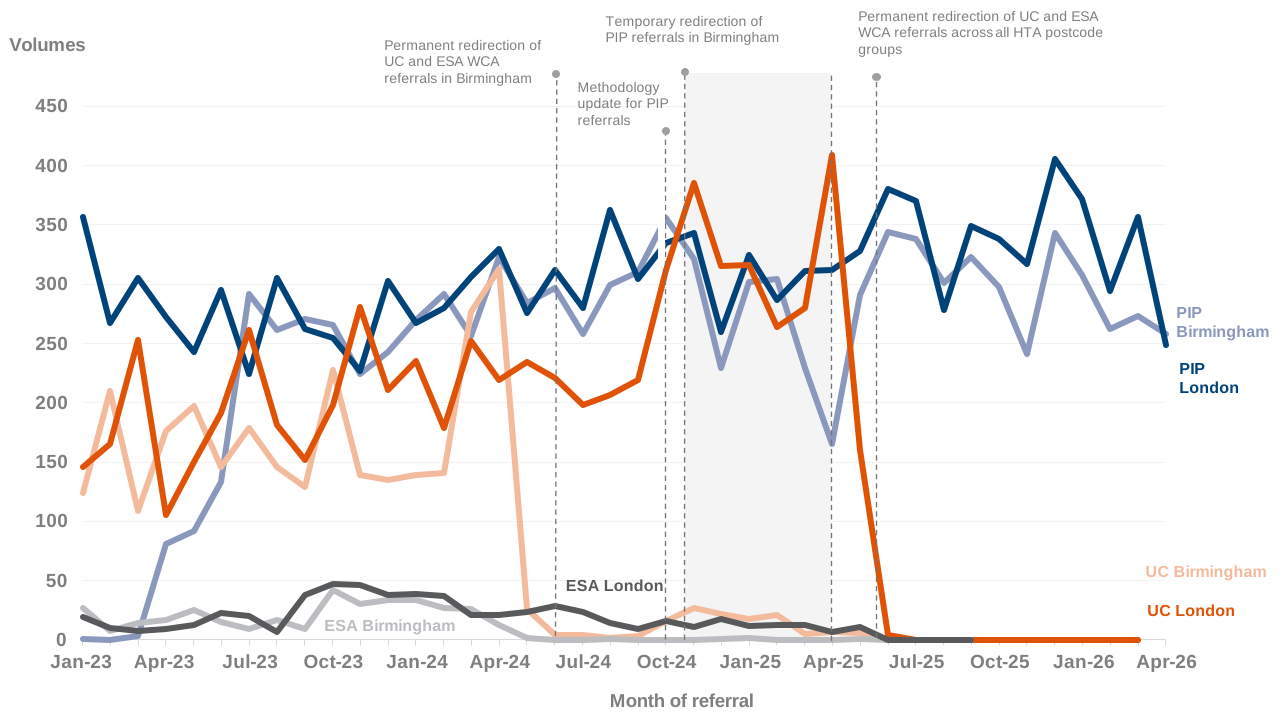
Figure 1: Number of referrals for an assessment in the Health Transformation Area (HTA), by benefit type and HTA postcode group.
Source: DWP Management Information on HTA referrals, correct as of 8 May 2026.
Figure 1 shows a line chart illustrating the trends in the volumes of referrals for an assessment by benefit type and HTA postcode group from January 2023 to April 2026 (where applicable).
Supporting information for Table 1 and Figure 1:
-
calendar year totals cover the period from 1 January to 31 December. Financial year (FY) totals refer to the period from 1 April to 31 March
-
totals may not sum due to low volumes being redacted
-
postcode districts covered by data in Table 1 are listed in Annex A
-
the number of referrals covered in Table 1 includes new applications, reassessments, award reviews and change of circumstances
-
an individual applicant may be counted in Table 1 more than once, e.g., due to submitting multiple applications, re-referrals during the same period or rebuilt referrals
-
these figures may be subject to revision in subsequent releases
-
figures marked [r] have been revised since the previous release; minor fluctuations may occur due to routine data processing corrections
-
in the December 2023 edition of this publication, Table 1 reported number of referrals for an assessment in the HTA by benefit type and site. Site has been updated to postcode group from the March 2024 edition onwards, as applications may be processed in a different HTA than their originating postcode. Postcode group will continue to be used in future editions
-
referrals for PIP assessments went live in Birmingham postcode district B14 in April 2023. Referrals for PIP assessments in Birmingham postcode districts B17, B19, B78 went live in July 2023. However, a small number of referrals were recorded between January and March 2023
-
a proportion of PIP assessment referrals from the Birmingham HTA postcode group were temporarily redirected to external assessment providers between 21 October 2024 and the end of March 2025 to allow the HTA to focus on PIP end‑to‑end transformation and test‑and‑learn activities
-
volumes for PIP referrals from 16 October 2024 to 30 April 2025 were revised following methodological improvements aimed at enhancing data quality. These included changes to the definition of intake referrals to prevent double‑counting, particularly in cases where referrals were recreated due to errors or audit‑related corrections. The revised methodology was introduced in the September 2025 edition and has been applied to all subsequent months. Referral volumes for UC and ESA WCA referrals were not revised under this methodology due to the permanent redirection of these referrals to external assessment providers from 16 May 2025
-
for the period October 2024 to January 2026, minor retrospective differences may be observed in monthly referral volumes. This reflects a correction to the way referrals are counted, whereby referrals dated on non‑working days are now attributed to the next working day, in line with internal DWP rules. Previously these referrals were counted on actual intake day, regardless of whether they fell on a working or non-working day. This methodology change has resulted in a small number of referrals shifting between months
-
data is only provided for referrals to UC WCAs in an in-house HTA between January 2023 and June 2025. From May 2025, referrals were permanently redirected to external assessment providers, with some small activity observed in June 2025. From July 2025 onwards (including subsequent and future months), a ‘[z]’ has been applied to represent zero activity
-
data is only provided for referrals to ESA WCAs in an in-house HTA between January 2023 and May 2025. From May 2025, referrals were permanently redirected to external assessment providers, and no further in-house ESA WCA activity is observed in subsequent months. As a result, figures from June 2025 onwards (including subsequent and future months) are shown as ‘[z]’
From 3 May 2024, UC and ESA WCA referrals from the HTA Birmingham postcode group were permanently redirected to external assessment providers. This redirection enabled the HTA to concentrate on PIP end-to-end transformation and test-and-learn activities. Table 1 and Figure 1 show that only small volumes were recorded in subsequent months due to rebuilt and good cause cases, and in the latest months UC and ESA WCA referrals have fallen to zero. Rebuilt WCA referrals occur when a good reason is accepted for an applicant’s failure to attend an appointment or return their questionnaire, or when audits require an assessment re-write which is then manually rebuilt with the updated assessment report.
From 16 May 2025, UC and ESA WCA referrals across all HTA postcode groups were permanently redirected to external assessment providers. We will stop reporting on UC and ESA WCA referral volumes from the September 2026 publication onward due to no activity.
5. Online PIP applications Management Information
Table 2 shows the number of applicants applying for PIP via the new digital self-serve (DSS) and invited digital (ID) GOV.UK channels.
The digital self-serve service went live on 27 July 2023 for some applicants living in certain postcode districts. This route allows applicants to register their PIP application and submit their Health Information Gather (HIG) online via GOV.UK. The service was expanded to those living in a small number of additional postcode districts on 14 December 2023.
The invited digital service went live on 24 June 2024 through a limited number of telephony agents with national coverage across all postcodes in England. It was later rolled out to all telephony agents from 12 July 2024. Through this route, applicants register their PIP application via the telephony channel and are subsequently invited to complete the HIG online via GOV.UK.
Together, the invited digital and digital self‑serve routes make up the apply for PIP digital service, and volumes from both routes are combined to represent total apply for PIP activity in this publication.
When registering an application, applicants provide personal information and contact details. Applicants may subsequently provide information about how their disability or health condition affects them via the HIG. The HIG is the same form as the PIP2; HIG is the term used within the Health Transformation Programme, while PIP2 continues to be used in the legacy PIP process and in the PIP Official Statistics publication. In this publication, the terms HIG and PIP2 are used interchangeably. Not all applicants who register an application will go on to return a HIG or PIP2. In addition, applicants who do register an application may wait before submitting a HIG, meaning submissions may occur after the April 2026 cut‑off date for this publication. As a result, HIG submissions are expected to be lower than registrations for the digital self‑serve channel, and comparisons should be made within the same channel.
Nationally, around a third of PIP claims used an online Health Information Gather (HIG) form over the latest three months (February 2026 to April 2026). In the digital self‑serve rollout postcode districts, around two in five registrations were completed via the online digital self‑serve channel over the same period.
Table 2: Number of applicants applying for PIP via the new Apply for PIP (AfP) digital service, including the Digital Self‑Serve (DSS) and Invited Digital (ID) GOV.UK channel.
Online PIP applications
| Reporting period | DSS Registrations | DSS HIG form submissions | ID HIG form submissions | Total AfP HIG form submissions |
|---|---|---|---|---|
| Total (all) | 82,259 | 69,591 | 526,642 | 596,233 |
| Total 2023 | 11,904 | 9,600 | [z] | 9,600 |
| Total 2024 | 31,705 | 26,364 | 140,926 | 167,290 |
| Total 2025 | 27,554 | 24,102 | 281,172 | 305,274 |
| Total 2026 to date | 11,096 | 9,525 | 104,544 | 114,069 |
| 2023 to 2024 FY | 20,926 | 16,969 | [z] | 16,969 |
| 2024 to 2025 FY | 30,803 | 25,925 | 216,447 | 242,372 |
| 2025 to 2026 FY | 27,626 | 24,341 | 284,511 | 308,852 |
| 2026 to 2027 FY to date | 2,904 | 2,356 | 25,684 | 28,040 |
| Jul 2023 | 313 | 199 | [z] | 199 |
| Aug 2023 | 2,111 | 1,548 | [z] | 1,548 |
| Sep 2023 | 2,561 | 2,072 | [z] | 2,072 |
| Oct 2023 | 2,548 | 2,080 | [z] | 2,080 |
| Nov 2023 | 2,466 | 2,128 | [z] | 2,128 |
| Dec 2023 | 1,905 | 1,573 | [z] | 1,573 |
| Jan 2024 | 3,079 | 2,449 | [z] | 2,449 |
| Feb 2024 | 2,964 | 2,388 | [z] | 2,388 |
| Mar 2024 | 2,979 | 2,532 | [z] | 2,532 |
| Apr 2024 | 3,252 | 2,696 | [z] | 2,696 |
| May 2024 | 2,587 | 2,216 | [z] | 2,216 |
| Jun 2024 | 2,455 | 1,880 | 4,022 | 5,902 |
| Jul 2024 | 2,690 | 2,311 | 22,895 | 25,206 |
| Aug 2024 | 2,475 | 1,951 | 23,570 | 25,521 |
| Sep 2024 | 2,704 | 2,260 | 25,289 | 27,549 |
| Oct 2024 | 2,584 | 2,231 | 26,769 | 29,000 |
| Nov 2024 | 2,254 | 1,968 | 22,492 | 24,460 |
| Dec 2024 | 1,682 | 1,482 | 15,889 | 17,371 |
| Jan 2025 | 2,914 | 2,429 | 23,225 | 25,654 |
| Feb 2025 | 2,510 | 2,181 | 25,002 | 27,183 |
| Mar 2025 | 2,696 | 2,320 | 27,294 | 29,614 |
| Apr 2025 | 1,879 | 1,748 | 22,113 | 23,861 |
| May 2025 | 2,076 | 1,800 | 22,311 | 24,111 |
| Jun 2025 | 1,747 | 1,520 | 7,753 | 9,273 |
| Jul 2025 | 2,627 | 2,298 | 26,872 | 29,170 |
| Aug 2025 | 2,269 | 2,020 | 25,025 | 27,045 |
| Sep 2025 | 2,358 | 2,039 | 33,860 | 35,899 |
| Oct 2025 | 2,376 | 2,064 | 28,136 | 30,200 |
| Nov 2025 | 2,183 | 1,964 | 20,736 | 22,700 |
| Dec 2025 | 1,919 | 1,719 | 18,845 | 20,564 |
| Jan 2026 | 2,795 | 2,386 | 23,582 | 25,968 |
| Feb 2026 | 2,600 | 2,327 | 25,956 | 28,283 |
| Mar 2026 | 2,797 | 2,456 | 29,322 | 31,778 |
| Apr 2026 | 2,904 | 2,356 | 25,684 | 28,040 |
Source: DWP Management Information on applicants applying for PIP via the new digital self-serve and invited digital channels on GOV.UK, correct as of 8 May 2026.
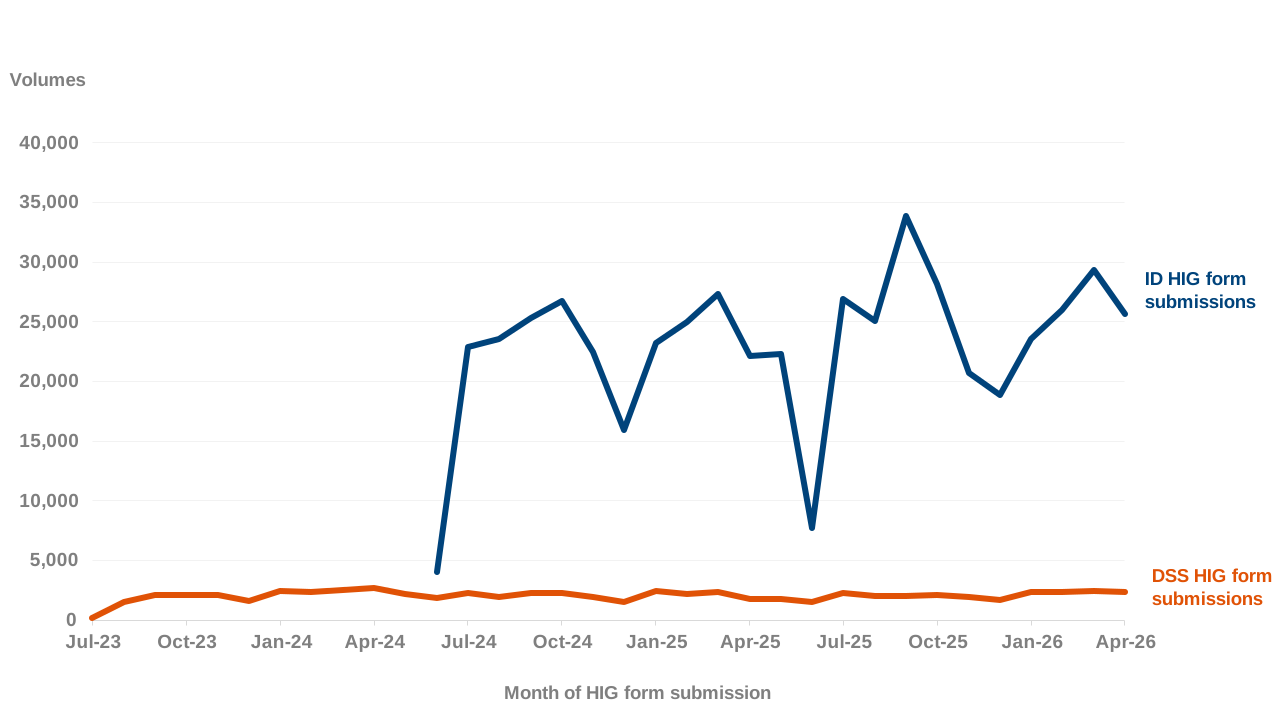
Figure 2: Number of Health Information Gather (HIG) form submissions via the new Digital Self‑Serve (DSS) and Invited Digital (ID) GOV.UK channels.
Source: DWP Management Information on Health Information Gather (HIG) form submissions via the new digital self‑serve and invited digital GOV.UK channels, correct as of 8 May 2026.
Figure 2 shows a line chart illustrating the trends in the number of Health Information Gather (HIG) form submissions made via the new digital self-serve and invited digital channels on GOV.UK from July 2023 to April 2026.
Supporting information for Table 2 and Figure 2:
-
calendar year totals cover the period from 1 January to 31 December. Financial year (FY) totals refer to the period from 1 April to 31 March
-
the online ‘Apply for PIP’ digital self-serve GOV.UK channel first went live on 27 July 2023. From 14 December 2023, the service was extended to cover the HTA postcode districts listed in Annex A
-
the Tactical PIP2 service was developed during the COVID lockdown periods to allow applicants who started their PIP application via the telephony channel to receive an email containing a link to a PDF version of the HIG form. This was later developed into an HTML form, which differed from the HIG form used in the digital self-serve service. Between June and November 2024, a small volume of Tactical PIP2 HIG submissions were included within the total invited digital HIG volumes. The Tactical PIP2 service was decommissioned on 27 November 2024, and no further volumes are available under this category
-
the invited digital service was introduced to replace the Tactical PIP2 service and went live on 24 June 2024. Applicants continue to start their PIP application via the telephony channel but are provided with the same HIG form as digital self-serve users, which is completed and submitted digitally via the GOV.UK website
-
the online service was unavailable from 28 November 2024 to 3 December 2024 for the digital self-serve service. During this period, no data was processed, and digital self-serve registrations and HIG form submissions were suspended, which may have slightly impacted the November 2024 and December 2024 monthly volumes. Additionally, the month of December typically experiences a seasonal drop in registrations and HIG form submissions, which likely also contributed to the lower volumes during December 2024
-
the overall monthly volumes for registrations and HIG form submissions across the apply for PIP digital services (digital self-serve and invited digital) were lower than expected in June 2025. This is because the data from the live service was not received into the data platform due to a connection failure between 18 June 2025 and 25 June 2025
-
all postcode districts currently covered by digital self-serve data in Table 2 are listed in Annex B
-
registrations and HIG submission volumes do not necessarily represent the same cohort of applicants in a particular month
-
these figures may be subject to revision in subsequent releases; figures marked with [r] indicate a revision from the previous edition, for example due to methodological improvements or updated data
6. About these statistics
The Health Transformation Programme (HTP) Evaluation Strategy, first published in May 2023 and updated in March 2026, provides an overview of plans to evaluate the HTP. The core principles of the evaluation strategy are to:
-
establish a robust and detailed evidence base to inform decisions about service improvements and how the HTP can drive better customer experience
-
provide person-centred insight on what works for whom to ensure a broad range of needs are considered when transforming our services
-
provide assurance that the business case benefits have been realised
This MI is an important part of the Programme’s plans to evaluate the services being developed, providing quantitative data for the HTAs and the online ‘Apply for PIP’ digital GOV.UK channel. This publication is part of an ongoing quarterly series of HTP MI. The contents will remain under review and will be further developed when appropriate to do so.
The next edition of Health Transformation Programme Management Information will be published on 15 September 2026.
7. Related Statistics
This MI has been published on 16 June 2026 to align with the publication date of the Personal Independence Payment: Accredited Official Statistics. This series will continue to be published on the same release cycle as the Personal Independence Payment: Accredited Official Statistics.
The Personal Independence Payment (PIP) statistics quarterly publication brings together statistics on:
-
PIP new applications and Disability Living Allowance (DLA) application reassessments, covering the PIP customer journey from registration through to decision, ongoing entitlement, award review, mandatory reconsideration (MR) and appeal
-
volumes of applicants entitled to PIP at a point in time (caseload), registrations and clearances for different stages of the journey (initiation of applications, award reviews and MRs), outcomes at clearance and median clearance times
-
customer journey statistics tracking initial decisions and award review outcomes following a PIP assessment
The Employment and Support Allowance (ESA) Work Capability Assessment statistics quarterly publication brings together statistics on:
-
ESA Work Capability Assessment outcomes
-
appeals decisions and mandatory reconsiderations for ESA applications (including re-assessed Incapacity Benefit applications)
-
monthly median ESA Work Capability Assessment mandatory reconsideration clearance times
-
ESA WCA cohort statistics covering the ESA Work Capability Assessment process
-
ESA Work Capability Assessment clearance times for initial applications
The Universal Credit Work Capability Assessment statistics quarterly publication brings together statistics on:
-
the number of applicants on Universal Credit (UC) with a health condition or disability restricting their ability to work
-
monthly DWP Universal Credit Work Capability Assessment (UC WCA) decisions and outcomes
-
medical conditions for applicants undertaking a WCA
-
UC health caseload and UC WCA decisions by previous ESA spell
As well as being available within the statistical summary publications, most data from these related statistics is also released through Stat-Xplore.
8. Further information and feedback
Lead analyst: Shaun Butcher
Analysts: Ahsan Hussain and Georgia Chaffey
Contact DWP Press Office if you have any questions or feedback.
9. Annex A: HTA Postcode Districts
Postcode districts covered by in-house HTAs, from Table 1.
HTA Postcode Districts
| HTA | Postcode districts |
|---|---|
| London | E5, N2, N3, N4, N6 |
| Birmingham | B14, B17, B19, B78 |
10. Annex B: Digital Self-Serve Postcode Districts
Postcode districts where the digital self‑serve GOV.UK service is currently available, from Table 2.
Digital Self-Serve Postcode Districts
| Postcode area | Postcode district |
|---|---|
| B | B14, B16, B17, B18, B19, B21, B42, B66, B67, B68, B69, B70, B71, B78 |
| BD | BD4, BD11, BD12 |
| BH | BH1, BH2, BH3, BH4, BH5, BH6, BH7, BH8, BH9, BH10, BH11, BH12, BH13, BH14, BH15, BH16, BH17, BH18, BH22 |
| BN | BN20, BN22, BN23 |
| CB | CB11 |
| CM | CM17, CM24 |
| CW | CW12 |
| DE | DE21, DE7, DE72, DE75 |
| DY | DY11, DY13 |
| E | E5, E7, E11, E12 |
| GL | GL1, GL5, GL10 |
| HD | HD1, HD4 |
| HP | HP23 |
| HR | HR7, HR8 |
| IG | IG1, IG2, IG3, IG4, IG5, IG6, IG7, IG8, IG9 |
| IP | IP3, IP4, IP5, IP6, IP10, IP11, IP12, IP13, IP15, IP16, IP17, IP18, IP19, IP20 |
| KT | KT6, KT7, KT8, KT9, KT10, KT12 |
| L | L9, L10, L21, L22, L23, L29, L30, L38 |
| LE | LE13 |
| LN | LN9, LN10, LN11, LN12, LN13 |
| LU | LU1, LU2, LU3, LU4, LU7 |
| M | M15, M16, M23, M31, M32, M33, M41 |
| N | N2, N3, N4, N6 |
| NE | NE1, NE2, NE4, NE5, NE98 |
| NG | NG10, NG15, NG17 |
| NR | NR31, NR32, NR33, NR34, NR35 |
| PE | PE21, PE23, PE24, PE25, PE34 |
| RG | RG14, RG20, RG21, RG22, RG23, RG24 |
| RH | RH7, RH8 |
| RM | RM10 |
| SG | SG7 |
| SK | SK11 |
| SO | SO24 |
| ST | ST13 |
| TN | TN8 |
| TW | TW16, TW17 |
| WA | WA14, WA15 |
| WF | WF13, WF15, WF16, WF17 |
| WR | WR2, WR5, WR6, WR13, WR14 |
| WS | WS6 |
| YO | YO11, YO12, YO13, YO14, YO22, YO25 |
11. Annex C: Glossary of terms
| Term | Definitions |
|---|---|
| Apply for PIP | The term used for the new digital service providing options to apply online. This includes the invited digital route, where applicants complete the Health Information Gather (HIG) online after calling to begin the application, as well as the wholly online digital self‑serve route via GOV.UK. |
| Digital Self-Serve | Applications are made wholly via GOV.UK, with both registration and the Health Information Gather (HIG) submitted digitally via the website. This is only available in a limited number of postcodes listed in Annex B. |
| Employment and Support Allowance (ESA) | A benefit for individuals who have a disability or health condition that affects how much they can work. ESA gives an individual money to help with living costs if they are unable to work and/or support to get back into work if they are able to. |
| Health Information Gather (HIG) form | A form for applicants to complete, usually on paper or online, on how their disability affects them, upon registration to PIP or when a change of circumstances occurs. This form is referred to as the PIP2 form in the legacy process. |
| Health Transformation Area (HTA) | The Health Transformation Area is an in-house service to process applications and undertake associated assessments for applicants that live in the geographical postcodes of the HTA (see Annex A). |
| Health Transformation Programme (HTP) | A Programme which is transforming Health and Disability benefit services over the longer term, developing a customer-focused integrated Health Assessment Service (HAS) for people with disabilities and health conditions claiming a benefit that uses functional health assessments. It is also transforming the entire PIP service, including introducing an option to apply online. |
| Invited Digital | A digital application route for Personal Independence Payment (PIP) where an applicant begins their claim via the telephony channel and is subsequently invited to complete the Health Information Gather (HIG) online via GOV.UK. |
| Personal Independence Payment (PIP) | A benefit administered by DWP to help towards the extra costs caused by long-term disability, ill-health or terminal ill-health. |
| PIP1 Submission | A form completed, usually by telephone or online, to capture the applicant’s personal information and contact details when registering a PIP application; this stage is currently referred to as a registration. |
| PIP2 Submission | A form for applicants to complete, usually on paper or online, on how their disability affects them, upon registration to PIP or when a change of circumstances occurs. Within the Health Transformation Programme, this form is referred to as the Health Information Gather (HIG). |
| Reassessment | From 8 April 2013, PIP replaced the Disability Living Allowance (DLA) benefit. Existing DLA applicants who claim PIP are reassessed for their eligibility for PIP against the same criteria as new PIP applicants. |
| Registration | Applicant makes an application to claim PIP. |
| Rebuilt Referral | Cases where good reason has been accepted after an applicant fails to attend or fails to return their questionnaire, or when audits require an assessment re-write that is then manually rebuilt with the updated assessment report. |
| Universal Credit (UC) | A benefit for people over 18 (with some exceptions for those aged 16 or 17) but under State Pension age who are either: In work but on a low income, or Out of work. |
| Work Capability Assessment (WCA) | An assessment to decide how much an individual’s illness or disability limits their capability to work. When an individual applies for Universal Credit (UC) they can report if they have a health condition or disability that affects their capability to work. |