Analytical note on government response to resale of live events tickets consultation
Published 19 December 2025

© Crown copyright 2025
This publication is licensed under the terms of the Open Government Licence v3.0 except where otherwise stated. To view this licence, visit nationalarchives.gov.uk/doc/open-government-licence/version/3 or write to the Information Policy Team, The National Archives, Kew, London TW9 4DU, or email: psi@nationalarchives.gov.uk.
Where we have identified any third party copyright information you will need to obtain permission from the copyright holders concerned.
This publication is available at https://www.gov.uk/government/publications/government-response-to-resale-of-live-events-tickets-consultation-analytical-note/analytical-note-on-government-response-to-resale-of-live-events-tickets-consultation
Summary
This analytical note explains the cost-benefit model created to estimate the financial impact and changes in ticket volumes resulting from a proposed price cap on live event ticket resale. For further information about the policy, see Government response to the consultation on the resale of live events tickets. The calculation is performed for 2 scenarios: the ‘baseline’ (the current uncapped market) and the ‘preferred way forward’ (with the price cap).
The core of the analysis is to estimate the volumes and prices of tickets exchanged across different parts of the live events ticket resale market. The important results from this indicative analysis, presented in 2024 to 2025 financial year prices, are that:
- due to reduced prices paid for tickets caused by a price cap in the resale market, there could be an overall annual reduction of £112 million spent by fans on live events tickets
- with a lower proportion of primary market ticket sales going to ticket touts, total tickets sold in the resale market could reduce by 0.9 million tickets
- inclusive of all fees paid, the average ticket price paid by fans on the resale market could reduce by £37
In line with the Green Book and Better Regulation Framework, the modelling will continue to be refined in preparation for an impact assessment, which will be published when the legislation is introduced to Parliament.
Technical analysis
The remainder of this analytical note contains an explanation of the calculations performed in the modelling. This section covers:
- model design
- model inputs
- model results
- model limitations
Detailed calculations performed in building the model are included as an annex.
Model design
The model estimates the flow of revenues and ticket volumes in the market for live event tickets. This simplified representation of the ticketing market approximates how the exchange of money for tickets moves between touts, fans, and primary ticket sellers. The model estimates how money moves between these groups through the primary market, through the currently uncapped resale platforms, and through alternative channels such as social media. The model design is illustrated in figure 1. Table 1 provides the definitions of the flows illustrated in figure 1.
Figure 1: the flow of spending on tickets between fans, touts, and the live events sector

Figure 1 is a flow diagram illustrating the flow of money in the ticketing market. Three market actors are illustrated: the live events industry who sell tickets; fans of live events; and ticket touts. Three markets where tickets can be bought and sold are illustrated: the primary sales market; the uncapped secondary ticketing platform market; and alternative resale channels and social media.
Figure 1 shows that tickets are bought in the following 3 ways:
- fans and touts buy tickets from live events sellers through the primary market
- fans buy tickets from touts through uncapped secondary ticketing platforms and through alternative resale channels and social media
- fans buy tickets from other fans through both uncapped secondary ticketing platforms and alternative resale channels and social media
Table 1: definitions of the model flow labels shown in figure 1
| Flow label | Definition of flow label |
|---|---|
| A | Money for tickets bought by fans on the primary market |
| B | Money for tickets bought by touts on the primary market |
| C | Money for tickets sold by touts and bought by fans on uncapped secondary ticketing platforms |
| D | Money for tickets sold by touts and bought by fans through alternative channels and social media |
| E | Money for tickets bought and sold between fans on uncapped secondary ticketing platforms |
| F | Money for tickets bought and sold between fans through alternative channels and social media |
| Profit | The difference between the total ticket prices paid by touts and the prices tickets are sold for |
Model inputs
The baseline modelling uses publicly available evidence and a series of assumptions to derive the values for all major flows in the ticketing market. Important sources include the Competition and Markets Authority’s (CMA):
- final report on the acquisition by Viagogo of StubHub
- report and recommendations to government concerning the secondary ticketing market
Initial inputs are the total volume of live event tickets purchased in the primary market (37.1 million) and the total volume (1.9 million)and value (£350 million) of tickets sold in the secondary market.[footnote 1][footnote 2][footnote 3]
Some further assumptions are needed to complete the baseline modelling:
- the majority of total resale spend goes through uncapped rather than capped secondary ticket resale platforms – we have assumed 75%[footnote 4]
- within the uncapped resale market, specialised ticket resale platforms are much preferred by fans to online marketplaces. This is the only qualitative evidence available, found from the CMA’s final report on the acquisition by Viagogo of StubHub. This evidence has been interpreted for modelling purposes to mean that 95% of all tickets by value are resold on the uncapped secondary ticketing platforms
- the majority of tickets are resold by touts, with the top 10% of resellers accounting for more than 70% of platform ticket resale volumes.[footnote 5] The modelling assumes 80% of tickets resold in the uncapped resale market are resold by ticket touts
- page 131 of the CMA’s final report on the acquisition by Viagogo of StubHub “found that most tickets sold through the Parties’ platforms [StubHub and Viagogo] in 2019 had a mark-up over their face value of more than 50%”. For modelling purposes it is assumed that on average a ticket is resold at a 75% mark-up
Further assumptions are needed to model the impacts of introducing a ticket resale price cap. These assumptions are included to allow us to estimate, despite the inherent uncertainties, how touts might adapt their activities in response to the intervention. Further analysis will be published in a full impact assessment alongside introduction of legislation. The modelling assumes that upon introducing a price cap:
- touts will significantly reduce the number of tickets they resell on ticket reselling platforms that currently operate without a cap – this is currently modelled as a 95% reduction
- touts selling outside of ticketing platforms reduce the number of tickets they are reselling – this is currently modelled as a 25% reduction
- there may be some displacement effect, with ticket touts continuing to sell tickets above face value, in contravention of the law, by moving to sell tickets outside of ticketing platforms. Lacking strong evidence of this potential effect, modelling currently assumes a 20% displacement effect
- fan-to-fan ticket reselling will continue happening at the same volumes and value as before
Model results
The ‘baseline’ modelling estimates that, inclusive of all buyer and seller fees, fans pay a total of £6,405 million on tickets each year. Of this, £404 million is spent in the resale market on 1.5 million tickets, giving an average ticket cost on the resale market of £269.
Following the price cap, the modelling estimates total spend of £6,293 million. Of this, £147 million is spent in the resale market on 0.6 million tickets, giving an average ticket cost on the resale market of £233. By comparing the ‘baseline’ and ‘preferred way forward’ modelling, we can estimate that because of the price cap introduction:
- due to reduced prices paid for tickets, there could be an overall annual reduction of £112 million spent by fans on live events tickets. This is calculated as the difference in the total spend, inclusive of all buyer and seller fees, that fans spend on tickets. This is £6,405 million minus £6,293 million = £112 million
- with a lower proportion of primary market tickets going to ticket touts, total tickets sold in the resale market could reduce by 0.9 million. This is calculated as the difference in the total number of tickets estimated to be purchased in the resale market. This is 1.5 million minus 0.6 million = 0.9 million fewer tickets
- inclusive of all fees paid, the average ticket price paid by fans on the resale market could reduce by £37. This is calculated as the difference in the average price paid for a ticket. This is calculated as £269 minus £233 = £37[footnote 6]
The estimated net change in tickets being purchased through the different flows within the live events ticketing market are shown in figure 2. The annex contains further detail of the calculations performed to estimate each element of the model.
Figure 2: impacts of the price cap on annual ticket volumes and ticket prices for each of the model flows (exclusive of buyer and seller fees)
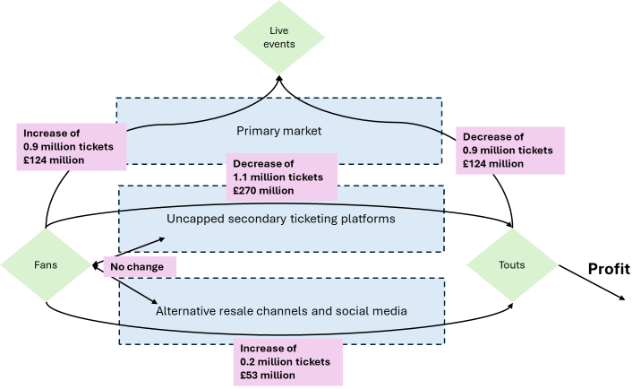
Figure 2 is a flow diagram illustrating the flow of money in the ticketing market, with each of the flows labelled with the estimated change in that flow resulting from the introduction of a price cap, exclusive of buyer and seller fees. It is estimated fans will buy 0.9 million more tickets from live events sellers in the primary market, spending an extra £124 million. It is estimated touts will buy 0.9 million fewer tickets from live events sellers in the primary markets, spending £124 million less.
It is estimated fans will buy 1.1 million fewer tickets from ticket touts through secondary ticketing platforms, spending £270 million less. It is estimated fans will buy 0.2 million more tickets from ticket touts through alternative resale channels, spending an extra £53 million. It is estimated there will be no change in tickets bought and sold between fans.
Model limitations
This model design will continue to be reviewed and improved where possible. The following list of impacts is not presently captured in the modelling:
- the benefits to the live events sector and the overall economy from fans now having more disposable income
- the impacts of policy interventions beyond the implementation of the price cap
- the modelling considers only the average ticket resale price and so may understate the impacts of less frequent, high mark-up, high-harm tout activity
Annex: detailed calculations
Calculation of model estimates for the ‘baseline’
1.9 million tickets sold in the secondary ticketing platform market
75% of these tickets are sold through uncapped platforms and unofficial platforms
1.9 million tickets × 75% = 1.4 million tickets
80% of tickets resold on uncapped platforms are sold by touts rather than fans
1.4 million tickets × 80% = 1.14 million tickets = Flow point C (tickets)
1.4 million tickets × 20% = 285,000 tickets = Flow point E (tickets)
75% mark-up on tickets resold by touts. Tickets resold by fans are at face value. So £324 million = (285,000 million tickets × price of a face value ticket) + (1.14 million × 1.8 × price of a face value ticket). Simplified and rearranged to give
Price of a face value ticket = £324 million ÷ 2.28 million = £142
Price of tout resold ticket = £142 × 1.8 = £249
1.14 million × £249 = £284 million = Flow point C (value)
285,000 tickets × £142 = £41 million = Flow point E (value)
95% of secondary ticketing spend is through platforms, 5% is through alternative channels
80% of alternative sales are via touts selling at £249, while 20% are sold by fans at £142, so 75,000 tickets are sold through alternative channels
20% are sold by fans = 15,000 = Flow point F (tickets)
15,000 × £142 = £2 million = Flow point F (value)
80% are sold by touts = 60,000 = Flow point D (tickets)
60,000 × £249 = £15 million = Flow point D (value)
Tickets purchased by touts = 1.14 million + 75,000 = 1.2 million = Flow point B (tickets)
1.2 million × £142 = £171 million = Flow point B (value)
37.1 million – 1.2 million = 35.9 million = Flow point A (tickets)
35.9 million × £149 = £5.1 billion = Flow point A (value)
Calculation of model estimates for the ‘preferred way forward’ modelling
Assumed 95% reduction in tickets sold by touts on regulated platforms
5% × 1.14 million = 57,000 tickets = Flow point C (tickets)
57,000 × £249 = £14 million = Flow point C (value)
Assumed 25% reduction in tickets sold by touts on alternative platforms
60,000 × 75% = 45,000
20% of tickets originally sold by touts on platforms are now sold via alternative channels
1.14 million × 20% = 228,000
228,000 + 45,000 = 273,000 = Flow point D (tickets)
273,000 × £249 = £68 million = Flow point D (value)
Fan to fan sales stay the same, 285,00 = Flow point E (tickets)
£41 million = Flow point E (value)
15,000 = Flow point F (tickets)
£2 million = Flow point F (value)
57,000 + 273,000 = 330,000 = Flow point B (tickets)
330,000 × £142 = £47 million = Flow point B (value)
37.1 million – 330,000 = 36.8 million = Flow point A (tickets)
36.8 million × £142 = £5.2 billion = Flow point A (value)
-
UK Music. ‘Here, There and Everywhere 2023’ ↩
-
Competition and Markets Authority. ‘Completed acquisition by PUG LLC (viagogo) of the StubHub business of eBay Inc. ↩
-
Competition and Markets Authority. ‘Completed acquisition by PUG LLC (viagogo) of the StubHub business of eBay Inc. ↩
-
Page 11 of the CMA final report on the acquisition by Viagogo of StubHub, tells us that the capped platforms Twickets and TicketSwap are small relative to StubHub and Viagogo, accounting for less than 5% of the market. There are numerous other capped platforms. Lacking better evidence but acknowledging uncapped platforms represent the majority of ticket resales, the modelling has used a simplifying assumption that 75% of tickets resold are resold through uncapped platforms. ↩
-
Competition and Markets Authority. ‘Completed acquisition by PUG LLC (viagogo) of the StubHub business of eBay Inc. ↩
-
The calculation does not sum due to rounding. ↩