Government evidence to the Senior Salaries Review Body on the pay of the Senior Civil Service (October 2026) (HTML)
Updated 19 October 2026

© Crown copyright 2026
This publication is licensed under the terms of the Open Government Licence v3.0 except where otherwise stated. To view this licence, visit nationalarchives.gov.uk/doc/open-government-licence/version/3 or write to the Information Policy Team, The National Archives, Kew, London TW9 4DU, or email: psi@nationalarchives.gov.uk.
Where we have identified any third party copyright information you will need to obtain permission from the copyright holders concerned.
This publication is available at https://www.gov.uk/government/publications/government-evidence-to-the-senior-salaries-review-body-on-the-pay-of-the-senior-civil-service/government-evidence-to-the-senior-salaries-review-body-on-the-pay-of-the-senior-civil-service-october-2026-html
Executive Summary
1. The Government has set out a radical reform agenda to transform how the United Kingdom is governed. Central to this vision is a shift away from over-centralised decision-making in Westminster and Whitehall toward a devolved model that places power, resources, and accountability into the hands of regional and local leaders. As part of this transition, central government must become smaller, leaner, and fundamentally more strategic. Where functions and responsibilities are devolved, central resources will be transferred to local areas without duplication, establishing an operating principle of “devolution by default” while modernising public services and driving national productivity.
2. Delivering this structural transformation places distinct, high-stakes demands on the Senior Civil Service (SCS). The Government’s most senior leaders are tasked not only with driving core policy and public service delivery under fiscal constraint, but also with leading complex system-wide changes - including the shift of capability, the rationalisation of departmental footprints, and the alignment of public service boundaries within a rewired State.
3. In this environment, the SCS must embody high-calibre strategic leadership, deep expertise, and an agile, outcomes-focused mindset. Reward structures must directly reflect these evolving expectations, incentivising strong performance and supporting a streamlined, highly effective senior leadership cadre. This is at the heart of the work on a Future Civil Service.
4. The Government invites the SSRB to comment on the proposals contained in its evidence to ensure the SCS pay and reward system makes reward contingent upon high performance and clear delivery milestones, and supports the development of a senior leadership cadre for the Civil Service that is able to meet the challenges of the future.
5. The Government’s evidence is provided in two parts. The first part is the main evidence in narrative form and sets out:
- Chapter 1 - 2026 SSRB recommendations for the SCS
- Chapter 2 - SCS priorities
- Chapter 3 - Wider context for the SCS and Civil Service
- Chapter 4 - Permanent Secretary and Director General Pay
6. The following information is annexed to the main evidence:
- Annex A - SCS data
- Annex B - SCS pay on appointment exceptions
- Annex C - Pensions
- Annex D - Permanent Secretary Remuneration
- Annex E - Government Commercial Organisation (GCO)
7. SCS pay awards for 2026 are still in the process of being implemented in some departments, so this written evidence does not currently include final data figures related to SCS pay for 2026. Any provisional workforce figures are provided from the Cabinet Office SCS database, but are not yet finalised and will need to be updated when SCS pay awards have been implemented and the central collections are complete.
8. This year’s evidence builds upon the foundational work initiated during the 2026/27 pay round. We will ensure the SSRB has the finalised data when it is available to support the development of its Report, and will provide further data in advance of oral evidence as and when it is available. The Government remains committed to continuing to bring the pay round forward to provide timely pay awards for public sector workforces. This means that a more advanced timetable is needed for all Pay Review Bodies as we continue transitioning to a timetable which enables the Government’s ambition for earlier awards. Cabinet Office officials continue to work closely with the SSRB secretariat to manage any impact and to provide any additional information required.
9. The second part of this report sets out the supporting statistical data to support decisions being made about SCS pay. As in previous years, the SSRB will receive separate economic evidence from HM Treasury.
10. At points in this document you will see references to a “route to reform”. Whilst there is currently not an overarching, signed-off SCS strategy, this is referenced in the context of the twin-track approach we are taking as we move towards a Future Civil Service.
Economic Context
11. 12-month CPI inflation was 3.1% in August 2026. This is lower than its recent peak of 3.8% in September 2025, but shows a rise from 2.6% in June 2026, as the energy price shock starts to feed through into household energy. Core CPI inflation (CPI excluding energy, food, alcohol and tobacco to give an indication of underlying inflationary pressure) was 2.6% in August 2026. The Bank of England’s July MPR central projection expects inflation will rise further, before falling again from mid-2027, with projected CPI inflation to be 2.4% in 2027-28.
12. The latest indicators suggest the labour market remains slack. HMRC Real Time Information data shows employee numbers have fallen on the year for 17 consecutive months to July 2026, while vacancies have continued to decline over the past twelve months. The unemployment rate has fallen back slightly, reaching 4.9% in the three months to July 2026.
13. Whole economy total average weekly earnings growth was 3.9% in the three months to July 2026. Recent fluctuations in this series partly reflect the effect of bonus payments and the timing of public sector pay settlements. Private sector regular pay growth (which is unaffected by these factors) has continued to fall, reaching 2.9% in the three months to July 2026. Private sector regular wage growth has been below public sector regular pay growth for 17 months, which reached 6.3% in the three months to July 2026.
14. Measures of average wage growth have historically been higher than median pay settlements, as they are affected by compositional changes in the labour force and factors such as changes to working hours. Settlement data are the most comparable data to PRB decisions, as they are a direct measure of consolidated pay awards, and are not directly affected by other factors such as changes to working hours or changes in the composition of employment. The Bank of England’s Agents report that average pay settlements for 2026 are 3.6% and lower than the average settlement for 2025 (4.0%). The Brightmine survey shows that businesses are reporting average settlements of 3.0% for 2027.
Affordability of pay award to the SCS
15. The Government has considered these factors whilst carefully evaluating the overall affordability position and recommends that the total increase in paybill for the SCS should be no higher than 2.3%.
16. As in previous years, HM Treasury has been clear that there will be no additional funding to departments for 2027/28 pay awards. The Cabinet Office will need to carefully consider the justification for any recommendation higher than 2.3%, and whether departments can make countervailing measures to meet the cost.
Chapter 1 – SSRB 2026 Recommendations and Pay Award Application
17. The 2026 SSRB report provided the following recommendations:
Recommendation 1:
We recommend that all members of the Senior Civil Service should receive a 3.5 per cent consolidated increase to base pay from 1 April 2026.
Recommendation 2:
We recommend an increase of £5,000 to the pay band minima for all SCS grades from 1 April 2026 (to be applied before the general consolidated pay award).
Recommendation 3:
We recommend that a central pot comprising 1.0 per cent of the total SCS pay bill is allocated for the introduction of pay progression for the SCS form 1 April 2026, to reward the acquisition and development of skills and expertise. Progression uplifts should be greater for those who are highest performing and lower in the pay band, and smaller for less performers higher in the band. Those whose objectives are only partially met should not receive a progression increase.
18. These followed the SSRB’s recommendation in the 2025 Report, which formally recommended that a fundamental review and ‘reset’ of SCS pay and reward frameworks be undertaken by the Government with urgency – to support the development and implementation at pace of solutions to the issues and anomalies that have been highlighted over many years by the Review Body.
19. In light of the overall constraints posed by the affordability context, as well as balance with the wider Civil Service workforce , the first recommendation on consolidated increases to pay was partially accepted and limited to a 2.5 percent increase. The Government accepted all other recommendations in full.
20. We improved our approach to implementation to improve consistency, fairness and speed in delivering the award. In accepting SSRB’s recommendations on SCS headline pay, and in recognition of the SSRB’s concerns about the speed and lack of consistency in the application of consolidated pay increases by departments in previous years, the Cabinet Office, consistent with its approach in recent years, was explicit in how the award was implemented across the SCS. This was to ensure consistency, and fairness, in the application of the award, and departments were informed of the criticality of following the advice and recommendations of the SSRB in the 2026 SCS Pay Practitioners Guidance. Already, some departments have confirmed they have paid the award to their SCS, with many following soon.
21. The Practitioners Guidance specified that:
- Departments must give all eligible members of the SCS a consolidated pay increase of 2.5% of their base pay from 1 April 2026.
- Increases of £5,000 should be applied to the minimum salaries for SCS pay bands.
- Set progression values should be applied consistently dependent on individuals position in the pay range and performance rating.
22. Where departments proposed to depart from this approach, they were required to seek Cabinet Office approval first. Dispensation was again agreed for FCDO in 2026/27 to reflect their unique workforce needs.
Implementation of the 2026/27 Awards
23. Due to the shorter timeframe for publishing this evidence, the Cabinet Office will provide the SSRB with its summary of the application of the 2026/27 award in advance of oral evidence. This is due to some departmental awards being implemented up to the publication of this evidence. We fully acknowledge and share the SSRB’s concerns with the speed with which departments are implementing their pay awards for the SCS. This was made clear in the 2026 Report. We welcome further discussions with the SSRB at oral evidence on how the speed of implementation can be improved.
Chapter 2 – SCS Priorities for 2027/28
Background
24. The Future Civil Service programme, established in Spring 2026, marks a decisive shift in how we will approach SCS workforce reform. Running alongside this, the Cabinet Secretary announced in July 2026 a fundamental ‘Review into the Organisation, Performance and Transformation of the Permanent Civil Service’. Reporting before summer 2027, this wide-ranging review will re-examine the Service’s overall constitution, size, shape, statutory basis, and core values.
25. Notable progress was made last year through the introduction and initial rollout of performance-based pay progression. For the 2027/28 pay year, the Government is committed to reinforcing this progression approach, allowing it to embed and drive up performance and delivery incentives across all departments. That initial phase represented the first step in responding to and implementing the SSRB’s recommendation in 2025 for a fundamental review of the Senior Civil Service reward framework.
26. This year’s evidence builds upon the foundational work initiated during the 2026/27 pay round. To bridge long-term vision with immediate action, the Government is adopting a twin-track approach that enables systemic review and immediate reform to run side-by-side:
- Short-Term Reform: For the 2027/28 pay year, the Government is committed to continuing the performance-based pay progression approach that targets reward towards our highest performers. Taking an approach that allows for embedding these reforms will mean we can properly evaluate their impact.
Route to Reform: In the short term, we need to continue to build on progress, implementing ‘no-regrets’ reforms that set a better baseline for future reforms.
- Long-Term Reform: Insights from the Cabinet Secretary’s Civil Service Review will drive the long-term transformation of the SCS into a leaner, segmented, and highly capable leadership cadre incentivised for high-impact outcomes. Rather than implementing piecemeal fixes, we are building an evidence base that enables us to make bold, confident, system-wide reforms once the long-term direction is set.
Route to Reform: Over the long term, we need more radical reform to SCS performance assessment and reward, moving away from siloed, bureaucratic HR processes toward a system that better supports and incentivises individuals for future delivery, raising the bar and significant contribution to real-world outcomes.
27. The twin-track approach will ensure that the review of the Civil Service and immediate reform can run side-by-side. Specifically for the SCS, the Future Civil Service programme will undertake a holistic evaluation of senior reward, performance management, and core terms and conditions, directly building upon and expanding the SCS Strategy work that has been underway. Ultimately, we want leaders with high impact, high accountability, delivering excellence, and shaping the future - together. This will involve transforming the SCS into a segmented, highly capable leadership cadre that is leaner, better motivated, and incentivised for long-term outcome.
Priorities for the 2027/28 Award
28. It is the Government’s ambition for the 2027/28 pay award to build a higher-performing, leaner and more expert senior cadre, signalling and reinforcing that excellent public delivery will be a cornerstone of a Future Civil Service.
29. Following the SSRB’s report, considerable progress was achieved, notably through the implementation of performance-based pay progression and fewer but higher bonuses, reserved for top performers. To build on this, this year the Government is focusing on the following strategic areas:
- 1. Performance-Linked Reward - The Government has introduced a performance-based pay progression framework that prioritises higher cash awards for top performers and intends to continue to strengthen this model to drive standards up. To further enhance rewards for exceptional delivery, parallel reviews of non-consolidated pay and the performance management policy and approach are currently underway to understand how we define, identify and incentivise truly impactful performance for future years.
- 2. Structural Pay Reform - Recent structural pay reforms have prioritised raising SCS pay band minima to shorten pay ranges, effectively reducing pay overlap while boosting recruitment, equity, and progression. To build on this, immediate efforts focus on modernising the existing structure to fairly compensate complex, high-weight, and specialist roles, as well as driving high performance and contribution by raising standards to ensure that all those who receive pay uplifts are meeting, if not exceeding expectations..
- 3. Workforce Stability and Retention - The Government is excluding an anomalies pot this year emphasising instead that reward should be targeted at high performers as a priority. Priority is being given to modernising the SCS offer through competitive non-pay flexibilities and developing milestone-linked incentives that boost retention and accountability on major projects, with detailed proposals to be presented at the upcoming SSRB oral evidence session.
- 4. Non-Pay Flexibilities - The Government aims to modernise the SCS reward system to enhance recruitment and align pay flexibilities with delegated departmental structures. Priority is focused on introducing simple, effective mechanisms to establish a stronger baseline offer and make the SCS more competitive against the wider public sector.
- 5. Director General Pay Review - Sponsored by the Cabinet Secretary, a review of Director General pay looking at testing options that allow remuneration to be better linked to skills, performance and deliverables and not exclusively be tied to base pay.
30. The Government wishes to prioritise the SCS pay award for 2027/28 as follows:
- Priority 1: Considering a baseline consolidated pay adjustment across the SCS. Building on previous SSRB recommendations around general consolidated increases (excluding underperformance), there is merit in exploring a similar approach this year. In the current economic climate, maintaining some level of broad-based pay adjustment remains a helpful consideration for the overall award structure. .
- Priority 2: to continue to strengthen the performance-related pay progression approach
- Priority 3: implementation of measures to deliver the five strategic priorities set out above for SCS pay.
Route to Reform: For this year, the Government’s position is that an award should be targeted to address these priorities, whilst set in the context of the Government’s wider affordability position and providing a clear pathway for further reform of the SCS pay framework.
31. In light of the advanced timing of the pay round and evolving work within the Future Civil Service programme, following the publication of this evidence we will ensure the SSRB are provided with the latest information, including supporting data on the proposals at the upcoming oral evidence. The Government further welcomes the SSRB’s offer in its recent reports for further engagement and assistance on addressing the longstanding and extended challenges in SCS reward.
32. The Government welcomes the SSRB’s views on the current strategic priorities and to provide recommendations this year which enable further reforms to the reward system.
1. Performance-Linked Reward
Performance Management Policy Reform
33. As the foundation of the pay progression model, the Government recognises that the performance management policy must enable fair, transparent and objective assessments of individual contribution to the overall success of the organisation in delivering for citizens and taxpayers. That is why a number of changes have been made to enhance the performance management framework, and also why the Government has launched a more fundamental review of the approach to managing performance in the SCS. This review is on track to report in November 2026, and will make recommendations to be implemented from April 2027.
The current framework
34. The SCS Performance Management Framework was updated in July 2026, building upon the previous revisions to further strengthen the narrative that there is a collective responsibility for an effective performance management process, role modelled by the senior leaders across the Civil Service.
35. The key changes made to the framework for 2026/27 are:
- All Directors General objectives must flow directly from the objectives agreed for Permanent Secretaries. Consistency and alignment to Permanent Secretary and Ministerial priorities will be assured by the Cabinet Secretary reviewing all Permanent Secretary objectives.
- The minimum standards have been updated. They are now more concise and aligned with the Cabinet Secretary’s priorities, explicitly requiring individuals to effectively manage the performance of others to meet these standards.
- A recommended approach to start and end year processes, adopting a new ‘Annual Performance Review’, with proposed model forms, agendas and scripts, to build greater consistency, transparency and fairness into the process.
36. In addition, we introduced moderation of DGs as a cross-government cohort, overseen by the new Senior Talent Committee.
37. The embedding of the updated minimum standards and expected distribution for a full performance year (2025-26) will ensure greater consistency across the system. This systematic approach has led to clearer expectations for all grades, resulting in a more consistent application of performance markings.
38. Crucially, the introduction of robust consistency checks and targeted data collection has provided greater transparency and improved the identification and management of underperformance, ensuring that the performance management system increasingly reflects our commitment to high standards and objective-led delivery.
39. The inaugural cross-government consistency check meeting has substantially enhanced transparency by facilitating insightful discussions from both departmental and cross-governmental perspectives. The data indicates that the number of individuals on Performance Development Plans remains proportionately low relative to the number of ‘Partially Met’ ratings.
40. Anecdotal evidence indicates that underperforming SCS are managed within their respective departments, typically via informal measures as an initial recourse, with a significant proportion separating from the organisation prior to the initiation of formal processes. The management of poor performance is an area of focus and new initiatives and approaches are being considered, particularly in the context of limiting the movement of poor performers.
41. For this performance year, to further strengthen the “golden thread” of delivery from the Prime Minister’s priorities down to individual SCS objectives, we are implementing an AI-led dip-testing exercise across the SCS cadre. This initiative serves a dual purpose: first, it provides a robust, evidence-based assessment of the quality and strategic alignment of objectives, ensuring they are pitched at the appropriate level of stretch and accountability. Second, it generates vital insights to inform the broader, fundamental review of SCS performance management for 2027/28.
Principles for Further Reform
42. Further, as set out earlier in the chapter, to support any changes to performance-linked reward, linking pay to performance and delivery necessitates a strong, trustworthy performance framework. Running to the same timescale, a review of the SCS performance management system is also underway, with any structural changes expected to be implemented from the 2027/28 performance year.
43. The system faces a number of core structural tensions, including:
- A Disconnect from Outcomes: Individual performance objectives are frequently detached from the broader strategic delivery of the organisation, leading to a focus on individual activity rather than collective impact.
- Ambiguity in Expectations: A fragmented landscape of leadership standards and management processes has created a lack of clarity, making it difficult for leaders to understand what defines true excellence in their specific role.
- Systemic Burden: The existing process has become overly administrative. Relying on heavy, manual moderation cycles creates a burden that provides diminishing returns, often distracting from meaningful conversations about performance, development, and delivery.
44. Ultimately, the review will consider how the Civil Service can build a culture of high-performance and high accountability. It should also address the burden on the user and create an intuitive, integrated and easy to use performance system that measures contribution and forms a fair and transparent basis for reward decisions.
Non-Consolidated Performance-Related Pay - Bonuses
45. The current non-consolidated pay pot for SCS is 3.3% of the overall SCS pay bill. The pot is used to fund end-of-year awards and in-year awards. Following the removal of forced distribution, there is no cap on the number of staff eligible for an end of year award. SCS who receive an ‘Exceeding’ and ‘High Performing’ box marking must receive an end of year award.
46. In January 2026, the former Chief Secretary to the Prime Minister announced changes to the approach for SCS bonuses, which were implemented as part of the 2026 SCS pay practitioner guidance. The maximum individual in-year award has been increased from £5,000 to £10,000. This improves the link between pay and high performance. Higher awards are expected to be used exceptionally to provide more timely recognition to those members of the SCS delivering government priorities, demonstrating innovation and for going above and beyond. The expectation is that this change will result in higher value in-year awards for fewer members of the SCS.
47. To measure the impact of these changes, the Cabinet Office is currently collating information from departments of the application of bonuses, which will be shared with the SSRB.
48. There were no changes to the total in year award thresholds. Individuals can receive more than one award, but the total value of awards for a single performance year should not exceed £25,000 unless the approval from the Chief Secretary to the Treasury is given.
49. In addition, as set out earlier in the chapter, the current non-consolidated pay application requires a full review to ensure it both complements the pay progression approach, better rewards the highest performers with more meaningful bonuses, and has a higher consistency of application across organisations. This is expected to be completed in advance of the oral evidence session.
Performance Based Pay Progression
50. Following the SSRB’s recommendation, the Government launched performance-based progression for pay band 1 to pay band 3, with effect from the 2026/27 pay year. The policy aligns with the principle that progression uplifts should be the largest for high performers lower in the pay range, and smaller for lower performers higher in the pay range.
51. Progression pay policy mechanics:
- Fixed Cash Value Awards: Progression growth is structured via fixed cash values determined by an individual’s moderated performance rating and position relative to a progression threshold (set at 75% of the pay range, following adjustments to pay band minima).
- Targeted Distribution: Within a dedicated 1% SCS paybill pot, Cabinet Office guidance defines standardised cash values with consistent differentials across grades. This ensures progressive movement through the range, providing higher relative awards to high performers lower in the band.
- Eligibility & Application: Progression payments apply after the basic award up to the pay band maximum. Staff receiving a ‘partially met’ performance rating are ineligible for progression payments.
Table 1: Performance-Based Progression Values (2026/2027)
| Pay Band | Progression Threshold | Performance Rating | Uplift At or Below Threshold | Uplift Above Threshold |
|---|---|---|---|---|
| SCS1 | £109,850 | Achieving | £1,000 | £750 |
| SCS1 | £109,850 | High | £2,000 | £1,500 |
| SCS1 | £109,850 | Exceeded | £3,000 | £2,250 |
| SCS2 | £148,125 | Achieving | £1,500 | £1,250 |
| SCS2 | £148,125 | High | £2,500 | £2,000 |
| SCS2 | £148,125 | Exceeded | £3,500 | £2,750 |
| SCS3 | £189,825 | Achieving | £2,000 | £1,750 |
| SCS3 | £189,825 | High | £3,000 | £2,500 |
| SCS3 | £189,825 | Exceeded | £4,000 | £3,250 |
Route to Reform: First-year impact data is currently being collected and will be shared with the SSRB once finalised. The Government considers the initial funding allocation appropriate for delivering meaningful structural reform.
Strategy on Performance Related Pay
Route to Reform: The Government intends to maintain and strengthen a performance-based progression framework for the upcoming year. This will continue to allow high-performing SCS to be rewarded.
52. In line with the policy intent of the progression model, the Government believes that there is more to be done to ensure that individuals who deliver the best results are recognised through the reward system. In addition to the review of SCS performance management, the Government will also undertake a comprehensive review of non-consolidated pay to align bonus structures with the consolidated pay progression model. The goal is to deliver more meaningful rewards for top performers while driving consistency across departments. It is expected that findings and recommendations will be presented to the SSRB ahead of the oral evidence session for consideration in its final report.
2. Structural Pay Reform
53. Recent targeted reforms to SCS pay band minima have successfully shortened salary ranges and reduced pay overlap with Grade 6 by 50% over the last three years. Despite this progress, the 2025/26 median Grade 6 maximum of £91,000 leaves a remaining £5,000 overlap with the minimum SCS1 salary.
| Year | Min | Max |
|---|---|---|
| 2020-21 | £71,000 | £117,800 |
| 2025-26 | £81,000 | £117,800 |
| 2026-27 | £86,000 | £117,800 |
Figure 1: Comparison of SCS1 Pay Band Ranges from the 2020/21 to 2026/27 pay years
54. We continue to hold the view that addressing the current pay bands is a key measure to addressing many of the structural issues that the SSRB has raised for many years, and it remains a priority to reduce this over the next few years. The Government continues to share the SSRB’s concerns of the issues arising in a number of departments with overlap between SCS1 and those in the delegated departmental pay structure, and expects the changes implemented in 2026/27, through increases of £5,000 to the pay band minima, to have had a positive impact.
55. Our focus this year is to shorten the pay ranges further, recognising the positive structural impacts on pay equity, attraction, mitigating overlap risks, and enabling a more effective pay progression system. This should be achieved predominantly through increases to the pay band minima, whilst recognising that the pay band maxima may need to be re-evaluated going forward to incentivise exceptional, higher performers higher in the pay range.
Route to Reform: For this year, we plan to review existing, established pay rules and modernise them for the future. This will create a fairer system that rewards the complexity and requirements of the job. This should be an immediate priority that we can build on in future years.
56. Our ambition is for a more modernised structure that can attract high job weight roles, and specialist functions, and better reward high performance and contribution. We will provide the SSRB further evidence on this work at the oral evidence session.
3. Workforce Stability and Retention
Route to Reform: In the short term, the Government needs to stabilise the workforce and reward challenges so as not to exacerbate the issues while fixing the system.
Anomalies Pot
57. The SSRB has held a previous view that an anomalies pot should be applied only exceptionally and a more meaningful solution is required to address pay anomalies, which the Government accepts and shares. Last year, following the recommendations from the SSRB, an anomalies pot was not included as part of the SCS award, and the rationale for not including an anomalies pot remains:
- Structural Resolution over Ad-Hoc Adjustments: progress on foundational reforms, particularly structural pay reform and performance-based progression, is systematically eroding the structural drivers of pay anomalies.
- Maintaining Workforce Consistency: relying on an anomalies pot risks creating unnecessary pay variance across a centrally managed, non-delegated SCS workforce.
- Dedicated Mechanisms for Equal Pay: systemic issues such as equal pay claims are more effectively and appropriately addressed through established departmental processes rather than general pay award allocations.
Route to Reform: In the short term, the Government does not wish to prioritise an anomalies pot, in favour of focusing on securing a consistent foundation to build future reform on.
Pivotal Role Allowances: Retention and Milestone-Linked Incentives
58. Successfully delivering major government priorities and large-scale projects requires reducing churn and keeping key people in post for longer.
59. Pivotal Role Allowances (PRAs) have been in place since 2013 to help retain SCS delivering critical programmes and those responsible for implementing the Government’s priorities. PRAs are removable, non-pensionable, with payment linked to milestones. They are recognised as a helpful tactical solution to address flight risk. Since their introduction, more than 400 PRAs have been agreed.
60. Previously, all PRAs were subject to central approval. As part of the Treasury’s Project Reset work to streamline central controls, PRAs at SCS1 and 2 level were delegated to departments from 1 January 2026 within an eligibility framework and a cost limit of 0.5% of departmental SCS paybill. PRAs at SCS3 level are not delegated and require the approval of the Cabinet Secretary.
61. Since this change to delegate, main departments have reported 44 PRAs in payment[footnote 1]. PRAs generally range from £10,000 - £15,000 per annum in value and are paid to retain people for up to three years. The PRAs currently in payment are spread across a wide range of professions, but are being used mainly by Policy (32%), Finance (23%) and Project Delivery (10%).
62. In addition, separate bespoke PRA arrangements are in place for National Infrastructure and Service Transformation Authority to support the recruitment and retention of Senior Responsible Owners responsible for delivering projects in the Government Major Projects Portfolio.
63. While PRAs have provided a “sticking plaster” for systemic pay problems, like the anomalies pot, the Government want to provide a more sustainable and effective approach in future that prioritises:
- Incentivising Tenure and Delivery: Work is underway to adapt the reward system to provide stronger financial and developmental incentives for individuals to remain in post through critical delivery milestones.
- Balanced Accountability: Proposed measures will explicitly link reward to performance, creating clear incentives for successful milestone delivery (see performance-linked rewards above) alongside appropriate consequences for non-delivery.
The Government will present further detailed and concrete proposals on these retention mechanisms to the SSRB during the upcoming oral evidence session.
4. Non-Pay Flexibilities
64. The Government’s view is that the SCS offer should offer more modern choices to drive better incentives and attraction to joining the SCS. Currently, the SCS offer diverges from the delegated pay structure in departments on a number of flexibilities. As part of this year’s priorities, the Government would like to bring the SCS offer up to an acceptable minimum. There are some simple, but effective, mechanisms to modernise our offer and make it more competitive against the wider public sector.
Chapter 3 – Wider Context for the SCS
65. The following chapter provides further information on areas noted of interest to the SSRB and relevant in the wider context for the SCS.
Places for Growth
66. The Civil Service has been reshaping the workforce, bringing more power and decision making roles out of Whitehall and closer to the communities it serves. This is delivered by the Places for Growth programme in the Cabinet Office.
67. PfG seeks to strengthen the UK-wide Government presence by bringing policy and senior roles into the regions and nations. The programme also seeks to increase collaboration across all spheres of government; grow Civil Service locations across the UK; and manage workforce and estate strategically in London.
68. A strong senior cadre supports thriving, sustainable Civil Service communities with 69-to-end careers and builds productive local partnerships. By 2030, 50% of UK-based SCS roles will be located in the regions and nations, along with 50% of the Fast Stream. Latest data (March 2026) shows this currently stands at 35%[footnote 2].
69. The contribution of SCS to “place leadership” is crucial for delivering the government’s objectives. Along with Permanent Secretary Place Champions, PfG supports regional Heads of Place to build and embed thriving Civil Service communities across the UK, and develop strong local partnerships.
70. Senior Civil Servants (SCS) across English regions, Scotland, Wales and Northern Ireland engage in place activity, particularly those based in the Thematic Campuses (i.e. Sheffield, Leeds, Darlington, Manchester, West Midlands and Aberdeen) and wider cross-government locations (i.e. York, Glasgow, Edinburgh, Bristol, Cardiff, Belfast, and Newcastle).
71. The Civil Service needs to be visible in, and representative of, the entire UK, across all departments, functions and professions. By having policy-makers, strategists and SCS closer to communities they serve, the Civil Service can take full advantage of the untapped and diverse talent available across the whole of the UK.
Places for Growth and Protected Characteristics in the SCS
72. Since 2020, PfG has supported departments to increase the proportion of UK-based SCS in the regions and nations from 26% to 35%. During this time the programme has monitored all monitored protected characteristics of civil servants working at SCS level[footnote 3].
- In 2020, 9.1% of civil servants working at SCS level identified as having ethnic minority backgrounds. This has now increased to 10.6% in 2026.
- In 2020, 45% of civil servants working at SCS level were female. This has increased to 49.8% in 2026.
- In 2020, 7.3% of civil servants working at SCS level had a known disability status, this is now 11.9% in 2026.
- In 2020, 6,1% of civil servants working at SCS level identified as LGBO. This is now 7.7% in 2026.
SCS Recruitment and Retention
73. As set out in previous evidence, it is a priority to reflect the need to ensure “the right people are working in the right places with the right incentives”.
74. Driving forward a raft of measures to improve recruitment as part of the Future Civil Service reform programme, including improving the candidate and vacancy holder experience of recruitment with a new Selection Framework, candidate attraction, and reforming SCS selection through Test and Learn initiatives.
75. Ensuring that all departments, functions and professions use secondments as a part of their strategic resourcing plans. Secondments will be used as a lever to bring external expertise and experience into the Civil Service, and to develop talent through skills and professional growth.
76. Introduced in 2022, assignment duration policy sets the expectation of a default minimum duration of 3 years for all SCS 1 and 2 posts. The exact length in role is set by the vacancy holder to support delivery requirements. There is scope for exceptions to assignment durations in line with business requirements and to take into account personal circumstances. This does not constitute a contractual change.
77. An interim review of the policy in October 2024 confirmed that all 17 Whitehall Departments have fully implemented the policy and give assignment durations to all relevant roles. A full evaluation of the policy will be conducted in early 2027 to understand the impact of the policy and whether it has had the desired effect to reduce churn in SCS 1 and 2 roles.
78. In September 2025, the GovXchange programme was launched in partnership with the Local Government Association. The programme facilitates secondments between local and central government to encourage the sharing of skills and experience. The programme is currently in its pilot stage, open to participants across 8 locations. An evaluation of the pilot will be conducted in September 2026, with the findings used to consider how the programme could be successfully scaled nationally.
SCS Recruitment
77. Recruitment across the Civil Service is governed by the Civil Service Commission’s (CSC) Recruitment Principles which set out the legal requirement for appointments to the Civil Service to be made on merit on the basis of fair and open competition. All Civil Service appointments, including decisions regarding SCS, are made in line with these principles.
78. In FY2025-26, 1,173 SCS campaigns were completed with 614 offers made. Of these, 109 were advertised internally within departments, 307 across-government and 757 externally to the Civil Service.
79. The Civil Service advertises all SCS1 and SCS2 vacancies on the principle of External by Default. External by Default means that vacancies will be open to external candidates outside the Civil Service, as well as existing civil servants, unless an exception applies. The policy is in place to ensure we are getting the right skills, in the right place, at the right time, in order to strengthen our ability to deliver quality outcomes for UK citizens and to strengthen equality of opportunity by opening up vacancies to the widest possible pool of candidates. External intake for SCS1 and SCS2 was 24.8% in FY 25/26 (provisional estimate), the highest since FY2017/18.
80. For SCS1 and SCS2 roles only in FY2025-26, 1,101 campaigns were completed with 606 offers with 64 advertised internally within departments, 95 advertised across government and 447 advertised externally to the Civil Service. Of these, 148 campaigns failed.
81. Director General and Permanent Secretary recruitment is overseen by the Senior Talent and Resourcing Team. They also run all Permanent Secretary competitions and the majority of Director General campaigns. Although there are clearly similarities in the recruitment approach and we aim to provide consistency to all candidates, processes for Deputy Director and Director differ from those for Director General and Permanent Secretary.
82. Deputy Director and Director recruitment is run by departments with central policy and guidance provided by Future Civil Service Group (FCS).
83. All SCS recruitment products are developed by FCS in consultation with the CSC as the independent regulator and owner of the Civil Service Recruitment Principles.
84. The CSC is further involved for SCS2 externally advertised campaigns which are normally chaired by a Civil Service Commissioner, who also signs off the selection criteria.
Recruitment Reform
85. FCS Workforce Reform Directorate have set out a significant and ambitious work plan designed to improve effective recruitment,). The work incorporates complementary commitments made by the then Minister for Cabinet Office (MCO) in July 2023 and by the Chief Secretary to the Prime Minister (CSPM) in January 2026 and with ambitions set out by the Cabinet Secretary on recruitment and secondments as part of the next phase of Civil Service reform plans.
86. FCS is continuing the monitoring and development of the first Civil Service recruitment metrics for speed, experience and diversity of recruitment, and benchmarks to drive improvements in time to hire and time to fill. It is also continuing with a series of Test and Learns which trial new ways of delivering recruitment with the findings shared across government. This year’s focus will be on reforming the SCS selection process looking at alternatives to Personal Statements and trialling the use of multiple assessment points rather than one face to face interview.
87. In July 2026, a review of Success Profiles concluded with agreement from HR Executive Board to develop a new Selection Framework focussed on assessing the Skills and Values needed for a role through the Experience and Potential that candidates demonstrate through the recruitment process. The final framework is in development and will go to People Board for sign off in September 2026, ahead of delivery in Summer 2027.
Retention
88. Overall SCS turnover increased slightly from 9.6% for the 2024/25 period to 11.3% for the 2025/26 period.
89. This increase has been driven primarily by an increase in departmental turnover[footnote 4] from 14.1% for the 2024/25 period to 17.2% for the 2025/26 period. Departmental turnover was limited by significant recruitment controls across many Civil Service departments during the previous year, which have somewhat lifted this year, allowing for increased movement.
90. Median tenure in post and payband have increased very slightly to 2.8 years and 3.8 years respectively. These continue to follow the trend of gradual increase since the end of the pandemic.
91. Generally, SCS turnover is not considered problematic. It is low compared to the wider economy, with similar sectors experiencing a turnover rate of around 15%. Additionally, actual resignations within the SCS remain low at around 3.4%. However, there are concerns that the current system encourages movement at a too frequent rate. Though turnover within the SCS should be expected as a centrally managed cadre, problems arise when the high levels of internal churn do not align appropriately with business need.
The Devolved Governments
92. The SCS in Scotland and Wales continue to be part of the centrally managed cadre which is governed by the UK, which differs from the delegated grade structure, which is managed by their own respective government. For both governments, over time, the position in regards to the SCS has shifted in recognition of the changing shape of devolution. Both governments operate remuneration committees (similar to those in UK Government departments).
93. The issue of leapfrogging has historically been prevalent in the Devolved Governments. Notably by the practice of pay progression at those in the delegated pay structure leading to many of the Grade 6 and 7 cadre sitting at the top of the pay band. Higher pay awards to delegated grades and the use of pay supplements in specialist roles further highlights the challenge of maintaining differentials for SCS. The non-payment of performance-related bonuses and the use of terms including flexitime, flexitime, overtime, and allowances, are notable areas of divergence between the Devolved Governments and UK Government departments. This was highlighted in the SSRB’s 2026 Report.
94. As stated in last year’s evidence, we continue to look at reviewing the current UK-wide SCS approach. We will involve both Governments as this work progresses.
Chapter 4 – Permanent Secretary and Director General Pay
Director General Remuneration
Quantum of End of Year Bonuses
95. A focus for STC this year has been consistent application of performance management (and linked remuneration). This resulted in central moderation of Directors General across the Civil Service through STC and fixing centrally the quantum of end year bonuses for Directors General.
96. Since the last evidence, the amounts have been updated following discussions at the Senior Talent Committee. The amounts were determined by ensuring proportionately the use of the NCPRP for awarded performance throughout the year as well as recognised sustained performance throughout the year, all within the bonus pay controls.
Table 2: Value of End-of-Year Non-Consolidated Performance Related Pay for Directors General.
| Performance Marking | NCPRP Award |
|---|---|
| Exceeding | £15,000 |
| High Performing | £10,000 |
Review of Directors General Pay
97. A review of Director General pay has been undertaken by the Cabinet Office, with Peter Schofield sponsorship, which provides a series of recommendations to pilot within the Director General workforce. It is the ambition that recommendations have wider applicability to the rest of the SCS as part of the Future Civil Service programme.
98. This review of Director General remuneration is a critical enabler of the Cabinet Secretary’s Future Civil Service programme. The review aims to establish a pay framework for Directors General that is more modular and performance-driven. The ambition is that this will resolve structural barriers to recruitment and retention by rewarding the high performance required of our most senior leaders.
99. This review was commissioned by the Cabinet Secretary, to consider reward challenges affecting Director General roles, specifically for Digital and Data, Finance, Human Resources and Chief Operating Officer roles. The challenges raised wider questions about how reward arrangements support recruitment, retention, motivation, performance and long-term capability across the Director General cohort.
100. The review highlights that the current uniform approach is increasingly unsuited to the varying demands of the modern Senior Civil Service workforce. By applying a rigid system across vastly different roles, the existing framework creates pay outcomes driven by recruitment routes rather than role complexity, resulting in an 11.3% salary premium for external hires over higher-performing internal promotees. This reliance on permanent, consolidated base salaries locks in fixed costs for the Exchequer and lacks the flexible, performance-linked variable pay structures seen in the wider public and private sectors.
101. We welcome further discussions with the SSRB on the reviews outcomes and will present them to the SSRB in due course for further consideration.
Permanent Secretaries
102. From time to time, the SSRB has made recommendations and commented on Permanent Secretary remuneration. As is longstanding, a robust framework applies to Permanent Secretary pay: roles are assigned to one of three pay tiers within the overall range (pay band) based on size and complexity. Specialists who receive market premium pay for their roles (e.g. the Cabinet Secretary and Chief Medical Officer) sit outside of the tiers.
103. For 2026/27, the SSRB recommended a £5,000 increase to the pay band minima. The Permanent Secretary Remuneration Committee (PSRC) is due to meet in September 2026 to finalise pay arrangements for 2026/27, where it will further consider the SSRB’s recommendations, and will share its outcomes with members when finalised.
104. Further information on Permanent Secretary remuneration can be found in Annex D.
ANNEX A
SCS Data
Chart 1: SCS Headcount by Payband and Year (2016-2026)
| Year | Deputy Director | Director | Director General | Perm. Sec. |
|---|---|---|---|---|
| 2016 | 3,135 | 765 | 140 | 40 |
| 2017 | 3,275 | 815 | 130 | 40 |
| 2018 | 3,540 | 860 | 155 | 40 |
| 2019 | 3,935 | 925 | 165 | 35 |
| 2020 | 4,230 | 1,005 | 175 | 35 |
| 2021 | 4,835 | 1,080 | 175 | 45 |
| 2022 | 5,090 | 1,175 | 180 | 45 |
| 2023 | 5,020 | 1,230 | 180 | 45 |
| 2024 | 5,225 | 1,230 | 180 | 50 |
| 2025 | 5,445 | 1,235 | 175 | 50 |
| 2026 | 5,430 | 1,295 | 195 | 45 |
Notes:
Data is as in Q1 of each financial year.
Data shows all SCS, rather than just those covered by the SSRB arrangements. Deputy Director grade includes those in PB1A.
Chart 2: SCS FTE by Payband and Year (2016-2026)
| Year | Deputy Director | Director | Director General | Perm. Sec. |
|---|---|---|---|---|
| 2016 | 3,060 | 750 | 135 | 40 |
| 2017 | 3,190 | 800 | 130 | 40 |
| 2018 | 3,455 | 845 | 150 | 40 |
| 2019 | 3,830 | 905 | 165 | 35 |
| 2020 | 4,115 | 980 | 170 | 35 |
| 2021 | 4,715 | 1,055 | 170 | 45 |
| 2022 | 4,955 | 1,145 | 180 | 45 |
| 2023 | 4,885 | 1,200 | 175 | 45 |
| 2024 | 5,090 | 1,205 | 175 | 50 |
| 2025 | 5,295 | 1,205 | 170 | 50 |
| 2026 | 5,275 | 1,260 | 190 | 45 |
Notes:
Data is as in Q1 of each financial year.
Data shows all SCS, rather than just those covered by the SSRB arrangements. ‘Deputy Director’ grade includes those in PB1A.
Chart 3: SCS Median Salary by Payband and Year (2010-2025)
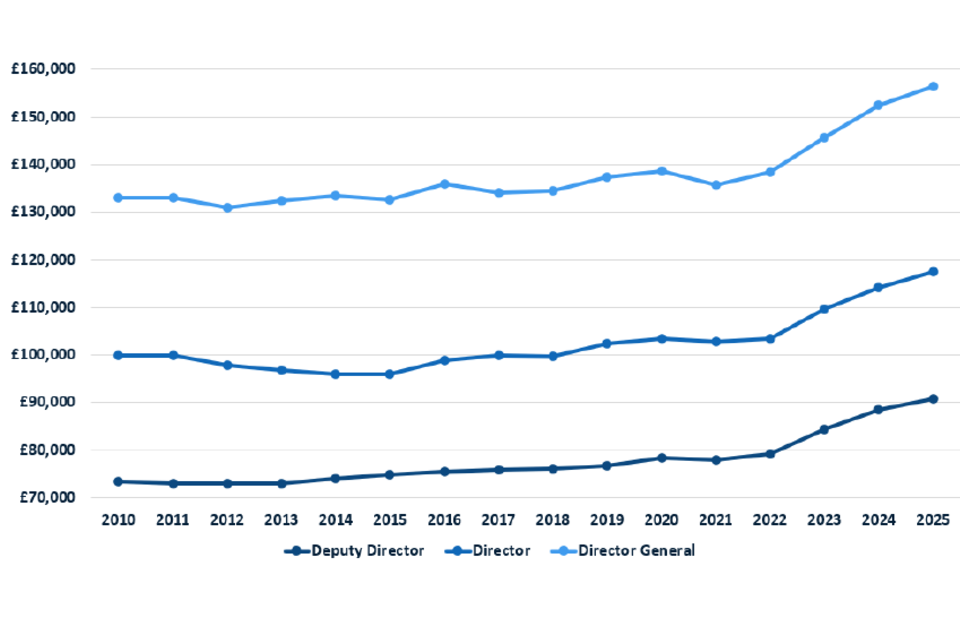
Notes:
This chart does not include those in PB1A.
Chart 4: SCS Mean Salary by Payband and Year (2010-2025)
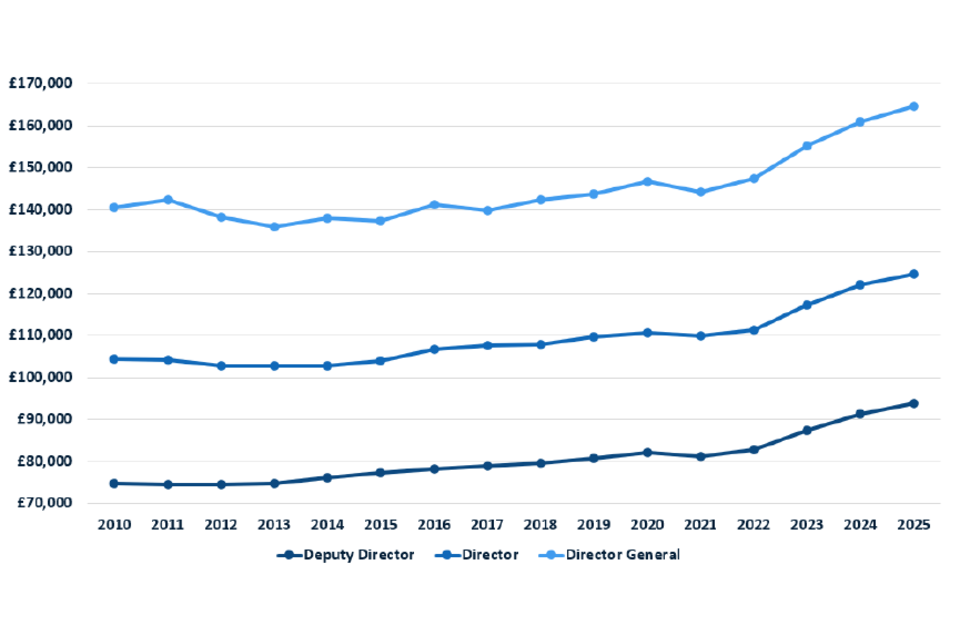
Notes:
This chart does not include those in PB1A.
Chart 5: Real Terms Erosion of SCS Salary by Payband and Year to 2010 Equivalents (2010-2024)
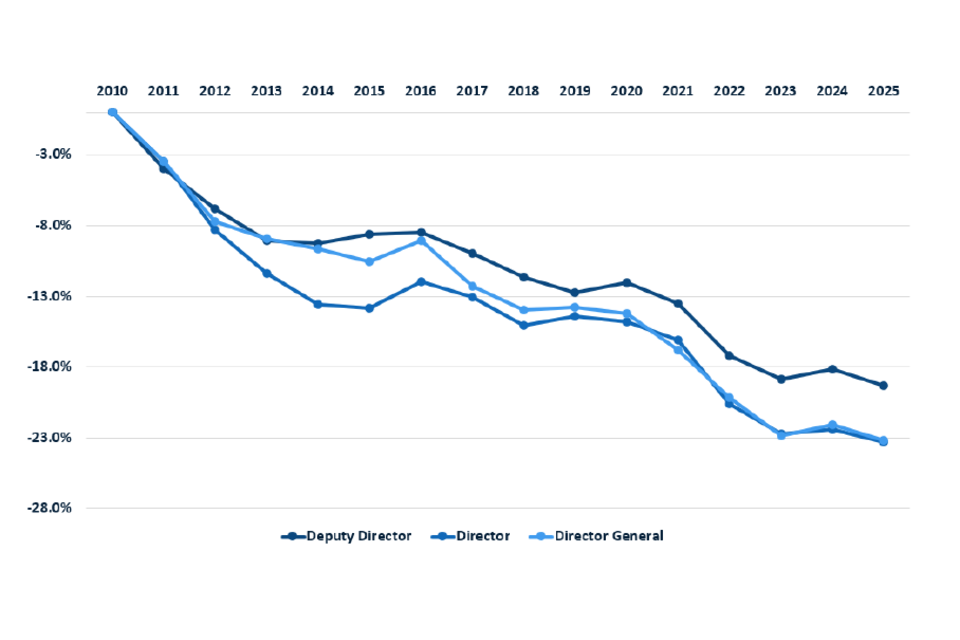
Notes:
Percentage figures are calculated on a full time equivalent basis for those SCS in scope for the SSRB pay award as at 1st April each year. Figures are derived from the differential between the actual salary paid to SCS and the expected ‘real’ value adjusted for inflation to April 2010 equivalent.
This chart does not include those in PB
Source:
SCS database, Cabinet Office
Inflation adjustment uses ONS CPIH indicators
Chart 6: Median Base Salary for SCS and Public and Private Sector Equivalents by Grade 2024
| Year | Deputy Director (PB1) | Director (PB2) |
|---|---|---|
| Civil Service | £90,800 | £117,600 |
| Public Sector | £101,100 | £165,700 |
| Private Sector | £133,600 | £226,200 |
Notes:
Civil Service Salary figures are calculated on a full time equivalent basis, and are for those SCS in scope for the SSRB pay award remit as at 1st April 2024
Public and Private Sector figures come from the Korn Ferry reward benchmarking report 2025 (with figures as of October 2024)
This chart does not include PB1A or Director Generals as data is not currently available. Figures are rounded to the nearest £100
Source:
SCS database, Cabinet Office
Korn Ferry reward benchmarking report 2025
Table 1: SCS Turnover, Departmental Turnover, and Resignation by Profession (2025/26)
| Profession | Resignations (1) | Turnover (1) | Departmental Turnover (1) |
|---|---|---|---|
| DDAT | 2.00% | 9.70% | 19.10% |
| Legal | 2.40% | 8.20% | 9.50% |
| Policy | 2.80% | 9.90% | 16.10% |
| Project Delivery | 3.30% | 12.30% | 21.00% |
| Operational Delivery | 3.60% | 11.50% | 14.90% |
| Other | 4.30% | 13.40% | 17.80% |
| Finance | 4.60% | 10.40% | 17.80% |
| Commercial | 4.90% | 12.00% | 14.80% |
| Human Resources | 5.20% | 13.70% | 24.80% |
| Economic | 6.90% | 15.80% | 21.30% |
| Property | 7.90% | 11.80% | 17.00% |
| Tax | .. | 6.80% | 9.50% |
| Communication | .. | 9.90% | 16.70% |
| Statistics | .. | 10.30% | 17.70% |
| Science And Engineering | .. | 12.40% | 14.50% |
| Security | .. | 20.10% | 32.40% |
| Internal Audit | .. | 22.40% | 22.40% |
| Clinical | .. | .. | 7.10% |
| Planning | .. | .. | 29.10% |
| Corporate Finance | .. | .. | .. |
| Counter-Fraud | .. | .. | .. |
| Overall | 3.40% | 11.30% | 17.20% |
Definitions:
Resignation rate includes all centrally managed SCS who resigned in the specified year Turnover rate includes all moves out of the centrally managed SCS over the specified year, including secondments, movements to an ‘SCS level’ role outside the centrally managed SCS (e.g. the diplomatic service), end of temporary promotion, etc
Departmental turnover rate includes moves between departments or their executive agencies / crown NDPBs within the year, in addition to moves included under turnover rate Further guidance on turnover calculations is available at: https://www.gov.uk/government/publications/turnover-in-the-civil-service
Notes:
Data is revised for each collection year. To ensure all leavers are counted, a small number of leavers from a previous year will be included in a more recent collection year
(1) Figures for resignations, turnover, and departmental turnover in 2024/25 include data for the SCS from Q1 2025 which is provisional only and will need to be updated when Q1 2025 data is finalised.
This table does not include SCS in the corporate finance, geography, inspector of education and training, intelligence analysis, internal audit, occupational psychology, operational research, planning, social research or veterinary professions due to low numbers.
”..” suppressed due to small numbers “-“ not available
Source:
SCS database, Cabinet Office
ANNEX B
SCS PAY ON APPOINTMENT EXCEPTIONS
1. In April 2018, a new pay on appointment policy for the SCS was introduced to help control departmental turnover. The rules are:
a. that no increase is given for moves on level transfer; and
b. that on promotion, SCS receive no more than 10% increase or the minimum of the new grade.
2. An exception process is, however, available in cases where internal candidates are moving to roles with greater scale or responsibility for increases to be offered, with the agreement of the Permanent Secretary and the relevant Head of Profession.
3. Starting pay exceptions at Director General level require the approval of the Chair of the Senior Talent Committee and the Cabinet Secretary. Less than five Director General exceptions were agreed in 2025/26. In 2025/26 there were 38 new Director General appointments, of which 22 were internal moves (16 on promotion and six level transfers) and 16 were from outside of government (external). At Director and Deputy Director level, main departments reported 60 starting pay exception cases for internal candidates. Table 1 below shows the number of cases and median salary agreed for each SCS grade.
Table 1: Number of Starting Pay Exception and Median Agreed Salary by Grade (2025/2026).
| Grade | Deputy Director | Director | Director General |
|---|---|---|---|
| Number of exceptions | 39 | 21 | N/D |
| Median salary agreed | £94,000 | £117,000 | N/D |
4. Cabinet Office issues guidance to departments with the annual SCS pay award practitioners guide. SCS pay exceptions are subject to the following criteria:
- Sustained high performance, increased effectiveness, deepened capability and expertise; and
- That the individual is relatively low in the pay range and/or have benefited less or not at all from the rise in the minima.
Departments should also consider the equality impact of any decisions made on exceptions, as well as any precedents they might be setting.
5. Cabinet Office helps departments make assessments of pay position by providing pay data by profession (lower quartile/median/upper quartile) annually. Some professions (e.g. Finance, DDaT) also actively support departments with applications by providing additional guidance and benchmarking.
Assessment of cases – Directors General
6. More information is held centrally on Directors General cases because they require approval of the Senior Talent Committee and the Cabinet Secretary, but is not disclosable due to the small numbers (less than five) approved. In accordance with the criteria, the weight and challenge of the role was considered as well as the skills and experience of the individual. Decisions are informed by internal pay quartile data by profession.
7. Less than five Director General exceptions were agreed by the Senior Talent Committee and the Cabinet Secretary (and the former Directors General Pay Committee) in 2025/26.
Assessment of cases – Deputy Directors and Directors
8. Main Whitehall departments reported that 60 exception cases were agreed at SCS1 and 2 level in 2025/26. The key headlines are:
Table 2: Number of Starting Pay Exceptions by Grade and Exception Type.
| Pay Band | Level transfer cases agreed | Pay on promotion cases agreed |
|---|---|---|
| SCS1 | 8 | 31 |
| SCS2 | 13 | 8 |
| Total | 21 | 39 |
- Exceptions have been granted for 14 different professions – the Digital, Data and Technology and Government Finance functions have the highest numbers.
- The median percentage increase agreed for level transfer was 7% and 15% for pay on promotion.
ANNEX C
Pensions
1. Pensions continue to form a critical part of the Civil Service total reward package, with both Defined Benefit and Defined Contribution pensions arrangements[footnote 5] available to members of the SCS.
2. Civil Service Pensions established “alpha”, a Career Average Defined Benefit pension scheme, on 1 April 2015. Since that date, all new joiners of Civil Service Pensions participate in alpha for future pension accrual, and the final tranche of all legacy scheme (PCSPS) members moved to alpha on 1 April 2022 for future accrual, although those with service in the final salary sections (classic, classic plus, and premium) will have their final salary calculated based on their salary when they leave service, even if that is many years in the future.
3. Alpha has an accrual rate of 2.32% of pensionable earnings, and is revalued each year by the change in the CPI index with no cap. Benefits are payable without reduction from an individual’s State Pension age. A key feature of the scheme design is that the value of a member’s accrued pension is not reduced by leaving the scheme, eg, if they leave service. Hence the scheme does not create barriers to labour market mobility. Members can transfer-in external pensions within their first 12 months of scheme membership. Members can only transfer pension out to Defined Benefit schemes.
4. As a consequence of the McCloud judgment, those who were active members of the defined benefit scheme on 31st March 2012 and have service between 1 April 2015 and 31 March 2022, will be provided with a choice at retirement of either their pre-2015 scheme benefits or alpha benefits for the period 2015-22[footnote 6].
5. Individual member contributions are determined by actual annual earnings which benefits part-time workers. The salary bands are shown in Table 1 below. The overall average employee contribution rate is 5.6%, which is in line with the yield target set by HM Treasury and lower than most other contributory major unfunded Public Service Pension Schemes.
Table 1: Percentage Value of Civil Service Pension Scheme Member Contributions (2026/2027)
| Actual Earnings | Contribution Rates |
|---|---|
| £0.00 to £36,199 | 4.60% |
| £36,200 to £56,000 | 5.45% |
| £56,001 to £150,000 | 7.35% |
| £150,001 and above | 8.05% |
The contribution table is considered every four years as part of the scheme valuation cycle and the table for 2027 to 2031 is currently under review as part of the 2024 valuation.
6. The pension valuation cycle sets the “employer” contribution rate, which is a flat-rate. The rate is 28.97% for 2026/27 and will be 22.32% for 2027 to 2031. The breakdown is shown in Table 2 below.
Table 2: Civil Service Employer Contribution Rates Valuation Cycle Changes (2026/2027 versus 2027-2031)
| Percentage of pensionable salary for 2026/2027 | Percentage of pensionable salary for 2027 to 2031 | |
|---|---|---|
| Cost of newly accruing pension minus member contribution of 5.6% | 23.6% | 21.2% |
| Past service deficit payment | 5.1% | 0.9% |
| Administration cost | 0.27% | 0.22% |
7. For SCS who pay a higher member contribution rate of 7.35%, the average value of the employer contribution for newly accruing pension is 21.85% in 2026/27 and will be 19.45% in 2027 to 2031.
8. The employer contribution rate is generous when compared to the private sector where employees will generally be provided with a defined contribution scheme. As defined contribution schemes are investment based, the employee also bears the risk of the pension not providing the expected level of income in retirement.
9. Most members of private sector pension schemes receive an employer contribution of 3 to 4% of salary. Pensions UK publish Pension Quality Mark (PQM) Standards[footnote 7] which set long-established standards for higher quality employer pension schemes. These include a requirement to contribute:
a. 12% of pensionable pay, with at least 6% from employer for PQM
b. 15% of pensionable pay, with at least 10% from the employer for PQM+
10. The Partnership pension scheme is a Defined Contribution pension scheme, which civil servants can switch to at any time after they join the Civil Service.
11. Table 3 below shows the automatic Partnership employer contribution rate. The Partnership pension scheme does not require any member contributions, but if a member chooses to make contributions, in addition to the rates shown below, their employer will also match their contribution, up to 3%. For example, if a 47 year old chooses to contribute 4%, their employer contributes 14.75% + 3% = 17.75%, which along with the member’s 4% contribution gives a total contribution of 21.75%.
Table 3: Civil Service Partnership Pension Automatic Employer Contribution Rate (2026/2027)
| Age at last 6 April | Percentage of pensionable earnings |
|---|---|
| Under 31 | 8.00% |
| 31 to 35 | 9.00% |
| 36 to 40 | 11.00% |
| 41 to 45 | 13.50% |
| 46 or over | 14.75% |
The contribution table is considered every four years as part of the scheme valuation cycle and the table for 2027 to 2031 is currently under review as part of the 2024 valuation.
Pension Tax from April 2020
12. From April 2020 the limits for the tapered Annual Allowance increased significantly. Prior to April 2020, the tapered Annual Allowance affected Civil Servants in alpha earning over £116,000. After April 2020 the tapered Annual Allowance is usually only an issue for the very highest paid SCS members (£200,000+).
13. Annual Allowance nonetheless continued to be an issue for the Civil Service after April 2020, with members earning over £100,000 being close to or exceeding the Annual Allowance and incurring a charge on their pension saving, especially those with long-service in the final salary sections when they were promoted.
14. The Spring Budget 2023 announced three main changes which impact Civil Service pension members: the increase in the Annual Allowance (AA) from £40,000 to £60,000 from 2023/24; allowing the “netting off” of positive and negative growth in pensions between alpha and the PCSPS from 2023/24; and the abolition of the Lifetime Allowance (LTA).
15. With the AA set at £60,000 a civil servant who only has alpha service can earn almost £162,000 p.a. before exceeding the allowance, compared to £108,000 in 2022/23. These figures disregard the potential impact of inflationary increases on past pension accrual, which can have a significant effect when the rate of inflation increases (this is due the inflation measures used in the HMRC calculation to adjust the value of accrued pension not aligning with the inflation measure used for alpha revaluation, due to differences in the tax year and scheme year).
16. The “netting off” between alpha and PCSPS is also expected to have a positive impact in reducing the number of members facing tax charges. This is because previously members with service in both PCSPS and alpha could see negative growth in one and an AA breach in the other, but were not able to combine the two to lower or remove the breach (which would reduce any tax due). This occurs when salaries increase by less than the rate of CPI.
17. Members who continue to breach the annual allowance and attract a tax charge retain the option to reduce their pension to meet an AA tax charge using a process called Scheme Pays, and so do not have to pay HMRC a tax charge directly.
18. The Lifetime Allowance has been abolished, and replaced by a Lump Sum Allowance which restricts the amount of tax-free pension lump an individual can receive to £268,275. This is only likely to affect Civil Servants with significant external pensions.
19. The alpha pension scheme does not have an automatic lump sum, and only the classic and classic plus sections of the PCSPS have an automatic lump sum. The scheme offers lump sum commutation at a rate of £12 of tax free lump sum per £1 of income. This rate is fixed, and is not set actuarially. It is lower than private sector Defined Benefit schemes offer (typical private sector commutation rates are 20:1 or slightly lower) and the Pension Protection Fund (PPF), which sets commutation rates to be actuarially neutral. At age 60 the PPF offers commutation[footnote 8] at £18.15 of lump sum per £1 of pension commuted, and at age 66 £15.47 of lump sum per £1.
20. With the abolition of the Lifetime Allowance and increases to the Annual Allowance amount and taper, there should be very few reasons a member may wish to either opt-out of the pension scheme entirely, or feel compelled to switch to Partnership due to tax considerations, aside from possibly the highest earners in excess of £200,000 p/a.
Pensions tax in 2022-23 and the Remedy Period
21. Pension Saving Statements were not issued to Remedy members in 2022/23 and Pension Inputs for 2022/23 were instead issued alongside revised Pension Inputs for the 2015-22 Remedy period by April 2025.
22. Around 36,000 members affected by the Remedy will need to enter the revised pension inputs into a HMRC calculator to determine whether a tax charge is due, or whether a past tax charge was under or overstated. It is expected that approximately 1,000 members will have past Annual Allowance charges amended. The vast majority of these will have lower charges, but it is possible some charges may be higher.
23. Where a tax charge for the remedy period has reduced, members will receive compensation. If a tax has increased prior to 2019/20 there will be no further action, if the charge related to 2019/20 or later HMRC will adjust tax records accordingly and arrange for the correct amount of tax to be paid either directly by the member or via a Scheme Pays reduction to the member’s pension.
ANNEX D
Permanent Secretaries Remuneration
1. A robust framework applies to permanent secretary pay: roles are assigned to one of three pay tiers within the overall range (pay band) based on size and complexity. Specialists who receive market premium pay for their roles (e.g. the Cabinet Secretary and Chief Medical Officer) sit outside of the tiers. With effect from 1 April 2025 the permanent secretary tiers are:
- Tier 1 - £200,000 - £220,000
- Tier 2 - £175,000 - £200,000
- Tier 3 - £155,000 - £175,000
2. Table 1 sets out, in £5,000 bands, the salaries of permanent secretaries within the tiers as at 1 April 2026.
Table 1: Distribution of Permanent Secretary Salaries by £5000 Band.
| Salary bands (£000) based on salaries at 1 April 2026 | Number of permanent secretaries in the salary band |
|---|---|
| 310 - 315 | 1 |
| 270 - 275 | 1 |
| 255 - 260 | 1 |
| 240 - 245 | 1 |
| 230 - 235 | 1 |
| 220 - 225 | 2 |
| 210 - 215 | 2 |
| 200 - 205 | 5 |
| 195 - 200 | 1 |
| 190 - 195 | 5 |
| 185 - 190 | 3 |
| 180 - 185 | 4 |
| 175 - 180 | 5 |
| 170 - 175 | 2 |
| 160 - 165 | 1 |
3. Pay and performance is assessed by the Permanent Secretary Remuneration Committee (PSRC), with membership comprising the Lead NED for Government as chair, the Cabinet Secretary, the Civil Service Chief Operating Officer and Permanent Secretary to the Cabinet Office, the Permanent Secretary to HMT, the Chair of the SSRB and up to two departmental NEDs.
4. PSRC’s remit is to provide an annual independent assessment of the performance of individual permanent secretaries, and to make recommendations to the Prime Minister on the consolidated and non-consolidated pay awards for individuals. As for other members of the SCS, the highest performing permanent secretaries (those assessed “Exceeding” or “High Performing”) are eligible for a non-consolidated performance related payment.
5. The PSRC considers permanent secretary performance on the basis of a wide range of robust evidence and feedback, including from the relevant Secretary of State/Minister and Lead Non Executive Director and a variety of business performance metrics. The Prime Minister approves PSRC’s recommendations for consolidated base pay and non-consolidated performance pay.
Performance Distribution
Table 2: Permanent Secretary Performance Rating Distribution (2022/2023 - 2024/2025).
| Rating | 2022/23 distribution | 2023/24 distribution | 2024/25 distribution |
|---|---|---|---|
| Exceeding | 12% | 7% | 8% |
| High Performing | 30% | 27% | 13% |
| Achieving | 58% | 67% | 79% |
| Low | 0% | 0% | 0% |
Notes:
- % figures have been rounded to the nearest whole number. Performance Markings for 2025/26 are yet to be finalised.
Tier ranges
6. With effect from 1 April 2025, the permanent secretary pay band is £155,000 to £220,000. Roles are assigned to tiers within the pay band: Tier 3 includes Second Permanent Secretaries and a handful of other smaller roles; Tier 2 is where most Head of Department roles sit; and, Tier 1 typically includes roles in the biggest and most complex departments.
7. There have been minimal changes to the pay band and tiers over the years, with some increases to the minimum, but no change to to maximum since 2010. In 2025, PSRC agreed to implement a new permanent secretary pay range of £155,000 - £220,000 with effect from 1 April 2025, and reviewed the permanent secretary tiers (within the band range) at the same time. The tiers from 1 April 2025 are:
- Tier 1 - £200,000 - £220,000
- Tier 2 - £175,000 - £200,000
- Tier 3 - £155,000 - £175,000
8. The pay tiers for permanent secretaries and where each role sits is set out in table 2, below.
Table 3: Permanent Secretary Pay Structure by Tier (from April 2016 Onwards)
| Tier and salary | Roles in the tier |
|---|---|
| Tier 1 (eight) £200,000 to £220,000 | HM Treasury Foreign Commonwealth & Development Office Ministry of Defence Dept Work & Pensions Home Office Ministry of Justice HM Revenue & Customs Dept Health & Social Care |
| Tier 2 (13) £175,000 to £200,000 | Dept Transport Dept Environment Food & Rural Affairs Govt Legal Dept Min for Housing, Communities and Local Govt Dept Education Secret Intelligence Services Security Service Govt Communications HQ Dept Business & Trade Dept Energy Security & Net Zero Scottish Govt Dept Science, Innovation & Technology Welsh Govt |
| Tier 3 (12) £155,000 to £175,000 | Northern Ireland Office Dept Digital Culture Media & Sport Office National Statistics Second Permanent Secretaries Dept for Health & Social Care HM Treasury (2 roles) Ministry of Defence Foreign Commonwealth & Development Office Cabinet Office - Joint Intelligence Committee Home Office Dept Energy Security & Net Zero Ministry of Justice |
| Specialists and other roles not assigned to these tiers (12) | Cabinet Secretary Civil Service Chief Operating Officer Director of Public Prosecutions Chief Medical Officer Government Chief Scientific Adviser Chief Executive UKHSA First Parliamentary Counsel DG, National Crime Agency National Armaments Director Second Permanent Secretary, European & Global Issues Director of Govt Comms Service National Statistician - vacant |
ANNEX E
The Government Commercial Organisation (GCO)
1. The Government Commercial Organisation (GCO) was established in 2017 to address capability issues within the senior commercial population in central government and enable government departments to deliver their aims at the best value for the taxpayer.
2. Serving as a single employer of all senior commercial experts in central government, the GCO is able to offer unique market-aligned terms and conditions. This has enabled the successful attraction and retention of experienced commercial specialists through a coordinated recruitment approach, compelling development and talent offer, competitive reward package and clearer access to a commercial career path.
3. The GCO comprises Commercial Leads (Grade 7), Associate Commercial Specialists (Grade 6), Commercial Specialists (SCS1) and Senior Commercial Specialists (SCS2/3). It has grown from 341 employees in 2018 to 1,722 in 2026[footnote 9].
4. There are 226 Senior Civil Servants (Commercial Specialists and Senior Commercial Specialists) in the GCO. This represents 13% of the total GCO population.
Table 1: Number of Senior Civil Servants by Grade and Terms and Conditions (August 2026).
| Position | Terms | Number of Employees |
|---|---|---|
| Commercial Specialist (SCS1) | Civil Service equivalent terms | 59 |
| Senior Commercial Specialist (SCS2) | Civil Service equivalent terms | <10 |
| Senior Commercial Specialist (SCS3) | Civil Service equivalent terms | <10 |
| Commercial Specialist (SCS1 equivalent) | GCO terms | 120 |
| Senior Commercial Specialist (SCS2 equivalent) | GCO terms | 35 |
| Senior Commercial Specialist (SCS3 equivalent) | GCO terms | <10 |
| Total | 226 |
5. GCO employees take GCO terms and conditions or Civil Service equivalent terms and conditions depending on their entry route and performance at the Assessment & Development Centre.
6. Employment on GCO terms and conditions requires:
a. Recruitment from the external market, or;
b. Recruitment from the internal market and an “A” at the Assessment & Development Centre; or,
c. Transition in line with the Cabinet Office Statement of Practice (COSOP) from the internal market and an “A” at Assessment & Development Centre.
7. 70% of SCS in the GCO are on GCO terms and conditions, with a significant proportion of these joining from the external market.
2026 Pay Award - Senior Civil Servants
8. The GCO SCS 2026/27 pay award will be implemented in September 2026.
9. The approach aligns with the SSRB’s 2026 recommendations that were accepted by the Government. Specifically:
- Increases to the Civil Service equivalent pay band minima in line with the SSRB recommendations (£5,000 uplift)
- 2.5% pot to address any specific workforce pay issues
- The introduction of pay progression for the SCS from 1 April 2026, to reward the acquisition and development of skills and expertise.
- This year’s package is being treated as the first step in this journey to recognising and rewarding exceptional delivery both in SCS and delegated grades. They are focused on the most immediate issues and provide a strong signal of intent for modernisation.
10. Reducing pay band widths forms part of a wider strategy to reduce gender and ethnicity pay gaps in the GCO as it helps to lessen pay variation.
11. GCO employees on Civil Service equivalent terms are eligible for non-consolidated end of year performance awards, the values of which are determined through the pay award process.
12. Effective 1 April 2023, the GCO updated its Performance Management Policy to include an organisational scorecard to encourage and recognise collective departmental achievement, as well as a wider range of individual performance markings.
13. Employees on Civil Service equivalent terms who received an “outstanding”, “excellent” or “great” performance rating for the 2025/26 performance year will receive a non-consolidated performance award.
14. GCO employees on GCO terms and conditions have a separate arrangement with the opportunity to receive Performance Related Pay (PRP). Commercial Specialists and Senior Commercial Specialists are eligible to receive up to 20% of their base salary as a non-consolidated Performance Related Payment.
15. Up to 5% of the 15% or 20% is determined through collective performance against the organisational scorecard, and the remainder is based on an evaluation of individual performance against stretching objectives at the employee’s end of year review.
Future Pay Priorities
16. Priorities for the next twelve months include:
- Finalise the implementation of an offer framework to improve the consistency of salary offers on appointment.
- We have been undertaking a pay & reward review, including external benchmarking, and will be working over the coming year on a plan & implementation
- Draft a revised Reward Strategy.
-
This is Q1 data. The Cabinet Office can provide updates to SSRB later in the year. ↩
-
This is according to the PfG scope based on FTE recorded in the CO SCS Database and excluding devolved governments and staff with unknown or overseas locations. ↩
-
Data sourced from Civil Service Statistics 2020 and 2026 and relates to SCS Level employees in the absence of demographic data for the centrally managed SCS. ↩
-
Departmental turnover rate includes the movement of SCS between department and their executive agencies/non-departmental public bodies within the year and movement to an ‘SCS level’ role outside the centrally managed SCS (such as the diplomatic service). ↩
-
Details of current and historic Civil Service pension scheme are available in scheme guides at https://www.civilservicepensionscheme.org.uk/memberhub/ ↩
-
Further details are available via the Remedy hub at https://www.civilservicepensionscheme.org.uk/remedy/ ↩
-
Actuarial factors - Actuarial factors from 1 October 2025 (PDF, 93KB) ↩
-
Data as at 1 August 2026 unless specified otherwise ↩