Annex B: Jobs and Careers Service evaluation strategy
Published 2 July 2026

© Crown copyright 2026
This publication is licensed under the terms of the Open Government Licence v3.0 except where otherwise stated. To view this licence, visit nationalarchives.gov.uk/doc/open-government-licence/version/3 or write to the Information Policy Team, The National Archives, Kew, London TW9 4DU, or email: psi@nationalarchives.gov.uk.
Where we have identified any third party copyright information you will need to obtain permission from the copyright holders concerned.
This publication is available at https://www.gov.uk/government/publications/get-britain-working-an-update-on-the-jobs-and-careers-service/annex-b-jobs-and-careers-service-evaluation-strategy
Executive summary
1. The Jobs and Careers Service is a large-scale reform, which aims to improve engagement in the labour market, employment and earnings. It will deliver these outcomes through a digital and inclusive, personalised, locally responsive service with enhanced employer relationships and a focus on career progression and good work. This evaluation strategy sets out how we will build a robust evidence base as the future service develops.
2. We will use a theory‑led approach aligned with the Magenta Book, which is the government’s central guidance on evaluation.[footnote 1] Our approach will combine test‑and‑learn during implementation with robust causal analysis and value for money assessment when scale and data permit. A Theory of Change summarises how activities are expected to deliver outcomes and impacts, the assumptions that must hold, and contextual factors. This strategy prepares the ground in Phase 1 (foundations and early learning), and during Phase 2 will deepen understanding through process evaluation and an assessment of impact and value for money (VfM).
Scope
3. This evaluation will assess whether the Jobs and Careers Service achieves its three core objectives set out in the Get Britain Working White Paper of improving engagement, employment, and earnings, as well as whether it is being delivered as designed.[footnote 2]
4. Consistent with the Jobs and Careers Service Theory of Change at Figure 2, the evaluation will focus on whether the service is delivering the short- and medium-term outcomes required to generate longer-term impacts, and in doing so meet the Get Britain Working core objectives. This strategy therefore places outcomes at the centre of the evaluation questions, selection of methods, and data requirements. Longer‑term impacts (e.g. employment, earnings, engagement) will be assessed when scale and data permit, but early evaluation will prioritise testing progress against the outcomes layer of the Theory of Change as prerequisites for impact.
5. The purpose of this evaluation is therefore to generate credible, timely evidence that:
-
manages delivery risk during implementation
-
addresses material evidence gaps in the Jobs and Careers Service design and operating model
-
measures outcomes and longer-term impacts against the core objectives
-
lays the groundwork (baselines, measures, methods and feedback loops) for ongoing evaluation and continuous improvement post-implementation
6. This strategy covers evaluations being carried out and funded under the Jobs and Careers Service programme (currently the Pathfinders, Coaching Academy and Flexible Delivery Network) and refers to other related evaluation activities where relevant (e.g. Universal Credit Conditionality Evidence trials, Youth and Economic Inactivity trailblazers).
Dependencies and alignment
7. The evaluation will track dependencies with the Youth Guarantee, Pathways to Work and Workplace Transformation, ensuring findings can be interpreted in the context of these interlinked changes.
Jobs and Careers Service Programme aims
8. As a framework for the evaluation, a set of evidence questions has been developed to examine how effectively the Jobs and Careers Service is delivering against the aims set out in the Get Britain Working White Paper.[footnote 3]
9. Furthermore, we have developed a Theory of Change which embeds these aims as testable outcomes [Figure 2]. The evaluation will build evidence to assess progress in achieving the outcomes set out in the Theory of Change and to understand how and why causal mechanisms are or are not working as intended.
Evaluation Approach
10. The evaluation will align with the Department’s Evidence and Evaluation Strategy (2025), which establishes the standards for how DWP prioritises evidence needs, assures methodological rigour, and embeds evaluation into major reforms. [footnote 4]
11. The evaluation will aim to answer the following questions:
-
To what extent does the Jobs and Careers Service’s digital, universal and inclusive support increase levels of engagement, particularly among priority groups?
-
Does the Jobs and Careers Service bring about improvements in employment and earnings outcomes compared with the existing service?
-
How do strengthened employer relationships improve customer outcomes?
-
How does the service effectively integrate careers, skills, and employment support to deliver more sustainable, higher-quality employment outcomes?
-
To what extent is the Jobs and Careers Service more locally responsive and embedded with other local partners than the current service?
-
To what extent does the Jobs and Careers Service foster a workforce with the capability, capacity, and motivation to deliver the service effectively, supporting positive customer outcomes?
Levels of Evaluation
12. The Jobs and Careers Service comprises a complex range of distinct reforms and delivery approaches, implemented at different scales and stages of maturity, and in different contexts, for example in devolved and localised settings.
13. The evaluation approach is therefore designed to reflect these differences. The theory-based approach will allow assessment of how context shapes implementation and outcomes, while identifying common mechanisms and transferable lessons. Where appropriate, the evaluation design will consider implications of differing delivery models for comparability and learning.
14. Evaluation will be undertaken at different levels, with the approach tailored to the nature, scale, and purpose of each component. Some components of the Jobs and Careers Service will be evaluated in their own right, particularly where there are clearly defined interventions and sufficient scale to support robust quantitative assessment. Other components will be evaluated as part of the wider Jobs and Careers Service offer, recognising that individual elements may interact with one another and with existing systems and services.
15. The evaluation approach will therefore vary, for example:
-
smaller‑scale research activities or proof‑of‑concept activity will focus primarily on process and implementation. These activities will not generate outcome or impact evidence
-
phased implementation with embedded trials, including some low-risk testing nationally, while concurrently testing higher-risk components in other areas at a smaller scale
-
national‑scale implementation, including larger-scale process evaluation and potentially trials using a counterfactual will generate evidence of the effectiveness, impact and efficiency of the new service compared with existing services, also enabling us to attribute causal effects of the reforms
16. This approach reflects the differing evidence needs at different stages of development, and the practical constraints around data, scale, and timeframes. An appraisal of these methods and their respective levels of suitability for various evaluation contexts is outlined in the figure below [Figure 1].
Figure 1: Levels of evidence diagram
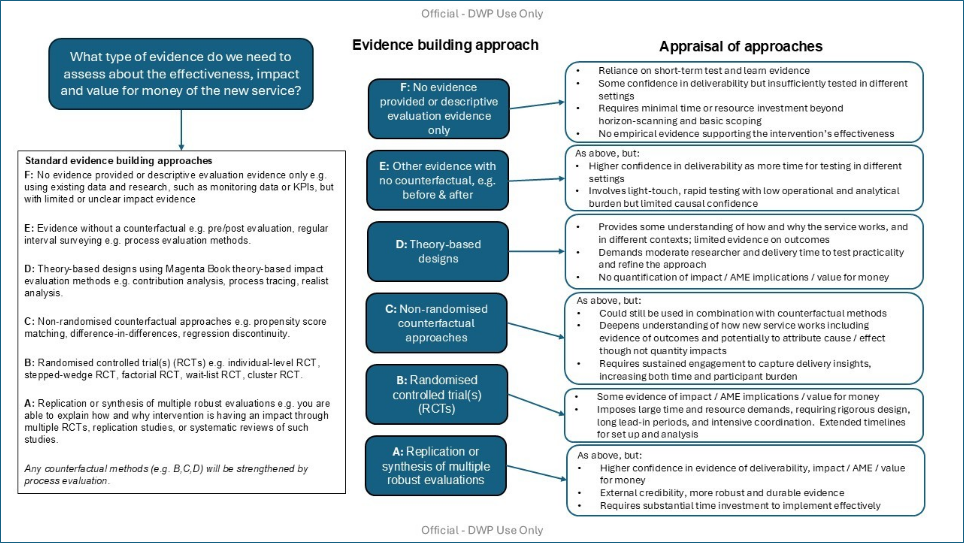
Figure 1: The diagram shows a hierarchy of evidence building approaches, from the weakest Level F (descriptive evaluation evidence only) to the strongest Level A (multiple robust evaluations). As evidence strength increases, confidence in impact and value for money improves, but greater time and resource are required.
Evaluation options
17. The Jobs and Careers Service is a complex, multi‑component reform operating across different places and delivery contexts. In such settings (where roll‑out is likely to be staggered, components interact, and local conditions vary) the Magenta Book and its Handling Complexity guidance point to theory‑based, contribution‑oriented evaluation as proportionate and robust. Relevant theory-based approaches are suitable for complex programmes, during and after implementation, and useful for establishing causation or contribution to impacts. Theory-based evaluations generate evidence on causal links and can provide a detailed understanding of how, why and under what conditions certain outcomes have come about.
18. Our approach will therefore be pragmatic, consisting of mixed‑methods, focused on understanding how and why change happens, for whom, and under what conditions, while triangulating evidence across qualitative and quantitative sources. We will use comparison opportunities where feasible and adapt designs as implementation evolves. Where formal trials are not feasible or proportionate, we will still gather targeted evidence (e.g. on what was delivered, how it was experienced, and interim signs of effect) to inform balanced judgements about contribution and to support continuous learning.
Theory of Change
19. A Theory of Change (ToC) sets out a clear understanding of how a programme is expected to bring about its intended outcomes. It describes the causal pathways linking inputs, activities, mechanisms, outputs, outcomes and impacts, as well as the assumptions and contextual factors that must hold along the way. In line with the Magenta Book and Government Social Research best practice, the ToC provides the foundation for a theory‑led and proportionate evaluation by clarifying what the Jobs and Careers Service is trying to achieve, how change is expected to happen, and what evidence is needed to test those expectations.
Narrative Jobs and Careers Service Theory of Change
Problem Statement
20. The Jobs and Careers Service has been created in response to the need for a modern, effective and user‑centred employment and careers service. The Jobs and Careers Service aims to create a transparent, adaptive and data‑driven service delivered through a skilled workforce and stronger local partnerships.
Figure 2: Current Jobs and Careers Service Theory of Change logic model
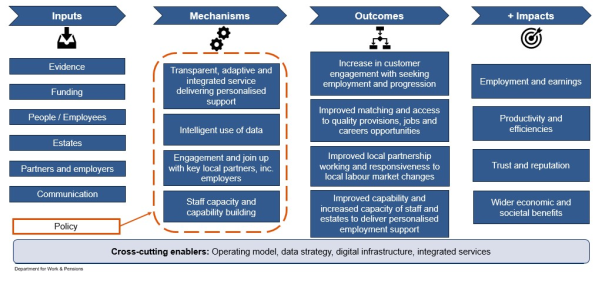
Figure 2: The flowchart-style diagram shows a Theory of Change logic model for the Jobs and Careers Service. The left-hand column sets out the inputs (including evidence, funding, employees, partners and policy), then moving through mechanisms such as personalised support and intelligent data use, to outcomes like improved engagement and job matching, and finally to wider impacts on employment and earnings, productivity and trust.
Inputs
21. Inputs are defined as the resources (financial, human resources, organisational, data etc.), capabilities or conditions that enable the programme to operate and deliver activity. Delivering the Jobs and Careers Service relies on core organisational resources and structures, including:
Evidence
Evidence-based approach to service design drawing on domestic and international evidence of what works.
Funding
Commitment to create a new, integrated Jobs and Careers Service in the Get Britain Working White Paper.
People / employees
Our workforce and the people we work with have the capability and capacity to deliver our services.
Estates
Transform our physical places with future-ready, accessible estates and take services to where customers need them, including flexible delivery in the form of mobile services, co-location and outreach activity.
Partners and employers
Build skills, careers and support local growth through partnerships with local authorities, careers services (Scotland and Wales), providers including voluntary and community sector, employers and other organisations.
Communication
Branding and external marketing of the new service offer.
Policy
The legal and political boundaries within which we deliver our services. Changes to policy could affect all mechanisms and outcomes.
22. Cross-cutting enablers include a new operating model and integrated services underpinned by transformed data and digital architecture, systems and tools.
Mechanisms
23. Mechanisms are defined as the processes through which changes and / or activities will deliver outcomes. Transformation occurs through four core mechanisms:
a. Transparent, adaptive and integrated service delivering personalised support:
-
clarity and transparency in the claimant commitment
-
employment, skills, and careers advice is integrated
- accessible, trusted and flexible service for customers – including flexible delivery and appointments
-
improved matching across skills, jobs and careers opportunities
- provision available locally through targeted partnerships
b. Intelligent use of data:
-
consistent digital recording of information
-
improved service responsiveness to labour market changes
-
timely, quality data available for evaluation and operational use
-
digital tools (for staff and customers) and staff capability to use the data
c. Engagement and join-up with partners and employers:
-
productive local network engagement and partnership working
-
clear governance and accountability
-
employer facing roles e.g. recruitment consultant
-
employer engagement and feedback (which is acted upon)
d. Staff capacity and capability building:
-
staff receive specific and appropriate training to deliver personalised support
-
staff empowered to offer flexibility in the frequency, intensity and channel of support, appropriate to individual customer needs
-
staff motivated in upskilling and professional development
-
staff readiness and confidence in changes to the delivery model (including co-location)
Outcomes
24. The Jobs and Careers Service aims to deliver the following short to medium-term outcomes:
a. Increased customer engagement with seeking employment and progression. Customers in receipt of benefits have a clearer understanding of the financial and employment support they will receive and their mutual obligations. There are increased opportunities for customers to interact with the Jobs and Careers Service through digital channels and to access the service in different settings. Increased engagement is an intermediate outcome that enables longer‑term impacts, including improved job entry and progression, and more sustainable employment outcomes over time.
b. Improved matching and access to quality provision, jobs, and careers opportunities. Increased access to appropriate skills and training, including work-related activity and support to address barriers; smarter matching to appropriate opportunities, reflecting supply and demand in local labour markets.
c. Improved local partnership working and responsiveness to labour market changes. Local partnership working, including with local authorities, providers and employers, is integral to the new service’s operation, with clear governance and strategic join-up.
d. Improved capability and increased capacity of staff and estates to deliver personalised employment support. Staff are empowered to deliver more productive and personalised employment-focused conversations with customers in appropriate settings. Our sites provide a welcoming and professional environment for customers and partners, with access to quality facilities.
Impacts
25. In the longer term, the Jobs and Careers Service expects to make positive contributions to:
a. Employment and earnings: The service aims to support a reduction in unemployment at a national level, while supporting people to boost their skills and move into higher paid, higher quality, and more productive work.
b. Productivity and efficiencies: Service transformation, including use of digital technology and better targeting of resources, should generate operational efficiencies while reducing spending on benefits.
c. Trust and reputation: Increased trust based on improved customer and employer engagement, experience and satisfaction with the service, while enhancing reputation through collaborative working with our partners.
d. Wider economic and social benefits: By achieving its objectives, the service will boost economic growth, help to reduce regional disparities and contribute to wider social benefits such as improving health, wellbeing and the environment.
Risks and assumptions
26. We recognise there are inherent assumptions and risks in the Jobs and Careers Service Theory of Change. Some risks and constraints (for example, data‑sharing barriers and limited resources) may persist and limit how far we can implement the Jobs and Careers Service or join up with other services.
27. Evaluation methods will be used to monitor assumptions that need to be met and risks that arise from the changes. We will be transparent about any limits in the data or delivery context and update the Theory of Change as we learn.
28. Figure 2 provides a visual summary of the Jobs and Careers Service Theory of Change logic model, mapping the key inputs, mechanisms and assumptions to the outcomes the service aims to achieve. The diagram supports a consistent understanding across the programme and guides where the evaluation will focus its testing.
29. Together, this Theory of Change sets the foundation for a coherent and proportionate evaluation by clarifying what needs to be tested, why, and under what conditions. It will continue to be refined as delivery evolves to ensure that the evaluation remains anchored in an up‑to‑date and credible understanding of how the Jobs and Careers Service is expected to work.
Planned evaluation phases
30. We are taking a phased approach to the evaluation, with progression to subsequent phases being evidence-led.
Phase 1: Test and Learn Approach
31. We have run targeted test‑and‑learn activities in early Pathfinder sites to assess whether delivery is operating as intended, how consistently it is being implemented across locations, and whether there are contextual or operational factors influencing delivery.
32. This phase will:
Develop and refine the core evaluation approach
-
Establish theories of change across key components of the Jobs and Careers Service model.
-
Clarify assumptions and causal pathways.
-
Identify mechanisms relevant to multiple areas of delivery within the Jobs and Careers Service.
Strengthen the Jobs and Careers Service evidence base
-
Review and align existing evidence, delivery insights, research activity and data sources to provide a concise understanding of the current evidence landscape and identify priority gaps where further insight is required.
-
This includes drawing on insights from Universal Credit Conditionality Evidence (UCCE) trials, which will contribute to the development of design assumptions and future evaluation options. These trials are generating early findings on how different approaches to appointment frequency, channels of support, and the structure of key interactions influence customer engagement and work coach time. This evidence will be highly relevant to help us shape more personalised employment support which is central to the Jobs and Careers Service reforms. Although full results will be available later in 2026, emerging learning will help to pinpoint which delivery mechanisms merit deeper investigation in Phase 2 and identify feasible opportunities for future causal and process evaluation designs.
Shape early-stage learning activities
-
Facilitate light‑touch, exploratory research and feedback mechanisms across early delivery settings to surface practical implementation issues, understand customer/staff experiences and inform iterative service design.
-
Capture operational feasibility insights and delivery variation without committing to early impact claims.
Build the conditions for later robust evaluation in Phases 2 and 3
-
Ensure data requirements, baselines and measurement approaches are scoped early where feasible.
-
Identify potential future evaluation designs and their feasibility (e.g., opportunities for comparison groups, natural variation or staged roll-out), without fixing decisions prematurely.
Activities
33. During Phase 1, a range of exploratory test and learn activities across early Pathfinder sites is informing our understanding of how the emerging service model operates in practice. These activities are helping to surface operational issues, identify contextual factors that shape delivery, and refine assumptions for later evaluation. Current activities include:
-
testing variations in the design and delivery of core service interactions including flexible appointments, digital options for customers who are closer to the labour market and more personalised support for those who need it
-
enhanced local partnership working with local authorities, organisations and employers
-
exploring different approaches to outreach and co-locating services in community settings, including the use of Youth Hubs, community venues and mobile delivery vans
-
capturing early operational learning from Coaching Academy training
-
testing how different environments shape the customer experience and the practicalities of delivering a locally responsive service
Phase 2: Upscaling and Roll-out
34. Phase 2 will embed mixed-methods evaluation within live roll-out to generate robust, decision‑grade learning on quality, mechanisms, and early outcomes, while readying data and designs for robust impact and value for money assessment at scale. This is consistent with the Magenta Book’s direction to embed evaluation during delivery and to use approaches that explain mechanisms and context, not only headline effects.
Process Evaluation
35. This strand will include a range of methods, such as:
-
qualitative research with staff and customers to understand how the Jobs and Careers Service is delivered in practice and how well it is working and why
-
surveys with staff and customers to capture their experiences of the Jobs and Careers Service
-
management information and system data to understand how delivery varies across settings and over time
36. This stage will test whether the Jobs and Careers Service is achieving its intended outcomes and impacts once the service is live and operating at full scale. We will compare results to the baselines and measures set earlier. Findings will feed into a clear set of actions to refine the operating model and inform ongoing improvement of the live service.
Impact Evaluation
37. Impact evaluation will be used to assess what outcomes, such as changes to employment and earnings, have occurred at least partly as a result of the Jobs and Careers Service, the magnitude of those outcomes, and the extent to which they can be attributed to the service rather than other factors.
38. By estimating the additionality of these outcomes, or the extent to which they would not have occurred in the absence of the Jobs and Careers Service (i.e. a counterfactual), the impact evaluation will provide robust estimates of the benefits directly attributable to the programme. Establishing the additionality of outcomes is also critical for assessing Value for Money (VfM), as it ensures that any benefits used in the VfM analysis reflect impacts generated by the new service, rather than outcomes that would have occurred anyway.
Value for Money Assessment
39. Value for Money (VfM) assessment will be used to generate evidence of efficiencies, considering whether the benefits of the Jobs and Careers Service outweigh the costs of designing, implementing and delivering the service. As the service will deliver a multitude of changes, VfM assessment can only be carried out on the programme in its entirety as some component parts will not be quantifiable.
Transparency
Publication of evaluations
40. We are committed to appropriate transparency and to sharing learning from the evaluation of the Jobs and Careers Service in the public domain where suitable. Evaluation outputs will be published in line with Government Social Research and DWP analytical and statistical publication standards, taking account of data quality, assurance processes, and disclosure considerations.
41. At this stage, it is not possible to specify the precise nature or timing of evaluation publications. Decisions on the timing of publication will be informed by the maturity of the evidence, the purpose of the analysis, and alignment with programme milestones. Publication plans will be reviewed as the Jobs and Careers Service implementation and the evaluation progresses.
Conclusion and next steps
42. This evaluation strategy provides a theory‑based framework for building robust evidence on the Jobs and Careers Service as the programme continues to evolve. It is necessarily flexible to adapt to decisions on delivery sequencing and roll-out, while ensuring that evaluation is embedded from the outset.
43. In the near term, the focus will remain on test‑and‑learn and process evaluation activities to assess the operational feasibility of changes, manage delivery risk, generate early learning, and refine assumptions. In parallel, the strategy puts in place the foundations required for future impact and value for money assessment, so that more intensive evaluation can be undertaken when scale and conditions allow.
44. The strategy will be kept under review, evolving in line with implementation plans.
Glossary of Terms
| Term | Definition |
|---|---|
| Coaching Academy | The Coaching Academy is designed to upskill Jobcentre Plus staff in professional coaching approaches. It aims to improve the quality of employment support by equipping work coaches with enhanced capability, knowledge of local labour markets, and coaching‑focused methods. The Academy supports delivery of the new Jobs and Careers Service and forms a core feature of Pathfinder testing. |
| Impact Evaluation | An evaluation that assesses the extent to which an intervention has caused observed outcomes, typically by estimating what would have happened in the absence of the intervention (counterfactual). Principal measures used are employment and earnings. Uses causal inference methods to isolate programme effects. |
| Pathfinders | Pathfinders are localised test sites established to test new approaches to employment support, Jobcentre Plus delivery and service design before national roll-out. |
| Process Evaluation | An evaluation that examines how an intervention is implemented, exploring fidelity, reach, delivery mechanisms, and contextual factors. Focuses on understanding why and how outcomes occur. |
| Test and Learn | A structured, iterative approach that uses small-scale tests to generate rapid empirical evidence on what works, for whom, and under what conditions. Findings inform real-time adaptation and optimisation of policy design and delivery. |
| Theory of Change | A structured description of how an intervention is expected to lead to intended outcomes, detailing causal pathways, assumptions, external factors, and conditions for change. Forms an analytical foundation for evaluation design. |
| Theory-based Evaluation | An evaluation approach that uses an explicit Theory of Change to investigate whether and how an intervention produces outcomes. Emphasises causal mechanisms, assumptions, and context. Draws on a variety of evidence types to build an evidence base aligned to the Theory of Change. |
| Universal Credit Conditionality Evidence Trials | Universal Credit (UC) conditionality requires customers in receipt of benefits to meet specific work‑related expectations (e.g., job search activities, skills assessments). The UC Channels Trial tests whether offering customers in the Intensive Work Search (IWS) group alternative channels to face-to-face work search review meetings adversely affects their labour market outcomes. The UC Frequencies Trial evaluates whether offering customers in the IWS group fewer work search review meetings in their first 13 weeks produces work outcomes comparable to business‑as‑usual, and which customer groups, if any, achieve comparable work outcomes under this lighter‑touch approach. |
| Value for Money Assessment | An analytical assessment of whether an intervention provides optimal use of public resources, typically considering economy, efficiency, effectiveness, and equity. |
| Youth Guarantee Trailblazers | Eight areas in England which pilot an integrated Youth Guarantee model for 18-21‑year‑olds. Trailblazers bring together local employment, skills, health and early intervention support to reduce rates of young people not in education, employment or training (NEET). They test leadership, governance, data‑sharing, and how local systems identify and engage young people. |
Theory of Change: Glossary of Terms
| Term | Definition |
|---|---|
| Inputs | The resources (financial, human resources, organisational, data etc), capabilities or conditions that enable the programme to operate and deliver activity. |
| Mechanisms | The actions, behaviours and processes through which activities and their outputs will deliver outcomes. |
| Outcomes | The desired results produced through the change mechanisms. Outcomes can occur over the short and medium term, in varying degrees, leading to longer-term impacts. |
| Impacts | The desired longer-term effects resulting from the changes on the key success measures. Appropriate evaluation methods will be required to establish causal links set out in the Theory of Change. |
-
HM Treasury (2011). The Magenta Book - GOV.UK ↩
-
DWP (2024).Get Britain Working White Paper - GOV.UK ↩
-
DWP (2024). Get Britain Working White Paper - GOV.UK ↩
-
DWP (2025).Evidence and Evaluation Strategy 2025 - GOV.UK ↩