GDA Step 2 of the GE Vernova Hitachi SMR: Fundamental Assessment full report
Published 11 December 2025
Applies to England and Wales

© Crown copyright 2025
This publication is licensed under the terms of the Open Government Licence v3.0 except where otherwise stated. To view this licence, visit nationalarchives.gov.uk/doc/open-government-licence/version/3 or write to the Information Policy Team, The National Archives, Kew, London TW9 4DU, or email: psi@nationalarchives.gov.uk.
Where we have identified any third party copyright information you will need to obtain permission from the copyright holders concerned.
This publication is available at https://www.gov.uk/government/publications/gda-step-2-of-the-ge-vernova-hitachi-smr-fundamental-assessment/gda-step-2-of-the-ge-vernova-hitachi-smr-fundamental-assessment-full-report
1. Introduction
This report sets out our findings following Step 2 of a generic design assessment (GDA) of the BWRX-300 small modular reactor nuclear reactor design.
GE Vernova Hitachi Nuclear Energy International LLC, UK Branch (GVHI, UK Branch) is the Requesting Party (RP) for the GDA. It is a branch office of GE Vernova Hitachi Nuclear Energy International LLC (GVHI). The design being assessed is the BWRX-300, which is designed by GE Vernova Hitachi Nuclear Energy Americas LLC (GVHA), a sister company of GVHI.
The entity names listed above are slightly different to those used in our Step 1 documents. This is a name change only, there is no change to the company number and so the legal identity of the RP has not changed.
Documents referenced in this report are referenced as GE-Hitachi documents because they were submitted prior to the company name change of the RP.
GVHI, UK Branch applied to the Department for Energy Security and Net Zero (DESNZ) for its design to enter the GDA process in January 2023 and the application was successful. The regulators (Environment Agency, Office for Nuclear Regulation (ONR) and Natural Resources Wales (NRW)) were asked by the Minister to begin a GDA for this design. Step 1 (Initiation) of the GDA formally began in January 2024.
The RP proposed a 2-step GDA taking 24 months. Step 1 started in January 2024 and finished in December 2024, taking 12 months (Step 1: statement of findings). Step 2 started in December 2024 and will finish in December 2025, also taking 12 months in line with the Step 1 proposal. The objective is for the RP to achieve a Step 2 Statement from the Environment Agency, Natural Resource Wales and from ONR. There are no plans to continue to Step 3 of a GDA.
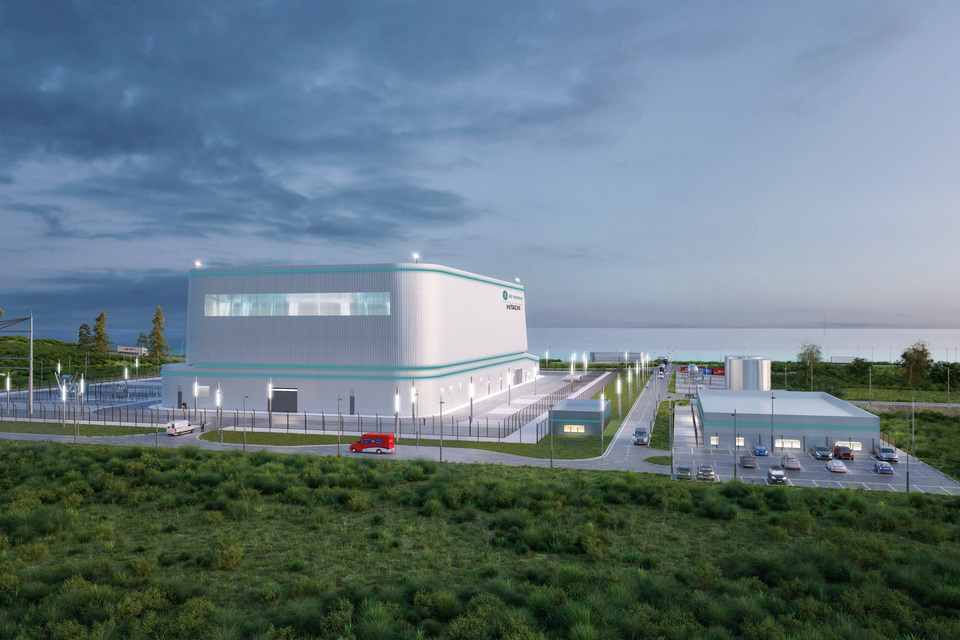
Illustration of BWRX-300 SMR. Copyright GE Vernova Hitachi Nuclear Energy International LLC.
1.1 Step 2 objectives
The top-level objectives for Step 2 are for the:
- Environment Agency to carry out an assessment to identify any fundamental environmental protection shortfalls in the design
- RP to complete the submissions needed for Step 2 (and in preparation for Step 3, if necessary) and to publish the submissions on its website
- RP to launch and publicise its public comments process
We will assess the design against regulatory requirements and expectations. This includes identifying any fundamental environmental protection shortfalls that could prevent the design from being potentially acceptable for deployment on sites in England or in Wales where NRW is the environmental regulator.
In this report, we:
- present the work we have done and the conclusions we have reached so far
- outline any fundamental environmental protection shortfalls, benchmarked against the level of detail we would expect to allow us to issue a Statement of Design Acceptability (SoDA) if the RP were to progress to GDA Step 3
- state if we consider changes to the design might be needed
We considered relevant comments received from the public or interested organisations to the RP’s comments process and the responses made to those comments.
We worked with NRW to carry out our assessment of fundamental environmental protection shortfalls during Step 2.
2. The BWRX-300 design
This section outlines the BWRX-300 reactor design and details the mechanisms by which radioactive waste will be generated, managed, and ultimately, disposed. Further information on the reactor design can be found in the BWRX-300 General Description document, publicly available on the GVHI website. The documents specific to the UK GDA can be found in the document library on the GVHI, UK Branch GDA website.
2.1 Outline of design
The BWRX-300 is a small modular boiling water reactor (BWR) that can generate 300 megawatts (MW) of electricity. BWRs are single circuit reactors, where water is heated as it passes through the reactor core. The resultant steam is dried and passed directly through a turbine before being condensed and returned as water to the reactor core. The single circuit process is illustrated in Figure 1.
BWR designs have been in operation for over 60 years and the BWRX-300 is a 10th generation BWR design. It is an evolution of the Simplified Boiling Water Reactor (SBWR) and the Economic Simplified Boiling Water Reactor (ESBWR). The ESBWR has been licensed by the United States Nuclear Regulatory Commission (US NRC) and completed Step 2 of a full GDA in 2008 under the first iteration of the GDA process. However, neither the SBWR or ESBWR have been built and operated.
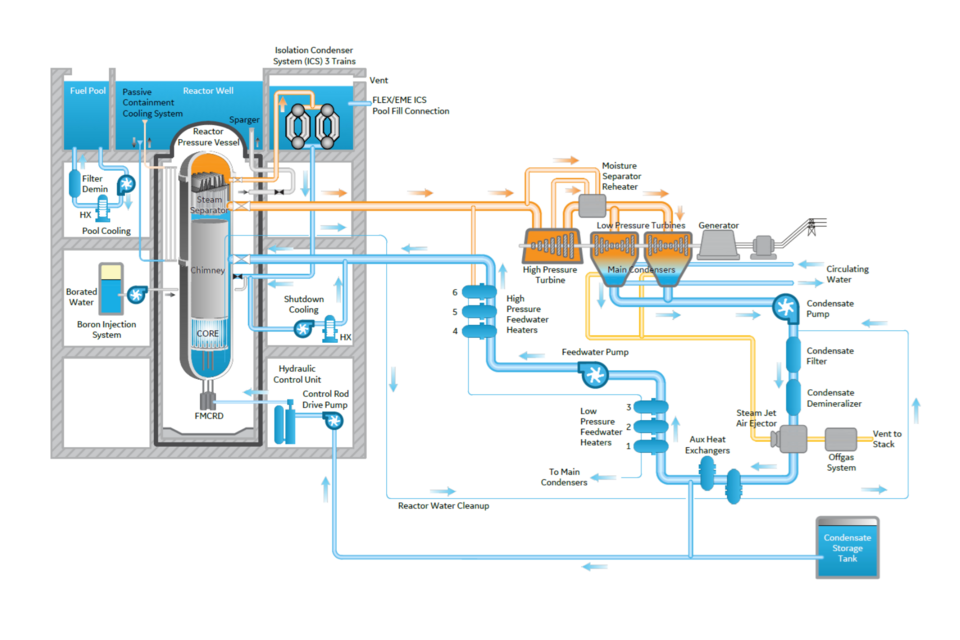
Figure 1. An illustration of the internal systems of the BWRX-300 small modular reactor. The image shows the reactor building containing the core inside a reactor pressure vessel. There is a steam outlet leading to a 3 stage turbine followed by a condenser. The water is returned to a condensate storage tank where it can be fed back to the reactor pressure vessel. Image copyright of GE Vernova Hitachi Nuclear Energy International LLC.
The BWRX-300 also has some features in common with the UK Advanced Boiling Water Reactor (UK ABWR), a design that previously completed a full GDA and was awarded a Statement of Design Acceptability (SoDA) in 2017 by the Environment Agency and Natural Resources Wales.
The BWRX-300 uses natural circulation, with a focus on passive safety. The plant is designed to operate for 60 years, with refuelling every 12 to 24 months dependent on operational decisions. The natural circulation is achieved by the chimney effect from the tall reactor pressure vessel. The reactor vessel is located almost entirely below ground level.
The reactor uses an existing uranium oxide zircaloy-2 clad fuel type (GNF2) enriched up to 4.95%. Reactivity is controlled by fine motion control rod drives (FMCRD) by inserting control rods from beneath the reactor pressure vessel.
The BWRX-300 aims to achieve a single globally applicable design, based on the International Atomic Energy Authority (IAEA) safety standards framework. The BWRX-300 design is also currently being put through regulatory scrutiny as part of licensing reviews in the US and Canada.
2.2 Sources, processing and disposal of radioactive waste
Radioactive waste in the form of solids, liquids and gases arise from activities associated directly or indirectly with operating and maintaining the reactor, and ultimately, from decommissioning the plant. The BWRX-300 radioactive waste systems are not novel compared to other BWR designs.
2.2.1 Gaseous wastes
Gaseous effluents occur from the condenser, where non-condensable gases are removed via steam jet air ejectors (SJAE) to maintain turbine efficiency. Gases are transferred to the off-gas system where they pass through a catalytic hydrogen and oxygen recombiner to reduce hydrogen risks. The gases are then conditioned to remove moisture before passing through charcoal delay beds, where some radionuclides, especially krypton and xenon isotopes can decay before sampling and routing to the stack for discharge.
Other gaseous waste will result from the building heating ventilation and cooling system (HVS). These gases are filtered using local pre-filters and high-efficiency particulate air (HEPA) filters before discharge via the stack.
2.2.2 Liquid wastes
The BWRX-300 is designed to have capacity to store and manage all water needed for normal operations. It maximises the potential for recycling liquids such that it could be operated with little or no liquid discharges. There may be circumstances where an operator could choose to make liquid discharges, such as to manage water volumes or where effluents cannot be made suitable for reuse. There are BWRs that do operate with no liquid discharges for a significant period.
Liquid effluents arise from sumps and floor drains, due to leakage or maintenance activities. Normal operational waste streams are transferred to the liquid waste management system, where they are collected in tanks and batch treated with filtration and ion exchange before being sampled and transferred to a condensate storage tank (CST) for reuse in the reactor or elsewhere is the plant as required. During refuelling, large volumes of water are used to flood the reactor cavity and refuelling pools. The BWRX-300 has sufficient storage capacity, such that after refuelling, this water can be cleaned for reuse rather than being discharged.
2.2.3 Solid wastes
Radioactive waste will result from ion exchange resins and filter backwash sludges from the treatment of liquid effluents; these could be low-level waste (LLW) or intermediate level waste (ILW). Liquids generated in the solid waste management system will be transferred to the liquid waste management system for treatment and reuse.
Radioactive waste will also result from filters from the off-gas system and HVS and other operational and maintenance wastes such as paper, rags, clothing, plastics, tools and activated or contaminated components. The solid waste management system will manage, package and store wastes until disposal, off-site. We consider if this includes appropriate sorting and segregation and waste characterisation for optimised disposal in the UK waste infrastructure.
It is proposed, for GDA, that the waste service offered by the Low Level Waste Repository (LLWR) will be used to dispose of low-level waste.
Spent fuel will be cooled in a spent fuel pool (SFP) before being dried and packaged for interim storage, in readiness for ultimate disposal at a geological disposal facility (GDF). Therefore, for this GDA we are assuming spent fuel is a waste.
There is also potential for oily radioactive wastes to be created which would be collected in drums for off-site disposal.
Non-radioactive substances will also be present in the radioactive waste and may affect how it is managed and its impact on the environment.
2.3 Non-radioactive waste
Non-radioactive waste is produced from all life cycle phases of a nuclear power station. When operating and maintaining the ‘conventional’ side of a BWR power station this will include:
- combustion gases discharged to air from diesel generators
- water containing water treatment chemicals from the turbine-condenser cooling system and other non-radioactive cooling systems, which can be discharged to the sea, lakes or other water bodies under a regulated environmental permit
- oils and any other significant liquids or sludges
- worn-out components
- general waste
3. Scope of generic design assessment
3.1 Requirements for the scope of GDA
Requirements for the scope of GDA are defined in the Environment Agency: Guidance for Requesting Parties (2023). We expect the RP to provide a scope of GDA with enough information and sufficient functional specifications for the design so that we can carry out a meaningful GDA.
A meaningful scope means that the information the RP provides should cover the full breadth and depth necessary for the ONR, the Environment Agency and NRW to carry out their assessments.
The scope should include all relevant topics and sufficient detail of the nuclear power plant design. Regulators require that the scope should state which structures, systems and components (SSCs) and regulatory assessment topics are considered. The design of the SSCs that support the environmental protection functions (relevant to waste and environmental assessment) need to be mature enough to enable meaningful assessment.
The scope of the GDA should include a statement indicating whether the RP is seeking a 2 or 3-step assessment, or a 3-step assessment targeting the issue of a Statement of Design Acceptability (SoDA) from the Environment Agency and NRW and Design Acceptance Certificate (DAC) from ONR.
3.2 Declared scope of this GDA
The scope of the BWRX-300 GDA is defined across 3 documents, the:
- Scope of Generic Design Assessment [GE Hitachi, 2024a]
- Design Reference Report [GE Hitachi, 2025a], see section 3.4.2 for more detail
- Master Document Submission List (MDSL), which is a live document detailing the latest version of each submission, that at the end of GDA form the submissions assessed under the scope of this GDA – at the close of this GDA, the final MDSL was version 19 [GE Hitachi, 2025b]
The scope document details the:
- applicable structures, systems and components (SSCs) of the reactor design
- the level of design maturity
- applicable life cycle stages and operating modes
- relationship with the GDA topic activities, which defines the scope of the submissions
There are some aspects of reactor design excluded from the GDA scope which are relevant to the Environment Agency assessment. These have been excluded for various reasons, including being related to systems outside of the main power block design (such as the detail of interim waste stores) or being site-specific (such as environmental monitoring). These aspects will be assessed at a future stage of the regulatory process, when information becomes available. The most significant exclusions are:
- management of failed fuel; this is fuel where the cladding integrity may be compromised, allowing the release of fission products from the fuel to the coolant
- management of waste from contaminated ground identified in preparing the site for construction
- design and associated analysis of systems outside of the power block for the management of intermediate-level waste (ILW)
- specification of skid-mounted or mobile equipment
- specification of headroom factors associated with annual aqueous and gaseous discharge limits, due to the use of a bounding case approach
- potential short-term doses based on maximum anticipated short-term discharges from the facility in normal operations, this would be a Step 3 activity
- assessment of accumulation of radionuclides in the local environment of the facility, this would be a Step 3 activity
Specific inclusions and exclusions of scope will be highlighted in each assessment topic, in sections 6 to 13 of this report.
The scope indicates that the GVHI, UK Branch is intending to progress to the end of GDA Step 2 only and the GDA will be carried out on a single reactor unit.
At the end of Step 1, we issued a Step 1: statement of findings concluding that there would be enough information for a meaningful GDA, subject to acceptable document content and quality.
3.3 Documents submitted for this GDA
Documents that form the GDA submission are recorded in the MDSL [GE Hitachi, 2025b]. These documents are organised into 3 tiers of information:
- the overarching documents of the safety, security, safeguards and environmental case (SSSE)
- supporting information consisting of the references cited within the tier 1 submissions linking to more detailed information
- selected supporting documentation consisting of detailed evidence such as design, evaluation and analysis to demonstrate that the design intent meets the high‐level claims and arguments made in tier 1
Tier 4 documentation is not recorded in the MDSL, but in a separate document list (DL). The DL captures all other information sent from the RP to the regulators such as correspondence, superseded versions of documents, Regulatory Queries (RQs), responses and public comments.
The tier 1 documents that form the SSSE and consist of:
- Preliminary Safety Report (PSR)
- Preliminary Environmental Report (PER)
- Generic Security Report (GSR)
- Preliminary Safeguards Report (PSgR)
Most of the information required by the Environment Agency can be found in the PER, which consists of 10 chapters:
- E01 - Introduction [GE-Hitachi, 2025c]
- E02 - Generic site description [GE-Hitachi, 2025d]
- E03 - Management arrangements and responsibilities [GE-Hitachi, 2025e]
- E04 - Information about the design [GE-Hitachi, 2025f]
- E05 - Radioactive waste management arrangements [GE-Hitachi, 2025g]
- E06 - Demonstration of BAT approach [GE-Hitachi, 2025h]
- E07 - Radioactive discharges [GE-Hitachi, 2025i]
- E08 - Approach to sampling and monitoring [GE-Hitachi, 2025g]
- E09 - Prospective radiological assessment [GE-Hitachi, 2025h]
- E10 - Other environmental regulations [GE-Hitachi, 2025l]
However, relevant information can also be found in chapters of the PSR, for example:
- 11 - Management of radioactive waste [GE-Hitachi, 2025m]
- 12 - Radiation protection [GE-Hitachi, 2025n]
- 17 - Management for safety and quality assurance [GE-Hitachi, 2025o]
- 21 - Decommissioning and end of life aspects [GE-Hitachi, 2025p]
- 23 - Reactor chemistry [GE-Hitachi, 2025q]
- 26 - Interim storage of spent fuel [GE-Hitachi, 2025r]
There are also some tier 2 documents important for our assessment, in particular:
- BWRX-300 UK GDA Alignment with Sustainability, RSR Objective and Principles & Generic Developed Principles [GE-Hitachi, 2024b]
- BWRX-300 UK GDA Integrated Waste Strategy [GE-Hitachi, 2025s]
- BWRX-300 UK GDA Demonstration of Disposability for Higher Activity Radioactive Wastes (Including Spent Nuclear Fuel), [GE-Hitachi, 2024c]
- Expert View on the Disposability of Wastes and Spent Fuel arising from the GE-Hitachi Nuclear Energy BWRX-300 [NWS, 2025]
- BWRX-300 GDA Environment Protection Function Methodology, [GE-Hitachi, 2025t]
- BWRX-300 UK GDA Analysis of Environmental Discharge Data for US Nuclear Power Plants, [GE-Hitachi, 2024d]
The procedures that detail the production, governance and management of documents with GDA are considered as part of our assessment of management arrangements and quality assurance (Section 6).
3.4 The design for this GDA
3.4.1 Design terminology
The design of the BWRX-300 uses a 4-stage design process as follows:
Baseline 0: The plant requirements are established, the high-level conceptual design developed, and corresponding requirements are identified.
Baseline 1: The system interfaces are established. The integrated three-dimensional model, the Simulation Assisted Engineering (SAE) model for instrumentation and control systems and the baseline safety assessments are developed to support construction licence applications. The system design descriptions (SDDs) are developed for the primary systems.
Baseline 2: The standard design is completed ready for construction planning, detailed component design, and support for equipment procurement/fabrication.
Baseline 3: The standard design applied to site-specific projects, where all remaining system and component design is completed in preparation for construction activities.
For this GDA, structures, systems and components that define the main power block are at Baseline 1 and progressing to Baseline 2. However, some of the more peripheral support systems, may still be at Baseline 0 but progressing to Baseline 1. This means that the design will continue to develop from that assessed in this GDA. Design developments will be assessed at a future regulatory process, either a GDA Step 3 or at a site-specific application for an environmental permit.
3.4.2 Design reference and design reference point
The BWRX-300 is a developing design that is not yet in operation, therefore, there is no reference plant that forms the basis for this GDA. The design reference (DR) for this GDA is based on the BWRX-300 standard plant design as of the end of March 2024. There are some additional variations relating to known changes, specifically around control and instrumentation and electrical systems. The Design Reference Report [GE-Hitachi, 2025a] provides a list of the systems, structures and components (SSC) which are included in the scope of the GDA, and their relevant GDA reference design documents. This snapshot of a developing design at a specific point in time (March 2024) is called the design reference point (DRP). The DRP is a design development point on which the safety, security, safeguards and environmental cases (SSSE) are based. This is the plant configuration control point, chosen by GVHI, UK Branch, upon which its analysis and our assessment is based.
A GDA carried out at this early stage of the design presents opportunities for environmental aspects to be considered early and to be included within detailed optioneering and decision-making. This should result in well-balanced optimisation and improved recording of information needed to substantiate the SSSE as it develops.
3.4.3 Design change
In previous GDAs, the design has evolved during the GDA timeframe as a result of the assessment process and having multiple DRPs in the GDA timeframe. This resulted in a design change acceptance process for bringing design changes into GDA, accompanied by a revision of the DR and DRP. This RP has opted to not bring design changes into GDA, but to consider the outcomes of the GDA assessment after the end of GDA or to capture requirements as Forward Action Plans (FAPs) where decisions are made whether to address them at a UK site-specific design or whether to feed the requirements into the international standard design [GE-Hitachi, 2025a].
The wider process to control design configuration is documented in the RP’s common procedure CP-03-100 [GE-Hitachi, 2024e]. Our assessment of the control of design configuration is considered in our assessment of management arrangements and quality assurance (section 6).
3.4.4 Forward Action Plans
The BWRX-300 is a developing design and, as a result, work is ongoing both on design and underpinning evidence for the design. This is business as usual for any design at this stage of maturity. Many actions are part of the normal process for development of design and the associated safety, security, safeguards and environmental case (SSSE). However, where specific actions arise from this GDA that are required to progress the BWRX-300 to a site-specific design for the UK, GVHI, UK Branch has opted to capture these actions as FAPs.
A forward action can arise from several sources [GE-Hitachi, 2025u] such as:
- assumptions and commitments made in the GDA submissions that will require future verification/implementation, for example, by the future constructor and/or plant operator
- a gap in the underpinning of the GDA submissions currently under development
- a potential gap in a future phase of submissions if additional work is not performed
- a gap identified by the regulators and communicated to the RP through a Regulatory Query (RQ) or Regulatory Observation (RO) – in this case, the RO resolution plan will formally capture the work required for the FAP
The identified FAPs are documented in relevant chapters of the SSSE documents with their additional context and also consolidated in the FAP report [GE-Hitachi, 2025u]. GVHI, UK Branch has a defined process to manage FAPs via a review panel and a central register which interfaces with the existing company process to manage commitments, design change or other actions. Our assessment of the RP’s process to manage FAPs is considered in the topic relating to management for safety and quality assurance (MSQA), (section 6).
4. Our assessment
4.1 Standards and guidance
We assessed the design against our regulatory requirements and expectations as detailed in our Environment Agency: Guidance for Requesting Parties (2023). This includes identifying any fundamental environmental protection shortfalls that could prevent the design from being potentially acceptable to build and operate at sites in England and Wales. We consider the methods, approaches, standards and philosophies that the RP used to underpin the design and form its environment case.
We made our assessment using our internal operational instruction and technical guides. We reviewed whether our Radioactive substances regulation (RSR): objective and principles and relevant RSR generic developed principles were considered. Where relevant, other international standards and guidance were considered, for example, from the International Atomic Energy Agency (IAEA), International Committee on Radiological Protection (ICRP) and the International Standards Organisation (ISO).
4.2 Scope and structure of our assessment
The assessment scope during Step 2 of GDA is a fundamental assessment of the design. There are 7 assessment topics for the environment. These are:
-
Management for safety and quality assurance (MSQA) – this considers the arrangements and process in place to manage and control the GDA submission made to regulators and the design configuration as it evolves, and to ensure environmental leadership within the RP organisation.
-
Radioactive waste management arrangements (RWMA) and best available techniques (BAT) – considers the strategic thinking behind the waste management and disposal choices and the process and structure of the demonstration of BAT, considering waste and impact minimisation aspects of the design. At Step 2 GDA, we are interested in the method and structure of the approach, with evidence being reviewed in Step 3 GDA or prior to or during application for an environmental permit.
-
Solid waste, spent fuel and disposability – considers the derivation of solid waste estimates and their acceptability for disposal with existing UK infrastructure.
-
Discharges – considers the derivation of gaseous and liquid estimates and their acceptability for disposal to the environment.
-
Sampling and monitoring – considers sampling or monitoring of all radioactive wastes to demonstrate compliance with an environmental permit and also in-process monitoring acceptability, where relevant to the demonstration of BAT.
-
Generic site and radiological impact – considers the method and parameters used to determine the impact of radioactivity on both human and non-human species and the impact assessment outcome.
-
Other environmental regulations – considers how the design is managing the requirements from environmental legislation other than the Radioactive Substances Regulations.
The topic-specific scope and findings are detailed in sections 6 to 13. The RP’s approach for sustainability was not explicitly in the scope of GDA. However, we agreed to include a commentary and observations on how sustainability has been considered in the BWRX-300 design (Section 15).
One of the most significant features of this design is that the reactor is located almost entirely below ground. Therefore, we have included a brief section on what this may mean for risk to the environment and how these risks could be mitigated (Section 16).
4.3 Working with other regulators
GDA is a joint regulatory process. We work alongside the ONR that considers nuclear safety, conventional health and safety, security and safeguards during GDA. We have also worked jointly with NRW on the environmental aspects of the design. This included joint meetings on matters of regulatory interest to each regulator, particularly at project level, on the joint assessment area of MSQA and in some aspects of ONR’s nuclear liabilities regulation (NLR) assessment area. ONR has reported its assessment on the ONR GDA website.
4.4 Public comments
As required in our Guidance for Requesting Parties, GVHI, UK Branch, launched its BWRX-300 GDA website and public comments process at the start of Step 2 of the GDA. It also published the main submissions (excluding any sensitive nuclear information or commercially confidential information) on that website. The comments process enables the public to contribute to GDA by asking questions or making comments on the GDA submissions published on the website. The RP is expected to respond to each comment received as part of this process. We would respond to any comments made that are relevant only to the regulators.
As part of our assessment, we review all public comments and GVHI, UK Branch’s responses. We use them to inform our assessment, where applicable. We have considered all comments and responses made up to the end of August 2025.
The public comment process began at the start of Step 2 of the GDA, in December 2024. Between then and the end of August 2025 the process received 7 comments from the public.
Two comments were offering to support the RP in achieving its development goals and they were referred to the company supplier pages.
Two comments noted documents were not on the website at the start of Step 2, there was a delay in uploading the documents to the website and the responses informed the originators when they were uploaded.
One comment was asking for names of individuals in the RP organisation, which the RP declined to provide.
One comment was asking if the RP was considering using nuclear for hydrogen generation, GVHI, UK Branch responded that this would be a decision for a future operator to make.
One comment related to the claim of natural circulation, noting that there were potential transients (minor deviations from normal steady state operation) where natural circulation was not the driving force of coolant circulation and pumps were required.
We have carefully reviewed the comments and responses. The comments received related to a number of matters that were not within the remit of this GDA for the Environment Agency and NRW.
4.5 Internal governance during GDA
Our internal process for carrying out a GDA is set out in our operational instruction on generic design assessment of candidate nuclear power plant designs [Environment Agency, 2020]. This describes the GDA process we use, links to guidance, it defines how the project should be set up and run, the regulatory tools we use, how we should record the assessment, and how we should work with others. The project governance is recorded in an audit trail document.
As part of our continuous improvement, we took into account lessons learned at the end of each previous GDA, and we have used the outcomes to modify and update our GDA processes and governance over time.
Our Step 2 assessment has been subject to a rigorous peer review process, consisting of a technical and legal review with input from NRW, a technical edit to ensure compliance with accessibility requirements, consistency checks with ONR, and a factual accuracy check by GVHI, UK Branch. It was then subject to a final Environment Agency and NRW acceptance via each regulator’s relevant Programme Board. This ensures that the outcomes are appropriate, legally, factually and technically correct and are consistent with our requirements and ONR assessments.
We followed the government accessible documents policy – Department for Environment, Food & Rural Affairs to ensure the reports are accessible and can be published.
5. Fundamental assessment outcomes
Our GDA Guidance for Requesting Parties requires a fundamental assessment during Step 2 of GDA. This involves examining the aspects of the submission that could potentially affect the environment. The assessment aims to identify any potential fundamental environmental shortfalls in the protection of the public and the environment from the deployment of the BWRX-300 in England or Wales.
The assessment, scope, method and outcomes for each of the topics assessed, as listed in section 4.2, are presented in the following sections of this report (sections 6 to 13).
Sections 14 to 16 provide a narrative of additional environmental aspects of the GDA submission that we have considered important, including:
- how the GVHI, UK Branch has considered our RSR objective and principles and our generic developed principles
- how the GVHI, UK Branch has considered sustainability
- what the below-ground deployment of the reactor means for environmental protection
6. Management for safety and quality assurance
Our aim in assessing management arrangements and quality assurance during GDA is to gain confidence in the quality of the RP’s GDA submission, and to confirm that adequate processes are in place to transfer the RP’s GDA information to a future operator. We work jointly with ONR using its MSQA assessment arrangements to consider how the design has been controlled and how the GDA submissions are produced and managed.
We carried out our assessment mainly by reviewing documents submitted by the RP, via scheduled monthly meetings on specific MSQA topics, and by carrying out a 3-day remote inspection (MSQA evaluation) of the RP’s MSQA arrangements for the GDA. Both the monthly meetings with the RP and the remote inspection were carried out jointly with the Office for Nuclear Regulation (ONR).
The main conclusions of our assessment are that the:
- RP has a clear organisational structure in place to deliver GDA, with identified roles and responsibilities to develop the GDA design, the Preliminary Environmental Report (PER), the Preliminary Safety Report (PSR) and supporting documents
- RP has defined arrangements in place for providing sufficient suitably qualified and experienced people (SQEP) to carry out GDA roles, including leadership, governance and decision-making, design development, PER and PSR authoring, and assurance roles
- RP has an integrated management system (IMS) – this is a hierarchical arrangement of management policies, manuals and processes, consistent with established ‘plan-do-check-act’ good practice – arrangements are integrated with respect to safety, security and environmental considerations
- IMS incorporates quality management arrangements, and the RP’s GDA management system is certified to the ISO9001:2015 quality management standard – in its submission, the RP states that it is also committed to seeking ISO14001:2015 environmental management system certification
- RP has appropriate and mature design management processes for the development of the reactor design, including suitable checks, reviews and approvals for design changes
- RP has put in place formal arrangements for engaging with regulators and responding to regulator correspondence – our experience through Step 2 is that these arrangements are effective
- RP has documented procedures in place for the production, control and review of GDA documents and records
During Step 2, we raised one RQ on MSQA. This has been closed, with a response provided during Step 2. The RQ related to how the RP demonstrates high standards of environmental leadership.
The RP has arrangements for managing issues identified in this GDA via a FAP. Future work would include developing specific arrangements for transferring knowledge from the RP to a future permit holder. We would expect such arrangements to be in place before the site-specific phase.
Overall, our conclusion is that the RP’s GDA management and quality arrangements are adequate for this stage of GDA.
7. Radioactive waste management arrangements
Our Guidance to Requesting Parties sets out the process we follow during GDA and the information required from the RP to complete our assessment of the RP’s radioactive waste management arrangements.
The RP is responsible for defining the scope of GDA and a number of exclusions from the scope of this GDA are defined in section 3.2. Additional exclusions which are relevant to our assessment of radioactive waste management arrangements include the radioactive waste and spent fuel management systems and facilities which are not within the BWRX300 standard design. This includes the onsite:
- lower activity waste (LAW) management facility
- movement system for sludges and resins at intermediate-level waste (ILW)
- ILW processing capability
- ILW storage facility
- spent fuel and irradiated in-core components (IICC) transfer system
- spent fuel and IICC storage facility
An indicative description of these systems and facilities is provided in the PER, based on known technologies operating on UK nuclear licensed sites. However, the design and analysis of these systems and facilities is out of scope of this GDA and will be assessed at an appropriate time for site-specific permitting.
During Step 2 of GDA, we assess strategic considerations for managing radioactive waste and spent fuel, including the RP’s integrated waste strategy and any relevant strategic documents. We expect these documents to identify the strategic considerations for radioactive waste management which underpin the design, as well as identifying radioactive wastes and spent fuel arisings from the BWRX-300 throughout the nuclear power plant’s life cycle and how they will be managed and disposed of.
During Step 2 of GDA, we also assess the decommissioning strategy and the decommissioning and waste management plan. This includes the RP’s considerations at the design stage for meeting our guidance for nuclear sites undergoing decommissioning and our guidance on requirements for release from radioactive substances regulation (known as ‘GRR’). This is guidance for surrendering a radioactive substances regulations (RSR) permit for a nuclear site.
Based on our Step 2 assessment of radioactive waste management arrangements, including decommissioning, we have found no fundamental environmental shortfalls at this stage that could prevent the design from being potentially acceptable to build and operate at sites in England and Wales.
Further details of our assessment are provided in the sections below.
7.1 Integrated waste strategy
The Integrated Waste Strategy (IWS) [GE-Hitachi, 2025s] meets our expectations for the current stage and maturity of the BWRX-300 design. The document defines the relevant legislation, requirements and guidance for managing wastes in the UK. We note a forward action has been captured to incorporate UK legislative and regulatory requirements into the BWRX-300 requirements management process at the site-specific design phase.
The IWS provides a description of the radioactive and non-radioactive wastes that may be generated throughout the plant’s life cycle, and indicative management strategies for these wastes based on the information currently available. We consider including both radioactive and non-radioactive wastes within the IWS to be good practice for a Step 2 GDA.
The IWS requires further development by a future developer or operator as the design matures and a realistic end-user source term is derived, to better define the wastes expected to be generated from the BWRX-300 design and how they will be managed. However, where there are gaps in information, we have confidence that they have been sufficiently captured through the identification of forward actions.
We raised 4 RQs relevant to our assessment of radioactive waste management arrangements. The RP’s response, alongside the updates which have subsequently been made to the relevant documents, sufficiently addressed our queries. A further 2 RQs were raised by the solid waste, spent fuel and disposability assessment topic and ONR raised a further 6 RQs, all of which were relevant to our assessment in this area.
7.2 Decommissioning
Our guidance for nuclear sites undergoing decommissioning outlines the Environment Agency’s expectations for decommissioning. We consider that the RP has addressed this guidance sufficiently in the context of a Step 2 GDA with a reactor design at such an early stage of design maturity.
The RP has presented a number of ways in which the BWRX-300 has been designed with decommissioning in mind, and we consider this is enough detail for a Step 2 GDA. We do, however, recommend continued consideration of decommissioning waste as the design develops to ensure our guidance is fully addressed by the time a site-specific permit application is made.
Any nuclear facility requires a preliminary decommissioning plan which evolves throughout the life of the site into the detailed decommissioning plan. These plans are guided by a decommissioning strategy. The RP has included a number of forward actions in its GDA submission [GE-Hitachi, 2025u] to ensure that this work takes place (FAP.DD-328 for a decommissioning strategy and FAP.PSR21-154 for a preliminary decommissioning plan).
Although the RP has demonstrated an understanding of GRR we don’t consider that its requirements (waste management plan (WMP) and site wide environmental safety case (SWESC)) have been fully embedded throughout the information presented for this Step 2 GDA. We have recommended that our guidance on requirements for release from radioactive substances regulation (GRR) is considered more fully for this design, as required by forward action FAP.IWS-356, by the time the design reaches site-specific permit application stage.
Our overall conclusion is that, subject to the recommendations made above, we accept how the RP has considered guidance for nuclear sites undergoing decommissioning in its design to date, but expect continued consideration of decommissioning wastes as the design develops.
8. Best available techniques
Our Guidance for Requesting Parties sets out the process we follow during GDA and the information required from the RP to complete our assessment of best available techniques (BAT). BAT is the method by which we expect operators to demonstrate optimisation. Our expectations for optimisation can be found in our RSR: Principles of optimisation.
The RP is responsible for defining the scope of GDA and a number of exclusions from the scope of this GDA are defined in section 3.2. Additional exclusions which are relevant to our assessment of BAT are detailed in section 7 above.
During Step 2 of GDA, we carry out a detailed assessment of the approach and methods used to demonstrate BAT. We assess the BAT claims and arguments proposed by the RP, and we look to ensure that there are plans in place to gather and present the necessary evidence for future assessment. We also assess a worked example of a claim, argument, evidence ‘thread’, to demonstrate the application of the RP’s optimisation process.
Based on our Step 2 assessment of BAT for the BWRX-300 design, we have found no fundamental environmental protection shortfalls at this stage that could prevent the design from being potentially acceptable to build and operate at sites in England and Wales.
However, we have identified one potential environmental protection shortfall (see section 8.2). We think that further work is required to demonstrate BAT in relation to the segregation of wastes. We have raised Regulatory Observation (RO) RO-BWRX300-002 to highlight our concerns and to determine how the RP plans to address them.
Further details of our assessment are provided in the sections below.
8.1 Assessment of the optimisation process
The optimisation process presented by the RP [GE-Hitachi, 2025h] meets our expectations for the current stage and maturity of the BWRX-300 design. The method and adoption of the claim, arguments and evidence approach is consistent with relevant good practice for new nuclear build.
The optimisation process defines a proportionate and systematic approach to the demonstration of BAT, identifying and quantifying the radioactive waste and source term and subsequently compiling the claims, arguments and evidence accordingly. The method includes a ‘decision tool’ for appropriately sentencing gaps and uncertainties in arguments and evidence which may result in identifying forward actions or risks.
As part of our assessment of the optimisation process, we sought evidence that BAT or equivalent considerations (recognising BAT is a requirement specific to UK legislation, although optimisation is not UK specific) are integrated into the RP’s engineering design process. We specifically considered the RP’s arrangements relating to design requirements and design decision-making.
The BWRX-300 design requirements [GE-Hitachi, 2024f] relevant to the protection of the public and the environment are consistent with the application of BAT. Although the application of BAT is not explicitly defined as a design requirement, the RP has identified forward actions to incorporate UK legislative and regulatory requirements, including the use of BAT, into the RP’s requirements management process for use in UK-specific design development [GE-Hitachi, 2025u].
The design decision-making process presented by the RP [GE-Hitachi, 2025a] appears to use a systematic and proportionate approach. Options are assessed against multiple considerations, including health and safety, environment, social, waste stream and decommissioning, alongside cost and schedule. The selection of design options based on a full range of relevant factors is considered good practice as it enables the identification of a single optimised outcome.
We raised one RQ during GDA Step 2 relevant to our assessment of the optimisation process. The RP’s responses, together with the updates which have subsequently been made to the relevant documents, sufficiently address our queries in this area.
8.2 Assessment of the best available techniques claims and arguments
The BAT claims and arguments structure presented by the RP [GE-Hitachi, 2025h] meets our expectations for the current stage and maturity of the BWRX-300 design. The claims and arguments structure provides a suitable basis for a future developer or operator to collate the supporting evidence and demonstrate BAT for the BWRX-300. For a Step 2 GDA, this appears to be reasonable.
During GDA Step 1, we advised the RP to consider whether the ‘small’ and ‘modular’ attributes of the SMR design would have environmental implications which need to be considered within the BAT claims and arguments structure, for example, restricted space for equipment and its maintenance. As the BWRX-300 design continues to mature and the BAT claims and arguments develop, this should be considered by a future developer or operator and in any future regulatory engagement on, or detailed assessment of, the demonstration of BAT for the BWRX-300 design.
In assessing the BAT claims and arguments, we have found a potential environmental protection shortfall in the BWRX-300 design. We have identified that further work is required to demonstrate BAT in relation to the segregation of wastes and raised Regulatory Observation (RO) RO-BWRX300-002, based on the following 2 points.
Firstly, the BWRX-300 design does not segregate non-radioactive and radioactive spent bead resins of different radiological characteristics, prior to processing and disposal. Although segregation could be facilitated by plant operations and the transfer of spent bead resins from the spent resin tank for processing on a batch-by-batch basis, this introduces the risk of mixing dissimilar categories of wastes within the BWRX‑300 design, which could compromise their subsequent management and increase the environmental impact of their disposal. This does not align with our regulatory expectations as defined in our generic developed principle RSMDP8 – Segregation of wastes.
Secondly, the BWRX-300 design combines radioactive floor, equipment and process drains into a common collection tank prior to treatment in the liquid waste management system (LWMS). These liquid wastes are likely to have different physical, chemical and radiological characteristics which could compromise their effective management or increase environmental impacts or risks during their treatment, such as secondary waste arisings. A robust justification is needed to demonstrate that this approach does not compromise effective management or increase environmental impacts or risks, in line with our regulatory expectations defined in our generic developed principle RSMDP8 ‑ Segregation of wastes.
The RP submitted a Resolution Plan in response to RO‑BWRX300‑002 on 14 August 2025 [GE-Hitachi, 2025v], which we consider to be acceptable in addressing the actions identified. Two of the RO actions required closure prior to the end of GDA Step 2 (RO‑BWRX300‑002 A1 and RO‑BWRX300‑002 A2). We have written to the RP to confirm closure of these actions. However, we have identified several inconsistencies associated with how these actions have been addressed in the PER and PSR submissions. These inconsistencies will need to be addressed by a future developer or operator when they progress the remaining actions for RO‑BWRX300‑002.
The Resolution Plan proposes the remaining RO actions (RO‑BWRX300‑002 A3 to RO‑BWRX300‑002 A9) will be addressed by a future developer or operator prior to site‑specific permitting. There is a risk that if the actions are not addressed until the site‑specific permitting phase as proposed, options to ensure appropriate segregation of wastes within the BWRX-300 design may be foreclosed, as the design matures. This may reduce the ability of the future developer or operator to incorporate design changes in a cost-effective way. The RP has acknowledged the benefits of carrying out the actions in the Resolution Plan promptly [GE-Hitachi, 2025v].
In assessing the BAT claims and arguments, we recognise that there are several design features of the BWRX-300 which are likely to be beneficial to the environment in minimising the generation (volume and activity) of radioactive waste and discharges (for example, increased use of stainless steel and reduced cobalt inventory). These are presented in the BAT claims and arguments structure, which provides a suitable basis for a future developer or operator to collate the supporting evidence and demonstrate BAT for the BWRX-300 design.
However, there is a disconnect between the BAT claims and arguments being presented for the BWRX-300 design and the discharge estimates. The source term used for GDA Step 2 is considered overly conservative, resulting in the derivation of conservative discharge estimates, as per RQ-01872 on source term and discharges. The RP has identified a number of forward actions to refine the end-user source term which should address this [GE-Hitachi, 2025u]. This should be considered in any future regulatory engagement on, or detailed assessment of, the BWRX-300 design.
We raised 5 RQs during GDA Step 2 relevant to our assessment of the BAT claims and arguments. Apart from the RQ on segregation that we escalated to an RO, the RP’s responses, together with the updates, which have subsequently been made to the relevant documents, sufficiently address our queries in these areas.
8.3 Assessment of the best available techniques worked example
The BAT worked examples presented by the RP [GE-Hitachi, 2025h] meet our expectations for the current stage and maturity of the BWRX-300 design. The worked examples sufficiently demonstrate implementation of the optimisation process, including application of the decision tool and identification of forward actions. This provides a suitable basis for a future developer or operator to demonstrate BAT for the BWRX-300 design, and at this stage in our assessment, appears to be reasonable.
We raised one RQ during GDA Step 2 relevant to our assessment of the BAT worked examples. The RP’s responses, together with the updates, which have subsequently been made to the relevant documents, sufficiently address our queries in this area.
8.4 Assessment of environmental protection functions and measures
Our Engineering: generic developed principles (specifically ENDP4) set out our expectation that environmental protection functions (EPFs) and environmental protection measures (EPMs) should be identified. During Step 2 of GDA, we carried out an assessment of the approach for identifying and managing EPFs and EPMs. We also assessed implementation of the method including initial identification of EPFs and EPMs.
Based on our Step 2 assessment of EPFs and EPMs, we have found no fundamental environmental protection shortfalls at this stage that could prevent the design from being potentially acceptable to build and operate at sites in England and Wales.
The method for identifying EPMs and EPFs [GE-Hitachi, 2025t] meets our expectations for the current stage and maturity of the BWRX-300 design. The RP did not identify structures, systems, components (SSCs) with an EPF during GDA Step 2. However, forward actions have been defined to implement the method, which includes identifying EPM and EPF.
We have not raised any RQs which are relevant to this assessment area during GDA Step 2.
9. Solid waste, spent fuel and disposability
9.1 Introduction
This chapter documents the Step 2 fundamental assessment of solid waste, spent fuel and disposability for the BWRX-300 GDA. We present our assessment outcomes specifically in relation to:
- identifying and quantifying solid radioactive waste and spent fuel
- proposed disposal routes for the radioactive wastes identified
- how waste records will be managed to enable disposal
- forward action plans relating to this topic area
Solid radioactive waste will be generated by the BWRX-300 from the point at which nuclear fuel is brought to site and commissioning of the reactor takes place. It will then be generated throughout the operational and decommissioning phases of the nuclear reactor. The design life of the BWRX-300 (the operational phase) is 60 years. Spent fuel will be generated throughout the operational phase of the reactor. The current assumption made by the RP is that the reactor will be subject to prompt decommissioning rather than extended periods of care and maintenance before final decommissioning of the equipment and buildings takes place. This is in line with current UK radioactive substances and nuclear decommissioning policy.
The RP describes the following waste types in its GDA submissions.
a. Higher activity wastes (HAW)
- includes high-level radioactive waste (HLW), intermediate-level radioactive wastes (ILW) and those low-level radioactive wastes that cannot be disposed of at a low-level waste facility
- the types of waste generated by the BWRX-300 in this category are spent fuel (assumed to be waste for the purposes of GDA), irradiated in-core components (IICCs) and wet solid wastes (which are assumed to be ILW when generated)
b. Lower activity wastes (LAW)
- ventilation filters
- aqueous effluent filter cartridges and reverse osmosis modules
- fine filter modules
- non-aqueous wet solid and liquid wastes
- heterogeneous dry solid wastes
c. Decommissioning wastes
- final core offload of spent fuel (SF)
- all control rods and reactor instrumentation assemblies
- final batches of filter backwash sludges and spent resins, HVS filters
- offload of spent charcoal from off-gas system delay beds
- contaminated and irradiated plant and equipment from pools, including fuel storage racks
The following sections mirror this format.
9.2 Our fundamental assessment of solid waste, spent fuel and disposability
The main goal of our assessment for this topic area is to ensure that any wastes identified are quantified and are disposable. Our conclusions on disposability are considered in the context of the disposal facilities currently available in the UK.
We base our assessment on published Environment Agency guidance and any relevant international guidance. The scope of our assessment is defined by our Guidance for Requesting Parties and what the RP defines as the scope of what it wants us to assess.
A high-level description of the scope of this GDA can be found in section 3.2. For solid waste, spent fuel and disposability the scope, as defined by the RP, includes:
- a high-level estimate of the nature and quantities of radioactive wastes anticipated to be generated during decommissioning, and an assurance that these can be managed and disposed of as required
- a summary of the nature, volume and characteristics of the radioactive wastes that will be generated through the life cycle of the BWRX-300
- a description of the strategy for the management of each waste stream
- a demonstration that it will be possible to design and operate capabilities for the safe and compliant management of ILW, including processing and packaging into a passively safe and disposable form and its onsite storage until such time as a geological disposal facility (GDF) becomes available – this will be based on a demonstration that the wastes are similar to those already managed elsewhere in the UK, with reference to example capabilities currently licensed and operating in the UK
- evidence of disposability of HAW streams based on Nuclear Waste Services’ (NWS) expert view
- demonstration of disposability for LAW streams, by showing that all relevant wastes can be managed such as to align with the relevant waste acceptance criteria (WAC) document from the Low Level Waste Repository (LLWR) suite of WAC documents
The RP has also specified that out of scope of this GDA are:
- detailed estimates of the nature and quantities of radioactive wastes anticipated to be generated during decommissioning
- design and associated analysis of systems outside the power block for the management of ILW
- management of failed fuel
An important point to note is that the RP has been clear throughout its submissions that the design is at an early stage and that most of the waste identification, quantification and disposal information provided for this assessment is indicative only.
We assessed several documents from the RP’s GDA submission for this topic area. The main document was the PER chapter E05 on radioactive waste management arrangements [GE-Hitachi, 2025g], but we also looked at PSR chapters 11 (Radioactive waste management) [GE-Hitachi, 2025m], 21 (Decommissioning) [GE-Hitachi, 2025p] and 26 (Spent fuel storage) [GE-Hitachi, 2025r] of the PSR and the Demonstration of Disposability [GE-Hitachi, 2024c] and IWS [GE-Hitachi, 2025s] supporting documents.
During our assessment, we raised the following RQs in relation to this topic area:
- RQ-01973 Waste identification
- RQ-01974 Waste quantification
- RQ-02054 Waste sludge and resin
- RQ-01811 RWMA UK context
- RQ-01971 RWMA IWS (Risks and opportunities)
- RQ-02051 RWMA waste strategy
- RQ-02053 Queries on IWS
In addition to this, ONR issued the following RQs that are also relevant here:
- RQ-01975 Waste containerisation
- RQ-01977 Waste condition monitoring
We refer to the RQs where relevant throughout the following sections.
9.3 Higher activity wastes (HAW)
The HAW the RP anticipates will be generated by the BWRX-300 are spent fuel, IICCs and wet solid ILW.
A 12-month fuel cycle is assumed for this GDA, but there is the possibility of a 24-month cycle being used in practice. When calculated, the different fuel cycles don’t significantly affect the quantification of the spent fuel or IICCs.
9.3.1 Identifying and quantifying higher activity wastes
The proposed fuel for the BWRX-300 is GNF2 fuel which is currently used in reactors around the world. The fuel rods are arranged in bundles housed in a fuel channel. The reactor core is made up of 240 fuel bundles (along with some associated in-core components). The RP has assumed that 32 fuel bundles will be replaced at every outage (annually). Over the proposed 60-year life of the BWRX-300, and including final de-fuelling, there are expected to be 2,128 fuel bundles generated.
Irradiated in-core components comprise instrument tubes (termed ‘strings’) and control rods.
As for spent fuel, the RP was able to produce a good estimate for control rods. The core contains 57 control rods, and the RP anticipates 4 control rods being replaced annually during every outage. When the final removal of all control rods at the end of the reactor’s life are taken into account, the total number of control rods becoming waste over the 60-year BWRX-300 life is 133.
Initially, the information presented on the IICCs lacked clarity and consistency between the documents we assessed. We raised questions relating to this in RQ-01973 on waste identification and RQ-01974 on waste quantification. In its responses, the RP made the necessary clarifications and addressed the inconsistencies in the subsequent version of its submission. Part of this was an update to the main waste inventory table in PER chapter E05 [GE-Hitachi, 2025g], which is now a much clearer representation of how much of each type of waste will be generated by the BWRX-300. This improvement has benefitted the RP’s presentation of information relating to LAW as well as HAW.
IICCs will be replaced only when necessary, so the RP was unable to estimate the quantity expected to be generated over the 60-year life of the reactor. We don’t disagree with this conclusion but, as with all the unquantified waste streams, we would expect to see the quantification improved as the design develops. This forms part of forward actions FAP.PSR21-153 and FAP.IWS-365.
Wet solid ILW is made up of spent bead resins and filter backwash sludges generated from the water treatment systems. During our assessment, we found inconsistencies in quantities and management arrangements throughout a number of documents that made up the RP’s submission. We raised questions in RQ-01974 on waste quantification (question 1.2) and in RQ-01973 on waste identification (question 1.7). We also raised a more detailed RQ specifically on this topic, RQ-02054 on waste sludge and resin wastes.
In response to all these questions, the RP has updated its submissions to improve the level of clarity and consistency between documents. We now understand that the spent bead resins and filter backwash sludges are being classed as ILW for the purposes of this GDA but may, in practice, be LLW. Prior to operation, the waste categorisation relies on derivation from the source term which is recognised as being conservative at this stage of the design development. The RP has included a forward action (FAP.PER5-113) for a future developer/operator to improve the end-user source term for wet solid wastes which is expected to improve the decision-making on how to manage them. We also now have more clarity on how these waste streams will be managed from the point of generation through to storage prior to ultimate disposal.
In terms of quantification, the RP has calculated a total for the 60-year life of the BWRX-300 to be 1,657.8 m³ of spent bead resins and 42.0 m³ of filter backwash sludges.
Despite our questions relating to identification and quantification of wet solid ILW being satisfied, it’s important to note that these waste streams are subject to a RO relating to the segregation of different categories of waste which is covered in section 8 of this report (BAT).
9.3.2 Disposal of higher activity wastes
Government policies in England and Wales for the long-term management of HAW and spent fuel are based on disposal in a GDF. For this GDA, it is assumed that the GDF will be available to accept HAW from the BWRX-300. In advance of the availability of an operational GDF, the wastes and spent fuel will be stored in interim storage facilities on the site. Interim storage is outside the scope of this GDA. NWS has developed a disposability assessment process to reduce the risk of the generation of waste that is incompatible with geological disposal. It is not appropriate for NWS to use its established disposability assessment for a Step 2 GDA due to the early stage of the design. For a Step 2 GDA, NWS provides an expert view on disposability intended to highlight any inherent, unmitigated risks to the disposability of HAW based on a high-level review [NWS, 2025]. Our expectation is that an RP seeks an expert view from NWS as part of its GDA submission. The RP has sought an expert view from NWS and produced its ‘Demonstration of Disposability’ document [GE-Hitachi, 2024c] to support this.
In its assessment, NWS identified 4 risks and 7 uncertainties that the RP would need to address before any further assessment could be carried out. The RP formally responded to demonstrate how it would address each point. One of the important points NWS raised is the lack of a reliable radiological source term on which to base realistic estimates. This mirrors concerns we raised throughout this GDA (see sections 10 and 12.5).
The RP has also included a number of forward actions to supply NWS with relevant information to enable it to carry out a full disposability assessment. These are captured in forward actions FAP.DD-319 (Fuel assembly design), FAP.DD-320 (Source term), FAP.PER5-349 (Disposability assessment), FAP.PER5-374 (Post-closure criticality) and FAP.IWS-370 (Uncertainty of GDF WAC).
NWS concluded that the characteristics of the wastes from the BWRX-300 are not significantly different from those that would arise from a gigawatt scale BWR, such as the UK ABWR. NWS has already completed a disposability assessment for the UK ABWR as part of its GDA. This provides NWS with the confidence to consider that a disposability case for the wastes and spent fuel from the BRWX-300 could be made [NWS, 2025]. This will represent an ongoing piece of work between NWS and a future developer or operator of the BWRX-300.
In May 2024, the UK government published its policy framework for managing radioactive substances and nuclear decommissioning (Managing radioactive substances and nuclear decommissioning: UK policy framework). The policy introduces a new option for disposal of less hazardous ILW to near surface disposal sites. This is a change from the previous approach of ILW being routed to a future GDF.
The RP recognised the new policy in its GDA submissions [GE-Hitachi, 2025g, GE-Hitachi, 2025s], which demonstrates a good understanding of the current approaches to solid radioactive waste disposal in the UK. The RP acknowledges that the thinking around developing an ILW near surface disposal facility is at a very early stage but does state that this option should not be foreclosed by any packaging decisions made by the operator or developer.
9.4 Lower activity wastes (LAW)
The RP identified ventilation filters, aqueous effluent filter cartridges and reverse osmosis modules (including membranes and granular activated carbon), fine filter modules, non-aqueous wet solid and liquid wastes and heterogeneous dry solid wastes as being lower activity wastes.
9.4.1 Identifying and quantifying lower activity wastes
The initial submission lacked clarity and consistency between the documents we assessed on the identifying and quantifying LAW. We asked a number of questions in RQ-01973 on waste identification, RQ-01974 on waste quantification and RQ-02051 on waste strategy. This resulted in the latest version of PER chapter E05 [GE-Hitachi, 2025g] and the IWS [GE-Hitachi, 2025s] being much clearer when discussing LAW identification and quantification. The most significant improvement was the data in the waste inventory table (Table 5-7) in PER chapter E05 [GE-Hitachi, 2025g].
With the exception of mixed dry solid waste, the RP was unable to quantify its operational LAW streams. It presented a number of reasons to justify this, which we accept in the context of a Step 2 fundamental assessment. We agree with the RP’s conclusions but highlight that the other waste estimates will have to be refined much further for a site-specific permit application. In relation to the granular activated carbon, sludge consolidation filters and reverse osmosis modules from the LWM system, the forward action to refine the end-user source term (FAP.PER5-112) is expected to address this.
9.4.2 Disposal of lower activity wastes
All the above LAW streams have common waste routes which the RP presents in PER chapter E05 [GE-Hitachi, 2025g]. It is important to note that because the information provided for this Step 2 GDA is ‘indicative only’ due to the design being at an early stage, further work will be needed by a future operator/developer to better define the disposal routes. To this end, the RP has included a forward action (FAP.PER5-115) to ensure a future operator or developer establishes off-site waste routes for LAW, and forward action (FAP.PER5-396) to ensure LAW is managed to enable its disposal.
9.5 Decommissioning wastes
Decommissioning is the administrative and technical actions taken to allow the removal of some or all of the regulatory controls from a nuclear facility or site. Decommissioning is a transition phase where operations have finished but radioactive substances activities are still required to clean out radioactive waste and to dismantle nuclear facilities. The decommissioning phase ends when all planned work involving radioactive substances has stopped.
9.5.1 Identifying and quantifying decommissioning wastes
The design of the BWRX-300 is still at an early stage, therefore, estimating wastes that will be generated at the end of the expected 60-year life of the power plant is highly uncertain. The RP has produced estimates of the HLW, ILW and LLW that it anticipates may be generated during decommissioning. The quantities presented by the RP are:
- HLW – 900 tonnes or 115.4 m³
- ILW – 650 tonnes or 557.9 m³
- LLW – 8,200 tonnes or 8,200 m³
The accompanying text in the current version Table 5-7 of PER chapter E05 [GE-Hitachi, 2025g] outlines what types of decommissioning wastes are included in the estimate. This seems reasonable in the context of a Step 2 GDA with the scope that has been defined. When a BWRX-300 does reach decommissioning, the estimates will need to include the ancillary buildings that are not included in the scope of this GDA (for example, ILW and LLW processing and storage buildings). We consider that as the design develops further work will be needed to better define the full extent of decommissioning wastes as this will be required during operations to ensure there is sufficient information for a permit variation to enable decommissioning.
9.5.2 Disposal of decommissioning wastes
Table 5-7 of PER chapter E05 [GE-Hitachi, 2025g] describes the types of wastes anticipated to be generated during decommissioning and the estimated quantities (see section 9.5.1). The previous 2 sections describe the potential disposal routes for HAW and LAW. These are expected to be the same for decommissioning wastes, acknowledging that new routes may develop over time.
9.6 Records and knowledge management for waste disposal
The RP refers to knowledge and records management when discussing decommissioning, but good records management will be required for radioactive waste disposal and storage purposes. In the PSR chapter 21 ‘Decommissioning and end of life aspects’ [GE-Hitachi, 2025p], the RP recognises the importance of records throughout the life of the plant from construction through to decommissioning, and states that records pertinent to decommissioning will be kept in the storage medium in standard use. The RP acknowledges that there are environmental permit conditions and nuclear site licence conditions requiring records be kept and that these can be inspected by the regulators throughout operation. It could, therefore, be reasonably concluded that the records management system for waste disposals is a matter for a future operator or developer to consider.
Although quite undeveloped, we consider the RP’s proposals on waste records adequate for a Step 2 GDA. The records management system will need to be developed to a much more advanced state for a site-specific permit application.
9.7 Forward action plan
This is a 2-step GDA and is, therefore, an assessment of the design fundamentals for the BWRX-300. The RP has been clear throughout its submissions that the design is at an early stage and that most of the waste identification, quantification and disposal information provided here is ‘indicative only’. We have noted throughout our assessment process that there are significant gaps between where this GDA ends and the level of detail that will be required for a site-specific permitting application. Having considered the forward actions resulting from discussion, RQs and the RP’s own gap analysis, we are confident that the BWRX-300 design could apply for a site-specific permit, following completion of the forward action plan.
The Forward Action Plan [GE-Hitachi, 2025u] is crucial to this and forward actions relevant to this topic area of solid waste, spent fuel and disposability have been referred to in context throughout this report.
9.8 Conclusions to our fundamental assessment of solid waste, spent fuel and disposability
The RP has addressed all our RQs and updated the GDA submissions accordingly. We now accept that the waste types identified, and estimates made by the RP are adequate, in the context of a 2-step GDA. We also agree with the reasons for not including some estimates at this early stage of design development. It is important to note, however, that at this early design stage, without a refined end-user source term specifically for the BWRX-300 to base waste quantification figures on, and with no operational experience from other BWRX-300 plants, these are only estimates. They will need to be refined and improved as the design progresses. This need to refine the source term and waste estimates is captured in a number of forward action plans relating to the continual refinement of estimates throughout the design and operational stages (FAP.PSR21-153 and FAP.IWS-365) and to develop end-user source terms (FAP.PSR26-156 for spent fuel, FAP.DD-324 & FAP.PER5-113 for wet solid ILW, FAP.DD-320 for spent fuel, FAP.PER5-112 for wastes from the LWMS and FAP. PSR23-113 for all radioactive waste).
The RP has demonstrated from the information at this early stage in design development of BWRX-300 that all radioactive wastes anticipated to be generated by the BWRX-300 would have a disposal route. For HAW, this conclusion is supported by an expert view provided by NWS [NWS, 2025] as part of this GDA process. The NWS expert view does, however, identify some risks and uncertainties that would need to be addressed before a full disposability assessment can be completed. The RP has also identified a number of forward actions for a future operator/developer to ensure that NWS gets the information it needs for a full disposability assessment. For LAW, this conclusion has been reached by considering the available WAC and is also subject to future work identified by the RP in its forward actions for a future operator/developer.
Based on the information provided so far and our Step 2 assessment, we have found no fundamental environmental protection shortfalls at this stage that could prevent the design from being potentially acceptable to build and operate at sites in England and Wales.
10. Discharges of liquid and gaseous radioactive waste
The scope of the assessment includes radioactive discharges from normal operations, which includes start-up, at power, shutdown, outage and discharges resulting from any other reasonably foreseeable events expected to occur during the lifetime of the reactors (‘expected events’). Excluded from the scope are discharges resulting from decommissioning activities and from any interim radioactive waste or spent fuel stores.
Our assessment is based on the information requested in our Guidance for Requesting Parties (2023) and made against Environment Agency expectations in our Radioactive substances regulation (RSR) objective and principles. Our assessment seeks to ensure that:
- sources of gaseous and liquid radioactive waste have been identified
- routes for gaseous and liquid radioactive waste to the environment have been identified
- the monthly discharge estimates are quantified for an appropriate range of radionuclides
- significant radionuclides relating to gaseous and liquid radioactive waste are identified, quantified and assigned an appropriate proposed limit
- the assumptions in the submission relating to gaseous and liquid radioactive waste are clearly visible, appropriate and justified
- annual limits proposed by GVHI, UK Branch should have:
- been clearly derived
- been given acceptable headroom
- taken account of our limit setting guidance
- the proposed discharges from the BWRX-300 do not exceed those of comparable nuclear power stations around the world
We raised one RQ during Step 2 (RQ-BWRX300-01872) to find out how the RP would be refining and improving its source term and discharges to be more realistic, as BWRX-300 specific operational data is unlikely to be available before application for a site-specific permit application. The response showed that at present there is no defined strategy but gave examples of what could be done. As a result, the FAPs associated with refinement of the source term and discharge estimates were improved (FAP.PSR23-133, FAP.PER7-196, FAP.PER7-430).
As a result of our assessment, we can conclude for Step 2 that the RP(‘s):
- has identified all sources of gaseous and liquid radioactive waste
- has also identified all routes for gaseous and liquid radioactive waste to the environment
- has not produced estimates for the whole range of radionuclides listed in 2004/2/Euratom [EU, 2004], but has a forward action (FAP.PER7-196) to do so for any site-specific development
- has not identified, quantified or assigned proposed limits to some significant radionuclides set out in 2004/2/Euratom [EU, 2004], this is also captured under the above FAP
- assumptions in the submission relating to gaseous and liquid radioactive waste are clearly visible, appropriate and justified
- has suggested that bounding values for gaseous and aqueous liquid radioactive discharges represent its proposed discharge limits for Step 2 – these implied discharge limits have:
- been clearly derived
- not specifically considered headroom, instead the RP has assumed that the conservatism in its assessment means that further addition of headroom is unnecessary
- not clearly taken account of our limit setting guidance
- discharge estimates do not clearly demonstrate the contribution from expected events, some expected events are captured in the methods used to derive the discharge estimates, but work is still required to show which expected events are included and their contribution to the discharges – this is captured by a FAP (FAP.PER5-110)
- estimates of liquid discharges compares favourably with operational data from other plants, when normalised against power output
- estimates of gaseous radioactive discharges do not compare favourably with operational data from other plants, when normalised against power output – it is anticipated that this comparison will improve when the RP completes its forward action to refine its source terms
11. Sampling and monitoring
Our information requirements for a GDA are given in our Guidance to Requesting Parties (2023).
For sampling arrangements, techniques and systems for measuring and assessing discharges and disposals of radioactive waste, our assessment covers:
- in-process monitoring
- monitoring final discharges of gaseous and aqueous wastes
- monitoring disposals of non-aqueous liquid and solid wastes
The RP must also demonstrate that its proposals represent BAT for monitoring and confirm that the sensitivity is sufficient to:
- readily demonstrate compliance with the proposed limits
- meet the levels of detection specified as good practice recommended by the EU in 2004/2/Euratom [EU, 2004]
The RP must describe the facilities provided for independent periodic sampling (by the regulator) of final discharges of gaseous and aqueous wastes.
Our assessment did not cover an environmental monitoring programme or groundwater monitoring arrangements as these are not included within the scope of GDA due to the site-specific nature of such monitoring. This will be considered at a site-specific permit application. The specification of skid-mounted mobile equipment (for example, for particulate, iodine, and noble gas samplers (PING)) has also been excluded, although we sought some information to understand the proposed functionality of the equipment and interaction of this type of system with fixed plant. The aspects of monitoring that are out of scope of GDA will need to be fully assessed at a future site-specific stage.
We raised 2 RQs throughout our assessment. These are:
- RQ-01806 Environment Agency Sampling and Monitoring: Generic developed principles (GDP) and BAT expectations, requirements for final accountancy monitoring (including particulate, iodine and noble gases) and FAPs
- RQ-01807 Environment Agency – Sampling and monitoring reference request
A summary of relevant information on the approach to sampling and monitoring is given in chapter E08 of the Preliminary Environmental Report (PER) [GE-Hitachi, 2025j] and relevant supporting documents.
11.1 Assessment of monitoring for normal operation
The design maturity of the BWRX-300 standard design at Step 2 is not sufficiently developed to provide detailed information for sampling and monitoring. However, the RP has described, at high-level, the arrangements for in-process monitoring, measurement and sampling systems. It has also provided estimated radioactive gaseous and aqueous liquid discharges under normal operating conditions, with proposals on how these discharges will be monitored, measured or sampled.
The BWRX-300 standard design does not include facilities for independent sampling of final discharges of gaseous and aqueous wastes, but the RP acknowledges that these need to be incorporated into the design for future permitting stages (FAP.PER8-207) [GE-Hitachi, 2025u]. Awareness of the need for sampling, monitoring and characterisation of wet and dry solid radioactive wastes has been shown, but details have not been determined as the solid waste management system is still in development. Consideration is also given to the BAT claims and arguments case for sampling and monitoring.
We have taken the relevant forward actions into account in our Step 2 assessment as well as considering how the RP has defined appropriate requirements, and considered good practice, OPEX, guidance and standards.
11.1.1 Gaseous discharges monitoring
The RP has identified the main plant vent stack (PVS) for the location for final sampling and monitoring of gaseous discharges. We have been unable to determine the suitability of the final gaseous radioactive discharge sampling and monitoring due to the level of information available at this stage, but the RP has demonstrated its understanding of the requirements for representative sampling and monitoring.
Limited information has been provided on the equipment or location of the sampling point. Whilst we agree that it is too early to be selecting equipment and the exact location for its installation, we recommend that approximate positioning requirements for sample extraction and flow monitoring are considered prior to site-specific deployment. This is so as not to rule out the standard design containing a suitable zone where the equipment can be installed, allowing for the requirements for representative monitoring to be met.
The sampling probe is also yet to be designed. No information has been presented on whether the sample return will be upstream or downstream of the extraction point, and there is a lack of information on the sampling lines and their design to prevent losses. The RP acknowledges the current proposed PVS height may not be optimal to achieve representative samples under laminar flow conditions. Final monitoring solutions for all the specified radionuclides have not yet been determined and importantly the type and location of a flow meter for radioactive gaseous discharges from the PVS has not yet been incorporated into the BWRX-300 design. There are FAPs to address these current gaps for which further assessment will be needed (FAP.PER8-207, PER8-209, PER8-310, PER8-337 and PER8-379.
11.1.2 Liquid (aqueous) discharges monitoring
The RP has identified the circulating water system (CWS) for the location for final sampling and monitoring of radioactive aqueous liquid discharges. From the information provided regarding monitoring of the final liquid (aqueous) discharges, the design for the BWRX-300 could meet our requirements subject to forward actions being carried out.
Provision has been made for sampling, monitoring and flow measurement on the final discharge line to the CWS, as well as having the capability to representatively sample tanks to characterise effluents and assess their suitability for discharge. We expect that proportional sampling (usually proportional to flow) for final discharges is used, with the Environment Agency’s Monitoring Certification Scheme (MCERTS) accredited equipment where available, but the current information does not provide that level of detail. The regime for tritium sampling and monitoring has not been determined yet, and further clarity is required over the specific radionuclides covered by analysis of ‘other radionuclides’. There are FAPs to address these current gaps (FAP.PER8-207, PER8-209, PER8-337 and PER8-379), for which further assessment will be needed.
For the same reasons as for the gaseous discharges monitoring, we recommend that approximate positioning requirements for sample extraction and flow monitoring are considered prior to site-specific deployment to avoid ruling out options.
11.1.3 In-process monitoring systems
In-process monitoring systems are being designed to demonstrate plant processes are operating correctly and to enable characterisation of gaseous and liquid streams in advance of discharge and final accountancy, whilst also providing the means to halt the discharges. There is an environmental level 2 BAT claim that radioactive discharges to the environment would be minimised during reactor operations. Plant performance and waste discharge monitoring would be provided to verify this claim during operations (for example, in-plant monitoring of noble gases as an indication of fuel failure). As the evidence for the demonstration of BAT is not considered in a GDA Step 2, it is not easy to identify all the aspects of in-process monitoring which are important for ensuring operation with BAT. We will assess this at an appropriate time in the future, when the BAT evidence is available.
11.1.4 Monitoring disposals of non-aqueous liquid and solid wastes
Awareness of the need for sampling, monitoring and characterisation of wet and dry solid radioactive wastes has been shown, but details of how this will be carried out have not been determined as the solid waste management system is still in development. There is a forward action for the future developer/operator to develop a characterisation plan for solid waste (FAP.PER8-211) [GE-Hitachi, 2025u] and so assessment will be done at that stage.
No specific information has been provided on the monitoring approach for non-aqueous liquids and, therefore, no assessment has been possible in Step 2.
11.1.5 Provision of independent sampling facilities
The BWRX-300 standard design does not include facilities for independent sampling (by the regulator) of final discharges of gaseous and aqueous waste, but the RP acknowledges that these need to be incorporated into the design for future permitting stages. We have accepted the intention to address this gap (FAP.PER8-207) [GE-Hitachi, 2025u], but we note that there are risks to not designing the independent and operator sampling and monitoring systems together. This could include, for example, disruption of required flow characteristics if multiple sampling nozzles are used, or not enough sample being taken if it is to be split between different collecting systems. For the gaseous sampling and monitoring system, these risks are compounded by the immaturity of the design of the system for operator monitoring.
11.1.6 Other requirements
The RP has considered BAT for sampling and monitoring. It has identified 3 environmental level 2 claims relevant to:
- the approach to sampling and monitoring for final discharge accounting that cover the minimisation of the activity (and impact) of gaseous and aqueous waste to the environment
- the use of sampling and monitoring techniques to detect deviations from normal operations, allowing mitigating action to be taken to minimise any resulting radiological releases
The arguments presented for these claims cover what we would expect to see and provide assurance that the requirements and appropriate methods for sampling and monitoring are understood. Evidence will be assessed when available.
It is too early to confirm that the requirements around the sensitivity of monitoring will be met, but the need for compliance with 2004/2/Euratom [EU,2004] reporting recommendations (which include specified limits of detection) are acknowledged (in relation to FAP.PER08-337) [GE-Hitachi, 2025u].
11.2 Areas for future work
In summary, there are several areas for future determination and assessment. These include:
- detailed design for the monitoring/sampling systems (fixed and mobile), ports, sampling lines, pipework – it is recognised that the choice of actual instrumentation is likely to be deferred to near installation to benefit from developments up to that point
- flow monitoring provision for the gaseous discharged via the PVS
- sampling for carbon-14 and tritium in gaseous discharges and tritium in liquid aqueous discharges
- provision of a spare access port in the PVS and design of stack access platform
- provision for remnant sample return
- radionuclides to be monitored and how appropriate sensitivity will be achieved (for example, limits of detection as required by 2004/2/Euratom [EU, 2004] ability to demonstrate compliance with proposed limits)
- actual provisions for independent sampling facilities
- access arrangements for calibration and maintenance
- sampling, monitoring and characterisation of solid radioactive wastes and non-aqueous liquid wastes
11.3 Conclusion
Overall, our conclusion is that with the work identified through FAPs, the considerations for monitoring are adequate for Step 2 of a GDA. However, we do have concerns in relation to forward action FAP.PER8-209 which covers the selection and locations for sampling and monitoring equipment [GE-Hitachi, 2025u]. Whilst we agree that it is too early to be selecting equipment and the exact location for its installation, we recommend (for both gaseous and aqueous discharges) that approximate positioning requirements for sample extraction and flow monitoring are considered. This is so as not to rule out there being a zone where the equipment can be installed, allowing for the requirements for representative sampling/monitoring to be met.
Based on our Step 2 assessment, we have found no fundamental environmental protection shortfalls at this stage that could prevent the design from being potentially acceptable to build and operate at sites in England and Wales.
12. Generic site and radiological impact assessment
This section of the report documents our assessment of the RP’s generic site description and prospective radiological impact assessment for the BWRX-300, documented in chapters E02 Generic Site Description [GE-Hitachi, 2025d] and E09 Prospective Radiological Assessment [GE-Hitachi, 2025k] of the PER, respectively. Our requirements for prospective radiological impact assessment and generic site description under Step 2 of GDA are listed in the Guidance for Requesting Parties.
12.1 Generic site description
A generic site description should define the characteristics of the site and the model parameters used in the prospective radiological impact assessments. These assessments are used to predict radionuclide behaviour and fate in the environment following discharge. As GDA is carried out before site-specific parameters are available, the RP must provide a description of the generic site parameters and justify why the parameters selected are suitable for the BWRX-300 generic site.
Based on our assessment of PER chapter E02, Generic Site Description [GE-Hitachi, 2025d] against our expectations at Step 2 of GDA, we have concluded that:
- the generic site description is broadly consistent with the characteristics of existing nuclear sites in Great Britain
- the parameters provided to define the generic site are sufficient for carrying out an initial radiological impact assessment (consistent with expectations for Step 2 of GDA)
- the parameters provided to define the generic site are consistent with the parameters defined in the detailed radiological impact assessment method
- the parameters provided to define the generic site are suitably bounding for an initial radiological impact assessment of the BWRX-300 design
12.2 Prospective radiological impact assessment
The RP carried out a staged initial radiological impact assessment at the proposed discharge limits (described in section 10) for one BWRX-300 unit during normal operations. The Environment Agency’s Initial radiological assessment tool (IRAT2) was used to carry out Stage 1 and Stage 2 initial assessments – we consider this tool to be suitable for assessing prospective doses for the public and wildlife during Step 2 of GDA.
We reviewed the outcomes of the initial radiological impact assessment presented by the RP against our radiological protection of people and the environment: generic developed principles, specifically:
- RPDP2, which states that radiation doses to individual people shall be below the relevant dose limits and in general should be below the relevant constraints
- RPDP3, which states that non-human species should be adequately protected from exposure to ionising radiation
The relevant dose limits and constraints for the public are:
- 1,000 micro-Sieverts per year (µSv/y) effective dose for members of the public (from all sources of radiation, excluding nuclear accidents or radiological emergencies, natural background radiation and medical irradiation)
- 300 µSv/y for proposed discharges and direct radiation from any new single source
- 500 µSv/y for discharges from any single site
The relevant dose constraint for wildlife is a combined dose rate of 40 micro-Grays per hour (µGy/h), below which the Environment Agency and Natural England have agreed there would be no adverse effect to the integrity of a protected site.
The RP’s initial radiological assessment, carried out using parameters from the generic site, resulted in doses to the public and dose rates to wildlife that were well below the relevant dose limits and source and site dose constraints:
- 18.2 µSv/y to the local resident from discharges to air
- 0.032 µGy/h to terrestrial wildlife from discharges to air
- 0.71 µSv/y to a member of a fishing family from discharges to sea
- 0.047 µGy/h to marine wildlife from discharges to sea
We verified the outcomes of the initial radiological assessment carried out by the RP by performing our own Stage 1 and Stage 2 assessment using IRAT2. The same preliminary bounding discharge source term and assumptions regarding stack height (effective release height) and coastal dispersion were included. Our assessment resulted in the same dose outcomes to the public and wildlife.
The assessments presented by the RP were carried out for a single BWRX-300 unit. If multiple units are to be sited together, the predicted discharges from the site will be higher and the radiological impact on the public and wildlife will require further assessment. This is not considered within the scope of GDA.
12.3 Detailed radiological impact assessment method
As the BWRX-300 GDA will conclude following Step 2, a refined radiological impact assessment was not provided during GDA. The RP outlined its proposed method for a refined radiological assessment to be carried out post-GDA in PER chapter E09 [GE-Hitachi, 2025k]. The method includes:
- development of gaseous and aqueous radionuclide discharge source terms
- selection and justification of models to be used to model dispersion and build-up of gaseous and aqueous radioactive wastes discharged into the environment
- an approach to selecting the representative person for the facility
- identification of relevant exposure pathways and habit data to be used to assess dose to the representative person
- a refined approach to assess off-site direct radiation doses using mathematical modelling and shielding assessments
- doses due to a build-up of radioactivity (60 years) in the environment during operations
- anticipated short-term discharges from the facility during normal operation which may contribute to public dose estimates
- collective doses to the UK, European and world populations (truncated at 500 years)
- a semi-quantitative uncertainty assessment considering a range of assessment parameters
We reviewed the method and consider that it aligns with our principles for assessment of prospective public doses. As such, we also consider that the method aligns with our generic developed principles, in particular:
- RSMDP13 – monitoring and assessment, which states that best available techniques, consistent with relevant guidance and standards, should be used to monitor and assess radioactive substances, disposals of radioactive wastes and the environment into which they are disposed
- RPDP4 – prospective dose assessments for radioactive discharges into the environment, which states that assessments of potential doses to the public and to non-human species should be made prior to granting any new or revised permit for the discharge of radioactive wastes into the environment
12.4 Regulatory Queries/Observations/Issues
The RP provided enough information to carry out a fundamental assessment. Two RQs were raised during Step 2. These were:
-
RQ-01852, which queried the following aspects of the RP’s submissions:
- use of average/representative values in the initial radiological assessment which were not considered bounding for existing UK nuclear sites
- data and assumptions underpinning the assessment of public dose from direct radiation
- use of the proposed stack height as an effective release height for modelling of gaseous discharges
-
RQ-02117, which queried the following aspects of the RP’s submissions:
- method and parameters to be used in the detailed radiological assessment versus site-specific radiological assessment
- short-term release assessment scenarios
Detailed responses were provided to all elements of the above queries. Where necessary, the RP amended PER chapters E02 and E09 to align the submissions with the relevant requirements and standards outlined in this section. Where no changes were made, suitable justification was provided for the aspects retained in the chapters. No ROs or RIs were raised for these assessment topics.
12.5 Conclusions
The RP’s generic site description and initial radiological impact assessment are adequate for Step 2 of GDA and we found no fundamental environmental protection shortfalls in these aspects of the PER. The RP has demonstrated that the BWRX-300 generic site can meet our expectations for permit application, subject to the completion of the actions outlined in the Forward Action Plan report [GE-Hitachi, 2025u]. However, given that the discharge source term will develop significantly in the future, we consider it inappropriate to draw conclusions (such as dominant radionuclide contributions or plant environmental performance) based on the radiological assessment until a detailed assessment has been carried out at the proposed discharge limits.
13. Other environmental regulations
Sections 7 to 12 of this report focus on radioactive substances regulation. This topic considers how the BWRX-300 is managing the requirements of environmental regulations other than radioactive substances regulation. This includes:
- water use and abstraction
- non-radioactive discharges to surface water
- non-radioactive discharges to groundwater
- operation of combustion plant and incinerators
- control of major accident hazards regulations (COMAH)
- fluorinated greenhouse gases (F gas) and ozone-depleting substances (ODS)
We completed our assessment by reviewing the relevant chapters of the RP’s submissions and had several meetings to discuss the information in more detail.
For water use and abstraction, the only abstraction will be from the sea to provide cooling water to the condenser. There are no other planned abstractions that will require permitting in the current design as construction is out of the scope of GDA.
Under normal conditions, all process fluid would be recirculated, which would mean there would be no need for aqueous radioactive discharges to the environment. Details and estimates of concentrations of non-radioactive substances have not been included due to the maturity of the design. The cooling water system will discharge the cooling water and the primary pollutant of this would be waste heat. The range of temperature increase across the condenser has been estimated, but more details and estimates of the temperature of the discharge will be provided at a site-specific stage. No information has been submitted on the options for the beneficial use of the waste heat produced.
The RP has stated that there are no planned discharges to groundwater. The below-ground deployment of the reactor and potential implications for groundwater are discussed in section 16.
Two standby diesel generators are required to provide power during any loss of off-site power events. This is fundamentally acceptable and is the most common solution for emergency electrical power at existing nuclear sites. The generators will likely require a Medium Combustion Plant Directive permit (MCPD) as the thermal input is likely to be above 1 MWth and below 50 MWth. The combustion plant proposed by the RP does not exceed 50 MWth (aggregate) and will not require a large combustion plant (LCP) permit. There are no current plans to have an onsite incinerator.
The RP has provided examples of where F gas may need to be used, but it has not yet established which type of F gas will be used.
It is not unusual for a nuclear site to be a lower tier COMAH establishment or to use F gases or ozone-depleting substances, therefore, there is no evidence that the fundamental elements of the design are inconsistent with existing plants.
This assessment has considered the foreseeable impact to the environment from other environmental regulations at a BWRX-300 SMR. Based on the information that we have assessed at Step 2, we have found no fundamental environmental protection shortfalls at this stage that could prevent the design from being potentially acceptable to build and operate at sites in England and Wales.
The RP has defined a forward action plan that includes 12 actions relating to the other environmental regulations topic that ensure the RP and/or future operators are aware of the further work needed to provide the required level of information for an appropriate assessment to be carried out on the BWRX-300 SMR.
14. Consideration of our RSR objective and principles
Our information requirements for a GDA are given in our Guidance for Requesting Parties (2023). However, our expectation of what should be included in the information submitted is presented in our Radioactive substances regulation (RSR): objective and principles and our RSR generic developed principles.
As part of the GDA submission, the RP provided a document to demonstrate how the RSR objective and principles and the generic developed principles (GDPs) had been incorporated into the PER [GE-Hitachi, 2024b]. This document identifies the principles and generic developed principles relevant to GDA and directs us to where supporting information is incorporated into the GDA submissions, including relevant FAPs. The mapping of principles to the submissions is not limited to the PER but extends to relevant information in the PSR. Those principles not considered relevant to GDA, but applicable to future phases of development in England and Wales will be reviewed at an appropriate time, as will those principles where supporting evidence will have developed as a project progresses. The commitment to do this is captured as a FAP (FAP.RSR-331). There is a separate FAPin relation to the process of justification (FAP.RSR-332).
The approach taken by the RP has been thorough and systematic. For each principle and the tabulated summary of the generic developed principles, there is clear distinction between what has been done in this GDA and what is not applicable to GDA, or what needs development by a future developer or operator. The use of a single FAP to capture a review of all the RSR objective and principles, along with the underpinning generic developed principles is appropriate and welcomed. However, this is likely to be an iterative process as any project develops rather than a single review as suggested. The separate FAP relating to justification is also considered appropriate as this is a separate regulatory process, not carried out by the Environment Agency or NRW. Justification is Principle 1 in our RSR objective and principles, where it is stated that we shall not issue a permit for a practice that has not been justified.
15. Sustainability
The UK policy framework for managing radioactive substances and nuclear decommissioning (2024) requires sustainability to be hard wired into thinking on the management of radioactive substances and how nuclear decommissioning is carried out. The Environment Agency and NRW have statutory duties for sustainability set out in the Environment Act 1995 and the goals and principles of the Well-being of Future Generations (Wales) Act 2015 and Part 1 of the Environment (Wales) Act 2016, respectively. This policy and legislation has shaped our organisational plans (EA2025 and now EA2030 and Natural Resources Wales/Well-being statement). Throughout these documents, our expectations are influenced by the UN Sustainable Development Goals (UNSDG), which require sustainability to be incorporated into the management of radioactive substances.
For GDA, our Guidance to Requesting Parties states that we expect to see sustainability considered in the design of new nuclear power stations. During our engagement with the RP, we discussed how sustainability aspects should be embedded as a principle of design and decision-making. We also noted that we would look for evidence of sustainability using the existing regulatory framework for management arrangements (in MSQA) and BAT.
The RP has provided a summary of how it sees the BWRX-300 design supporting sustainable development, and considers sustainability in its design in ‘BWRX-300 UK Generic Design Assessment (GDA) Alignment with Sustainability, RSR Objective and Principles & Generic Developed Principles’ [GE-Hitachi, 2024b], which is expanded on in the ‘Integrated Waste Strategy’ [GE-Hitachi, 2025s].
15.1 United Nations’ Sustainable Development Goals
The RP has recognised the regulatory expectations noted above and has identified the United Nations’ Sustainable Development Goals (UNSDG) relevant to the BWRX-300 design. The 2 most applicable overarching UNSDGs are:
- UNSDG 7, affordable clean energy
- UNSDG 13, climate action
The RP has stated that nuclear power is acknowledged to be a low carbon form of energy generation and aligns with UK policy to have nuclear as part of the UK energy mix to support achievement of net zero as outlined in the Net Zero Strategy: Build Back Greener (2021). This supports UNSDG 13 (climate action) through decarbonisation of energy generation. The RP also states that the BWRX-300 is designed to be a low-cost nuclear design by applying design simplification, standard component use and modular construction, supporting lower cost energy in line with UNSDG 7 – affordable clean energy.
In addition to the 2 overarching UNSDGs, the RP has considered all the UNSDGs and summarised relevant supporting evidence and identified opportunities [GE-Hitachi, 2025s]. Within this table are:
- generalised benefits of nuclear power – energy security, baseload generation, low carbon energy and lower emission to air than fossil fuels for particulates, nitrogen oxides and sulphur oxides
- specific aspects of the BWRX-300 design that benefit sustainability – see section 15.2 for more detail
- benefits of the use of industry good practice and compliance with legislation – such as safety of workers and the public, application of the waste management hierarchy, and generation of monitoring data for transparent communications
- general expectations of a future developer – such as education, training, jobs, improved diversity, equality and equity and improved local infrastructure
- opportunities for a future developer – such as energy saving in buildings, use of waste heat and use of learning and experience from other sites
The RP has recognised the Well-being of the Future Generations (Wales) Act in the IWS and linked it with the UNSDGs. The RP recognised that:
- there is a legal link between the Well-Being of Future Generations (Wales) Act and the United Nations’ Sustainable Development Goals
- the Act puts in place a ‘sustainable development principle’ requiring public bodies to act in accordance with the principle
- NRW operates under this principle to ensure the achievement of 7 goals relating to wellbeing in Wales
15.2 Sustainability in design
Specific aspects of the BWRX-300 design that the RP claims support a sustainable approach are:
- design simplification and standardisation
- modularisation
- waste management
15.2.1 Design simplification and standardisation
BWRs are not novel technology and have evolved in design over the decades they have been in operation. The BWRX-300 design is a simplification of previous BWRs which the RP claims will result in lower resource use and land use. It is also claimed that having a standard design of the main power block for international deployment rather than variants for each country and their regulatory regimes is more sustainable in that it reduces overall costs, making power more affordable. This aligns with UNSDG 7. It is expected that there will also be benefits for decommissioning as a result of standardisation. Standardisation also means that experience gained from construction, commissioning, operation and decommissioning will be transferable across all deployments, achieving the benefits more quickly.
The design does have flexibility to allow for further improvements at site-specific deployment, where peripheral plant and services, such as water treatment and waste stores, can be shared where multiple power block units are deployed. This should further reduce resource use and cost. There is a forward action to capture this opportunity for future developers to take forward (FAP.IWS-381).
We note that, whilst reduced resource use through design simplification appears to be a logical claim, it is not quantified (normalised to power output) or compared to previous iterations of BWR designs. Therefore, we cannot assess how significant design simplification is as a contribution to reducing resource use. We will look for evidence to support this claim if a site-specific permit application is made.
Simplification to reduce resource use appears to be good in principle, but not if it comes at the expense of poorly optimised disposal of operational waste. At this early stage of design, it is not clear whether the balance of optimisation is appropriate. Therefore, we raised RO-BWRX300-002 which remains open at the end of Step 2 of this GDA. This RO aims to ensure an acceptable BAT demonstration of this optimisation can be made at an appropriate time, based on better information than is currently available (see section 8). This will be an area of future regulatory scrutiny.
15.2.2 Modularisation
The RP states that the strategy for the BWRX-300 is to use modular construction, making use of off-site factory-based construction where feasible. This will allow for improved quality due to a controlled manufacturing environment and testing capability. This will also result in a reduced build schedule due to reduced assembly and construction time. The benefits of the modularisation approach will increase as more units are built, and the learning is applied to the manufacturing and construction processes. These result in significant time and cost saving outcomes, which aligns with UNSDG 7. As for simplification and standardisation, it is claimed that modularisation should result in quicker and simpler decommissioning through learning from repeated activities.
We agree that the sustainability claims made around modularisation are logical and feasible and in line with UNSDG 7. The benefits support reduction in delivery time and cost, rather than reduced materials and resource use. Modularisation of the BWRX-300 is currently a strategy and there is little evidence that the concept design assessed in this GDA has been developed with modular construction in mind.
15.2.3 Waste management
The RP demonstrates a clear understanding of the UK policy and legislation around radioactive waste, such as ‘as low as reasonably achievable” the preference for concentrate and contain, and the application of the waste management hierarchy. This includes consideration of ONR’s safety assessment principles and our generic developed principles relating to waste minimisation.
In particular, the BWRX-300 is presented by the RP as a design that minimises radioactive liquid discharges. BWRs recirculate reactor coolant water and can operate with no liquid radioactive discharges for long periods of time [GE-Hitachi, 2024d]. The BWRX-300 is designed to be particularly water efficient in this respect. Also, the BWRX-300 has the capacity to retain the large volumes of water required for refuelling, which can result in very few liquid discharges.
Waste minimisation is an important factor for ensuring sustainability and this is considered in detail in our assessment of BAT (Section 8).
15.3 Sustainability assessment
We assess sustainability through our existing regulatory tools. Management arrangements should support an appropriate culture for sustainable development and environmental protection, and processes should be in place to support and implement the expectations relating to such a culture. The demonstration of BAT, which is the application of our Principles of optimisation should include evidence to support sustainability in decision-making for both design and operational practices.
In a GDA Step 2 we are assessing whether a design can fundamentally be operated in England and Wales, subject to gaining all necessary permissions in the future. We look at the method and structure proposed for the demonstrations of BAT. We do not assess adequacy of the evidence supporting the claims and arguments made until either a GDA Step 3 or submission of a permit application.
Therefore, consideration of sustainability at a high level and the linkage to the UNSDGs is appropriate at this design stage and for a Step 2 GDA. At future stages of any BWRX-300 development, we will look for evidence of sustainability considerations in design and decision-making. The Environment Agency and NRW must consider sustainability principles to the best extent possible in our ways of working. These may include considering the circular economy in material or component selection, considering carbon footprints and reducing resource use.
16. Below-ground deployment
The BWRX-300 design states the reactor building (RB) will be a ‘cylindrical shaped structure embedded in a vertical shaft to a depth of approximately 35 m below ground’ [GE-Hitachi, 2025w]. This below-ground deployment of the reactor and reactor containment is novel to the UK. The depth of the RB may present a novel risk to the environment associated with the management and monitoring of the groundwater throughout the lifetime of the plant.
Risks to the plant integrity could be caused by groundwater seepage into the structure, but also the plant could impact on the groundwater quality through leakage of contamination out to the environment. Groundwater that enters the plant would become a liquid waste, creating a new feed to the liquid waste management systems via the floor drain route. This could lead to an increase in the volume liquid effluent requiring management.
There is potential for such groundwater ingress to become contaminated with radioactivity, oils or other substances once in the plant. If contaminated water was allowed to accumulate in a sump there could be potential for this water to seep back out into the groundwater, resulting in groundwater becoming contaminated. We note that groundwater on a nuclear licensed site falls within the remit of ONR, but, at the boundary, it falls under the remit of the environmental regulators. Therefore, both regulators are likely to be interested in minimising ingress and egress.
We have discussed these risks with the RP at technical meetings, and it has provided the following information.
The reactor building houses the containment structure which contains the reactor pressure vessel. The reactor building and containment are embedded below ground level and will be constructed using pre-assembled diaphragm plate steel composite modules. This is stated to be a leak-tight containment boundary. The containment structure provides shielding and support to the plant and protection from environmental and natural hazards.
There will be a structures monitoring and ageing management programme (SMAMP) which will ensure sampling and testing of the groundwater to allow the operator to assess whether the below-ground structures are at risk from a chemically aggressive environment. If the sampling of the surrounding soils or groundwater shows levels outside the optimum levels for pH, sulphates and chlorides, this could indicate below-ground structures are at risk.
If protective coatings are being used on below-ground structures to manage the effects of ageing, the SMAMP will ensure monitoring and maintenance of the protective coatings is carried out in accordance with guidance.
Numerous groundwater considerations such as modelling of groundwater, movement of groundwater through faults, hydrostatic pressure impacts, surcharge loads and groundwater levels impacts have already been considered, and methods for assessment and management have been provided.
When the design maturity allows, detailed description of measures designed to prevent accidental spills and leaks of non-radioactive pollutants that could give rise to accidental pollution of land and groundwater will be considered. The RP has stated that all tanks will meet UK requirements for pollution prevention, offloading areas will be bunded to the required capacity to contain any spills and facilities to pump out with sampling, and control will be installed. Any underground fuel lines will have a double wall arrangement, and the system is designed to detect any leakages. This system will be inspected periodically to support detection before any leakage to the environment occurs.
To manage excess water within the plant such as fire water or groundwater ingress, separation is provided by flood hazard containment walls, dikes, curbs, trenches, and watertight doors.
The RP has included FAP-PER10-229 to ensure a description of how the civil design will consider groundwater impact on below-ground structures and how the plant stands up to climate change effects on groundwater over long periods.
We have assessed the RP’s consideration of guidance on requirements for release (GRR) as part of decommissioning in our technical assessment report on BAT and RWMA. Our conclusion is that although the RP has demonstrated an understanding of GRR, we don’t consider that the opportunities it provides have been fully embedded throughout the information presented for this Step 2 GDA. We have recommended that GRR is considered more fully for this design, as required by forward action FAP.IWS-356, by the time the design reaches site-specific permit application stage.
17. Conclusions
Our Step 2 assessment has concluded that no identified fundamental environmental protection shortfalls in the design have been identified so far.
However, we have identified one potential environmental protection shortfall. We think that further work will be needed to be able to prove that the decision not to sort and segregate waste ion exchange resins demonstrates BAT.
We raised a RO (RO-BWRX300-002) to highlight our concerns and to determine what the RP proposed to do to substantiate this decision. This information would be required as part of a site-specific permit application. Actions 1 and 2 of the RO were closed in GDA Step 2 through amendments made to the PER and PSR. Actions 3 to 9 of the RO remain open at the end of GDA Step 2, as the work would be completed during any future UK development.
Overall, there were no aspects of the design that were identified to be unacceptable so far, and we have been able to make the following judgements following our fundamental assessment.
The RP has adequate management arrangements in place to implement GDA. There is a mature design process and an appropriate integrated management system in place for staff capability, document delivery, document control and quality surveillance, such that we can be confident in the submissions received for this GDA.
There is a clear integrated waste management strategy that considers radioactive waste and includes consideration of conventional solid wastes; this is considered good practice. We recommend continued consideration of decommissioning throughout the detailed design work to ensure there is sufficient information for any future permit application.
We are satisfied that the RP has a systematic optimisation process and that the structure of the demonstration of BAT provides a suitable basis to be taken forward by any future developer. The design at this stage is likely to be consistent with the application of BAT for minimising the impact of radioactive waste disposals on people and the environment, subject to the completion of the further work identified in RO‑BWRX300-002.
The estimates for gaseous and liquid discharges presented in GDA adopt a bounding case and are considered representative of discharge limits rather than realistic estimates of the expected discharges. Further work is required around source term refinement, contribution from expected events and alignment with 2004/2/Euratom [EU, 2004].
The RP has made indicative estimates for low activity and higher activity solid wastes from operation of the BWRX-300 and for decommissioning wastes. The RP has also demonstrated that all radioactive waste streams expected to be generated by the BWRX‑300 would have a disposal route.
An expert view by NWS of the future disposal of spent fuel and certain solid radioactive waste streams has concluded that they are likely to be able to be disposed of in a future geological facility. We agree with this view.
One of the important points raised by NWS is the lack of a reliable radiological source term on which to base realistic estimates. This aligns with our concerns in relation to overly conservative solid radioactive waste estimates, discharge estimates and dose impacts.
Sampling and monitoring provision is still in the early stages of development. However, the necessary work identified through FAPs for sampling and monitoring are adequate for Step 2 of a GDA. We would recommend (for both gaseous and aqueous discharges) that approximate positioning requirements for sample extraction and flow monitoring are considered as soon as possible. This will ensure that a suitable zone will be available where the equipment can be installed, allowing for the requirements for representative sampling/monitoring to be met.
We agree that the radiation dose to the public and wildlife from radioactive waste discharges and disposals is likely to be below relevant dose limits and dose constraints during normal operations based on bounding case discharge data. However, source term refinement will be needed to be able to draw specific conclusions (such as dominant radionuclide contributions or plant environmental performance) based on the subsequent radiological assessment.
Two standby diesel generators are required to provide power during any loss of offsite power events. The BWRX-300 will likely require an environmental permit under the MCPD as the thermal input is above 1 MWth and below 50 MWth but will not require a LCP permit.
We agree that the RP is applying relevant legislation, regulatory requirements and relevant good practice in its design decisions.
This assessment is made based on the scope and information submitted in the following documents, the:
- Scope of Generic Design Assessment [GE-Hitachi, 2024a]
- Design Reference Report [GE-Hitachi, 2025a]
- Master Document Submission List (MDSL), Revision 19 [GE-Hitachi, 2025b]
We have not been requested to carry out Step 3 of GDA, Detailed Assessment, and so this conclusion is subject to carrying out that detailed assessment and any future developer gaining the necessary site-specific permissions. The detailed assessment work would include the further work from the FAPs and that identified in the open RO, which will be closed when the work is completed during any future UK development. Our conclusion is without prejudice to us identifying further regulatory concerns and shortfalls during any future detailed assessment.
18. References
Environment Agency, 2020. Operational Instruction LIT11573, Generic design assessment of candidate nuclear power plant designs, August 2020.
EU, 2004. Commission Recommendation on standardised information on radioactive airborne and liquid discharges into the environment from nuclear power reactors and reprocessing plants in normal operation (2004/2/Euratom). Official Journal of the European Union, L 2, 36-46. Commission of the European Communities, 2004.
GE-Hitachi, 2024a. BWRX-300 UK GDA Scope of Generic Design Assessment, NEDC-34148P Revision 2, October 2024.
GE-Hitachi, 2024b. BWRX-300 UK GDA Alignment with Sustainability, RSR Objective and Principles & Generic Developed Principles, NEDC-34231P Revision A, November 2024.
GE-Hitachi, 2024c. BWRX-300 UK GDA Demonstration of Disposability for Higher Activity Radioactive Wastes (Including Spent Nuclear Fuel), NEDC-34229P Revision A, November 2024.
GE-Hitachi, 2024d. BWRX-300 UK GDA Analysis of Environmental Discharge Data for US Nuclear Power Plants, NEDC-34279P Revision A, November 2024.
GE-Hitachi, 2024e. GE-Hitachi Common Procedure: Design Control. CP-03-100, Revision 11, April 2024
GE-Hitachi, 2024f. BWRX-300 As Low As Reasonably Achievable Design Criteria for Standard Design, 006N5081, Rev 0, August 2024.
GE-Hitachi, 2025a BWRX-300 UK GDA Design Reference Report, NEDC-34154P Revision 3, April 2025.
GE-Hitachi, 2025b BWRX-300 UK GDA Master Document Submission List, NEDO-34087 Revision 19, November 2025.
GE-Hitachi, 2025c. BWRX-300 UK GDA Preliminary Environmental Report Chapter E1 - Introduction, NEDC-34218P Revision B, July 2025.
GE-Hitachi, 2025d. BWRX-300 UK GDA Preliminary Environmental Report Chapter E2 - Generic site description, NEDC-34219P Revision B, July 2025.
GE-Hitachi, 2025e. BWRX-300 UK GDA Preliminary Environmental Report Chapter E3 - Management arrangements and responsibilities, NEDC-34220P Revision B, July 2025.
GE-Hitachi, 2025f. BWRX-300 UK GDA Preliminary Environmental Report Chapter E4 - Information about the design, NEDC-34221P Revision B, July 2025.
GE-Hitachi, 2025g. BWRX-300 UK GDA Preliminary Environmental Report Chapter E5 - Radioactive waste management arrangements, NEDC-34222P Revision B, July 2025.
GE-Hitachi, 2025h. BWRX-300 UK GDA Preliminary Environmental Report Chapter E6 - Demonstration of BAT approach, NEDC-34223P Revision B, July 2025.
GE-Hitachi, 2025i. BWRX-300 UK GDA Preliminary Environmental Report Chapter E7 - Radioactive discharges, NEDC-34224P Revision B, July 2025.
GE-Hitachi 2025j. BWRX-300 UK GDA Preliminary Environmental Report Chapter E8 - Approach to sampling and monitoring, NEDC-34225P Revision B, July 2025.
GE-Hitachi, 2025k. BWRX-300 UK GDA Preliminary Environmental Report Chapter E9 - Prospective radiological assessment, NEDC-34226P Revision C, July 2025.
GE-Hitachi, 2025l. BWRX-300 UK GDA Preliminary Environmental Report Chapter E10 - Other environmental regulations, NEDC-34227P Revision B, July 2025.
GE-Hitachi, 2025m. BWRX-300 UK GDA Preliminary Safety Report Chapter 11 - Management of Radioactive Waste, NEDC-34174P Revision B July 2025.
GE-Hitachi, 2025n. BWRX-300 UK GDA Preliminary Safety Report Chapter 12 – Radiation Protection, NEDC-34175P Revision B, July 2025.
GE-Hitachi, 2025o. BWRX-300 UK GDA Preliminary Safety Report Chapter 17 - Management for Safety and Quality Assurance, NEDC-34189P Revision 1, July 2025.
GE-Hitachi, 2025p. BWRX-300 UK GDA Preliminary Safety Report Chapter 21 - Decommissioning and End of Life Aspects, NEDC-34193P Revision B, July 2025.
GE-Hitachi, 2025q. BWRX-300 UK GDA Preliminary Safety Report Chapter 23 - Reactor Chemistry, NEDC-34195P Revision C, July 2025.
GE-Hitachi, 2025r. BWRX-300 UK GDA Preliminary Safety Report Chapter 26 – Interim Storage of Spent Fuel, NEDC-34198P Revision B, July 2025.
GE-Hitachi, 2025s. BWRX-300 UK GDA Integrated Waste Strategy, NEDO-34228 Revision B, July 2025.
GE-Hitachi, 2025t. BWRX-300 GDA Environment Protection Function Methodology, NEDC-34347 Revision A, April 2025.
GE-Hitachi, 2025u. BWRX-300 Generic Design Assessment Forward Action Plan, NEDC-34274P, Revision 2, July 2025.
GE-Hitachi, 2025v. Submission of BWRX-300 UK GDA GEH Resolution Plan to RO-BWRX300-002, M250299, August 2025.
GE-Hitachi, 2025w. BWRX-300 UK GDA Preliminary Safety Report Chapter 2: Site Characteristics NEDO-34164 Revision B, July 2025.
NWS, 2025. Expert View on the Disposability of Wastes and Spent Fuel arising from the GE-Hitachi Nuclear Energy BWRX-300, M250257, May 2025.