Gangmasters and Labour Abuse Authority: annual report and accounts for 2024 to 2025 (accessible)
Updated 23 January 2026

© Crown copyright 2026
This publication is licensed under the terms of the Open Government Licence v3.0 except where otherwise stated. To view this licence, visit nationalarchives.gov.uk/doc/open-government-licence/version/3 or write to the Information Policy Team, The National Archives, Kew, London TW9 4DU, or email: psi@nationalarchives.gov.uk.
Where we have identified any third party copyright information you will need to obtain permission from the copyright holders concerned.
This publication is available at https://www.gov.uk/government/publications/gangmasters-and-labour-abuse-authority-annual-report-and-accounts-2024-to-2025/gangmasters-and-labour-abuse-authority-annual-report-and-accounts-for-2024-to-2025-accessible
Gangmasters and Labour Abuse Authority Annual Report and Accounts 2024-2025
1 April 2024 to 31 March 2025
Presented to Parliament pursuant to section 23 of the Gangmasters (Licensing) Act 2004.
Ordered by the House of Commons to be printed 18 December 2025.
1. Foreword
The reporting period 2024-25 aligns to the second year of our strategy. This year, we built upon the transformative work we started in 2023-24 to provide a consistent and reliable service to workers, businesses and the public in the fight to stop worker exploitation.
In 2024-25, we built upon previous successes to:
- Further improve our work as a regulator by reducing the time taken to issue a new licence by 69%.[footnote 1] This meant we achieved our target of 60 working days.
- Initiate 121% more compliance inspections[footnote 2] to ensure businesses maintain the GLAA licensing standards.
- Launch a comprehensive People Strategy, focused on developing leadership, culture, diversity, recruitment and learning and development.
- Maintain a victim centric approach, demonstrated by 98% of victims assigned to our Victim Navigator remaining fully engaged.
- Create a high-performing, inclusive and more diverse organisation where 10.6% of colleagues report being from a minority ethnic background.[footnote 3]
In April 2026, the GLAA will be abolished and the Fair Work Agency created. This coincides with the final year of our strategy, for which we have three key operational objectives:
- Improve intelligence on worker exploitation making the most of each operational encounter.
- Use our powers to stop unlicensed gangmaster activity.
- Disrupt criminals and further prevent worker exploitation through criminal prosecutions and civil disruption orders.
Alongside these objectives, we will:
- Reduce the burden on taxpayers by increasing licence fees and recovering a greater proportion of licensing costs incurred.
- Progress our data improvement plan to improve processes and better utilise the data we have, to aid decision making and influence policy.
- Enhance staff engagement, further improve diversity and inclusion, as well as our learning and development though the continued delivery of our People Strategy.
Over our final year, we are committed to delivering on our priorities and will work towards a smooth transition to the Fair Work Agency.
Elysia McCaffrey
Chief Executive Officer
Julia Mulligan
Chair
2. Performance report
This section provides a detailed, evidence-based assessment of how the organisation has performed against its objectives. It supports transparency and accountability by explaining key performance metrics, variances, risks, and lessons learned. The aim is to help users understand the effectiveness, efficiency, and impact of the organisation’s activities, as demonstrated through key case studies.
2.1 Who we are
On 5 February 2004, 23 people drowned picking cockles in Morecambe Bay. They had been trafficked into the country illegally and hired out to gather shellfish by local criminal gangs.
The Gangmasters Licensing Authority was set up in the aftermath of this tragedy to regulate people and companies supplying workers to the food and horticulture industries, and to prevent anything similar from happening again. These origins continue to drive our operations today, as we strive to protect vulnerable workers.
In 2016, Parliament expanded our remit. We changed our name and were granted police-like enforcement powers to deal with serious worker exploitation, including modern-day slavery.
As the Gangmasters and Labour Abuse Authority (GLAA), our work has three principal strands, to:
- Regulate
- Prevent worker abuse
- Investigate the exploitation of people for their labour.
Our role is to stop labour exploitation and protect vulnerable workers. Through the intelligence we receive from our inspections, the public, charities, industry and other government departments, we investigate reports of worker exploitation and illegal activity such as human trafficking, forced labour and illegal labour provision, as well as offences under the National Minimum Wage and Employment Agencies Acts.
Our licensing scheme regulates any business that supplies labour into the UK in the four regulated sectors below:
- Agriculture
- Horticulture
- Shellfish gathering
- Any associated processing and packaging
We investigate offences under the Modern Slavery Act linked to forced or compulsory labour in England and Wales and have close partnerships with a wide range of agencies, including the National Minimum Wage Team at His Majesty’s Revenue and Customs (HMRC), the Employment Agency Standards Inspectorate (EAS) and UK law enforcement, including the National Crime Agency (NCA). The Director of Labour Market Enforcement (DLME) also sets strategic priorities for labour market enforcement bodies, which informs our own strategic direction.
We are operationally independent of government as an arm’s length body of the Home Office, held to account by a Board of independent non-executive directors and Chair. The Board sets and oversees the delivery of our strategy, our performance and governance. The GLAA is led by our Chief Executive Officer and Executive Team.
We have 113 colleagues, working in teams around the UK with a headquarters in Nottingham.
We are audited by the Government Internal Audit Agency and the National Audit Office.
2.2 Victims’ stories
Through our work we encounter a wide range of victims of labour exploitation and labour market offences. The severity of this exploitation varies from issues about pay and remuneration, to serious modern-day slavery.
We identify victims under three tier categories:
- Tier 1: Modern slavery – a person who has been subjected to slavery, servitude or forced and compulsory labour
- Tier 2: Serious labour exploitation (forced labour) – all work or service that is extracted from any one person under the menace of any penalty and for which the individual has not offered themselves voluntarily
- Tier 3: Labour abuse – includes issues about pay, contracts and remuneration.
Victims in all three categories are supported by the GLAA to varying degrees. We are a victim focused organisation, putting them at the forefront of how we prioritise our work and achieve the best possible outcomes. The below case studies highlight our work to help victims and workers out of exploitative situations.
Case Studies: Modern slavery
Our most serious investigations involve allegations of modern slavery. This can also include economic and unsafe conditions, debt bondage, serious physical harm, and mental abuse. In these instances, victims often have their wages controlled by a third party and can be forced to live in dangerous accommodation as a condition of their employment.
Case study: Safeguarding a victim of modern slavery
GLAA investigators were asked to assist a police operation which aimed to recover a victim of modern slavery and arrest an offender. Our investigators attended the police operation supported by the GLAA Victim Navigator. The Navigator’s role is to provide a trusted bridge between law enforcement and victims. During the operation, GLAA colleagues developed a rapport with the victim who had been living in an exploitative situation for over 30 years. The victim was an elderly British man who was forced to work long hours on a caravan site completing maintenance work, cleaning and tending to the animals. He recalled that most days he worked over 12 hours. The victim, who was vulnerable, was reassured and their immediate needs were met with support from our Victim Navigator. They were removed from the place of exploitation and agreed to a referral into in the National Referral Mechanism.
Our investigators conducted a search of the victim’s home, which was in an extremely poor state. Investigators were able to provide significant support to Police colleagues. As a result, our investigators were able to provide expert advice and guidance in relation to the offences and evidential possibilities and a vulnerable person was safeguarded after years of abuse.
Once the victim was settled into safe housing our Victim Navigator supported him in getting his finances organised, ensuring that he was receiving the pension he was entitled to into his own bank account. Our Victim Navigator also encouraged the victim to contact his family – he had not spoken to them in 10 years, some of them in 30 years, as he was discouraged by his exploiter to have contact with them, with his exploiter reminding him often that his family wanted nothing to do with him. After some encouragement he got in touch with his eldest brother, the whole family were so overwhelmed and thankful that he was ok. The victim asked our Victim Navigator to explain to his family what had happened to him as he could not find the words. We were able to reunite the victim with his family and he is now looking forward to moving closer to them.
One of his family members stated, “Thank you so much for the support you are giving him, we all appreciate you so much”.
The Detective Inspector fed back the following about the GLAA team “I just wanted to send a formal thank you for the attendance of your staff to support the operation where we attended the caravan site for compulsory labour and were able to remove a vulnerable male from the site.
[GLAA colleagues] were fantastic, helping with the searches, supporting [victim] and advice in relation to the offences and evidential possibilities. Their help really was invaluable and Jess has maintained support of [victim] and when the Salvation Army initially refused to support [victim] in a safe house (because he is a British national with state pension etc) there was a significant push back from Jess and our own Jen Mills to make sure Salvation Army understood [victims] needs and vulnerability and safeguarding to finally get them to take [victim] and support him in the long term.”
Serious Labour Exploitation
Through our work we often identify victims living in unsafe or overcrowded accommodation which has been provided by their employer. These individuals are also frequently exposed to unsafe working practices.
Case study: Tackling Unlicensed Labour and Exploitation: A Multi-Agency Response
GLAA colleagues investigated an agency supplying workers to the care sector. The investigation discovered that the agency was also operating within GLAA regulated sectors without a GLAA licence. Concerns were raised about the financial exploitation of workers and a serious disregard for their wellbeing. The GLAA coordinated a multi-agency approach involving several relevant authorities. This led to the agency’s Directors being issued with a Labour Market Enforcement Undertaking (LMEU) outlining the necessary steps to restore and maintain compliance with key employer legislation. The LMEU remains under active monitoring. Additionally, the employer was served an enforcement notice for offences under section 13(1) of the Gangmasters (Licensing) Act 2004, for engaging an unlicensed labour provider.
Labour Abuse
Abuse also includes non-payment of the national minimum wage, withholding of holiday pay or other elements of pay, or being forced to pay for services such as personal protective equipment, work finding fees, training etc. Most of these victims are identified through our compliance and enforcement activities, often in partnership with other agencies such as HMRC.
Case study: Supporting Workers to Understand their Rights
Following a compliance inspection of a Labour Provider it was uncovered that their workers were incorrectly being classified as self-employed. Many workers did not understand their responsibilities and were unhappy with the arrangement. Through a partnership approach with HMRC, it was confirmed the workers did not meet the criteria for self-employment and they should be classified as employees. Following our joint intervention, the firm transitioned workers to proper contracts. As a result, workers will now receive entitled benefits such as holiday pay, sick leave, and maternity leave. The workers have also gained reassurance about their tax contributions, ensuring they are paying correct taxes. This marked a successful outcome for both compliance and worker welfare.
2.3 Our priorities and strategic objectives
This Annual Report and Accounts 2024-25 reports on the second year of our three-year corporate strategy. It sets out the organisation’s mission, values, and explains how they have been delivered through our three strategic goals.
Our mission: Our mission is to stop the exploitation of workers in the UK and to ensure employers treat them fairly.
Our values: Integrity, respect, commitment, professionalism, and teamwork Our three strategic goals are:
Goal 1: Be a robust and effective regulator
Regulation is our core business, and we will ensure it is resourced appropriately and operates effectively.
Goal 2: Be known as experts in addressing worker abuse and exploitation
We will use our analytical and intelligence capabilities to influence policy and practice, develop and expand our prevention activities and ensure we can properly direct and prioritise our work.
Goal 3: Be an essential enforcement partner
We will prioritise our enforcement operations through our strategic assessment, and work in collaboration with partners to tackle serious worker exploitation and abuse in line with those priorities.
Alongside our three strategic goals outlined above, we also have several key deliverables to ensure our people and resources are effectively managed to deliver our strategy.
The three-year strategy is supported by an annual business plan, which directs the in-year activities needed to meet our strategic objectives, underpinned by performance measures.
2.4 Operational activity
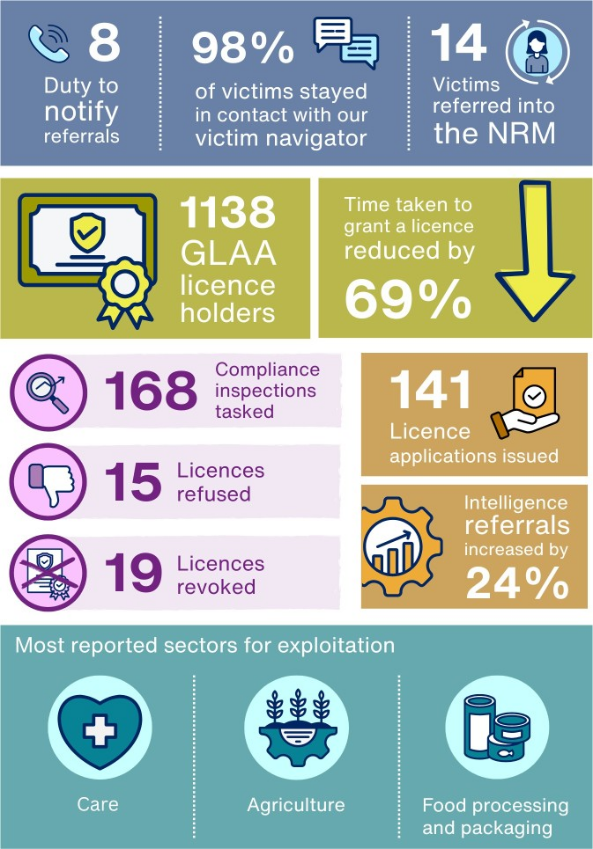
- 8 duty to notify referrals
- 98% of victims stayed in contact with our victim navigator
- 14 victims referred into the NRM
- 1,138 GLAA licence holders
- Time taken to grant a licence reduced by 69%
- 168 compliance inspections tasked
- 15 licences refused
- 19 licences revoked
- 141 licence applications issued
- intelligence referrals increased by 24%
Most reported sectors for exploitation:
- Care
- Agriculture
- Food processing and packaging
2.5 Performance measures
This year we built on the successful transformation in 2023-24 to further improve our performance. This is evident in the below key performance indicators.
Goal 1: Be a robust and effective regulator (2024-25)
| Measure | Target | Actual | Assessment | 2023-24 |
|---|---|---|---|---|
| Median time taken to make a licensing decision on a new licence application | 60 working days | 42 working days | Achieved | 138 working days |
| Licence holders inspected each quarter | 6% (17 inspections per quarter) | 9.2% (30 inspections per quarter) | Achieved | N/A |
| Increase the volume of section 12 and 13 investigations[footnote 4] | 79 investigations | 57 investigations | Not achieved | 72 investigations |
| Increase in compliance officers attending PIP1 training | 33% increase | 0% | Not achieved | N/A |
Continuous improvement in our regulation activities has improved licensing decision times. In 2024-25, we surpassed our target of 60 days, making decisions on new licence applications in 42 working days (on average). This was achieved through embedding a streamlined decision process, robust risk profiling and more proportionate inspection methods. Through making licensing decisions more quickly, we enable businesses to trade earlier or identify issues promptly.
As a result, we were able to shift resources from bureaucratic processes, to focus on higher risk inspections. Crucially, we exceeded our target for inspecting 6% of licence holders per quarter, by inspecting 9.8% of businesses. We also increased the number of new business inspections, which ensure new operators meet our licensing standards from the outset and allow for early interventions if necessary. In 2024-25, we undertook 76 new business inspections, compared to only one the previous year.
However, we did not meet our target of undertaking 79 investigations related to section 12 and 13 offences. This has been attributed to the 59% increase of modern slavery investigations undertaken this year 148 in 2024-25, compared to 93 in 2023-24. For more information see strategic goal 3 on being an essential enforcement partner. Increasing section 12 and 13 investigations will be a focus for the GLAA in 2025-26 to stop unlicensed gangmasters.
Delivery of the professionalising investigations programme level 1 (PIP1) training was deferred to 2025-26, due to the availability of trainers. Through this training, we will increase the number of officers who can conduct investigations. In August 2024 we successfully rolled out a new internal compliance training programme.
Goal 2: Be known as experts in addressing worker abuse and exploitation (2024-25)
| Measure | Target | Actual | Assessment | 2023-24 |
|---|---|---|---|---|
| Internally generated intelligence linked to Control Strategy Priorities[footnote 5] | 50% | 28% | Not achieved | N/A |
| Average engagement scores across social media channels | 6% | 6.2% | Achieved | N/A |
| Roundtables to engage key communities completed | 2 | 2 | Achieved | N/A |
In 2024-25, 28% of internally generated intelligence was linked to our Control Strategy Priorities, which direct enforcement activities. This is below our target of 50%. In 2025-26, we will focus on further improving our intelligence processes to maximise every encounter during operational activity to improve our intelligence picture, our Control Strategy and emerging threats.
Following a review and development of a new communications strategy, we met our target for social media engagement across all channels. We focused on delivering key messages, resulting in more meaningful and targeted posts.
We also achieved our target of delivering two stakeholder roundtables. One focused the regulated sector to address specific intelligence gaps. The second was hosted by DBT to gather feedback and insight for the formation of the Fair Work Agency.
Strategic goal 3: Be an essential enforcement partner (2024-25)
| Measure | Target | Actual | Assessment | 2023-24 |
|---|---|---|---|---|
| GLAA led investigations which result in a criminal or civil disruption order | 25% | 10% | Not achieved | 22% |
| Victims assigned to the victim navigator are engaged in our legislative process | 95% | 98% | Achieved | 100% |
| Lessons learned completed | 4 | 4 | Achieved | 4 |
In 2024-25, 10% of GLAA led investigations resulted in a criminal or civil disruption order. This meant we did not achieve our target of 25%. However, we increased the number of enforcement investigations by 10% (202, 2023-24 to 222, 2024-25), offering us more opportunity to investigate potential labour exploitation. Key reasons for not achieving our target were the increased complexity of investigations and changes to the way the CPS handle cases.
A cornerstone of our work is the Victim Navigator Programme which provides specialist support for victims, helping to increase conviction rates. This year 98% of victims assigned to the Victim Navigator remained engaged with the investigative process, surpassing our target of 95%.
We also embedded continuous improvement processes and achieved our target to deliver four lessons learned exercises. These focused on our Contact Centre, Intelligence function and business continuity.
Strategic goal 4: our people and resources (2024-25)
| Measure | Target | Actual | Assessment | 2023-24 |
|---|---|---|---|---|
| Employee engagement through the completion of the People Survey | 74% | 77% | Achieved | 69% |
| Ensure staff retention rates remain 85% or higher | 85% | 80% | Not achieved | 82% |
| Improve the gender balance in the GLAA Operations function | 36.3% | 37% | Achieved | 33% |
| Average working days lost in a rolling 12-month period due to sickness absence, not to exceed 6.5 days | <6.5 days | 9.1 days | Not achieved | 8.9 days |
| Colleagues who report being from a minority ethnic background (as a percentage of the total workforce) | 10% | 10.6% | Achieved | 7.6% |
| Deliver the service within one per cent of the overall budget | Within one per cent | -6.39% | Not achieved | 0.58% |
We achieved our target for employee’s engagement, with 77% of colleagues reporting they had ‘real sense of belonging at the GLAA’ via the People Survey in March 2025. This surpassed our 74% target.
Our retention rate for 2024-25 was 80%, just below our target of 85%. This was anticipated following a substantial organisational change which continued into the early part of this year.
Equality, Diversity, and Inclusion is one of five pillars in our People Strategy. In 2024-25, the number of colleagues who report being from a minority ethnic background increased from 6 to 10.6% (target 10%). In addition, the number of female colleagues in our operations directorate increased by 11%, again meeting our target.
On average, 9.1 working days were lost due to sickness absence in a rolling 12-month period. This did not meet our ambitious target to not exceed 6.5 working days. However, sickness absence was comparable to the previous year (8.9 working days, 2023-24). We are prioritising wellbeing to support attendance in the workplace. This includes having resources in place for managers support colleagues with mental health concerns. We have also had a renewed focus on supporting people to return to work after periods of absence.
Our target was to deliver the service within one per cent of the budget. There were unforeseen reductions on IT provisions, GLAA office space and dilapidation costs, meaning we were 6.39% under budget for resource expenditure meaning the target was not met. Further explanations of this can be found in our financial statements.
Risks
Our strategic risks to delivery are detailed in our governance statement on page 37. These are broadly consistent with those detailed in the previous reporting period. However, the upcoming transition to the Fair Work Agency, has created a new strategic risk for the organisation. This new risk was identified in 2025-26 and agreed with the GLAA Board.
Each risk has mitigations in place and continue to be reviewed as part of our risk management framework. Our strategic risks have not materially affected our ability to deliver our key strategic objectives this year.
The future
We are proud of the improvements made to the GLAA’s performance. In 2025-26, we will focus on improving the areas which remain challenging including intelligence, targeting more unlicensed gangmasters and using our powers to stop unlicensed activity. We will disrupt criminals and prevent worker exploitation through increasing the use of criminal prosecutions and civil disruption orders.
In addition, we will help ensure the GLAA is in the best possible position to transition to the Fair Work Agency, setting the foundations for even greater effectiveness in the fight to stop worker exploitation.
Elysia McCaffrey
Chief Executive Officer
2.6 Performance analysis
The performance analysis section provides a detailed, evidence-based assessment of how the organisation has performed against its objectives. It supports transparency and accountability by linking activities to outcomes, explaining variances, and identifying risks and lessons learned. This helps users understand the effectiveness, efficiency, and impact of the organisation’s work.
2.7 How we delivered against our strategic objectives in 2024-25
In addition to the performance measures set out earlier in this document, we set ourselves some key business deliverables to improve performance.
Strategic Goal One: Be a robust and effective regulator
This year, we were focused on enhancing our regulatory practices. Our aim was to further reduce the time taken to make licensing decisions to allow businesses to trade more quickly. Our other target was to increase the number of compliance inspections, to ensure labour providers meet our standards and workers are protected. We also wanted to create resilience in our operational directorate through embedding agile, multi-disciplinary teams that we can deploy where they are needed most.
In 2025-26, our goal will be to consolidate the improvements made in years one and two of our strategy to deliver a consistent, reliable, and quality service. To ensure we can continue to be a robust and effective regulator, as well as meet Treasury rules, the GLAA licence fee will increase for the first time since 2009.
Key deliverables
| What we said we would do | What we achieved |
|---|---|
| Delivering a first-class service by further reducing the time it takes to make licensing decisions. | We achieved this deliverable through reducing the time it takes to make a licensing decision by 69% (138 to 42 working days). We also reviewed the way we risk rate businesses to ensure our approach to inspecting businesses during the application process remains fit for purpose. |
| Increase the number of compliance inspections (CIs). | We achieved this deliverable. The number of CIs tasked increased to 168 (76, 2023-24), an increase of 55%. Through streamlining our application process, we freed up resources to deliver more compliance activity. This includes both thematic CIs and Compliance New Businesses (CNB) inspections. The Operations team introduced a new robust process to inspect businesses that are newly operating in sector. CNB inspections ensure businesses that were not operating in GLAA sectors at time of applying for a licence are meeting our licensing standards in practice. CNBs provide an early opportunity to ensure compliance and rectify any minor issues. In 2024-25, 168 CIs were tasked (76, 2023-24), and 76 CNBs were tasked (1, 2023-24). |
| Improve the skills and diversity of operational teams to improve investigations and provide tailored support to victims from many different cultures. | We partly achieved this deliverable. This is evident through the delivery of: - A new compliance training programme, which was rolled out in August 2024. This comprehensive three-week training programme was developed collaboratively by colleagues across all Directorates. Feedback of the training has been positive, with one Licensing Officer sharing “I gained valuable skills and insights on compliance checks, and I’m excited to apply them.” - A new Operations Manual, to support all enforcement colleagues, was developed and is available for all new starters. Delivery of the professionalising investigations programme level 1 (PIP1) course was deferred to 2025/26 due to the availability of trainers. This was one of our key performance indicators. |
Strategic Goal Two: Be known as experts in addressing worker abuse and exploitation
This year we improved our intelligence model and governance processes. This is vital to ensuring the GLAA is effective and compliant. We have also created a concise and focused Stakeholder and Engagement Plan. This has helped us to find new ways to stop worker exploitation through increased joint working with key partners.
In 2025-26, we will further improve our intelligence processes implementing changes to how we collect, record and access information and intelligence. We will also focus on understanding how women and girls are exposed to additional vulnerabilities.
Key deliverables
| What we said we would do | What we achieved |
|---|---|
| Our data will enable us to accurately understand trends and changes in criminal activity, as well as the people being targeted and exploited. | We partly achieved this deliverable. Our target was for 50% of internally generated intelligence to be linked to a Control Strategy priority. In 2024-25 just over a quarter (28%) of all internally generated intelligence was. However, key activities were delivered to improve the way we collect, record and access the information and intelligence we receive by: - Recruiting a Research and Indexing Officer to support our Analysts to focus on interpretating the data to discover useful information, inform conclusions and support decision making. - Developing a business case for change requirements to our intelligence system. However, this will not be progressed due to funding limitations. - Starting a Data Quality project – focused on our own performance data. Through this we can rectify minor errors as early as possible. This is helping us to strengthen our second line of assurance and give us greater confidence in our data. - Sharing key trends through our Online Stakeholder Seminar. Other key data projects to streamline current sources of data were started in 2024-25. These projects will continue into 2025-26 under our data quality improvement plan. |
| We will increase our positive enforcement outcomes with better use of evidence-based policing. | We did not achieve this deliverable. We did not achieve our target to increase the percentage of GLAA led investigations which result in a criminal or civil disruption order to 25%. However, work continued this year to further embed evidence-based policing to improve our enforcement outcomes. Furthermore, we worked with the National Crime Agency and Modern Slavery and Organised Immigration Crime Unit to review existing terminology and definitions. This led to the recommended definitions on labour exploitation and abuse and debt bondage being adopted nationally. The GLAA also reviewed our ‘Investigations Decision Matrix’ and rolled it out to the contact centre. This has allowed us to concentrate our resources more effectively and increase consistency. |
| Improve the reach and power of engagement to continually improve our strategic partnerships | We achieved this deliverable. Our target was for an average of 6% engagement score across all social media channels by November 2024. We achieved this at 6.2%. We carried out four projects to support this deliverable: - Our Communication and Stakeholder Engagement Plan was embedded, and continues to be reviewed and improved, with input from senior leaders. - Quarterly intelligence reports on our website and in the Stakeholder newsletter. The reports were also presented at our Online Stakeholder Seminar. - Intelligence collection plans were made available internally. Work planned to develop the GLAA website was cancelled due to the upcoming transition to the Fair Work Agency meaning that this would not be an effective use of taxpayers’ money. |
| People will look to us for our insight and expertise on understanding and tackling worker exploitation. | We achieved this deliverable through: - Developing key messages about our work and how we support victims. This is integrated into our Communications and Stakeholder Engagement Plan. - Sharing victim’s stories where possible and appropriate. In particular our Victim Navigator provides anonymised updates internally. - Delivering two Roundtables. These focused on intelligence gaps in the regulated sectors and the Fair Work Agency. This meant we also met our KPI for delivering two Roundtables. |
| Our Contact Centre will be easy to access and able to provide the support people need. | We achieved this deliverable. Several key projects underpin the successful delivery of this: - Introduced in 2024, the Contact Centre provides an accessible one-stop shop for a complexity of the issues the GLAA deals with. This has simplified how the public, businesses and partners contact the GLAA. - Working with intelligence colleagues the Contact Centre has introduced a new process to ensure all queries are appropriately dealt with. - We have promoted the Contact Centre details on all our communication platforms, with a particular focus on our website and social media ensuring previous communication avenues are removed. -Contact Centre colleagues provide professional advice and signposting to those contacting the GLAA. The team is a vital part to ensuring issues are dealt with effectively. |
Strategic Goal three: Be an essential enforcement partner
This year, we continued to invest in key partnerships to stop worker exploitation. A central part of this has also been the continued growth of our Victim Navigator role, to ensure the needs of victims are prioritised during investigations. As an organisation, we are continually looking for opportunities to learn and improve as we recognise the methods used to exploit workers changes.
In 2025-26, we will continue to develop our strategic partnerships, ensuring we work effectively to prevent and disrupt criminals who exploit workers. We will also continue to prioritise the needs of victims of modern slavery and exploitation and evaluate the impact of our enforcement activities.
Key deliverables
| What we said we would do | What we achieved |
|---|---|
| To improve our joint working with policing, the National Crime Agency (NCA) and other critical operational agencies. | We mostly achieved this deliverable. Although we did not increase the percentage of investigations resulting in a criminal or civil disruption, we still delivered key projects to improve joint working. A project of note for us this year, was to review how we work with HMRC. This has helped us to better understand the impact of our role as a regulator in driving compliance, tackling mutual bad actors and disrupting worker exploitation. As a result, HMRC have reported over £140m Compliance Yield from GLAA licence holders for 2024-2025. This is an increase of over 50% on previous years. Further improvements to this partnership with HMRC will remain be a focus for the GLAA next year. One activity focused on Organised Crime Groups was not delivered due to an intelligence led change of our Control Strategy Priorities. |
| Victims will be put first in all our operational effort. | We achieved this deliverable. Of those victims supported by the Victim Navigator, 98% remained engaged. This year we: - Embedded the lessons learnt process into the Tactical Tasking and Co-ordination Group. Through this process we identified further opportunities to improve oversight and accountability. - Reviewed how we monitor support provided to victims. This led to the creation of a definition for ‘alternative support’ provided to victims. This year, our investigators started recordingthis information. Monitoring this will help us understand more about the need of victims and ensure those needs are prioritised in our operations. - Developed ideas for collaborative projects, which will be delivered in 2025-26. Work will continue next year to ensure victims remain central to our work and are prioritised in operational activity. |
| We will continue to show we are a learning organisation | We achieved this deliverable. We carried out the following projects to support this deliverable: - Delivered four lessons learned focused on the way we communicate, our Contact Centre, our Intelligence function and business continuity. - Reviewed our Investigator Decision matrix to ensure consistent use a terminology and language. Implemented Masterclass sessions, as a vehicle for sharing learning and expertise. Two sessions were delivered in 2024-25, and more sessions are planned for the next year. Colleagues are encouraged to ask for topics they would benefit from. |
Our People and Resources:
Align our priorities with our capacity, resources and budget
This year a key success was the launch of our three-year People Strategy. The Strategy introduces five interconnected pillars: culture and engagement, leadership, recruitment and talent, learning and development and equality, diversity and inclusion. Alongside the focus on our people, we have further embedded the principles of value for money across the GLAA.
Our focus next year is to continue to deliver key commitments of the People Strategy and improve our organisational governance through delivering key improvement projects on data, assurance, and accountability.
Key deliverables
| What we said we would do | What we achieved |
|---|---|
| We will have empowering leaders | We achieved this deliverable. The GLAA’s commitment for empowering leadership is reflected in the inclusion of leadership as one of our five People Strategy pillars. This year, the focus has specifically been on the Extended Leadership Team (ELT). Line managers have greater autonomy through access to our HR system. This has empowered managers to have greater oversight of their teams. For instance, this access has enabled line managers to have early conversations with colleagues on sickness absence. Managers are also encouraged to discuss the support tools and initiatives available with team members. Including, Employee Assistance Programme, occupational health, workplace adjustment and carer’s passports. Furthermore, in October 2024 the ELT had an away day, which focused on the delivery of the People Strategy, Civil Service Success Profiles and successes and challenges. To celebrate and recognise the work of team members, leaders are encouraged to send instant rewards through our ‘Star Rewards’. Across this year, 475 instant awards were sent by managers (306, 2023-24). This was also supported by our Director Awards and CEO Values Awards – a monthly award to recognise work or contributions to the organisation which align closely to our core values: integrity, respect, commitment, professionalism, and teamwork. The theme of our November 2024 People Survey was leadership and line management. Results from the survey showed significant positivity felt towards line managers. Through the delivery of our People Strategy, there are plans in place to further develop our leaders in 2025-26. |
| We will improve our diversity and inclusion. | We achieved this deliverable and associated key performance indicators. We improved the gender balance in the GLAA Operations directorate to 37% and increased the percentage of colleagues who report being from a minority ethnic background to 10.6%. Equality, Diversity and Inclusion is one of the five pillars that underpin our People Strategy. This year, the EDI group was reestablished to promote and support diversity, equality and inclusion within the GLAA, facilitating the EDI strand of the People Strategy. The EDI Group is employee-led with representation from across GLAA with a purpose of promoting the EDI agenda. Membership is voluntary and open to all employees passionate about diversity and inclusion. We updated our internal EDI pages to better reflect our current strategies, tools, and policies. This update supports a more inclusive workplace culture and ensures employees have easy access to relevant information. We assisted teams in evaluating the equality implications of major change initiatives. This included delivering training on Equality Impact Assessments and encouraging collaboration with staff networks to ensure accessibility was considered from the outset. Accessibility needs and testing were integrated into the early planning stages of projects. We continued to mark significant diversity and inclusion events, helping to build a culture rooted in respect, belonging, and fairness. These celebrations also raised awareness of barriers to inclusion and promoted allyship and teamwork. EDI principles were embedded into key training programmes to help line managers understand their role in fostering an inclusive environment. This training equipped them to support career development more effectively, contributing to innovation and overall organisational success. This year we have also seen improvements in EDI including the increase of colleagues reporting their diversity data to 77% in March 2025 (72%, March 2024). We remain committed to tracking our progress through internal metrics such as the People Survey, as well as external benchmarks across the Civil Service and broader industries. Our goal is to keep improving and ensure the GLAA remains a great place to work. |
| Embedding the principles of value for money throughout the organisation | We achieved this deliverable through carrying out: - A move to a more affordable head office space which met our technology requirements and organisation’s needs. - An asset management plan to support our mobile workforce. - A review of our licence fee structure. This will inform plans in 2025-26 to increase our licence fees for the first time in 16 years. - Reviewed our Finance Manual to ensure rigorous controls on spending. The Audit Risk and Assurance Committee, plays a key role in supporting the GLAA Board and Accounting Officer by offering oversight and assurance on the effectiveness, integrity, and value for money of GLAA’s audit, risk, and control frameworks. The Committee evaluates and challenges the Assurance Framework, ensuring that appropriate actions are taken in response to findings from Internal Audit and other evaluations. Additionally, ARAC supervises the external audit process for GLAA’s financial statements and advises on the formal approval of the accounts by the Accounting Officer. |
Financial review
Strong financial controls and assurance arrangements operated effectively throughout 2023–24 and 2024–25. The GLAA maintained robust systems for managing public funds, supported by segregation of duties, compliance checks and monthly budget monitoring and forecasting.
Assurance was provided through:
- Monthly finance and commercial meetings between the GLAA Finance Team and the Executive Team
- Regular reporting on financial performance, forecasts, and budget variances to the Home Office sponsor team (including Home Office finance)
- Fortnightly meetings with Home Office commercial
- Finance reports to each Board meeting and detailed analysis to the Finance and Performance Committee
There were no significant control weaknesses, breaches of regularity or propriety, or material losses during the year. The Accounting Officer is satisfied that these arrangements provided effective control and accountability in line with Managing Public Money and the Financial Reporting Manual.
Shortly after the election in 2024, the government launched a 2-stage Spending Review (SR) to settle budgets from 2024-25 up to 2028-29. Phase 1 of the SR occurred in the summer of 2024 and sought to determine the final budgets for the current financial year (2024-25) and for 2025-26. The GLAA were part of a line-by-line review of current activity conducted by the Home Office in July and August 2024, used by the Home Office to find additional savings to re-invest into new governmental priorities. This did not result in changes to the GLAA allocation but the GLAA continues to ensure spending is line with government priorities and expectations, including supporting the government Fair Work Agenda.
The 2023–24 financial year was exceptional for GLAA, marked by an additional £1m in funding to support a new operating model. This investment drove improved performance but also resulted in a £1.4m increase in gross expenditure compared to the previous year 2022-23 (£9,484,000 2023-24 against £8,061,000 2022-23).
In 2024–25, funding returned to historic levels. This supported reduction on Grant in Aid funding £1,592,000 (£6,119,000 2024-25 and £7,711,000 2023-24).
Staff pay costs decreased by £0.3m between 2023–24 and 2024–25. This reduction was primarily due to the absence of the one-off £1,500 payment to staff (excluding the Executive) made in 2023–24 (£156,000), alongside restructuring and severance savings.
Operating costs saw the most significant shift, decreasing by £1.9m. Key drivers included:
-
Professional services: £830k spent in 2023–24 to support transformation; no spend in 2024–25.
-
Restructuring: £337k in staff exit costs in 2023–24; none in 2024–25.
-
Accommodation: £491k movement, due to a dilapidation provision being provided and then released.
Income remained stable at £1.3m in 2024-25. With a fee increase in 2025-26, the GLAA forecasts licensing income to increase to a recurring £1.7m from 2026-27. An increase of
£0.4m on current levels. This increase helps the GLAA to progress objectives in line with HM Treasury’s Managing Public Money guidance to recover all costs of licensing activity through its licence fees.
The impact of the fee increase on licensed businesses and the GLAA’s revenue will be closely monitored. These changes would have been hard to make without the new operating model and resulting improved performance especially on timeliness of licensing decisions.
The GLAA’s core funding continues via the Home Office. The Home Office continue to support the GLAA with funding to continue its activities.
Additional investment from the Department for Business and Trade will support the creation of the Fair Work Agency from 2025-26. A new funding arrangement as a part of Fair Work Agency under the Department for Business and Trade will be in place in 2026-27, covering the current activities of the GLAA.
Elysia McCaffrey
Chief Executive Officer
15 December 2025
3. Accountability report
The Accountability Report supports the entity’s accountability to Parliament by demonstrating how it is governed, how resources are managed, and how it complies with statutory and parliamentary requirements. It reflects best practice in corporate governance, aligning with relevant codes and norms to ensure transparency, integrity, and public trust.
3.1 Corporate Governance Report
The Director’s Report
Executive Team
Declarations of interest for the Executive Team are recorded on page 65. These are disclosed for transparency and in case of conflict with their GLAA management responsibilities.
The composition of the Executive Team is identified under the Remuneration and Staff Report on page 49 and comprises of the Chief Executive Officer (CEO), the Director of Strategy and Impact, the Director of Operational Delivery and the Director of Corporate Services.
Also, on pages 49 to 65, under the Remuneration and Staff Report, there is a register of Board member directorships and significant interests. A public register of interests for Board members is held, and this may be accessed via the GLAA’s website.
Financial position
The Statement of Comprehensive Net Expenditure for the year ended 31 March 2025 on page 74 shows a deficit of £5,946,000 (deficit of £8,143,000, 2023-24).
This deficit reflects the fact that, for the purposes of financial reporting, the Grant-in-Aid (GIA) does not form part of the GLAA’s income. It is accounted for in the Financial Statements within the Statement of Changes in Taxpayers’ Equity for the year ended 31 March 2025 on page 77.
Pension arrangements
Pension arrangements for the GLAA are provided through the Civil Service Pension Scheme. Further details can be found within the Remuneration and Staff Report on pages 49 to 65.
Payment policy
The Government commitment is to pay 90% of undisputed and valid invoices from small and medium sized enterprises within five days and 100% of all undisputed and valid invoices to be paid within 30 days. Government departments are required to report their performance against these payment targets on a quarterly basis on GOV.UK.
Through the Public Contract Regulations 2015, public sector buyers must include 30-day payment terms in new public sector contracts; and require that this payment term be passed down the supply chain. Public sector buyers must also publish annual reports on their payment performance.
For 2024-25, the GLAA achieved an average payment time of 3 days (3.44 days in 2023-24).
Complaints procedure
The GLAA has an established Complaints Policy and Procedure.[footnote 6] All formal complaints are responded to in writing and are dealt with by the Governance Team. If the complainant is dissatisfied, the complainant can write to the GLAA’s CEO for a review of their complaint.
If they are still dissatisfied, they can refer the matter to the Parliamentary and Health Service Ombudsman (PHSO), who investigate complaints about maladministration or service failure on the part of the GLAA.
Oversight of the enforcement powers granted to the GLAA from 2017, comes under the remit of the Independent Office for Police Conduct (IOPC). Any abuse of the GLAA’s PACE (Authorised Police and Criminal Evidence Act 1984) powers can therefore result in a complaint being sent to the IOPC, who then determine how that complaint should be dealt with in accordance with the GLAA (Complaints and Misconduct) Regulations 2017.[footnote 7] To date there have been no cases referred to the IOPC, which gives the GLAA confidence in its operations of its wider investigative powers.
In 2024-25 the GLAA received five formal complaints (10 received in 2023-24). Two were refused for not including enough information for the GLAA to action a response or being for other law enforcement agencies. One complaint was upheld, and two complaints were not upheld. The CEO completed an internal review of two complaints. Complaints received related mainly to our operations, but one related to an FOI which had been exempted.
0 complaints received in 2024-25 were referred to the PHSO (0 complaints were referred in 2023-24).
Freedom of Information Act
Under the Freedom of Information Act 2000 (FOI Act), anybody may request information from a public authority which has functions in England, Wales and/or Northern Ireland. The FOI Act requires that all requests are in writing (this does include emails), stating clearly what information is required with the name of the applicant and an address for correspondence. The GLAA provides guidance on how it handles FOI requests in the External Communications Policy.
In 2024-25 the GLAA received 26 requests under the FOI Act (36 requests in 2023-24). Requests mainly concerned operational activity, finance and HR.
96% of responses were provided inside the stipulated 20-day period. Where there were delays this was generally due to resource pressures.
Published FOIs can be found on the GLAA website.
Equality, Diversity and Inclusion
Equality, Diversity and Inclusion is one of the five pillars that underpin our People Strategy. In September 2024, we reestablished the Equality, Diversity and Inclusion (EDI) group, to promote and support diversity, equality and inclusion within the GLAA, facilitating the EDI strand of the People Strategy. Membership of the group is open to all colleagues who are passionate about diversity and inclusion.
This year, the EDI group created a calendar of significant EDI dates to ensure timely, and meaningful communications. This led to the delivery of key messages and awareness raising sessions on topics such as: Neurodiversity Celebration week, International Women’s Day, LGBT+ History Month and Black History Month.
EDI principles were embedded into key training programmes to help line managers understand their role in fostering an inclusive environment. This training equipped them to support career development more effectively, contributing to innovation and overall organisational success.
The EDI group also discussed and reviewed options for improving the way we collect diversity data of employees, which would help with reporting and understanding the GLAA workforce make-up. By March 2025, 77% of colleagues reported their diversity data, a 4% increase from March 2024 (73%).
This year, we also continued our involvement in the Boardroom Apprentice scheme, which seeks to enable a wider diversity of individuals to play their part in our boardrooms. A Board member was assigned to be a Board Apprentice Mentor to support and provide guidance during the 12-month scheme.
Enviromental sustainability
Overview
Scope of reporting
In line with government sustainability reporting requirements, GLAA reports environmental impacts across the following scopes:
-
Scope 1 (Direct emissions): Includes CO₂ emissions from fuel used in GLAA-controlled assets such as fleet vehicles and heating systems. (GLAA has no direct emissions as it controls no assets like this directly).
-
Scope 2 (Indirect energy emissions): Covers emissions from purchased electricity and energy consumed in GLAA-operated buildings.
-
Scope 3 (Other indirect emissions): Includes emissions from business travel, water usage, paper consumption, and waste disposal. These activities are not directly controlled but are associated with GLAA operations.
The GLAA continues to monitor and reduce its environmental footprint through improved data collection and operational efficiencies. Environmental matters are part of organisational decision making and assessed as party of risks and opportunities.
We seek to comply with all applicable legal and other relevant requirements that relate to our environmental aspects. We are committed to working to ensure that we take proper account of the impact of our activities on the environment. Performance in relation to greenhouse gas emissions, waste management and finite resource consumption is set out in the following tables.
The GLAA is dependent on provision of this data from their landlords, the Government Property Agency (GPA). It has therefore not been possible to provide some information.
The GLAA has taken action to reduce the size of its office by 41%, from 345.4 sqm in our previous office Apex Court to 203.96 in Loxley House. Both offices were shared government buildings in Nottingham, with change happening between December 2024 and January 2025. The shared space in the new building was higher than the old building so the total reduction in space was reduced to 17% (from 546.8 to 454.76).
Sustainability data for new building has not been provided by GPA. As advised by GPA we have included quarter 4 2023-24 data which was from our old building (Apex Court), to estimate these numbers.
All figures provided are based on upon calculations supplied by the landlord (GPA) in relation to the proportion of GLAA usage against that of the whole building.
The GLAA will work to improve data especially from its landlord and from suppliers and improve assurance on available data, such mileage in hire cars, public transport and flights.
Greenhouse gas emissions (Scope 2)
Consumption KWH/Cost
| 2024-25 KWH Total | 2024-25 Cost Total | 2023-24 KWH Total | 2023-24 Cost Total | |
|---|---|---|---|---|
| Electricity consumption KWH Estimated CO2 consumption (KG) |
109,443 22,660 |
Not available | 112,531 23,302 |
Not available |
| Gas consumption KWH Estimated CO2 consumption (KG) |
76,825 14,051 |
Not available | 75,443 13,791 |
Not available |
| Total COS Consumption (KG) (For captured data) | 36,711 | Not available | 37,093 | Not available |
Waste management (Scope 3)
| 2024-25 KG Total | 2024-25 Cost Total | 2023-24 KG Total | 2023-24 Cost Total | |
|---|---|---|---|---|
| Hazardous waste | Not available | Not available | Not available | Not available |
| Non-hazardous waste | Not available | Not available | Not available | Not available |
| ICT waste recycled, reused, and recovered externally | Not available | Not available | Not available | Not available |
| Single Use Plastic | Not available | Not available | Not available | Not available |
| Waste incinerated with energy recovery | Not available | Not available | Not available | Not available |
| Waste incinerated without energy recovery | Not available | Not available | Not available | Not available |
| Waste composted/food waste | Not available | Not available | Not available | Not available |
| Landfill kg | - | Not available | - | Not available |
| Recycled/reused tonnes | 2.105 | Not available | 2.157 | Not available |
| Recovery tonnes | 5.952 | Not available | 8.425 | Not available |
| Total (where data available) | 8.057 | Not available | 10.582 | Not available |
Where information is stated as ‘not available’ our landlord was unable to provide this information.
In line with the ban on supply of single-use plastics in England from October 2023, we have taken steps to ensure removal from our supply chain. We are confident that they have been removed from our estate and facilities management supply lines as well as our commercial supply lines.
Recycling (Scope 3)
Although paper recycling in the office remains high as above table shows, we do not have data on GLAA paper recycling. Colleagues working from home are also provided with shredders and will normally deal with this through domestic recycling, making it difficult to quantify overall levels. All IT hardware is disposed of responsibly, meeting the Waste Electrical and Electronic Equipment (WEEE) Regulations.
The GLAA has managed to reduce its printer paper usage by 40%, this is recycled paper that is used in the office and is provided to colleagues working from home.
| 2024-25 Total | 2023-24 Total | |
|---|---|---|
| Sheets of printing paper | 53,500 | 88,875 |
Water usage (Scope 3)
| 2024-25 Total | 2024-25 Cost Total | 2023-24 Total | 2023-24 Cost Total | |
|---|---|---|---|---|
| Water (m3) | 107.6 | Not available | 114 | Not available |
GLAA share of water usage reduced 2024-25. GLAA will work to support landlord and building to reduce water usage.
Travel (Scope 3)
Most of GLAA business travel is conducted in private vehicles due to the nature of its operational activities.
| 2024-25 Total £000s | 2023-24 Total £000s | |
|---|---|---|
| Vehicle hire | 83 | 70 |
| Mileage | 34 | 46 |
| Train travel | 26 | 21 |
| Air travel Domestic | 3 | 1 |
| Air travel International | 2 | - |
| Total | 148 | 138 |
We are adopting strategies to minimise the environmental impacts of business travel. We have increased the use of collaboration software (Microsoft Teams) and Cloud-based services (Microsoft 365) which has permitted hybrid working within the organisation. This has reduced energy consumption and commuting to the GLAA office.
GLAA licence holders can be based overseas. With an increase in overseas licence holders especially central Asia, this has impacted international travel the GLAA does to protect workers.
The GLAA uses a government hire contract, the vehicles supplied are being moved towards fully zero emission at tailpipe in line with government commitments.
Sustainable procurement
Our procurement policy is to ensure we take account of government policy objectives such as sustainability by using Crown Commercial Services framework contracts for most of our procurement. These procurement processes include consideration of sustainability and wider government policy objectives.
Reducing environmental impacts from ICT and digital
As part of its office move the GLAA has removed it reliance on its own local server room, that had its own dedicated air conditioning. GLAA ICT infrastructure if provided by Home Office who are working to reduce these impacts.
Future actions
We are committed to reducing our impact on the environment in line with the Greening Government Commitments and will continue our efforts to reduce our greenhouse gas emissions.
The GLAA is working towards Net Zero by 2050 and adapting to climate change by doing the following:
- Use of technology to reduce the need to travel including high impact travel such as air travel.
- Use of private vehicles is hard to avoid due to the nature of our work, but for longer journeys hire cars are encouraged which are increasingly fuel efficient and the use of electric vehicles is becoming more common.
- Business Continuity plans that consider the impact of climate change and incorporates this into plans to mitigate and reduce this impact.
The Home Office reports on the GLAA as an NDPB as part of its environmental and sustainability reporting. This is reported under the following two main strands:
- The Greening Government Commitments, including sustainable procurement; and
- The United Nations Sustainable Development Goals.
Rural proofing
As part of our commitment to inclusive and effective policy delivery, the GLAA has considered the impact of its operations and strategic decisions on rural communities. Labour exploitation and non-compliance with employment standards can occur in both urban and rural settings, but rural areas often present unique challenges due to geographic isolation, limited access to services, and seasonal labour patterns.
In developing enforcement strategies, stakeholder engagement, and resource allocation, we have taken steps to ensure rural needs are reflected. This includes tailoring our approach and intelligence efforts to rural sectors such as agriculture and food processing and working to improve visibility and access to support.
Targets
Other targets or sub-targets identified by the Greening Government Commitment are not deemed to be relevant to the GLAA. These targets, such as ‘Nature recovery’ and ‘Adapting to climate change’ relate to land, estate and building management. As a tenant of the Government Property Agency (GPA), these are areas outside our direct control.
Similarly, the GLAA’s response to adapting to climate change will be led by the GPA’s approach.
Integrity and counter bribery protections
We are committed to the highest standards of ethical conduct and integrity. We do not tolerate any form of bribery by, or of, our employees, agents or consultants, or any person or body acting on its behalf. We will fully investigate any instances of alleged or suspected bribery in line with our Disciplinary Policy and Procedure.
We communicate our Anti-Bribery Policy and Procedure on an annual basis and individuals are required to state that they have read and understood the policy.
The same applies to Protected Disclosure matters, and our approach to this is set out in the GLAA Protected Disclosure Policy and Procedure.
Elysia McCaffrey
Accounting Officer
15 December 2025
3.2 Statement of Accounting Officer’s responsibilities
Under the Gangmasters (Licensing Authority) Regulations 2015 the GLAA must prepare a statement of accounts for each financial year in the form and containing such information as the Secretary of State for the Home Office may direct and in accordance with the Accounts Direction. The accounts are prepared on an accruals basis and must give a true and fair view of the state of affairs of the GLAA and of its income and expenditure, Statement of Financial Position, and cash flows for the financial year.
In preparing the accounts, I, as Accounting Officer, am required to comply with the requirements of the Financial Reporting Manual (FReM) and to:
- Observe the Accounts Direction issued by the Secretary of State, including the relevant accounting and disclosure requirements, and apply suitable accounting policies on a consistent basis
- Make judgements and estimates on a reasonable basis
- State whether applicable accounting standards, as set out in the FReM, have been followed, and disclose and explain any material departures in the accounts
- Prepare the accounts on a going concern basis and
- Confirm that the Annual Report and Accounts as a whole is fair, balanced, understandable, and take personal responsibility for the Annual Report and Accounts and the judgements required for determining that it is fair, balanced, and understandable.
The Secretary of State for the Home Office has designated the Chief Executive Officer as Accounting Officer of the GLAA. The responsibilities of an Accounting Officer - including responsibility for the propriety and regularity of the public finances for which the Accounting Officer is answerable, keeping proper records and for safeguarding the GLAA’s assets - as set out in Managing Public Money published by HM Treasury.
As Accounting Officer, I have taken all the steps that I ought to have taken to make myself aware of any relevant audit information and to establish that the GLAA’s auditors are aware of that information. So far as I am aware, there is no relevant audit information of which the GLAA’s auditor are unaware.
3.3 Governance Statement
Scope of Accounting Officer’s responsibilities
As the Chief Executive and designated Accounting Officer for the GLAA, I have responsibility for the management and control of the resources used within the Authority as delegated to me by the Home Office.
I am responsible for maintaining a sound system of governance, internal control and risk management that supports the achievement of the GLAA’s aims, priorities and objectives, whilst safeguarding the public funds and departmental assets for which I am personally responsible. The GLAA is responsible for managing a diverse range of risks and is committed to engaging effectively with its customers and stakeholders to ensure that their views are known and considered in the decision-making process.
The system of internal control in use has been subject to regular review by the Executive Team as shown by the governance structure above. The GLAA Board is presented with a full strategic risk register bi-annually and has delegated responsibility for routine monitoring of risk management arrangements to the Audit and Risk Assurance Committee (ARAC). The setting of risk appetite for all strategic risks is the responsibility of the GLAA Board. Processes are in place for risks to be escalated within the GLAA and to the Home Office where necessary.
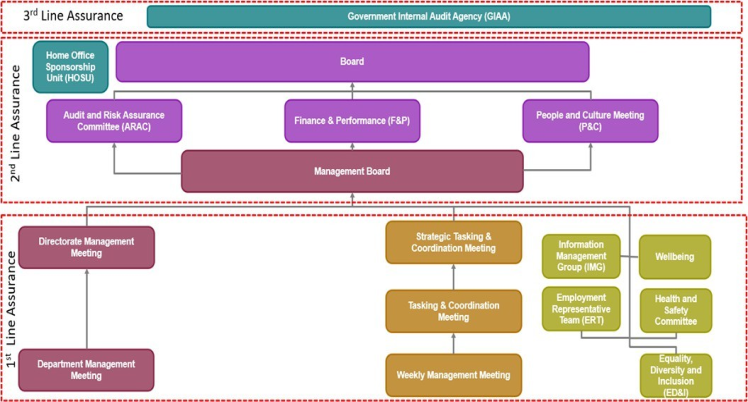
Figure 1. The GLAA governance structure.
During the reporting period 2024-2025 the GLAA reported regularly to the Home Office to satisfy it of the regularity and propriety of expenditure relating to licensing and to enforcement, the responsibility for which has been delegated directly to the GLAA by the Secretary of State.
In addition, the GLAA ensured that the Home Office Permanent Secretary was made aware of the main risks managed by the GLAA through regular reporting to the sponsor team.
In preparing the annual Governance Statement for 2024-2025 we have incorporated the guidance from the HM Treasury DAO (GEN) 02/12 and Managing Public Money annex 3.1 and have applied the principles set out in the Corporate Governance Code for central government departments.
The Board
The GLAA is a NDPB sponsored by the Home Office. Our activities are controlled and
monitored by the GLAA’s Board whose members are appointed by the Secretary of State.
During the year the GLAA Board recruited two new members, one of which left during the reporting year. We have continued our sponsorship of a Board Apprentice, mentored by a Board member.
Regulation 4 of The Gangmasters (Licensing Authority) Regulations 2015 provides for the appointment of up to eight Board members. Board meetings are also attended by the GLAA’s Executive Team. In 2024-2025, the Board held a total of six formal meetings, a strategy day and an exceptional meeting.
The Board has three committees that conduct business on its behalf. All committees are supported by terms of reference and minutes from these meetings are shared with the Board.
Audit Risk and Assurance Committee
ARAC provides assurance on matters of risk, control and governance, internal and external audit provision, accounting and governance policies and the compilation of the GLAA’s Annual Report and Accounts.
For each meeting ARAC is provided with reports on:
- Any significant changes to the Authority’s Strategic Risk Register.
- Information assurance activity.
- Internal Auditing activity including internal audit reports and associated recommendations.
- External Audit activity summarising work done and emerging findings.
When appropriate ARAC receives other reports including the draft governance statement, specific policies for approval and an annual report on information management.
People and Culture Committee
The People and Culture Committee provides assurance, advice and support in relation to people and culture responsibilities and duties. The Committee is also formally responsible for overseeing decisions and changes relating to HR policy and remuneration (excluding pension).
At each meeting the Committee reviews and monitors progress for pay related matters including the pay remit, people metrics aligned to the People Strategy and associated people policies. The People and Culture Committee also receive reports on people related risks.
Finance and Performance Committee
The Finance and Performance Committee provides advice, scrutiny and challenge to the Chief Executive as Accounting Officer (AO) on financial planning and management and business performance.
At each meeting the Committee receives reports on:
- The GLAA’s financial position
- Strategic performance aligned to the delivery of the annual business plan.
When requested the Committee also receives reports on specific performance areas, and efficiency and productivity.
The GLAA hosts an Online Stakeholder Seminar, which is chaired by a Board member. During these quarterly online seminars, the GLAA shares an overview of the previous quarter intelligence picture and an update about the operational work which has been undertaken. Guest speakers from other departments are also invited to speak. This seminar seeks to share knowledge and understanding of emerging threats, risk and harm to businesses and workers to stop worker exploitation and enhance partnership working.
The GLAA is also a member of various national stakeholder groups and governance structures, including the Modern Slavery Threat Group, Prosecution Oversight Group, forums established by the Director of Labour Market Enforcement and international liaison committees.
Board Effectiveness
The Board undertook accountability training this financial year to support the ongoing progress of Board effectiveness. Reports and papers prepared for Board meetings are assured by the lead director and the Chief Executive. The Executive also meets to review Board papers allowing opportunity for input on any cross-cutting issues and improve assurance on papers and data presented. Real time feedback on how the meeting has been conducted is provided in the Board meetings through one member of the Board being nominated to act as the Board conscience. The GLAA recognises challenges with extracting and producing data from internal systems and flags any limitations to the Board. The Executive has given assurance that the data presented to the Board is accurate and complete and therefore sufficient to support the Board’s oversight and decision making, despite these challenges.
Due to changes in Board members and the development of the Fair Work Agency, a Board effectiveness review was not conducted in 2024-25. This is being dealt with on an ongoing basis through a process of ongoing review.
The Board reflects on its performance throughout the year via its Board Conscience, which helps ensure the Board’s conduct remains fair, inclusive and true to our values. Each sub-committee contributes to this reflection by providing an annual written summary of its work and decisions, allowing the Board to consider its collective impact and effectiveness.
The Board continued to act in accordance with Corporate Governance Code.
Attendance
A full list of members and their individual attendance records at Board meetings during 2024-2025 is detailed below. A public register of interests for Board members is held, and this may be accessed via the GLAA’s website.
| Representative | GLAA Board meetings | Audit and Risk & Assurance Committee | People & Culture Committee | Finance & Performance Committee |
|---|---|---|---|---|
| Julia Mulligan, Chair | 5/6 | N/A | 3/3 | 2/2 |
| David Snowball, Board Member | 6/6 | N/A | 3/3 | 2/2 |
| Keith Rosser, Board Member | 5/6 | 4/4 | N/A | 1/2 |
| Mike Sheldon, Board Member (from 01/05/2024) | 5/5 | 2/4 | N/A | 2/2 |
| Pippa Greenslade, Board Member | 5/6 | N/A | 3/3 | 1/2 |
| Suzanne McCarthy, Board Member | 6/6 | 4/4 | N/A | 2/2 |
| Tony Lochery, Board Member (01/05/2024 - 28/11/2024) | 1/2 | N/A | 2/2 | N/A |
| Elysia McCaffrey, GLAA CEO | 6/6 | 3/3 | 3/3 | 2/2 |
NB – The CEO Elysia McCaffrey is not formally appointed to the Board.
During the year, the ARAC considered a number of reports from the Executive and internal audit covering key risks and issues and the management of risk itself within the GLAA. Further information regarding key risks and issues is set out later in this statement.
The GLAA Board, subject to the approval of the Secretary of State, appoint a Chief Executive who, with Directors, ensures the operational objectives of the GLAA are delivered. The GLAA records its performance against agreed business plan objectives and reports on performance at Board Meetings. The Board has deemed the quality acceptable for its purposes of oversight and scrutiny of the GLAA.
Internal Audit
The internal audit service is provided by the Government Internal Audit Agency (GIAA) operating to the standards set out in Public Sector Internal Audit. The internal audit strategy is based on the analysis of the risk to which we are exposed by the Executive Team and ARAC.
Four audits were undertaken during the year. The table below summarises the assurance ratings for each audit. In 2024-25, we received an overall ‘Moderate’ audit rating, meaning we maintained our audit performance.
| Audit subject | Assurance rating |
|---|---|
| Assurance of SOPs and Policies | Limited |
| Government Functional Standards | Limited |
| Regulator Audit - Part 2 | Moderate |
| Culture | Moderate |
Risk Management
During 2024-2025 and on a continuing basis, GLAA risk management continued to operate and be reviewed. Local risk registers were maintained which inform the strategic risk register. These risks are scrutinised through various levels as illustrated in the figure below. Team meetings inform and regularly escalate risks to directorate meetings. This provides first line assurances through individual ‘risk owners’ and the due diligence undertaken by the Risk and Information Assurance Manager.
Second line assurance is carried out at the Management Board by way of a standing agenda item for Risk Management and finally, third line assurance is undertaken by ARAC, which is attended by relevant key stakeholders, including the GIAA. Key risks are escalated to the Home Office through the regular Sponsorship meetings.
Risk appetite statement - The GLAA does not have a single risk appetite, but separate appetites across its activities. The GLAA recognises that in pursuit of its goals, strategic priorities and outcomes, it may choose to accept different degrees of risk in different areas.
The GLAA has established and articulated a risk appetite for different areas of the business. Where the GLAA chooses to accept an increased level of risk it will do so, subject to ensuring that the potential benefits and threats are fully understood before actions are authorised, that it has sufficient risk capacity, and that sensible and proportionate measures to mitigate risk are established.
GLAA’s approach to risk management remains under active review. A new risk management tool used by Home Office has been introduced, and implementation of a risk engine developed by Government Internal Audit Agency (GIAA) is underway. Risk management is regularly reviewed by ARAC and the Board, with associated policies and processes subject to full annual review.
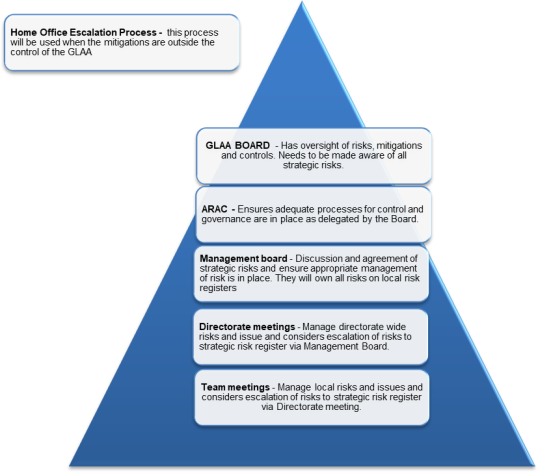
Home Office Escalation Process – this process will be used when the mitigations are outside the control of the GLAA.
GLAA Board – Has oversight of risks, mitigations and controls. Needs to be made aware of all strategic risks.
ARAC – Ensures adequate processes for control and governance are in place as delegated by the Board.
Management board – Discussion and agreement of strategic risks and ensure appropriate management of risk is in place. They will own all risks on local risk registers.
Directorate meetings – Manage directorate wide risks and issue and considers escalation of risks to strategic risk register via Management Board.
Team meetings – Manage local risks and issues and considers escalation of risks to strategic risk register via Directorate meeting.
Risk category and appetite
Business and operational area risk appetite levels
The GLAA’s risk appetite across a range of activities is articulated as follows:
Deliver our statutory responsibilities: The GLAA has key statutory responsibilities both as a public body and as an organisation charged with regulatory and enforcement
responsibilities for regulated and unregulated sectors of the labour market. Failure to deliver on these areas places significant risks on those at risk of being exploited in the labour market. The GLAA therefore takes an averse approach to the risk of failing meeting our statutory responsibilities.
Legal and Health & Safety (compliance): We retain an averse risk appetite to behaving in an illegal, unrealistic or irrational way, or any other way, which would be likely to give rise to significant risks in breaching legislation.
Information Governance: We are heavily reliant upon information and data to be able to operate as an effective risk-based regulator. The accidental or deliberate wrongful disclosure of sensitive or official information has the potential to erode trust, damage our reputation and ultimately prevent us from being able to function. We have minimal appetite for such risks. The accidental or deliberate wrongful disclosure of sensitive or restricted information has the potential to erode trust, damage our reputation and ultimately prevent us from being able to function.
Anti-fraud and financial controls: We are averse to the risks of internal fraud and fraudulent behaviour and will maintain appropriately robust controls and sanctions to maximise prevention, detection and deterrence of this type of behaviour.
Physical and Information Security: Alongside other businesses we recognise that the GLAA faces increasing physical, information security and cyber risks which may be internal or external to the organisation and may be malicious or unintentional. The GLAA is averse to these risks which may potentially cause loss, harm or reputational damage related to the GLAA’s physical and technical infrastructure and assets, or the use of technology within the organisation. We place an emphasis on deploying our security controls, alongside Home Office providers, effectively against a baseline risk appetite of averse.
Operational controls and compliance: Acknowledgement of the development and operational maturity of our enforcement and regulatory services, we maintain a cautious risk appetite to sustaining appropriate operational processes, systems and controls to support the provision of our public services.
Organisational controls and compliance: As a public sector organisation the GLAA has a wide range of statutory obligations with which it must comply. We maintain a minimalist risk appetite to the processes, systems and controls to ensure that we fulfil these obligations.
Organisational change and development: We have a hungry risk appetite towards continuous improvement, seeking opportunities to take a well-managed approach to innovate and deliver change in order to achieve our strategic vision and objectives, including how we maximise opportunities around our IT and infrastructure to be as efficient and effective as possible. The risk that opportunities to influence a highly effective FWA could be lost, losing potential benefits for staff and vulnerable people.
Reputational: We rely on our reputation to influence and secure the engagement of those we regulate and other stakeholders. The support of these parties is essential to achieving our goals and so we hold a strong commitment to being seen as a proportionate and respected regulator and retain an overall cautious risk appetite for our reputation.
However, we are prepared to take a stance which may be opposed by some of our audience where we believe it is necessary for the achievement of one or all of our statutory objectives.
Staff recruitment: We are committed to attracting the highest calibre and diversity of candidates to the GLAA to maximise the personal and collective contributions of staff towards the achievement of our strategic vision and goals. We take a hungry approach, actively seeking new and innovative ways to maximise our recruitment reach so that our candidate pool is as diverse and capable as it is possible to be.
Staff retention, development and progression: We are committed to providing a working environment in which all GLAA employees are able to progress, develop and thrive, working positively and constructively to maximise their potential and career development. We will take an open approach, seeking to tailor our approaches to the needs of individual staff or particular professions or departments.
Staff performance: We are committed to providing a working environment in which all GLAA employees are able to maximise their personal and collective contributions towards the achievement of our strategic vision and goals.
When we identify poor performance we will take a cautious approach, seeking to provide the opportunity and support to enable performance to improve. However, when we identify good performance, we will take a more open approach, ensuring our reward and recognition mechanisms amplify GLAA employee productivity to retain high calibre employees.
Staff misconduct: We are averse to risks of deliberate acts of misconduct from staff and will tackle these. However, we will ensure the GLAA takes an open approach towards opportunities to learn, when appropriate. We aim to act clearly and effectively to maintain the high standards of professional conduct and behaviour we expect of our workforce.
Operational prioritisation: We have an open appetite towards prioritising resources based on the intelligence led threat and risks posed to the public, rather than focusing on the order by which they were reported to the GLAA.
Finance and budgeting: As a responsible public sector organisation we need careful financial planning to ensure that we do not risk significant over-spend or under-spend. Therefore, we have a cautious risk appetite in this area.
Definitions of appetite
| Appetite | Rank | Description |
|---|---|---|
| Hungry | 5/5 | Eager to be innovative and choose activities that focus on maximising opportunities (additional benefits and goals) and offering potentially very high reward, even if these activities carry a very high residual risk. |
| Open | 4/5 | Undertakes activities by seeking to achieve a balance between a high likelihood of successful delivery and a high degree of reward and value for money; or activities themselves may potentially carry, or contribute to, a high degree of residual risk. |
| Cautious | 3/5 | Willing to accept/tolerate a degree of risk in selecting which activities to undertake to achieve key deliverables or initiatives, where we have identified scope to achieve significant reward and/or realise an opportunity; or activities undertaken may carry a high degree of inherent risk that is deemed controllable to a large extent. |
| Minimalist | 2/5 | Predilection to undertake activities considered to be very safe in the achievement of key deliverables or initiatives; or activities will only be taken where they have a low degree of inherent risk. The associated potential for reward/pursuit of opportunity is not a key driver in selecting activities. |
| Averse | 1/5 | Avoidance of risk and uncertainty in achievement of key deliverables or initiatives is paramount; or activities undertaken will only be those considered to carry virtually no inherent risk. |
The strategic risk register and emerging issues are presented to the regular ARAC meetings with any actions that have been taken, and proposed actions. The Board receives the strategic risk register twice a year. The risk register, management and tolerance levels are then set and reviewed in line with Home Office best practice. A review took place in May 2024 and no changes were made.
Risk Environment
GLAA operates in an environment where there is significant risk which must be managed. Some of these risks can only be mitigated and cannot be eliminated or reduced to a low level. GLAA aims to manage risks within set appetites. There were a number of significant risks ranked as having higher level potential impacts and likelihood of occurring.
These included:
- Corruption, theft and fraud – potential risk that employees are not aware of or do not follow relevant policies and procedures on corruption, theft and fraud. Work is ongoing to update HR and Finance policies relating to fraud including the GLAA’s vetting policy to ensure the right level of vetting for respective role and duties.
- Overspend or underspend on budgets - if spend and budgets are not managed effectively, the GLAA may not make best use of resources to meet its Strategic Objectives. The risk continues to be managed regularly and closely. The Executive Team continue to scrutinise planned and requests for expenditure.
- We are not a robust and effective regulator – this is the core of the GLAA mission and focus of its work on developing the Target Operating Model.
- Non-Compliance with Data Protection Act and General Data Protection Regulation – GLAA is still working on improving compliance around the data it holds. Sometimes this is technically challenging and resource intensive.
- Inadequate data quality – Due to resource constraints and dependence on manual data entry from colleagues, this has the potential to report inaccurate data leading to a lack of confidence in GLAA activity. There is an inability to capture the right activities to show our efficiency, effectiveness and maximise our resources. The Data Quality Programme will begin work to fully embed the automated licensing system GLASS and manage process changes for improved data accuracy.
- Insufficient investigative capacity to be an effective operational partner – compliance investigative activity has been impacted due to low resources and capacity. LAPOs have been deployed to meet resource demand however, onboarding new staff has the potential to negatively impact performance.
- Compliance with Standard Operating Procedures and Policies to be challenged where necessary – due to challenges in accessing or understanding guidance documents. Efforts have been made to renew guidance policies, and lunch-and-learn sessions were provided by the Governance Manager to departments.
- Legal Challenges – GLAA will always face a number of challenges from both its operational activity and corporate activities, especially as the organisation continues to go through significant changes.
- Commercial procurement and pipeline demand management – poorly defined commercial business requirements could result in contracts that fail to deliver the required services. Work has started to fully embed the GLAA Commercial Steering Group, aiming to develop a training package for relevant staff regarding commercial activities.
- Financial stability may impact positive performance – The GLAA and wider public sector are subject to ongoing funding pressures and challenges. The ability to mitigate risks or take opportunities often come down to resource issues.
- Lack of adequate capability and capacity to implement meaningful change – Given the scale of change from strategic to operational, this risk covered both capacity and capability to implement change.
- Key person dependency – as a result of unplanned absences or leavers in critical and statutory roles. The People Strategy will enable the support of the longer-term mitigation of this risk.
Review of effectiveness
As Accounting Officer, I have responsibility for reviewing the effectiveness of the system of internal control. My review is informed by the work of the internal auditors and the Directors within the GLAA who have responsibility for the development and maintenance of the internal control framework, and comments made by the external auditors in their management letter and other reports.
Financial management
The GLAA has had confirmation of funding for 2025-26 from Home Office. As the GLAA will transition to the Fair Work Agency in April 2026. Funding is expected to confirmed before the start of the financial year. The new agency will be sponsored by Department for Business and Trade, who have submitted a spending review bid for the creation of the Fair Work Agency.
Information security
In 2024–25, the GLAA’s Data Protection Officer reported no personal data breaches to the Information Commissioner’s Office (ICO), consistent with the previous year (0 in 2023–24). While a small number of incidents were recorded and assessed internally, none met the threshold for external reporting under the ICO’s reporting framework and were therefore classified as ‘not reportable’.
Protected Disclosures (Whistleblowing) Arrangements
The GLAA has a Protected Disclosures (Whistleblowing) policy and procedure which is available both on the GLAA intranet and GLAA website[footnote 8] for all colleagues to view. ARAC has oversight of this policy and when any disclosures are made. The policy outlines three options to make a disclosure. One is through a line manager who is expected to make a fair evaluation. Option two is through a dedicated e-mail which is monitored by the Head of People and Change, and option three is directly to the CEO or to the Chair of ARAC. In 2024-2025, no disclosures were received (0 in 2023-24).
Review of effectiveness
ARAC, on behalf of the GLAA’s Board, has regularly scrutinised the effectiveness of the system of internal control. Issues that have been identified are in the process of being addressed. I am confident that arrangements that have been initiated this year and are continuing will improve the areas of weakness identified through the work of ARAC and the Board. With the guidance of internal audit and ARAC, the Executive Team has a good understanding of the risks and issues the Authority faces and is working to mitigate these.
Government Functional Standards
Last year, we defined necessary roles and established a stable basis for assurance and risk-based control. Regularly reassessing areas of tolerance, supported by our assurance framework development. This year, we are continuously reassessing areas in which we can tolerate, supported by the development of our Assurance Framework. We improved mentoring around policy management, assessed first- and second-line defences against each control as part of our Assurance Mapping development, and have focused on tightening data quality governance and assurance. This work was overseen by the Executive Team and reported on to our ARAC.
Elysia McCaffrey
Accounting Officer
15 December 2025
3.4 Remuneration and staff report
Executive Team
The composition of the Executive Team in the reporting period was as follows:
-
Elysia McCaffrey, Chief Executive Officer
-
Karen O’Brien, Director of Corporate Services
-
Phillip Cain, Director of Operations
-
Samantha Ireland, Director of Strategy and Impact
Contract information
Policy on the remuneration of the Executive Team
The initial salary packages for all Executive Team were set using a benchmarking process to define comparable packages for the area and the specialist skills required and are in line with Civil Service guidelines. Current and future salary packages are set in line with the work and recommendations of the Senior Salaries Review Body and Civil Service pay guidance. The terms and conditions of the Chief Executive are determined by the Board and approved by the Secretary of State. Positions were advertised nationally. Salary information is recorded in the tables on pages 55 to 56.
Board members remuneration (audited)
The Chair and Board members of the GLAA are remunerated on a daily basis.
These costs are included in the staff costs total of £5,632,000 in 2024-25 (£5,951,000 2023-24) on page 62.
Non-executive directors remuneration
| Directorships and significant interests | Remuneration 2024-25, £000s | Remuneration 2023-24, £000s | |
|---|---|---|---|
| Julia Mulligan | Independent Member of the Parole Board Chair, Independent Domestic Abuse Service Independent Chair, Police Advisory Board for England and Wales Senior Independent Director, Independent Office for Police Conduct Close associate with consultant at Capgemini |
10-15 | 25-30 |
| Suzanne McCarthy | Chair, Fire Standards Board, Chief Fire Officers Association Chair, Valuation Tribunal Service and Chair, Finance Committee and Remuneration Committee, Ministry of Housing, Communities and Local Government Board Member and Chair, Standards Committee, Fundraising Regulator Independent Appointed Person, Greater London Authority Chair, Right to Succeed Chair, Lepra Board Member and Chair of Audit Committee, College of Policing Chair, National Guardian Office’s Accountability and Liaison Board, Care Quality Commission Member of the Royal Institute of Chartered Surveyors’ Transitional Standards Steering Group Reserve Chair, General Pharmaceutical Council, Fitness to Practice Panel Chair designate, ACCA, Regulation Board Member, Standards Investigation Panel, IPSO Director of Medics Academy (Vopulus Ltd). |
0-5 | 5-10 |
| Deep Sagar (tenure ended 30.04.24) | Member, Employment Tribunal Advisory Member, Commission for Local Administration Board Member, Legal Aid Agency Chair, NHS Continuing Care Review Panels, England and Wales Chair, Advisory Committee on Packaging Member, Civil Legal Services Appeals Panel Board Member, Plexus/Omega Housing Consultant, Austen Jones Solicitors Board Member, Animal and Plant Health Agency (from 18 Jul 22) |
0-5 | 5-10 |
| Pippa Greeslade | Member, Senior Salary Review Body, Department of Business, Energy and Industrial Strategy, UK Gov | 0-5 | 0-5 |
| David Snowball | None | 5-10 | 10-15 |
| Philip Cain (to 23.07.23)* | Senior Assessor, College of Policing Chair, TGAT Post 16 Education Governors Board, Gorse Academy Trust Leeds (until May 23) P M Cain Consultancy Ltd (Dissolved July 2023) |
- | 5-10 |
| Keith Rosser | Group Director, Reed Non-Executive Board Member, Disclosure Scotland (Executive Agency of Scottish Government) Non-Executive Board Member, SEPA (Scottish Environment Protection Agency) Non-Executive Board Member, Community Justice Scotland Advisory Board Member, ME Passport Chair, Modern Work Foundation Company Director, UKIFA Honorary Fellow of Lancaster University |
5-10 | 5-10 |
| Mike Sheldon (tenure started 01.05.24) | Meat and Livestock Commission Pension Fund, Trustee, nominated by Agriculture and Horticulture Development Board Chair of the Board, Seafish Industry Authority |
0-5 | - |
| Tony Lochery (tenure 01.05.24 to 28.11.24) | None | - | - |
*Phil Cain is no longer a non-executive director and is now employed by GLAA as Director of Operations
For the past few years, the GLAA has been going through a period of change. Now that new ways of working and leadership have become established, outside formal meetings, there have been fewer demands on the Chair’s time. This was why there was a decrease in remuneration of the Chair during the year 2024-25.
Payments made to Chair and the Board for travel and subsistence are detailed below. This was all normal business-related travel, and subsistence was reimbursed in line with the GLAA’s policy.
| Board Travel and Subsistence | 2024-25, £ | 2023-24, £ |
|---|---|---|
| Chair | 364 | 1,778 |
| Board | 1,774 | 1,832 |
| Board Apprentice | 377 | 394 |
| Total | 2,515 | 4,004 |
Tax arrangements for public sector appointees
There were no off-payroll engagements as of 31 March 2025 (none 2023-24) for more than £245 per day, and that lasted for longer than six months. These are contractors and consultants who have their own tax and national insurance arrangements; none were current or former employees of the GLAA (none 2023-24). None of the engagements involved Board members or any of the Executive Leadership Team with significant financial responsibility, during the financial year.
Consultancy costs
The total spends on contractors for 2024-25 was £0 (£36,281 2023-24). GLAA normally does not have any spend on contractors or very limited spend as in 2023-24 due to the cost of these arrangements.
Policy on the duration of contracts and notice periods
The Chief Executive, Elysia McCaffrey, is a permanent employee. She commenced her position on 28 June 2021. During the first six months of service, the notice period is one month, on completion of six months service, the notice period is three months.
All other Directors are permanent employees and all Directors’ contracts contain a three-month notice period, which is an appropriate time to allow for a handover period.
Policy on performance related pay
All GLAA staff members, subject to an eligibility criterion, may qualify for performance related pay (PRP) in addition to basic salaries. Each year the GLAA submits its proposals for its approach to pay increases and changes in line with annual Civil Service pay guidance to the Minister for approval.
In 2023-24 spot awards were introduced that could be issued by a manager, Director, or the CEO. These awards continued into 2024-25 and all staff in post 1 December 2024 received a £50 voucher.
The remaining end of year bonus was divided between those achieving an effective and highly effective rating in their end of year assessment. The award was differentiated and paid to those rated highly effective £937 (£1,168 2023-24) and those rated effective £624 (£779 2023-24). With amounts paid pro rata for part time staff and staff that had not been in post all year.
The Chief Executive and Directors PRP is determined by their contracts (up to 10% award) and review by People and Culture Committee. Awards are dependent upon meeting agreed personal objectives. This is assessed by the Chair and People and Culture Committee.
Employment of Disabled Persons’ Policy
The GLAA works to ensure disability is not regarded as a barrier to recruitment or promotion. It is committed to ensuring disabled employees have access to the same opportunities as other employees, not only when they first join but at all stages in their career.
The GLAA is a Disability Confident employer, which means we commit to offering an interview to a fair and proportionate number of disabled applicants that meet the minimum selection criteria for the post.
The GLAA is committed to fostering an inclusive and equitable recruitment process where all candidates are treated fairly and have equal access to opportunities. We welcome applications from individuals with disabilities and encourage anyone who meets the essential skills and qualifications for a role to apply.
As part of our commitment as a Disability Confident employer, we will offer reasonable adjustments and additional support throughout the recruitment process. All recruitment and promotion decisions are made based on the skills, experience, and potential required to successfully perform the role.
The GLAA also supports the continued employment and development of colleagues who become disabled during their time with us. We are committed to providing appropriate training, supporting career progression, and promoting the advancement of disabled employees across the organisation.
Transparency on Business Appointments
In compliance with Business Appointment rules, the GLAA is transparent in the advice given to individual applications for senior employees. Advice regarding specific business appointments has been published on the Home Office website.[footnote 9]
GLAA has well established process in place to approve staff wanting to take on secondary business interests.
There were no exits from Senior Civil Service (SCS) equivalent roles within GLAA during the reporting period. In line with Cabinet Office guidance, SCS leavers are required to complete a Business Appointment Rules (BAR) application. Where a trigger is met, applications are processed by the SCS HR Team. As no exits occurred, no applications were submitted, no conditions were set, and no applications were found unsuitable.
Employee turnover
In 2024-25 GLAA overall employee turnover was 15.67% (25.11% 2023-24). When considering colleagues that moved to other roles within the civil service, the turnover is reduced to 11.98% 2024-25 (18.83% 2023-24).
Employee engagement
Following the announcement of the creation of the Fair Work Agency, the GLAA has actively engaged with all colleagues, including engaging with our trade union representatives, organisation-wide calls with the Executive Team and Department for Business and Trade colleagues, forums for questions, answers and feedback in person and online and opportunities to do this anonymously.
Engagement continued to be a key focus of GLAA activity in 2024-25, with a range of approaches for colleagues to share their views and impact change, including weekly drop in calls with the CEO, employee surveys, shared forums for questions and answers online and an established Employee Representation Team.
The organisation has made tangible progress in areas such as team collaboration, managerial support, and recognition. Our 2024-2025 People Survey results show that employees feel supported and valued, and recognised for their contributions and good work, indicating progress in fostering a culture of appreciation and recognition.
There has been a notable increase in the percentage of employees who feel a sense of belonging within the organisation (+12%). This positive shift suggests that recent efforts to build a more inclusive, supportive culture are having an impact. This is a key indicator of engagement and morale, and it highlights the importance of continuing to listen to employee feedback and act on it meaningfully.
The survey highlighted that employees feel more comfortable raising concerns, reflecting an environment of trust and openness. These results highlight improvements in leadership effectiveness and organisational culture as well as signifying meaningful improvement towards creating a collaborative and inclusive workplace.
Other employee matters
GLAA continues to prioritise effective employment practices, including active employee consultation and participation, strong trade union relationships, and a commitment to health and safety at work. Our approach to human capital management includes career development, employability support, and a fair and transparent pay policy. These elements underpin our workforce strategy and support the delivery of our organisational objectives.
Training, development, and progression opportunities are available to all employees. Within the GLAA’s People Strategy, the Recruitment and Talent Pillar aims to attract, recruit, reward and nurture diverse talent. This works alongside the Learning and Development Pillar which is focused on equipping colleagues with the skills and learning opportunities to thrive. All employees are encouraged to have discussions about training and career aspirations with their line manager. Training that comes with a cost is reviewed across the organisation at the Management Board meetings and equality and diversity is considered through an Equality Impact Assessment.
We communicate directly with all employees regarding employment issues that relate to them, we also engage with the Public and Commercial Services Union (PCS) with formal consultation where appropriate and actively encourage individual and group employee participation on relevant employment matters. Regular union management meetings are held to discuss employment matters and to resolve any issues to the satisfaction of the organisation and union where possible.
A Health and Safety Committee is held on a quarterly basis where representatives from across the organisation discuss health and safety matters and any changes required to improve safe working within the organisation.
Salary information (audited)
Single total figure of remuneration
The Chief Executive (Senior Civil Servant scale 2) and the three Directors (Senior Civil Servant scale 1) are GLAA Senior Civil Servant (SCS) equivalent posts.
The bonus for SCS posts is a maximum bonus of 10% of base salary, on a sliding scale of performance against objectives. It is expected that 10% can only be awarded if all objectives are considered to have been exceeded.
The figures in the table include salary, benefit in kind, and non-consolidated performance-related pay. There were no severance payments or benefit in kind payments to the CEO or Directors in 2024-25 (none in 2023-24). It does not include employer pension contributions and the cash equivalent transfer value of pensions.
The PRP payments within the single remuneration figure are reported on a paid basis. A bonus was approved for the CEO relating to 2023-24 performance year at the maximum of 10% which will be paid during 2024-25. (In 2023-24 a full 10% bonus was also approved paid in 2024-25).
No other benefits-in-kind or compensation were paid to the CEO, Directors or the COO. The GLAA does not offer any remuneration package which is not in the form of cash.
Executive Director pay
2024-25
| Director | Job title | Salary, £000s | Performance Payments, £000s | Pensions Benefits, £000s | Total, £000s |
|---|---|---|---|---|---|
| Elysia McCaffrey | Chief Executive | 120-125 | 10-15 | 54 | 185-190 |
| Samantha Ireland | Director of Strategy & Impact | 75-80 | 0-5 | 30 | 110-115 |
| Phillip Cain | Director of Operations | 85-90 | 0-5 | - | 85-90 |
| Karen O’Brien | Director of Corporate Services | 75-80 | 0-5 | 56 | 135-140 |
2023-24
| Director | Job title | Salary, £000s | Performance Payments, £000s | Pensions Benefits, £000s | Total, £000s |
|---|---|---|---|---|---|
| Elysia McCaffrey | Chief Executive | 115-120 | 10-15 | 27 | 150-155 |
| Daniel Scully (to 21.07.23) | Chief Operating Officer | 15-20 (FYE 75-80) | - | 56 | 75-80 |
| Samantha Ireland (from 09.05.23) | Director of Strategy & Impact | 65-70 (FYE 75-80) | - | 26 | 90-95 |
| Phillip Cain (from 24.07.23) | Director of Operations | 55-60 (FYE 80-85) | - | - | 55-60 |
| Karen O’Brien (from 2.10.23) | Director of Corporate Services | 35-40 (FYE 75-80) | - | (60)[footnote 10] | (20)-(25) |
Pension Remedy (audited)
Accrued pension benefits included in this table for any individual affected by the Public Service Pensions Remedy have been calculated based on their inclusion in the legacy scheme for the period between 1 April 2015 and 31 March 2022, following the McCloud judgment. The Public Service Pensions Remedy applies to individuals that were members, or eligible to be members, of a public service pension scheme on 31 March 2012 and were members of a public service pension scheme between 1 April 2015 and 31 March 2022.
The basis for the calculation reflects the legal position that impacted members have been rolled back into the relevant legacy scheme for the remedy period and that this will apply unless the member actively exercises their entitlement on retirement to decide instead to receive benefits calculated under the terms of the Alpha scheme for the period from 1 April 2015 to 31 March 2022.
Fair pay disclosure (audited)
Reporting bodies are required to disclose the relationship between the remuneration of the highest paid director in the organisation and the median remuneration of the organisation’s workforce.
Total remuneration includes salary, benefits in kind and non-consolidated performance related pay. It does not include severance payments, employer pension contributions, and the cash equivalent transfer value of pensions.
The banded remuneration of the highest-paid director is shown below. There were no significant changes in ratios in 2024-25 compared to 2023-24.
| Highest paid Director | 2024-25 | 2023-24 |
|---|---|---|
| Remuneration | £135,000 to £140,000 | £125,000 to £130,000 |
| Salary | £120,000 to £125,000 | £115,000 to £120,000 |
| Total Remuneration | 2024-25, £ | 2024-25, ratio | 2023-24, £ | 2023-24, ratio |
|---|---|---|---|---|
| Median | 35,539 | 3.87 | 35,453 | 3.60 |
| 75th Percentile | 42,396 | 3.24 | 42,126 | 3.03 |
| 25th Percentile | 33,197 | 4.14 | 33,564 | 3.80 |
| Salary only | 2024-25, £ | 2024-25, ratio | 2023-24, £ | 2023-24, ratio |
|---|---|---|---|---|
| Median | 34,728 | 3.53 | 34,692 | 3.39 |
| 75th Percentile | 41,699 | 2.94 | 41,000 | 2.87 |
| 25th Percentile | 32,790 | 3.74 | 32,785 | 3.58 |
The percentage change in salary for the highest paid director was 4.26%, the average percentage change in salary for all other employees was 0.9%.
The increase in the highest paid director’s remuneration, particularly when staff pay remained relatively flat, has led to widening pay ratios, especially at the 25th percentile, where the ratio increased from 3.80 2023-24 to 4.14 2024-25. The ratio reflects fewer lower-graded staff and more higher-paid staff in post at 31 March 2025 compared to 2024 in this percentile.
The percentage change in renumeration for the highest paid director was 7.8%.
SCS-equivalent staff are subject to separate pay arrangements, with bonuses defined contractually. Pay awards for both SCS and other GLAA staff follow civil service guidance but differ in structure. Changes in median pay are more influenced by staff turnover, whereas SCS-level staffing tends to be more stable, which can impact ratio.
The highest paid director received a bonus in both 2024-25 and 2023-24, the percentage change was 0%. The bonuses are also shown in the Single Total Figure of Remuneration within the Remuneration Report. For other employees, the average end of year performance pay and bonuses paid to eligible employees was £686 (£892 in 2023-24) a 23% decrease.
In 2024-25, no employees received remuneration in excess of the highest-paid director (none 2023-24). Remuneration ranged from £25,000-£30,000 to £135,000-£140,000 (£20,000-£25,000 to £120,000-£125,000 2023-24). Total remuneration includes salary, non-consolidated PRP, and benefits in kind. It does not include severance payments, employer pension contributions, and the cash equivalent transfer value of pensions.
Staff composition (head count) as at 31 March 2025
2024-25:
| Female | Male | Non-binary | |
|---|---|---|---|
| Other employees | 48 | 60 | 1 |
| Executive | 3 | 1 | - |
| Board | 1 | 1 | - |
| Total | 54 | 64 | 1 |
2023-24:
| Female | Male | Non-binary | |
|---|---|---|---|
| Other employees | 47 | 57 | 1 |
| Executive | 3 | 1 | - |
| Board | 3 | 3 | - |
| Total | 54 | 64 | 1 |
Pension information
Pension costs
The pension arrangements for the GLAA are covered by the Superannuation Act 1972 and reflect benefits for members of the PCSPS and Civil Servants and other pension scheme (alpha). The Superannuation Act provides for defined pension benefits to be met from the consolidated fund and no liability rests with the GLAA.
Past and present employees of the GLAA are covered by the provisions of the PCSPS and alpha. The scheme is a defined benefit scheme and liability rests with the scheme and not the GLAA. Benefits are paid from the Civil Superannuation Vote, to which the GLAA makes contributions calculated to cover accruing pension entitlement for staff employed.
Statements of account for the scheme are provided by the Cabinet Office Civil Superannuation Resource Account. The PCSPS pension scheme undergoes a reassessment of the contribution rates by the Government Actuary at four-yearly intervals.
In respect of defined contribution schemes, the GLAA recognises the contributions payable for the year.
Full details can be found on pages 62 to 63 of the Remuneration and Staff Report.
CETV Information (Audited)
2024-2025
| Director | Accrued pension as at 31/03/25 and related lump sum at pension age £000s | Real increase in pension and related lump sum at pension age £000s | CETV at 31 March 2024 £000s | CETV at 31 March 2025 £000s | Real increase in CETV £000s |
|---|---|---|---|---|---|
| Elysia McCaffrey | 35 - 40 plus a lump sum of 85 - 90 | 2.5 - 5 plus a lump sum of 0 - 2.5 | 697 | 633 | 31 |
| Samantha Ireland | 10 - 15 | 0 - 2.5 | 136 | 106 | 16 |
| Phillip Cain | - | - | - | - | - |
| Karen O’Brien | 40 - 45 plus a lump sum of 100 - 105 | 2.5 - 5 plus a lump sum of 2.5 - 5 | 931 | 846 | 49 |
There was £12,548 employer contributions paid to the Partnership Pension Scheme for Phillip Cain in 2024-25 (£8,453 2023-24).
Accrued pension benefits included in this table for any individual affected by the Public Service Pensions Remedy have been calculated based on their inclusion in the legacy scheme for the period between 1 April 2015 and 31 March 2022, following the McCloud judgment. The Public Service Pensions Remedy applies to individuals that were members, or eligible to be members, of a public service pension scheme on 31 March 2012 and were members of a public service pension scheme between 1 April 2015 and 31 March 2022.
The basis for the calculation reflects the legal position that impacted members have been rolled back into the relevant legacy scheme for the remedy period and that this will apply unless the member actively exercises their entitlement on retirement to decide instead to receive benefits calculated under the terms of the Alpha scheme for the period from 1 April 2015 to 31 March 2022.
Civil Service pensions
Pension benefits are provided through the Civil Service pension arrangements. From 1 April 2015, a new pension scheme for civil servants was introduced – the Civil Servants and Others Pension Scheme or alpha, which provides benefits on a career average basis with a normal pension age equal to the member’s State Pension Age (or 65 if higher).
From that date, all newly appointed civil servants, and the majority of those already in service, joined alpha. Prior to that date, civil servants participated in the Principal Civil
Service Pension Scheme (PCSPS). The PCSPS has four sections: three providing benefits on a final salary basis (classic, premium or classic plus) with a normal pension age of 60; and one providing benefits on a whole career basis (nuvos) with a normal pension age of 65.
These statutory arrangements are unfunded with the cost of benefits met by monies voted by Parliament each year. Pensions payable under classic, premium, classic plus, nuvos and alpha are increased annually in line with Pensions Increase legislation. Existing members of the PCSPS who were within 10 years of their normal pension age on 1 April 2012 remained in the PCSPS after 1 April 2015. Those who were between 10 years and 13 years and 5 months from their normal pension age on 1 April 2012 switched into alpha sometime between 1 June 2015 and 1 February 2022. Because the government plans to remove discrimination identified by the courts in the way that the 2015 pension reforms were introduced for some members, it is expected that, in due course, eligible members with relevant service between 1 April 2015 and 31 March 2022 may be entitled to different pension benefits in relation to that period (and this may affect the Cash Equivalent Transfer Values shown in this report – see below). All members who switch to alpha have their PCSPS benefits ‘banked’, with those with earlier benefits in one of the final salary sections of the PCSPS having those benefits based on their final salary when they leave alpha. (The pension figures quoted for officials show pension earned in PCSPS or alpha – as appropriate. Where the official has benefits in both the PCSPS and alpha the figure quoted is the combined value of their benefits in the two schemes). Members joining from October 2002 may opt for either the appropriate defined benefit arrangement or a defined contribution (money purchase) pension with an employer contribution (partnership pension account).
Employee contributions are salary-related and range between 4.6% and 8.05% for members of classic, premium, classic plus, nuvos and alpha. Benefits in classic accrue at the rate of 1/80th of final pensionable earnings for each year of service. In addition, a lump sum equivalent to three years’ initial pension is payable on retirement. For premium, benefits accrue at the rate of 1/60th of final pensionable earnings for each year of service. Unlike classic, there is no automatic lump sum. Classic plus is essentially a hybrid with benefits for service before 1 October 2002 calculated broadly as per classic and benefits for service from October 2002 worked out as in premium. In nuvos, a member builds up a pension based on their pensionable earnings during their period of scheme membership. At the end of the scheme year (31 March), the member’s earned pension account is credited with 2.3% of their pensionable earnings in that scheme year and the accrued pension is uprated in line with Pensions Increase legislation. Benefits in alpha build up in a similar way to nuvos, except that the accrual rate in 2.32%. In all cases, members may opt to give up (commute) pension for a lump sum up to the limits set by the Finance Act 2004.
The partnership pension account is an occupational defined contribution pension arrangement which is part of the Legal and General Mastertrust. The employer makes a basic contribution of between 8% and 14.75% (depending on the age of the member). The employee does not have to contribute, but where they do make contributions, the employer will match these up to a limit of 3% of pensionable salary (in addition to the employer’s basic contribution). Employers also contribute a further 0.5% of pensionable salary to cover the cost of centrally provided risk benefit cover (death in service and ill health retirement).
The accrued pension quoted is the pension the member is entitled to receive when they reach pension age, or immediately on ceasing to be an active member of the scheme if they are already at or over pension age. Pension age is 60 for members of classic, premium, and classic plus, 65 for members of nuvos, and the higher of 65 or State Pension Age for members of alpha. (The pension figures quoted for officials show pension earned in PCSPS or alpha – as appropriate. Where the official has benefits in both the PCSPS and alpha, the figure quoted is the combined value of their benefits in the two schemes but note that part of that pension may be payable from different ages.)
Further details about the Civil Service pension arrangements can be found at the website www.civilservicepensionscheme.org.uk
Cash Equivalent Transfer Values
A Cash Equivalent Transfer Value (CETV) is the actuarially assessed capitalised value of the pension scheme benefits accrued by a member at a particular point in time. The benefits valued are the member’s accrued benefits and any contingent spouse’s pension payable from the scheme. A CETV is a payment made by a pension scheme or arrangement to secure pension benefits in another pension scheme or arrangement when the member leaves a scheme and chooses to transfer the benefits accrued in their former scheme. The pension figures shown relate to the benefits that the individual has accrued as a consequence of their total membership of the pension scheme, not just their service in a senior capacity to which disclosure applies.
The figures include the value of any pension benefit in another scheme or arrangement which the member has transferred to the Civil Service pension arrangements. They also include any additional pension benefit accrued to the member as a result of their buying additional pension benefits at their own cost. CETVs are worked out in accordance with The Occupational Pension Schemes (Transfer Values) (Amendment) Regulations 2008, and do not take account of any actual or potential reduction to benefits resulting from Lifetime Allowance Tax which may be due when pension benefits are taken.
CETV figures are calculated using the guidance on discount rates for calculating unfunded public service pension contribution rates. HM Treasury published updated guidance on 27 April 2023 which was used in the calculation of the 2023-24 and 2024-25 CETV figures.
Real increase in CETV
This reflects the increase in CETV that is funded by the employer. It does not include the increase in accrued pension due to inflation, contributions paid by the employee (including the value of any benefits transferred from another pension scheme or arrangement) and uses common market valuation factors for the start and end of the period.
Staff costs (Audited)
2024-25
| Permanently employed staff £000s | Other / Temporary £000s | Total | |
| Staff salaries including PRP | 4,064 | 51 | 4,115 |
|---|---|---|---|
| Employee benefits as per IAS 19 | 24 | - | 24 |
| Social security costs | 432 | 5 | 437 |
| Pension service costs | 1,042 | 14 | 1,056 |
| Total | 5,562 | 70 | 5,632 |
2023-24
| Permanently employed staff £000s | Other / Temporary £000s | Total | |
|---|---|---|---|
| Staff salaries including PRP | 4,346 | 9/ | 4,437 |
| Employee benefits as per IAS 19 | 5 | - | 5 |
| Social security costs | 473 | 10 | 483 |
| Pension service costs | 1,001 | 25 | 1,026 |
| Total | 5,825 | 126 | 5,951 |
Three employees were employed on a fixed term contract during 2024-25 (four employees 2023-24). GLAA spent £0 on Consultancy in 2024-25 (£36,281 in 2023-24).
A total of £116,000 was accrued for Performance Related Pay (PRP) in 2024-25, (£129,000 2023-24).
Pension costs
The PCSPS and the Civil Servant and Other Pension Scheme (CSOPS) – known as “Alpha” – are unfunded multiemployer defined benefit schemes but the GLAA is unable to identify its share of the underlying assets and liabilities. The scheme actuary valued the Civil Service Pension Scheme as at 31 March 2020.[footnote 11]
You can also find details in the resource accounts of the Cabinet Office.[footnote 12]
For 2024-25 employers’ contributions of £959,000 were payable to PCSPS and CSOPS (£932,000 2023-24) at one of four rates in the range of 26.6% to 30.3% of pensionable earnings, based on salary bands.
The Scheme Actuary reviews employer contributions usually every four years following a full scheme valuation. The salary bands and contribution rates were revised for 2024-25 and will remain unchanged until 2026-27. The contribution rates reflect benefits as they are accrued, not when the costs are actually incurred, and reflect past experience of the scheme.
Employees can opt to open a partnership pension account or a stakeholder pension with an employer contribution. In 2024-25 employer’s contributions of £94,000 (£91,000 2023-24) were paid to Legal and General, who was appointed as the sole stakeholder pension providers in September 2018. Employer contributions are age-related and ranged from 8% to 14.75%. Employers also match employee contributions up to 3% of pensionable earnings.
In addition, employer contributions of £3,000 (£3,000 2023-24), 0.5% of pensionable pay, were payable to the PCSPS in 2024-25 to cover the cost of the future provision of lump sum benefits on death in service or ill health retirement of these employees. Contributions due to the partnership pension providers at 31 March 2025 were £0 (£0 31 March 2024). Contributions prepaid at that date were nil (nil in 31 March 2024).
Average number of employees (based on FTE) (Audited)
2024-25:
| Total | Permanent staff | Others | |
|---|---|---|---|
| Total directly employed | 113 | 112 | 1 |
2023-24:
| Total | Permanent staff | Others | |
|---|---|---|---|
| Total directly employed | 115 | 113 | 2 |
Reporting of Civil Service and other compensation schemes exit packages 2024-25 (Audited)
There were no exit packages agreed during 2024-25 (6 exit packages in 2023-24).
2024-25:
| Exit package cost band | Number of compulsory redundancies | Number of other departures agreed | Total number of exit packages by cost band |
|---|---|---|---|
| <£10,000 | - | - | - |
| £10,000 - £25,000 | - | - | - |
| £25,000 - £50,000 | - | - | - |
| £50,000 - £100,000 | - | - | - |
| £100,000 - £150,000 | - | - | - |
| £150,000 - £200,000 | - | - | - |
| Total Number of exit packages | - | - | - |
| Total resource cost (£,000) | - | - | - |
2023-24:
| Exit package cost band | Number of compulsory redundancies | Number of other departures agreed | Total number of exit packages by cost band |
|---|---|---|---|
| <£10,000 | - | - | - |
| £10,000 - £25,000 | - | - | - |
| £25,000 - £50,000 | - | 4 | 4 |
| £50,000 - £100,000 | - | 1 | 1 |
| £100,000 - £150,000 | - | 1 | 1 |
| £150,000 - £200,000 | - | - | - |
| Total Number of exit packages | - | 6 | 6 |
| Total resource cost (£,000) | - | 337 | 337 |
Redundancy and other departure costs have been paid in accordance with the provisions of the Civil Service Compensation Scheme (CSCS), a statutory scheme made under the Superannuation Act 1972. The table above shows the total cost of exit packages agreed and accounted for in 2024-25 (2023-24 comparative figures are also given).
£0 exit costs were paid in 2024-25, the year of departure (£337,000 2023-24). Where the NDPB has agreed early retirements, the additional costs are met by the NDPB and not by the Civil Service pension scheme. Ill-health retirement costs are met by the pension scheme and are not included in the table. There were no special severance payments made (nil 2023-24).
Sickness absence
For the reporting year to 31 March 2025, the average number of days lost to employee sickness was 9.11 (11.01 in 2023-24).
The vast majority due to long term sickness absences relating to recovery from surgery, cases of anxiety/stress/depression, and viral infections. Short term sickness has seen a reduction this year, however cough/cold/flu continues to be one of the main causes of short-term sickness absence followed by musculoskeletal issues.
Trade Union Facility time
The Trade Union (Facility Time Publication Requirements) Regulations 2017 require certain public-sector employers to publish information on facility time used by Trade Union representatives. The information below sets out the relevant Trade Union facility time data for the GLAA covering the period 1 April 2024 to 31 March 2025.
The information is based on time sheet recordings by the PCS union representatives regarding union facility time.
2024-25:
| Employees who are Union officials during period | FTE | Facility time % | Cost of facility time % of pay bill | Total cost of facility time £000 | Total pay bill £000 | Paid Trade Union activities % |
|---|---|---|---|---|---|---|
| 5 | 5 | 0-50 | 0.005 | 3 | 5,632 | 100 |
2023-24:
| Employees who are Union officials during period | FTE | Facility time % | Cost of facility time % of pay bill | Total cost of facility time £000 | Total pay bill £000 | Paid Trade Union activities % |
|---|---|---|---|---|---|---|
| 4 | 4 | 1-50 | 0.1 | 6 | 5,951 | 100 |
Declarations of interest
| Executive Leadership Team | Declarations of Interest |
|---|---|
| Elysia McCaffrey, Chief Executive | Board Member of the Association of Chief Executives |
| Karen O’Brien, Director of Corporate Services | None |
| Phillip Cain, Director of Operations | Senior Assessor, College of Policing |
| Samantha Ireland, Director of Strategy and Impact | Magistrate |
3.5 Parliamentary Accountability and Audit Report
All information in this section is audited by the Comptroller and Auditor General.
Regularity of expenditure and Income
There are no regularity issues to report.
Fees and charges (Audited)
For the purposes of cost recovery, expenditure has been analysed by function, as well as category, shown in note 2 on page 85. All costs are allocated based on the GLAA’s best estimate of the apportionment of costs between enforcement and licensing activities.
The organisation should operate on a full cost recovery basis, which is currently not being achieved. The GLAA has agreed a fee increase (55%) to apply from April 2025 to move it towards full cost recovery.
| Income £000s | Full costs £000s | Surplus/(deficit) £000s | Fee recovery actual % | |
|---|---|---|---|---|
| Licensing 2024-25 | 1,221 | 4,780 | (3,559) | 26% |
| Licensing 2023-24 | 1,226 | 4,725 | (3,499) | 26% |
Further information on the fees charged and number of licences can be found in note 5 on pages 87 to 88.
Remote contingent liabilities
In addition to contingent liabilities reported in accordance with IAS 37, the GLAA also reports liabilities for which the likelihood of a transfer of economic benefit in settlement is too remote to meet the definition of a contingent liability.
GLAA has an ongoing legal case involving staffing matters. This case is not expected to present potential liabilities for the organisation.
The GLAA has no quantifiable remote contingent liabilities as at 31 March 2025 (none 2023-24).
Parliamentary accountability disclosures
Regularity of expenditure
There are no regularity issues to report.
Losses and special payments
Managing public money requires disclosure of losses and special payments by category type and value where they exceed £300,000 in total and for any individual items above £300,000. During the year 1 April 2024 to 31 March 2025, the GLAA incurred no losses (£0 2023-24). GLAA made no special payments in 2024-25 (£0 2023-24).
Gifts
No gifts were made in the year 2024-25 (2023-24: Nil).
Elysia McCaffrey
Accounting Officer
15 December 2025
3.6 The Certificate and Report of the Comptroller and Auditor General to the Houses of Parliament
Opinion on financial statements
I certify that I have audited the financial statements of the Gangmasters and Labour Abuse Authority for the year ended 31 March 2025 under the Gangmasters (Licensing Authority) Regulations 2015.
The financial statements comprise the Gangmasters and Labour Abuse Authority’s:
- Statement of Financial Position as at 31 March 2025
- Statement of Comprehensive Net Expenditure, Statement of Cash Flows and
Statement of Changes in Taxpayers’ Equity for the year then ended; and
- the related notes including the significant accounting policies.
The financial reporting framework that has been applied in the preparation of the financial statements is applicable law and UK adopted international accounting standards.
In my opinion, the financial statements:
- give a true and fair view of the state of the Gangmasters and Labour Abuse Authority’s affairs as at 31 March 2025 and its net expenditure for the year then ended; and
- have been properly prepared in accordance with the Gangmasters (Licensing Authority) Regulations 2015 and Secretary of State directions issued thereunder.
Opinion on regularity
In my opinion, in all material respects, the income and expenditure recorded in the financial statements have been applied to the purposes intended by Parliament and the financial transactions recorded in the financial statements conform to the authorities which govern them.
Basis for opinions
I conducted my audit in accordance with International Standards on Auditing (UK) (ISAs UK), applicable law and Practice Note 10 Audit of Financial Statements and Regularity of Public Sector Bodies in the United Kingdom (2024). My responsibilities under those standards are further described in the Auditor’s responsibilities for the audit of the financial statements section of my certificate.
Those standards require me and my staff to comply with the Financial Reporting Council’s Revised Ethical Standard 2024. I am independent of the Gangmasters and Labour Abuse Authority in accordance with the ethical requirements that are relevant to my audit of the financial statements in the UK. My staff and I have fulfilled our other ethical responsibilities in accordance with these requirements.
I believe that the audit evidence I have obtained is sufficient and appropriate to provide a basis for my opinion.
Conclusions relating to going concern
In auditing the financial statements, I have concluded that the Gangmasters and Labour Abuse Authority’s use of the going concern basis of accounting in the preparation of the financial statements is appropriate.
Based on the work I have performed, I have not identified any material uncertainties relating to events or conditions that, individually or collectively, may cast significant doubt on the Gangmasters and Labour Abuse Authority’s ability to continue as a going concern for a period of at least twelve months from when the financial statements are authorised for issue.
My responsibilities and the responsibilities of the Accounting Officer with respect to going concern are described in the relevant sections of this certificate.
The going concern basis of accounting for the Gangmasters and Labour Abuse Authority is adopted in consideration of the requirements set out in HM Treasury’s Government Financial Reporting Manual, which requires entities to adopt the going concern basis of accounting in the preparation of the financial statements where it is anticipated that the services which they provide will continue into the future.
Other Information
The other information comprises information included in the Annual Report, but does not include the financial statements and my auditor’s certificate thereon. The Accounting Officer is responsible for the other information.
My opinion on the financial statements does not cover the other information and, except to the extent otherwise explicitly stated in my certificate, I do not express any form of assurance conclusion thereon.
My responsibility is to read the other information and, in doing so, consider whether the other information is materially inconsistent with the financial statements, or my knowledge obtained in the audit, or otherwise appears to be materially misstated.
If I identify such material inconsistencies or apparent material misstatements, I am required to determine whether this gives rise to a material misstatement in the financial statements themselves. If, based on the work I have performed, I conclude that there is a material misstatement of this other information, I am required to report that fact. I have nothing to report in this regard.
Opinion on other matters
In my opinion the part of the Remuneration and Staff Report to be audited has been properly prepared in accordance with Secretary of State directions issued under the Gangmasters (Licensing Authority) Regulations 2015.
In my opinion, based on the work undertaken in the course of the audit:
- the parts of the Accountability Report subject to audit have been properly prepared in accordance with Secretary of State directions made under the Gangmasters (Licensing Authority) Regulations 2015; and
- the information given in the Performance and Accountability Reports for the financial year for which the financial statements are prepared is consistent with the financial statements and is in accordance with the applicable legal requirements.
Matters on which I report by exception
In the light of the knowledge and understanding of the Gangmasters and Labour Abuse Authority and its environment obtained in the course of the audit, I have not identified material misstatements in the Performance and Accountability Reports.
I have nothing to report in respect of the following matters which I report to you if, in my opinion:
- adequate accounting records have not been kept by the Gangmasters and Labour Abuse Authority or returns adequate for my audit have not been received from branches not visited by my staff; or
- I have not received all of the information and explanations I require for my audit; or
- the financial statements and the parts of the Accountability Report subject to audit are not in agreement with the accounting records and returns; or
- certain disclosures of remuneration specified by HM Treasury’s Government Financial Reporting Manual have not been made or parts of the Remuneration and Staff Report to be audited is not in agreement with the accounting records and returns; or
- the Governance Statement does not reflect compliance with HM Treasury’s guidance.
Responsibilities of the Accounting Officer for the financial statements
As explained more fully in the Statement of Accounting Officer’s Responsibilities, the Accounting Officer is responsible for:
- maintaining proper accounting records;
- providing the C&AG with access to all information of which management is aware that is relevant to the preparation of the financial statements such as records, documentation and other matters;
- providing the C&AG with additional information and explanations needed for his audit;
- providing the C&AG with unrestricted access to persons within the Gangmasters and Labour Abuse Authority from whom the auditor determines it necessary to obtain audit evidence;
- ensuring such internal controls are in place as deemed necessary to enable the preparation of financial statements to be free from material misstatement, whether due to fraud or error;
- preparing financial statements which give a true and fair view in accordance with Secretary of State directions issued under the Gangmasters (Licensing Authority) Regulations 2015;
- preparing the annual report, which includes the Remuneration and Staff Report, in accordance with Secretary of State directions issued under the Gangmasters (Licensing Authority) Regulations 2015; and
- assessing the Gangmasters and Labour Abuse Authority’s ability to continue as a going concern, disclosing, as applicable, matters related to going concern and using the going concern basis of accounting unless the Accounting Officer anticipates that the services provided by the Gangmasters and Labour Abuse Authority will not continue to be provided in the future.
Auditor’s responsibilities for the audit of the financial statements
My responsibility is to audit, certify and report on the financial statements in accordance with the Gangmasters (Licensing Authority) Regulations 2015.
My objectives are to obtain reasonable assurance about whether the financial statements as a whole are free from material misstatement, whether due to fraud or error, and to issue a certificate that includes my opinion. Reasonable assurance is a high level of assurance but is not a guarantee that an audit conducted in accordance with ISAs (UK) will always detect a material misstatement when it exists. Misstatements can arise from fraud or error and are considered material if, individually or in the aggregate, they could reasonably be expected to influence the economic decisions of users taken on the basis of these financial statements.
Extent to which the audit was considered capable of detecting non-compliance with laws and regulations including fraud
I design procedures in line with my responsibilities, outlined above, to detect material misstatements in respect of non-compliance with laws and regulations, including fraud. The extent to which my procedures are capable of detecting non-compliance with laws and regulations, including fraud is detailed below.
Identifying and assessing potential risks related to non-compliance with laws and regulations, including fraud
In identifying and assessing risks of material misstatement in respect of non-compliance with laws and regulations, including fraud, I:
- considered the nature of the sector, control environment and operational performance including the design of the Gangmasters and Labour Abuse Authority’s accounting policies.
- inquired of management, the Gangmasters and Labour Abuse Authority’s head of internal audit and those charged with governance, including obtaining and reviewing supporting documentation relating to the Gangmasters and Labour Abuse Authority’s policies and procedures on:
- identifying, evaluating and complying with laws and regulations;
- detecting and responding to the risks of fraud; and
- the internal controls established to mitigate risks related to fraud or non-compliance with laws and regulations including the Gangmasters and Labour Abuse Authority’s controls relating to the Gangmasters and Labour Abuse Authority’s compliance with the Gangmasters (Licensing Authority) Regulations 2015 and Managing Public Money.
-
inquired of management, the Gangmasters and Labour Abuse Authority’s head of internal audit and those charged with governance whether:
- they were aware of any instances of non-compliance with laws and regulations;
- they had knowledge of any actual, suspected, or alleged fraud;
- discussed with the engagement team regarding how and where fraud might occur in the financial statements and any potential indicators of fraud.
As a result of these procedures, I considered the opportunities and incentives that may exist within the Gangmasters and Labour Abuse Authority’s for fraud and identified the greatest potential for fraud in the following areas: revenue recognition, posting of unusual journals, complex transactions and bias in management estimates. In common with all audits under ISAs (UK), I am required to perform specific procedures to respond to the risk of management override.
I obtained an understanding of the Gangmasters and Labour Abuse Authority’s framework of authority and other legal and regulatory frameworks in which the Gangmasters and Labour Abuse Authority’s operates. I focused on those laws and regulations that had a direct effect on material amounts and disclosures in the financial statements or that had a fundamental effect on the operations of the Gangmasters and Labour Abuse Authority’s.
The key laws and regulations I considered in this context included Gangmasters (Licensing Authority) Regulations 2015, employment law, pensions and tax legislation, Managing Public Money and the Gangmasters (Licensing Conditions) Rules 2009.
Audit response to identified risk
To respond to the identified risks resulting from the above procedures:
- I reviewed the financial statement disclosures and testing to supporting documentation to assess compliance with provisions of relevant laws and regulations described above as having direct effect on the financial statements;
- I enquired of management, the Audit and Risk Assurance Committee concerning actual and potential litigation and claims;
- I reviewed minutes of meetings of those charged with governance and the Board and internal audit reports;
- I addressed the risk of fraud through management override of controls by testing the appropriateness of journal entries and other adjustments; assessing whether the judgements on estimates are indicative of a potential bias; and evaluating the business rationale of any significant transactions that are unusual or outside the normal course of business; and
- I performed substantive testing of income streams and confirmed appropriate fees had been applied and the performance obligation had been met.
I communicated relevant identified laws and regulations and potential risks of fraud to all engagement team members and remained alert to any indications of fraud or non-compliance with laws and regulations throughout the audit.
A further description of my responsibilities for the audit of the financial statements is located on the Financial Reporting Council’s website at: www.frc.org.uk/auditorsresponsibilities. This description forms part of my certificate.
Other auditor’s responsibilities
I am required to obtain sufficient appropriate audit evidence to give reasonable assurance that the expenditure and income recorded in the financial statements have been applied to the purposes intended by Parliament and the financial transactions recorded in the financial statements conform to the authorities which govern them.
I communicate with those charged with governance regarding, among other matters, the planned scope and timing of the audit and significant audit findings, including any significant deficiencies in internal control I identify during my audit.
Report
I have no observations to make on these financial statements.
Gareth Davies
Comptroller and Auditor General 16 December 2025
National Audit Office
157-197 Buckingham Palace Road Victoria
London
SW1W 9SP
4. Financial Statements
4.1 Statement of comprehensive net expenditure for the year ended 31 March 2025
| Expenditure | Note | 2024-25, £000s | 2023-24, £000s |
|---|---|---|---|
| Staff costs | 3 | 5,632 | 5,951 |
| Operating expenditure | 3 | 1,645 | 3,533 |
| Total expenditure | 7,277 | 9,484 |
| Revenue from contracts with customers | Note | 2024-25, £000s | 2023-24, £000s |
|---|---|---|---|
| Other | 4 | (129) | (128) |
| Licence fees | 5 | (896) | (893) |
| Application inspections | 5 | (306) | (320) |
| Total income | (1,331) | (1,341) | |
| Net expenditure for the year | 5,946 | 8,143 |
4.2 Other comprehensive expenditure
| Note | 2024-25 | 2023-24 | |
|---|---|---|---|
| Items that will not be reclassified to net operating cost | - | ||
| Comprehensive net expenditure for the year | 5,946 | 8,143 |
The notes on pages 78 to 96 form an integral part of the accounts.
4.3 State of financial position as at 31 March 2025
| Note | 31 March 2025, £000s | 31 March 2024, £000s | |
|---|---|---|---|
| Non-current assets | |||
| Property, plant, and equipment | 6 | 203 | 136 |
| Intangible assets | 7 | 297 | 525 |
| Right of use assets | 9 | 493 | 91 |
| Total non-current assets | 993 | 752 | |
| Current assets | |||
| Trade and other receivables | 10 | 217 | 292 |
| Cash and cash equivalents | 11 | 624 | 567 |
| #Total current assets | 841 | 859 | |
| Total assets | 1,834 | 1,611 | |
| Current liabilities | |||
| Trade and other payables | 12 | (1,137) | (1,235) |
| Lease Liability | 13 | (111) | (91) |
| Provisions | 14 | - | (277) |
| Total current liabilities | (1,248) | (1,603) | |
| Total assets less current liabilities | 586 | 8 | |
| Non-current liabilities | |||
| Lease Liability | 13 | (337) | - |
| Provisions | 14 | (68) | - |
| Total non-current liabilities | (405) | - | |
| Total liabilities | (1,653) | (1,603) | |
| Assets less liabilities | 181 | 8 | |
| Reserves | |||
| General reserve | 181 | 8 | |
| Total reserves | 181 | 8 |
Elysia McCaffrey
Accounting Officer
15 December 2025
The notes on pages 78 to 96 form an integral part of the accounts.
4.4 Statement of cash flows for the year ended 31 March 2025
| Note | 2024-25, £000s | 2023-24, £000s | |
|---|---|---|---|
| Cash flows from operating activities: | |||
| Next expenditure | SoCNE | (5,946) | (8,143) |
| Adjustments for non-cash transactions: | |||
| Depreciation | 6 & 9 | 164 | 279 |
| Amortisation | 7 | 155 | 337 |
| Interest paid on lease liability repayments | 13 | (4) | (2) |
| Loss on Disposal | 6 | 26 | - |
| Changes in working capital | |||
| (Increase)/Decrease in trade and other receivables | 10 | 75 | (131) |
| Increase/(Decrease) in trade and other payables | 12 | (98) | 81 |
| Release/Creation of Provisions | 14 | (209) | 260 |
| Less movement in payables relating to items not passing through SoCNE | 92 | (107) | |
| Net cash outflow from operating activities | (5,745) | (7,426) | |
| Cash flows from investing activities | |||
| Purchase of property, plant, and equipment | (187) | (62) | |
| Purchase of intangible assets | (39) | (41) | |
| Net cash outflow from investing activities | (226) | (103) | |
| Cash flows from financing activities | |||
| Revenue – Grant in Aid | SoCTE | 6,119 | 7,711 |
| Capital element of lease liability repayments | 13 | (91) | (107) |
| Total financing | 6,028 | 7,604 | |
| Net (decrease)/increase in cash and cash equivalents in the period | 11 | 57 | 75 |
| Cash and cash equivalents at the beginning of the period | 11 | 567 | 492 |
| Cash and cash equivalents at the end of the period | 11 | 624 | 567 |
The notes on pages 78 to 96 form an integral part of the accounts.
4.5 Statement of changes in taxpayers’ equity for the year ended 31 March 2025
| General reserve £000s | |
|---|---|
| Balance at 1 April 2023 | 440 |
| Net expenditure | (8,143) |
| Grant-in-aid | 7,711 |
| Balance at 31 March 2024 | 8 |
| Balance at 1 April 2024 | 8 |
| Net expenditure | (5,946) |
| Grant-in-aid | 6,119 |
| Balance at 31 March 2025 | 181 |
‘General fund reserves’ are reserves that reflect a contribution from or to the Consolidated Fund.
The notes on pages 78 to 96 form an integral part of the accounts.
4.6 Notes to the accounts
1. Statement of accounting policies
These financial statements have been prepared in accordance with the 2024-25 FReM issued by HM Treasury. The accounting policies contained in the FReM apply to International Financial Reporting Standards (IFRS) as adapted or interpreted for the public sector context. Where the FReM permits a choice of accounting policy, the accounting policy which is judged to be most appropriate to the circumstances of the GLAA for the purpose of giving a true and fair view has been selected. The policies adopted by the GLAA for the reportable activity are described below. They have been applied consistently in dealing with items that are considered material to the accounts.
Reporting entity name
The Gangmasters and Labour Abuse Authority.
Group Accounts
The largest group of entities for which consolidated accounts are prepared and of which GLAA is a member is the Home Office Group, included within the Consolidated Accounts of HM Government.
The smallest group of entities for which group accounts are drawn up and of which GLAA is a member is the Home Office Departmental Group.
The parent entity of GLAA is the Home Office, the registered office of the Home Office is: 2 Marsham Street, London, SW1P 4DF, United Kingdom.
Copies of the Home Office Group Accounts and HM Government Consolidated Accounts are publicly available from: https://www.gov.uk/government/publications.
Accounting convention
These accounts have been prepared under the historical cost convention, modified to account for the revaluation of property, plant and equipment, intangible assets, and inventories.
All figures are shown to the nearest £1,000; this may result in small cumulative rounding differences between notes.
Basis of accounts preparation
The statements of accounts are prepared in accordance with regulation 9 of the Gangmasters (Licensing Authority) Regulations 2015 and directions made thereunder by the Secretary of State, reporting the state of the GLAA’s affairs as at 31 March 2025 and its financial position for the year.
The GLAA’s accounts are audited by the Comptroller and Auditor General.
Any events that would impact on these accounts after the 31 March 2025 are stated in note 17 on page 96.
Going concern
The government has announced intention to combine the GLAA with some other bodies to create the Fair Work Agency. GLAA expects current activities to continue or be expanded even if they are managed differently.
The GLAA has received confirmation of funding for 2025-26 from the Home Office, its current sponsor department. However, from April 2026 GLAA expects to be disbanded and be part of the Fair Work Agency under the Department for Business and Trade, who have submitted a Spending Review Bid for that new body for 2026-27. The outcome of funding for the Fair Work Agency remains to be confirmed.
There is no reason to believe that the functions of GLAA will not continue. There is expected to be future sponsorship and its unlikely future parliamentary approval will not be forthcoming. The intention of the Fair Work Agency is to bring together and improve or enhance existing provisions. It has accordingly been considered appropriate to adopt a going concern basis for the preparation of these financial statements.
Grant in Aid
GIA utilised for both revenue and capital expenditure is regarded as a finance flow used to support the statutory and other objectives of the GLAA and is credited to the general reserve in the year to which it relates on a receipts basis.
Segmental reporting
A segment is a distinguishable component of the business that is engaged in providing products or services, which is subject to risks and rewards that are different from other segments, and which are reviewed with senior management. The GLAA has two separately identifiable business objectives which are reported under this heading, these being licensing activities and enforcement activities. Under the adoption of IFRS 8, it has been necessary to add these to the existing cost recovery analysis.
Costs are apportioned between licensing and enforcement activities based on management judgement of the fair apportionment of costs between these segments. This is reviewed annually.
Income
Revenue: contracts with customers
Income is recognised when all the conditions laid down in IFRS 15 Income have been satisfied. This follows the five steps set in IFRS 15. Revenue is recognised when a performance obligation included within a contract with a customer is satisfied, at the transaction price allocated to that performance obligation (the transaction price being the licence or application fee). This is a point in time for application fees as this is a one off fee, and over time for licence fees (12 month the licence period).
Application inspection payments: The key performance obligation is defined as when a when the licence decision is made.
Licence fees: The licence fee is paid with an application inspection fee for those applying for a new licence or paid annually, normally before the expiration of the licence for existing licence holders. These fees are paid by those applying for a licence based on projected turnover in the regulated sector and by those renewing based on their turnover in sector. This is based on the fee bands below note 5 (pages 87 to 88).
The performance obligation is discharged over the course of the licence period. Therefore, the income is recognised monthly over the life of a licence and, in the case of new licences, only once issued. In the case of cancelled or refused licence applications, the fee is not refundable, the full amount of the licence fee is then recognised.
As application inspection payments and licence fees are both received in advance, these funds are held as contract liabilities until the performance obligation is met or refunds are made.
These policies in line with IFRS 15 were reviewed by management and GLAA Audit and Risk Committee and agreed that this approach provided an appropriate approach to income recognition.
Income received for both licence fees and application fees are exempt from value added
tax (VAT) and are set in accordance with HM Treasury’s Fees and Charges Guide.
Contract liabilities represent income received in advance of the performance obligations being satisfied. These balances are classified as current liabilities (see note 12 Trade payables and other current liabilities), as they relate to services that will be delivered in the following reporting period.
As a result, income recognised in 2024–25 includes the amounts that were recorded as contract liabilities at the beginning of the period (i.e. from 2023–24).
The reduction in deferred income compared to the prior year is explained in note 12.
Payables
The GLAA has a policy of paying all suppliers promptly. The payables figure represents the amounts owed to GLAA suppliers who have issued invoices to the GLAA which have been processed but not paid at the balance sheet date. These amounts are generally paid shortly (days) after being processed, and certainly within one year.
Accruals
The GLAA prepares its accounts on an accruals basis. It accrues for transactions and where appropriate uses estimates to ensure that the accounts give a true and fair view of events and transactions during the reporting period.
Financial assets and liabilities
The GLAA classifies its non-derivative financial assets as loans and receivables. Financial assets and liabilities are recognised at fair value, loans and receivables are then held at amortised cost (the transaction price plus any directly attributable transaction costs).
Property, plant and equipment
Plant and equipment are held at depreciated historic cost which is a proxy for fair value. The capitalisation threshold for expenditure on property, plant and equipment is £5,000. As these assets have a short useful economic life (UEL) and low values, this method represents fair value under IAS 16 and permitted by the FReM. The UEL and residual value is assessed on an annual basis in line with the impairment review. GLAA assets are not revalued as this is not deemed material.
Depreciation
Depreciation is provided against tangible fixed assets on a straight-line basis at rates calculated to write off the cost over the expected UEL of the asset over the following periods:
Fixtures and fittings: 1-7 years
Plant and machinery: 1-5 years
Information technology: 1-10 years
Intangible assets
In line with IAS 38, where no active market comparable price exists, intangible assets are valued at historic cost. Impairment is reviewed on an annual basis (at balance sheet date). The capitalisation threshold for expenditure on intangible assets is £5,000.
Amortisation
Amortisation is provided against intangible fixed assets on a straight-line basis at rates calculated to write off the cost over the expected UEL of the asset over the following periods: This includes both internal and externally developed intangible assets. The useful lives of intangible assets are assessed to be either finite or indefinite. All intangible assets are currently assessed to have a finite life and are assessed for impairment.
Software licence: 1-5 years
Website: 1-5 years
Information technology: 1-10 years
Assets under construction
Assets under construction are shown at accumulated cost with depreciation commencing when the asset is completed and brought into service.
Cash
Cash and cash equivalents comprise cash in hand, current balances with banks.
Financial Instruments
IFRS 9 includes requirements for classification, recognition, and measurement, impairment, derecognition and general hedge accounting. GLAA does not operate hedge accounting, so the specific requirements of IFRS 9 for hedge instruments do not apply.
Receivables are shown net of expected credit losses. These accounts do not include transition disclosures in respect of IFRS 9, due to the effect of IFRS 9 not being material for GLAA.
Receivable items for GLAA includes only trade receivables, prepayments, and accrued income, all of which are due within the next 12 months. On this basis, no impairments in accordance with the requirements of HM Treasury’s Financial Reporting Manual and IFRS 9 are required.
GLAA believe the fair value of its receivable items is noted in the accounts, with no requirement to adjust the carrying value for estimated future flow of repayment. This is based on historical collection rates.
Leases IFRS 16
IFRS 16 “Leases” introduces a single lessee accounting model, removing the distinction between operating and finance leases and requiring a lessee to recognise ‘right of use’ assets and liabilities for all leases (apart from the exemptions included below). For government bodies reporting under the FReM, IFRS 16 was implemented on 1 April 2022 and replaces IAS 17 (Leases).
The GLAA has adopted the approach of its parent Department, the Home Office. Leasing activities relate to being a lessee in respect of buildings occupied for operational purposes.
For short term and low value leases in line with the practical expedients and FReM, GLAA will not apply IFRS 16 to short term or low value leases and will expense lease payments as they fall due.
These are defined as leases with:
- a lease term of up to 12 months are considered short term leases.
- an underlying asset value of up to £5,000 are considered low value leases.
This is consistent with GLAA capitalisation threshold on purchases assets. The total value of any short term or low value leases will be disclosed in the notes to the financial statements.
At the commencement date of any new lease, we measure the lease liability at the present value of the lease payments. IFRS 16 requires that we also recognise interest payable on the lease payments, based on a discount rate applied to the Lease Liability outstanding balance.
Under IFRS 16, cash repayments of the lease liability are split into a principal portion (which reduces the amount of the balance sheet liability) and a notional interest payable portion (which is chargeable to the Statement of Comprehensive Income).
Our share of the lease for our office space (Apex Court and then Loxley House), falls under the scope of IFRS 16. GLAA separates out rent charges from service charges for this building, as required by IFRS 16. We have capitalised only the rent element. Service charges are expensed separately and treated as running costs.
GLAA exited the Apex Court building in December 2024 to allow the Government Property Agency (GPA) to complete necessary works before the building was returned to the landlord. A new lease commenced in late January 2025. During the interim period, GPA provided temporary office accommodation for GLAA, including space at Loxley House and access to another government building in central Nottingham (Unity Square – operated by His Majesty’s Revenue and Customs - HMRC).
For both leases variable lease payments, were not applicable – all payments are fixed. The lease liability reflects the non-cancellable period to July 2029, based on the expected exercise of the first break option. There were no residual value guarantees, the lease is assessed to not impose significant restrictions on GLAA’s operations or financing. There are no sale and leaseback expected in future, and none entered into during the reporting period.
Due to practical and expedient considerations, it has not been possible to split rental payments between lease and non-lease components. The entire payment has therefore been treated as a single lease component in accordance with the practical expedient permitted by IFRS 16.
Employee benefits
Under IAS 19, employee benefit costs must be recognised in the period in which it was earned. Therefore, the GLAA accrues all allowable untaken leave due at the Statement of Financial Position date utilising the measurement method of the average daily rate per employee.
Total severance / early retirement costs are expensed in full in the year in which the departure is agreed (in line with IAS 19). Both offer and acceptance of the scheme conditions must be confirmed, and the date agreement is reached dictates the year in which the costs are expensed in total. For compulsory schemes, the necessary legal and consultation exercises must have been completed in advance but the critical date for recognition purposes is the date that the departure has become irreversible.
Accounting policies for expenditure
The accounts are prepared on an accruals basis and must give a true and fair view of the state of affairs of the GLAA and of its income and expenditure.
Tax
The GLAA is not registered for VAT as its statutory functions are outside the scope of VAT. As VAT is not recoverable, it is charged to the relevant expenditure category or included in the capitalised purchase cost of non-current assets. The GLAA is also not liable for corporation tax.
Provisions
The GLAA provides for obligations arising from past events where the GLAA has a present obligation at the Statement of Financial Position date, and where it is probable that it will be required to settle the obligation, and a reliable estimate can be made. Where material, future costs have been discounted using the rate as directed by HM Treasury.
Estimates and judgements
The GLAA has assumed a lease break will be exercised on its headquarters building based on information from Department for Business and Trade who will sponsor the new Fair Work Agency.
The interest rate assumed on the building lease liability is based on the incremental borrowing rate for government departments is set by HM Treasury and communicated in HM Treasury PES paper releases. On transition, this rate was 0.95% for Apex Court and 4.81% for its new lease at Loxley House. This is consistent with guidance and the approach of the GLAA parent department (Home Office).
It has included a provision for dilapidations based on estimate provided by Government Property Agency, this represents GLAA bast estimate of this liability.
IFRS issued but not yet effective
IFRS 17 is the new accounting standard for insurance contracts and aims to make risk transfer contracts more comparable between entities. The standard sets out the principles for the recognition, measurement, presentation and disclosure of insurance contracts within the scope and replaces the previous standard IFRS 4 Insurance Contracts.
The new standard is being applied by HM Treasury in the FReM from 1 April 2025 (with limited options for early adoption). No material impact is anticipated from this standard.
IFRS 18 Presentation and Disclosure in Financial Statement (effective date, periods starting after 1 January 2027).
IFRS 19 Subsidiaries without Public Accountability: Disclosures (effective date, periods starting after 1 January 2027).
Future Guidance
Non-Investment Asset Valuation
The Government Financial Reporting Manual (FReM) 2025–26 introduces revised guidance for the valuation of non-investment assets held for operational capacity. These
changes, including the removal of the specialised/non-specialised asset distinction and updated valuation approaches aligned with IPSAS 45, are not effective for the 2024–25 reporting period.
GLAA has continued to apply the existing FReM guidance for 2024–25. The updated requirements will be considered and incorporated into accounting policies for future reporting periods, where applicable.
Social Benefits
The 2025–26 Government Financial Reporting Manual (FReM) introduces new guidance on the accounting treatment of social benefits, aligned with international standards. This guidance is not yet effective for the 2024–25 reporting period.
GLAA has reviewed the forthcoming changes and does not expect a material impact on its financial statements. As it does not administer or deliver social benefit schemes within the scope of the new standard. The updated requirements will be considered and reflected in future accounting policies as appropriate.
Domicile status
The GLAA principal place of business is Nottingham, England.
2. Statement of operating costs by operating segment
In line with HM Treasury’s Fees and Charges Guide, the GLAA is required to operate on a full cost recovery basis.
GLAA has been approved to increase its fees from April 2025 by 55%. This will move it closer to full cost recovery and GLAA has presented plans on how the full gap be closed over a number of years, but this remains subject to approval.
2024-25:
| Function | Licensing, £000s | Enforcement, £000s | Total, £000s |
|---|---|---|---|
| Expenditure | |||
| Staff costs | (3,656) | (1,976) | (5,632) |
| Operating expenditure | (1,124) | (521) | (1,645) |
| Total | (4,780) | (2,497) | (7,277) |
| Income | |||
| Licensing | 1,202 | - | 1,202 |
| Other | 19 | 110 | 129 |
| Total | 1,221 | 110 | 1,331 |
| Net (expenditure) | (3,559) | (2,387) | (5,946) |
2023-24:
| Function | Licensing, £000s | Enforcement, £000s | Total, £000s |
|---|---|---|---|
| Expenditure | |||
| Staff costs | (2,885) | (3,066) | (5,951) |
| Operating expenditure | (1,840) | (1,693) | (3,533) |
| Total | **(4,725) ** | **(4,759) ** | **(9,484) ** |
| Income | |||
| Licensing | 1,213 | - | 1,213 |
| Other | 13 | 115 | 128 |
| Total | 1,226 | 115 | 1,341 |
| Net (expenditure) | (3,499) | (4,644) | (8,143) |
This analysis of income satisfies both the fees and charges requirements of HM Treasury, and the same basis has been used for IFRS 8 Operating Segments, to show the cost of the licensing function. Net assets are not split by segment in reporting to the Board.
3. Expenditure
Staff costs
2024-25:
| Permanently employed staff, £000s | Other / temporary, £000s | |
|---|---|---|
| Staff salaries including PRP | 4,064 | 51 |
| Employee benefits as per IAS 19 | 24 | - |
| Social security costs | 432 | 5 |
| Pension service costs | 1,042 | 14 |
| Total | 5,562 | 70 |
2023-24:
| Permanently employed staff, £000s | Other / temporary, £000s | |
|---|---|---|
| Staff salaries including PRP | 4,346 | 91 |
| Employee benefits as per IAS 19 | 5 | - |
| Social security costs | 473 | 10 |
| Pension service costs | 1,001 | 25 |
| Total | 5,825 | 126 |
Further staff disclosures can be found in the Remuneration and Staff Report section of the Annual Report (on pages 49 to 65).
Operating expenditure
| 2024-25 Total, £000s | 2023-24 Total, £000s | |
|---|---|---|
| Travel and subsistence | 290 | 253 |
| Information technology | 594 | 532 |
| Marketing | 15 | 6 |
| Depreciation | 164 | 279 |
| Amortisation | 155 | 337 |
| Legal costs | 36 | 121 |
| Recruitment | 1 | 2 |
| Accommodation* | 35 | 526 |
| Training | 80 | 86 |
| Interpreters | 11 | 54 |
| External auditors | 67 | 44 |
| Stationery/postage | 7 | 31 |
| Board expenses | 3 | 5 |
| Professional services/advice | - | 830 |
| Restructuring | - | 337 |
| Victim Navigator | 63 | 60 |
| Finance Costs | 4 | 2 |
| Loss On Disposal of Fixed Asset | 25 | - |
| Other | 95 | 28 |
| Total | 1,645 | 3,533 |
The external audit fee was £55,000 in 2024-25 (initially £44,000 2023-24 was increased £12,000 to £56,000). There were no non audit services provided by external audit (£0 2023-24).
Some cost classified as other expenditure in 2023-24 has been split out new lines for victim navigator and finance costs, to support transparency.
*The accommodation costs figure includes a credit of £260,000 relating to a dilapidation provision no longer required associated with GLAA’s Apex Court premises.
4. Other Revenue from Contracts with Customers
| 2024-25, £000s | 2023-24, £000s | |
|---|---|---|
| Additional enforcement income from Department of Agriculture, Environment and Rural Affairs (DAERA), for regional food activity | 100 | 100 |
| Other income (Bank Interest) | 29 | 28 |
| Total | 129 | 128 |
5. Licence fees and application inspections
| Annual turnover | Fee Band | New applications (inspection and licence Fees), £ | Application inspection fee, £ | Renewal fee, £ |
|---|---|---|---|---|
| £10m+ | A | 5,500 | 2,900 | 2,600 |
| £5-10m | B | 4,400 | 2,400 | 2,000 |
| £1-5m | C | 3,350 | 2,150 | 1,200 |
| <£1m | D | 2,250 | 1,850 | 400 |
Licence fees are based on gross annual turnover within the sector. Licence fees have remained unchanged since 2009.
Under the 2004 Act, the GLAA regulates the UK-wide licensing of activities involving the supply or use of workers in connection with agriculture, horticulture and shellfish gathering, and associated processing and packaging industries. Exclusions to this are set out in the Gangmasters (Exclusions) Regulations 2013. The Act requires the GLAA to keep under review generally the activities of persons acting as gangmasters and to create and maintain a Public Register of persons licensed under the Act.
Licence fees
The number of licences issued was as follows:
| 2024-25 | Licences issued/renewed* | Licence applications cancelled | Licence applications refused | Licences revoked | Recognised £000s |
|---|---|---|---|---|---|
| Horticulture, agriculture, and shellfish | 1,138 | 10 | 15 | 19 | 896 |
| 2023-24 | Licences issued/renewed* | Licence applications cancelled | Licence applications refused | Licences revoked | Recognised £000s |
|---|---|---|---|---|---|
| Horticulture, agriculture, and shellfish | 1,138 | 41 | 14 | 7 | 893 |
*Licences issued and renewed reflect the number of licences as at 31 March, as this number fluctuates through the year based on applications made and processed and licences renewed.
Application inspections
Application inspection income is based on gross annual turnover within the sector, as identified in the table above. In 2024-25 inspection income was £306,000. (£320,000 2023-24).
6. Property, plant and equipment
| 2024-25 | Plant and machinery total, £000s | Information technology total, £000s | Fixtures and fittings total, £000s | GLAA total, £000s |
|---|---|---|---|---|
| Cost or valuation: | ||||
| At 1 April 2024 | 51 | 1,649 | 161 | 1,861 |
| Additions | 132 | 15 | 0 | 147 |
| Disposal | (7) | (117) | (133) | (257) |
| At 31 March 2025 | 176 | 1,547 | 28 | 1,751 |
| Depreciation: | ||||
| At 1 April 2024 | 41 | 1,559 | 125 | 1,725 |
| Charge for the period | 23 | 21 | 10 | 54 |
| Disposal | (7) | (117) | (107) | (231) |
| At 31 March 2025 | 57 | 1,463 | 28 | 1,548 |
| Net book value: | ||||
| At 31 March 2025 | 119 | 84 | - | 203 |
| At 31 March 2024 | 10 | 90 | 36 | 136 |
| Asset Financing | ||||
| Net book value owned as at 31 March 2025 | 119 | 84 | - | 203 |
| Carrying amount at 31 March 2025 | 0 | 203 | 24 | 227 |
| 2023-24 | Plant and machinery total, £000s | Information technology total, £000s | Fixtures and fittings total, £000s | GLAA total, £000s |
|---|---|---|---|---|
| Cost or valuation: | ||||
| At 1 April 2023 | 41 | 1,560 | 161 | 1,762 |
| Additions | 10 | 89 | - | 99 |
| At 31 March 2024 | 51 | 1,649 | 161 | 1,861 |
| Depreciation: | ||||
| At 1 April 2023 | 41 | 1,402 | 111 | 1,554 |
| Charge for the period | - | 157 | 14 | 171 |
| At 31 March 2024 | 41 | 1,559 | 125 | 1,725 |
| Net book value: | ||||
| At 31 March 2024 | 10 | 90 | 36 | 136 |
| At 31 March 2023 | - | 158 | 50 | 208 |
| Asset Financing | ||||
| Net book value owned as at 31 March 2024 | 10 | 90 | 36 | 136 |
| Carrying amount at 31 March 2024 | 10 | 90 | 36 | 136 |
7. Intangible assets
| 2024-25 | Software licence, £000s | Websites, £000s | Assets under construction, £000s | GLAA total, £000s |
| Cost or valuation: | ||||
|---|---|---|---|---|
| At 1 April 2024 | 1,384 | - | 113 | 1,497 |
| Reclassifications and Transfers | 29 | 11 | (113) | (73) |
| At 31 March 2025 | 1,413 | 11 | - | 1,424 |
| Amortisation: | ||||
| At 1 April 2024 | 972 | - | - | 972 |
| Charge for the period | 153 | 2 | - | 155 |
| At 31 March 2025 | 1,125 | 2 | - | 1,127 |
| Net book value: | ||||
| At 31 March 2025 | 288 | 9 | - | 297 |
| At 31 March 2024 | 412 | - | 113 | 525 |
| 2023-24 | Software licence, £000s | Websites, £000s | Assets under construction, £000s | GLAA total, £000s |
| Cost or valuation: | ||||
|---|---|---|---|---|
| At 1 April 2023 | 1,384 | - | 1,384 | |
| Addition | 113 | 113 | ||
| At 31 March 2024 | 1,384 | 113 | 1,497 | |
| Amortisation: | ||||
| At 1 April 2023 | 635 | - | 635 | |
| Charge for the period | 337 | 337 | ||
| At 31 March 2024 | 972 | - | 972 | |
| Net book value: | ||||
| At 31 March 2024 | 412 | 113 | 525 | |
| At 31 March 2023 | 749 | - | 749 |
The GLAA’s most material intangible asset is its licensing system GLASS, with a net book value of £267,000 (£412,00 2023-24). This asset has a useful life estimated to Feb-2027.
8. Financial Instruments
The GLAA does not enter into contracts that use derivative instruments such as interest rate swaps or any other hedging facilities. The GLAA seeks to eliminate or minimise its exposure to interest rate and exchange rate risk by not making investments and does not have any contracts denominated in foreign currencies. Trade receivables and payables are not interest-bearing and are stated at their amortised cost, which is usually their invoiced amount.
Cash at bank and in hand comprises cash in hand and current balances with banks, which are subject to insignificant changes in value. Liquidity risk is managed through the management of GIA funding through the Home Office. As the cash requirements of the GLAA are met through Grant in Aid, financial instruments play a more limited role in creating and managing risk than would apply to a non-public sector body.
Financial assets within the accounts relate to cash and cash equivalents and trade receivables. Financial liabilities relate to payables balances, as per the Government commitment all undisputed and valid invoices must be paid within 30 days hence there is no exposure to discounting of these balances. The GLAA has no material exposure to currency, credit, liquidity, or market risk.
Liquidity risk
As the cash requirements of the GLAA are met through Grant in Aid, financial instruments play a more limited role in creating and managing risk The GLAA is not therefore exposed to significant liquidity risk.
Foreign currency risk
The GLAA is not exposed to any foreign exchange risk.
Credit risk
The GLAA is not exposed to significant credit risk, licence fees are all paid in advance of work on applications or issue and renewal of a licence.
9. Right of use assets
The GLAA has recognised a new right of use asset for its share of the building it occupies at Loxley House, Nottingham. GLAA moved from another shared building Apex court, also in Nottingham where it had also recognised a right of use asset.
Leasing Activity
GLAA occupies office accommodation at Loxley House, Nottingham, under a Memorandum of Terms of Occupation (MOTO) agreement with the Government Property Agency (GPA). The agreement grants GLAA the right to use 203.96 square metres of space on the fourth floor, plus a proportionate share of common areas, for delivery of its operations.
The prescribed lease term is from 27 January 2025 to 26 July 2034, with break options available to the GPA on 29 July 2029 and 29 July 2031, subject to 12 months’ notice. Based on confirmation from the new sponsor department, GLAA has assumed the lease will end at the first break point in July 2029 for accounting purposes.
The annual licence payment is £111,313.54, payable quarterly in advance and subject to rent review on 29 July 2029.
Right-of-Use Assets
GLAA recognises a right-of-use asset at the commencement of the lease, measured at the present value of lease payments over the expected lease term to July 2029.
Dilapidation Provision
GLAA has recognised a dilapidation provision in respect of its occupation at Loxley House. The estimate of £84,000 was provided by the Government Property Agency (GPA), based on GLAA’s proportionate share of the space. This amount has been discounted to £68,000 using the HM Treasury discount rate (4.81%) and the expected lease break date of 29 July 2029 and this included in Right-of-Use Asset calculation and as a provision (note 14).
The carrying amount of right-of-use asset:
2024-25:
| Loxley, £000s | Apex, £000s | Total, £000s | |
|---|---|---|---|
| Cost or Valuation: | |||
| At 1 April 2024 | - | 306 | 306 |
| Additions – new leases | 512 | - | 512 |
| Disposal | - | (306) | (306) |
| At 31 March 2025 | 512 | - | 512 |
| Depreciation | |||
| At 1 April 2024 | - | 215 | 215 |
| Charge for Year | 19 | 91 | 110 |
| Disposal | (306) | (306) | |
| Total | 19 | - | 19 |
| Carrying Amount | |||
| 31 March 2025 | 493 | - | 493 |
| 2023-24, £000s | |
|---|---|
| Cost or Valuation: | |
| At 1 April 2023 | 306 |
| Additions | - |
| Disposal | - |
| At 31 March 2024 | 306 |
| Depreciation | |
| At 1 April 2023 | 107 |
| Charge for Year | 108 |
| Total | 215 |
| Carrying Amount | |
| 31 March 2024 | 91 |
Depreciation is charged on a straight-line basis over the lease term. For the year ending 31 March 2026, depreciation on the right-of-use asset was £19,000.
10. Trade receivables, financial and other assets
| 2024-25, £000s | 2023-24, £000s | |
|---|---|---|
| Trade receivables: | ||
| Trade receivables | - | 2 |
| Other receivables: | ||
| Prepayments and accrued income | 217 | 290 |
| Total | 217 | 292 |
11. Cash and cash equivalents
| 2024-25, £000s | 2023-24, £000s | |
|---|---|---|
| Balance at 1 April | 567 | 492 |
| Net change in cash and cash equivalent balances | 57 | 75 |
| Balance at 31 March | 624 | 567 |
| The following balances at 31 March were held at: | ||
| Commercial banks and cash in hand | 624 | 567 |
| Balance at 31 March | 624 | 567 |
12. Trade payables and other current liabilities
| 2024-25, £000s | 2023-24, £000s | |
|---|---|---|
| Amounts falling due within one year | ||
| Other taxation and social security | - | - |
| Trade payables | 28 | 10 |
| Accruals | 665 | 672 |
| Total | 693 | 682 |
The movement on contract liabilities of £109,000 and nearly 20% is explained as part of the improvements in the timeliness of processing new licence applications, which has led to a greater proportion of fees being recognised as income within the same financial year.
| Contract Liabilities | 2024-25, £000s | 2023-24, £000s |
|---|---|---|
| Deferred Application Fees | 403 | 443 |
| Deferred Licence Fees | 41 | 110 |
| Total | 444 | 553 |
13. Lease Liability
| 2024-25, £000s | 2023-24, £000s | |
|---|---|---|
| Balance at 1 April: | 91 | 199 |
| Addition | 444 | - |
| Lease Payment | (91) | (110) |
| Interest Payments | 4 | 2 |
| At 31 March | 448 | 91 |
| Lease Liabilities under IFRS 16 | ||
| Lease Liability | 444 | 93 |
| Less Interest Element | 4 | (2) |
| Present Value of Obligation | 448 | 91 |
| Current | 111 | 91 |
| Non-current | 337 | - |
| Total | 448 | 91 |
GLAA had no short term or low value leases at 31 March 2025 (none 2023-24).
Maturity Analysis
In accordance with IFRS 16 and the FReM Application Guidance, the following table presents a maturity analysis of lease liabilities, showing the undiscounted contractual payments due:
| Timeframe | Number |
|---|---|
| Within 1 Year | 84 |
| 1 to 2 Years | 199 |
| 2 to 5 Years | 162 |
| Total | 445 |
The lease liabilities represent the future payments under lease contracts that are recognised on the balance sheet. The amounts disclosed above are the gross contractual payments and do not include the effect of discounting.
Liquidity Risk
GLAA considers its exposure to liquidity risk from lease liabilities to be minimal. This assessment is based on the following factors:
- GLAA is funded through ongoing government allocations, which provide a stable and predictable source of cash flows to meet operational and contractual obligations.
- Lease payments are planned and budgeted as part of the annual financial cycle, ensuring that sufficient resources are available to meet liabilities as they fall due.
- There are no significant lease contracts with variable payment terms or contingent liabilities that could materially affect liquidity.
As such, GLAA does not anticipate that lease payments will pose a material liquidity risk.
14. Provisions for liabilities
In accordance with IAS 37, provisions are disclosed in the Statement of Financial Position for legal and constructive obligations in existence at the end of the reporting period if the payment amount to settle the obligation is probable and can be reliably estimated. The amount recognised in provisions considers the resources required to cover future payment obligations. Measurement is based on the settlement amount with the highest probability.
2024-25:
| Dilapidations, £000s | Total, £000s | |
|---|---|---|
| Balance as at 1 April 2024 | 277 | 277 |
| Provision provided for in year | 68 | |
| Provisions not required written back | (277) | (277) |
| Balance at 31 March 2025 | 68 | - |
The Government Property Agency (GPA) had previously indicated that GLAA would be liable for dilapidations at Apex Court. GPA has now confirmed that GLAA is not liable, as only the headline leaseholder bears responsibility on this lease.
GLAA has recognised a provision of £68,000 for dilapidation costs associated with its occupation of Loxley House. The estimate of £84,000 was provided by the Government Property Agency (GPA), based on GLAA’s proportionate share of the space and represents GLAA best estimate of this liability.
This amount has been discounted to reflect the expected timing of outflows at the assumed lease break date of 29 July 2029, using the HM Treasury discount rate £68,000.
The provision covers reinstatement obligations under the MOTO agreement, including removal of fixtures and restoration of any alterations. The estimate is subject to uncertainty regarding future condition and lease terms and will continue to be reviewed by GPA and GLAA.
15. Capital and other financial commitments
The GLAA had no outstanding capital or other financial commitments as at 31 March 2025 (£0 31 March 2024).
16. Related party transactions
The GLAA is a NDPB of the Home Office. The Home Office is regarded as a related party. During the year, the GLAA has had a number of material transactions with the Home Office.
In addition, the GLAA has had a small number of transactions with other government departments and other central government bodies. Most of these transactions have been with:
- DAERA
During the year GIA has been received from the Home Office as disclosed in the Statement of Cash Flows on page 76.
The GLAA had no transactions with the organisations identified by Directors under the Declarations of Interest.
A formal register of interests is received from the CEO and Directors on an annual basis and is included on page 65. Payment to the CEO and Directors has been disclosed as part of the Remuneration and Staff Report on pages 49 to 65.
During the year, no Minister, Directors, or other related party has undertaken any material transactions with the GLAA, the Home Office or any other government departments.
17. Events after the reporting date
There were no significant events after the reporting period that require disclosure. In accordance with the requirements of IAS 10 Events After the Reporting Period, events are considered up to the date on which the accounts are authorised for issue.
The Accounting Officer authorised these financial statements for issue on the date of the Comptroller and Auditor General’s audit certificate on pages 68 to 73.
Phone: 0345 602 5020 Address: 4th Floor, Loxley House, Nottingham NG2 3NG Confidential Reporting: 0800 432 0804
Web: www.gla.gov.uk
Facebook: www.facebook.com/TheGLAA
YouTube: bit.ly/gla_vids
Stopping worker exploitation
E03348869
978-1-5286-5677-1
-
A reduction from 138 working days in 2023-24 to 42 working days in 2024-25. ↩
-
Compliance Inspections tasked have increased to 168 (76, 2023-24). ↩
-
An increase from 6% of colleagues in 2023-24. This is a percentage of the total workforce. ↩
-
Section 12 and 13 investigations relate to unlicensed gangmaster offences under the Gangmasters (Licensing) Act 2024. ↩
-
Our Control Strategy identifies specific priorities that dictate our operational activity. These are based on our strategic threat assessment and are subject to change as the profile and our understanding of the exploitation of workers develops. ↩
-
www.gla.gov.uk/publications/protected-disclosures-policy-and-procedure ↩
-
https://www.gov.uk/government/publications/home-office-business-appointment-rules-advice ↩
-
Karen O’Brien moved from Civil Service Classic pension to Alpha pension scheme, this has changed how her pension benefits have now been calculated and resulted in a negative result. ↩
-
Civil Service Pension Scheme Actuarial Valuation as at 31 March 2020 - Valuation Results (publishing.service.gov.uk) ↩