Supplementary content: Forensic Information Databases annual report 2024 to 2025 (accessible)
Updated 11 March 2026

© Crown copyright 2026
This publication is licensed under the terms of the Open Government Licence v3.0 except where otherwise stated. To view this licence, visit nationalarchives.gov.uk/doc/open-government-licence/version/3 or write to the Information Policy Team, The National Archives, Kew, London TW9 4DU, or email: psi@nationalarchives.gov.uk.
Where we have identified any third party copyright information you will need to obtain permission from the copyright holders concerned.
This publication is available at https://www.gov.uk/government/publications/forensic-information-databases-annual-report-2024-to-2025/supplementary-content-forensic-information-databases-annual-report-2024-to-2025-accessible
Objective and Scope
Available as Supplementary Content to the FIND Strategy Board Annual report published annually.
References
References referred to in relevant footnotes throughout.
The FIND Strategy Board Annual report can be found at the .GOV website (at: National DNA Database documents - GOV.UK).
The Forensic Information Databases Strategy Board
Governance and oversight of the National DNA Database[footnote 1] is provided by the Forensic Information Databases (FIND) Strategy Board, established in statute[footnote 2] as the National DNA Database Strategy Board. Following the publication of the government’s Forensic Science Strategy, the decision was taken to expand the governance role of the Strategy Board to also cover the National Fingerprint Database during 2016/2017, and the new name was adopted to reflect this wider strategic role.
The strategic aim of the Strategy Board is to provide governance and oversight for the operation of the National DNA and Fingerprint Databases:
- it may issue guidance about the destruction of DNA profiles under the Protection of Freedoms Act 2012 (PoFA)[footnote 3];
- it may issue guidance about the circumstances under which applications for retention under PoFA[footnote 4] may be made to the Biometrics and Surveillance Camera Commissioner (‘The Biometrics Commissioner’)[footnote 5] [footnote 6];
- it must publish governance rules which must be laid before Parliament[footnote 7]; and
- it must make an annual report to the Home Secretary about the exercise of its functions[footnote 8].
The governance rules[footnote 9] set out in more detail the way in which the Board operates, and include its objectives[footnote 10] which are to implement strategy and policy to ensure:
- the most effective and efficient use of DNA and fingerprint databases to support the purposes laid down in the legislation (and no other), these are;
- the interests of national security;
- terrorist investigations;
- the prevention and detection of crime;
- the investigation of an offence or the conduct of a prosecution; and
- the identification of a deceased person.
- the public is aware of the governance, capability, and limitations of the DNA and fingerprint databases so that confidence is maintained in its use across all communities.
The Science and Technology Ethics Advisory Committee
The Science and Technology Ethics Advisory Committee (STEAC) provides independent advice to Home Office ministers on ethical issues related to the use of biometrics, forensics, and large data sets.
In relation this this document, STEAC considers the ethical impact on society, groups and individuals of:
- the collection, retention and use of human biometric identifiers, such as DNA, fingerprints, and face recognition
- policy and projects from the Forensic Information Databases Strategy Board
- relevant projects from the Home Office Biometrics Programme, including giving advice on data protection impact assessments
It also considers issues raised by key stakeholders such as the Forensic Information Databases Strategy Board, the Biometrics Commissioner, and the Forensic Science Regulator.
1. The National DNA Database (NDNAD)
1.1. DNA profile records
NDNAD holds two types of DNA profile:
i. Individuals
The police can take a ‘DNA sample’ from every individual that they arrest for a recordable offence. This consists of their entire genome (the genetic material that every individual has in each of the cells of their body) and is usually taken by swabbing the inside of the cheek to collect some cells. The sample is then sent to an accredited laboratory, known as a ‘Forensic Service Provider’ (FSP), which looks at discrete areas of the genome (which represent only a tiny fraction of that individual’s DNA), plus the sex chromosomes (XX for women and XY for men[footnote 11]. A ‘subject’ profile is then produced consisting of:
- 16 pairs of numbers (which correspond to the 16 areas within a person’s DNA which are analysed)
- a sex marker derived from the sex chromosomes
In unrelated individuals, the chance of two unrelated people having identical profile records is less than one in a billion[footnote 12].
An example profile would be:
X,Y; 14,19; 9.3,9.3; 12,15; 22,23; 28,30; 11,14; 19,20; 9,12; 13,15; 18,18; 15,15; 10,13; 14,16; 18,21; 15,16; 24,29
The DNA profile is loaded to NDNAD where it can be searched against DNA profile records recovered from crime scenes.
ii. Crime scenes
DNA is recovered from crime scenes by police Crime Scene Investigators (CSIs). Nearly every cell in an individual’s body contains a complete copy of their DNA so there are many ways in which an offender may leave their DNA behind at a crime scene (for example, in blood or skin cells left on clothing or surfaces) or by touching a surface. CSIs examine places where the perpetrator of the crime is most likely to have left traces of their DNA behind. Items likely to contain traces of DNA are sent to an accredited laboratory for analysis. If the laboratory recovers any DNA, a crime scene DNA profile may be produced and loaded onto the NDNAD.
1.2 Matches
When the NDNAD is searched the DNA profile records from crime scenes are searched against the DNA profile records from individuals or other crime scenes. A full match occurs when the 16 pairs of numbers (and sex marker) representing an individual’s DNA profile are an exact match to those in the DNA left at the crime scene or when a crime scene profile matches another crime scene profile.
i. Full Match
The diagram below illustrates a match between a subject profile (top row) and a crime scene profile (bottom row).

Diagram for full match
Where a match is made, this indicates that the individual may be a suspect in the police’s investigation of the alleged crime. It may also help to identify a witness or eliminate other people from the police investigation.
ii. Partial Match
Sometimes it is not possible to recover a complete DNA profile from the crime scene; for instance, where the perpetrator has tried to remove the evidence or because the DNA has become degraded. In these circumstances, a partial crime profile is obtained, and searched against individuals on NDNAD, producing a partial match.
The diagram below illustrates a partial match between a subject profile (top row) and a crime scene profile (bottom row).

Diagram for partial match
Partial matches provide valuable leads for the police but, depending on how much of the information is missing, the result is likely to have lower evidential weight than a full match.
1.3 Familial searches
One half of an individual’s DNA profile is inherited from their father and the other half from their mother. As a result, the DNA profile records of a parent and child, or two siblings, will share a significant proportion of the 16 pairs of numbers which make up the DNA profile of the individual. This means that, in cases where the police have found the perpetrator’s DNA at the crime scene, but that individual does not have a profile on NDNAD, a search of the database, known as a ‘familial search’, can be carried out to identify possible close relatives (parents, children, or siblings) of the perpetrator. The police use other intelligence, such as age and geography, to narrow down the list before investigating further. The search is computerised and involves only the DNA profile records on NDNAD.
1.4 Identical siblings
Identical siblings will share the same DNA profile, and the DNA profiling system currently used for NDNAD purposes cannot differentiate between identical siblings. However, even identical siblings have different fingerprints so these can be used to differentiate them. Fingerprints may be taken by the police electronically from any individual that they arrest; these are then uploaded into IDENT1. Unlike DNA (where samples must be sent to a laboratory for processing) fingerprints can be loaded rapidly to IDENT1 allowing a fingerprint comparison to be undertaken and a person’s identity verified (or not) at the police station, thereby ensuring that their DNA profile and arrest details are stored against the correct record.
1.5 Security and Quality Control
1.5.1 Access to NDNAD
Day-to-day operation of NDNAD is the responsibility of FINDS. Data held on NDNAD are kept securely and the laboratories that provide DNA profile records to NDNAD are subject to regular assessment.
Key controls include:
- No police officer or police force has direct access to the data held on NDNAD, but they are informed of any matches it produces.
- FSPs who undertake DNA profiling under contract to the police service and submit the resulting crime scene and subject profile records for loading, but do not have direct access to NDNAD.
1.5.2 Compliance to international quality standards
The control and management of a forensic database service has been defined as a forensic science activity under the FSR Act 2021, but it is not currently subject to the FSR Code of Practice.
1.5.3 Error rates[footnote 13]
Police forces and FSPs have put in place a number of safeguards to minimise the occurrence of errors in the sampling and processing of DNA samples and the interpretation of generated DNA profiles; FINDS carry out daily integrity checks for the DNA profile records loaded to the NDNAD. Despite these safeguards, errors do sometimes occur for samples taken from individuals and from crime scenes.
There are four types of errors which may occur; these are explained below:
i. Force sample or record handling error:
This occurs where the DNA profile is associated with incorrect information, the source of the error in these cases could be either a physical DNA sample swap in the custody suite or the DNA record being attached to the incorrect PNC record. For example, if person A and person B are sampled at the same time, and the samples are put in the wrong bags with incorrect forms, person A’s sample would be attached to information (PNC ID number, name etc.) about person B, and vice versa. Similarly, crime scene sample C could have information associated with it which relates to crime scene sample D and vice versa. These are all errors which have occurred during the police force process. They could also relate to instances where a sample has been taken that contravenes PoFA.
ii. Forensic service provider sample or record handling error:
As above, this occurs where the DNA profile is associated with incorrect information during the FSP process. Sources of this error include samples being mixed up as described above, or contamination of DNA samples during processing.
iii. Forensic service provider interpretation error:
This occurs where the FSP has made an error during the analysis/interpretation of the DNA profile.
iv. FINDS (DNA) transcription or amendment error:
This occurs where FINDS has introduced inaccurate information to the record on the NDNAD.
2. National Fingerprint Database
2.1 Who Manages IDENT1?
IDENT1 is the UK’s national database for holding, searching and comparing fingerprint and palm print data. It is the central forensic system used by UK LEAs to verify the identify individuals that come to the attention of the Police when arrested or detained and can be used to speculatively search fingerprints left at crime scenes to identify suspects, or to match multiple crime scenes to the same suspect.
IDENT1 replaced the previous National Automated Fingerprint Identification System (NAFIS) in 2012. This upgrade expanded the capabilities of the database to include palm prints, improve the technology and processing speed of an ever-increasing database size, and enable future-proofing for integration with other biometric databases (such as Facial Images).
IDENT1 is owned and operated by the Home Office. The management of the operations of this IT system is currently carried out under government contract by Leidos. Leidos also manage the Livescan™ equipment infrastructure within custody suites of each LEA that is used to take electronic fingerprints from arrestees for faster uploading to IDENT1.
In accordance with UK GDPR, the LEAs are the data controllers (data owners) for fingerprints that they upload to IDENT1. FINDS (a part of the Home Office) are the data processors that administrate the IDENT1 database, correcting or deleting fingerprint records on behalf of the Forces (data owners). FINDS also monitor IDENT1 to identify any records held that may in part be incorrect or hold unexpected results, thereby providing assurance of the integrity of the data held within. FINDS also monitor the performance of the LEAs that input into IDENT1 as part of the FINDS performance monitoring framework and data assurance strategy.
2.2 Fingerprints
Many species of the Animal Kingdom possess fingerprints as well as humans, including the Great Apes, Monkeys and Koalas. In all of these animals (including humans) these patterns of papillary ridges called fingerprints are formed during foetal development and once grown, remain unchanged (with the exception of any deep damage and or scarring) throughout the lifespan. These papillary ridges are also referred to as friction ridges because they are thought to help with climbing and gripping, and also for enhancing the sensation of touch (texture perception) by causing increased vibrations of the digits when contacting with a surface.
In humans there are exceptions:
- Individuals with the genetic abnormality ‘adermatoglyphia’ are born with completely smooth fingertips, palms and soles.
- People born with ectodermal dysplasia have no fingerprints.
- Some anti-cancer medication (capecitabine) can cause the loss of fingerprints.
- Temporary loss can be experienced through swelling of the fingertips (such as from bee stings)
- In the elderly, due to decreased elasticity of the epidermis, fingerprints can be very difficult to capture and distinguish any detail.
Generally, fingerprints remain unchanged and unique, but for the select few exceptions that test the rule.
It is common consensus within the Forensic community that each person possesses a unique set of fingerprints. The often-cited probability that 2 people have the exact same set of fingerprints is said to be 1 in 64 billion, although this is an estimated number that cannot be proved. Fingerprints are shown to be similar in general but still distinct and unique at a detailed level. As an example, fingerprints between human genetic twins when examined at the minutiae level, suggests their formation is a combination of the genome, how the genome was expressed and developed into a foetus and effects of the micro-environment (pressures and micro-turbulence of the amniotic fluid) within the womb.
In humans, unique friction ridge detail is located on the tips of each finger, but also on the palms of the hand and the feet. Pores that secrete oils and sweat, cover the fingertips, palms of the hand and soles of the feet. When contact is made with a surface, this oil and sweat substance is transferred, leaving an impression mark. If an individual touches or steps in any environmental substance (such as blood or paint) an impression mark can also be made by the transfer of this substance to another surface.
The mark that is left is the friction ridge detail that is of interest, because these latent fingerprints (the term ‘Fingerprint Examination’ is often used to include palm and foot sole examination too) can be treated to be made more visible and ‘lifted’ for analysis and comparison in the laboratory.
The high degree of variability between individuals (making it a powerful discriminatory tool), coupled with the persistence of the friction ridge detail throughout a person’s lifespan allows it to be used for Police and or Forensic purposes, (for the identification or verification of a person’s identity). When applied by an expert witness it can be used as evidence in a court of law.
2.3 Fingerprint Records
The national fingerprint database holds two types of fingerprint record:
i. Individuals
UK Law Enforcement Agencies routinely take a set of fingerprints (and palm prints) from all persons they arrest. Each time if they are repeat offenders.
Fingerprints are now most frequently taken on electronic fingerprint scanning devices situated in Police Custody Suites, called Livescan™ to be loaded onto IDENT1. They can still be taken using the older method of applying a black ink to the friction ridge skin and an impression recorded on a paper fingerprint form. A set of fingerprints is known as a ‘Tenprint’ and is comprised of:
- Impressions of each fingertip from both hands - taken by rolling each finger from edge to edge.
- A full-length impression of all 4 fingers and thumb for each hand.
- Impressions of the ridge detail present on both palms.
ii. Crime scenes
CSIs attend crime scenes and will examine surfaces which the perpetrator of the crime is most likely to have touched. Using a range of techniques, they will develop latent (not visible) fingermarks to make them sufficiently visible, such that that once lifted can be returned to the laboratory for further analysis. Once at the lab, the crime scene marks can be compared to (searched against) the unified Tenprint collection on IDENT1 to attempt to identify the offender, or to compare against the marks collection to identify if the same suspect is associated with another crime scene.
Whilst at the same crime scene, CSIs may also recover objects (referred to as items) that the suspect may have handled, leaving fingerprints behind. These items may be packaged for any further latent print enhancement at the laboratory. As above, once enhanced, fingerprints from crime scene item exhibits can be analysed and compared to IDENT1 collections.
2.4 Fingerprint Matches
Fingerprint examination is a long-established forensic discipline and has been used within the Criminal Justice System in the UK since 1902. The comparison of fingerprints to confirm a match is provided in the form of an opinion, rather than as a statement of fact. This because, as mentioned above, it cannot be proved that each person has a unique set. What can be confirmed is that sufficient numbers of unique identifiers (minutiae) on one fingerprint show a corresponding match to another fingerprint, making misidentification unlikely.
The skill of the fingerprint examiner is in identifying those individual characteristics and matching them to a 2nd fingerprint. This identification of individual characteristics within a fingerprint is considered to be subjective, the examiner undergoing a cognitive decision process following a systematic approach before deciding whether 2 fingerprints match and therefore originate from the same person.
The systematic approach to forensic examination was developed in 1959 and has been internationally adopted as the standard methodology for fingerprint examination for practitioners to follow since the 1990s. It is referred to as the ACE-V methodology:
- Analysis
- Comparison
- Evaluation
- Verification
During the Analysis step, the fingerprint examiner will make observations of details within both fingerprints being compared at 3 separate and successive levels of detail.
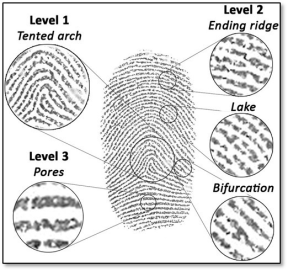
Fingerprint level details
1st Level Detail:
The general direction of ridge flow (overall pattern)
2nd Level Detail:
Characteristics such as ridge endings or bifurcations.
3rd Level Detail:
Detail within the ridge structure (pores and ridge shape).
The comparison step can be carried out after analysis at each successive level of detail. Therefore, if a difference between the 2 fingerprints is found at the 1st and or 2nd level detail then further analysis would not be necessary as sufficient information would have been gathered to exclude the possibility of a match.
At the evaluation step, the practitioner assesses all comparative evidence from the analysis stage to make the final decision if the 2 fingerprints match and therefore originate from the same person. The practitioner will use their skill and experience from more nuanced considerations of fingerprint analysis. For example, permitting tolerances for any distortion caused by the surface from which a mark was lifted (or what can be inferred about the way the mark was deposited), or partial capture of the fingerprint mark before making any final judgement. The final evaluation outcome will typically be either the self-explanatory: identified, excluded, insufficient, or inconclusive.
The final verification step is a repeat fingerprint examination by a separate and independent practitioner. This is a valuable quality control step in the process to provide safeguards against errors and incorrect results. Once completed, the evaluations of both practitioners are compared to check for agreement. Should they disagree in their final outcome, a final 3rd independent examination by another independent practitioner may be required to reach a final judgement.
3. Legislation governing DNA and Fingerprint retention
3.1 Overview
For England and Wales the Protection of Freedoms Act 2012 (PoFA) and subsequent Acts[footnote 14] amended Police and Criminal Evidence Act 1984 (PACE) to establish the current retention framework for DNA and fingerprints. The NDNAD also contains profiles from Scotland and Northern Ireland.
The enabling legislation for Scotland is:
-
Part 2 of the Criminal Procedure (Scotland) Act 1995
-
Section 56 of the Criminal Justice (Scotland) Act 2003 [voluntary samples]
-
Chapter 4 of Part 4 of the Age of Criminal Responsibility (Scotland) Act 2019
The enabling legislation for Northern Ireland is:
- Police and Criminal Evidence (Northern Ireland) Order 1989 (PACE NI)
3.2 Protection of Freedoms Act 2012
3.2.1 Introduction
PoFA includes detailed rules on how long the police may retain an individual’s DNA sample, profile and fingerprints.
3.2.2 DNA profile records and fingerprints
Depending on the circumstances, a DNA profile and fingerprint record may be retained indefinitely, held for three to five years and then destroyed, or destroyed immediately.
3.2.3 DNA samples
PoFA requires all DNA samples taken from individuals to be destroyed as soon as a profile has been obtained from them (or in any case within 6 months) unless it is retained under the Criminal Procedure and Investigations Act 1996 (CPIA)[footnote 15]. This allows sufficient time for the sample to be analysed and a DNA profile to be produced and uploaded to NDNAD.
3.3 Biometrics and Surveillance Camera Commissioner
PoFA also established the position of Commissioner for the Retention and Use of Biometric Material (‘the ‘Biometrics Commissioner’)[footnote 16]. The position is independent of Government.
As indicated in Table 1b, one of the Biometrics and Surveillance Camera Commissioner’s functions is to decide, whether or not the police may retain DNA profile records and fingerprints obtained from individuals arrested, but not charged with a qualifying offence. They also have a general responsibility to keep the retention and use of DNA and fingerprints under review, including retention on national security grounds.
3.4 Scottish Biometrics Commissioner
The Scottish Biometrics Commissioner Act 2020 established the office of the Scottish Biometric Commissioner and the role of the Scottish Biometric Commissioner in exercising independent oversight of biometric data used for policing and criminal justice purposes in Scotland.[footnote 17]
3.5 Extensions
Where an individual has been arrested or charged with a qualifying offence and an initial three-year period of retention, has been granted, PoFA allows a chief constable to apply to a district judge for a two-year extension of the retention period. This can be applied in specific circumstances, such as;
- the victim is under 18
- the victim is a vulnerable adult,
- the victim is associated with the person to whom the retained material relates
- further retention is considered necessary for the prevention or detection of crime.
3.6 Speculative searches
PoFA allows the DNA profile and fingerprints taken from arrested individuals to be searched against NDNAD and IDENT1, to see if they match any subject or crime scene profile already stored. Unless a match is found, or PoFA provides another power to retain them (for example because the person has a previous conviction) the DNA and fingerprints are deleted once the ‘speculative search’ has been completed. If there is a match the police will decide whether to investigate the individual or not.
Table 1a: Retention periods[footnote 18] for convicted individuals
| Situation | Fingerprint & DNA Retention Period |
|---|---|
| Any age convicted (including given a caution or youth caution) of a qualifying offence | Indefinite |
| Adult convicted (including given a caution) of a minor offence | Indefinite |
| Under 18 convicted (including given a youth caution) of a minor offence | 1st conviction: five years (plus length of any prison sentence), or indefinite if the prison sentence is for five years or more. 2nd conviction: indefinite |
Table 1b: Retention periods[footnote 19] for non-convicted individuals
| Situation | Fingerprint & DNA Retention Period |
|---|---|
| Any age charged with but not convicted of a qualifying[footnote 20] offence | Three years plus a two-year extension if granted by a District Judge (or indefinite if the individual has a previous conviction for a recordable[footnote 21] offence which is not excluded) |
| Any age arrested for but not charged with a qualifying offence | Three years if granted by the Biometrics and Surveillance Camera Commissioner plus a two-year extension if granted by a District Judge (or indefinite if the individual has a previous conviction[footnote 22] for a recordable offence which is not excluded[footnote 23]) |
| Any age arrested for or charged with a minor[footnote 24] offence | None (or indefinite if the individual has a previous conviction for a recordable offence which is not excluded) |
| Over 18 given a Penalty Notice for Disorder | Two years |
3.7 Early Deletion
PoFA requires the FIND Strategy Board to issue guidance about the destruction of DNA profile records[footnote 25]. Guidance known as the ‘Deletion of Records from National Police Systems’, covering DNA profile records and samples, fingerprints and PNC records was first published in May 2015. The guidance is only statutory in relation to DNA profile records and only applies to those individuals who:
- have no prior convictions and whose biometric material is held because they have been given a Penalty Notice for Disorder
- have been charged with, but not convicted of, a qualifying offence; or
- receive a simple or conditional caution.
The guidance states that Chief Officers may wish to consider early deletion if applied for on specified grounds. These include:
- a recordable offence has not taken place (e.g. where an individual died but it has been established that they died of natural causes);
- the investigation was based on a malicious or false allegation;
- the arrested individual has a proven alibi;
- the status of the individual (e.g. as victim, offender, or witness) is not clear at the time of arrest;
- a magistrate or judge recommends it;
- another individual is convicted of the offence; and
- where it is in the public interest to do so.
The Record Deletion Process provides guidance and an application form[footnote 26] which specifies the evidence that the Chief Officer should consider, this application form is available on GOV.uk.
Glossary
Accreditation: This is the independent assessment of the services that an organisation delivers, to determine whether they meet defined standards. Forensic Service Providers and laboratories which process DNA samples and fingerprints are required to be accredited to ISO/IEC 17025; a standard set out by the International Standard Organisation which requires that samples are processed under appropriate laboratory conditions and that contamination is avoided.
Centralised DNA Contamination Elimination Database: A database held within FINDS containing reference profile records from individuals who work within the DNA supply chain, such as police officers, police staff, manufacturers and others who come into regular contact with crime scenes or evidence, so that any DNA inadvertently left at a crime scene can be eliminated from the investigation.
Biometrics and Surveillance Camera Commissioner (‘the Biometrics Commissioner’): The Biometrics Commissioner is responsible for keeping under review the retention and use by the police of DNA samples, DNA profile records and fingerprints; and for agreeing or rejecting applications by the police to retain DNA profile records and fingerprints from persons arrested for qualifying offences but not charged or convicted for up to three years.
Crime scene investigator (CSI): A member of police staff employed to collect samples which may contain DNA and other forensic evidence left at a crime scene.
Deoxyribonucleic Acid (DNA): Genetic material contained within most of the cells of the human body which determines an individual’s characteristics such as sex, eye colour, hair colour etc.
DNA-17: The current method used to process a DNA sample in the UK which analyses a sample of DNA at 16 different areas plus a sex marker.
DNA profile: A series of pairs of numbers (16 pairs where the DNA-17 method is used) plus a sex marker which are derived following the processing of a DNA sample. There are two types of DNA profile records:
- crime scene DNA profile: this is a DNA profile derived from a crime scene sample
- subject DNA profile: this is a DNA profile derived from a subject sample
Once derived, DNA profile records are usually loaded onto the National DNA Database. See ‘DNA sample’.
DNA sample: There are two main types of DNA sample:
- crime scene sample: this is a sample of DNA taken from a crime scene e.g. from a surface, clothing or bodily fluid (such as blood) left at a crime scene.
- subject sample: this is a sample of DNA taken from an individual, often from their cheek, by way of a ‘buccal swab’ though it can be taken from hair or a bodily fluid such as blood, urine or semen.
In the case of missing persons, DNA samples may also be taken from the belongings of that person or their family for the purposes of identifying a body should one be found.
Early deletion: The Record Deletion Guidance sets out certain, limited, circumstances under which an individual whose DNA profile is being retained by the police can apply to have it destroyed sooner than normal.
Excluded offence: Under the retention framework for DNA and fingerprints, an ‘excluded’ offence is a recordable offence which is minor, was committed when the individual was under 18, for which they received a sentence of fewer than five years imprisonment and is the only recordable offence for which the individual has been convicted.
Familial search: A search of NDNAD to look for relatives of the perpetrator carried out where DNA is found at a crime scene but there is no subject profile on NDNAD. Such a search may produce a list of possible relatives of the offender. The police use other intelligence, such as age and geography, to narrow down the list before investigating further. Because of the privacy issues, cost and staffing involved in familial searches, they are only used for the most serious crimes. All such searches require the approval by the Chair of the FIND Strategy Board (or a nominee of the Chair).
FINDS transcription or amendment error: This occurs where FINDS have introduced inaccurate information.
Force sample or record handling error: This occurs where the DNA profile is associated with the wrong information. For example, if person A and person B are sampled at the same time, and the samples are put in the wrong kits, so person A’s sample is attached to information (PNC ID number, name etc.) about person B, and vice versa. Similarly, crime scene sample C could have information associated with it which relates to crime scene sample D.
Forensic Archive Ltd. (FAL): A company established following the closure of the Forensic Science Service (FSS), to manage case files from investigation work which it had carried out. (The FSS was the body which used to have responsibility for most forensic science testing in relation to forensic evidence). In March 2012, the FSS closed, and its work was transferred to private Forensic Service Providers and in-house police laboratories.
Forensic Information Database Service (FINDS): The Home Office Unit responsible for administering NDNAD, Fingerprint Database and the Footwear database services.
Forensic Information Databases (FIND) Strategy Board: The FIND Strategy Board provides governance and oversight over NDNAD and the Fingerprint Database. It has a number of statutory functions including issuing guidance on the destruction of profile records and producing an annual report.
Forensic Service Provider (FSP): An organisation which provides forensic analysis services for the criminal justice system.
FSP interpretation error: This occurs where the FSP has made an error during the processing of the sample.
FSP sample and/or record handling error: As above, this occurs where the DNA profile is associated with the wrong information. It could involve samples being mixed up as described above or contaminating DNA being introduced during processing.
Forensic Science Regulator (FSR): Responsible for ensuring that the provision of forensic science services across the criminal justice system in England and Wales is subject to an appropriate regime of scientific quality standards. The Scottish and Northern Irish authorities collaborate with the FSR in the setting of quality standards.
Law Enforcement Agencies (LEAs): Any organisation authorised to take samples under PACE.
Match: There are three types of matches:
- crime scene to subject: Where a crime scene DNA profile matches a subject DNA profile
- crime scene to crime scene: Where a crime scene DNA profile matches another crime scene DNA profile (i.e. indicating that the same individual was present at both crime scenes).
- subject to subject: Where a subject profile matches a subject profile already held on NDNAD (i.e. indicating that the individual already has a profile on NDNAD).
Match rate: The percentage of crime scene DNA profile records which, once loaded onto NDNAD, match against a subject DNA profile (or subject DNA profile records which match to crime scene DNA profile records).
Minor offence: Under the retention framework for DNA and fingerprints, a minor offence is a ‘recordable’ offence which is not a ‘qualifying’ offence.
Missing Persons DNA Database (MPDD): The MPDD holds DNA profile records obtained from the belongings of people who have gone missing or from their close relatives (who will have similar DNA). If an unidentified body is found DNA can be taken from it and run against that on the MPDD to see if there is a match. This assists with police investigations and helps to bring closure for the family of the missing person. DNA profile records on the MPDD are not held on NDNAD.
National DNA Database (NDNAD): A database containing both subject and crime scene DNA profile records connected with crimes committed throughout the United Kingdom. (Subject DNA profile records retained on the Scottish and Northern Irish DNA Databases are copied to NDNAD; crime scene DNA profile records retained on those databases are copied to NDNAD if a match is not found).
Non-Routine search: A search made against a DNA profile which has not been uploaded onto NDNAD.
Partial match: Where, for instance, the perpetrator has tried to remove the evidence, or DNA has been partially destroyed by environmental conditions, it may not be possible to obtain a complete DNA profile from a crime scene. A partial DNA profile can still be used to obtain a partial match against profile records on NDNAD. Partial matches provide valuable leads for the police but, depending on how much of the information is missing, the result is likely to be interpreted with lower evidential weight than a full match. See ‘Match’.
Police and Criminal Evidence Act 1984 (PACE): PACE makes a number of provisions to do with police powers, including in relation to the taking and retention of DNA and fingerprints.
Protection of Freedoms Act 2012 (PoFA): Prior to coming into force for the DNA and fingerprint sections of PoFA on 31st October 2013, DNA and fingerprints from all individuals arrested for, charged with or convicted of a recordable offence were held indefinitely. PoFA amended PACE to introduce a much more restricted retention schedule under which the majority of profile records belonging to innocent people were destroyed. See ‘Police and Criminal Evidence Act 1984 (PACE)’.
Qualifying offence: Under the retention framework for DNA and fingerprints, a ‘qualifying’ offence is one listed under section 65A of the Police and Criminal Evidence Act 1984 (the list comprises sexual, violent, terrorism and burglary offences).
Recordable offence: A ‘recordable’ offence is one for which the police are required to keep a record. Generally speaking, these are imprisonable offences; however, it also includes a number of non-imprisonable offences such as begging and taxi touting. The police are not able to take or retain the DNA or fingerprints of an individual who is arrested for an offence which is not recordable.
Routine search: A search made against a DNA profile uploaded onto NDNAD.
Science and Technology Ethics Advisory Committee: Formerly known as the DNA Ethics Group (between 2007-2017), and then the Biometrics and Forensics Ethics Group until it was replaced by the Science and Technology Ethics Advisory Committee in 2025.
SGMPlus: The previous method used to process a DNA sample which analysed a sample of DNA at ten different areas plus a sex marker. In July 2014, SGMPlus was upgraded to DNA-17.
Y-STR: Y-STR analysis is a method which can be used when processing complex casework samples to aid the detection of male DNA where there may be trace amounts, in the presence of high levels of female DNA (for example in sexual offences and violent crime). Y-STRs are taken specifically from the male Y chromosome and are transmitted along the paternal lineage. Due to the nature of this analysis, Y-STR is often used in paternity and genealogical DNA testing and can also be used to identify missing persons and familial searches.
Full revision history
| Issue Number | Issue Date | Summary of changes |
|---|---|---|
| 1 | 28/03/2024 | New Document |
| 2 | 13/02/2025 | DCR1358 – Minor Updates |
| 3 | 25/02/2026 | Full Document Review |
-
As set out under section 3 of the governance rules. ↩
-
Section 63AB of the Police and Criminal Evidence Act 1984 (PACE) ↩
-
Section 63AB(2), Police and Criminal Evidence Act 1984. ↩
-
Ibid 2, section 63G. ↩
-
Ibid 2, section 63AB(4). ↩
-
The Biometrics Commissioner’s latest annual report is available at: Biometrics and Surveillance Camera Commissioner: report 2023 to 2024 - GOV.UK ↩
-
Ibid 2, section 63AB(6). ↩
-
Ibid 2, section 63AB(7). ↩
-
Published at Forensic Information Databases strategy board: revised governance rules - GOV.UK ↩
-
As set out under section 4 of the governance rules. ↩
-
An individual’s DNA is contained within discrete structures within a cell known as chromosomes. Men have a copy of an X and Y chromosome whereas women have two copies of the X chromosome. ↩
-
As agreed with the Forensic Science Regulator and the Crown Prosecution Service, in order to give a conservative figure, routine statistical reporting of DNA evidence in court continues to be reported as ‘one in a billion’. Certain cases might be reported with a more precise probability; this is assessed on a case-by-case basis. ↩
-
The Centralised DNA Contamination Elimination Database (CED), which contains the profile records of police officers and staff and people in the wider DNA process, highlights DNA profiles that are potentially sourced from contamination rather than the crime scene, and so may also be indicative of DNA handling issues. ↩
-
Detailed in The Forensic Information Databases Strategy Board Policy for Access and Use of DNA Samples, DNA Profiles, Fingerprint Images, Custody Images, and Associated Data ↩
-
Under the Criminal Procedure and Investigations Act 1996 (CPIA) (and its associated code of practice) evidence can be retained where it may be needed for disclosure to the defence. This means that, in complex cases, a DNA sample may be retained for longer. This sample can only be used only in relation to that particular offence and must be destroyed once its potential need for use as evidence has ended. ↩
-
For more information on the work of the Biometrics Commissioner see Biometrics Commissioner ↩
-
Scottish Biometrics Commissioner Act 2020 ↩
-
Relates to the retention regimes in England and Wales only. ↩
-
Relates to the retention regimes in England and Wales only. ↩
-
A ‘qualifying’ offence is one listed under section 65A of the Police and Criminal Evidence Act 1984 (the list includes sexual, violent, terrorism and burglary offences). ↩
-
A ‘recordable’ offence is one for which the police are required to keep a record. Generally speaking, these are imprisonable offences; however, it also includes a number of non-imprisonable offences such as begging and taxi touting. The police are not able to take or retain the DNA or fingerprints of an individual who is arrested for an offence which is not recordable. ↩
-
Convictions include cautions, reprimands and final warnings. ↩
-
An ‘excluded’ offence is a recordable offence which is minor, was committed when the individual was under 18, for which they received a sentence of fewer than 5 years imprisonment and is the only recordable offence for which the individual has been convicted. ↩
-
A minor offence is a ‘recordable’ offence which is not also a ‘qualifying’ offence. ↩
-
As set out under section 63AB(4) of the Police and Criminal Evidence act 1984 (PACE) as inserted by section 24 of PoFA. ↩
-
Available at https://www.gov.uk/government/publications/dna-early-deletion-guidance-and-application-form ↩