Forecast evaluation report – June 2026
Updated 2 June 2026

© Crown copyright 2026
This publication is licensed under the terms of the Open Government Licence v3.0 except where otherwise stated. To view this licence, visit nationalarchives.gov.uk/doc/open-government-licence/version/3 or write to the Information Policy Team, The National Archives, Kew, London TW9 4DU, or email: psi@nationalarchives.gov.uk.
Where we have identified any third party copyright information you will need to obtain permission from the copyright holders concerned.
This publication is available at https://www.gov.uk/government/publications/forecast-evaluation-report-june-2026/forecast-evaluation-report-june-2026
Foreword
The Office for Budget Responsibility was created in 2010 to provide independent and authoritative analysis of the UK public finances. One of our core roles is to produce the Government’s official economic and fiscal forecasts which are published twice a year in our Economic and fiscal outlook (EFO).
In each EFO, we stress the uncertainty that lies around all such forecasts. We compare our central forecasts to those of other forecasters. We highlight the limited confidence that should be placed in our central forecast given the scale of shocks that inevitably drive a wedge between any central prediction and subsequent outcomes. We use sensitivity and scenario analysis to show how the public finances could be affected by alternative economic outcomes. And we highlight the residual uncertainties in the public finances, even if one were confident about the path for the economy – for example, because of uncertain estimates of the cost of policy measures.
These uncertainties mean differences between outturns and forecasts are inevitable. Our central forecast is constructed under the conditioning assumption of stated government policy at the time the forecast is produced. It is also conditional on the absence of positive or negative shocks. However, subsequent changes in policy are the rule rather than the exception. And shocks are inevitable and often large – as we have seen over the past six years with the Covid pandemic, the energy price spikes following the Russian invasion of Ukraine, and the rise in inflation and interest rates that followed. But some differences between a central forecast and subsequent outturns are due to factors that could have been anticipated through improved modelling techniques, by looking at alternative data sources, or by using different assumptions. Genuine errors, which would have been corrected before the forecast was finalised if we had spotted them, can also be a source of forecast differences, and we identify these as errors where applicable.
We believe it is important to identify, understand, and learn from these differences and errors, and then to set out our plans for improving the way in which we forecast. We are therefore committed to transparent evaluation of our forecast performance. Our legislation requires the OBR to undertake, at least once a year, “an assessment of the accuracy of fiscal and economic forecasts previously prepared by it.” To meet this requirement, we produce this annual Forecast evaluation report (FER) which evaluates how successive forecasts have compared against outturn. In our 2023 Working paper No.19: The OBR’s forecast performance, we took a more comprehensive look at the OBR’s overall forecasting record since we were established in 2010.[footnote 1] This regular transparent evaluation of our forecast performance both ensures the OBR is accountable for the accuracy of its forecasts, and helps us to identify potential sources of persistent forecast difference or bias in our forecasting models, methods, or judgement and take action to address these in future forecasts. It also allows us to evaluate our assessments of the economic and fiscal impact of large, uncertain shocks.
In line with the approach taken in the 2025 FER, this year’s FER analyses the performance of our one- (from March 2024), two- (from March 2023) and five- (from July 2020) year ahead economic and fiscal forecasts for the 2024-25 financial year. This report focuses on the five-year forecast central scenario presented in our July 2020 Fiscal sustainability report, rather than the central forecast in our March 2020 EFO. Although this scenario was not an official forecast, it provides a more meaningful basis for evaluation than the March 2020 EFO, which was produced before the scale and nature of the Covid pandemic were understood and was published shortly before the first UK lockdown.[footnote 2]
For this FER, economy outturn data is taken from the ONS’s first quarterly estimate for the fourth quarter of 2025 released on 12 February 2026. This incorporates the ONS 2025 Blue Book-consistent National Accounts data that was released on 30 September 2025. For public sector receipts and expenditure, the outturn data used is from the ONS’s 23 April 2026 Public Sector Finances publication.
In line with our Memorandum of Understanding, we provided a final copy of this report to the Treasury two working days in advance of publication.
We would be pleased to receive feedback on the approaches taken in this FER as well as on any aspect of the content or presentation of our analysis. This can be sent to feedback@obr.uk.
The Budget Responsibility Committee
Professor David Miles CBE and Tom Josephs
Chapter 1: Executive summary
1.1 Since the OBR was established in 2010 we have been committed to transparent evaluation of our performance as the Government’s economic and fiscal forecaster. This Forecast evaluation report (FER) evaluates one- (from March 2024), two- (from March 2023) and five- (from July 2020) year ahead economic and fiscal forecasts for the 2024-25 financial year. The ongoing impact of unexpected shocks, including the Covid pandemic and 2022 energy price shock, explain a large portion of the short- and medium-term differences between forecasts and outturn for 2024-25.
1.2 Our central forecasts are estimates which represent the middle of a possible range of outcomes for economic and fiscal variables. These variables are subject to a huge number of drivers and the impact of future shocks which cannot be predicted before they occur. To illustrate the range of uncertainty around our central forecast we use scenarios, fan charts, and sensitivity analysis in all our Economic and fiscal outlooks (EFOs). This risk analysis is at least as important for fiscal policymakers, and those who scrutinise fiscal policy decisions, as the central forecast. In this FER, we therefore also assess the performance of the scenarios we have used in EFOs to illustrate the potential range of impacts of the two major recent shocks to hit the economy and public finances – the Covid pandemic and the 2022 energy price shock following Russia’s invasion of Ukraine.
1.3 In this FER we also explain our fiscal multiplier framework and make an initial assessment of our use of these multipliers in the Autumn 2024 forecast for GDP growth in 2025. The OBR defines fiscal multipliers as the impact of a policy package on demand, which, in the short run, can affect the output gap by changing the level of economic activity relative to potential output. We have a separate framework – which we consider alongside our multipliers – for assessing and incorporating the possible medium- and longer-term impacts of policy on potential output. The initial analysis in this FER suggests that, based on the outturn for 2025, it is unlikely that the multipliers we used to assess the impact of the Autumn Budget 2024 policy package were too low and so underestimated the initial impact of the fiscal loosening on near-term GDP growth. However, we will continue to review this issue in future FERs, when we will be able to consider outturn for more years of the five-year forecast made in Autumn 2024.
Evaluating our forecasts for 2024-25
1.4 The large, persistent impact of the 2022 energy price shock was the key factor behind differences between economic outturn in 2024-25 and the March 2023 and March 2024 forecasts. In particular, the rise in energy prices had greater-than-expected second-round impacts on inflation, particularly due to what now seems likely to have been its impact in generating strong nominal wage growth in a tight labour market. Partly as a consequence, interest rates remained higher than expected by market participants at the time of both forecasts. While we overestimated real GDP growth in our March 2023 forecast, and underestimated it in our March 2024 forecast, both forecasts significantly underestimated nominal GDP growth – a key driver of tax revenues – due to this stronger-than-expected inflation.
1.5 Differences between outturn and our fiscal forecasts over this period also largely reflected the impact of the energy price shock and the large policy responses to it. Public sector net borrowing (PSNB) in 2024-25 was £152 billion (5.2 per cent of GDP). The key differences between this and our forecasts were:
-
The March 2023 two-year ahead forecast for borrowing in 2024-25 was £85 billion (3.2 per cent of GDP), which was £66 billion (2.0 per cent of GDP) lower than outturn. This was largely driven by higher-than-expected public spending. That was primarily due to more persistent inflation and higher interest rates than expected, which raised debt interest and welfare spending, and due to policy decisions to substantially increase departmental spending at Autumn Budget 2024. There was also a large forecasting difference for other current spending. This was only partially offset by higher-than-expected receipts due to stronger growth in nominal tax bases than expected.
-
The March 2024 one-year ahead forecast for borrowing in 2024-25 was £87 billion (3.1 per cent of GDP) – very similar to the March 2023 forecast – and was £65 billion (2.0 per cent of GDP) lower than outturn. While receipts outturn were in line with forecast, outturn spending was considerably higher, driven by the same factors affecting the March 2023 forecast, including the increase to departmental spending announced at Autumn Budget 2024.
Chart 1.1: Drivers of differences between borrowing forecasts and 2024-25 outturn
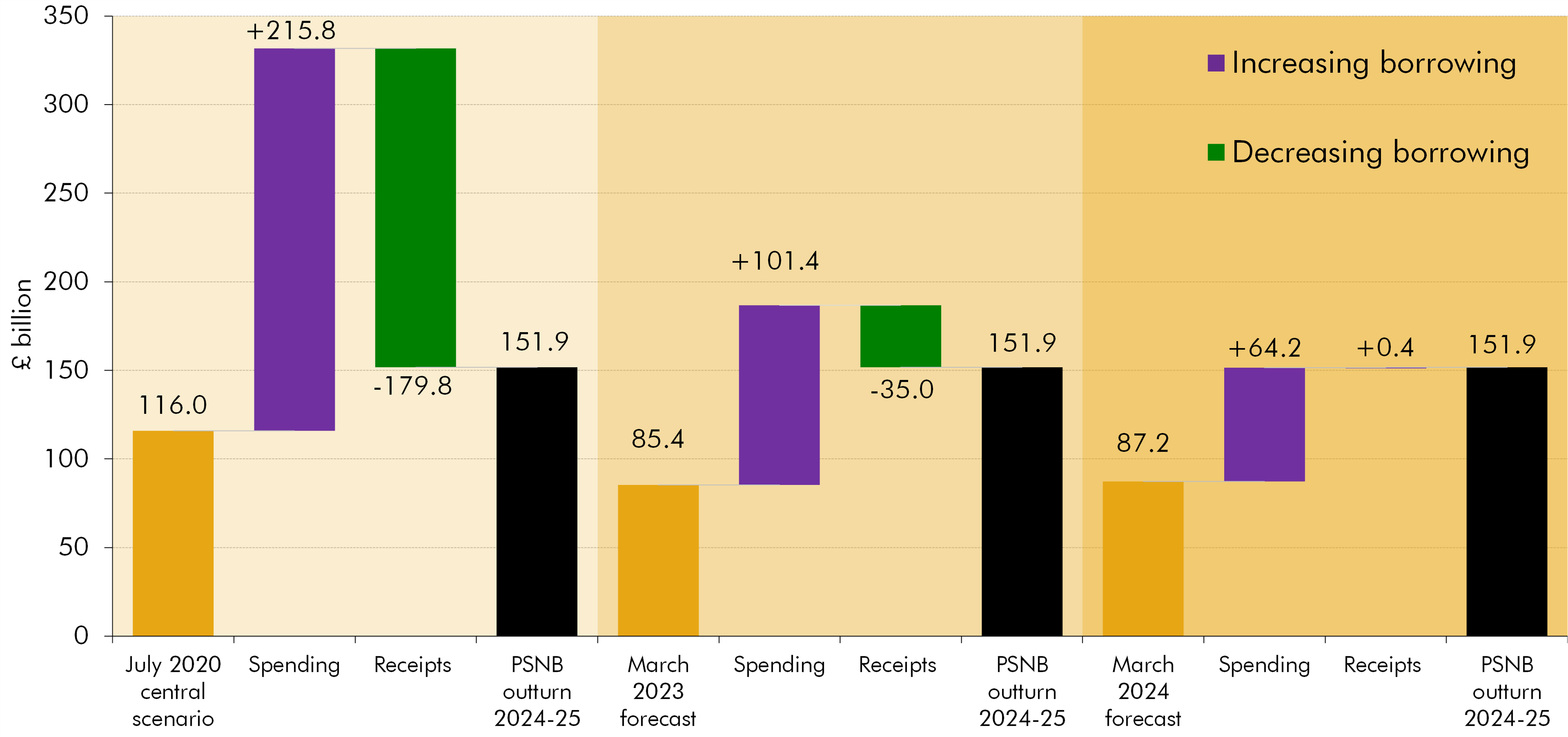
Waterfall chart showing the drivers of difference between borrowing forecasts and 2024-25 outturn.
Source: ONS, OBR
1.6 The five-year ahead forecasts for 2024-25 were produced during the initial phase of the Covid pandemic in 2020. Reflecting the very high uncertainty at this time, in July 2020, the OBR produced a central scenario alongside two alternative scenarios to show how different short- and medium-term assumptions for the pandemic could affect economic and fiscal outcomes. The central scenario provided a reasonably accurate assessment of the short-term economic and fiscal impact of the pandemic. However, the scenarios did not anticipate the inflationary pressures that developed as the pandemic ended and could not have foreseen the subsequent 2022 energy price shock. The resulting much higher-than-expected inflation and nominal GDP growth led to both spending and receipts diverging significantly from the projections in the scenarios over the medium term, although these differences were broadly offsetting in terms of borrowing.
1.7 Evaluating these forecasts for 2024-25, alongside evaluations of earlier years from recent FERs, provides lessons for forecasting the economic and fiscal impact of energy price shocks. The sharp rise in energy prices caused by the current escalation of conflict in the Middle East was not incorporated in our most recent March 2026 forecast since it happened only a few days before publication and after the forecast had been finalised. Assessing how this latest energy shock will affect the economy and public finances will therefore again be a key issue for our next forecast. While the impact of each shock on the economy and public finances will inevitably be different, some key lessons from the 2022 shock are:
-
The impact of higher energy prices on inflation following the 2022 energy price shock was larger and more persistent than we had expected. While the direct effects were broadly in line with our initial expectations, the second-round effects were significantly above our forecasts. Various factors contributed to this including a tight labour market causing a higher wage response than expected. In response to this, we have adjusted our analytical and modelling toolkit, including our assumption for the second-round pass-through of energy prices to inflation and some of our short-term inflation modelling equations.
-
We overestimated the impact of the 2022 energy price shock on household’s real disposable income, partially due to stronger-than-expected wage growth and subsequent policy support. In terms of the supply-side impact, higher energy prices may have contributed to weak productivity growth over this period, but it is hard to separate out the exact impact of the energy price shock from the many other factors that likely affected productivity growth at this time.
-
The overall impact of the energy shock on the public finances was to significantly increase government borrowing and debt. Initially, higher inflation increased spending on most welfare benefits and index-linked debt interest costs, with only a small offset from higher taxes on the energy sector. In addition, the direct discretionary policy response to support households and businesses with the costs of the energy price shock added substantially to borrowing in 2022 and 2023. The subsequent pass-through of inflation to higher nominal earnings and nominal consumption acted to increase tax revenues, which partly offset the initial negative impact on borrowing. But it also contributed to persistently elevated interest rates which raised debt interest spending. Persistently higher inflation also increasingly eroded the real value of departmental spending which was then increased in a series of government policy decisions over this period.
Development priorities
1.8 Our forecast development priorities reflect the lessons outlined above and other forecast differences identified in this report. We will use the lessons from the evaluation of the forecasts made following the 2022 energy price shock to inform our assessment of the impact of the current energy price shock in our next forecast. Wider economic forecast development priorities include assessing our approach to business investment modelling, developing our trade modelling capabilities, and expanding our use of the Oxford Economics Global Economic Model for scenario analysis. Wider fiscal forecast development priorities focus on understanding the volatility and forecast differences for self assessment income tax receipts at an individual income component level, reviewing the drivers of our onshore corporation tax receipts forecast, assessing alternative economic determinants for our insurance premium tax receipts forecast, reviewing our local authority self-financed expenditure forecast, and understanding the link between recent unemployment outturn data and welfare spending.
Chapter 2: Fiscal multipliers
Introduction
2.1 All our forecasts incorporate an assessment of the potential economic and fiscal impacts of changes in government policy. In making these assessments we divide the potential impact of policy into two parts: the ‘direct effects’ of a given policy change on the public finances; and the ‘indirect effects’ that capture the potential impact of a change in policy on economic activity, which may then have subsequent impacts on the public finances.[footnote 3] One element of our approach to assessing these indirect effects is the use of fiscal multipliers.
2.2 The OBR defines fiscal multipliers as the impact of a policy package on demand, which, at least in the short run, can affect the output gap by changing the level of economic activity relative to potential output. Wider economic impacts, such as possible supply-side effects of policy on potential output, or effects on inflation, are considered separately. The overall real GDP impact of a policy package is therefore a combination of the demand-side fiscal multiplier impact and any supply-side effects, with inflation effects impacting nominal GDP.
2.3 The OBR’s definition of fiscal multipliers differs from that used by some other institutions. Fiscal multipliers used in other contexts may capture both demand- and supply-side effects on real GDP, as well as impacts on inflation.[footnote 4] This needs to be taken into account when comparing the results of the OBR’s multipliers against those used by other institutions. Such differences may partly or fully reflect a different definition of multipliers. To aid comparability, the first part of this chapter explains our fiscal multipliers framework and how we apply it in our forecast.
2.4 Some analysts have suggested that the multipliers the OBR used in assessing the impact of the significant reduction in government spending announced in 2010 were too low. Previous Forecast evaluation reports (FERs) between 2012 and 2017 assessed this issue in detail. This analysis concluded that, while there is significant uncertainty around fiscal multiplier estimates, there was limited evidence that the multipliers that we used at that time were too low or tapered too quickly.[footnote 5] More recently, some analysts have also suggested the fiscal multipliers that we applied to the increase in government spending in our October 2024 forecast were too low and taper too quickly.[footnote 6] The second part of this chapter therefore evaluates the short-term application of our fiscal multipliers for the October 2024 forecast.[footnote 7],[footnote 8]
The OBR’s fiscal multiplier framework
Definition
2.5 In the OBR’s framework, our medium-term GDP forecast is informed by judgements about both potential output and the output gap profile.[footnote 9] We therefore have separate, but related, frameworks for assessing how policy may affect each of these.
2.6 We define fiscal multipliers as the impact of a whole policy package on aggregate demand and the output gap. For example, a fiscal stimulus (such as higher spending or lower tax) is likely to raise demand in the economy relative to supply, either via the government directly producing or consuming more or via other economic agents having more disposable income to spend. This generally results in a rise in the level of real GDP in the short term.
2.7 The OBR’s fiscal multiplier framework does not account for any wider, non-demand related economic effects. These multipliers therefore do not capture how policy may affect the potential output of the economy (e.g. how many people wish to work) or the impacts on inflation (e.g. how the pass-through of a change in VAT would directly change prices). We use a separate framework for assessing the possible supply-side impacts of policy on potential output, which is described in detail in Briefing paper No.10: Accounting for the supply-side effects of policy.
2.8 As mentioned above, this definition of fiscal multipliers is narrower than that sometimes used in the academic literature and by other institutions. Fiscal multipliers are often defined as the total change in output resulting from a unit change in a fiscal variable. This definition of fiscal multipliers may capture both demand and, generally less temporarily, supply-side effects on real GDP. Our approach instead uses separate frameworks to assess these possible demand- and supply-side effects.
2.9 The fiscal multipliers we use to assess the impact of policy on aggregate demand typically taper over the forecast period, consistent with the findings of much of the economic literature on this issue.[footnote 10] A rise in government activity, assuming such activity does not increase potential output by an equivalent amount, would be expected to put pressure on economic resources and, over time, ‘crowd out’ the private sector components of expenditure in GDP. Conversely, a fall in government activity under similar conditions would reduce pressure on economic resources and over time potentially ‘crowd in’ private sector activity. The mechanism for this includes changes to exchange rates, real wages and real interest rates. For example, a fiscal expansion may raise the demand for labour, increasing real wages, which causes private businesses to reduce output. Any impact of policy on potential output, which we assess through the separate supply-side frameworks mentioned above, will typically have an impact at and beyond our five-year forecast horizon.
2.10 Our forecasts may also include how wider economic variables are impacted by the demand-side effect of policy. For example, a fiscal expansion, with no change to potential output, is likely to lead to greater inflationary pressure – and that effect, if sufficiently large, would be reflected in our inflation forecast.
Quantification and application
2.11 It is important to stress there is no single multiplier that applies to all policies and at all points in the economic cycle. Empirical estimates of multipliers in the economic literature have a wide range, and suggest that multipliers vary due to:[footnote 11]
-
Macroeconomic conditions. The impact of policy on demand will depend on economic conditions at the time the policy is introduced, including the stage of the economic cycle, underlying structural conditions of the economy, and/or the nature of any economic shocks. For example, when there is spare capacity, there would likely be less pressure on economic resources following a fiscal stimulus, and so less crowding out of private sector activity. As a result, a fiscal stimulus would generally have a larger impact on real GDP. Conversely, when the economy is operating above capacity, the same fiscal stimulus would likely place more pressure on economic resources, so there would be more crowding out. The same fiscal stimulus would be likely to have a smaller impact on real GDP.
-
The policy instrument. The multipliers we use vary across different categories of policy, defined as changes in: taxes, annually managed expenditure (AME), and departmental spending (known as departmental expenditure limits, or DELs). DELs are split into capital DEL (CDEL) and resource DEL (RDEL). This reflects a well established finding in the literature that different types of fiscal intervention tend to have different effects on demand and on economic activity.
2.12 Our published fiscal multipliers, set out in Table 2.1, are therefore the starting point, not the end point, for any assessment we make. These estimates are drawn from the literature and represent multipliers that could apply to a small, open economy such as the UK. The starting point is that the largest impact of demand is in the year when the policy is announced, with the impact then gradually tapering to zero by the fifth year of the forecast for the reasons set out above. The largest initial multiplier is for government capital spending (CDEL) while the lowest is for taxation.[footnote 12] Previous FERs have evaluated these multipliers and concluded that, while the estimates are highly uncertain, there is no clear evidence that they are too low, and they remain in line with recent empirical evidence.[footnote 13]
Table 2.1: Fiscal multipliers
| Year | ||||||
|---|---|---|---|---|---|---|
| 0 | 1 | 2 | 3 | 4 | 5 | |
| Tax | 0.33 | 0.30 | 0.23 | 0.14 | 0.05 | 0.00 |
| AME | 0.60 | 0.57 | 0.43 | 0.23 | 0.07 | 0.00 |
| RDEL | 0.45 | 0.42 | 0.29 | 0.13 | 0.04 | 0.00 |
| CDEL | 1.00 | 0.83 | 0.43 | 0.23 | 0.07 | 0.00 |
| Source: OBR |
2.13 As set out above, the multipliers shown in Table 2.1 are a starting point rather than set values which we apply in all circumstances. In assessing the appropriate multipliers to apply in any given forecast, we always first assess the prevailing macroeconomic conditions and type of policy package, then judge whether to apply these published figures or make adjustments. For example, we may reduce the size of the multiplier if:[footnote 14]
-
The output gap is small or positive, which could mean that crowding-out effects may be larger.
-
The policy package is anticipated, which could mean that the impact of policy is already reflected in outturn data or in surveys of expectations that inform our pre-measures forecast.
-
The policy package may affect domestic output less than usual; for example, if it is likely to boost demand for goods with a high import-intensity or if there is likely to be a large offset from changes in household savings.
2.14 Similarly, we may choose to increase the size of the multipliers if we assess that crowding out effects are likely to be less strong than is typical, or if a policy package is likely to have a greater-than-typical impact on domestic demand.
Evaluating our October 2024 forecast of 2025 GDP growth
2.15 At Autumn Budget 2024, the Government announced a large, front-loaded loosening of fiscal policy. This peaked in 2025-26 with a planned increase in borrowing of £35 billion (1.2 per cent of GDP) in that year, composed of a £60 billion increase in spending (mostly current spending), partly offset by a £25 billion increase in taxes.
2.16 In line with the approach set out in the preceding section, in taking a judgement on the impact of this very large policy package on the forecast for GDP growth, we first considered the wider macroeconomic context and assessed the potential wider economic impacts of the policy package.
2.17 We adjusted down the impact of the policy package on aggregate demand and the output gap, compared with an application of our published fiscal multipliers, by 0.2 per cent of real GDP in 2025-26. This reflected the large fiscal loosening and the economy’s proximity to its supply capacity. The mechanism for this adjustment included an increase in our Bank Rate and gilt rate forecasts by a ¼ percentage point over the five-year forecast, as we judged the fiscal loosening was likely not fully anticipated by market participants. Overall, we judged that the policy package would lead to a 0.6 percentage point increase in aggregate demand in 2025-26.
2.18 We also incorporated an estimate of the wider supply-side impact of policy. In 2025-26, we judged that the demand-side multiplier effect would be offset by a 0.1 per cent fall in potential output. This was due to a combination of the estimated impact on labour supply of the policy to increase employer National Insurance contributions (NICs), and private investment crowding out. Overall, the net impact of both our aggregate demand and potential output judgements was that policy would lead to a 0.6 per cent rise in real GDP in 2025-26.
2.19 Beyond 2025-26, we assumed the net effect on the policy package on potential output and real GDP would be broadly neutral by 2029-30. The demand-side impact from our multipliers tapered as the output gap closed, with higher government investment and consumption at the forecast horizon crowding out some private sector output in the medium term. The boost to potential output from higher public investment spending was broadly offset by lower labour supply from higher employer NICs and lower private investment from some crowding out. However, we also noted that the higher public investment, if sustained, could raise potential output by 1.1 per cent of GDP in the long term based on our supply-side public investment framework.
Evaluating the October 2024 forecast against 2025 outturn
2.20 Chart 2.1 compares our October 2024 real GDP growth forecast with 2025 outturn.[footnote 15] The forecast is decomposed into the pre-measures forecast (gold), the estimated demand-side multiplier effects of policy (blue), and the estimated supply-side effects of policy (green).
2.21 This illustrates that the October 2024 forecast was too optimistic on growth for 2025, with the current ONS estimate of the outturn of 1.4 per cent compared to our forecast of 2 per cent. In broad terms, this could be because our pre-measures forecast was too optimistic, our assessment of policy effects was too optimistic, or some combination of the two. We have compared our pre- and post-measures forecasts for the composition of real GDP against outturn. This gave little indication of the particular driver of the overall forecast difference, but did illustrate the likelihood of both pre-measures and post-measures factors.[footnote 16]
Chart 2.1: Comparison of outturn and forecast real GDP growth for 2025
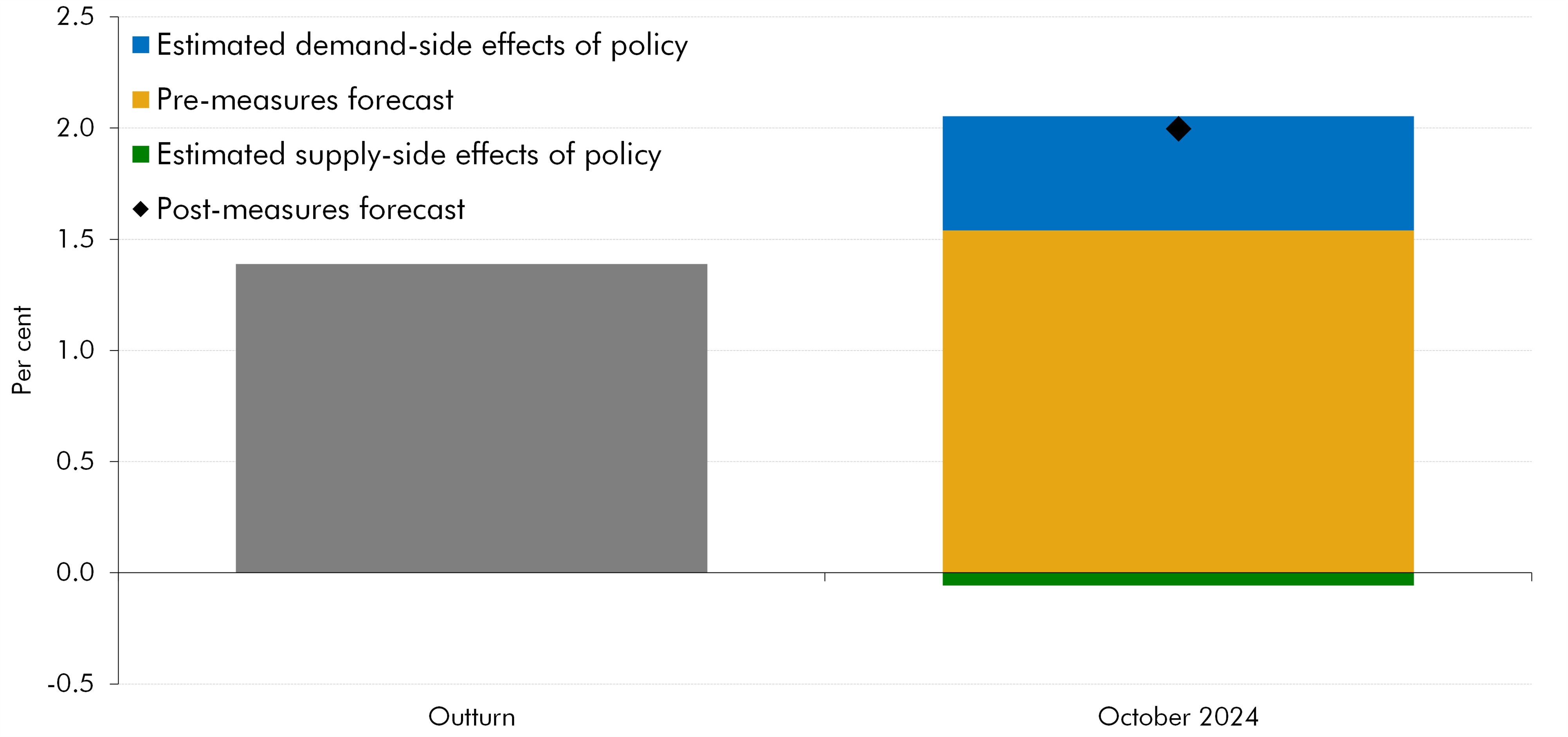
Bar chart showing a comparison between real GDP outturn and forecasts.
Source: ONS, OBR
2.22 It is challenging at this point, and when looking only at one year’s outturn against forecast, to assess with certainty the relative contributions of the various potential drivers of this difference. However the following factors may have contributed:
-
It is possible that our pre-measures forecast underestimated the negative effects of US trade policy. As set out in Chapter 3, our March 2024 forecast may have underestimated growth in 2024 due to anticipated US trade policy causing frontloading effects and higher net exports – and this could have then supressed growth in 2025. There are wider factors that could also explain an overly optimistic pre-measures forecast, including the economy having less momentum than we thought at the time of the forecast, energy prices subsequently rising by more than was expected, and the impact of the Jaguar Land Rover shutdown.
-
It is also possible that our forecast was too low because the October 2024 policy package was anticipated ahead of its announcement by more than we realised, and so was already affecting the outturn and survey data that we use to inform our pre-measures forecast. This could potentially have caused us to double-count effects across our pre- and post-measures forecasts. For example, a large part of the policy package was higher expenditure targeted at addressing existing pressures. For the 2024-25 financial year, much of this spending increase had been announced earlier in the year and was being implemented by the time of the October 2024 Budget, and so will have been affecting economic outturn data to some extent.
-
It is also possible that differences between forecast and outturn were due to judgements in the post-measures forecast, such as the magnitude of crowding out, the scale of the negative impact of policy on supply, and the strength of the monetary policy response.
2.23 Given the lack of a counterfactual it is very difficult to be definitive on which of these judgements may have driven the differences. Based on the outturn for 2025, it does, however, seem unlikely that the multipliers we used to assess the impact of the October 2024 policy package were too low and so underestimated the initial impact of the fiscal loosening on growth. Chart 2.1 shows that GDP outturn for 2025 were weaker than forecast by around as much as the estimated demand effects of the fiscal loosening based on the multipliers applied in the October 2024 forecast. This preliminary analysis, therefore, does not support the argument that we underestimated the short-run demand effect of the October 2024 fiscal loosening.
2.24 We will continue to review this issue in future FERs when we will be able to consider outturn for more years of the five-year forecast made in October 2024, taking the same type of approach as used in the 2017 FER to look back and assess the multipliers used in the 2010 forecast. We may also analyse other fiscal events.
Chapter 3: Evaluating forecasts for 2024-25
Introduction
3.1 This chapter evaluates the one- (from March 2024), two- (from March 2023) and five- (from July 2020) year ahead economic and fiscal forecasts for the 2024-25 financial year. We also compare the OBR’s forecast performance with that of external forecasters. The online annex accompanying this report contains more detailed forecast comparisons for a wider set of economic and fiscal variables, including updated average forecast differences figures. Economy outturn data is from the ONS’s first quarterly estimate for the fourth quarter of 2025 released on 12 February 2026.[footnote 17] For public sector receipts and expenditure, the outturn data is taken from the ONS’s 23 April 2026 Public Sector Finances publication.
3.2 As set out in the Foreword, this report focuses on the five-year ahead forecast differences for the central scenario presented in our July 2020 Fiscal sustainability report (FSR), rather than our March 2020 Economic and fiscal outlook (EFO). Although this scenario was not an official forecast, it provides a more meaningful basis for evaluation than the March 2020 EFO, which was produced before the scale and nature of the Covid pandemic were understood and was published shortly before the first UK lockdown.[footnote 18]
3.3 Our central forecasts are estimates which represent the middle of a range of possible outcomes for economic and fiscal variables. These variables are subject to a huge number of drivers and to the impact of future shocks which cannot be predicted with any accuracy before they occur. Outcomes both substantially below and above the central forecast are therefore highly likely. To illustrate the range of uncertainty around our central forecast we use scenarios, fan charts, and sensitivity analysis in all our EFOs. This risk analysis is at least as important for fiscal policymakers, and those who scrutinise fiscal policy decisions, as the central forecast.
The context for forecasts of 2024-25
3.4 The forecasts evaluated in this report were conducted during a particularly turbulent period in the UK’s post-war economic history, due to:
-
the Covid pandemic, which began in 2020 and precipitated the largest peacetime contraction in GDP;
-
the 2022 energy price shock following Russia’s invasion of Ukraine, with prolonged effects on inflation and global interest rates; and
-
significant uncertainty and subsequent changes in US trade policy since President Trump was elected in 2024.
3.5 Unexpected shocks therefore explain a very large portion of the five-year differences between forecasts made prior to them occurring and outturn for 2024-25. This chapter analyses how this caused outcomes to diverge from the central forecast, which is important for informing how we calibrate and present the risks around future forecasts. However, some of these shocks had happened by the point that the shorter-term forecasts assessed here were made (for example, the 2022 energy price shock occurred before the March 2023 and March 2024 forecasts for 2024-25). In these cases, we assess how effectively the ongoing impact of these shocks was captured in these forecasts, and what we can learn from this. This chapter also highlights where forecast differences are not directly related to the impact of shocks and considers how we can learn from these wider issues and address them in our forecast development programme.
3.6 This Forecast evaluation report (FER) therefore includes two sections that specifically assess our analysis of the two major recent shocks to hit the economy and public finances. Box 3.1 evaluates the July 2020 FSR scenarios, our first official projections to take full account of the emerging impact of the pandemic. Chapter 4 includes a section summarising the lessons we have learned from the 2022 energy price shock for our economic and fiscal forecasts.
Box 3.1: Evaluation of the July 2020 Fiscal sustainability report scenarios
In the July 2020 Fiscal sustainability report (FSR), we presented three potential scenarios for the economy and the public finances over the medium term. These were the OBR’s first official projections to take full account of the emerging impact of the Covid pandemic. A ‘central’ scenario was presented alongside an ‘upside’ and a ‘downside’ scenario. This reflected the high uncertainty at that time around the length and severity of the pandemic and the impact it would have on the economy and public finances.a In this box, we build on the December 2021 Forecast evaluation report (FER), which assessed the short-term performance of these scenarios, and consider how they subsequently compared with outturn over the full five-year projection period. The scenarios were as follows:
-
The upside scenario assumed that activity would rebound relatively quickly from the pandemic, recovering its pre-virus peak by the first quarter of 2021, and there would be no enduring economic scarring.
-
In the central scenario, output recovered more slowly, regaining its pre-virus peak by the end of 2022. Some medium-term economic scarring was assumed, with productivity hit by lower cumulative business investment and higher business failures, and with the equilibrium rate of unemployment remaining elevated.
-
In the downside scenario, output recovered even more slowly, returning to its pre-virus peak only in the third quarter of 2024. This reflected a more significant hit to productivity and a higher medium-term unemployment rate as the economy was assumed to go through a period of significant restructuring.
Chart A shows the real GDP and inflation forecast under each scenario alongside the outturn over the relevant period. For real GDP, outturn was within the range assumed in these scenarios – broadly following a path between the central and upside scenario. This suggests the scarring assumption included in the central scenario may have been overly pessimistic. However, it is difficult to robustly assess this given the economy was hit by subsequent economic shocks and developments that were not foreseen at the time the scenarios were produced. For example, the impact of the pandemic on the labour market was seen at the time as a key area of potential scarring. Subsequent labour market developments present a mixed picture. While unemployment rose by less, and for a shorter period, than anticipated in the central scenario – likely partly due to subsequent extensions to the coronavirus job retention scheme and other labour market support measures – declines in labour market participation proved more persistent than expected. At the same time, subsequent population, and therefore labour supply, growth has been higher than expected mainly due to the unexpected spike in inward migration.
For inflation, which was assumed to follow the same path across all three scenarios, outturn was materially above expectations from 2021 onwards. At the time, we expected the pandemic to depress both demand and supply in the economy and therefore not lead to inflationary pressure. We assumed that inflation would be driven primarily by movements in energy prices – which initially fell sharply – rather than by domestic cost pressures. In practice, domestic demand recovered more quickly than expected after the initial impact of the pandemic, while uneven recoveries in supply across the globe, alongside a global shift of demand from services to goods due to the pandemic, created global supply bottlenecks. These factors pushed up inflation materially in 2021. Inflation then rose very sharply following the unforeseen 2022 energy price shock after Russia’s invasion of Ukraine. As a result, while by the end of the five-year period real GDP was broadly in line with our central scenario, nominal GDP was much higher than expected.
Chart A: Observed and forecast real GDP growth and CPI growth
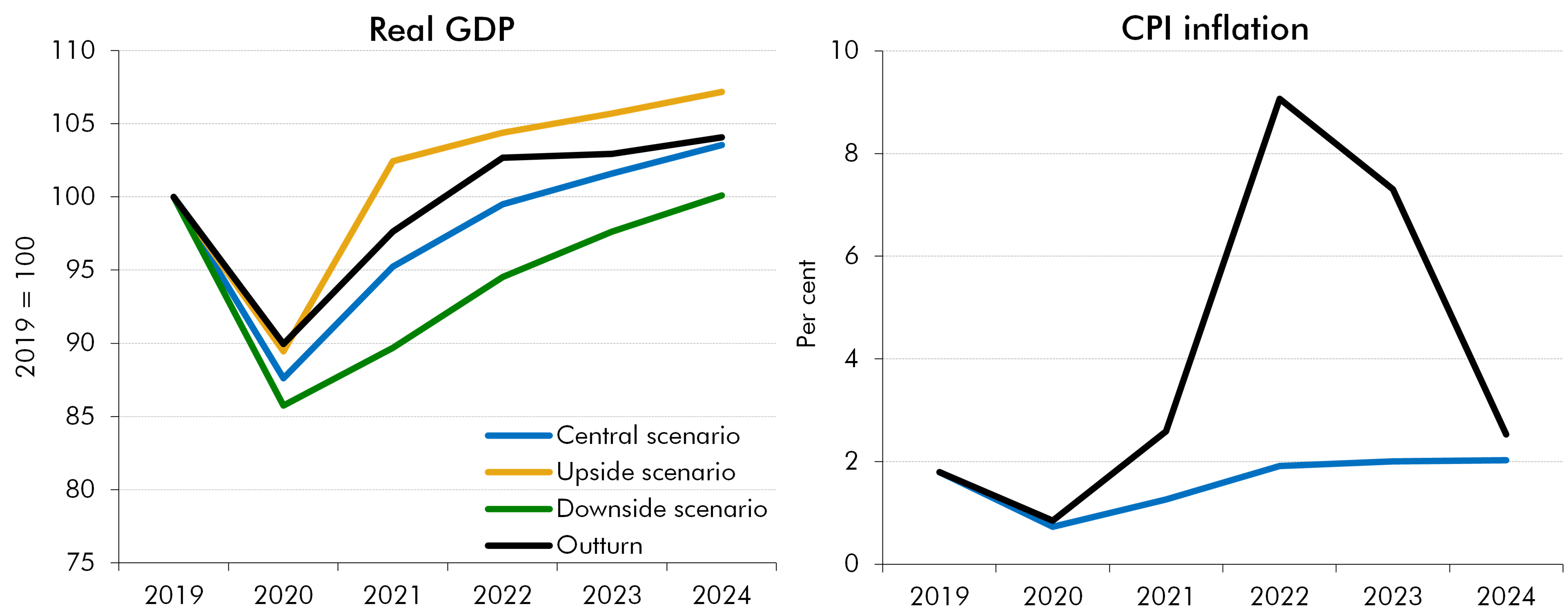
Side-by-side line charts comparing real GDP and CPI inflation outturn against our July 2020 scenarios.
Source: ONS, OBR
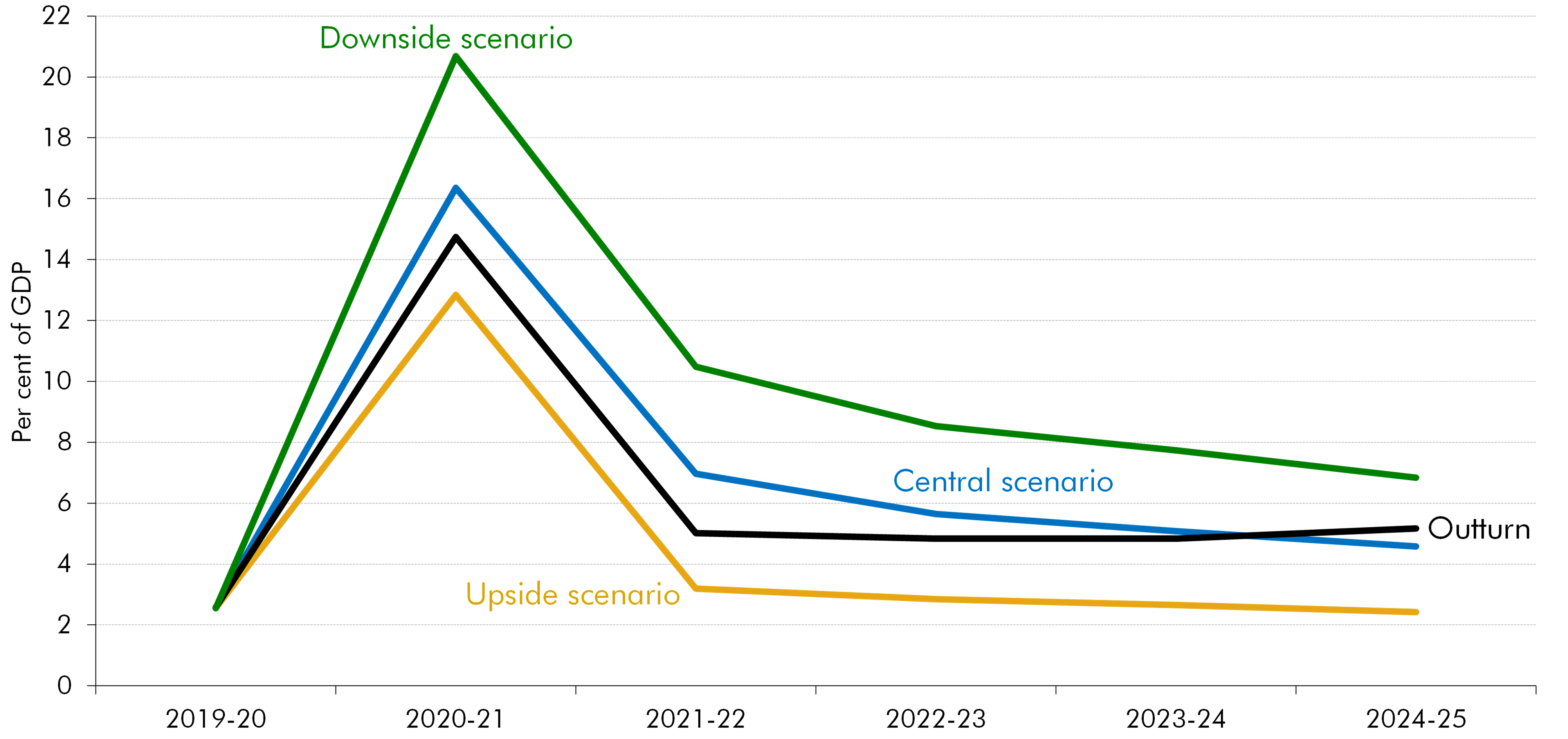
Chart B shows borrowing under each scenario, alongside the outturn over the five-year forecast period. The central scenario assumed a sharp rise in borrowing to 16.4 per cent of GDP in 2020-21 due to the impact of the pandemic, before falling sharply to 7.0 per cent of GDP in 2021-22 as the immediate impact of the pandemic was expected to recede. It was then projected to remain at around 5 per cent of GDP over the rest of the five-year period, which would have been still significantly above pre-pandemic levels.
Outturn borrowing in the short-term forecast years of 2020-21 and 2021-22 was between the upside and central scenario. The scenarios correctly anticipated the very sharp but largely temporary rise in borrowing, largely driven by the government support package, a rise in pandemic-related spending, and a fall in a broad range of receipts. This was particularly concentrated in personal taxes due to falling employment and earnings, and consumption taxes due to the various restrictions that limited consumer spending.
Over the medium term, outturn borrowing was broadly in line with the central scenario. However, this was driven by very large but mostly offsetting factors that were not anticipated at the time the scenarios were produced:
-
It was expected that public spending would moderate after the pandemic and return broadly to pre-pandemic levels. In practice, higher-than-expected inflation from 2021 onwards, described above, pushed up spending compared to the scenarios in areas including debt interest and welfare. In addition, policy decisions were taken to raise departmental expenditure limits compared to previous plans, some of which reflected policy responses to the longer-term health impacts of the pandemic and to inflationary pressures. Overall, total spending was £216 billion higher than the central scenario in 2024-25.
-
This was broadly offset in borrowing by receipts growing more strongly than anticipated. This was driven by the higher-than-expected nominal GDP growth, described above, combined with subsequent policy decisions to raise revenue – including the freezes to personal tax thresholds from April 2021. Overall, receipts were £180 billion higher than the central scenario. Around half was from higher income tax and National Insurance contributions boosted by higher-than-expected earnings and the impact of the threshold freezes.
Chart B: Outturn and July 2020 scenarios for public sector net borrowing
Line chart comparing outturn and July 2020 scenarios for public sector net borrowing.
Source: ONS, OBR
Overall, these scenarios provided a reasonably accurate initial short-term assessment of the potential economic and fiscal impact of the pandemic. This shows the value of producing such scenarios even in times of very high uncertainty. We will continue to use scenarios in our EFOs to illustrate key risks to the central forecast, in line with recommendations from our 2025 external review.b The July 2020 scenarios did not anticipate the inflationary pressures that developed as the pandemic ended and could not have foreseen the subsequent 2022 energy price shock. The resulting much higher-than-expected inflation and nominal GDP growth led to both spending and receipts diverging significantly from the projections in the scenarios over the medium term. Understanding and evaluating the reasons for these divergences has been very important for learning lessons for future forecasts on the impact of inflation on the public finances, as is summarised in Chapter 4 of this report.
a) On an ad-hoc basis, the OBR also produced an initial illustrative scenario on 14 April 2020 to assess the effects of the coronavirus outbreak.
b) See recommendation 8 of Van Geest, L., External Review of the Office for Budget Responsibility, February 2025
Economy forecast
3.7 This section focuses on evaluating the performance of our March 2023 and March 2024 economic forecasts for 2024-25, based on latest outturn data. The performance of the July 2020 central scenario is primarily assessed above in Box 3.1. We also examine how forecast differences for this year compare to our average forecast performance since 2010 and to forecasts made by external analysts.
Conditioning assumptions
3.8 We condition our forecasts on market expectations of interest rates and energy prices. Bank Rate in 2024-25 was significantly higher than the expectations we used in all forecasts considered here (Table 3.1). This was, in large part, due to market participants underestimating the persistence of inflation, and accompanying monetary policy tightness, following the 2022 energy price shock. Oil prices remained elevated in 2024-25 by more than expected and so were slightly higher than our one-year and two-year forecasts (by 2.8 per cent and 4.3 per cent respectively).[footnote 19]
Table 3.1: Bank Rate and oil prices in 2024-25
| Bank Rate (per cent) | Oil prices ($ per barrel) | |||||
|---|---|---|---|---|---|---|
| One-year ahead | Two-year ahead | Five-year ahead | One-year ahead | Two-year ahead | Five-year ahead | |
| Outturn in 2024-25 | 4.9 | 4.9 | 4.9 | 78.3 | 78.3 | 78.3 |
| Forecast | 4.4 | 3.5 | 0.2 | 76.2 | 75.1 | 42.7 |
| Difference | 0.6 | 1.5 | 4.8 | 2.1 | 3.2 | 35.6 |
| Difference (per cent) | 2.8 | 4.3 | 83.5 |
| Source: Bank of England, LSEG Workspace, OBR |
Real GDP
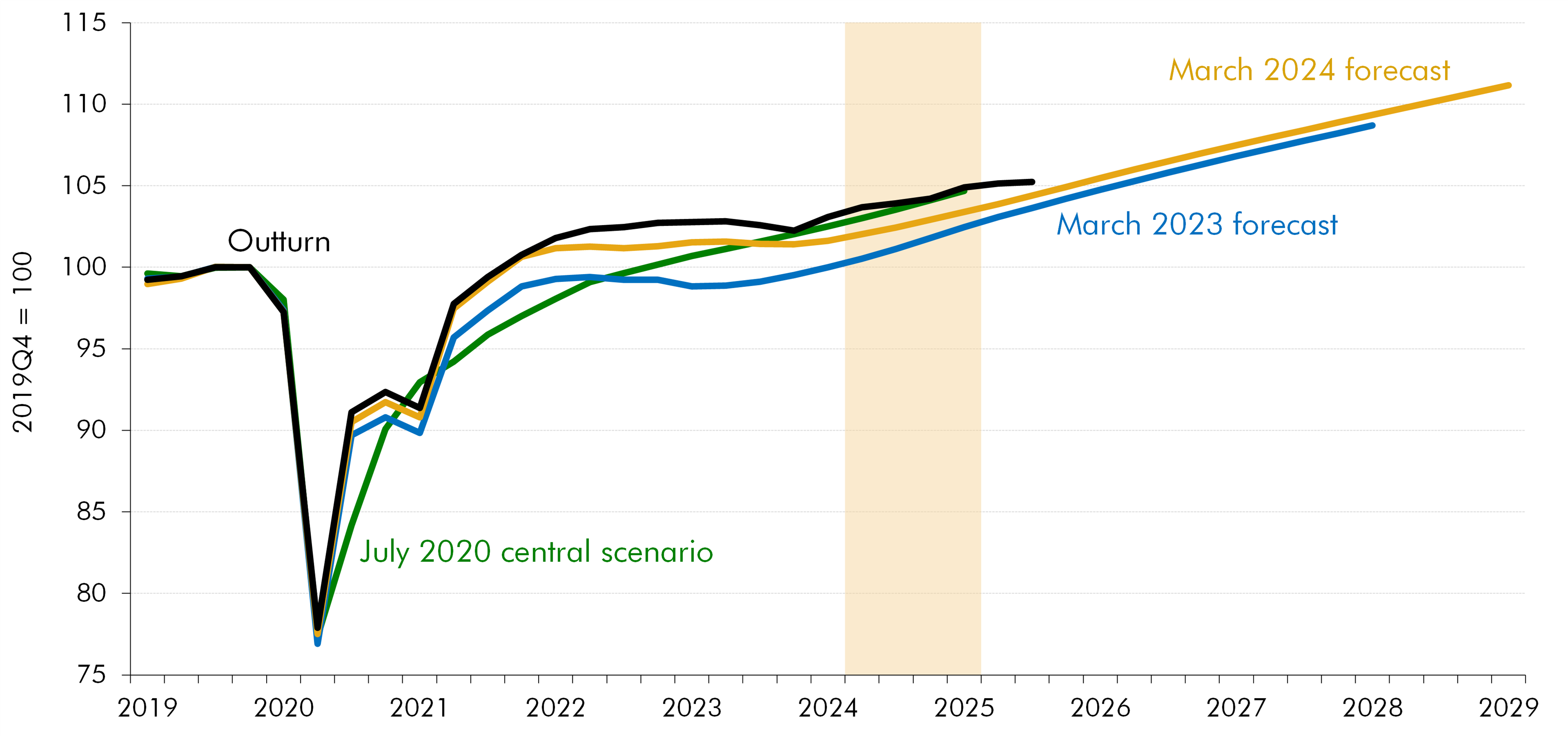
3.9 Looking at our successive forecasts for real GDP growth in 2024-25 (Table 3.2) and the profile for the level of GDP (Chart 3.1):[footnote 20], [footnote 21]
-
The March 2023 two-year ahead forecast incorporated our judgement on the ongoing impact of the 2022 energy price shock. However, cumulative real GDP growth over the subsequent two years underperformed our expectations by 0.8 percentage points, and real GDP growth in 2024-25 was around 0.6 percentage points lower than forecast. This is likely because the forecast did not anticipate the negative impact on real GDP growth of the persistence of inflation and higher interest rates, partly reflecting the forecast conditioning assumptions set out above.
-
The March 2024 one-year ahead forecast underestimated real GDP growth in 2024-25 by 0.3 percentage points. This is slightly below the average one-year ahead forecast difference.[footnote 22] Part of this stronger-than-expected growth may reflect an unanticipated front-loading of trade activity in response to expected changes in US trade policy. In particular, firms may have brought forward exports to the US ahead of potential tariff increases, boosting net exports and GDP growth in the second half of 2024-25 relative to what was assumed at the time of the forecast.
Table 3.2: Real GDP growth
| One-year ahead | Two-year ahead | Five-year ahead | |
|---|---|---|---|
| Annual growth in 2024-25 (per cent) | |||
| Outturn | 1.5 | 1.5 | 1.5 |
| Forecast | 1.2 | 2.1 | 2.0 |
| Difference (percentage point) | 0.3 | -0.6 | -0.5 |
| Cumulative growth to 2024-25 (per cent) | |||
| Outturn | 1.5 | 1.6 | 18.1 |
| Forecast | 1.2 | 2.3 | 20.5 |
| Difference (percentage point) | 0.3 | -0.8 | -2.4 |
| Source: ONS, OBR |
Chart 3.1: Quarterly real GDP level
Line chart showing real GDP level across outturn and forecasts.
Note: The shaded area marks 2024-25.
Source: ONS, OBR
Inflation
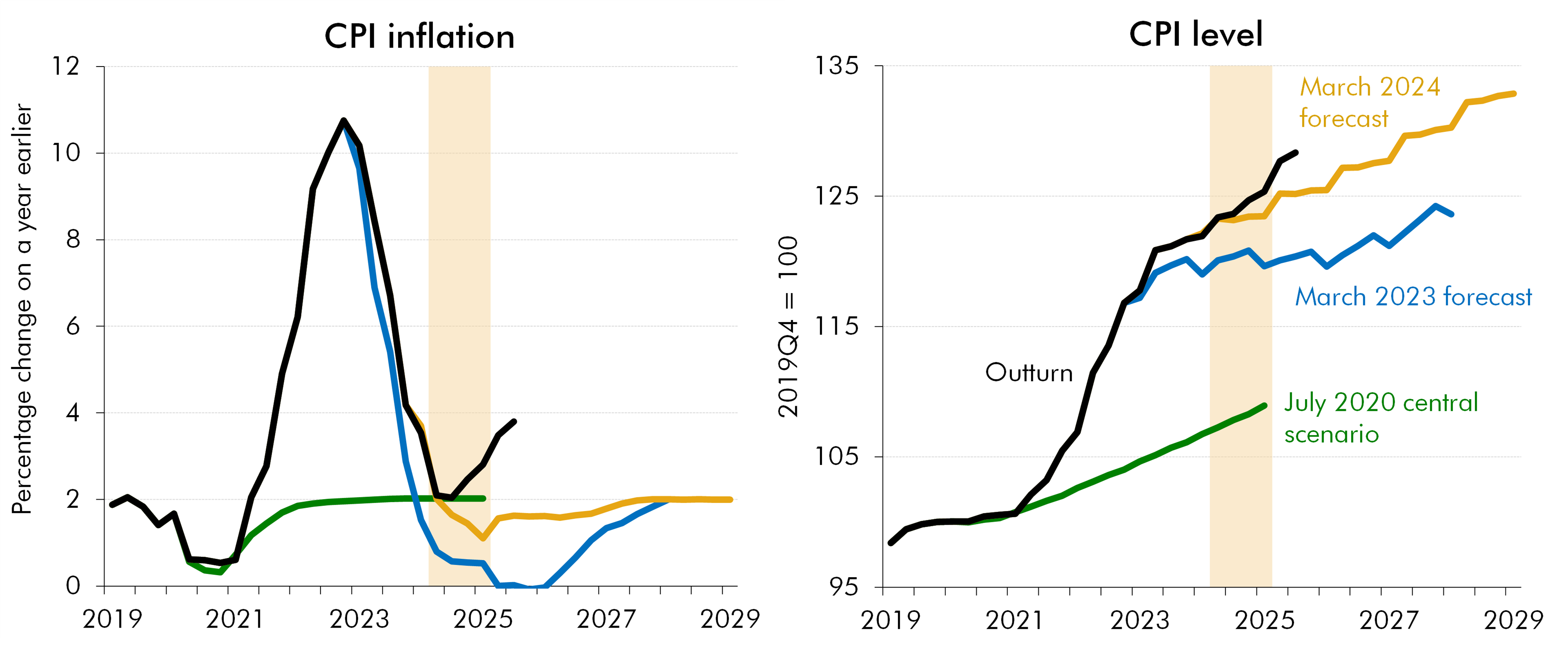
3.10 All three of the forecasts considered here significantly underestimated inflation in 2024-25. The one-year and two-year ahead forecast differences for inflation in this period are notably higher than our average forecast difference. A key driver was our underestimation of inflation persistence following the 2022 energy price shock, as explored in detail in Chapter 4. Looking at successive forecasts:
-
For the March 2023 two-year ahead forecast prices cumulatively rose by 8.2 per cent over the two-year period, 3.4 percentage points above forecast (Table 3.3). While this forecast included an ongoing impact from the 2022 energy price shock, it underestimated the persistence of inflation, assuming instead inflation would fall below the 2 per cent target to 0.6 per cent in 2024-25. Instead, inflation in 2024-25 was 2.4 per cent, which was 1.7 percentage points above forecast. As detailed in Chapter 4, this persistence primarily reflects larger-than-expected second-round effects.
-
For the March 2024 one-year ahead forecast prices rose by 2.4 per cent over the year, 0.8 percentage points above forecast (Table 3.3). Similar to our March 2023 forecast, this forecast also underestimated the persistence of inflation in energy and food prices, as well as second-round effects on wage growth (see more details in Chapter 4). Inflation began to rise in 2024-25, in contrast to our forecast which expected inflation to initially fall before gradually returning to the Bank of England target of 2 per cent by 2027-28.
Chart 3.2: CPI inflation rate and level
Side-by-side line charts showing inflation rate and level for different OBR forecasts.
Note: The shaded area marks 2024-25
Source: ONS, OBR
Table 3.3: CPI inflation
| One-year ahead | Two-year ahead | Five-year ahead | |
|---|---|---|---|
| Annual growth in 2024-25 (per cent) | |||
| Outturn | 2.4 | 2.4 | 2.4 |
| Forecast | 1.6 | 0.6 | 2.0 |
| Difference (percentage point) | 0.8 | 1.7 | 0.3 |
| Cumulative growth to 2024-25 (per cent) | |||
| Outturn | 2.4 | 8.2 | 23.8 |
| Forecast | 1.6 | 4.8 | 7.7 |
| Difference (percentage point) | 0.8 | 3.4 | 16.0 |
| Source: ONS, OBR |
Labour market
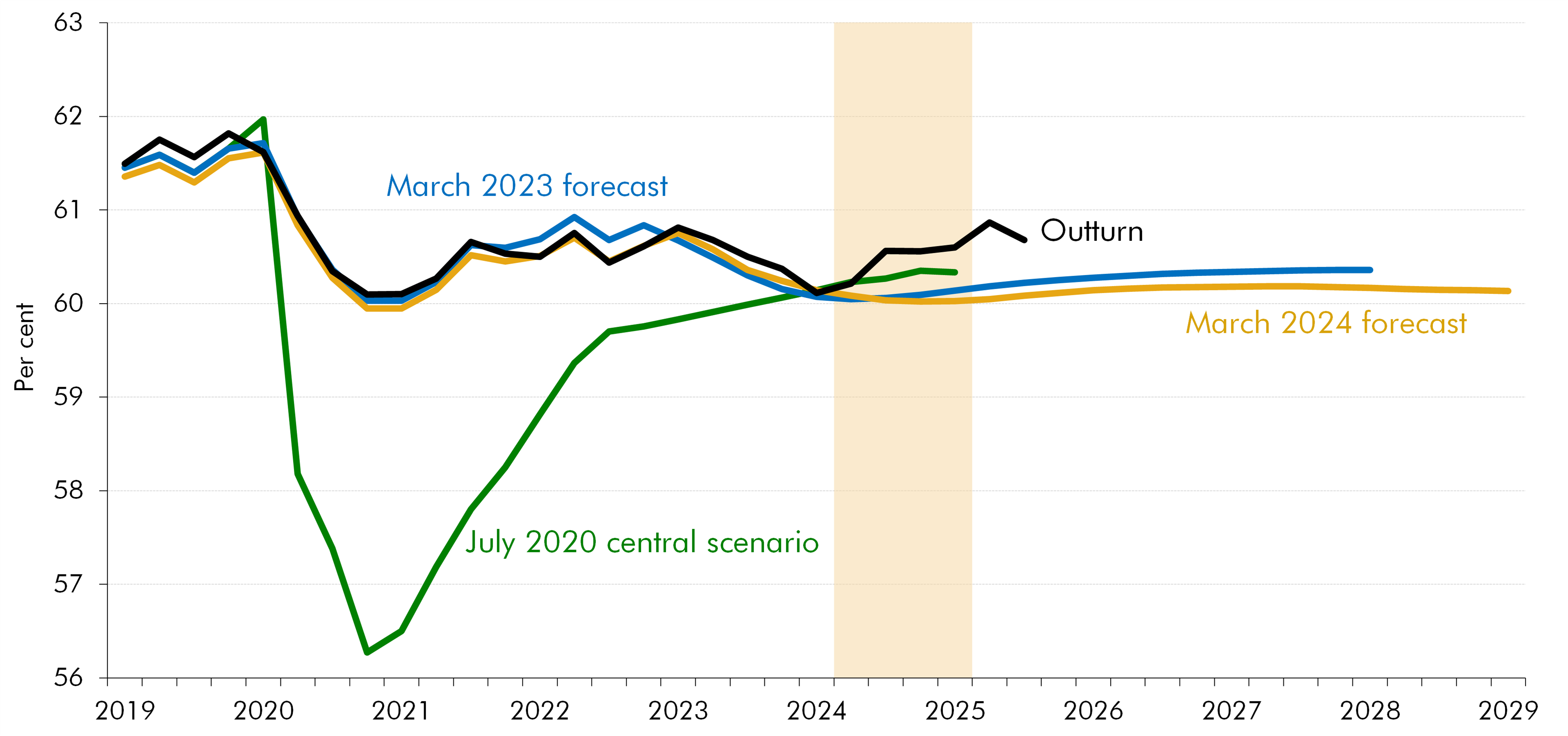
3.11 Our forecasts underestimated the employment rate in 2024-25 (Chart 3.3), though by small margins compared to our average historical forecast differences.[footnote 23] For the one-year and two-year ahead forecasts, the forecast undershoot likely reflects an overestimation of the sensitivity of the labour market to higher inflation and interest rates, with employment proving more resilient than expected. The overall level of employment was also higher than our forecasts. This is due to a combination of a higher-than-forecast employment rate, and the impact of the higher-than-expected spike in net migration, due in part to ONS data revisions showing migration to have been higher than previously thought.[footnote 24]
Chart 3.3: Employment rate
Line chart showing employment rate across outturn and forecasts.
Note: The shaded area marks 2024-25.
Source: ONS, OBR
3.12 Our forecasts for nominal earnings underestimated the pace of growth in 2024-25 by between 2.5 and 3.9 percentage points, reflecting our underestimation of inflation persistence, prolonged labour market tightness, and higher-than-expected public sector pay awards. We also underestimated real earnings growth by between 1.2 and 3.8 percentage points. This is because a tight labour market meant workers were able to recover some of the real wage losses from previous years (as noted in our 2024 and 2025 FERs).
Table 3.4: Nominal and real earnings growth
| Nominal earnings | Real earnings | |||||
|---|---|---|---|---|---|---|
| One-year ahead | Two-year ahead | Five-year ahead | One-year ahead | Two-year ahead | Five-year ahead | |
| Annual growth in 2024-25 (per cent) | ||||||
| Outturn | 5.6 | 5.6 | 5.6 | 2.4 | 2.4 | 2.4 |
| Forecast | 3.1 | 1.7 | 3.2 | 1.2 | 0.8 | -1.5 |
| Difference (percentage point) | 2.5 | 3.9 | 2.3 | 1.2 | 1.5 | 3.8 |
| Cumulative growth to 2024-25 (per cent) | ||||||
| Outturn | 5.6 | 11.5 | 25.6 | 2.4 | 2.8 | -14.9 |
| Forecast | 3.1 | 5.8 | 13.7 | 1.2 | 1.5 | -1.8 |
| Difference (percentage point) | 2.5 | 5.7 | 11.8 | 1.2 | 1.3 | -13.0 |
| Source: ONS, OBR |
Nominal GDP
3.13 As a result of the higher-than-expected inflation, these forecasts also underestimated cumulative nominal GDP growth – a key driver of the fiscal forecast (Table 3.5). Looking at successive forecasts:
-
The March 2023 two-year ahead forecast underestimated nominal GDP growth by 1.8 percentage points in 2024-25 due to underestimating GDP deflator growth by 2.5 percentage points. Cumulatively over the two-year period, nominal GDP growth was 4.7 percentage points above forecast, reflecting an underestimate of GDP deflator growth of 5.4 percentage points and an overestimate of real GDP growth of 0.8 percentage points.
-
The March 2024 one-year ahead forecast underestimated nominal GDP growth by 3.6 percentage points, primarily reflecting higher-than-expected GDP deflator growth (by 3.2 percentage points) and real GDP growth (0.3 percentage points).
Table 3.5: Nominal GDP and GDP deflator
| Nominal GDP | GDP deflator | |||||
|---|---|---|---|---|---|---|
| One-year ahead | Two-year ahead | Five-year ahead | One-year ahead | Two-year ahead | Five-year ahead | |
| Annual growth in 2024-25 (per cent) | ||||||
| Outturn | 5.5 | 5.5 | 5.5 | 4.0 | 4.0 | 4.0 |
| Forecast | 2.0 | 3.7 | 4.1 | 0.8 | 1.6 | 2.0 |
| Difference (percentage point) | 3.6 | 1.8 | 1.5 | 3.2 | 2.5 | 2.0 |
| Cumulative growth to 2024-25 (per cent) | ||||||
| Outturn | 5.5 | 11.2 | 39.0 | 4.0 | 9.6 | 23.6 |
| Forecast | 2.0 | 6.6 | 28.5 | 0.8 | 4.1 | 6.5 |
| Difference (percentage point) | 3.6 | 4.7 | 10.5 | 3.2 | 5.4 | 17.2 |
| Source: ONS, OBR |
3.14 Looking at the level of nominal GDP (Chart 3.4), some of the forecast differences reflect revisions to the level of nominal GDP from successive ONS Blue Book revisions, which affect the base against which forecast differences are assessed:
-
Revisions following Blue Book 2023, published after our March 2023 forecast, showed that the economy had grown more quickly and more strongly from the pandemic than initially estimated, raising estimates of nominal GDP notably in 2021 and 2022.
-
Similarly, nominal GDP was revised up further at Blue Book 2024, published after both our March 2023 and March 2024 forecasts. This was driven by upward adjustments to the government consumption deflator and the terms of trade, and greater real growth concentrated in transport, professional, and business support services industries.
-
Blue Book 2025 revisions further raised the level of nominal GDP, mostly from periods before the pandemic.[footnote 25] This was largely driven by improved research and development (R&D) data and updates to the measure of activities of large multinational pharmaceutical companies.
Chart 3.4: Nominal GDP level
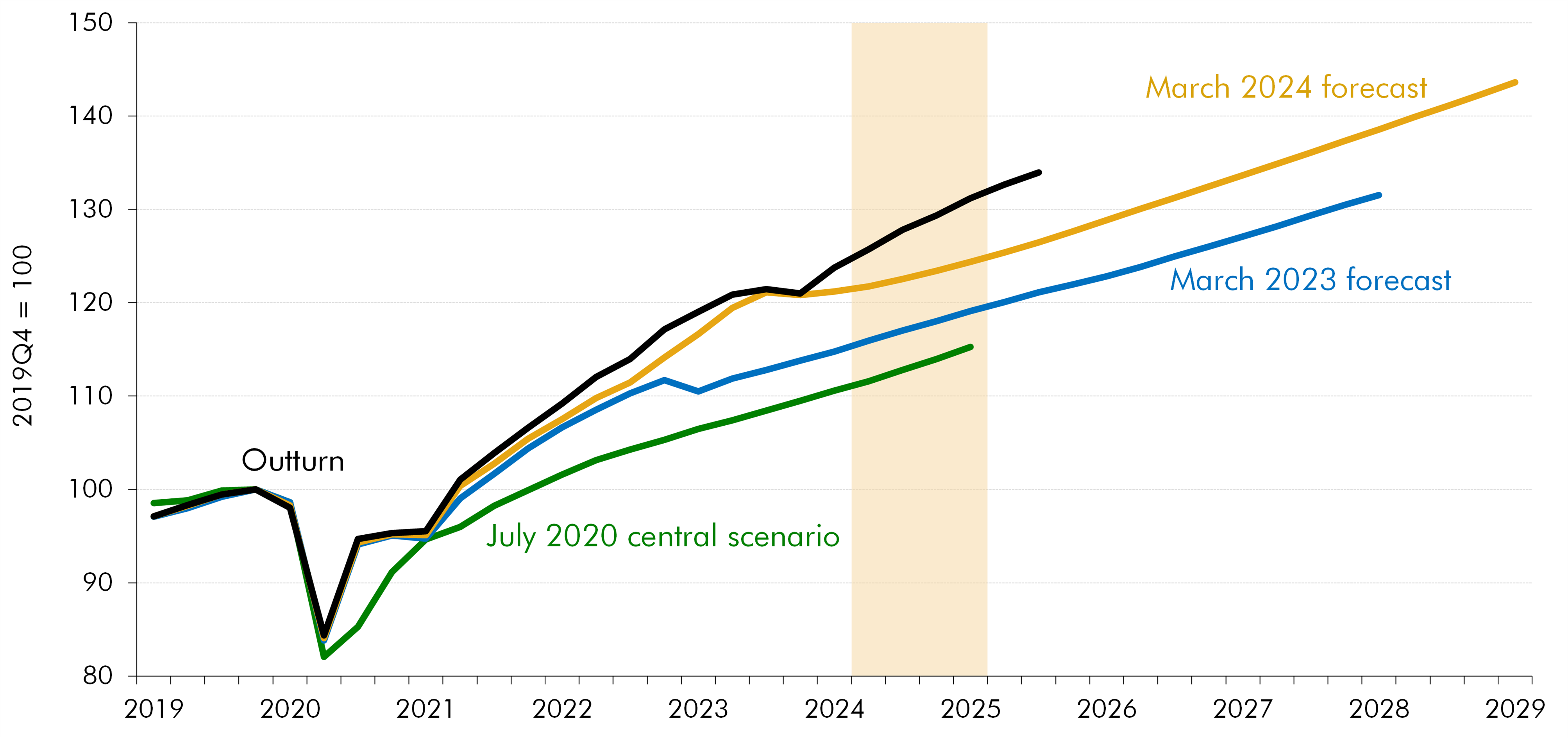
Line chart showing nominal GDP level across outturn and forecasts.
Note: The shaded area marks 2024-25.
Source: ONS, OBR
Fiscal forecasts for 2024-25
Introduction
3.15 This section focuses on assessing the performance of the March 2023 and March 2024 fiscal forecasts for the 2024-25 financial year. The performance of the July 2020 central scenario is primarily assessed above in Box 3.1. We explore the differences between our forecast and the latest outturn data for:
-
public sector net borrowing (PSNB);
-
the receipts and spending forecasts that underpinned this borrowing forecast; and
-
public sector net debt (PSND).
3.16 Where possible, we use our usual approach in FERs, breaking down differences between outturn data and our fiscal forecasts into four categories:[footnote 26]
-
policy changes – differences due to policies announced after the publication of the forecast at their initial costing value;
-
economic factors – differences due to the changes in underlying economic conditions relative to our initial forecast;
-
classification changes – differences due to items being reclassified into or out of the public sector following the forecast;[footnote 27] and
-
fiscal forecasting differences – any remaining differences that cannot be explained by the other categories, such as those related to how well the underlying forecast model matches reality, judgements that we impose on top of the effects of economic determinants, or the impact of recostings between forecasts.
Borrowing
3.17 PSNB in 2024-25 was £152 billion (5.2 per cent of GDP). As a per cent of GDP, outturn borrowing was higher than each forecast, as higher cash borrowing was only partly offset by a larger nominal economy (Chart 3.5). The differences between our initial forecasts for cash PSNB and outturn in 2024-25, broken down by the contributions from receipts and spending, are shown in Chart 3.6 and can be summarised as follows:[footnote 28]
-
The March 2023 two-year ahead forecast for borrowing in 2024-25 was £85 billion (3.2 per cent of GDP), which was £66 billion (2.0 per cent of GDP) lower than outturn. This difference was largely driven by higher-than-expected spending which was primarily due to the persistence of inflation and interest rates raising debt interest and welfare spending, policy increases to spending on departmental expenditure limits (DELs), and also a large fiscal forecasting difference for other current spending, which is explained further below. This was only partially offset by higher-than-expected receipts, of which over half was from income tax and National Insurance contributions (NICs).
-
The March 2024 one-year ahead forecast for borrowing in 2024-25 was £87 billion (3.1 per cent of GDP) – very similar to the March 2023 forecast – and was £65 billion (2.0 per cent of GDP) lower than outturn. While receipts outturn were in line with forecast, outturn spending was considerably higher, mostly driven by the same factors affecting the March 2023 forecast.
Chart 3.5: Borrowing as a share of GDP
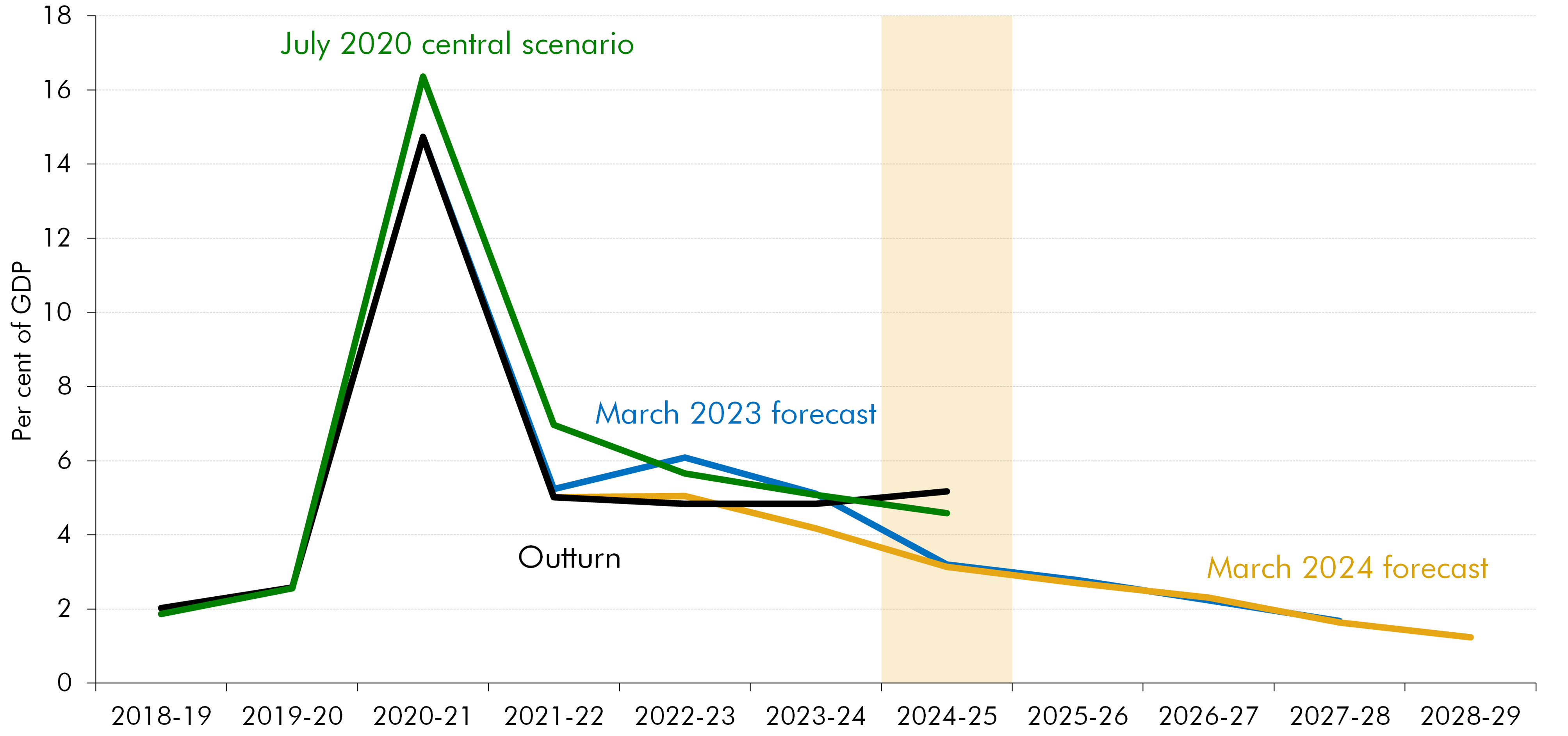
Line chart showing borrowing forecasts and outturn as a share of GDP.
Note: PSNB is shown as the share of GDP forecast at the time. The shaded area marks 2024-25.
Source: ONS, OBR
Chart 3.6: Drivers of differences between borrowing forecasts and 2024-25 outturn
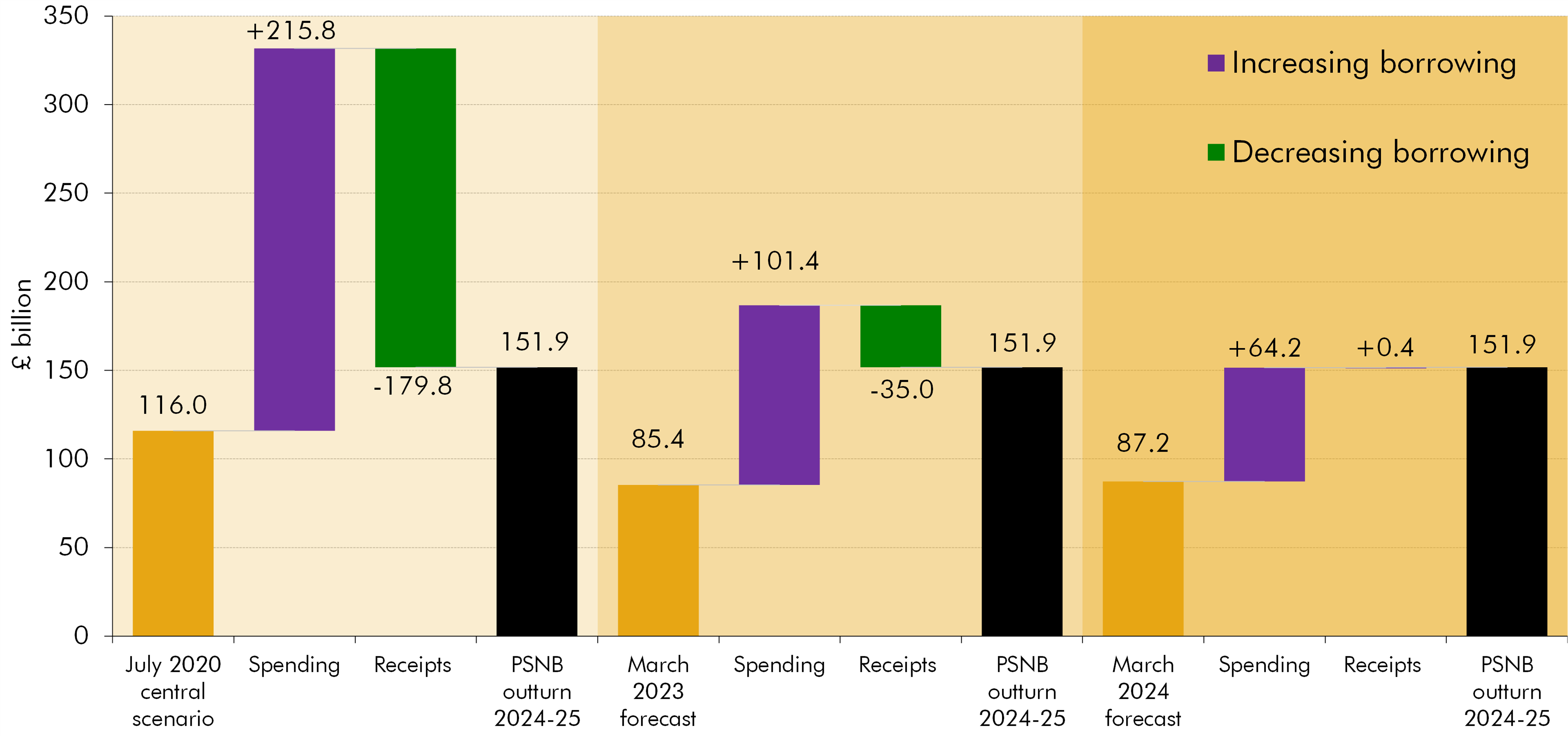
Waterfall chart showing the drivers of difference between borrowing forecasts and 2024-25 outturn.
Source: ONS, OBR
Receipts
3.18 Public sector current receipts (PSCR) in 2024-25 were £1,139 billion (38.8) per cent of GDP. This was £35 billion (3.2 per cent) higher than the March 2023 two-year ahead forecast and broadly in line with the March 2024 one-year ahead forecast. However, as a share of GDP, PSCR was 2.6 per cent of GDP and 2.1 per cent of GDP lower than the March 2023 and March 2024 forecasts, respectively (Chart 3.7).
3.19 As outlined in paragraph 3.13, outturn nominal GDP was much higher than assumed in these forecasts. A large share of this increase was due to data revisions to previous periods, which increased the level of nominal GDP, in particular in 2021 and 2022.[footnote 29] There were no revisions to the quantity of cash receipts received by HMRC over these periods. Therefore, the higher level of nominal GDP had the effect of mechanically lowering receipts as a share of nominal GDP, meaning the economy was less ‘tax rich’ than we understood when producing the March 2023 and March 2024 forecasts.
Chart 3.7: Receipts as a share of GDP
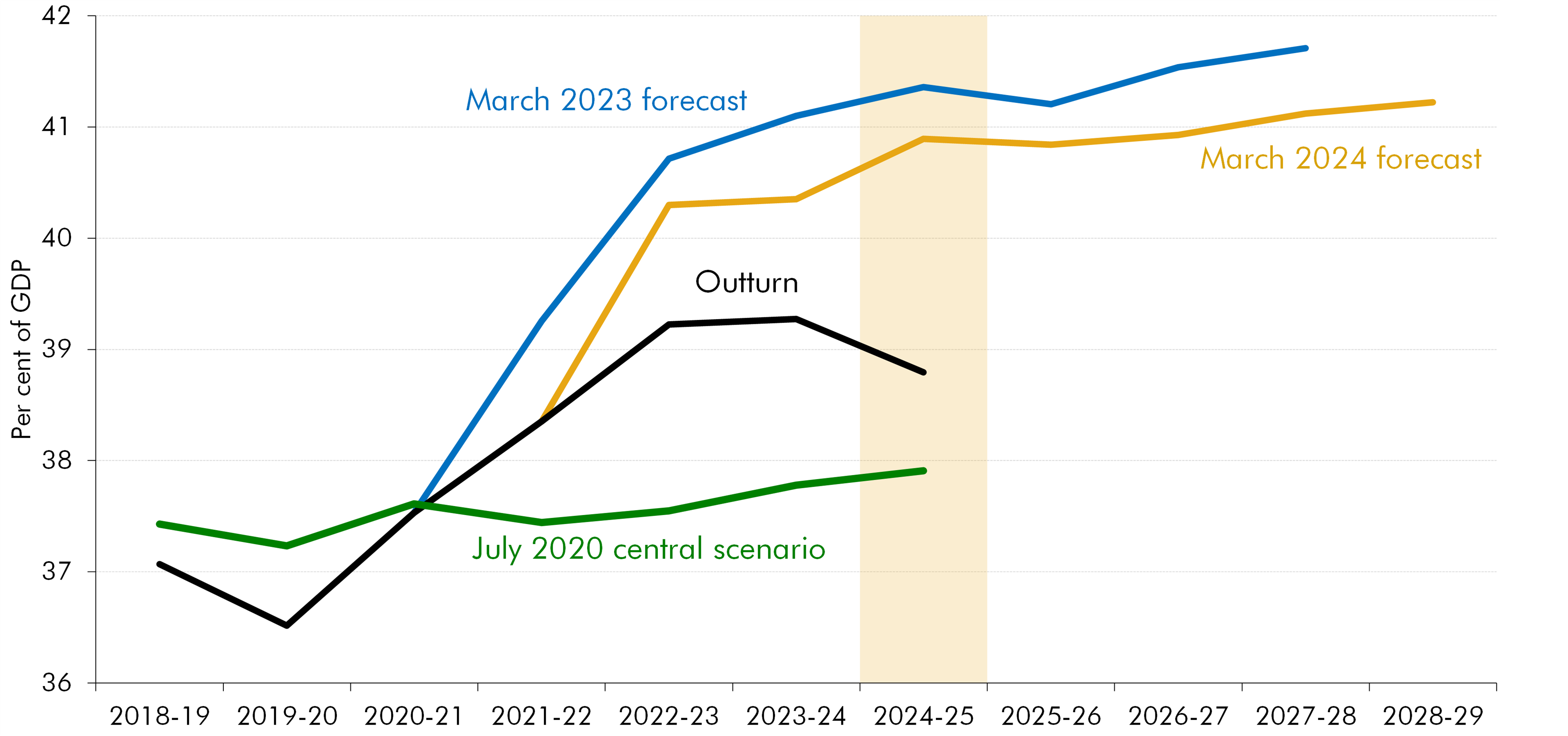
Line chart showing receipts forecasts and outturn as a share of GDP.
Note: PSCR is shown as the share of GDP forecast at the time. The shaded area marks 2024-25.
Source: ONS, OBR
3.20 In cash terms, the contributions to forecast differences between receipts and outturn can be categorised into differences due to economic determinants, policy, classification changes, and other fiscal forecasting factors, as set out in paragraph 3.16. Differences due to economic determinants overall pushed up receipts in 2024-25 by £68 billion compared to the March 2023 forecast and by £20 billion compared to the March 2024 forecast (Chart 3.8). The largest contributors to this were:
-
Higher-than-expected nominal earnings and employment significantly boosted income tax and NICs, accounting for £41 billion and £13 billion of the forecast differences with the March 2023 and 2024 forecasts, respectively. This was largely driven by the persistence of inflationary pressure and prolonged labour market tightness, as outlined above.
-
Higher-than-forecast nominal consumption, which largely affects VAT receipts, accounting for £8 billion of the March 2023 forecast difference but was lower than expected in the March 2024 forecast reducing the forecast difference by £1 billion. The difference to the March 2023 forecast is largely explained by the impact of higher-than-expected inflation feeding through to nominal consumption. Although outturn inflation was also higher than expected at our March 2024 forecast, nominal consumption was lower than forecast. Households increased savings at a greater rate than anticipated so that a higher income forecast did not fully feed into consumption.
-
Higher profits, which largely affect corporation tax receipts, accounting for £8 billion of the forecast difference compared to the March 2023 forecast, and £2 billion compared to the March 2024 forecast. This was likely driven by higher domestically generated inflation than anticipated in 2023, feeding through to a broad range of GDP income components, including profits.
-
A set of other economic factors accounting for £10 billion and £6 billion of the forecast difference to our March 2023 and 2024 forecasts, respectively. These included higher-than-expected Bank Rate, boosting interest and dividend receipts, and the impact of higher-than-forecast property prices and transactions on stamp duty land tax. The larger nominal economy also likely resulted in higher-than-expected revenues across several smaller receipts lines.
3.21 There were several significant tax policy changes introduced after the March 2023 forecast was produced that reduced receipts compared to forecast by an estimated £22 billion in 2024-25. The 2p reductions to the main rate of employee NICs at Autumn Statement 2023 and Spring Budget 2024 were estimated at the time to reduce NICs by a combined £19 billion in 2024-25. The freeze to fuel duty included in Spring Budget 2024 and the business rate relief at Autumn Statement 2023 were also estimated at the time to reduce receipts by £3.1 billion and £2.4 billion respectively. The differences in the actual yield from these measures compared to the initial costing are captured in fiscal forecast differences, explained below.
3.22 The small difference due to classification changes largely reflects the ONS not yet incorporating receipts from the capacity markets scheme in outturn data. As these receipts will be incorporated by the ONS in future, we include them in our forecasts. There is a partial offset from warm home discount receipts that were not included in any of the forecasts analysed but have been incorporated into ONS outturn. These receipts are fiscally neutral and fully offset in spending.
Chart 3.8: Contributions to overall receipts forecast differences
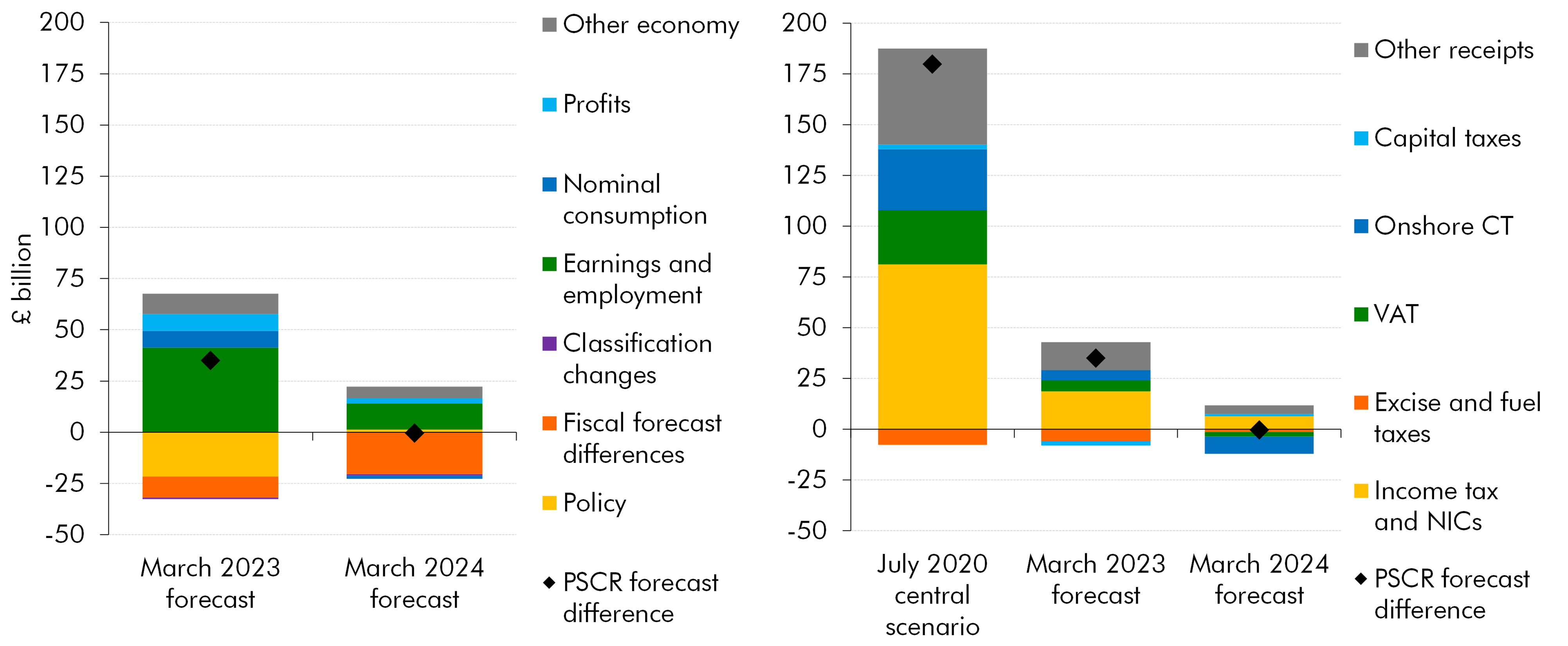
Side-by-side stacked bar charts showing receipts forecast differences for 2024-25.
Note: Due to a lack of ready-reckoning infrastructure that is consistent with the July 2020 scenario and the related elasticities, we are unable to accurately provide a split for impacts from economic factors and fiscal forecasting differences for July 2020. Therefore, a breakdown for the July 2020 central scenario is not provided in the left panel of Chart 3.8.
Source: HMRC, ONS, OBR
3.23 The following section decomposes total forecast differences by tax stream (Table 3.6), summarising the impact from economic factors, policy, classification changes, and a specific focus on the fiscal forecast differences, which are used to inform our fiscal forecast development programme outlined in Chapter 4. Overall, there are negative fiscal forecast differences between the March 2023 and March 2024 forecasts and outturn of £10 billion and £20 billion, respectively:[footnote 30]
-
Income tax and NICs are the largest contributor to overall receipts forecast differences, mainly driven by higher-than-expected nominal earnings which pushed up receipts compared to forecast, as described above. For the March 2023 forecast, this was partially offset by the policy decisions to reduce the main rate of employee NICs (paragraph 3.21). For both the March 2023 and March 2024 forecasts, there is also an offset from negative fiscal forecast differences, which are mostly explained by shortfalls in the forecast for self assessment income tax. This likely relates to weakness in partnership income. We are therefore conducting a review of partnership income, which is highly volatile with relatively large historical forecast differences, ahead of our next forecast.
-
Value added tax (VAT) receipts were underestimated in the March 2023 forecast but slightly overestimated in the March 2024 forecast. As set out in paragraph 3.20, higher nominal consumption boosted VAT receipts compared to the March 2023 forecast, more than explaining the overall forecast difference. The partial offset from the negative fiscal forecast difference may be explained by a lower-than-expected standard VAT-rated share of consumer spending. The difference to the March 2024 forecast was more than explained by lower nominal consumption.
-
Onshore corporation tax (onshore CT) was underestimated in the March 2023 forecast but overestimated in the March 2024 forecast. Higher profits boosted receipts for both the March 2023 and 2024 forecasts (paragraph 3.20) but in each instance this was partly offset by higher gross fixed capital formation, meaning more use of capital allowances. The large negative fiscal forecast difference for the March 2024 forecast was concentrated in small company corporation tax. As highlighted in the 2025 FER, we have reviewed the income and deduction components of taxable profits in response to this. We will be reviewing equations for income and deduction components in the rest of the onshore CT forecast further ahead of our next forecast, as explained further in Chapter 4.
-
Excise and fuel taxes were overestimated in both the March 2023 and 2024 forecasts. Receipts were boosted, compared to the March 2023 forecast, by higher inflation on the indexation of fuel, alcohol and tobacco receipts. However, this was more than offset by successive policy decisions to freeze fuel duty rates and large fiscal forecast differences for excise taxes. Outturn was much closer to our March 2024 forecast but there remained a large fiscal forecast difference concentrated in tobacco receipts. Analysis showed that these fiscal forecast differences were likely driven by lower-than-expected underlying consumption across both alcohol and tobacco, and we therefore revised down consumption trends in our November 2025 forecast.[footnote 31] We also increased the price elasticities for hand-rolling tobacco to assume a greater responsiveness from consumers to price changes.
-
Capital taxes were overestimated in the March 2023 forecast but underestimated in the March 2024 forecast. Higher residential property prices and transactions boosted capital tax receipts for both forecasts, with a partial offset from lower equity prices for the March 2023 forecast. Fiscal forecasting differences can be mostly explained by an assumption that the high gains realised during 2020-21 and 2021-22 would unwind for only one year, after which receipts growth would return to its long-run trend. However, capital gains tax (CGT) liabilities in 2023-24 were weaker than expected, reflecting a more prolonged unwinding of gains, and highlighting the volatility of CGT revenues. We are investigating historical CGT liabilities data further to help inform future forecast judgements, as detailed in the fiscal model assessment database that accompanies this report.
-
Other receipts were underestimated at each forecast. There was a sizeable impact from economic determinants, notably a larger nominal economy, as outlined in paragraph 3.20. Around one-third of the positive fiscal forecast difference for the March 2023 forecast was in insurance premium tax (IPT) and analysis of historical forecast differences point to a bias within the IPT forecast of consistently underestimating receipts. The negative fiscal forecast difference for the March 2024 forecast was driven by a broad range of receipts. We are reviewing several components of other receipts as part of our forecast development programme and more detail is provided in the fiscal model assessment database that accompanies this report.
Table 3.6: Receipts forecast differences for 2024-25 by receipts stream
| £ billion | |||||||
|---|---|---|---|---|---|---|---|
| of which: | |||||||
| Forecast | Outturn | Difference | Economic factors | Policy changes | Classification changes | Fiscal forecasting difference | |
| Income tax and NICs | |||||||
| July 2020 | 396.1 | 477.3 | 81.2 | -8.3 | 0.0 | ||
| March 2023 | 458.6 | 477.3 | 18.8 | 43.6 | -19.2 | 0.0 | -5.6 |
| March 2024 | 470.8 | 477.3 | 6.5 | 13.3 | 0.1 | 0.0 | -7.0 |
| Value added tax | |||||||
| July 2020 | 146.6 | 173.3 | 26.7 | 1.2 | 0.0 | ||
| March 2023 | 167.9 | 173.3 | 5.3 | 7.8 | 0.6 | 0.0 | -3.0 |
| March 2024 | 175.6 | 173.3 | -2.3 | -3.2 | 0.6 | 0.0 | 0.3 |
| Onshore corporation tax(1) | |||||||
| July 2020 | 60.1 | 90.0 | 29.9 | 9.3 | 0.0 | ||
| March 2023 | 85.1 | 90.0 | 4.9 | 5.5 | 1.3 | 0.0 | -1.9 |
| March 2024 | 98.4 | 90.0 | -8.5 | 0.4 | 0.2 | 0.0 | -9.1 |
| Excise and fuel taxes(2) | |||||||
| July 2020 | 52.5 | 44.8 | -7.7 | -9.8 | 0.0 | ||
| March 2023 | 50.8 | 44.8 | -6.0 | 1.7 | -3.4 | 0.0 | -4.3 |
| March 2024 | 46.2 | 44.8 | -1.4 | -0.1 | 0.0 | 0.0 | -1.2 |
| Capital taxes(3) | |||||||
| July 2020 | 39.2 | 41.5 | 2.3 | 0.3 | 0.0 | ||
| March 2023 | 43.4 | 41.5 | -1.9 | 0.0 | 0.5 | 0.0 | -2.5 |
| March 2024 | 40.5 | 41.5 | 1.0 | 1.7 | 0.1 | 0.0 | -0.9 |
| Other receipts | |||||||
| July 2020 | 264.4 | 311.8 | 47.4 | 9.0 | -0.4 | ||
| March 2023 | 297.9 | 311.8 | 13.9 | 8.9 | -1.3 | -0.7 | 7.0 |
| March 2024 | 307.6 | 311.8 | 4.3 | 7.4 | 0.3 | -0.9 | -2.5 |
| 1) Excludes Pillar 2 taxes. |
| 2) Includes fuel, alcohol, and tobacco duties. |
| 3) Includes capital gains tax, inheritance tax, and stamp duties. |
| Note: Due to a lack of ready-reckoning infrastructure that is consistent with the July 2020 scenario and the related elasticities, we are unable to accurately provide a split for impacts from economic factors and fiscal forecasting differences for July 2020. We do provide the impact from policy and classification changes but this will not sum to the total difference between forecast and outturn. In the supplementary material that accompanies this FER we do provide this breakdown against the March 2020 forecast. |
| Source: HMRC, ONS, OBR |
Spending
3.24 Total managed expenditure (TME) in 2024-25 was £1,291 billion (44.0 per cent of GDP). In cash terms, this was £101 billion (9 per cent) higher than the March 2023 two-year ahead forecast and £64 billion (5 per cent) higher than the March 2024 one-year ahead forecast. As a share of GDP, TME in 2024-25 was 0.6 per cent of GDP lower than the March 2023 forecast, but in line with the March 2024 forecast (Chart 3.9). The underestimate of cash spending was broadly offset by higher-than-expected nominal GDP due to the data revisions and forecast differences described above.
Chart 3.9: Spending as a share of GDP
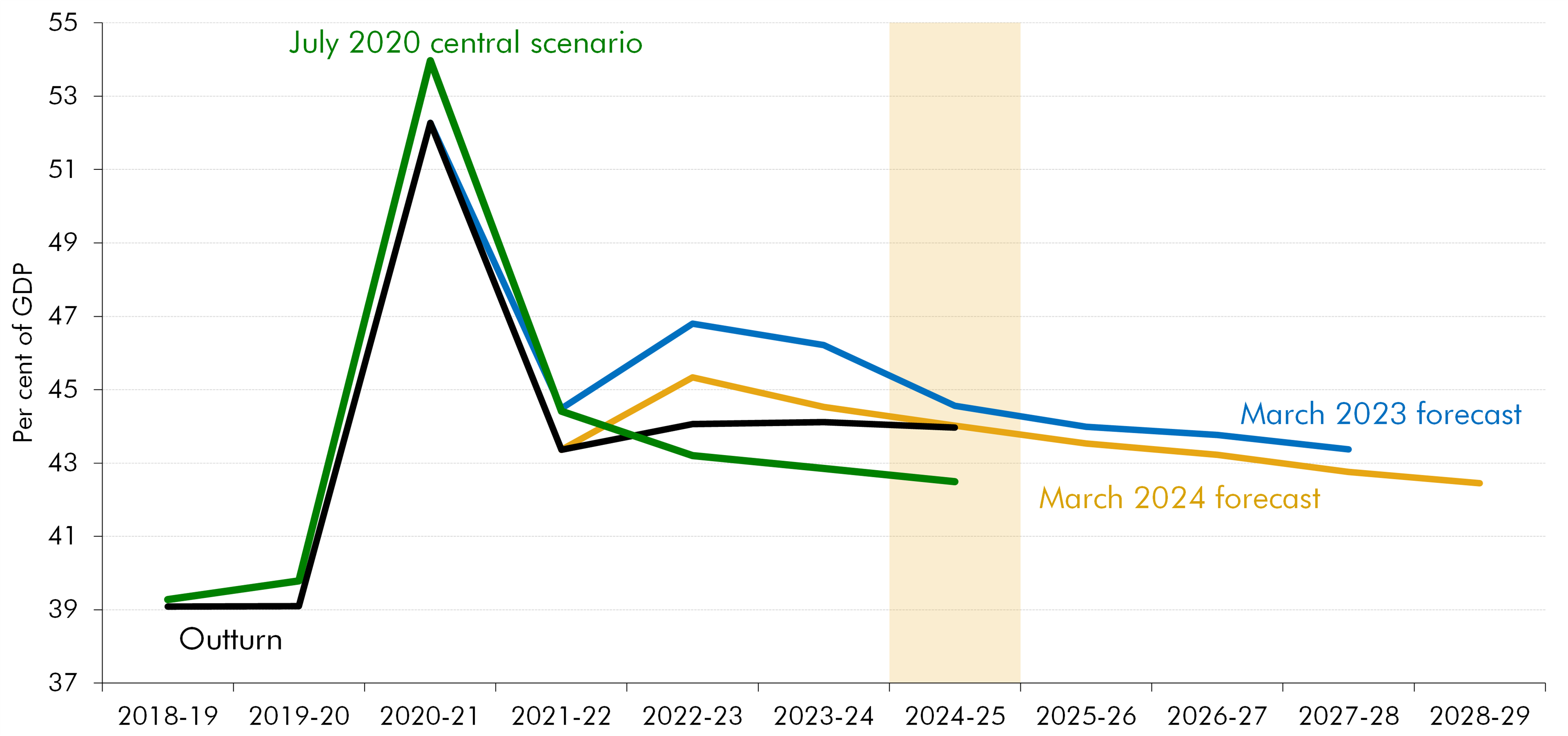
Line chart showing spending forecasts and outturn as a share of GDP.
Note: TME is shown as the share of GDP forecast at the time. The shaded area marks 2024-25.
Source: ONS, OBR
3.25 In cash terms, the contributions to spending forecast differences can be categorised into differences due to economic determinants, policy, classification changes, and other fiscal forecasting factors, as set out in paragraph 3.16. Changes in the economic determinants which drive welfare and debt interest spending pushed up spending in 2024-25 by £40 billion compared to the March 2023 forecast and by £18 billion compared to the March 2024 forecast (Chart 3.10). The largest differences due to changes in the economy forecast were:
-
Higher-than-expected inflation and earnings growth driving higher benefit uprating account for £6 billion of the forecast difference for welfare spending compared to the March 2023 forecast. Higher debt interest spending due to higher inflation account for £16 billion and £10 billion of the forecast differences for debt interest spending compared to the March 2023 and March 2024 forecasts, respectively.
-
Higher-than-expected interest rates account for £9 billion and £2.5 billion of the forecast differences for debt interest spending compared to the March 2023 and March 2024 forecasts, respectively. Additionally, interest losses on the Asset Purchase Facility (APF) are partially explained by higher Bank Rate, which accounts for £10 billion and £5 billion of the forecast difference in debt interest spending compared to the March 2023 and March 2024 forecasts, respectively.
3.26 Substantial spending policy changes introduced after the March 2023 forecast affected spending in 2024-25. Policy changes account for £32 billion and £26 billion of the forecast differences for TME compared to the March 2023 and March 2024 forecasts, respectively. Predominantly, these were due to policy changes which increased DEL spending by £33 billion above the forecast made in March 2023, with resource departmental expenditure limits (RDEL) accounting for £30 billion of this. The increase in 2024-25 DEL spending following the March 2024 forecast was explored in depth in the October 2024 Review of the March 2024 forecast for departmental expenditure limits.
3.27 There is a small difference due to classification changes, largely reflecting the incorporation of the capacity markets scheme and the warm home discount mentioned in paragraph 3.22. Additionally, from the March 2024 forecast, the Scottish block grant was reclassified from annually managed expenditure (AME) to DEL, representing around £45 billion. This reclassification explains over half of the total forecast difference for DEL at each forecast, but did not affect TME or PSNB.
Chart 3.10: Contributions to overall spending forecast differences
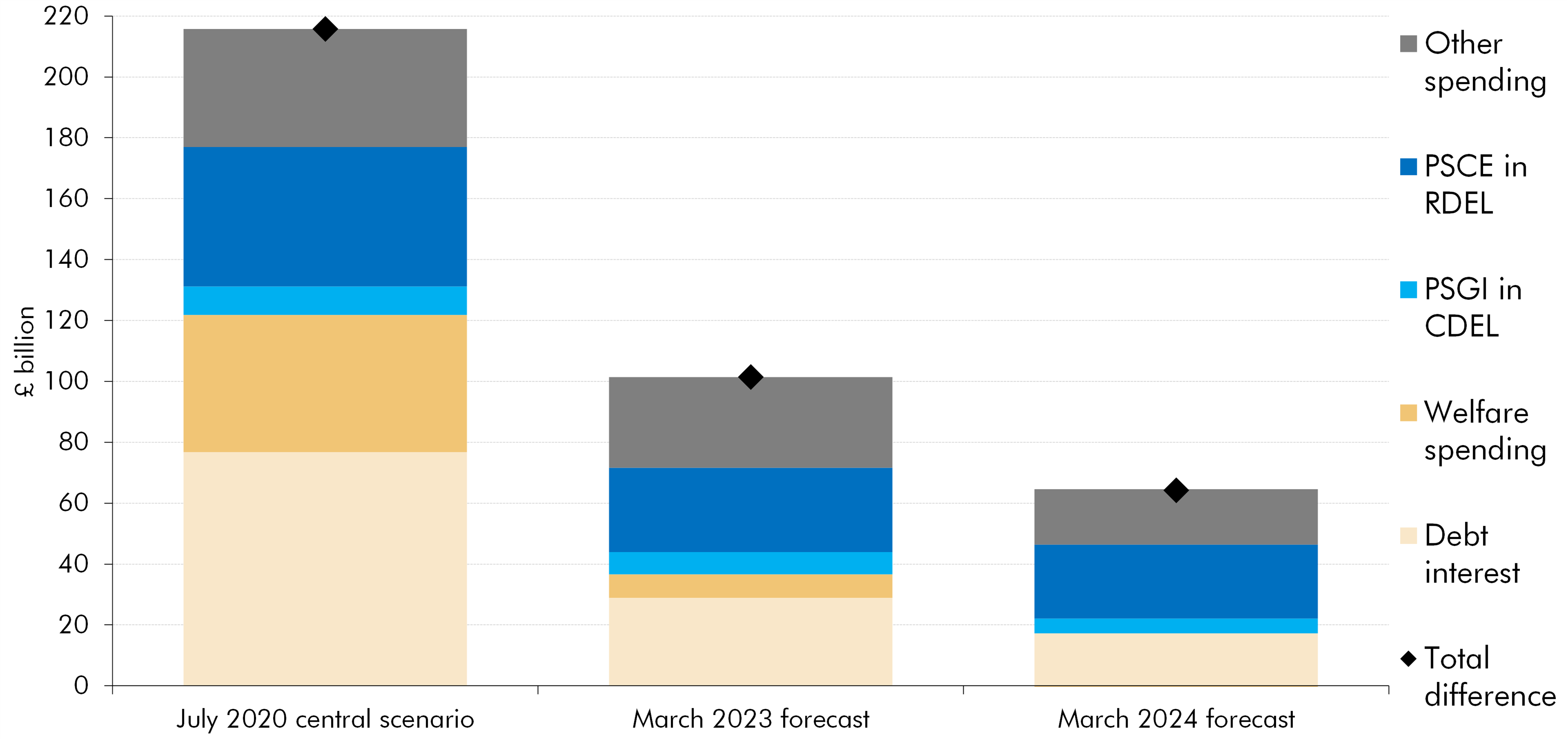
Stacked bar chart showing the contributions to differences between spending forecasts and outturn.
Note: Excluding the reclassification of the Scottish Government block grant from AME to DEL.
Source: HM Treasury, ONS, OBR
3.28 The following section decomposes total forecast differences by spending category (Table 3.7), summarising the impacts from economic factors, policy, classification changes, and a specific focus on the fiscal forecast differences, which are used to inform our fiscal forecast development programme outlined in Chapter 4. Overall, there are positive fiscal forecast differences between the March 2023 and March 2024 forecasts and outturn of £29 billion and £19 billion, respectively.
-
Departmental expenditure limits are the largest contributor to overall spending forecast differences, with outturn for 2024-25 underestimated by £80 billion and £74 billion in the March 2023 and March 2024 forecasts, respectively. This was mainly driven by the policy and classification changes described above. In addition, there were fiscal forecast differences mostly concentrated in capital DEL (CDEL), of £6.2 billion for the March 2023 forecast and £4.3 billion for the March 2024 forecast. These differences most likely reflect an overestimate of the degree to which departments would underspend against their capital spending plans. The analysis in last year’s FER also showed that we overestimated underspends in 2023-24, and so we are now reviewing our approach in this area.
-
Central government debt interest is the second-largest contributor to overall spending differences, with outturn for 2024-25 underestimated by £29 billion in the March 2023 forecast and £17 billion and March 2024 forecast. This was mainly due to the higher-than-expected inflation and interest rates described above. For the March 2023 forecast, this was partially offset by a negative fiscal forecast difference of £5 billion due to a model correction relating to debt that redeemed within the forecast horizon leading to lower debt interest spending.
-
Welfare spending is the third-largest contributor to overall spending forecast differences, with outturn for 2024-25 underestimated by £8 billion in March 2023. This is mostly explained by the higher-than-expected inflation and earnings growth described above. Outturn welfare spending was broadly in line with the March 2024 forecast (£0.4 billion below forecast).
-
Excluding the reclassification of the Scottish block grant, other spending was underestimated by £30 billion in the March 2023 forecast and £18 billion in the March 2024 forecast. Most of these underestimates were in National Accounts adjustments and locally financed current expenditure, which in the March 2024 forecast had positive fiscal forecast differences of £9 billion and £4 billion, respectively. The largest components of the underestimate of National Accounts adjustments in the March 2024 forecast were a £5 billion underestimate of central government current grants and a £3 billion underestimate of the imputed subsidy local authorities provide to their housing revenue accounts (HRA).[footnote 32] We discuss planned improvements to the forecasts of central government accounting adjustments and local government spending in Chapter 4.
Table 3.7: Spending forecast differences for 2024-25 by spending category
| £ billion | |||||||
|---|---|---|---|---|---|---|---|
| of which: | |||||||
| Forecast | Outturn | Difference | Economic factors | Policy changes | Classification changes | Fiscal forecasting difference | |
| PSCE in RDEL | |||||||
| July 2020 | 408.6 | 493.8 | 85.2 | 0.0 | 46.2 | 37.1 | 1.9 |
| March 2023 | 426.7 | 493.8 | 67.1 | 0.0 | 29.8 | 36.0 | 1.3 |
| March 2024 | 430.2 | 493.8 | 63.6 | 0.0 | 22.1 | 41.1 | 0.4 |
| PSGI in CDEL | |||||||
| July 2020 | 94.8 | 110.0 | 15.2 | 0.0 | 5.0 | 4.2 | 6.1 |
| March 2023 | 96.9 | 110.0 | 13.2 | 0.0 | 2.9 | 4.1 | 6.2 |
| March 2024 | 99.2 | 110.0 | 10.8 | 0.0 | 0.2 | 6.3 | 4.3 |
| Total welfare spending | |||||||
| July 2020 | 269.7 | 314.8 | 45.1 | ||||
| March 2023 | 307.0 | 314.8 | 7.8 | 5.5 | 0.3 | 0.0 | 1.9 |
| March 2024 | 315.1 | 314.8 | -0.4 | 0.0 | -1.3 | 0.0 | 1.0 |
| Other current spending | |||||||
| July 2020 | 227.7 | 231.1 | 3.5 | 0.0 | -0.5 | -32.5 | 36.5 |
| March 2023 | 244.7 | 231.1 | -13.6 | 0.0 | -3.6 | -32.8 | 22.8 |
| March 2024 | 256.1 | 231.1 | -25.0 | 0.0 | 2.7 | -40.3 | 12.7 |
| Other capital spending | |||||||
| July 2020 | 44.6 | 34.6 | -10.0 | 0.0 | -3.8 | -5.9 | -0.4 |
| March 2023 | 36.6 | 34.6 | -2.0 | 0.0 | 2.3 | -5.9 | 1.6 |
| March 2024 | 36.8 | 34.6 | -2.1 | 0.0 | 2.3 | -5.9 | 1.5 |
| £ billion | |||||||
| of which: | |||||||
| Forecast | Outturn | Difference | APF interest losses | RPI inflation | Interest rates | Financing and other | |
| Central government debt interest, net of APF ; | |||||||
| July 2020 | 29.5 | 106.2 | 76.7 | 34.3 | 9.8 | 25.9 | 6.7 |
| March 2023 | 77.3 | 106.2 | 28.9 | 9.6 | 15.8 | 8.8 | -5.3 |
| March 2024 | 89.0 | 106.2 | 17.3 | 4.8 | 10.5 | 2.5 | -0.5 |
| Note: Due to a lack of ready-reckoning infrastructure that is consistent with the July 2020 scenario and the related elasticities, we are unable to accurately provide a split for impacts from economic factors and fiscal forecasting differences for welfare spending for July 2020. In the supplementary material that accompanies this FER we do provide this breakdown against the March 2020 forecast. |
| Source: DWP, HM Treasury, ONS, OBR |
Debt
3.29 PSND in 2024-25 was £2.8 trillion, or 93.2 per cent of GDP. The differences between our initial forecasts for 2024-25 PSND and this outturn are shown in Chart 3.11 and Chart 3.12 and can be summarised as follows:
-
The July 2020 five-year ahead central scenario expected PSND to be 102.1 per cent of GDP (£2.6 trillion) in 2024-25. This was 8.8 per cent of GDP higher than outturn but £173 billion lower in cash terms. Although cash debt was significantly higher than forecast, driven by the persistently higher borrowing outlined in paragraph 3.17, this was offset by the nominal economy being much larger than we had expected in July 2020.
-
The March 2023 two-year ahead forecast for PSND was 102.4 per cent of GDP (£2.8 trillion) – 9.2 per cent of GDP higher than outturn but £22 billion lower in cash terms. As shown in Chart 3.11, PSND has fallen steadily from the pandemic-related high in 2020-21, largely due to the much larger nominal economy than previously forecast driven by the upward revisions to nominal GDP outturn in prior years to 2024-25 (paragraph 3.14). There has also been a large downward impact on cash debt from the Bank of England’s Term Funding Scheme (TFS) repayments, with participants paying off loans ahead of maturity dates and earlier than we had forecast, partially offsetting the higher-than-expected borrowing (paragraph 3.17).
-
The March 2024 one-year ahead forecast for PSND was 98.8 per cent of GDP (£2.8 trillion) in 2024-25, which was 5.5 per cent of GDP higher than outturn but £12 billion lower in cash terms. The difference between outturn and forecast was driven by the same factors as the March 2023 forecast.
3.30 While PSND has declined slightly in recent years, the measure of debt that excludes the Bank of England (PSND ex BoE), has increased as a share of GDP in each year since 2021-22 and is now above the pandemic peak. The reduction in cash debt from the TFS repayments, explained above, is not included in the calculation of PSND ex BoE, which was used as the target measure for debt under the previous Government’s fiscal rules. Removing the impact of the TFS meant that PSND ex BoE provided a better indicator than headline PSND of the underlying trajectory of public sector debt over this period. PSND ex BoE is also lower as a share of GDP than expected in each of our forecasts, again explained by the larger nominal economy, but has risen at a similar trajectory to the forecasts and is higher than expected in cash terms.
Chart 3.11: Debt as a share of GDP
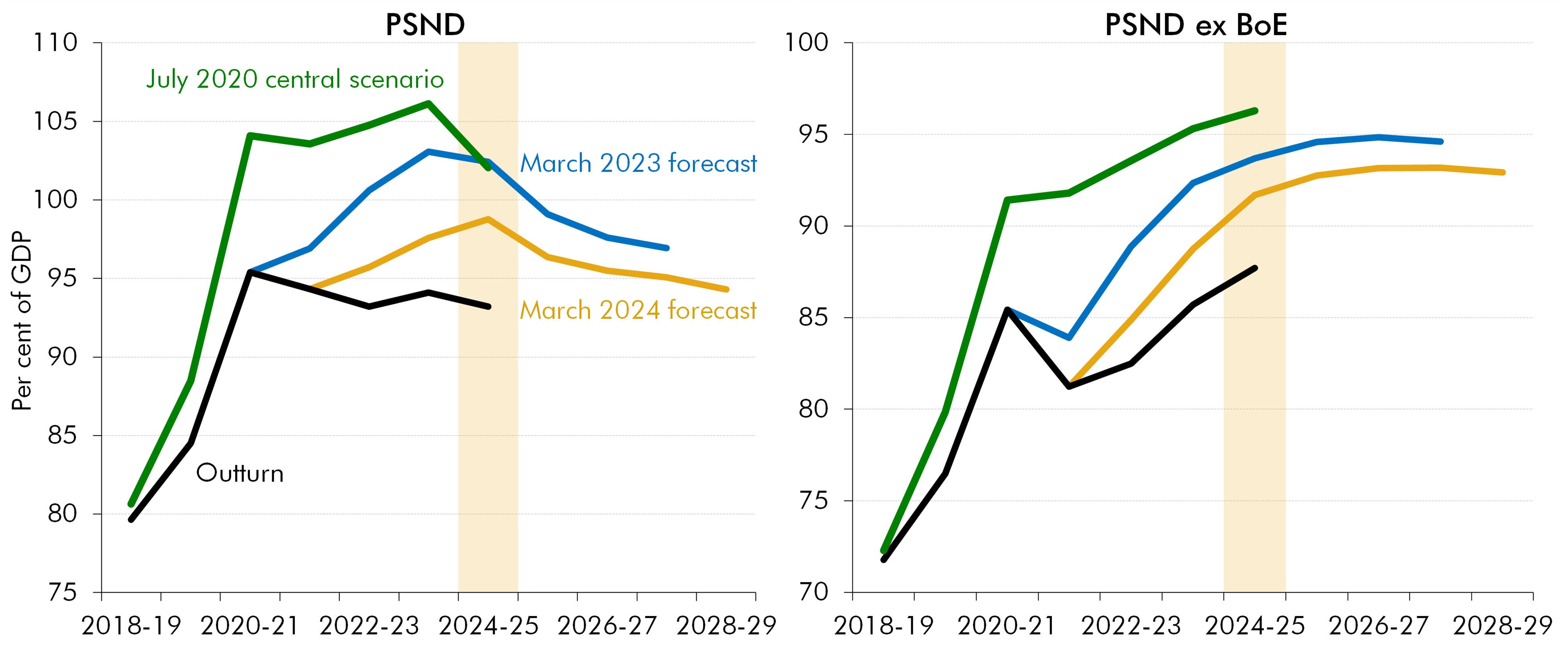
Side-by-side line charts showing debt forecasts and outturn as a share of GDP.
Note: PSND and PSND ex BoE are shown as the share of GDP forecast at the time. The shaded area marks 2024-25.
Source: ONS, OBR
Chart 3.12: Drivers of difference between PSND forecasts and 2024-25 outturn
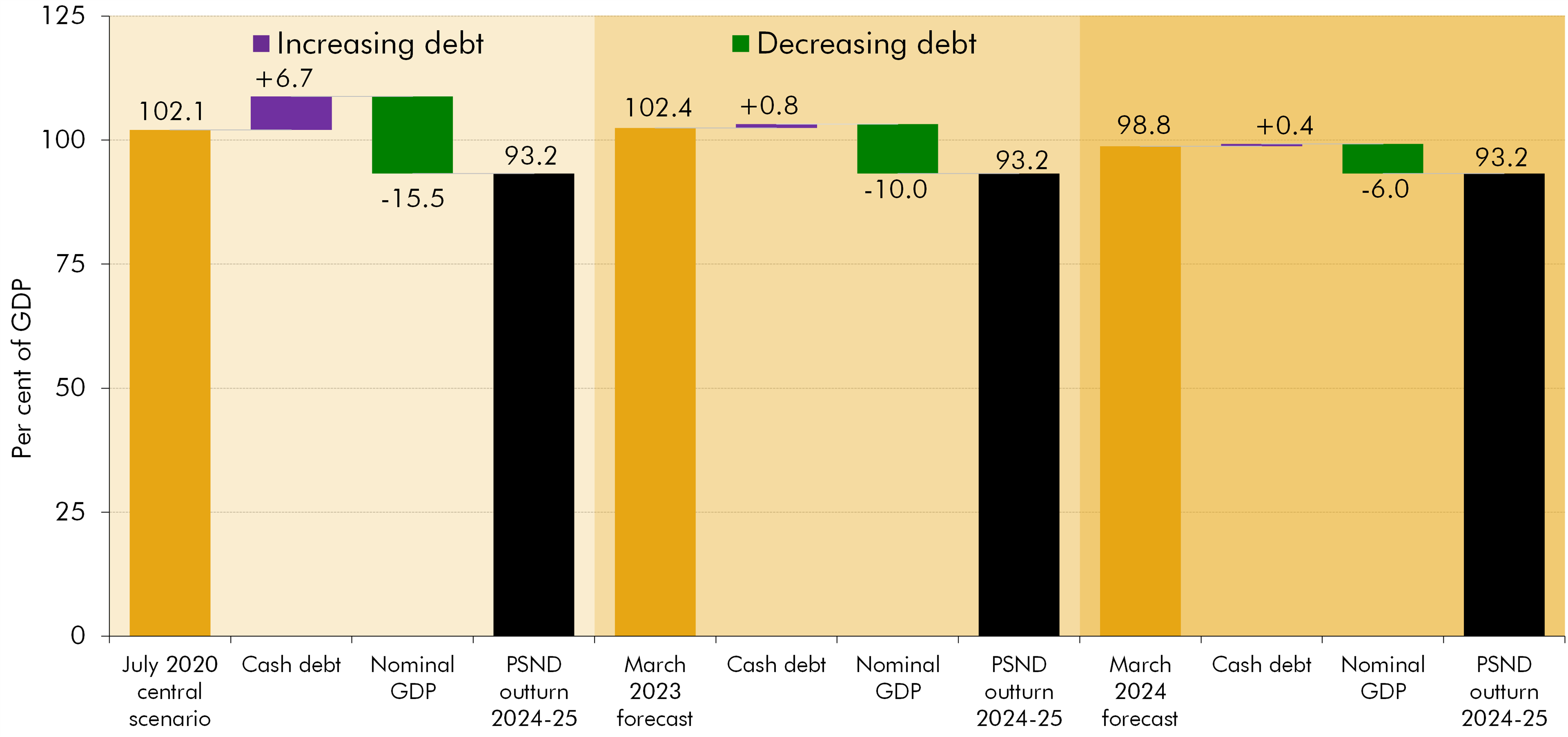
Waterfall chart showing the drivers of difference between debt forecasts and 2024-25 outturn.
Source: ONS, OBR
External forecasts for the UK economy and public finances
3.31 In each EFO, we compare our forecasts with contemporaneous external forecasts for the UK economy, providing an indication of the uncertainty around our central projections due to differing forecast judgements and conditioning assumptions. While it is not always possible to pinpoint the exact reasons for these differences, this comparison helps contextualise our forecasts within the range of projections made around the same time.
3.32 The average of external forecasts used in this section uses forecasts taken from Forecasts for the UK economy, published by the Treasury four times a year. To evaluate the relative accuracy of OBR projections, we consider the median average external forecast for GDP growth and CPI inflation in 2024 and for PSNB as a percentage of GDP in 2024-25. Comparisons to additional variables and a comprehensive guide to our methodology can be found in our online annexes to this publication on our website. The one- and two-year ahead external forecasts were conducted in February 2023 and 2024 respectively. The five-year ahead OBR forecast refers to the July 2020 central scenario and the average external forecast is an average of those conducted in May 2020, the closest available comparison.
Real GDP growth
3.33 Across forecast horizons, the OBR’s real GDP growth forecasts for 2024 were higher than the respective external forecast averages (Table 3.8). For example, the two-year ahead OBR forecast overestimated growth by 0.7 percentage points, while the external average was close to outturn. This may reflect the difference in inflation forecasts set out below, given, as set out in paragraph 3.34, we likely did not fully anticipate the negative effects of the persistence of inflation on real GDP growth.
Table 3.8: OBR and external forecasts for GDP growth in 2024
| One-year ahead | Two-year ahead | Five-year ahead | ||||
|---|---|---|---|---|---|---|
| OBR | External average | OBR | External average | OBR | External average | |
| Outturn (per cent) | 1.1 | 1.1 | 1.1 | 1.1 | 1.1 | 1.1 |
| Forecast | 0.8 | 0.3 | 1.8 | 1.0 | 1.9 | 1.6 |
| Difference (percentage point) | 0.3 | 0.7 | -0.7 | 0.1 | -0.8 | -0.6 |
| Note: External averages use the median values of external forecasts compiled by HM Treasury. |
| Source: HM Treasury, ONS, OBR |
CPI inflation
3.34 For both the one-year and five-year ahead inflation forecasts, the OBR and externals had comparable differences to outturn, likely driven by the factors outlined earlier in this chapter. The two-year ahead forecasts show more variation, with the OBR underestimating inflation by more than the external average. This likely reflects our underestimation of inflation persistence, discussed earlier in this chapter, while the difference in timing and associated conditioning assumptions of forecasts could also have played a role.[footnote 33]
Table 3.9: OBR and external forecasts for CPI inflation in 2024
| One-year ahead | Two-year ahead | Five-year ahead | ||||
|---|---|---|---|---|---|---|
| OBR | External average | OBR | External average | OBR | External average | |
| Outturn (per cent) | 2.5 | 2.5 | 2.5 | 2.5 | 2.5 | 2.5 |
| Forecast | 2.2 | 2.6 | 0.9 | 2.4 | 2.0 | 1.9 |
| Difference (percentage point) | 0.2 | -0.1 | 1.5 | 0.1 | 0.5 | 0.6 |
| Note: External averages use the median values of external forecasts compiled by HM Treasury. |
| Source: HM Treasury, ONS, OBR |
Public sector net borrowing (PSNB)
3.35 Across all forecasts, both the OBR and the average of external forecasts underestimated borrowing in 2024-25. For the one-year ahead and two-year ahead forecasts the differences to outturn were similar in the OBR and external average forecasts. At the five-year horizon the OBR forecast was closer to outturn, but as discussed in Box 3.1 this reflected very large but broadly offsetting differences between outturn and the forecasts for both spending and receipts.
Table 3.10: OBR and external forecasts for borrowing in 2024-25
| One-year ahead | Two-year ahead | Five-year ahead | ||||
|---|---|---|---|---|---|---|
| OBR | External average | OBR | External average | OBR | External average | |
| Outturn (per cent of GDP) | 5.2 | 5.2 | 5.2 | 5.2 | 5.2 | 5.2 |
| Forecast | 3.0 | 3.4 | 2.9 | 2.7 | 4.0 | 3.1 |
| Difference (percentage point) | 2.2 | 1.8 | 2.3 | 2.5 | 1.2 | 2.1 |
| Note: Numbers are based on fiscal years. External average uses the external forecasts compiled by the Treasury. Nominal public sector net borrowing has been adjusted for classification changes between the original forecast and the latest outturn and then divided by the latest outturn for nominal GDP in 2024-25 and therefore differ from the numbers presented in Chart 3.5. |
| Source: HM Treasury, ONS, OBR |
Chapter 4: Refining our forecasts
Introduction
4.1 The scrutiny of our forecast performance in Forecast evaluation reports (FERs) is an important part of our commitment to transparency. It facilitates greater understanding of our forecasts and helps ensure we can be held to account for the judgements we make. It is also important that we use it to learn lessons from past forecast performance, with the aim of improving future forecasts. In this chapter, we therefore summarise the most important lessons we have learnt, alongside actual and planned improvements to our models for economic and fiscal forecasting. Further details on these plans are provided in updated model assessment databases, published alongside this FER.
4.2 This chapter starts with a summary of the lessons we have learned from the 2022 energy price shock for our economic and fiscal forecasts. This reflects the central role that that shock has played in the difference between outturn and our forecasts for the period assessed in this and recent FERs. But it also reflects the ongoing importance energy prices will have for our forecasts, particularly given the recent rise in energy prices as a result of the current escalation of conflict in the Middle East.
Lessons from the 2022 energy price shock for our economic and fiscal forecasts
4.3 The 2022 energy price shock, and its subsequent economic and fiscal impacts, has been a key driver of recent differences between our forecasts and outturn, including those highlighted in this FER. Across this and recent previous FERs we have evaluated the reasons for these forecast differences and detailed how we have updated our forecast methodologies in response to the lessons we have drawn from this analysis.[footnote 34]
4.4 The sharp rise in energy prices caused by the current escalation of conflict in the Middle East was not incorporated in our most recent March 2026 forecast. Assessing how this latest energy shock will affect the economy and public finances will therefore be a key issue for our next forecast. While the source and impact of each shock will be different, we can still learn lessons from the past. In this section we therefore summarise the main lessons we have drawn from our analysis across recent FERs of the impact of the 2022 energy price shock on our economy and fiscal forecasts. This analysis also underlines the importance of producing detailed and comprehensive analysis of the range of uncertainty around the impact of shocks on the economy when they occur – drawing on scenarios, fan charts, sensitivity analysis, and ongoing reassessment of assumptions as shocks evolve.
Economy
4.5 The 2022 energy price shock impacted the economy through several channels, outlined below. In many cases, we have updated our forecasting approach and modelling in response to the findings in recent FERs on the impact the shock had through these channels compared to our initial expectations.
4.6 Our conditioning assumptions for energy prices and interest rates are based on market expectations. Following Russia’s invasion of Ukraine, gas prices in 2022-23 were five times higher than the market expectations incorporated in our March 2021 forecast, before undershooting the market expectations used in our March 2022 forecast by around 40 per cent as supply concerns eased. Prices then fell more rapidly than market participants had predicted in 2023-24, reaching around half the level assumed in our March 2023 forecast. This volatility in market expectations highlights the importance of illustrating this key uncertainty in our forecast. For example, our March 2023 Economic and fiscal outlook (EFO) included higher and lower energy price scenarios, with outturn in 2023-24 much closer to the lower price scenario than our central forecast.
4.7 Direct inflation effects account for the mechanical pass-through of energy prices to fuel and utility prices. Following the 2022 energy price shock, the largest differences between our forecasts and outturn for fuel and utility prices were driven by differences between actual energy prices and the market expectations on which we condition the forecast, as discussed above. Much smaller differences were driven by our modelling of the Ofgem price cap (for utilities prices) and the pass-through of wholesale fuel prices to consumer prices. That said, given the volatility of energy prices in recent years, small differences can have a significant effect on overall inflation. We have therefore updated our approach to draw on a range of external estimates of the Ofgem price gap to compare to our forecast, and plan to update our econometric model of short-term fuel inflation to better capture this channel.
4.8 We underestimated the size of the second-round effects of the energy shock on wider inflation. In our March 2022 forecast, we assumed these would add a further 25 per cent to the direct effect of energy prices on inflation. We evaluated this assumption back in 2023 and concluded that they were actually closer to 50 per cent.[footnote 35] Our underestimate was likely due to three factors:
-
Non-linearities in the pass-through of energy shocks, with stronger pass-through when inflation is already high as in the post-pandemic period;
-
a tighter-than-expected labour market, putting workers in a stronger bargaining position to protect their real wages; and,
-
Bank Rate increases taking longer than expected to moderate aggregate demand, given the higher share of fixed-rate mortgages compared to the previous hiking cycle.
4.9 Overall, inflation proved more persistent, and became more domestically generated, after the initial shock than we originally expected. CPI inflation was 5.7 per cent in 2023-24 and 2.4 per cent in 2024-25, both higher than most post-March 2022 forecasts for these years.[footnote 36] This had important implications for the public finances which are discussed below. This partially relates to the larger-than-expected second-round effects, discussed above, which took longer to impact headline inflation than the immediate direct impacts of wholesale energy prices, but also reflects the role of inflation expectations. In response to these forecast differences, we have updated our wages equations and our non-tradables inflation equation.
4.10 Inflation expectations had been low and well anchored at the time of the 2022 shock, which probably limited the initial pass-through to prices, particularly wages. However, in subsequent periods workers appear to have sought to recoup some of the real wage erosion. This suggests that workers set wage demands to a large extent based on the recent increase in inflation, rather than on a purely forward-looking expectation that inflation would fall. This likely contributed to nominal and real wage growth remaining higher for longer than we expected, with nominal wages growing by 5.6 per cent and real wages by 2.4 per cent in 2024-25. Workers were likely able to recoup some of the initial fall in real wages due to their bargaining power in a tight labour market, reflecting the importance of spare capacity in determining the inflation impact of external price shocks.[footnote 37] This highlights the importance of considering inflation expectations and the state of the labour market when forecasting the impact of a price shock.
4.11 Despite the higher and more persistent inflation than we expected, the fact that much of it was a result of higher wage growth meant that real household disposable incomes held up better than we expected. However, the subsequent path of interest rates, which was higher than market participants had anticipated, alongside the uncertainty created by the shock, meant that we overestimated the extent to which households would smooth consumption through a lower saving rate. This contributed to us underestimating the impact of the energy price shock on household consumption – in particular, how persistent the effect would be. In outturn, the saving rate rose from around 2¾ per cent to 6¼ per cent between 2023 and 2024 and real household consumption fell by around ½ per cent over the same period. This highlights the importance of household saving behaviour, alongside real income effects, in determining the effects of shocks.
4.12 As fossil fuels are largely an imported factor input in the UK, persistently higher energy prices could reduce potential output by lowering the quantity of output that firms find it profitable to produce. We estimated in the July 2022 Fiscal risks and sustainability report that a 10 per cent increase in medium-term fossil fuel prices could reduce potential output by 0.13 per cent in the short term and 0.18 in the long term. While it is hard to separately identify the impact of energy prices on productivity in outturn, persistently high prices have likely contributed to weak productivity growth since 2022. We plan to review our estimate of the elasticity of potential output to fossil fuel prices, given the likely change in the intensity of fossil fuel usage in the UK economy since the 2022 energy shock.
Public finances
4.13 Compared with our October 2021 forecast, which was made before the Russian invasion of Ukraine, outturn borrowing in 2022-23 and 2023-24 was £44 billion and £73 billion higher than forecast, respectively. This shows how the initial impact of the energy price shock, and subsequent rise in inflation, was very negative for the public finances. This was driven by inflation leading to higher spending and by the very large government support package in response to the 2022 shock. For the reasons set out above the impact of the shock on inflation was more persistent than we initially expected. As inflation became more domestically generated this provided a partial offset to the higher spending through a broad increase in nominal tax bases, notably personal taxes and VAT receipts. However, it also created more persistent spending pressures including on departmental spending limits and from the impact of higher interest rates on debt interest costs. Overall, even in 2024-25, borrowing was substantially higher than the forecasts we made in 2023 and 2024, which as explained in Chapter 3, was largely due to the impact of inflation remaining higher than we expected for longer.
4.14 The initial impact of the rise in energy prices in 2022 led to higher spending primarily by increasing the cost of most welfare benefits (uprated by September CPI) and the interest paid on index-linked debt (linked to RPI). For example, spending on index-linked debt rose from £36 billion in 2021-22 to £68 billion in 2022-23. Debt interest spending in the UK is particularly exposed to inflation shocks given the high share of index-linked debt compared with other advanced economies.
4.15 There was a partial offset from the direct energy price and inflation impacts in 2022 on tax revenues from energy production, however, these offsets are relatively small given the decline in production levels over the past couple of decades. Offshore corporation tax rose from £0.5 billion in 2020-21 to £6.6 billion in 2022-23, moderating thereafter as energy prices fell. At the 2022 Autumn Statement, the previous Government announced windfall taxes on energy producers via the energy profits levy (EPL) and electricity generator levy (EGL) that raised an annual peak of £4.5 billion in 2022-23. Eventual outturn from these windfall taxes was much lower than initial forecasts due to lower wholesale energy prices, as outlined above.
4.16 The initial total fiscal impact of an energy price shock is also very dependent on any wider government support packages. The previous Government spent £40 billion on energy support schemes in 2022-23, and various other measures – including a council tax rebate, cost-of-living payments and fuel duty cuts – added a further £17 billon to borrowing. In total the cost of new energy and cost-of-living support policies in 2022-23 was £51 billion, allowing for the offset from windfall taxes outlined above.[footnote 38]
4.17 As set out above, the impact of the initial shock on inflation was more persistent than we initially expected. The rise in domestically generated inflation following the initial energy shock provided some offset to the initial negative impact by boosting the nominal value of tax bases and tax revenues. This was particularly important for labour income which has a high effective tax rate. Income tax rose from £225 billion (9.4 per cent of GDP) in 2021-22 to £277 billion (9.9 per cent of GDP) in 2023-24, driven by frozen tax thresholds and higher nominal earnings. In response to this, we increased our forecast for income tax at each forecast between October 2021 and March 2024. Second-round inflation effects can also add to spending pressures, for example, through the state pension which is uprated by the triple lock – a maximum of CPI inflation, earnings growth, and 2.5 per cent.[footnote 39] This analysis shows the importance of assessing the potential second-round effects of inflation on the public finances when producing both the central forecast and scenarios following any energy price shock.
4.18 The overall fiscal impact of higher inflation also depends on how governments respond to the impact it has on departmental spending. Other things equal, higher inflation will erode the real-terms value of public spending because departmental expenditure limits (DELs) are typically set in nominal terms at Spending Reviews. The energy price shock came after nominal limits had been set in the 2021 Spending Review and previous governments subsequently chose to increase those limits, which had alleviated some, but not all, of the squeeze on real spending power by the time of the March 2024 Budget.[footnote 40] This shows the importance of transparently assessing the risks and pressures around departmental spending alongside the central forecast, which is based on the allocations set at Spending Reviews.
4.19 If higher domestically generated inflation is accompanied by higher interest rates, this also feeds directly into debt interest spending through raised yields on new debt issuance and losses on the Asset Purchase Facility (APF). The yield on ten-year UK gilts rose from close to zero during the pandemic to around 4.5 per cent in 2023, and Bank Rate reached a peak of 5.25 per cent. Higher-than-expected interest rates are estimated to have pushed up debt interest spending in 2023-24 by £45 billion compared to the October 2021 forecast.
4.20 Higher interest rates also lead to an increase in interest-sensitive receipts. This is concentrated in interest and dividend receipts through higher returns on the stock of government reserves and holdings of financial assets, self assessment income tax through higher savings income, and corporation tax paid on interest income. Interest and dividend receipts rose sharply from £24 billion in 2021-22 (1.0 per cent of GDP) to £44 billion (1.6 per cent of GDP) in 2023-24, which was £9 billion and £2 billion higher than our March and November 2022 forecasts respectively.[footnote 41] In response to these forecast differences we reviewed the interest and dividends forecast model to better capture and align to relationships observed in ONS outturn data (as highlighted in the 2025 Fiscal model assessment database). We also changed our savings income determinant within self assessment income tax, outlined further in paragraph 4.27, and made changes to onshore corporation tax models in order to better capture the effects of higher interest rates on small business expenditure and profits (after a shortfall in 2024-25) at our March 2025 forecast.[footnote 42]
Economic forecasting improvements
4.21 With limited resources to continuously update, develop, and explain the tools we use in economic modelling, we concentrate our efforts in areas of the forecast that are the most material. Below we outline the new priorities we are taking forward since our 2025 FER, and our progress against previously identified modelling priorities.
4.22 Chapter 3 highlights that inflation and labour market judgements were a key part of the difference between outturn and our March 2023 and March 2024 economic forecasts.[footnote 43] Recent FERs, including in 2024 and 2025, highlighted similar results and detailed the forecast improvements we were making in response. We will continue to develop our approach to forecasting in these areas in addition to progressing developments in wider areas of the economy forecast that are set out in the next section.
New priorities since our previous Forecast evaluation report
4.23 Our four main new priorities for economic forecast development are set out below. Alongside these, as set out in the Economic model development database accompanying this report, we are also reviewing our labour supply model elasticities and our output gap models:
-
We comprehensively reviewed total factor productivity (TFP) in 2025 and have developed our government investment framework. We are now assessing our approach to business investment modelling, the remaining driver of productivity. We plan to update and broaden the range of econometric models used to inform our judgements on this.
-
Given recent energy market movements, we are reviewing how energy prices impact our forecast. This includes reviewing the production function method used to link changes in energy prices to productivity and updating our fuel prices econometric equation to better reflect volatility in energy markets.
-
Given the global trade environment, we are expanding our trade modelling capabilities, drawing on external expertise alongside our own work. This will involve exploring a range of economic models and assessing their suitability for complementing our existing approach to modelling trade.
-
Given the recommendation of the OBR’s recent external review to more explicitly highlight uncertainty, we are expanding our use of the Oxford Economics Global Economic Model for scenario analysis. This will inform how we communicate uncertainty around the central forecast.
Progress against previously identified priorities
4.24 The process of refining our models and the judgements underpinning our economic forecasts is a continuous one that draws on analysis prepared in forecasting rounds and for our FERs. Recent model developments that have already been factored into our forecasts are set out below:
-
We have completed various work in response to the inflation differences to outturn identified in this and previous FERs. This includes updating the medium‑term econometric equations used to forecast: CPI food and non‑alcoholic beverages inflation, the non‑oil goods imports deflator and CPI tradables, and non-tradables inflation. We also intend to publish an article explaining our inflation forecast in more detail in response to our recent external review.[footnote 44]
-
Reviewing the econometric equation used to inform our deposit rate forecasts, given the significant change in interest rates since the model was last updated. This work reflects the shift to a higher interest rate environment and assesses whether the existing specification continues to provide an appropriate guide to deposit rate dynamics.
-
Developing our own demographic scenario capability to support long‑term population projections. This work strengthens our assessment of the long‑run implications of demographic change for the economy and public finances, and provides a more flexible framework for scenario analysis. It complements our wider programme of long‑term model development and supports analysis in publications such as the Fiscal risks and sustainability report.
Fiscal forecast improvements
4.25 We review our fiscal forecasting modelling priorities and progress alongside each FER, with the results published each year in a database on our website. In guiding our forecast development programme, we specifically focus on the fiscal forecasting differences identified in the FER analysis. This helps us focus on those differences that are primarily driven by judgements in our fiscal forecast or by features of the fiscal forecast models.
New priorities since our previous model assessment database
4.26 Using this approach, we have identified a number of priorities for fiscal forecast development based on the analysis in this report and wider analysis of historical forecast differences. The Fiscal model assessment database that accompanies this report comprehensively sets out these modelling issues and priorities for future work including:
-
The analysis in this FER shows that we overestimated self assessment income tax in both the March 2023 and 2024 forecasts. We will work with HMRC to better understand volatility and forecast differences at an individual income component level with a specific focus on partnership income, which was highlighted as a likely driver of the March 2024 forecast difference outlined in Chapter 3.
-
Chapter 3 highlighted the large one-year ahead fiscal forecast difference for onshore corporation tax (onshore CT). In response to this, last summer we reviewed the small company corporation tax forecast, adjusting for the lower starting point for small company onshore CT and splitting out smaller companies from larger companies in the forecasting model. This summer we will review the equations for the income and deduction components that underpin the rest of the forecast, with a specific focus on group relief and potential profits mis-specification.
-
Analysis of historical forecast differences shows that we have generally underestimated insurance premium tax (IPT) receipts. This was a pattern that was also observed specifically for 2024-25 in the analysis shown in Chapter 3. We will conduct a review of this forecast to assess whether there are alternative economic determinants that could provide a stronger link with IPT receipts.
-
Large revisions to outturn local government spending, set out in our November 2025 EFO, mean that both the March 2023 and March 2024 forecasts significantly underestimated locally financed expenditure and other components of local government spending in 2024-25. Decomposing the forecast difference indicates central-government-to-local-authority grants are a large driver of the underestimate. As part of the joint Local Government Financial Information Task Force made up of the ONS, MHCLG and the Treasury, announced in November 2025, we will be reviewing the local government forecast. This will include work to improve the flow of data to the ONS, including on grants, with the aim of reducing the risk of misalignment between the forecast and outturn data.
-
Analysis in this report, and last year’s FER, illustrated that a large part of our near-term forecast errors is explained by underestimates of National Accounts adjustments. We are working with the Treasury to better understand the adjustments made to align the central government data that the Treasury holds to the central government data the ONS publishes, and how to forecast these.
-
Recent rises in unemployment, as measured in the Labour Force Survey, have not immediately led to higher universal credit caseload. We will work with DWP to investigate the potential reasons for this divergence – including time lags and definitional differences. We will also review the evidence underpinning our assumptions for incapacity caseload growth, and how these are incorporated into DWP’s forecast model, as this growth currently slows sharply at the end of the forecast period.
Progress against previously identified priorities
4.27 The updated model assessment database on our website outlines progress against the priorities set out in the July 2025 FER in full detail. This section highlights progress in some key areas:
-
Within self assessment income tax, a large overestimate of savings liabilities for the 2022-23 tax year and underestimate for 2023-24 suggested there was evidence of an extended lagged effect in savings income, where sharp increases in interest rates take longer than we previously expected to feed into increases in liabilities. In response we developed a new determinant that incorporated a weighting of the interest rate from the previous year to better account for this lag in savings income being received.
-
At the November 2025 forecast we implemented several modelling changes that revised down our forecast for alcohol and tobacco receipts, reflecting recent overestimates. We revised down consumption trends to more closely align to recent trends in outturn data, increased the level of prices in our alcohol forecast (which has the effect of reducing forecast demand), and raised the price elasticities for hand-rolling tobacco to assume a greater responsiveness from consumers to price changes. We will keep these assumptions under review and plan on further assessing the impacts of price and household income on demand in our excise tax models ahead of our next forecast.
-
Revised electric vehicle assumptions underpinning vehicle excise duty were included in the November 2025 forecast, ensuring all forecasts utilising these were aligned. We also developed a conversion tool to align fuel duty van kilometre splits to the vehicle excise duty forecast, where this had previously only existed for cars.
-
In October 2024 we published our review into departmental expenditure limits, which made a set of recommendations for the information we receive from the Treasury on the risks to the DEL envelope, including a forecast for total public sector pay. In 2025, we worked with the Treasury to develop a forecast for public sector total pay that is consistent with our forecast for DEL and the economic classification of DEL spending that the Treasury provides, which we included in our November 2025 and subsequent EFOs.
-
Within welfare spending, we simplified our housing benefit forecast to account for the end of legacy cases, as most housing benefit cases have already moved to universal credit. We also improved the accuracy of the universal credit model, which now better reflects changes in employment, unemployment and inactivity.
-
Atkins, G., and L. Lanskey, Working paper No.19: The OBR’s forecast performance, August 2023. ↩
-
A numerical assessment of the March 2020 forecast against outturn is provided in the supplementary tables that accompany this report. ↩
-
For more detail on how we assess the economic and fiscal impact of government policy measures, see OBR, Dynamic scoring of policy measures in OBR forecasts, 2023, and OBR, Briefing paper No.6: Policy costings and our forecast, 2014. ↩
-
See Ramey V., Ten years after the financial crisis: What have we learned from the renaissance in fiscal research?, 2019. ↩
-
See Box: 2.3 in the October 2013 FER for a summary of external views and Box 2.2 in the October 2017 FER for a summary of our analysis in response. ↩
-
See, for example, New Economics Foundation, The OBR’s fiscal powers need a rethink, 2024; New Economics Foundation, Forecasting a better future, 2025; and written evidence submitted to the Commons Treasury Committee’s The OBR: 15 years on inquiry by Dr Rob Calvert Jump (University of Greenwich) and Professor Jo Michell (UWE Bristol) in 2026. ↩
-
We considered evaluating other forecasts but discounted them for three reasons. Pre-2020 forecasts are covered by previous work, 2020-2023 forecasts are heavily impacted by external shocks, and for post-2023 forecasts the October 2024 forecast is the major policy event which had sizeable multiplier effects that can be assessed against early outturn at this point in time. ↩
-
This analysis also responds to a FER 2025 development priority. ↩
-
See our Real GDP growth forecast in-depth page on our website. ↩
-
See for example: Leeper, E. M., et al., Fiscal foresight and information flows, Econometrica 81:3, 2013 and Barrell, R., and M. Weale, The Economics of a Reduction in VAT, Fiscal Studies 30:1, 2009. ↩
-
For example, see: Warmedinger, T., C. D. Checherita-Westphal, and P. Hernandez de Cos, Fiscal Multipliers and Beyond, ECB Occasional Paper 162, 2015; Ramey, V., Ten Years after the Financial Crisis: What Have We Learned from the Renaissance in Fiscal Research?, 2019; and Auerbach, A. J., and Y. Gorodnichenko, Measuring the output responses to fiscal policy, American Economic Journal: Economic Policy, 2012. ↩
-
Among other factors, the size of a multiplier is larger if there are fewer leakages (the share of the stimulus saved or spent on imports). Direct government spending such as CDEL has a more immediate first-round effect on demand than tax cuts, a share of which may be saved by individuals. See Spilimbergo, A, Symansky, S and Schindler, M (2009), Fiscal multipliers, IMF Staff Position Note SPN/09/11. ↩
-
The FERs published between 2012 and 2018 detail our evaluation. Box 2.2. of the 2017 FER provides a summary of our analysis and Box 2.2 of the 2019 FER compares our multipliers to the literature. ↩
-
The November 2020, October 2024, and November 2025 forecasts are examples of where we have adjusted our multipliers down. ↩
-
We compare the October 2024 forecast with 2025 calendar year outturn data, as full outturn for the 2025–26 fiscal year is not yet available at the time of writing. ↩
-
Diagnostic analysis of GDP expenditure components does not point to a clear single driver of the overall forecast difference. This partly reflects ONS Blue Book revisions, particularly to business investment, which altered historical levels and the implied growth path, making it difficult to separate genuine forecast errors from mechanical effects. ↩
-
This therefore incorporates the ONS 2025 Blue Book-consistent National Accounts data that was released on 30 September 2025. ↩
-
The supplementary material that accompanies this report provides differences against outturn for both the March 2020 forecast and July 2020 central scenario when referencing our five-year ahead forecast differences. ↩
-
As with oil prices, we condition our forecast on market expectations for wholesale gas prices, which were another major contributor to inflation, rising from an average of 29 pence a therm in 2019-20 to 97 pence a therm in 2024-25. ↩
-
Cumulative growth for the five-year ahead forecast was large, given the July 2020 central scenario starts from the significant fall in real GDP cause by the Covid-19 pandemic. ↩
-
Our real GDP growth forecasts for 2024-25 were in line with our past average forecast performance. ↩
-
Average forecast differences used for comparison were discussed in Chapter 2 of the 2025 Forecast evaluation report. ↩
-
The assessment of our forecast performance relative to outturn has been complicated by measurement issues with the ONS’s Labour Force Survey (LFS), the main source of our estimates. These issues particularly affect estimates for 2023-2024, with wider data sources suggesting the fall in 2024 and rebound in 2025 were both overstated, although the level in late 2024 should be more representative. See Office for National Statistics, Labour Force Survey quality update: April 2026, April 2026. ↩
-
Our March 2024 EFO included different migration scenarios to address this. ↩
-
See Box 2.2 of our November 2025 EFO for more detail on these revisions. ↩
-
Where this is not possible, for the March 2023 and 2024 forecasts we have assumed that receipts grow in line with the nominal economy with an elasticity of 1.1 to provide a value for ‘economic factors’. The expansion of our ready-reckoning infrastructure should mean we will be able to provide a fuller breakdown for more receipts lines in future. ↩
-
We also reflect Treasury decisions to switch spending between DEL and AME budgets. These changes are reflected in Table 3.7 below and the supplementary tables published alongside this FER. ↩
-
The differences between the July 2020 scenarios and outturn for PSNB are discussed in more detail in Box 3.1 above. ↩
-
Blue Book 2025 revisions also changed the composition of GDP, with growth in the economy estimated to have been driven less by more tax-rich household activity (labour income and consumption) and more by less tax-rich business activity (corporate profits and business investment) than previously thought. ↩
-
Due to a lack of ready-reckoning infrastructure that is consistent with the July 2020 central scenario and the related elasticities, we are unable to accurately provide a split for impacts from economic factors and fiscal forecasting differences for July 2020. In the supplementary material that accompanies this FER we do provide this breakdown for the March 2020 forecast. ↩
-
As highlighted in our November 2025 EFO, lower alcohol consumption was likely driven by a combination of factors such as a growing trend of alcohol moderation, with substitution to no- and low-alcohol alternatives, and a response to higher prices. There may also be an impact from demographic changes, with some evidence of lower alcohol consumption in younger age groups. Lower tobacco consumption is in part due to the substitution from tobacco products towards vaping. ↩
-
This underestimate is neutral for borrowing, as the imputed subsidies local authorities pay to the Housing Revenue Account are also recorded as a public sector receipt in public corporations’ gross operating surplus. ↩
-
The external forecasts do not typically disclose what energy price outturn and market expectations they have used to condition their forecasts. This means it is difficult to make a direct comparison with the energy prices we used to condition our March 2023 forecast. However, energy prices were very volatile in early 2023 so it is possible that taking market expectations for energy prices at different points over this window could have led to material differences in inflation forecasts. Chapter 5 of March 2023 EFO explored the sensitivity of our forecast to energy prices. ↩
-
This includes our October 2023 FER, in particular Boxes 2.1 and 2.2, our October 2024 FER and our July 2025 FER. ↩
-
As discussed in Box 2.1 of the October 2023 FER. ↩
-
Exceptions were the November 2023 and March 2024 forecasts for 2023-24 and the November 2023 forecast for 2024-25. ↩
-
We have developed a suite of wage equations to provide short- and medium-term forecasts for wages. These capture the short-run responsiveness of wages to cyclical changes. ↩
-
The values for energy support schemes, the council tax rebate, cost-of-living payments and fuel duty cuts referenced in paragraph 4.16 are consistent with the outturn available as of summer 2023 and in Box 3.1 of our October 2023 FER. ↩
-
As earnings growth is expected to follow high inflation with a lag, the pressure on welfare spending is more persistent: though the state pension was uprated by CPI inflation in 2022, in subsequent years it has been uprated by earnings growth instead. ↩
-
OBR, Review of the March 2024 forecast for departmental expenditure limits, October 2024. ↩
-
The increase to interest and dividend receipts was boosted further by the impact of higher RPI inflation on the accrued interest on student loans and the impact of higher equity prices on the returns from funded pension assets. ↩
-
See Box 4.1 of the March 2025 EFO. ↩
-
Though as noted in Chapter 3, issues with the ONS Labour Force Survey were a key part of forecast differences to outturn. ↩
-
Van Geest, L., External Review of the Office for Budget Responsibility, February 2025. ↩