Floating bus stops provision and design
Published 26 January 2026
Applies to England

© Crown copyright 2026
This publication is licensed under the terms of the Open Government Licence v3.0 except where otherwise stated. To view this licence, visit nationalarchives.gov.uk/doc/open-government-licence/version/3 or write to the Information Policy Team, The National Archives, Kew, London TW9 4DU, or email: psi@nationalarchives.gov.uk.
Where we have identified any third party copyright information you will need to obtain permission from the copyright holders concerned.
This publication is available at https://www.gov.uk/government/publications/floating-bus-stops-provision-and-design/floating-bus-stops-provision-and-design
Status of this guidance
This guidance is based on our understanding of current law and the latest best practice.
As with all guidance on GOV.UK, we will update it to reflect any changes in the legal position or best practice.
You can sign up to get an email alert when this guidance is updated.
Floating bus stops are bus stops where a cycle track and bus stop intersect and where bus passengers, pedestrians and cyclists may interact.
This statutory guidance:
- covers the provision and design of floating bus stops
- applies to both new schemes and existing installations in England
It is the first version of the guidance issued under section 31 of the Bus Services Act 2025 and replaces the guidance on bus stop bypasses and shared use bus boarders set out in local transport note (LTN) 1/20 (section 6.6, paragraphs 8 to 11).
Under section 31 of the act, the following bodies must have regard to this guidance when installing or altering any such installations on their road networks:
- local transport authorities
- local highway authorities
- local traffic authorities
- Transport for London
- National Highways, as a strategic highways company
Section 32 of the act empowers the Secretary of State for Transport to request that relevant authorities provide information on stopping places provided by them, including on:
- how they have complied with their duties regarding the accessibility of stopping places
- the provision and design of floating bus stops
The Secretary of State will be able to publish information and make statements about compliance.
What this guidance covers
The term ‘floating bus stop’ has been used previously to refer to those designs in which a cycle track is taken behind an island. These designs are also known as bus stop bypasses or bus stop islands.
For the purposes of this guidance, to align with the statutory definition, the term ‘floating bus stop’ is used as an umbrella term to include all design types where a cycle track and bus stop intersect and where bus passengers, pedestrians and cyclists may interact.
Floating bus stops are a combination of a cycle track and a footway. There are many different configurations, and this guidance provides advice on the design of bus stop bypasses and shared use bus boarders.
This is the first version of the guidance. Further versions will be developed to include advice on different design types, informed by further research carried out by Active Travel England (ATE). This is due to complete in 2027.
The research will focus on the safety, accessibility and suitability of floating bus stops across different contexts. It will also identify and test potential enhancements to better meet the needs of all users.
As set out in Local transport note 1/20: cycle infrastructure design (LTN 1/20), protected infrastructure, such as segregated cycle tracks, is a key element of improving safety for cyclists. Protected space for cycling will enable more people to cycle, regardless of the volume of motor traffic. Not only must cycle infrastructure be safe, it should also be perceived to be safe so that more people feel able to cycle.
The guidance assumes that, following a consideration of the options, a decision has been made that protected infrastructure is required to deliver safe new or improved cycle facilities along a bus route. This may have been identified through an authority’s local cycling and walking investment plan, local transport plan, local implementation plan (in London) or other network-planning activity.
Once this decision has been made, protection will need to be maintained through bus stops to reduce the risk of conflict between cyclists and buses. In delivering this, the needs of bus passengers and cyclists will need to be considered to maintain accessible provision for bus passengers, while also accommodating cyclists’ safety needs. The advice in this guidance aims to help designers consider the point of view of bus passengers, cyclists and pedestrians.
Advice on deciding appropriate cycle facilities for different environments is given in LTN 1/20. Section 4.4 defines ‘protected infrastructure’ as:
- fully kerbed cycle tracks
- stepped cycle tracks
- cycle lanes with light segregation measures such as flexible ‘wands’
Figure 4.1 of LTN 1/20 summarises the traffic conditions when protected space for cycling is appropriate.
Pause on new installations
On 20 November 2025 the Minister for Roads and Buses Simon Lightwood MP wrote to all local authorities in England asking them to pause the installation of floating bus stop designs which require passengers to board or alight directly from or into a cycle track. This pause is still in place.
This guidance should be used to adjust proposed designs which would fall within the pause. Where these designs are already installed, this guidance can be used to make adjustments to them, but it is for local authorities to determine how to apply it to their networks.
Definitions
Floating bus stop
Section 31 of the Bus Services Act 2025 defines a floating bus stop as follows.
Floating bus stop” means an area in the immediate vicinity of a stopping place for local services, which is designed –
- for use by people accessing the stopping place, and
- so as to incorporate a cycle track (within the meaning of the Highways Act 1980 (see section 329 of that Act));
local service” and “stopping place” have the same meanings as in the Transport Act 1985 (see sections 2 and 137 of that Act).
Bus stop bypass
Designs in which the bus shelter/flag is situated on an island distinct from the cycle track with the track taken behind that island. Bus passengers board and alight from and to the footway island – see graphic 2.
Shared use bus boarder
Designs which require people to board or alight directly from or into a cycle track.
Cycle track with bus boarding island
Designs in which the cycle track is taken in front of the shelter and flag, with an area of footway provided for passengers to board or alight the bus next to the kerb – see graphic 3.
Pedestrian
For the purpose of this guidance, pedestrians are:
- people walking, including those with physical, sensory or cognitive impairments who are travelling on foot
- people using mobility aids such as wheelchairs and rollators or mobility scooters designed for use on the footway – currently defined in law as ‘invalid carriages’
In the context of this guidance, this includes people waiting to board a bus at a bus stop.
Cyclist
Anyone using a pedal cycle, including an electrically-assisted pedal cycle which complies with the Electrically Assisted Pedal Cycle Regulations 2015 (as amended).
Footway
Defined in section 329 of the Highways Act 1980 as part of the highway over which there is a right of way on foot only. This includes people using mobility aids. Often called the pavement.
Carriageway
Part of the highway over which there is a right of way for vehicles, including cycles.
Cycle track
A way comprised in a highway over which there is a right of way for pedal cyclists, with or without a right of way on foot (section 329 Highways Act 1980). A cycle track is not part of the footway, nor is it part of the carriageway. It is a separate entity, usually bounded by a kerb or level difference. This is distinct from a cycle lane, which is an area of the carriageway reserved for pedal cycles.
Introduction
Local authorities are responsible for managing their roads for all users, including people walking, wheeling, cycling and using the bus. This includes delivering safe, high-quality walking, wheeling and cycling infrastructure and managing the provision of bus infrastructure, including bus stops.
The interaction of buses and cyclists at bus stops can create safety risks for cyclists, and protected infrastructure is an important tool to keep cyclists safe, as well as improve the perception of how safe it is to cycle, which is key to enabling more people to cycle. This guidance aims to help designers provide safe cycling facilities that also meet the needs of bus passengers.
This is in line with the department’s commitment to create a transport network that puts passengers at its heart by removing barriers, promoting opportunity and supporting economic growth – enabling all transport users, including disabled people to make the journeys they want and need – doing so with ease, confidence and dignity.
The forthcoming Accessible Travel Charter will further illustrate this commitment by setting out clearly the principles that transport providers and authorities should adopt to ensure an inclusive transport system for all.
Legislation
The Bus Services Act 2025 was a key legislative step to improve the accessibility of bus services in England. Sections 21, 30, 31 and 32 of the act specifically cover the:
- publication of accessibility plans
- provision and design of floating bus stops
- duty for authorities to provide information on stopping places to the Secretary of State
Cycling should also be accessible to people of all ages and abilities. For many people, a cycle is a mobility aid that helps them get around or carry items or passengers. This does not have to be a specially-adapted cycle, it may simply be a conventional cycle that enables them to travel when they cannot drive, or walk very far, due to a health condition or disability.
For other people, an adapted cycle, such as a handcycle or tricycle may be a mode of independent transport that frees them from reliance on assistance from others. A vision impaired person may be travelling on a tandem, parents may be carrying young children in a trailer or specially designed cargo cycle.
Other relevant legislation
Local authorities are also bound by equalities legislation, particularly the Public Sector Equality Duty under section 149 of the Equality Act 2010. Managing their roads is a function to which the duty applies, meaning that they must have regard to the need to:
- eliminate unlawful discrimination
- promote equality of opportunity
- foster relations between people who share protected characteristics and people who do not
In meeting the requirement in the Bus Services Act 2025 to have regard to this guidance local authorities will need to be mindful of their other duties such as:
- those on road safety under the Road Traffic Act 1988
- duty to maintain their roads under the Highways Act 1980
- the network management duty under the Traffic Management Act 2004
Research outcomes
This guidance draws principally on 2 research reports published by Living Streets and Guide Dogs, both of which were centred on the experiences of pedestrians and bus passengers. The reports raised concerns about floating bus stops.
In March 2024 Living Streets published its research report Inclusive design at bus stops with cycle tracks. The report was produced as part of the Living Streets project ‘Inclusive Design at Bus Stops and Continuous Footways’, funded by the Scottish Road Research Board, Transport Scotland and the Department for Transport.
The research found that ‘Past poor design and a failure to treat concerns seriously sets a context for current fears’ around floating bus stops. It highlighted that changes to infrastructure can create fear for disabled people. For many blind and partially sighted people this can lead to avoiding certain locations and journeys.
In September 2024 Guide Dogs published Designing for Inclusion. This report was the result of Guide Dogs commissioning University College London (UCL) to research the impact of cycling infrastructure including bus stop bypasses and shared use bus boarders on disabled people.
The research highlighted the challenges disabled people face when boarding and leaving a bus directly onto a cycle track and the practical challenges in safely navigating these spaces for a wide range of groups.
It found that bus stop bypasses (referred to as ‘floating island bus stops’ in the research) and shared use bus boarders were currently not perceived to be safe. Vision-impaired people are less able to detect cyclists at floating bus stops, leading to ‘psychological stress’ and a general sense of fear about using them, which causes some people to avoid using bus services.
Guide Dogs’ recommendation as a result of this research was that a moratorium on shared use designs should be put in place until there is evidence they can be implemented safely.
In 2018 Transport for London (TfL) published a supplementary guidance note: Pedestrian crossings at Bus Stop Bypasses to recommend that a Zebra crossing on a raised table, without zigzag markings or Belisha beacons, be provided instead of an uncontrolled pedestrian crossing-point between the footway and bus stop island – as well as tactile paving layouts with appropriate colour and tonal contrast.
The principles below have been collated using the findings and recommendations from these research outcomes.
Design process: engagement
Changes to the way local roads operate should always be developed with the input of the community and those likely to be affected. In designing floating bus stops, it is particularly important to gain input from groups representing disabled people and bus passengers, as well as local walking and cycling groups at an early stage of scheme development. An authority may choose to develop network-wide policies and local design guidance. Good engagement applies to the development of these as well as to individual schemes.
Bus operators, network planners and bus stop infrastructure managers should also be invited to give their input. Engagement should be meaningful, transparent and inclusive to help shape, support and refine the rollout of bus stop infrastructure.
The aim should be to deliver inclusive early engagement and consultation. Active Travel England (ATE) has published a best practice guide to consultation and engagement which contains further detailed information on engagement and how to involve people in the project development process. Any online engagement or consultation materials should comply with the Public Sector Bodies (Websites and Mobile Applications) (No. 2) Accessibility Regulations 2018 to ensure they are accessible to disabled people.
Designers should undergo training in the accessibility requirements of disabled people and inclusive design to ensure that they have the skills necessary to produce accessible designs. Training should:
- include pan-impairment content
- be delivered by disabled people, wherever possible
- form part of ongoing professional development
As set out in paragraph 1.1.3 of LTN 1/20, those designing cycling and walking schemes should have an appropriate level of experience and training.
The DfT-funded Bus Centre of Excellence (BCoE) provides a range of free courses to BCoE members including online training courses on understanding disability and inclusive design.
Engagement objectives
Ensure the views of all users, including both disabled and non-disabled bus passengers, cyclists and pedestrians are considered fully in planning and design.
Increase public understanding of how floating bus stops affect different users.
Foster ownership and trust among local communities through ongoing, place-based dialogue.
Key engagement principles
Inclusive early engagement and consultation in the development of design with all users including cyclists, pedestrians, and bus passengers.
Ensure diversity of engagement, including pan-impairment, pan-modal input from disabled and older people with appropriate lived experience and/or knowledge.
Provide comprehensive accessible information to everyone involved, to improve pan-impairment consideration.
Demonstrate changes made in response to public feedback, for example ‘you said, we did’.
Accessibility requirements and the Public Sector Equality Duty apply to all measures. In making any changes to their road networks, authorities must ensure that elements of a scheme do not discriminate, directly or indirectly. They have a duty to make reasonable adjustments anticipating the needs of those with protected characteristics.
This should include carrying out equality impact assessments on proposed schemes to:
- identify and anticipate adjustments
- act on the findings
Buses are the most frequently used form of public transport by disabled people, who also make slightly more journeys by bus than non-disabled people. Some groups may be particularly reliant on buses to make independent journeys and may also be considered to be in the most vulnerable group of road users as set out in the road user hierarchy in the Highway Code. These may include (but are not limited to):
- disabled people who cannot walk, wheel or cycle, or drive
- older people who may have surrendered their driving licence, for whom walking or cycling is not realistic
The impact on those who are reliant on buses should be considered through the equality impact assessment when designing floating bus stops.
Design process: user needs
At floating bus stops, different groups of road users interact, each of which has their own needs and requirements from that space. Inclusive mobility – a guide to best practice on access to pedestrian and transport infrastructure does consider accessibility of bus stops generally and should be considered alongside this guidance, which relates specifically to bus stops where cycle tracks are incorporated into designs.
Consistency of design and layout across all sites was identified through both research and stakeholder feedback carried out for this guidance, as a key consideration to give certainty to users and aid navigation. Authorities should adopt a consistent approach to layouts across their areas, ensuring that the bus shelter flag and crossing point are in the same place relative to each other from one bus stop to the next whenever possible.
If there is a need to diverge from this, it should be highlighted during engagement with local user groups and the decision and reasoning should be documented.
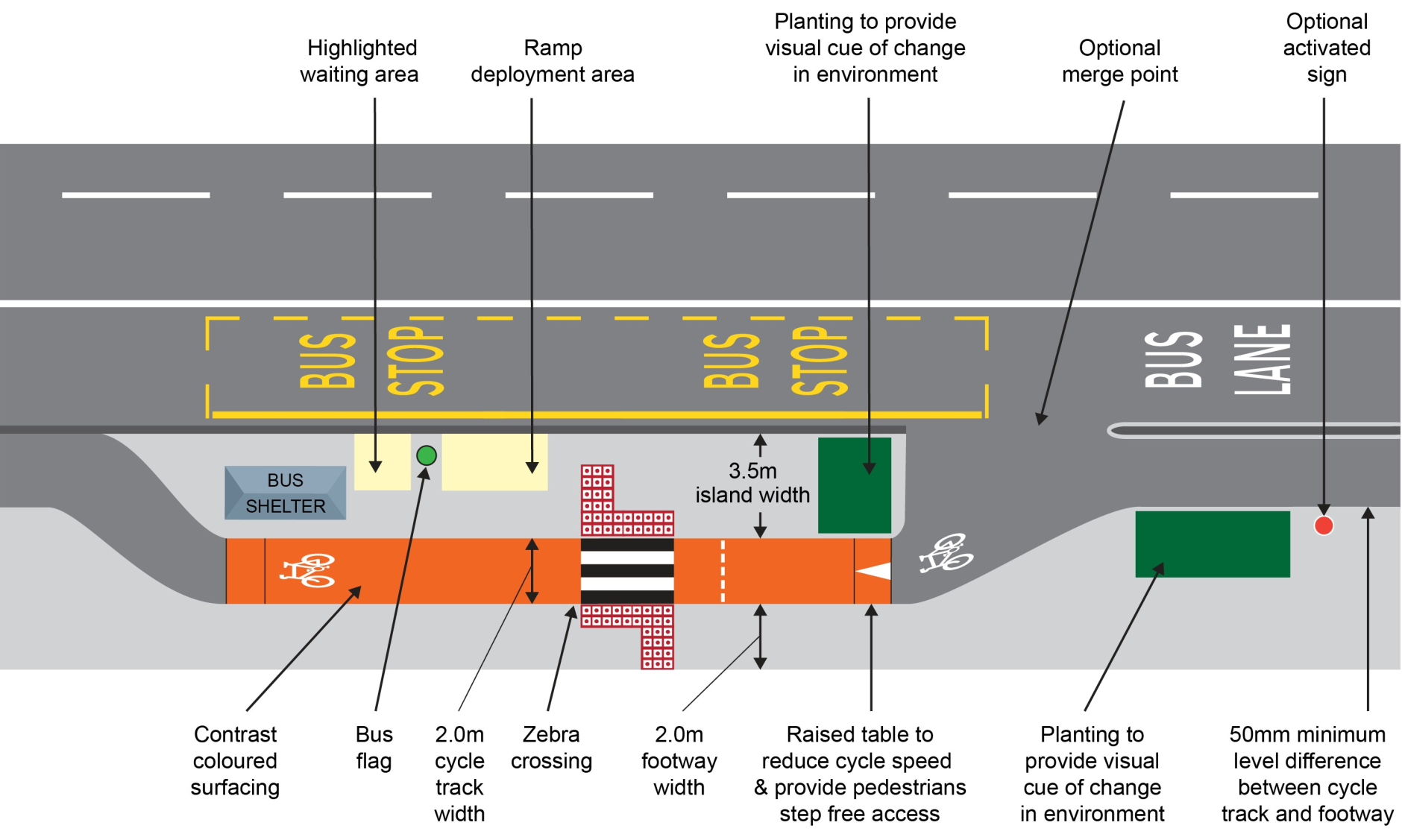
Graphic 1 illustrates a suggested standard layout for locations with sufficient space, including the central relationship between the bus stop flag, shelter and any crossing point.
This is an indicative illustration of a bus stop bypass, but the central relationship can be applied to any bus stop layout. The dimensions are those recommended in Step 1 of the assessment process.
Specific layout decisions – for example the orientation of the bus shelter and flag – may vary between authorities.
Other elements are illustrated, which may improve accessibility, and designers will need to consider which may be suitable for particular schemes. This layout may be developed further in future guidance. Further guidance will be developed for activated signs, to be informed by research carried out by ATE.
Graphic 1 – Floating bus stop design considerations with suggested dimensions (not to scale)
Other key considerations identified through research and stakeholder feedback include the following.
At a bus stop bypass the island should always be:
- big enough to accommodate the likely number of people using it
- ideally be no less than 2.5m wide
Street furniture in the surrounding environment should be positioned so as not to obstruct people’s routes to and from the stop.
Bus shelters should have see-through end panels to improve forward visibility. Any planting provided should be well-maintained so that it does not obscure sightlines.
Colour contrast and level difference of at least 50mm should always be provided to indicate the presence of the cycle track.
Tactile paving should always be to the correct colours and layouts as per the guidance on the use of tactile paving surfaces.
Crossfall on the island should be minimised.
Zebra and signal-controlled crossings across cycle tracks must comply with the Traffic Signs Regulations and General Directions 2016. The design should ensure the crossing point provides sufficient visibility to cyclists to enable them to act in time to comply with the legal requirements to give way or stop respectively.
Signing on the approach, mounted within cyclists’ eyeline, ‘give way’ markings and other measures to enhance conspicuity should be considered to help alert cyclists to the possible presence of bus passengers ahead. The potential to distract cyclists from concentrating on the presence of pedestrians should be considered.
The following tables summarise the needs of pedestrians, cyclists and bus passengers in relation to floating bus stops.
Table 1 – Pedestrians: user needs and design principles
| User need | Design principle |
|---|---|
| Avoids conflict with cyclists | Safe |
| Clear and legible route through the bus stop, separate from cycling, boarding and alighting space | Coherent |
| Available width is sufficient for pedestrian flows | Comfortable |
| Surface accessible for walking/wheeling; cyclist speed is reduced | Comfortable |
| Minimum deviation from route | Direct |
Table 2 – Disabled pedestrians: additional user needs and design principles
| User need | Design principle |
|---|---|
| A suitable route is detectable by vision impaired people | Coherent |
| Available width is sufficient for people to pass each other, including wheelchair users and vision impaired people, including placement of any street furniture | Comfortable |
| Surface is suitable for wheelchair users | Comfortable |
Table 3 – Cyclists user needs and design principles
| User need | Design principle |
|---|---|
| Adequate protection from motor traffic | Safe |
| Avoids conflict with pedestrians and people boarding/alighting the bus | Safe |
| Clear and legible route through the bus stop, separate from pedestrians, boarding and alighting space | Coherent |
| Clear and legible cycle track crossing(s) | Coherent |
| Design should minimise distractions to help ensure cyclists are aware of people boarding and alighting the bus | Coherent |
| Suitable surface provided for cycling | Comfortable |
| Speed reducing measures do not cause undue discomfort | Comfortable |
| Appropriate intuitive and navigable route minimising deviation through the bus stop area. Minimum deviation from route | Direct |
Table 4 – Disabled cyclists: additional user needs and design principles
| User need | Design principle |
|---|---|
| Minimal crossfall | Safe |
| Available space accommodates passage of Cycle Design Vehicle as defined in LTN 1/20 (1/2 way) | Comfortable |
| Ramps for cycle track crossing(s) do not cause tipping/loss of balance | Comfortable |
| Routes need to be suitable and appropriate for use by disabled cyclists using a range of types of cycles. | Comfortable |
Table 5 – People boarding the bus: user needs and design principles
| User need | Design principle |
|---|---|
| Adequate space to wait, clear of cyclists and pedestrians | Comfortable |
| No conflict with cyclists through bus stop area. | Safe |
| Slow cyclist speed through bus stop area. | Safe |
| Minimum width of cycle track to be crossed | Comfortable |
| Adequate visibility to approaching cyclists at cycle track crossing(s) | Safe |
| Clear where people should wait and from where to board a bus (may be different) | Coherent |
| Direct route from waiting area to boarding area, if different. | Coherent |
| Clear where people should cross the cycle track | Coherent |
| Suitable stop facilities – shelter, information etc. | Comfortable |
| Pedestrians have legal priority crossing the cycle track, suitable for the speed and volume of cyclists | Coherent |
Table 6 – Disabled people boarding the bus: user needs and design principles
| User need | Design principle |
|---|---|
| Sufficient space to deploy a wheelchair ramp safely (or a wheelchair lift if the stop is used by coaches) | Safe |
| Appropriate tactile paving to find and use cycle track crossings | Coherent |
| Level surface at cycle track crossing(s) | Comfortable |
Table 7 – People alighting the bus: user needs and design principles
| User need | Design principle |
|---|---|
| Adequate space to alight, clear of cyclists and pedestrians | Comfortable |
| No conflict with cyclists through bus stop are | Safe |
| Slow cyclist speed through bus stop area | Safe |
| Minimum width of cycle track to be crossed | Comfortable |
| Adequate visibility to approaching cyclists at cycle track crossing(s) | Safe |
| Clear where people should cross the cycle track | Coherent |
| Pedestrians have legal priority crossing the cycle track, suitable for the speed and volume of cyclists | Comfortable |
| Direct route from alighting area to crossing point(s) and footway beyond | Direct |
Table 8 – Disabled people alighting the bus: user needs and design principles
| User need | Design principle |
|---|---|
| Sufficient space to deploy a wheelchair ramp safely | Comfortable |
| Appropriate tactile paving to find and use cycle track crossings | Coherent |
| Level surface at cycle track crossing(s) | Comfortable |
| Sufficient space to manoeuvre a wheelchair when exiting the ramp and joining the footway | Comfortable |
Design process: assessment and metrics
This section sets out a suggested design process and criteria for use when considering the design of floating bus stops or assessing existing floating bus stops. It is focussed on the floating bus stop area and not on surrounding conditions or layouts. Stakeholder engagement informed the guiding principles for design listed below, which have been used to develop this process.
- Accessibility and safety for all users should be the primary considerations for designers.
- Floating bus stops should only be considered on streets with bus routes where protected infrastructure has been identified as necessary as set out in LTN 1/20.
- No bus passenger should be expected to board or alight a bus directly into a cycle track
- There should be enough level surface for a wheelchair ramp to be deployed and for the wheelchair user and anyone accompanying them to manoeuvre.
- Where a crossing area is considered necessary, it should always be highlighted on the cycle track and efforts made to slow cyclists on the approach.
- Space should be allocated in direct proportion to the number of users (current or predicted), be they pedestrians; cyclists; or bus passengers waiting, boarding or alighting.
- Tactile paving, road markings, signing and assistive technology should be legible and clear to users.
- Education and enforcement measures should be planned for each new floating bus stop.
- The safety and performance of floating bus stops for all user groups should be monitored once installed and changes made to improve accessibility if issues are found.
Designers should gather metrics to inform the assessment process. The results can be used in conjunction with the process outlined below to determine possible design solutions.
Metrics for consideration
Available carriageway and footway widths
Measure at the stop location and either side of the approach and exit. Is there enough space to accommodate the minimum values, including any deflection or treatment on approach for the cycle track to slow cyclists? Can space be taken from the carriageway to fulfil minimum width requirements for pedestrians and cyclists?
Surrounding environment
Record the street type – residential, high street, town centre, suburban/arterial road. Record if there are active frontages – such as shops and restaurants – that will generate significant pedestrian traffic. Locations nearby that will generate large numbers of people at specific times include schools and sports venues. Locations that may generate demand from more vulnerable pedestrians such as care homes, hospitals, GP surgeries, day centres or similar.
Forward visibility for cyclists on approach to stop
This should be enough to allow cyclists to slow down in time. Signs and markings may be used in advance of the bus stop, particularly if forward visibility is restricted.
Collision records
Consider these for the past 3 years if available. Pay particular attention to incidents between pedestrians and cyclists and between cyclists and buses at or near the stop. Observation and interaction analysis may also help identify potential collisions and points of conflict.
Pedestrian numbers per hour – people walking past the stop, not waiting for a bus or boarding/alighting
Counts should record numbers of people using mobility aids. Pedestrian comfort level should also be assessed to ensure there is enough space for people to circulate safely without stepping into the cycle track.
Cyclist numbers per hour
Numbers of people using hand cycles, tricycles, adapted cycles and others should be recorded separately if possible. Large numbers of cyclists may restrict the visibility of crossings. Latent demand should be assessed if planning a new route, for example through the propensity to cycle tool.
Cyclist speed
Record speed of cyclists on approach to the stop. If speeds seem excessive then consider deflection on the approach or other means to reduce inappropriate speed. Designs should enable slower riding speeds. This applies to cyclists, including those using e-cycles and cargo-cycles but also other forms of micromobility, such as e-scooters within DfT approved trial areas.
Bus passengers per hour – people waiting to board and people alighting
Counts should record numbers of people using mobility aids.
If the number of passengers getting on and off the bus is high, then they will need adequate space and clear separation to reduce the risk of conflict with passing cyclists. Disabled people may need more time to board and alight, for example if ramp deployment is required. It is useful to look for surge times and daily variations.
Bus movements per hour at peak times
Include whether multiple bus routes use the site, which may require consideration of space for people to interchange between buses. Record if there any bus stands, timing points or crew changeover points which will require bus drivers to be able to access nearby facilities.
If the frequency of buses is high, then passengers will need to get clear easy access to the kerbside or risk frequently blocking the path of cyclists and potentially causing delays and conflict. Likewise, cyclists on carriageway will frequently interact with buses which may increase collision risk.
Speed of general traffic
The 85th percentile speed of general traffic will affect the approach speed of buses (where bus lanes are not provided) and may require longer stops or a layby. Variations throughout the day should be considered.
General traffic flow levels
If motor traffic volumes are high, then the safety risk to cyclists or pedestrians interacting with motor traffic is increased. Figure 4.1 in LTN 1/20 summarises the traffic conditions when protected space for cycling (fully kerbed cycle tracks, stepped cycle tracks and light segregation), marked cycle lanes without physical features and cycling in mixed traffic are appropriate.
Quality of surfacing
If the footway and carriageway do not have smooth, well-maintained surfacing, this is likely to make it harder for people walking, wheeling and cycling to use them. Consider if poor surfacing can be addressed as part of the scheme. The effect of different weather conditions on surfaces should also be considered.
Street lighting
What street lighting is provided? Is this sufficient to ensure the stop and associated signs and markings are visible to all users? Lighting at bus stops should not be switched off during the hours of darkness.
Ongoing maintenance
Are markings, tactiles and signs worn or sub-standard? Do they require attention as part of delivery of the proposed design?
Consider future maintenance needs, including seasonal maintenance such as leaf litter clearance and gritting.
Design process: process steps
The process below is intended to be used by design engineers on new schemes but can also be used to determine adjustments to existing arrangements.
Step 1. Note the desired and minimum widths for a cycle track, a footway and an island at a bus stop bypass or a cycle track with bus boarding island (whichever is appropriate).
| Bus stop bypass – ideal | Bus stop bypass – minimum | Cycle track with bus boarding island – ideal | Cycle track with bus boarding island – minimum | |
|---|---|---|---|---|
| Footway | 2.0m | 1.5m | 3.0m | 2.0m |
| Cycle track (1 way) | 2.0m | 1.5m | 2.0m | 1.5m |
| Cycle track (2 way) | 3.0m | 2.5m | 3.0m | 2.5m |
| Island | 3.5m | 2.5m | 2.0m | 1.5m |
Step 2. Determine the total width of the site – including carriageway, footway, cycle track and island width.
Step 3. If minimum width exceeds total width available, assess flow for each mode.
If the minimum width of the cycle track, footway and island exceed the total width of the site, assess flow for each mode.
Determine the number of people walking or wheeling, the number of predicted cyclists, and the number of bus passengers using the site in the peak hour. Latent demand should be considered as well as actual values.
| Low flow | Medium flow | High flow | |
|---|---|---|---|
| Walking (pedestrians a day) | < 500 | 500 – 2,000 | > 2,000 |
| Cycling (cyclists an hour) | < 200 | 200 – 800 | > 800 |
| Bus users (boardings a day) | < 250 | 250 – 1,000 | > 1,000 |
Flow data is based on LTN 1/20 for cycling and Active Travel England advice for walking and bus users. Note that these numbers are a guide rather than an absolute.
Step 4. Consider contextual justification for smaller widths, including justification based on low or medium flow. If there is not enough width available to accommodate flows then strong justification will be required based on the surrounding context, or an alternative to providing a floating bus stop should be sought.
| Low flow | Medium flow | |
|---|---|---|
| Footway | 1.5m | 2.0m |
| Cycle track | 1.0m | 1.5m |
| Island | 0.5m – 1.5m | 2.0m |
Design options
The layouts below set out the recommended parameters and contexts for 2 design options. Refer to the process steps for variations that may be appropriate in different contexts.
Bus stop bypass
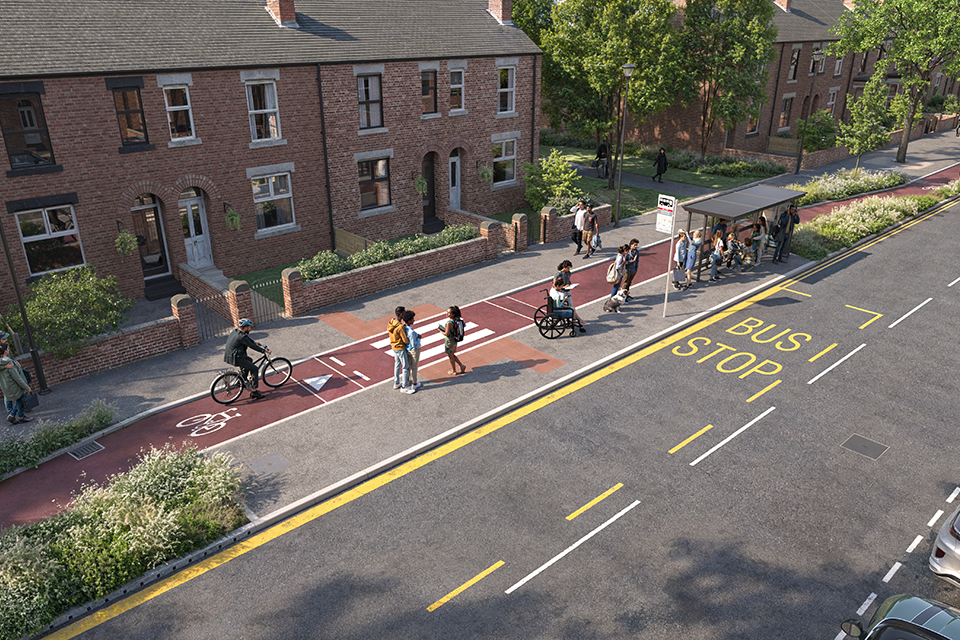
Graphic 2 shows a layout for a bus stop bypass. This layout can be adapted for sites with more than one bus, or to accommodate a two-way cycle track.
Graphic 2 – Layout for a bus stop bypass
Applicable contexts
| Pedestrian numbers | Medium |
| Cycle numbers | Medium |
| Bus movements per hour | Medium |
| Place context | Low and medium |
Table showing recommended minimum dimensions and features.
| Design details | Optimum values |
|---|---|
| Island width | 3.5m desired; 2.5m minimum (contextual justification required if otherwise, see process steps) |
| Footway width | 2m desired; 1.5m minimum |
| Cycle track width 1 way | 2m desired, 1.5m minimum |
| Cycle track width 2 way | 3m desired; 2.5m minimum |
| Crossing type | Zebra |
| Shelter position | On island |
| Level difference from cycle track to footway | 125mm desired; 50mm minimum |
| Material visual contrast between cycle track and footway | High (see Inclusive mobility) |
| Tactile paving | Red blister with controlled crossing |
| Forward visibility for cyclists | See LTN 1/20 table 5.5 |
| Measures to slow cyclists | Horizontal and vertical deflection; signing and markings |
Cycle track with bus boarding island
Graphic 3 – Layout for a cycle track with bus boarding island

Applicable contexts
| Pedestrian numbers | Low to medium |
| Cycle numbers | Low to medium |
| Bus movements per hour | Low to medium |
| Place context | Low and medium |
Table showing recommended minimum dimensions and features.
| Design details | Optimum values |
|---|---|
| Boarding island width | 2.0m desired, 1.5m minimum (contextual justification required if otherwise, see process steps) |
| Footway width | 3m desired behind the bus shelter, 2m minimum |
| Cycle track width 1 way | 2m desired, 1.5m minimum |
| Cycle track width 2 way | 3m desired, 2.5m minimum |
| Crossing type | Zebra |
| Shelter position | Behind cycle track |
| Level difference from cycle track to footway | Not applicable |
| Material visual contrast between cycle track and footway | High |
| Tactile paving | Red blister with controlled crossing |
| Forward visibility for cyclists | See LTN 1/20 table 5.5 |
| Measures to slow cyclists | Signing and markings |
Shared use bus boarders
There are several variations of this design but the common principle is that the cycle track is taken in front of the bus shelter and/or flag, so that pedestrians step straight from or into it when boarding or alighting a bus. The cycle track is delineated through the use of colour and/or materials. There is no level difference between the track and the footway.
The letter issued to local authorities by the Minister for Local Transport on 20 November 2025 put on hold any new installations which use this layout, and this pause remains in place. These designs are in conflict with the design principle that people should not board or alight into the direct path of a cyclist.
Existing designs of this type, whether proposed or in place, may be adapted in light of this guidance and the advice in paragraphs 6.6.12 – 6.6.15 of LTN 1/20.
The assessment process should be used to review existing sites to establish the user profile and available space, and the results used to consider what changes should be made.
A review may conclude that no changes are needed, taking into account factors such as performance and user feedback.
Adaptation of these designs may include conversion to a cycle track with a bus boarding island by adding an appropriate boarding island.
Authorities looking at this option should bear in mind that contrasting materials or painted hatching used to create a boarding island do not change the underlying status of an existing cycle track. If these are to be used, the authority should consider amending the designation of the cycle track to exempt these areas, retaining them as footway.
Graphic 4 – Standard bus stop with no treatment
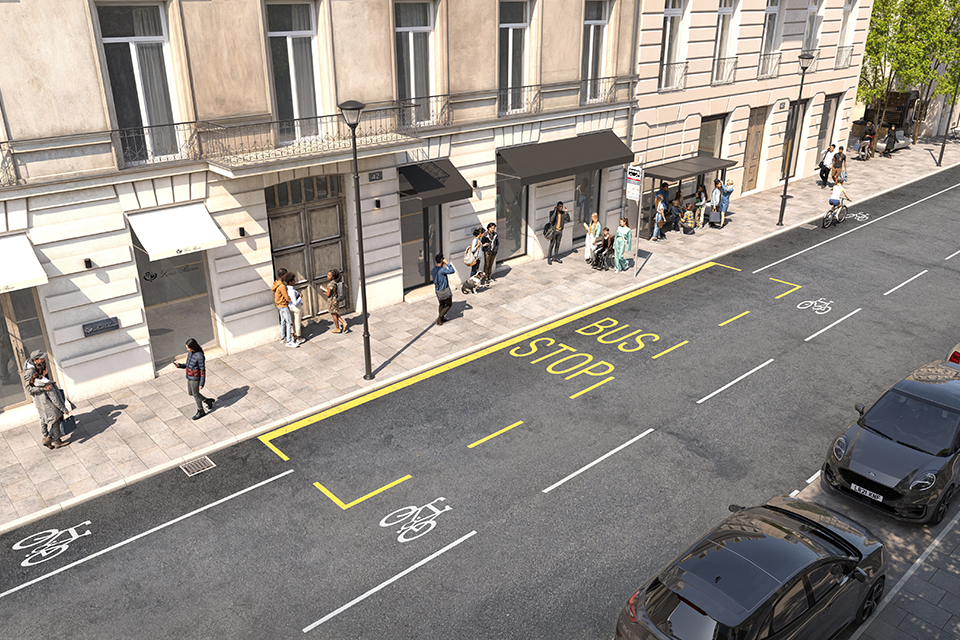
Bus stops may be left untreated where cyclist flows and traffic speeds and volumes are low and where the risk to cyclist safety is low. This may be preferable where, after considering the outcome of the assessment process, it is clear that a floating bus stop is not suitable for a particular location.
In these circumstances, as per the advice in chapter 7 of LTN 1/20, it may be appropriate to provide a cycle lane on the carriageway and retain a standard bus stop cage marking.
The street context shown is of a city centre street which may be a restricted parking zone and with traffic restricted to local access and through buses and cyclists. There is no parking permitted within the cycle lane.
Behaviour change
While appropriate and effective design will help address accessibility concerns about floating bus stops, how people behave when using them will also play a part in how well they are perceived. Both Living Streets’ and Guide Dogs’ research identified poor cyclist behaviour as a factor in how confident people felt at a floating bus stop. Particular issues included cyclists failing to:
- slow down on the approaches
- observe the legal requirement to give way to people on zebra or other formal crossings
Good design can help reduce the likelihood of such issues occurring but additional measures to address poor or inappropriate behaviour should be considered and implemented alongside any infrastructure changes.
This can include complementary publicity and behaviour change activity aimed at ensuring that new and existing bus stop designs are safe, inclusive and understood by all users.
ATE can provide campaign materials for local authorities to use in raising awareness of the Highway Code, with a particular focus on the rules designed to protect people walking, cycling and motorcycling. These include materials designed to remind road users, particularly cyclists, to give way at crossings at bus stops.
They highlight 5 key rules, which protect at-risk road users where there is poor compliance and understanding of the rules. These include some of the rules updated in 2022 and rule H2 which states that people should give way to people waiting to cross at zebra or parallel crossings.
For more information and to request materials please email contact@activetravelengland.gov.uk.
Enforcement
Schedule 14 part 5 of the Traffic Signs Regulations and General Directions 2016 place a requirement on cyclists to give precedence to any pedestrian on a zebra crossing and to stop at a red light at a signal-controlled crossing. This includes crossings placed across cycle tracks.
Not complying with this requirement is an offence under the Road Traffic Act 1988. This is an offence subject to police enforcement. Authorities may wish to consider working with local forces, for example, to develop targeted campaigns for sites where compliance has been identified as an issue.
There are offences available to the police to consider in relation to poor or dangerous cycling behaviour which may create issues at bus stops, for example inappropriate speed.
Secretary of State requests for information
This section does not form part of the statutory guidance issued under section 31.
Section 32 of the act gives powers to the Secretary of State to request:
- information from local authorities on how they have complied with the requirement in section 31 to have regard to this guidance
- any other information, relating to stopping places provided by the authority and used by local services, that is specified in the request
This will promote accountability, allowing the government to understand the progress being made across the country to ensure that bus stops and infrastructure are safe and accessible to all passengers.
This section does not constrain the exercise of the power in section 32 but is intended as a guide to what may be requested from local authorities if there are concerns about compliance with the duty to have regard to the guidance.
What would trigger a request?
There are no set criteria within the legislation, and this is not intended to be a complaint or call-in process. The department may, for example, make a request for information if it identifies significant concerns about an authority’s approach to implementing floating bus stops.
Authorities should make use of ATE’s design review process to help resolve issues with the design of individual schemes during their development.
What information would be required?
Any request is likely to focus on information local authorities are likely to already have through the activities which naturally form part of developing any traffic management or active travel scheme. Local authorities should still consider how to ensure the design metrics and principles are incorporated into their design processes and decision making.
Local authorities may consider the following information helpful in answering any requests from the Secretary of State:
- how decisions were made on route choice and whether to provide protected infrastructure – and therefore whether the scheme falls in scope of this guidance
- how the principles and metrics within this guidance have been considered during the design process for any scheme, for example through a checklist
- what consultation and engagement has been carried out with relevant groups, particularly bus passengers, disabled people and cyclists and the outcome
- accurate records of type and location of floating bus stops
- that an equality impact assessment has been undertaken
- that a road safety audit has been carried out
- plans to, or results of, monitoring and evaluation of installations, including user feedback and how that has been considered and acted on
Consultation requirements
Section 31 of the Bus Services Act 2025 requires the Secretary of State to consult the Disabled Persons’ Transport Advisory Committee (DPTAC) and other relevant persons before publishing this guidance. DPTAC was consulted during its development and Transport for All was commissioned to run workshops with a range of disability and road user groups and individuals with lived experience of disability to ensure the recommendations reflect their needs. The groups represented included:
- Age UK
- All-Party Parliamentary Group for Cycling and Walking
- Bikeability Trust
- Campaign for Better Transport
- Confederation Passenger Transport
- Cycling UK
- Guide Dogs
- Mencap
- Motability Foundation
- Parliamentary Advisory Council for Transport Safety
- Policy Connect
- Transport for All
- Transport for All members
- Wheels for Wellbeing
- Walk Wheel Cycle Trust
The department and ATE also sought feedback from the Urban Transport Group, Living Streets, Guide Dogs, RNIB, Transport for London, and ATE’s Technical Oversight and Advisory Group.
The department and ATE would like to thank all those involved for their time and contributions.