Recognising quality in your FRAEW report
Published 14 September 2026
Applies to England

© Crown copyright 2026
This publication is licensed under the terms of the Open Government Licence v3.0 except where otherwise stated. To view this licence, visit nationalarchives.gov.uk/doc/open-government-licence/version/3 or write to the Information Policy Team, The National Archives, Kew, London TW9 4DU, or email: psi@nationalarchives.gov.uk.
Where we have identified any third party copyright information you will need to obtain permission from the copyright holders concerned.
This publication is available at https://www.gov.uk/government/publications/fire-risk-appraisals-of-external-walls-fraews/recognising-quality-in-your-fraew-report
A practical checklist for understanding what good looks like
Purpose of this guidance
This guidance helps building owners, managing agents, residents and others understand what to look for in a completed Fire Risk Appraisal of External Walls (FRAEW).
It explains what a clear, well-supported FRAEW should include and highlights common issues that may reduce confidence in its findings.
You do not need to be familiar with PAS 9980 to use this guidance. It is designed to help you understand whether an FRAEW is clear, evidence-based and easy to follow.
Signs of a strong FRAEW
A strong FRAEW is:
- clearly explained
- proportionate and risk-based
- supported by evidence
- consistent across all documents
- transparent about assumptions and limitations
How this guidance is organised
PAS 9980 follows a series of steps that a competent professional should consider before reaching conclusions. This guidance reflects those steps and is organised into four themes.
Together, the checks help you understand how the assessment was carried out, what evidence was used, how conclusions were reached and whether any further action is required.
1. Understanding the assessment
Checks 1 to 4 help you understand:
- the scope, limitations and uncertainties of the assessment
- the building being assessed
- how the building height has been determined
- the external wall construction
2. Understanding competence and evidence
Checks 5 to 6 help you understand:
- who carried out the assessment and how competence has been demonstrated
- whether the assessment is supported by appropriate evidence, investigations and peer review
3. Understanding how risk has been assessed
Checks 7 to 13 help you understand:
- the building’s fire strategy and fire hazard factors
- fire performance factors
- façade configuration
- the risk of secondary fires
- external fire spread
- the evidence used to support the assessment
- how different risk factors have been considered together to reach an overall outcome
4. Understanding recommendations and outcomes
Checks 14 to 18 help you understand:
- whether interim or mitigation measures are appropriate
- the recommended remedial works and the reasons for them
- the expected outcome of the recommendations
- whether further fire engineering analysis is required
- the overall conclusions and proposed next steps
Check 1: Scope, limitations and uncertainty
A good FRAEW should clearly explain what the assessment covers, what it does not cover, and where assumptions or uncertainty remain. This helps readers understand how the conclusions have been reached and whether there are any gaps in the available information.
What good looks like
A clear FRAEW will usually:
- clearly define what was and was not assessed
- identify access and inspection limitations
- distinguish confirmed information from assumptions
- explain how assumptions affect conclusions
- explain any uncertainty within the assessment
- identify where further investigation may be needed
- confirm the approach aligns with PAS 9980
Common issues to look for
Common issues include:
- scope not being clearly defined
- exclusions not explained
- assumptions presented as facts
- uncertainty not acknowledged
- limitations not reflected in recommendations
- no explanation of further investigation requirements
Why this matters
An FRAEW should be transparent about its scope, limitations and uncertainties. This allows readers to understand the basis of the assessment and whether any further investigation may be needed.
Check 2: Clarity of building description
Readers should be able to understand the building, its external walls and the context of the assessment without referring to multiple documents.
What good looks like
A clear FRAEW will usually:
- identify the building name, address, height and number of storeys
- explain the building’s use, such as residential or commercial, and any key features
- describe the structural frame and external wall construction
- explain the arrangement of cladding types
- describe the building shape and façade geometry
- identify the cladding and insulation materials
- explain any relevant refurbishment history and the condition of the building
- identify surrounding risks and firefighting access arrangements
- describe relevant fire safety systems and any building modifications
Common issues to look for
Common issues include:
- vague building descriptions
- unclear wall construction or materials
- key features omitted
- multiple wall types present, but treated as a single wall type throughout the assessment
- excessive information unrelated to external wall fire risk
- refurbishment history not explained
Why this matters
The building’s height, use, layout, fire strategy and construction all influence external wall fire risk.
Check 3: Building height
Building height should be measured and reported clearly, as this will impact on the level of risk.
What good looks like
A clear FRAEW will usually:
- use a recognised method of measurement
- state the building height in metres
- confirm the number of storeys and any variations in building height
- explain any features affecting the measurement
The diagram shows how height should be measured.
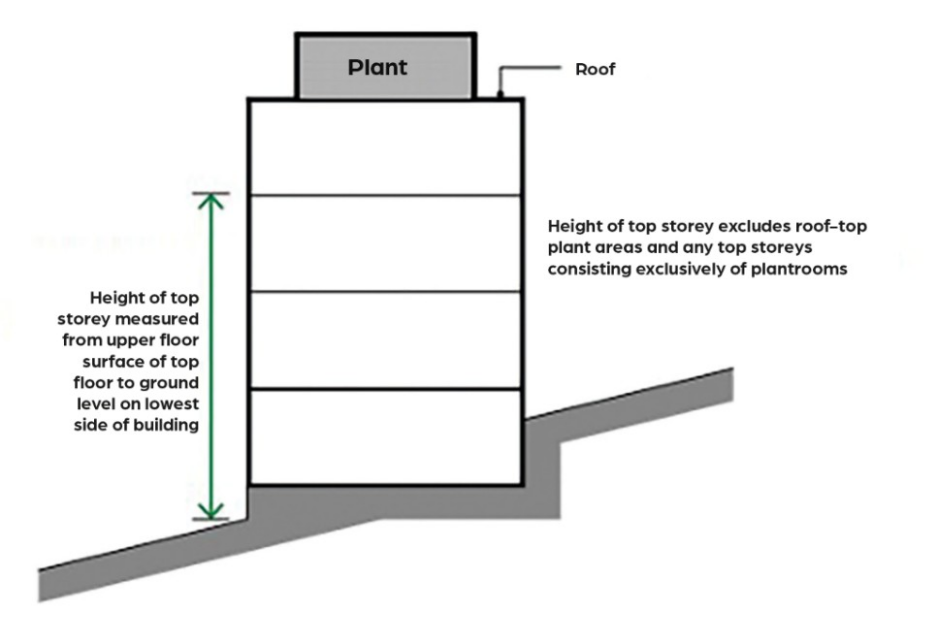
The diagram shows that building height should be measured from the lowest external ground level adjacent to the building to the floor level of the top storey. Roof-top machinery and plant areas are not included in this measurement. Any storey that is used for, or consists exclusively of, roof-top machinery or plant rooms should be disregarded when determining the top storey.
Common issues to look for
Common issues include:
- unclear or inconsistent building height
- roof plant included in the height calculation
- number of storeys not stated, or variations in height not identified
- measurement method not explained
Why this matters
Building height affects how external wall fire risk is assessed and can influence evacuation, firefighting access and the likely consequences of external fire spread. Clear measurement helps readers understand the basis of the assessment and check that the correct height has been used.
Check 4: External wall construction
Different wall systems present different levels of risk. The FRAEW should clearly explain the materials, systems and methods of construction being assessed across all external walls.
What good looks like
A clear FRAEW will usually:
- explain how the wall is constructed from outside to inside
- identify materials and system components
- explain the role of cavity barriers and fire breaks
- reference manufacturer information where available
- explain any refurbishment or overcladding
Table 1: Example wall build-up (outside to inside)
| Component | Example description |
|---|---|
| Render finish | Coloured render finish. Thickness and fire performance depend on the system specification. |
| Reinforcement mesh | Glass fibre mesh embedded within the render basecoat. |
| Render basecoat | Fibre-reinforced basecoat forming part of the render system. |
| Insulation layer | Expanded polystyrene (EPS) insulation boards forming the primary insulation layer. |
| Fire breaks / cavity barriers | Mineral fibre cavity barriers installed at compartment lines, openings and other locations required by the system design. |
| Fixings | Mechanical fixings and/or adhesive used to secure the insulation to the substrate. |
| Substrate | Precast concrete panels forming the original external wall construction. |
| Internal lining | Internal finishes, such as plasterboard or applied finishes. Where relevant, this should include how the lining interfaces with any steel framing system (SFS) and contributes to the fire performance of the wall build-up. |
Table 1 shows an example of how a FRAEW may describe the external wall build-up. The exact format may vary, but the report should clearly identify the main wall components and materials so that the assessor’s findings can be understood and reviewed.
Common issues to look for
Common issues include:
- wall build-up unclear or incomplete
- materials described in generic terms only
- cavity barriers not identified
- manufacturer information missing
- reliance on unverified assumptions
Why this matters
Fire risk can vary significantly between different wall systems and construction types. It can also be affected by assumptions made during the appraisal process. A clear description of the wall build-up allows readers to understand how materials, components and design features contribute to risk, supports a proportionate assessment, and helps ensure the basis for key assumptions is clear.
Check 5: FRAEW author competence
The FRAEW should demonstrate that it has been carried out by competent professionals and, where appropriate, independently peer reviewed. The roles and responsibilities of those involved in the assessment should be clearly explained.
What good looks like
A clear FRAEW will usually:
- clearly identify authors and reviewers
- clearly explain their roles in the assessment
- provide relevant qualifications and experience
- identify the peer reviewer and explain their role, where applicable
- declare any conflicts of interest
Common issues to look for
Common issues include:
- individuals not clearly identified
- competence not demonstrated
- no competency statement provided
- no evidence of independent peer review provided
- conflicts of interest not declared
Why this matters
Evidence of competence and appropriate peer review helps build confidence that the FRAEW is robust, evidence-based and carried out in line with PAS 9980.
Check 6: Clarity of evidence and findings from investigations
Readers should be able to understand what evidence has been used, how reliable it is, and how it supports the conclusions reached.
What good looks like
A clear FRAEW will usually:
- reference relevant drawings and specifications
- include product information and data sheets, where relevant
- refer to Fire Risk Assessments (FRAs), reports and surveys that support the appraisal
- explain findings from intrusive inspections
- include relevant specialist advice and technical assessments
- clearly explain how the evidence supports the conclusions reached
- use relevant fire test evidence, certification and other supporting information
- provide or clearly reference key supporting documents
Common issues to look for
Common issues include:
- conclusions that are not supported by evidence
- documents that are provided without explanation
- evidence and conclusions that are not clearly linked
- references that are difficult to locate
- fire test evidence or certification included without explaining its relevance
- supporting documents that are referenced but not available
Why this matters
FRAEW conclusions should be supported by evidence rather than assumption. Clearly linking evidence to findings helps readers understand how conclusions have been reached and increases confidence in the appraisal.
Check 7: Consideration of fire strategy and fire hazard risk factors
The consequences of external fire spread are influenced by factors such as occupancy, compartmentation, smoke control, firefighting facilities and evacuation arrangements. These factors are normally addressed through the building’s fire strategy and fire risk assessment and should align with the FRAEW.
What good looks like
A clear FRAEW will usually consider and explain:
- occupancy, including whether any occupants may need additional support to evacuate
- the extent and distribution of cladding across the building
- the arrangement and distribution of wall types and their impact on risk
- escape route design
- compartmentation
- smoke control systems
- fire detection and alarm systems
- fire suppression systems
- firefighting facilities
- rising mains
- firefighting lifts
- any specific fire hazards relevant to the building
It will also usually:
- provide a clear rationale for each risk rating
- explain why a factor has been assessed as not applicable, where relevant
- include an overall summary of findings relating to fire strategy and fire hazards
Common issues to look for
Common issues include:
- omitted risk factors
- factors listed without explanation
- unjustified risk ratings
- no overall summary of fire strategy risk provided
Why this matters
Fire strategy measures can reduce or increase the consequences of external fire spread. Understanding how occupants evacuate, how smoke is managed and how firefighters can respond helps ensure the overall risk assessment reflects the building, not just the external wall materials.
Check 8: Fire performance risk factors
A FRAEW should consider all relevant fire performance factors set out in PAS 9980 and explain how the construction of the external wall influences external fire spread.
What good looks like
A clear FRAEW will usually consider and explain:
- external wall fire performance
- external surface reaction to fire
- cladding panel performance, including panel construction and gaps
- cavities, insulation materials and cavity barriers
- substrate materials and sheathing boards
- internal finishes
- balconies and other external attachments, where relevant
Common issues to look for
Common issues include:
- omitted key wall components
- assumptions unsupported by evidence
- inconsistent assessment of wall types
- unexplained risk ratings
- unjustified use of not-applicable factors
Why this matters
The materials and systems used within the external wall can significantly influence fire behaviour. A systematic assessment helps demonstrate how each component contributes to the overall risk.
Check 9: Façade configuration risk factors
An FRAEW should assess how the façade, i.e. the physical arrangement of the building and its external wall system, influences the likelihood and consequences of fire spread.
What good looks like
A clear FRAEW will usually consider and explain how the following factors influence the likelihood and consequences of fire spread:
- building height
- proximity to external ignition sources
- the extent of cladding and cavities
- proximity to windows and other openings
- service penetrations and vents
- proximity to escape route openings
- balconies and other façade attachments
- proximity to neighbouring buildings
It will also usually:
- explain how each factor influences risk
- provide evidence to support the ratings assigned
- include an overall summary of façade configuration risk
Common issues to look for
Common issues include:
- risk factors assessed in isolation
- poorly described building geometry
- overlooked openings and penetrations
- unjustified risk ratings
- no overall conclusion on façade configuration risk
Why this matters
The configuration of a building can affect how quickly fire spreads over the façade, whether it can re-enter the building and whether neighbouring buildings could be affected. Understanding these factors helps achieve a proportionate assessment of risk.
Check 10: Possibility of secondary fires
The FRAEW should explain whether fire spread via the external wall could result in secondary fires in other parts of the building. This assessment should consider building layout, façade configuration and the location of openings.
What good looks like
A clear FRAEW will usually:
- identify the areas where a fire is most likely to start
- explain how fire could spread externally and re-enter the building
- consider the impact of windows, vents and other openings on fire spread
- explain the relationship between façade configuration and fire spread potential
- support conclusions with building-specific observations
- explain how different risk factors interact and influence the overall risk
Common issues to look for
Common issues include:
- generic statements that lack building-specific analysis
- no assessment of how secondary fires could occur
- façade features not being considered
- potential routes for fire re-entry being overlooked
- conclusions that are not clearly explained
Why this matters
Secondary fires can significantly increase life safety risk by allowing a fire to spread to multiple compartments. Understanding how façade configuration and openings could contribute to fire re-entry helps ensure the overall fire risk is properly assessed.
Check 11: Risk of external wall fire spread
The FRAEW should clearly explain how fire could spread and how risk is controlled.
What good looks like
A clear FRAEW will usually explain:
- external wall fire spread mechanisms
- cavity barriers and fire stopping measures
- smoke control measures
- detection and suppression systems where relevant
- firefighting access arrangements
- external ignition hazards
-
likely impact on occupants
- how fire spread, façade configuration and control measures influence the overall risk outcome
Common issues to look for
Common issues include:
- fire spread routes are not explained
- cavity barrier strategy is unclear
- external ignition risks are not considered
- conclusions are not supported by evidence
Why this matters
The purpose of a FRAEW is to assess the risk of fire spread over or within the external walls. Clearly explaining fire spread mechanisms, control measures and potential consequences helps demonstrate how risk has been evaluated and supports proportionate recommendations.
Check 12: Visual evidence to support the assessment
Visual information can help explain how external fire spread could affect the building and support the FRAEW findings.
What good looks like
A clear FRAEW will usually explain:
- potential fire spread routes using diagrams, where appropriate
- how fire could spread between floors
- the relationship between openings and the external wall
- key findings using annotated photographs, where appropriate
- how images and diagrams support the conclusions reached
Common issues to look for
Common issues include:
- no visual evidence to support the assessment where complex fire spread routes exist
- unclear or poorly labelled diagrams
- images included without explanation or context
- fire spread routes and mechanisms that are difficult to follow
Why this matters
Complex fire spread pathways can be difficult to explain through text alone. Visual evidence, such as diagrams, can improve understanding for readers and help demonstrate how fire could spread between compartments or across elevations.
Check 13: Bringing together the risk factors
An FRAEW should clearly explain how different risk factors have been assessed and combined to reach an overall fire risk outcome. Visual tools can help explain the assessment but should support, not replace, professional judgement.
Using visual summaries
The strongest FRAEWs use visual summaries to help explain how different factors contribute to the overall risk outcome, such as:
- risk matrices
- risk factor tables
- fire performance diagrams
- façade risk summaries
Visual aids should support professional judgement and help explain how conclusions have been reached. They should not be used as a standalone scoring exercise.
Looking at your building as a whole
The FRAEW should not consider individual risk factors in isolation. Instead, it should explain how fire strategy, fire performance and façade configuration factors combine to influence the overall risk outcome for the building.
The overall risk outcome should be supported by clear reasoning, evidence and professional judgement.
What good looks like
A clear FRAEW will usually explain:
- how individual fire strategy, fire performance and façade configuration factors influence risk
- how these factors interact and combine to inform the overall risk outcome for the building
- how the overall risk outcome has been reached
- the reasoning and evidence supporting the conclusions
- how tables, charts or diagrams have been used to support understanding
Common issues to look for
Common issues include:
- risk factors presented as a list without explaining how they interact
- visual tools relied upon without supporting explanation
- little or no justification for the overall risk outcome
- no explanation of how risks relate to fire spread or occupant safety
- generic summaries that do not reflect the specific building
- conclusions that are not clearly supported by evidence
Why this matters
A clear risk factor analysis helps readers understand how the overall fire risk judgement has been reached and whether it is proportionate to the building being assessed.
Check 14: Interim and mitigation measures
Where risks are identified, the FRAEW should explain whether interim or mitigation measures are required and how they relate to the identified risk.
Examples of interim or mitigation measures
These may include:
- waking watch or fire wardens
- enhanced fire detection systems
- temporary alarm systems
- resident communication measures
- management controls
- enhanced inspections
- firefighting access controls
What good looks like
A clear FRAEW will usually explain:
- whether interim or mitigation measures are required and why
- how recommendations relate to the identified risks
- why any proposed measures are proportionate to the level of risk identified
- why no interim measures are required, where applicable
- any reasonable options considered as part of the assessment
Common issues to look for
Common issues include:
- recommendations not linked to identified risks
- interim measures included without explanation
- recommendations copied from standard templates
- no explanation of proportionality
- mitigation measures used without considering remediation needs
- expected risk reduction not explained
Why this matters
Interim and mitigation measures should help reduce risk while longer-term solutions are considered or implemented. Recommendations should always be proportionate to the level of risk identified.
Check 15: Remediation recommendations
Where remediation is required, recommendations should clearly explain what works are needed, why they are necessary and how they will reduce risk.
What good looks like
A clear FRAEW will usually explain:
- how proposed remedial works relate to the identified risks
- whether remediation is localised or required more widely across the building
- why the proposed works are proportionate to the level of risk identified
- the evidence, drawings or photographs that support the recommendations, where appropriate
- how the proposed works are expected to improve the fire risk outcome
Common issues to look for
Common issues include:
- generic recommendations such as “replace cladding”
- remediation that appears disproportionate to the identified risk
- no distinction between isolated issues and system-wide defects
- recommendations unsupported by evidence
- poor link between findings and proposed works
Why this matters
Clear and proportionate recommendations help demonstrate that the proposed works are necessary and linked to the risks identified during the assessment.
Check 16: Outcome of recommended actions
The FRAEW should explain how interim, mitigation and remediation measures are expected to improve the overall fire risk outcome.
What good looks like
A clear FRAEW will usually explain:
- the anticipated effect of the recommendations on the identified risks
- the expected risk outcome following implementation
- any assumptions, dependencies or conditions that underpin the outcome
- how and why the level of risk is expected to reduce
- whether the risk is expected to reduce to a tolerable or low level
Common issues to look for
Common issues include:
- no explanation of the expected outcome
- assumptions not identified
- risk reduction claims made without justification
- recommendations presented without explaining how they improve safety
- no indication of the expected residual risk
Why this matters
The expected outcome helps demonstrate that the recommendations can address the identified risks and improve the building’s overall fire safety position.
Check 17: Consider whether further fire engineering analysis is required
In some cases, a FRAEW may identify the need for further fire engineering analysis to better understand external wall performance and refine the overall risk outcome.
What good looks like
A clear FRAEW will usually explain:
- whether further fire engineering analysis is required and why
- the scope and purpose of any additional analysis
- how further analysis could influence the overall risk outcome
- any assumptions underpinning the need for further analysis
- why no further analysis is considered necessary, where applicable
Common issues to look for
Common issues include:
- no consideration of whether further analysis may be required
- unexplained recommendations for additional fire engineering analysis
- no explanation of how further analysis could influence the assessment outcome
- failure to consider options for refining the risk assessment
Why this matters
Additional fire engineering analysis may help refine the understanding of risk and support more proportionate recommendations. FRAEW readers should be able to understand whether further work is needed and why.
Check 18: Overall risk outcome and next steps
The FRAEW should clearly summarise the overall findings and risk outcome for each external wall system. The conclusion should explain how the outcome was reached and identify any required actions.
What good looks like
A clear FRAEW will usually explain:
- the fire risk outcome for each declared external wall system
- how the overall risk outcome has been reached
- the key fire strategy, fire performance and façade configuration factors that influenced the outcome
- how visual summaries, such as tables, support understanding
- the findings in a way that can be understood by non-technical readers
- why remediation is, or is not, required for a particular external wall system
Table 2: Example conclusion summary table
Consider including a simple summary table showing:
| External Wall System | Risk Outcome | Key Factors Influencing Outcome | Action Required |
|---|---|---|---|
| Wall Type A | Tolerable | Fire strategy, façade configuration | No |
| Wall Type B | Medium | Fire performance, secondary fires | Yes |
Table 2 provides a simple summary of the outcome for each external wall system. It shows the risk outcome, the main factors that influenced that outcome, and whether any further action is required. The FRAEW should clearly explain how these factors, and any other relevant considerations, support the overall risk outcome and conclusions.
Common issues to look for
Common issues include:
- conclusions presented without explaining how they were reached
- risk outcomes that are not linked to the assessment findings
- visual summaries used without supporting explanation
- overly technical language that is difficult for non-technical readers to understand
- conclusions that repeat earlier sections rather than summarising the key findings
- unclear recommended actions or next steps
Why this matters
The conclusion is often the section most frequently read by stakeholders. It should provide a clear explanation of the overall risk outcome and any actions arising from the assessment.