Introduction
Published 1 October 2026

© Crown copyright 2026
This publication is licensed under the terms of the Open Government Licence v3.0 except where otherwise stated. To view this licence, visit nationalarchives.gov.uk/doc/open-government-licence/version/3 or write to the Information Policy Team, The National Archives, Kew, London TW9 4DU, or email: psi@nationalarchives.gov.uk.
Where we have identified any third party copyright information you will need to obtain permission from the copyright holders concerned.
This publication is available at https://www.gov.uk/government/publications/final-evaluation-of-bduk-legacy-vouchers-schemes/introduction
This report provides the findings for the final phase of the evaluation of Building Digital UK (BDUK)’s voucher schemes as delivered up to 2021. The purpose of this final phase was to assess how connectivity and wider economic, social and environmental outcomes changed over a longer period, in order to understand the longer-term impacts of the voucher schemes. The report should be read in conjunction with earlier evaluation reports, including the Phase One: Initial Impacts and Benefits Report (2022) and the Phase Two: Impacts and Value for Money report (2023).
1. About the voucher product
BDUK, part of the Department for Digital, Culture, Media and Sport (DCMS), is responsible for delivering the government’s digital infrastructure programmes. Its vision is that everyone in the UK can benefit from better digital connections, including gigabit-capable broadband.
Vouchers are one of several demand-side interventions BDUK uses to increase broadband coverage. The schemes offered vouchers to eligible households and businesses that can be claimed by a broadband supplier on their behalf. The vouchers evaluated in this report provided a financial subsidy, ranging from £1,500 to £3,500 per premise, which contributes towards capital cost of deploying gigabit-capable broadband infrastructure. By combining multiple vouchers within a pre-agreed local area, suppliers are able to make deployment commercially viable and deliver new connections in places that would otherwise be uneconomic to serve.
The voucher schemes were expected to deliver a range of benefits:
-
Increased coverage by making new gigabit-capable network build commercially viable in areas that would otherwise be uneconomic to serve. This in turn should lead to increases in average download speeds as households and businesses take up the service.
-
Benefits for households, including better access to digital services and improved support for home working and learning, all of which can contribute to improved wellbeing.
-
Benefits for businesses and the wider economy, through improved productivity, greater digital adoption, and increased opportunities for growth and innovation.
-
Market stimulation and competition benefits, by reducing barriers to entry and enabling smaller and alternative network providers to expand into new areas.
Vouchers have been used in three BDUK programmes, two of which are covered by this final evaluation:
-
The Gigabit Broadband Voucher Scheme (GBVS) was launched in 2017 under the Local Full Fibre Networks programme, with a focus on connecting SMEs. It closed to new applications in May 2020 and was used to connect 29,200 premises in total.
-
The Rural Gigabit Connectivity (RGC) programme followed in May 2019, adapting the voucher approach to support full-fibre delivery in rural areas only. RGC closed to new applications on 31 March 2021, with some projects transferring to the UK Gigabit Voucher (UKGV) Scheme. RGC was used to connect 12,500 premises.
UKGV, delivered under Project Gigabit, continues to provide vouchers to extend coverage to hard-to-reach areas, but is out of scope for this evaluation and is covered through a separate national study.
In addition to evaluating and comparing vouchers by programme, it is also possible to comparatively analyse them by type. There were two types of voucher covered by this evaluation. Standard vouchers were standalone awards available only for business premises under GBVS, approved on a case-by-case basis against pre-approved supplier packages. Project vouchers, by contrast, were aggregated across multiple premises within a defined area, allowing suppliers to build new infrastructure with the subsidy capped at an agreed budget. Only those premises that applied for and claimed a voucher are counted as voucher connections, but other premises upgraded as part of the same project could also benefit by accessing services over the new network.
2. About the evaluation
BDUK appointed Hatch, GC Insight and Belmana to undertake the evaluation of the BDUK vouchers products, including both of the schemes above (hereafter referred to as the GBVS and RGC voucher schemes).
The evaluation had a number of different elements:
-
An impact evaluation, which aimed to assess the additional coverage and premises passed due to vouchers compared to areas that have not received support, and the outcomes and impacts generated for businesses and households.
-
A process evaluation to understand how the impacts were achieved, and to identify any barriers and enablers to achieving objectives.
-
A value for money evaluation to assess whether the schemes have delivered good value for money based on the costs and benefits.
The key research strands have included:
1. Analysis of BDUK monitoring data, focusing on how vouchers have been used and in which locations.
2. Interviews with suppliers that used vouchers to gain their perspectives on the impact of the programme and how it has influenced their investment decisions.
3. Counterfactual analysis of the additional impact of vouchers on the availability of gigabit capable broadband and take-up of high-speed broadband, as measured by change in average download speeds
4. Counterfactual analysis of the impact of vouchers on business and local area economic performance.
5. A business beneficiary survey to understand the benefits of upgraded connections for businesses, and the changes it has allowed them to implement.
6. A resident beneficiary survey to explore how upgraded connections have affected various aspects of households’ quality of life.
3. About this report
This is the final report evaluating the impact and value for money of BDUK’s voucher schemes, building on earlier reports published in August 2022 and September 2023. Its main focus is on assessing the longer-term impacts of vouchers. The last RGC voucher was issued in March 2021, so at least four years have passed since the final premises were connected, providing sufficient time for outcomes to emerge and be observed in broadband and economic datasets.
The research questions for this final evaluation were agreed with BDUK at the outset of this final phase. They provide the framework for evaluating the design, impacts, and value for money of the voucher schemes. The research questions are as follows:
-
What changes in coverage and average download speeds have been achieved through the schemes, and what proportion of these improvements would have occurred in the absence of vouchers (deadweight)?
-
Was the design of the voucher schemes effective, including whether there were differences in outcomes between voucher types (standard vs project), between the two schemes (GBVS and RGC), and between vouchers of different values?
-
Did vouchers stimulate the broadband market by increasing competition, for example by reducing barriers to entry and supporting the growth of smaller providers?
-
What outcomes and impacts have vouchers generated for households, businesses, and communities?
-
How has improved connectivity changed behaviours and practices among beneficiaries?
-
Over what timeframe have these impacts emerged and persisted?
-
What is the overall value of the benefits and disbenefits of the voucher schemes, and do they represent good use of public funding?
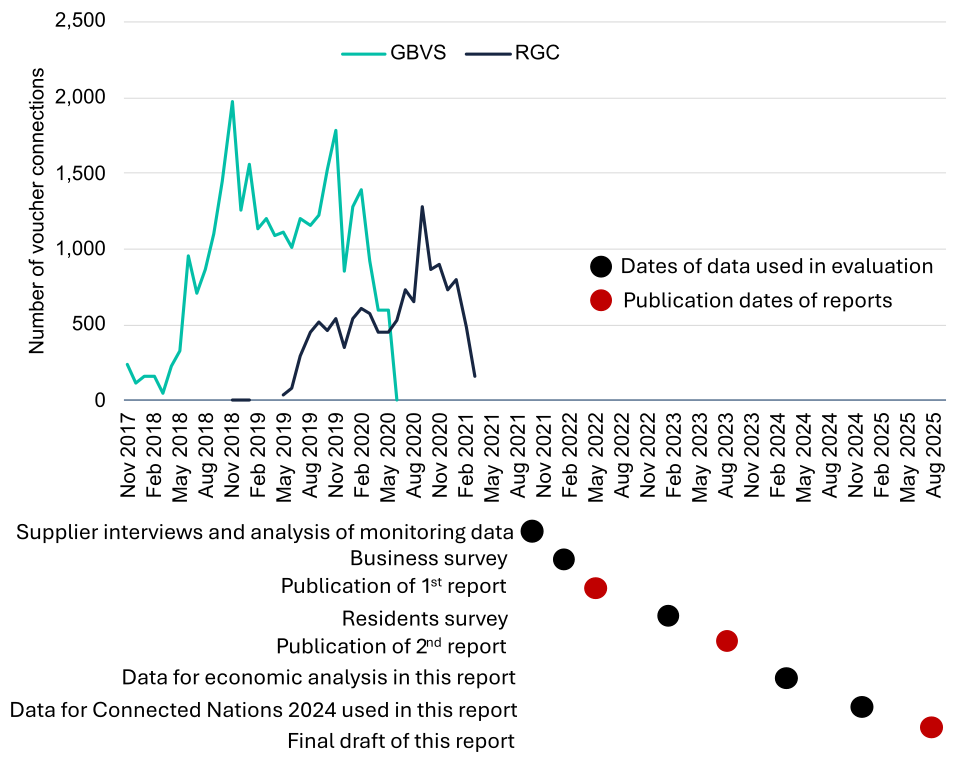
The chart below shows the dates of voucher connections for the GBVS and RGC schemes up to March 2021. It also shows the key dates for which data is available which can be used to assess the impacts of vouchers. Voucher connections refer to vouchers that are recorded as paid or connected in BDUK monitoring data. Following advice from BDUK, the voucher issued date is used as the best available proxy for when the broadband connection was delivered.
Voucher connections by scheme and dates of key data points and evaluation reports