Conclusions
Published 1 October 2026

© Crown copyright 2026
This publication is licensed under the terms of the Open Government Licence v3.0 except where otherwise stated. To view this licence, visit nationalarchives.gov.uk/doc/open-government-licence/version/3 or write to the Information Policy Team, The National Archives, Kew, London TW9 4DU, or email: psi@nationalarchives.gov.uk.
Where we have identified any third party copyright information you will need to obtain permission from the copyright holders concerned.
This publication is available at https://www.gov.uk/government/publications/final-evaluation-of-bduk-legacy-vouchers-schemes/conclusions
This section presents the main conclusions of the evaluation, which are structured around the key research questions agreed with Building Digital UK(BDUK) for the final evaluation.
1. What changes in coverage and average download speeds have been achieved through the schemes, and what proportion of these improvements would have occurred in the absence of vouchers (deadweight)?
It has not been possible to assess voucher impacts on coverage outcomes. At very local levels the Connected Nations data show inconsistencies, including cases where gigabit coverage appears to fall in voucher areas, suggesting that the effects of vouchers are not being accurately or consistently recorded. For this reason, the evaluation has focused on average download speeds, which provide a more reliable though still imperfect proxy for access, since they are influenced by household and business take-up.
The evaluation found that areas that received vouchers consistently experienced much larger changes in average download speeds than similar control areas, indicating that vouchers generated additional effects. The scale of these effects, in terms of Megabits per second, varies depending on whether we look at output area level or postcode level as well as treatment year, and the timeframe considered. For areas that received their first voucher in 2018 and 2021, around half of the change in download speeds after one year at output area level can be attributed to vouchers, rising to about 80% when analysis is carried out at postcode level. Effects in 2019 and 2020 were smaller but still statistically significant, implying a higher level of deadweight, but that vouchers still played an important role in improving access and take-up of high-speed broadband.
2. Was the design of the voucher schemes effective?
The evaluation also considered whether the design of voucher schemes affected outcomes differently, looking at differences between schemes, voucher types, and voucher values. The findings are mixed and vary across years:
-
Voucher schemes: Overall, the analysis suggests that Rural Gigabit Connectivity(RGC) vouchers were more effective and cost-effective than Gigabit Broadband Voucher Scheme(GBVS) vouchers at delivering additional improvements in download speeds, although results vary by year and unit of analysis (postcodes vs output areas). This is consistent with the design of RGC, which was targeted at rural areas where deadweight was expected to be low. By contrast, GBVS was designed to stimulate an emerging gigabit market, including in more commercially attractive areas, where some deadweight may have been anticipated. As a result, assessing effectiveness in terms of additional speed gains naturally favours RGC.
-
Voucher types: The results indicate that project vouchers were generally more effective and cost-effective than standard vouchers, particularly in later years. While there are some year-to-year inconsistencies, the overall pattern suggests that project vouchers became more effective over time, reflecting their growing focus on rural areas.
-
Voucher value: The evaluation has not been able to identify an optimal voucher value, but it has assessed differences between top-up vouchers and regular vouchers to explore whether this resulted in different outcomes. The analysis finds no evidence that top-up vouchers led to greater improvements in average download speeds compared with standard vouchers. Areas receiving top-ups had higher average voucher values, but this did not consistently translate into greater speed improvements. However his should be interpreted with care. Top-ups were designed to support more remote and higher-cost premises, where achievable speeds may be lower and wider network expansion less likely. As a result, changes in average download speed are a limited indicator of the effectiveness of top-up vouchers.
3. Did vouchers stimulate the broadband market by increasing competition, for example by reducing barriers to entry and supporting the growth of smaller providers?
The evidence shows that vouchers did stimulate the broadband market, though the nature of the impacts varied. Vouchers clearly supported the growth of smaller and newer suppliers, providing many with the platform to expand their networks, reach unviable areas, and attract further private investment. They also influenced strategic decisions, accelerating the shift to full fibre and encouraging suppliers to adopt more ambitious rollout strategies. At the national level, this contributed to a more diverse and competitive market, with “alt-nets” better able to challenge incumbents. However, the impact on competition at the local level was more limited: in many rural areas, vouchers supported a single provider rather than direct competition. This was due to the commercial realities of operating in less viable areas, where the market can only often only support one provider.
4. What outcomes and impacts have vouchers generated for households, businesses, and communities?
The evaluation finds clear evidence that vouchers generated significant impacts for both businesses and households.
For businesses, the counterfactual analysis showed that voucher-supported firms achieved stronger employment and turnover growth than comparable unsupported firms. Productivity, measured as turnover per employee, fell across the economy during the evaluation period, but voucher-supported firms experienced a smaller decline than controls, suggesting greater resilience. These quantitative findings are supported by the business survey carried out earlier in the evaluation. Among businesses reporting that their upgraded broadband enabled them to do new things, 82% reported an increase in productivity with 34% of those reporting a major increase, 50% saw an increase in profitability, and 42% reported an increase in turnover.
Importantly, the improved connections also helped firms adapt during the pandemic: 70% of businesses said that their upgrade had a positive effect on their ability to adapt and continue trading. This effect was particularly strong for RGC recipients where 53% reporting a major impact, compared to 43% for GBVS, and for rural businesses.
For households, vouchers produced substantial wellbeing benefits. These reflect increased life satisfaction associated with improved connectivity. These findings are based on self-reported survey evidence, and are therefore less robust than the counterfactual analysis used for business impacts. The residents survey reported a wider set of specific benefits, including more leisure time, reduced stress, improved educational opportunities, and reduced loneliness. The main benefits were concentrated among working households and households with children. These groups were more likely to report a range of benefits from their upgraded connection including a better work-life balance, educational benefits, reduced stress and the ability to start a new business.
The upgraded connections were also particularly valuable for households during the pandemic: 79% of households reported that their upgrade had a positive effect on their ability to adapt during lockdowns. The main benefits cited were the ability to stream entertainment services, to shop online which was especially important for older groups, and to work from home, important for working-age households.
The evaluation did not assess wider community impacts directly. However, some of the benefits identified for households and businesses are likely to have contributed indirectly to community outcomes. For example, reductions in loneliness, improved access to online services, and greater ability to work and learn from home may support stronger social connections within communities. Similarly, improved business resilience, higher earnings, and greater employment stability can benefit local economies and the sustainability of local services. Taken together, these findings suggest that vouchers are likely to have delivered indirect community-level benefits, although the scale of these impacts has not been assessed explicitly.
5. How has improved connectivity changed behaviours and practices among beneficiaries?
The earlier household and business surveys carried out as part of the evaluation also provide evidence of how improved connectivity has changed behaviours among both businesses and households.
For businesses, the survey showed that many firms introduced new practices as a direct result of their upgraded connections. These included greater use of cloud-based services, video conferencing, and e-commerce platforms, as well as supporting more flexible and remote working. Firms also reported greater scope to innovate, reach new markets, and collaborate more effectively with customers and suppliers. These changes demonstrate how improved connectivity enabled businesses not only to expand their operations but also to adopt more efficient and resilient ways of working.
For households, the most common behavioural changes were increased streaming of entertainment, greater online shopping, and more frequent communication with friends and family through video calls and messaging platforms. In addition, specific groups reported distinct changes: employed individuals increased their homeworking, households with children made greater use of the internet to support children’s learning, and disadvantaged groups such as lone parents and those in low-skilled occupations were more likely to use the internet for skills development.
The upgraded connection also enabled older households and those in uncommercial areas to do a range of things for the first time, including streaming entertainment services, video chatting with friends and family, accessing health and other services online, and using cloud storage. A high proportion of these households reported that the upgrade had been important in making this possible, and many said it had a positive impact on their quality of life.
6. Over what timeframe have these impacts emerged and persisted?
The evidence shows that the impacts of vouchers persist well beyond the year of connection. For areas supported in 2018, 2019 and 2020, average download speeds remained around 50% higher than control areas even three years after treatment. This demonstrates that voucher effects were not short-lived but provided durable improvements in broadband performance.
The counterfactual analysis of business outcomes also shows that impacts on employment and turnover were not confined to the year of support. Additional growth was observed for up to three years after firms received a voucher, indicating that vouchers had a sustained effect on business expansion.
Taken together, the evidence demonstrates that both broadband and economic impacts of vouchers have endured for at least three years after connection. These benefits may in reality persist for longer, but there is currently insufficient evidence to demonstrate this beyond the three-year period covered by the analysis.
7. What is the overall value of the benefits and disbenefits of the voucher schemes, and do they represent good use of public funding?
The cost–benefit analysis demonstrates that the GBVS and RGC voucher schemes have delivered clear value for money. Across both schemes combined, the total monetised benefits are estimated at between £324 million and £430 million, compared with programme costs of around £139 million. This equates to an overall benefit–cost ratio (BCR) of 2.3 to 3.1, meaning that for every £1 of public investment, between £2.30 and £3.10 of benefits have been generated.
Looking at the schemes separately, the BCR for GBVS is estimated at 2.2 to 2.6, while the BCR for RGC is higher at 2.7 to 4.3. Both schemes therefore represent good use of public funding, though the profile of benefits differs. GBVS accounted for the vast majority of business vouchers, so its quantified benefits are dominated by the wage premium analysis, which captures the additional earnings associated with new jobs created in supported firms. RGC supported a larger share of households, so its benefits are more heavily weighted towards improvements in household wellbeing, which were substantial on a per-household basis.
8. Revisiting the Theory of Change
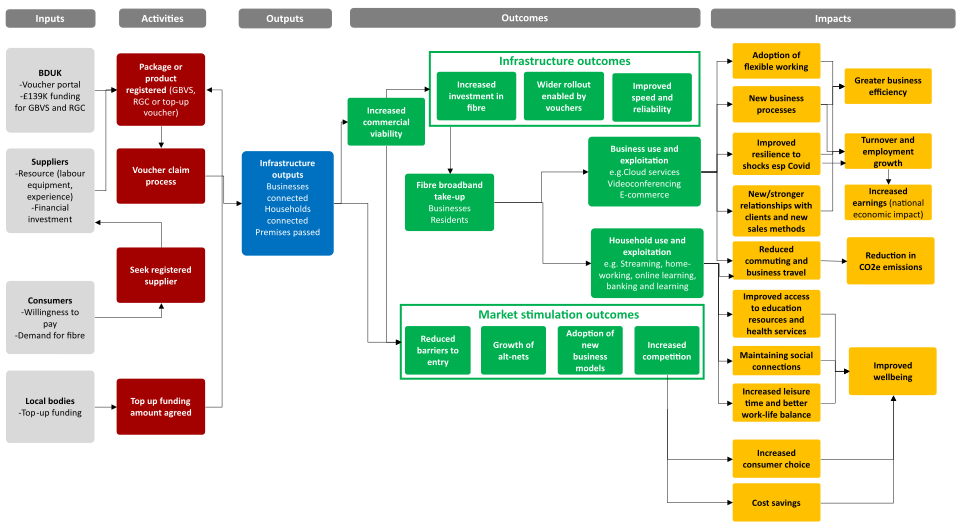
The evaluation has revisited the original theory of change for BDUK’s legacy voucher schemes. The diagram below sets out which outcomes and impacts have been evidenced through the evaluation. The revised theory of change draws on evidence gathered across all phases of the evaluation, including business and household surveys, interviews with voucher suppliers, and quasi-experimental analysis of impacts on broadband performance and business outcomes.
The robustness of the evidence used to populate the diagram varies. It is strongest for infrastructure and connectivity outcomes and for economic impacts on businesses, where quasi-experimental methods have been used to estimate additionality. Evidence for household and behavioural outcomes relies more heavily on survey data. However, both the business survey (n=1,681) and the household survey (n=4,298) achieved large sample sizes and provide a credible evidence base for understanding how vouchers affected behaviour and outcomes.
8.1 Outcomes and impacts evidenced through the evaluation
The evaluation has found evidence for most of the infrastructure and connectivity outcomes set out in the original theory of change. Improvements in connectivity have been assessed using changes in average download speeds, which were used as a proxy indicator because the evaluation could not directly measure additional changes in gigabit-capable coverage. This is a limitation of the analysis. However, the quantitative findings are supported by strong qualitative evidence from supplier interviews, which consistently reported that many connections, particularly in rural areas, would not have been commercially viable without voucher support.
Supplier interviews also provide strong evidence that vouchers played a critical role in stimulating the broadband market. In particular, vouchers helped new and smaller suppliers enter the market and expand their networks, increasing competition at national, regional and sub-regional levels. This aligns closely with the original objectives of the GBVS scheme. While this did not generally result in increased competition at a very local level (e.g. individual postcodes), it did contribute to a more diverse and competitive supplier landscape overall.
There is also good evidence of economic, social and environmental impacts. The strongest evidence relates to economic impacts on businesses. The evaluation shows that voucher-supported businesses experienced additional growth in employment and turnover compared with comparable non-voucher businesses. Productivity declined across the economy during the period studied, but the decline was smaller for voucher-supported businesses, suggesting improved efficiency and resilience. These findings are supported by the business survey, which reports efficiency, cost and resilience benefits linked to improved connectivity.
The impact pathways shown in the first column of the impacts section of the diagram describe the changes that led to these impacts. These draw mainly on evidence from the business and household surveys, which captured reported changes in behaviour and use of broadband following upgrade. These pathways focus on the main benefits reported by respondents and are not intended to be an exhaustive list of all possible observed effects.
8.2 Elements of the original theory of change not fully evidenced
Some elements of the original theory of change have not been fully evidenced through this evaluation, for the following reasons:
-
Learning and delivery insights: Generating learning for BDUK was an intended outcome of the programme. While this evaluation contributes to that learning, this was not a primary focus of the analysis. Exploration of learning and delivery insights was considered in scope for the final phase but was subsequently de-scoped.
-
Enabling 5G deployment: Although included in the original theory of change, impacts on 5G deployment were not explored through the evaluation and no evidence has been gathered on this outcome.
-
Land and property values: Potential impacts on land and property prices were not measured as part of the evaluation.
-
Local area economic effects: Wider local economic impacts beyond individual voucher-supported businesses were assessed. Some positive effects were identified, including higher employment and turnover compared with control areas. However, the evidence is less robust, particularly for turnover, due to limitations in local-level turnover data and the fact that voucher areas performed less well than the national average overall.
-
Innovation and new technologies: Innovation was not a major focus of the evaluation. However, survey evidence suggests some impact: 21% of business beneficiaries reported developing new products or processes following their upgrade, rising to 78% among businesses that cited innovation as a reason for upgrading. This suggests potential impacts that were not explored in depth.
Revised theory of change for BDUK legacy vouchers