
Fens 2100+: Case for Change and Partnership Action Plan
Published 2 April 2026
Applies to England

© Crown copyright 2026
This publication is licensed under the terms of the Open Government Licence v3.0 except where otherwise stated. To view this licence, visit nationalarchives.gov.uk/doc/open-government-licence/version/3 or write to the Information Policy Team, The National Archives, Kew, London TW9 4DU, or email: psi@nationalarchives.gov.uk.
Where we have identified any third party copyright information you will need to obtain permission from the copyright holders concerned.
This publication is available at https://www.gov.uk/government/publications/fens-2100/fens-2100-case-for-change-and-partnership-action-plan
1. Foreword
1.1 From strategy to action
The Fens are entering a period of significant and accelerating risk. Our existing approach to managing water, flood, and coastal risks is no longer sufficient due to:
- ageing assets
- increasing climate pressures
- growing expectations from communities and industry
The evidence is clear: without timely and coordinated intervention, the resilience of this nationally important region will continue to decline. This will increase long term costs and expose communities, infrastructure, and the wider economy to avoidable risk.
The Fens 2100+ Partnership provides a shared platform for addressing this challenge. Built on strong principles and cross sector collaboration, it aims to secure a climate resilient future for the Fens. It will do this by aligning investment, strengthening system performance, and ensuring the decisions we take today are the right ones. This directly supports the core purposes of the regional flood and coastal committees (RFCCs), which are:
- enabling coherent regional planning
- encouraging efficient and risk-based investment
- strengthening links across all risk management authorities (RMAs)
This Case for Change sets out why decisive action is required. It highlights the urgency to:
- enhance the health of existing assets
- shift from reactive maintenance to proactive system resilience
- move towards system level investment that brings together place-keeping and place-making endeavours
These actions are essential because, without the critical flood, coastal, and water management assets, and the day-to-day management that sustains them, the Fens simply would not exist.
The next decade will be critical. The 17-point Partnership Action Plan outlines a targeted programme of actions. These will:
- halt decline
- build asset resilience
- position the region to secure the right investment at the right time
It also provides a clear framework for aligning flood and coastal management with broader social, environmental, and economic priorities. This will ensure value for money and long-term benefit for local communities.
The Fens has a long history of innovation and collective stewardship. With clear direction and coordinated action, we can continue that legacy by:
- protecting communities
- supporting sustainable growth
- strengthening the resilience of this nationally significant region
1.2 Our partnership
This partnership report is written for and on behalf of the Fens 2100+ Partnership. It includes regional leadership and representation from:
- Regional flood and coastal committees (RFCCs)
- National Farmers Union (NFU)
- Anglian Water
- Cambridgeshire County Council
- Norfolk County Council
- Lincolnshire County Council
- Association of Drainage Authorities (ADA)
- Natural England
- Cambridgeshire and Peterborough Combined Authority
- Environment Agency
- Middle Level Commissioners
- Black Sluice Internal Drainage Board (IDB)
- Welland and Deepings IDB
Image 1: Fens 2100+ partner logos. Image credit Arup.
This document builds on several previous studies including the:
- Future Fens Integrated Adaptation Manifesto
- UK Fens Climate Change Risk Assessment (CCRA)
- Fens 2100+ Outcome Statements
- Fens 2100+ Systems Insights
- Fens 2100+ Summary Baseline Report and Catchment Baseline Reports
You can get more information by emailing Fens2100@environment-agency.gov.uk.
This document has been produced by Arup in collaboration with the Environment Agency, Rivelin Bridge and the Fens 2100+ Partners. It is part of a wider programme of work, drawing from engagement across the area and sector.
Image 2 shows the total Fens 2100+ study area.
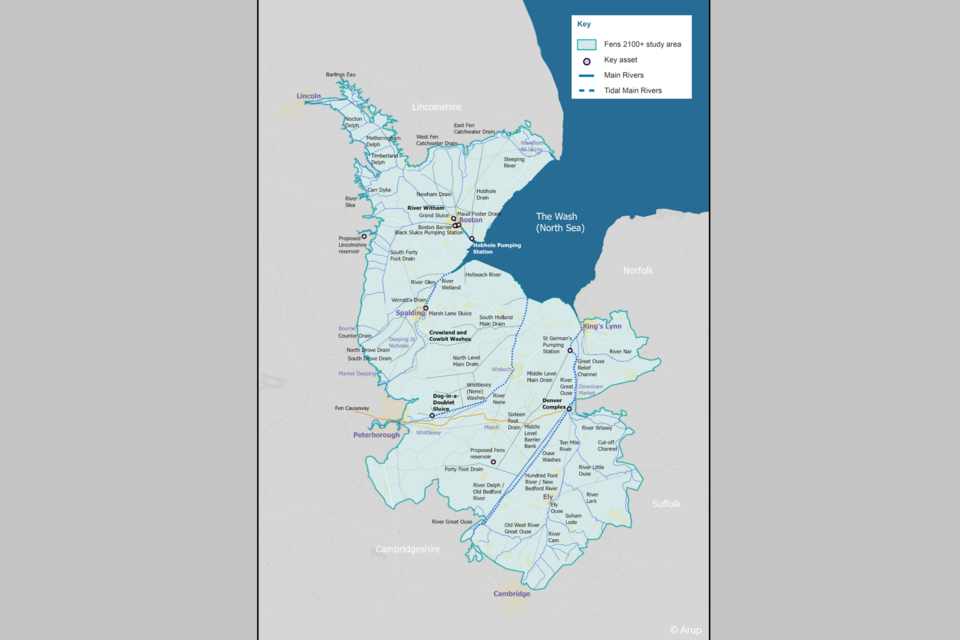
Image 2: The total Fens 2100+ study area, showing the main rivers, tidal rivers and important assets within the study area. Image credit Arup.
2. Navigating this report
This Case for Change is structured in three parts:
Part 1 - what the evidence tells us
Drawing evidence from the Fens 2100+ summary baseline report, and other documents produced since 2020, this section sets out the need for change. This evidence has revealed challenges related to the current and future vulnerability of the asset system that the region depends on for everyday safety, security and prosperity.
Part 2 - transforming our approach
Given the evidence we now hold, it is essential that we continue to innovate and transform our approach to asset management. We need to align asset strategies and regional investment priorities to maximise impact. This section sets out a partnership approach to:
- halting the decline in our assets
- embracing opportunities to provide lasting benefits for current and future generations
- securing sustainable regional investment for the years ahead
Part 3 - our Partnership Action Plan
This section sets out the commitments of the Fens 2100+ Partnership over the next two years. The 17-point Partnership Action Plan includes actions and initiatives to:
- secure a “decade of action” and investment
- align asset management and regional growth and investment strategies
3. Our journey to date
3.1 Building the Case for Change
The main milestones in our journey to date include:
- July 2020 - Fens measures were included in the national FCERM Strategy
- December 2020 – the Future Fens: Flood Risk Management Baseline report set an evidence baseline for the Great Ouse catchment
- June 2021 - the Tidal River Nene Baseline evidence report was completed
- November 2021 – the Future Fens Integrated Adaptation Manifesto was launched at COP26, setting out 10 important strategic outcome ambitions of the Taskforce
- Spring 2023 – the Fens 2100+ began work, including stakeholder interviews which influenced setting up a partnership board and programme governance
- December 2023 - site visits during winter 2023 to 2024 revealed the impacts of flooding during this period, including meetings with flood-affected farmers
- April 2024 - outcomes workshops collaboratively developed for 4 plausible and possible futures for the Fens, underpinned by investment in flood risk infrastructure
- Summer 2024 - lived experience workshops and site visits took place across the Fens to better understand the reality of challenges and operations of the assets
- October 2024 - the UK Fens CCRA outlined the main climate risks in the Fens and the urgency for change
- January 2025 - system insight stories set out landscape-scale insights and understanding of the system, wider context of the area, and how to work together
- November 2025 - Catchment Baseline Reports produced the first complete picture of the asset system
- December 2025 - the Case for Change - our plan for immediate actions over the next 2 years
These milestones are also shown in image 3.
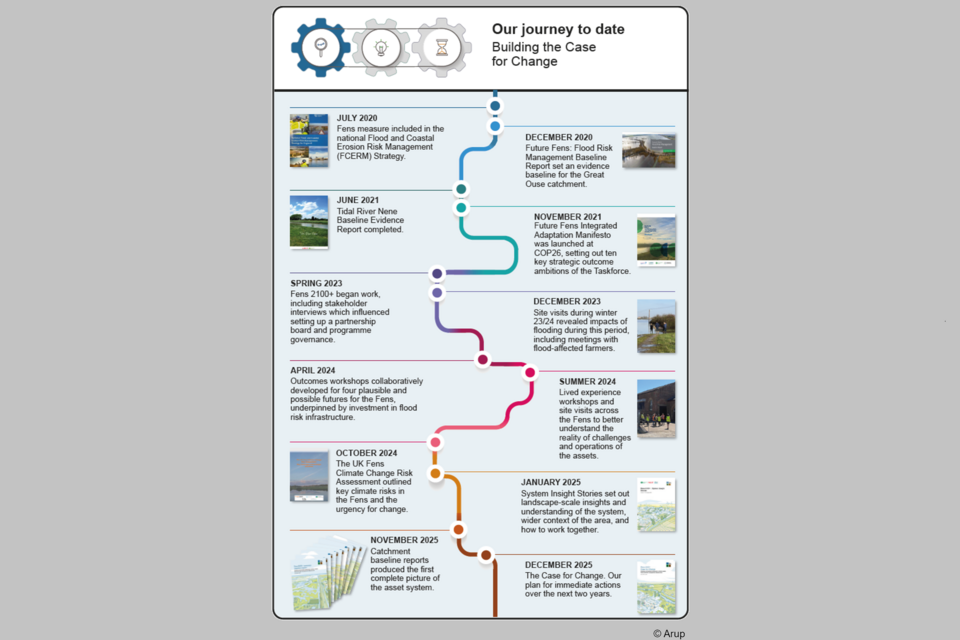
Image 3: Our journey to date – building the case for change shows the main milestones in the work. Image credit Arup.
4. What the evidence tells us
Measure 1.5.4 of the National FCERM Strategy for England (2020)
This measure set out the need for a long-term plan for managing future flood risk in the Fens. The first step was to gather data to produce a comprehensive evidence baseline across the whole Fens system.
History of change
The Fens today reflect investment decisions made over the last 400 years. Large-scale drainage schemes transformed wetlands into productive farmland, a success achieved through collective action and shared responsibility. This history offers hope: when stakeholders unite behind a common purpose, dramatic change is possible.
Critical infrastructure
Unlike most landscapes, the Fens cannot exist without active water management. 87% of land in the Fens is below the mean spring tide level, making it extremely vulnerable to flooding from rivers and the sea. The safety and productivity of this man-made landscape depends entirely on the active management of a complex network of FCERM assets. These must be operated 24 hours a day, 365 days a year.
A single asset system
The resilience of the Fens relies on an integrated system of approximately 17,000 assets. These include:
- 271km of tidal defences
- 1,082km of Main River defences
- 6 flood storage areas
- the pumping stations, watercourses and sluices which drain the low-lying land
Approximately 35% of assets are owned and managed by the Environment Agency. The remaining 65% are the responsibility of IDBs, other RMAs or riparian owners. Many of the assets are multi-purpose, managing water for flood risk reduction, navigation, water resources and environmental value. The expertise of asset managers is therefore critical.
Because these assets are interconnected, failure in one part can cascade across the system. This interdependence demands investment and maintenance strategies that treat the Fens as a single, integrated system, and not a patchwork of local interventions.
Asset condition
The baseline reports reveal a critical and unsustainable situation: an ageing asset system under acute stress, operating beyond its intended capacity. By 2040, 31% of assets in the Fens are predicted to be beyond the end of their foreseeable design life. Many embankments are more than 125 years old and pre-date modern engineering standards. Furthermore, climate change is accelerating risks to crucial embankments, pumping stations and sluices.
We have identified particular challenges, including:
- Dog-in-a-Doublet Sluice
- the Denver Complex
- Hobhole Pumping Station
- many of the Main River embankments
The future use of the Crowland and Cowbit Washes also requires partnership decisions. Choices about these and other assets will influence the wider system and present opportunities for early action and learning.
Climate risks
Present day risks from chronic stresses to ageing critical infrastructure and acute stresses from extreme weather events are already being compounded by climate change.
Alongside sea level rise, the UK Fens CCRA and baseline reports identify multiple, compounding hazards. These include:
- higher peak flows in rivers
- increased surface water
- more frequent and severe droughts
- increased heat risk
All of these will place greater strain on the ageing FCERM asset system, as well as agricultural productivity, biodiversity and human health.
“Looking to the future, climate change (including sea level rise and other climate related trends) alongside socio-economic drivers is set to increase these challenges. If current and future risks are to be well managed, strategic choices need to be made today about the long-term vision of the Fens and investment secured to realise that vision. This is an urgent need, and not one that can be delayed. In the absence of an agreed vision, investment in mal-adapted infrastructure and stranded assets is a real risk. Sea levels will continue to rise for decades and centuries to come…and although the future is yet to be revealed, much is known, providing a window of opportunity now to set out a future vision for the Fens that responds and builds resilience to these challenges.”
Tyndall Centre for Climate Change Research
Rivers and the sea
Flood risk in the Fens is shaped by the interaction between rivers and tides. Tide levels in The Wash control river discharge and add risks though tidal flooding. We saw this in in the tidal surge of 2013. Decisions on where the coastline and tidal limits are held alter the landscape response and the wider flood risk management approach. The inland system is completely dependent on the shoreline system, making cohesive management of both essential.
What is at stake: the value of the Fens
The Fens is an area of enormous regional and national significance. It:
- contains 48% of England’s Grade 1 agricultural land
- produces a third of England’s vegetable crops
- supports 80,000 jobs in the food supply chain
- holds more than 4,000 cultural heritage assets
- includes vital transport and energy infrastructure
- provides £500 million of natural capital benefits annually
Failure to safeguard this region would threaten this value, and the lives and livelihoods of more than 600,000 people.
Beyond business as usual
The scale and urgency of the challenge means that current ‘fix-on-fail’ approaches to asset replacement cannot keep pace with the growing risks. The investment required is in the billions. This far exceeds current budgets and demands a step-change in how we plan, fund, and achieve infrastructure renewal.
Without this urgent change, the ageing FCERM infrastructure will deteriorate further. This will increase the likelihood of catastrophic asset failures, such as embankment breaches or the break-down of pumping stations or sluices, resulting in widespread flooding.
A call for innovation
To combat this threat, innovation and collaboration are essential. Throughout the history of the Fens, collective action has transformed the landscape. This has been achieved through vision, collaboration and a willingness to innovate to adapt to the problems of their time. This legacy provides a strong foundation for tackling today’s complex risks.
4.1 What is needed
A partnership for change
The Fens is a man-made landscape that requires constant management. Without critical flood, coastal, and water management infrastructure, the Fens simply would not exist. This infrastructure is fundamental to the Fens and the economic vitality of the surrounding region. Continuing with current asset management approaches will not be enough to safeguard communities, agriculture, and the environment. It also won’t support regional growth and long-term resilience.
Collaboration
No single organisation can solve this challenge alone. Strategic coordination and governance are essential. Effective asset management in the Fens will require collaboration across multiple agencies, authorities and stakeholders.
Flood, coastal and water security
Managing this complex landscape requires a systems-based approach that recognises that flood management decisions affect, and are affected by, other choices.
Decisions about flood infrastructure must align with broader strategies. Examples include:
- shoreline management plans (SMPs)
- regional water resource plans including the proposed Lincolnshire and Fens reservoirs
- local nature recovery strategies (LRNS)
Growth and resilience
Investment decisions must also play a central role in achieving the Government’s Growth Agenda. They can do this by safeguarding one of the UK’s most economically significant and strategically connected regions. The Fens support vital east–west and north–south connectivity, securing road, rail and energy corridors linking Lincolnshire, Cambridgeshire, Suffolk and Norfolk. Protecting this infrastructure is essential to sustaining economic stability and future growth in local cities. These include:
- Lincoln
- Peterborough
- Cambridge
In these cities, housing and employment opportunities rely on flood resilience and water security.
Decision-making must also reflect the nationally significant contribution the Fens make to food security and innovation. The region’s unique agricultural and environmental assets underpin high-value, globally competitive sectors such as life sciences and agri-tech. Continued success in these sectors depends on reliable water management and resilient infrastructure.
Investment
The investment demand to improve asset health and performance across Environment Agency and IDB assets is projected to be between £6 billion and £9.4 billion. It is forecast that 50% of this investment is needed within the next 4 decades to sustain the current standard of service (SoS).
The area will need additional investment to adapt and transform the asset-system. This will further safeguard the region against climate change and provide the confidence and capacity to support regional growth,.
The scale of investment cannot be met by public finances alone. It will therefore be necessary to work with stakeholders and beneficiaries to:
- explore innovative funding and finance models
- secure local contributions and private investment
Monitoring, evaluation and learning
Learning from past events, new evidence, and the experience of RMAs will be essential to promote effective management strategies which are responsive to emerging risks and opportunities.
A carbon strategy
The high energy demand of the FCERM asset system, caused largely by the need for pumping, adds to its vulnerability. It also increases cost of asset operation and renewal. A clear strategy for carbon reduction is needed to increase resilience.
5. Transforming our approach
We plan to transform our approach in order to secure a climate resilient and vibrant future for the Fens. There are 7 parts to this:
- a turning point
- shared commitment
- securing the right investment
- reasons for change
- shifting the paradigm
- place keeping and place making
- a “decade of action”
These parts are summarised in Image 4 and explained in detail in the next section.
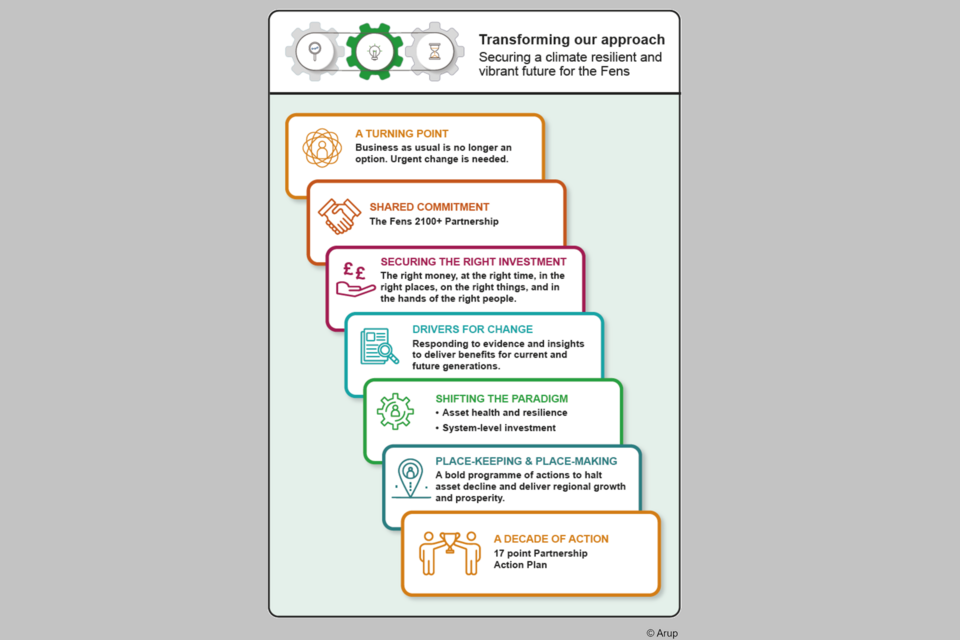
Image 4: Infographic setting out how we are transforming our approach. Credit Arup.
A turning point
The evidence is clear: business as usual is no longer sustainable.
Urgent action is required to:
- safeguard people, agriculture, and the environment
- provide the confidence needed for future regional investment, growth and prosperity
Continuing with traditional water management, flood and coastal resilience practices, without significant adaptation and investment, will not be enough. This is due to the combined pressures of:
- ageing infrastructure
- accelerating climate change
- rising societal expectations
“The future of the Fens cannot be secured through local tactical actions to improve a particular barrier or embankment, but demands a long term ‘whole of Fens’ strategy…that is appropriately transformative (to address the big challenges) and reflects the critical timescales for action”.
Tyndall Centre for Climate Change Research
To meet these challenges, we must rethink and transform our approach, embedding resilience, innovation, and long-term planning into every decision. This is not optional; it is essential to protect the Fens, secure economic stability, and achieve the ambitions set out in the:
- National FCERM Strategy
- UK Infrastructure – A Ten-Year Strategy (2025)
- UK’s Modern Industrial Strategy (2025)
- UK Government Resilience Action Plan (2025)
A shared commitment
The Fens 2100+ Partnership is resolved to address this challenge. We are committed to shaping a climate-resilient and vibrant future for the Fens. We will work collaboratively with organisations such as the Future Fens Integrated Adaptation Taskforce and Water Resources East to provide integrated solutions.
The Fens 2100+ Partnership is founded on a set of principles that are fundamental and non-negotiable. These are that:
- the Fens is nationally and regionally significant, underpinning food security, economic prosperity, environmental value, and community wellbeing
- FCERM assets are critical to sustaining this value, providing the infrastructure that protects people, businesses, and ecosystems
- maintaining these assets is becoming increasingly challenging, as pressures from climate change, ageing infrastructure, and resource constraints intensify
- urgent action is required now to safeguard this unique region and its benefits for future generations - delays will increase costs, risks, and the scale of future interventions
- no single organisation can meet this challenge alone - collaboration across sectors, governance levels, and disciplines is essential to achieve integrated, long-term solutions
This shared premise provides the starting point for:
- coordinated action
- clear accountability
- innovative approaches to investment and planning
It guides the approach to transformation and action planning described in this Case for Change.
Securing the right investment at the right time
The history of the Fens, spanning 16 generations, demonstrates what ambition, targeted investment, and collaboration can achieve in managing water, assets, and transforming landscapes. Building on this legacy, our future responses must remain intentional, innovative, and sharply focused. This is because the need for action is urgent.
Evidence shows that much of the region’s critical FCERM infrastructure is ageing and increasingly vulnerable. At the same time, climate risks projected for the 2040s will bring more frequent and severe challenges. These include:
- rising sea levels
- more intense rainfall
- prolonged droughts
With long lead-in times required for major investment and system upgrades, the window for action is now. Delay will only escalate costs and compound risks for communities, businesses, and the environment.
To achieve current and future goals, we must creatively secure the right money, at the right time, in the right places, for the right things, and in the hands of the right people. This will require continued technical innovation, alongside governance and investment models that put people and place at the heart of impactful decision-making.
The scale of investment required will need both public and private investment to meet the asset challenge and realise the full potential of the region.
The pace of this transformation cannot be achieved by engineering and technology alone. It will depend on:
- collaboration
- trust
- shared purpose
Reasons for change
The evidence presented in the baseline reports provides a strong strategic foundation for decisive action. This is supported by other partnership resources such as The UK Fens CCRA and emerging regional spatial plans. To build and strengthen the Fens 2100+ partnership, it will be critical to continue harnessing:
- new and emerging data
- lived experience
- foresight
This approach will enable us to:
- confidently shape regional choices
- align flood and coastal investment priorities
- seize funding opportunities
- future-proof decisions
The futures explored with regional stakeholders underscore the vital role of water management and flood and coastal infrastructure in safeguarding the Fens. These systems are essential for:
- the safety of local communities
- agriculture and food security
- health of terrestrial and marine habitats
- effective land use and carbon management
Many of these challenges carry regional, national, and even international significance.
Decision-making must therefore serve both current and future generations, addressing regional and national needs. This means we must look beyond immediate pressures to ensure investments are resilient and adaptive. Climate change, population growth, and economic transitions will shape the Fens for decades to come. Our choices today must anticipate and respond to these long-term dynamics.
Shifting the paradigm
To secure timely and effective investment and respond to the broader reasons for change, we must transform how we manage and invest in flood and coastal infrastructure. This shift is critical to achieving national policy ambitions and aligning with recognised best practice in asset management.
As a partnership, we propose to prioritise asset health and resilience, moving decisively beyond reactive maintenance and “fix-on-fail” approaches. We will maximise the value of our finite resources and ensure that every pound spent strengthens the system against future shocks and stresses. We will do this by
- extending the life of existing assets
- optimising performance
- halting decline
Secondly, we will transition to system-level investment across all partners. We will treat assets not as isolated components but as parts of an interconnected network.
This approach will:
- enable integrated solutions that address the entire asset system, including coastal defences, main river defences, flood storage areas, and pumped and gravity drainage systems
- reflect the multiple functions of the assets, supporting wider land-use planning, socio-economic priorities, and environmental ambitions
- unlock innovation in funding and finance, by aggregating investments where beneficial to scale and attract both public and private investment
Together, the shift toward asset health and resilience, combined with system-level investment, will enable us to better manage near-term acute risks such as flooding. At the same time we will take early action to address chronic risks including sea-level rise and ageing infrastructure. This paradigm shift will allow us to create an asset-system that:
- is resilient, adaptive, and sustainable
- protects communities
- supports economic growth
- meets the challenges of a changing climate
Alignment with NEPC’s reviving our ageing infrastructure report
The reviving our aging infrastructure report reinforces the urgency and direction of our proposed paradigm shift. It calls for:
- proactive maintenance
- system-level coordination
- innovative funding
These principles are at the heart of our approach.
By prioritising asset health and resilience, we respond directly to the report’s evidence that early intervention achieves significant economic and risk-reduction benefits. Our commitment to system-level investment reflects NEPC’s recommendation for integrated stewardship across interconnected infrastructure networks.
Finally, by strengthening governance and unlocking new financing models, we will align with the report’s enablers for change. This makes sure that our strategy is not only ambitious but grounded in best practice and national policy priorities.
Place-keeping and place-making
We will achieve this transformation through a bold and integrated programme of:
- place-keeping actions that support RMAs in halting asset decline and safeguarding the security of the region
- place-making actions that enable regional partners to align flood and coastal strategies with wider spatial planning and growth ambitions, ensuring integrated, future-ready infrastructure and sustainable development – regional partners include local government, the Coastal Group, and the Future Fens Integrated Adaptation Taskforce
This builds on lessons learnt from strategic investment programmes on the:
- River Thames
- Humber
- Lincolnshire Coast
This approach will:
- strengthen governance and funding arrangements
- create a clear and accountable framework for achieving outcomes
- enable the rapid implementation of no-regrets asset management investments
These are essential actions that provide immediate value and reduce risk in the near-term. It also lays the groundwork for long-term strategic decision-making. By aligning flood and coastal strategies with spatial planning and economic growth priorities, we can ensure that future infrastructure and development are resilient, adaptive, and aligned with national objectives.
In short, this dual focus on near-term action and long-term planning will:
- give partners greater certainty
- unlock investment opportunities
- position the region to respond to a changing climate with confidence and clarity
A “decade of action”
The Fens 2100+ partnership is committed to driving a step-change in how we collectively manage and create asset resilience across the Fens system. Our shared responsibility demands bold thinking and collaborative action. Important questions at the heart of this transformation, include:
- How do we collectively achieve 21st Century asset management in the Fens to improve asset health and achieve value for money for the partners, the public and the region?
- What should a future-ready asset system look like in 10 years?
- Where should we focus resources to achieve an impactful “decade of action” and secure the necessary public and private investment?
- How do we align water management, flood and coastal strategies with regional growth and prosperity?
- How can we sustainably meet the needs of current and future generations?
These questions underpin the 17-point Partnership Action Plan set out in the next section. The plan is designed to complement the National FCERM Strategy and to align the efforts of the two RFCCs and their partners. This will make sure that regional and local responses are coordinated, effective and impactful.
Over the next 2 years, the Partnership Action Plan will lay the groundwork for a “decade of action”. This will turn strategic ambitions into targeted capital and revenue investment and coordinated partnership delivery. The plan addresses all 4 pillars of resilience, which are:
- plan
- protect and maintain
- respond
- recover
Plan
We will take proactive steps to prepare for and adapt to the current and future impacts of climate change. We will also respond to the specific asset management needs and ambitions of local places.
Protect and maintain
We will reduce flood risk to safeguard communities and critical locations, supported by essential maintenance, renewal, and where necessary, decommissioning of infrastructure.
Respond
We will strengthen the ability of people and places to effectively manage and respond to flooding incidents.
Recover
We will enhance the capacity of communities and places to rebound quickly and sustainably after flooding events.
The Partnership Action Plan recognises that transformation is not a one-time intervention but an ongoing process. To support collaboration, innovation and continuous learning, we will embed a monitoring and evaluation framework within the Action Plan. This will ensure every decision strengthens resilience and accelerates progress toward a climate-resilient, thriving Fens.
6. Our Partnership Action Plan
This 2-year Partnership Action Plan marks the first step toward securing a “decade of action” and investment to strengthen near-term asset health and resilience. It also supports partners in preparing for longer-term investment needs. Through learning from action on the ground, the plan will help transform our approach and shape a climate-resilient and thriving future.
Image 5 summarises out Partnership Action Plan and the actions contained within it. These are explained in detail in the following section.
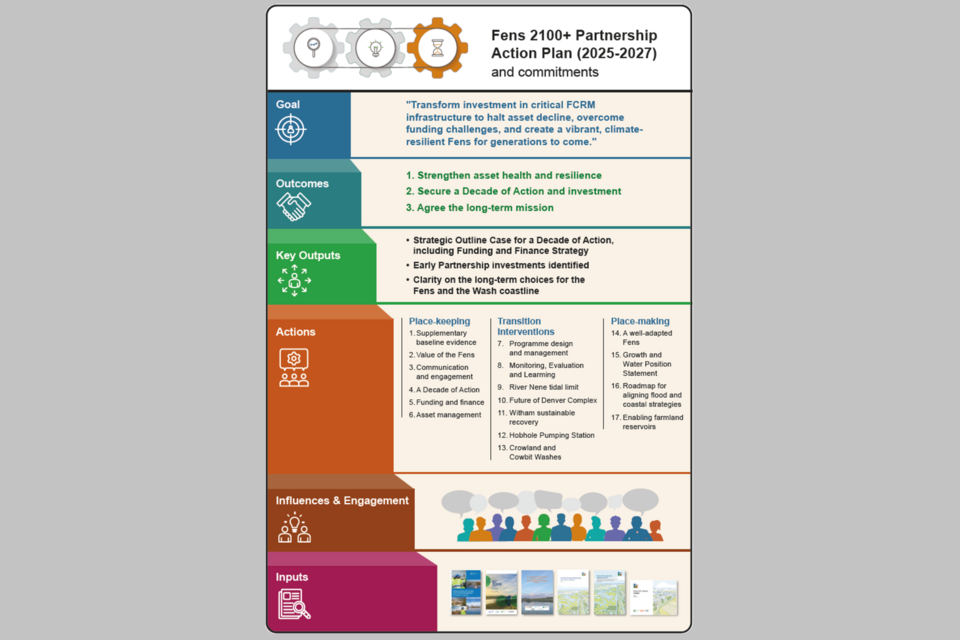
Image 5: The Fens 2100+ Partnership Action Plan (2025–2027) and commitments. Credit Arup.
6.1 Place-keeping actions
Actions 1 to 6 are designed to achieve near-term improvements in asset management and support the co-development of a system-wide programme of investment for a “decade of action”.
Action 1 - Supplementary baseline evidence
We will continue to build momentum around gathering evidence with partners and other organisations. We will also focus on drawing in greater knowledge about the Wash and the coast.
Action 2 - Value of the Fens
We will develop a shared narrative that demonstrates the value of the Fens, what is at stake and its future potential. We will use this to inform and strengthen investment decisions.
Action 3 - Communication and engagement
We will create and provide a bold communication strategy for Fens 2100+ that ignites interest, connects partners and projects, and unites programmes under a shared vision. We will map stakeholder links and align efforts to ensure every piece fits together seamlessly.
Action 4 – “Decade of action”
Define the ‘desired end-state’
We will work with partners to define the target end state for the Fens asset system. We will specify desired levels of reliability and performance and align them with long-term resilience objectives. This will describe the ambition for the next decade and set the path for future delivery.
Co-create a partnership “decade of action”
We will collaborate with partners to develop a “decade of action” for the system and each catchment across the Fens. We will align this with the national investment steer.
The “decade of action” will cover all 4 resilience pillars, plan, protect and maintain, and respond and recover – across all RMAs. It will support achieving the desired end-state for the system and outcomes for the Fens.
This will consider:
- What appropriate legal and compliance aspects need to be considered? This includes environmental and health and safety requirements.
- What maintenance and refurbishment activities are needed?
- What are the no-regrets asset renewal and replacement choices?
- What are the no-regrets rationalisation and decommissioning choices?
- Where does the asset system need transformation?
- How can we enhance future response and recovery to create safety and security?
10-year costed plan for data and evidence
We will develop a costed and prioritised plan for future data and evidence gathering where needed. This will support FCERM planning and delivery over the next decade.
Carbon pipeline and action plan
Develop a costed and prioritised long-list of projects for decarbonisation, aligned to the desired end-state and “decade of action”. These will span multiple scales and focus on reducing emissions across the Fens asset system.
Action 5 - Funding and finance
Strategic outline case
We will develop a strategic outline case (SOC) for the “decade of action”. This should secure the investment, resources and commitment needed to carry work out as a partnership programme. This will include establishing governance and partnership delivery mechanisms to work at pace.
Green Finance
We will conduct a spatial and financial assessment of opportunities for green funding and finance within the Fens. This will help to identify how it can enhance the use of public and private investment.
Leveraging existing funding and finance mechanisms
We will explore how to make the most of current funding mechanisms, and identify where there may be opportunities for future innovation.
Unlocking new revenue streams and models
We will work with the Future Fens Integrated Adaptation Taskforce and the Fens Transition Lab to identify opportunities to access landscape scale investment from the private sector.
Action 6 - Asset management
Fens asset class: Asset management position statement and guidance
We will develop a joint position statement across both Fens RFCCs that defines the approach to lowland embankment maintenance across the Environment Agency and IDBs. This will focus on making the most of maintenance budgets.
We will work partners and alongside the Environment Agency’s Lowland Resilience Team to develop and trial a lowland embankment maintenance performance standard in the Fens. We will also develop an approach to how we determine asset health in lowland embankments to achieve reliability and performance.
Decommissioning and asset transfer
Implement the national decommissioning guidance set out in the national investment toolkit in the Fens. Explore and define the resources, and ways of working needed to embed FCERM asset decommissioning, asset transfer and within a lowland system, pilot the approach within a specific location, and share findings with the national FCERM team including the lowland resilience team.
Post-flood principles and scenarios
To support decision making during and immediately after flood events, we will:
- develop post-flood principles that adapt national guidance to local catchments, clarifying decisions on whether to build back, do something different, or focus on local resilience, to ensure transparent decision making
- develop an opportunities map to inform regional decision making, identifying critical areas for replacement
- identify areas that could look for different approaches such as storage or switching to resilience-based approaches
6.2 Transition interventions
Actions 7 and 8 are designed to set up the team and programme for delivery beyond 2027. Actions 9-13 address immediate investment challenges with significant potential to scale learning across the partnership and wider system.
Action 7 - Programme design and management
We will establish a team for programme delivery beyond 2027, including governance and partnership arrangements.
Action 8 - Monitoring, evaluation and learning
We will implement a monitoring and learning plan. This will foster accountability, transparency, knowledge sharing, and impact reporting.
Action 9 - River Nene tidal limit
We will strategically appraise FCERM investment scenarios for the replacement of Dog-in-a-Doublet Sluice and associated investment choices and opportunities. We will include potential synergies with the Fens Reservoir proposals and wider water resource infrastructure and investments.
Action 10 - Future of the Denver Complex
We will strategically develop the long-term investment scenarios for the future of the Denver Complex and explore future FCERM asset renewal and replacement options.
Action 11 - Witham Sustainable Recovery
We will continue to support sustainable recovery works on the Lower Witham and draw out lessons that can apply to the wider Fens.
Action 12 - Hobhole Pumping Station
We will support partners in completing the Hobhole Pumping Station replacement and draw out lessons to support wider investment and delivery across the Fens.
Action 13 - Crowland and Cowbit Washes
We will understand the choices for the Washes and the value water storage can have within the Welland and Nene system. This will help to future proof against climate risks.
6.3 Place-making actions
Actions 14 to 17 are designed to support medium to long-term partnership investment planning. They bring together place-keeping investment with regional place-making choices and growth ambitions.
The Fens 2100+ programme is not the forum for making political and democratic decisions regarding regional growth and spatial planning. These partnership actions will however support engagement with regional and national decision-makers regarding the long-term vision for the region and whole-system leadership.
Action 14 - A well-adapted Fens
We will work with regional stakeholders to understand the spatial choices and plausible futures for the Fens. This will draw on national and international best practice to support future public dialogue and engagement.
Action 15 - Growth and water position statement
We will support development of an actionable place-based growth and water position statement for the Fens. We will work with the mayoral authorities and other partners to inform regional spatial planning.
Action 16 - Roadmap for aligning flood and coastal strategies
We will work with the Wash Coastal Group and partners to develop shared principles, boundaries and outcomes. These will help align short- to medium-term coastal, flood risk and water management investments. We will identify practical steps for:
- tackling evidence sharing
- solution dependencies
- governance, engagement and investment timings
Action 17 - Enabling farmland reservoirs
We will support an update of the guide to planning, designing, constructing and commissioning of water storage reservoirs (Environment Agency and Cranfield University, 2019). In the Fens, this will support integrated water management approaches and a dependable supply of water.
7. Looking forward
The evidence leaves no doubt. We are now firmly beyond the point where business as usual approaches to asset management can be relied upon to provide resilience, security, and prosperity for the Fens.
The existence of the Fens was hard won, through centuries of land drainage and reclamation. We cannot take this unique landscape for granted. Past generations responded to technological change and societal need with vision, ambition, and a willingness to adapt. Today, the Fens stand as testament to what can be achieved when partners unite behind a common purpose. There is no reason we cannot continue to innovate at pace and harness that same spirit of ingenuity.
The risks of delay are stark. Without urgent and sustained investment, the Fens’ critical flood and water management infrastructure will continue to decline. This will place communities, businesses, and the environment under unacceptable and escalating threat. Inaction will lead to:
- the loss of nationally significant farmland
- further biodiversity decline
- disruption to essential infrastructure
This will undermine the region’s economic vitality and weaken long-term growth and resilience. These are not future possibilities but present realities. They demand immediate, coordinated, and collective action.
With long lead-in times required for major investment and system upgrades, the window for action is now. Delay will only escalate costs and compound risks for communities, businesses, and the environment.
Looking forward, Fens 2100+ partners must work together across agencies, authorities, sectors, and communities. They must be guided by the dual objectives of place-keeping and place-making.
This report has set out a specific and actionable agenda for the next two years. The 17-point Partnership Action Plan provides a clear roadmap for:
- halting asset decline
- strengthening system resilience
- unlocking new models of investment
It identifies the critical interventions needed to address immediate risks while laying the foundations for long-term transformation.
The most important outputs by 2027 include:
- an SOC for a “decade of action”, including a funding and finance strategy
- the identification of early partnership investments
- clarity on the long-term choices for the Fens and the Wash coastline
Successful delivery will not only safeguard the future of the Fens but will also strengthen economic growth. This will benefit:
- Lincolnshire
- Cambridgeshire
- Suffolk
- Norfolk
It will play a central role in realising commitments to the National FCERM Strategy alongside regional and national growth ambitions.
The Fens 2100+ Partnership is committed to achieving this bold programme of place-keeping and place-making. We will realise our goal of ‘transforming investment in critical FCERM infrastructure, halting asset decline, overcoming funding challenges, and creating a vibrant, climate-resilient Fens for generations to come’.