Farming Sector Environmental Objectives: native woodland
Published 22 October 2026
Applies to England

© Crown copyright 2026
This publication is licensed under the terms of the Open Government Licence v3.0 except where otherwise stated. To view this licence, visit nationalarchives.gov.uk/doc/open-government-licence/version/3 or write to the Information Policy Team, The National Archives, Kew, London TW9 4DU, or email: psi@nationalarchives.gov.uk.
Where we have identified any third party copyright information you will need to obtain permission from the copyright holders concerned.
This publication is available at https://www.gov.uk/government/publications/farming-sector-environmental-objectives/farming-sector-environmental-objectives-native-woodland
1. Objective title
The farming sector and delivery partners will deliver sufficient suitable agri-environment scheme actions on 137,000 ha of native woodland to support the establishment or maintenance of favourable condition by 2040.
2. Objective overview
Native woodlands consist primarily (some native woodlands will include a proportion of naturalised on non-native species) of tree species that are indigenous to England, such as English oak, field maple, and European beech. They form a foundation for ecosystems, providing habitats and resources that many local species have evolved to depend upon.
The National Forest Inventory estimated that in 2015, there was over 900,000 hectares of native woodland in England, of which, less than 10% was in favourable condition.
Through agri‑environment schemes, this objective focusses on the management and enhancement of England’s native woodlands on agricultural land.
3. Relevant targets and commitments
30by30
Under the Global Biodiversity Framework, the UK government has agreed to:
- effectively conserve and manage 30% of our land and sea for nature by 2030
The framework does not set specific pathways to meet the target, which are devolved to the individual nations. Defra has produced the 30by30 on land: Delivery plan which focusses on the creation, restoration and long-term management of wildlife-rich habitat to meet the target. Native woodland restored and managed to “wildlife-rich” status under this objective will contribute to the 30by30 target.
Environment Act 2021
Under the authority of the Environment Act 2021, regulations set out under the The Environmental Targets Regulations 2023 set statutory targets for Defra to:
-
halt the decline in species abundance by 2030, as represented by the overall relative species abundance index
-
increase the relative species abundance index by 2042 so that it is greater than in 2022 and at least 10% greater than in 2030
-
restore or create in excess of 500,000 hectares of a range of wildlife-rich habitats, outside protected sites, by 2042
Environmental Improvement Plan
The Environmental Improvement Plan 2025 builds on the targets set out in the Environment Act, under the Restored Nature goal.
Key commitments states that Defra will:
-
halt the decline in species abundance by 2030
-
increase the use and manufacturing of hardwood species from 2024 levels
-
enhance the adaptive capacity and resilience of the treescape by increasing its extent, connectivity and diversity, improving its condition and conserving the genetic diversity within and between species
The key actions include supporting farmers and land managers contributing to this target through agri-environment scheme agreements.
4. Delivery approach
4.1 Methodology
Existing environmental land management (ELM) actions have been reviewed to identify those that support the establishment and maintenance of native woodlands in favourable condition.
Modifiers are used when calculating the contribution of certain actions, as uptake can apply to both native and ancient woodland, which cannot be disaggregated under the current methodology. For this reason only 50% of uptake is considered to contribute from:
-
WS2: Plantations on Ancient Woodland Sites (PAWS) - restoration and maintenance
-
CWS2: Manage and restore plantations on ancient woodland sites (PAWS) supplement
Progress towards this objective is measured by total uptake of contributing key ELM scheme actions in live agreements at the capture date. All key ELM actions are measured in hectares.
Supporting actions make a direct or indirect contribution that is not measurable with current methodologies, and therefore not included in achieved uptake. Inclusion may change as further evidence and information becomes available.
4.2 Baselines and Assumptions
“Favourable condition” is measured using the methodology used in the National Forest Inventory (NFI) Woodland Ecological Condition Scoring. This uses a set of fifteen indicators, such as health, age and species composition, to score a woodland on a scale of 0 to 45. In order to consider woodland as being in favourable condition, it must score at least 35 on this scale.
This objective uses the extent of native woodland in favourable condition in 2020 as its baseline. According to the [National Forest Inventory (NFI) Woodland Ecological Condition] (https://www.forestresearch.gov.uk/tools-and-resources/national-forest-inventory/what-our-woodlands-and-tree-cover-outside-woodlands-are-like-today-nfi-inventory-reports-and-woodland-map-reports/nfi-woodland-ecological-condition/) report, there were an estimated 914,095 hectares of native woodland in England in 2015, also noting that 82,703 hectares (9%) was in favourable condition. However, in 2020, this data was already five to ten years out of date.
Using estimates gathered from from the ‘Bunce’ Woodland Survey of Great Britain, it is estimated that 8,464 hectares of native woodland fell out of favourable condition between 2015 and 2020. This provides a baseline value of 74,239 hectares (8%) for the objective in 2020.
To support the target ambition of 15% of native woodland in favourable condition by 2040, the farming sector aims to deliver 137,114 hectares agri-environment scheme actions. This baseline will be refined over time to reflect the availability of more recent data.
4.3 Key and Supporting Actions
Table 1: Environmental land management scheme actions contributing to Native Woodland
| Action Code | Action Name | Scheme | Type |
|---|---|---|---|
| CWS2 | Manage and restore plantations on ancient woodland sites (PAWS) supplement | CS Higher Tier | Key (m) |
| CWS8 | Manage native woodland including Ancient Semi-Natural Woodlands (ASNW) | CS Higher Tier | Key |
| WS2 | Plantations on Ancient Woodland Sites (PAWS) - restoration and maintenance | Countryside Stewardship | Key (m) |
| CES6 | Maintain features for wildfire management (fire belts) supplement | CS Higher Tier | Supporting |
| CSP3 | Bracken control supplement | CS Higher Tier | Supporting |
| CSP13 | Invasive plant species control and management (lower rate) | CS Higher Tier | Supporting |
| CSP14 | Invasive plant species control and management (intermediate rate) | CS Higher Tier | Supporting |
| CSP15 | Invasive plant species control and management (upper rate) | CS Higher Tier | Supporting |
| CWD2 | Woodland improvement | CS Higher Tier | Supporting |
| CWS1 | Deer control and management | CS Higher Tier | Supporting |
| CWS3 | Grey squirrel control and management | CS Higher Tier | Supporting |
| CWS5 | Improve woodland resilience | CS Higher Tier | Supporting |
| CWS10 | 2-zone rides supplement | CS Higher Tier | Supporting |
| CWS11 | 3-zone rides supplement | CS Higher Tier | Supporting |
| BE6 | Veteran tree surgery | Countryside Stewardship | Supporting |
| SP3 | Bracken control supplement | Countryside Stewardship | Supporting |
| SP4 | Control of invasive plant species supplement | Countryside Stewardship | Supporting |
| WD2 | Woodland improvement | Countryside Stewardship | Supporting |
| WS1 | Deer control and management | Countryside Stewardship | Supporting |
| WS3 | Squirrel control and management | Countryside Stewardship | Supporting |
| BC4 | Tree Guard Post and wire | Capital Grants | Supporting |
| BN12 | Stone Wall Restoration | Capital Grants | Supporting |
| BN13 | Top wiring - stone wall | Capital Grants | Supporting |
| BN14 | Stone wall supplement - stone from quarry | Capital Grants | Supporting |
| BN15 | Stone wall supplement - difficult sites | Capital Grants | Supporting |
| BN16 | Repair stone walls | Capital Grants | Supporting |
| FG1 | Fencing | Capital Grants | Supporting |
| FG2 | Sheep netting | Capital Grants | Supporting |
| FG3 | Permanent electric fencing | Capital Grants | Supporting |
| FG4 | Rabbit fencing supplement | Capital Grants | Supporting |
| FG5 | Fencing supplement - difficult sites | Capital Grants | Supporting |
| FG9 | Deer fencing | Capital Grants | Supporting |
| FG10 | Temporary deer fencing | Capital Grants | Supporting |
| FG11 | Deer control and management | Capital Grants | Supporting |
| FG16 | Deer pedestrian gate | Capital Grants | Supporting |
| FG17 | Deer vehicle gate | Capital Grants | Supporting |
| FY1 | Deer high seat | Capital Grants | Supporting |
| FY2 | Woodland infrastructure | Capital Grants | Supporting |
| FY3 | Squirrel traps and maintenance | Capital Grants | Supporting |
| FY4 | Create 2-zone rides in woodland | Capital Grants | Supporting |
| FY5 | Create 3-zone rides in woodland | Capital Grants | Supporting |
| FY6 | Restore copping in woodland | Capital Grants | Supporting |
| FY7 | Assessing woodland condition | Capital Grants | Supporting |
| FY8 | Supplement for a free-standing deer high seat | Capital Grants | Supporting |
| PA7 | Species management plan | Capital Grants | Supporting |
| PA3 | Woodland Management plan | Capital Grants | Supporting |
| TE4 | Supply and plant tree | Capital Grants | Supporting |
| TE5 | Supplement for individual tree shelters | Capital Grants | Supporting |
| TE11 | Tree surgery | Capital Grants | Supporting |
| TE13 | Creation of deadwood habitat | Capital Grants | Supporting |
| TE17 | Tree surgery for veteran trees | Capital Grants | Supporting |
| SB1 | Scrub control and felling diseased trees | Capital Grants | Supporting |
| SB2 | Scrub control difficult sites | Capital Grants | Supporting |
| SB4 | Chemical bracken control | Capital Grants | Supporting |
| SB5 | Mechanical bracken control | Capital Grants | Supporting |
| SB6 | Rhododendron control | Capital Grants | Supporting |
| SM1 | Training for deer control | Capital Grants | Supporting |
| SM3 | Training to control and manage non-native plants | Capital Grants | Supporting |
| SM5 | Traps for edible dormouse | Capital Grants | Supporting |
| SM6 | Use monitoring equipment to manage invasive species | Capital Grants | Supporting |
| TE6 | Tree guard (tube and mesh) | Capital Grants | Supporting |
| TE7 | Tree guard (wood post and rail) | Capital Grants | Supporting |
| TE8 | Tree guard (wood post and wire) | Capital Grants | Supporting |
Note: (m) indicates where only 50% of uptake is considered to contribute to this objective
4.4 Required trajectory
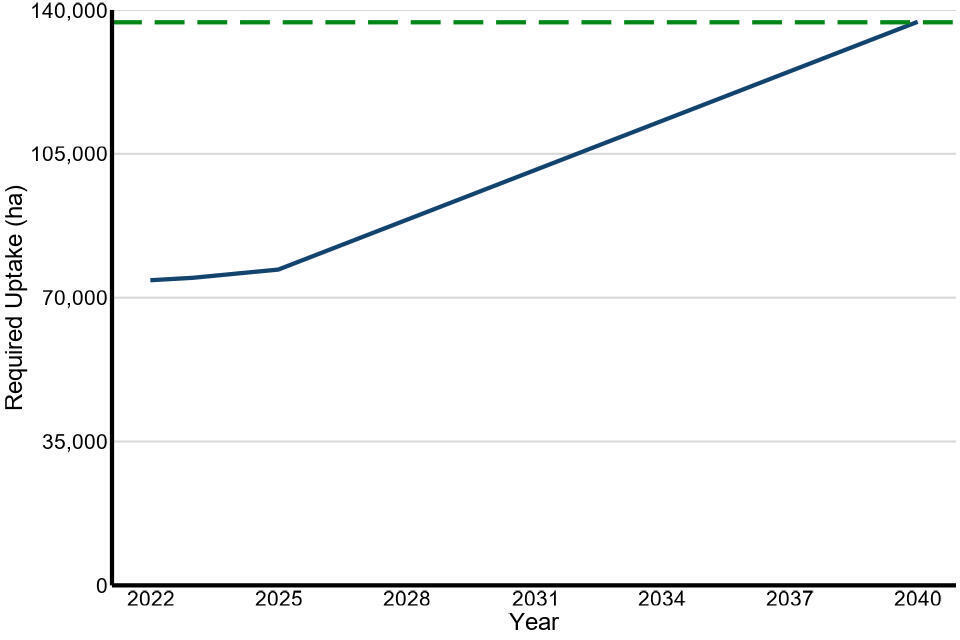
The required area of contributing actions has been calculated through to 2040. This trajectory is based on analysis of historic uptake and illustrates the annual uptake that would be required to contribute to the environmental objective by the end of the assessment period. Its shape is informed by assumptions about economic and behavioural factors and delivery constraints.
As information on future schemes is not currently available, the trajectory should not be interpreted as a forecast of uptake or as an indication of future scheme availability.
Figure 2: Required uptake of actions contributing to Native Woodland to 2040, hectares
Source: Department for Environment, Food and Rural Affairs
5. Metadata
| Objective | Native Woodland |
|---|---|
| Related commitments | Statutory wildlife-rich habitat creation targets |
| Reporting status | Interim |
| Contributing schemes | CS, CSHT |
| Aggregation method | Agreements live as at the capture date |
| Geographical scope | England |
| First reported | October 2026 |
| Last updated | October 2026 |