Farming Sector Environmental Objectives: hedgerows
Published 22 October 2026
Applies to England

© Crown copyright 2026
This publication is licensed under the terms of the Open Government Licence v3.0 except where otherwise stated. To view this licence, visit nationalarchives.gov.uk/doc/open-government-licence/version/3 or write to the Information Policy Team, The National Archives, Kew, London TW9 4DU, or email: psi@nationalarchives.gov.uk.
Where we have identified any third party copyright information you will need to obtain permission from the copyright holders concerned.
This publication is available at https://www.gov.uk/government/publications/farming-sector-environmental-objectives/farming-sector-environmental-objectives-hedgerows
1. Objective title
The farming sector and delivery partners will create or restore at least 48,200 kilometres of managed hedgerows by 2037, increasing to a total of at least 72,500 kilometres of additional managed hedgerows by 2050.
2. Objective overview
Hedgerows are a vital component of England’s ecosystems, forming an extensive ecological network across the countryside. They support biodiversity, store carbon, reduce soil erosion, and have long been an integral feature of the landscape.
Historically, the extent of hedgerows across England was significantly greater than it is today, with extensive networks forming a characteristic feature of the countryside.
The objective is for the farming sector to support the creation and restoration of hedgerows across the country through agri-environment schemes.
3. Relevant targets and commitments
30by30
Under the Global Biodiversity Framework, the UK government has agreed to:
- effectively conserve and manage 30% of our land and sea for nature by 2030
The framework does not set specific pathways to meet the target, which are devolved to the individual nations. Defra has produced the 30by30 on land: Delivery plan which focusses on the creation, restoration and long-term management of wildlife-rich habitat to meet the target. Hedgerows created, restored and managed under this objective will contribute to 30by30 target due to their wildlife-rich status, where the management and protection criteria are also met.
Environmental Improvement Plan
The Environmental Improvement Plan 2025 (EIP25) sets a key action for hedgerows:
- support farmers and land managers to create or restore 48,000km of hedgerows by 2037 and 72,500km of hedgerows by 2050
Carbon Budget 6
The Climate Change Committee issues a series of reports advising the UK Government on key milestones for achieving Net Zero. These Carbon Budgets setting legally binding, five‑year caps on greenhouse gas emissions through to 2050.
Carbon Budget 6, covering the period 2033 to 2037, set the following target:
- by 2037, we will reduce annual emissions through agriculture, forestry and other land uses (AFOLU) by 4.9Mt CO2e per annum, in line with the Sixth Carbon Budget.
This target is shared across Defra, with the farming sector responsible for 1.63 million tonnes CO2e of the 4.9 million tonne requirement. Contribution of hedgerow actions towards abatement targets are not currently reported within the environmental objectives.
4. Delivery approach
4.1 Methodology
The uptake of environmental land management (ELM) actions that create and restore hedgerows, such as planting new hedges and encouraging new growth where a hedgerow is not continuous, will be used to measure progress towards achieving this objective.
For this objective, a ‘managed hedgerow’ is a boundary line of trees or shrubs that has been shaped or maintained through human intervention.
Progress towards creation under this objective is measured as total uptake of new or increased key actions between 2023 and 2050. Where an increase in actions occurs, only the additional amount is counted. All key actions are measured in kilometres.
4.2 Baselines and assumptions
For the purpose of this objective, the 1st January 2023 is used as a baseline, counting contributing uptake on this date as zero kilometres. However, this does not indicate the absence of related activity prior to this date.
4.3 Key and supporting actions
Table 1: Environmental land management actions contributing to Hedgerows
| Action Code | Action Name | Scheme | Type |
|---|---|---|---|
| BN7 | Hedgerow gapping-up | Capital Grants | Key |
| BN11 | Planting new hedges | Capital Grants | Key |
| BN5 | Hedgerow laying | Capital Grants | Supporting |
| BN6 | Hedgerow coppicing | Capital Grants | Supporting |
| BN8 | Hedgerow supplement - casting up | Capital Grants | Supporting |
| BN9 | Hedgerow supplement - substantial pre-work | Capital Grants | Supporting |
| HRW1 | Assess and record hedgerow condition | Sustainable Farming Incentive 2023 | Supporting |
| HRW2 | Manage hedgerows | Sustainable Farming Incentive 2023 | Supporting |
| HRW3 | Maintain existing hedgerow trees, or establish new ones | Sustainable Farming Incentive 2023 | Supporting |
4.4 Required trajectory
The required length of contributing actions has been calculated through to 2050 to meet the long-term objective. This includes the uptake required to achieve the interim deadline for 2037.
This trajectory is based on analysis of historic uptake and illustrates the annual uptake that would be required to contribute to the environmental objective by the end of the assessment period. Its shape is informed by assumptions about economic and behavioural factors and delivery constraints.
As information on future schemes is not currently available, the trajectory should not be interpreted as a forecast of uptake or as an indication of future scheme availability.
Figure 2: Required uptake of actions contributing to Hedgerows to 2050, kilometres
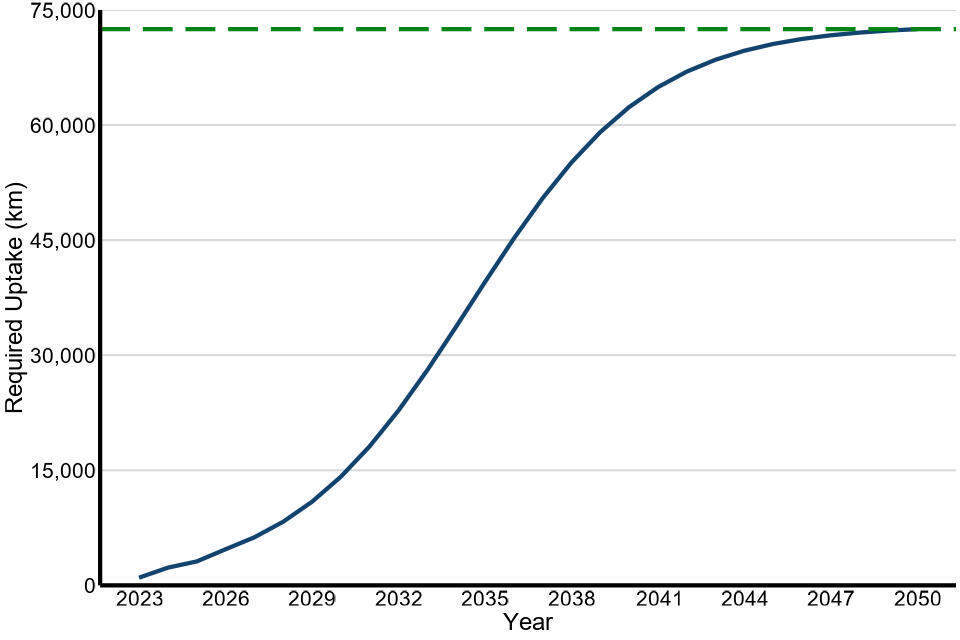
Source: Department for Environment, Food and Rural Affairs
5. Metadata
| Objective | Hedgerows |
|---|---|
| Related commitments | Statutory wildlife-rich habitat and carbon emissions targets |
| Reporting status | Final |
| Contributing schemes | CS |
| Aggregation method | Agreements live since January 2023 |
| Geographical scope | England |
| First reported | October 2026 |
| Last updated | October 2026 |