Family Resources Survey Transformation: integrating administrative data for benefits
Published 26 March 2026

© Crown copyright 2026
This publication is licensed under the terms of the Open Government Licence v3.0 except where otherwise stated. To view this licence, visit nationalarchives.gov.uk/doc/open-government-licence/version/3 or write to the Information Policy Team, The National Archives, Kew, London TW9 4DU, or email: psi@nationalarchives.gov.uk.
Where we have identified any third party copyright information you will need to obtain permission from the copyright holders concerned.
This publication is available at https://www.gov.uk/government/publications/family-resources-survey-transformation-integrating-administrative-data-for-benefits/family-resources-survey-transformation-integrating-administrative-data-for-benefits
1. Context
- This report follows our initial research report published in March 2024 which outlined the wider Family Resources Survey (FRS) Transformation objectives and initial research findings.
- This is in the context of the UK Statistics Authority’s strategy for data linking and the Office for Statistics Regulation’s recommendations on social surveys and administrative data integration.
- We are now proceeding with the integration of administrative data on benefits and tax credits into the published Family Resources Survey from March 2026. This resolves a substantial proportion but not all the long-standing undercount of benefit receipt in the survey.
- This paper focuses on the process and methodologies used to integrate these data sources.
- Technical and data availability issues mean it is not possible, at this stage, to implement a revised grossing regime to resolve more fully the benefit undercount.
- Work will continue on a revised grossing regime and the integration of other administrative data sources, including HMRC Real Time information on PAYE and Self Assessment.
- Further implementation plans, when confirmed, will be communicated via the FRS release strategy and the DWP Statistical Work Programme.
2. Overview
The approach we have taken to integrating benefits and tax credits is a refinement of the process outlined in our technical paper of March 2024.
The steps are to:
- Produce the FRS lookup file by linking adult respondents to their National Insurance Numbers.
- Use the lookup file to link around 95% of respondents to each of the administrative datasets, identifying benefit receipt and payments at the time of interview.
- Identify deductions, recoveries and the net amounts paid via the Central Payments System.
- Use survey responses for approximately 5% of respondents who remain unlinked.
- Use survey responses for the small number of benefits where administrative data sources are not available.
- Quality assure by reconciling and credibility checking administrative data and survey responses.
- Compile a complete FRS benefits table based on administrative data for the main benefits, with residual survey elements.
- Integrate this table into the FRS hierarchical set of tables - populating FRS Adult, Household and Benunit tables with relevant benefit variable values.
3. Lookup file
3.1 Lookup file context
The lookup file provides the link between adult FRS respondents’ survey data and their administrative records. It consists of the standard FRS respondent identifiers for household, family and individual (SERNUM, BENUNIT, PERSON) together with encrypted National Insurance Numbers (NINOs).
NINOs are obtained by linking respondents by name, postcode, and date of birth to DWP’s Customer Information System (CIS). CIS stores the names, dates of birth, and latest address information, for everyone who has been issued with a NINO.
Accurate recording of respondent name and date of birth information is critical for the success of this process. We have worked with Office for National Statistics colleagues, who carry out fieldwork on behalf of DWP, over time to improve capture. This has involved interviewer briefings, better questionnaire support materials, new questionnaire prompts to improve accurate recording of information, full capture of middle names, improvements to the structure of interview questions.
From 2007 until 2018, linking required explicit respondent consent, as required by the Data Protection Act 1998. On average, each year in Great Britain, around two thirds of respondents consented. We then matched around 80% of consenting respondents, giving us an average overall match rate of just over 50%. The consent rates were lower in Northern Ireland, resulting in a lower match rate in that region.
Since the implementation of the General Data Protection Regulation (GDPR) in 2018, public task, rather than consent, has provided the lawful basis for all FRS processing, including linking, in Great Britain (GDPR Article 6(1)(e)). Consent remained the legal basis in Northern Ireland until 2020.
This means we have permission to link all respondents, who are fully informed about how their information will be used, as opposed to just the two thirds who consented previously.
This change, together with improvements in our linking methodology, means that since 2020 we can find NINOs for more than 95% of respondents on average on a UK-wide basis.
3.2 Linking process
Automated SAS-based routines use a large number of match keys made up of every possible combination of full and part elements of first name, middle initial, surname, date of birth and postcode. The decision on whether to accept the match given by a particular key combination depends on the uniqueness of that combination on CIS where:
Key combination uniqueness = (Number of unique combinations / Total number of combinations)
The initial threshold for match acceptance is set at 90%. We then undertake a quality assurance process whereby:
- every match between 90% to 99% uniqueness is manually examined
- selected matches with more than 99% uniqueness are also checked
The quality assurance process involves outputting the full names, dates of birth, postcodes and addresses for respondents and the corresponding details they have been matched to on CIS.
Full details are output for every individual in the household, so that matches can be assessed in a family/household context. This can help by, for example, picking up cases where there has been a name change on marriage.
The manual checking process identifies particular kinds of errors in the automated matching and picks up some matches that were missed. We also use email addresses and telephone numbers (available for a minority of respondents and not used in the automated matching) to confirm matches.
The pre and post quality assurance match rates are outlined in the table below. We reject between 1% and 2% of initial matches as part of the quality assurance process. The general policy with manual quality assurance is ‘if in doubt, do not accept a match.’
Table 3.1 Lookup file match rates pre and post quality assurance, by FRS survey year, United Kingdom
| Survey year ending March | Matched - 90% threshold | Matched - Post-QA | Unmatched - 90% threshold | Unmatched - Post-QA | Match rate - 90% threshold | Match rate - Post-QA | All adults |
|---|---|---|---|---|---|---|---|
| 2019 | 29,890 | 29,292 | 1,227 | 1,825 | 96.1% | 94.1% | 31,117 |
| 2020 | 29,928 | 29,434 | 1,346 | 1,840 | 95.7% | 94.1% | 31,274 |
| 2021 | 16,916 | 16,722 | 345 | 539 | 98.0% | 96.9% | 17,261 |
| 2022 | 26,900 | 26,542 | 626 | 984 | 97.7% | 96.4% | 27,526 |
| 2023 | 41,137 | 40,629 | 1,356 | 1,864 | 96.8% | 95.6% | 42,493 |
| 2024 | 27,477 | 27,197 | 1,091 | 1,371 | 96.2% | 95.2% | 28,568 |
Note: Figures for 2018 to 2019 and 2019 to 2020 only include respondents in Northern Ireland who provided consent.
Lookup file match rates have been consistently high across time and by geographic region and can be seen in Table 3.2. The low rates observed in Northern Ireland for the earliest two years are because they were still using consent as the legal basis for linking up to 2020. London is the only other region where a match rate of less than 90% is achieved.
Table 3.2 Percentage of all adult respondents linked to National Insurance Numbers
| Location, survey year ending March | 2018 | 2019 | 2020 | 2021 | 2022 | 2023 | 2024 |
|---|---|---|---|---|---|---|---|
| UK | 88 | 88 | 97 | 96 | 96 | 95 | 95 |
| Great Britain | 94 | 94 | 97 | 97 | 96 | 95 | 96 |
| England | 93 | 94 | 97 | 97 | 96 | 95 | 95 |
| Wales | 95 | 93 | 98 | 97 | 94 | 96 | 99 |
| Scotland | 96 | 97 | 98 | 98 | 97 | 97 | 97 |
| Northern Ireland | 37 | 33 | 94 | 90 | 95 | 93 | 90 |
| English regions, survey year ending March | 2018 | 2019 | 2020 | 2021 | 2022 | 2023 | 2024 |
|---|---|---|---|---|---|---|---|
| North East | 98 | 97 | 98 | 98 | 99 | 97 | 97 |
| North West | 97 | 97 | 98 | 98 | 97 | 97 | 97 |
| Yorkshire and The Humber | 95 | 96 | 96 | 98 | 97 | 97 | 97 |
| East Midlands | 95 | 95 | 97 | 99 | 98 | 98 | 97 |
| West Midlands | 95 | 95 | 97 | 97 | 97 | 96 | 93 |
| East of England | 94 | 96 | 97 | 98 | 97 | 97 | 97 |
| London | 80 | 79 | 92 | 92 | 87 | 86 | 87 |
| South East | 94 | 94 | 97 | 96 | 95 | 95 | 95 |
| South West | 97 | 97 | 98 | 98 | 98 | 96 | 97 |
Note: Percentage of all adults – including adults who did not consent to linking in Northern Ireland in 2018 to 2019 and 2019 to 2020.
4. Integrating benefits and tax credits
This section steps through the linking process used for each of the main administrative sources in turn. The administrative sources used are outlined in Figure 4.1.
Figure 4.1 Benefit administrative sources used for linking to the FRS
| Benefit | Administrative data source/system |
|---|---|
| Attendance Allowance, Disability Allowance, Carer’s Allowance, Industrial Injury Disability Benefit, Jobseeker’s Allowance, Employment and Support Allowance and Income Support, State Pension and Pension Credit, Maternity Allowance, Bereavement Support Payment | General Matching Service (GMS) / Central Payment System (CPS) |
| State Pension - Get your State Pension (GYSP) claimants | Central Payment System (CPS) |
| Universal Credit | Universal Credit Full Service |
| Personal Independence Payment | Personal Independence Payment System |
| Housing Benefit | Single Housing Benefit Extract (SHBE) |
| Child Benefit, Child Tax Credit & Working Tax Credit | HMRC (extracts held by DWP) |
The objective is to identify accurately the benefits respondents are in receipt of at the time of interview and the amounts they are paid on an on-going regular basis. We also aim to ensure the benefit amounts recorded reflect the rates that apply in the relevant financial year.
4.2 General Matching Service
4.2.1 General Matching Service extracts
The General Matching Service (GMS) data extracts are sourced from the various DWP Legacy Benefit computer systems. These are the IT systems used to run most benefits other than Universal Credit.
Extracts are produced for each benefit, containing up-to-date information on live benefit claims, which are used for fraud and error identification, as well as analytical purposes.
Extract frequency varies between one and six weeks depending on the legacy system being used.
Some short benefit spells may occasionally be missing. For example, in a 6-weekly scan schedule a claim to benefit that starts and ends within that 6-week window, and is not current at the extraction date, will be missed from the extract. However, the benefits that tend to be on longer extraction schedules tend to be benefits that also have longer benefit durations.
The linking process for GMS-sourced benefits all follow the same methodology and steps as outlined in Figure 4.2.
Figure 4.2 GMS linking process
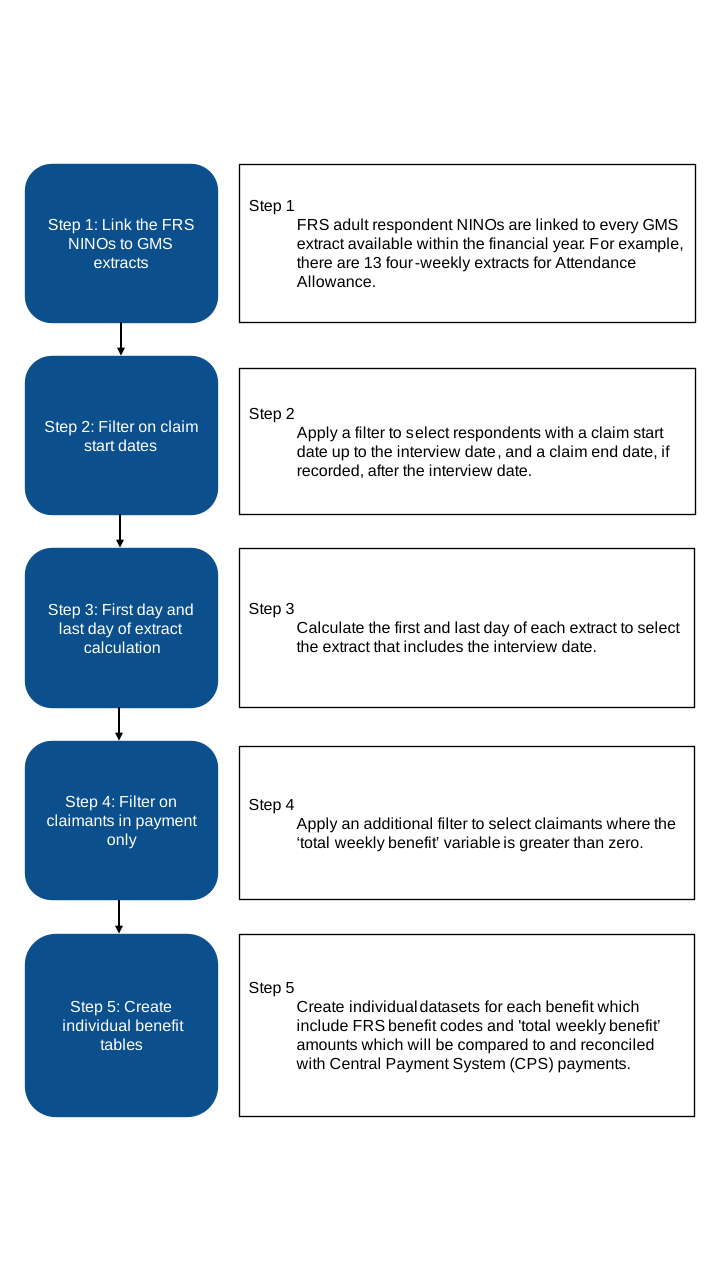
Using the lookup file, we link adult respondents to each individual GMS dataset across the survey year. We identify respondents in receipt at the time of interview based on a claim start date before or up to the interview date, and a claim end date, if recorded, after the interview date. Additionally, we filter to select claims where the benefit amount, recorded as ‘total weekly benefit,’ is greater than zero.
For those in receipt, we then identify the GMS total weekly benefit amount closest to, but before, the interview date. If no payment has been made before the interview date, for example a new claim, with first payment yet to be made, then we take the first payment amount after the interview date, with time limits applied, usually 30 days.
4.2.2 Linking General Matching Service identified claimants to the Central Payments System
The Central Payment System (CPS) is DWP’s integrated payment and accounting system. CPS extracts provide complete benefit payment records for all claimants.
Each claimant, identified by their NINO, has one row per payment date, detailing the components of the award and the calculation of the net payment amount after any deductions (for example for direct payment of utility bills), or recoveries (for example for overpayments of benefit), are taken into account.
We use CPS to identify the actual amount received and the amount of any deductions or recoveries.
In the vast majority of cases the GMS total weekly benefit amount identified by our matching code equals the CPS net amount plus any deductions or recoveries. However, for a small number of cases, 1% or fewer, this is not the case.
We investigate these cases to identify the reason for, and resolve, the discrepancies. Common reasons are where the GMS value, closest to the interview date, has taken into account a change of circumstances, which has yet to be reflected in the last CPS payment prior to the interview date. Also, commonly, for respondents interviewed at the start of the survey year, the annual uprating of the benefit amount might be reflected in GMS but not yet in CPS.
There are also occasional glitches in GMS records, where some element is missing, (for example claim start date or total weekly benefit amount) around the time of interview. This can result in a record failing our automated criteria for inclusion.
Direct linking to CPS is used to identify these cases and obtain benefit and payment records.
Practical, operational flaws can also affect CPS data. There can be errors in start and end dates for payments or components. This can result in different components, covering the same period, being paid on different dates, with one payment just falling outside the interview window.
We are looking to continually refine our processes so more of these issues can be identified and resolved though automated checks.
There is also a small number of benefit combinations found in GMS records which are not possible according to benefit rules. These cases are likely due to system input error. They are identified via credibility checks against survey responses and the final benefit values are corrected accordingly.
4.2.3 Example of linking respondents to GMS and CPS
Figure 4.3 below gives an example of how the linking process works using Attendance Allowance (AA).
We use the lookup file to link respondents to the GMS AA dataset. An AA extract is produced every 4 weeks. In this example, the respondent was interviewed on 05 May 2022, and we identify from GMS that they had a live AA claim in the extract which included the interview date: 02 May 2022 to 29 May 2022.
Figure 4.3 Linking to FRS respondents to the GMS Attendance Allowance dataset
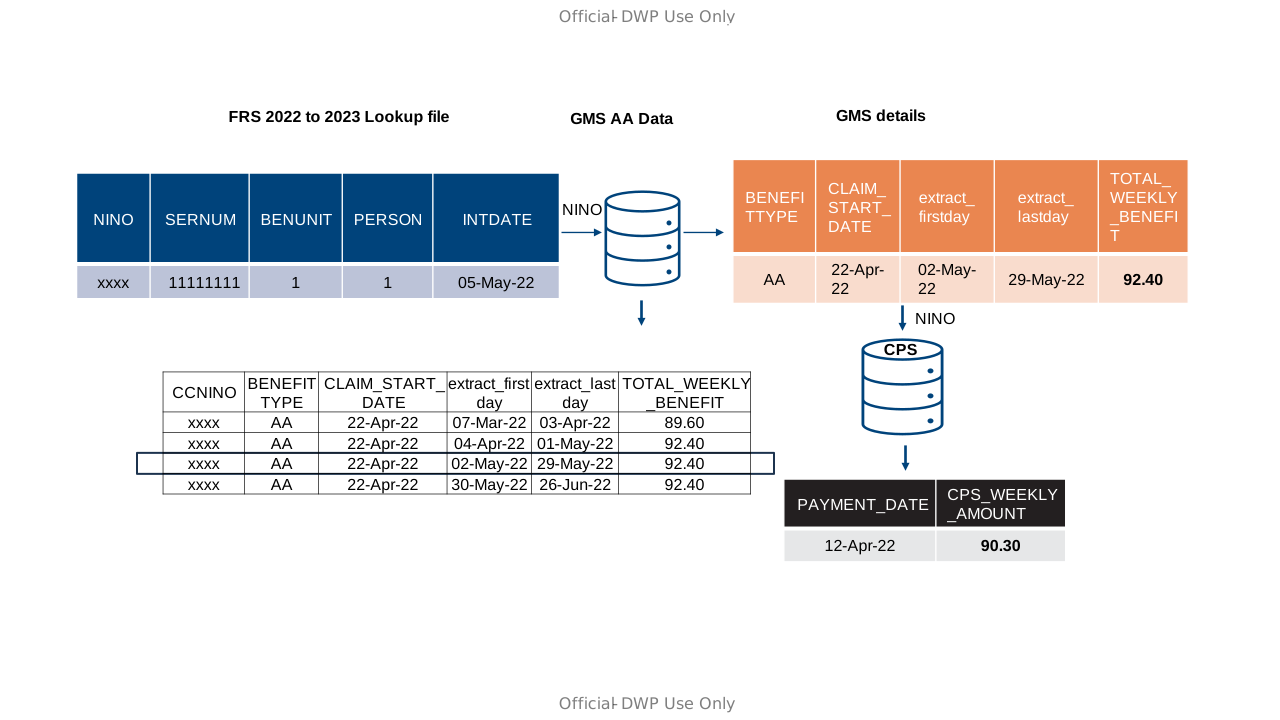
Figure 4.3 Linking to FRS respondents to the GMS Attendance Allowance dataset
The total weekly benefit amount according to GMS is £92.40, which is the higher rate of AA that applied in that financial year.
We can also see that the last amount actually received, as recorded in CPS, covered a period which was partly before and partly after the annual benefit uprating and the amount paid was lower at £90.30.
In these circumstances, we apply a standard rule that the benefit amount recorded on the FRS should reflect fully the rate that applies in relevant financial year. Therefore, the GMS amount of £92.40 is allocated in this case.
Figure 4.4 gives examples of how CPS gives a complete picture of benefit payments, with the CPS records identifying deductions for third party payments and recoveries for overpayments or other reasons such as loan repayments.
For example, ‘Person 1’ in the household represented by the SERNUM ‘11111111’ was interviewed on 31 July 2022 and is found to have a live claim for Jobseeker’s Allowance (JSA) in the GMS extract 30 Jul 22 to 05 Aug 22, which includes the interview date. The JSA entitlement amount according to the GMS extract is £77.00. However, by linking to CPS and identifying the actual payment details closest to the interview date we can see that this person had a deduction and a recovery payment which reduced their actual net JSA payment to £59.66.
In our admin-based benefits table, the net amount will be recorded as the JSA amount and the deduction and recovery amounts will be recorded separately in their own categories e.g. third-party payments, loan repayments. In this way, complete and accurate payment circumstances can be recorded on the final benefits table.
Figure 4.4 Using CPS to identify deductions from benefit amounts
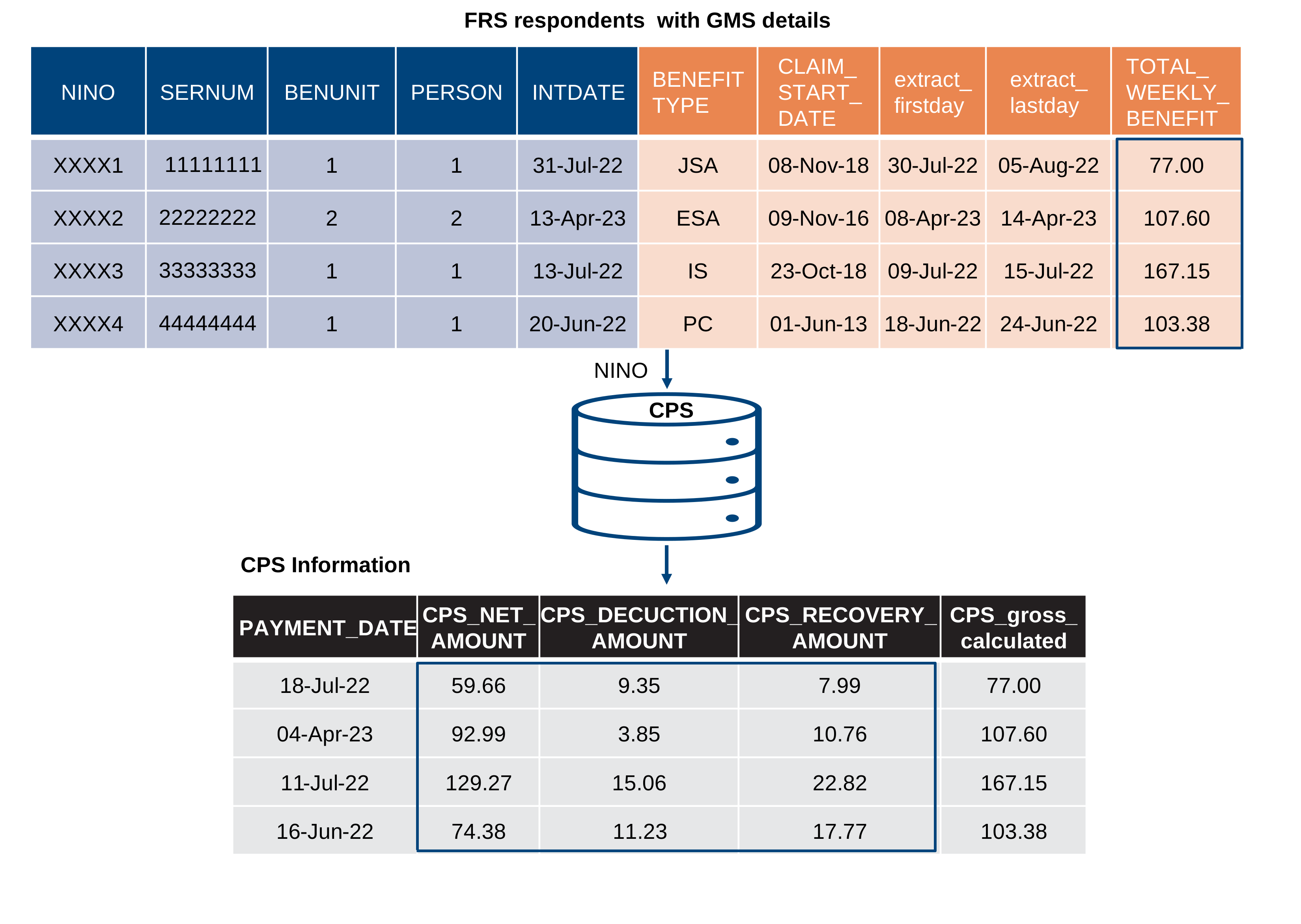
Figure 4.4 Using CPS to identify deductions from benefit amounts
4.2.4 Disability Living Allowance
Linking FRS respondents to Disability Living Allowance (DLA) GMS extracts requires an additional step compared to the process outlined in sections 4.2.1 to 4.2.3.
This is because, when a child claims DLA, their NINO is often recorded on GMS rather than their parents and the FRS lookup file only contains adult NINOs.
DWP’s Registration and Population Interaction Database (RAPID) contains a Child Benefit Relationship table which contains parent and child NINOs, where available.
We link the adult FRS NINOs, using the lookup file, to this table to identify FRS children and obtain their NINOs. We then link those children to the GMS DLA extract to identify FRS children in receipt of DLA.
The identification of DLA benefit receipts process goes through five main steps as outlined in Figure 4.5.
Figure 4.5 Identifying Children (with NINOs) in receipt of DLA
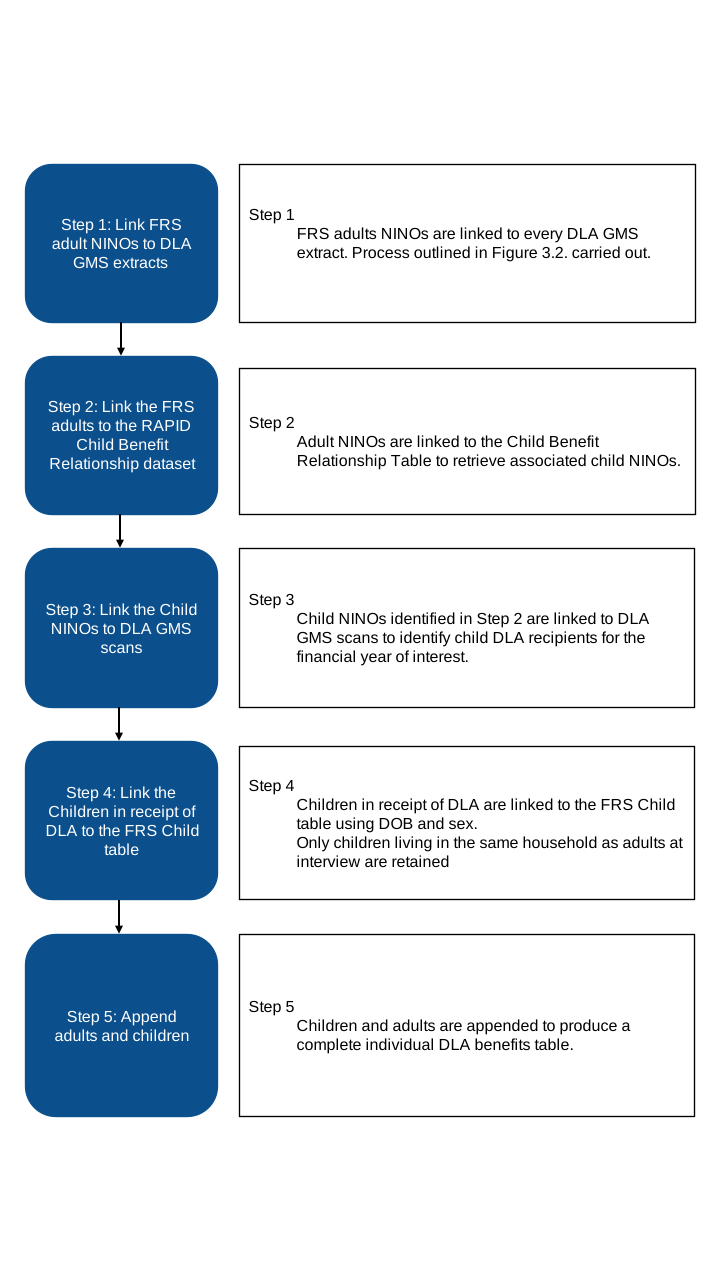
Figure 4.5 Identifying Children (with NINOs) in receipt of DLA
Note the Child Benefit Relationship Dataset includes families in receipt of child benefit. It does not cover those who have chosen not to receive the benefit or opted out because of the High Income Child Benefit Charge. However latest HMRC figures show that over 90% of families are covered. This means that we are likely to identify most but not all children who are in receipt of DLA.
4.2.4 State Pension
To obtain complete coverage of State Pension we link to three separate sources:
- State Pension GMS extract
- Pension Credit GMS extract
- Central Payments System
The GMS extract is the main source for State Pension claims made prior to the introduction of Get Your State Pension (GYSP) in 2019. The linking process here is the same for other GMS extracts as described in sections 4.2.1 to 4.2.3.
For a minority of GMS records, a State Pension end date is recorded when a Pension Credit claim begins. We capture State Pension for these cases via the Pension Credit GMS scan. The linking process then is the same as for other GMS extracts.
New State Pension claims via the GYSP system since 2019 are not present on GMS. We link directly to CPS to identify State Pension receipt and amounts for these cases.
4.3 Universal Credit
4.3.1 Universal Credit Full Service (UCFS) Datasets
Universal Credit Full Service (UCFS) datasets provide complete information on all UC claimants: statement detail, monthly payments, deductions, payments directly to landlords, recoveries. UCFS covers every year of our time series apart from Financial Year Ending (FYE) 2019 where we used the UC Official Statistics datasets.
4.3.2 Universal Credit Linking Methodology
The high-level steps to linking respondents to UC records are as follows in Figure 4.6.
Figure 4.6 Universal Credit Linking Methodology
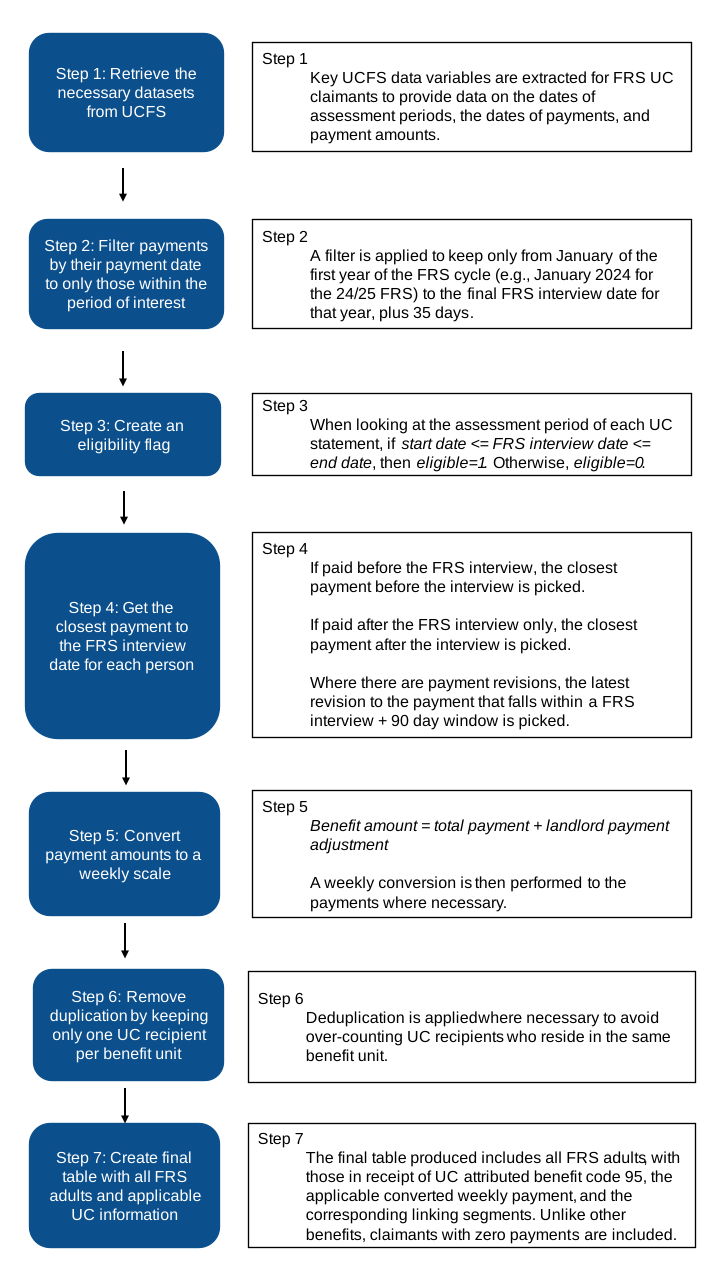
Figure 4.6 Universal Credit Linking Methodology
The first step links respondents to the UCFS statement dataset. An initial filter is then applied to retain statements that relate to the period from January of the relevant FRS survey year (for example, January 2024 for FYE 2025) to the final FRS interview date for that year, plus 35 days.
A simple flag is created for each UC statement to identify the assessment period which includes the respondent’s FRS interview date. An eligible UC claimant is defined as a respondent with a live UC claim at the time of their FRS interview.
FRS respondents with at least one eligible UC statement, as identified through this process, are then retained for payment matching. We aim to select the payment that best represents a respondent’s circumstances at the time of their FRS interview. To do this, we choose the payment closest to the interview date less than or equal to 60 days before the interview, where available. We also consider the occasional claimants who were only paid after their interview date, or for whom no payments fall within the 60‑day period before the interview. For these claimants, we choose the closest payment less than or equal to 35 days after the interview date.
In some cases, UC statements are later revised. When this happens, UCFS stores the revised payment as a separate data entry. Cases where revisions exist are identified. The latest statement revision made within 90 days of the interview date is selected and the payment corresponding to that statement allocated.
In UCFS data, the ‘total payment’ variable excludes housing payments made directly to landlords. Where they exist, direct payments to landlords, are added to ‘total payment’ to calculate the correct FRS benefit amount.
Unlike other benefits, UC includes claimants with zero payments. UC is designed to reflect changes in income, and claims are not closed unless there are three consecutive months of zero awards.
Finally, deduplication is applied to avoid overcounting UC recipients. UCFS records show information for both individuals in an eligible couple as two separate records, even though payment is made to a single person per benefit unit.
Figure 4.7 UCFS Data Example
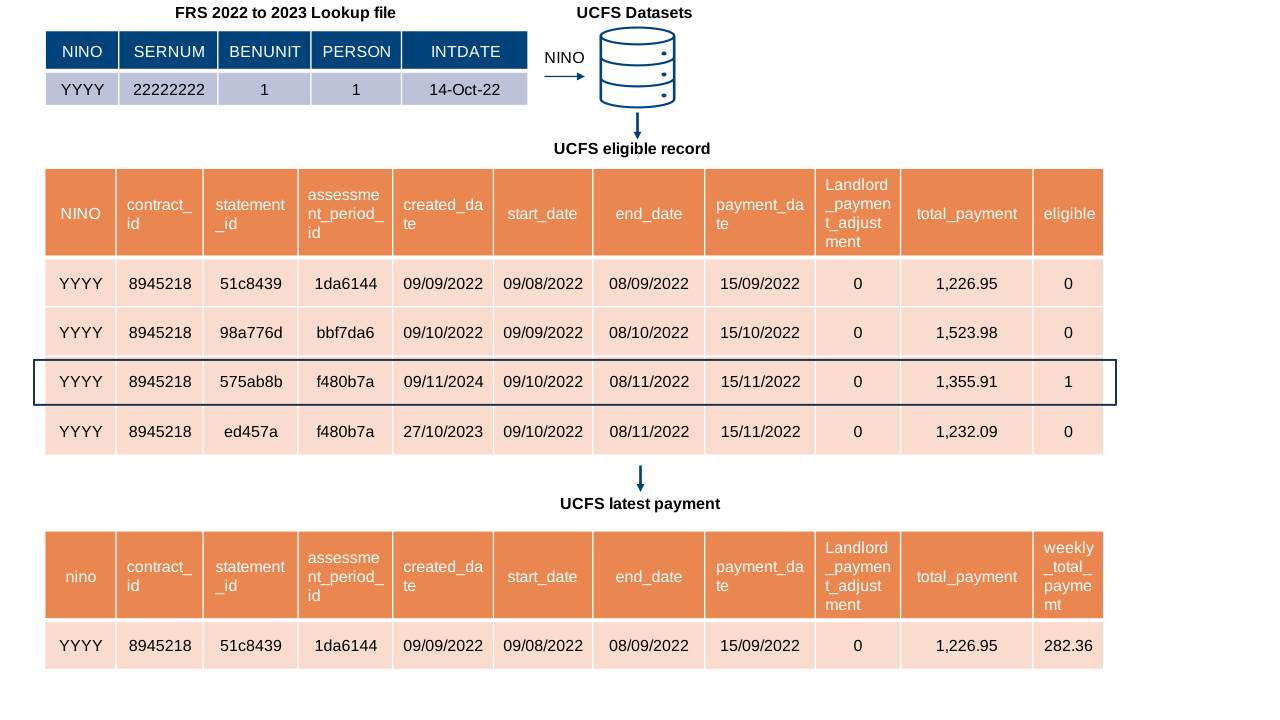
Figure 4.7 UCFS Data Example
The example above illustrates our methodology, using the survey year 2022 to 2023.
As with other administrative sources, the FRS lookup file provides the link to the UCFS datasets via respondent NINOs.
The first UCFS table displays all the records that have assessment period end dates that are up to 60 days before and up to 35 days after the FRS interview date.
Respondent YYYY has three assessment periods in this window:
- August: from 09 August 2022 to 08 September 2022
- September: from 09 September 2022 to 08 October 2022
- October: from 09 October 2022 to 08 November 2022
This respondent is identified as in receipt of UC at the time of the interview with the interview date (14 October 2022) falling between the start and end date of the third statement (09 October 2022 and 08 November 2022) The person is therefore given the eligibility flag of 1 (eligible) for this period.
The second UCFS table outlines which UC payment is chosen for this FRS respondent during processing. This payment was chosen as it is the closest payment to the interview that is within the 60-day window before the interview (14 October 2022 – 08 September 2022 = 36 days). This decision aligns with the questionnaire prompt “How much did you get last time?”. As a payment exists within the 60-day window before the interview, there is no need to look at payments made after the interview. Similarly, this payment had no subsequent revisions (as seen in the table for the October statements), so no further processing was needed.
Since UCFS includes the actual amount paid along with deductions and recoveries, there is no need to investigate UC amounts from CPS. The weekly benefit amount of £282.36 was calculated using the total payment, the landlord payment adjustment, and a weekly conversion.
4.4 Housing Benefit – Single Housing Benefit Extract
The Single Housing Benefit Extract (SHBE) is a monthly extract of all Housing Benefit claims in the UK. DWP compiles the dataset from information supplied by each local authority. It contains detailed claimant‑level records, including weekly award amounts, drawn directly from local authority IT systems.
The process for linking FRS respondents to SHBE is similar to the one used for GMS. Respondents are linked to each of the monthly extracts for the survey year. Housing Benefit claims are identified where there is a claim start date before or up to the interview date and that claim is live in the monthly extract covering the interview date. The weekly amount recorded on the relevant monthly extract is used.
In the historical SHBE time series there are occasional gaps in the information supplied by individual local authorities in particular months. This has, rarely, led to gaps in the data which may result in a small number of respondent housing benefit claims being missed.
4.5 Personal Independence Payment
Monthly Personal Independence Payment (PIP) extracts are produced from the dedicated PIP IT system. These datasets are used to publish Official Statistics on PIP caseload.
Again, the process is similar to that for GMS datasets. A respondent is identified as in receipt of PIP if they appear in the extract for a month containing the interview date – with an onflow date (equivalent to claim start date) before or up to the interview date and their recorded benefit rate is greater than zero.
As with the GMS datasets linking process, entitlement is established via the PIP dataset, then the actual amount of benefit paid is identified via CPS. As with the GMS process, credibility checks are then carried out, ensuring that the correct rates for the financial year are applied.
Some children over the age of sixteen receive PIP in their own right. As with DLA, we identify these children indirectly by linking adult respondents to RAPID’s Child Benefit Relationship table, which contains child and parent NINOs for each financial year. We then link the FRS respondent children identified to the PIP and CPS datasets in turn to identify live claims at the time of interview and payment amounts.
The Child Benefit Relationship dataset includes about 91% of families who are eligible for Child Benefit as some families have opted out because of the High Income Child Benefit Charge. Therefore, we are likely to miss a small number of children in the sample who are in receipt with this linking process.
4.6 Child Benefit
Prior to February 2021 Child Benefit data were stored on old, DWP-hosted legacy systems. The Future Child Benefit Programme (FChB) migrated Child Benefit to HMRC’s modern tax‑administration platforms, alongside the launch of the Child Benefit Service (CBS) in 2021.
The new extracts from the FChB system are cleaner and more accurate compared to the legacy systems.
However, the way we link respondents to both sources is broadly similar – linking respondents by NINO to data extracts for the survey year, identifying live child benefit claims at the time of interview, extracting the last payment made before the interview date or the first payment if made just after. If interview date is at the start of the survey year, we adjust the payment amount, if necessary to ensure it reflects the rates payable during the survey year.
As with GMS and other data sources, we also carry out credibility checks against survey responses. Specifically for child benefit there is a check to ensure that child benefit is only allocated if the respondent has reported having parental/guardian responsibility for a child.
4.7 Tax Credits
DWP holds a tax credits database which is updated with new records from HMRC in regular intervals throughout the year.
For each survey year, we extract records for all linked FRS respondents who have had at least one day in receipt of either Working Tax Credit (WTC) of Child Tax Credit (CTC) in that year.
The claim start and end dates for each WTC and CTC record are extracted, which enables us to determine whether each FRS respondent had an open claim to either of the tax credits at the time of interview.
The amounts associated with each tax credit are converted to weekly pound amounts.
The Final WTC and CTC tables produced contain all the FRS adults, and those in receipts will have the appropriate benefit code as well as their weekly benefit amount.
4.8 Compiling the overall benefits table, populating related tables
4.8.1 Benefits table
In the process of linking FRS survey responses to the individual administrative datasets, separate tables are created for each benefit, containing standard variables identifying the benefit, components, and the benefit amount received.
Separately, the survey records for unlinked respondents are edited according to the standard, existing survey benefit editing routines. The survey responses for the minor benefits where administrative data sources aren’t available are also edited using existing processes.
All three elements are then merged to create a provisional benefits table.
Final editing and credibility checking then occurs.
Additional variables, such as flags for various components of the UC award, are derived from existing variables and added to the dataset. Markers identifying linked and unlinked respondents are also added.
4.8.1 Other FRS tables
After the final benefits table is produced, new versions of the adult, child and benunit tables are also created to ensure the income and benefit flag variables reflect the information now seen in the Benefits table for each respondent.
Similarly, a new version of the renter table is created to ensure that all the Housing Benefit information it contains reflects the information seen in the benefits table for each respondent.
5. Results of administrative data linking
5.1 Undercount of benefit receipt
We have achieved a high match rate of FRS respondents to their National Insurance Numbers across time and by geographic region as shown in Figure 3.3.
This has given us a highly effective tool for linking respondents to the variety of available administrative sources for benefits and tax credits, as outlined in section 4.
The undercount in benefit receipt has been clearly illustrated over time in the annual FRS publication Table M.6a. The results in the 2023 to 2024 table are representative.
Table 5.1 Receipt of state support, FRS data and administrative data, 2023 to 2024, Great Britain [Table M6a FRS2324]
Benefit units, adults or individuals
| Benefit/tax credit received | FRS 2023 to 204: Ungrossed percentage | FRS 2023 to 2024: Grossed number (1,000s) | Grossed percentage | Administrative data: Number (1,000s) | Administrative data: Percentage | Administrative data: Percentage difference |
|---|---|---|---|---|---|---|
| All benefit units | 100 | 35,030 | 100 | 35,030 | 100 | not applicable |
| Income Support | [low] | 160 | [low] | 140 | [low] | 14 |
| Pension Credit | 4 | 970 | 3 | 1,370 | 4 | –29 |
| Housing Benefit | 6 | 1,730 | 5 | 2,350 | 7 | –26 |
| Council Tax Reduction | 12 | 3,710 | 11 | 4,440 | 13 | –16 |
| Universal Credit | 9 | 3,200 | 9 | 4,770 | 14 | –33 |
| Scottish Child Payment | [low] | 140 | [low] | 190 | 1 | –26 |
| All in-work benefit units | 100 | 22,110 | 100 | 22,110 | 100 | not applicable |
| Working Tax Credit | 1 | 300 | 1 | 410 | 2 | –27 |
| Child Tax Credit | 2 | 480 | 2 | 490 | 2 | –2 |
| All adults | 100 | 51,480 | 100 | 51,480 | 100 | not applicable |
| State Pension | 30 | 11,480 | 22 | 11,660 | 23 | –2 |
| Attendance Allowance | 2 | 910 | 2 | 1,540 | 3 | –41 |
| Carer’s Allowance | 1 | 840 | 2 | 990 | 2 | –15 |
| Employment and Support Allowance | 2 | 960 | 2 | 1,570 | 3 | –39 |
| All individuals aged 16 or over | 100 | 53,150 | 100 | 53,150 | 100 | not applicable |
| Disability Living Allowance | 2 | 730 | 1 | 640 | 1 | 14 |
| Personal Independence Payment | 5 | 2,770 | 5 | 3,410 | 6 | –19 |
To produce a summary measure we averaged the undercount, weighting the average for each benefit by caseload size. The benefits and tax credits included are:
Universal Credit, Jobseeker’s Allowance, Employment and Support Allowance, Income Support, Housing Benefit, Working Tax Credit, Child Tax Credit, Attendance Allowance, Disability Living Allowance, Personal Independence Payment, Industrial Injuries Disablement Benefit, Carer’s Allowance, State Pension, Pension Credit, Child benefit.
5.2 Reducing the undercount by linking to administrative datasets
Table 5.2 shows the weighted average undercount when survey responses are used. This is compared to the undercount when survey responses are replaced with administrative records for the approximately 95% of respondents we can link.
Table 5.2 Weighted average undercount of benefit receipt, self-reported and after linking to administrative date, by region
| Survey year ending March | Percentage in 2022 | Percentage in 2023 | Percentage in 2024 | Percentage in 2025 |
|---|---|---|---|---|
| United Kingdom: Survey - self reported | 16 | 19 | 20 | [z] |
| United Kingdom: Admin-linked | 7 | 9 | 12 | 13 |
| Great Britain: Survey - self reported | 16 | 18 | 19 | [z] |
| Great Britain: Admin-linked | 7 | 9 | 12 | 13 |
| England: Survey - self reported | 15 | 19 | 19 | [z] |
| England: Admin-linked | 7 | 10 | 12 | 13 |
| Wales: Survey - self reported | 12 | 11 | 17 | [z] |
| Wales: Admin-linked | 4 | 3 | 11 | 13 |
| Scotland: Survey - self reported | 20 | 17 | 18 | [z] |
| Scotland: Admin-linked | 8 | 9 | 13 | 10 |
| Northern Ireland: Survey - self reported | 29 | 28 | 28 | [z] |
| Northern Ireland: Admin-linked | 19 | 16 | 14 | 20 |
[z] = not applicable, admin records replaced survey responses in published FRS
At a United Kingdom level, the average survey undercount over the three years to 2024 is 18%, while the admin-linked percentage is 9%. Therefore, administrative data linking resolves around 50% of the benefit undercount.
There is some variation in these numbers at country or region level. The average survey undercount over the three years to 2024 is lower in Wales and the effect of linking produces a proportionately larger reduction. And the average survey undercount in Northern Ireland is larger and the effect of linking somewhat smaller. Full details, including results for the English regions are available in the tables accompanying this report.
5.3 Effects of linking for each benefit – Universal Credit example
We have also produced detailed breakdowns of the effects of linking by benefit. Table 5.3 shows results for Universal Credit at a United Kingdom level.
Table 5.3 Universal Credit caseload, award and expenditure estimates, United Kingdom
| Survey year ending March | 2022 | 2023 | 2024 | 2025 |
|---|---|---|---|---|
| Caseload (thousands): administrative caseload | 4,960 | 4,986 | 5,436 | 6,223 |
| Caseload (thousands): survey | 3,150 | 3,188 | 3,337 | [z] |
| Caseload (thousands): admin-linked survey | 3,858 | 3,812 | 4,333 | 5,123 |
| Coverage: survey/caseload | 64% | 64% | 61% | [z] |
| Coverage: admin-linked/caseload | 78% | 76% | 80% | 82% |
| Mean monthly award £: administrative caseload | 678 | 724 | 802 | 902 |
| Mean monthly award £: survey | 789 | 817 | 930 | [z] |
| Mean monthly award £: admin-linked survey | 702 | 729 | 836 | 911 |
| Annual Expenditure £m: caseload estimate | 40,381 | 43,319 | 52,287 | 67,394 |
| Annual Expenditure £m: survey | 29,830 | 31,255 | 37,259 | [z] |
| Annual Expenditure £m: admin-linked survey | 32,501 | 33,331 | 43,458 | 56,022 |
| Annual Expenditure £m: increase due to linking | 7% | 5% | 12% | [z] |
[z] = not applicable, admin records replaced survey responses in published FRS
Administrative caseload is the average number of Universal Credit claimants over the survey year. It is an average of the monthly figures published on DWP’s Stat-Xplore. Administrative caseload mean awards are also annual averages derived from monthly Stat-Xplore figures.
The survey and admin-linked survey caseloads are grossed estimates produced using the standard FRS grossing factor (Gross4). The mean monthly awards are also weighted using Gross4.
Coverage is the proportion of administrative caseload represented by the survey estimates. The increase in coverage due to linking averaged 15% over the three years to 2024: the 3-year average of survey/caseload is 63% and for admin-linked/survey it is 78%.
Annual expenditure is estimated by multiplying average caseload by mean award. The increase in expenditure coverage because of linking was 7%, 5% and 12% over the three years to 2024 – 8% on average over the three years.
Detailed breakdowns for each benefit by region, where sample sizes allow, are contained in the tables accompanying this report.
5.4 Effects of linking – overall expenditure for the 15 benefits included
In Table 5.4 we have aggregated the individual benefit expenditure estimates, for the 15 benefits included, to produce overall estimates for the UK, Great Britain, Scotland, Wales and Northern Ireland.
On average over the three survey years to 2024 at a UK level administrative linking has increased the estimate of expenditure on benefits in the FRS by 10%. As with caseload the increase due to linking is somewhat lower in Wales compared to the UK overall, and significantly higher in Northern Ireland.
Full breakdowns, including for the English regions are available in the accompanying tables.
Table 5.4 Estimates of total benefit expenditure, by region
| Survey year ending March | 2022 expenditure £m | 2023 expenditure £m | 2024 expenditure £m | 2025 expenditure £m |
| United Kingdom: administrative estimate | 234,600 | 243,100 | 274,500 | 302,900 |
| United Kingdom: survey | 194,900 | 197,500 | 220,700 | [z] |
| United Kingdom: admin-linked survey | 214,700 | 216,100 | 245,600 | 265,400 |
| United Kingdom: increase due to linking (%) | 10 | 9 | 11 | [z] |
| Great Britain: administrative estimate | 226,800 | 235,000 | 265,300 | 292,800 |
| Great Britain: survey | 189,500 | 191,700 | 214,300 | [z] |
| Great Britain: admin-linked survey | 208,300 | 209,300 | 237,800 | 257,300 |
| Great Britain: increase due to linking (%) | 10 | 9 | 11 | [z] |
| England: administrative estimate | 194,400 | 201,600 | 228,400 | 253,300 |
| England: survey | 162,500 | 163,600 | 184,100 | [z] |
| England: admin-linked survey | 178,400 | 178,700 | 204,800 | 222,300 |
| England: increase due to linking (%) | 10 | 9 | 11 | [z] |
| Wales: administrative estimate | 12,400 | 12,900 | 14,600 | 16,100 |
| Wales: survey | 11,100 | 11,400 | 12,200 | [z] |
| Wales: admin-linked survey | 12,100 | 12,500 | 13,400 | 13,900 |
| Wales: increase due to linking (%) | 9 | 9 | 10 | [z] |
| Scotland: administrative estimate | 19,600 | 20,200 | 22,100 | 22,900 |
| Scotland: survey | 15,800 | 16,700 | 17,900 | [z] |
| Scotland: admin-linked survey | 17,800 | 18,100 | 19,600 | 21,100 |
| Scotland: increase due to linking (%) | 12 | 8 | 9 | [z] |
| Northern Ireland: administrative estimate | 8,000 | 8,300 | 9,400 | 10,400 |
| Northern Ireland: survey | 5,400 | 5,700 | 6,400 | [z] |
| Northern Ireland: admin-linked survey | 6,300 | 6,800 | 7,800 | 8,200 |
| Northern Ireland: increase due to linking (%) | 16 | 18 | 21 | [z] |
[z] = not applicable, admin records replaced survey responses in published FRS
6. Further work
Our long-term work programme continues, and we are advancing work across a number of different areas.
- integration of devolved Scottish benefits
- integrating HMRC Real Time Information on PAYE and Self Assessment data.
- revising our grossing regime by introducing new controls for benefits, as outlined in initial research report published in March 2024
- investigating other sources including HMRC savings and investments data and Child Maintenance data
Further implementation plans, when confirmed, will be communicated via the FRS release strategy and the DWP Statistical Work Programme.
7. Feedback
We welcome feedback.
If you have any comments or questions about any aspect of the FRS Transformation project, please contact:
Email: frs.transformation@DWP.GOV.UK
8. Useful links
The landing page for this document is here: Family Resources Survey Transformation: integrating administrative data for benefits.
Further information on the FRS can be accessed from the Family Resources Survey home page, together with the Background Information and Methodology document and Family Resources Survey: quality assessment report.
Accompanying excel and ODS tables can be accessed here: Family Resources Survey, integrating administrative data for benefits.
9. Glossary
CIS: Customer Information System (CIS) is a DWP information system that stores the names and addresses of everyone who has been issued with a NINO.
CPS: Central Payment System (CPS) is the single integrated payment and accounting system used by DWP.
DWP: Department for Work and Pensions.
FChB: The Future Child Benefit Programme (FChB) migrated Child Benefit to HMRC’s modern tax‑administration platforms, alongside the launch of the Child Benefit Service (CBS) in 2021. The new extracts from the FChB system are cleaner and more accurate compared to the legacy systems.
FRS: The Family Resources Survey (FRS) is a continuous survey which collects information on the income and circumstances of individuals living in a representative sample of private households in the United Kingdom. The survey has been running in Great Britain since October 1992 and was extended to cover Northern Ireland in the survey year 2002 to 2003.
GDPR: General Data Protection Regulation (GDPR) is a European Union regulation which controls how personal information is used by organisations, businesses, or the government. The Data Protection Act 2018 is the UK’s implementation of GDPR.
GMS: General Matching Service (GMS) is primarily a tool used to identify potential fraud and error on DWP customer cases. It provides a way of ensuring our data are coherent and consistent by comparing data held by the DWP to our customer’s cases.
GYSP: Get your State Pension is the digital service used to administer and pay State Pension for new claims.
HMRC: His Majesty’s Revenue and Customs.
NINO: National Insurance Number.
ONS: Office for National Statistics.
PAYE: Pay As You Earn (PAYE) is the system for deducting and collecting Income Tax and National Insurance contributions from employment income.
RAPID: Registration and Population Interaction Database (RAPID) is a database created by the DWP. It provides a single coherent view of interactions across the breadth of benefits and earnings datasets for anyone with a National Insurance Number (NINO)
Self Assessment: Self Assessment tax return is a system HM Revenue and Customs (HMRC) uses to collect Income Tax. Although tax is usually deducted automatically from wages and pensions using PAYE, people and businesses with other income must report it in a tax return.
SHBE: The Single Housing Benefit Extract (SHBE) is a monthly extract of all Housing Benefit claims in the UK. It is compiled by the Department for Work and Pensions (DWP) using information supplied by local authorities, drawn directly from their IT systems.
List of Benefit Abbreviations
| Abbreviation | Benefit/Tax Credit name |
|---|---|
| UC | Universal Credit |
| JSA | Jobseeker’s Allowance |
| ESA | Employment and Support Allowance |
| IS | Income Support |
| HB | Housing Benefit |
| WTC | Working Tax Credit |
| CTC | Child Tax Credit |
| AA | Attendance Allowance |
| DLA | Disability Living Allowance |
| PIP | Personal Independence Payment |
| IIDB | Industrial Injuries Disablement Benefit |
| CA | Carer’s Allowance |
| SP | State Pension |
| PC | Pension Credit |
| CB | Child Benefit |
| GYSP | Get your State Pension |