Evaluation Task Force Strategy 2026-2029 (HTML)
Updated 24 August 2026

© Crown copyright 2026
This publication is licensed under the terms of the Open Government Licence v3.0 except where otherwise stated. To view this licence, visit nationalarchives.gov.uk/doc/open-government-licence/version/3 or write to the Information Policy Team, The National Archives, Kew, London TW9 4DU, or email: psi@nationalarchives.gov.uk.
Where we have identified any third party copyright information you will need to obtain permission from the copyright holders concerned.
This publication is available at https://www.gov.uk/government/publications/evaluation-task-force-strategy-2026-2029/evaluation-task-force-strategy-2026-2029-html
Introduction
The Evaluation Task Force (ETF) is a joint HM Treasury (HMT) and Cabinet Office unit, set up in 2021 to place evaluation evidence at the heart of government decisions. We jointly report to Cabinet Office Ministers and the Chief Secretary to the Treasury.
As the central hub of evaluation expertise in government, the ETF improves the way the government’s programmes are evaluated to inform decisions on whether they should be continued, expanded, modified or stopped. The team provides departments with evaluation advice and support on their major projects and priority programmes, as well as a proactive scrutiny and challenge function focused on government priority areas.
By working closely with stakeholders across and outside of government, the ETF is an integral part of how the government measures and improves the effectiveness and value for money of its policies, programmes and services. Between 2022 and 2025 we established a core service offer to deliver the aims and objectives set out in the first ETF strategy[footnote 1]. We had three overarching objectives:
- Government departments design and deliver robust and proportionate evaluation across their portfolio.
- Government departments have a transparent approach to their evaluation activity, publishing evaluation outputs in a timely fashion.
- Good quality evaluation evidence informs decision-making in government.
To achieve these objectives, we:
- embedded evaluation into decision-making processes;
- promoted the importance of evaluation across government, and;
- supported the delivery of priority evaluations.
Further details on our achievements, including our Major Projects Review, revised Magenta Book, Evaluation Academy, Evaluation Registry, Evaluation Accelerator Fund, and support to the What Works Network can be viewed in the Annex.
The Evidence and Evaluation Ecosystem in Government: Unlocking Evaluation Opportunities
Since 2021 the ETF has led a fundamental reform of evaluation in government. We have established best practice in evaluation and raised the bar on evaluation standards across the Civil Service. We have built evaluation capacity across government to support ongoing capability growth. Our work on Major Projects is just one example of how our commitment and focus has delivered significant improvements - the ETF helped raise the proportion of Major Projects with good quality evaluation plans from 8% in 2019 to over 34% in 2025. [footnote 2]
While this improvement is significant, it represents only the starting point. We must ensure that evaluation turns evidence into shared learning so that government can innovate, adapt and make decisions with greater confidence. This is vital if we are going to rewire the state to move faster, take more risks, innovate and improve public services.
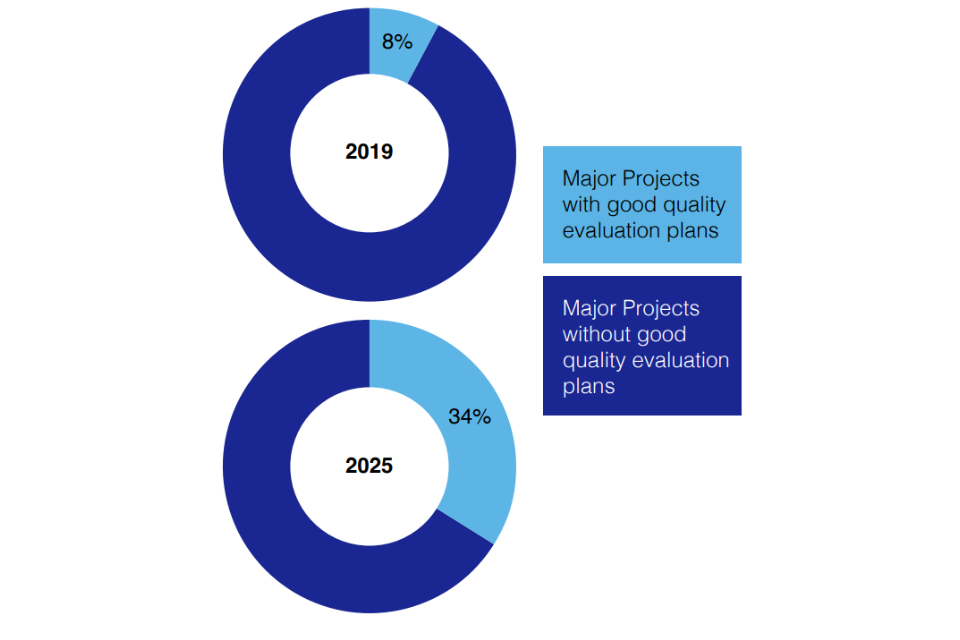
2019: 92% without good quality evaluation plans, 8% with good quality evaluation plans; 2025: 66% without good quality evaluation plans, 34% with good quality evaluation plans
The ETF has identified the following opportunities in evaluation to support the government’s priorities:
- Increasingly complex policy challenges require us to work across organisational boundaries. We need approaches that integrate our evidence and evaluation efforts so that we can better understand the cumulative impact of cross-government programmes and learn how to deliver the most effective and efficient services for the public.
- Reforms to spending, governance and accountability frameworks provide a vital mechanism for embedding evidence and evaluation requirements across government.
- As the volume and quality of evaluation evidence increases across government, the ETF must pivot our efforts to ensure evidence is used. We will work to close the ‘translation gap’ and ensure evidence informs decisions.
- In fast-paced policy environments, ‘test and learn’ and adaptive evaluation can help government better understand problems, optimise solutions, and assess impact.
- Artificial intelligence (AI) and digital transformation offer opportunities to drive increased efficiency and effectiveness in public service delivery. Robust, timely and proportionate evaluation of AI and digital tools developed across government is essential to learn lessons from AI adoption and deliver better outcomes for the public.
Our new strategy
Our work to date has helped to lay the foundations for more evidence-based policy making. Our new strategy focuses on how we can leverage the systems and tools we have built to support faster evidence-based delivery of the government’s priorities. This means ensuring evaluation doesn’t just happen, but that evidence shapes decisions, drives greater efficiency and innovation in public services, and improves delivery and outcomes for citizens.
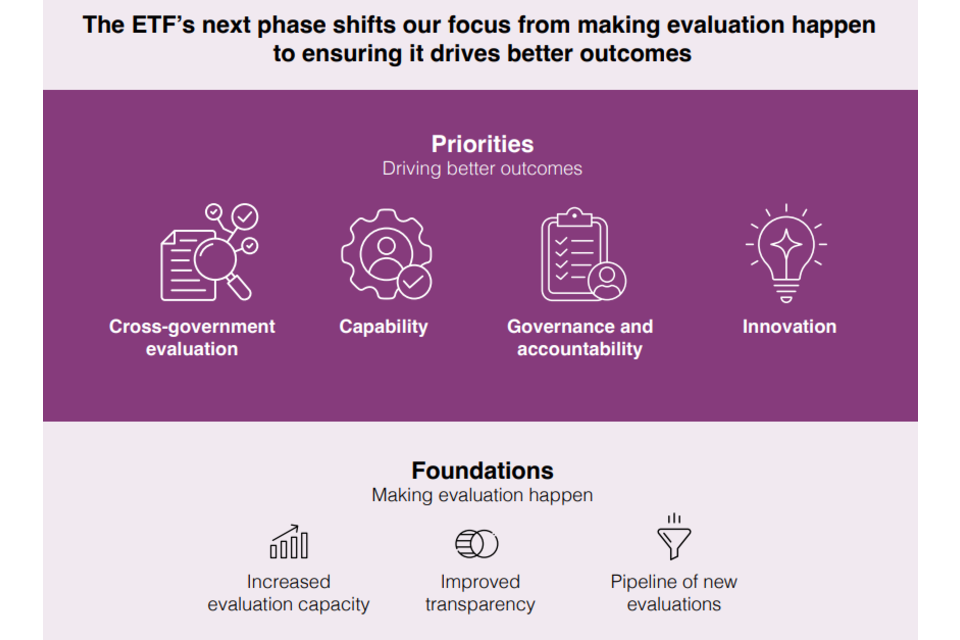
The ETF’s next phase shifts our focus from making evaluation happen to ensuring it drives better outcomes.
Prorities
Driving better outcomes
- Cross-government evaluation
- Capability
- Governance and accountability
- Innovation
Mission
Embed robust evaluation evidence into policy and spending decisions across government.
Foundations
Making evaluation happen.
- Increased evaluation capacity
- Improved transparency
- Created pipeline transparency of new evaluations
The ETF will work in partnership with stakeholders from across and outside government to refine and deliver these workstreams.
Outcomes
We will focus all our work on achieving the following outcomes:
- Greater awareness of the value and importance of robust evaluation evidence throughout the policy cycle and across national and local government
- Strengthened capability to generate and use evaluation evidence across national and local government.
- Enhanced spending, governance, and accountability frameworks where using robust evaluation evidence is a requirement.
- Increased use of adaptive evaluation to support better understanding of problems, optimisation of solutions, and assessment of impact.
- Increased use of evidence and evaluation across organisational boundaries to support a better understanding of the cumulative impact of complex cross-government programmes.
We expect that these outcomes will lead to the following longer-term impacts:
- Routine use of evaluation evidence to inform spending and operational decisions.
- Greater effectiveness and efficiency of government policies, projects, and programmes.
Achieving these impacts will rely on the following assumptions:
- Addressing barriers and blockers relating to our key workstreams
- Continued buy-in and commitment for evaluation and the work of the ETF from senior leaders across government.
- Increasing awareness of the importance of using evaluation evidence drives greater use of evidence.
- Increased evaluation capability leads to increased delivery of high quality evaluations across government.
- A continued improvement in the number of spending proposals using good quality evidence and evaluation plans.
- A sustained increase in the proportion of major projects with robust evaluation plans.
Our activities - how we will deliver these outcomes
The ETF will work in partnership with stakeholders from across and outside government to deliver the following activities.
Leadership and advocacy
We will foster an environment where evaluation is a tool for learning and innovation, encouraging a shift towards evidence-informed risk-taking and sharing best practice.
- Drive greater generation and use of robust evaluation evidence through our engagement with departments and senior leaders across government.
- Provide evidence and evaluation leadership in response to key government priorities, including:
- Violence Against Women and Girls: establish a What Works programme on Violence Against Women & Girls[footnote 3].
- AI and digital transformation: support the robust, proportionate and timely evaluation of AI and digital tools to ensure we capture and share learning across government and drive improvements in public service delivery.
- Fund priority evaluations through the Evaluation Accelerator Fund.
Our mission is to embed robust evaluation evidence into policy and spending decisions across government. Building on the foundations of our first strategy, which increased evaluation capability across government, improved transparency, and created a pipeline of new evaluations, we will work to put evidence at the heart of how government delivers for the public. We will hold departments to account for using evidence, and ensure public money is spent on what works. As such, the ETF will work on the following priority areas:
- Cross-government evaluation: We will integrate the generation and use of robust evaluation evidence into complex cross-government programmes. Our activity will support both national and place-based interventions to remove blockers, optimise interventions, and better understand impact.
- Governance and accountability: Working closely with HMT and departments, we will reform evidence requirements across spending, governance and accountability frameworks.
- Capability: Working with cross-government partners, we will build capability to generate and use robust evaluation evidence across key civil service professions and local government.
- Innovation: We will champion more agile ‘test and learn’ evaluation approaches to optimise rapid policy development and establish frameworks to evaluate the adoption of AI and digital tools across public services.
The ETF will work in partnership with stakeholders from across and outside government to refine and deliver these workstreams.
Outcomes
We will focus all our work on achieving the following outcomes:
- Greater awareness of the value and importance of robust evaluation evidence throughout the policy cycle and across national and local government
- Strengthened capability to generate and use evaluation evidence across national and local government.
- Enhanced spending, governance, and accountability frameworks where using robust evaluation evidence is a requirement.
- Increased use of adaptive evaluation to support better understanding of problems, optimisation of solutions, and assessment of impact.
- Increased use of evidence and evaluation across organisational boundaries to support a better understanding of the cumulative impact of complex cross-government programmes.
We expect that these outcomes will lead to the following longer-term impacts:
- Routine use of evaluation evidence to inform spending and operational decisions.
- Greater effectiveness and efficiency of government policies, projects, and programmes.
Achieving these impacts will rely on the following assumptions:
- Addressing barriers and blockers relating to our key workstreams
- Continued buy-in and commitment for evaluation and the work of the ETF from senior leaders across government.
- Increasing awareness of the importance of using evaluation evidence drives greater use of evidence.
- Increased evaluation capability leads to increased delivery of high quality evaluations across government.
- A continued improvement in the number of spending proposals using good quality evidence and evaluation plans.
- A sustained increase in the proportion of major projects with robust evaluation plans.
Our activities - how we will deliver these outcomes
The ETF will work in partnership with stakeholders from across and outside government to deliver the following activities.
Leadership and advocacy
We will foster an environment where evaluation is a tool for learning and innovation, encouraging a shift towards evidence-informed risk-taking and sharing best practice.
- Drive greater generation and use of robust evaluation evidence through our engagement with departments and senior leaders across government.
- Provide evidence and evaluation leadership in response to key government priorities, including:
- Violence Against Women and Girls: establish a What Works programme on Violence Against Women & Girls [footnote 3]
- AI and digital transformation: support the robust, proportionate and timely evaluation of AI and digital tools to ensure we capture and share learning across government and drive improvements in public service delivery.
- Fund priority evaluations through the Evaluation Accelerator Fund.
Capability building
We will provide the training and infrastructure necessary to ensure departments have appropriate technical evaluation expertise and can act as effective advocates and partners in the evaluation process.
- Equip key civil service professions and local government (focussed at MSA level) with the knowledge and skills they need to advocate for, and use evaluation evidence effectively by providing new evaluation training for policy and project delivery professionals.
- Encourage best practice in generating and using robust evaluation evidence across national and local government through our Evaluation and Trials Advice Panel (ETAP) and support for What Works Centres, to support civil servants and government programmes – at national and local levels.
- Support the What Works Network to ensure government takes advantage of What Works Centres’ expertise, resources and evaluation advice on specific policy issues.
- Provide technical guidance that supports robust evaluation design and delivery including the updated Magenta Book (central government guidance on evaluation).
Governance and accountability
We will ensure that evaluation is embedded into formal decision-making and remains visible to support public and parliamentary scrutiny.
- Provide HM Treasury with evaluation expertise during Spending Reviews and wider strategic reforms ensuring spending decisions are informed by evidence and deliver value for money.
- Increase transparency of evaluation evidence: Expand the Evaluation Registry, which serves as a GOV.UK repository for all planned, ongoing, and completed government evaluations, making evaluation findings accessible, promoting learning from previous programmes, and strengthening public accountability for the effectiveness of government spending.
- Integrate evaluation requirements into departmental governance processes. We will work with senior leaders across government to ensure evaluation is integrated in department governance processes and underpins spending decisions.
- Strengthen the quantity and quality of major project evaluations[footnote 4] including a review of evaluation in the Government Major Projects Portfolio (GMPP) by 2028 to understand how well GMPP projects are being evaluated.
Theory of Change
We have developed a high level Theory of Change to describe how our activities will deliver our intended outcomes and contribute to our overall mission. The Theory of Change has informed our performance monitoring and will also be used to inform an independent evaluation of our impact.
Mission
To embed robust evaluation evidence into policy and spending decisions across government
Impact
- Greater effectiveness and efficiency of interventions across government
- Routine use of evaluation evidence to inform spending and operational decisions
Outcomes
- Greater awareness of the value and importance of generating and using robust evaluation evidence across national and local government
- Strengthened capability to generate and use evaluation evidence across national and local government
- Enhanced spending, governance and accountability frameworks where using robust evaluation evidence is a requirement
- Increased use of adaptive evaluation to support better understanding of problems, optimisation of solutions, and assessment of impact
- Increased use of evidence and evaluation across organisational boundaries to support a better understanding of the cumulative impact of complex cross-government programmes
Activities
Leadership and Advocacy
Evidence informed risk-taking, innovation and sharing best practice
Drive greater generation and use of robust evaluation evidence:
Engagement with departments and senior leaders across government.
Provide evaluation and evidence leadership, rapidly responding to emerging cross-government priorities: Establish a What Works programme on Violence Against Women & Girls, robust evaluation of AI and digital tools.
Fund priority evaluations:
Evaluation Accelerator Fund.
Capability Building
Training and infrastructure that support improved knowledge and skills across professions and local government
Equip key civil service professions and local government (MSs) with the
knowledge and skills they need to advocate for, and use evaluation evidence effectively: Evaluation training for policy and project delivery professionals, work with local partners.
Encourage best practice across national and local government:
Evaluation and Trial Advice Panel (ETAP).
Support the What Works Network:
Promote WWC’s with national and local government.
Provide technical guidance: Magenta Book.
Governance & Accountability
Embedding evaluation into formal decision-making, strengthening accountability and transparency
Provide HM Treasury with evidence and evaluation expertise:
Support for spending reviews and strategic reform, scrutiny of priority business cases, evaluation expertise for Value for Money reviews.
Increase transparency of evaluation evidence:
Expand the Evaluation Registry.
Integrate evaluation requirements:
Central government guidance, department governance.
Strengthen major project evaluation:
Review of GMPP evaluation scale and quality.
Problem: While the ETF has established the foundations for evidence-based policy, the volume, consistency and quality of evaluation across government remain insufficient. We must now leverage the systems and tools we have built to ensure evidence is used to drive faster delivery of the government’s priorities, while also demonstrating value for money.
How will we understand our impact?
We are held to account by our senior leadership including Cabinet Office and HMT ministers and our Oversight Board. We will commission an independent evaluation to understand our impact and identify improvements. We will also monitor our performance using monitoring data and surveys. The table below provides an outline of the outputs and outcomes we expect to see with successful delivery of our strategy and sets out the metrics and methods we will use to measure our progress.
Leadership and advocacy
Foster an environment where evaluation is a tool for learning and innovation, encouraging a shift towards evidence-informed risk-taking and sharing best practice.
| Theme | Activities | Outputs | Outcomes* | Metrics |
|---|---|---|---|---|
| Support greater generation and use of robust evaluation evidence | Stakeholder engagement - departments and senior leaders |
- Strategic meetings and communications with senior leaders - Regular department meetings |
1, 2 | - Increased use of evaluation evidence (stakeholder survey) - Value of priority programmes ETF has supported - Feedback from departments (stakeholder survey) |
| Provide evidence and evaluation leadership in response to key-government priorities | Establish a What Works Violence Against Women and Girls Programme | VAWG activities TBC | 1, 5 | - VAWG metrics TBC |
| Support high quality evaluation of AI and digital tools and coordinate lesson learned | - Strategic meetings and communications with senior leaders - Regular department meetings |
1, 2 | Increased awareness of best practice in evaluation of AI and digital tools (stakeholder survey) |
Capability building
Provide the training and infrastructure necessary to ensure departments have appropriate technical evaluation expertise and can act as effective advocates and partners in the evaluation process.
| Theme | Activities | Outputs | Outcomes* | Metrics |
|---|---|---|---|---|
| Equip key civil service professions and local government (MSAs) with the knowledge and skills they need to advocate for and use evaluation evidence effectively | Launch evaluation training for Policy Professionals | - Programme developed, piloted and refined. - Programme being delivered |
1, 2, 5 | - # policy professionals trained - Increased knowledge, confidence and skills among attendees (survey) - Feedback from attendees (survey) |
| Adapt evaluation programme for Policy Professionals for project delivery professionals | - Programme adapted, piloted and refined | 1, 2, 5 | - # project delivery professionals trained - Increased knowledge, confidence and skills among attendees (survey) - Feedback from attendees (survey) |
|
| Work with local government partners to understand their needs and develop a capability offer | - Capability offer for local partners developed, piloted and refined | 1, 2, 5 | - # local partners accessing ETF advice/support (ETF tracker) - Increased knowledge, confidence and skills among local partners receiving support or capability offer (survey) - Feedback from local partners (email & survey) - Increasing demand for ETF support from local government (ETAP data) |
|
| Encourage best practice in generating and using robust evaluation evidence across national and local government | Evaluation and Trial Advice Panel (ETAP) | ETAP advice and scrutiny of government programmes | 1, 2, 5 | - # and value of programmes ETAP has advised/supported (ETF tracker) - Feedback from panel users (survey) |
| Secretariat for the WWN | - Introduce WWCs performance self-assessments system, to understand WWCs current performance and inform improvements. - Regular promotion and communications of WWCs with national and local government |
1, 2, 5 | - # of WWCs performance self-assessments carried out - Increased awareness of WWCs (stakeholder survey) |
|
| Provide technical guidance | Publish and promote guidance that supports robust evaluation design and delivery | Updated Magenta Book promoted | 2, 4, 5 | Feedback (email & stakeholder survey) |
Governance and accountability: Ensure evaluation is embedded into formal decision-making and remains visible to support public and parliamentary scrutiny.
| Theme | Activities | Outputs | Outcomes* | Metrics |
|---|---|---|---|---|
| Provide HM Treasury with evidence and evaluation expertise | Support central reforms of spending, governance and accountability frameworks | - Strategic meetings and communications with senior leaders in HM Treasury, CO and departments | 1, 2 | - Increased use of evaluation evidence (stakeholder survey) |
| Provide ongoing support for departments and HM Treasury Spending Teams | - Regular meetings with Spending Teams - Guidance for departments on evidence and evaluation aspects of business cases |
1, 2, 3 | - Feedback from Spending Teams (email/survey) | |
| Business case scrutiny | - ETF scrutiny/advice on business cases - Evaluation conditions set for business cases |
1 | - # and value of business cases ETF has advised/supported (ETF tracker) | |
| Provide challenge and support on SR27 business cases | - Guidance and support for Spending Teams - Scrutiny of SR proposals |
1 | - # and value of spending proposals ETF has advised/ supported during SR27 (ETF tracker) | |
| Set and track delivery of SR27 evaluation settlement conditions | - Evaluation specific settlement conditions set | 1, 5 | - # evaluation specific settlement conditions set - % of evaluation conditions delivered |
|
| Support evaluation of OBR scored programmes (review evaluation plans and findings) | - Provision of advice and feedback to departments | 1, 5 | - # OBR scored programmes supported - Feedback from HMT spending teams, OBR and departments (email/survey) |
|
| Provide evidence and evaluation expertise for HM Treasury Value for Money reviews | Evaluation advice provided on VfM reviews | 1, 2, 5 | - # of VfM reviews supported - Feedback from HMT teams |
|
| Increase transparency of evaluation evidence | Expand the Evaluation Registry | - Registry is operational and data reported quarterly to Department directors of Analysis - Registry workflow updated to reflect changes in the Magenta Book and GMPP guidance - Registry promoted with departments as key transparency tool |
1, 3 | - # users and evaluations - Feedback (email & stakeholder survey) |
| Integrate evaluation requirements | ||||
| in spending, governance and accountability frameworks | Review and strengthen department spending, governance, accountability frameworks | Evaluation requirements embedded | 1, 3 | - # departments with evaluation requirements embedded in approval processes. - Feedback from departments (stakeholder survey) |
| Strengthen major project evaluation | Ongoing activities and commitments to strengthen the quantity and quality of major project evaluation. | Outstanding actions and ongoing commitments outlined in progress report delivered[footnote 5] | 1, 2, 3 | Improved proportion of GMPP with good quality evaluation plans (ETF review of major project evaluation) |
| Review scale and quality of evaluation across the GMPP by March 2028. | Completed and published review | 1, 2, 3 | Improved proportion of GMPP with good quality evaluation plans (ETF review of major project evaluation) |
*Outcomes:
- Greater awareness of the value and importance of robust evaluation evidence throughout the policy cycle and across national and local government key civil service professions
- Strengthened capability to generate and use evaluation evidence across national key civil service professions and local government.
- Enhanced spending, governance, and accountability frameworks where using robust evaluation evidence is a requirement.
- Increased use of adaptive evaluation to support better understanding of problems, optimisation of solutions, and assessment of impact.
- Increased use of evidence and evaluation across organisational boundaries to support a better understanding of the cumulative impact of complex cross-government programmes.
Annex: Our achievements 2022-2025
1. Embedding evaluation into decision-making processes
- Evaluation Advice to HM Treasury (HMT): We work with HMT to review the supporting evidence and evaluation plans of business cases during Spending Reviews and for business cases going through key assurance and approvals processes (Treasury Approvals Point and Major Project Review Group). During the 2021 and 2025 Spending Reviews, we advised spending teams on the strength of the evidence of over 260 business cases and implemented spending conditions to ensure priority projects include robust programme evaluation. In doing so, we ensured evaluation informs key decisions and helps to maximise the value from every taxpayer pound.
- Engagement with Departments: Our work has ensured that all departments have published evaluation strategies. As a result, departments will be held to account on the scale and quality of their evaluations, which will support better evidence-based decision-making. We strengthened the role of evaluation and evidence in decision-making by working closely with analytical leaders across departments, including Departmental Directors of Analysis and Heads of Profession. As of September 2025, we have provided departments with evaluation advice on over 750 projects, which have a total value of over £560bn.
- Government Major Projects Portfolio (GMPP): The ETF regularly reviews the coverage of evaluation plans across the GMPP, and provides programmes with tailored advice on how to improve. We published an updated GMPP review in April 2025[footnote 5], showing that the proportion of major projects with good evaluation has increased substantially since 2019 from 8% to 34%. We also published an action plan to drive further improvement. Since publication, the ETF, in collaboration with the National Infrastructure and Service Transformation Authority (NISTA) and HMT, has delivered on a number of key actions including strengthening evaluation requirements in HMT guidance and developing a robust data pipeline to track compliance. We have also delivered a package of capability support, including priority access to the Evaluation and Trials Advice Panel and published a range of best practice major project evaluation plans[footnote 6] to demonstrate what good quality evaluations of complex major projects look like.
- Cabinet Office Complex Grants Advice Panel (CGAP): We have ensured evaluation is built into the £172 billion (2021-22 figure) of spending delivered through government grants by providing evaluation advice and scrutiny to projects attending the Cabinet Office Complex Grants Advice Panel (CGAP). As of March 2025, we have provided evaluation advice on over 140 grants, representing a total grant value of over £56bn.
- Evaluation Guidance and Standards: The ETF advocates for the role of evaluation in central guidance and compliance documents. We have strengthened the role of evaluation and appraisal in the Treasury Approvals Process[footnote 7] guidance, Managing Public Money[footnote 8], the Green Book[footnote 9] guidance on appraisal, the Magenta Book[footnote 10] guidance on evaluation and monitoring, and the Teal Book[footnote 11] guidance on government project delivery. As a result, the government’s expenditure of £1.37 trillion[footnote 12] (2025-26) is now underpinned by robust evaluation requirements.
- Magenta Book: We published an updated Magenta Book in May 2026 to establish best practice around Test and Learn agile evaluation approaches, prototyping and rapid experimentation. We ensured alignment between the Magenta Book and other government guidance, including the Green Book, the Teal Book and Managing Public Money. After identifying a lack of advice on how to evaluate the use of AI in the public sector, we published best practice guidance to support the government’s ambitions to harness the benefits of new AI tools and technologies.[footnote 13]
2. Promoting the importance of evaluation across government
- Evaluation Academy: We developed the Evaluation Academy to upskill departmental analysts and build evaluation capability across HM Government. A Randomised Controlled Trial demonstrated significant increases in trainees’ confidence and networks following completion of the train-the-trainer programme[footnote 14]. The Academy now has a network of over 200 evaluation trainers across around 30 organisations who have gone on to train over 2,400 civil servants in their respective departments. This innovative model of evaluation training offers a sustainable and cost-effective way to strengthen evaluation productivity across government.
- Evaluation Registry: We have designed and implemented the government Evaluation Registry[footnote 15] to collate evaluation plans and reports within a single accessible platform. The Registry was launched in March 2025 and now supports more than 1,800 users and brings together over 2,000 evaluations. The Registry provides an invaluable tool for evidence-based decision-making while setting a high standard for transparency and accountability. By mandating that departments register new evaluations and findings, the Registry ensures that insights are shared both across and outside government. This allows decision-makers to scale successful initiatives, avoid past failures, and apply evidence of ‘what works’ to deliver better outcomes for citizens.
- Annual conference: We have promoted the importance of evaluation in government by raising awareness of evaluation and showcasing examples of best practice at our annual conferences. Since 2022 our conferences have been attended by over 3,300 delegates from the government evaluation community and academia.
3. Supporting the delivery of priority evaluations
- Evaluation Advice to Departments: As of March 2025, we have provided evaluation advice to government departments on 549 programmes with a value of £554 billion, enabling the delivery of high-quality priority evaluations. The evaluations have informed decisions on whether to modify, stop, or scale up government programmes, ensuring public spending delivers value for money and improves people’s lives.
- Evaluation Accelerator Fund: We designed and managed the £22 million Evaluation Accelerator Fund to support the delivery of high-quality evaluations in priority policy areas. To date we have supported over 50 high-priority projects across four phases, generating actionable evidence to fill critical evidence gaps identified by government departments and What Works Centres. [footnote 16] For example, we supported an impact evaluation by the Ministry of Justice assessing the effectiveness of GPS tagging for community sentences in England and Wales. The evidence from this evaluation has informed the department’s approach to expanding the use of electronic monitoring.[footnote 17] Another example is an evaluation by the Centre for Homelessness Impact on interventions to reduce homelessness among care leavers. The evaluation has filled an important evidence gap on what works to improve housing outcomes for care leavers, highlighting programmes with beneficial impacts.[footnote 18][footnote 19]
- Labour Market Evaluation and Pilots Fund: We co-led the £37.5m Labour Market Evaluation and Pilots Fund with HMT to create new evidence on the effectiveness of policies which aim to improve labour market outcomes. The fund supported over 20 projects across nine departments, and resulted in high-quality evaluations and evidence reviews which have informed decisions on extending funding for promising pilots and stopping funding for interventions with limited evidence of success.[footnote 20] A notable example is the evaluation of JobsPlus, a new community-led approach being piloted across England to help people find work and boost their earnings. It follows the model’s success in the United States. Over 1,000 people have engaged with JobsPlus. Early pilot results indicate success in engaging typically underserved groups, who are less likely to use current employment services.[footnote 21] The project was developed by the Department for Work and Pensions, Learning & Work Institute and Youth Futures Foundation.
- What Works Network: We are the secretariat of the What Works Network and promote and champion their work to ensure that departments take advantage of the 12 What Works Centres’ (WWC) expertise and resources. WWCs are a significant resource for government - in the first 10 years of the network, they collectively designed and delivered over 500 trials and evaluations, which have fed directly into policy and practice. The ETF set out a refreshed vision for a more ambitious and visible network of high-performing WWCs and programmes in the What Works Network Strategy in 2023. [footnote 22]This will help policymakers and practitioners make better-informed decisions that improve outcomes and deliver long-term value.
- Evaluation and Trials Advice Panel: We bring together expert evaluators and academics through our Evaluation and Trials Advice Panel (ETAP) to give civil servants free access to evaluation expertise to support the design and implementation of high-quality evaluations. Since 2021 the panel has included over 140 evaluation experts, and has delivered over 90 peer review and advice sessions to ensure government evaluations are of high-quality and can inform policy decisions.
-
The Evaluation Task Force Strategy 2022 - 2025 (HTML) - GOV.UK ↩
-
Freedom from violence and abuse: A cross-government strategy. ↩ ↩2
-
Progress report on the Government Major Projects Evaluation Review Action Plan. ↩
-
Government Major Projects Evaluation Review, April 2025 ↩ ↩2
-
Treasury Approvals Process for projects and programmes - GOV.UK ↩
-
A brief guide to the public finances - Office for Budget Responsibility. ↩
-
New Guidance for Evaluating the Impact of AI Tools - GOV.UK ↩
-
Electronic Monitoring in the Criminal Justice System - GOV.UK (PDF, 196KB) ↩
-
Sanders, Hirneis and Picker (2024). A Quasi-experimental evaluation of the lifelong links intervention for reducing homelessness amongst care leavers. The British Journal of Social Work. ↩
-
Staying Put: Leaving Care and the Risk of Homelessness. Centre for Homelessness Impact. (PDF, 1,933KB) ↩
-
Labour Markets Evaluation and Pilots (LMEP) Fund: funded projects - GOV.UK ↩
-
Getting neighbourhoods working: over 1,000 people take part in community-led employment support ↩