Accelerating impact: 9 years of the Global Challenges Research Fund
Published 15 September 2025

© Crown copyright 2025
This publication is licensed under the terms of the Open Government Licence v3.0 except where otherwise stated. To view this licence, visit nationalarchives.gov.uk/doc/open-government-licence/version/3 or write to the Information Policy Team, The National Archives, Kew, London TW9 4DU, or email: psi@nationalarchives.gov.uk.
Where we have identified any third party copyright information you will need to obtain permission from the copyright holders concerned.
This publication is available at https://www.gov.uk/government/publications/evaluation-of-the-global-challenges-research-fund-research-into-use-synthesis-report/accelerating-impact-9-years-of-the-global-challenges-research-fund
The Global Challenges Research Fund (GCRF) was a £1.5 billion initiative that addressed social, political, economic and environmental challenges faced in low and middle-income countries (LMICs).
Running from 2016 to 2025, GCRF mobilised international partnerships, interdisciplinary research and innovation (R&I) and cross-sectoral networks, and made lasting investments in skills, systems, and infrastructure.
Through impact-oriented R&I, the Fund aimed to improve lives and opportunities worldwide, contributing to the success of the Sustainable Development Goals (SDGs). Taking a broad approach to commissioning research and innovation across diverse countries, regions and themes, GCRF supported partnered projects between UK and institutions in more than 100 countries in Africa, Asia and Latin America. The Fund closed in 2025 after 9 years.
This brief explores the Fund’s achievements, especially in 4 areas where longer-term outcomes are already emerging- policies, practices, R&I capabilities and market development – and provides insights into the contribution GCRF-funded awards have made to complex global challenges. It also features case studies, identifies missed opportunities and highlights lessons for future programmes.
Five key achievements
GCRF achieved faster progress towards real-world impact than was anticipated:
-
GCRF projects made tangible progress around complex challenges, such as improving energy access in rural communities in LMICs. Interdisciplinary R&I, often working with local communities, addressed interconnected issues to deliver meaningful change
For example in Kenya, one project supported agribusiness to develop community solar technology to address energy gaps, while allowing land to be used for agriculture and enhancing water conservation. The technology was designed, tested and refined closely with communities to ensure it worked for them. -
Owing to their interdisciplinary and multi-stakeholder approach, GCRF awards successfully fostered innovative strategies and outcomes less often seen in more conventional research programmes.
In Lebanon, for example, grants established networks that brought together education specialists and conflict researchers – areas that tend to operate separately, with stakeholders who do not usually collaborate. GCRF’s support led to the development of guidelines for providing disability-inclusive education for displaced young people affected by conflict, informed by dialogue with the Lebanese government and service providers. -
GCRF’s focus on capacity strengthening underpinned achievements: a wide range of skills for problem-solving research and stakeholder collaboration was developed, effectively positioning research for practical use. Early career researchers successfully gained hands-on experience in implementing innovative methodologies and engaging with stakeholders, and non-academic partners enhanced their research capabilities. Key potential users of R&I benefited from support to apply evidence – uncommon in more traditional research funding.
In the Indian Ocean, for example, communities’ evidence-informed legal knowledge and skills were developed, enabling them to advocate effectively for their land claims and succeed in legal challenges -
Equitable partnerships between UK and LMIC institutions were a foundational strength in GCRF, successfully advancing R&I. Despite structural inequities in financial regulations that required UK institutions to be budget holders, the programme achieved significant milestones: investing in transformative partnerships and networks; fostering novel connections among academic and non-academic stakeholders; promoting knowledge and resource exchange; and establishing impactful collaborations with research users.
For example in India, a collaboration between private sector entities and a student start-up developed a locally relevant solution to an invasive weed by exploring ways to use it to improve livelihoods. -
The flexibility offered by GCRF funding greatly enhanced the potential for development impact. Longer time frames and a responsive approach to changes supported award holders to achieve outcomes relevant to their context and setting.
This was seen at play in Vietnam, where multi-level governance systems mean that policy processes take place at both provincial and national levels, characterised by disconnects and overlapping processes. Funding flexibility allowed GCRF researchers to engage over time in policy processes on disaster risk management, scaling efforts up or down to respond to windows of opportunity to enhance the use of evidence on disaster risks in policy development and implementation and promote the benefits for livelihoods.
GCRF was values-driven for those involved. This was true of research commissioners, and more so for researchers funded through it. They had an absolute commitment to research for a bigger purpose, beyond their own careers, and their institutions were behind them in this. GCRF’s whole system, interdisciplinary approach, looking at all problems anywhere in LMICs, showed a unique level of ambition.
Senior GCRF stakeholder
GCRF at a glance
GCRF’s scope was uniquely complex in the research and innovation funding landscape. It spanned numerous policy areas, sectors, stakeholders and institutions worldwide and worked across fields such as health, education, environment, enterprise, trade, humanitarian assistance, and civil society.
- 3,000+ grants
- 140+ programmes
- 100+ countries
- 12,000+ researchers
- 48,350+ associated researchers and stakeholders
- 12,571 unique publications of which 10,096 open access publications
- 11,245 open data sets
- 9,726 engagement activities
- 992 grants – leading to new research collaborations
Source: 2021 Results analysis, by Digital Science; Research Quality Plus Evaluation Report 2022
Excellent research with development impact
GCRF aimed to facilitate collaborative, practical research to create new ways to tackle development problems, harnessing the expertise of researchers in the UK and in countries around the world to contribute to the SDGs.
Broadly, the Fund focused on:
- challenge-led and interdisciplinary research.
- strengthening capability for research, innovation and knowledge exchange in the UK and developing countries.
- providing an agile response to emergencies with an urgent research or on-the-ground need
Figure 1: Distribution of GCRF projects across SDGs
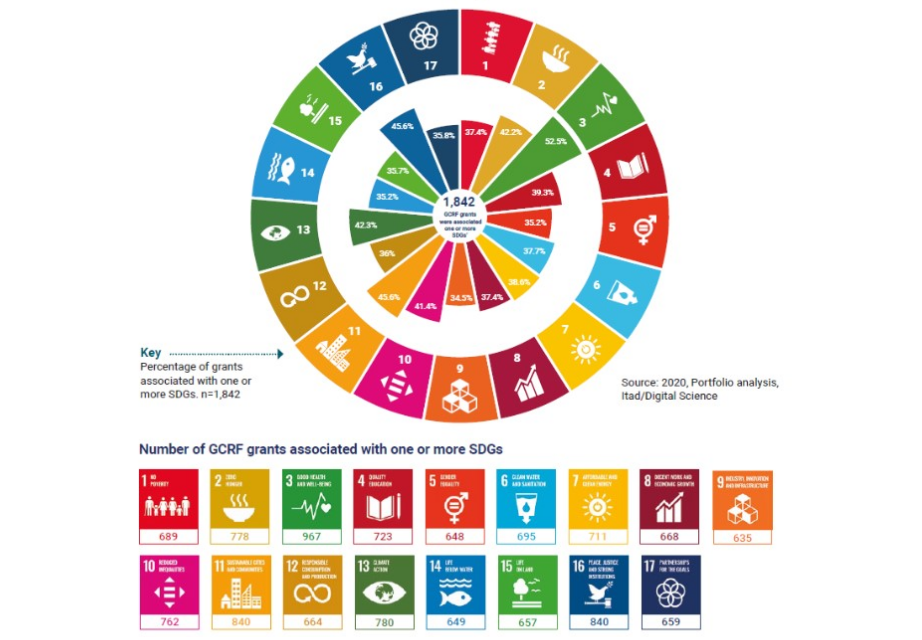
Data table: Figure 1 – Distribution of publications in the UN SDGs
1,842 awards had an SDG associated to it.
| Number of UN SDGs | UN SDG | Number of Grants | Percentage of Awards with an SDG |
|---|---|---|---|
| 3 | Good Health and Well Being | 967 | 52.5% |
| 11 | Sustainable Cities and Communities | 840 | 45.6% |
| 16 | Peace, Justice and Strong Institutions | 840 | 45.6% |
| 13 | Climate Action | 780 | 42.3% |
| 2 | Zero Hunger | 778 | 42.2% |
| 10 | Reduced Inequalities | 762 | 41.4% |
| 4 | Quality Education | 723 | 39.3% |
| 7 | Affordable and Clean Energy | 711 | 38.6% |
| 6 | Clean Water and Sanitation | 695 | 37.7% |
| 1 | No Poverty | 689 | 37.4% |
| 8 | Decent Work and Economic Growth | 688 | 37.4% |
| 12 | Responsible Consumption and Production | 664 | 36.0% |
| 17 | Partnerships for the Goals | 659 | 35.8% |
| 15 | Life on Land | 657 | 35.7% |
| 14 | Life Below Water | 649 | 35.2% |
| 5 | Gender Equality | 648 | 35.2% |
| 9 | Industry, Innovation and Infrastructure | 635 | 34.5% |
Source: 2020, Portfolio analysis, Itad/Digital Science
A global reach
GCRF was delivered through partnerships between UK and LMIC researchers (as per OECD-DAC rating). The map below gives an overview of the scale and scope of the Fund.
Figure 2: Map of the scale and scope of the Fund.
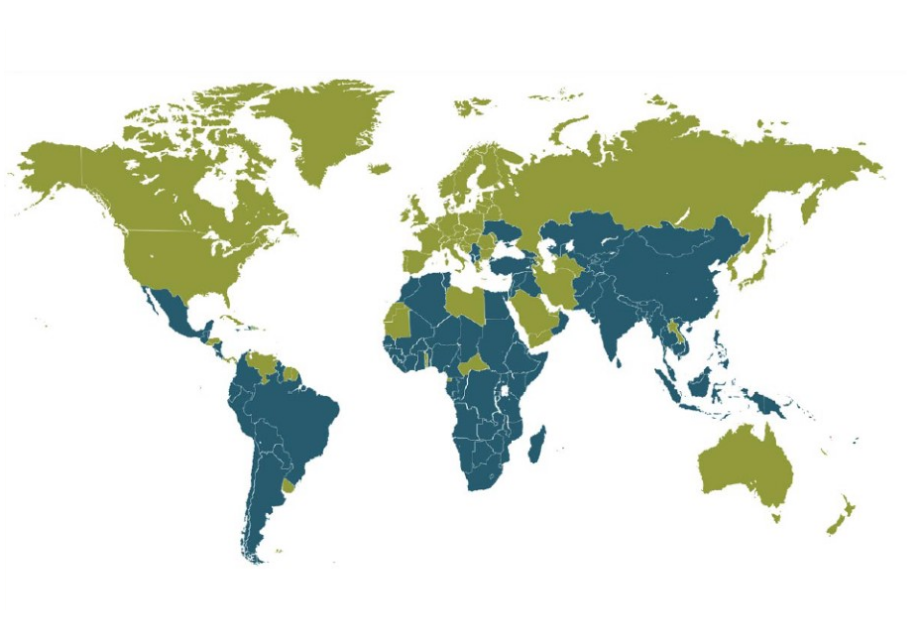
More than 102 countries were involved in GCRF projects. The countries with the top 5 most funded activities were
- South Africa
- Kenya
- India
- Brazil
- Uganda
Projects: 2,892 out of 3,304 projects were primarily located in LMICs.
- Upper middle-income countries: 754
- Lower middle-income countries: 1,357
- Low-income countries: 781
LMIC researchers were involved in 2,037 publications, and as lead authors in 591
Source: 2021 Results analysis, by Digital Science; Research Quality Plus Evaluation Report 2022
Policy achievements: translating research into action
GCRF aimed to bridge the gap between research and policy. The Fund championed stakeholder and policymaker engagement throughout the research cycle to translate insights effectively into policy design, practice, and implementation.
GCRF awards produced research that shaped national policy design and implementation in LMICs – a key step in moving the Fund towards real-world impact at scale and addressing complex development challenges.
In India, GCRF-funded activities and evidence on a range of policy innovations – such as regulations to improve the management of post-harvest losses, and digital early warning tools to manage invasive weed infestations – influenced state governments to invest in and adopt these to support sustainable agriculture and improved livelihoods.
In Kenya, GCRF research influenced policy and regulatory change, including enhanced economic development policies, risk assessment procedures and regulations for the development of fisheries on Lake Victoria. In the Southern India Ocean (South Africa), decision makers used GCRF-related evidence to develop marine economy management plans and incorporated evidence into international ocean governance processes.
In Vietnam, evidence use increased within policy processes on disaster risk management and impacts on rural livelihoods.
In Kenya and the Southern Indian Ocean, GCRF projects enhanced the inclusion of poor and marginalised communities in decision-making processes, including the legal recognition of customary rights and their increased participation in policy processes.
Spotlight 1: Timing climate tipping points – predicting biodiversity at risk for policymaking
Africa is particularly vulnerable to the effects of the climate crisis, facing increasingly extreme weather that threatens ecosystems, biodiversity, and the people whose livelihoods depend on them.
A GCRF-funded project explored the relationship between climate risks, biodiversity and ecosystem services (such as food security and water resources) in large, typically hard-to-study areas to inform climate change adaptation policies and strategies in Sub-Saharan Africa.
The project was designed to meet policymakers’ needs. Using a highly innovative approach to combine scientific data on African biodiversity from multiple sources with a time frame analysis, the project was able to forecast combined climate impacts for more than 30,000 species globally. This analysis highlights that risks of future ecological disruption from climate change will start much more abruptly – before 2030 in tropical areas on the Africa continent – than previous models had identified.
Project highlights Research supported by this award has contributed to policy processes at national, continental Africa and global scales, including:
- Contributed to the evidence base that was used extensively by the Africa chapter of the IPCC Working Group II Report. The report had the most comprehensive and policy-relevant Africa assessment ever conducted by the IPCC for climate change impacts, adaptation and vulnerability for countries in continental Africa.
- Used in global environmental assessments (e.g. IPCC AR6 report) to suggest levels of dangerous climate change for biodiversity and provide information to policymakers on the importance of limiting global warming to 1.5°C.
- Informed applied research to develop tools to guide conservation managers in South Africa for prioritising areas for conservation under future climate change.
- Informed the climate change strategy of the African Union and has been presented in briefings to climate change negotiators from many African countries.
- Prompted new thinking about climate change risk at the research-to-practice interface, such as in conservation biology, where there are now proposals to use related methods to better incorporate climate change risks into the IUCN Red List process
Reference: Forecasting climate risks to biodiversity and ecosystem services to strengthen climate change adaptation in Africa, Royal Society, Future Leaders Africa Independent Research (FLAIR) Programme
Practice achievements: supporting innovation and application
Applying R&I in technologies, practices, and services is key to ensuring that it leads to tangible, real-world outcomes, not just academic knowledge. GCRF-funded research developed context-specific solutions to global challenges – supporting the co-creation, testing and adoption of new tools, methods and technologies.
Evidence from case studies in India, Vietnam, Kenya and Lebanon indicates that GCRF awards supported the adoption of technological innovations and influenced improvements in practices and implementation approaches at both small and wider scales. Achievements in this area show promise for lasting impact through extending their reach and demonstrating international replicability, for example:
The methodology behind a flood forecasting tool developed by a GCRF team in Vietnam to improve understanding of communities’ sensitivity to climate change and floods was subsequently applied to tropical cyclone impact forecasting in Southern Africa. Humanitarian organisations such as the Red Cross have since used this data to produce emergency reports.
Strong demand for technology was found in an Indian Ocean case of new tracking devices for small boats, where several sub-Saharan African nations expressed an interest in trialling the innovation for themselves.
The methodology for water hyacinth detection, developed under an award in India, was applied in Lake Victoria in Kenya because of the involvement of a Kenyan PhD student in the award. This, in turn, stimulated interest from the Kenyan government and spurred additional funding and efforts focused on composting and recycling water hyacinth.
In Lebanon, journalists underwent training to enhance their use of inclusive language when reporting on disability. Designed through a GCRF partnership between researchers and Lebanese civil society media organisations, this led to improvements in the inclusive language used in local media.
Spotlight 2: Sustainability on stage – community theatre and palliative care in Bangladesh
Palliative care is a human right, but its provision is a global health challenge. Bangladesh struggles with isolated palliative care services and sparse training opportunities, all of which are limited to the capital, Dhaka. Involving community members in the provision of local palliative care services is a key practice approach that helps to solve this challenge. GCRF funded a partnership to boost community involvement in a public health palliative care project in Bangladesh through a culturally appropriate and evidence-based strategy, using community theatre as a key tool. The aim was to provide local benefits to palliative care practice and to generate national and global learning through a UK-Bangladesh interdisciplinary approach that combined experts in performing arts, anthropology, palliative medicine and community development
We facilitated the funding, but we’re seeing 90% of the benefits in Bangladesh. Our Bangladeshi partners now have networks between themselves which function without UK support.
UK-based GCRF partner
Project highlights
The team created new research and methods to increase community participation in providing palliative care services that can be applied in other settings. The project adapted to contextual challenges, e.g. adapting the theatre performance to a short, street theatre version, which was performed in public spaces several times a day, given the long working day of many community members. Local benefits were created through increasing community participation in providing end-of-life care in the pilot communities, and findings have reached wider palliative healthcare decision makers across Dhaka. National and international future practitioners have been reached through the arts-based community approach being incorporated into the curriculum offered by the medical university partners in the UK and Bangladesh. The community engagement approach was integrated into the programme offering of the NGO partner, which offers a pathway for the novel practice around palliative care to scale to other settings in Bangladesh. Evidence was presented in accessible, actionable formats for intended users, ranging from academic journal articles to videos, the central theatre piece and a strategic road map for enhancing community engagement in other public health initiatives. The project laid the foundations of a new international academic network to continue to research the challenge of palliative care in resource-poor settings, and further grants were obtained for follow-on projects in rural areas of Bangladesh and Dhaka.
Reference: Partnership to ensure the sustainability of a public health palliative care project in Bangladesh through community theatre, Arts and Humanities Research Council.
Strengthening capacities for research and innovation achievements: Skills, systems and partnerships
Strengthened skills, infrastructure and equitable partnerships are essential foundations for high-quality, locally relevant R&I in both the UK and LMICs. Trusted cross-sector collaborations help to expand individual and organisational capacities across local, regional and continental systems, as shown in Spotlight 3.
GCRF awards demonstrated how capacity strengthening benefited project teams, research collaborators, non-academic partners and institutions, and rippled out to other groups.
Opportunities for knowledge exchange among researchers were offered through an Indian Ocean award by establishing a training centre to enhance research and technical marine science skills. More senior researchers provided support, guidance and leadership to junior colleagues, fostering career development within and beyond the institution.
A non-governmental organisation (NGO) in Lebanon improved its research and advocacy work through collaboration with a university partner; and in Vietnam, interdisciplinary collaboration between a university and the private sector sparked the creation of an enterprise to manufacture and market rice protein snack products.
In India, teams utilised their institutions’ existing networks and platforms to support official collaborations, which allowed for pooling resources and expertise, fostering a collaborative research environment.
This created opportunities for early career researchers and facilitated collaboration between UK-based researchers and Indian and Ethiopian partners, enabling knowledge transfer, capacity building, and the development of a strong international research partnership.
Spotlight 3: Data, development and dialogue – African-led research for youth unemployment
Africa has the youngest population globally, and youth unemployment is a significant challenge across the continent.
A GCRF-funded project strengthened research capacities across African universities to tackle youth unemployment and ineffective policies and to engage young people to identify root causes and solutions. It also developed a database to store and manage large amounts of digital information on policy models, programmatic solutions and other outputs tailored for governments and stakeholders working to resolve youth unemployment in Africa.
The project strengthened skills and established knowledge platforms and technological systems on the challenges of youth unemployment and why young people do not engage on government programmes designed to benefit them. Since the closure of the GCRF-funded project in 2022, an active network led from the continent remains in place in Ghana, Kenya, Nigeria, South Africa and other countries, with ongoing discussions involving policymakers and key stakeholders on how to promote economic initiatives and entrepreneurship as routes to tackling youth unemployment.
This includes continued training programmes, additional mentorship programmes at various African universities, funding being sought to establish incubation hubs, and ongoing webinars engaging the network. This represents a significant capacity shift in continental knowledge systems to generate evidence and policy innovations in the critical area of youth unemployment in Africa.
Project highlights
- Increased productive collaboration across the continent between numerous African universities emerged during the project, with shared PhD students, co-authoring of papers, and regular ongoing meetings.
- Various platforms were created – one brought together young people, researchers, government and industry stakeholders collaboratively to identify the problems that young people face in finding employment.
- Training based on the project’s evidence includes a train-the-trainer programme in entrepreneurship and an Innovation Mentorship Education Certification workshop, which has to date trained more than 900 researchers and young people, as well as representatives from the business sector across the 4 African countries.
- Seed funding was competitively awarded to 9 new youth-led businesses to develop their innovation and generate employment for young people.
- Responding to a timely opportunity, the project raised the profile of youth entrepreneurship as a solution to youth unemployment, leading the Nigerian President (2020) to support its inclusion in university curricula nationwide.
- Connections on a continental scale have been enabled by the institutional members of the African Research Universities Alliance (ARUA), who have provided funding and mentorship for smaller African universities to also participate in the youth employment initiative.
Reference: Partnership, research and capacity building for youth unemployment solutions in Africa (PRAC 4 YUSA), Economic and Social Research Council.
Market development achievements: research and real-world change
GCRF aimed to fund research to mobilise investment in markets and innovations, empower value chain stakeholders to provide products and services, and address barriers to uptake.
There was less evidence of progress in this area, because there were relatively few market-facing awards in GCRF, and therefore not many in the sample. Nevertheless, those that were funded to stimulate value chains have been successful.
Small research and networking grants awarded in Vietnam and India enhanced opportunities for agricultural communities living in poverty by developing commercially relevant and innovative technologies to tackle environmental or public health issues and taking them through their different stages of commercial development to implementation and use.
Our genomic techniques will apply in many other areas and the identification of rice varieties can be immediately transferred to farmers. Because the project was successful, it was scaled internationally into Philippines and Thailand. It wasn’t in the original project; it’s something that we tried through the connections of our Vietnamese collaborators.
GCRF grant holder
Spotlight 4: From space to strategy – responding to resilience needs in Malaysia
Data and technology are important for understanding and managing ocean health, climate change, and biodiversity.
A GCRF-funded project used satellite-based solutions to provide Malaysian government decision-makers with analysis on marine oil pollution, deforestation, and flooding via a live decision-support platform.
A GCRF-funded project used satellite-based solutions to provide Malaysian government decision makers with analysis on marine oil pollution, deforestation, and flooding via a live decision support platform. The ‘Earth and Sea Observation System’ (EASOS) project brought together 23 Malaysian government agencies and 10 UK companies to create and test the platform. From the outset, the long-term sustainability and marketability of the system were built into the project, based on building trusted partnerships. Key to this was securing an ongoing arrangement with the Malaysian Government for the project to provide access to the online decision support tools and alert service for other government agencies and organisations.
Project highlights
- EASOS aimed to expand its market by providing ‘Software as a Service’ (SaaS) to enable continuous system improvements and updates. As part of the SaaS offering, government agencies had access to the visualisation tools and received customised alerts for flood, oil spill and deforestation events generated by the system.
- Promotion in Malaysia continues through an NGO which showcases and demonstrates capabilities and manages negotiations with potential government clients. Once the project closed, a UK-based partner made a strategic investment to sustain the services, resulting in alerts issued pro bono to enable interested users to see the added value compared to their existing capabilities during live operations.
- A commercial model was devised to support EASOS’s expansion into other countries and services. It focuses on leveraging the EASOS ‘brand’ under which UK satellite-based services in sustainable development and disaster resilience can gain greater market visibility and access. Interested government agencies and potential clients would engage with the service through a commercial agreement to cover the costs of tailoring EASOS services to their specific contexts, needs and budgets.
- Key to the success of the project were trust and buy-in from local stakeholders and high-level engagement within the Malaysian government to pilot and then extend the service.
Reference: Earth and Sea Observation System, UK Space Agency.
Missed opportunities and challenges: potential for further impact
Although GCRF made strong progress across many areas, some missed opportunities and challenges limited its potential. These insights underline the importance of strategic coordination and sustained investment to maximise the potential of stakeholder networks for real-world impact.
Earlier coordination by funders to cluster and connect awards could have strengthened collaboration, increased impact within country systems by creating critical mass, and fostered shared learning – especially regarding equity, diversity and inclusion and engaging vulnerable communities.
The lack of a unified Fund-wide strategy to connect and coordinate awards in similar regions or on similar issues limited the scale of impact. Funding reductions in 2021 further curtailed the potential of networks.
GCRF itself was not treated as a learning and capacity strengthening network, although there were opportunities to link up both grant holders and funding partners to promote rich learning at the Fund level. This opportunity should be better grasped in future funds, with the establishment and incentivising of learning networks from the outset.
Strategic support for network formation was often overlooked. In a handful of key programmes, GCRF funders used combinations of flexible, sequenced funding – such as exploratory awards and networking grants – to build networks and engage stakeholders around an issue or in-country. This typically led to stronger awards with better results, and could have been deployed as a Fund-wide approach.
Where the Fund took a programme-based approach to commissioning and connecting research, such as in the FLAIR Fellowships Programme, evidence showed more effective practice and better results.
Many networks were sustained through the individual efforts of researchers leveraging existing relationships. GCRF projects highlight the crucial role of agile networks and champions in navigating complex environments in LMICs, leveraging international collaborations between LMIC and UK experts to bridge skills gaps and foster impactful partnerships.
Drivers of impact: lessons for future funds
GCRF’s progress along its pathway to impact was shaped by several key drivers of impact that supported research to translate into real-world change.
Flexible funding
Opportunities for follow-on funding to develop and scale R&I are a major global gap. GCRF was consistently seen as unique in offering a variety of flexible funding types, ranging from network and partnership development grants to early career support and fully fledged research funding, with integrated impact activities.
This benefits of this flexibility really showed during the Covid-19 pandemic. UK researchers were unable to travel to carry out field work. GCRF teams in the Ganges Delta redeployed budget to Indian early career researchers to carry out the work with remote support from the UK. This ensured that the work continued and it also created additional opportunities for career development.
Adaptive ways of working
GCRF funding helped researchers and innovators navigate challenges through a variety of common ways of working, seen in successful projects. These included iterative stakeholder engagement, co-producing tools to help drive change, responding to opportunities to increase impact, and developing networks to position credible evidence or innovations for take-up.
For instance, as seen in the examples from India, Vietnam, the Indian Ocean, Kenya and Lebanon, analytical tools, data applications, policy action plans and new practices that were co-produced with stakeholders were more in tune with the concerns of decision makers and communities, responded more effectively to local conditions, and were more likely to be seen as credible.
Networks
GCRF support enabled agile networks, both new and existing, although this could have been more consistent. Networks were crucial for navigating dynamic policy contexts, e.g. by rapidly mobilising multiple forms of evidence and influencing channels when a window of opportunity opened, or maintaining the salience of a policy agenda in unconducive political environments.
For example in the Indian Ocean, GCRF-supported researchers and their network of partners in South Africa were able to respond to the opportunity presented by the nationwide marine spatial planning process, mobilising evidence, champions and legal challenges to successfully support the integration of small-scale fishing communities’ customary rights to livelihood and food security as considerations in the policy process.
Reciprocal capacity strengthening
GCRF’s strengths in mobilising mutual capacity strengthening, where both UK and LMIC partners developed skills and R&I infrastructures, helped to advance outcomes, e.g. exchanging, combining and extending skills in methods and technologies to adapt innovations to local conditions.
Vietnamese partners were able to leverage the reputation of UK institutions to give them access to new networks and key stakeholders, which was important for uptake of their innovation. Involving local researchers, institutions and organisations helped to tailor technological innovations to the relevant market and value chain and to create demand for and interest in the tools and services.
Evaluating R&I: lessons from 5 years of GCRF’s evaluation
This learning brief is based on 5 years of evidence produced by GCRF’s evaluation, generated from 2020 to 2025.
GCRF’s evaluation was innovative owing to its large scale – 3,000+ grants in the portfolio, global reach and combination of large-scale quantitative methods (surveys, bibliometric data science, and in-depth qualitative approaches, including country case studies).
The evaluation was led by Itad Ltd in partnership with RAND Europe, Athena Infonomics (India), AFIDEP (Kenya), Digital Science (UK) and NIRAS LTS (UK).
Evidence base and coverage over 5 years
-
392 awards reviewed in-depth – approx. 10% of the awards in GCRF’s portfolio, but covering £928.3 million of the expenditure, approximately 62% of the total GCRF budget of £1.5 billion.
-
2,336 award teams, both UK and LMIC partners, responded to the survey on processes, outputs and outcomes – approx. 77% of the GCRF portfolio.
-
146 programme managers responded to a survey on the same topics – 100% of GCRF programme managers.
-
650+ stakeholders in LMICs and the UK consulted through interviews and country visits.