Environmental Indicator Framework Theme K (International)
Updated 15 April 2026
Applies to England

© Crown copyright 2026
This publication is licensed under the terms of the Open Government Licence v3.0 except where otherwise stated. To view this licence, visit nationalarchives.gov.uk/doc/open-government-licence/version/3 or write to the Information Policy Team, The National Archives, Kew, London TW9 4DU, or email: psi@nationalarchives.gov.uk.
Where we have identified any third party copyright information you will need to obtain permission from the copyright holders concerned.
This publication is available at https://www.gov.uk/government/publications/environmental-indicator-framework-theme-k-international/environmental-indicator-framework-theme-k-international
K1: Global environmental impacts of UK consumption of key commodities
Short Description
This indicator tracks the impact on the environment globally resulting from the UK's domestic consumption, linked to the sustainability of the products we consume. The indicator is based on multi regional input-output (MRIO) modelling, which is used to model global trade flows representing the monetary inputs and outputs across different countries and their commercial sectors. While the indicator is also based on a similar concept and approach to J1 Carbon footprint and consumer buying choices and J2 Raw material consumption, the detail of the methodologies does not align and therefore the results are not directly comparable.
Readiness and Links to Data
An indicator is presented here that shows (a) the deforestation risk, (b) the global ‘scarcity-weighted blue water use equivalent’ from UK consumption of imported commodities, and (c) a biodiversity metric based on the predicted extinctions from UK consumption. The figures are calculated using the Input-Output Trade Analysis (IOTA) framework and the results were reported for the first time in 2021, and are now published as an official statistic. Information on how the data have been obtained and how the statistics have been calculated is available in UK Biodiversity Indicator – Global biodiversity impacts of UK economic activity and sustainable consumption. An interactive dashboard called The Global Environmental Impacts of Consumption (GEIC) Indicator, created by Joint Nature Conservation Committee (JNCC) and the Stockholm Environment Institute at the University of York (SEI York) allows for a more detailed navigation of the data supporting the K1 indicator, including additional metrics, and a breakdown of the impacts by commodity and producing nations. Further details of the updates to the methodology and data source can be found in the Technical documentation for UK Biodiversity Indicator A4.
Notes on Indicator
Data that trace all commodities back to their exact countries of origin are not publicly available. This information is necessary to accurately link production to biodiversity, deforestation and water use. Therefore, the outputs produced by this indicator are derived from modelling these trade flows, and so (whilst based on empirical statistics) they should be considered as best estimates rather than exact figures. Additional caveats and limitations are outlined in the source publication – the Global biodiversity impacts of UK economic activity and sustainable consumption.
Note that the entire time series has been recalculated compared to the previous data release. This was done to ensure consistency across the time series following updates to underlying data sources. This includes the Food and Agriculture Organisation of the United Nations time series data, which is often updated with corrections or additions, and so the most recent version is downloaded for use each year. See the technical documentation for further information.
Correction: in April 2026, the scarcity-weighted water footprint was updated to correct an error that had been identified in the original data. The error related to an incorrect implementation in the code of equation 1 in Section 5.2 of the Technical documentation.
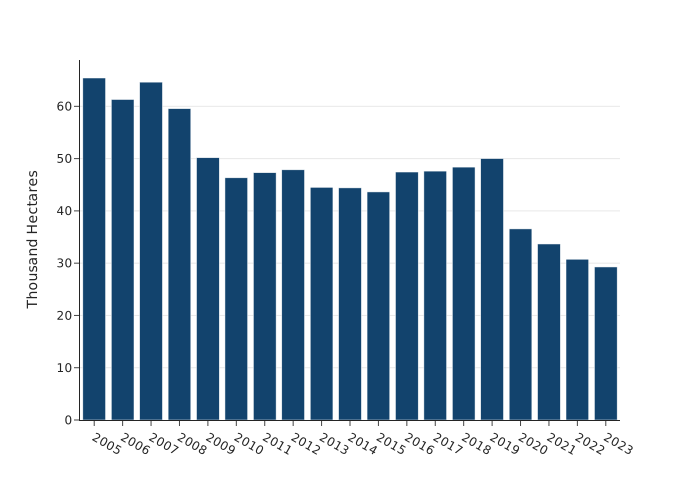
K1a: Area of deforestation associated with UK consumption, 2005 to 2023
Source: Joint Nature Conservation Committee, Stockholm Environment Institute at the University of York
Download the data for this chart in .csv format
Notes on Component
Estimates refer to deforestation from UK consumption of crop, cattle-related and timber commodities only.
Trend Description
UK consumption of crop, cattle-related and timber commodities in 2023 (the latest year for which data are available) was associated with an estimated 29,275 hectares of agriculture-driven deforestation worldwide, a decrease of 55.3% since the time-series began in 2005. Between 2009 and 2019 the level of deforestation stabilised, before decreasing from 49,997 hectares in 2019 to 29,275 hectares in 2023.
Assessment: K1a
A decrease (improvement) in the area of deforestation was observed over the short- medium- and long-term assessment periods.
Change since 2018 has also been assessed, which in this case is the same as the short-term assessment, showing a decrease (improvement) in the area of deforestation associated with UK consumption.
| Component | Period | Date range | Percentage change | Smoothing function | Assessment of change |
|---|---|---|---|---|---|
| K1a | Short term | 2018 to 2023 | -42.06 | Loess | Improvement |
| K1a | Medium term | 2013 to 2023 | -40.76 | Loess | Improvement |
| K1a | Long term | 2005 to 2023 | -60.46 | Loess | Improvement |
Note that assessment categories for short, medium and long term were assigned based on smoothed data, so percent change figures in Table K1a may differ from unsmoothed values quoted elsewhere. Percent change refers to the difference seen from the first to last year in the specified date range.
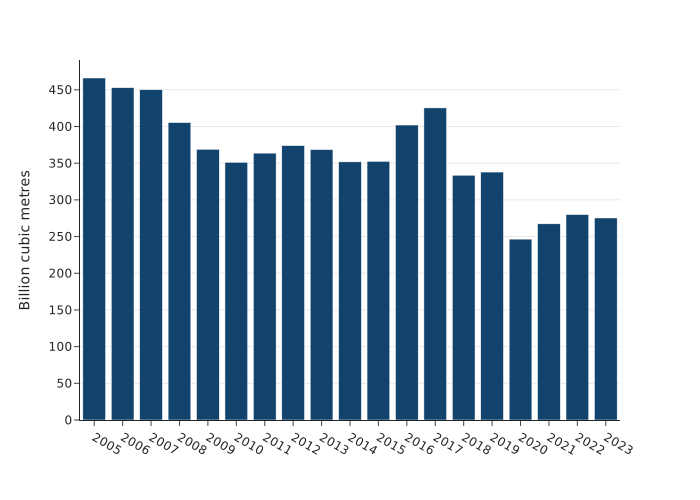
K1b: Global scarcity-weighted blue water equivalent use associated with UK consumption, 2005 to 2023
Source: Joint Nature Conservation Committee, Stockholm Environment Institute at the University of York
Download the data for this chart in .csv format
Notes on Component
Scarcity-weighted blue water use equivalent scales the blue water footprint (surface and groundwater consumed as a result of production) according to water availability in a region after human and aquatic ecosystem demands have been met. Estimates of the global scarcity-weighted blue water use refer to the UK consumption of crop commodities only.
Trend Description
UK consumption of crop commodities in 2023 was responsible for an estimated 275.35 billion cubic-metres of scarcity-weighted blue water use equivalent worldwide, a 41% decrease compared to 2005 (466.11 billion cubic-metres). Between 2022 and 2023 (the latest year) there was little to no change.
Assessment: K1b
A decrease (improvement) in the amount of blue water used (scarcity-weighted equivalent) was observed over the short-, medium- and long-term assessment period.
Change since 2018 has also been assessed, which in this case is the same as the short-term assessment, showing a decrease (improvement) in the amount of blue water used (scarcity-weighted equivalent) associated with UK consumption.
| Component | Period | Date range | Percentage change | Smoothing function | Assessment of change |
|---|---|---|---|---|---|
| K1b | Short term | 2018 to 2023 | -28.59 | Loess | Improvement |
| K1b | Medium term | 2013 to 2023 | -31.30 | Loess | Improvement |
| K1b | Long term | 2005 to 2023 | -47.75 | Loess | Improvement |
Note that assessment categories for short, medium and long term were assigned based on smoothed data, so percent change figures in Table K1b may differ from unsmoothed values quoted elsewhere. Percent change refers to the difference seen from the first to last year in the specified date range.
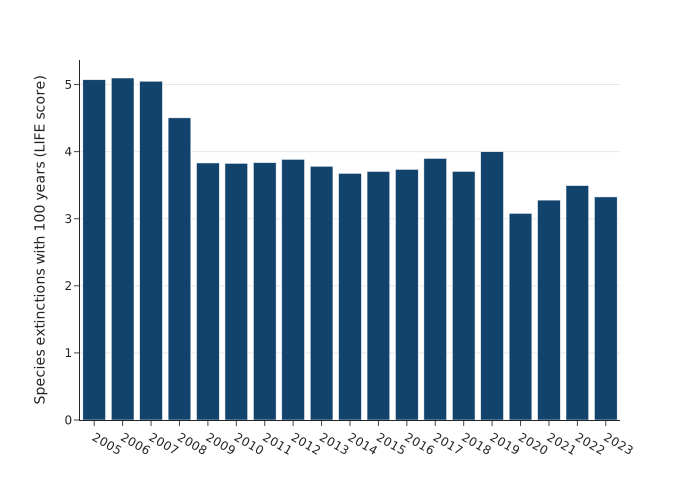
K1c: Predicted number of species commited to extinction in the next 100 years worldwide associated with UK consumption of crop commodities annually, 2005 to 2023
Source: Joint Nature Conservation Committee, Stockholm Environment Institute at the University of York
Download the data for this chart in .csv format
Notes on Component
The LIFE score is a metric that provides an estimate of the probability of extinction across ~30k terrestrial vertebrate species, using changes in their modelled area of habitat since pre-industrial times. The impact of changes in area of habitat are related to the proportion that has been lost already, so that per unit area losses in habitat will have the greatest impacts on extinction risk for those species which have faced the greatest losses of habitat. The metric provides an estimate of the number of species committed to extinction over approximately 100 years. A score of 1 is equivalent to one global extinction. Consequently, results show the sum of the UK’s contribution to global extinctions across all the world as a result of UK consumption of crop commodities.
Trend Description
UK consumption of crop commodities in 2023 resulted in a LIFE score of 3.32. The LIFE score is the predicted number of species becoming globally extinct in the next 100 years, based upon the actions taken in 2023, and assuming no mitigating actions are taken. The LIFE score has remained largely stable since 2009 before falling in 2020. Since then, it has risen slightly to 3.32 in 2023.
Assessment: K1c
An improvement (decrease) in the LIFE score was observed over the short-, medium- and long-term time periods with a decrease in the number of species predicted to be committed to global extinction within the next 100 years.
Change since 2018 has also been assessed, which in this case is the same as the short term assessment, showing a decrease (improvement) in the LIFE score.
| Component | Period | Date range | Percentage change | Smoothing function | Assessment of change |
|---|---|---|---|---|---|
| K1c | Short term | 2018 to 2023 | -11.90 | Loess | Improvement |
| K1c | Medium term | 2013 to 2023 | -12.69 | Loess | Improvement |
| K1c | Long term | 2005 to 2023 | -38.79 | Loess | Improvement |
Note that assessment categories for short, medium and long term were assigned based on smoothed data, so percent change figures in Table K1c may differ from unsmoothed values quoted elsewhere. Percent change refers to the difference seen from the first to last year in the specified date range.
Metadata
| Primary Goal | There are no specific goals in the Environmental Improvement Plan for this indicator, however the Plan commits us to leaving a lighter footprint on the global environment by enhancing sustainability and supporting zero deforestation supply chains. |
|---|---|
| Relevant Goals | There are no specific goals in the Environmental Improvement Plan for this indicator, however the Plan commits us to leaving a lighter footprint on the global environment by enhancing sustainability and supporting zero deforestation supply chains. |
| Relevant Targets | No specific target |
| Natural Capital | Service or benefit associated with natural capital asset |
| Related Commitments | Sustainable Development Goals 12, 14 and 15 |
| Geographical Scope | International |
| Development Status | Final |
| First Reported | 2022 |
| Latest Data | 2023 |
| Last Updated | Mar 2026 |
Return to Environmental Indicator Framework Collection Page
K2: Developing countries better able to protect and improve the environment with UK support
Short Description
The poorest people and countries in the world are often the most vulnerable and likely to be hardest hit by the degradation of natural environments. Climate change and the deterioration of natural environments are prime drivers of poverty, food insecurity and instability, and can trigger conflict and migration. This indicator will report outcomes of the UK Official Development Assitance (ODA) investments and other UK investment programmes into climate and nature. These programmes include International Climate Finance contributions through the Blue Planet Fund and Biodiversity Challenge Funds, for example, which support developing countries to tackle biodiversity loss, mitigate and adapt to climate change and alleviate poverty.
Readiness and Links to Data
An interim indicator here is presented for the using data from the International Climate Finance (ICF) Results 2025. The indicator K2a tracks the results across 18 different ICF Programmes, measuring the difference in area of ecosystem coverage where ecosystem loss has been avoided because of intervention. It is listed under ICF Key Performance Indicator 8 within the ICF results. The indicator tracks the removal or reduction in pressures from sources including but not limited to logging, water extraction, mining, invasive species and pollution. A baseline measurement is made for the ecosystem, with a counterfactual modelled on what would occur in the absence of intervention. The programmes are assessed annually or at set milestones against the counterfactual to provide the total land area that has avoided ecosystem loss. This includes assessment of the condition of the habitat retained, to ensure it has been maintained in a functioning state and not degraded.
Ecosystem degradation is a major driver of biodiversity loss and reduces the potential benefits people derive from the natural environment. Sustainable management practices can help to limit the impacts of climate change, protect ecosystem services and protect biodiversity. K2b tracks the results from 21 different ICF Programmes, identifying the total area of land under sustainable management practices due to the direct intervention from the ICF. It is listed under ICF Key Performance Indicator 17 in the ICF results. Sustainable management practices may include but are not limited to: soil, vegetation, water and animal management, fisheries and aquaculture practices for the marine and freshwater environment, as well as restoration practices. These sustainable management practices will vary geographically and depend on the dominant ecosystem in the region they are applied to.
Further development is needed to identify how to assess outcomes of UK overseas investment, building on existing and developing evaluation schemes for International Climate Finance, including alignment with the portfolio monitoring, evaluation and learning approach for the Blue Planet Fund. This will aim to further align the indicator with the Kunming-Montreal Global Biodiversity Framework.
Notes on Indicator
The indicators presented here as K2a and K2b are designed to track changes related to intervention from ICF programmes. These indicators are context-specific, therefore they do not capture either positive or negative impacts on the environment outside of the specific aims of the programmes. Consequently, external impacts ranging from deforestation and ecosystem loss, to reforestation or additional sustainable land management practices, will be present but not recorded within the indicator. In the case of the data presented in K2b, it does not capture the long-term benefits received from implementing sustainable land management practices, nor the quality of the implementation in terms of meeting sustainable standards. For observations of some of these impacts on the environment from UK consumption please see the K1 indicator.
Both indicators present data from ICF programmes, the data from these programmes are updated annually or at set key milestones. Consequently, the results from some of these programmes can be recorded for several years before being updated in the indicator.
As ICF data are based on advancing programmatic evidence, historic results may be revised. Updates can occur when programmes provide backdated data, resolve earlier data quality issues, or improve their methodologies. Revised figures are reflected in subsequent publications of the ICF results and the K2 indicator accordingly.
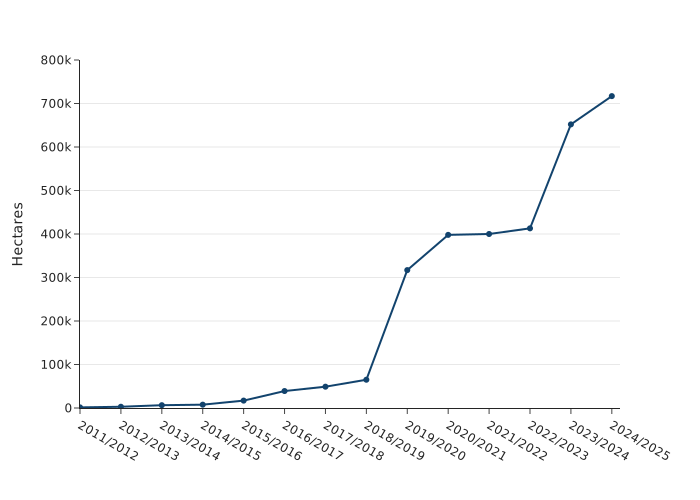
K2a: Area of ecosystem loss avoided due to International Climate Finance programmes, 2011/2012 to 2024/2025
Source: Foreign, Commonwealth & Development Office
Download the data for this chart in .csv format
Notes on Component
Data is reported on each financial year from April to March of the following year.
Trend Description
In total, between the 2011/2012 and 2024/2025 financial years, 717,000 hectares of land have avoided ecosystem loss due to ICF programmes. A large increase was seen between 2022/2023 and 2023/2024, with a further 10% increase in the total cumulative area from 2023/2024 to 2024/2025, equivalent to approximately 65,000 hectares.
Assessment: K2a
No assessment of change was undertaken for this indicator as further development is required to present statistical trends for the cumulative nature of the datasets
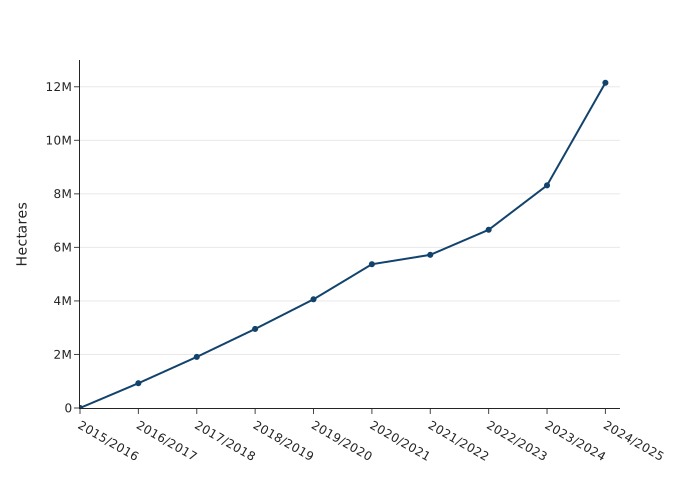
K2b: Cumulative area under sustainable management practices due to International Climate Finance programmes, 2015/2016 to 2024/2025
Source: Foreign, Commonwealth & Development Office
Download the data for this chart in .csv format
Notes on Component
Data is reported on each financial year from April to March of the following year.
Trend Description
A total of 12,149,000 hectares have received sustainable management practices through ICF from 2015/2016 to 2024/2025. In the last year of data, covering the 2024/2025 financial year, there has been a 46.1% increase in the total land area (or 3,832,000 hectares) of land newly under sustainable management practices.
Assessment: K2b
No assessment of change was undertaken for this indicator as further development is required to present statistical trends for the cumulative nature of the datasets
Metadata
| Primary Goal | There are no specific goals in the Environmental Improvement Plan for this indicator; however, the Plan commits us to helping developing nations protect and improve the environment. |
|---|---|
| Relevant Goals | There are no specific goals in the Environmental Improvement Plan for this indicator; however, the Plan commits us to helping developing nations protect and improve the environment. |
| Relevant Targets | No specific target |
| Natural Capital | Service or benefit associated with natural capital asset |
| Related Commitments | No related reporting commitment |
| Geographical Scope | International |
| Development Status | Interim |
| First Reported | 2024 |
| Latest Data | 2024/2025 |
| Last Updated | Feb 2026 |
Return to Environmental Indicator Framework Collection Page
K3: Status of endemic and globally threatened species in the UK Overseas Territories
Short Description
The UK Overseas Territories (UKOTs) are considered globally significant biodiversity hotspots, supporting complex ecosystems which are home to many species that are found nowhere else in the world. This indicator assesses the proportion of endemic species in the UKOTs that are considered threatened on International Union for Conservation of Nature (IUCN) Red List assessments. Threatened species are those that are in the Red List categories (Vulnerable, Endangered and Critically Endangered). Over time, the indicator will capture changes in the status of endemic species as new assessments are undertaken and species are reassessed.
The ongoing development of indicator K3 will contribute to the provision of an evidence base for future biodiversity conservation efforts in the UKOTs.
Readiness and Links to Data
An interim indicator is presented here which shows the percentage of endemic species in all IUCN Red List categories, together with a combined threatened category and an unassessed category, across the UKOTs.
Data for this indicator have been obtained from the International Union for Conservation of Nature (IUCN) Red List of Threatened Species and complemented by The UK's wildlife overseas: a stocktake of nature in our Overseas Territories. Additional species have been added through direct engagement and contribution from the UKOTs. Work is ongoing with the UKOTs, evaluating additional species records and assessing endemic status to further expand and refine the current data set. This indicator will track changes in the status of endemic species as additional Red List assessments are undertaken, including being able to identify trends over time in the future.
Detailed information on data collection and analysis is available in JNCC Report Number 795. We welcome any feedback on these statistics, particularly on their usefulness and value, via environmentalindicators@defra.gov.uk.
Notes on Indicator
This indicator includes data from 13 of the UK Overseas Territories; the British Antarctic Territory is not included. The UK Government and Mauritius reached a political agreement on 3rd October 2024 on the exercise of sovereignty over the Chagos Archipelago / British Indian Ocean Territory. Subject to a formal treaty being agreed, the United Kingdom will agree that Mauritius is sovereign over the Chagos Archipelago, including Diego Garcia. Until the Treaty is signed, ratified and then comes into force, British Indian Ocean Territory will continue to contribute to this indicator.
The global red list assessment status of endemic species have been used in this indicator; it does not contain regional red list assessment status. Species that have regional assessments but not global assessments and are known endemic species have been included in this database in the unassessed category. There are 662 confirmed endemic species in the UKOTs, of which 520 have been assessed on the IUCN Red List.
Species records from the IUCN Red List have been included up to March 2025. Additional data from the Stocktake and from direct engagement with the UKOTs has also been included up to January 2025.
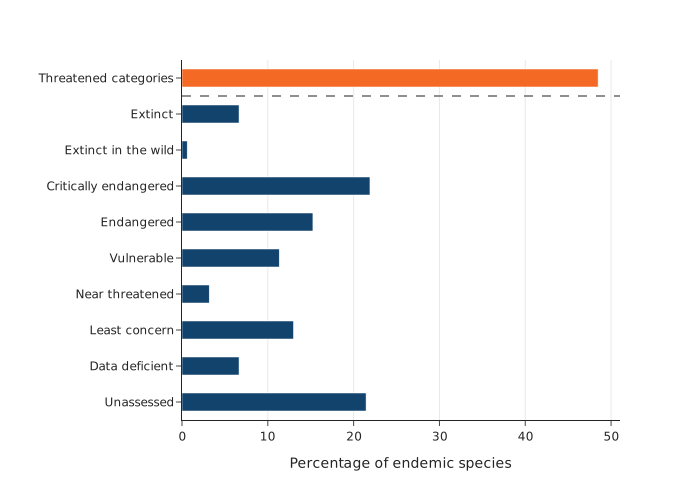
K3: Status of endemic and globally threatened species in the UK Overseas Territories, 2025
Source: Joint Nature Conservation Committee
Download the data for this chart in .csv format
Notes on Figure
Threatened species are those that are in the Red List categories Vulnerable, Endangered and Critically Endangered.
Trend Description
As of March 2025, 48.5% of the endemic species in the UKOT’s are considered threatened. These fall under the Vulnerable, Endangered and Critically Endangered IUCN Red List categories, with 75, 101 and 145 species under each category respectively. A further 6.7% and 0.6% of endemic species are considered Extinct or Extinct in the Wild respectively. Since the initial assessment of Red List assessed endemic species in 2023, 3 have changed Red List Index category, 2 have progressed to a more threatened category, 1 from Endangered to Critically Endangered and 1 from Vulnerable to Endangered. One species improved in its Red List Index, moving from Endangered to Near Threatened. Note that of the current endemic species list of 662 species, 142 are unassessed.
Assessment: K3
No assessment of change was undertaken for this indicator as a suitable time series is not yet available.
Metadata
| Headline | Impacts on the natural environment overseas |
|---|---|
| Primary Goal | There are no specific goals in the Environmental Improvement Plan for this indicator, but the Plan commits us to taking action to recover threatened, iconic or economically important species of animals, plants and fungi, and where possible to prevent human-induced extinction or loss of known threatened species, in the Overseas Territories. |
| Relevant Goals | There are no specific goals in the Environmental Improvement Plan for this indicator, but the Plan commits us to taking action to recover threatened, iconic or economically important species of animals, plants and fungi, and where possible to prevent human-induced extinction or loss of known threatened species, in the Overseas Territories. |
| Relevant Targets | No specific target |
| Natural Capital | Condition of assets - species and ecological communities |
| Related Commitments | Sustainable Development Goals 14 and 15 |
| Geographical Scope | UK Overseas Territories |
| Development Status | Interim |
| First Reported | 2023 |
| Last updated | May 2025 |
| Latest Data | 2025 |
Return to Environmental Indicator Framework Collection Page
K4: Extent and condition of terrestrial and marine protected areas in the UK Overseas Territories
Short Description
The UK Overseas Territories (UKOTs) are home to a variety of spectacular and often unique marine and terrestrial ecosystems. Protected areas are a key tool for conserving the globally significant and, in many cases endemic, biodiversity found in the Territories. This indicator will have 2 components: (a) extent and (b) condition of UKOT protected areas. It will show changes in the coverage of protected areas and other effective area-based conservation measures (OECMs) across the UKOTs, from a 2020 baseline. Protected area extent data provided by UKOT governments and aggregated across UKOTs to produce percent coverages calculated for land and marine environments separately. The indicator will also demonstrate the condition of protected areas in the UKOTs, using aspects of protected area condition that can be assessed cost-effectively.
Readiness and Links to Data
An interim indicator is presented here that shows the extent of protected areas and OECMs across the UKOTs. Development of the condition aspect of this indicator is continuing, exploring options for assessing marine and terrestrial protected area condition and using 6 UKOTs as case studies. Information on how the data have been obtained and how the statistics have been calculated is available in JNCC Report Number 792.
Detailed statistics, including a breakdown of protected area coverage for each UKOT, is available on the JNCC website.
We would welcome any feedback on these statistics, particularly on their usefulness and value, via environmentalindicators@defra.gov.uk.
Notes on Indicator
Results for the ‘UKOTs combined’ presented in the chart include 13 UK Overseas Territories: Anguilla, Bermuda, British Indian Ocean Territory, British Virgin Islands, Cayman Islands, Falkland Islands, Gibraltar, Montserrat, Pitcairn Islands Group, Saint Helena, Ascension and Tristan da Cunha, South Georgia and the South Sandwich Islands, Sovereign Base Areas of Akrotiri and Dhekelia, and the Turks and Caicos Islands. The British Antarctic Territory is not included since Antarctic protection is delivered through the Antarctic Treaty System. The UK Government and Mauritius reached a political agreement on 3rd October 2024 on the exercise of sovereignty over the Chagos Archipelago/British Indian Ocean Territory. Subject to a formal treaty being agreed, the United Kingdom will agree that Mauritius is sovereign over the Chagos Archipelago, including Diego Garcia. Until the Treaty is signed, ratified and then comes into force, British Indian Ocean Territory will continue to contribute to this indicator.
The indicator includes protected areas and OECMs formally established up to and during December 2024, where these are implemented for and/or deliver biodiversity conservation. There is a wide range of protected area designation types within and across the UKOTs; the data reported represent the UKOT governments’ views on the composition of their respective protected area networks. Extent is measured using the outer boundaries of sites; the indicator does not assess the extent of management measures within protected areas and OECMs. Further constraints are described in JNCC Report Number 792.
Marine protection statistics represent PA and OECM coverage across the entire extent of each UKOT’s waters, mapped from the coast to the exclusive economic zone (or equivalent) using UK Hydrographic Office (UKHO) maritime boundary data. Four UKOTs (Anguilla, Cayman Islands, Montserrat, Turks and Caicos Islands) lack formally agreed international maritime boundaries for parts of their waters, therefore approximate sea areas were calculated using median lines sourced from the UKHO.
The only formal changes to PAs reported in 2024 came from South Georgia and the South Sandwich Islands (SGSSI), comprising a boundary update to the SGSSI marine PA, and the Cayman Islands with an extension to an existing terrestrial PA. These resulted in no detectable change (to 2 decimal places) to aggregated marine and terrestrial protection for the UKOTs combined, but a 0.02% increase in terrestrial protection within the Cayman Islands specifically. Further details can be found in Appendix 1 of JNCC Report Number 792.
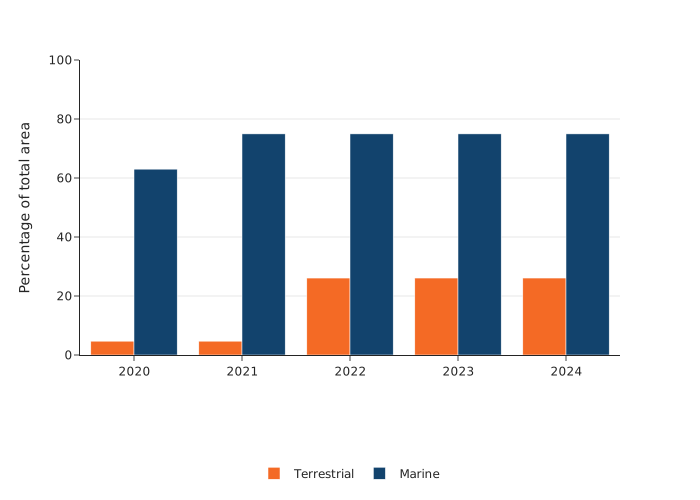
K4: Percent coverage of protected areas and other effective area-based conservation measures in the UK Overseas Territories, 2020 to 2024
Source: Joint Nature Conservation Committee
Download the data for this chart in .csv format
Notes on Figure
Percentages for the extent of terrestrial and marine environments in protected areas have been rounded to the nearest 0.01%. In the case of Bermuda, this has resulted in rounding down the coverage of the marine environment from 0.0008% to 0.00%.
Trend Description
As of the end of December 2024, protected areas and OECMs covered three-quarters (75%) of the marine environment in the UKOTs (remaining level since 2021), and covered more than a quarter (26.1%) of the terrestrial environment (remaining level since 2022). Protection has expanded over the last four years, with a 21.4% increase in terrestrial protection and a 12.0% increase in marine protection since the end of 2020 (the first year in the time series).
UKOTs’ waters are more than 300 times larger than their collective land area (5,749,254 km2 of sea compared to 17,741 km2 of land, excluding British Antarctic Territory) and, correspondingly the extent of marine protection (4,309,275 km2) in 2024 was also 3 orders of magnitude larger than for the terrestrial environment (4,628 km2).
Assessment: K4
No assessment of change was undertaken for this indicator as a suitable time series is not yet available in the Environmental Indicator Framework.
Metadata
| Headline | Impacts on the natural environment overseas |
|---|---|
| Primary Goal | There are no specific goals in the Environmental Improvement Plan for this indicator, but the Plan commits us to working with the Overseas Territories governments to implement effective monitoring and enforcement of large scale marine protected areas as part of the Blue Belt programme. |
| Relevant Goals | There are no specific goals in the Environmental Improvement Plan for this indicator, but the Plan commits us to working with the Overseas Territories governments to implement effective monitoring and enforcement of large scale marine protected areas as part of the Blue Belt programme. |
| Relevant Targets | No specific target |
| Natural Capital | Condition of assets - freshwater, Condition of assets - land, Condition of assets - seas, Condition of assets - species and ecological communities |
| Related Commitments | Sustainable Development Goals 14 and 15 |
| Geographical Scope | UK Overseas Territories |
| Development Status | Interim |
| First Reported | 2020 |
| Last updated | May 2025 |
| Latest Data | 2024 |