Environmental Indicator Framework Theme G (Natural Beauty and Engagement)
Updated 13 May 2026
Applies to England

© Crown copyright 2026
This publication is licensed under the terms of the Open Government Licence v3.0 except where otherwise stated. To view this licence, visit nationalarchives.gov.uk/doc/open-government-licence/version/3 or write to the Information Policy Team, The National Archives, Kew, London TW9 4DU, or email: psi@nationalarchives.gov.uk.
Where we have identified any third party copyright information you will need to obtain permission from the copyright holders concerned.
This publication is available at https://www.gov.uk/government/publications/environmental-indicator-framework-theme-g-natural-beauty-and-engagement/environmental-indicator-framework-theme-g-natural-beauty-and-engagement
G1: Changes in landscape and waterscape character
Short Description
The Council of Europe Landscape Convention defines landscape as ‘…an area, as perceived by people, whose character is the result of the action or interaction of natural and/or human factors’. Landscape character, therefore, includes not only natural physical features such as hills, forests, rivers and lakes, but also man-made features like buildings and transport infrastructure. It is made up of the characteristics of all these individual features on their own, and the way they fit together in a place.
This composite indicator describes changes in physical, visual, cultural and experiential attributes of landscape character in England. It uses the 159 National Character Areas (NCAs) as the underpinning spatial and analytical framework. Indicator components G1a and G1b assess the extent to which these changes contribute positively towards achieving the aspirational landscape outcomes described in the NCA Statements of Environmental Opportunity. These statements refer to any one of a range of opportunities outlined in each NCA profile produced by National England. Component G1c uses spatial analysis to show how 5 attributes of landscape character (positive visual, negative visual, experiential, cultural and access) are changing over time. A further measure, currently in development, will draw upon new questions added to Natural England’s People and Nature Survey to establish people’s perceptions about the character of their local landscape.
Readiness and Links to Data
This interim indicator presents a baseline assessment of changes to landscape character in England across the period 2015 to 2019 for components G1a and G1c. To assess the extent to which these changes are contributing positively towards achieving the outcomes described in the Statements of Environmental Opportunity, the statements across all NCAs have been distilled into 34 landscape objectives and NCAs with broadly similar character and pressures for change have been grouped into 18 landscape types that represent rural, urban and coastal landscapes. These indicator components are planned to be updated in 2026 with new data covering the period 2019 to 2024 (or nearest available data).
The interim indicator also presents results from existing published assessments of the influence of agri-environment schemes in conserving and enhancing landscape character in England. These assessments are used in component G1b to show changes from 2013 to 2023.
All data, including the full reports and more granular results for each of the 18 broad landscape types underpinning the G1 indicator, are accommodated within the Landscape Change Evidence Hub which brings together the analyses and spatial mapping to provide an overview of changes in landscape character in NCAs and Protected Landscapes.
The National Character Area Profiles website holds the updated profiles for each of the 159 NCAs which provide the supporting analytical context on landscape character for components a, b and c of this indicator.
The Changes in landscape characteristics of NCAs in England Atlas provides interactive access to the supporting analysis for component G1a.
The data for the ‘agri-environment scheme’ theme analysis (2013, 2018 and 2023) for component G1b is published in the LM04150 Monitoring Report on the Defra Science Search portal.
The Change in Visual and Experiential Landscape Character website presents mapped outputs of change in landscape character across England for component G1c.
G1a: Changes in the landscape characteristics of NCAs in England, overall and within and outside of Protected Landscapes, 2015 to 2019
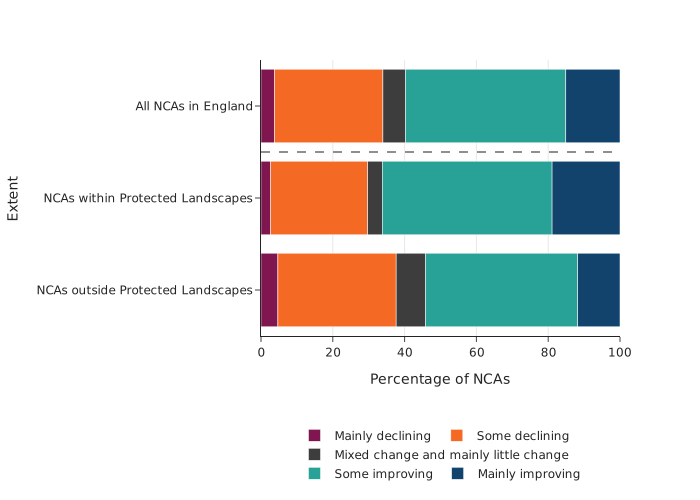
Source: Natural England
Download the data for this chart in .csv format
Notes on Figure
Results are based on the total number of NCAs within each extent category. Of the 159 NCAs across England, 74 were deemed to fall within a Protected Landscape and 85 were deemed to fall outside of a Protected Landscape.
Data are not always available for the exact monitoring points of 2015 and 2019. Where there is deviation to reflect data availability, this is recorded in the source publication.
Additional data limitations and caveats are also recorded in the source publication.
NCA change data are evaluated against a set of high-level landscape objectives. The objectives differ according to the landscape type to which an NCA is allocated, to reflect the relevant landscape pressures and opportunities.
For the purposes of establishing high-level trends for this reporting, the detailed evaluation of change allows each NCA to be allocated to one of the following ‘overall’ landscape change categories:
-
Mainly improving – the majority of evidence shows improving trends against objectives
-
Some improving – some objectives show little change, but where there is change, there is more evidence of improving trends than declining
-
Mixed change – less stable than ‘mainly little change’, but some evidence of equal amounts of declining and improving trends
-
Mainly little change – although there is some evidence of both improving and declining trends, the majority of evidence relates to little change against objectives
-
Some declining – some objectives show little change, but where there is change, there is more evidence of declining trends than improving
-
Mainly declining – the majority of evidence shows declining trends against objectives
To understand whether there is a difference in the results between NCAs that are wholly or partly within Protected Landscapes and those that are outside of them, NCAs are analysed as falling within Protected Landscapes if more than 5% of an NCA area is within a Protected Landscape, or an NCA contains a whole Protected Landscape that covers less than 5% of the total NCA area.
While being a relatively low threshold, 5% of an NCA's area is considered enough for a Protected Landscape designation to positively influence the management of important landscape features within an NCA. Remaining NCAs are analysed as falling outside of Protected Landscapes.
More granular results for each of the 18 broad landscape types underpinning this indicator component are available in the Changes in landscape characteristics of NCAs in England Atlas
Trend Description
Between 2015 and 2019, 16% (25 count) of NCAs across the whole of England show a ‘mainly improving’ overall change in landscape character, with a further 44% (70 count) assessed as ‘some improving’. Almost 4% (6 count) of NCAs were assessed as ‘mainly declining’ and 30% (48 count) were assessed as ‘some declining’ in terms of meeting the relevant landscape objectives. The remaining 8% (10 count) were assessed as showing either mixed or mainly little change overall.
Landscape objectives with the most positive trends (the most improving or strongly improving trends) when all landscape types are considered, include those relating to:
-
reduction and management of conifer plantations for landscape and biodiversity benefits in relevant landscape types; and
-
conservation and enhancement of traditional orchard habitats as characteristic landscape features strengthening the historic sense of place.
Landscape objectives with the most negative trends (the most ‘declining’ or ‘strongly declining’ trends) when all landscape types are considered, include those relating to:
-
conservation and enhancement of landscapes for their tranquillity and dark skies where they are under pressure from the potential impacts of development and associated infrastructure;
-
conservation and enhancement of the field boundary features and patterns that characterise our varied landscapes; and
-
improving the ecological condition of rivers and canals as important landscape features including habitats, connectivity and cultural significance.
Over the same period (2015 to 2019), 19% of NCAs falling wholly or partly within Protected Landscapes show a ‘mainly improving’ overall change in landscape character. This compares to 13% for NCAs falling outside of Protected Landscapes. The proportion of NCAs showing ‘mainly declining’ and ‘some declining’ change is lower for NCAs within Protected Landscapes (30%) than for those outside of Protected Landscapes (38%).
Landscape objectives with the most positive trends for NCAs within Protected Landscapes include those relating to:
-
reduction and management of conifer plantations for landscape and biodiversity benefits – looking to restructure and carefully enhance, where appropriate, the broadleaved element of woodland cover. The same trend is found in NCAs falling outside of Protected Landscapes.
-
conservation and enhancement of traditional orchard habitats as characteristic landscape features strengthening the historic sense of place. The same trend is found in NCAs falling outside of Protected Landscapes; and
-
conservation and enhancement of the characteristic and historic patterns of woodland, grassland and pasture. Improvements are notably more pronounced than those seen in NCAs falling outside of Protected Landscapes.
Landscape objectives with the most negative trends for NCAs within Protected Landscapes include those relating to:
-
improvements in the quality and extent of green corridors within the peri-urban landscape, increasing areas of publicly accessible green spaces. This is reversed in NCAs falling outside of Protected Landscapes, where the trends are more positive for this objective; and
-
conservation and enhancement of landscapes for their tranquillity and dark skies particularly where they are under pressure from the potential impacts of development and associated infrastructure. Declining trends are more pronounced in NCAs falling outside of Protected Landscapes.
Landscape objectives with the most negative trends within NCAs falling outside of Protected Landscapes additionally include those relating to:
- conservation and enhancement of the field boundary features and patterns that characterise our varied landscapes. Declining trends are less pronounced in NCAs falling within Protected Landscapes.
Landscape objectives with the most positive trends within NCAs falling outside of Protected Landscapes additionally include those relating to:
- increasing opportunities for enjoyment of the landscape and waterscapes, enhancing the network of public spaces, open green space and parks.
Assessment: G1a
No assessment of change was undertaken for this indicator as a suitable time series is not yet available in the Environmental Indicator Framework.
G1b: The influence of agri-environment schemes in conserving and enhancing landscape character in England, 2013 to 2023
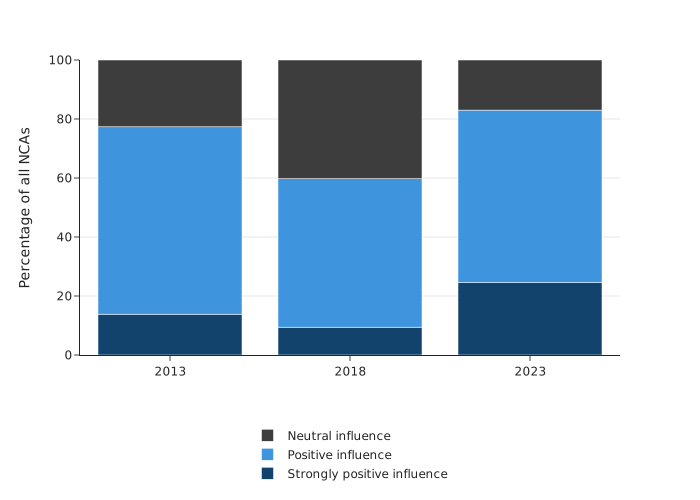
Source: Natural England
Download the data for this chart in .csv format
Notes on Figure
This evidence base assesses the effectiveness of agri-environment schemes, that is, Countryside Stewardship (introduced in 2015) and any remaining Environmental Stewardship schemes, in maintaining and enhancing landscape character, quality and resilience. The 2023 assessment includes the initial introduction of the Sustainable Farming Incentive (part of the new Environmental Land Management schemes), along with existing uptake from Environmental Stewardship and Countryside Stewardship. While there are some differences between agri-environment schemes, the 2023 assessment method is sufficiently aligned with the 2018 assessment and the 2013 baseline to allow a comparison to be made.
The assessment has been undertaken against 8 landscape change themes:
-
woodland and trees
-
field patterns and boundary types
-
agricultural land use
-
traditional farm buildings
-
historic environment
-
semi-natural habitats
-
coast
-
water management
Assessment results are judged against a series of landscape thresholds (one for each objective) expressed as the percentage of agri-environment scheme uptake against the landscape feature(s) that the agri-environment scheme options are affecting. The number and importance of the objectives where the threshold is met provide the assessment result for the individual themes, while the sum of the results across all themes provides the overall landscape assessment for that NCA. Overall results are described as neutral, positive or strongly positive (there were no ‘negative’ results identified that were significant enough to influence the assessment).
The source data for this indicator component are updated every 5 years. The next scheduled assessment for 2028 will likely be completed in 2029.
More granular results for this indicator component are available within the NCA Agri-environment Landscape Monitoring Atlas
Trend Description
The 2023 assessment has observed an increase in the uptake of agri-environment scheme options and/or actions following decreased levels in 2018, which are likely to result in strongly positive or positive landscape effects. Strongly positive results occur mainly in the north-west and south-west of England, with other clusters of strongly positive NCAs in central western areas. Positive results are found throughout England. There is a large cluster of neutral NCAs around Lancashire, Manchester and Merseyside. There is also a cluster of neutral NCAs around London and to the north of the Thames. There were no ‘negative’ results identified that were significant enough to influence the assessment.
Overall, the results of the 2023 assessment showed that agri-environment schemes were having:
-
a strongly positive effect on the landscape of 39 NCAs (25%)
-
a positive effect on the landscape of 93 NCAs (58%)
-
a neutral effect on the landscape of 27 NCAs (17%)
The previous 2018 assessment found that Countryside Stewardship and Environmental Stewardship schemes were having a strongly positive effect on the landscape of 15 NCAs (9%), a positive effect in 80 NCAs (50%) and a neutral effect in 64 NCAs (40%). The first assessment in 2013 found that Environmental Stewardship schemes were having a strongly positive effect on the landscape of 22 NCAs (14%), a positive effect in 101 NCAs (64%) and a neutral effect in 36 NCAs (23%).
Following a fall away of positive and strongly positive effects on the landscape in 2018, there has been an increase in both of these categories in 2023, with more NCAs assessed as strongly positive in 2023 (39 NCAs) than in 2013 (22 NCAs).
Across the landscape change themes, agri-environment schemes are most frequently having a strongly positive impact on field patterns and boundary types, semi-natural habitats and the coast. When considering both positive and strongly positive landscape impacts, agri-environment schemes are most frequently having a beneficial impact on the semi-natural habitats theme. Agri-environment schemes are having the least beneficial landscape impact in the traditional farm building and water management themes when considering both positive and strongly positive landscape impacts. Agri-environment schemes are having a more beneficial impact on NCAs that are partly or wholly within Protected Landscapes than those outside of Protected Landscapes.
Assessment: G1b
The percentage of NCAs where agri-environment schemes have had a strongly positive or positive influence on conserving and enhancing landscape character has increased over the medium-term assessment period. There are insufficient data points to make a short-term assessment, and the time series is not yet long enough to make a long-term assessment.
Change since 2018 has also been assessed, and over this period, the percentage of NCAs where agri-environment schemes have had a strongly positive or positive influence on conserving and enhancing landscape character has increased. However, this result is based on only 2 data points so should be considered as indicative and not evidence of a clear trend.
Further information on this assessment, along with details on the methodology, is provided in the Assessment guide page. Summaries by Environmental Improvement Plan goal and information on indicator links are presented in the Assessment results pages.
| Component | Subcomponent | Period | Date range | Percentage change | Smoothing function | Assessment of change |
|---|---|---|---|---|---|---|
| G1b | Strongly positive and positive influence | Short term | N/A | N/A | N/A | Not assessed |
| G1b | Strongly positive and positive influence | Medium term | 2013 to 2023 | 7.32 | Unsmoothed | Improvement |
| G1b | Strongly positive and positive influence | Long term | N/A | N/A | N/A | Not assessed |
Note that percentage change refers to the difference seen from the first to last year in the specified date range.
G1c: Spatial changes in visual and experiential landscape character in England, overall and by key attributes of character, 2015 to 2019
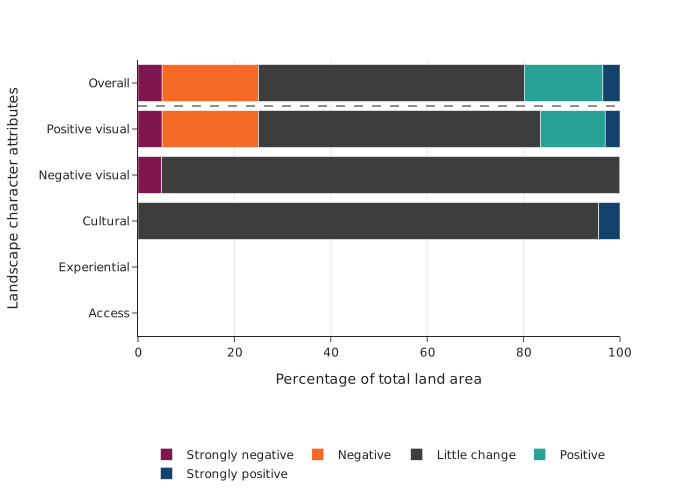
Source: Natural England
Download the data for this chart in .csv format
Notes on Figure
The analysis underpinning this component provides spatial changes in key attributes of landscape that contribute to visual and experiential character. These key attributes of visual and experiential landscape character are defined within 5 themes:
-
Positive visual (rivers, habitat diversity and buildings greater than 70 metres in height such as cathedrals)
-
Negative visual (new postcodes, roads and industrial land-use)
-
Cultural (including scheduled monuments, national trails, canals and open green spaces)
-
Experiential (noise intensity and remoteness)
-
Access (green space access, accessible land and footpath access)
The analysis is modelled at fine scale (for example, metres or kilometres) across the whole of England.
The change mapping uses a subset of 21 component indicators taken from a broader spatial indicator which maps landscape character using 32 components. The component indicators selected to report on spatial change were chosen from those aspects which are more likely to alter within a 10-year period.
There were insufficient data available to assess changes to the experiential and access attributes.
More granular results for each of the 18 broad landscape types underpinning this indicator component are available on the Change in Visual and Experiential Landscape Character website.
Trend Description
Between 2015 and 2019, there was a positive change (improvement) in the visual and experiential character of the overall landscape across almost 20% of the land area of England (3.6% strongly positive and 16.3% positive) and there was a negative change (deterioration) across 25% of the land area (5% strongly negative and 20% negative). There was little change in the overall visual and experiential character of the landscape across the remaining 55% of the land area of England between 2015 and 2019. Overall, this equates to a net reduction in the visual and experiential character of the landscape across England.
The positive changes to overall visual and experiential character were driven by an increase in positive visual attributes (mainly due to greater habitat diversity, and some improved river water quality) across 16.5% of the land area of England and strongly positive changes to cultural attributes across 4.4% of England, due to new landscape designations. The negative changes were driven by the combination of a decrease in positive visual attributes (habitat diversity and river water quality) across 25% of the land area of England as well as a further deterioration of negative visual attributes (such as new urban and industrial development) across 4.9% of England.
There was little change to both negative visual and cultural attributes across the vast majority of the country (95.1% and 95.6% respectively) and little change to positive visual attributes across more than half the country (58.5%).
Assessment: G1c
No assessment of change is undertaken for this indicator as a suitable time series is not available in the Environmental Indicator Framework.
Metadata
| Headline | Landscapes and waterscapes |
|---|---|
| Primary Goal | Access to nature |
| Relevant Goals | Access to nature |
| Relevant Targets | Safeguarding and enhancing the beauty of our natural scenery and improving its environmental value while being sensitive to considerations of its heritage |
| Natural Capital | Condition of assets - freshwater, Condition of assets - land, Condition of assets - marine |
| Related Commitments | This indicator, and associated data will be included in a summary of landscape activities reported to the Council of Europe Landscape Convention. |
| Geographical Scope | England |
| Development Status | Interim |
| First Reported | 2024 |
| Last updated | May 2025 |
| Latest Data | 2023 |
Return to Environmental Indicator Framework Collection Page
G2: Condition of heritage features including designated geological sites and scheduled monuments
Short Description
This indicator consists of 2 measures that describe (a) the condition of geological and geomorphological (landforms and the processes which create them) heritage features of Sites of Special Scientific Interest (SSSIs) and (b) the condition of Scheduled Monuments. Heritage features enable us to understand how our landscapes have been formed and are an important aspect of landscape character that significantly contribute to our enjoyment and appreciation of the natural beauty. We have a particular responsibility to conserve heritage features of designated sites. The indicator uses information from SSSI condition assessments and information which supports the production of Historic England’s annual Heritage at Risk Register.
All geological (including geomorphological) features designated as SSSIs have first been subject to rigorous and systematic scientific assessment leading to their selection as nationally important Geological Conservation Review (GCR) sites. As of December 2023, there were 1,221 SSSIs in England designated wholly, or in part, for their geology, encompassing 1,797 features identified through the GCR. Many SSSIs contain more than one geological heritage feature.
Monuments designated as Scheduled Monuments have been recognised by the Secretary of State as being nationally important. For a monument to be considered of national importance its surviving features, above and/or below the surface of the land or seabed, must have a particular significance that relates to its historic, traditional, architectural, artistic and/or archaeological interest. As of August 2023, there were 19,955 Scheduled Monuments in England.
Readiness and Links to Data
Data are available on SSSI condition assessments (as a searchable database), and as a data download of SSSI Monitored features. A programme of work was initiated in 2020, aimed at assessing the condition of previously unassessed geological features and reassessing the condition of features which have not been assessed for more than 6 years.
Data on Scheduled Monuments at risk are also available. These data have been collated over an extended time period as it is not currently possible to update them in full on a regular basis. In 2026, we intend to expand the indicator to cover all designated heritage features at risk (including registered parks and gardens and registered battefields).
Notes on Indicator
The observed increase in the percentage of geological and geomorphological heritage features in favourable condition from 2019 to 2021 and the absence of any major changes to the percentage of features in the unfavourable assessment categories over the same period is largely due to the timing of data inputted since 2019. Most new assessments in favourable condition were included in the 2021 results, whereas most unfavourable assessments were still being finalised at that time. These unfavourable assessments have now been included in the 2023 data, removing the skew towards favourable condition which existed in the 2021 data.
There has been an increase in the number of geological and geomorphological features reported on between 2019 and 2023 due to a change in methodology in processing the data which has identified and now included some features and SSSIs erroneously left out of previous reports. These are not newly designated features and SSSIs, but long-established features and sites missed out of previous reports.
Data on the condition of Scheduled Monuments in this indicator are based on archaeology assessments only. As of August 2023, 884 Scheduled Monuments have additional condition assessments based on their built or structural remains; these have been omitted from this indicator.
G2a: Condition of geological and geomorphological heritage features of Sites of Special Scientific Interest in England, 2019 to 2023
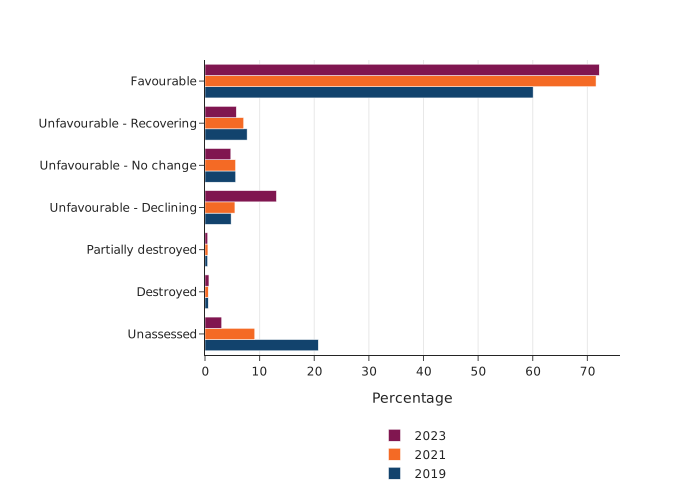
Source: Natural England
Download the data for this chart in .csv format
Notes on Figure
Based on the condition of 1,742 geological and geomorphological heritage features that had been assessed by December 2023, with 46% of those assessments being carried out since 2017 and 53% being carried out since 2013. A further 3% of all 1,797 features are still to be assessed. As of December 2019, 1,326 geological and geomorphological heritage features had been assessed.
This indicator is updated biennially; the next scheduled update, using 2025 data, will take place in 2026.
Trend Description
In total, 72% of all designated geological features have been assessed as being in favourable condition as of December 2023 (a 12 percentage-point increase in the equivalent figure for 2019, but the same as that reported in 2021) and a further 6% have been assessed as being in an unfavourable but recovering condition. The proportion of features in unfavourable declining condition has increased to 13% in 2023. Approximately 1% have been destroyed or partially destroyed.
Assessment: G2a
No assessment of change was undertaken for this indicator as a suitable time series is not yet available in the Environmental Indicator Framework.
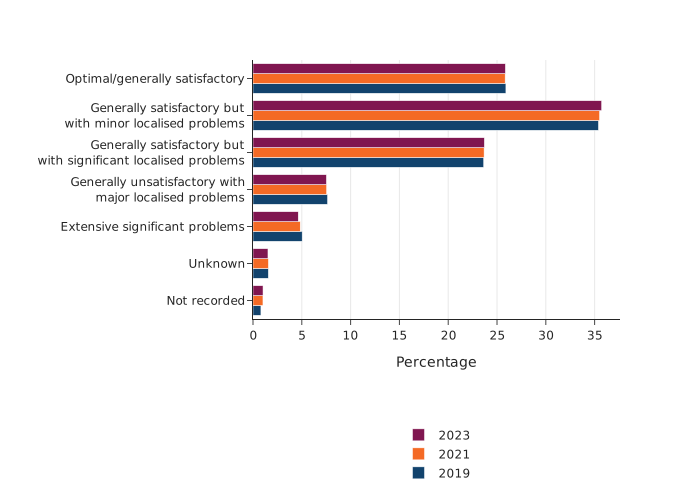
G2b: Condition of Scheduled Monuments in England (based on entries with archaeological assessments), 2019 to 2023
Source: Historic England
Download the data for this chart in .csv format
Notes on Figure
Based on the archaeological assessments of the 19,955 Scheduled Monuments that had been assessed by August 2023. Of these, 19% have been subject to new or updated condition assessments since 2017 and 32% have been assessed since 2013. A further 1% of all features are still to be assessed. As of August 2019, 19,848 Scheduled Monuments had archaeological assessments in place.
This indicator is updated biennially; the next scheduled update, using 2025 data, will take place in 2026.
Trend Description
In total, 85.3% of all Scheduled Monuments with archaeological assessments were considered as being in optimal or generally satisfactory condition in 2023, whereas 12.2% were considered as either being in a generally unsatisfactory condition or having extensive significant problems. This represents a slight positive change from data first published in 2020.
Assessment: G2b
No assessment of change was undertaken for this indicator as a suitable time series is not yet available in the Environmental Indicator Framework.
Metadata
| Headline | Landscapes and waterscapes |
|---|---|
| Primary Goal | Access to nature |
| Relevant Goals | Access to nature |
| Relevant Targets | Safeguarding and enhancing the beauty of our natural scenery and improving its environmental value while being sensitive to considerations of its heritage |
| Natural Capital | Condition of assets - freshwater, Condition of assets - land, Condition of assets - marine |
| Related Commitments | Reporting under the European Landscape Convention |
| Geographical Scope | England |
| Development Status | Final |
| First Reported | 2020 |
| Last updated | May 2025 |
| Latest Data | 2023 |
Return to Environmental Indicator Framework Collection Page
G3: Enhancement of green and blue infrastructure
Short Description
This indicator will show changes in the quantity, quality, accessibility and, ultimately, multiple functions of green and blue infrastructure. Green and blue spaces and other natural features in and around our built environment, including within Green Belts, are part of networks of multi-functional green infrastructure, which are capable of delivering a wide range of benefits that are essential to health and wellbeing, nature, climate, water and prosperity. Green infrastructure includes land, freshwater and coastal spaces.
This indicator is being developed from two sources. The first source, led by Natural England, with Defra and an advisory group, on the Green Infrastructure Framework – Principles and Standards for England which covers both green and blue infrastructure. These standards aim to green our towns and cities, by improving existing green infrastructure provision and encouraging more investment. Green and blue infrastructure can also make an important contribution towards mitigation and adaptation to climate change. The second source is Natural England’s People and Nature Survey (PaNS) results.
Readiness and Links to Data
An interim indicator is presented here that is based on (a) Natural England’s updated Accessible Greenspace Standards and its England Green Infrastructure Mapping Database, and (b) its People and Nature Survey (PaNS).
Please note that future updates to this indicator will incorporate Defra's Access to green and blue space in England which is an official statistic in development and measures distance to green and blue space along a network of walkable streets and paths. These data will feed into the Environmental Indicator Framework in due course.
The Accessible Greenspace Standards have informed the development of measures for accessible greenspace quantity and proximity, at different scales. These are measured using the England Green Infrastructure Mapping Database.
Natural England’s Accessible Greenspace Standards also include criteria for greenspace quality, including accessibility for all. The standards refer to the Green Flag criteria, which include a broad range of aspects and features of greenspace quality for individual sites. In developing a sub-indicator for G3 for greenspace quality, Natural England aimed to develop a national and high-level approach to measuring greenspace quality. Working with a group of expert representatives of non-governmental organisations in 2022, they considered the utility of data gathered by Natural England’s People and Nature Survey for a greenspace quality indicator. The resulting indicator draws on PaNS data for understanding the public’s expectations regarding green and natural space, and their perceptions of the actuality of their local greenspace and natural spaces. Summary data for these components are available in the Statistics and technical details for 2026 national indicators dataset.
Natural England and Defra updated the baseline (Version 1.1) maps of Green and Blue Infrastructure across England prior to the 2025 update of this indicator with new datasets, i.e. Version 2.1 (2022) and Version 2.2 (2024), for future analysis using the updated Accessible Greenspace Standards. The England Green Infrastructure Mapping Database Version 2.1 Method Statement provides details of the Green Infrastructure Mapping Version 2.1 (2022). The Green Infrastructure Framework Mapping Analysis provides the Version 2.2 (2024) statistical data, analysis and findings for G3a.
Additional green infrastructure indicators are in development by Defra and Natural England. Natural England is developing two further indicators linked to the Green Infrastructure Framework Standards, i.e. an Urban Nature Recovery indicator, and an Urban Greening indicator. Outputs of new data and further analysis of the Green Infrastructure Mapping will be considered for providing additional information in the final indicator.
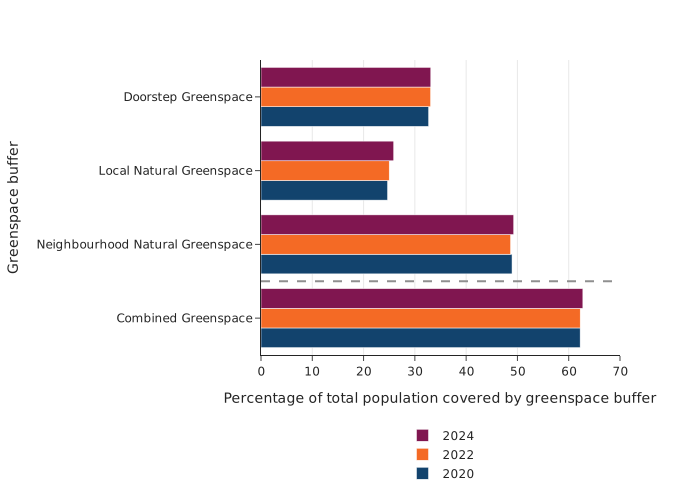
G3a: Percentage of the total population in England living in close proximity of greenspace, 2020 to 2024
Source: Natural England
Download the data for this chart in .csv format
Notes on Component
Figure G3a covers both urban and rural areas.
Doorstep Greenspace is accessible greenspace of at least 0.5 hectares in size within a 200 metre straight-line distance from home; Local Natural Greenspace is accessible natural greenspace of at least 2 hectares in size within a 300 metre straight-line distance from home; and Neighbourhood Natural Greenspace is accessible natural greenspace of at least 10 hectares within a 1 kilometre (km) straight-line distance from home.
The Combined Greenspace category, while not an officially designated greenspace standard in itself, includes the percentage of the population living within the defined proximity of access to any one or more of the Doorstep Greenspace, and Local and Neighbourhood Natural Greenspace Standards outlined above.
The ‘percentage of total population covered by greenspace buffer’ is based on an assumption that the population within each lower layer super output area (LSOA) is evenly distributed.
Trend Description
Between 2020 and 2024, the proportion of the population living in close proximity to greenspace has remained relatively stable in all the categories. There are small increases in all categories, with the largest being an increase of just over 1% in the Local Natural Greenspace category. Overall, across the 3 data points currently available, results suggest that approximately:
• 1 in 3 people live within 200 metres of a Doorstep Greenspace of at least 0.5 hectares
• 1 in 4 people live within 300 metres of a Local Natural Greenspace of at least 2 hectares
• 1 in 2 people live within 1 km of a Neighbourhood Natural Greenspace of at least 10 hectares
When considered together at any year in the data, these 3 most local Accessible Greenspace Standards criteria (as set out above) allow us to form a composite picture of accessible greenspace close to home. Findings suggest that almost 2 in 3 people (62.8% in 2024) have access to greenspace as defined by one or more of the Doorstep Greenspace, Local Natural Greenspace and Neighbourhood Natural Greenspace Standards included within this indicator, and hence within a maximum 1 km radius of home.
Assessment: G3a
No assessment of change was undertaken for this indicator as a suitable time series is not yet available in the Environmental Indicator Framework.
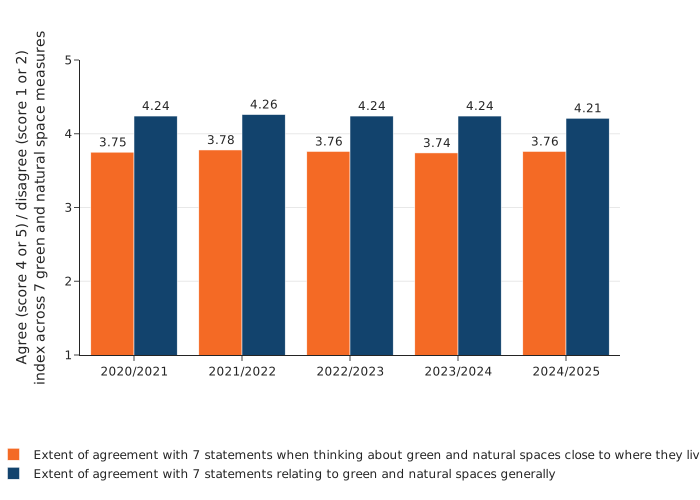
G3bi: Comparing Perceptions of Green and Natural Spaces Close to Where People Live with Expectations of Green and Natural Spaces More Generally, Survey Years 2020/2021 to 2024/2025
Source: Natural England
Download the data for this chart in .csv format
Notes on Component
Figure G3bi is derived from PaNS data collected in the survey years (April to March) 2020/2021 to 2024/2025. Base: 25,026 English adults in 2024/2025.
The indicator is based on responses to question [M1_Q4]: ‘How much do you agree or disagree with the following statements relating to green and natural spaces generally? In general, green and natural spaces should be:’ and question [M1_Q5]: ‘Now, thinking about green and natural spaces close to where you live, how much do you agree or disagree with the following statements? My local green and natural spaces actually are:’. The statements presented to respondents are:
- a) within easy walking distance
- b) good places for mental health and wellbeing
- c) a high enough standard to want to spend time in
- d) good places for children to play
- e) places that encourage physical health and exercise
- f) good places to meet other people
- g) provide good opportunities to see nature
Scores 1 (strongly disagree), 2 (disagree), 3 (neither agree nor disagree), 4 (agree), 5 (strongly agree) are attributed to all responses to each of the statements relating to general expectations about green and natural spaces (question [M1_Q4]) and perceptions of the quality of local green and natural spaces (question [M1_Q5]). Overall means of all responses to the 7 statements are then presented as the annual indicator values for both expectations and perceptions. These values can range from 1, indicating the lowest levels of expectation generally and perception locally of the quality of green and natural spaces (equivalent to strongly disagreeing with all 7 statements) to 5, indicating the highest levels of expectation and perception (strongly agreeing with all 7 statements).
Natural England and stakeholder representatives involved in developing the G3 quality indicator also considered an option for the greenspace quality indicator based on the PaNS question Q3 (M1_Q3) ‘Thinking of the green and natural spaces close to where you live, have they improved or reduced in the last 5 years, or have they not changed?'. It was concluded that this question was broad and open to wide interpretation, so not as effective as an indicator as the approach taken.
Trend Description
In 2024/25, the majority of adults agreed that green and natural spaces should be good places for mental health and wellbeing, provide good opportunities to see nature, be of a high enough standard to want to spend time in, be within easy walking distance, be places that encourage physical health and exercise, be good places for children to play and be good places to meet other people. Level of agreement with these statements about green and natural spaces generally has not changed since 2020/21 when the question was first asked.
However, adults’ perceptions of the green and natural spaces near where they live consistently fell short of their expectations of green and natural spaces more generally. In an index that combines the mean agreement with statements across the seven measures of what green and natural space should be, the mean agreement score was lower for green and natural spaces close to where people live with an overall mean score of 3.76, compared with an overall mean agreement score of 4.21 for green and natural spaces more generally. The maximum mean score was 5. Therefore, adults are less likely to agree that their local green and natural spaces meet these quality measures, compared to what they would expect from green and natural spaces more generally. There has been no real change in these figures since 2020/21.
Assessment: G3bi
No assessment of change was undertaken for this indicator as a suitable time series is not yet available in the Environmental Indicator Framework.
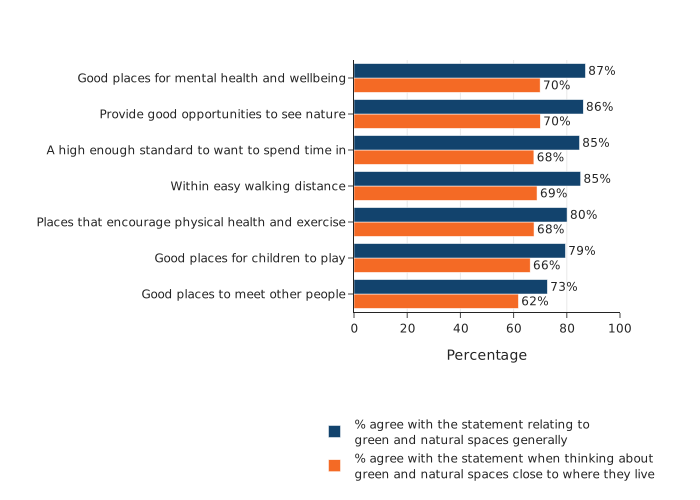
G3bii: Comparing Perceptions of Green and Natural Spaces Close to Where People Live with Expectations of Green and Natural Spaces More Generally, Broken Down by Individual Measures of Quality of Provision, Survey Year 2024/2025
Source: Natural England
Download the data for this chart in .csv format
Notes on Component
Figure G3bii is derived from PaNS data collected in the survey year (April to March) 2023 to 2025. Base: 25,026 English adults.
The indicator is based on responses to question [M1_Q4]: ‘How much do you agree or disagree with the following statements relating to green and natural spaces generally? In general, green and natural spaces should be:’ and question [M1_Q5]: ‘Now, thinking about green and natural spaces close to where you live, how much do you agree or disagree with the following statements? My local green and natural spaces actually are:’. The statements are:
- a) within easy walking distance
- b) good places for mental health and wellbeing
- c) a high enough standard to want to spend time in
- d) good places for children to play
- e) places that encourage physical health and exercise
- f) good places to meet other people
- g) provide good opportunities to see nature
Some response options ('agree' and 'strongly agree') in PaNS have been combined for the purposes of this indicator.
Trend Description
In 2024/2025, the proportion of adults who agreed their local green and natural spaces met the selection of quality statements about these spaces was at least 10 percentage points (pp) lower than their expectations of these spaces more generally. The greatest gap between perceptions of how local green and natural spaces actually are and expectations of what they should be like were found for the statements ‘within easy walking distance’ (16 pp), ‘good places for mental health and wellbeing’ (17 pp) and 'a high enough standard to want to spend time in' (17). The smallest gap between perceptions and expectations (11 pp) was observed for the statement 'good places to meet other people'.
Assessment: G3bii
No assessment of change is undertaken for this indicator as a suitable time series is not available in the Environmental Indicator Framework.
Metadata
| Primary Goal | Access to nature |
|---|---|
| Relevant Goals | Access to nature, Restored nature |
| Relevant Targets | Creating or restoring 500,000 hectares of wildlife-rich habitat outside the protected site network, focusing on priority habitats as part of a wider set of land management changes providing extensive benefits, Making sure that there are high quality, accessible, natural spaces close to where people live and work, particularly in urban areas, and encouraging more people to spend time in them to benefit their health and wellbeing |
| Natural Capital | Condition of assets - freshwater, Condition of assets - land, Condition of assets - species and ecological communities |
| Related Commitments | Reporting under European Landscape Convention, Reporting on the United Nation’s Sustainable Development Goals, for example, Goal 11: ‘Make cities and human settlements inclusive, safe, resilient and sustainable’, May provide evidence in support of Climate Change Risk Assessment and the Adaptation Sub-Committee’s assessment of the National Adaptation Programme, under the Climate Change Act (2008) |
| Geographical Scope | England |
| Development Status | Interim |
| First Reported | 2022 |
| Latest Data | 2025 |
| Last Updated | May 2026 |
Return to Environmental Indicator Framework Collection Page
G4: Engagement with the natural environment
Short Description
This indicator will track changes in people’s engagement with the natural environment. It is our objective that, alongside improvements in natural environments, people are also engaging more with them. Spending time in the natural environment is important for both human health and wellbeing, and increasing pro-environmental behaviours to support nature recovery.
A range of measurements may be indicative of engagement with the natural environment, but for the purposes of this indicator, data covering the broadest possible aspects of nature and engagement were sought. In addition, other measures of engagement relating to people’s care and concern for the environment are measured as part of indicators 'G5 People engaged in social action for the environment' and 'G6 Environmental attitudes and behaviours'.
Readiness and Links to Data
This indicator was revised in the 2025 update of the Environmental Indicator Framework. It presents data from 2 of Natural England’s nationally representative surveys on time spent in natural spaces (spanning a wide range of green and blue spaces, both urban and rural):
1) The Adults People and Nature Survey (A-PaNS) which began collecting data for adults on an on-going basis from 2 April 2020.
2) The Children’s People and Nature Survey (C-PaNS) which collects data for children twice yearly (beginning in August 2021), once during school holiday-time and once in term-time.
Work to compare A-PaNS data with Monitor of Engagement with the Natural Environment (MENE) survey data collected before 2020 found that due to changes in survey mode and questions, results from the 2 surveys cannot be compared and therefore, the MENE data were removed from this indicator during the 2025 update. More information on A-PaNS and C-PaNS methods, outputs and the full questionnaires, are available on the People and Nature Survey (PaNS) homepage.
Summary data for all 4 components of this indicator are available in the Statistics and technical details for 2026 national indicators dataset.
Notes on Indicator
Adults' and children’s results are not directly comparable due to the use of child-appropriate questions in the children’s surveys.
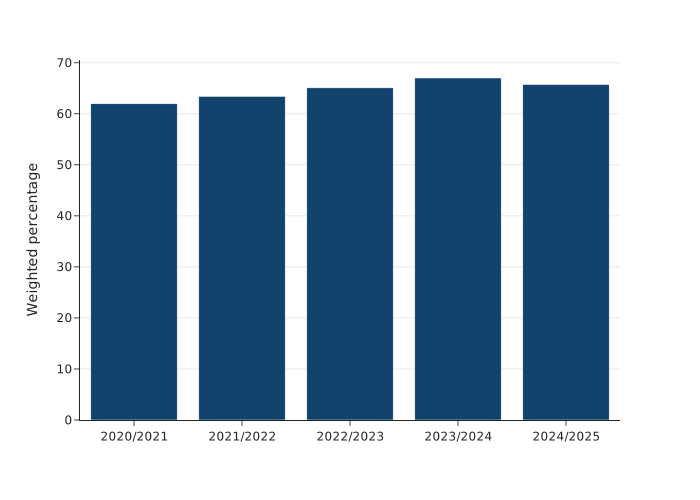
G4a: Proportion of adults in England visiting green and natural spaces in the past 14 days, survey years 2020/2021 to 2024/2025
Source: Natural England
Download the data for this chart in .csv format
Notes on Component
Figure G4a is based on A-PaNS data collected in survey years (April to March) 2020/2021 to 2024/2025 with A-PaNS weightings applied. Base: Module 2 adults. It shows responses to question [No_Of_Visits]: ‘How many times, if at all, did you make this type of visit to green and natural spaces in the last 14 days?’. Some response options have been combined for the purposes of this indicator.
Trend Description
The proportion of adults visiting green and natural spaces at least once in the past 14 days has increased slightly over the last 5 years, from 62% in 2020/2021 to 66% in 2024/2025. A slight decrease was seen in the latest year, from 67% in 2023/2024 to 66% in 2024/2025.
Assessment: G4a
No assessment of change was undertaken for this indicator as a suitable time series is not yet available in the Environmental Indicator Framework.
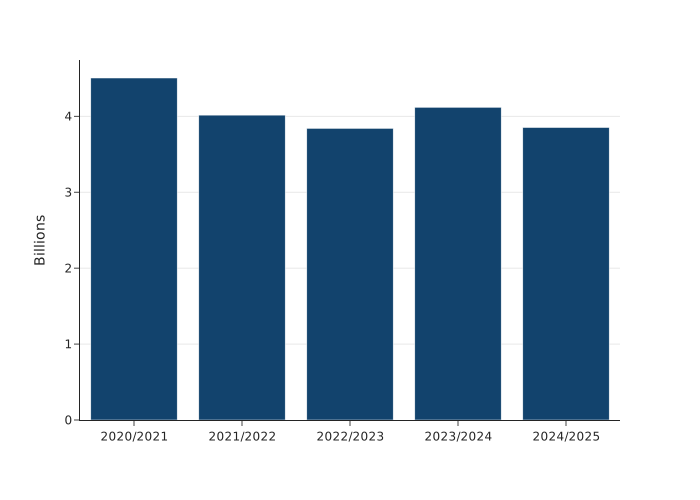
G4b: Gross annual number of visits to green and natural spaces by adults in England, survey years 2020/2021 to 2024/2025
Source: Natural England
Download the data for this chart in .csv format
Notes on Component
Figure G4b is based on A-PaNS data collected in survey years (April to March) 2020/2021 to 2024/2025 with A-PaNS weightings applied. Base: Module 2 adults. It shows responses to question [No_Of_Visits]: ‘How many times, if at all, did you make this type of visit to green and natural spaces in the last 14 days?’. Some response options have been combined for the purposes of this indicator.
Trend Description
Despite a small increase in 2023/2024, the gross annual number of visits to green and natural spaces has fallen by 14.5% from just over 4.5 billion in 2020/2021 to 3.9 billion in 2024/2025.
Assessment: G4b
No assessment of change was undertaken for this indicator as a suitable time series is not yet available in the Environmental Indicator Framework.
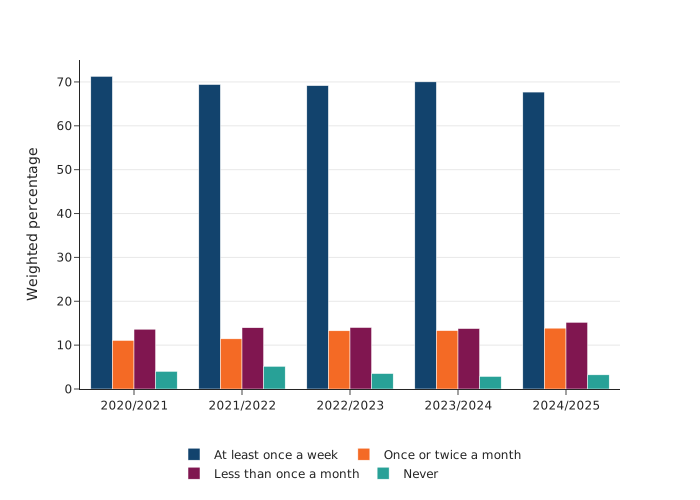
G4c: Frequency of visits to green and natural spaces in the past 12 months by adults in England, survey years 2020/2021 to 2024/2025
Source: Natural England
Download the data for this chart in .csv format
Notes on Component
Figure G4c is based on A-PaNS data collected in survey years (April to March) 2020/2021 to 2024/2025 with A-PaNS weightings applied. Base: All respondents. It shows responses to question [M1_Q1]: ‘In the last 12 months, how often, on average have you spent free time outside in green and natural spaces?’. Some response options have been combined for the purposes of this indicator.
Trend Description
In 2024/2025, 68% of adults said they had spent free time outside in green and natural spaces on average at least once a week in the past 12 months. This is slightly lower compared to figures reported in previous years. Approximately 29% said they spent free time outside in green and natural spaces less often than once a week, and around 3% said they spent no free time outside in green and natural spaces.
Assessment: G4c
No assessment of change was undertaken for this indicator as a suitable time series is not yet available in the Environmental Indicator Framework.
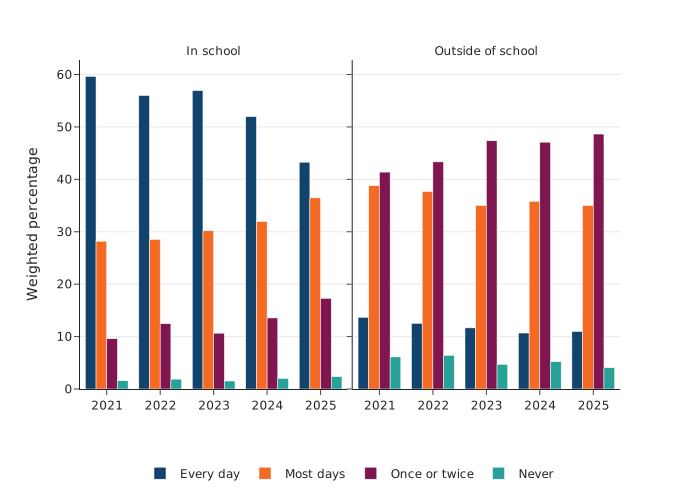
G4d: Frequency of time spent outside in the last week by children in England, survey years 2021 to 2025
Source: Natural England
Download the data for this chart in .csv format
Notes on Component
Figure G4d is based on C-PaNS data collected in survey years 2021 to 2025 with C-PaNS weightings applied. Data are collected at 2 time-points each year, across 2 to 3 weeks in the school holidays (August) and again during term-time (September to October). Base: All respondents or just term-time respondents for question [CS_Q5A]. It shows responses to questions [CS_Q5A]: ‘Thinking about the last week at school, how often have you spent time outside?’ and [CS_Q6B]: ‘Now thinking about when you were not at school in the last week, how often have you spent time outside in places that are not your garden?’.
Trend Description
In 2025, C-PaNS results show that when thinking about the last week, 43% of children said they spent time outside every day when at school. This is a decrease of 17 percentage points compared to 2021 (60%). Around 36% of children had spent time outside most days, 17% had spent time outside once or twice, and a small percentage had not spent time outside at all.
Children reported spending time outside less frequently when not at school in all 5 years. For example, in 2025, 11% of children said they had spent time outside every day when not at school. 35% of children had spent time outside most days, 49% had spent time outside once or twice, and around 4% had not spent time outside at all.
Assessment: G4d
No assessment of change was undertaken for this indicator as a suitable time series is not yet available in the Environmental Indicator Framework.
Metadata
| Primary Goal | Access to nature |
|---|---|
| Relevant Goals | Access to nature |
| Relevant Targets | Making sure that there are high quality, accessible, natural spaces close to where people live and work, particularly in urban areas, and encouraging more people to spend time in them to benefit their health and wellbeing |
| Natural Capital | Service or benefit associated with natural capital asset |
| Related Commitments | None |
| Geographical Scope | England |
| Development Status | Final |
| First Reported | 2019 |
| Latest Data | 2025 |
| Last Updated | May 2026 |
Return to Environmental Indicator Framework Collection Page
G5: People engaged in social action for the environment
Short Description
Social action is about people coming together to help improve their lives and solve the problems that are important in their communities. It can broadly be defined as practical action in the service of others, which is (i) carried out by individuals or groups of people working together, (ii) not mandated and not for profit, (iii) done for the good of others – individuals, communities and/or society, and (iv) bringing about social change and/or value.
Multiple measurements will be used within this indicator as indicative of social actions which people can take to care for and restore the environment.
Readiness and Links to Data
This indicator presents data from 3 sources:
1) The England Biodiversity Indicators which show volunteer time spent on activities of benefit to the natural environment in England.
2) Natural England’s nationally representative Adults People and Nature Survey (A-PaNS) which show adults’ self-reported social action for the environment. A-PaNS began collecting data on an on-going basis from 2 April 2020.
3) Natural England’s nationally representative Children’s People and Nature Survey (C-PaNS) which show children’s self-reported social action for the environment. C-PaNS collects data twice yearly (beginning in 2021), once during school holiday-time and once in term-time.
More information on A-PaNS and C-PaNS methods, outputs and the full questionnaires, are available on the PaNS homepage.
Summary data for G5b and G5c are available in the National indicators 2026 - statistics and technical details dataset.
Notes on Indicator
The children’s social action index is not directly comparable to the adults’ index due to the use of different social action statements and a simplified response scale that does not allow for weighting of actions based on their commonality.
The adults’ and children’s social action indices presented here in G5b and G5c measure how people come together to build capacity and act as communities to make changes that benefit the environment. In contrast, the adults’ and children’s pro-environmental behaviours indices presented in G6b and G6d are based on the actions of individuals themselves to directly benefit the environment.
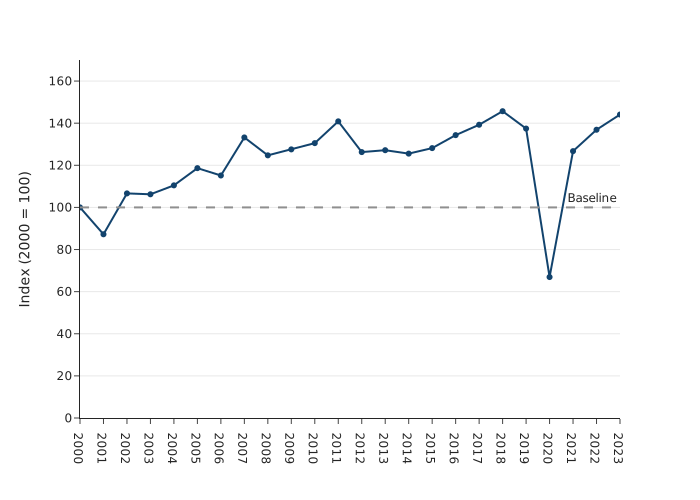
G5a: Volunteer time spent on the natural environment in England, 2000 to 2023
Source: Department for Environment, Food & Rural Affairs
Download the data for this chart in .csv format
Notes on Component
The sharp decline in the index in 2020 was due to the impacts of COVID-19 restrictions. 4 of the 10 organisations ceased volunteering entirely during this time, with the remaining 6 organisations significantly reducing volunteer hours. Further restrictions were also in place during the first 6 months of 2021, but time spent volunteering began to increase again as these restrictions eased.
Some data have been imputed to fill gaps in the time series where contributing organisations were unable to provide figures for a particular year.
Data provided by 6 organisations (The Conservation Volunteers, Canal and River Trust (formerly British Waterways), National Parks England, Natural England, RSPB and The Wildlife Trusts) covered financial years rather than calendar years. Financial year data have been assigned to the first calendar year (for example, 2022/2023 data were allocated to 2022).
Data provided by one organisation (Canal and River Trust) include volunteering carried out in Wales.
Trend Description
Between 2000 and 2019, the index of the amount of time contributed by environmental volunteers in England fluctuated but, overall, it increased by 37%. The index then fell sharply in 2020 due to the impacts of COVID-19 restrictions. While it showed considerable recovery in 2021, the index was likely still impacted by COVID-19 restrictions in the first 6 months of that year. In 2023, the index increased further to 144.1, and across the whole time series (from 2000 to 2023), the environmental volunteering index for England has increased by 44%.
Assessment: G5a
There has been an increase (improvement) in the amount of time contributed by environmental volunteers in England over the long-term assessment period, while there was little to no change observed over the short and medium term.
Change since 2018 has also been assessed. There was little to no change in volunteer time spent on the natural environment since 2018. However, this is based on 6 data points and volunteering in 2020 and 2021 was heavily impacted by COVID-19 restrictions so should be considered as indicative and not evidence of a clear trend.
The assessment results reported here are not directly comparable with other analyses published elsewhere that use different methodologies to explore this indicator component.
Further information on this assessment, along with details on the methodology, is provided in the Assessment guide page. Summaries by Environmental Improvement Plan goal and information on indicator links are presented in the Assessment results pages.
| Component | Period | Date range | Percentage change | Smoothing function | Assessment of change |
|---|---|---|---|---|---|
| G5a | Short term | 2018 to 2023 | 2.47 | Loess | Little or no change |
| G5a | Medium term | 2013 to 2023 | -1.48 | Loess | Little or no change |
| G5a | Long term | 2000 to 2023 | 42.33 | Loess | Improvement |
Note that assessment categories for the short, medium and long term were assigned based on smoothed data, so percentage change figures in Table G5 may differ from unsmoothed values quoted elsewhere. Percentage change refers to the difference seen from the first to last year in the specified date range.
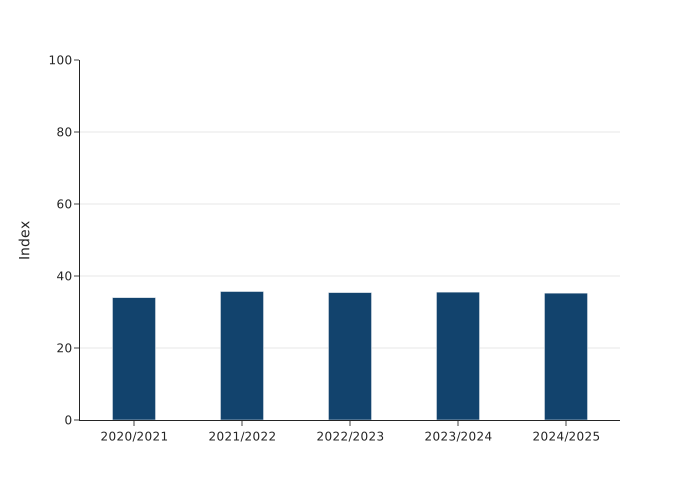
G5b: Adults’ social action score as an index from 0 to 100, England, survey years 2020/2021 to 2024/2025
Source: Natural England
Download the data for this chart in .csv format
Notes on Component
Figure G5b is derived from A-PaNS data collected in survey years (April to March) 2020/2021 to 2024/2025 with A-PaNS weightings applied. Base: All asked Module 4.
The indicator is based on responses to question [M4_Q9, options b to h]: ‘How often do you do the actions below when you have the opportunity?’. Scores from 0 (low social action) to 100 (high social action) represent a weighted index of self-reported social action formed from the following statements:
- ‘I vote for political parties with strong environmental policies’
- ‘I contact an MP or council about an environmental issue’
- ‘I sign petitions or participate in a campaign or demonstration about an environmental issue’
- ‘I volunteer time for an environmental cause’
- ‘I donate money to or am a member of an environmental organisation’
- ‘I try to persuade people I know in person to do more to help the environment’
- ‘I post online content related to the environment’
The inverse of the mean and the variance of responses on the 5-point rating scale (from 1-Never to 5-Always or whenever I have the opportunity) was used to determine an additional weighting by statement. By applying this weighting based on commonality, behaviours that require more commitment and are engaged with less frequently carry a higher weight in the overall index.
Trend Description
A-PaNS data show that in 2024/2025 adults on average scored 35 out of 100 on an index of no social action taken for the environment (0) to high engagement with social action for the environment (100). This figure is similar to the index scores reported for previours years, however, it is not possible to equate these results to an equivalent number of social actions because of the different weightings applied to each of the actions within this measure.
Assessment: G5b
No assessment of change was undertaken for this indicator as a suitable time series is not yet available in the Environmental Indicator Framework.
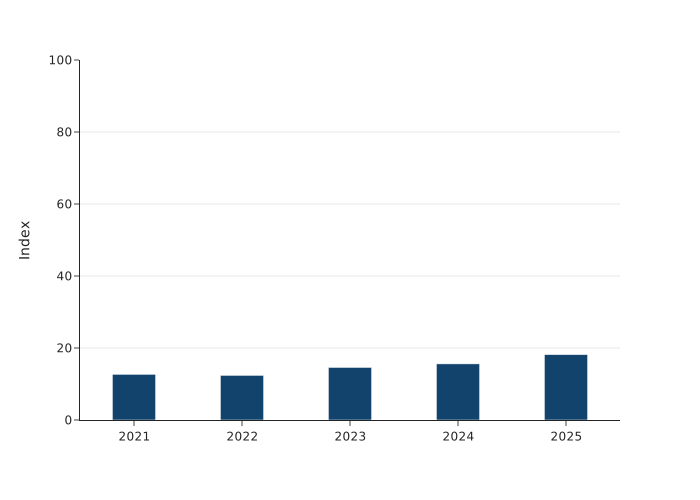
G5c: Children’s social action score as an index from 0 to 100, England, survey years 2021 to 2025
Source: Natural England
Download the data for this chart in .csv format
Notes on Component
Figure G5c is derived from C-PaNS data collected in survey years 2021 to 2025 with C-PaNS weightings applied. Data are collected at 2 time-points each year, across 2 to 3 weeks in the school holidays (August) and again during term-time (September to October). Base: All respondents.
The indicator is based on responses to question [CS_Q10]: ‘Which of the following things do you do to look after the environment? There are lots of options but they may not all apply to you or all make sense. Only pick the ones you understand and do yourself to look after the environment.’ Scores from 0 (low social action) to 100 (high social action) represent an index of self-reported social action formed from the following statements:
- ‘Talk to friends and family about looking after the environment’
- ‘Volunteer my time (for example, litter pick, planting, raising awareness)’
- ‘Raise awareness by posting or sharing information online’
- ‘Try and change what our leaders are doing (for example, sign petitions, demonstrate, or write to them)’
Trend Description
C-PaNS data show that in 2025, children on average scored 18 out of 100 on an index of no social action taken for the environment (0) to high engagement with social action for the environment (100). This result is slightly higher compared to the index scores reported for previous years and on average, roughly equates to every second child carrying out any one of the 4 social actions included within this measure.
Assessment: G5c
No assessment of change was undertaken for this indicator as a suitable time series is not yet available in the Environmental Indicator Framework.
Metadata
| Primary Goal | Access to nature |
|---|---|
| Relevant Goals | Access to nature |
| Relevant Targets | Focusing on increasing action to improve the environment from all sectors of society |
| Natural Capital | Service or benefit associated with natural capital asset |
| Related Commitments | None |
| Geographical Scope | England |
| Development Status | Final |
| First Reported | 2019 |
| Latest Data | 2025 |
| Last Updated | May 2026 |
Return to Environmental Indicator Framework Collection Page
G6: Environmental attitudes and behaviours
Short Description
This indicator will track changes in people’s attitudes and behaviours relating to the environment, such as the importance people place on environmental issues, as well as behaviours in key policy areas relating to care for the environment. This may include positive behaviours to support the environment and sustainable use of natural resources, such as waste, water and energy.
Readiness and Links to Data
This indicator presents data on self-reported pro-environmental attitudes and behaviours from 2 of Natural England’s nationally representative surveys:
1) The Adults People and Nature Survey (A-PaNS) which began collecting data for adults on an on-going basis from 2 April 2020.
2) The Children’s People and Nature Survey (C-PaNS) which collects data for children twice yearly (beginning in 2021), once during school holiday-time and once in term-time.
More information on A-PaNS and C-PaNS methods, outputs and the full questionnaires, are available on the PaNS homepage.
Summary data for G6a to G6d are available in the Statistics and technical details for 2026 national indicators dataset.
Notes on Indicator
The children’s environmental protection metric and pro-environmental behaviours index are not directly comparable to the adults’ measures due to the use of different questions and pro-environmental statements.
While there are similarities between the adults’ and children’s pro-environmental behaviours indices presented here in G6b and G6d and the social action indices presented in G5b and G5c, the G6 indicators are based on the actions individuals take themselves to directly benefit the environment, whereas the G5 indicators are based on the actions individuals take as part of communities and groups to make changes that benefit the environment.
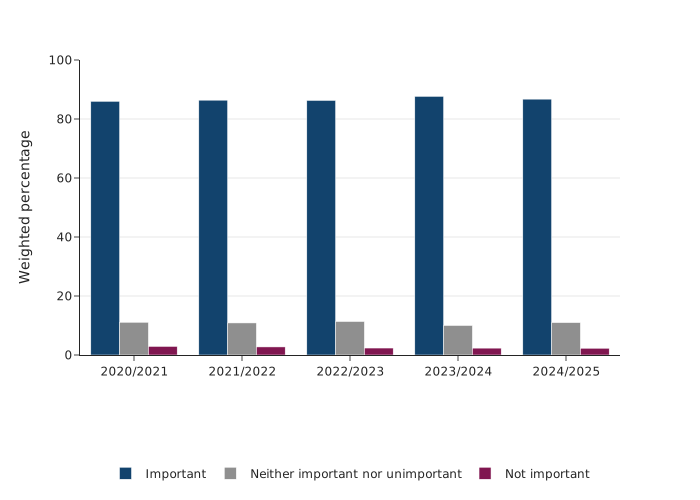
G6a: Percentage of adults in England reporting that protecting the environment is important to them, survey years 2020/2021 to 2024/2025
Source: Natural England
Download the data for this chart in .csv format
Notes on Component
Figure G6a is based on A-PaNS data collected in survey years (April to March) 2020/2021 to 2024/2025 with A-PaNS weightings applied. Base: All asked Module 4. It shows responses to the question [M4_Q2]: ‘How important is protecting the environment to you personally?’. Some response options have been combined for the purposes of this indicator.
Trend Description
A-PaNS data show that 87% of adults reported that protecting the environment is important to them. This figure is similar to previous years.
Assessment: G6a
No assessment of change was undertaken for this indicator as a suitable time series is not yet available in the Environmental Indicator Framework.
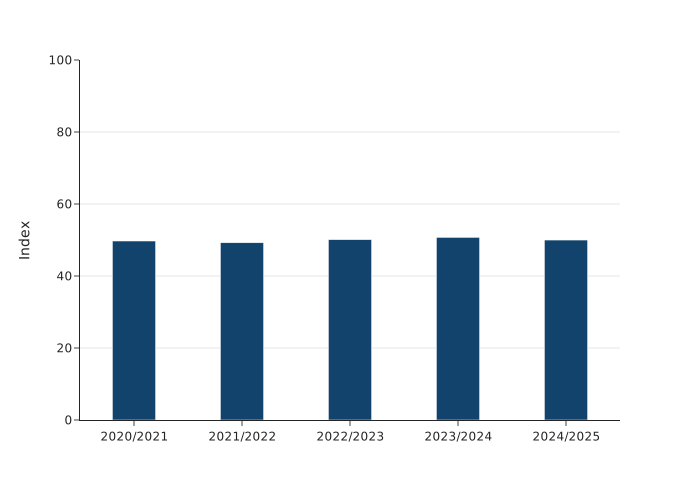
G6b: Adults’ pro-environmental behaviour score as an index from 0 to 100, England, survey years 2020/2021 to 2024/2025
Source: Natural England
Download the data for this chart in .csv format
Notes on Component
Figure G6b is derived from A-PaNS data collected in survey years (April to March) 2020/2021 to 2024/2025 with A-PaNS weightings applied. Base: All asked Module 4.
The indicator is based on responses to question [M4_Q11, options 1 to 9]: ‘Thinking about the last month, which of the following have you done?’. Scores from 0 (low pro-environmental behaviour) to 100 (high pro-environmental behaviour) represent an index of self-reported social action formed from the following statements:
- ‘Composted food waste, or put food waste out for collection’
- ‘Switched off lights and appliances to save energy or to protect the environment’
- ‘Recycled items’
- ‘Brought your own bags when shopping’
- ‘Bought products with an environmental label’
- ‘Bought produce that is grown locally or in season’
- ‘Bought second-hand items’
- ‘Watched wildlife or nature programmes’
- ‘Taken shorter showers to save water or energy’
Trend Description
A-PaNS data show that adults on average scored around 50 out of 100 on an index of reporting no pro-environmental behaviours (0) to high engagement with pro-environmental behaviours (100) from 2020/2021 to 2024/2025. On average, this equates to every adult carrying out half of the 9 pro-environmental behaviours included within this measure.
Assessment: G6b
No assessment of change was undertaken for this indicator as a suitable time series is not yet available in the Environmental Indicator Framework.
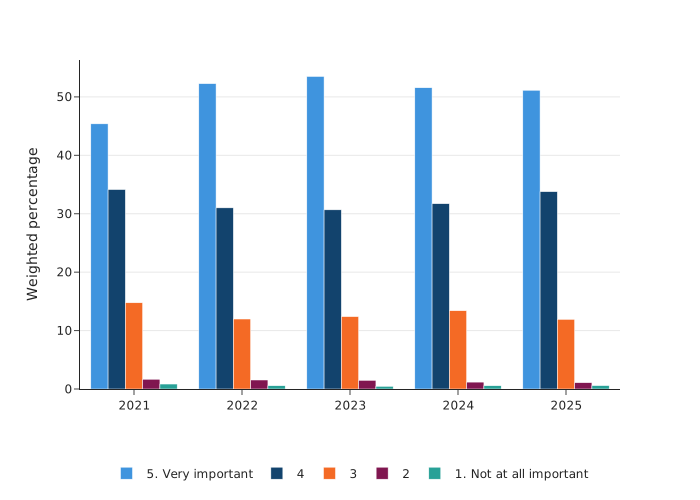
G6c: Percentage of children in England reporting that looking after the environment is important to them, survey years 2021 to 2025
Source: Natural England
Download the data for this chart in .csv format
Notes on Component
Figure G6c is based on C-PaNS data collected in survey years 2021 to 2025 with C-PaNS weightings applied. Data are collected at 2 time-periods each year, across 2 to 3 weeks in the school holidays (August) and again during term-time (September to October). Base: All respondents. It shows responses to question [CS_Q9]: ‘How important is looking after the environment to you?’.
Trend Description
C-PaNS data show that when asked about how important looking after the environment was to them on a scale of 1 (not at all important) to 5 (very important), around half of children (51%) said ‘5’ and around one-third (34%) said ‘4’ in 2025. Less than 3% said ‘2’ or ‘1’ in all 5 years.
Assessment: G6c
No assessment of change was undertaken for this indicator as a suitable time series is not yet available in the Environmental Indicator Framework.
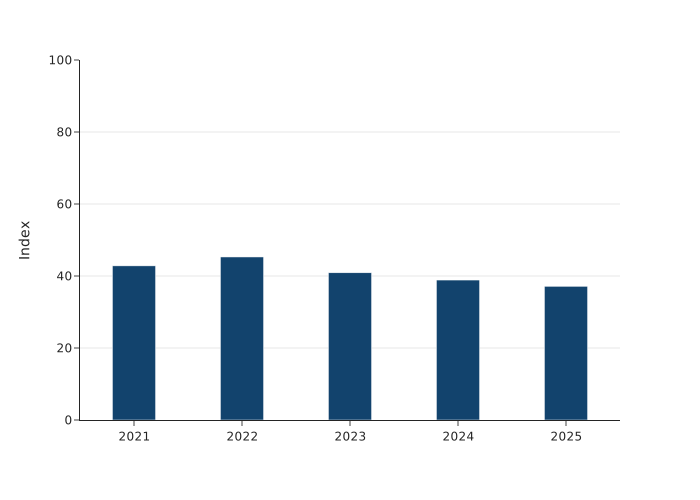
G6d: Children’s pro-environmental behaviour score as an index from 0 to 100, England, survey years 2021 to 2025
Source: Natural England
Download the data for this chart in .csv format
Notes on Component
Figure G6d is derived from C-PaNS data collected in survey years 2021 to 2025 with C-PaNS weightings applied. Data are collected at 2 time-periods each year, across 2 to 3 weeks in the school holidays (August) and again during term-time (September to October). Base: All respondents.
The indicator is based on responses to question [CS_Q10]: ‘Which of the following things do you do to look after the environment? There are lots of options but they may not all apply to you or all make sense. Only pick the ones you understand and do yourself to look after the environment.’ Scores from 0 (low pro-environmental behaviour) to 100 (high pro-environmental behaviour) represent an index of self-reported social action formed from the following statements:
- ‘Eat less meat (including vegetarian or vegan)’
- 'Turn lights off’
- ‘Turn the tap off while brush my teeth’
- ‘Think about the environment when I buy things’
- ‘Recycle my waste’
- ‘Do things in the garden to help the wildlife (for example, feed birds, grow plants that insects like, make homes for wildlife)’
- ‘Pick up litter’
- ‘Walk, cycle or take public transport as much as I can’
- ‘Read about (online or in books) or watch programmes about the environment’
Trend Description
C-PaNS data show that in 2025, children scored 37 out of 100 on an index of reporting no pro-environmental behaviours (0) to high engagement with pro-environmental behaviours (100). This figure has slightly decreased in recent years (from 43 in 2021). On average, this roughly equates to every child carrying out any 4 of the 9 pro-environmental behaviours included within this measure.
Assessment: G6d
No assessment of change was undertaken for this indicator as a suitable time series is not yet available in the Environmental Indicator Framework.
Metadata
| Primary Goal | Access to nature |
|---|---|
| Relevant Goals | Access to nature |
| Relevant Targets | Focusing on increasing action to improve the environment from all sectors of society |
| Natural Capital | Service or benefit associated with natural capital asset |
| Related Commitments | None |
| Geographical Scope | England |
| Development Status | Final |
| First Reported | 2022 |
| Latest Data | 2025 |
| Last Updated | May 2026 |
Return to Environmental Indicator Framework Collection Page
G7: Health and wellbeing benefits
Short Description
A growing body of research illustrated by a Defra funded Social Science Research Fellowship on the natural environment and human health and Natural England’s narrative review of reviews of nature exposure and human health and wellbeing in the UK provides evidence of how improved quality, access to and engagement with nature can impact on health and wellbeing, showing the interconnection between our own and our planet’s health. This indicator will therefore aim to show the benefits to human health and wellbeing that can be gained through England’s natural environments. This includes benefits gained from more people engaging with nature, but also more passive benefits through improvements in natural environments that may impact on human health and wellbeing (for example, improvements in air quality, climate regulation, and noise mitigation). The indicator will aim to track changes for people in disadvantaged groups and others who may benefit the most.
Readiness and Links to Data
This interim indicator presents data on self-reported mental and physical health benefits of nature from 2 of Natural England’s nationally representative surveys:
1) The Adults People and Nature Survey (A-PaNS) which began collecting data for adults on an on-going basis from 2 April 2020.
2) The Children’s People and Nature Survey (C-PaNS) which collects data for children twice yearly (beginning in 2021), once during school holiday-time and once in term-time.
More information on A-PaNS and C-PaNS survey methods, outputs and the full questionnaires, are available on the People and Nature Survey (PaNS) homepage.
Summary data for G7a and G7b are available in the Statistics and technical details for 2026 national indicators dataset.
This interim indicator may be superseded following an assessment of more appropriate national data to evidence the health and wellbeing implications of improvements in quality, access to and engagement with England’s natural environments.
Natural England carried out analysis to understand the health benefits gained from exposure to nature and to support the development of a potential new G7 Environmental Indicator Framework indicator. The report is available here on Natural England’s Access to Evidence website.
Notes on Indicator
Adults' and children’s results are not directly comparable due to the use of child-appropriate questions in the children’s surveys.
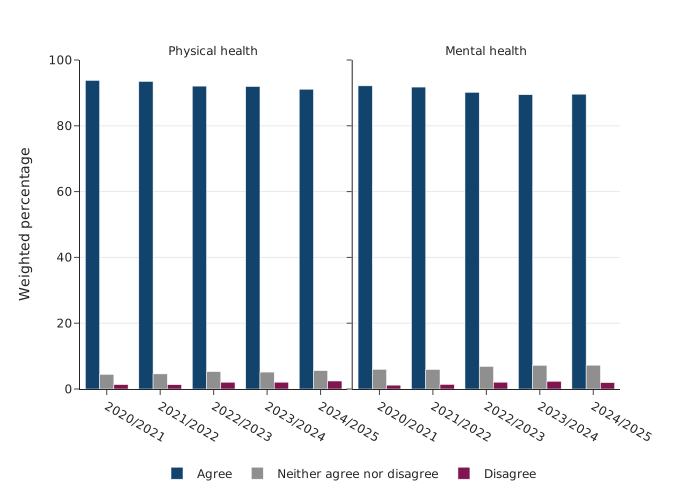
G7a: Percentage of adults in England reporting that time spent outdoors was good for their physical and mental health, survey years 2020/2021 to 2024/2025
Source: Natural England
Download the data for this chart in .csv format
Notes on Component
Figure G7a is based on A-PaNS data collected in survey years (April to March) 2020/2021 to 2024/2025 with A-PaNS weightings applied. Base: Respondents who had visited a green space in the last 14 days. It shows responses to question [M2A_Q9]: ‘To what extent do you agree or disagree with the following statements about this time spent outdoors. 1) It was good for my physical health, 2) It was good for my mental health’. Some response options have been combined for the purposes of this indicator.
Trend Description
A-PaNS data show that the majority of adults who had visited green and natural spaces in the last 14 days agreed that spending this time outdoors was good for their physical health (91% in 2024/2025). Similarly, 90% agreed that spending this time outdoors was good for their mental health.
Assessment: G7a
No assessment of change was undertaken for this indicator as a suitable time series is not yet available in the Environmental Indicator Framework.
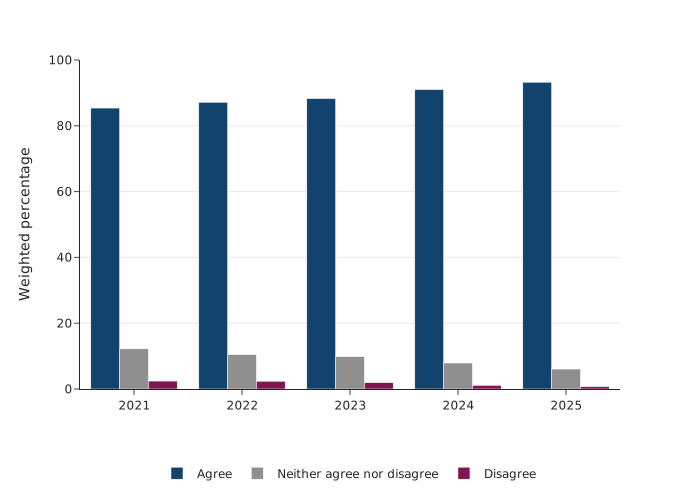
G7b: Percentage of children in England agreeing that being in nature makes them very happy, survey years 2021 to 2025
Source: Natural England
Download the data for this chart in .csv format
Notes on Component
Figure G7b is based on C-PaNS data collected in survey years 2021 to 2025 with C-PaNS weightings applied. Data are collected at 2 time-points each year, across 2 to 3 weeks in the school holidays (August) and again during term-time (September to October). Base: All respondents. It shows responses to question [CS_Q12a]: ‘How much do you agree or disagree with the following - Being in nature makes me very happy’. Some response options have been combined for the purposes of this indicator.
Trend Description
C-PaNS data show that the majority of children agreed with the statement that being in nature makes them very happy. It also appears that this figure has increased slightly over time, from 85% in 2021 to 93% in 2025.
Assessment: G7b
No assessment of change was undertaken for this indicator as a suitable time series is not yet available in the Environmental Indicator Framework.
Metadata
| Primary Goal | Access to nature |
|---|---|
| Relevant Goals | Access to nature |
| Relevant Targets | Making sure that there are high quality, accessible, natural spaces close to where people live and work, particularly in urban areas, and encouraging more people to spend time in them to benefit their health and wellbeing |
| Natural Capital | Service or benefit associated with natural capital asset |
| Related Commitments | May provide evidence in support of Climate Change Risk Assessment and the Adaptation Sub-Committee’s assessment of the National Adaptation Programme, under the Climate Change Act (2008) |
| Geographical Scope | England |
| Development Status | Interim |
| First Reported | 2022 |
| Latest Data | 2025 |
| Last Updated | May 2026 |