ESPAUR report 2025 to 2026: Chapter 9. ESPAUR oversight group members’ activities and actions to tackle AMR – mapping to the UK AMR National Action Plan
Published 12 November 2026

© Crown copyright 2026
This publication is licensed under the terms of the Open Government Licence v3.0 except where otherwise stated. To view this licence, visit nationalarchives.gov.uk/doc/open-government-licence/version/3 or write to the Information Policy Team, The National Archives, Kew, London TW9 4DU, or email: psi@nationalarchives.gov.uk.
Where we have identified any third party copyright information you will need to obtain permission from the copyright holders concerned.
This publication is available at https://www.gov.uk/government/publications/english-surveillance-programme-for-antimicrobial-utilisation-and-resistance-espaur/espaur-report-2025-to-2026-chapter-9-espaur-oversight-group-members-activities-and-actions-to-tackle-amr-mapping-to-the-uk-amr-national-action-pl
Main messages
The ESPAUR Oversight Group comprises over 30 stakeholder organisations including the UK nations and national organisations, professional and educational bodies, healthcare providers and regulators.
A total of 13 stakeholders have contributed to this year’s ESPAUR report comprising the British Dental Association (BDA), British Infection Association (BIA), British Society for Antimicrobial Chemotherapy (BSAC), College of General Dentistry (CGD), Microbiology Society, Royal College of General Practitioners (RCGP), Royal College of Nursing (RCN), Royal Pharmaceutical Society (RPS), UKCPA Pharmacy Infection Network (UKCPA-PIN), Veterinary Medicines Directorate (VMD), NHS England, Public Health Agency (Northern Ireland), Antimicrobial Resistance and Healthcare Associated Infection (ARHAI) Scotland (Figure 9.1).
A total of 30 updates from 6 organisations, British Infection Association, UKCPA Pharmacy Infection Network (PIN), Royal Pharmaceutical Society Antimicrobial Expert Advice Group, British Society for Antimicrobial Chemotherapy, Care Quality Commission (CQC), Veterinary Medicines Directorate, in support of 14 commitments and 5 outcomes within the 2024 to 2029 National Action Plan (NAP) for Antimicrobial Resistance (AMR) have been reported to ESPAUR between April 2025 and March 2026. These include, but are not limited to:
-
presenting national study findings to support antimicrobial stewardship (AMS) practice
-
developing international Outpatient Parenteral Antimicrobial Therapy (OPAT) good practice recommendations and piloting an evidence‑based accreditation approach for OPAT services
-
expanding national antimicrobial registries to strengthen AMR data and clinical engagement
-
delivering targeted webinar series to enhance knowledge of emerging antimicrobial treatments and AMS practices
-
contributing to international discussions on AMR, emphasising One Health and global representation
-
engaging in political advocacy to raise the profile of AMR and promote diagnostic stewardship in national policy discussions
The ESPAUR Oversight Group comprises over 30 stakeholder organisations including the UK nations and national organisations, professional and educational bodies, healthcare providers, regulators and has the following members:
- Department of Health and Social Care (DHSC), including the AMR Policy Team, Dental Public Health, and the Office for Health Improvement and Disparities (OHID)
- DHSC Expert Advisory Committee on Antimicrobial Prescribing, Resistance and Healthcare Associated Infection (APRHAI)
- British Dental Association (BDA)
- British Infection Association (BIA)
- Bennett Institute for Applied Data Science (OpenPrescribing/OpenSAFELY)
- British National Formulary (BNF)
- British Society for Antimicrobial Chemotherapy (BSAC)
- Care Quality Commission (CQC)
- College of General Dentistry (CGD)
- Independent Healthcare Providers Network (IHPN)
- IQVIA
- Microbiology Society
- National Pharmaceutical Advisers Group/ICB Chief Pharmacist representation
- National Institute of Health and Care Excellence (NICE)
- NHS England (NHSE)
- Primary Care Pharmacy Association (PCPA)
- Royal College of Nursing (RCN)
- Royal College of Pathologists
- Royal College of Physicians (RCP)
- Royal College of General Practitioners (RCGP)
- Royal College of Surgeons (RCS)
- Royal College of Paediatrics and Child Health (RCPCH)
- Royal Pharmaceutical Society (RPS)
- Rx-Info Ltd
- Specialist Pharmacy Service (SPS)
- UK Clinical Pharmacy Association: Pharmacy Infection Network (UKCPA PIN)
- Veterinary Medicines Directorate (VMD – DEFRA)
- Antimicrobial Resistance and Healthcare Associated Infection (ARHAI) Scotland
- NHS National Services Scotland
- Public Health Scotland
- Public Health Wales
- Public Health Agency Northern Ireland (Health and Social Care Northern Ireland – HSCNI)
- Public partner and patient representation
- UKHSA (previously PHE) (represented by individuals with appropriate expertise from AMR and HCAI Division, Behavioural Insights, regions, Field Service, microbiology services and communications teams)
British Dental Association (BDA)
The BDA works nationally and internationally, addressing the role of dentistry in AMR.
Dr Mick Armstrong and Dr Susie Sanderson OBE, Chair and member respectively, of BDA’s Health and Science Committee, represent the BDA on the Council of European Dentists’ Oral Health working group, contributing to a Council of European Dentists resolution on AMR and One Health.
The World Dental Federation Task Team on Preventing AMR and Infections, chaired by the BDA Health and Science Committee member, Dr Wendy Thompson, continues to advocate for the role of dentistry within the AMR agenda.
Dr Thompson was invited to speak about AMR and oral health, by the Union for International Cancer Control (UICC) at side meetings of the World Health Assembly (May 2025) and invited by UICC, the Norwegian Cancer Society and Norway’s Mission to the UN, to speak at the UN High Level Meeting on non-communicable diseases (September 2025).
The BDA supported a World AMR Awareness Week statement, alongside 22 national dental organisations (November 2025).
BDA colleagues co-authored a poster on perceptions of patient requests for antibiotics, utilising BDA’s annual General Dental Practitioner survey, which was presented at the British Society for Oral and Dental Research Early Careers Researchers Conference (March 2026).
The BDA consulted with the Scottish Dental Clinical Effectiveness Programme (SDCEP) on the Drug Prescribing for Dentistry guidance update. Dr Leonard Maguire, Northern Ireland Dental Practice Committee, participated in SDCEP’s short-life working group to update Antibiotic Prophylaxis Against Infective Endocarditis implementation advice.
British Infection Association (BIA)
The BIA is professional organisation and registered charity. Its aim is to maintain and improve the quality of care provided by clinical infection services. The association fulfils this aim by supporting healthcare workers from a variety of disciplines who provide care for patients with infection. Support is provided through conferences, education resources, a member’s email discussion forum, research grants and publication of research through the ‘Journal of Infection and Clinical Infection in Practice’. Throughout 2025 and 2026 activities have included:
- launch of a new podcast, More Infection Chat, which discusses articles published in the BIA journals, ‘Clinical Infection in Practice’ and ‘Journal of Infection’ – the podcast supports the dissemination of evidence that include those that relate to the appropriate use of antibiotics
- ‘Infection Quick Reference Guide July 2025: Fever in the Returning Traveller’ which details the diagnosis and treatment of infections in an integrated way across different settings
- ‘Best Practice Standards for the delivery of NHS Infection Service in the United Kingdom’ was updated in March 2025, detailing the role of the infection workforce in delivery of current service (produced in collaboration with the Royal College of Pathologists)
- position statement produced in collaboration with the Intensive Care Society in October 2025 – use of continuous infusion for piperacillin/tazobactam and meropenem within critical care settings within the UK
British Society for Antimicrobial Chemotherapy (BSAC)
The BSAC’s mission is to build the world’s most dynamic community of infection experts. Its vision is a world where the workforce is equipped to prevent and manage infection, including those due to drug-resistant pathogens. BSAC fulfils the mission and works toward the vision by providing high-quality open access support to a wide range of professionals across the world. This support takes many forms: free membership, workshops, conferences, educational resources, advocacy and the publication of research via its Journal of Antimicrobial Chemotherapy and the online open access education and research journal JAC-Antimicrobial Resistance.
The society offers a rich portfolio of activities that support the UK National Action Plan (NAP) alongside many other local, national, regional and global efforts to neutralise the threat of AMR. Throughout 2025 to 2026 these activities included:
- extending the Global Antimicrobial Stewardship Accreditation Scheme (GAMSAS), a continuous quality improvement programme seeking to identify barriers to successful antimicrobial stewardship (AMS) practice and build a global community of accredited AMS Centres of Excellence – as of 2026, more than 20 organisations have been accredited around the world (the GAMSAS scheme features as a case study in the current UK AMR NAP)
- piloting the LEAP (Leadership into Antimicrobial Stewardship), a 9-month mentoring programme that aims to support a broad range of healthcare professionals to work within existing AMS programmes to specifically promote, embed and provide peer support in AMS within their clinical area, providing AMS leadership amongst their peers
- providing the secretariat for the All-Party Parliamentary Group on Antimicrobial Resistance, orchestrating meetings with UK government ministers and civil servants, and conducting global campaign partnerships through Stop Superbugs and Wounds That Won’t Heal
- operating a PhD Parliamentary Internship programme through the office of Baroness Natalie Bennett, Dr Danny Chambers MP and Beccy Cooper MP
- running an Infection Learning Hub which includes more than 70 open access e-learning courses with more than a quarter of a million learners worldwide
- embedding the UK Outpatient Parenteral Antimicrobial Therapy (OPAT) programme which aims to bring care closer to home – BSAC has worked with NHSE to develop a business case and cost calculator to support the establishment of new services and to aid the expansion of existing ones
- managing the UK Antimicrobial Registry, developed in partnership with the University of Aberdeen, to capture the real-world use of antimicrobial agents and to identify where unmet clinical need lies
- maintaining a national susceptibility testing programme, supporting laboratories using EUCAST methodologies and serving as the national susceptibility testing committee for the UK
- supporting the Drug Stability Testing Programme to provide an expanding repository of open access data on the stability of drugs and medical devices, compliant with UK NHS standards as provided by the relevant Yellow Cover Documents
The society is also a registered National Institute for Health and Care Research (NIHR) partner and serves, and is available to serve, as an implementation partner on large consortia research projects and randomised controlled trials.
College of General Dentistry (CGD)
For World AMR Awareness Week 2025, the CGD joined with 22 other national dental organisations to support the theme Act Now: Protect Our Present, Secure Our Future: CGD is proud to collaborate with the UK Research and Innovation-funded PEOPLE AMR Transdisciplinary Network which is delivering person-centre AMS across One Health setting. Looking ahead, it is delighted to be working with the team from Universities of Oxford, Manchester, Reading, Surrey, Aberystwyth, Bristol and Cardiff over the next 4 years to deliver the EMOTIVE-AMS study ‘Emotion-informed Messaging to Optimise prescribing and Tackle Inappropriate Veterinary and human antibiotic use in the community’.
In support of the refreshed NICE guidance on antibiotic prophylaxis for infective endocarditis, the CGD provided expert review of implementation advice produced by the Scottish Dental Clinical Effectiveness Programme (SDCEP).
Over the year, the CGD also contributed to international efforts to tackle AMR through the International College of Dentists and International Association for Dental, Oral and Craniofacial Research (IADR). Dr Thompson was lead author of the IADR Policy Statement on AMR and received its Distinguished Scientist Award in Pharmacology, Therapeutics and Toxicology Research in recognition of her leadership in the field dental AMS.
Microbiology Society
The Microbiology Society is a membership charity for scientists interested in microbes, their effects and their practical uses. It has a worldwide membership based in universities, industry, hospitals, research institutes, schools, and other organisations.
Microbiology Society members have a unique depth and breadth of knowledge about the discipline. The society’s role is to help unlock and harness the potential of that knowledge. We do this by bringing together and empowering communities that shape the future of microbiology. We generate public benefit by fostering communication both among communities of microbiologists and between microbiologists and other communities who can translate that knowledge in useful ways.
To this end, the Microbiology Society is committed to supporting members working to provide solutions to the AMR crisis. In 2023 the society launched the ‘Knocking Out AMR’ project which aims to promote effective solutions to minimise AMR through cross-disciplinary and multisector collaboration worldwide within a ‘One Health’ context.
In the period between April 2025 and March 2026, the Microbiology Society has:
-
responded to Ireland’s third NAP on AMR and organised a panel discussion with Department of Agriculture Environment and Rural Affairs, Environmental Protection Agency and Department of Health
-
hosted 4 cross-disciplinary ‘AMR in Focus’ webinars where topics included –
-
‘On the frontline: A Clinician’s Reality of AMR in the UK’
-
‘Taking STRIDES: The value of diagnostics against AMR’
-
‘Surveillance to Policy’
-
‘Transitioning from academia to industry’
-
-
published article on AMR in Wastewater for the National Preparedness Commission
-
collected and submitted feedback to the Global Action Plan on AMR
-
hosted a panel discussion on the role of SMEs in AMR at Innovations Against AMR summit
-
delivered ‘Resilience against Resistance: The Future of Antimicrobial Resistance in Mexico’ workshop at British Embassy in Mexico
-
published ‘Towards biofilm innovation: how can we tackle challenges and unlock potential?’ policy briefing
-
published ‘How can vaccines help against AMR’ animation
-
launched AMR Innovation Exchange Webinar Series in collaboration with the Global AMR Innovation Fund team at the Medicines and Healthcare products Regulatory Agency (MHRA)
-
delivered a range of public engagement activities from its Champions Scheme
-
continued to promote success stories from its members working within AMR
In 2026 and 2027 the society will continue to develop its offering to its global membership to support their ongoing work to deliver solutions to AMR.
Royal College of General Practitioners (RCGP)
The RCGP continues to collaborate with UKHSA to implement the TARGET antibiotics toolkit to help primary care providers use AMS interventions in their practices (see Chapter 6). In addition, the RCGP incorporates AMS topics within the clinical learning programme.
The RCGP Prescribing and Medicines Optimisation Special Interest Group, clinical advisers and representatives have supported AMS through collaboration with the RCGP clinical policy team.
RCGP clinical policy has identified ‘preventive medicine’ as its key clinical policy priority, and within this vaccination and AMR are 2 key areas. The college shall be publishing a paper on prevention in general practice in the coming months with key recommendations and case examples of good practice.
It has developed a policy statement recognising the importance of medication reviews. In terms of AMS, this is particularly important for minimising the risk of extended courses of prophylactic antibiotics for example for urinary tract infections. The statement recognises that “support and resources should be provided at national and local levels for the implementation of medication reviews as part of person-centred care”.
As part of this statement, RCGP has highlighted the importance of clinical leadership: “NHSE and ICBs should embed GP clinical leadership within medicines optimisation structures at practice, neighbourhood, ICB and national levels, ensuring that GPs work collaboratively with pharmacy teams to strengthen clinical governance and support effective, safe medication optimisation.”
A policy submission for medic representation within the NHSE document ‘Workforce for AMS strategic planning (WASSP)’ was accepted in the draft (not yet published by NHSE).
RCGP contributes to national consultations including MHRA and NICE guidelines, quality standards and indicators, including responses from the RCGP clinical advisors network.
A RCGP Medicines Optimisation SIG member has provided a brief update on ESPAUR via AWTTC learning at lunch, and the group highlighted emerging issues within the regular forums.
Royal College of Nursing (RCN)
The RCN hosted an AMR summit ‘Empowering nurses to take a leading role in AMS’ in November 2025. The focus was on empowering nurses to lead on infection prevention reducing the need for antimicrobial prescriptions, the importance of nurse-led innovations in AMS and current challenges and future threats of AMR in the nursing workforce.
AMR continues to be part of the infection prevention and control (IPC) programme offered by the RCN as well as in the conferences scheduled for 2026.
Royal Pharmaceutical Society (RPS)
The RPS became the Royal College of Pharmacy in April 2026, and the Antimicrobial Expert Advisory Group (AmEAG) continues to support the members and the oversight panel with expertise related to antimicrobials. The group is meeting this month to refine our workplan which is aligned with the NAP, and the activities are designed to support colleagues in all sectors of pharmacy to engage with and raise awareness of AMS. The June AmEAG meeting will discuss World Antimicrobial Resistance Awareness Week (WAAW) activities that can be undertaken by the Royal College of Pharmacy.
The workplan includes supporting the sustainability agenda and AmEAG are now represented in the Infection Societies’ Sustainability Forum.
UKCPA Pharmacy Infection Network (PIN)
The UKCPA is a hub for pharmacy-led and delivered infection education, networking and original practice-based research. The UKCPA PIN Committee provides support for pharmacy infection professions via educational activities, an online forum for sharing best practices between members, and collaborates with other expert groups. Throughout 2025 and 2026 activities to support the NAP have included:
Education
Unlocking Better Infection Management
This in-person masterclass in October 2025 brought together pharmacy professionals from across the UK and had the following learning outcomes:
- enhanced knowledge of AMS strategies
- application of AMS research
- expanding the AMS workforce
Bug Busters – Next Generation Solutions
This series of webinars focused on new approaches to old problems:
- fungal infections and new antifungals
- building a penicillin allergy de-labelling service
- phage therapy in infection
Antimicrobial stewardship – working together towards the NAP
This was a presentation at Clinical Pharmacy Congress North.
The committee posts a weekly infection round up on the UKCPA forum. This includes signposting to recently published landmark papers, upcoming educational activities and weekly talking points on AMR and AMS.
Collaborations
Committee members have been working with UKHSA to produce scenarios where the prescribing of fluroquinolone antibiotics may be considered. The work is expected to be published in 2026 and is in response to the repeated MHRA warnings regarding this class of medication.
Members of the committee have contributed to a report titled ‘Infection Prevention and Management in the UK: the infection-specialist workforce’. This has been co-ordinated on behalf of the Royal College of Physicians and includes contributions from many infection societies.
Consultations
The Pharmacy Infection Network is a registered NICE stakeholder and responds to consultations on guidelines, quality standards and indicators.
The network responded to the recent UKHSA consultations on Intravenous to Oral Switch, Start Smart Then Focus and Antimicrobial Prescribing and Stewardship competency framework as well as responding to the 10-year NHS workforce plan survey.
Veterinary Medicines Directorate (VMD)
The VMD coordinates the Animals, Plants, Food, and Environment (APFE) components of the UK’s AMR NAP, 2024 to 2029. This includes managing Defra’s commitments and overseeing the UK-wide APFE Delivery Board. The wider Defra Implementation Plan represents roughly 130 deliverables contributing to 17 of the 30 commitments within the AMR NAP.
The UK Veterinary Antibiotic Resistance and Sales Surveillance (VARSS) 2024 Report was published in November 2025. The report uses a new mg/kg metric for sales and usage data, which better represents UK animal populations and allows UK data to be compared to that published across Europe. Total antibiotic sales in food-producing animals have remained stable between 2023 and 2024 and have decreased by 57% since 2014. However, both the pig and gamebird sectors recorded an uptick in use over the last 2 years. Results from our AMR harmonised monitoring programme show an overall encouraging picture in key resistance findings measured in healthy poultry. We also presented 10 years of clinical surveillance data for each animal species for the first time. Sporadic findings of resistance to human-only antibiotics may suggest possible environmental or indirect transmission routes.
AMR resistance and sales surveillance data in the UK animal population from 2025 will be published in the upcoming VARSS report in November 2026 and will be available at Veterinary Antimicrobial Resistance and Sales Surveillance.
The VMD continues to work closely with the livestock and companion animal sectors to promote good AMS and antibiotic use data collection. In November 2025, the APFE Delivery Board endorsed the Responsible Use of Medicines in Agriculture Alliance (RUMA) Targets Task Force’s third cycle of antimicrobial use (AMU) targets covering 2025 to 2029. The board also endorsed the UK’s first national antimicrobial use reduction targets for companion animals, led by the RUMA Companion Animal and Equine (CA&E) Targets and Measures Working group, which were published in December 2025.
The VMD has supported the aims of the Ruminant Antibiotic Stewardship Roadmap (RR) to strengthen and evidence responsible AMS across the UK’s ruminant sectors. We helped with the creation of the RR stakeholder survey, which ran during early 2026, to ensure questions would generate meaningful responses. Publication of the roadmap is scheduled for October 2026. Additionally, the VMD supports the goals of the mandatory proposals for the Defra Animal Health and Welfare Pathway, which includes improving national livestock health and welfare, enhancing biosecurity and supporting disease eradication. We helped Defra to share and discuss the consultation survey with the veterinary profession and farming community and look forward to continuing to work with Defra’s pathway team on the best way forward.
In parallel to livestock work, there is encouraging progress in the companion animal sectors. For the first time, we have reported on equine antibiotic usage with data collected from approximately 25% of the sector. Stewardship is also moving in the right direction, with sales of antibiotics for dogs and cats showing a sustained downward trend. These developments are supported by work led by the VMD to close longstanding AMR data gaps in companion animals. In July 2025, the VMD launched the ‘Healthy Cats and Dogs’ pilot project which aims to establish a baseline level of AMR in healthy pets in the UK and identify the most effective methods for national surveillance of companion animals. This project marks a major step forward and is progressing well with over 1000 Ipsos pet owners survey responses.
AMR surveillance in animals is well established in the UK; however, most clinical testing is done by private veterinary laboratories and is not shared with government. The Private Laboratories Initiative (PLI), led by the VMD, continues to build partnerships with private veterinary laboratories to improve the sharing and incorporation of privately held clinical AMR data into government surveillance outputs. The initiative includes 4 key animal sectors (companion animals, farm animals, fish, and equine) and sits under the Biosecurity Portfolio of Cabinet Office’s Integrated Security Fund (UKISF). The PLI was recently awarded 2 additional years of funding to extend its work until March 2028.
In addition to the PLI, the VMD was also awarded 2 years of UKISF biosecurity funding to deliver AMR BioBorders, a new cross-government project using metagenomic surveillance to detect AMR in imported raw meat destined for raw pet food. This work will strengthen UK border biosecurity, address an existing surveillance gap, and provide evidence to protect both animal and public health. Building on the networks and collaboration begun under PATH-SAFE, this project will enable the UK to make risk-based decisions about surveillance and control measures.
The Advisory Committee on Antimicrobial Prescribing, Resistance and Healthcare Associated Infection (APHRAI) and the Defra Antimicrobial Resistance Coordination (DARC) Group are finalising the results from a joint-exercise prioritising each of the 30 NAP 2024 to 2029 commitments against 4 criteria (impact, cost-effectiveness, feasibility, and likelihood of achieving meaningful progress) using a One Health perspective. This exercise aims to enhance the focus and prioritisation of activity towards commitments.
Internationally, VMD continues to work alongside Foreign, Commonwealth and Development Office and the DHSC to identify and prioritise impactful diplomatic and technical international activities, to help deliver the Political Declaration on AMR agreed at the United Nations General Assembly High-Level Meeting in 2024. This includes Defra and VMD leading the UK’s top priority of supporting the establishment of a global Independent Panel for Evidence and Action Against AMR (IPEA).
NHS England regional team
Between June and September 2025, the East of England regional team (supported by the North West and South East regions) developed an audit tool to understand AMS activities and limitations in community health services, mental health services and health and justice providers. Participating organisations were asked to audit their antibiotic prescribing over a 2-week period in October 2025. No patient identifiable information was requested or provided. Completed audits were returned to the project team for collation and analysis.
Twenty-eight organisations participated in the audit and returned data. The majority of responses (54%, n=15) were received from organisations who provide both community and mental health services and accounted for 83% (n=1,211) of all audited prescriptions. Overall:
- 1,453 prescriptions were audited
- 92% were compliant with NICE and local guidelines or microbiology advice
- 88% were prescribed with the correct course length
- 15% were broad-spectrum antibiotics
The majority of incorrect choices of antibiotic were metronidazole and co-amoxiclav, suggesting education on correct use of these antibiotics is required. Broad spectrum antibiotic use continues to be driven by co-amoxiclav use, suggesting intervention is needed. The majority of incorrect course lengths were for co-amoxiclav and doxycycline, suggesting education or interventions are required.
Public Health Agency, Northern Ireland
Over the last year, the Public Health Agency (PHA), Strategic Planning and Performance Group (SPPG) and wider HSC partner organisations progressed a coordinated programme of work to support delivery of the UK AMR NAP 2024 to 2029, with activity spanning public engagement, IPC, AMS, surveillance and workforce development. Aligned with commitment 2.1 and 2.2 an extensive programme of community engagement was rolled out to strengthen AMR awareness and promote appropriate antibiotic use.
During World Antimicrobial resistance Awareness Week (WAAW) an AMR roadshow event travelled into medical centres, shopping centres and leisure centres across Northern Ireland to reinforce key prevention and self-care messages. Our NI STEM ambassadors used the e-Bug lessons to connect and inspire children and young people across 15 schools, in both primary and post-primary education. To optimise management of urinary tract infections (commitment 4.1), PHA and SPPG established a regional UTI working group bringing together expertise in infection prevention and primary care AMS to develop a Skip the Dip campaign with the aim to align messages across independent care homes and primary care, improve clinical pathways and reduce unwarranted variation in the diagnosis and management of these common infections.
To build system capability for data driven stewardship (commitment 3.2), SPPG advanced the development and testing of a primary care dashboard to improve visibility of prescribing and utilisation patterns and support targeted quality improvement. To promote and support appropriate antimicrobial prescribing (commitment 4.2) funding was secured to launch a regional penicillin allergy service, enabling comprehensive allergy assessment and supporting safe use of first line agents where appropriate. Additionally, the secondary care workstream established a regional process for developing and adopting guidance across all trusts, with multiple guidelines now in development to standardise best practice and strengthen stewardship.
Workforce capability was enhanced through IPC HCID train the trainer provision (commitment 1.1 and 5.1), expanding local capacity to deliver consistent, high quality IPC training. To meet our commitment to the health and social care workforce (5.2), the Chief Medical Officer wrote to regional academic institutions delivering undergraduate healthcare programmes to request support for the NI AMR implementation plan and to strengthen AMR content within curricula, helping embed stewardship and IPC principles across the future workforce. This wide and varied programme of work demonstrates a co-ordinated whole-system approach to support delivery of the UK AMR NAP 2024 to 2029.
Scottish One Health Antimicrobial Use and Antimicrobial Resistance
NHS Scotland continue to support delivery of the UK NAP 2024 to 2029 through the Human Health Antimicrobial Resistance and Prescribing Surveillance (HHARPS) Programme (formerly the SONAAR Programme), led by ARHAI Scotland. The programme provides coordinated national surveillance of antimicrobial use (AMU), AMR, and infection across human healthcare settings, with public reporting through the Scottish One Health Antimicrobial Use and Antimicrobial Resistance (SONAAR) annual report.
Aligned with the NAP One Health approach, HHARPS monitors trends in AMU and AMR across primary care and acute hospitals, alongside integrated animal health surveillance in partnership with Public Health Scotland. These outputs provide actionable intelligence on prescribing patterns, resistance in key pathogens, and infection burden, directly supporting AMS (Outcome 4) through prescribing optimisation, national guidance, and diagnostic and laboratory strategies in collaboration with the Scottish Antimicrobial Prescribing Group (SAPG) and Scottish Microbiology and Virology Forum (SMVF).
During 2025, HHARPS strengthened delivery against NAP priorities, including Outcome 3 (strengthened surveillance) through enhanced data integration and linkage. In relation to Outcome 8 (health inequalities), work is underway to develop options for expanded reporting stratified by inequality characteristics. Additional developments include enhanced AMU surveillance, including national monitoring of methenamine use, and continued development of linked AMU, AMR, and infection analyses to inform targeted stewardship interventions and reduce inappropriate antimicrobial use.
The next SONAAR report will be published in November 2026, aligned with World Antimicrobial Awareness Week, with coordinated delivery by ARHAI Scotland (human health) and PHS (animal health), ensuring a sustained, coherent One Health contribution to UK AMR surveillance.
Mapping actions being taken by ESPAUR Oversight Group members to support progress towards commitments and targets within the UK National Action Plan 2024 to 2029
ESPAUR Oversight Group (OG) members are encouraged to submit their AMR activities to the UKHSA ESPAUR team quarterly. A total of 30 updates from 6 organisations in support of the 2024 to 2029 UK AMR NAP commitments and outcomes have been reported to ESPAUR between April 2025 and March 2026. Below are AMR and AMS activities submitted by ESPAUR OG members to support progress towards the 2024 to 2029 AMR NAP that have been collated and individually linked to the 2024 to 2029 UK AMR NAP outcomes and commitments.
Stakeholders have undertaken a range of activities, including but not limited to:
-
presenting national study findings to support AMS practice
-
developing international OPAT good practice recommendations and piloting an evidence‑based accreditation approach for OPAT services
-
expanding national antimicrobial registries to strengthen AMR data and clinical engagement
-
delivering targeted webinar series to enhance knowledge of emerging antimicrobial treatments and stewardship practices
-
contributing to international discussions on AMR, emphasising One Health and global representation
-
engaging in political advocacy to raise the profile of AMR and promote diagnostic stewardship in national policy discussions
AMR and AMS activities reported by ESPAUR Oversight Group members’ organisations to support 2024 to 2029 AMR NAP
British Infection Association (BIA)
NAP outcome and commitment
Theme: Optimising the use of antimicrobials
Outcome: Antimicrobial stewardship and disposal
Commitment: 4.1; Clinical decision support, 4.2; Appropriate prescribing and disposal
AMR and AMS Activity to support the UK 2024 to 2029 NAP
The BIA hosted a Critical Care Infection Dilemmas Day which focussed on addressing antibiotic use and diagnostics in critical care for trainees and specialists in Infectious Disease, Microbiology, and Critical Care Medicine. The day allowed discussions on cases and lectures were given by critical care infections experts, range of within the field of, as well as providing opportunities to contribute to debate.
UKCPA Pharmacy Infection Network (PIN) Committee
NAP outcome and commitment
Theme: Investing in innovation, supply and access
Outcome: Using information for action
Commitment: 7.1; Evidence generation and use, 7.2; Research network
AMR and AMS Activity to support the UK 2024 to 2029 NAP
UKCPA PIN collated data from a nationwide study of teicoplanin use in hospital practice (TUCK-SHOP), designed and led by members of the PIN committee. Data from the TUCK-SHOP study was reported at the UKCPA PIN Masterclass for primary and secondary care pharmacists involved in the patient care and those working in AMS. The masterclass aimed to provide an update on the current AMS agenda in the modern NHS.
Royal Pharmaceutical Society Antimicrobial Expert Advice Group
NAP outcome and commitment
Theme: Optimising the use of antimicrobials
Outcome: AMR workforce
Commitment: 5.1; Health and social care training
AMR and AMS Activity to support the UK 2024 to 2029 NAP
The Royal College of Pharmacy Antimicrobial Expert Advisory Group support colleagues in NAP related work. The Royal College of Pharmacy intranet page signposted resources related to AMS and for World AMR Awareness Week 2025. Members of the Expert Advisory Group delivered blogs discussing AMS in a range of settings including primary care.
British Society for Antimicrobial Chemotherapy
NAP outcome and commitment
Theme: Being a good global partner
Outcome: AMR workforce
Commitment: 9.1; Prevention and preparedness, 9.2; Access and Stewardship, 9.5; Advocacy and engagement
AMR and AMS Activity to support the UK 2024 to 2029 NAP
The BSAC continues work on political advocacy and provides the secretariat function for the All Party Parliamentary Group (APPG) on AMR, chaired by Rebecca Cooper MP and Public Health Doctor. Recent meetings have focussed on the impact of global conflict on AMR and the release of the National Security Strategy as well as the ‘Diagnostics into Practice’ initiative emphasising the need to optimise diagnostic stewardship.
Care Quality Commission (CQC)
NAP outcome and commitment
Theme: Optimising the use of antimicrobials
Outcome: AMR workforce
Commitment: 5.1; Health and social care training
AMR and AMS Activity to support the UK 2024 to 2029 NAP
The CQC have used an internal bulletin to explain antimicrobial resistance, promote a training module and encourage staff to sign up as antibiotic guardians.
The CQC Medicines Optimisation Team has worked on the 2026 annual Chief Pharmacist Engagement call with on average 94% of trusts in England to discuss AMS. Information gathered from each trust will be used to contribute to the annual State of Care report to demonstrate good practice and highlight areas for improvement.
Figure 9.1. Examples of activities undertaken by ESPAUR Oversight Group members to support the UK National Action Plan for AMR 2024 to 2029
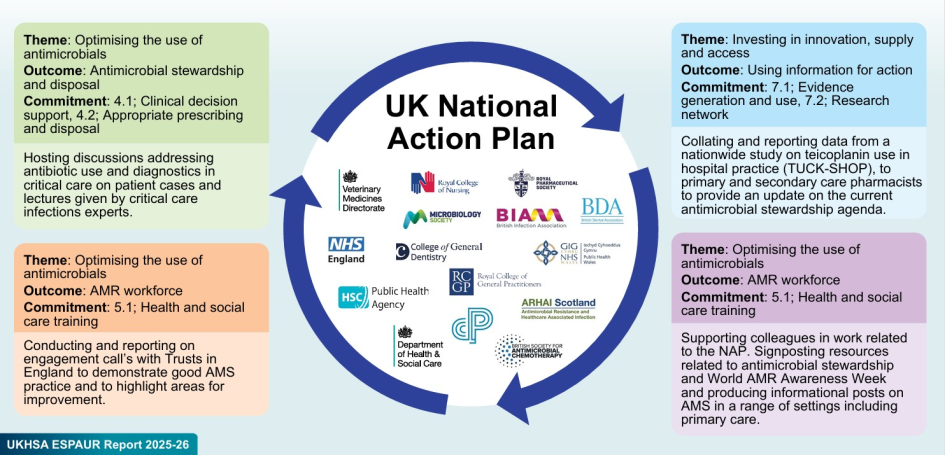
This infographic highlights the ESPAUR Oversight Group members who have contributed to this years’ ESPAUR report by sharing their activities undertaken to support commitments within the UK National Action Plan for AMR 2024-29.
A circle in the centre of the infographic contains the logos of the organisations who have contributed to this years’ ESPAUR report. Four boxes around the circle contain examples of the work that ESPAUR Oversight Group members have conducted that support the National Action Plan for AMR and not a comprehensive list.
The top left box contains the text:
Theme: Optimising the use of antimicrobials
Outcome: Antimicrobial stewardship and disposal
Commitment: 4.1; Clinical decision support, 4.2; Appropriate prescribing and disposal
Hosting discussions addressing antibiotic use and diagnostics in critical care on patient cases and lectures given by critical care infections experts.
The top right box contains the text:
Theme: Investing in innovation, supply and access
Outcome: Using information for action
Commitment: 7.1; Evidence generation and use, 7.2; Research network
Collating and reporting data from a nationwide study on teicoplanin use in hospital practice (TUCK-SHOP), to primary and secondary care pharmacists to provide an update on the current antimicrobial stewardship agenda.
The bottom left box contains the text:
Theme: Optimising the use of antimicrobials
Outcome: AMR workforce
Commitment: 5.1; Health and social care training
Conducting and reporting on engagement call’s with Trusts in England to demonstrate good AMS practice and to highlight areas for improvement.
The bottom right box contains the text:
Theme: Optimising the use of antimicrobials
Outcome: AMR workforce
Commitment: 5.1; Health and social care training
Supporting colleagues in work related to the NAP. Signposting resources related to antimicrobial stewardship and World AMR Awareness Week and producing informational posts on AMS in a range of settings including primary care.
The organisations that have contributed to this years’ ESPAUR report are:
· British Dental Association (BDA)
· British Infection Association (BIA)
· British Society for Antimicrobial Chemotherapy (BSAC)
· College of General Dentistry
· Microbiology Society
· Royal College of General Practitioners
· Royal College of Nursing
· Royal Pharmaceutical Society
· UKCPA Pharmacy Infection Network (PIN)
· Veterinary Medicines Directorate (VMD)
· NHS England
· Department of Health and Social Care
· Public Health Agency, Northern Ireland
· ARHAI Scotland (Scottish One Health Antimicrobial Use and Antimicrobial Resistance (SONAAR))