ESPAUR report 2025 to 2026: Chapter 4. AMR and AMU spotlights
Published 12 November 2026

© Crown copyright 2026
This publication is licensed under the terms of the Open Government Licence v3.0 except where otherwise stated. To view this licence, visit nationalarchives.gov.uk/doc/open-government-licence/version/3 or write to the Information Policy Team, The National Archives, Kew, London TW9 4DU, or email: psi@nationalarchives.gov.uk.
Where we have identified any third party copyright information you will need to obtain permission from the copyright holders concerned.
This publication is available at https://www.gov.uk/government/publications/english-surveillance-programme-for-antimicrobial-utilisation-and-resistance-espaur/espaur-report-2025-to-2026-chapter-4-amr-and-amu-spotlights
Main messages
Surveillance data on antimicrobial resistance (AMR), antimicrobial use (AMU), diagnostics and infectious disease epidemiology provide intelligence to support antimicrobial stewardship, healthcare planning and public health decision-making. This new chapter presents examples of how surveillance data are being translated into action across the healthcare system.
Surveillance data were used to estimate the healthcare costs associated with Gram-negative blood stream infections, providing evidence to support resource allocation, intervention prioritisation and future cost-effectiveness evaluations. Preliminary analyses estimate that approximately 53,400 Gram-negative bloodstream infection-related hospital admissions cost NHS hospitals around £800 million between 2023 and 2024, with ongoing work to quantify the costs directly attributable to infection and AMR.
Mandatory bacteraemia surveillance has identified increasing incidence of both methicillin-susceptible Staphylococcus aureus (MSSA) and methicillin-resistant S. aureus (MRSA) bacteraemia in England. Following a prolonged period of low incidence, the upward trend in MRSA bacteraemia and absence of a single dominant lineage highlight the value of integrated epidemiological and genomic surveillance for detecting changing patterns of infection, identifying populations at increased risk and informing infection prevention and control measures.
National surveillance suggests that increasing use of the urinary antiseptic methenamine hippurate for recurrent urinary tract infection (UTI) prevention was temporally associated with reduced nitrofurantoin prescribing, supporting its potential role as an antibiotic-sparing strategy. Ongoing analyses will determine the extent to which wider adoption of methenamine could reduce prophylactic, long-term antibiotic use and support antimicrobial stewardship in the management of recurrent UTIs.
Fungal surveillance has identified the rapid emergence of Trichophyton indotineae in the UK, a difficult-to-treat dermatophyte with high levels of resistance to the first-line antifungal terbinafine. Enhanced surveillance data have helped characterise affected populations, identify potential transmission routes and increase awareness.
Evidence from the Wales Sore Throat Test and Treat service suggests that clinical prediction rules alone may not reliably identify patients with group A streptococcal infection. Combining clinical assessment with rapid point-of-care testing could support more targeted antibiotic decision-making and may contribute to optimised antimicrobial stewardship in community pharmacy settings.
Introduction to Chapter 4
Surveillance data on antimicrobial resistance (AMR), antimicrobial use (AMU), diagnostics and infectious disease epidemiology is essential for translating evidence into action. Beyond describing trends, this data can inform antimicrobial stewardship interventions, guide the prioritisation of limited healthcare resources, evaluate the impact and cost-effectiveness of interventions and identify emerging threats requiring a public health response.
This new chapter presents examples of how surveillance data is being used across the healthcare system to inform decision-making. These include assessing the health and economic burden of AMR, supporting improved antimicrobial use through diagnostics and awareness-raising activities, and identifying emerging pathogens, changing resistance patterns and populations at increased risk of infection.
Estimating the cost of antimicrobial resistance: Methodological considerations and preliminary results for costing Gram-negative bloodstream infections
Establishing costs of AMR provides necessary evidence to inform investment decisions and resource allocation within constrained healthcare budgets. Cost estimates can help identify and prioritise interventions that offer the greatest value for money as well as support the case for action. However, quantifying the health and economic burden of AMR remains methodologically challenging. Several key factors must be considered, including:
- population of interest – costs vary substantially according to both patient and infection characteristics, such as the demography, causative organism, clinical syndrome, and antibiotic resistance profile
- attribution – the costs attributed to infection or resistance, and therefore likely avoidable if infection or resistance is prevented, depend on the comparison group used, such as individuals with susceptible infections or those without infection
- setting and perspective – costs differ across hospital and community settings and according to the perspective taken, such as healthcare system, patient or society
- timescale – AMR may generate both immediate costs, for example treatment and longer-term effects, through reduced antibiotic effectiveness in the population or potentially impacting procedures that rely on effective antimicrobial treatment, such as surgery and chemotherapy
Initial work has focused on estimating the short-term hospital admission costs for Gram-negative bloodstream infections (GNBSIs), which are major contributors to the AMR burden and healthcare costs. Using UKHSA routine surveillance data on Escherichia coli, Klebsiella spp. and Pseudomonas aeruginosa, a cohort of hospital admissions to English NHS trusts during FY 2023 to 2024 was established linked to confirmed GNBSI laboratory reports. Using this GNBSI patient cohort, 2 costing approaches were explored:
- Applying Health Resource Groups (HRGs) to admission records and assigning associated unit costs.
- Estimating costs of excess length of stay and mortality attributable to infection and resistance.
Costing using HRGs (approach 1) reflects patients’ healthcare utilisation, including critical care use. This approach can therefore help identify target groups for intervention, through analysis of how costs are distributed across different patient and infection groups. Initial results estimate ~53,400 GNBSI-linked hospital admissions costed ~£800 million in the 2023 to 2024 financial year (FY) (Figure 4.1). Community-onset E. coli BSIs accounted for the largest share of total costs (40.4%), driven primarily by their substantial underlying case burden (56.2% of cases).
Figure 4.1. Total costs of hospital admissions that can be linked to a GNBSI report in the 2023 to 2024 FY in England
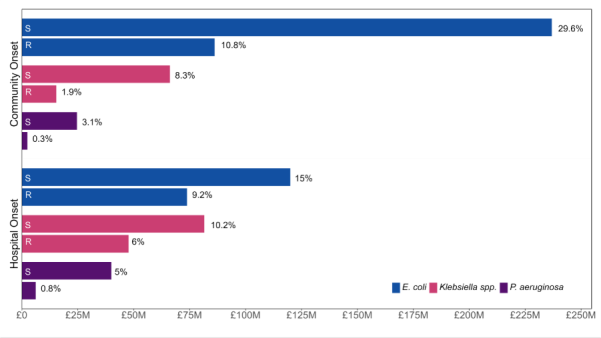
However, estimates from approach 1 reflect total costs of the hospital stay, which may not correspond to costs attributable to infection or resistance itself. Work is therefore underway to estimate attributable costs (approach 2). This requires the development of causal inference methods to estimate the excess length of stay and mortality attributable to infection and resistance (see Research chapter for description of this work). These approaches better estimate attributable burden and allow estimation of quality-adjusted life year loss needed for subsequent cost-effectiveness evaluations of interventions.
Future work will expand analyses to cover the full healthcare pathway, additional perspectives and resistant infections beyond GNBSI. For example, work is underway to produce a high-level estimate of the total short-term cost of AMR to hospitals in England, combining estimates of resistant infection incidence, length of stay and the cost of a bed-day.
Emerging concerns – Trichophyton indotineae
Outbreaks of superficial skin infections caused by the emergent dermatophyte Trichophyton indotineae (Trichophyton mentagrophytes genotype VIII) were first reported in southern Asia in 2014 (1), where it is now endemic. Cases have since been reported worldwide including Europe, Canada and the USA, South America and Africa with mounting evidence of infection acquisition and transmission outside original areas of endemicity (2).
T. indotineae infections most frequently present as tinea cruris or corporis however, poor response to treatment can result in widespread disfiguring lesions affecting multiple body sites (1, 2). Most isolates exhibit in-vitro resistance to terbinafine, and most infections are clinically resistant to this first-line drug (1, 2). There are also reported cases with poor response to second-line itraconazole treatment. Because of this, patients frequently experience prolonged infections requiring protracted treatment regimens. This can lead to stigma and negatively impact patient mental health. Initial treatment failures and prolonged treatment regimens also have implications for antimicrobial stewardship.
The UKHSA Mycology Reference Laboratory (MRL) has detailed the rapid emergence and spread of T. indotineae in the UK (3). There were 363 cases between January 2017 and August 2025, most of which were reported since January 2023 (85%; 310 cases). Almost three-quarters of UK isolates tested (74%; 92/124) were resistant to terbinafine.
A recent UKHSA analysis found that T. indotineae cases were highly concentrated in major UK urban centres (4). Most of the affected individuals were working-age adults of South Asian ethnicity, suggesting potential links to endemic regions (4). Patient ages and infection sites suggested multiple exposure routes, with possible amplification through sexual networks. Distinguishing imported from locally acquired infections is critical for effective public health action; a pilot of enhanced surveillance of T. indotineae will be launched in East London in autumn 2026.
The UKHSA MRL have also reported the emergence of closely related species Trichophyton mentagrophytes genotype VII (TMVII) (5, 6). This genotype is largely sexually transmitted and is spreading predominantly amongst gay, bisexual and other men who have sex with men. Whilst no UK isolates have been reported as terbinafine resistant to date, there is concern that resistance could develop as it has within T. indotineae.
There is likely substantial under-ascertainment of both T. indotineae and TMVII prevalence due to lack of clinical suspicion. Therefore, isolates are only occasionally referred to expert centres for formal identification. There is also a lack of commercial methods for rapid and accurate identification at local laboratories, resulting in probable misidentification by using phenotypic methods. UKHSA briefing notes were issued in May 2025 and July 2025 alerting healthcare professionals to the emergence of T. indotineae and TMVII respectively, with the aim of increasing clinical suspicion and encouraging prompt identification and treatment of infections caused by these dermatophytes.
Recent trends in Staphylococcus aureus
Trends in MRSA and MSSA bacteraemia
Bacteraemias reported to the UKHSA mandatory surveillance of bacteraemia accounted for approximately 4% to 6% of all Staphylococcus aureus (S. aureus) infections reported through voluntary laboratory surveillance (SGSS) between FY 2019 to 2020 and FY 2024 to 2025, highlighting that bacteraemia surveillance captures only a small proportion of the wider burden of S. aureus infection.
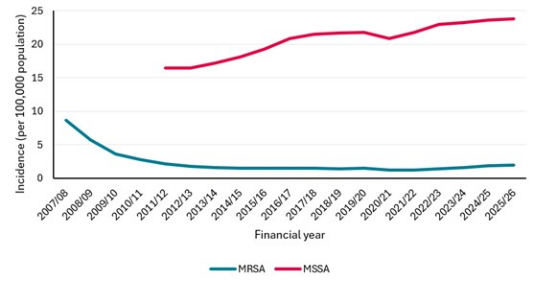
UKHSA mandatory surveillance of bacteraemia shows that methicillin-resistant Staphylococcus aureus (MRSA) bacteraemia incidence has increased in recent years, following a period of relatively stable, low incidence between FY 2014 to 2015 and FY 2021 to 2022. In FY 2025 to 2026, incidence reached 2 cases per 100,000 population, the highest incidence since FY 2011 and 2012 and 35.4% higher than in FY 2018 to 2019.
Methicillin-susceptible Staphylococcus aureus (MSSA) bacteraemia incidence has increased steadily since the start of surveillance in FY 2011 to 2012. Following a brief decline during the COVID-19 pandemic, incidence returned to an increasing trend, reaching 23.8 cases per 100,000 population in FY 2025 to 2026, which was an increase of 10.1% since FY 2018 to 2019 (Figure 4.2).
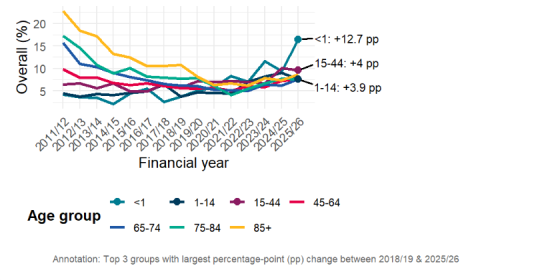
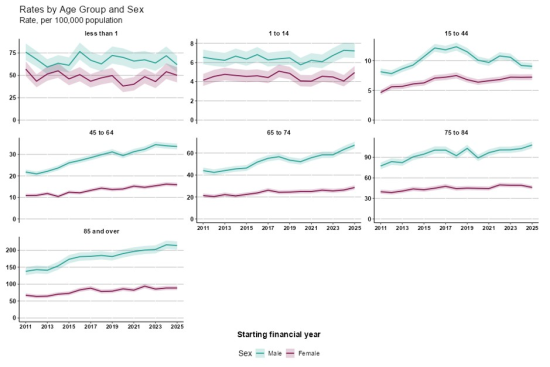
Between 2018 to 2019 and 2025 to 2026, bacteraemia incidence increased across most characteristics for both MRSA and MSSA, although relative increases were generally greater for MRSA. Overall incidence rose by 35.4% for MRSA compared with 10.1% for MSSA, with increases in both community- and hospital-onset cases. Increases by sex were similar within both MRSA and MSSA, with MRSA rising by around 35% in both females and males, compared with around 10% for MSSA. Age-specific trends differed more markedly: MRSA incidence increased substantially among younger age groups (Figure 4.3b), particularly those aged <1 year (+345.4%) and one to 14 years (+116%), but declined among those aged 85+ (−7.1%). In contrast, MSSA increased in most age groups, with the largest rises among older adults aged 65 to 74 (+18.3%) and 85+ (+16.7%). Regional variation was also greater for MRSA, ranging from an 8.9% decrease in the East of England to a 65.7% increase in the Midlands, whereas MSSA increased across all regions by 2.5% (North West) to 18.1% (East of England).
Figure 4.2. Trends in the incidence of MRSA and MSSA bacteraemia in England, FY 2007 to 2008 to FY 2025 to 2026
Source: national mandatory surveillance of bacteraemia
The proportion of S. aureus bacteraemia caused by MRSA also increased in recent years, from a low of 5.5% in FY 2021 to 2022 to 9.2% in FY 2025 to 2026. In the under-one-year group, the proportion of S. aureus bacteraemias that were MRSA increased notably between FY 2018 to 2019 and FY 2025 to 2026, increasing from 3.8% to 16.5% (13 cases to 53 cases), representing the largest absolute increase across all age groups of 12.7% (Figure 4.3a).
Figure 4.3 a) Trends in percentage of S. aureus bacteraemia cases that are methicillin-resistant (MRSA) in England between FY 2011 to 2012 and FY 2025 to 2026 (source: mandatory surveillance of bacteraemia) b) Age- and sex-specific incidence trends for MRSA bacteraemia
a)
b)
Changing epidemiology of MRSA bacteraemia
Following the recent increase in MRSA bacteraemia, national surveillance data from FY 2018/2019 to FY 2024/2025 was linked with additional datasets, including Hospital Episode Statistics, to examine changes in case characteristics over time. Linked analyses indicated that the recent increase in MRSA bacteraemia was accompanied by changes in the demographic and clinical profile of cases. Compared with the pre-pandemic period, infants aged under one year were more likely to be represented among cases during the recent period of increase (FY 2022/2023 to FY 2024/2025), while adults aged 75 years and over were less likely to be represented.
Differences were also observed by ethnicity and clinical characteristics. Compared with cases of White ethnicity, cases of Black (aRR 2.06, 95% CI 1.41 to 3.02) and ‘Other’ (aRR 2.80, 95% CI 1.12 to 7.02) ethnicity were significantly more likely to present during the recent period of increase. While, compared with the pre-pandemic period, cases with severe (aRR 1.53, 95% CI 1.21 to 1.94) and moderate Charlson severity grades (aRR 1.39, 95% CI 1.09 to 1.77) were significantly more likely to occur during the recent period, compared with comorbidity grade of ‘none’, indicating a shift towards more clinically complex patients.
Genomic trends
Recent trends in circulating S. aureus lineages were assessed through linkage of the mandatory surveillance of bacteraemia data with Staphylococcus aureus reference laboratory data from a voluntary surveillance system (2). Sequence typing data was available for 62.9% of MRSA cases, compared with only 6.6% MSSA cases, reflecting predominance of submission from MRSA cases.
The recent increase in MRSA cases did not appear to be associated with a single dominant CC, rather changes were observed across multiple established lineages. CC22 (EMRSA-15) declined substantially, decreasing from 30.7% of typed isolates in FY 2017 to FY 2018 to 6.3% in FY 2023 to FY 2024. Over the same period, CC5 increased from 17% to 25%, becoming the most frequently identified MRSA lineage by FY 2023 to FY 2024, while CC8 increased from 14% to 21%. MSSA isolates demonstrated greater clonal diversity than MRSA isolates. Among MSSA cases, CC398 showed a notable increase over the study period, rising from 11.9% to 20.9% of typed isolates.
Taken together, these findings highlight the need to better understand the populations and settings driving the sustained increase in MSSA bacteraemia, which accounts for the majority of S. aureus bloodstream infections, as well as the more recent increases in MRSA bacteraemia. Continued genomic surveillance is needed to characterise changes in the molecular epidemiology of S. aureus, including the emergence and spread of resistance and virulence determinants. While MSSA represents the overall burden, the increasing proportion of S. aureus bacteraemias caused by MRSA is also of particular concern as this may also have implications for empirical treatment in populations at greatest risk, as well as for targeted infection prevention and control measures.
Methenamine and nitrofurantoin antibiotic consumption, 2019 to 2025: Is there evidence of an antibiotic-sparing effect in England?
Methenamine hippurate is a non-antibiotic urinary antiseptic increasingly used for the prevention of recurrent urinary tract infections (UTIs) amid growing concerns about AMR and the need for antibiotic-sparing strategies. The National Institute for Health and Care Excellence (NICE) published new guidance on methenamine hippurate as a preventative treatment for people with recurrent UTI in December 2024. This project aimed to examine whether increased methenamine use was associated with reduced prophylaxis-related UTI antibiotic use, specifically nitrofurantoin, across National Health Service (NHS) healthcare settings. The analysis was stratified by region, sex and age groups in England between 2018 and 2025.
Dispensing data was obtained from ePACT2 (primary care) and Rx-info (secondary care) for 2019 to 2025. Nitrofurantoin immediate‑release (IR) formulations are typically used for UTI prophylaxis, while nitrofurantoin modified‑release (MR) 100 mg formulations are used for acute treatment. Use of MR formulation is likely to have been influenced by the 2024 introduction of the Pharmacy First scheme, under which community pharmacists are authorised to supply nitrofurantoin 100 mg MR via a patient group direction (PGD), a legal framework enabling pharmacist supply to eligible patients without a GP‑issued prescription.
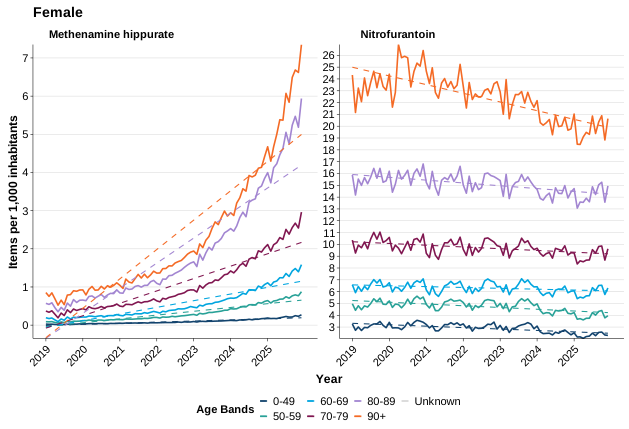
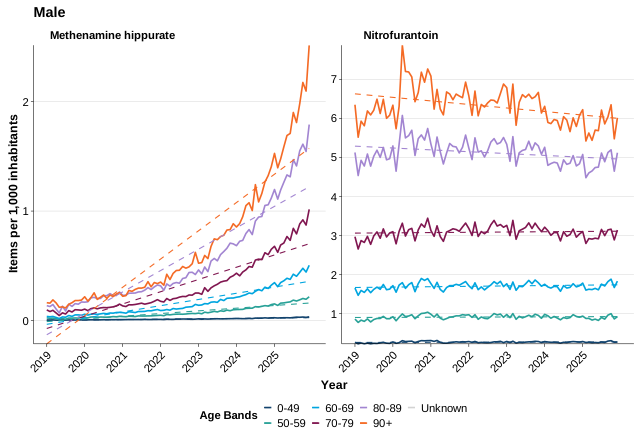
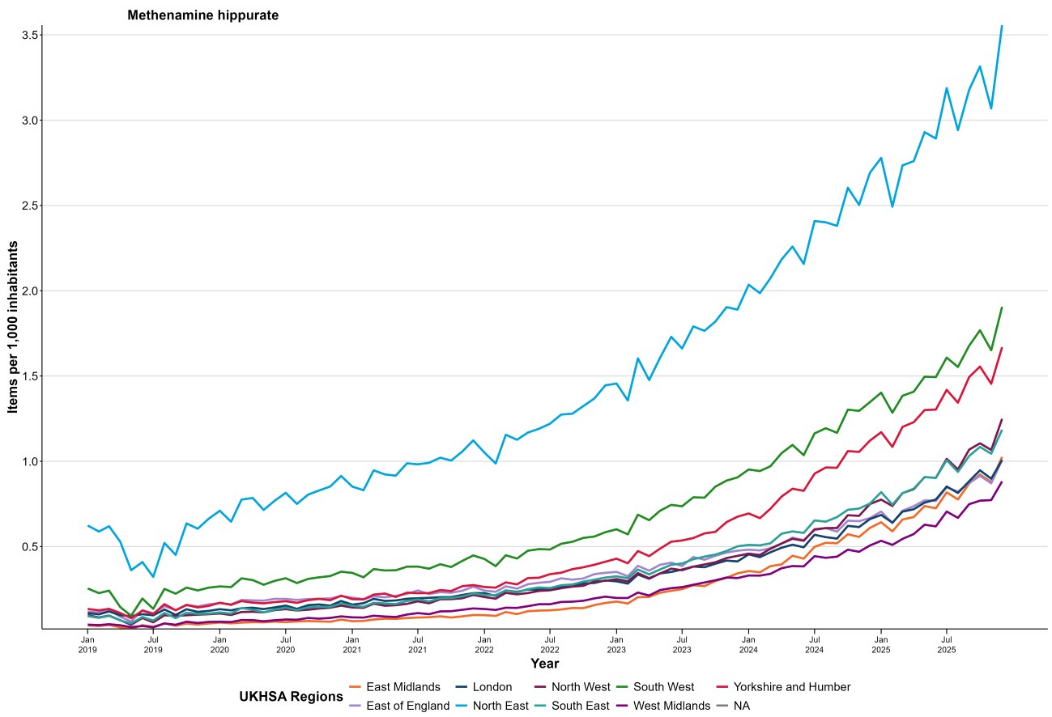
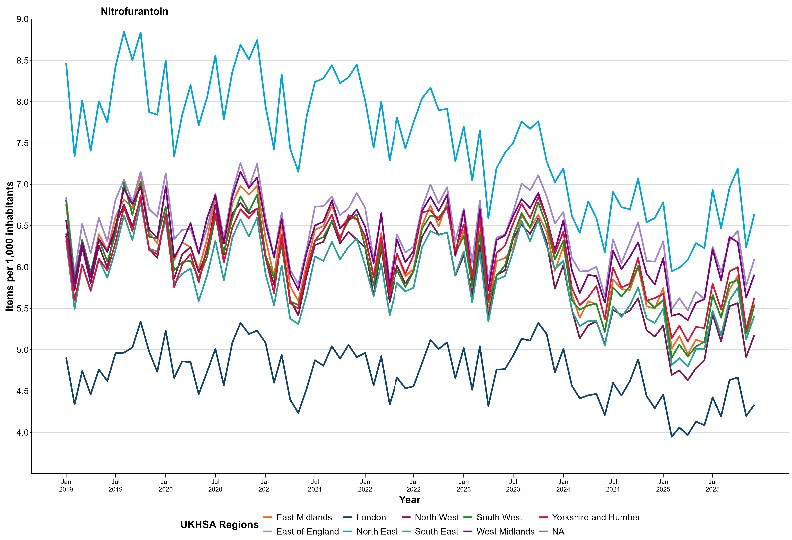
Methenamine use increased by 48% from 2019 to 2025 (from 44.4 to 77 DDDs per 1,000 population), across both primary and secondary care in England (NHS), with the greater proportion of methenamine prescribing attributed to primary care. The increase in methenamine dispensed based on GP prescriptions coincides with a gradual decline in nitrofurantoin dispensing (presented here for all nitrofurantoin formulations), across all age groups (Figure 4.4). Reductions were more pronounced in regions with higher methenamine uptake (Figure 4.5). This percentage increase is not directly comparable with estimates reported elsewhere in the report because it is based on a different measure of methenamine consumption and analytical approach.
This initial analysis provides an early national overview of changes in methenamine and nitrofurantoin consumption using routinely collected dispensing data. Ongoing work will strengthen these findings through validation of nitrofurantoin IR prescribing data, enabling a more specific assessment of UTI prophylaxis prescribing. Planned time-series analyses will examine associations between methenamine uptake and nitrofurantoin use while accounting for seasonality and regional variation, supported by sensitivity analyses using comparator antibiotics. Further work will also evaluate long-course antibiotic prescribing at patient level and explore alternative prophylactic agents, including cefalexin.
Trends in England from 2019 to 2025 suggest a potential substitution effect between methenamine and nitrofurantoin, indicating that wider adoption of methenamine could support AMS by reducing long-term antibiotic use for recurrent UTIs.
Figure 4.4. GP practice dispensing of methenamine hippurate and nitrofurantoin, expressed as items per 1,000 population, by age and sex, England, 2019 to 2025 [note]
Note: Differing y-axes
Figure 4.5. GP practice dispensing of methenamine hippurate and nitrofurantoin, expressed as items per 1,000 population, by region, England, 2019 to 2025 [note]
Note: Differing y-axes
Point-of-care testing (POCT) improved antibiotic targeting for sore throat in community pharmacy in Wales
Acute sore throat is one of the most common reasons for seeking healthcare, accounting for millions of consultations each year in the UK. It is also the largest infection pathway within England’s Pharmacy First service, accounting for over one-third of consultations, with phenoxymethylpenicillin the most frequently supplied antibiotic.
Although group A Streptococcus (GAS) is the most common bacterial cause, most sore throats are viral and do not require antibiotic treatment (9). Distinguishing bacterial from viral infection on clinical grounds alone remains challenging. Clinical prediction rules (CPRs), such as FeverPAIN (10) and Centor, support risk assessment but cannot reliably identify patients with GAS infection. This diagnostic uncertainty can lead to both unnecessary antibiotic use and missed treatment of patients with GAS infection, highlighting the need for improved antibiotic targeting.
Building the evidence base
England’s Pharmacy First sore throat pathway reflects current NICE guidance, which recommends CPRs to guide antibiotic prescribing (9). In 2019, NICE concluded that routine rapid antigen detection tests (RADTs) in primary care were unlikely to provide additional benefit or be cost-effective than CPRs alone and noted a lack of evidence from community pharmacy (12). Since 2018, Wales has delivered a national community pharmacy Sore Throat Test and Treat (STTT) service, integrating CPRs with RADTs. RADTs provide results during the patient consultation at the point of care, enabling immediate antibiotic treatment decisions without the delays of laboratory testing. Using data from the national STTT service, UKHSA, the Welsh Government, NHS Wales and academic partners evaluated whether combining RADTs with CPRs improved antibiotic targeting.
Evidence from the Wales STTT service
The evaluation included 73,617 consultations from 577 community pharmacies between 2018 and 2024, representing the largest real-world evaluation of GAS POCT in community pharmacy to date. Overall, 37% of patients tested positive for GAS, with the highest positivity among children aged 6 to 10 years (47%) (13).
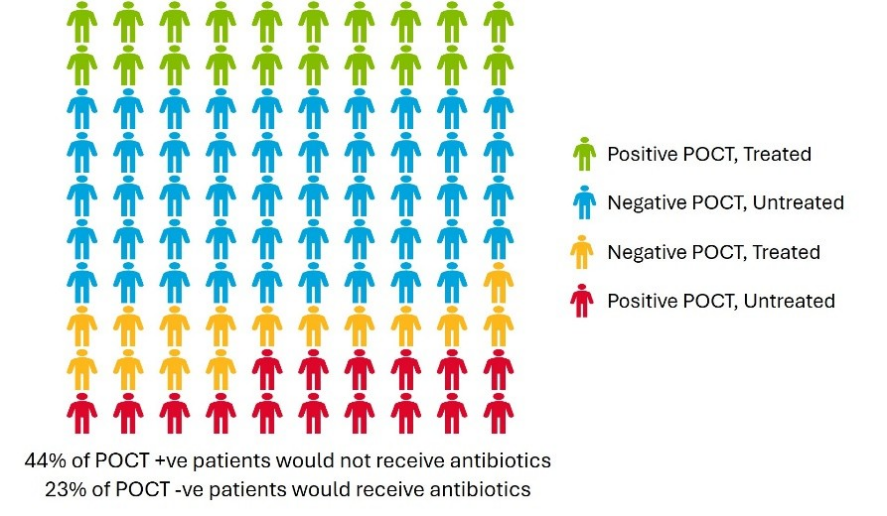
The evaluation demonstrated that CPRs alone could not reliably distinguish patients with GAS infection. If antibiotic prescribing had relied solely on the NICE-recommended FeverPAIN threshold (≥4), 44% of patients testing positive for GAS would not have received antibiotics, while 23% of patients testing negative for GAS would have received unnecessary antibiotics (Figure 4.6). The greatest discordance between CPRs and GAS POCT results occurred among children aged 6 to 10 years. Together, these findings demonstrate the value of combining CPRs with POCT to improve antibiotic targeting, helping distinguish patients with GAS infection from those whose sore throat is unlikely to benefit from antibiotics.
Figure 4.6. Impact of using FeverPAIN ≥4 alone to guide antibiotic prescribing in 100 patients presenting to the Wales Sore Throat Test and Treat (STTT) service, assuming GAS positivity of 36%
From evidence to action
Since 2019, evidence for RADTs in community pharmacy has expanded substantially. Following an independent review, Health Technology Wales now recommends routine use of RADTs in Welsh community pharmacies, concluding that their use is estimated to be cost-effective compared with standard GP assessment (14). The Appraisal Panel recognised the wider health benefits of reducing antibiotic prescribing, including impacts on AMR, and that these could not be robustly captured in current economic modelling. It was therefore judged that the likely benefits of introducing RADTs outweighed the remaining uncertainty about cost-effectiveness. Given that the greatest discordance between CPRs and GAS POCT was observed in children, further validation in this population is needed, particularly given the limited paediatric representation underpinning the development and validation of these tools (11).
As England’s Pharmacy First sore throat pathway evolves, these findings provide contemporary real-world evidence to inform future consideration of POCT to improve antibiotic targeting and strengthen AMS. Continued surveillance of GAS epidemiology alongside antibiotic prescribing for sore throat across the 4 UK nations will be important to enable comparison of trends as different approaches to sore throat management are implemented.
References
1. Chowdhary A, Singh A, Kaur A, Khurana A. ‘The emergence and worldwide spread of the species Trichophyton indotineae causing difficult-to-treat dermatophytosis: A new challenge in the management of dermatophytosis’ PLoS Pathogens 2022: volume 18, issue 9, e1010795
2. Dellière S, Jabet A, Abdolrasouli A. ‘Current and emerging issues in dermatophyte infections’ PLoS Pathogens 2024: volume 20, issue 6, e1012258
3. Abdolrasouli A, Barton RC, Borman AM. ‘Spread of Antifungal-Resistant Trichophyton indotineae, United Kingdom, 2017-2024’ Emerging Infectious Diseases 2025: volume 31, issue 1, pages 192 to 194
4. Czerniewska A and others. ‘Rapid emergence of Trichophyton indotineae (Trichophyton mentagrophytes ITS genotype VIII) observed in the United Kingdom, up to August 2025’ Eurosurveillance 2025: volume 30, issue 49, page 2500892
5. Tan XL and others. ‘Trichophyton mentagrophytes genotype VII sexually transmitted infection in the UK: where are we now?’ British Journal of Dermatology 2025: volume 193, issue 3, pages 566 to 568
6. Abdolrasouli A and others. ‘Emerging Trichophyton mentagrophytes genotype VII in the United Kingdom’ Journal of the European Academy of Dermatology and Venereology 2025: volume 39, issue 10, pages e944 to e946
7. Amin-Chowdhury Z and others. ‘Methicillin-resistant Staphylococcus aureus bacteraemia rise in England: start of a troubling trend?’ Journal of Hospital Infection 2026: volume 172, pages 272 to 274
8. Krishna A and others. ‘Genomic and epidemiological patterns in Staphylococcus aureus bacteraemia: a national surveillance study, England, 2017-2024’ In: ESCAIDE 2025 Abstract Book. European Scientific Conference on Applied Infectious Disease Epidemiology (ESCAIDE) 2025. Poster abstract
9. National Institute for Health and Care Excellence (NICE). ‘Sore throat (acute): antimicrobial prescribing’ NICE guideline NG84 2018
10. Little P, Moore M, Hobbs FDR and others. ‘PRImary care Streptococcal Management (PRISM) study: identifying clinical variables associated with Lancefield group A β-haemolytic streptococci and Lancefield non-group A streptococcal throat infections from two cohorts of patients presenting with an acute sore throat.’ British Medical Journal Open 2013, issue 3
11. Seeley A, Fanshawe T, Voysey M, Hay A, Moore M, Hayward G. ‘Diagnostic accuracy of FeverPAIN and Centor criteria for bacterial throat infection in adults with sore throat: a secondary analysis of a randomised controlled trial.’ British Journal of General Practice Open 2021: volume 5, issue 6
12. NICE. ‘Rapid tests for group A streptococcal infections in people with a sore throat’ Diagnostics guidance DG38 2019
13. Bustamante Q, Thornton H, Lawson G, Guy RL, Ahmed H, Evans A, Cannings-John R, Mantzourani E, Jones C, Brown CS, Hall V, Lamagni T, Mirfenderesky M. ‘Added value of point-of-care testing for Group A Streptococcus in community pharmacy sore throat pathways: analysis of the Wales Sore Throat Test and Treat service’ Clinical Microbiology and Infection 2026
14. Health Technology Wales. ‘Evidence Appraisal Report EAR020-2: Rapid antigen detection tests for group A streptococcal infections to treat people with a sore throat in the community pharmacy setting’ 2026