ESPAUR report 2025 to 2026: Chapter 10. Knowledge mobilisation of ESPAUR report – evaluation of feedback from report users
Published 12 November 2026

© Crown copyright 2026
This publication is licensed under the terms of the Open Government Licence v3.0 except where otherwise stated. To view this licence, visit nationalarchives.gov.uk/doc/open-government-licence/version/3 or write to the Information Policy Team, The National Archives, Kew, London TW9 4DU, or email: psi@nationalarchives.gov.uk.
Where we have identified any third party copyright information you will need to obtain permission from the copyright holders concerned.
This publication is available at https://www.gov.uk/government/publications/english-surveillance-programme-for-antimicrobial-utilisation-and-resistance-espaur/espaur-report-2025-to-2026-chapter-10-knowledge-mobilisation-of-espaur-report-evaluation-of-feedback-from-report-users
The annual ESPAUR report and its collation of surveillance and antimicrobial stewardship (AMS) efforts is used widely in the UK. Since its inception, the report has persistently broadened and diversified its content, extending beyond antibiotic resistance, in response to the escalating threat of antimicrobial resistance (AMR) over the past decade. To accompany the annual publication of the ESPAUR report, a webinar is hosted by the UK Health Security Agency (UKHSA) to explore key insights and features of the new report to stakeholders.
Reaching the public, healthcare professionals and industry through media channels is a priority for the UKHSA to raise awareness of the latest AMR and antimicrobial consumption surveillance, research and best stewardship practices. Press coverage reminds people of the scale of the issue, supports behaviour-change interventions and ensures the healthcare industry is aware of the latest information on prescribing and disposal that supports a reduction in AMR. Our media-related activity for 2025 to 2026 aligns with the commitments set out in the 2024 to 2029 UK AMR National Action Plan (NAP).
2024 to 2025 webinar survey feedback
A total of 533 respondents participated in the 2024 to 2025 ESPAUR webinar survey. Descriptive analysis was carried out to summarise responses from report users. Most of the questions and their respective answers were structured in a categorical manner, with some allowing for free text responses. The response rate varied per question, with data analysed for each question out of ‘known’ answers.
In the 2024 to 2025 webinar survey, 31.3% (167 out of 533) of respondents were pharmacists, 22.5.% (120 out of 533) were doctors and nurses ), and public health professionals accounted for almost 10% (9.9%, 53 out of 533) (Table 10.1).
Table 10.1. Frequently reported job roles in 2024 to 2025 ESPAUR report webinar surveys
| Role | Number | % |
|---|---|---|
| Pharmacist | 167 | 31.3 |
| Doctor | 85 | 15.9 |
| Nurse | 35 | 6.6 |
| Public health professional | 53 | 9.9 |
| Epidemiologist | 21 | 3.9 |
| IPC specialist [note 1] | 29 | 5.4 |
| Other job roles [note 2] | 143 | 26.8 |
| Total | 533 | 100.0 |
Note 1: Infection Prevention Control (IPC)
Note 2: Other job roles include academic or researcher, healthcare scientist (for example, microbiologist), scientist, pharmacy technician, national government, NHS management, local government, general practitioner, commissioner, member of the public, dentist, health economist, business support officer, patient advocate, programme manager, industry, health practitioner, advanced clinical practitioner, non-profit or charity as well as patient advocate, veterinary surgeon.
Where known, the majority of respondents from the 2024 to 2025 webinar would recommend use of the report to others (85.2% (277 out of 325)). Infographics, which are used to highlight key messages and statistics in the report, were found to be useful by the majority of respondents (85% (307 out of 360)). Of those that reported use of the ESPAUR report over the previous 12 months, 45.7% (145 out of 317) used it yearly, 38.8% (123 out of 317) used it quarterly, 12.9% (41 out of 317) used it monthly, 2.2% (7 out of 317) used it weekly and 0.32% daily (1 out of 317). The 3 most frequently used chapters in the report were AMR (84.7% (276 out of 326)), AMS (69.3% (226 out of 326)) and antimicrobial consumption (AMC) (55.8% (182 out of 326)). Over half of the respondents reported that they accessed 3 or more report chapters (56% (181 out of 326)) (for this question, respondents could select multiple responses). The most common reasons for accessing the report were to gather information (41% (138 out of 335)), to share information with others (32% (107 out of 335)) and to inform policy (15% (49 out of 335)).
Further free text responses on how readers could be encouraged to share the report were creating short, visually engaging formats such as one‑page infographics or graphic summaries, using social media to share infographics, and creating short videos to share specific areas of the report. Some free text responses suggested improvements to the report including shortening the report, improving infographics, and additional data such as comparisons of regional data.
Evaluation and knowledge mobilisation of the ESPAUR report (5 years analysis)
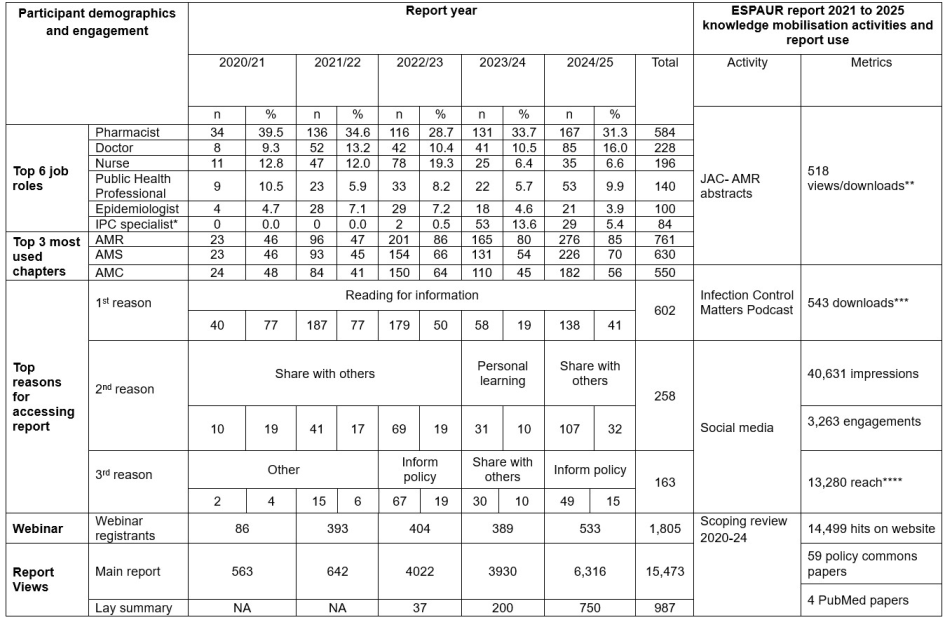
As part of a wider evaluation of activities to knowledge mobilise the ESPAUR report, an evaluation was undertaken to assess report use and engagement using ESPAUR webinar data over the 5 years that these webinars have been hosted. Data on the ESPAUR report use by chapter shows that the AMR and AMS, followed by the AMC chapter for report years 2021 to 2022, 2022 to 2023, 2023 to 2024 and 2024 to 2025 were the ones most commonly used, and in 2020 to 2021, the most used chapters were the AMC chapter, followed by the AMR and AMS chapters (Table 10.2). The top 2 reasons reported for accessing the report between years 2020 to 2021 and 2024 to 2025 were for information and to share with others.
Data further showed that views to the main ESPAUR report were 11 times higher in the ESPAUR report 2024 to 2025 (6,316) compared to the 2020 to 2021 report (563). Similarly, views to the lay summary were 20 times higher in the 2024 to 2025 report (750) when compared to the 2022 to 2023 report (37). The lay summary was introduced for the 2022 to 2023 report, therefore data are unavailable for the earlier reports (Table 10.2) . The full analysis will be submitted for peer review.
Knowledge mobilisation activities
Infection Control Matters podcast
Following publication in 2025, to knowledge mobilise the 2024 to 2025 ESPAUR report, an episode of the Infection Control Matters podcast featuring the ESPAUR report was released on 14 November. In 2022, a similar approach had been used to knowledge mobilise the 2021 to 2022 ESPAUR report. AMR at a National level – the 2025 ESPAUR Report: Infection Control Matters.
The episode of the Infection Control Matters podcast featuring the 2021 to 2022 ESPAUR report, released in 2022, received 1,014 downloads and the episode featuring the 2024 to 2025 report, released in 2026, received 543 downloads (data correct as of 31 March 2026) (Table 10.2) .
Journal metrics
In 2023, an article was published in Journal of Antimicrobial Chemotherapy that reported ESPAUR’s progress on the UK AMR NAP targets, with a focus on key highlights from the 2021 to 2022 report published in November 2022 (Table 10.2) . In 2026, abstracts on each of the 9 chapters of the 2024 to 2025 ESPAUR report were published in the JAC-Antimicrobial Resistance journal (Volume 8, Supplement 2). Since publication, these abstracts have received 518 views and downloads, (data correct as of 4 June 2026) (Table 10.1). The article featuring key highlights from the 2021 to 2022 report has received 2,278 views, with 19 citations (data correct as of 4 June 2026) (Figure 10.1).
Social media assets for ESPAUR engagement
Social media platforms Facebook, Instagram, X (Twitter) and LinkedIn, were used as a method to share messaging on antibiotic resistance, health inequalities information and data and signpost to the ESPAUR report 2024 to 2025. Engagement data were extracted from Sprout Social and descriptive analysis of engagement activity results across the social media platforms showed 40,631 impressions, a reach of 13,280 for Facebook and Instagram (unavailable for X (formerly Twitter) and LinkedIn), 3,263 engagements with an 8% engagement rate and a click-through-rate (CTR) average of 6.5% for Facebook, X and LinkedIn (unavailable for Instagram) (Table 10.2) .
Table 10.2. Overview of ESPAUR report chapter use, the most common reasons for accessing the report and engagement metrics following report knowledge mobilisation activities
Notes
IPC stands for Infection Prevention Control
ESPAUR report 2021 to 2025 metrics:
- JAC-AMR abstract – data correct as of 4 June 2026
- Infection Control Matters podcast – data correct as of 31 March 2026
- social media reach – Facebook and Instagram only
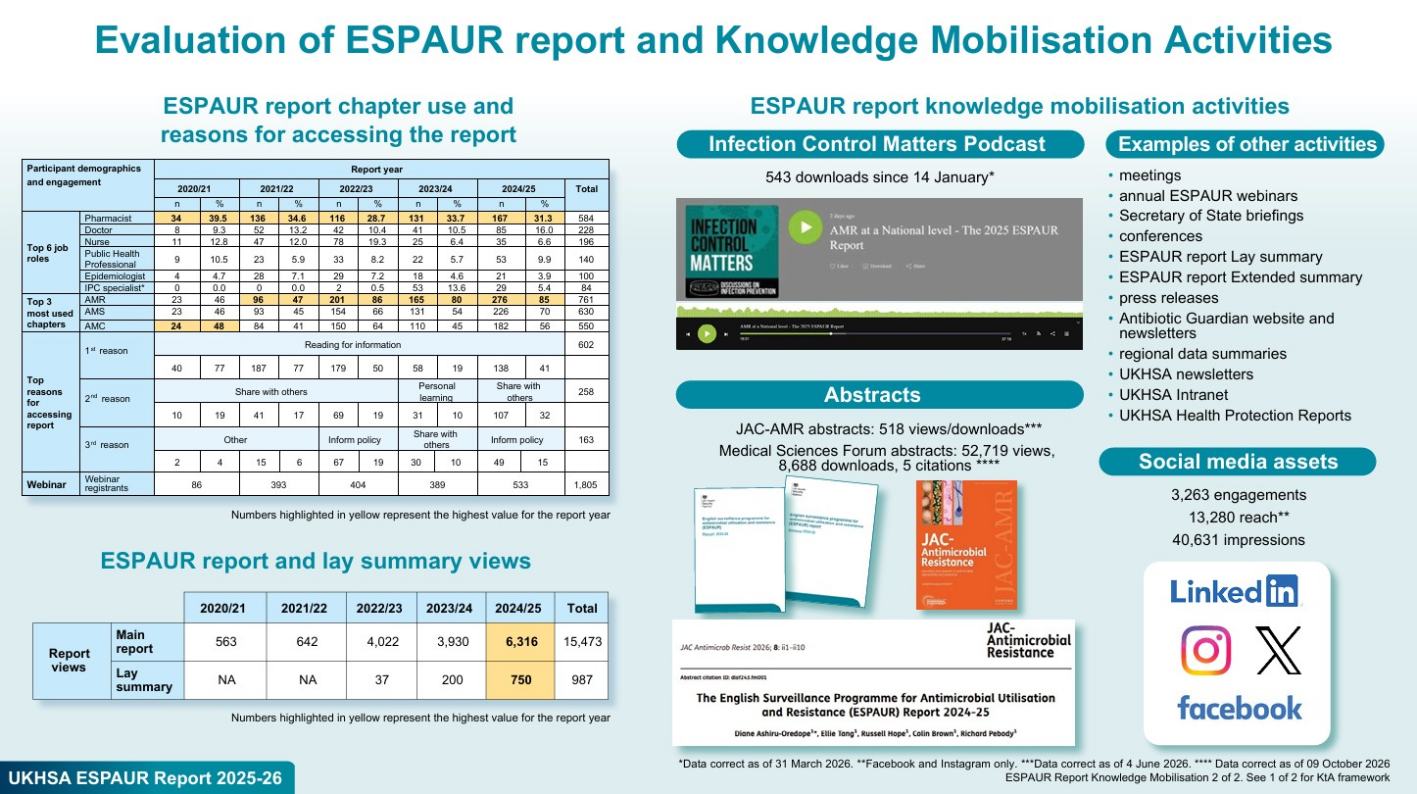
Figure 10.1. Evaluation of ESPAUR report and knowledge mobilisation activities
Text version of Figure 10.1
An infographic summarising ESPAUR report use, views and knowledge mobilisation activities.
Top left title: ESPAUR report chapter use and reasons for accessing the report uses.
On the top left hand side of the table, under a heading titled ‘Participant demographics and engagement’, the top job roles of participants reported for each year is listed:
-
2020 to 2021: Pharmacists: 34 (39.5%); Nurses: 11 (12.8%); Public health professionals: 9 (10.5%); Doctors: 8 (9.3%); Epidemiologists: 4 (4.7%); IPC specialists: 0 (0%)
-
2021 to 2022: Pharmacists: 136 (34.6%); Doctors: 52 (13.2%); Nurses: 47 (12%); Epidemiologists: 28 (7.1%); Public health professionals: 23 (5.9%); IPC specialists: 0 (0%)
-
2022 to 2023: Pharmacists: 116 (28.7%); Nurses: 78 (19.3%); Doctors: 42 (10.4%); Public health professionals: 33 (8.2%); Epidemiologists: 29 (7.2%); IPC specialists: 2 (0.5%)
-
2023 to 2024: Pharmacists: 131 (33.7%); IPC specialists: 53 (13.6%); Doctors: 41 (10.5%); Public health professionals: 22 (5.7%); Epidemiologists: 18 (4.6%); Nurses: 25 (6.4%)
-
2024 to 2025: Pharmacists: 167 (31.3%); Doctors: 85 (16%); Public health professionals: 53 (9.9%); Nurses: 35 (6.6%); IPC specialists: 29 (5.4%); Epidemiologists: 21 (3.9%)
This table also shows the most used chapters (‘AMR’, ’AMS’, and ‘AMC’) highlights responses from surveys sent through annual webinars in 2020/2021 to 2024/2025 with counts, percentages, and totals:
- AMR: 2020 to 2021: 23 (46%); 2021/22: 96 (47%) [note]; 2022 to 2023: 201 (86%) [note]; 2023 to 2024: 165 (80%) [note]; 2024 to 2025: 276 (85%) [note]; total 761
- AMS: 2020 to 2021: 23 (46%); 2021 to 2022: 93 (45%); 2022 to 2023: 154 (66%); 2023 to 2024: 131 (54%); 2024 to 2025: 226 (70%); total 630
- AMC: 2020 to 2021: 24 (48%) [note]; 2021 to 2022: 84 (41%); 2022 to 2023: 150 (64%); 2023 to 2024: 110 (45%); 2024 to 2025: 182 (56%); total 550
Note: These values are highlighted in yellow in the table.
Overall, AMR is the most used chapter in the reports, followed by AMS, with the AMC chapter, except year 2020 to 2021, where AMC was most used followed by both AMR and AMC.
The top reasons for accessing the report:
- first reason for all report years – reading for information:
2020 to 2021: 40 (77%); 2021 to 2022: 187 (77%); 2022 to 2023: 179 (50%); 2023 to 2024: 58 (19%); 2024 to 2025: 138 (41%); total 602 - second reason – to share with others in 2020 to 2021: 10 (19%); 2021 to 2022: 41, (17%); 2022 to 2023: 69 (19%) and 2024 to 2025: 107 (32%). Personal learning in 2023/24: 31 (10%); total 258.
- third reason – other in 2020 to 2021: 2 (4%); 2021 to 2022: 15 (6%). Informing policy in 2022/23: 67 (19%); 2024/25: 49 (15%). Sharing with others in 2023/24: 30 (10%); total 163
A footnote under this table states: “Numbers highlighted in yellow represent the highest value for the report year”.
Webinar registrations:
Webinar registrations increased substantially over the period: 86 in 2020 to 2021, 393 in 2021 to 2022, 404 in 2022 to 2023, 389 in 2023 to 2024, 533 in 2024 to 2025.
There were 1,805 webinar registrations in total across all years.
The AMR chapter is consistently the most-used section of the ESPAUR report, reading for information remains the primary reason for access, and engagement through webinars has increased markedly, reaching its highest level in 2024/25.
A table in the bottom left summarises the ESPAUR report and lay summary views.
Main report views – 2020 to 2021: 563; 2021 to 2022: 642; 2022 to 2023: 4,022; 2023 to 2024: 3,930; 2024 to 2025: 6,316 [note]; total 15,473.
Lay summary views – 2020 to 2021: NA; 2021 to 2022: NA; 2022 to 2023: 37; 2023 to 2024: 200; 2024 to 2025: 750 [note]; total 987.
Note: These values are highlighted in yellow in the table.
A footnote under this table states “Numbers highlighted in yellow represent the highest value for the report year”.
On the right side of the infographic, knowledge mobilisation activities of the ESPAUR report are provided.
Infection Control Matters Podcast: 543 downloads since 14 January [note 1].
Social media assets:
Platform logos displayed: LinkedIn, Instagram, X, and Facebook.
40,631 impressions
3,263 engagements
13,280 reach [note 2]
Abstracts: JAC-AMR abstracts: 518 views/downloads [note 3], Medical Sciences Forum abstracts: 52,719 views, 8,688 downloads, 5 citations [note 4].
A teal box contains the text “Examples of other activities” and below this, the following are listed; meetings, annual ESPAUR webinars, Secretary of State briefings, conferences, the ESPAUR report lay summary, ESPAUR report extended summary, press releases, the Antibiotic Guardian website and newsletters, regional data summaries, UKHSA newsletters, the UKHSA intranet, and UKHSA Health Protection Reports”.
Note 1: Data correct as of 31 March 2026 Note 2: Facebook and Instagram only Note 3. Data correct as of 4 June 2026 Note 4: Data correct as of 9 October 2026
A footer states “ESPAUR Report Knowledge Mobilisation 2 of 2. See 1 of 2 for KtA framework”.
Knowledge mobilisation of ESPAUR report using Knowledge to Action framework
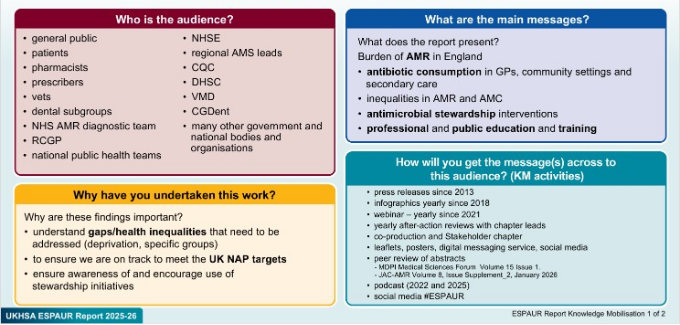
The Knowledge to Action (KTA) framework aims to fill the knowledge to action gap by ensuring that key findings from research are implemented and embedded into practice in a structured way. The framework consists of 4 key components, namely why, what, who, and how, designed to identify the reasons for the work, the key messages, an appropriate audience, and appropriate methods to share the messages. The model consists of 2 main components, knowledge generation, and implementation into practice.
The KTA model was used to communicate and tailor key messages from the ESPAUR report such as AMR burden in England, and professional and public education and training, to key ESPAUR stakeholders such as pharmacists, national public heath teams and the public. The reason for undertaking this work is embedded in the UK AMR NAP. The key messages were communicated with the target audience using press releases, infographics, digital messaging, podcasts and journal articles (Figure 10.2).
Figure 10.2. Knowledge mobilisation of ESPAUR report using Knowledge-to-Action framework
Text version of Figure 10.2
At the top left corner of the graphic, a burgundy box shows the heading ‘Who is the audience?’ followed by a list of groups including:
- the general public
- patients
- pharmacists
- prescribers
- vets
- dental subgroups
- the NHS AMR Diagnostic Team,
- RCGP
- National Public Health Teams
- NHSE
- regional AMS leads
- CQC
- DHSC
- VMD
- CGDent
- many other government and national organisations
At the top right corner of the graphic, a blue box shows the heading ‘What are the main messages? What does the report present?’ and lists key points:
- the burden of AMR in England
- antibiotic consumption in GPs
- community and secondary care settings
- inequalities in AMR and antimicrobial consumption (AMC)
- antimicrobial stewardship interventions
- professional and public education and training
At the bottom left corner, an amber box shows the heading ‘Why have you undertaken this work? Why are these findings important?’ and explains that the work aims to understand gaps and health inequalities (such as deprivation and specific groups), ensure progress towards meeting UK NAP targets, and raise awareness of and encourage use of stewardship initiatives.
At the bottom right corner, a green box shows the heading ‘How will you get the message(s) across to this audience?’ (KM activities) and underneath is a list of communication methods including:
- press releases since 2013
- yearly infographics since 2018
- webinars since 2021
- yearly after-action reviews
- co-production and stakeholder engagement
- leaflets, posters and digital messaging (including social media)
- peer-reviewed abstracts –
- Multidisciplinary Digital Publishing Institute (MDPI) ESPAUR Report Webinar and Antibiotic Guardian Shared Learning Awards Medical Sciences Forum 2022: volume 15, issue 1
- JAC-Antimicrobial Resistance Key findings from the ESPAUR report: 2024-25 2026: volume 8, issue supplement 2
- podcasts in 2022 and 2025
- social media using #ESPAUR