Ending Rough Sleeping Risk Assessment Tool (ERSRAT): A practical guide to identify those most at risk
Published 16 December 2025
Applies to England

© Crown copyright 2025
This publication is licensed under the terms of the Open Government Licence v3.0 except where otherwise stated. To view this licence, visit nationalarchives.gov.uk/doc/open-government-licence/version/3 or write to the Information Policy Team, The National Archives, Kew, London TW9 4DU, or email: psi@nationalarchives.gov.uk.
Where we have identified any third party copyright information you will need to obtain permission from the copyright holders concerned.
This publication is available at https://www.gov.uk/government/publications/ending-rough-sleeping-risk-assessment-tool-ersrat/ending-rough-sleeping-risk-assessment-tool-ersrat-a-practical-guide-to-identify-those-most-at-risk
Glossary
Care leavers: Care leavers are young people aged 16-25 years old who have been in care at some point since they were 14-years old and were in care on or after their sixteenth birthday. These young people are statutorily entitled to some ongoing help and support from the local authority after they leave care.
Changing Futures: This is a cross-government programme that has been working with 15 local partnerships, aimed at improving support for adults facing multiple disadvantage including combinations of homelessness, substance misuse, mental ill health, domestic abuse, and contact with the criminal justice system.
Cross government homelessness and rough sleeping strategy: National Plan to End Homelessness. Published December 2025 which sets out the MHCLG long-term vision to end homelessness and rough sleeping, making sure everyone has access to a safe and secure home.
Duty to Refer: This is a duty on named public bodies to refer people who they think may be at risk of homelessness to a local authority of their choice, with the individual’s consent. This is intended to identify households at risk, including when it is still possible to prevent homelessness.
Ending Rough Sleeping Risk Assessment Tool: A new tool for local authorities which supports them to make better assessments of an individual’s risk of long-term rough sleeping.
HCLIC (Homelessness Case Level Information Collection): This is the system used in England to collect detailed data on homelessness applications made to local authorities.
Homelessness: Legally, a person is considered homeless if they do not have accommodation that they have a legal right to occupy, which is accessible and physically available to them (and their household) or which it would be reasonable for them to continue to live in. Homelessness is an umbrella term and there are subsections of homelessness including statutory homelessness, rough sleeping, single homelessness, hidden homelessness.
Homelessness assistance: Homelessness assistance is support provided by local councils to individuals who are homeless or at risk of losing their home. This includes help with finding emergency accommodation, assessing housing needs, and offering advice or support to prevent homelessness.
Local authority: A local government organisation, also known as a council, officially responsible for a range of public services, funds, and facilities in their local area.
Long-term rough sleeping: Long-term rough sleeping means someone has been seen rough sleeping recently and has also been seen on at least three separate months over the past year.
Multiple disadvantage: Many people sleeping rough may be experiencing a range of complex and overlapping needs. The Changing Futures Programme (see definition above) defines multiple disadvantage as experiencing three or more of the following at the same time: homelessness; substance misuse; mental ill health, domestic abuse, and contact with the criminal justice system.
Priority need: Section 188 of Housing Act 1996 requires housing authorities to secure accommodation for homeless applicants who have a priority need for accommodation based on certain circumstances (such as pregnancy or having child dependents, being homeless as a result of domestic abuse or an emergency disaster, being vulnerable as a result of a disability or a health condition, or having been in care, prison or the Armed Forces).
Public institution: An organisation established and funded by the government to serve the public interest, implement laws, and provide essential services or regulations for society. Examples of public institutions in the context of homelessness include prisons (adult and youth), general and psychiatric hospitals, asylum support, and children’s social care.
Rough sleeping: This is the most acute and extreme form of homelessness that is characterised by someone about to, or actually, bedding down in the open air (such as on the street, in tents, doorways, parks, bus shelters or encampments) or places not designed for habitation (including cardboard boxes, stairwells, cars and other makeshift and not fit for purpose places). Rough sleeping does not include people in hostels or shelters or the hidden homeless, such as those sofa surfing but who are nonetheless homeless.
Sofa surfing: Sofa surfing means you have nowhere to live and are staying with various friends or family members in place of your own home.
Supported housing: Housing provision that also includes wrap-around support. Residents of supported housing need care, support or supervision, alongside accommodation. Supported housing may, for example, help those with vulnerabilities relating to age, disabilities, substance use, release from prison or care.
Temporary accommodation: Temporary accommodation is provided by local housing authorities in England who have a duty to secure accommodation for unintentionally homeless households in priority need (under Part 7 of the Housing Act 1996). This duty remains in place until the duty is ended, which is usually because suitable secure accommodation becomes available.
Voluntary Sector: This term is used to describe the work of charities and other organisations which are neither private business or those carried out by local or national government. The Voluntary Sector includes charities which are commissioned by local authorities to deliver services to address rough sleeping. (See also the Community and Faith sector.)
Young People: This refers to people aged between 16 to 24.
Introduction
As set out in the cross government homelessness and rough sleeping strategy A National Plan to End Homelessness, as part of our work to get back on track to ending homelessness and rough sleeping, we have worked with 24 local councils across England to pilot an Ending Rough Sleeping Risk Assessment Tool.
This tool is intended to support local authorities and the wider homelessness and rough sleeping sector to help to assess the risk of a person sleeping rough long-term to support local decision making on service offers.
Who is this guide for
This guide is for those working with people who present as homeless, who may or may not be sleeping rough presently and are not identified as priority need.
Key audiences include local authorities, homelessness charities, the wider homelessness and rough sleeping sector and others with an interest in tackling entrenched rough sleeping.
The guide is aimed at people who are working in the sector. However, we hope that those with an interest in supporting those who are vulnerable and at risk will find it useful to compare their approaches with the information provided here.
This is not a guide to systems change or systems thinking; and the tool does not utilise any algorithms. Instead, it seeks to share the indicators of those most at risk and, help to identify where further support may be required. This in turn may initiate changes in the way a local authority or organisation considers people and the way support is offered.
How to use this guide
The guide is not designed to be read from cover to cover, but rather for readers to ‘dip into’ chapters of interest. Chapters are designed to stand alone, and where material is relevant to several topics, it will appear in more than one chapter. The guide includes links throughout to other relevant chapters.
Local authorities and their partners come into contact with a range of individuals sleeping rough or at risk of doing so. This tool aims to give local authorities a more objective and standardised way to assess the risk of an individual sleeping rough long term in order to support local choices on how to prioritise access to accommodation and support.
The tool uses indicators of circumstances and needs to provide an alternative to prioritising access to services based on ‘verification’ of having slept rough. It has been produced using available evidence and analytical data about the drivers of long-term rough sleeping, as well as feedback from the sector, including the lessons learnt from a previous London Councils pilot and the MHCLG ERSRAT pilot. Throughout the pilot, we have been testing the tool, questions, scores and the practice around its use, along with outcomes delivered. This will continue to inform the future development of the tool.
The initial feedback from the pilot has indicated the need for a tool to assist with identifying those most at risk of becoming a long-term rough sleeper. We are therefore providing this interim version of the tool to be used as best practice. Once the ERSRAT pilot completes in 2026, the tool will also be reviewed, any recommendations actioned, and the tool updated version will be produced and released as required.
The tool has been tested within LAs, with a focus on teams engaging with those presenting as homeless with no priority need. However, the tool can be used in other settings where those in non-priority need present. When the guidance refers to LAs, this could also encompass other supporting organisations which support those who are at risk of or currently rough sleeping.
Creating the guide
This guide was developed with the support of feedback from local authorities, and London councils.
The guide draws on evidence collected as part of the national data collection on homelessness and rough sleeping and interviews with local authorities, alongside the experience of MHCLG’s in house advisers about their experiences of identifying those most at risk of sleeping rough long-term. The guide includes suggestions on how questions may be introduced or asked, however decisions remain with the interviewer how they initiate the conversation and gain responses based on their own experience and the individual circumstances.
Interaction with homelessness duties
The tool should not be used as an alternative to carrying out homelessness assessments and delivering statutory duties It should be used as an additional needs assessment to enable LAs to make a decision about the service offer they are able to make to someone who has no apparent priority need but has a higher risk of long-term rough sleeping.
LAs are required to take a homelessness application from any person who may be homeless and assess whether they are homeless or threatened with homelessness, and eligible for assistance. If the applicant is homeless and owed the relief duty, the LA must consider if there is reason to believe they may have priority need and are to be provided with interim accommodation whilst trying to relieve their homelessness.
If the LA decides no interim accommodation duty to refer is owed, they should use the tool to assess the person’s risk of long-term rough sleeping. Accommodation and service options will vary between areas, but the expectation is that services are available to those with high scores according to the tool.
The tool should be used by LAs, outreach teams and other agencies. However, it is for the LA and other agencies to decide which team within its structure and assessment arrangements is best placed to utilise the tool.
When to use the tool
The tool should be used to assess single people who the local authority believes:
- are homeless tonight and may sleep rough without support; and
- have no apparent priority need that would require interim accommodation to be provided
The tool should not be used if the person has priority need because they are:
- homeless due to experiencing domestic abuse
- a homeless young person aged 18-20 who has been in care (looked after/ care leaver) at any time when they were aged 16-17
- pregnant, or have children in their care; or
- homeless due to fire, flood or other disaster
The tool should also not be used if:
-
on first approach, there is reason to believe the person MAY have priority need because they are vulnerable, according to the homelessness legislation. If, a person provided with interim accommodation was subsequently assessed as not having priority need, the tool should be used to assess their risk of long-term rough sleeping before they are asked to leave temporary accommodation.
-
the person is not eligible for homelessness assistance or to access accommodation, because they are a non-UK national with restricted eligibility. You may instead wish to follow guidance on exhausting all options to support this group.
There is also an opportunity to use the tool at earlier stages engaging with clients. This could include but is not limited to assessing a client who is about to be released from prison or supported accommodation to ascertain if they are at a higher risk of becoming a long term rough sleeper and how they can be helped at an earlier stage to avoid that situation; or assessing a client who is no longer in priority need but still vulnerable and who may also become homeless due to changes in circumstance.
Risk Assessment Tool questions
The Rough Sleeping Risk Assessment Tool comprises 8 questions, 7 of which are scored.
The answers to the risk assessment questions are scored on a scale from 0 to 4 points – except for question 1 which is not scored and question 8 which has a max score of 3. The score attributed to each answer can be found in Appendix 1, the final column of each table. The maximum score is 27 points. The higher the score, the greater the risk of an individual sleeping rough for an extended period of time. Local authorities and other organisations should consider how to differentiate their responses to individuals using these scores and in light of the resources and services available in their area.
We expect LAs and other organisations will want to set a threshold to trigger access to accommodation and support suitable for those with high risk of long-term rough sleeping. LAs that are considering appropriate thresholds and particular service offers in their area can engage with MHCLG advisers who are available to discuss this further and support them. The threshold can be incorporated into the scoring template for your reference. All tool questions must be answered for a total score to be generated at the end of the tool.
Recognising the different experiences of women
The scored responses to the questions in this tool seek to recognise experiences that may be particularly relevant to women, for instance experience of domestic abuse, staying in a refuge, having had children taken into care, or walking all night rather than bedding down. This provides an opportunity to highlight vulnerabilities but not replicate a priority needs assessment. This also does not replace any existing assessments which are detailed and might lead to identifying detailed vulnerabilities, relevant information or other support available.
People who are already sleeping rough
This assessment tool is intended for those who are at risk of sleeping rough, and becoming long term rough sleepers, but could also be used to assess risks for someone who has already slept rough and is looking for help to avoid long-term rough sleeping.
How to conduct the assessment
If you have not already interviewed the client for the homelessness assessment (i.e. if a separate team or person is using the ERSRAT) you may want to begin with an open question such as ‘can you tell me how you came to be here today?’ This question should help you to gather a general sense of the person’s homelessness.
The first question to be asked from the tool is ‘Where did you sleep last night?’ This is a non-scoring question but should begin to help the client to talk about their experience. You should encourage the client to speak freely about the previous few weeks which have led them to approach the homelessness service and complete the score sheet as the client talks.
Open questions may well enable the client to tell you much of what you need to complete the tool with follow up questions limited to points that have not been covered in the client’s initial overview of their situation.
The questions asked in the tool are mostly so that you can encourage the client to provide the information you need, without running through the options as a checklist. If you are concerned that the client is not being honest with a response, you may ask follow-up questions for clarity and to be satisfied that the score is correct. However, the questions should be asked in a friendly and encouraging way, with an assumption that the client is being truthful unless there is reason to think otherwise.
Guidance on the questions
The scoring for each question is set out in Appendix 1.
You may choose to use an opening question, leading to those in the main tool, as referenced in the “How to conduct the assessment” section above, which should not be scored and should help you to gather a general sense of the case. You can use the information disclosed in this initial discussion to complete the tool at the end of the discussion. It is not necessary to ask all the questions below if these have already been answered by this initial question.
For the purposes of the form and scoring, it is necessary to answer all questions before the tool is completed. All questions must be answered to provide the final score.
Q1: Where did you stay last night?
This question aims to gain an understanding of recent sleeping arrangements/night movements and guide the client into talking about their experience. It also provides an understanding of any support system they may have in place, along with capturing the current position of a client at the point the tool is used. We have noted from the Women’s Census that there are several common answers which women may pick if they are vulnerable. These include “Walk around all night” and “Spent time in cafes/restaurants/ waiting rooms”. This recognises that some people, particularly women, may not sleep at night, instead making use of transitional places, 24-hour restaurants and waiting areas for safety. If the answer to this question is vague, gently probe for specifics, for example if the person sofa surfed with a friend, you could follow this up with, ‘is this a person you know well/have known for a long time?’ If the answer is ‘slept rough’ then ask where, and how they came to be in that location, and if they have had contact with an outreach service. If through this first question you establish that the person is likely to be a known rough sleeper, you should pause and check whether the ERSRAT assessment is appropriate for them.
There is also an option from the answer list “Not homeless. Assessed as part of prevention planning”. This is for LAs using the tool as part of prevention, where the client is not homeless tonight. This could include, for example, using the tool to assess the needs of someone due for release from prison, to assist with planning to prevent their homelessness.
Q2: Have you left prison/MOJ funded accommodation (CAS, AP, etc.), a refuge, substance misuse residential treatment, hospital, hostel/supported housing, or Home Office asylum accommodation in the last week?
If yes, ask follow-ups to see if this seems accurate such as ‘do you remember which ward you were on,’ ‘which prison or MOJ accommodation were you in, and were you referred to a local authority for help because you are homeless?’ etc.
Q3: How did you end up leaving your last settled accommodation?
This question may require some further probing in some cases. If people respond with prison, hospital, cold weather shelter etc, these are not settled accommodation and so you need to ask about accommodation prior to that, such as family/friends, tenancy, supported housing etc.
Q4: Please tell me about family, friends, community/faith or other groups you have contact with who have provided you with support or with somewhere to stay?
This question aims to find out what support individuals can access. Those with limited or no social networks are more likely to end up in long-term rough sleeping. Information may already have been volunteered in the ‘how did you come to be here today?’ question.
Q5: Do you have a physical illness, disability, mental health or a drug/alcohol issue, or have you previously been a victim of domestic abuse / VAWG?
For this question you may need to ask additional questions where people identify a mental or physical health need to establish whether or not they have required inpatient treatment. A client may disclose mental health issues that have not been diagnosed by a health professional and are not a response to current homelessness (e.g. anxiety, depression), and for which you may score the person as having a mental health issue. Clients may also highlight experiences of domestic abuse or having had children taken into care at any age. Clients may attract multiple scores if they have more than one need. Multiple disadvantage would include combinations of homelessness, substance misuse, mental health issues, domestic abuse and contact with the criminal justice system. There is an option to select “more than one disadvantage identified” which provides a higher overall score.
Q6: (For under 25s only) Do you have experience of any of the following: (See Appendix 1 for full question and response options)
This question is for young people under 25 only as it aims to pick up on adverse childhood experiences that can be prevalent amongst long term rough sleepers, at a point where it is possible to prevent young people from experiencing rough sleeping. There is an option to select “more than one disadvantage identified” which provides a higher overall score. The final option is not applicable. Use this option for any clients who are aged 25 years old and above, for which this question does not apply.
Q7: Do you have experience of time in prison, substance misuse residential treatment, refuge, frequent hospital admittances or homelessness hostels?
This question is used to indicate experience of public institutions. You may need to ask follow-up questions if the client does not provide details of the institution. The question is about whole life experience and not just recent time in an institution or service. One optional answer refers to “frequent hospital admissions for physical or mental health needs”. When identifying frequency, we align with NICE guidelines which defines frequency as patients admitted as inpatients in the 2001-2 financial year who were subsequently readmitted three or more times within a 12-month period.” There is an option to select “more than one disadvantage identified” which provides a higher overall score.
Q8 Are you currently receiving benefits or wages/salary?
Again, you may need to probe if answers are vague, or unclear. Follow ups could include ‘how do you support yourself’, ‘when was the last time you worked’, etc. For the answer related to recent loss of income, the question is whether the client has experienced a change in financial circumstances (e.g. loss of job) that has contributed to them becoming homeless. This may be very recent or a few months past, so some judgement may be needed on how relevant this loss was to the client’s current homelessness. People may be in receipt of benefits but have additional challenges such as sanctions or unmanageable debt. This would not change the scoring but should be considered in any action plan once the scoring has been completed.
Data Collection
MHCLG will not collect any data from this tool. Any data generated from the use of the tool will be for the LA to use to help make informed decisions regarding how best to support its cohort. This data can be shared with the LA’s advisers to gain further support and assist the advisers to understand more about the cohort. See Appendix 2 – Collecting the Data, for further details.
Appendix 1: Question and Scoring overview
Q1: Where did you stay last night? * Note this question is not scored but should be included in the assessment for the purposes of capturing the current position of people at point tool is used.
| Where did you stay last night? | |
|---|---|
| Slept rough / walked around all night | |
| Spent time in cafes/ restaurants / waiting rooms | |
| Stayed with friends or family who I have not previously lived with | |
| Stayed with family/friends who I have lived with for some time | |
| Stayed with a person of short acquaintance | |
| Settled accommodation | |
| Supported housing or hostel | |
| Not homeless. Assessed as part of prevention planning |
Q2: Have you left prison/MOJ funded accommodation (CAS, AP, etc), a refuge, substance misuse residential treatment, hospital, hostel/supported housing, Home Office asylum accommodation in the last week?
| Prison or MOJ funded accommodation (CAS or Approved Premises) | 4 |
| Domestic Abuse / VAWG Refuge | 4 |
| Drug or alcohol residential treatment | 3 |
| Hospital | 2 |
| Hostel | 2 |
| Home Office accommodation | 1 |
| No | 0 |
Q3: How did you end up leaving your last settled accommodation?
| Abandonment/eviction from hostel/supported housing | 4 |
| Abandonment/eviction from HMO or other PRS tenancy/ Home Office housing | 1 |
| Abandonment/eviction from social housing tenancy | 3 |
| Family or friends no longer willing or able to accommodate | 1 |
| Non-domestic abuse related relationship breakdown with partner | 2 |
| Domestic abuse - perpetrator | 2 |
| Other violence or harassment | 2 |
| Planned move or other | 0 |
Q4: Family, Friends and Community
| Please tell me about family, friends, community/faith or other groups you have contact with who have provided you with support or with somewhere to stay? | |
|---|---|
| History of care/no safe connections | 4 |
| No positive supportive connections in the area | 3 |
| Has stayed with friends occasionally for limited time | 2 |
| Receiving support/accommodation from community or faith group | 1 |
| Has been living with family but relationship broken down, asked to leave | 1 |
| Has been staying with family or a friend for a stable period | 0 |
Q5: Do you have a physical illness or disability, a mental health issue, or a drug/alcohol issue or have you previously been the victim of domestic abuse / VAWG?
| Mental health issue, has previously been an inpatient | 2 |
| Mental health issue, not had inpatient treatment | 1 |
| Physical health issue – has previously been an inpatient | 2 |
| Physical health issue -not requiring inpatient treatment | 1 |
| Previously been the victim of domestic abuse / VAWG | 2 |
| Have been pregnant recently and / or had children taken into care | 2 |
| Drug or alcohol dependent | 3 |
| Learning disability – has received local authority learning disability services as a child or adult | 3 |
| Learning disability – diagnosed but able to manage independently | 2 |
| If more than one disadvantage is identified, please select this option | 4 |
| No | 0 |
NB: If the person discloses a current mental or physical health condition that has required inpatient care, or is vulnerable due to a learning disability, the decision that there is no reason to believe s/he has priority need should be reviewed.
Q6: For young people under 25 only.
| Do you have experience of any of the following: | |
|---|---|
| Regularly missing or being excluded from school as a child | 3 |
| Family became homeless/you became homeless | 3 |
| You/your family had contact with children’s services? | 3 |
| If more than one disadvantage is identified, please select this option | 4 |
| No | 0 |
| Not applicable | 0 |
Q7: Do you have experience of time in prison, substance misuse residential treatment, refuge, frequent hospital admittances or homelessness hostels?
| Yes, prison | 3 |
| Yes, drug and alcohol | 3 |
| Yes, domestic abuse or VAWG refuge | 3 |
| Yes, frequent hospital admissions for physical or mental health needs | 2 |
| Yes, homelessness accommodation on more than one occasion | 2 |
| Yes, hostel | 2 |
| If more than one disadvantage is identified, please select this option | 4 |
| No | 0 |
Q8: Are you currently receiving benefits or wages/salary?
| Destitute (no income) | 3 |
| Recent significant loss of income (e.g. job loss, suspension of benefit claim) | 2 |
| Long term unemployed (1 year or more) | 2 |
| UC or other benefit claim in payment (but employed in the last year) - Stable | 1 |
| Intermittent income – unstable (casual work) | 1 |
| Stable/regular income from wages/salary | 0 |
Appendix 2: Collecting the data
There are no algorithms in the tool to make decisions about clients and next steps. The tool collects the information you provide to help understand the factors that contributed to the client’s status and the risk this presents in their rough sleeping journey.
LAs and other organisations have two options to access the tool. Some software companies have included the tool in their software provision, and you may wish to utilise the tool through this means. Please check with your provider as the list of suppliers changes regularly.
If your software provider has not included the tool within its provision yet, you can use the tool in the form of the excel spreadsheet template downloadable from gov.uk. If you will be using the tool in the form of the excel spreadsheet template, please ensure that you save this document in a secure area within your service in the same way you manage directly identifiable data. MHCLG will not request regular data updates from this tool, so you will need to ensure that the tool is covered in your data protection policy. It has been developed not to collect personal information, and to assist in providing an indication of the risk of becoming a long-term rough sleeper, supporting other assessments in the service.
LA data protection and sharing policies usually reflect the need to share data with other organisations including LAs, government institutions and third sector organisations such as charities in the voluntary sector offering homelessness support. The data you collect and store in the template does not contain personal information as the template has been provided, and you may wish to consider if you want to include additional information and if it can be shared with others to support clients.
Data collected outside of the software provision version of the tool
This includes:
Tool data
Responses to the eight questions asked when completing the tool assessment.
Outcome data – requires continued monitoring within the LA
6 follow up questions will be asked following the tool questionnaire. The first three questions should be completed once a decision has been taken about next steps for the client.
The final three questions follow up on the client journey.
The questions are provided below with the list of optional answers.
| Data collected by the LAs from assessment outcome | |
|---|---|
| 1. Was the person offered accommodation as a result of the assessment | Yes |
| No | |
| 2. Reasons accommodation not provided. | Risk assessment tool score threshold not met |
| Did not meet other criteria or service unsuitable for person’s needs/risks | |
| Person declined | |
| Other accommodation secured | |
| Not offered – other reason (please state – free text box) | |
| 3. If yes, did the person take up the accommodation offered? | YES/NO |
| 4. If this person was accommodated as a result of this assessment, were they found to be rough sleeping within: | 1 month; 3 months; 6 months; 9 months; 12 months |
| 5. If this person was not accommodated as a result of this assessment, were they found to be rough sleeping within: | 1 month; 3 months; 6 months; 9 months; 12 months |
| 6. if person scored above the threshold but was not accommodated or refused or abandoned accommodation, were they then found to be rough sleeping within: | 1 month, 3 months, 6 months, 9 months, 12 months |
This will enable LAs to collect the following data:
-
Of those above score XX (this will be the LA threshold) who were accommodated how many were found rough sleeping within 1 month, at 3 months, at 6 months, at 12 months
-
Of those above score XX (this will be the LA threshold) who were not accommodated how many were found rough sleeping within 1 month, at 3 months, at 6 months, at 12 months
-
Of those below score XX (this will be the LA threshold) how many were found rough sleeping within 1 month, at 3 months, at 6 months, at 12 months
Appendix 3: How to use the tool Excel Spreadsheet template
This section provides an overview of the fields within the excel spreadsheet.
A screen shot of the excel spreadsheet is provided at Image 1, as a reference point to the guide.
Image 1:
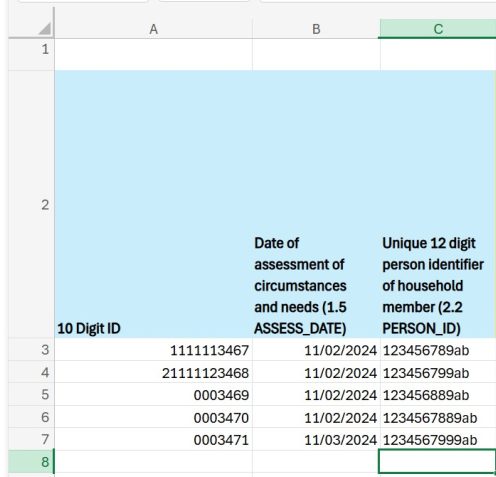
From Cell A3, users are asked to include an ID. This could be one of two options:
1. The client’s reference number as generated by your IT system; or
2. The LA will generate a number which it will use as a reference point for the Client and this specific assessment. This is a maximum of 10 digits.
Each assessment (regardless of the client) must have a different number. This means that if more than one assessment is completed for a client, each assessment will have a separate number. We would expect that the LA will include the follow-on data on the latest assessment and previous assessments will be closed.
The Client Reference ID is the reference that is used with HCLIC. This is to enable LAs to easily identify the client when looking at follow on data to input regarding any future instances of rough sleeping.
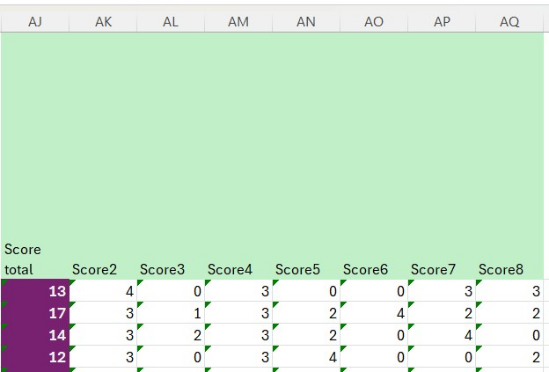
Columns D-K contain the 8 tool questions as outlined below in Image 2. The scores and total are provided in columns AJ-AQ (see image 3).
Image 2:
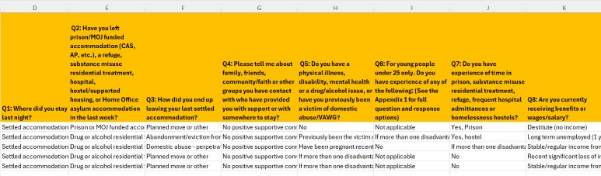
Image 3:
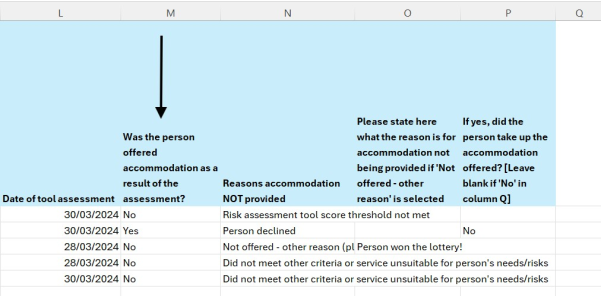
If ‘NO’ is selected in column M (accommodation offered, see Image 4), please proceed to column N to select why it was not offered. If there is a reason not included or further information is to be provided, please include this in column O which is a free text box.
Image 4:
LAs are encouraged to look at the how those assessed have progressed. Include data on those who have been found rough sleeping within 1, 3, 6, 9 or 12 months of the assessment being completed, as and when this is available in columns R-AF as seen in image 5 below.
Image 5:
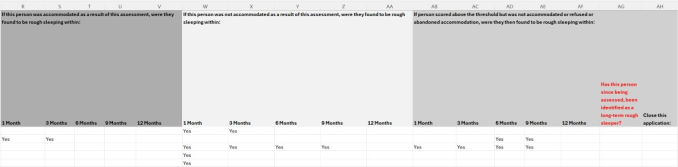
LAs will set their own thresholds, and this will need to be considered in the template when looking at those who have been assessed. When completing columns AB – AF, please consider your high threshold and include data based on this.
If the client has been identified as a long-term rough sleeper, please indicate this in column AG (see image 6).
Image 6:

If this assessment has been closed and another assessment has been completed, please indicate this in column AH. Future internal reporting on this client will be on the newest assessment completed.