DSIT Supplementary Estimates memorandum 2025 to 2026
Published 10 February 2026

© Crown copyright 2026
This publication is licensed under the terms of the Open Government Licence v3.0 except where otherwise stated. To view this licence, visit nationalarchives.gov.uk/doc/open-government-licence/version/3 or write to the Information Policy Team, The National Archives, Kew, London TW9 4DU, or email: psi@nationalarchives.gov.uk.
Where we have identified any third party copyright information you will need to obtain permission from the copyright holders concerned.
This publication is available at https://www.gov.uk/government/publications/dsit-supplementary-estimates-memorandum-2025-to-2026/dsit-supplementary-estimates-memorandum-2025-to-2026
This memorandum gives further explanation to the Department for Science, Innovation and Technology (DSIT) Supplementary Estimate 2025 to 2026. The format of this document follows guidance from the Parliamentary Scrutiny Unit, to provide wider context on the department’s objectives and finances.
1. Overview
1.1 Objectives
The Department for Science, Innovation and Technology (DSIT) has the following priority outcomes:
-
Growth and Prosperity – Harnessing and accelerating science and technology to drive economic growth, raise living standards, and make life more affordable across the UK.
-
Modernising Public Services – Using technology to make public services more accessible, efficient, and responsive to people’s needs.
-
Tech Adoption and Skills – Ensuring everyone — across all regions and backgrounds — can access the skills, tools, and opportunities to thrive in a digital economy.
-
Technology You Can Trust – Making sure technology is safe, trusted, and delivers positive outcomes for society, with a particular focus on protecting children online.
The detail of how spending programmes relate to these priorities is provided in Section 3.1.
1.2 Spending controls
DSIT’s spending is broken down into several spending totals, for which Parliament’s approval is sought.
The spending totals which Parliament votes are:
- Resource Departmental Expenditure Limit (“Resource DEL”) – expenditure within the current financial year, including day to day running costs such as staff and corporate costs.
- Capital Departmental Expenditure Limit (“Capital DEL”) – expenditure on creating or buying assets, where value will extend beyond the current financial year, which for DSIT includes investment in digital infrastructure, and Research and Development (R&D) spending.
- Resource Annually Managed Expenditure (“Resource AME”) – less predictable day to day spending: in DSIT’s case, mainly movements in the value of provisions and the expenditure of the National Endowment for Science, Technology and the Arts (NESTA) Trust.
- Capital Annually Managed Expenditure (“Capital AME”) – less predictable investment spending: in DSIT’s case, pension valuations.
In addition, Parliament votes on the net cash requirement, designed to cover the elements of the above budgets, which require DSIT to pay out cash in year.
1.3 Main areas of spending
The graphic below shows the main components of DSIT’s RDEL and CDEL budgets for the year, included in the latest Supplementary Estimate, and the proportions of funds spent on its main activities. Figures in the charts below may not sum back to the totals due to rounding.
Resource DEL by spending area: total budget £1,177.5 million 2025 to 2026
| Description | £ million |
|---|---|
| Depreciation | 502.1 |
| Core and agency admin costs | 236.7 |
| Government Digital Function | 236.5 |
| Digital, broadcasting and media | 88.3 |
| Building Digital UK | 40.4 |
| Other Costs including partners organisations | 73.6 |
| Total | £1,177.5 million |
Capital DEL by spending area: total budget £14,486.3 million[footnote 1] 2025 to 2026
| Description | £ million |
|---|---|
| UK Research and Innovation (UKRI) | 9,243.4 |
| UK contribution to EU Programmes | 2,028.3 |
| UK Space Agency | 675.9 |
| Other costs | 966.2 |
| Building Digital UK | 487.3 |
| Met Office | 392.9 |
| Government Digital Function | 84.2 |
| Science and Society | 113.1 |
| National Measurement System (NMS) | 136.5 |
| Advanced Research and Invention Agency (ARIA) | 183.7 |
| Other partner organisations | 23.0 |
| Information Commissioner’s Office (ICO) | 2.9 |
| Geospatial Commission | 150.9 |
| Total | £14,486.3 million |
1.4 Comparison of spending totals sought
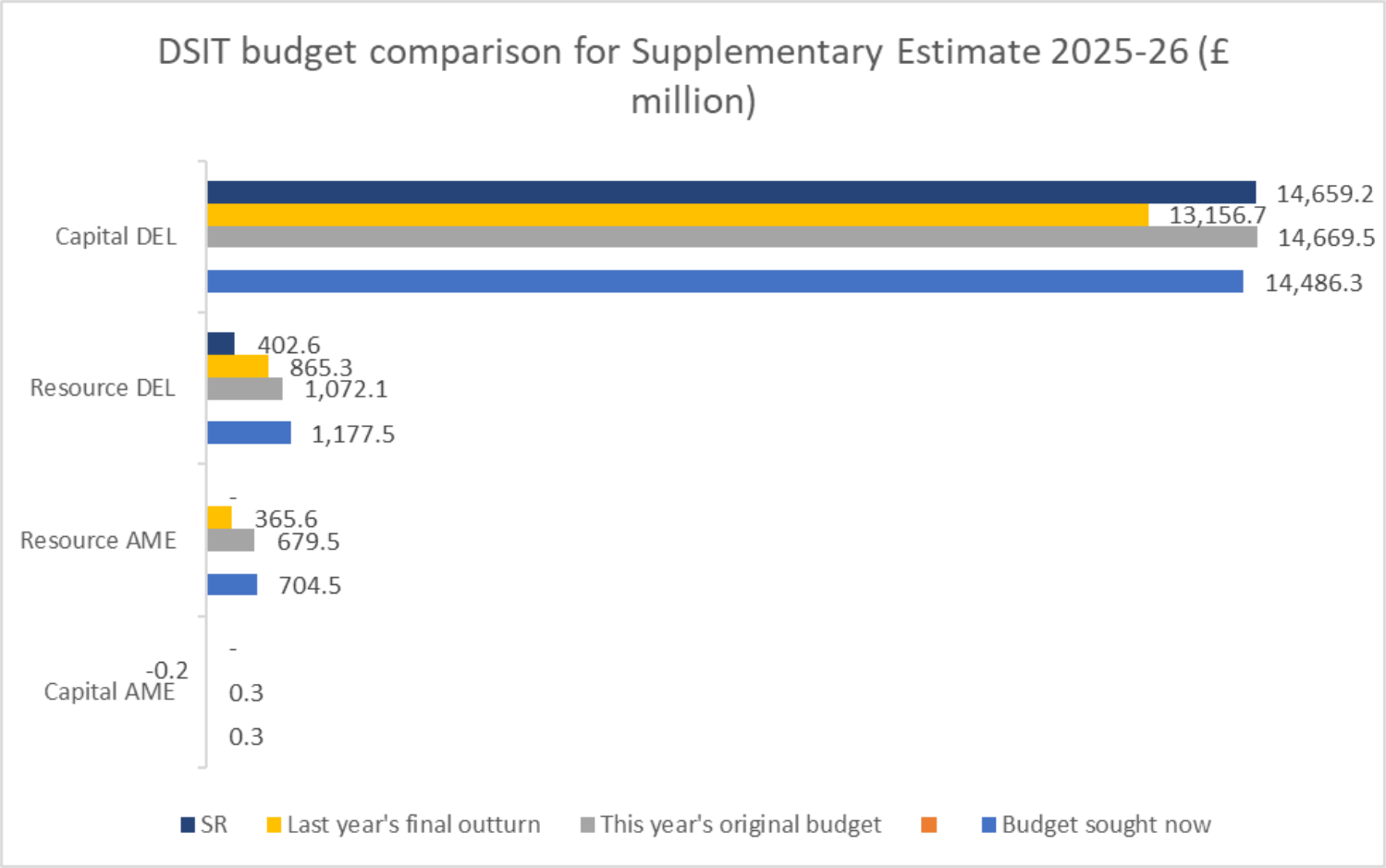
The table and graphic below show how the totals sought for DSIT in its Supplementary Estimate compare with the original budget this year and the final outturn for last year. The final outturn for 2024-25 has been restated to reflect the Cyber Machinery of Government (MoG) changes which took place during 2025-26. Resource DEL is the net position including non-cash depreciation of £502.1 million.
Table 1: Spending total amounts sought for DSIT this year compared with the original budget this year.
| Supplementary Estimate 2025 to 2026 | Difference (+/-) compared to Main Estimate 2025 to 2026 (£m) | Difference (+/-) compared to Main Estimate 2025 to 2026 (%) | ||
|---|---|---|---|---|
| Resource DEL | 1,177.5 | 105.5 | 9.8% | |
| Capital DEL | 14,486.3 | -183.2 | -1.2% | |
| Resource AME | 704.5 | 25.0 | 4% | |
| Capital AME | 0.3 | 0.0 | 0% |
Table 2: Spending total amounts sought for DSIT this year compared with final outturn last year.
| Supplementary Estimate 2025 to 2026 | Difference (+/-) compared to final outturn 2024 to 2025 (£m) | Difference (+/-) compared to final outturn 2024 to 2025 (%) | ||
|---|---|---|---|---|
| Resource DEL | 1,177.5 | 312.3 | 36.1% | |
| Capital DEL | 14,486.3 | 1,329.7 | 10.1% | |
| Resource AME | 704.5 | 338.9 | -92.7% | |
| Capital AME | 0.3 | 0.4 | -264.0% |
Table 3: Difference (+/-), compared to Spending Review
| Supplementary Estimate 2025 to 2026 | Difference (+/-), compared to Spending Review 2025 (£m) | Difference (+/-), compared to Spending Review 2025 (%) | |
|---|---|---|---|
| Resource DEL | 1,177.5 | 775.0 | 192.5% |
| Capital DEL | 14,486.3 | -172.9 | -1.2% |
| Resource AME | 704.5 | 704.5 | 100% |
| Capital AME | 0.3 | 0.3 | 100% |
Figure 1: DSIT budgets, £ million
1.5 Key drivers of spending changes since original budget
Resource DEL
There is a net increase in RDEL of £105.4 million in the amount sought in the Supplementary Estimate for 2025-26, compared to the budget agreed as part of the Main Estimate 2025-26. The main changes relate to:
- £50.2 million increase in depreciation budgets to reflect the latest forecasts.
- £40.5 million additional funding for AI Exemplars (now known as AI Frontiers) announced at Spring Budget 2025.[footnote 2]
- £15.2 million additional funding announced during Summer 2025 for Eutelsat investment.[footnote 3]
Capital DEL
There is a £183.2 million decrease in CDEL budgets at Supplementary Estimate 2025-26 compared to the Main Estimate 2025-26, with main drivers relating to:
- £180.0 million Budget Exchange into future financial years relating to EU Programmes.
- £141.0 million additional funding for Eutelsat investment.
- £65.0 million net Budget Cover Transfers out to other government departments.
- £34.3 million Budget Exchange for BDUK Shared Rural Network, to reflect the latest cost profile.
- £31.0 million pensions settlement payment to HMT through a budget “surrender” mechanism.
- £14.5 million Budget Exchange for Life Sciences Innovative Manufacturing Fund (LSIMF), to reflect updated cost profile.
There is a £25.0 million increase in Capital and Resource AME budget sought compared to the budget agreed as part of the Main Estimate 2025-26. This is the result of an updated value for UKRI Corporation Tax.
1.6 Key drivers of spending changes since the Spending Review
| Spend category | Budget subhead | Details of funding | Estimated cost (£m) |
|---|---|---|---|
| RDEL | Modernising and reforming the work of the Government Functions | Additional funding for AI Exemplars (now known as AI Frontiers), per the Spring Statement | 40.5[footnote 4] |
1.7 Reserve claims and spending pressures
Since the SR25 Settlement the following funding was provided by HM Treasury as part of the Spring Budget 2025 and in this Estimate.
| Spend category | Budget subhead | Details of funding | Estimated cost (£m) |
|---|---|---|---|
| CDEL | Science and Research | Additional funding announced for Eutelsat during Summer 2025 | 141.0 |
| RDEL | Various subheads | Additional depreciation funding agreed with HMT | 50.2 |
| RDEL | Science and Research | Additional funding announced for Eutelsat during Summer 2025 | 15.2 |
1.8 Funding and other spending announcements
Confirmation of DSIT’s settlement for 2025-26 was made at Autumn Budget 2024 (AB24)[footnote 5] on 30 October 2024. There was also a series of announcements related to DSIT:
- Investing up to £520 million, with £70 million in 2025-26, for a new Life Sciences Innovative Manufacturing Fund to drive growth and build resilience for future health emergencies.
- Over £500 million in 2025-26 for Project Gigabit and the Shared Rural Network, driving the rollout of digital infrastructure to under-served parts of the UK.
- Extending the Made Smarter Innovation programme, with up to £37 million in funding in 2025-26 to help firms integrate digital technologies into the manufacturing process.
- Launching a new multi-year R&D Missions Programme, with at least £25 million of investment in 2025-26, to solve targeted problems, that will crowd in private and third sector investment to accelerate delivery of each Mission.
- Investing up to £80 million in 2025-26 to support the transformation of corporate functions across government to deliver more efficient, cost-effective and modern systems as part of government’s Shared Services Strategy.
- Supporting the commercialisation of our world-class university research by providing at least £40 million over 5 years for proof-of-concept funding and improvements to support the UK’s cutting-edge research into firms of the future.
- Extending the Innovation Accelerators programme into 2025-26 to continue to bolster high-potential innovation clusters in the Glasgow City Region, Greater Manchester and the West Midlands.
- Announcing 10-year R&D budgets to create a stable environment for productive long-term partnerships with industry, with these being set out as part of Part 2 of the Spending Review.
- Creating a National Data Library, that will provide easy, ethical and secure access to public data assets, giving researchers and businesses access to powerful insights that will transform people’s quality of life through better public services and cutting-edge innovation.
- Establishing the new Regulatory Innovation Office, which will reduce the burden of red tape, speeding up access to new technologies, that improve people’s daily lives and unlock growth opportunities.
- Announcing a review to be led by the Government Chief Scientific Adviser (GCSA), Professor Dame Angela McLean, and National Technology Adviser (NTA), Dr Dave Smith, which will focus on barriers to the adoption of transformative technologies.
The Spring Statement took place on 26 March 2025 and included the following announcement for DSIT:
- AI Exemplars (now known as AI Frontiers), where DSIT will receive £42 million additional funding in 2025-26 to test new ways of improving public services and reducing costs through use of Artificial Intelligence (AI).
An Autumn Budget took place on 26 November 2025 and included the following announcements for DSIT:
- Artificial Intelligence – DSIT announced a package of investments in skills, compute capacity, and dedicated AI growth zones, across the UK.
- The appointment of a panel of AI Ambassadors, including Nobel laureate Simon Johnson, Monzo co-founder Tom Blomfield, and AI researcher Raia Hadsell from Google DeepMind.
- A £10 million investment for the semiconductor industry in South Wales to maximise the growth opportunities from the AI Growth Zone including creating high-skilled jobs in local communities. It builds on the Industrial Strategy and the Digital and Technologies Sector Plan, ensuring the UK remains at the forefront of innovation in frontier technologies.
-
R&D – DSIT announced £38.6 billion for UKRI over the next 4 years.
- Of this, £14 billion will go to curiosity-driven research, where the UK is already leading.
- To strengthen how we apply and commercialise our research, £8 billion will fund work aimed at governmental and societal priorities, and £7 billion will support innovative companies to start-up, scale and succeed in the UK. Within these categories, £9 billion will go towards the Industrial Strategy sectors.
- Entrepreneurship – the ‘Entrepreneurship Prospectus’ was published alongside the Budget to help growing companies.
- We are investing £4 million a year in new ‘Enterprise Fellowships’, funding up to 100 researchers to spin-out or take up secondments in UK firms.
- Innovate UK has a £130 million ‘Growth Catalyst’ scheme, offering grants and tailored support to frontier companies. The previous programme generated £1.55 billion of follow-on investment from £156 million of grants.
- The British Business Bank announced measures, including Series B funding for scaling firms and plans to unlock pension fund capital for UK asset.
- Life Sciences – The UK is building new research infrastructure, scaling manufacturing, improving regulation, strengthening clinical trials and securing further private investment in life sciences. Our ambition is to be Europe’s leading life sciences economy by 2030.
- We announced a new £50 million R&D fund pilot to support large-scale life sciences projects.
- The Life Sciences Innovative Manufacturing Fund has awarded its first grants, securing £30 million of investment in West Midlands companies.
- We are also providing £50 million for mental health research and £10 million for addiction research.
1.9 New policies and programmes - ambit changes
The ambit has been updated to include the activities relating to the Cyber MoG areas, which have transferred from Cabinet Office to DSIT as of 3 June 2025:
“Driving the Government Cyber Action Plan to transform public sector cyber and digital resilience, securing critical functions through effective proactive risk management and clear direction alongside the rapid deployment of scalable services and incident response.”
As of 1 November 2025, Building Digital UK (BDUK), which was previously an Executive Agency of DSIT, moved to the core department. To ensure comparability with the Main Estimate 2025-26, spend in this area continues to be reported against a specific BDUK subhead at Supplementary Estimate 2025-26. This approach will be reviewed and reflected within the Main Estimate 2026-27.
1.10 Administration costs and efficiency plans
At Main Estimate 2025-26, the administration budget (ring fenced and non-ringfenced) was set at £376.8 million. The Supplementary Estimates budgets reflect the £365.4 million administration budget agreed with HM Treasury for 2025-26, including changes agreed as part of the Spending Review 2025 Phase 1 in Autumn 2024. The £11.3 million decrease since Main Estimate mainly relates to BCTs out to other government departments, including for the Matrix programme. The £55.2 million increase compared with 2024-25 outturn mainly relates to £24.5m increase for the Matrix programme, £6.6 million increase in depreciation budgets and £5.2 million increase in Integrated Corporate Services (ICS) recharges in relation to the Government Digital Services MoG and increased estate costs for associated additional buildings.
Table 4: administration costs - spending total amounts sought this year compared to original budget this year and final outturn last year
| Supplementary Estimate 2025 to 2026 (£m) | Difference (+/-) compared to Main Estimate 2025 to 2026 (£m) | Difference (+/-) compared to Main Estimate 2025 to 2026 (%) | Difference (+/-) compared to final outturn 2024 to 2025 (£m) | Difference (+/-) compared to final outturn 2024 to 2025 (%) | |
|---|---|---|---|---|---|
| Administration costs | 365.4 | -11.3 | -3.0% | 55.2 | 31.7% |
1.11 Spending trends
The DSIT DEL Spending Trends charts below show overall spending trends since the establishment of DSIT. For the last 5 years, it is based on historic data for outturns, and budgets presented in the Supplementary Estimate 2025-26. Resource DEL is the net position, including non-cash depreciation of £502.1 million.
Figure 2: DSIT DEL spending trends: 2021 to 2022 to 2029 to 2030 (£m).
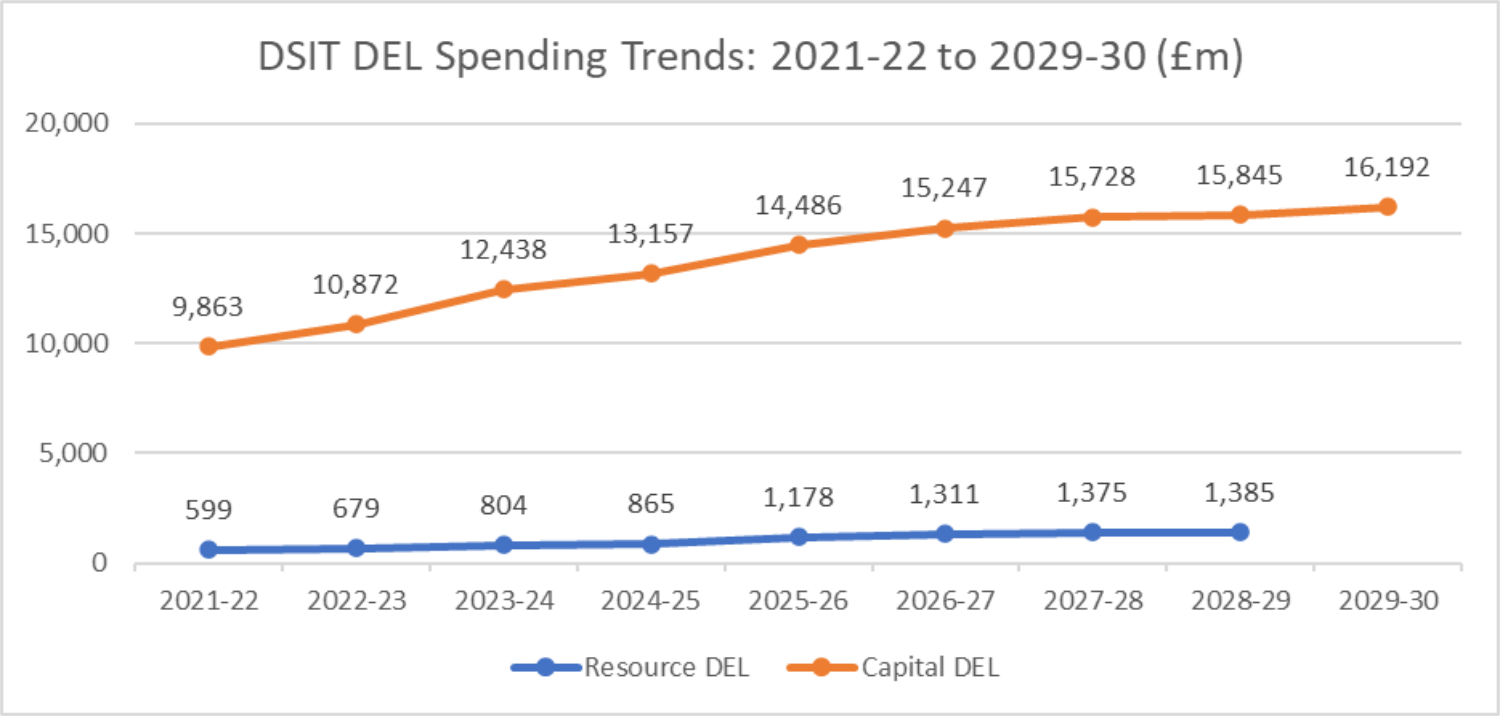
The trend (Figure 2) diagram is showing outturns for 21-22, 22-23, 23-24 and 24-25, 25-26 Supplementary Estimates budgets sought and Spending Review budgets for 26-27, 27-28, 28-29 and 29-30. Note that 2029-30 RDEL budgets were not set through SR25 and therefore do not appear in this diagram.
DEL budgets
Capital DEL increases mainly reflect a continuing growth in spend qualifying as R&D since the last Spending Review. The EU Programmes budget has increased by £1 billion in 2025-26 compared with 2024-25, due to timing of invoice payments. Non-R&D CDEL programmes spend such as Building Digital UK (BDUK) have increased budgets in 2025-26 compared with 2024-25 by £131 million.
Resource DEL in 2025-26 reflects an increase in budget for key programmes, including Digital Technologies and Telecoms and the Government Digital Service (GDS), following the Digital MoG.
Figure 3: DSIT AME spending trends: 2021 to 2022 to 2028 to 2029 (£m).
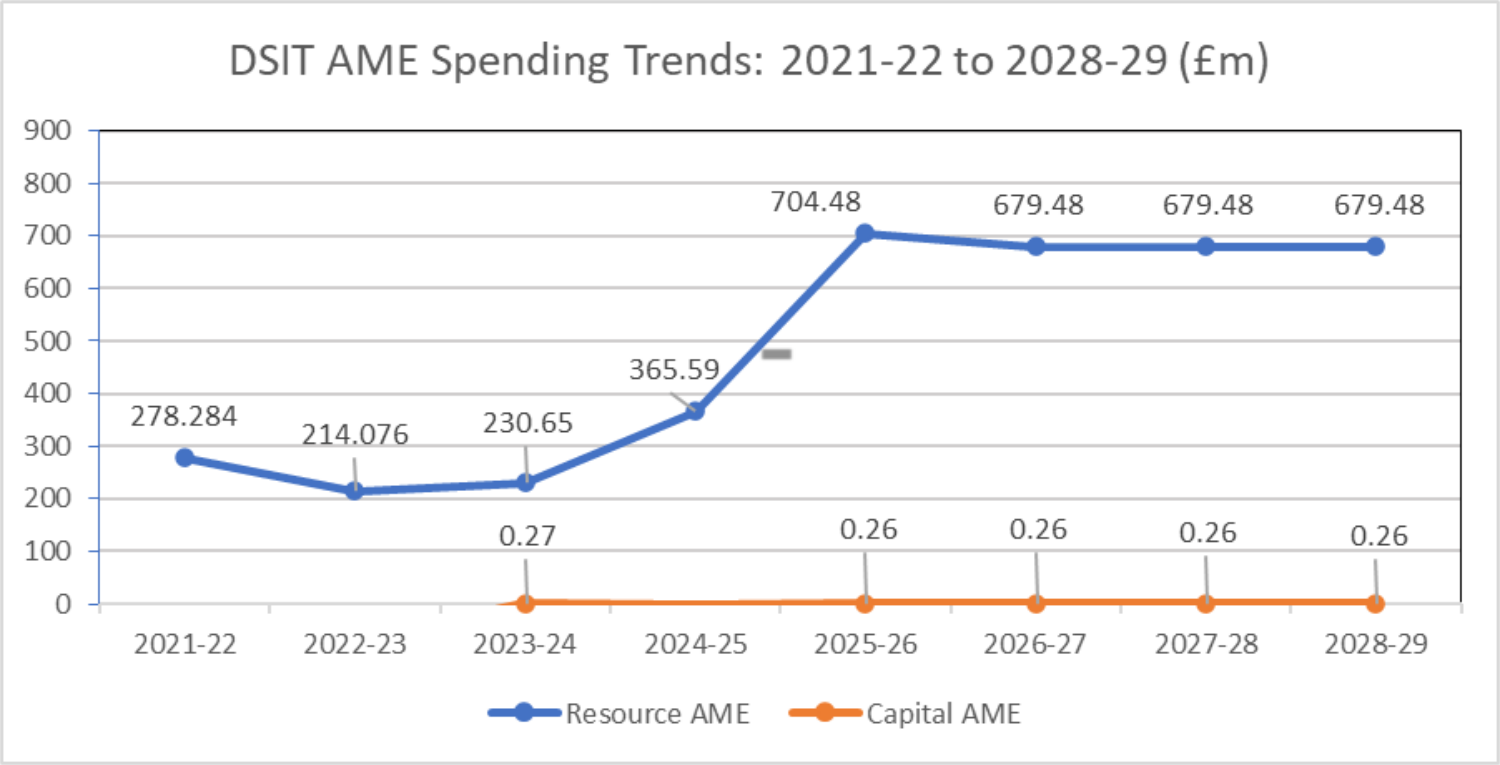
The trend (Figure 3) diagram is showing outturns for 21-22, 22-23, 23-24 and 24-25, 25-26 Supplementary Estimates budgets sought, and Spending Review budgets for 26-27, 27-28 and 28-29. Note that 2029-30 AME budgets were not set through SR25. AME budgets for SR25 were based on current year projections and will be reviewed at future years’ Estimates rounds.
AME budgets
Resource AME in DSIT is subject to significant fluctuation from year to year due to non-cash costs arising from movements in provisions and the impact of changes to discount rates. The main provision in 2025-26 relates to a £283m potential foreign exchange rate movement on EU Programmes hedging on forward contracts.
2. Spending detail
As shown in the table in Section 3.1, departmental expenditure may contribute to different strategic objectives. However, due to Parliamentary rules, budgets must be assigned to only one specific Estimate subhead even though spending often contributes to other lines.
The subheads in the Resource DEL, Capital DEL, Resource AME and Capital AME tables are explained below:
| Subhead Letter(s) | Subhead Name | Subhead Description |
|---|---|---|
| A/ N/ P | Deliver an ambitious industrial strategy | Includes spend on the activities of the Office for Life Sciences (OLS), Eutelsat and the Met Office (operational function) |
| B | Promote competitive markets and responsible business practices | Includes spend on Innovative Regulation, which supports the creation of a UK regulatory environment which encourages business innovation and growth |
| C/ I/ M/ O/ Q | Science and Research | Includes spend on Academies, GO Science, the UK Space Agency (an Executive Agency), Horizon Europe, Research England (an ALB) and UK Research and Innovation (UKRI) (an ALB) |
| D/ J | Capability | Includes spend on enabling functions, corporate and running costs |
| E/ K | Government as Shareholder | Includes spend and income (including dividends) relating to public corporations, including the Met Office (shareholder function) |
| F/ L/ R | Support for the Digital, Broadcasting and Media Sectors | Includes spend relating to Digital Economy Unit (which includes the Open Networks R&D Fund programme which will deliver upon the UK’s 5G Supply Chain Diversification Strategy, building secure and resilient communications infrastructure as well as enhancing competition and innovation within the telecoms supply chain), Broadband, AI, Ofcom (an ALB) and Information Commissioners Office (ICO) (an ALB) |
| G | Modernising and reforming the work of the Government Functions | Includes spend in relation to the Digital areas which were transferred via MoG from Cabinet Office in July 2024, plus the activities of the Geospatial Commission and the Cyber MoG from Cabinet Office in June 2025 |
| H | Building Digital UK | Relates to the spend and income of DSIT’s former Executive Agency BDUK (which moved to DSIT core department as of 1 November 2025), which includes Project Gigabit, Shared Rural Network (SRN) and Superfast Broadband |
2.1 Explanations of changes in spending
Resource DEL
The table below shows how DSIT’s spending plans for Resource DEL (net, including non-cash depreciation of £502.1 million) compare with the earlier Main Estimate.
Table 5: Resource DEL spending plans this year compared with earlier this year
| Subhead | Description | 2025 to 2026 Supplementary Estimates budget sought (£m) | 2025 to 2026 Main Estimates budget approved (£m) | Change from Main Estimate (£ m) | Changes from Main Estimate (%) | See note number | |
|---|---|---|---|---|---|---|---|
| A | Deliver an ambitious industrial strategy | 7.4 | 6.1 | 1.3 | 21.4% | no data | |
| B | Promote competitive markets and responsible business practices | no data | no data | no data | no data | no data | |
| C, I, M | Science and Research | 375.5 | 401.3 | -25.8 | -6.4% | no data | |
| D, J | Capability | 318.4 | 326.2 | -7.8 | -2.4% | no data | |
| E, K | Government as Shareholder | -19.0 | -14.5 | -4.4 | -30.6% | no data | |
| F, L | Support for the Digital, Broadcasting and Media sectors | 108.4 | 111.3 | -2.9 | -2.6% | no data | |
| G | Modernising and reforming the work of the Government Functions | 345.1 | 192.3 | 152.8 | 79.5% | 1 | |
| H | Building Digital UK | 41.6 | 49.3 | -7.7 | -15.6% | no data | |
| No data | Total voted and non-voted | 1,177.5 | 1,072.1 | 105.5 | 9.8% | no data |
Differences of more than 10% which are more than £10 million; of more than 5% and £200 million; and significant or unusual changes, are explained below. Numbers relate to the relevant row in the table above.
Note number:
1. Modernising and reforming the work of the Government Functions
Resource DEL spending under these subheads is, overall, £152.8 million or 79.5% higher in the Supplementary Estimate for 2025-26 compared to the Main Estimate 2025-26. The main movements are:
- £40.5 million additional funding awarded for AI Exemplars (now known as AI Frontiers) post-Main Estimate.
- £108.6 million depreciation funding awarded post-Main Estimate and following internal reallocations of depreciation budgets between subheads post-Business Planning.
Capital DEL
The table below shows how spending plans for Capital DEL compare with earlier this year.
Table 6: Capital DEL spending plans this year compared with earlier this year
| Subhead | Description | 2025 to 2026 Supplementary Estimates budget sought (£m) | 2025 to 2026 Main Estimates budget approved (£m) | Change from Main Estimate (£m) | Change from Main Estimate (%) | See note number |
|---|---|---|---|---|---|---|
| A | Deliver an ambitious industrial strategy | 415.9 | 602.3 | -186.4 | -30.9% | 2 |
| B | Promote competitive markets and responsible business practices | 10.3 | 8.1 | 2.2 | 27.4% | no data |
| C, I, M | Science and Research | 12,735.0 | 12,572.2 | 162.8 | 1.3% | no data |
| D, J | Capability | 22.0 | 125.2 | -103.2 | 82.5% | 3 |
| E, K | Government as Shareholder | 334.7 | 311.4 | 23.3 | 7.5% | no data |
| F, L | Support for the Digital, Broadcasting and Media sectors | 238.3 | 250.5 | -12.2 | -4.9% | no data |
| G | Modernising and reforming the work of the Government Functions | 242.9 | 226.2 | 16.7 | 7.4% | no data |
| H | Building Digital UK | 487.3 | 573.6 | -86.3 | -15.1% | 4 |
| No data | Total voted and non-voted | 14,486.3 | 14,669.5 | -183.2 | -1.2% | no data |
Differences of more than 10% which are more than £10 million; of more than 5% which are more than £200 million; and significant or unusual changes, are explained below.
Note number:
2. Deliver an Ambitious Industrial Strategy
Total capital spending under these subheads is forecast to decrease by £186.4 million or 30.9% at the Supplementary Estimate 2025-26 compared to the 2025-26 Main Estimate. This is mainly due to:
- £129.0 million decrease in Office for Life Sciences (OLS) budget. This includes a £14.5 million Budget Exchange into 2026-27 for Life Sciences Innovative Manufacturing Fund (LSIMF) to reflect the latest spend profile, £43.1 million “budget cover” transfers to the Department for Health and Social Care, and to the devolved governments for Scotland and Wales, and internal budget reallocations to UKRI for managed programmes.
- £28.2 million decrease in Met Office relates to the timing of budget allocations following the Business Planning conclusion post-Main Estimate.
- £17.1 million decrease in National Measurement System (NMS) following re-allocation of internal budgets – Business Planning was finalised post-Main Estimate.
3. Capability
Total capital spending under these subheads is forecast to decrease by £103.2 million or 82.5% at the Supplementary Estimate 2025-2026 compared to the 2025-2026 Main Estimate. This is due to 2025-2026 Business Planning being finalised after the Main Estimate, the Supplementary Estimate therefore reflects final allocation of 2025-2026 budgets to other subheads.
4. Building Digital UK
Capital budget under this subhead will decrease by £86.4 million or 15.1% at the Supplementary Estimate 2025-26 compared to the 2025-26 Main Estimate. This is due to:
- £34.3 million decrease for Budget Exchange for Shared Rural Network (SRN) into 2026-27 to reflect the latest profile of work.
- £28.9 million net decrease reflecting planned Budget Cover Transfers to other government departments including the devolved nations for devolved elements of Superfast Extension and Gigabit Infrastructure Subsidy (GIS).
- £23.2 million decrease for reallocation between subheads post-Business Planning.
Resource AME
The table below shows how spending plans for Resource AME compare with earlier this year.
Table 7: Resource AME spending plans this year compared with earlier this year
| Subhead | Description | 2025 to 2026 Supplementary Estimates budget sought (£m) | 2025 to 2026 Main Estimates budget approved (£m) | Change from Main Estimate (£m) | Change from Main Estimate (%) | See note number | |
|---|---|---|---|---|---|---|---|
| Subhead | Description | 2025 to 2026 Supplementary Estimates budget sought (£m) | 2025 to 2026 Main Estimates budget approved (£m) | Change from Main Estimate (£m) | Change from Main Estimate (%) | See note number | |
| O, Q | Science and Research | 687.8 | 662.8 | 25.0 | 3.8% | no data | |
| N, P | Deliver an ambitious industrial strategy | 13.5 | 13.5 | no data | no data | no data | |
| R | Broadcasting and Media ALB (net) | 3.2 | 3.2 | no data | no data | no data | |
| No data | Total voted and non-voted | 704.5 | 679.5 | 25.0 | 3.7% | no data |
Capital AME
The table below shows how spending plans for Capital AME compare with earlier this year.
Table 8: Capital AME spending plans for this year compared with earlier this year
| Subhead | Description | 2025 to 2026 Supplementary Estimates budget sought (£m) | 2025 to 2026 Main Estimates budget approved (£m) | Change from Main Estimate (£m) | Change from Main Estimate (%) | See note number |
|---|---|---|---|---|---|---|
| O. Q | Science and Research | 0.3 | 0.3 | no data | no data | no data |
| No data | Total voted and non-voted | 0.3 | 0.3 | no data | no data | no data |
2.2 Restructuring
During 2025-26, a Machinery of Government (MoG) change moved legacy Cyber organisations from Cabinet Office to DSIT[footnote 6]. The budget transfer took place at 2025-26 Supplementary Estimate. Prior years’ values reflect the restated position, that includes Cyber within DSIT.
2.3 Ring fenced budgets
Within the totals, the following elements are ring fenced i.e. savings in these budgets may not be used to fund pressures on other budgets without express permission from HM Treasury.
As part of the Estimate process, HM Treasury can agree to relax ring fences, to allow the department to manage pressures and reallocate underspends.
The department is discussing a revised set of policy ring fences with HM Treasury following the recent Spending Review and will communicate these in future Estimates once they have been agreed.
Table 9: amounts sought this year compared with earlier this year
| 2025 to 2026 Supplementary Estimates (£m) | Main Estimate 2025 to 2026 (£m) | Change from Main Estimate 2025 to 2026 (%) | |
|---|---|---|---|
| Financial transactions Of which: |
214.5 | 67.5 | 217.8% |
| British Technology Investments (BTI) | 20.0 | 20.0 | 0% |
| National Measurement Service (NMS) | 6.1 | 6.1 | 0% |
| Met Office | 27.8 | 28.1[footnote 7] | 1.1% |
| UK Research and Innovation (UKRI) | 22.0 | 22.0 | 0% |
| Space | 147.0 | 0 | 100% |
| Other | -8.1 | -8.7 | 3.4% |
| Depreciation | 502.0 | 451.9 | 11.1% |
The £147.0 million increase in Space at Supplementary Estimate 2025-26 compared to Main Estimate mainly relates to additional funding for investment in Eutelsat announced in Summer 2025.
2.4 Changes to contingent liabilities
The schedule of contingent liabilities is listed in Annex B Part III: Note K of the Estimate.
This schedule relates to liabilities recognised at the time of issuing this document with a complete audited schedule to be published in the Annual Report and Accounts.
The estimate for current contingent liabilities which were disclosed at the 2025-2026 Supplementary Estimate have either moved by de minimis amounts or remained unquantifiable.
3. Priorities and performance
3.1 How spending relates to objectives
The table below shows how funding against each subhead contributes to Departmental priorities under the Outcome Delivery Plan.
Outcome 1: Growth and Prosperity
Estimates subheads: A, N, P, B, C, I, M, O, Q
Outcome 2: Modernising Public Services
Estimates subheads: D, J, E, K, G
Outcome 3: Tech Adoption and Skills
Estimates subheads: F, L, R, H
Outcome 4: Technology You Can Trust
Estimates subheads: F, L, R
3.2 Measures of performance against each priority
DSIT measures performance for the department against its high-level objectives.
Outcome 1: Growth and Prosperity
Metrics:
- Gross expenditure on R&D as a percentage of GDP (GERD)
- Business Expenditure on Research and Development (BERD)
- Field weighted citation impact
- Number of new UK unicorns
- Value of equity investment into R&D-intensive businesses in the UK
- Gross Value Added of the digital sector (£) - (monthly / yearly)
- Percentage of premises passed with gigabit-capable broadband (including premises with access to FTTP and/or DOCSIS3.1)
Outcome 2: Modernising Public Services
Metrics:
- Percentage of civil servants working in tech, digital and data roles
Outcome 3: Tech Adoption and Skills
Metrics:
- Percentage of geographic area with 4G coverage from at least one mobile network operator (UK, outdoor)
- Percentage of premises with 5G coverage from at least one mobile network operator (UK, coverage outside premises)
Outcome 4: Technology You Can Trust
Metrics:
- Percent of adult UK internet users who claim they have experienced at least one example of potentially harmful online content or behaviour in the last 4 weeks.
3.3 Major projects
The department is currently responsible for 7 major projects that are included in the Government Major Projects Portfolio (GMPP). Details for the projects are included below, taken from the NISTA Annual Report 2024-2025 published in August 2025. Any changes since then are not reflected.
Met Office Supercomputing 2020+ Programme
Delivering our future Supercomputing capability through the procurement and installation of an increased supercomputing capacity. This includes storage, observation networks, post processing systems and services, tooling for data exploitation delivery and support resources throughout the investment lifetime, data centre hosting, networking security services and decommissioning.
| Met Office Supercomputing 2020+ Programme | Details |
|---|---|
| Start Date | 1 January 2018 |
| End Date | 11 July 2032 |
| Whole Life Baseline Cost | £1.24 billion |
| NISTA Sub-Category | ICT |
| Delivery Confidence Assessment | AMBER |
Matrix Cluster Transformation Programme
The Matrix Transformation Programme seeks to implement the Government Shared Service Strategy for 8 government departments, by modernising and consolidating back-office systems and services. This will include delivery of a new shared business process service (BPS), a combined enterprise resource planning (ERP) system including ancillary technologies, and a change in ways of working for all users.
| Matrix Cluster Transformation Programme | Details |
|---|---|
| Start Date | 1 April 2022 |
| End Date | 30 November 2027 |
| Whole Life Baseline Cost | £938 million |
| NISTA Sub-Category | Government Transformation and Service Delivery |
| Delivery Confidence Assessment | AMBER |
Project Gigabit
Deliver gigabit capable broadband to at least 99% of premises by 2032[footnote 8] and achieve full coverage as soon as possible. The government is subsidising deployment of non-commercial premises through Project Gigabit, other than premises which are not affordable or do not represent value for money.
| Project Gigabit | Details |
|---|---|
| Start Date | 1 April 2021 |
| End Date | 31 December 2032 |
| Whole Life Baseline Cost | £5.4 billon |
| NISTA Sub- Category | Infrastructure and Construction |
| Delivery Confidence Assessment | AMBER |
Shared Rural Network
The Shared Rural Network (SRN) programme is a deal between government and the 4 Mobile Network Operators (MNOs) - EE, Virgin Media O2, Vodafone and Three (with obligations flowing through to any subsequent merged entity).
The programme achieved its overarching objectives of delivering 4G coverage to 95% of UK landmass, 280,000 premises and 16,000km of roads over 12 months ahead of the programme deadline of the end of 2025, with the most significant coverage improvements in rural parts of Scotland and Wales.
The SRN programme is split between public and privately funded elements and underpinned by the MNOs’ spectrum licence obligations. In line with the 6-year capital funding period, the MNOs’ legally binding spectrum obligations for the SRN, which are still yet to be met, must be achieved by January 2027 and the programme will continue to deliver coverage improvements up to that point. Having achieved the overarching objectives of the SRN programme, government and the MNOs have worked together to agree a revised plan to target remaining deployment of infrastructure in places where the benefit will be felt the most.
| Shared Rural Network | Details |
|---|---|
| Start Date | 11 March 2020 |
| End Date | 11 March 2040 |
| Whole Life Baseline Cost | £512 million |
| NISTA Sub-Category | Infrastructure and Construction |
| Delivery Confidence Assessment | AMBER |
GOV.UK One Login
GOV.UK One Login provides a single way for users to create an account, log in, and prove their identity to access all central government services. It replaces the previous landscape of siloed and duplicative sign-in and identity-proofing methods, providing one ‘front door’ for connected services that will continue to be operated by departments. By streamlining access, this consolidation reduces costs, lowers the risk of fraud, enhances inclusion, and significantly improves the user experience, amplifying benefits to both government and citizens, ensuring it remains the ‘market-leading’ account and identity verification solution across government.
| GOV.UK One Login | Details |
|---|---|
| Start Date | 4 January 2021 |
| End Date | 31 March 2028 |
| Whole Life Baseline Cost | £342.19 million |
| NISTA Sub-Category | ICT |
| Delivery Confidence Assessment | AMBER |
Major projects recently completed/closed
Open Networks Programme
The Open Networks Research and Development (R&D) Fund is the £250 million government supported programme to deliver upon the UK’s 5G Supply Chain Diversification Strategy. The Open Networks R&D Fund aims to accelerate the development and deployment of open interface architectures, such as Open RAN, and our ambition to:
- Accelerate open-interface products and solutions - ensuring they are truly interoperable, performant, and sustainable – to support our long-term vision for a more open and innovative telecoms market.
- Incentivise and de-risk accelerated deployment in the UK - to encourage and accelerate network operators to adopt and deploy open network solutions.
- Develop an internationally recognised UK telecoms ecosystem - positioning the UK as a leading global market and focal point for research into open network technology.
| Open Networks Programme | Details |
|---|---|
| Start Date | 1 September 2021 |
| End Date | 31 March 2025 |
| Whole Life Baseline Cost | £325 million |
| NISTA Sub-Category | Infrastructure and Construction |
| Delivery Confidence Assessment | N/A (Programme completed) |
Major projects scheduled for completion in 2025-2026
National Underground Asset Register
The National Underground Asset Register (NUAR) is a new digital map of the pipes and cables beneath our feet. The service will improve the efficiency and safety of works and is envisaged to deliver over 4bn of economic growth over 10 years.
| National Underground Asset Register | Details |
|---|---|
| Start Date | 9 August 2021 |
| End Date | 31 March 2026 |
| Whole Life Baseline Cost | £42.6 million |
| NISTA Sub-Category | Government Transformation and Service Delivery |
| Delivery Confidence Assessment | AMBER |
Major projects expected to join the portfolio in 2025-26 or 2026-27
National Timing Centre (NTC) is expected to be added once its Business Case has been approved. Details to be confirmed.
The Infrastructure and Projects Authority reports on delivery of major projects annually. Data for DSIT can be found here.
4. Other information
4.1 Research and Development expenditure
The following is provided as contextual information on R&D expenditure at the request of the Science, Innovation & Technology Committee. In contrast to the spending outlined in previous sections, it does not represent a firm spending commitment as part of the estimates process.
R&D spending under the Frascati definition is expected to increase relative to last year’s final outturn as explained below.
Table 10: breakdown of R&D expenditure - spending plans this year compared to the original allocations this year and final outturn last year
| Spending plans this year | Supplementary Estimate 2025-2026 (£m) | Change from earlier this year (£m): initial allocations 2025 to 2026)[footnote 9] | Change earlier this year (%): initial allocations 2025 to 2026) | Change from last year (£m): final outturn 2024 to 2025[footnote 10] | Change from last year (%): final outturn 2024 to 2025 | Note number |
|---|---|---|---|---|---|---|
| UKRI [footnote 11] | 9,221.4 | 410.4 | 4.7% | -544.0 | -5.6% | 1 |
| UK contribution to EU programmes | 2,028.3 | -707.7 | -25.9% | 992.3 | 95.8% | 2 |
| UKSA | 675.9 | 7.9 | 1.2% | 68.9 | 11.4% | 3 |
| Met Office | 364.1 | 54.1 | 17.4% | 94.3 | 34.9% | 4 |
| National Academies | 220.3 | 3.3 | 1.5% | -11.7 | -5.0% | no data |
| ARIA | 183.7 | -0.3 | -0.1% | 152.7 | 492.7% | 5 |
| NMS | 130.4 | 0.4 | 0.3% | 9.4 | 7.8% | no data |
| AISI | 69.0 | 3.0 | 4.5% | 69.0 | 100% | 6 |
| OLS | 22.3 | -106.7 | -82.7% | 1.3 | 6.2% | 7 |
| GO Science | 17.7 | -0.3 | -1.5% | 2.7 | 18.3% | 8 |
| Other DSIT Programmes[footnote 12] | 654.0 | 83.0 | 14.5% | 29.8 | 4.8% | 9 |
| Total R&D | 13,587.1 | -252.9 | -1.8% | 864.7 | 6.8% | no data |
Differences of more than 10% are explained below.
1. UKRI
R&D spend has not increased or decreased by more than 10% however due to the relative size of these budgets it is worth highlighting that UKRI budgets change during the financial year due to UKRI managing programmes on behalf of DSIT, with budget allocations to UKRI from core DSIT as these are confirmed. Changes from 2024-25 primarily reflect the timing of Research England payments, due to differences in academic years and financial years.
2. UK contribution to EU programmes
R&D spend has increased compared with 2024-25 due to profile of costs across financial years. 2025-26 represents the first full year of costs, whereas 2024-25 represented only a partial payment year. R&D spend has decreased compared to Main Estimate largely due to budget for the Horizon Europe Guarantee being transferred to UKRI. A portion of the budget has also been budget exchanged into 2026-27.
3. UK Space Agency
R&D spend has increased compared with 2024-25 in line with European Space Agency (ESA) commitments. Through ESA the UK has entered into multi-lateral commitments to deliver science and innovation space programmes that benefit the UK and mitigate national risks. The increase from 2024–25 allowed the UK to reduce its outstanding ESA commitments, improving future affordability.
4. Met Office
R&D spend has increased compared with earlier this year and with 2024-25 due to a £95m milestone payment on the Met Office supercomputer slipping from 2024-25 into 2025-26. The increase from Main Estimate is due to the transfer of additional budget to cover this milestone payment.
5. Advanced Research & Invention Agency
R&D spend has increased compared with 2024-25 in line with increased activity since ARIA has been established.
6. AI Security Institute
AISI was established at the start of 2025-26, therefore no R&D spend was recorded during 2024-25.
7. Office for Life Sciences
R&D spend has decreased compared with earlier this year, this includes a decrease of £43.1m for budget cover transfers to the Department for Health and Social Care, and to the devolved governments for Scotland and Wales, and the remainder relates to internal budget reallocations from OLS to UKRI for managed programmes.
8. Government Office for Science
R&D spend has increased compared with 2024-25 due to higher costs for delivery of GO Science activity in 2025-26, including providing science insights to government and covid inquiry costs.
9. Other DSIT programmes
R&D spend has increased compared with the start of 2025-26 due to internal reallocation of headroom identified in the year to maximise use of available resources.
4.2 Additional specific information required by the Select Committee
Breakdown of administration budget
| Spending | Spending total amounts sought this year Supplementary Estimate 2025-26 (£m) | Spending total at Main Estimate 2025-26 (£m) | Compared to Main Estimate 2025-26 (%) | |
|---|---|---|---|---|
| Wages and salaries / Purchase of goods and services/other | 334.0 | 348.2 | -4% | |
| Depreciation | 20.3 | 17.1 | 19% | |
| Total core department and Agency administration | 354.3 | 365.3 | -3% | |
| UKRI (depreciation) | 0.0 | 0.0 | no data | |
| Information Commissioners Office (ICO) | 0.0 | 0.0 | no data | |
| Information Commissioners Office (depreciation) | 3.2 | 3.3 | no data | |
| Ofcom (depreciation) | 7.8 | 8.2 | -5% | |
| UK Shared Business Services (UKSBS) | 0.0 | 0.0 | no data | |
| Total partner organisations administration | 11.1 | 11.5 | -3% | |
| Total administration budget | 365.4 | 376.8 | -3% |
4.3 Additional specific information required by the Select Committee
Breakdown of income sources and trend analysis
| Source of Income | DSIT Group Estimated Income 2025-2026 (£m) | DSIT Group Income Outturn 2024-2025 (£m) | Movement to prior year (£m) |
|---|---|---|---|
| Fees, charges and recharges to/ from external customers and central Government organisations | 386.1 | 345.0 | 41.1 |
| Income from other government departments and public sector | 653.1 | 665.0 | - 11.9 |
| Sales of goods and services | 42.0 | 47.0 | -5.0 |
| European Union funding | 2.6 | 5.0 | -2.4 |
| Current grants and capital grants | 191.4 | 213.0 | -21.6 |
| Miscellaneous income | 155.8 | 72.0 | 83.8 |
| Other income* | no data | 29.0 | -29.0 |
| Total Operating Income | 1,430.9 | 1,376.0 | 54.9 |
| Finance Income: o/w Loan repayments | 44.2 | 23.0 | 21.2 |
| Finance Income: o/w Dividends | 40.2 | 39.0 | 1.2 |
| Finance Income: o/w Shares disposal | 14.3 | no data | 14.3 |
| Finance Income: o/w Secondments recharges | 1.0 | no data | 1.0 |
| Finance Income | 99.8 | 62.0 | 37.8 |
| Total Income | 1,530.8 | 1,438.0 | 92.8 |
Income will be finalised at the year end, and for the purposes of preparing the income forecast we have assumed that historic trends will continue into 2025–26; therefore, the position presented is an estimate.
| Income | £m | Commentary | |
|---|---|---|---|
| Fees, charges and recharges to/ from external customers and central Government organisations | £386.1 million | The Department’s income primarily arises from fees and charges associated with its regulatory and digital services functions. The largest element relates to received and retained income from Ofcom (c£190 million), reflecting its role in overseeing and regulating the UK communications sector. A substantial proportion (c£100m) also comes from fee income received and retained from the Information Commissioner’s Office (ICO), which supports the delivery of its statutory regulatory responsibilities. The Department further receives c£65 million cost‑recovery income from the Government Digital Service (GDS), including contributions from public‑sector users of the GOV.UK Notify platform, which contributes to sustaining core digital services across government. |
|
| Income from other government departments and public sector | 653.1 | In 2025–26, this income is predominantly expected from Innovate UK (IUK) activity. The income arises where government funding is combined with industry or other partners to deliver research and innovation projects across priority sectors. Key contributors include income from government departments for the Centre for Aerodynamics, other IUK-managed initiatives such as Faraday (supporting battery innovation) and the Advanced Propulsion Centre (supporting low‑carbon propulsion technologies) or Co‑Funding for Manufacturing, Materials & Mobility, reflecting the breadth of IUK’s role in partnering with industry to drive UK innovation. |
|
| Sales of goods and services | 42.0 | R & D Royalties Income for Produced Assets. | |
| European Union funding | 2.6 | Alongside domestic grant income, DSIT also receives European Union funding to support collaborative UK–EU research, shared scientific infrastructure and cross‑border innovation programmes. | |
| Current grants and capital grants | 191.4 | Current capital grants from other government departments in relation to research programmes, for example Research England Higher Education Innovation Funding. | |
| Miscellaneous income | 155.8 | The main source of miscellaneous income is the income received by UKSBS, reflecting cost‑recovery for the shared services UKSBS provides across multiple government organisations. Additional funding from Institutes, Centres, Facilities & Catapults (ESA10) and the DSIT Geospatial Programme income, that supports national research infrastructure and specialist data mapping capability. |
|
| Finance Income | 99.8 | Finance income comprises approximately £44 million in retained loan‑repayment interest from the Met Office and the National Measurement System (NMS). In addition, around £40 million relates to dividend payments received from the Met Office, the Intellectual Property Office (IPO) and Ordnance Survey. Loans repayment interest and dividends are retained. | |
| Total Income | 1,530.8 | no data |
4.4 Additional specific information required by the Select Committee
Additional breakdown of UKRI budgets[footnote 13]
| Breakdown of UKRI budgets | Spending plans this year: Supplementary Estimate 2025-2026 (£m) | Initial 2025-26 Allocations (£m) | |
|---|---|---|---|
| Council R&D budgets[footnote 14] | 5,742 | 6,013 | |
| Of which Arts and Humanities Research Council (AHRC) | 74 | 70 | |
| Of which Biotechnology and Biological Sciences Research Council (BBSRC) | 328 | 326 | |
| Of which Engineering and Physical Sciences Research Council (EPSRC) | 649 | 640 | |
| Of which Economic and Social Research Council (ESRC) | 161 | 123 | |
| Of which Medical Research Council (MRC) | 619 | 602 | |
| Of which Natural Environment Research Council (NERC) | 329 | 327 | |
| Of which Science and Technology Facilities Council (STFC) | 638 | 618 | |
| Of which Research England (RE)[footnote 15] | 2,002 | 2,359 | |
| Of which Innovate UK (IUK) | 942 | 948 | |
| Cross UKRI R&D budgets | 2,763 | 2,798 | |
| Of which Collective Talent | 761 | 773 | |
| UKRI Reported Total[footnote 16] | 8,505 | 8,811 | |
| Managed programmes and SE25-26 budget adjustments[footnote 17] | 716 | - | |
| Overall UKRI Total[footnote 18] | 9,221 | 8,811[footnote 19] |
5. Accounting Officer approval
This memorandum has been prepared according to the requirements and guidance set out by the House of Commons Scrutiny Unit, available on the Scrutiny Unit website.
The information in this Estimates Memorandum has been approved by myself as departmental Accounting Officer.
Emran Mian
Accounting Officer
Permanent Secretary
Department for Science, Innovation and Technology
2 February 2026
-
Some values in this Capital DEL graph do not align to the R&D table in section 4.1. This is due to Capital DEL budgets in this section 1.3 including Financial Transactions-related budgets, which are not R&D-related and therefore not included within the R&D values. ↩
-
£40.5 million represents the Barnett formula adjusted figure of the £42 million announced. ↩
-
Restated: The DSIT Main Estimate Memorandum 2025-26 value was incorrectly stated at -£14.5 million. ↩
-
The pre-SR target was by 2023; this has since been updated to 2032. ↩
-
R&D budgets for 2025-26 were not confirmed at Main Estimate 2025-26, as Business Planning was not finalised until post-Main Estimate. The values in this column are therefore based on the DSIT R&D plans to 2029-2030 published October 2025, with an additional line added for ‘other DSIT programmes’, for comparability with Supplementary Estimate. Further detail, including a breakdown of initial UKRI budgets, can be viewed within the DSIT R&D Allocations 2025-26. ↩
-
Comparable values as at Supplementary Estimate 2024-25 are not available. The values in this column therefore reflect 2024-25 final outturn for each R&D body. ↩
-
The UKRI Initial Allocation for 2025-26 does not include a small number of DSIT managed programmes. See also further breakdown of UKRI budgets in section 4.4 below. ↩
-
Includes DSIT-led programmes such as Geospatial, International funding (incl. ODA) ↩
-
For reference, UKRI have also recently published a breakdown of SR budget allocations UKRI Budget Allocations. The table above aligns to this publication, however there have been updates to budgets since this, including those made at Supplementary Estimate such as Budget Cover transfers with other departments. ↩
-
Some individual council figures are greater than published allocations as some funding that was originally allocated to cross-UKRI budgets has been distributed amongst the research councils. ↩
-
Funding has moved between Research England and managed programmes during the year. ↩
-
Totals differ from those published in the R&D allocations explainer primarily due to the timing of Research England payments, due to differences in academic years and financial years. This does not represent a decrease in overall funding available to UKRI. ↩
-
This line includes £13 million Budget Cover Transfers from other departments at SE25-26 which have not yet been formally assigned to the relevant council or programme. ↩
-
UKRI total is greater than the published allocation as it includes programmes that UKRI manages on behalf of DSIT that were not included in published allocations. ↩
-
Values as per initial allocations DSIT R&D Allocations for 2025-2026 ↩