
Dry weather and drought in England: 19 December 2025 to 8 January 2026
Updated 26 June 2026
Applies to England

© Crown copyright 2026
This publication is licensed under the terms of the Open Government Licence v3.0 except where otherwise stated. To view this licence, visit nationalarchives.gov.uk/doc/open-government-licence/version/3 or write to the Information Policy Team, The National Archives, Kew, London TW9 4DU, or email: psi@nationalarchives.gov.uk.
Where we have identified any third party copyright information you will need to obtain permission from the copyright holders concerned.
This publication is available at https://www.gov.uk/government/publications/dry-weather-and-drought-in-england-july-2025-to-march-2026-summary-reports/dry-weather-and-drought-in-england-19-december-2025-to-8-january-2026
1. Summary
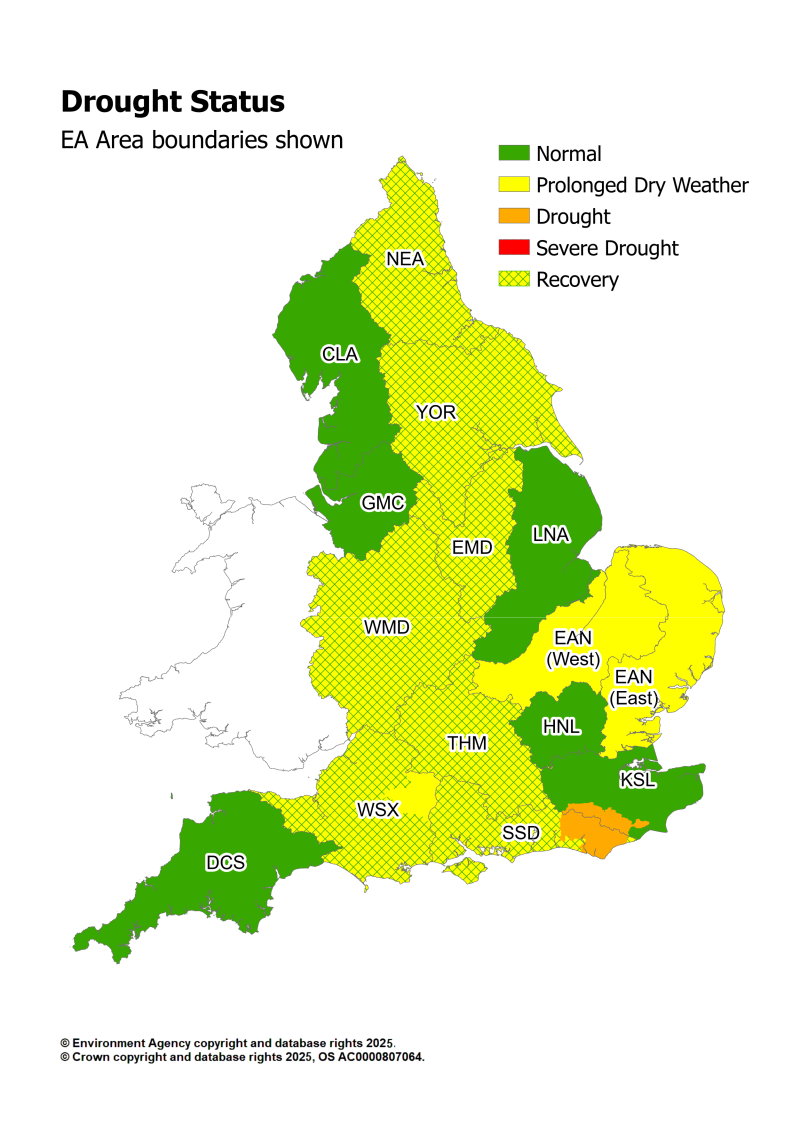
There have been further improvements in the water resources position, following the wet weather over the autumn and start of December. The Environment Agency’s Solent and South Downs Area (covering Hampshire and parts of Sussex) moved into recovery status this week and its Lincolnshire and Northamptonshire Area moved into normal status. Only East Anglia and parts of the Environment Agency Wessex area remain in prolonged dry weather status. Only those parts of Sussex aligning with the South East Water supply areas remain in drought status.
It was a very dry end to December, followed by a dry week for many in the first week of January. In the first 6 days of January, England has received 8% of the long term average (LTA) rainfall for the month. Following 2 dry weeks, river flows are now below normal or lower across most of the country with 4 indicator sites across the north-east and south-west measuring exceptionally low flows for the time of year. Soil moisture deficits are around average for early January, apart from in south-east England where soils remain slightly drier than expected.
Reservoir storage for England is 84.9%, which is slightly below average for the start of January. Storage in central, north-east and north-west England has decreased in the past week in response to the dry spell, and although overall storage has increased in east England, it is still much lower than expected for the time of year. Two reservoirs are below 60% full: Abberton and Hanningfield in east England. Farmers are also reporting their own reservoirs in East Anglia are lower than normal for the time of year.
Navigations and canals that were closed for drought purposes over the summer have now reopened. There has been a significant increase in storage of supply reservoirs to the canal network, although some remain low as engineering work is taking place which presents a small risk if there is a dry winter. The Canal & River Trust will monitor the situation during the winter.
2. Area drought status
There have been 2 changes to area drought status since the last briefing on 18 December:
- Lincolnshire and Northamptonshire (LNA) Area has moved to normal status
- parts of Solent and South Downs (SSD) Area that are not still in drought have moved into recovery
2.1 Areas in drought
- parts of SSD in Sussex aligning with South East Water supply areas
2.2 Areas in prolonged dry weather
- East Anglia (EAN)
- Wessex (WSX) – the upper Hampshire Avon catchment only
2.3 Areas in recovery
- Yorkshire (YOR)
- East Midlands (EMD)
- West Midlands (WMD)
- North East (NEA)
- SSD – those parts of the area not in drought status
- Thames (THM)
- WSX – excluding the upper Hampshire Avon catchment
2.4 How the stages of drought response work
Each area is reviewing its status depending on the triggers they have outlined in their drought plan.
More detail of how we manage drought, including our 4 stages of drought response, is available in Drought: how it is managed in England.
3. Current water situation
January began with a dry week for much of England, which followed a very dry week for all between Christmas and New Year. The north-west has seen the highest precipitation total of 12mm, but much of the precipitation that has fallen in England has been as snow rather than rain. December rainfall totals were near or above average across most of the country. So far in January, England has received 8% of the LTA rainfall for the month.
River flows are classed as below normal or lower at more than three-quarters of sites after 2 weeks of dry weather. Of the 10 sites classed as normal, most are in south-east and south-west England. Sixteen sites were classed as notably low, including most of the sites in north-west and north-east England. Four sites were exceptionally low, including the Rivers Till, Swale and Wharfe in north-east England and the River Exe in the south-west.
Groundwater levels are rising at the majority of boreholes across England. Groundwater levels were classed as normal or higher at almost all sites at the end of December, with just 2 exceptions, both of which are in chalk aquifers. Washpit Farm in east England was classed as below normal, while Chipstead in south-east England was classed as exceptionally low. Beyond these 2 sites, chalk aquifers are generally in the normal range. Many sites in central and north England are now above normal or higher as a wet autumn has helped levels recover.
Soil moisture deficits are around average in almost all regions, although in the south-east soils remain slightly drier than would be expected for the time of year. Deficits have been almost completely eradicated in the north-west.
Reservoir stocks across England for the period ending 6 January were 84.9%, having decreased by 1% since the end of December, as just under half of reservoirs saw a decrease in levels. Two reservoirs remain below 60% full: Abberton and Hanningfield in east England. Bewl reservoir in the south-east is now 60.1% full.
More details are available in our water situation reports for England.
4. Public water supply
Most water companies have seen good recovery and are moving into business as usual mode. Some residual risks remain for water companies in East Anglia and South East England with lower than expected reservoir levels and different groundwater recharge. South West Water is monitoring the levels of Colliford in Cornwall as this is lower than expected. Risk of drought impacts next year in these areas is dependent on the rest of winter rainfall and groundwater recharge. There is however still have time for sources to recover through February and March.
Water companies report their drought response using operational drought levels, from drought level 1 escalating to level 4. Companies not included below are in business as usual mode. We are regularly engaging with all companies and with Water UK on the situation.
4.1 Anglian Water
Anglian Water remains at drought level 1 in the following supply areas: Fenland, Norfolk Norwich and the Broads, Ruthamford Central, North, South, and West.
4.2 Cambridge Water
Cambridge Water remains at drought level 1.
4.3 Essex and Suffolk Water
Essex and Suffolk Water remains at drought level 1 in its Essex, Northern Central, Blyth, and Hartismere supply areas.
4.4 Northumbrian Water
Northumbrian Water remains at drought level 1.
4.5 Southern Water
Southern Water is at drought level 2 in its Kent Medway and Sussex Hastings areas. Its Sussex Worthing and Sussex Brighton areas remain at drought level 1. All other areas are in business as usual.
4.6 South East Water
South East Water remains at drought level 1 in all its water resource zones. As of 2 January, Ardingly reservoir was at 78.15% total capacity. South East Water was granted its Ardingly winter drought permit on 22 September and was granted its River Ouse drought order on 3 December. The company implemented a temporary use ban (TUB) for customers in Kent and Sussex areas from 18 July 2025 and removed exemptions from this ban on 17 October. South East Water applied for a non-essential use drought order to restrict some uses of water by businesses on 24 October and withdrew this application on 15 December. More detail is available on South East Water website.
4.7 Thames Water
Thames Water remains in business as usual in its Swindon and Oxfordshire supply area and removed its TUB on 27 November. Thames Water’s London and other zones remain at drought level 1.
4.8 Veolia Water
Veolia Water Projects Limited remains at drought level 1.
5. Agriculture
The drier and colder conditions have slowed refill of winter storage reservoirs in eastern England as many river flows are below normal for the time of year, restricting the ability for some licence holders to abstract. There are currently 179 hands off flow restrictions in force on abstraction licences. The position in the rest of the country is much better with reports of full reservoirs across the Midlands.
The Environment Agency has received some requests to extend winter refill season beyond March 2026 and these will be reviewed on a case-by-case basis depending on water availability.
Uncertainty around water resilience remains in the sector, especially if the remaining winter period is dry and farm irrigation reservoirs are not completely refilled. We are currently reviewing short term support options for abstractors ahead of the spring in the event that there is a dry winter in addition to long term water resources resilience options.
The Environment Agency dry weather farming blog is available to help farmers prepare for the winter and details support available to help improve access to water.
6. Energy
There are no known issues with the energy sector.
7. Environment
The number of incidents caused by drought and dry weather in 2025 was 319, around average for the last eight years. The number of new drought and dry weather incidents has significantly reduced with the cooler wetter weather, with no incidents recorded so far this year.
8. Navigation
As per the previous brief, navigation across the Canal & River Trust network is in a good position.
9. Weather forecast
Through Thursday night and into Friday, Storm Goretti (named by Météo-France) will bring rain and strong winds to much of southern and central England. As it meets colder air in the east, this precipitation is expected to fall as snow, particularly on higher ground. On Saturday and Sunday, conditions are expected to be drier, with cold mornings bringing frosts. Forecasts become less certain for Monday onwards, as mild Atlantic air clashes with cold air over the UK.
10. Drought readiness actions
In response to the drought and dry weather, the Environment Agency continues to act by:
- operating our Gold command structure for our national incident response
- planning for potential continuation of dry weather into winter and spring using the latest drought prospects information from water companies and other sectors
- co-ordinating closely with water companies to implement actions in statutory drought plans, taking necessary action to safeguard public water supplies
- activating drought plans for those Environment Agency areas in drought and PDW status
- enhancing abstraction licence compliance checks and issuing hands off flow or level restrictions and warnings to some abstractors in areas experiencing low flows
- monitoring, preparing and responding to incidents caused by low river flows, particularly in those Environment Agency Areas in drought status
- providing dry weather advice to fishery operators to help protect their waters
- hosting regular national drought meetings
The next National Drought Group meeting is scheduled for 15 January.
The next briefing is due on 22 January.
11. Contact us
Contact drought.national@environment-agency.gov.uk if you have questions about this report.