
Dry weather and drought in England: 23 to 29 October 2026
Updated 30 October 2026
Applies to England

© Crown copyright 2026
This publication is licensed under the terms of the Open Government Licence v3.0 except where otherwise stated. To view this licence, visit nationalarchives.gov.uk/doc/open-government-licence/version/3 or write to the Information Policy Team, The National Archives, Kew, London TW9 4DU, or email: psi@nationalarchives.gov.uk.
Where we have identified any third party copyright information you will need to obtain permission from the copyright holders concerned.
This publication is available at https://www.gov.uk/government/publications/dry-weather-and-drought-in-england-2026-summary-reports/dry-weather-and-drought-in-england-23-to-29-october-2026
1. Summary
Two named storms, Austen and Boelo, made this the wettest reporting week across England since October 2024. The rainfall improved river flows and reservoir storage, but significant water resource pressures remain.
October rainfall to date is 111% of the long-term average for England, although soil remains drier than expected for the time of year. River flows increased at almost all reporting sites, with most now normal or higher. More than two-thirds of reservoirs or reservoir groups also increased in storage, taking total storage for England to 57.9% as of 27 October, although this remains 19% below average and ten reservoirs or groups are still exceptionally low. Groundwater levels continue to decline at most sites, as dry soils limit recharge.
Severe drought remains in parts of Cornwall, Devon, Dorset, Somerset, East Sussex and West Sussex. This reflects the continued pressure on water resources in areas reliant on Ardingly Reservoir, Wimbleball Reservoir and several smaller reservoirs in Devon and west Cornwall. Recent rainfall has improved conditions elsewhere, allowing Cumbria and Lancashire and Greater Manchester, Merseyside and Cheshire Environment Agency Areas to move to recovery on 28 October.
Public water supplies remain under pressure in some drought-affected areas despite recent rainfall. Reservoir and groundwater storage continues to decline for several water companies, particularly in the south, although some are seeing small increases in usable storage. Temporary use bans remain widespread, and water companies continue to progress drought permits and orders. We need at least 120% of average rainfall over the next six months for the entire country to be out of drought by next spring.
There are continuing concerns about the ability of farmers to refill water storage reservoirs over winter, with some irrigation reservoirs at historic lows. Sustained recovery in river flows and above average winter rainfall will be needed to support refill, with greatest concerns in the West Midlands, East Anglia and Devon and Cornwall.
The water resources situation across the Canal & River Trust network has improved, particularly in the more responsive northern reservoirs. Summer measures to manage demand are being progressively lifted and canal restrictions have reduced, although drought-related navigation restrictions remain in place on parts of the River Thames.
Confirmed environmental incidents caused by drought and dry weather continue to increase, although the rate of increase is slowing with only eight confirmed incidents so far in October, bringing the total to 414 for 2026. Recent rainfall should help reduce impacts, but prolonged rainfall will be needed for significant improvement.
2. Active temporary use bans (TUBs)
The following companies have implemented TUBs, in all or part of their supply areas:
- Affinity Water – central and east regions, covering Bedfordshire, Berkshire, Buckinghamshire, Hertfordshire, Surrey, and parts of London and Essex
- Anglian Water – whole company area, excluding Hartlepool
- Bristol Water – whole company area
- Cambridge Water – whole company area
- Essex and Suffolk Water – whole company area
- Southern Water – Hampshire and the Isle of Wight
- South East Water – whole company area
- South West Water – whole company area, excluding Bournemouth
- Thames Water – whole company area
- Wessex Water – whole company area
The Water Industry Act 1991 incorporates legislation which makes provision for another water undertaker to supply sites within an existing water undertaker’s area. Where an alternative undertaker is appointed, a New Appointment and Variation (NAV) is made by Ofwat. Companies operating as a NAV have the same legal duties and responsibilities as other water companies to produce drought plans. NAVs can have their own sources of supply but are primarily supplied by bulk supply agreements with the water undertaker in the area. NAV TUBs were introduced at the same time as their respective incumbent companies as follows:
-
Leaf Water implemented TUBs for its customers in areas supplied by South East Water, Essex and Suffolk Water, and Cambridge Water
-
Albion Water implemented TUBs for its customers in areas supplied by Thames Water
-
Leep Water implemented TUBs for its customers in areas supplied by South East Water, Southern Water, South West Water, Thames Water, Wessex Water, Anglian Water, Affinity Water, Bristol Water, and Essex and Suffolk Water
-
Independent Water Networks (IWN) implemented TUBs for its customers in areas supplied by South East Water, Southern Water, South West Water, Thames Water, Wessex Water, Anglian Water, Affinity Water, Bristol Water, Cambridge Water, and Essex and Suffolk Water
-
Last Mile Water implemented TUBs for its customers in areas supplied by South East Water, Southern Water, South West Water, Anglian Water, Affinity Water, Thames Water, Essex and Suffolk Water, Wessex Water and Bristol Water
-
MUA implemented TUBs for its customers in areas supplied by Affinity Water and Anglian Water
-
ESP implemented TUBs for its customers in areas supplied by Bristol Water, Wessex Water, Thames Water, South East Water, Affinity Water and Anglian Water
-
Matrix implemented TUBs for its customers in areas supplied by Thames Water
Further information can be found on each company’s website.
3. Environment Agency Area drought status
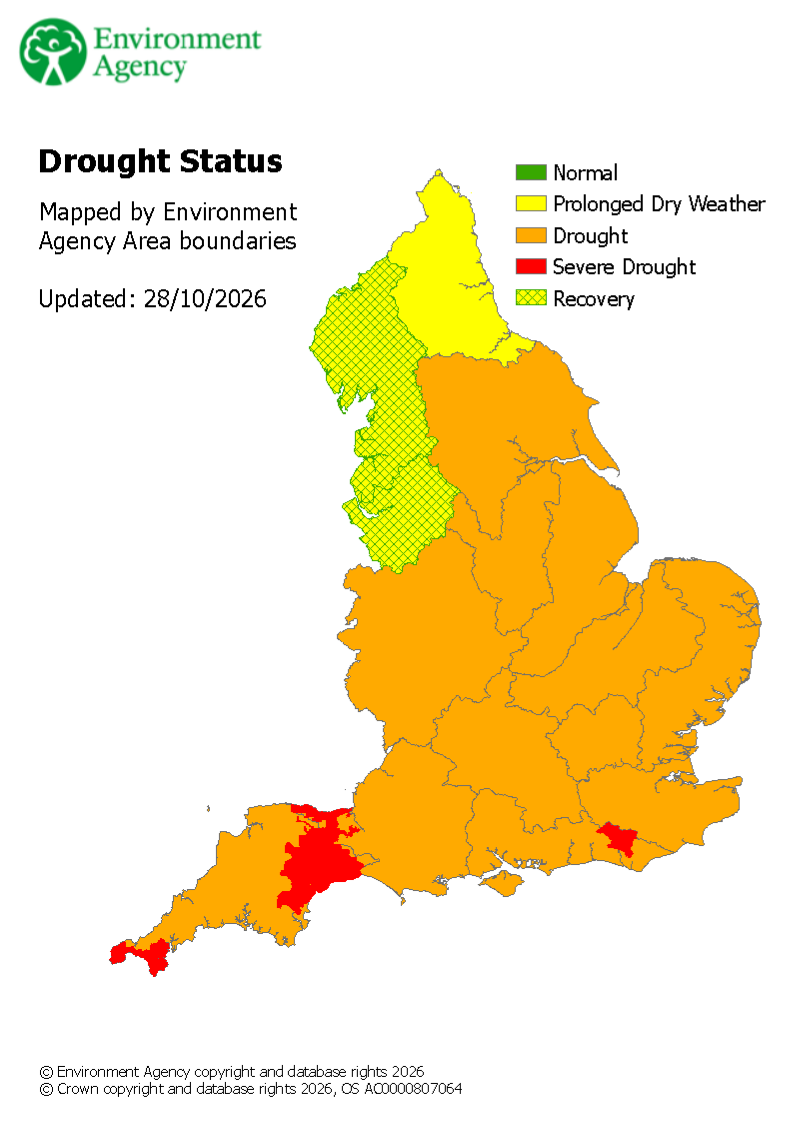
There have been two changes in Environment Agency Area drought status this week:
- Cumbria and Lancashire moved to recovery on 28 October
- Greater Manchester, Merseyside and Cheshire moved to recovery on 28 October
Figure 1: Environment Agency drought status
3.1 Environment Agency Areas in severe drought
- Parts of Devon and Cornwall and Wessex Areas that are supplied by Wimbleball reservoir, Kenninck, Tottisford & Trenchford (KTT) and Venford reservoirs, and Stithians and Drift reservoirs
- Parts of Solent and South Downs and Kent and South London Areas that are supplied by Ardingly reservoir
3.2 Environment Agency Areas in drought
-
Remaining parts of Devon, Cornwall and Isles of Scilly that are not in severe drought
-
Remaining parts of Wessex that are not in severe drought
-
Remaining parts of Kent and South London that are not in severe drought
-
Remaining parts of Solent and South Downs that are not in severe drought
-
East Anglia
-
Hertfordshire and North London
-
Thames
-
West Midlands
-
East Midlands
- Lincolnshire and Northamptonshire
- Yorkshire
3.3 Environment Agency Areas in prolonged dry weather
Northeast
3.4 Environment Agency Areas in recovery
- Cumbria and Lancashire
- Greater Manchester, Merseyside and Cheshire
3.5 How drought response stages work
Each Environment Agency Area reviews its status depending on the triggers they have outlined in their drought plan.
More detail of how we manage drought, including our 4 stages of drought response, is available in Drought: how it is managed in England.
4. Current water situation
With two named storms, Austen and Boelo bringing rainfall to all regions, it has been the wettest reporting week across England since October 2024. Rainfall totals ranged from 39mm in east England to 87mm in the south-west. Rainfall totals for October to date range from 99% of the long-term average (LTA) in central England to 120% in the north-west. For England as a whole, the rainfall total for October so far is 100mm, equivalent to 111% of the LTA. Despite recent rainfall, soils remain drier than would be expected across much of England for the time of year.
Due to the recent rainfall river flows have increased at almost all of sites we report on. Most sites were classed as normal, 29 sites (53%). Five sites (9% of the total) were classed as notably high, and 14 sites (25%) were classed as above normal. One site (2%), Austins Bridge on the River Dart in south-west England, was classed as exceptionally high. The remaining 6 sites (10%) were classed as either below normal or notably low.
Groundwater levels decreased at most sites, as soils need to be saturated before rainfall can effectively recharge resources. Sites in chalk aquifers are all normal or lower for the time of year, with four sites in southern England classed as exceptionally low. These are Tilshead in the Upper Hampshire Avon Chalk, Chipstead in the Epsom North Downs, Chalk and Woodyates in the Upper Dorset Stour Chalk and Jackaments Bottom in the Burford Oolitic Limestone.
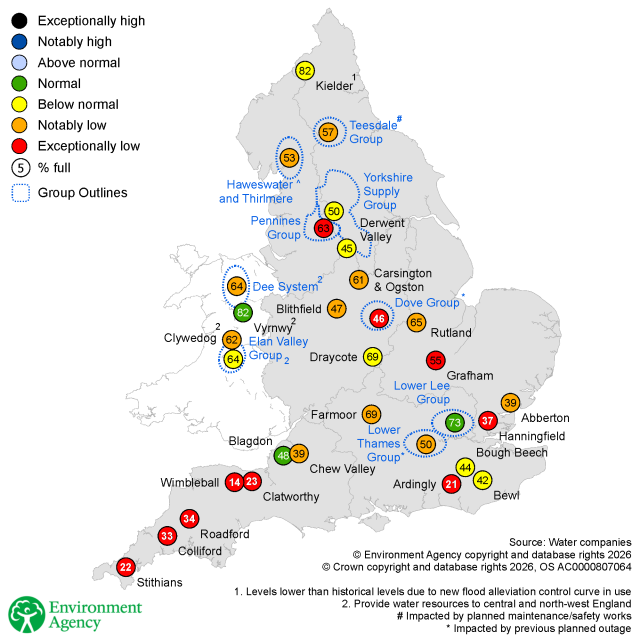
Due to the recent rainfall more than two-thirds of reservoirs or reservoir groups recorded an increase in storage in the week ending 27 October 2026. Storage for England has increased to 57.9%, which is 19% below average for the time of year. Seventeen reservoirs are less than 50% full. Just three reservoirs are classed as normal for the time of year, with all others classed as below normal or lower. Ten reservoirs or reservoir groups are now classed as exceptionally low (Figure 2):
- Hanningfield reservoir operated by Essex and Suffolk Water
- Ardingly reservoir operated by South East Water
- Clatworthy reservoir operated by Wessex Water
- Colliford, Roadford, Stithians and Wimbleball reservoirs operated by South West Water
- Dove Group operated by Severn Trent Water, where winter refill was impacted by water quality and operational issues
- Grafham Water reservoir operated by Anglian Water
- Pennines Group operated by United Utilities Water
More details are available in our water situation reports for England.
Figure 2: Reservoir stocks at key individual and groups of reservoirs for week ending 27 October 2026 as a percentage of total capacity and classed relative to an analysis of historic values.
Note: Classes shown may not necessarily relate to control curves or triggers for drought actions. As well as for public water supply, some reservoirs are drawn down to provide flood storage, river compensation flows or for reservoir safety inspections. In some cases, current reservoir operating rules may differ from historic ones.
5. Public water supply
Public water supply reservoir and groundwater storage continues to decline for several water companies, particularly in the south, whereas others are showing a small increase in usable volume following the recent rain. Further significant rainfall is needed to return to normal water resource conditions for many water companies.
Water companies report their drought response using operational drought levels, from drought level (DL)1 escalating to DL4. We expect water companies to follow their drought plans and act early to ensure there are sufficient supplies.
We regularly engage with all water companies. The companies not included below have not needed to activate their drought plans. Further information on the latest situation can be found on each water company’s website.
5.1 Affinity Water
Affinity Water remains at business as usual (BAU); its East region has reached the company’s environmental trigger. TUBs remain in place for customers in its Central region and East region, driven by high demand.
5.2 Anglian Water
Anglian Water remains at DL2 in its Fenland and Norfolk, Norwich and Broads water resource zones (WRZ). Ruthamford, Lincolnshire and Suffolk remain at DL1. TUBs remain in place across the whole company area, except for Hartlepool.
5.3 Bristol Water
Bristol Water remains at DL1. TUBs remain in place for all customers to help protect flows on the River Severn, after an application for a drought order by the Environment Agency.
5.4 Cambridge Water
Cambridge Water remains at DL1. TUBs remain in place for all its customers.
5.5 Essex and Suffolk Water
Essex and Suffolk Water remains at DL2 in all WRZs. TUBs remain in place for all its customers.
5.6 Northumbrian Water
Northumbrian Water remains at DL1 in all its WRZs.
5.7 Severn Trent Water
Severn Trent Water’s North Staffs WRZ has moved back to BAU from DL2, as reservoir storage has improved after the recent rainfall. Its Strategic Grid North WRZ remains at DL1.
5.8 Southern Water
Southern Water is at DL1 in its Hampshire and Isle of Wight WRZs. Its Kent Medway East and West WRZs and Sussex Hastings WRZ are now at DL2. Other WRZs remain at BAU. TUBs are still in force for customers in the Hampshire and the Isle of Wight area. The company applied to the Secretary of State for a drought order on the River Test and a Non-Essential Use Ban (NEUB) drought order on 31 July. A public hearing was held on 25 August and additional information submitted on 27 August. We are awaiting the Secretary of State decision.
5.9 South East Water
The company is at DL3 in its Eastbourne and Haywards Heath WRZs. All other WRZs remain at DL1. Company-wide TUBs remain in force, with exemptions removed in areas at DL3. The Environment Agency granted South East Water’s River Ouse (Ardingly reservoir) drought permit on 29 September. A NEUB drought order application was submitted on 2 October.
5.10 South West Water
South West Water’s Colliford WRZ and Roadford WRZ remain at DL1, Isles of Scilly WRZ moved back to DL2 and Wimbleball WRZ remains at DL3. TUBs remain in place for all South West Water customers, excluding Bournemouth. On 2 October a drought permit was issued at Wimbleball reservoir to reduce the compensation flow; further information can be found on the company’s website. An application for a NEUB drought order was submitted on 6 October for its Wimbleball zone. Storage at several reservoirs continues to decline.
5.11 South Staffordshire Water
South Staffordshire Water remains at DL2.
5.12 Thames Water
Thames Water remains at DL3 in its Swindon and Oxfordshire (SWOX) WRZ, the rest of the WRZs remain at DL2. Company-wide TUBs remain in force. The Environment Agency granted Thames Water’s Farmoor drought permit on 29 September.
5.13 United Utilities
United Utilities Strategic Resource Zone (SRZ) remains above DL1 in Enhanced Monitoring and Operations.
5.14 Veolia Water
Veolia Water remains at DL2
5.15 Wessex Water
Wessex Water remains at DL3. Storage at several reservoirs continues to decline. Company-wide TUBs remain in force.
5.16 Yorkshire Water
Yorkshire Water remains at DL1.
6. Agriculture
The recharge of storage reservoirs remains a primary concern for abstractors in the agriculture sector as some irrigation reservoirs are at historic lows. Our regulatory position statement that allows licence holders to abstract water earlier in the season to refill storage reservoirs, remains in place until 31 October.
Further information can be found at Abstraction outside the authorised period for filling water storage reservoirs: RPS 382 - GOV.UK
With the official reservoir refill season starting on 1 November, restrictions on some abstraction licences are possible at the start of the season, where river flows are low.
Requests as of 27 October to use the abstraction season extension RPS 382:
| RPS 382 notifications by EA Area | 27/10/2026 11:00 |
|---|---|
| East Anglia | 35 |
| Kent, South London and East Sussex | 5 |
| Solent and South Downs | 8 |
| East Midlands | 3 |
| Hertfordshire and North London | 4 |
| Lincolnshire and Northamptonshire | 7 |
| North East | 1 |
| Total notifications | 63 |
| Valid notifications | 59 |
| Invalid notifications | 4 |
River flows currently range between exceptionally low to normal for the time of year, so in some areas licence restrictions remain in force to protect the environment. There are currently 207 restrictions on abstraction licences, this is a considerable reduction on last week’s figure (414) because of Storm Austen. Formal section 57 restrictions remain in place in parts of East Anglia until 31 October. There are 1,383 voluntary reductions in place reducing abstraction by 50% until 31 October. Voluntary reductions are spread across the Thames, Wye and Severn catchments.
The Environment Agency continues to work closely with abstractors and is supporting farmers to help improve water resilience and access to water. To date we have received 42 flexible abstraction requests from the agriculture sector.
We have published our agriculture reservoir refill prospect report. This informs the sector of the key risks from a dry winter and the actions that are needed to mitigate the impacts of drought continuing into spring. The headline is that without more than 100% of long-term average rainfall over the winter refill period, not all areas will be expected to completely refill winter storage reservoirs, with particular concerns in West Midlands, East Anglia and Devon and Cornwall Areas.
7. Environment
Numbers of confirmed incidents caused by drought and dry weather continue to increase, although this has slowed since the end of August. There has been a significantly smaller increase so far this month, with eight confirmed incidents. There were 30 confirmed incidents in September and 184 in August. The total for 2026 so far is now 414.
This total of 414 exceeds the overall total for 2022 (380) and 2025 (321), the two previous drought years. The 2026 figure will likely increase further due to reporting lags. Relatively high numbers of drought and dry weather incidents have been reported in Devon, Cornwall and Isles of Scilly, East Anglia, Greater Manchester, Merseyside and Cheshire, Hertfordshire and North London, Solent and South Downs, West Midlands and Thames Environment Agency Areas this year.
Whilst recent rainfall will contribute to a reduction in drought and dry weather incidents, prolonged rain and wet weather will be required for significant improvements to become evident.
8. Navigation
Water resource levels have improved across much of the Canal & River Trust network, with the strongest recovery seen in the more responsive northern reservoirs. As a result, summer measures to reduce water demands have been lifted progressively, and the number of canal restrictions has gradually fallen.
The Canal & River Trust is continuing its drought response and winter preparedness. Its activities include monitoring reservoir replenishment, undertaking leak repairs and developing contingency plans. A programme of winter maintenance work is also scheduled across the network over the coming weeks.
Within Environment Agency navigation, current drought related closures remain in place across the River Thames and published Lock & Weir Keeper assisted passage and lock operating hours are in force. Locks subject to drought restrictions will be available for navigation each day between certain times. This will ensure there is sufficient time to implement and remove the restrictions safely at the beginning and end of each day. Locks continuing with navigation restrictions are St. John’s to Osney, Culham to Going and Penton Hook to Teddington.
At the end of November, there will be an end of season drought update for the River Wye in the West Midlands to the commercial canoe hire businesses. Boating activities are now mainly limited to rowing events at some clubs based in Monmouth as well as some canoe slalom events at Symonds Yat.
9. Weather forecast
Fine weather is forecast for Friday and throughout the weekend for England, with sunny spells. Overnight and early morning fog patches are forecast for many areas of England. High pressure is set to dominate conditions across England next week bringing further dry weather.
10. Drought readiness actions
The Environment Agency has activated its incident response arrangements, with Gold Command structures in place and drought plans being implemented to support early intervention and coordinated action.
Enhanced communications activity being taken includes:
- issuing press notices and holding media briefings
- increasing engagement with stakeholders, local partners and Members of Parliament
- publishing a weekly drought update on GOV.UK
The Environment Agency has strengthened environmental monitoring, increasing both surveillance and operational interventions to identify, assess and mitigate potential environmental impacts of the drought.
The National Drought Group continues to meet regularly to monitor risks, preparation and impacts of the ongoing drought. The next scheduled meeting is on 4 November.
11. Contact us
Contact drought.national@environment-agency.gov.uk if you have questions about this report.