
Dry weather and drought in England: 18 to 24 September 2026
Updated 9 October 2026
Applies to England

© Crown copyright 2026
This publication is licensed under the terms of the Open Government Licence v3.0 except where otherwise stated. To view this licence, visit nationalarchives.gov.uk/doc/open-government-licence/version/3 or write to the Information Policy Team, The National Archives, Kew, London TW9 4DU, or email: psi@nationalarchives.gov.uk.
Where we have identified any third party copyright information you will need to obtain permission from the copyright holders concerned.
This publication is available at https://www.gov.uk/government/publications/dry-weather-and-drought-in-england-2026-summary-reports/dry-weather-and-drought-in-england-18-to-24-september-2026
1. Summary
It has been another dry week across most of England except for the north-west. Central, east and south-east England received less than 5mm of rainfall. Up until 22 September, England has received 58% of the long term average (LTA) rainfall total for September. River flows decreased at almost all sites we report on. Most sites remain classed as below normal or lower for the time of year. Groundwater levels continue their seasonal decline, with levels decreasing at all sites. Reservoir storage for England has stabilised but continues to fall across central and southern England. There are 14 reservoirs or reservoir groups now less than half full and 5 classed as exceptionally low.
There has been no change to Environment Agency Area drought status this week. Ten areas are in drought status and the remainder in prolonged dry weather status.
Water demand has continued to decrease because of cooler temperatures, slightly increased rainfall and the implementation of temporary use bans (TUBs). However, demand remains above expected levels in some areas.
Public water supply reservoir and groundwater storage continue to decline for several water companies, although for some, the rate of decline has slowed. Further significant rainfall is needed to return water resources to normal conditions for many water companies. The TUBs in place have not changed since last week and around 30 million people are still affected. Water companies continue to progress drought permits and orders.
The Canal and River Trust water resource position remains poor. The heatwaves this year have led to a rapid drawdown from water supply reservoirs due to high demands across the network. Recent rainfall has had a very modest impact with more reactive reservoirs in northern canal sections seeing some improvement, including the full reopening of Lancaster canal. However, most canals have seen little or no impact.
Recent rainfall has reduced drought pressures on agriculture. The main irrigation season has ended, although conditions vary by area and some water demand remains for harvesting root crops. Concerns continue about winter reservoir replenishment, with some reservoirs and on-farm water storage remaining very low. Abstraction restrictions have increased slightly, largely due to lower river flows. Formal Section 57 restrictions remain in parts of East Anglia until 31 October.
Environmental impacts remain widespread, including:
- low flows
- water quality issues
- algal blooms
- fish mortality
Although recent rainfall and cooler weather have slowed the rate at which impacts are increasing. Continued impacts include:
- algal growth in the River Coquet in Northumberland
- algae incidents on the Grand Union Canal in Marsworth
- fish mortality incidents in Southery Internal Drainage Board drains in Norfolk and at Fonthill Lake in Wiltshire
The Environment Agency remains focused on its drought response and continues to hold weekly National Drought Group meetings. The latest National Drought Group focussed on public water supplies and the next meeting is 1 October.
2. Active temporary use bans (TUBs)
The following companies have implemented TUBs, in all or part of their supply areas:
- Affinity Water – Central and East regions, covering Bedfordshire, Berkshire, Buckinghamshire, Hertfordshire, Surrey, and parts of London and Essex
- Anglian Water – whole company area, excluding Hartlepool
- Bristol Water – whole company area
- Cambridge Water – whole company area
- Essex and Suffolk Water – whole company area
- Southern Water – Hampshire and the Isle of Wight
- South East Water – whole company area
- South West Water – whole company area, excluding Bournemouth
- Thames Water – whole company area
- Wessex Water – whole company area
3. Area drought status
There have been no changes in area drought status this week:
Figure 1: Environment Agency drought status

3.1 Areas in drought
- East Anglia
- Hertfordshire and North London
- Thames
- Devon, Cornwall and Isles of Scilly
- West Midlands
- Wessex
- Kent and South London
- Solent and South Downs
- East Midlands
- Lincolnshire and Northamptonshire
3.2 Areas in prolonged dry weather
- Northeast
- Yorkshire
- Cumbria and Lancashire
- Greater Manchester, Merseyside and Cheshire
3.3 How the stages of drought response work
Each area is reviewing its status depending on the triggers they have outlined in their drought plan.
More detail of how we manage drought, including our 4 stages of drought response, is available in Drought: how it is managed in England.
4. Current water situation
Rainfall patterns have followed a similar pattern to last week, wetter in the north-west but drier elsewhere particularly across southern and eastern areas. Rainfall totals ranged from 1mm and 3mm in east and south-east England, to 23mm in the north-west. Rainfall totals for September to date are around half the LTA for the month in south-east and east England, but up to 84% of the LTA in north-west England. For England as a whole, the rainfall total for September so far is 58% of the LTA.
River flows decreased at most sites we report on when compared to the previous week, with all sites classed as normal or lower for the time of year. Nineteen sites (35% of the total), mostly found in north-west and central England, were classed as normal. Twenty-one (38%) were classed as below normal and 10 sites (18%) were classed as notably low. Five sites (9%) were classed as exceptionally low, the:
- River Derwent in the north-east
- Rivers Ouse and Yare in east England
- Upper Hampshire Avon and River Tone in the south-west
The seasonal decline in groundwater levels continued with levels decreasing at all sites. Chalk aquifer sites are all normal or lower for the time of year with 3 sites in the Wessex Downs, Yorkshire Wolds, and South Downs, classed as notably low. Tilshead in the Upper Hampshire Avon Chalk, and Chipstead, in Epsom North Downs Chalk are classed as exceptionally low. Groundwater levels in the oolitic limestone of the Cotswolds, at Jackaments Bottom, are classed as notably low for the time of year.
There has been a north-south split in reservoir response this week, with those across central and southern England continuing to decrease while many in northern England and Wales rose slightly, benefitting from the wetter conditions. Storage for England has stabilised this week at 56.4% and is now 18.6% below average for the time of year. Fourteen reservoirs or reservoir groups are less than 50% full, with the majority remaining classed as notably low. Five are classed as exceptionally low for the time of year (Figure 2):
- Ardingly reservoir operated by South East Water
- Clatworthy reservoir operated by Wessex Water
- Dove Group operated by Severn Trent Water, where winter refill was impacted by water quality and operational issues
- Hanningfield reservoir operated by Essex and Suffolk Water
- Wimbleball reservoir operated by South West Water
More details are available in our water situation reports for England.
Figure 2: Reservoir stocks at key individual and groups of reservoirs for week ending 22 September 2026 as a percentage of total capacity and classed relative to an analysis of historic values
Classes shown may not necessarily relate to control curves or triggers for drought actions. As well as for public water supply, some reservoirs are drawn down to provide flood storage, river compensation flows or for reservoir safety inspections. In some cases, current reservoir operating rules may differ from historic ones.
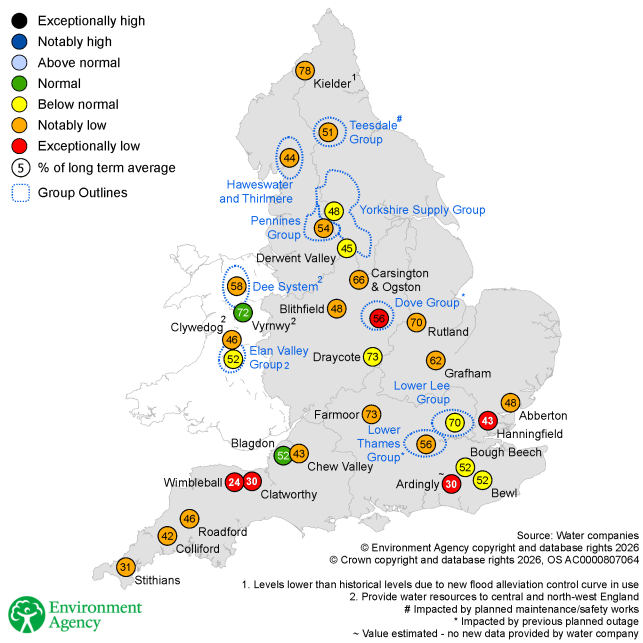
Kielder reservoir levels are lower than historic levels due to a new flood alleviation control curve in use. The Dee System, Elan Valley Group, Clywedog and Vyrnwy reservoirs provide water resources to central and north-west England. Teesdale Group is impacted by planned maintenance and safety works. The Dove Group and Lower Thames Group are impacted by a previously planned outage. Ardingly reservoir is value estimated as no new data was provided by the water company.
5. Public water supply
Water demand has continued to decrease in general as a result of cooler temperatures, slightly increased rainfall and the implementation of TUBs, although it remains above expected levels in some areas.
Public water supply reservoir and groundwater storage continue to decline for several water companies, although for some the rate of decline has slowed. Further significant rainfall is needed to return to normal water resource conditions for many water companies.
Water companies report their drought response using operational drought levels, from drought level (DL) 1 escalating to DL 4. We expect water companies to follow their drought plans and act early to ensure there are sufficient supplies.
We regularly engage with all water companies. The companies not included here are in business as usual (BAU). Further information on the situation can be found on each water company’s website.
5.1 Affinity Water
Affinity Water remains at BAU. Its East region has reached Affinity Water’s environmental trigger. TUBs remain in place for customers in its Central region and East region, driven by high demand.
5.2 Anglian Water
Anglian Water remains at DL2 in its Fenland and Norfolk, Norwich and Broads water resource zones (WRZs). Ruthamford, Lincolnshire and Suffolk remain at DL1. TUBs remain in place across the whole company area, except for Hartlepool.
5.3 Bristol Water
Bristol Water remains at BAU. TUBs remain in place for all customers to help protect flows on the River Severn, after an application for a drought order by the Environment Agency.
5.4 Cambridge Water
Cambridge Water remains at DL1. TUBs remain in place for all its customers.
5.5 Essex and Suffolk Water
Essex and Suffolk Water remains at DL2 in all WRZs. TUBs remain in place for all its customers. Demand has stabilised.
5.6 Northumbrian Water
Northumbrian Water remains at DL1 in all its WRZs.
5.7 Severn Trent Water
Severn Trent Water remains in DL2 in its North Staffs WRZ, and its Strategic Grid North WRZ has now moved into DL1.
5.8 Southern Water
Southern Water is at DL1 in its Hampshire and Isle of Wight WRZs. Other WRZs remain at BAU. TUBs are still in force for customers in the Hampshire and the Isle of Wight area.
The company applied to the Secretary of State for a drought order on the River Test and a non-essential drought order on 31 July. A public hearing was held on 25 August and additional information submitted on 27 August. We are awaiting the Secretary of State decision.
5.9 South East Water
South East Water remains at DL2 in its Eastbourne and Haywards Heath WRZs. All other WRZs remain at DL1. Company-wide TUBs remain in force.
On 28 August, South East Water applied to the Environment Agency for a drought permit on the River Ouse. A public hearing was held on 18 September. The planning inspectorate report is due Friday 25 September.
5.10 South Staffordshire Water
South Staffordshire Water remains at DL1.
5.11 South West Water
South West Water’s Colliford WRZ remains at DL1. Wimbleball and the Isle of Scilly remain at DL2. Other WRZs remain at BAU. TUBs remain in place for all South West Water customers, excluding Bournemouth.
On 16 September, the company applied to the Environment Agency for a drought permit at Wimbleball to reduce the compensation flow. Further information can be found on the company’s website.
5.12 Thames Water
Thames Water remains at DL2 in all its WRZs. Company-wide TUBs remain in force.
Thames Water applied to the Environment Agency for its Farmoor drought permit on 17 September. Further information can be found on the company’s website.
5.13 United Utilities
United Utilities Strategic Resource Zone remains at DL1. Carlisle WRZ remains in BAU.
5.14 Veolia Water
Veolia Water remains at DL1.
5.15 Wessex Water
Wessex Water remains in DL2. Reservoir storage continues to decline. Company-wide TUBs remain in force.
5.16 Yorkshire Water
Yorkshire Water remains at DL1 in its Grid WRZ.
6. Agriculture
Rainfall has eased drought pressures for the agriculture sector and peak irrigation season has now passed, although this pressure is still variable depending on the quantity of rain received. Some pressure remains for finishing root crops. To protect rivers from pollution, farmers are advised to assess ground and weather conditions before spreading organic manures, including slurries.
Concerns remain in some areas about the ability to refill reservoirs over the winter, with some reservoirs and farm storage reported at 0% to 20% capacity.
There are 533 restrictions on abstraction licences. This is a small increase from last week (467) due to decreased river flows in some catchments. Formal section 57 restrictions remain in place in parts of East Anglia until 31 October.
There are 1,383 voluntary restrictions in place reducing abstraction by 50%. Restrictions are spread across Thames, Wye and Severn catchments. We have received 39 flexible abstraction requests from the agriculture sector to date. The Environment Agency continues to work closely with abstractors and partners regarding the implementation of any formal restrictions and supporting farmers to help improve water resilience.
7. Environment
The increase in the numbers of confirmed incidents caused by drought and dry weather has slowed in recent weeks in response to cooler and wetter weather.
Confirmed incidents caused by drought and dry weather total 374 since the start of 2026. This now exceeds the overall number for 2025 (294). This figure will likely increase further due to reporting lags.
There have been 35 confirmed algae and 85 confirmed dead fish incidents attributed to drought and dry weather since the start of 2026. These figures are above the 2025 equivalent totals. Reported examples include:
- fish incidents in Hertfordshire and North London
- algal growth in the River Coquet in Northumberland
- fish and algae incidents in Thames area
- fish mortality incidents in Southery Internal Drainage Board drains in Norfolk and at Fonthill Lake in Wiltshire
There have been 175 confirmed abstraction or low flow incidents since the start of 2026. Confirmed abstraction or low-flow incidents are now higher than equivalent totals from 2025. High numbers of drought and dry weather incidents have been reported in Devon, Cornwall and Isles of Scilly, East Anglia, Greater Manchester, Hertfordshire and North London, Solent and South Downs, West Midlands and Thames areas over the summer.
The Environment Agency and Natural Resources Wales applied for the River Severn Drought Order (RSDO) on 17 August 2026. An appeals hearing with an independent inspector was held on 3 September 2026. The RSDO has been put on hold due to improving levels in the Clywedog reservoir.
8. Navigation
The Canal and River Trust water resource position remains poor. The heatwaves this year have led to a rapid draw down from water supply reservoirs due to high demands across the network. Recent rainfall has had a very modest impact with more reactive reservoirs in northern canal sections, seeing some improvement, including the full reopening of Lancaster canal. However, most canals have seen little or no impact. As such there is no widespread easing to measures taken to control demands so far.
Reservoir-fed canals are particularly affected with reservoir feeds being restricted and compensation flows reduced. Restrictions are now very unlikely to become closures with recent rainfall and reducing demands. Following a review at the end of August, the 14-day movement suspension has been extended until 30 September 2026 and will be kept under review if drought conditions continue.
Environment Agency navigation closures have eased in parts of Yorkshire but remain in Lincolnshire and Northamptonshire, Hertfordshire and North London, and the lower Thames. In Kent, fish and canoe passes have been closed on the River Medway with the lock restrictions that started in late August remaining in place. There are issues maintaining the published navigation depth at several locations on the Medway. Weed growth remains present in some areas. The navigation of several lock flights on the Leeds and Liverpool Canal has restricted operating hours but otherwise is open to navigation.
9. Weather forecast
Friday will see a weakening band of rain moving east through the day, however many areas will remain dry. The weekend is expected to be settled with plenty of sunshine, with a chance of rain in the far north-west late on Sunday. Conditions will remain changeable on Monday and Tuesday, with a chance of rain and strong winds, particularly in western areas, while southern and eastern areas remain more settled and dry.
10. Drought readiness actions
The Environment Agency has activated its incident response arrangements, with Gold Command structures in place and drought plans being implemented to support early intervention and coordinated action.
Enhanced communications activity being taken includes:
- issuing press notices and holding media briefings
- increasing engagement with stakeholders, local partners and MPs
- publishing a weekly drought update on GOV.UK
The Environment Agency has strengthened environmental monitoring, increasing both surveillance and operational interventions to identify, assess and mitigate potential environmental impacts as drought conditions develop.
The National Drought Group continues to meet weekly to monitor risks, preparation and impacts of the ongoing drought. The next meeting will be held on 1 October.
11. Contact us
Contact drought.national@environment-agency.gov.uk if you have questions about this report.