
Dry weather and drought in England: 10 July to 16 July 2026
Updated 23 October 2026
Applies to England

© Crown copyright 2026
This publication is licensed under the terms of the Open Government Licence v3.0 except where otherwise stated. To view this licence, visit nationalarchives.gov.uk/doc/open-government-licence/version/3 or write to the Information Policy Team, The National Archives, Kew, London TW9 4DU, or email: psi@nationalarchives.gov.uk.
Where we have identified any third party copyright information you will need to obtain permission from the copyright holders concerned.
This publication is available at https://www.gov.uk/government/publications/dry-weather-and-drought-in-england-2026-summary-reports/dry-weather-and-drought-in-england-10-july-to-16-july-2026
1. Summary
July has continued to be very dry with only 3% of the long term average (LTA) rainfall received. Whilst temperatures have decreased a bit it has still been warm with a lot of demands on water company resources. River flows continue to decrease with the majority below normal or lower and reservoir storage has dropped to 78.8% for England around 5% below the LTA for the time of year.
Following the introduction of a temporary use ban (TUB) in Kent by South East Water at the start of July, due to high demand impacting network capacity, further water companies have announced TUBs. TUBs were introduced for:
- Anglian Water on 11 July
- South West Water on 14 July for a small area in parts of Devon and Dorset served by a water treatment works
- Affinity Water for its central region from 17 July
- Cambridge Water from 17 July due predominantly to high demands
- Southern Water in Hampshire and the Isle of Wight, from 10 July triggered by resilience issues for this area and the potential for a drought order application for the River Test
Companies have reported experiencing around a 20% increase in demand above normal in the heatwave over the past weekend.
In the agricultural sector, impacts from the heatwaves are increasingly being observed, with winter storage levels declining rapidly, more abstraction restrictions in place, and increasing demand for irrigation and drinking water for livestock. Cereal harvest has started earlier than expected, but the later sown spring crops have been impacted by the dry spring. Some livestock farmers in East Anglia are reporting issues with the lack of forage.
Environmental incidents, such as those with dead fish due to dry weather and drought, are steadily increasing and wildfires are occurring around the country.
The Environment Agency is increasing its drought response activities, actively coordinating preparedness, with the National Drought Group scheduled to meet on 20 July and monthly through the summer.
2. Area drought status
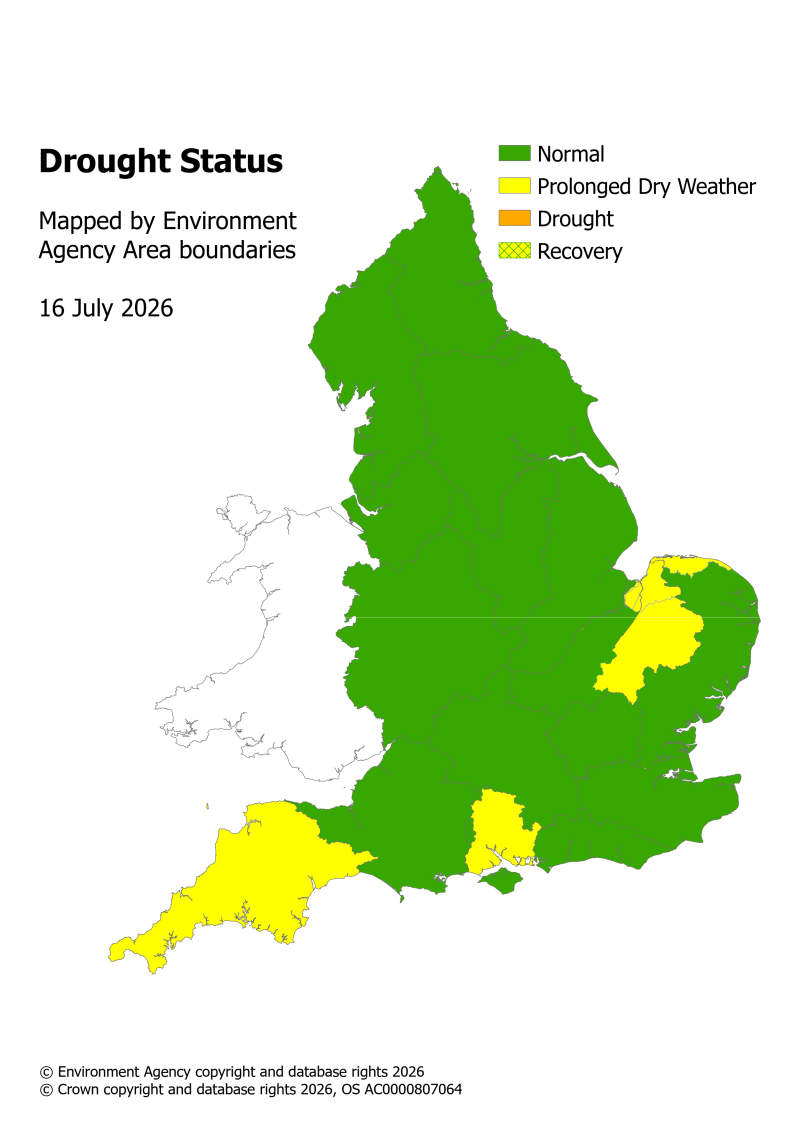
There has been one change to area drought status this week. Devon, Cornwall and Isles of Scilly have moved to prolonged dry weather.
2.1 Areas in drought
No areas are in drought.
2.2 Areas in prolonged dry weather
- Devon, Cornwall and Isles of Scilly
- East Anglia – Cam & Ely Ouse, North West & North Norfolk catchments
- Solent and South Downs – Hampshire and Isle of Wight catchments
2.3 How the stages of drought response work
Each area is reviewing its status depending on the triggers they have outlined in their drought plan.
More detail of how the Environment Agency manage drought, including our 4 stages of drought response, is available in Drought: how it is managed in England.
3. Current water situation
With less than 1mm of rainfall recorded anywhere in the week ending 14 July, the dry weather of previous weeks has continued across England. Rainfall totals for the month to date range from 0% of the LTA in east and south-east England to 9% in the north-west. For England as a whole, just 3% of the LTA has been received.
Soil moisture deficits continued to grow across England, as high temperatures and very dry weather continue. Soils are now much drier than average in all parts of the country.
River flows decreased at most indicator sites, and the majority are now classed as below normal or lower for the time of year. Thirteen sites were classed as notably low, mainly in central, east and southern England. Seven sites were classed as exceptionally low for the time of year, including the River Swale in the north-east, the River Tone in the south-west, and the River Cam in east England.
Groundwater levels continue their seasonal recession, with levels decreasing at most sites. In limestone aquifers such as the Oolitic limestone of the Cotswolds, levels have fallen quickly and were notably low for the time of year. Some quicker responding chalk aquifers such as the Wessex downs have also seen levels fall below normal or notably low levels.
In the week ending 14 July, reservoir storage for England was 78.8%, which is 5% below the LTA for the time of year. Almost all reservoirs recorded a decrease in storage in the week, and over half of reservoirs are now classed as below normal or lower for the time of year. This includes 6 reservoirs classed as notably low, including Wimbleball (South West Water), Grafham (Anglian Water) and Hanningfield (Essex and Suffolk Water). Blagdon reservoir operated by Bristol Water was classed as exceptionally low for the time of year.
More details are available in the water situation reports for England.
4. Public water supply
Whilst it has been a bit cooler, hot weather and a lack of rainfall has continued this week. This has led to some water companies continuing to experience significant peak demands for water.
Some parts of the country have received lower than average rainfall this spring, which with record spring temperatures, has resulted in a greater than normal reduction in reservoir and groundwater storage and river flows for several water companies. However, many companies are still currently operating in business as usual (BAU).
Water companies report their drought response using operational drought levels, from drought level 1 escalating to level 4. The Environment Agency expect water companies to follow their drought plans and act early to ensure there are sufficient supplies.
4.1 Affinity Water
The company reports to be in BAU but has reached its drought environmental trigger in its East zone.
A TUB was announced on 10 July and enforced from 17 July to manage high demands as a result of recent heat waves.
4.1 Anglian Water
The company moved to drought level 2 in its Fenland and Norfolk Norwich and in its Broads zones on 10 July, with its other zones in BAU.
A TUB was announced on 9 July and enforced from 11 July, covering the whole area except for Hartlepool.
4.3 Cambridge Water
Cambridge Water is now at drought level 1.
Driven by high demand for water, Cambridge Water advertised a TUB 9 July to be enforced from 17 July company wide. The company has taken other demand saving measures including sending staff to newer housing developments and golf clubs to reinforce the TUB messaging. The company reported it was in a better than anticipated supply position by the end of last weekend.
4.4 Essex and Suffolk Water
Essex and Suffolk Water is now at drought level 1 for all its water resource zones (WRZs).
This is due to low river flows and increased water demand driven by the hot weather. Suffolk WRZ has been issued with appeals for restraint.
4.6 Severn Trent Water
Severn Trent Water is now at drought level 1 in its North Staffs WRZ.
This is due to increased water demand driven by the hot weather and storage levels in its Tittesworth reservoir.
4.7 Southern Water
Southern Water is enforcing a TUB from 10 July for customers in its Hampshire and the Isle of Wight area and is preparing a drought order for the River Test.
4.8 South East Water
South East Water remains at drought level 1 in its Haywards Heath and Eastbourne WRZs.
Storage at Arlington and Ardingly reservoirs has declined over recent weeks. A TUB remains in place for customers in Kent and the company reports this helped stabilise the situation.
4.8 South West Water
South West Water announced a TUB on 13 July for enforcement 14 July. This TUB is for an area in Devon and Dorset supplied by a specific water treatment works that is experiencing an increase in demand pressure, and consumption is out stripping the ability to produce water.
4.9 South Staffordshire Water
South Staffs Water moved to drought level 1 on 14 July.
The level at Blithfield is currently 70%, a 4.2% drop compared to the previous week. The Nethertown pump back scheme is not in operation, due to the North Muskham hands off flow. The company has an ongoing water efficiency campaign. The Environment Agency has requested that the company provide us with more detailed information on a weekly basis going forward.
4.10 Thames Water
Thames water is now in drought level 1 for London.
This is led primarily by the water situation in London, but increasing risk in all areas made Thames decide to move the whole company into drought level 1. It has increased its media campaign in London.
4.11 United Utilities
United Utilities strategic resource zone (Haweswater) crossed into enhanced monitoring and operations (EMO) over the weekend. Carlisle WRZ (Castle Carrock) also crossed into EMO on 14 July.
United Utilities shared that it has sent tankers to several farms in its region to support agriculture.
4.12 Wessex Water
Wessex Water is now at drought level 1.
This is due to a decline in its groundwater levels.
4.13 Yorkshire Water
Yorkshire Water remains at drought level 1 in its Grid WRZ.
Reservoir storage has declined from last week driven by high demand and low rainfall. It continues to communicate with customers on using water wisely.
5. Agriculture
With the continuing dry conditions and high temperatures, this year’s harvest has already started in some places across East Anglia. High temperatures are causing some concerns for cereals and spring barley yields are expected to be impacted by the lack of rain earlier in the season.
River flows continue to decline and most monitoring sites are below normal for the time of year. In response to continuing dry conditions, there has been a significant increase in the number of hands-off flow restrictions on abstractions licences. This week there are 1,327 hands off flow restrictions in force on abstraction licences, compared to 729 last week. Abstraction licence restrictions are increasing pressure on farm storage reservoirs. Irrigation reservoirs stocks vary across the country and are around 30% to 50% full where abstractors are heavily reliant on storage reservoirs.
There are increasing concerns around water resilience for the rest of the year if the dry conditions continue. Additionally, there are concerns for forage supplies this winter where there has been limited grass growth this year.
7. Environment
There has been limited impact on the environment up to this point but confirmed incidents caused by drought and dry weather have been steadily increasing. The total for 2026 (29) is still lower than at this time in 2025 (141). However, the overall number of estimated and confirmed incidents with dead fish has rapidly increased during the last 3 weeks. It is likely those attributed to drought and dry weather that are underestimated.
The dry, hot weather has also led to wildfires breaking out at various places around the country. The Environment Agency is working with the relevant authorities to support as required.
8. Navigation
Overall the water resource position for the Canal & River Trust remains normal for the time of year and better than in 2025. Most canals are open for navigation, but there are increasing numbers of localised impacts, associated more with asset performance and maintenance, rather than the lack of water. However, in recent weeks there has been higher demands due to heatwaves and dry conditions. The Canal & River Trust continue to closely monitor the situation.
9. Weather forecast
Friday is expected to be another warm, dry day with sunny spells for many. Areas of cloud in the east may linger near North Sea coasts but will clear elsewhere. It will remain dry and settled through the weekend. Sunny spells will be interrupted by increasing cloud, bringing the potential for showers. Temperatures will be very warm early in the weekend before returning closer to average by the end of the weekend.
Next week (20 to 29 July) will see dry weather continue to dominate as high pressure remains close to the UK. Temperatures are expected to be less hot than recent days. The influence of this high pressure may wane towards the end of the month, bringing a greater chance of rain or showers, particularly in the north.
Further ahead (30 July to 13 August) conditions may become more changeable, with showers, thunderstorms or longer spells of rain a possibility. In the south and south-east, dry and bright interludes are likely. Temperatures are likely to be above normal, with hot spells possible.
10. Drought readiness actions
The Environment Agency is well prepared, is actively coordinating across government and sectors, and is acting on lessons from 2022 and 2025. The National Drought Group was reconvened on 18 June to monitor risks, preparation and impacts. It will meet monthly through the summer. The next meeting is on 20 July.
11. Contact us
Contact drought.national@environment-agency.gov.uk if you have questions about this report.