Digital inclusion for connection: final report
Published 29 September 2026

© Crown copyright 2026
This publication is licensed under the terms of the Open Government Licence v3.0 except where otherwise stated. To view this licence, visit nationalarchives.gov.uk/doc/open-government-licence/version/3 or write to the Information Policy Team, The National Archives, Kew, London TW9 4DU, or email: psi@nationalarchives.gov.uk.
Where we have identified any third party copyright information you will need to obtain permission from the copyright holders concerned.
This publication is available at https://www.gov.uk/government/publications/digital-inclusion-for-connection-digital-inclusion-for-disabled-adults/digital-inclusion-for-connection-final-report
Evidence from a pilot to increase digital confidence and reduce loneliness among disabled adults.
Executive summary
Digital inclusion is a core UK government priority. However, disabled adults face greater barriers to getting online and using digital services effectively, safely and confidently. These barriers include inaccessible design, the cost and suitability of devices and assistive technology, lower digital confidence, and wider pressures linked to health, income and access to support. They can affect not only access to services and opportunities, but also people’s ability to maintain relationships and participate in community life. Disabled adults are also more likely to experience loneliness, yet there is still limited evidence on how digital inclusion support may affect social connection and loneliness for this group. This pilot was designed, in part, to build understanding in this area.
This report presents findings from the Digital Inclusion for Connection pilot and the wider work that informed it. The work was delivered in three stages: an evidence review, lived-experience research with disabled working-age adults, and pilot interventions delivered through a range of organisations. Together, these stages explored how digital inclusion support could help disabled working-age adults who had limited digital engagement and varying experiences of loneliness and social isolation. Using a needs-led model, it evaluated and examined how support with access, confidence, skills, and accessibility could contribute to stronger connection and participation in everyday life.
The pilot design was informed by lived-experience research and provided a tailored approach to participants. Pilot interventions were delivered through trusted organisations and included a mix of one-to-one support, group activity, assistive technology support, drop-in provision, and tailored help with digital confidence, safety and skills. The evaluation considered what supported engagement, which barriers remained, and what lessons could be drawn.
The findings suggest that digital inclusion for disabled working-age adults is best understood as more than access to a device or internet connection. Its value lies in whether digital tools help people maintain relationships, access support, take part in activities and participate more fully in everyday life with greater confidence and independence. In other words, the significance of digital inclusion lies in the extent to which improved digital support enables individuals to achieve outcomes that matter to them.
The findings also suggest that digital inclusion is a shared responsibility across government, industry, and civil society. Targeted support can improve confidence and skills, but sustained digital inclusion also depends on an accessible wider digital market, including devices, platforms, telecoms services, retail environments and customer support. Wider practical factors, including transport, may also affect whether people can access digital support and equipment.
As a small-scale pilot, this provides qualitative evidence on the key barriers, mechanisms and delivery models relevant to future policy and practice. The evidence for the effectiveness of intervention is stronger in relation to digital confidence, skills and engagement than to changes in loneliness or social isolation. This reflects the short delivery period, which limited the ability to assess longer-term social outcomes and suggests a need for further investigation in this area.
Key findings
The research suggests that:
- Digital inclusion can strengthen connection. Participants were clear that online contact does not offer the same experience as face-to-face interaction. However, digital tools can still play an important role where they help people stay connected, access services, join activities and reduce practical barriers to participation. This points to a broader understanding of connection, including relationships, access to support, community participation, and confidence to engage in everyday life.
- Barriers to digital inclusion are often compounded. Disabled adults may face many of the same barriers as other digitally excluded groups, including low confidence, connectivity issues, concerns about scams and negative past experiences. But these often interact with disability-related barriers such as inaccessible design, unsuitable technology, assistive technology needs and wider pressures linked to health, income, and care provision. This can make digital exclusion deeper and more persistent. Support is therefore likely to be most effective when it recognises these overlapping barriers and responds with accessible, trusted, and tailored delivery.
- Confidence supports participation. Fear of mistakes, concerns about scams, mistrust of digital spaces and difficult past experiences all shaped whether people felt able to take part. Support therefore needs to address confidence and online safety alongside access and skills, particularly where digital participation can support connection to people, services, and activities.
- Trusted routes support engagement. The findings suggest that people were more likely to engage where support felt trusted and accessible. In this pilot, engagement was achieved through community and charity organisations, but trust may also be built through peer support, role models and other existing relationships or networks. This suggests the importance of trusted routes into support, rather than a single delivery model.
- Accessibility and usability should be central to digital inclusion. For some disabled adults, the key issue was whether devices, digital services and online environments were accessible, usable and compatible with assistive technology. Accessibility needs to be built in from the outset across technology, services and support.
- Awareness remains a challenge. Many disabled adults were unable to benefit from accessible features, assistive tools and support offers because they did not know these existed or did not understand their relevance. Stronger information, referral and signposting routes could improve take-up of support already available and help more people use digital tools to access support, opportunities, and social connection.
- Affordability is a key concern. Disabled adults face heightened affordability barriers in relation to technology, shaped not only by the higher cost of assistive technology but also by wider financial pressures and the additional costs associated with disability. Reliance on assistive software can increase the need to regularly replace or update devices, and/or mean that users rely on older less effective version.
- Flexible support is more effective. Participants differed widely in their goals, impairments, starting points, support needs and preferences for learning. A blended model combining one-to-one, group and drop-in support across online and in-person appeared better suited to this variation than a standardised offer. This underlines the value of personalised support, while highlighting the importance of considering how tailored approaches can be delivered at scale.
Implications
Taken together, the findings suggest that future policy and delivery should place greater emphasis on meaningful participation, connection and sustainability, rather than focusing narrowly on access alone. Effective support is likely to require flexible, wraparound approaches that address overlapping barriers in parallel, including suitable devices and connectivity, accessibility, confidence, skills and trusted support embedded in the community.
In particular, the findings suggest that future policy and delivery should:
- place accessibility and assistive technology at the centre of digital inclusion policy and delivery
- design support that addresses multiple and intersecting barriers to digital inclusion, rather than treating access, skills, confidence and accessibility as separate issues
- provide flexible, needs-led support rather than standardised models
- work through trusted community, charity, and specialist organisations, alongside peer support and role models to improve engagement
- improve awareness among disabled adults and the organisations supporting them of accessible features, assistive tools and available support offers
- account for ongoing affordability challenges, including connectivity, maintenance, replacement and technology refresh
- recognise that sustained inclusion may require ongoing support over time, rather than one-off or short-term intervention
- clarify the roles of government, industry, service providers and community organisations in promoting and implementing inclusive design by default
Conclusion
The research provides new evidence on how support for disabled working-age adults can better address digital exclusion. It suggests that support is most effective when it combines accessible and suitable technology, connectivity, skills, confidence-building and online safety, and when it is tailored to individual needs and delivered through trusted routes. The findings reinforce that accessibility, and assistive technology should be treated as core elements of digital inclusion, not optional extras. Where sustained inclusion is the goal, ongoing support with affordability, maintenance, replacement and technology refresh may also be needed. Further deep dives may be needed to inform future policy design and implementation, particularly on affordability, assistive technology, trusted delivery models, and longer-term impacts on connection and loneliness.
Introduction and background
Digital inclusion is a core UK government priority. The Digital Inclusion Action Plan: First Steps (February 2025) sets out the ambition that everyone in the UK has the connectivity, skills, support, and confidence needed to participate fully in digital life.[footnote 1] The ability to participate in digital society is now essential for accessing services, employment, and social connection. Yet digital exclusion remains a significant issue across the UK. Around 15% of people cannot complete foundational digital tasks, and a further 6% are completely offline.[footnote 2], [footnote 3]
These barriers are not experienced evenly across the population. Disabled adults are over 50% more likely than non-disabled adults to face obstacles to getting online and using digital services.[footnote 4] Lower digital confidence can limit opportunities and increase everyday costs by reducing access to cheaper online tariffs and money saving tools.[footnote 5] Disabled people are also more likely to lack foundational digital skills and to encounter accessibility barriers.[footnote 6]
For disabled adults, these challenges often reflect a combination of factors rather than a single barrier. Digital services, websites, and devices may be difficult to use if they are not designed with different access needs in mind. Assistive technology may be unavailable, unaffordable, or poorly supported. Costs may also be higher where people need specialist devices, software or connectivity that meets accessibility needs. These barriers often sit alongside wider pressures, including poor health, lower income, transport difficulties, and reduced access to local support. This means that digital exclusion may be deeper and more persistent for disabled adults and may be harder to address through standard approaches alone. [footnote 7]
Loneliness is also more prevalent among disabled adults than in the general population. It is associated with poorer wellbeing and mental health.[footnote 8] Taken together, these factors point to an important policy challenge at the intersection of disability, digital inclusion, and social connection.
Digital participation can support social connection in several ways. It can help people stay in touch with friends and family and take part in groups and communities. It can also help people access information, find opportunities, and overcome practical barriers to in-person participation, for example by supporting journey planning, booking and access to local services.[footnote 9] However, digital inclusion should not be understood simply as internet access or device ownership. Digital inclusion exists on a spectrum. Many people are technically online but still excluded from safe, confident, and meaningful participation because of barriers linked to skills, confidence, affordability, accessibility, and device suitability.[footnote 10]
Disabled people are less likely to own a suitable device, less likely to have essential digital skills and face a digital landscape where accessibility is uneven.[footnote 11], [footnote 12], [footnote 13] They face a greater risk of digital exclusion because they encounter the same challenges as the general population (such as affordability issues and gaps in essential digital skills) while also dealing with additional barriers such as inaccessible online environments or not having access to the assistive technology they need.
There is a notable evidence gap surrounding this policy challenge. Research and provision have often focused on older people, with less evidence on digital inclusion, social connection and loneliness among disabled adults, particularly across working-age groups and different impairment types. This pilot was designed, in part, to help address that gap.
Pilot objectives and evaluation questions
This study was designed as a small-scale pilot to help address an important evidence gap. It focused on a cohort of disabled adults who had limited online engagement and experienced social isolation. As a pilot, the study was intended to test and refine approaches in a real-world setting, rather than to generate statistically robust evidence of impact at scale. The sample size was therefore deliberately limited and should be understood in that context. The aim was to generate practical learning that could inform broader policymaking, future pilot development, and more detailed evaluation.
The study placed particular emphasis on understanding and responding to psychological barriers. These included low confidence, fear of online harms, lack of trust and perceived irrelevance.
The pilot had 3 core objectives:
- to assess the extent to which targeted digital inclusion support improves digital confidence and foundational skills, strengthens social connection, and reduces loneliness among disabled adults, both online and in person
- to understand how psychological barriers such as low confidence, fear of online harms, mistrust and perceived irrelevance influence engagement and outcomes, and to identify practical approaches that appear effective in overcoming them
- to explore the contribution of different delivery models and support components to participation and outcomes, and to consider how the approach could be scaled and integrated with local and public services
The evaluation was guided by the following questions:
- how successful were recruitment and retention? Which approaches were effective or ineffective, and what adaptations were required to meet participants’ needs?
- what changes occurred in self-reported digital confidence and foundational digital skills from baseline to the end of the pilot?
- how did participation affect self-reported social connectedness and loneliness, including both online and offline interactions?
- which psychological barriers emerged during the pilot? What strategies were used to overcome them? Which approaches worked best or less well? How did participants’ attitudes or emotions towards technology change over time?
- how could the model be integrated into existing public sector or community services?
Principles underpinning this work
The pilot was shaped by the following principles:
- “Nothing About Us Without Us.” This work was guided by the principle “Nothing About Us Without Us.” Disabled people’s voices were built into the research, pilot design, delivery, and evaluation from the outset. This was central to the approach. It helped bring lived experience closer to policymaking and ensured the work was shaped by the people it aimed to support.
- Social model of disability. The work was grounded in the social model of disability. It took an impairment-agnostic, needs-led and equity-led approach. Rather than categorising people by diagnosis, it focused on identifying and removing the barriers that prevent participation.
- Co-design. Co-design sat at the core of the pilot. Disabled people helped shape the work through interviews, focus groups and ongoing feedback. This helped ensure the offer remained relevant, respectful, and responsive to what mattered most to participants.
- Trusted delivery and accessibility by design. The work was delivered through trusted charities and community organisations. This helped build confidence, relevance, and psychological safety. Accessibility was built in from the start through the design of venues, materials, tools, and platforms. Tailored adjustments, device set-up, and follow-up support were provided where needed.
Taken together, these principles positioned digital inclusion not as an end, but as a means of supporting greater confidence, participation, and social connection.
Methodology summary
This report presents DSIT’s findings and conclusions on how digital inclusion support may affect social connection for disabled adults. PwC, Scope, and Enable co-delivered the pilot interventions.[footnote 14] Three Hands convened a Critical Friends Group of lived experience experts and sector stakeholders, which formed part of the project’s governance and provided advisory input at key stages outlined in Appendix A.
The work had 4 stages: an evidence review, lived experience research, pilot co-design, and pilot delivery and evaluation. The lived experience research included an accessible survey and qualitative fieldwork with disabled adults, including focus groups and depth interviews. These insights were used to shape a blended pilot model combining one-to-one and group-based support delivered through trusted charities.
Figure 1. Four-stage approach used in the Digital Inclusion for Connection pilot
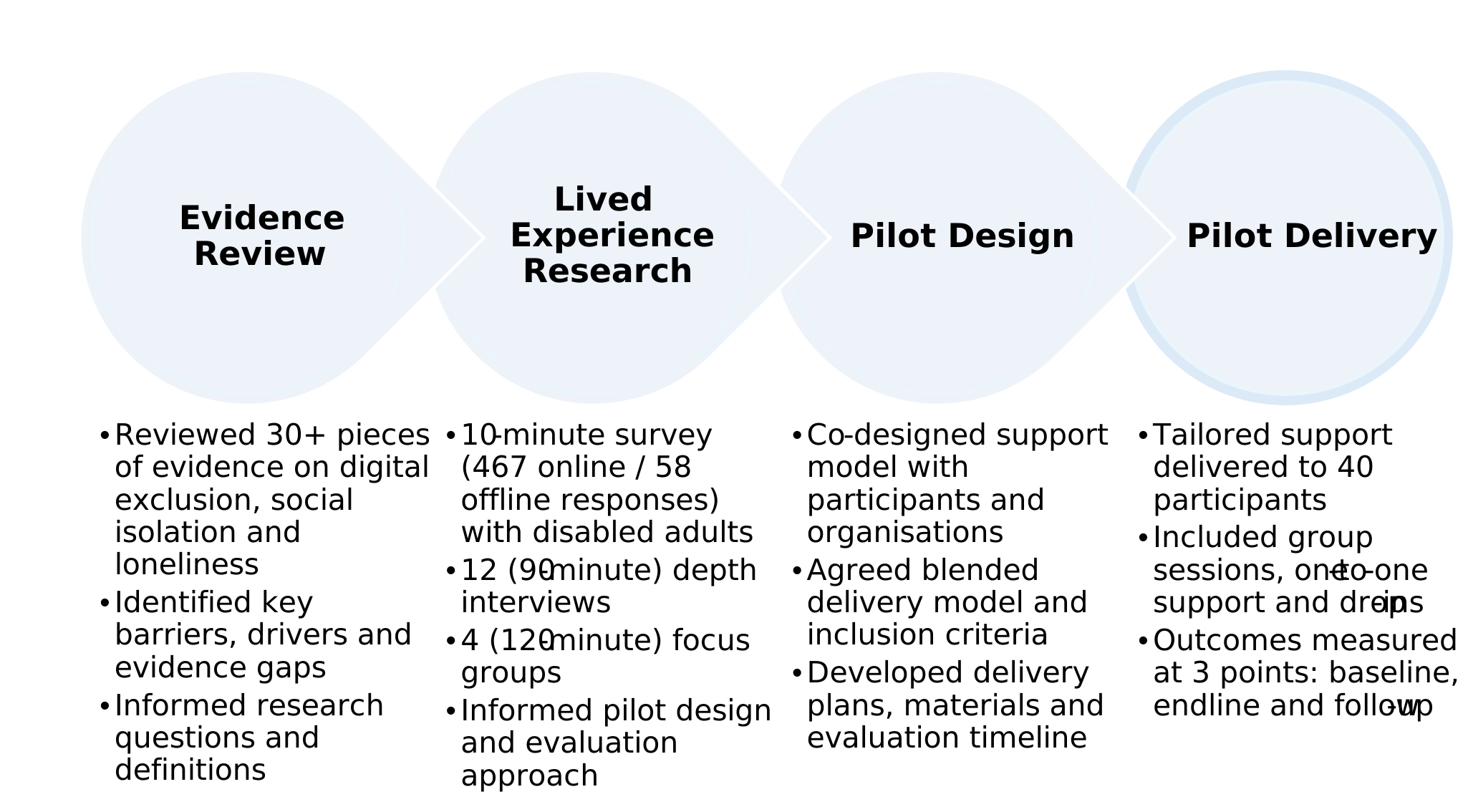
Participants were disabled adults aged 18 to 64 living in England, Scotland, or Wales, reflecting the areas in which delivery organisations were active. All participants reported experiencing loneliness “at least some of the time” and were occasional or limited internet users facing a range of barriers related to confidence, skills, affordability, accessibility, and assistive technology.
The evaluation drew on baseline, endline and short follow-up data, alongside delivery monitoring and qualitative insight. It examined changes in digital confidence and skills, social connectedness, and loneliness, as well as participant experiences of support. Findings should be interpreted with caution given the small sample, short delivery period, and exploratory nature of the pilot. Full methodological details are provided in Appendix B, and the evidence review is included in Appendix C.
Lived experience research
Key takeaways
- Disabled people face heightened barriers to inclusion: Disabled people face many of the same barriers to digital inclusion as others, but these are often compounded by accessibility needs, high costs and low confidence.
- Accessibility is central to participation: Devices, platforms, and services were not always usable or compatible with assistive technology, and there is limited awareness of the tools available.
- Building confidence is key to increasing engagement: Fear of making mistakes, past negative experiences, and concerns about scams or privacy often reduced willingness to engage.
- Digital inclusion can strengthen social connection, but in isolation does not tackle loneliness: The drivers of loneliness and social isolation among disabled people are often deep rooted and impact people with varying levels of digital skills and confidence.
- A flexible, needs-led approach to digital inclusion support is desired: Participants wanted support that was practical, tailored, and relevant to daily life, including communicating with others, managing everyday tasks, and increasing independence.
Quantitative survey
The survey was designed to understand disabled peoples’ attitudes to technology, the internet and connecting to other people. The key objectives were to:
- understand the barriers and challenges to engaging online, including those faced by more regular online users
- identify digital skills, confidence, and support requirements
- explore experiences and attitudes towards assistive technology
- explore the link between loneliness/social isolation and digital engagement
The survey was completed by 525 disabled adults from across the UK, with data collection involving both online and in-person out-reach. Fieldwork was conducted between 16 January 2026 and 20 March 2026.
Key themes
Disabled people are broadly positive about technology and the internet
Nearly three-quarters (73%) of disabled people feel that the internet is good for disabled people (20% are neutral and 6% disagree) and the disabled community and 46% feel that being online has a positive effect on their mental health (34% are neutral and 18% disagree). However, only 22% believe that AI advancements will benefit society as a whole (34% are neutral and 44% disagree).
Technology and the online world are not designed with disabled people in mind
Only 13% agree that new technology is often designed with disabled people in mind and 21% require support to do at least some of the things they like to do on the internet. Many face challenges navigating the digital world with websites often not designed to be fully accessible. Experiences vary across online activities, while 69% feel that online shopping and online banking are fully accessible for them but only 52% say the same about Government websites and 45% for health services.
For my own general use, the only issue that comes to mind is how badly some websites are built
Non-binary, 18 to 24, learning, understanding, or concentrating, neurodivergence
Compatible accessibility, which works on all tech and within different realms online
Woman, 45 to 54, chronic or long-term condition, chronic or long-term pain, mobility
Disabled people also stated that improved accessibility and usability of technology would make it easier for them to do things they want to do online.
There is a lack of awareness and access to assistive technology
Less than half (40%) are currently using assistive technology to help them go online. Assistive technology includes functions that are built into devices, as well as separate devices, software, or tools such as magnifiers, text-to-speech software, screen readers, voice control, or live captions. The majority (60%) of those who use assistive technology feel that it meets their needs and makes it easier for them to engage online (57%). However, only 37% feel that they have access to all the assistive technology they need and only a quarter (25%) say that they can comfortably afford it.
Many of those not currently using assistive technology feel it might help them (46%), but limited awareness and costs emerge as barriers to take-up. Thirty-nine percent don’t know what assistive technologies are available, 27% don’t think they can afford it, and 19% are not confident using assistive technology.
Regular online users still have concerns and challenges about using the internet
Even among those who go online as much as they want, a number of concerns and challenges when using the internet emerge; 53% worry about privacy and security, 48% worry about scams or harmful content, 17% worry about making a mistake or something going wrong, 16% feel the internet is too expensive, 14% face connectivity challenges and 5% feel their access needs make it hard to use the internet.
There is strong interest in digital upskilling to keep up with the pace of change
While the majority (74%) rate their ability to use the internet as good or excellent, there is still strong interest in digital upskilling. Areas of interest include learning more about assistive technology (66%), improving digital skills (53%) and learning more about how to stay safe online (53%). Only 27% feel that they would know where to go to improve their digital skills implying a gap in service provision.
Experiences of loneliness and social isolation are similar for those with different levels of online usage and confidence
A quarter (25%) of disabled people stated that they feel lonely always or often, and 39% feel lonely some of the time.[footnote 15] Many of those who feel lonely always or often use the internet daily (89%) showing that digital inclusion alone will not fully address this problem.
Loneliness is higher among those who live alone, and the importance of providing a sense of belonging is highlighted by almost half (48%) of disabled people stating that they often feel left out and 37% saying that they meet socially with friends, family, or colleagues less than once a month or never.
Being online can make disabled people feel more connected to others
There are indications that the internet can play a role in addressing social isolation and loneliness. Sixty-three percent feel that being online makes them feel more connected to other people, with a range of activities having a positive impact in this regard including sending or receiving messages using apps, video calls, and social media. Over half (55%) feel that being online makes it easier to find offline social activities and the majority (76%) feel that being online is not a replacement for face-to-face interactions.
Qualitative research
The qualitative research was designed to provide a deeper understanding of individual experiences, goals, and challenges. The key objectives were to:
- understand experiences of loneliness and social isolation amongst disabled people, who are limited or occasional internet users
- understand the practical and psychological barriers to digital inclusion including skills, confidence, motivation, technology, affordability, connectivity
- explore the role of assistive technology, including awareness, understanding, barriers to use, and role in digital inclusion
- identify what would overcome the barriers to digital inclusion including support requirements and preferred ways of learning to inform interventions design
- explore the potential role of digital inclusion in reducing loneliness
Key themes
Digital inclusion as spectrum
Use of digital technology varies across the disabled population, and the research supports existing findings that digital exclusion is not a binary state of being online or offline. Rather, it exists on a spectrum ranging from complete digital disconnection to limited, insecure or low-skilled access to the digital world.
How people use devices and the internet is highly individualised. Many participants who were more digitally engaged displayed high levels of confidence in particular activities while showing strong aversion to others. For example, someone may feel comfortable using social media and browsing websites but not feel confident undertaking online banking or completing online forms. Similarly, an individual may be able to use a laptop for work but struggle to use digital technology more broadly in other aspects of daily life such as for online banking or shopping.
Participant Story
A man who lived alone with a chronic condition, chronic pain and mobility condition. He was unable to work due to disability and owned a laptop and a smartphone but did not currently have Wi-Fi at home.
His experience illustrates how digital inclusion is a spectrum, rather than a binary state. Whilst the participant had appropriate devices, he lacked the skills and confidence to use his devices to their full potential. Additionally, whilst wanting in-person support, the participant’s intersecting conditions could make it difficult for him to reach spaces where such support would be provided.
I would be willing to meet up somewhere locally or with easy access and have assistance and support with using a laptop computer with the basics […]. At the moment I know how to do email etc and Facebook and WhatsApp but anything further I am not that confident at all on using a laptop.
Male, 55 to 64, chronic or long-term condition, chronic or long-term pain, mobility
Frequency of engaging online alone is not an indicator of digital inclusion. We saw examples where online engagement was limited to WhatsApp, and while this activity could be daily, participants did not consider it to be “being online” in the same way as browsing the internet, using social media, or accessing online services such as healthcare, banking, or government services.
Participant Story
An older man with long-term mental health issues, living alone, had moved in and out of work since the early 2000s, mainly in manual labour or driving roles. He described himself as very isolated and described how his condition could lead him to withdraw from social contact.
He owned a smartphone and a tablet, although he had not used the tablet because he found it too confusing. His smartphone use was limited, being used only for calls, WhatsApp and YouTube Music. He reported low confidence in his digital skills, concern about slow typing and online scams, and confusion about the range of options available, leading him to stick to what he knew.
I had a tablet about 10 years ago. I’ve been frightened off it because I’ve never used that kind of technology before… My finger just brushing against it, and then it would jump to another page. I’m just not confident even using a touch screen.
Male, 55 to 64, mental health condition
Digital inclusion barriers
The research found that disabled people face many of the same barriers to inclusion that non-disabled people face but experiences of these can often be heightened. Barriers that emerged included:
- access: no internet at home, poor connectivity, inaccessible website design, limited awareness of and access to assistive technology
- affordability: internet and devices broadly seen to be expensive, but assistive technology (both devices and subscriptions) adds an additional premium
- limited digital skills: not able to complete certain digital tasks and/or relying on others for support. Some also described the difficulty of keeping up with the pace of technological change or adapting to their own changing needs where they had fluctuating or progressive conditions
- low confidence and motivation: negative previous experiences both online and more broadly across their lives, with experiences shaping attitudes dating as far back as school, even among older participants. This fear of making mistakes could lead to reluctance to engage online or try new things
Barriers to digital engagement were often complex, overlapping and can fluctuate from day to day depending on a person’s condition. This resulted in highly individualised needs and support requirements. While many of these barriers can also affect people without disabilities, the research found that they are often heightened by the specificities and complexities associated with disability and long-term health conditions.
I have auditory processing disorder, dyscalculia, poor internet connection, caregiving responsibilities, and an autistic predisposition to avoiding phone calls. I need support that doesn’t rely on either phone calls or synchronous in-app/website live-chats, because my connection will invariably be disrupted (for one of a thousand reasons) and then I’ve lost access to support.
Non-binary, 35 to 44, chronic or long-term condition, chronic or long-term pain, mental health, neurodivergence
Access barriers
Disabled people can face similar access barriers to non-disabled users such as no internet at home, poor connectivity, lack of smartphone, laptop, or tablet. However, in addition to this, accessibility of the online environment, devices and assistive technology can create additional barriers to digital engagement for disabled people.
Participants described how websites or apps could be inaccessible, for example not being designed for screen readers. They also reported that apps or websites that had previously worked for them could become inaccessible following updates or design changes. Where online was presented as the default means of access, inability to use these services could not only prevent access to essential services but also contribute to feelings of social isolation by limiting participation in activities that others could access, impacting people’s self-esteem and independence.
I couldn’t really see most of them, even with the screen enlarger on, it just wasn’t reading it properly because it’s obviously not been enabled for that kind of tech.
Female, 45 to 54, chronic or long-term condition, chronic or long-term pain, mobility
Devices themselves could present barriers to use depending on the disability or condition involved. Where individuals were unable to use features, this could lead to disengagement from that device and potentially from technology more broadly. A poor experience with one aspect of technology, particularly where repeated, or where assistive technology did not meet need, could have a lasting impact on someone’s willingness to engage with digital tools.
The research also highlighted that digital devices and the internet often do not meet disabled people’s basic accessibility needs, limiting their ability to interact with and engage with them. In relation to assistive technology, participants described a complex landscape of built-in tools, software, and hardware provided by different suppliers. Many felt they could benefit from assistive technology, but awareness of what was available, and of how to find appropriate information or support, was often limited.
It’s exactly the same as if you go around a shop and everything is too close together so you can’t get round in your wheelchair, that’s how I feel about the internet
Female, 35 to 44, chronic or long-term condition, chronic or long-term pain, dexterity, mental health, mobility, neurological condition
I understand there are free screen reading options, something with 4 letters. I can’t remember what it’s called. It stands for something. But again, I haven’t got that downloaded. I don’t know anything about it.
Female, 45 to 54, vision impairment
Affordability barriers
Many disabled people experience both real and perceived cost barriers in relation to technology. Some require specific devices that are positioned at a premium price point, such as laptops or computers with greater memory capacity to run assistive technology software, or more expensive devices that are regarded as having better built-in accessibility features, such as iPhones. Subscription models for assistive software were also cited as a particular concern.
Anything that falls under the category of being a bit different because it is assistive technology is always excruciatingly expensive and impossible to either afford yourself. Or the waiting list to apply to get those things, like access to work, or a referral to an occupational therapist through the local authority is so long it makes people feel like second-class citizens in the first place.
Female, 45 to 54, vision impairment
Participants acknowledged that they were not fully aware of the assistive technology available and there may be cheaper tools available that are relevant to them. However, it was felt to be unclear how to find out about this.
There was also felt to be an inherent risk in trying something new, due to fears of wasting money on technology that would ultimately prove to not work for them. The ability to ‘try before you buy’ was not felt to currently be available.
In some cases, access to preferred assistive technology had been facilitated by the Access to Work scheme, but the same technology could not be afforded for personal use, thus limiting what people could do online.
All of these things are massively expensive. Any programme or piece of kit that is designed with accessibility in mind costs the Earth
Female, 45 to 54, chronic or long-term condition, chronic or long-term pain, mobility
Limited digital skills
Participants sometimes had a narrow digital skills set, and while comfortable using the internet for familiar activities such as messaging friends and watching videos, they lacked other foundational digital skills, such as using email or using word processing applications. There were many examples where they relied on support from friends and family for certain digital tasks and these included online shopping, booking appointments, and managing Universal Credit. Progressive conditions can lead to people losing digital skills, for example the ability to type or navigate online, where they are unaware of assistive technology that can support them.
So, if I get a message saying to make an appointment or a repeat prescription, I’ll need either my mum or my personal assistants to do it or go in or do it by phone, the old-fashioned way. I can’t do it all online anymore.
Man, 45 to 54, learning, understanding or concentrating, vision
During the research we also observed that some participants initially overstated their digital skills and confidence. Charities advised that this masking behaviour is common and highlights the importance of building trust so that people feel comfortable sharing the challenges they face, and support can be tailored accordingly.
Low confidence and motivational barriers
Among those who were more digitally excluded, there was a recurring sense that technology was “not for me.” This reflected a combination of psychological barriers but was often expressed as a firmly held belief, contributing to pronounced digital exclusion. Underlying this were fears of failure, embarrassment, and frustration, often driven by negative past experiences.
I was getting bullied and it just made me think no Facebook, it’s not for me, because the negative comment can actually make you feel not good.
Male, 46 to 55, learning, understanding or concentrating
Confidence often varied across different devices and activities. For example, someone might feel confident using social media to view content but not to interact with others online. Similarly, an individual might feel comfortable using the NHS app to manage GP appointments, while seeing online banking as far beyond their comfort zone. These motivational barriers could be reinforced when attempts to complete new digital tasks were unsuccessful. In relation to assistive technology, poor experiences, including using tools that were inappropriate or did not fully meet someone’s needs, could further reduce willingness to try other technologies, even where more suitable options existed or later became available.
In my opinion, when you have a physical health impairment, we all live life in some degree of fear… When I find something I can do, or I can use, I like to hold onto it. So that means we’re very averse to change. So, when someone comes along and says, try this instead, we need a whole lot more convincing than say somebody more able bodied.
Male, 46 to 55, chronic or long-term condition, chronic or long-term pain, mobility
Participant Story
A woman aged 55 to 64 in Glasgow with a learning disability and hearing impairment described very limited digital use. She owned a smartphone, which she used mainly for calls and messages, and had a laptop that she did not use. She described technology as not being for her, linking this to earlier experiences at school and a fear of failure. She relied on
her daughter for online tasks such as Universal Credit forms, which created stress when help was not available. Group classes at the library had felt too fast, and she expressed a preference for one-to-one support and a desire to learn to manage essential tasks independently.
I know that’s a new technology for the young’uns, but not me
I can’t do it; I’m not doing it. That’s the way I go. I get agitated because I can’t do it. I wasn’t smart at school
Female, 55 to 64, learning disability and hearing impairment
Safety online
Related to confidence online, many disabled people also spoke about concerns for their own safety and wellbeing online. Worries about scams or online bullying as a result of interacting with others online were common. However, we also saw more indirect fears about online safety emerge such as a general prevalence of negative content on news and social media websites, as well as concerns over not being able to trust information online.
But I think, specifically, as a disabled person, you see a lot of ableism around online and, so, it’s not very nice to see people saying things that affect you personally. So, I just choose not to go on it as much as I can.
Female, 25 to 34, chronic or long-term condition, chronic or long-term pain, mobility impairment
I don’t feel competent with it. I mean, I can use the computer and stuff. I can do typing and things like that. I don’t know whether it’s genuine or not. And if I go and buy something from a business, whether it’s a genuine transaction or whatever. I just don’t know whether you’re being scammed.
Female, 55 to 64, mental health condition
This has particularly strong links to socialising online, as concerns about online safety were particularly prevalent when discussing social media and interacting with others online. The concerns and fear for safety can lead to disabled people not interacting with things online that could lead to more social connection.
Loneliness and social isolation
Disabled people are more likely to experience loneliness and social isolation than others, and the drivers of this are often deep-rooted. Examples identified during the research included:
- not feeling listened to or understood
- limited social networks
- low confidence in social situations
- feeling left behind by society or technology
- barriers to interaction, such as limited public transport links or inability to access the technology needed to connect online
- being housebound or living in sheltered accommodation
Our research shows that there are a wide range of systemic factors that can lead to loneliness and social isolation. Participants described feeling left out by broader societal and technological change, showing that digital exclusion does have an impact. However, there are often a number of elements at play.
You feel like you are on a desert island, even though you are in a huge town
Woman, 35 to 44, Chronic or long-term condition (inc. Pain) Dexterity, Mental health, Mobility, Neurological condition
Participants with more limited digital engagement could struggle to see how greater digital participation would reduce feelings of loneliness and social isolation. In some cases, they associated the internet only with practical tasks they knew they needed to complete. By contrast, those who were more digitally engaged were more likely to see how online interaction could help them stay in contact with others through means that suited their needs and preferences.
At the same time, many participants were keen to emphasise that being online was not a replacement for face-to-face interaction. There were concerns about more services moving online, resulting in reduced face-to-face interaction and fewer alternative routes to support. For example, where online banking is available but there is no branch within a reasonable and accessible travel distance.
This points to 2 important conclusions. First, online contact alone is unlikely to be sufficient to reduce loneliness and social isolation. Secondly, digital inclusion can still be an important and necessary route to support social connection. Greater digital engagement and skills can help individuals access an increasingly digital world and reduce feelings of being left behind. They can also support people to find, organise, and arrange face-to-face activities, even where online contact itself is not a substitute for meeting in person.
I live an isolated life… if I could find some kind of interest or entertainment or whatever, using the internet, it may help with isolation.
Male, 55 to 64, mental health condition
Intervention design and emerging challenges
The lived experience research informed the design of the interventions taken forward into the pilot and identified several important considerations for future intervention design.
Those who were most digitally excluded could also be the most resistant to building broad digital skills. This was particularly evident among participants who felt that technology was “not for them.” For these individuals, it could be difficult to identify the benefits that digital technology might bring. In many cases, they had managed without technology and the internet and were resistant because they could not readily see its relevance or value.
Where this is the case, the research suggests that it is important to identify a clear hook that provides a meaningful route into digital learning. Common learning goals identified included online safety and security, accessing services such as Universal Credit, banking or health appointments online, understanding assistive technology and how to use it, and developing work related skills like email or Microsoft Office. Learning these skills could then provide a basis for developing broader digital capability.
It was more difficult for participants to identify goals related to developing social connection and reducing loneliness and isolation. Those that were identified included developing new online social skills (like gaming, forums and social media), building confidence engaging with social networks online (video calls, social media), searching for relevant face-to-face social activities online.
Wider considerations for pilot design
A one-size-fits-all approach will not work. It is important to understand individual needs and preferences. People with the same condition may interact with technology in different ways, and assumptions should not be made about what intervention is likely to help. This underlines the importance of adopting a needs-led approach, grouping support around similar barriers, preferences or objectives rather than presuming need on the basis of condition alone.
In an ideal scenario - Put a tailored package together to meet the needs of an individual and their disability- including security already installed on up-to-date laptop or tablet with ability to rent or buy over time.
Female, 55 to 64, chronic or long-term condition, chronic or long-term pain, dexterity, hearing, learning, understanding or concentrating, memory, mental health, mobility, speech or language, stamina, breathing, or fatigue
Trusted networks matter. There was a strong preference for engagement through trusted networks such as local community groups, charities, and libraries. Some participants expressed suspicion of government initiatives and uncertainty about engaging directly with businesses or organisations, particularly for personalised help where there were concerns about specialist knowledge and possible cost.
The best people I found so far, and I always go back to are charities… People that are living it, breathing it, sleeping it, repeating it. I’d much rather that…like my advocate, my support lady that I speak to about spine injuries, I’ll go back to her with queries and things because she’s in a wheelchair. She’s lived it for 30 years, and I trust her. Trust is a massive thing, isn’t it? When you’ve got a disability.
Female, 35 to 44, chronic or long-term condition, chronic or long-term pain, dexterity, mental health, mobility, neurological condition
One-to-one support is often preferred. Many participants expressed a preference for one-to-one support and guidance, as this was felt to allow learning to progress at the individual’s own pace and account for the nuances and complexities of their condition or disability. At the same time, this raises challenges when considering the scalability of such support.
…I’ve tried training courses like that before, and I just can’t manage to do it. I’ve tried doing training courses with the screen with them before or with computers before and I’ve found that I needed too much one-to-one support with it.
Man, 45 to 54, learning, understanding or concentrating, vision impairment
Raising awareness of assistive technology is important. As set out above, awareness of assistive technology was often low. This creates an opportunity to improve awareness of available technologies, support and resources. However, the research also highlighted that any technology provided requires wraparound support. Participants described previous experiences where technology, whether standard or assistive, had been provided to support digital engagement, but without the skills and assistance needed to use it effectively. In such cases, the technology could not be fully utilised
A central repository for information, which would solve the problems really in terms of what types of technology or the learning of technology because if you could go somewhere like Scope, for example, with a dedicated area where they can recommend different apps for different things and also tell you what technology you might need to access them.
Female, 45 to 54, chronic or long-term condition, chronic or long-term pain, mobility
Pilot design summary
The pilot tested a flexible, needs-led model of digital inclusion support for disabled working-age adults with limited digital engagement and varying experiences of loneliness and social isolation. Support was delivered through a mix of one-to-one, group, peer-based and drop-in activity, alongside tailored help with digital confidence, online safety, skills, accessibility, and assistive technology.
Participants engaged in different ways depending on their needs, goals and starting points. Some took part in one activity, while others engaged in more than one element of the offer. This allowed the pilot to test a flexible delivery model rather than a standardised intervention.
The section that follows examines early outcomes and impact, drawing on participant feedback, diaries, and baseline and endline data. A fuller description of the pilot design and theory of change is provided in Appendix D.
All participants in the pilot were invited to complete both the baseline and endline surveys. These were administered online by the charity delivery partners, with some participants receiving face-to-face support to complete them. Endline responses were collected within one week of the intervention ending, although not all participants completed the survey or provided complete data. Detailed information on the monitoring tools, question sets and measures used at each stage is provided in Appendix E.
Pilot outcomes and impact
The following outcomes and impacts are suggestive and should be interpreted with appropriate caution as this was a small-scale pilot intended to test and refine approaches in a real-world setting, rather than to generate statistically robust evidence of impact at scale.
Key takeaways
- Tailored approaches are required to meet highly individualised needs: The pilot appeared to work best when support was practical, personalised, and directly relevant to participants’ own goals and access needs.
- Peer-to-peer knowledge sharing and role models help build confidence: As well as supporting skills development they helped to reduce shame, built reassurance, and helped some participants feel understood.
- Access to experts is highly valued: People don’t currently know where to go to ask for support, so one-to-one sessions were highly valued in enabling development of practical skills, confidence and increasing awareness of accessibility tools.
- Delivery through trusted organisations is key to maximising engagement: Working with charities was effective in providing safe spaces to learn and encouraging ongoing participation.
- The pilot was more effective in increasing digital inclusion, than in reducing loneliness/social isolation: The clearest early outcomes were in digital confidence, practical skills, and awareness of accessibility tools. Evidence of change in loneliness was more limited, but some participants reported feeling less alone through peer learning, shared experience, and improved ways of staying in touch.
This section draws on participant diaries, feedback, and baseline and endline data to assess early outcomes from the pilot, what supported engagement, what worked less well, and where the evidence is strongest. Endline data were collected from 36 of the 40 participants, whilst the other 4 did not respond. The evidence is strongest in relation to short-term changes in digital confidence, digital skills, awareness, and participation. Evidence on loneliness is more limited, partly because the pilot was small and delivered over a short period. Nonetheless, the findings suggest digital support can help create the conditions for greater connection over time.
Participants took part in different types of support. Some attended one activity, while others took part in more than one. This allowed the pilot to test a flexible model and reflected the different needs, goals and starting points of participants.
A complete list of what was delivered and to whom can be found in Appendix F. Participant demographics can be found in Appendix G.
Key themes
Participant motivations for digital engagement
Participants wanted digital support for practical reasons. Many wanted help with everyday tasks. These included writing documents, using email, managing reminders, accessing online services, and learning how to use devices more effectively.
Some wanted support because technology felt overwhelming. They described fear of getting things wrong, concern about scams, and uncertainty about where to start. For these participants, motivation often came from wanting to feel safer and more in control.
It feels like it’s such a minefield and there are so many scams and issues related to it that it becomes such a huge overwhelming scary thing. I felt so worried about doing something wrong I wasn’t really doing anything other than watching from a safe distance.
Female, 55 to 64, chronic or long-term condition, chronic or long-term pain, dexterity, memory, mental health, mobility, physical impairment
Others were motivated by the hope that technology could reduce effort and make daily life easier. This was especially important for people managing fatigue, pain, brain fog, executive function difficulties, or hand dexterity issues.
Participants also wanted to improve independence. They were looking for ways to do more for themselves, with less reliance on others. This included finding tools that matched their access needs and helped them complete tasks more easily.
For some, motivation was linked to learning and progression. They wanted to build skills they had missed before, return to study, or gain confidence using newer tools such as AI.
I have learnt just so much over the past 4 sessions, and I will definitely keep practicing and once I have WIFI installed in my flat use it a lot more.
Man, 55 to 64, chronic or long-term condition, chronic or long-term pain, dexterity, memory, mental health, mobility, physical impairment
Social motivations were also important. Some participants wanted digital support so they could stay in touch with friends and family, join groups, or feel less isolated. In some cases, this was linked to fluctuating health or communication barriers.
trying the ones recommended will help me maintain the ability to stay in contact with friends when my hands are not working well.
Female, 55 to 64, chronic or long-term condition, chronic or long-term pain, dexterity, memory, mental health, mobility, physical impairment
Another described an interest in joining new groups online once they felt more confident engaging with the digital world.
I would be interested in online gaming. Probably this sounds a bit silly or I am too old for this, but I am lonely when I am here on my own in the evenings. I’m not sure I would sign into chat rooms to just talk but if there were ways to connect with other people and play games against each other whilst chatting
Female, 45 to 54, vision impairment
Participants were also motivated by the chance to connect with others facing similar barriers. For some, this was part of what made the support feel relevant and worth taking up.
It helped me feel more confident about using digital tools and sharing my experiences with others, Learning I’m not alone in facing challenges was really reassuring.
Man, 45 to 54, chronic or long-term condition, chronic or long-term pain, mobility
Taken together, these motivations show that participants were not only looking for access to technology. They wanted support that would help them manage daily life, reduce stress, build confidence, increase independence, and strengthen connection with others.
Changes in digital confidence and skills
The clearest early outcome was improved digital confidence. Participants often described feeling less anxious about technology after taking part. They said support helped them feel calmer, more willing to try things, and less afraid of making mistakes.
it gave me reassurance that what I am doing is safe and in the correct manner
Female, 55 to 64, chronic or long-term condition, chronic or long-term pain, learning, understanding or concentrating, mental health
Participants reported progress in practical digital skills, including using speech-to-text, voice notes, reminders, calendars, accessibility settings, email functions and AI tools. For some, this involved clear milestones, such as sending a first email after a digital upskilling session or downloading and setting up WhatsApp. While these were often small changes, they were meaningful because they were immediately relevant and useful in everyday life.
Several participants also described using new features on their phones or laptops following sessions, which made tasks easier, reduced effort and, in some cases, increased their independence.
The strongest feedback was associated with support that was practical and directly relevant to daily life. Participants responded particularly well when they could clearly see how a skill would help them in everyday situations, especially in workshops focused on accessibility, online safety, email, and AI.
Changes in digital skills and confidence measures
The survey findings suggest a modest improvement in digital skills and confidence over the pilot period which is supported by qualitative feedback. Participants reported both greater confidence in their ability to use the internet and lower levels of support needed from others. There was a 5% increase in participants rating their ability to use the internet as excellent or good and a 17% decrease in those rating their ability to use the internet as poor or bad.
Digital inclusion, accessibility, and assistive technology
The pilot also improved digital inclusion in a wider sense. This was not just about access to devices. It was about helping people use technology in ways that worked for them.
Participants valued learning about accessibility features. These included screen filters, captions, dictation, one-touch settings, voice assistants, and easier ways to take screenshots or make notes. These adjustments helped some participants use technology with less strain and less frustration.
I did learn a lot about how to format my phone and laptop for my accessible needs, and this has made my life much easier over the last few days.
Female, 45 to 53, chronic or long-term condition, chronic or long-term pain, hearing, learning, understanding or concentrating, memory, mental health, mobility, stamina, breathing, or fatigue
This kind of support was important because it helped reduce barriers that had previously limited participation. It also enabled some participants to see technology as more relevant, more accessible and more achievable for them.
Participants also valued learning about newer forms of assistive technology. Many had not previously been aware of recent developments in the field, including more affordable devices and tools.
I can now see a light at the end of the tunnel and will be able to save so much time once I take a leap of faith in doing some purchasing (via Amazon etc) and basically doing trial and error
Man, 45 to 54, dexterity impairment
Participants also responded positively to the tone and format of delivery. Support was most effective when it felt inclusive, respectful and non-judgemental. This helped to build trust and made participants feel that their needs and experiences were understood.
Social connection and loneliness
The evidence on loneliness is more limited. The pilot was short. It was not designed to measure longer-term change in social isolation. However, there were clear signs that the pilot helped some participants feel more connected and less alone.
This was strongest in peer and group settings. Participants often said it helped to hear that others faced similar barriers. This reduced shame and self-doubt. It also made digital learning feel less isolating.
I feel less alone as I’ve done the computer courses but forgot most of it. I’m glad I’m not alone struggling alone
Female, 45 to 54, chronic or long-term condition, learning, understanding or concentrating, memory, mental health, neurodivergence, neurological condition
For some participants, improved digital skills also had a direct link to connection. They described using tools such as voice notes, speech-to-text and online platforms to stay in touch when their condition made other forms of communication harder.
It makes such a difference when I’m having a bad day, I can still maintain contact with people, whereas I wouldn’t have been able to before.
Female, 55 to 64, chronic or long-term condition, chronic or long-term pain, dexterity, memory, mental health, mobility, physical impairment
These findings suggest that digital support may help reduce loneliness over time. But in this pilot, the strongest evidence is on the building blocks of connection. These include confidence, access, inclusion and the ability to communicate more easily.
Changes in loneliness and social connection measures
Baseline and endline responses across 4 loneliness and social connection questions show some improvement over the pilot period. However, given the small sample size these findings should be treated as indicative rather than conclusive. In addition, where there has been a positive change, qualitative feedback suggests this may be driven more by the nature of the intervention itself, for example the opportunity for group-based learning or buddying support, than specific digital skills learnt that have improved social connection.
Taken together, the qualitative feedback and quantitative findings suggest only limited shifts in loneliness and social connection. While there is some indication of movement away from the most negative response categories, much of this change appears to reflect movement into intermediate categories such as “some of the time” or “occasionally”, rather than towards the least lonely responses. As such, the findings do not provide clear evidence of substantial change over the pilot period.
Limitations of our work
These findings should be interpreted with appropriate caution. The analysis is based on a relatively small, matched sample, comprising only participants who completed both the baseline and endline surveys. Baseline data were available for 40 participants, with endline data available for up to 36, depending on the measure. Restricting the analysis to matched responses helps to reduce the risk of bias arising from differential survey completion over time. The small sample size means the findings should still be treated as indicative.
What appeared to support engagement and progress
Several features appeared to support progress across the pilot:
- Practical support worked best. Participants valued support that solved real problems. They responded well to tips, tools and features they could use straight away.
- Personalised support was important. One-to-one and buddying support helped when needs were specific or complex. This included help with assistive technology, set-up and individual goals.
- Group settings added reassurance. Group sessions helped people learn from others. They also helped participants feel less alone. This was especially important for people who lacked confidence.
- Trusted and inclusive delivery mattered. Participants valued warm facilitation, plain language and a low-pressure environment. They engaged more when they felt respected and safe.
- Accessibility by design was essential. Participants benefited when accessibility was built into the session and the content, not treated as an add-on.
What worked less well
A small number of factors appeared to limit engagement or reduce the effectiveness of support in some parts of the pilot:
- Pace and content coverage could be challenging: some workshop sessions appeared less effective when too much content was covered in a short period, or when frequent task-switching made it harder for participants to follow. In some cases, this also meant planned topics could not be covered in enough depth.
- Online delivery could be affected by technical issues: poor internet connectivity reduced how fully some participants could engage in virtual sessions and, at times, affected their confidence in participating.
- Some participants wanted more structure or tailoring: this was most evident in a small number of expert or demonstration sessions, where participants sometimes felt the format was too open-ended or not sufficiently focused on their individual needs.
- Some types of support needed more time to lead to sustained change: in buddying and peer support, participants sometimes indicated that progress would depend on further practice, follow-up or independent research before changes became embedded.
Cross-cutting themes
Three cross-cutting themes stand out:
- Confidence was both an outcome and a condition for progress. Many participants needed confidence before they could build skills. As confidence improved, they became more willing to try, ask questions and practise.
- Accessibility and inclusion were central. Participants made progress when tools and sessions matched the reality of their needs. This included physical access, cognitive load, fatigue and fluctuating conditions.
- Connection came through both skills and experience. Some participants connected through the tools they learned. Others connected through the experience of learning with others. Both routes mattered.
Conclusion
The pilot shows that digital inclusion support can improve confidence, practical skills, and accessibility in the short term. These were the strongest outcomes across the pilot. The findings also suggest that digital support can help create the conditions for greater connection. This happened through reduced anxiety, increased independence, better communication tools, and a stronger sense of not being alone.
The pilot worked best when support was practical, tailored, inclusive and delivered through trusted relationships. It worked less well when technical barriers remained, when time was too short, or when support was not specific enough for individual needs.
The evidence on loneliness is still early, but the pilot provides a strong basis for further testing. It suggests that digital inclusion can support connection when it is designed around real needs, everyday use, and accessible delivery. Appendix H provides an intervention-level summary of what appeared to work, and where each intervention seemed most useful.
Participant stories
One-to-one expert support increased confidence and clarified next steps.
One participant described an expert session as helpful both practically and emotionally. The session provided suggestions on digital accessibility, AI, reading tools, travel apps, and television accessibility settings. The participant said it was “helpful to connect with someone who experienced some similar difficulties to my own in accessing technology” and that the session made them feel “more hopeful and interested to learn more about how I might progress and achieve things in a different way.” The session also helped the participant identify clear next steps, including checking accessibility settings and setting up a new mobile phone.
Woman, 45 to 54, vision impairment
Digital buddying built confidence through steady progress.
A participant attending buddying to learn basic laptop skills described the session as “very helpful” because they only knew “the very basics of using a laptop.” They said the support was “helping with my confidence,” that they felt “very relaxed and slowly getting confident,” and that they were “so happy to be getting the help.” The diary suggests that progress was gradual but meaningful, supported by continuity across sessions.
Man, 55 to 64, chronic or long-term condition, chronic or long-term pain, mobility
Peer support and skill sharing reduced isolation and built reassurance.
In a peer support session, one participant said the session “helped to share resources and ideas” and was also “therapeutic and validating,” noting that engaging with technology could be “very emotional and difficult.” Another participant said, “I felt useful and it was nice for each of us to share our difficulties and have others come up with solutions.” These accounts suggest that peer sessions offered both practical learning and emotional reassurance. They also suggest that shared learning could support connection by helping participants feel less alone and more able to engage with others.
Woman, 45 to 54, chronic or long-term condition, mobility, neurological condition, speech or language, stamina, breathing or fatigue
Digital upskilling course built confidence for work and connection
One participant attended a two-week digital upskilling course and built both digital skills and confidence during this short time frame. Prior to attending the course, they were cautious about doing things online due to previous negative experiences which had limited their use. The course had given them confidence in 2 main areas. Firstly, online forms and emails and during the course they had been able to apply for three jobs using the skills they had learnt. Secondly, they were able to set up and use video calls, which they said would allow them to contact their friends and family on an ongoing basis.
Male, 46 to 55, learning, understanding or concentrating
Discussion
Digital inclusion for disabled working-age adults is about more than internet access or device ownership. Its value depends on whether it helps people connect with others, access support, and participate in everyday life.
Digital exclusion often sits on a spectrum. Some people have a device or some level of connectivity but still face barriers that limit meaningful participation. These barriers can also limit opportunities for connection.
This has important policy implications. A narrow focus on connectivity, devices or basic skills may miss the barriers that shape digital participation for disabled adults. Digital exclusion often sits alongside poverty, poor health, transport barriers, low confidence, and limited support. These pressures can combine and deepen exclusion. They can also reduce access to services, opportunities, relationships, and community participation.
A broader view of digital inclusion is therefore needed. Digital inclusion should be understood as a route to participation, connection and independence.
Digital participation appears to have the greatest value when it supports offline life. Digital tools can help disabled adults stay in touch with family and friends, access services and employment opportunities, join groups, and take part in community activity. They can also help people manage practical barriers to participation. Digital inclusion appears most useful when it supports the forms of connection that matter in everyday life and sits alongside wider social and practical support.
The project serves as a pilot by offering valuable insights into potential mechanisms and effective strategies. However, the short delivery period limits conclusions about longer-term outcomes, especially in relation to loneliness and sustained social connection.
Key themes
Barriers that can be heightened for disabled people
Many barriers to digital participation are not unique to disabled people. However, they can be more acute, more persistent, or have greater consequences for disabled adults. This can weaken both digital participation and social connection.
Accessibility barriers can make available services difficult to use. Websites, apps, devices and digital services may be technically available but still unusable if systems, interfaces and settings do not match people’s needs. Having a device or internet connection does not always translate into meaningful access. Website design, poor usability and platform changes can disrupt participation and make it harder to stay connected to services, activities and other people.
Poor compatibility with assistive technology can increase exclusion. Accessibility and assistive technology are central to digital inclusion for many disabled adults. Services need to work well with screen readers, voice control, captions and other assistive tools. Where compatibility is weak, barriers to communication, access to support and wider participation increase.
Accessible content and communication are also essential. People need information in formats they can use. They also need instructions, interfaces and support that reflect different impairments, preferences and changing needs, including fluctuating or progressive conditions. Where this is lacking, digital participation becomes harder and the wider benefits of being online are less likely to be realised.
Cost pressures can be greater for disabled adults. In addition to the costs faced by many people, disabled adults may face extra costs linked to assistive technology, specialist devices or subscription-based accessibility tools. This can increase pressure on digital participation and reduce the value of one-off support. It can also limit continued access to the tools needed to maintain relationships, services and activities over time.
The quality and flexibility of support can matter more where needs are complex or change over time. Personalised, trusted and flexible support appears more effective than standardised approaches, particularly for people whose needs change. The quality of support can shape whether people are able to use digital tools to engage with others and with the world around them.
The social context of digital participation also matters. Peer support and role models helped build trust and reduce stigma. Inclusion depends not only on technical access, but also on whether disabled people feel welcome, confident and represented in digital spaces and services. These factors can shape whether digital participation feels like a meaningful route to connection.
Recruitment, engagement and accessibility
Recruitment appeared stronger when delivered through trusted community and charity organisations and through accessible outreach routes. This seems to have helped reach participants with low confidence, limited digital engagement and concerns about relevance. For some, trust in the organisation offering support was an important first step.
Recruitment should therefore be seen as part of the intervention. Trusted local organisations may make support feel more relevant and accessible, especially for disabled adults who have had difficult prior experiences or are unsure whether digital support is right for them. For some disabled adults, these trusted routes may include not only general community organisations but also disability-led groups, local disability networks and other specialist organisations. This is particularly important where the aim is to strengthen connection because trust may shape whether people engage with support in the first place.
Social isolation and loneliness
There is stronger evidence on changes in confidence and skills than on changes in loneliness and social isolation. Loneliness and social isolation are shaped by wider circumstances and often change over longer periods. The short delivery period limited what could be observed.
These outcomes are also difficult to measure. They are largely self-reported. They may be difficult for participants to discuss directly. Different people also experience them differently. They cannot be understood adequately through simple indicators such as frequency of contact alone. In practice, understanding change often depended on qualitative insight and on trusted delivery relationships that enabled participants to describe what feeling more or less connected meant for them.
Even so, digital support appears most valuable when it helps participants do things that matter to them. This included keeping in touch, accessing services, joining activities and reducing practical barriers to participation. In this context, connection includes maintaining personal relationships, accessing support, joining groups and taking part in community life. Digital inclusion appears to support connection most effectively when it enables fuller participation in everyday life.
Digital inclusion also appears to work best as part of a wider approach to social connection and inclusion. Digital contact does not provide the same experience as face-to-face interaction, and on its own may not be enough to reduce loneliness or social isolation. Its value may lie in helping people maintain relationships, access support and participate more fully where other barriers exist. This suggests that digital inclusion may be most effective when combined with wider forms of social and practical support.
Psychological barriers, mechanisms and promising approaches
The pilot provides useful insight into the psychological barriers that shaped engagement and the approaches that appeared most helpful. Low confidence, fear of mistakes, fear of scams, mistrust of digital spaces and a sense that technology was not for them were all important barriers. Inaccessible design and previous negative experiences often reinforced these concerns.
These barriers matter for connection as well as digital participation. Where people feel anxious, excluded or unsure, they may be less likely to use digital tools to stay connected, access support or join activities.
Several approaches appeared promising. Support delivered through trusted organisations and familiar settings appeared to make participation feel more relevant and achievable. One-to-one support was often valued where participants needed reassurance, flexibility and help at their own pace. Practical online safety routines also appeared important in building confidence.
Peer support may also play an important role. Seeing someone with similar experiences engage successfully may help reduce anxiety and make digital participation feel more achievable. Carers, family members and other informal supporters may also help sustain motivation and resolve problems over time. These forms of support may also help people use digital tools in ways that strengthen connection in everyday life.
Implications for service design and integration
A blended, needs-led model appears to be a promising approach for this group. Participants differed in their goals, starting points, support needs and learning preferences. A flexible offer, combining one-to-one, group and drop-in support across face-to-face and virtual formats, appears better suited to this variation than a single standardised model.
Accessibility and assistive technology should be treated as foundational. For some participants, difficulties using devices, navigating services or accessing suitable features were as significant as a lack of skills. This points to the importance of building accessibility in from the outset, alongside practical support with device set-up, adjustments and follow-up.
This model could potentially be more closely aligned with current public sector and community services. Digital inclusion support is likely to be most effective when embedded within wider systems of support for disabled adults, including trusted community provision and services that already support participation, wellbeing and access to everyday services. This is likely to be particularly important where the intended outcome is stronger connection.
Future service design is likely to be strongest where support is flexible, trusted, accessible and linked to wider systems of support.
Sustainability of devices and ongoing support
Digital inclusion is an ongoing process. Devices age, break and become outdated. Software changes. Accessibility settings may need adjustment. A device that is suitable at the start may become less useful over time if it loses support, cannot run essential applications or becomes difficult to maintain.
This matters because gains made through support may become harder to sustain when people cannot keep their technology working and up to date. Digital inclusion may therefore need to extend beyond initial access, set-up and skills support. It may also need to include device and tech refresh, repairs, troubleshooting, updates and ongoing usability. Sustainable support touchpoints may also be important over time, giving people opportunities to ask questions, refresh their knowledge, be reminded of key steps and practise new skills as technologies, needs and circumstances change.
This is particularly important for disabled adults who rely on compatibility between devices, software and assistive tools. It is also important for connection, because loss of usable technology may mean loss of access to communication, support and participation.
The role of industry and the wider market
Responsibility for digital inclusion extends beyond government-funded programmes and the voluntary sector. It is shaped by a wider ecosystem, including government, industry, service providers, delivery organisations and communities. This reflects the wider roles set out in the Digital Inclusion Action Plan.
Technology companies, platforms, manufacturers, telecoms providers and retailers all shape how easy it is for people to engage in digital life. They shape the design, accessibility, affordability and usability of products and services. They also shape the information, advice and support available when people try to use them.
Built-in accessibility features can be powerful. But their value depends on whether people know they exist, can understand how to use them, and can access support when needed. Retail environments and customer support also matter in practice, especially for people who need tailored advice, set-up help or reassurance. Platform and operating system providers influence whether products are usable in everyday settings and whether accessibility works consistently across updates, devices and applications.
This points to an important policy implication. Lasting progress on digital inclusion is likely to require action across the whole ecosystem, not only through targeted support programmes. Further work could usefully consider what more government, industry, manufacturers, retailers, platforms and service providers can do, individually and together, to support digital inclusion for disabled people in practice.
Policy-significant findings
Several findings are especially relevant for future policy and delivery:
- Awareness is a major barrier and a potential route into wider digital engagement. People can only benefit from accessible features, assistive tools and support offers when they know these exist and understand their relevance. Stronger information, referral and signposting routes would help disabled adults identify and use relevant support, settings and tools. Greater awareness and understanding of assistive tools may also function as a hook into wider digital engagement by showing how technology can solve practical problems, reduce effort and support everyday participation. This may be an important condition for connection where accessible tools and support are available but underused.
- Digital inclusion depends on shared responsibility across sectors. The findings point to the need for clearer shared responsibility across government, service providers, technology companies, manufacturers, retailers, local services, and the voluntary and community sector. Digital inclusion outcomes are shaped not only by targeted support, but also by whether the wider market is accessible, affordable and usable in practice. This suggests the value of a more coordinated model of responsibility.
- Joined-up and community-based support appears especially valuable. The evidence supports coordinated and community embedded approaches. The strongest evidence points to models that combine personalised digital support with wider forms of practical and social support. Digital inclusion is likely to have greater impact when linked to local services, trusted relationships and opportunities for community participation. This is especially relevant where connection is a central aim.
- Confidence is a key condition for engagement. Access and skills matter, but confidence often shapes whether people engage in the first place. Fear of scams, low trust, anxiety about making mistakes and difficult past experiences can all reduce participation. This matters because confidence shapes whether people use digital tools to communicate, seek support and take part in everyday life.
- Trusted and relational delivery can strengthen engagement. Engagement was stronger where support was delivered through trusted local organisations and where peer support helped reduce anxiety and stigma. These forms of delivery may be especially important where the aim is to support connection among people who are socially isolated.
- Sustained inclusion is likely to require ongoing support over time. The pilot highlights the importance of sustainability. Digital inclusion for disabled adults often requires ongoing support. This may include set-up, troubleshooting, updates, repairs, replacement, accessibility adjustments and adaptation over time. It may also include device and tech refresh where equipment becomes outdated or loses compatibility with essential software and assistive technology. Sustained connection is likely to depend on this longer-term usability.
Implications for policy and delivery
Taken together, the findings support a broader approach to digital inclusion for disabled working-age adults. The research suggests future policy should place greater emphasis on participation, connection, independence and access to opportunity. Several priorities emerge:
- Accessibility and assistive technology should sit at the centre of policy, service design, procurement and delivery.
- Awareness should be treated as a core component of inclusion. Clearer information on accessible features, assistive tools and support offers would help more people make use of what is already available.
- Responsibility should be defined more clearly across sectors. Government has a role in setting expectations and supporting coordination. Service providers, industry, local systems and community organisations each have a distinct role in delivery.
- Delivery models should support coordination. Approaches that link digital support with wider services, local assets and in-person opportunities appear especially promising for connection and participation.
- Confidence, trust and safety should be treated as core outcomes. Support appears most effective when it is relational, flexible and responsive to lived experience.
- Future approaches should plan for sustainability from the outset. Affordability, maintenance, replacement, device and tech refresh, troubleshooting and changing needs all shape long-term inclusion and the ability to stay connected over time.
Overall conclusion
The pilot shows that for working-age disabled adults who are socially isolated and digitally excluded, effective support is likely to be accessible, personalised, confidence-building and delivered through trusted organisations. It also suggests that digital inclusion interventions are most promising when designed around meaningful participation and connection.
The pilot provides a practical starting point for how digital inclusion policy may respond more effectively to the needs of disabled adults who face overlapping barriers related to access, confidence, accessibility and connection. Its main value lies in identifying priorities for future development and testing. These include longer-term support, stronger comparative evidence on different delivery models, closer integration with local and public services, greater attention to device sustainability and tech refresh, and clearer consideration of the role of industry.
Appendix A: Critical friends group insights
The key insights from the Critical Friends Group were:
- Digital inclusion as a pathway to connection - Digital inclusion should be understood as a means of supporting social connection, participation and belonging. Success should not be judged only by digital engagement, but also by whether people feel more connected and better able to participate in everyday life.
- Confidence, relevance and trust as mechanisms of change - Confidence, personal relevance and trusted support were seen as central to engagement.
- Trusted community organisations and proportionate evaluation - Trusted local organisations were seen as important for making recruitment and delivery feel safe, relevant and accessible. The group also emphasised the need for proportionate and accessible evaluation that minimised burden on participants.
- Centring on Lived Experience – Digital inclusion programmes should be co-designed and co-delivered by disabled people. Co-design builds trust in the programme which can increase engagement and participation. Co-delivery leads to more effective interventions, as shared lived experience can be a powerful motivator.
- Online safety as a core part of support - Practical online safety should be built in from the outset, rather than treated as an add-on. This was particularly important for people with low confidence or concerns about scams and online harms.
- Accessibility and assistive technology as core elements - Accessibility and assistive technology were seen as foundational, not optional. Support needed to reflect different access needs and enable meaningful participation. This included careful use of language, avoiding terms like ‘assessment’ which might have negative connotations especially for disabled people.
- Person-centred and flexible support - Support should be tailored to individual needs and goals. It should offer different routes into engagement and retain non-digital options where these were preferred or needed. Some will have had negative prior learning experiences and providing the wrong kind of environment (e.g. classroom based) may reinforce low confidence and self-esteem.
- The importance of the wider ecosystem - Digital exclusion was not seen as a standalone issue. It often interacted with wider barriers such as affordability, transport, health, social isolation and limited access to trusted local support. This reinforced the need to locate digital inclusion within a broader ecosystem of support.
How it shaped design and evaluation
This input shaped both the research and the pilot design. It reinforced the focus on connection outcomes, accessibility, assistive technology, confidence building and online safety. It also supported delivery through trusted local organisations and the retention of non-digital routes where appropriate.
For the evaluation, the group supported a concise and accessible outcome set and a proportionate approach to data collection at baseline, during delivery and at endline, with participant needs and burden kept in view throughout.
Appendix B: Project methodology
Governance and delivery
PwC supported the pilot and the underlying analysis for this study. Scope and Enable contributed to the research and co-delivered the pilot interventions. Three Hands convened a Critical Friends Group made up of lived experience experts and sector stakeholders.
Governance: Critical Friends Group
The Critical Friends Group formed part of the project’s governance rather than its formal methodology. The group was convened by Three Hands as an advisory forum of lived experience experts and sector stakeholders. It provided constructive challenge at key points, especially during research design and pilot planning. It also reviewed issues such as recruitment, accessibility, safeguarding and evaluation burden.
The Critical Friends group was made up of 6 lived experience experts and 3 experts from the third sector. Two sessions were held with the Critical Friends Group, and the key themes are presented below.
Stage 1: Evidence review
The evidence review mapped the existing evidence base on digital exclusion, social isolation and loneliness through desk-based research. It identified practical and psychological drivers and barriers. It also highlighted promising interventions and gaps in the evidence beyond age-based analyses. The review helped develop provisional definitions and refine the research questions. It also informed the sampling approach, with a focus on working-age disabled adults with limited online engagement and social isolation.
Stage 2: Lived experience research
The lived experience research combined:
- A survey with responses gathered both online and in-person, including face-to-face outreach to maximise engagement. The survey was designed to be accessible (in Plain English and meeting digital accessibility guidelines to enable assistive technology compatibility), and an Easy Read version was created for offline and online use.
- Qualitative research involved engagement with 26 x participants across 4 focus groups and 12 depth interviews in a mixture of online, telephone and face-to-face sessions.
Together, these methods provided a baseline picture of access, skills and confidence. They also surfaced practical and psychological barriers in participants’ own words. The research identified the conditions that make support feel safe, relevant and motivating. These insights directly shaped the pilot model and evaluation approach.
Stage 3: Pilot design
The pilot model was co-designed with participants and delivery organisations. Drawing on insights from the survey, interviews and focus groups, the team prioritised and sequenced the support components. It agreed a blended delivery model that combined one-to-one and small group formats through trusted intermediaries. Inclusion and exclusion criteria were defined, and a proportionate evaluation timeline was set with baseline, endline and short follow-up points. This stage produced the theory of change, detailed delivery plans, and materials. It also established the data collection processes, safeguarding routes and organisational roles, and confirmed the main feasibility constraints, including a four-week delivery window per cohort.
Stage 4: Pilot
The pilot delivered needs-led support through a blended model involving PwC and trusted charities Scope and Enable. Support was tailored to participants’ goals and included group sessions on assistive technology, one-to-one assistive technology support, digital skills coaching, upskilling courses and drop-in support. Safeguarding, accessibility and online safety were embedded throughout. Outcomes were measured at baseline, immediately after support and at short follow-up. The evaluation tracked changes in digital confidence and skills, social connectedness and loneliness, using recommended national indicators for loneliness. By focusing on people at the intersection of digital exclusion, disability and loneliness, the study aimed to generate practical insights to inform future delivery and scale-up.
Participants and recruitment
To address the objectives of the study, participants were recruited against the following criteria:
- Aged 18 to 64.
- Living in England, Scotland or Wales. Coverage reflected the locations in which delivery organisations were active and these included urban, suburban and rural locations.
- All experiencing loneliness at least some of the time (measured using a combination of the three-item loneliness scale and a single direct question in line with national indicators)
- All participants had a physical or mental health condition with a substantial and long-term impact (over 12 months) on day-to-day activities, as per the Equality Act 2010 definition. Our pan-disability approach incorporated a broad mix including:
- Sensory impairments
- Mobility conditions
- Chronic Pain
- Dexterity conditions
- Mental Health conditions
- Learning disabilities
- Participants were limited online users, covering a broad spectrum of digital exclusion and barriers to engagement including:
- Limited digital skills
- Low confidence
- Access and affordability
- Use of assistive technology
- Mix of demographics:
- Gender
- Ethnicity
- Working Status
Participants were recruited through trusted community and charity organisations across England, Scotland and Wales:
- Outreach used accessible materials in multiple formats with options to respond online, by phone or in person.
- Reasonable adjustments were offered at all stages
- Eligible participants completed informed consent and baseline measures at onboarding, and accessibility needs were recorded to inform adjustments and any device or assistive technology configuration.
Appendix C: Literature review
The challenge: loneliness and social isolation among disabled adults
Social isolation refers to a limited frequency of social contact. Loneliness is the distress that arises when social needs feel unmet. These are distinct but often overlap, and effective responses need to consider both objective contact and subjective experience.[footnote 16]
Disabled adults consistently report higher levels of isolation and loneliness than non-disabled peers, with elevated rates of chronic loneliness.[footnote 17] This objective disparity is mirrored in subjective experience. According to the Community Life Survey 2024/2025, disabled adults (15%) were significantly more likely to report that they feel lonely “often or always” than non-disabled adults (3%) and they were more likely to report indirect indicators of loneliness: 18% of disabled adults said they often or always felt left out, isolated or lacking companionship, compared with 5% of non-disabled adults.[footnote 18]
The drivers include fewer opportunities to socialise, smaller and more burdened networks, experiences of being othered, and structural disadvantages such as higher unemployment, each independently associated with loneliness and poorer mental health.[footnote 19],[footnote 20] This is also compounded by other structural disadvantages, such as increased likelihood of unemployment, which are independent risk factors for loneliness.[footnote 21] The evidence further suggests that increasing the quantity of contact alone is insufficient; interventions need to strengthen belonging and reduce barriers to participation in everyday life.[footnote 22]
These findings point to a broader understanding of the causes of loneliness. Loneliness is not caused solely by social isolation, but also by a generalised feeling of exclusion from society. From feeling unwelcome in a public space because there is no accessible entrance to encountering websites that are incompatible with assistive technology, small societal exclusions can reinforce loneliness.[footnote 23] As Dr Jacqueline Jodl has written, “Loneliness cannot be cured by technology or a miracle pill, but it can be diminished through social inclusion—true inclusion for all”.[footnote 24]
Overall, the evidence shows that disabled people are more likely to be both socially isolated and lonely, with consequences for mental health and wellbeing, and that effective responses must go beyond simply increasing social contacts to address barriers to inclusion and strengthen a sense of belonging.
Why digital inclusion matters for connection
Digital participation has become increasingly essential for accessing services, employment and social life. Although the proportion of people who are completely offline has fallen over the last decade, many remain excluded from meaningful use because of gaps in essential skills, affordability pressures, smartphone-only access and concerns about online harms.[footnote 25]
Digital inclusion is commonly defined as ensuring that everyone has the access, skills, support and confidence to participate in and benefit from modern digital society, whatever their circumstances.[footnote 26] Two principles flow from this definition. First, inclusion is a spectrum rather than an offline/online binary: people may be connected but still excluded from safe, meaningful use.[footnote 27] Second, a needs-first perspective emphasises participation led by individual motivations and goals, including the choice to disengage when that aligns with personal preferences and safety.
Significant progress has been made in reducing the number of people who are completely offline. Ofcom’s analysis indicates that around 6% of adults did not have home internet access in 2025, down from about 18% 10 years earlier; among those without access, many report no perceived need or interest in going online, highlighting that some non-use is by choice.[footnote 28] This principle is echoed in Age UK’s “Offline and Overlooked” campaign which argues for protecting and improving offline routes for people who prefer, or need, to engage without digital channels.[footnote 29]
However, a substantial number of people are online but still digitally excluded. The Lloyds Bank Consumer Digital Index 2024 estimates that 7.9 million people in the UK lack essential digital skills, and around twenty-one million cannot complete the essential digital tasks required for work.[footnote 30] At the same time, almost 1 in 5 adults who go online are smartphone only users, a constraint that can limit the ability to perform tasks that are easier on larger screens or require multitasking across applications.[footnote 31] These factors act as barriers to inclusion alongside psychosocial barriers, such as low confidence and fear of online harms where concerns about safety, scams and harmful content deter engagement or lead to selective, limited use.[footnote 32]
Known barriers to digital inclusion for disabled people
Disabled people are at heightened risk of digital exclusion not only because they face the same structural pressures affecting the wider population, such as affordability constraints and gaps in essential digital skills, but also because these pressures are compounded by impairment-related barriers, including inaccessible platforms, assistive technology requirements and concerns about online harms.
The issue of affordability is particularly significant in this context. Scope’s Disability Price Tag research highlights that disabled households face higher costs than non-disabled households, suggesting that the cost of connectivity, devices and ongoing digital participation may be disproportionately burdensome for many disabled people. This means digital exclusion should not be understood simply as a question of individual choice or motivation, but as an outcome shaped by broader economic inequality and disability-related disadvantage. Affordability and availability issues may therefore leave some households without reliable home internet, while even those with some level of access may have to ration use, depend on less suitable devices, or rely on public access points that are not always accessible, private or convenient. In this sense, digital exclusion for disabled people is both a technical and a socio-economic issue, reflecting wider patterns of inequality rather than a standalone problem.[footnote 33]
Device access and suitability present further obstacles. A substantial number of disabled people do not own a suitable computer or smartphone, and many require assistive technologies to use devices effectively, software and hardware that can be costly to procure and maintain.[footnote 34] Poorly suited or uncomfortable equipment can also deter sustained use.[footnote 35] These constraints compound affordability pressures and can leave individuals technically “connected” but unable to participate meaningfully.
Accessibility and usability of digital services remain uneven. Large-scale analyses show that many high‑traffic‑web homepages still have detectable accessibility errors against WCAG standards, creating friction at the very point of entry.[footnote 36] Frequent interface changes, inconsistent captioning or alt text, and compatibility issues with assistive tech can erode confidence and independence, even among users who appear to be online.
Awareness and take-up of support are also limited. Many people are unfamiliar with the assistive tools, skills programmes and financial support that could help, such as discounted broadband and mobile social tariffs, leading to underutilisation. Ofcom reports that awareness and uptake of social tariffs among eligible households remain low (around one in ten), despite potential savings.[footnote 37] Without proactive outreach and trusted intermediaries, offers that could reduce barriers often do not reach those most likely to benefit.
Skills gaps are a persistent driver of exclusion. National surveys indicate that millions of adults lack essential digital skills for life and work, with disabled people over‑represented among those without these capabilities.[footnote 38] Smartphone only access, common among lower income and disabled users, can further restrict what people can do online, especially tasks that are easier on larger screens or require multitasking across applications.[footnote 39] Without foundational skills and appropriate devices, accessible design alone cannot deliver inclusion.
Psychological barriers can be as limiting as practical ones. Fear of scams and harmful content, low confidence, anxiety about learning, mistrust of digital spaces and perceived irrelevance all reduce motivation to engage. For some, disengagement is a rational protective response following negative experiences.[footnote 40] Research on digital inequalities highlights how self-efficacy, trust and perceived benefit shape whether access translates into meaningful use, and how tailored, supportive learning environments are needed to build confidence over time.[footnote 41], [footnote 42]
What the evidence says about digital inclusion and loneliness
The evidence base on whether digital inclusion effectively reduces loneliness and social isolation is limited and mixed. Much of the literature comes from small studies focused on older cohorts, and findings vary by population and intervention type. Systematic reviews suggest technology mediated approaches can yield small but positive effects on loneliness, most reliably when they help people maintain contact with existing friends and family and offer low-friction routes into community life.[footnote 43], [footnote 44] At the same time, digital technology is not a panacea. Benefits depend on the quality and meaning of interactions and on whether online activity connects to offline opportunities and supportive relationships.[footnote 45] A useful distinction is between transitory loneliness, which may respond to improved communication, and chronic loneliness, where entrenched perceptions can lead individuals to interpret online interactions negatively and gain limited benefit.[footnote 46] Outcomes also vary with income, living circumstances, mobility and self-efficacy, underscoring the importance of tailored, inclusive approaches.[footnote 47]
Digital technology should therefore complement, not replace, non-digital routes to services and social participation. Blended models, linking safe, confidence building digital support within person opportunities and local assets, appear more promising for sustained impact, particularly when they are personalised and co-designed.[footnote 48] At the same time, inclusive digital participation can strengthen existing ties and widen options for connection and may also contribute to a broader sense of inclusion in everyday life.
Appendix D: Pilot design
The pilot design was informed by the evidence review, lived experience research and delivery organisation input. Given the small scale of the pilot, a light-touch theory of change was developed to provide a practical framework for design and evaluation. This is consistent with Magenta Book guidance, which emphasises the value of proportionate, theory-based approaches to evaluation. For this ToC to be more detailed, additional evidence on causal pathways between digital inclusion and supporting connection and reducing loneliness would be required.
The theory of change positioned digital inclusion not as an end in itself, but as a means of supporting wider participation and social connection. It reflected the finding that barriers to digital engagement were not limited to access or skills. They also included low confidence, fear of online harms, poor accessibility, limited awareness of assistive technology, and previous negative experiences.
The pilot was therefore designed on the basis that accessible, person-centred support delivered through trusted organisations could help reduce these barriers. The expected mechanisms of change were that tailored support would build confidence, reduce anxiety, improve accessibility, and enable more meaningful use of digital tools. In turn, this was expected to strengthen digital confidence and foundational skills, improve independent use of devices and online services, and support greater participation in relationships, services and community life.
The theory of change also recognised that outcomes would depend on wider enabling conditions. These included trust in delivery organisations, the availability of appropriate accessibility adjustments, and the extent to which non-digital barriers such as affordability, health or social isolation affected engagement. For this reason, the framework was intended to support practical learning and evaluation, rather than to provide a full causal model of impact.
Figure 2. Light-touch theory of change for the Digital Inclusion for Connection pilot
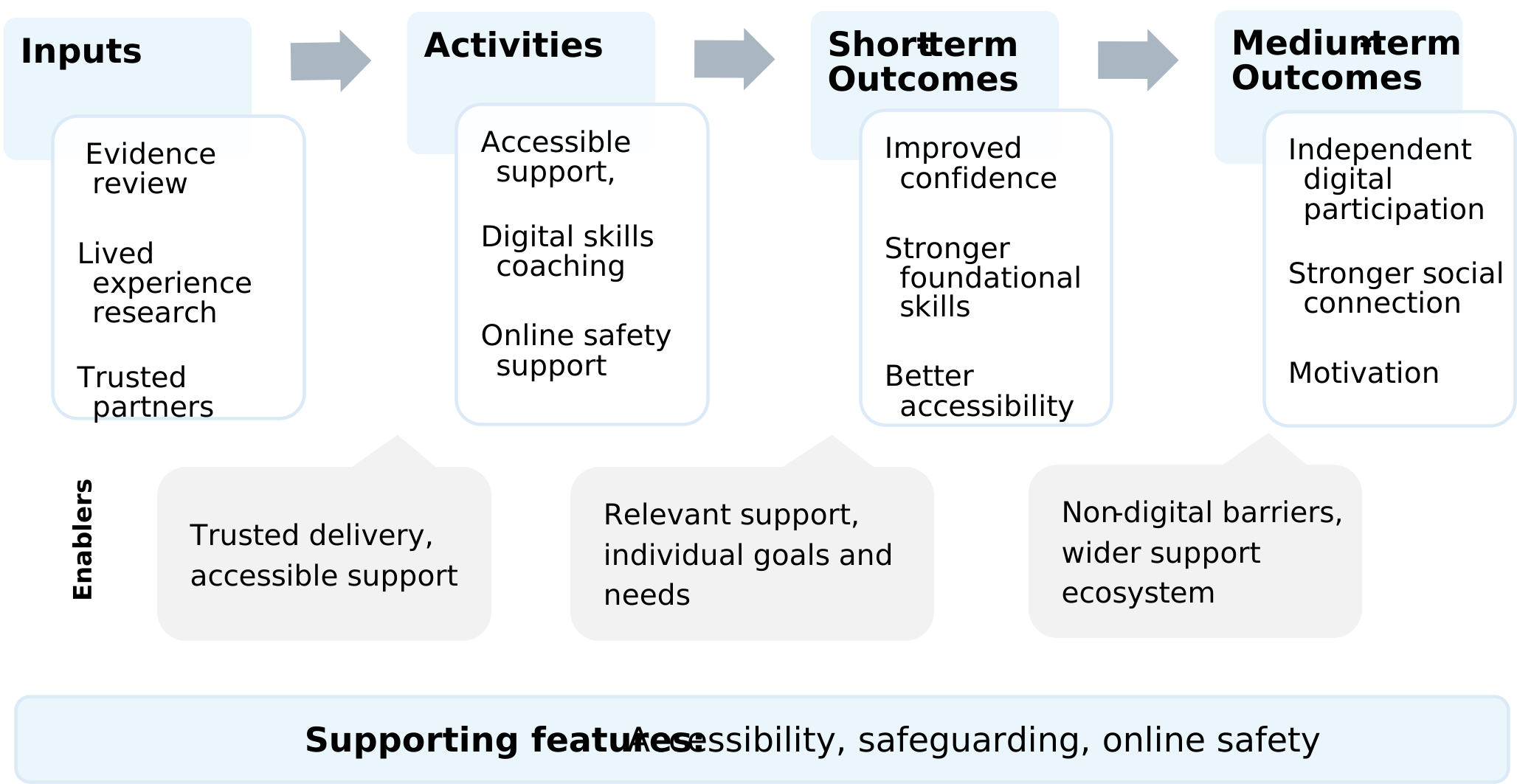
The pilot design was intended to offer multiple routes into engagement. This reflected the finding that a single standardised offer would be unlikely to meet the needs of participants facing different combinations of practical, psychological and accessibility barriers. The pilot therefore evaluated a flexible approach that could respond to differing levels of confidence, readiness and support need. However, due to the constraints of a small-scale pilot, it was not possible to provide one-to-one support to every participant. Instead, the model aimed to ensure that all forty participants received at least one intervention, with more tailored support offered where feasible.
Monitoring and evaluation
A proportionate and accessible monitoring and evaluation approach was used to understand what changed during the pilot, what appeared to support engagement and progress, and how the model could be refined. Data were collected at 3 points: baseline at onboarding, a midpoint check-in at the end of week one or within a week of each activity attended where feasible, and endline at completion of support.
The evaluation focused on changes in digital access, skills and confidence, alongside social connection and loneliness. Baseline and endline data captured loneliness measures, digital engagement, barriers and concerns, self-rated digital ability, and need for or challenges relating to assistive technology. Participants also identified personal learning and connection goals at baseline.
Open-ended reflections at midpoint and endline captured learning, progress towards goals, changes in confidence, perceived implications for social connection, participant experience, and any remaining support needs. This qualitative feedback helped to contextualise the quantitative findings and informed delivery adjustments where needed.
Analysis focused on describing the baseline profile of participants and examining change between baseline and endline in loneliness, digital access, skills and confidence, support needs, and assistive technology use and challenges.
Table 1 summarises the intervention offer, including the rationale for each component and its intended outcome.
| Intervention | Format | Rationale | Intended outcome |
|---|---|---|---|
| Group expert session on AT | Face-to-face, group | Participants wanted opportunities to see and try tools with expert guidance in a safe, low-pressure environment | Increased awareness and confidence in using assistive technology; peer learning and shared problem solving |
| One-to-one expert sessions | Virtual, one-to-one | Some participants required tailored assessment and configuration to match specific access needs, including smartphone only users and people with impairments | Improved accessibility of devices and more effective use of assistive technology |
| Digital buddying | Face-to-face and virtual, one-to-one | Research highlighted low confidence, fear of scams and feeling overwhelmed, indicating a need for personalised support and continuity | Increased confidence, reinforcement of online safety routines, and progress towards personal digital goals |
| Group peer support | Face-to-face, group | Participants experiencing isolation or anxiety about formal learning benefited from learning alongside others in a trusted environment | Greater confidence, reassurance, belonging and peer support |
| Digital upskilling workshop(s) | Small group, face-to-face and virtual | Survey findings highlighted common gaps in core digital tasks, accessibility features and online safety | Improved practical digital skills and confidence in everyday online tasks. Workshop topics were guided by participant goals. |
| Drop-in sessions | Face-to-face, one-to-one | Participants needed low friction access to practical support without committing to a full course | Timely support with immediate digital barriers and reduced anxiety about formal learning |
| Digital upskilling course | Face-to-face, group, 2 weeks | Some participants preferred a more structured pathway to build confidence and skills over time | Improved foundational digital skills, confidence and peer connection |
Appendix E: Monitoring and evaluation instruments
This appendix summarises the monitoring and evaluation instruments used during the pilot, including the timing of data collection, core measures and approach to analysis.
Timing and consent
Data were collected at up to 3 points:
- baseline, at onboarding before support began
- midpoint, at the end of week one where feasible
- endline, at completion of support
This provided a proportionate and accessible basis for understanding participant profile, early experience and change over the course of the pilot.
At baseline, participants were asked for consent to record and use anonymised responses. They were able to decline, ask further questions or request removal from contact lists.
Baseline measures
Baseline data were used to profile participants and understand their starting point. Measures covered:
- demographic information
- impairment, condition and access needs
- loneliness, using the three-item loneliness scale and a single direct loneliness question
- digital access, engagement, skills and confidence
- use of, and need for, assistive technology
- personal goals for digital participation and social connection
These measures were used to inform support planning and provide a baseline for later comparison.
Midpoint check-in
Where feasible, a midpoint check-in was completed at the end of week 1 or following each intervention activity. This captured early reflections on learning, confidence, progress towards goals, social connection and any remaining support needs. Midpoint findings were used mainly to inform delivery adjustments during the pilot.
Endline measures
Endline data collection repeated the main baseline measures to assess change over time. It also included open-ended reflections on learning, confidence, progress towards goals, social connection, experience of support and any remaining needs.
Optional diaries were also used where available to provide additional qualitative insight into participant experience and progress.
Analysis
Analysis focused on participant profile, change over time, and what appeared to work, for whom, and under what conditions.
Baseline data were used to describe the participant group in terms of demographics, access needs, digital access, skills and confidence, and motivations for going online. Baseline and endline data were compared to examine changes in:
- digital confidence and skills
- social connection and loneliness
- broader participation experiences
Qualitative feedback from midpoint and endline reflections, and from optional diaries, was used to interpret these findings. It helped identify:
- what motivated people to engage online
- how participants experienced the support
- what appeared to work well or less well
- which approaches were most useful for different people and in different circumstances
Appendix F: Intervention blends delivered
| Participant number | Group AT session | 1:1 expert session | Digital buddy | Work-shop(s) | Drop-in session | Digital skills course | Group peer support | Total |
|---|---|---|---|---|---|---|---|---|
| P01 | 1 | 1 | - | 4 | - | - | 1 | 7 |
| P02 | 1 | 1 | - | 1 | - | - | - | 3 |
| P03 | 1 | 1 | - | 5 | - | - | 1 | 8 |
| P04 | 1 | - | - | - | - | - | - | 1 |
| P05 | 1 | 1 | - | 2 | - | - | - | 4 |
| P06 | 1 | - | - | - | - | - | - | 1 |
| P07 | - | 1 | 1 | - | - | - | 1 | 3 |
| P08 | - | 1 | 4 | - | - | - | - | 5 |
| P09 | - | 1 | - | - | - | - | - | 1 |
| P10 | - | 1 | - | - | - | - | - | 1 |
| P11 | - | 1 | 2 | - | - | - | - | 3 |
| P12 | - | - | - | 4 | - | - | - | 4 |
| P13 | - | - | - | 1 | - | - | - | 1 |
| P14 | - | 1 | - | 2 | - | - | 1 | 4 |
| P15 | - | - | - | 3 | - | - | 1 | 4 |
| P16 | - | - | - | 4 | - | - | - | 4 |
| P17 | - | - | - | 4 | - | - | 1 | 5 |
| P18 | - | - | - | - | 1 | - | - | 1 |
| P19 | - | - | - | - | 1 | - | - | 1 |
| P20 | - | - | - | - | 1 | - | - | 1 |
| P21 | - | - | 1 | 1 | 2 | |||
| P22 | - | - | - | 2 | - | - | - | 2 |
| P23 | - | - | - | 3 | - | - | - | 3 |
| P24 | - | - | - | 1 | - | - | - | 1 |
| P25 | - | - | - | 3 | - | - | 1 | 4 |
| P26 | - | - | - | 1 | - | - | - | 1 |
| P27 | - | - | - | 1 | - | - | - | 1 |
| P28 | - | - | - | 1 | 1 | - | - | 2 |
| P29 | - | - | - | 1 | - | - | - | 1 |
| P30 | - | - | - | - | - | 1 | - | 1 |
| P31 | - | - | - | - | - | 1 | 1 | |
| P32 | - | - | - | - | - | 1 | - | 1 |
| P33 | - | - | - | - | - | 1 | - | 1 |
| P34 | - | - | - | - | - | 1 | - | 1 |
| P35 | - | - | - | - | - | 1 | - | 1 |
| P36 | - | - | - | - | - | 1 | - | 1 |
| P37 | - | - | - | - | - | 1 | - | 1 |
| P38 | - | - | - | - | - | 1 | - | 1 |
| P39 | - | - | - | - | - | 1 | - | 1 |
| P40 | - | - | - | - | - | 1 | - | 1 |
Appendix G: Participant demographics
Note: Base sizes for characteristics may be lower where participants shared less information.
Qualitative research (n=26)
| Characteristic | Category | n | % |
|---|---|---|---|
| Age group (n=26) | 18 to 24 | 4 | 15 |
| Age group (n=26) | 25 to 34 | 3 | 12 |
| Age group (n=26) | 35 to 44 | 4 | 15 |
| Age group (n=26) | 45 to 54 | 7 | 27 |
| Age group (n=26) | 55 to 64 | 8 | 31 |
| Gender (n=26) | Woman | 13 | 50 |
| Gender (n=26) | Man | 13 | 50 |
| Ethnic group (n=21) | White (English, Welsh, Scottish, Northern Irish or British) | 15 | 71 |
| Ethnic group (n=21) | White (Irish) | 4 | 19 |
| Ethnic group (n=21) | Asian or Asian British (Pakistani) | 1 | 5 |
| Ethnic group (n=21) | Mixed or multiple ethnic groups (White and Black Caribbean) | 1 | 5 |
| Nation (n=26) | England | 12 | 46 |
| Nation (n=26) | Scotland | 12 | 46 |
| Nation (n=26) | Wales | 2 | 8 |
| Living situation (n=13) | Living alone | 4 | 31 |
| Living situation (n=13) | Living with partner or family | 7 | 54 |
| Living situation (n=13) | Shared household | 1 | 8 |
| Living situation (n=13) | Other | 1 | 8 |
| Employment status (n=21) | Employed | 6 | 29 |
| Employment status (n=21) | Not in employment | 15 | 71 |
| Self-reported impairment or condition (multi-select) | Chronic or long-term condition | 3 | 12 |
| Self-reported impairment or condition (multi-select) | Chronic or long-term pain | 3 | 12 |
| Self-reported impairment or condition (multi-select) | Dexterity | 1 | 4 |
| Self-reported impairment or condition (multi-select) | Hearing | 3 | 12 |
| Self-reported impairment or condition (multi-select) | Learning, understanding or concentrating | 7 | 27 |
| Self-reported impairment or condition (multi-select) | Memory | 1 | 4 |
| Self-reported impairment or condition (multi-select) | Mental health | 3 | 12 |
| Self-reported impairment or condition (multi-select) | Mobility | 2 | 8 |
| Self-reported impairment or condition (multi-select) | Neurodivergence | 2 | 8 |
| Self-reported impairment or condition (multi-select) | Neurological condition (including epilepsy) | 4 | 15 |
| Self-reported impairment or condition (multi-select) | Speech or language | 2 | 8 |
| Self-reported impairment or condition (multi-select) | Stamina, breathing, or fatigue | 1 | 4 |
Quantitative research
| Characteristic | Category | n | % |
|---|---|---|---|
| Age group (n=523) | 18 to 24 | 20 | 4 |
| Age group (n=523) | 25 to 34 | 74 | 14 |
| Age group (n=523) | 35 to 44 | 106 | 20 |
| Age group (n=523) | 45 to 54 | 129 | 25 |
| Age group (n=523) | 55 to 64 | 118 | 23 |
| Age group (n=523) | 65 to 74 | 63 | 12 |
| Age group (n=523) | 75 to 84 | 12 | 2 |
| Age group (n=523) | 85 or above | 1 | 0 |
| Gender (n=518) | Woman | 375 | 72 |
| Gender (n=518) | Man | 107 | 21 |
| Gender (n=518) | Nonbinary | 24 | 5 |
| Gender (n=518) | Use another term | 7 | 1 |
| Gender (n=518) | Prefer not to say | 5 | 1 |
| Ethnic group (n=521) | White (English, Welsh, Scottish, Northern Irish or British) | 428 | 82 |
| Ethnic group (n=521) | White (Irish) | 9 | 2 |
| Ethnic group (n=521) | Any other White background | 27 | 5 |
| Ethnic group (n=521) | Mixed or multiple ethnic groups (White and Black Caribbean) | 5 | 1 |
| Ethnic group (n=521) | Mixed or multiple ethnic groups (White and Asian) | 4 | 1 |
| Ethnic group (n=521) | Any other Mixed or Multiple background | 8 | 2 |
| Ethnic group (n=521) | Asian or Asian British (Indian) | 11 | 2 |
| Ethnic group (n=521) | Asian or Asian British (Pakistani) | 5 | 1 |
| Ethnic group (n=521) | Asian or Asian British (Chinese) | 2 | 0 |
| Ethnic group (n=521) | Any other Asian background | 1 | 0 |
| Ethnic group (n=521) | Black, Black British, Caribbean or African (Caribbean) | 3 | 1 |
| Ethnic group (n=521) | Black, Black British, Caribbean or African (African) | 4 | 1 |
| Ethnic group (n=521) | Any other Black, Black British, Caribbean or African background | 1 | 0 |
| Ethnic group (n=521) | Any other ethnic group | 2 | 0 |
| Ethnic group (n=521) | Prefer not to say | 11 | 2 |
| Nation (n=523) | England | 472 | 90 |
| Nation (n=523) | Scotland | 12 | 12 |
| Nation (n=523) | Wales | 38 | 38 |
| Nation (n=523) | Northern Ireland | 1 | 0 |
| Living situation (multi-select) | Living alone | 172 | 33 |
| Living situation (multi-select) | Living with partner | 195 | 37 |
| Living situation (multi-select) | Living with my parents | 68 | 13 |
| Living situation (multi-select) | Living with children, under 18 years old | 80 | 15 |
| Living situation (multi-select) | Living with children, over 18 years old | 54 | 10 |
| Living situation (multi-select) | Shared household | 12 | 2 |
| Living situation (multi-select) | Other | 27 | 5 |
| Employment status (n=525) | Employed | 159 | 30 |
| Employment status (n=525) | Not in employment | 366 | 70 |
| Self-reported impairment or condition (multi-select) | Chronic or long-term condition | 337 | 64 |
| Self-reported impairment or condition (multi-select) | Chronic or long-term pain | 271 | 52 |
| Self-reported impairment or condition (multi-select) | Dexterity (handling or using objects) | 142 | 27 |
| Self-reported impairment or condition (multi-select) | Hearing | 76 | 14 |
| Self-reported impairment or condition (multi-select) | Learning, understanding or concentrating | 118 | 22 |
| Self-reported impairment or condition (multi-select) | Memory | 107 | 20 |
| Self-reported impairment or condition (multi-select) | Mental health | 263 | 50 |
| Self-reported impairment or condition (multi-select) | Mobility (moving around) | 314 | 60 |
| Self-reported impairment or condition (multi-select) | Neurodivergence (including autism, social or behavioural differences or ADHD) | 162 | 31 |
| Self-reported impairment or condition (multi-select) | Neurological condition (including epilepsy) | 128 | 24 |
| Self-reported impairment or condition (multi-select) | Speech or language | 43 | 8 |
| Self-reported impairment or condition (multi-select) | Stamina, breathing, or fatigue | 157 | 30 |
| Self-reported impairment or condition (multi-select) | Vision | 65 | 12 |
Pilot (n=40)
| Characteristic | Category | n | % |
|---|---|---|---|
| Age group (n=40) | 18 to 24 | 2 | 5 |
| Age group (n=40) | 25 to 34 | 6 | 15 |
| Age group (n=40) | 35 to 44 | 10 | 25 |
| Age group (n=40) | 45 to 54 | 15 | 38 |
| Age group (n=40) | 55 to 64 | 7 | 18 |
| Gender (n=40) | Woman | 27 | 68 |
| Gender (n=40) | Man | 12 | 30 |
| Gender (n=40) | Nonbinary | 1 | 3 |
| Ethnic group (n=39) | White (English, Welsh, Scottish, Northern Irish or British) | 28 | 72 |
| Ethnic group (n=39) | White (Irish) | 2 | 5 |
| Ethnic group (n=39) | Any other White background | 2 | 5 |
| Ethnic group (n=39) | Mixed or multiple ethnic groups (White and Black Caribbean) | 1 | 3 |
| Ethnic group (n=39) | Any other Mixed or Multiple background | 1 | 3 |
| Ethnic group (n=39) | Asian or Asian British (Pakistani) | 1 | 3 |
| Ethnic group (n=39) | Black, Black British, Caribbean or African (Caribbean) | 3 | 8 |
| Ethnic group (n=39) | Any other Black, Black British, Caribbean or African background | 1 | 3 |
| Nation (n=40) | England | 26 | 65 |
| Nation (n=40) | Scotland | 11 | 28 |
| Nation (n=40) | Wales | 3 | 8 |
| Living situation (n=28) | Living alone | 11 | 39 |
| Living situation (n=28) | Living with partner or family | 15 | 54 |
| Living situation (n=28) | Shared household | 1 | 4 |
| Living situation (n=28) | Other | 1 | 4 |
| Employment status (n=40) | Employed | 11 | 28 |
| Employment status (n=40) | Not in employment | 29 | 73 |
| Self-reported impairment or condition (multi-select) | Chronic or long-term condition | 22 | 55 |
| Self-reported impairment or condition (multi-select) | Chronic or long-term pain | 19 | 48 |
| Self-reported impairment or condition (multi-select) | Dexterity | 10 | 25 |
| Self-reported impairment or condition (multi-select) | Hearing | 4 | 10 |
| Self-reported impairment or condition (multi-select) | Learning, understanding or concentrating | 10 | 25 |
| Self-reported impairment or condition (multi-select) | Memory | 7 | 18 |
| Self-reported impairment or condition (multi-select) | Mental health | 25 | 63 |
| Self-reported impairment or condition (multi-select) | Mobility | 16 | 40 |
| Self-reported impairment or condition (multi-select) | Neurodivergence | 7 | 18 |
| Self-reported impairment or condition (multi-select) | Neurological condition (including epilepsy) | 7 | 18 |
| Self-reported impairment or condition (multi-select) | Speech or language | 3 | 8 |
| Self-reported impairment or condition (multi-select) | Stamina, breathing, or fatigue | 13 | 33 |
| Self-reported impairment or condition (multi-select) | Vision | 2 | 5 |
| Self-reported impairment or condition (multi-select) | Prefer not to say | 1 | 3 |
Appendix H: Intervention-level summary
Intervention: group expert session on assistive technology
What worked
- increased awareness of assistive technology and other digital tools
- broadened understanding and increased confidence to explore options not previously considered
What worked less well
- less effective for participants who wanted more tailored support
- limited time for questions
- limited opportunity to try technology directly
Most useful for
- those looking to broaden awareness of available tools and possible solutions, rather than immediate personalised advice
Intervention: one-to-one expert sessions
What worked
- tailored advice linked to participant’s specific situations
- specialist input leading to practical suggestions
- the opportunity to discuss barriers in depth
- sessions also appeared to build confidence and hope
What worked less well
- sessions are less structured and depend on the participant’s engagement
- signposting to next steps can be challenging in the session
Most useful for
- people with specific accessibility questions, assistive technology needs, or individual barriers better addressed through personalised support
Intervention: digital buddying
What worked
- regular, low-pressure support over time
- learning at their own pace
- able to revisit basics, asking questions, and building confidence gradually
- continuity appeared important
What worked less well
- progress could be gradual and, often, required more than one session
- depended on continuity, follow-up and time for practice
Most useful for
- people with low confidence, basic skills need, or who benefited from regular reassurance and a familiar relationship over time
Intervention: group peer support
What worked
- participants benefited from sharing ideas, hearing how others used technology, and discussing barriers openly
- sessions offered both practical value and emotional reassurance
What worked less well
- ideas raised may not be feasible for other participants, or require significant follow-up research
Most useful for
- participants who benefited from discussion, shared experience, mutual validation and practical exchange with others facing similar barriers
Intervention: digital upskilling workshop(s)
What worked
- focused on practical, immediately usable skills linked to everyday needs (for example scam awareness or email use)
- these sessions also appeared to build confidence, and group settings could provide reassurance through shared experience
What worked less well
- difficult to judge content and pacing without prior knowledge of workshop attendees
- technical issues also reduced participation in some online sessions
Most useful for
- people seeking structured learning on a specific topic, especially where content was practical and clearly relevant to everyday life
Intervention: drop-in sessions
What worked
- helpful in tackling limited confidence.
- quick wins, such as uninstalling apps or enabling accessibility features, appeared to build confidence and reassure participants that some problems could be resolved easily
What worked less well
- difficult to adjust for highly specific or advanced needs, where specialist expertise was not always available
Most useful for
- participants with low or moderate digital skills who needed practical troubleshooting and confidence-building support
Intervention: digital upskilling course
What worked
- building basic digital skills, covered by the essential digital skills framework
- building confidence as a basis for further digital skills learning
- group setting can help with soft social skills broader than just digital ones
What worked less well
- participants did not always have their own, or similar technology that they could continue to use learnt skills on outside of course
Most useful for
- participants with the same level of digital skills who need guided learning about a set of digital skills, confidence building and a space to repeat tasks to build independent use
References
-
UK Government (2025), Digital Inclusion Action Plan: First Steps ↩
-
Lloyds Banking Group (2024), 2024 Consumer Digital Index. ↩
-
Ofcom (2024a), Adults’ media use and attitudes report 2024 ↩
-
Lloyds Bank. UK Consumer Digital Index 2023. ↩
-
Good Things Foundation. The economic impact of digital inclusion in the UK and related work on affordability, savings and access to lower cost services. ↩
-
Lloyds Bank. Essential Digital Skills UK Report 2023. ↩
-
Centre for Ageing Better and Good Things Foundation. Offline and Overlooked and related research on digital exclusion and multiple disadvantage. ↩
-
Office for National Statistics. Disability, wellbeing and loneliness, UK and related loneliness analysis. ↩
-
‘PwC’ refers to the UK member firm and may sometimes refer to the PwC network. Each member firm is a separate legal entity. Please see www.pwc.com/structure for further details. ↩
-
This is higher than reported in the 2024/2025 Community Survey which found 15% of disabled people reported feeling lonely always/often– our working hypothesis is that as this is a subjective measure, there may be a seasonal impact (our survey was conducted in January). ↩
-
Office for National Statistics (2018), Measuring loneliness: guidance for use of the national indicators on surveys. ↩
-
Ipsen, C. and Gimm, G. (2021), Social Isolation and Loneliness Among Rural and Urban People with Disabilities. University of Montana Rural Institute for Inclusive Communities Research Report. ↩
-
Department for Culture, Media & Sport (2025), Community Life Survey 2024/25: Loneliness and support networks. ↩
-
Mann et al. (2017), A life less lonely: the state of the art in interventions to reduce loneliness in people with mental health problems ↩
-
Cacioppo, J. and Cacioppo, S. (2018), The growing problem of loneliness ↩
-
Morrish, N. and Medina-Lara, A. (2021), Does unemployment lead to greater levels of loneliness? A systematic review ↩
-
Cacioppo, J and Cacioppo, S (2018), The growing problem of loneliness ↩
-
UK Government (2025), Digital Inclusion Action Plan: First Steps, 2025. ↩
-
Elahi, F. (2020), Digital Inclusion: Bridging Divides. Cumberland Lodge Report . ↩
-
Ofcom (2025), Adults’ media use and attitudes report 2025. ↩
-
Age UK (2023), Age UK analysis reveals that almost 6 million people (5,800,000) aged 65 + are either unable to use the internet safely and successfully or aren’t online at all. ↩
-
Ofcom (2025), Adults’ media use and attitudes report 2025. ↩
-
Reynolds, J, (2025) Confidence at every level: Revisiting the role confidence plays in digital inclusion ↩
-
Scope, Disability Price Tag, https://www.scope.org.uk/campaigns/disability-price-tag ↩
-
Ofcom (2025), Adults’ media use and attitudes report 2025. ↩
-
Pacheco, E., Burgess, H. (2024) The divide between us: internet access among people with and without disabilities in the post-pandemic era ↩
-
Helsper, E. (2021), The digital disconnect: The social causes and consequences of digital inequalities. ↩
-
Seifert A, Cotten SR, Xie B. A. (2021), Double Burden of Exclusion? Digital and Social Exclusion of Older Adults in Times of COVID-19 ↩
-
Khosravi, P., Rezvani, A., & Wiewiora, A. (2016). The impact of technology on older adults’ social isolation ↩
-
Buecker, S,. and Horstmann, K,. (2021), Loneliness and Social Isolation During the COVID-19 Pandemic ↩
-
Chen YR, Schulz PJ. (2016), The Effect of Information Communication Technology Interventions on Reducing Social Isolation in the Elderly: A Systematic Review ↩
-
Cacioppo, J. and Cacioppo, S. (2018), The growing problem of loneliness ↩
-
Helsper, E. (2021), The digital disconnect: The social causes and consequences of digital inequalities. ↩
-
Good Things Foundation (2022), An evaluation of the DCMS Digital Lifeline Fund programme ↩