Democratic Engagement Fund: Prospectus
Published 8 June 2026
Applies to England

© Crown copyright 2026
This publication is licensed under the terms of the Open Government Licence v3.0 except where otherwise stated. To view this licence, visit nationalarchives.gov.uk/doc/open-government-licence/version/3 or write to the Information Policy Team, The National Archives, Kew, London TW9 4DU, or email: psi@nationalarchives.gov.uk.
Where we have identified any third party copyright information you will need to obtain permission from the copyright holders concerned.
This publication is available at https://www.gov.uk/government/publications/democratic-engagement-fund-prospectus/democratic-engagement-fund-prospectus
Grant summary
Purpose
Levels of democratic participation vary significantly, with some groups and places less likely to feel informed, confident or able to take part in democratic processes. The Democratic Engagement Fund will provide grants to civil society organisations (CSOs) to deliver politically neutral, place‑based activities that help people understand, engage with, and participate in democracy.
The Fund focuses on groups that are currently less democratically engaged and aims to generate evidence on what works to increase democratic participation, informing future policy and practice.
Type of grant
General - Competed.
Who can apply
We welcome applications from civil society organisations with experience of, or demonstrable capacity to deliver, community based, politically neutral projects in England, including:
- Charities
- Charitable Incorporated Organisations (CIOs)
- Community Interest Companies (CICs)
- Companies Limited by Guarantee
- Community Benefit Societies / Co‑operatives
- Other Voluntary, Community and Social Enterprise (VCSE) organisations.
Partnership and consortium bids are welcome. One organisation must act as the lead, accountable body and will be responsible for managing the grant and ensuring funds are used appropriately. Please note local authorities cannot apply directly although they may support a CSO to deliver a project (for example, by providing venues, data insights)
Funding available
Most projects will receive around £25,000. The maximum award is £50,000 per project.
Funding will be paid as follows:
- 75% in 2026/27
- 25% in 2027/28, following completion of delivery and completion of evaluation requirements. We encourage projects to be completed by October 2027 and data collection to be completed by December 2027.
Important dates
Applications open: 22 June 2026
Deadline for applications: 31 August 2026
Funding awarded and paid: January 2027
Monitoring and evaluation set-up period: January-March 2027
Projects may begin delivering: March 2027
Introduction
Declining engagement and trust in our democratic institutions and processes are long‑standing, cross‑cutting challenges in the UK. Barriers to engagement include:
- Capability - such as knowledge and language
- Opportunity - including access to democratic infrastructure, time and mobility
- Motivation - trust, sense of efficacy and civic duty.
Evidence from the Electoral Commission and academics indicates that these barriers disproportionately affect groups such as young people, frequent movers, ethnic minorities, people from low socioeconomic backgrounds, those with disabilities and those experiencing homelessness.
The government has committed, through its manifesto and the Strategy for Modern and Secure Elections, to improving democratic engagement. By establishing the Democratic Engagement Fund, we aim to address the challenges set out above supporting CSOs to design, test and deliver place‑based interventions targeted at groups with historically low turnout and participation. The overall aim is to strengthen democratic engagement and enable more inclusive participation in our democracy, particularly among less engaged communities.
In addition, CSOs will be able to apply to carry out democratic engagement with young people, supporting the expansion of the franchise to 16- and 17-year-olds. This aims to provide early insight of ‘what works’ in engaging young people, which can then be built upon ahead of the franchise change. This is a strategic collaboration that amplifies impact across the government’s election priorities through aligned messaging and effective use of resources.
A piloting approach is necessary because the existing evidence is limited on which interventions effectively reduce, overcome or prevent barriers to democratic engagement among disengaged groups. By testing and evaluating a range of approaches, in a variety of local contexts, the Fund will build a stronger evidence base on what works to enhance democratic engagement.
Impact is likely to vary significantly by demographic group, geography and local context. Piloting will therefore allow us to understand which interventions work, for whom, and in which settings. Through robust evaluation of the piloted projects, the Fund will generate evidence on how different interventions address barriers to democratic engagement across diverse communities.
Grant objectives - what are we looking for:
Build a robust evidence base on ‘what works’
Strengthen the evidence base on democratic engagement by requiring consistent, high-quality monitoring and evaluation throughout project delivery, generating timely and usable insights into impact, effectiveness and good practice.
This objective focuses on identifying what works to improve awareness, motivation and participation especially among underrepresented groups. By building a clearer understanding of effective interventions and how they can be delivered well, CSOs and local authorities will be better equipped to invest in, adapt and scale proven approaches - supporting long-term capability across the democratic engagement sector.
This will be particularly important in generating early evidence on effective approaches to preparing and supporting younger citizens to participate as the voting age is lowered to 16.
Prevent or overcome barriers for less engaged groups
Enable and support CSOs to design, test and deliver interventions that identify, prevent or overcome barriers to democratic engagement among less engaged demographic groups.
This includes addressing barriers related to knowledge, access, motivation and trust, with the aim of ensuring all citizens - particularly those historically underrepresented or disengaged - have meaningful opportunities to participate in democratic processes and institutions.
A key focus is increasing political literacy, by equipping individuals with the knowledge, skills and confidence needed to understand democratic processes and exercise their civic and democratic rights, including through education and information sharing that supports informed participation.
Improve democratic participation and engagement
Fund CSOs to deliver projects that improve awareness and understanding of democratic processes and institutions, strengthen positive attitudes towards them, and improve motivation to participate, both among the general public and targeted under-engaged groups.
This objective broadens democratic participation beyond the ballot box, fostering more sustained, meaningful long-term engagement in democratic life.
Projects may, for example, achieve this by encouraging participation in democratic activities beyond voting (such as meeting or engaging with their MP or councillor, signing petitions, or getting involved in a local campaign), or addressing barriers faced by groups with historically lower levels of democratic participation.
By strengthening these foundations, this objective supports citizens to contribute meaningfully to decisions that affect their lives – a core principle of any democratic system - enhancing democratic legitimacy, trust and participation.
All projects must fall within one of the categories set out below (which includes additional examples to support decision-making and design of proposals). Projects we may fund include (for example): community meals paired with structured conversations about shared local issues and collective decision‑making; democracy workshops that explain how democratic systems work; interactive exhibitions that explore why democracy matters; youth councils or advisory boards focused on place‑based issues.
Other projects may be skills‑building workshops to support constructive participation and mock parliaments or simulated democratic decision‑making exercises, or photo‑voice projects where participants take photos of places or issues that matter locally and meet to discuss how decisions shape those spaces.
Eligibility criteria
Applicants must meet all of the following:
1. Civil Society Organisation
a. Must be a non-governmental, non-profit entity such as a charity, voluntary group, social enterprise, co-operative, or faith group that works independently from the state and market.
b. Must be based in the UK. The project can only take place in England and is encouraged to be undertaken at a local level rather than nationally. We are particularly interested in applications that reach places with historically lower levels of democratic engagement.
Eligible organisations include:
- an organisation registered as a charity with the Charity Commission
- a company limited by guarantee registered with Companies House, that is established for charitable, benevolent or philanthropic purposes
- Charitable Incorporated Organisations (CIO) registered with The Charity Commission
- Community Interest Companies (CIC) registered with Companies House
- Community Benefit Societies (CBS) or Co-operative societies registered with the Financial Conduct Authority (FCA)
-
an unincorporated community group or organisation, or an unincorporated association that is:
- established for charitable, benevolent or philanthropic purposes
- has a governing body with at least 3 members
- has an inclusive membership policy
- has a governing document
- can provide accounts for the last 2 financial years
- has its own UK business bank account
Those who are not eligible to apply include:
- individuals or sole traders
- statutory bodies or public sector organisations (e.g. local authority bodies)
- organisations primarily engaged in political activity
- regulated education sector organisations (e.g. schools, further and higher education institutions, academy trusts, universities)
2. Political Impartiality
a. Must operate independently of political parties and avoid any activity that promotes or endorses a political agenda.
b. Organisations must not use grant funding for lobbying, campaigning for elected office, or influencing legislation. Further details are below, under the heading Political neutrality and impartiality.
3. Accessible Communications
a. Applicants must commit to providing information in accessible formats proportionate to the nature and scale of the project. Disability organisations consistently identify British Sign Language (BSL) and Easy Read as core accessible formats, however, other formats could be considered.
b. Applicants must ensure their activities and materials are digitally accessible to their intended audiences, using appropriate and proportionate formats.
c. Where materials are translated, organisations must ensure translations are accurate and reflect the intended meaning. Applicants should outline how translations will be quality‑assured, for example, by using accredited translators, community language specialists, or verification by native speakers (who would ideally be subject-matter experts, or at least well-informed about democratic engagement). Materials already translated by the Electoral Commission will not be funded again.
d. These examples are not an exhaustive list. Applicants should also consider other forms of accessibility as appropriate to their audience.
4. Legal and financial standing
a. Must be legally constituted and able to demonstrate governance and financial controls. You will need to provide two years of accounts. Those operating at a loss will not be eligible to apply.
b. Applicants must have an annual turnover / income of at least £50,000 and no more than £1 million.
c. Applicants must confirm that neither their organisation nor its senior leadership/trustees have unspent convictions for electoral offences or other relevant unspent offences that could reasonably call into question the organisation’s ability to deliver an impartial, lawful and trustworthy project.
5. Alignment with Programme Objectives
a. Activities must fit the grant’s objectives (please see above).
Funding available
The Democratic Engagement Fund has a total budget of up to £2.5 million to support CSOs to deliver democratic engagement activity.
The Fund will operate across the 2026 to 2027 financial year, with approximately 75% of funding being distributed. A further 25% will follow in FY 2027/28. The Ministry of Housing, Communities and Local Government (MHCLG) reserves the right to increase or decrease the total amount of funding available prior to awards being made.
Funding available per project
Organisations may apply for grants of up to £25,000 per project.
In exceptional cases, bids of up to £50,000 will be considered where applicants can clearly demonstrate that the additional funding is necessary to deliver significantly greater impact or represents strong value for money. Applications seeking more than £25,000 must provide a clear, evidence‑based justification explaining how the additional funding will meaningfully enhance outcomes.
In most instances, we expect to award grants of up to £25,000.
An organisation may only apply once to this grant. An organisation cannot apply for more than one project.
Payment of grants
Grant funding will be paid in two instalments:
- 75% on completion of the Grant Funding Agreement
- 25% on completion of the project and submission of final monitoring and evaluation data
Release of the final 25% is conditional on the project demonstrating satisfactory performance, progress, delivering activity in line with the approved proposal, and meeting monitoring and evaluation requirements. We anticipate 75% of the grant award to be paid in early 2027 with the final 25% being paid in FY27/28.
Any underspend must be returned to MHCLG at the end of the funding period. Also, MHCLG reserves the right to withhold, reduce or recover grant payments in line with the terms and conditions of the Grant Funding Agreement.
Project duration and timing
We cannot fund work retrospectively. Projects must start no earlier than January 2027, and all funded activity must be completed on or before 31 October 2027. To ensure we can provide the outstanding 25% payment to the projects, data collection should aim to be completed by December 2027.
Shorter interventions are acceptable where applicants can clearly demonstrate delivery and impact within the grant period.
Applicants may choose to continue, expand or scale projects beyond the funded period using other sources of funding; however, MHCLG funding and performance monitoring will apply only to the agreed grant period.
Apply for funding
To apply for funding, you must complete the application form.
Please contact democraticengagement@communities.gov.uk for any other questions about the grant.
Q&A to support your application
What do we mean by democratic engagement or participation?
We understand “participation” or “engagement” in democratic activities to mean a citizen taking action, at and between elections, that can influence decisions affecting their lives and the lives of others. That action could include voting, signing an online petition or writing to a newspaper, among many others.
What do we mean by Civil Society Organisation?
Civil Society Organisation (CSO) is a broad term for non-governmental, non-profit entities such as charities, voluntary groups, social enterprises (where they operate on a not‑for‑profit or asset‑locked basis (e.g., CIC limited by guarantee). Social enterprises that operate with a profit‑distribution model e.g. CIC limited by shares are not eligible. CSOs also include co-operatives and faith groups that work independently from the state and market to create social value, address community needs and empower citizens.
Who is the target demographic?
This Fund is designed to test promising approaches to improving democratic engagement among underrepresented groups. We are particularly interested in interventions that can demonstrate clear mechanisms of change and provide robust learning on what works, for whom, and in what contexts.
Our research identified six groups who are underrepresented in terms in democratic activity:
- young people (aged 5-25)
- ethnic minority groups
- people who are homeless
- regular movers
- disabled people
- people from low socio economic backgrounds
Evidence indicates that early democratic engagement helps to build lasting habits of participation over a person’s lifetime. To support the government’s commitment to extending the franchise to 16 and 17‑year‑olds, CSOs may apply for projects that assist with this transition primarily as part of the young people (aged 5-25) demographic. All proposals must still fall within one of the prescribed categories in the table below.
Our research also highlighted that there is limited robust evaluation or evidence available on the impact of interventions to improve democratic participation and its drivers. This grant therefore intends to enhance that evidence base through its robust evaluation.
The grant
The Democratic Engagement Fund is a competitive grant fund. From mid-June 2026, CSOs will be able to bid for up to £25,000 per organisation (exceptionally up to £50,000 where a clear, evidence‑based case demonstrates additional impact and value for money).
The key stages of the Fund are detailed on the timeline below:
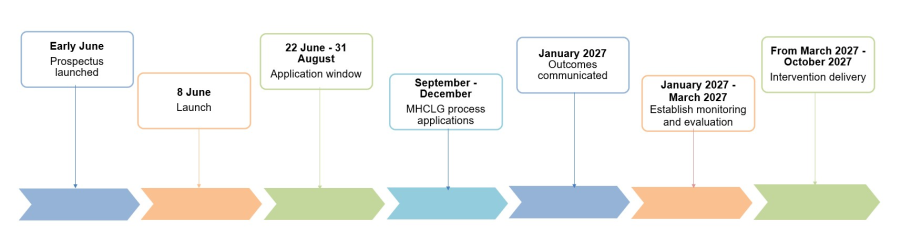
- The grant application period will run from 22 June 2026 to 31 August 2026.
- Applications will be processed and assessed between 1 September and 31 December 2026, with outcomes expected in January 2027.
- Grant Funding Agreements will be issued in January 2027, and initial payments will be made at that point.
- January to February 2027 will be a ramp‑up period to set up monitoring and evaluation. Projects may begin delivery from March 2027.
- All funded project activity must be completed by October 2027 to enable release of the final 25% payment by the end of Financial Year 2027/28.
- Projects are not required to run for a full year; shorter interventions (e.g. six‑week programmes) are acceptable where they demonstrate clear delivery and impact within the grant period.
- All grant funding must be fully disbursed by the end of Financial Year 2027/28.
- An evaluation report will be produced by MHCLG and/or an independent research organisation, and is expected to be published in 2028.
Successful applicants must demonstrate the capacity to deliver place-based, politically neutral projects designed to increase democratic participation and awareness. The projects must reach at least one of the target underrepresented groups outlined above.
Projects must demonstrate proactive outreach to citizens in their own spaces and communities, rather than relying on participants to come forward, and consider how to make participation simple for these groups. This is to ensure that the projects do not rely on any prior level of democratic engagement or simply reach those who would already be democratically engaged. This will in many instances require overcoming disengagement barriers to encourage participation in the project itself, for example making participation in the project straightforward, and there being wider benefits to taking part. See the scoring criteria.
Applicants must explain how their project boosts democratic participation in one of the categories detailed in the table below. Please note you will be asked to select the relevant category on your application form. Examples provided are illustrative only and are not prescriptive:
Category: Outreach
Description
Activities to enhance motivation to participate in democracy.
Outreach is a two-way process to increase motivation to participate, to increase interest in democracy, or tackle underlying barriers to participation such as low trust in institutions.
Outreach activity may also include bringing concepts beyond voting to life for participants, for example by helping people understand how democratic institutions, decision‑making and participation relate to their own experiences, concerns and local context.
Outreach should make democracy feel relevant and engaging, especially for groups who may feel disconnected from traditional political processes.
Projects must not rely on target groups coming to potentially unfamiliar settings but must instead reach out proactively to citizens’ own spaces and communities. Preferably, these activities should be in-person; however, applicants should demonstrate an understanding of a target group’s own/preferred spaces, and whether they are in-person/physical, digital/online, or a combination.
Examples
Democracy days- where citizens can learn about democratic institutions, voting, register, and engage in Q&A sessions.
Providing democratic information at existing touchpoints e.g. youth clubs, sports teams etc.
Fund democracy ambassadors/community champions.
Language-accessible sessions (including BSL where appropriate) for ethnic minority communities.
Creative competitions on what democracy means to the citizen.
Art Installations & Street Theatre: Using creative mediums to spark conversations about democracy.
Storytelling Projects: Collecting and sharing citizen voices to highlight why participation matters.
Drama and Theatre: Plays or performances that explore themes like fairness, representation, and why voting matters.
Category: Informing
Description
Activities to inform participants about democracy and democratic processes. This category should aim to improve democratic knowledge.
Projects should provide citizens with essential voting information (e.g. how to cast a ballot), or provide structured learning experiences that build civic literacy and democratic behaviours. Wherever possible, this information should be linked to motivational components to encourage participants to see the purpose of participating in these ways (e.g. the relevance of these civic concepts to their day to day lives).
Applications focused on the distribution, contextualisation or trusted delivery of existing high‑quality democratic information are actively encouraged. Where applications propose the creation of new democratic information content, they will be expected to demonstrate a clear and evidenced gap, explain why existing materials are not sufficient, and set out appropriate quality‑assurance arrangements. Projects that create new resources must evidence in their application form how this fills an unmet need. All activity under this category must be delivered as non‑partisan voter education, with information provided in accessible formats.
Projects should avoid assuming any prior knowledge of democracy or politics, and should be designed to meet participants where they are, building understanding from the basics upward.
Examples
Information/ guidance for people without fixed addresses or with disabilities.
Collaboration with housing associations to integrate democratic education in shelters and temporary accommodation to explain voting rights.
Category: Widening opportunities
Description
Activities to widen opportunities to learn and participate in democracy.
Enable participation beyond voting. To strengthen democratic engagement by enabling citizens to influence decisions in meaningful ways, fostering trust and ownership in governance. This includes participatory practice and programmes that help individuals understand how democratic systems work, evaluate information, and practice constructive dialogue.
Activities may enable residents to understand, engage with, and influence local or neighbourhood governance and can support citizens to engage directly with neighbourhood level decision making forums.
Examples
Deliberative forums- creating safe, structured spaces for dialogue where citizens can discuss issues and share perspectives and engage place‑based decision‑makers on community perspectives.
This may include the use of digital deliberative democracy tools where appropriate.
Young Mayors.
Mock elections. Enabling provision for participants to input into decisions affecting them.
Facilitated debate forums or deliberative workshops where participants explore democratic concepts, rights, and responsibilities.
Mock decision‑making exercises or role‑play simulations that help people experience how democratic processes work.
Projects may primarily sit within one category but can include secondary elements from others where this strengthens impact.
Projects that receive grant funding must address at least one of the following aims:
- Increase intention to participate by improving attitudes towards democratic institutions, and confidence or value in democratic processes.
- Increase intention to participate by increasing understanding and awareness of how to engage with democratic processes.
- Increase democratic activity among target groups.
This programme is designed to increase democratic participation. While improvements in voter registration may occur as a secondary benefit, this is not a primary aim of the fund, as democratic participation goes beyond voting. This fund, through the above aims, intends to tackle these earlier, underlying or broader barriers to participation, and encourage democratic engagement more broadly.
In summary, these aims set out both what projects funded through the programme should seek to influence and what MHCLG will assess through monitoring and evaluation. They are not intended to prescribe the specific activities applicants must deliver, but instead to provide a clear framework for understanding how projects are expected to contribute to increased democratic participation, and how impact will be measured.
Roles and responsibilities
The Ministry of Housing, Communities and Local Government will:
- assess bids against the assessment criteria
- notify bidders of funding decisions
- provide funding as agreed in the grant funding agreement
- ensure that funding awards to accountable bodies are compliant under the subsidy control regime
- coordinate monitoring and evaluation and analyse this data
If successful, the accountable body must:
- act in good faith with MHCLG
- sign a grant funding agreement
- attend monitoring check-ins or complete monitoring check-in forms
- conduct data collection before, during, and after project delivery
- share monitoring and evaluation data with MHCLG and an independent evaluation contractor at frequent intervals
- provide evidence of costs incurred, as requested by MHCLG
- put in place delivery processes
- oversee delivery
- be accountable for delivery
- cooperate with due diligence checks
- ensure that any contractors, service providers or partners used to deliver services funded through the grant satisfy due diligence checks
- deliver projects in line with agreed plans and budgets
- share lessons learnt from the delivery of the project with MHCLG
- comply with the Equality Act 2010
Project evaluation
An aim of the fund is to enhance the evidence base of what works to improve democratic engagement and its underlying drivers. Projects funded through the Democratic Engagement Fund are therefore expected to contribute to this evidence base, and robust evaluation will form a required part of delivery. Evaluation is data collection before, during and after project delivery. Commitment is required to data collection and reporting throughout project delivery.
Projects are expected to begin delivering from March 2027. Ahead of this, in January-February 2027 (following project selection and bid award) there will be an induction phase to ensure that CSOs are able to use appropriate monitoring and evaluation tools. Data collection will continue until December 2027, after projects close in October 2027 to allow for follow-up and post-completion data.
Evaluation analysis will be led by MHCLG and/or an independent research organisation on its behalf. Grantees will be required to support the evaluation by collecting and sharing proportionate monitoring and evaluation data as part of project delivery.
A key principle behind the data collection will be establishing any changes in knowledge, attitudes or behaviours after participation in a project. These knowledge, attitude and behaviour metrics will align with outcomes of the grant fund. These will be evaluated by CSOs collecting data (e.g. via a survey) on these outcomes before projects are delivered (‘baseline data’) and afterwards (‘impact data’). This information will need to be provided in a consistent format, to enable MHCLG to assess impact and results across projects, therefore projects must agree to use set templates for data collection, which will be provided by MHCLG and/or an independent research organisation.
The precise data collection method required is likely to vary depending on the evaluation design and whether a project is included in a standard or more in‑depth evaluation strand. Examples of the data that will be collected and shared include monitoring data (e.g. the number of projects delivered, their reach, demographics of participants reached) and baseline and impact surveys with participants and project teams.
Grantees’ responsibilities relating to this data collection will likely include administering surveys at an appropriate time (e.g. providing paper or online surveys for participants to complete) and helping participants complete these where required (e.g. in cases of low literacy). Grantees are expected to encourage participants to fill out such surveys, as low response rates would hinder the evaluation’s effectiveness.
A smaller number of projects will also be selected to collect more in-depth evaluation activity including qualitative interviews and/or focus groups, which would be conducted by an independent research organisation on behalf of MHCLG. This data collection would be in addition to the previously mentioned data collection that all projects must conduct.
Full expectations and data collection tools will be provided to all applicants when projects are awarded.
Evaluation is expected to focus on learnings at both project and programme level. Bespoke evaluation reports for every individual project are not anticipated. Nonetheless, findings from the evaluation will be designed to be useful and useable to CSOs and others designing future projects to enhance democratic engagement.
Guidance and support on monitoring and evaluation expectations will be provided to successful applicants during the pre-application, induction and delivery phases.
What support will I get?
Successful applicants will receive ongoing support from MHCLG throughout the grant period. This will include an induction workshop covering key aspects of delivery such as accessibility, impartiality, monitoring and evaluation. Additional training will be offered through smaller group sessions focused on developing accessible materials. Grantees will also have group support sessions throughout their project. Where required, and where resource is able, MHCLG will also provide 1‑to‑1 support to help address specific delivery challenges.
Grantees will have access to core resources, guidance materials, data collection instruments, and tools to assist with effective and impartial delivery and evaluation of their projects.
Grantees may also wish to consult materials provided by the Electoral Commission, which offer practical, non‑partisan resources to support democratic engagement with specific groups. These materials include tailored guidance, accessible information formats and tools designed to help organisations engage communities confidently and impartially. These resources are also available in 21 other languages.
Additionally, MHCLG will provide instruction as to how to conduct monitoring and evaluation data collection and how to report results. CSOs will be expected to include resource to be able to lead data collection activities with participants and delivery staff, including for example organising surveys of participants before and/or after interventions, or gathering administrative data.
Assessment criteria
We will do an initial check to make sure your project meets our criteria for funding. You can only apply if you pass the eligibility check. For this, we will check:
- that your organisation meets the eligibility criteria
- that your request for funding is within the maximum limit of £50,000
The scores for all the criteria will be added to give a total score for the application. The maximum total score is 300. Your total score will be used to compare against other applications.
We may undertake checks to verify the information provided in the applications.
In addition, we will undertake financial, adverse publicity, and other due diligence checks for matters of reputational concern against each potential grant recipient.
Once applications have been scored an internal moderation process will take place to select the final approved bids.
MHCLG reserves the right to vary these conditions and the right to not make an award, and either withdraw or reduce the funding to the grant recipient if reasonably required, in line with the terms and conditions set out within the Grant Funding Agreement.
We expect to fund an estimated 80-100 projects.
Applications that do not meet all eligibility requirements will not be assessed further.
If any scored question receives a score of 0, the application is rejected and will not progress
Scoring approach
Eligible applications will be assessed using a 0–3 scoring scale for each scored section, where:
- 3 – Exceeds requirements
- 2 – Meets requirements
- 1 – Partially meets requirements
- 0 – Does not meet requirements
| Rating | Judgement | Definition |
|---|---|---|
| 3 - Excellent | Exceeds requirements (pass) | The response provided fully satisfies and exceeds the criteria detailed in the question, offering additional clearly recognisable benefits over and above the level required in the specification. The Applicant has submitted a response which fully and successfully demonstrates that they meet the criteria detailed, and in addition has identified and demonstrated factors that will offer additional benefits. |
| 2 - Good | Meets requirements (pass) | The response provided fully satisfies the criteria detailed in the question. The Applicant has submitted a response which fully and successfully demonstrates that they meet the criteria detailed. |
| 1 - Satisfactory | Meets minimum requirements (pass) | The response meets the basic requirements but has some gaps, weaknesses, or is lacking in detail in one or more areas. |
| 0 - Unsatisfactory | Does not meet requirements (fail) | The response clearly fails to meet several criteria detailed in the question. The Applicant has submitted a response which exhibits clear and significant omissions regarding meeting the criteria detailed. |
Portfolio approach
After scoring and moderation, MHCLG will select a balanced portfolio of projects. This means that the highest‑scoring applications will not automatically be funded. We will seek to fund a geographically and contextually diverse portfolio of projects. Selection will be based on delivery quality and reach, not alignment with local political structures or priorities.
In building the final portfolio, we will seek to:
- avoid funding a large number of projects using very similar approaches;
- ensure geographic spread across England; and
- fund a mix of projects led by CSOs
Application form sections and weightings
| Section | Scoring Mechanism | Criteria |
|---|---|---|
| 1. Applicant details and eligibility | Pass / Fail | Applicants must provide: - organisation and lead contact details - organisation type and registration details (where applicable) - partner organisations and roles, where relevant - total funding requested (up to £50k) |
| 2. Project proposal | Scored 0-3 40% weighting / 1,200 words limit |
This section assesses the quality and credibility of your proposed project, including: - target group(s) and understanding of their needs - project category (Outreach, Informing, Widening Opportunities) and rationale - outcomes and beneficiaries, including how change will occur - political impartiality, including safeguards and controls - proactive outreach, reaching people in their own spaces - delivery plan and timeline, including feasibility - fit with organisational experience and strengths |
| 3. Budget and value for money | Scored 0-3 10% weighting |
This section assesses whether: - costs are eligible, proportionate and clearly itemised - the budget aligns with proposed activity - costs represent good value for money - payment terms and evaluation requirements are understood |
| 4. Barriers, risks and safeguarding | Scored 0-3 10% weighting / 500 words limit |
This section assesses: - key delivery risks and mitigation strategies - safeguarding arrangements for participants - accessibility considerations and mitigations - proportionate arrangements for working with children, young people or vulnerable adults. |
| 5. Reach | Scored 0-3 15% weighting / 400 words limit |
This section assesses: - existing reach and trust with the target group- assessors will look for evidence that applicants have considered whether new or persuasive approaches are needed to reach their target group, alongside any existing reach or trust they already hold - anticipated participant numbers and assumptions - place‑based credibility and partnerships - geographic focus and accessibility of delivery |
| 6. Outcomes and evaluation | Scored 0-3 25% weighting / 750 words limit |
This section assesses: - experience of collecting monitoring data - ability to collect accurate, secure participant data - willingness to use MHCLG‑provided tools - data protection arrangements - openness to participating in more in‑depth evaluation if selected |
| 7. Declaration | Pass / Fail | Applicants must confirm that: - all information provided is accurate to the best of their knowledge - grant funding will not generate private profit - funding will not be used for political, ideological, extremist or exclusively religious activity. |
Political impartiality and neutrality
Through the Civil Society Covenant (a co-designed agreement between government and the civil society sector on how they will work together), the government recognises and respects the independence and legitimacy of CSOs to advocate and campaign, and to hold the government to account to make better laws, regulation and decisions.
At the same time, grant recipients will be expected to run politically impartial, unbiased, neutral and non-partisan community activity that will enable targeted networks and individuals to increase their participation in democratic activities. The impartiality and neutrality requirement applies to all aspects of activities funded by the grant.
Political impartiality
For the purposes of this fund, acting in a politically impartial way means delivering a project without allowing your personal political beliefs to affect your work. Politically impartial activity may include:
- explaining how democratic institutions and processes work
- supporting people to understand their rights or participate in democratic processes
- facilitating discussion that helps people explore democratic issues
- framing discussions around shared values and critical thinking
It is possible to run projects to improve democratic engagement while also remaining politically impartial. For example:
- Grant recipients may include discussion of political issues in their projects, especially where this supports learning, understanding or participation.
- Impartiality requirements do not prevent engagement with complex or controversial topics, provided that they are explored in a politically impartial manner. This means that political parties, candidates, campaign issues or political positions must not be promoted, endorsed or opposed, and personal or organisational political views must not be presented as fact or preferred outcomes.
- Where political issues are explored, they should be presented as a balanced range of perspectives. Balance can be achieved by, for example:
- explaining differing viewpoints fairly and dispassionately, and avoiding bias in tone, framing or emphasis;
- supporting participants to form their own informed views rather than steering them towards particular positions;
- distinguishing clearly between factual information, contested opinion and moral or legal boundaries (such as discrimination);
- aiming for understanding and informed, evidence-based discussion, and avoiding advocacy or persuasion.
- Approaches need not be so restrictive that they undermine effective delivery or meaningful engagement. Instead, impartiality should be applied sensitively and proportionately, taking account of context, the purpose of an activity, the audience, setting, and specific issues being discussed.
Political neutrality
You will be asked whether anyone who will be involved in your proposed project falls into a list of categories related to political activity.
People involved in projects funded by the grant include those directly involved, such as project leaders working or volunteering for a CSO. Anyone involved in your project who falls into one of the political activity categories would need to declare that fact and explain how they would ensure that the project would maintain its political neutrality. How the CSO proposes to do this will need to be explained in the application form.
For example, if your application is successful a person might inform MHCLG in writing that they would act in a politically impartial way for the duration of the grant-funded project; or that they would recuse themselves from involvement in the project. These are only examples. Someone who fell into any of the political activity categories might suggest other ways in which they would ensure the project could maintain its political neutrality.
The political activity categories are defined as anyone who:
- campaigns for, promotes or opposes any political party, candidate, or elected officeholder
- seeks to influence the outcome of a national or local election, or referendum
- has stood, is standing or is preparing to stand for election to any sort of elected office,
- serves as any sort of elected officeholder (such as a local councillor or MP)
- holds an official role in a political party (such as agent, treasurer, chair, campaign organiser or spokesperson)
- makes any donations to a registered political party, elected officeholder or candidate standing for election
- carries out any similar activities
- would allow their personal political views to determine any advice given or action taken as part of the project
If the list did not apply to anyone involved in your project, you would not need to make this declaration.
Political neutrality also means you:
- must, if you explore government policy or the law on a political or social issue, focus on building understanding of the issue, including its impact on citizens, and must base your work on evidence including lived experience
- must make all reasonable efforts to promote respectful debate with all those you engage with
- must carry out any activities involving political parties, elected representatives, or candidates standing for election by fairly and proportionately engaging a balanced range of parties or individual politicians
- must notify MHCLG of any activity carried out that could be seen as breaching the conditions above
- must share with MHCLG staff, if requested to do so, any material you intend to use publicly
- must sign a declaration confirming you will remain politically neutral while the grant funds are being used
For people who are not directly involved in delivering projects funded by the grant (such as CSO trustees), being politically neutral also means that:
- If you have carried out any of activities (a) – (e) in the last 12 months, you must be willing to sign a declaration confirming either that you will act in a politically impartial way (as defined above) for the duration of the project funded by the grant, or that you will recuse yourself from involvement in the project.
Assessing political impartiality and neutrality
When assessing your organisation’s capacity for political impartiality and neutrality (as defined above), MHCLG will consider information including:
- the record of your organisation’s activities and achievements (online and offline)
- past and current activities of your senior leaders (including trustees and management committee) and any conflicts or perceived conflicts of interest
- information from the Charity Commission and Companies House
- social media activity
- the possibility that the points above might bring the government into disrepute through association
Audit and assurance
Grantees must keep accurate financial records and may be asked to provide evidence of expenditure. MHCLG may conduct spot checks or audits to ensure appropriate use of public funds, including compliance with the requirement for political neutrality.
Changes to the project
Any significant changes to budget, activities, timelines or delivery partners must be agreed with MHCLG in advance. If changes are substantial or risks cannot be mitigated, MHCLG may vary or terminate the grant.
Grant Funding Agreement
Full terms and conditions will be set out in the MHCLG Grant Funding Agreement, which grantees must sign before funding is released. MHCLG has the right to withhold, reduce or recover funding if these terms are not followed.
Who cannot apply?
- Individuals, or organisations applying on behalf of individuals
-
Business or for-profit organisations, this includes:
- Companies with a legal status of Limited by Shares
- for profit organisations including those who apply with a non-profit sponsor
- Sole traders, whether applying independently or in association with a non‑profit organisation.
- Local authorities cannot apply directly although they may support a CSO to deliver a project (for example, by providing venues, data insights).
- Schools, although we are happy to accept applications from community education groups, e.g. library homework club or after school projects
- Universities, although we are happy to accept applications from community based education groups linked to universities (e.g., university volunteering hubs, widening participation outreach teams, or student led community projects), provided the activity is delivered in and for local communities rather than as part of core academic provision.
-
Organisations whose projects would cover the following:
- Activities that generate profits for private gain, this does not exclude social enterprises operating on a not‑for‑profit or asset‑locked basis, provided that any surplus is reinvested in the organisation’s social mission and not distributed to individuals or shareholders
- Activities that practice or promote religion, or any activities actively promoting certain belief systems (or indeed the lack of belief) faith-based organisations can apply, but the activities funded must not fall under this stated exclusion
- Activities that are party political and encourage political support towards certain political parties or candidates - this includes civil society or lobbying groups associated with political parties including unions
- Activities that aim to further support for issue-based campaigns or have lobbying purposes.
What support is available for applicants?
If you have questions about the grant programme, have any accessibility needs, or queries on the eligibility of your organisation or project plan, please email democraticengagement@communities.gov.uk.
The MHCLG Democratic Engagement Team will run online application workshops explaining how to apply, how to write a strong application and what we are looking to fund. These sessions will take place on:
- Monday 15 June, 2pm
- Wednesday 17 June, 2pm
You can sign up to your preferred session via Eventbrite.
If you are unable to attend a workshop, a recording will be made available on YouTube.
What due diligence will take place?
As the grants come from public money, we’ll need to carry out due diligence checks for successful projects and CSOs. These are tests to check that you are who you say you are and that you’ve got all the relevant policies and insurance in place when you start your project. If you receive a successful outcome, we will ask you to provide a series of documents. If your application is successful we may ask you to:
- provide your organisation’s UK bank account details or attach a confirmation letter from your sponsor organisation to confirm they can hold and ringfence the funds on your behalf alongside a reference statement
- provide your or your sponsor organisation’s governance documents, including a suitable ‘dissolution’ or ‘winding up’ clause
- provide a copy of your or your sponsor organisation’s most recent audited accounts or accounts signed by an independent and qualified accountant
- provide a statement of your or your sponsor organisations cash flow for the current year
- give evidence of your or your sponsor organisations public liability and employer’s liability insurance
- provide your or sponsor organisation’s financial regulations/procedures, including a statement of cash flow and budget for the current year
- demonstrate appropriate safeguarding arrangements for all participants in your project - this includes having an up‑to‑date safeguarding policy, a named safeguarding lead, DBS checks where required, and suitable consent processes for children and young people
- show that where there are applicants working with vulnerable adults, disabled people, or people experiencing homelessness, you outline proportionate measures to ensure participant safety, accessibility and wellbeing throughout delivery
- provide an Equality, Diversity and Inclusion policy/statement if available
You do not need to provide all this information with your application at this stage
What costs will the grant cover?
We will fund a broad range of activities and the costs associated with running your project. Costs could include (but are not limited to):
- project management costs, transport and overheads - these must be proportional to the work being carried out and cannot exceed 30% of total grant amount (you must show clear calculation of these costs in your budget)
- staff and volunteer costs, such as travel expenses and staffing costs (we can fund project‑specific staff and freelance time (including backfill where directly attributable to delivery and evaluation) - this may include volunteer expenses and training, administrative support and time required for reporting and evaluation
- training for practitioners, frontline staff, or community leaders to confidently deliver democratic education and support democratic engagement in their organisations
- venue hire
- professional fees, such as cost of hiring people to help with the project (e.g. graphic designer, video maker, BSL interpreter, etc)
- production of materials and resources to support the delivery of outreach activity
We expect grants to include costs to support accessibility requirements for project activities and data collection costs.
- Other costs:
- basic supplies and materials
- equipment rental for activities
- information resources in community languages
- training materials
- digital content
- printed materials.
What grant funding will not cover:
- general running costs not related to your project
- general organisational salaries or routine overheads unrelated to the project
- routine building maintenance
- utility bills
- insurance
- standard IT equipment
- costs from before your grant was awarded
- activities promoting political parties or candidates
- lobbying or campaign activities
- profit-making activities
- projects focused solely on social media
- general community events without clear democratic participation outcomes
- buying property
- major building work
- large equipment purchases
- vehicles
- office furniture
- routine repairs
- debt repayment
- recoverable VAT if you’re VAT registered
- costs covered by other funding
- activities that have already taken place
- fundraising activities
- retrospective costs including application preparation.
What makes a request exceptional? (for those who apply for between £25,001 - £50,000)
We expect most grantees to be awarded up to £25,000. However, exceptional requests of up to £50,000 will be considered only where applicants can clearly demonstrate that their proposal goes above and beyond standard delivery. For example, where the project offers significantly greater impact, or incurs unavoidable higher costs such as delivering in areas with exceptionally high venue hire or delivering projects that require specialist accessibility equipment.
These are illustrative examples; there may be other reasons why a request might be exceptional. The key point is that applicants must provide strong, evidence‑based justification showing how the additional funding will meaningfully enhance outcomes and deliver clear value for money.
What do we mean by accessibility requirements?
By accessibility to a project, we mean how applicants will include everyone in the relevant community group so they can take part in the project in the best way possible. Applicants should include budget lines to show accessibility costs where appropriate, for example providing information in different formats or community languages, BSL interpretation at events, or adjustments to the physical environment. We recognise that accessibility requirements must be proportionate to the scale of funding and activity, and applicants should demonstrate how accessibility will be addressed in a way that is appropriate, affordable and effective for their project and audience. Proportionate provision may include prioritising the most relevant formats for the target group, rather than providing all formats in every case.
How will you decide what to fund?
We will assess your application against a few key criteria:
- your organisation’s previous experience in this space (reach)
- how proposed project activity meets the aims of the fund and reaches those who are less democratically engaged as set out above
- how accessibility has been considered and factored into the budget
- your organisation’s ability to demonstrate impartiality and deliver in a neutral and non-party political way
- that your activity meets the legal guidance and remains impartial at all times
- how clear you are on how to make your proposal happen, including a well-thought-out budget and timeline, any risks and how you will mitigate them
- how you plan to provide accurate and robust data for the evaluation
What support will be offered to grantees once they have been awarded funding?
Grantees will be supported throughout the grant period. Grantees will be invited to an induction workshop to cover details of grant delivery, impartiality, accessibility, monitoring and evaluation.
Grantees will also be supported with further training, advice and support on impartiality.
This will include an initial introductory workshop which all successful grantees are required to attend, and further support during delivery. The induction workshop will take place virtually in January 2027. Successful applicants will need to make sure at least one member of staff is available to attend.
We recommend consulting the government’s guidance on political impartiality - Political impartiality in schools. For further guidance on impartiality, you may wish to consult the impartiality campaigning toolkit for CSOs developed by the Greater London Authority (GLA) and Shout Out UK - Your Guide to Impartiality. Grantees may want to use this toolkit to train relevant staff, volunteers and partners who will be working on the project.
We will also schedule check-ins with all grantees to understand how the project is progressing, and offer advice to help with any challenges. One-to-one support will be provided upon request and subject to MHCLG resource.
We will attend one of your in-person activities (at your invitation) to see your project in action and give feedback. And finally, you will be given access to the evidence bank that projects will feed in to.
Compliance
Applicants must confirm that their project complies with UK Subsidy Control requirements. You may be asked to provide a short self‑declaration, and MHCLG will carry out proportionate checks to assess any subsidy risk before funding is awarded.
Fraud, bribery and corruption
MHCLG has zero tolerance for fraud, bribery or corruption. Grantees must maintain accurate financial records, report any suspected irregularities immediately, and cooperate with audit or assurance checks. MHCLG may conduct spot checks to ensure appropriate use of public funds.
Data protection and privacy
Projects must comply with UK GDPR and Data Protection legislation. Applicants must outline how they will collect, store and process personal data safely, including secure handling of participant information. Where projects involve collecting data from children, young people or vulnerable adults, a Data Protection Impact Assessment (DPIA) may be required. Data must be retained securely and only for as long as necessary.
Freedom of Information and transparency
As a public funder, MHCLG may publish information about funded organisations and awards. Applicants should avoid submitting confidential or commercially sensitive information unless necessary. Any such information should be clearly marked, noting that MHCLG may still be required to release information under the Freedom of Information Act.
How to apply
Applications are submitted via the Grant Portal by 31 August 2026, 23:59 (BST).
Please note applications do not open till 22 June 2026.
You will complete the online form, attach your budget and cashflow, and confirm eligibility and impartiality statements. We will not accept late or email submissions. Shortlisted applicants may be contacted for clarifications.
FAQs
About the Fund
What is the purpose of the grant?
What makes this fund different?
The Democratic Engagement Fund is a government funded programme focused on testing and evidencing what works to increase democratic participation among groups that are currently less engaged in democratic activity.
Unlike many charitable or philanthropic funds, this programme places a strong emphasis on political impartiality, place-based delivery, and robust, consistent evaluation across projects.
The Fund is designed to generate learning that can inform future public policy and delivery, particularly where there is currently limited evidence about which approaches are most effective for different groups, places and contexts. Projects are therefore expected not only to deliver high-quality engagement activity, but also to contribute data and insight to a wider evidence base.
This programme is different because of its role in supporting government understanding of democratic engagement and in shaping future approaches to public investment in this area, including in the context of the government’s commitment to extend the right to vote to 16 and 17 year olds.
What do we mean by democratic engagement and participation?
We understand “participation” or “engagement” in democratic activities to mean a citizen taking action, at and between elections, that can influence decisions affecting their lives and the lives of others. That action could include voting, signing an online petition or writing to a newspaper, among many others.
Who is the target demographic?
The Fund’s resources are designed for projects that work with these groups:
-
young people (aged 5-25)
-
ethnic minority groups
-
people who are homeless
-
regular movers
-
disabled people
-
people from low socio economic backgrounds.
Why is the Fund only targeting these groups?
Evidence and engagement with the sector suggests that people in these groups tend to participate in democratic activities less frequently compared to the population in general or face additional barriers to engaging in democracy.
Why is the grant not UK wide?
MHCLG is committed to sharing findings from the projects funded by this grant with all the governments in the UK, and to ensure there are opportunities to learn about how different parts of the UK have tackled the challenge of improving democratic engagement.
What if my project will cover more than one target group?
Projects may work with participants who fall into more than one of the target groups (for example, a young disabled person from a low socio-economic background). Applications like this are welcomed, but do not score higher than those who work with just one of the demographics.
On the application form, you will be asked to select a primary target group (which you think your project will have the greatest effect on). But you will also be able to indicate whether your project could positively impact any of the other target groups as well.
Why is there no specific grant to support the government’s commitment to extend the right to vote to 16- and 17-year-olds?
The commitment to extent the right to vote to 16- and 17-year-olds is envisaged to help drive the engagement of young people in our democratic processes. We know that the drivers of participation for this group may not be interventions which only target 16- and 17-year-olds, but interventions which can take place over a much wider age bracket. As a result, projects that work with the target demographic of young people aged 5-25 will be relevant to the franchise change. The wider demographics will have the potential for further relevance for young people, where they experience the intersectionality of further demographic characteristics.
Funding arrangements
How much can I apply for?
Most projects will receive around £25,000.
The maximum award is £50,000 per project.
How long will funding last for?
For the financial years 26/27 and 27/28. Funding will be paid as follows:
-
75% in 2026/27
-
25% in 2027/28 (after completion of both delivery and evaluation requirements.
-
Projects should be completed by October 2027. Final data collection should be completed by December 2027.
Will similar grants be offered in the future?
There are currently no plans for further funding rounds of this particular grant after March 2028.
Eligibility
Which Civil Society Organisations (CSO) are eligible to apply to this Fund?
CSO is a broad term for non-governmental, non-profit entities. Those eligible to apply to this Fund are:
-
Charities
-
Charitable Incorporated Organisations (CIOs)
-
Community Interest Companies (CICs)
-
Companies Limited by Guarantee
-
Community Benefit Societies / Co‑operatives
-
Co-operatives and faith groups that work independently from the state and market to create social value and address community needs.
-
Other Voluntary, Community and Social Enterprise (VCSE) organisations
CSOs applying to this Fund must operate on a not-for-profit or asset-locked basis (for example, a CIC limited by guarantee).
Social enterprises that operate with a profit-distribution model (for example, a CIC limited by shares without an asset lock) are not eligible to apply.
Can businesses apply?
Organisations run for profit distribution to shareholders are not eligible to apply.
Can a CSO apply if we have previously delivered work funded by the government?
Yes.
Can newly formed CSOs apply, or do we need a minimum operating history?
You will need to provide two years of accounts and be able to demonstrate governance and financial controls. CSOs operating at a loss will not be eligible to apply.
Can we submit multiple applications for different projects?
No, we will only accept one application per organisation.
Organisations may be part of one partnership or consortium application only. If an organisation applies as a single applicant, it cannot also be included in another application as a partner.
Can CSOs work together to form a joint bid?
Partnership and consortium bids are welcome. One organisation (a CSO) must act as the lead, accountable body and will be responsible for managing the grant and ensuring funds are used appropriately.
Can national CSOs apply to the Fund?
CSOs with a national remit may apply where:
- Their proposed activities are delivered in specific local areas in England, and meaningfully engage the Fund’s target groups;
- They meet all the criteria set out above under the heading Eligibility criteria.
Projects intended to operate on a national scale, or proposals that involve the organisation redistributing the grant to others, are not eligible. This ensures that monitoring and evaluation can be carried out effectively, and that delivery and impact can be clearly attributed to the grantee.
Who do you define as young people?
For this Fund, young people are defined as being between the ages of 5 and 25.
What do you mean by politically impartial?
The section above called Political neutrality and impartiality defines what we mean by political impartiality. Please take the time to fully understand the definitions and how they apply to you and this Fund.
Evaluation
What will evaluation look like?
Grantees will be required to support the evaluation by collecting and sharing proportionate monitoring and evaluation data with the evaluators.
Grantees’ responsibilities will likely include administering surveys for participants to complete, helping participants where required and encouraging participants to fill out the surveys (as low response rates would hinder the evaluation’s effectiveness).
Is training or support provided to help with the evaluation?
MHCLG will provide instruction on how to conduct data collection and how to report results.
The precise data collection method required is likely to vary depending on the evaluation design and whether a project is evaluated standardly or in-depth.
Application process
How will applications be assessed?
The section above called Assessment Criteria sets out the detail of how your application will be assessed, including information about the scoring approach, and the weight we will give to each section of the application. Please take the time to fully understand this section so that you have the best chance of a successful application.
When will we hear about our application?
We expect to inform applicants of the results of their applications in January 2027.
Will I get feedback on my application?
Due to expected high demand we are unable to provide feedback on applications. However, if a project is selected, the MHCLG Democratic Engagement Team may offer advice to applicants on how their project might be enhanced or altered.
Can I get support with my application?
MHCLG cannot communicate with applicants once the application window opens.
During project delivery
What happens if our project timeline changes after the award?
If you are awarded funds, you must discuss and agree in advance with MHCLG any significant proposed changes to your project’s budget, activities, timelines or delivery partners.
In rare cases where changes are very substantial or risks cannot be mitigated, MHCLG may vary or terminate the grant.