Demand responsive transport
Published 17 December 2025
Applies to England

© Crown copyright 2025
This publication is licensed under the terms of the Open Government Licence v3.0 except where otherwise stated. To view this licence, visit nationalarchives.gov.uk/doc/open-government-licence/version/3 or write to the Information Policy Team, The National Archives, Kew, London TW9 4DU, or email: psi@nationalarchives.gov.uk.
Where we have identified any third party copyright information you will need to obtain permission from the copyright holders concerned.
This publication is available at https://www.gov.uk/government/publications/demand-responsive-transport/demand-responsive-transport
Introduction
This best practice guidance on demand responsive transport (DRT) for local authorities in England includes:
- the basic principles of DRT, including a working definition, obligations and possible success criteria
- a 4-stage model based on planning, procuring, launching and sustaining DRT, identifying the actions required for each
- case studies which illustrate existing DRT schemes
- the timeline for a typical local authority scheme and the various stages of developing typical service models
Example specification templates are provided to assist authorities in the creation of their own documents.
The guidance will also be relevant to other organisations involved in the provision of DRT, such as operators and technology providers.
There is no one size fits all for DRT. The circumstances of each local authority are unique and the choices and stages an authority makes and goes through will all differ. It is therefore not possible to provide a single solution for how to go about setting up and running DRT. However, this guidance sets out key areas to consider, covers at a high level the different ways in which things can be done, makes suggestions and provides examples for methods of doing things depending on the differing LA circumstances. It also sets out a high-level overall timeframe for devising and launching a DRT scheme and provides some example templates for LAs when seeking to procure software.
The guidance does not prescribe an approach to take and makes no comment on the merits or otherwise of specific products. The department does not endorse any particular service provider. It does however set out examples of what has worked – or not – for others and aims to consider and explain why. Local authorities can reflect upon these experiences and adapt them based on local needs, resources and views.
Background
In 2021, DfT provided £20 million through its Rural Mobility Fund (RMF) to 15 local authorities in England outside London to trial DRT in rural and suburban areas. These schemes are participating in an ongoing monitoring and evaluation process. An interim process evaluation was published in September 2023 and the final process evaluation report was published alongside this guidance in December 2025.
A value for money and impact evaluation is now underway. Separate to the RMF, other local authorities have also experimented with DRT during this period.
The Bus Services Act 2025 received Royal Assent on 27 October 2025. This provides new opportunities for local authorities to take responsibility for bus services in their area and tailor services to local needs. New obligations to consider socially necessary bus services are also introduced. Local authorities should consider the role that DRT services may be able to play in discharging these responsibilities.
What is DRT?
Demand responsive transport (DRT) is a wide-ranging term that has been used interchangeably to cover many modes of bookable or on-demand transport.
At one end of the spectrum, there are traditional ‘dial-a-ride’ services aimed at older and disabled people, perhaps operated on a voluntary basis as community transport. At the other, there are newly emerging automated technologies where an autonomous vehicle can be summoned on demand. In between these are concepts such as flexible bus services, which are registered bus routes under public service vehicle (PSV) legislation able to deviate from a fixed route.
DRT services generally run without a set timetable and typically use smaller vehicles than fixed route bus services.
A formal definition of DRT is yet to emerge, however, for the purposes of this guidance, the department regards DRT as:
a flexible service that provides shared transport at separate fares in response to requests from users who specify their desired location and time of pick-up and drop-off, typically using smaller vehicles than traditional fixed route bus services
This guidance does not currently cover the use of automated vehicles. If you are interested in using such vehicles, you should contact the Centre for Connected and Autonomous Vehicles (CCAV) - enquiries@ccav.gov.uk.
Why DRT?
DRT can complement fixed route public transport services and improve mobility in low-density areas and at low-demand times of day.
While many DRT services are implemented primarily to improve social inclusivity and access to services, DRT can also contribute to decarbonisation by replacing private car journeys and facilitating multi-modal travel – for example, linking users to a train station or fixed route bus service.
It is important that DRT services are integrated into the local transport network to be effective.
Success criteria
While DRT has many merits, it should not be regarded as a ‘silver bullet’ for transport problems. Financial benefits are more likely to accrue through improved value for money than actual cost savings - for example, enabling people to make more varied journeys in terms of time and destination.
Experience so far has indicated that a DRT service, especially in rural areas, is likely to need ongoing financial and practical support. Such services are unlikely to be commercially profitable to operate and will require some form of sustained local authority or other external assistance.
The process evaluation of the RMF demonstrates that establishing and sustaining a DRT scheme will require clear aims, commitment and resourcing within the local authority. Simply establishing a scheme and expecting it to run itself is unlikely to lead to a successful deployment that will survive in the long term. Local authorities should upskill their staff to understand DRT better and develop a longer-term corporate knowledge within their transport teams so that DRT knowledge is not lost when staff change positions.
A successful outcome for an individual local authority will vary according to what the authority aimed to achieve. Experience so far has demonstrated that authorities will have different tolerances for the cost of a scheme depending on local circumstances and attitudes. However, a scheme might be considered successful if it has:
- a low level of empty running
- high passenger loadings, including a high degree of aggregation - grouping passengers to be carried together on the same vehicle at the same time
- few unmet bookings
- a low subsidy level
Unsuccessful schemes on the other hand are likely to:
- spend more time running empty
- carry single passengers rather than grouping journeys together
- require a high and increasing subsidy from the local authority
- be unavailable when passengers want to book
While these criteria are a useful rule of thumb, they must be viewed in the context of local circumstances. A high number of unmet bookings may be a sign of the scheme unlocking previously untapped demand and representative of a broader switch to public transport. A high degree of empty running may be an innate characteristic of the local geography and demographics. A local authority may wish to bear higher costs per passenger to ensure certain remote areas are served. Success criteria should be determined on the basis of local needs and resources.
Social value
At practitioner level, there is an increasing focus on, and recognition of, social value and the wider benefits that DRT provision can offer. Although local authorities most commonly support the service financially, its benefits may be felt elsewhere: for example, the health authority may benefit from a reduction in the number of missed appointments. NHS England has calculated that, in 2021/22, nearly 7.5 million outpatient appointments were missed by patients.
Reducing missed appointments helps to ensure that clinical time is used effectively and means patients on the waiting list can be seen more quickly. For the patient, it might mean being able to continue, or return, to work. There are wider benefits that accrue from this, such as reduced welfare and other costs to government, as well as the personal benefit to the patient of potentially improved quality of life. Physical and mental health benefits also apply. This may also apply more strongly for an older person, given the increasing risks of isolation and poor health as an individual ages.
Network management
The Bus Services Act 2025 introduces a requirement on local authorities to keep under review a list of socially necessary services. In some areas, this list is likely to include flexible bus services which provide a socially necessary service to rural areas. Local authorities should refer to the guidance produced by the department on enhanced partnerships, once available (expected early 2026).
Accessibility
The government wants disabled people to be able to travel easily, confidently and without additional cost, and it is important that all transport services play their part in making this a reality. This is especially important in the case of services which may replace traditional modes of transport, or where disabled passengers may have few, if any, alternative options.
It follows that demand responsive services should be accessible and local authorities should comply with their Public Sector Equality Duty when making decisions concerning their provision.
Consideration should also be given to concessionary fares. Where DRT is replacing an existing fixed route service using funding from DfT, the department expects that English National Concessionary Travel Scheme (ENCTS) equivalence is provided to ENCTS passholders. Consideration should also be given to the provision of some level of concession to ENCTS passholders on DRT services not replacing existing routes.
There is recognition that making DRT sustainable and more viable is challenging, and local authorities are encouraged to speak to the department for further advice where needed. While the ultimate decision lays with the local authority, the department recommends that a concession should be provided in all circumstances.
Although smartphones are becoming increasingly common, there are still significant parts of the population who find them too expensive to obtain, difficult to use, or who otherwise do not have access. Local authorities and service providers should continue to provide access to an alternative way of obtaining information and booking a journey, such as a call centre, as well as ensuring that digital interfaces are accessible, and providing support to people to use them.
Ensuring the app itself is accessible and easy to use will encourage use of the service as a whole, improve passenger satisfaction and confidence, and reduce dependence on call centres. The Public Sector Bodies (Websites and Mobile Applications) (No. 2) Accessibility Regulations 2018 (S.I 2018/952) obliges public sector bodies to take the necessary measures to make their websites and applications more accessible by making them perceivable, operable, understandable, and robust, except where doing so would impose a disproportionate burden. In that case, the body should explain this in their accessibility statement, in accordance with regulation 7(4).
Software providers offering their services to authorities are strongly advised to consider how they can ensure that their products meet this requirement. These regulations also provide an appropriate standard for DRT operator websites and mobile applications to meet.
It is important that vehicles used on demand responsive services are accessible. While buses below 22 seats are not currently subject to the Public Service Vehicles Accessibility Regulations (PSVAR) (S.I 2000/1970) as amended, they should provide an equivalent level of accessibility. They should, for example, provide a wheelchair space and boarding ramp or lift, colour contrasting hand holds and step edges, minimising step heights, and incorporate priority seating where appropriate.
Where PSVs designed to carry more than 22 passengers are used, they should comply with the requirements of PSVAR and, where possible, the Public Service Vehicles (Accessible Information) Regulations 2023 S.I 2023/715.
The accessible information regulations were however designed principally for fixed-route services. While accessible information is likely to be equally valuable to DRT passengers, there may be some aspects of the requirements which are difficult to achieve where routes are not fixed.
When taxis or private hire vehicles are in use on DRT services, local authorities should act in accordance with the guidance on accessibility in the taxi and private hire vehicle licensing best practice guidance. Given the nature of DRT services however, we strongly recommend that authorities require enough DRT vehicles to be wheelchair accessible to enable wheelchair users to travel with the same freedom and flexibility as other passengers.
DRT services have the potential to both support independent travel by disabled people or to inhibit access, depending upon how they are designed and implemented. Information on the accessibility of services, including locations at which passengers can be picked up and dropped off should be easily available. Pre-identified and ad hoc stopping places should be identified so as to maximise inclusivity. In particular, such locations should take account of requirements for the deployment of wheelchair ramps or lifts and be easily identifiable by passengers with a range of impairments.
Stage 1: Planning
This section focuses on the planning stage of introducing a DRT service.
This stage should identify the challenges that a scheme is intended to address. This section sets out issues that a local authority will need to consider when doing this and highlights how data can help. It looks at practical issues such as:
- the timescales for introducing a scheme
- the size of the operational area
- maximising the use of resources - for example, vehicles
Identifying the challenge
There are many things to explore when considering whether to pursue DRT in some form. The starting point should be to identify and understand the transport challenge that you are trying to solve and identify your aims.
DRT can unlock opportunities that were not previously available to people. It may be that people in a particular area cannot access education and employment opportunities or health and leisure services. This may be a long-term issue due to a chronic lack of bus services or may have arisen more recently due to the withdrawal of traditional services leading to a lack of public transport provision in a rural or semi-rural area.
Alternatively, it could be that a large new business or industrial park is opening, with variable and unsociable shift patterns and it will be difficult for those without a car to access it. The provision of a DRT service, or other bus service, may provide better equality of opportunity by facilitating access to a place of work, in addition to the individual and wider benefits it can provide.
It might be that an area has few services, operating infrequently – for example, a shopping service once a week - and there is perceived demand for increased service provision such as in rural, semi-rural or suburban areas with low car ownership or low income and few timetabled services. There may be train stations and transport hubs nearby to which there are no local connections in a particular area, and DRT would enable onward travel. In these circumstances, DRT may allow more flexibility in time of travel or destination and in doing so create demand that wasn’t in evidence before its launch.
It is also important to recognise and identify when an area may not be suitable for DRT. This is more likely to be where there is already a reasonably dense and developed public transport network, such as in an urban area, where commercial routes are able to operate successfully.
Due to the nature of DRT currently requiring subsidy, it is important to ensure that competition law is adhered to and that DRT does not detract from commercially operated services, or from existing community transport (CT) services operated by the third sector. Indeed, DRT can support patronage on commercial services by providing connections or working as a feeder service. It can complement CT by working alongside it or incorporating existing CT in partnership with the provider where appropriate.
Where a bus franchising scheme is in place, local authorities determine the details of services to be provided and different arrangements apply.
Where a bus franchising scheme is in place, local authorities determine the details of services to be provided and different arrangements apply.
The aim of DRT provision is to improve the public transport offering to better connect people, including those with disabilities and older people and to increase public transport usage, including where possible growing patronage on other services and forms of public transport. This is most likely to occur in areas where there is currently only a limited or no bus service, but not exclusively. The form of DRT can vary and is explored later in this section.
Where DRT replaces larger non-zero emission buses, which were poorly used and travelled long distances, it may also support environmental aims through the introduction of smaller vehicles only travelling when and where there is demand. In some circumstances, it may also support reduced emissions through modal shift if private car users make use of it at times.
DRT may also encourage active travel, through enabling access to more remote areas where standard larger fixed route services are less likely to travel.
| Problem | What is your transport challenge? Who is affected? |
| Data | What sources of data do you have? Are you able to map travel patterns? |
| Objectives | What would you like to change and achieve? What do you want those affected to be able to do differently? |
| Planning | Why are you considering DRT? Are you considering DRT alongside other services? How does DRT fit in, support and be part of the wider bus network? |
| Operational area | In which area are you considering DRT? Why this area? |
| Target passengers | Who are your target passengers and why? How will DRT be able to meet partially or fully the travel needs of those target passengers? |
| Budget | What is your budget? Over what time period? Do you have a continuity/long term plan? |
Key things to think about at the start of the DRT development process which will influence how you set up the scheme.
-
Does the local authority have an in-house fleet and drivers which could be (partially) utilised?
-
Does the local authority already employ drivers’ directly?
-
Will the vehicles be bought or leased? Vehicle lead-in times, although anecdotally reported to be improving, can still be lengthy.
-
Employment of drivers – operator or local authority or other party?
-
Speak to the in-house procurement team for advice early on.
Examples where DRT might be appropriate
1. Rural, semi-rural or suburban area with low car ownership or low income and few timetabled services
Presenting need
- People without a car, particularly older and disabled people, have difficulty accessing health, social and leisure services.
- Young people are unable to travel to college and places of training and employment without a lift from a relative.
DRT purpose
- Enable local population to travel to local towns and villages to access services.
- Enable young people to travel independently to colleges.
Potential impact
- Reduction in missed health appointments.
- Improved health and mental wellbeing.
Long-term plan or aim
- Continued need for DRT as, given the geography and population density, a fixed route service is unlikely to be commercially viable and would operate a limited and infrequent service.
- DRT may also be physically more accessible for older and disabled people due to the potential for door-to-door or corner-to-corner pickups.
- Supports opportunity and improves equality.
- Supports economic growth.
2. New industrial park, large place of employment with few transport links or workplace with irregular hours
Presenting need
- Workers without a car have difficulty accessing places of employment.
- Those on lower incomes in particular may struggle to get to work.
- Employers are finding it difficult to recruit staff due to access.
DRT purpose
- Enable people to travel to places of employment.
- Ensure employer is able to fill vacancies.
Potential impact
- Improved access to employment.
- Easier to recruit and retain staff.
- Less need for land to be used for car parking.
Long-term plan or aim
- Potential for some services to be fixed, e.g. where large numbers of people start to use DRT and commence work at the same time.
- Improved transport facilitating access to employment supports growth and opportunity.
3. Very few local buses serving train stations in rural areas
Presenting need
- People reliant on a car to access train station for onward travel.
DRT purpose
- Reduce the need for private transport in order to be able to travel to the train station.
- Provide transport to the train station for those currently unable to access it.
Potential impact
- Local residents able to travel to the train station to make onward journeys without the need for a car.
- Enable people to undertake onward travel into larger towns and cities for work, social, leisure and other opportunities.
Long-term plan or aim
- Increase access to employment, leisure, and onward travel further afield including to visit family and friends.
- Support mental wellbeing.
- Support wider economy through enabling access to cities and places of employment and also access to leisure services and holiday destinations.
4. No bus services in the evening into local urban centres
Presenting need
- Local residents unable to do seasonal things such as late night shopping, access Christmas markets.
- Year-round activities such as evening socialisation including pubs and restaurants, cinemas, attending evening sporting fixtures, and completing journeys home in the evening from places further afield are limited.
DRT purpose
- Enable people to access the night-time economy, to socialise and take part in seasonal events.
Potential impact
- Increased footfall and activity at venues and areas active in the evening.
- Increased participation in evening social and leisure activities.
Long-term plan or aim
- Support growth and opportunity.
- Develop and support night-time economy.
Local authorities have developed their understanding of existing services and demand in their area through the development of bus service improvement plans using data collection and analysis, and engagement with bus operators and the community. In 2024, local authorities were asked to complete bus connectivity assessments, which again involved data collation and analysis. Some authorities have also undertaken additional mapping and engaged data analytics tools, to better understand patterns of movement, potential and projected demand and the impact of different interventions.
Engagement with the local community and organisations such as colleges, industrial or business parks and health services can help identify a need. For example, a health centre may be experiencing high numbers of missed appointments, or a destination may see high car usage but have limited parking available.
It is also important to consider internal engagement with other areas of the authority too, including young people and education, adult social care and housing and planning, all of which either use and require transport provision or approve planning applications where there will likely be a need for transport.
A service is more likely to be successful if available from the early stages of a new housing development, rather than towards the end when the final homes are completed. By that point, those who have been living on such a development for some time will have made other travel arrangements and be less likely to use a new DRT service. It is likely that car dependency would have already taken hold. The same principle would apply for locations such as new business parks.
Through available data, areas with few or no bus services can be clearly identified. DfT has made available a Connectivity Tool to support identification and a better understanding of the location of well-connected and more poorly connected areas, as well as understand the transport interventions needed to enable people to access jobs and vital services. There are many other analytical programmes and software which can assist with projecting and mapping travel patterns in a particular area.
DRT should be seen as part of the wider bus network. When an authority is considering DRT, it is important to think about how it fits in, fills a gap and supports the overall bus service provided. For example, some local authorities with large rural areas, such as Gloucestershire, that previously had little or infrequent bus network may end up with a quite comprehensive DRT scheme. In other authorities, DRT may only be suited to smaller pockets. Stage 3, which deals with launching refers to including DRT in the wider bus network.
Leicestershire, which started off with one DRT zone as part of the Rural Mobility Fund pilots, has used government bus funding to redesign the bus network countywide. This has resulted in the introduction of DRT in 11 additional zones across the county.
DRT services can have a role to play in areas with franchising. Greater Manchester for instance, is considering exploring a greater use of DRT to complement the wider network where demand is low, as a feeder into high frequency core fixed route services and to support new developments to demonstrate demand ahead of fixed route services being introduced.
Once a DRT service is in operation, potential demand can be much easier to calculate through booking requests to unserved areas, and direct requests for a service once people have seen it operating in another area. Conversely, a lack of booking requests indicates a lack of demand. This may be for a variety of reasons including perceived availability, reliability and desirability.
In determining whether to pursue DRT, it is advisable to speak to other local authorities who deploy it in areas with similar characteristics. They can provide valuable insights into their experience of issues such as setting it up, usage levels, revenue expectations, and resource requirements.
Know your aims
There is an increasing focus at practitioner level on recognising social value and the wider benefits that DRT provision can offer. Much of the current DRT in operation seeks to improve access to health and leisure services, education and employment and facilitate onward connection at transport hubs including train and bus stations. Many local authorities with existing DRT schemes have raised the issue of social value and the consideration of how this might be better recognised. It may also feed into the aims of the DRT service. The value for money and impact evaluation for the Rural Mobility Fund DRT pilots will include a focus on social value and wider benefits.
Defining your aims and understanding what you are seeking to achieve through the introduction of a DRT service will help assist you both in measuring the success of the scheme and identifying where there is room for improvement. Having clear aims helps enable a more focused strategic plan and set up of the service. Stage 4 deals with the process of measuring success and reviewing the service.
For instance, if you have identified that people living in a relatively sparsely populated, low income area with high unemployment are facing challenges with getting into the local towns, or connecting to key bus routes/transport hubs for onward travel to places of employment and education, the aim will clearly be to provide an affordable service at the times it is most needed, to the areas people most need to be able to travel to. It is therefore clear from the outset that in order to fulfil the aim, there will be a need to provide a service enabling people to travel during morning and evening rush hour and slightly earlier for young people returning from educational establishments. This will impact decisions about vehicles, zone size and hours of operation.
Having identified this primary aim, the next step is to think through costs, revenue sources and service provision (including vehicles and operations). There are many DRT service models available: for example, it may be that a semi-flexible service that includes some fixed route elements is most appropriate – perhaps fixed close to the destination with some flexibility prior to this.
When setting up a service and assessing costs and revenue/funding streams, it is important to consider how and when the vehicles will be used to meet the aim and what proportion of time the vehicles are expected to be in service. Projecting accurate funding, revenue and spend in relation to DRT is important in planning a sustainable service. General experience with the RMF has been that although passenger numbers mostly started off at a low base, numbers have broadly increased over time.
Aggregating journeys - Buckinghamshire High Wycombe – Pick Me Up
This scheme uses 6 PSVs. It covers large parts of High Wycombe and has the second smallest operating zone of the Rural Mobility Fund DRT pilots at 14 square miles, but also the second largest population density at 5,978 people per square mile.
As of 2024, it has by far the highest monthly average number of passengers at over 6,000, with the next nearest being under 4,000. The RMF evaluation has shown that there is a strong positive association between passenger journeys and the number of vehicles operating within the zone. In the April to September 2024 reporting period, it had an average of 3.88 passenger journeys per vehicle operating hour.
While the average passenger journeys per vehicle operating hour is 3.88, there will be times when the vehicle is carrying in excess of that. High Wycombe is classified as ‘a town with rural fringe’ in the RMF evaluation report. It is the most urban of all the RMF schemes.
High Wycombe is situated in a valley surrounded by hills – with the edges of the town, served by the DRT scheme to the south of the river Wye, squeezed in and elongated between the hills. It could be argued that this type of geography lends itself well to DRT, as parts of the urban area are too linear to sustain a regular fixed route service and better suited to DRT. The level of demand (alongside other factors), indicates the use of PSVs rather than PHVs.
Funding sources for DRT
It is important to think through funding for the DRT scheme. As well as looking at upfront costs, thought should be given to how the service can be sustained in the longer term after any initial funding pot is used. There are several main potential funding streams:
- grant funding from central government
- section 106 developer contributions under the Town and Country Planning Act 1990
- local business or employers - where DRT services will provide access to areas with large employers, such as industrial parks and hospitals, contributions from such organisations and businesses may be appropriate
Maximizing usage of vehicles and resources
A sustainable and viable DRT service is likely to be best supported by identifying multi-purpose uses rather than just a narrow focus such as solely aiming to support access to education or employment.
Increased hours of operation obviously mean increased driver and operational costs but can lead to a more comprehensive and inclusive service. This may deliver increased social benefits elsewhere and potentially be proportionally less costly per passenger than a service with narrower operating windows.
There may be instances where there is spare capacity due to the local authority having a large in-house fleet for adult social care provision, However, the vast majority of DRT launched in England in the last few years has necessitated either the purchasing or leasing of additional vehicles. Therefore, in a scenario such as the one described above, identifying secondary or additional aims for the DRT service is important. In between commuting hours, there may be a need for some people to travel to workplaces with non-conventional working hours. These could include for example, medical professionals working at hospitals, people working in industrial parks and other locations with variable shift patterns. But there is likely to be a greater number of people, particularly older people, wanting to access social, leisure and health services.
We encourage engagement with partner agencies such as health and other parts of the local authority such as education and adult social care. It may be that there is the potential for ‘co-mingling’ (i.e. shared use of vehicles to provide different services). This might include a commuter DRT service in the morning with traditional dial a ride type services during the day. Another example would be providing home to school services in the morning and fully flexible service provision during the day.
There are multiple tiers within the NHS including integrated care boards and partnerships, primary care networks and NHS trusts. Trusts do not necessarily align neatly with local transport authority boundaries and this can act as a deterrent to working together. However, some local authorities have made progress towards integrating some of their transport provision with local NHS bodies and some trusts have expressed an interest in working with local authorities in their area. The changes to local government structures under the Government’s devolution approach could present an opportunity for authorities to explore how this could be achieved within the new structure.
Another key partner can be the community transport sector. In some instances, an operator may be able and keen to diversify and provide an increased service, if the funding can be made available. Depending on the circumstances, working with the community transport operator may provide the most comprehensive service at the least cost.
Community transport services either operate on a section 19 or a section 22 permit under the Transport Act 1985.
Read separate guidance on the use of section 19 and section 22 permits.
Timescales
It commonly takes around a year to plan, set up and launch a DRT scheme from scratch. The resources and budget available will impact on the development of the DRT service and its delivery. It might be that there is dedicated full-time resource or it may only form a part of someone’s role, and they are only able to commit a few hours per week to it. The experience and capability of the DRT lead will also impact on the pace of delivery. Allocating a dedicated DRT resource gives a greater opportunity to engage with the service and technology providers and seek improvements and adjustments.
Some local authorities have opted to carry out an initial soft or partial launch so that they can further develop the service once it is operating. This enables them to identify and rectify any teething issues. It also reduces the risk of overpromising and underdelivering. Stage 3 looks further at the process of launching a service.
Figure 1 - an example of a typical timeline to set up and launch a DRT scheme from scratch
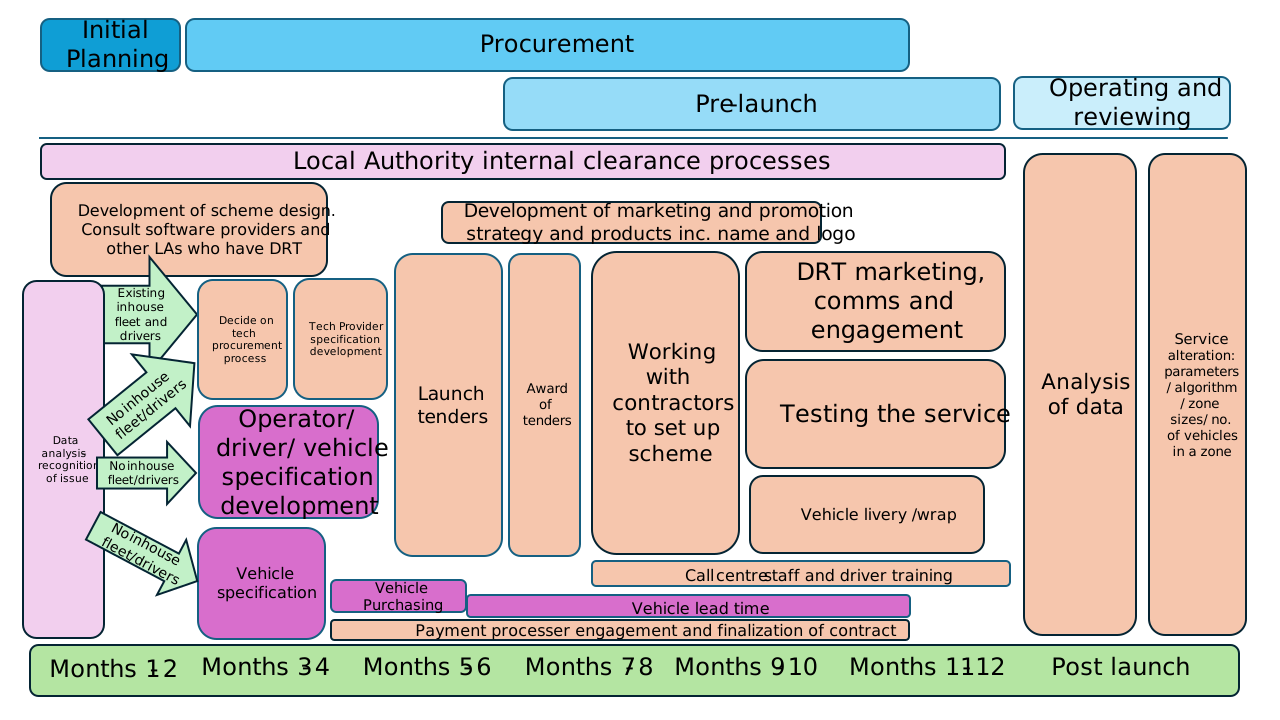
See a table listing the steps shown in this graphic.
Fares
There are various pricing structures for fares. A common approach is zonal-based, with the fare increasing incrementally through several levels, for example, concentric circles from the point of origin.
Another approach is to adopt a simple distance-based approach, for example, one rate for journeys under 5 miles and another rate for journeys over this. Some simply operate a flat fare system.
The most appropriate structure will depend on the aims of the service. If the service is primarily intended to offer short, local journeys then a flat fare which encourages longer distance travel may not be appropriate. Overall, a balance needs to be achieved between enabling people to access the service at a reasonable fare and contributing towards the cost of running it. Getting this balance right will support the viability of the scheme and help to reduce the subsidy needed.
Zone sizing
The picture emerging from RMF monitoring and evaluation is that the number of vehicles operating within a rural zone substantially impacts patronage levels – the more vehicles, the higher the total passenger numbers. In a more built-up area, it seems possible to have slightly fewer vehicles. This appears to be because in a rural area, journey distances tend to be longer than those in a town or suburban setting. Therefore, if the operating zone is quite large, it is easy for the vehicle to be taken up with many long, single journeys which prevents other passengers from using it at the same time without hugely deviating from the original passenger’s route.
Large deviations make the service less attractive to passengers as the journey time becomes far greater than it would be in a car or other means. In order to qualify and register as a flexible bus service, each passenger must be able to leave the bus within 15 miles (measured in a straight line) from the place at which they were picked up.
LAs operating DRT in a rural area have tried different zonal set ups, before settling on an approach for their area, although this remains subject to regular review to respond to changes or make improvements. For example, North Lincolnshire previously operated with 6 vehicles across a single zone but found that the vehicles were travelling significant distances with few people on them. As a result, it divided the zone into 2 smaller areas and found this to be a better way of supporting aggregation.
Having a large geographic zone, with the intention of providing access to DRT to as many people as possible, will require a higher number of vehicles. It is generally considered better to start with a smaller geographical area which can be increased in size, rather than to start with a larger area and find that the number of vehicles available is insufficient to serve it. This will lead to many bookings being unfulfilled and higher levels of dissatisfaction. See further information in the Soft launching part of the section on launching.
Obvious interchanges and destinations which those inside a DRT zone are likely to use should be included within it where possible. However, where these locations sit outside, journeys to and from the destination should be permitted. This is important as it not only provides the service that people want but also helps to support aggregation and service viability, since it taps into a potentially higher passenger flow than other parts of the zone. The Rural Mobility Fund evaluation has shown that railway stations are among the most popular destinations. Nottinghamshire’s Nottsbus On Demand and Leicestershire’s Fox Connect DRT services both serve East Midlands Parkway Interchange, enabling onward connections. Nottsbus On Demand services also serve railway stations in Newark, Retford and Mansfield.
Capping by journey length - East Sussex Flexibus
East Sussex started out with 10 operating zones covering 80% of the county - not serving major towns such as Eastbourne and Hastings. It found that that the rigid system of 1 vehicle per zone meant that, in some zones, the vehicle was underutilised, while in others, there were unfulfilled bookings due to lack of vehicle availability.
Some zones were consequently merged so that there were 7 zones. However, even this was found not to be optimal in terms of maximizing booking fulfilment and aggregation.
East Sussex consequently switched to a single operating zone with the vehicles being able to move around it freely based on bookings and demand. However, the maximum length of a journey is capped at 14 miles, to avoid lengthy journeys which preclude other simultaneous rides, maximizing vehicle availability.
There has since been a 25% decrease in the number of vehicles needed. 95% of rural residents are now within 30 minutes of key destinations by bus or Flexibus while 87% of rural residents are now within a 30 minute ride by bus from the nearest GP surgery – without Flexibus this would be 44%.
East Sussex has calculated a benefit to cost ratio (BCR) of 3.02, indicating high value for money and also estimated over £10 million of wider economic impact over the period of operation until April 2026.
On demand or pre booking
Some DRT schemes operate virtually ‘on-demand’, such as Milton Keynes and Go-2 in Sevenoaks. Others require pre-booking at least 24 hours in advance.
Advantages of operating a scheme with advance bookings include enabling vehicle routes to be determined further in advance, potentially allowing a better level of aggregation, albeit often with manual intervention by local authority staff. However, the RMF process evaluation reported that “some local authorities were concerned that allowing journey bookings too far in advance without requiring payment until the journey is made leads to ‘no shows’ and wasted vehicle trips”.
Consequently, some LAs introduced advanced payment for bookings or reduced the length of time in advance that journeys could be booked. It is worth noting that the RMF process evaluation found that ‘about half of unfulfilled bookings were attributable to the service provider and about 1 in 5 to the user’. The average advance booking time for RMF DRT services was 2.7 days.
Conversely, some would-be riders could potentially be deterred from using the service if booking is only on-demand. If they need to get somewhere for a specific time such as an appointment or work, then they may want certainty in advance.
Service standards
As part of the planning process, local authorities may want to determine a level and standard of service that they want their DRT scheme to achieve. This will carry forward into the procurement process and can be used as criteria to determine whether providers are meeting the terms of their contract and whether the scheme is meeting its aims. Stage 4 (reviewing and sustaining) considers how to review this.
Others may prefer to wait before setting these standards, once it is clear from the procurement process what is realistically achievable in the marketplace. Informed planning and design of the scheme, in particular involving discussion with authorities already operating DRT, will enable more realistic and achievable metrics and standards to be created.
Some standards will however be non-negotiable. Bus services are subject to rules which govern their punctuality and reliability. For flexible bus services, when an operator accepts a booking for a particular time, the vehicle must arrive at each individual passenger pick-up and destination within a maximum 20 minute time window. This time window can work in 2 ways:
- a period specified by the operator (for example, the pick-up will be between 10.30 am and 10.50 am)
- in reference to an agreed time - no more than 10 minutes before or after the agreed time – for example, the booking is made for 10.40 am, pick up can be no earlier than 10.30 am and no later than 10.50 am
Failure to meet this standard could potentially lead to enforcement action being taken by the Traffic Commissioners.
Standards cover a wide range of areas. For example, as part of any tender for the operator and software provider, the specification may include targets for operator cancellation of booked rides, customer satisfaction, vehicle and driver availability etc. Targets such as aggregation levels should be set at a realistic level, especially in the early stages. Over ambitious aggregation targets could lead to unacceptable deviation rates (the distance or time a vehicle deviates after collecting a passenger to collect other passenger(s) before dropping off the first passenger at their destination).
There are likely to be trade-offs required between service standards. While passenger satisfaction is important and collecting passengers from their door is likely to be popular in itself, it may lead to longer journey and waiting times as vehicles deviate more. A high deviation rate can risk lower aggregation as prospective passengers find alternative means to travel more directly and are not attracted to the scheme. As we see at Stage 3: Launching, it is essential that passengers know what they can realistically expect from the service.
Key points
- Identify the problem and challenge you want to address.
- Get a clear understanding of the specific issues and needs of the area.
- Think about how these are best addressed.
- Consider sources of funding and standards to be achieved.
Stage 2: Procurement
This section looks at procuring a demand responsive transport service. It highlights the aspects that will need to be procured, such as vehicles, drivers and software, as well as options for packaging these into lots. The section also highlights processes which may be required such as obtaining operator licences and payment processors, with which some participants may be unfamiliar.
Common procurement elements
Local authorities should recognise that the processes for procuring a DRT service may be quite different from procuring a standard fixed route bus service. There are likely to be more participants in the process and greater internal support needed from parties not necessarily directly involved in transport matters so far, particularly when procuring for the first time. These may include lawyers, IT specialists, data controllers and finance.
There are common elements to the procurement of DRT schemes and a well-conducted planning stage will make it easier to carry these out. The following will need to be procured.
Fleet / operator
Vehicles will be needed to provide the service, as well as an operator and the facilities for maintenance.
Drivers
These will need to be recruited and trained in working on a DRT service. Sufficient drivers will be needed to take account of working patterns and legal requirements.
Software and booking platforms
Software to support scheduling, routing and receiving bookings will be required. While an app is likely to be the primary method of booking a journey, a call centre will be needed for those who cannot book digitally. There may also be a desire to allow bookings through a website.
Local authorities may wish to specify, or include as quality criteria, indicators such as time parameters from booking to pick-up, target maximum journey times and user satisfaction. Some parameters and requirements are set in legislation, such as the window for a flexible bus service to arrive when a booking time is accepted.
Operating a DRT service can require trade-offs between:
- costs - including driver salaries
- vehicle size and fleet size - impacting aggregation levels
- passenger expectations/satisfaction - impacted by deviation rates, vehicle availability and booking fulfilment etc
All of these will be reflected in the procurement.
The optimum balance is likely to be determined by funding availability and passenger expectations. Authorities will also need to take account of any service standards they have set at the planning stage. A successful service will need to meet the expectations created for passengers.
Service design at the planning stage will influence the providers that are able to bid to operate it at the procurement stage. While the tools available from a DRT provider will be helpful in scoping out a service, before contracting you should ensure a good understanding of what all software providers can offer.
DRT technology is a global market with participants often based in other countries and used to operating in a very different regulatory environment to that in England. A detailed understanding of the nuances of UK legislation may not be in place, not least amongst new entrants to the UK market. There can be an assumption that DRT is simply the same as taxis. Local authorities will need to be assured that bidders understand the timescales involved in processes, such as obtaining operator licences and registering services.
Intelligent Transport Systems UK (ITS UK) is the membership body for the UK transport technology sector, including providers of digital DRT systems. The department does not endorse any particular supplier of DRT technology and makes no comment on the merits or otherwise of specific products.
Packaging the work
One of the key aspects of procuring a DRT service is deciding how to package these various aspects. While it may be simpler to bundle all aspects together, this can have risks as well as benefits. In the RMF pilots, some areas chose to contract each element out individually while others adopted a mixed approach or managed the scheme in-house.
Here are some examples of ways of packaging the work and their advantages and potential disadvantages.
Single lot: fully integrated contract
Contracting as a single lot, for instance to an established operator who offers to arrange the vehicles, drivers and technology, may appear initially to be the most straightforward process. It reduces the number of procurement processes and interfaces that the local authority needs to manage. The scheme may be able to piggyback on existing supplier relationships – such as those between an operator and a payment provider – delivering economies of scale and operational simplicity.
Advantages
-
Simplified procurement and contract management.
-
Fewer interfaces for the authority to oversee.
-
Potential for cost-efficiencies through supplier scale and partnerships.
Disadvantages
-
If the operator withdraws after award (for example, due to rising costs), the entire package must be re-let.
-
Less flexibility to adapt individual components.
-
Risk of over-reliance on a single supplier.
Considerations
-
Local authorities should clearly define data access requirements in the specification to retain understanding and influence over the scheme.
-
Provisions for continuity and step-in arrangements should be built into the contract.
Split lot procurement: modular contracts
Where procurement is split, each element can stand alone. This model allows the local authority to contract separately for software, operations, fleet provision, and other services. If one contractor drops out or underperforms, the rest of the system can continue operating without complete service disruption.
Advantages
-
Greater flexibility in managing each service element.
-
Reduces the systemic risk of total failure if one provider exits.
-
Opportunity to bring in specialist expertise for each area.
Disadvantages
-
Increases complexity of procurement and contract management.
-
Requires stronger internal resource to coordinate multiple suppliers.
Considerations
-
Contractual governance and inter-supplier communication will need to be robust.
-
Ideal for authorities confident in managing multiple interfaces.
Combined lots: mixed approach
Some local authorities choose to combine related elements, such as operations and technology, into a single contract while procuring others (for example, marketing or fleet leasing) separately. This offers a compromise between simplicity and flexibility.
Advantages
-
Tailored to internal capacity and market maturity.
-
Allows bundling of elements that are closely integrated.
-
Offers more adaptability than a fully integrated contract.
Disadvantages
-
Still requires careful contract coordination
-
Risk of dependency on key integrated suppliers
Considerations
- Clear delineation of responsibilities and data-sharing expectations remains essential.
In-house delivery with selective contracting
Local authorities may choose to retain certain elements in-house, such as oversight, performance monitoring, or customer support, while outsourcing fleet provision, operations, or app development. This approach is often taken to maintain policy control and mitigate risk exposure.
Advantages
-
Greater public sector control and policy alignment.
-
Reduced exposure to fleet or workforce risks.
-
Potential to build internal expertise over time.
Disadvantages
-
Demands more internal capacity and management time.
-
May slow responsiveness compared to fully outsourced models.
Considerations
- A clear assessment of internal strengths and gaps is vital before adopting this approach.
Collaborative procurement
Local authorities may benefit from collaborating with neighbouring areas on procurement, particularly where residents regularly travel between their areas. This can achieve economies of scale and simplify the user experience across regions. However, while this can widen the network, smaller operators, especially community transport, taxi and PHV providers, may have limited ability to operate over larger areas.
Advantages
-
Shared procurement costs and economies of scale.
-
Supports seamless regional travel experiences.
Disadvantages
-
Requires alignment of priorities and governance structures.
-
Smaller operators may be excluded if the footprint is too large.
Considerations
- Procurement should be designed to encourage a wide pool of potential operators while enabling scale.
Integrating community transport, taxis and private hire vehicles (PHVs)
DRT procurement can involve non-traditional providers such as community transport operators or licensed taxis and PHVs. For instance, the Robin DRT service in Gloucestershire was split between a traditional bus operator and a community transport provider, each delivering a service in different areas.
In addition Section 12 of the Transport Act 1985 allows taxi and PHV operators to provide bus services under special restricted operator licences. Smaller providers can often bring strong local knowledge and flexibility and are well-suited to rural or low-demand areas.
Advantages
-
Widens the pool of potential providers.
-
Leverages existing local expertise and capacity.
-
Enables flexible service models and vehicle types.
Disadvantages
-
Some providers may have limited resources or tech capability.
-
Integration with central booking platforms may be more complex.
Considerations
-
A comprehensive provider review should be conducted early in service design.
-
Splitting contracts geographically or by role can increase market participation.
Revenue risk allocation
Many local authorities choose to take on the revenue risk themselves, paying a fixed contract amount to the operator or tech provider, rather than expecting operators to rely on passenger fares. This gives the authority more control and adaptability. Others opt to transfer the revenue risk to the operator, which some see as a performance incentive.
Advantages of authority-retained risk
-
Greater freedom to adapt services without renegotiation.
-
Predictable budgeting.
Advantages of operator-retained risk
-
Encourages innovation and improved service quality.
-
May drive better ride aggregation.
Considerations
-
Authorities should evaluate their ability to manage financial risk.
-
Hybrid models may be appropriate in some contexts.
Relationship management and data sharing
Strong, open working relationships between the authority, the operator, and the technology provider are essential for service success. These partnerships enable effective performance monitoring, data-driven service changes, and responsive problem-solving.
Recommendations
Authorities must have guaranteed access to all relevant data - both in real time and for historic analysis.
Regular review meetings and shared service key performance indicators (KPIs) should be built into contracts.
Strong relationships support iterative improvements and long-term sustainability.
Using community transport - The Robin: Gloucestershire
This scheme began in 2022 in 2 operating zones: a southern area of the Forest of Dean in the south of the county and a northern area of the Cotswolds in the north-east of the county.
The scheme is designed to connect rural residents to locations where they can connect to fixed-route services for onward travel. The software and app are designed to complement fixed-route services rather than replace them.
The Robin had a staggered start to allow lessons to be learned from the initial deployment, using a community transport provider in the Forest of Dean and a traditional bus operator in the North Cotswolds.
The community transport operator used its network to create awareness of the opportunities offered by the service and to explain how to use it. The service was carefully branded to move beyond traditional perceptions of ‘dial-a-ride’ services. This helped it to attract a different passenger profile.
Younger people are using the Robin, particularly during the morning peak where destinations tend to be schools, colleges, employers and the train station. During the day, the demographic is slightly older and the destinations become more varied.
The impact was such that the Robin has subsequently been rolled out across Gloucestershire with services now operating in 6 distinct zones.
Local authorities should consider the scope for using the ‘Total Transport’ principles in procurement. The 2019 Total Transport feasibility report and pilot review gives further information but this approach involves integrating transport services that are currently commissioned by different central and local government agencies and provided by different operators. This can include partnering with the health and social care sectors, home to school transport and other transport providers. The goal is to allow existing resources to be allocated and co-ordinated more efficiently, resulting in services to passengers that are more effective at meeting their needs.
One approach that is growing in popularity is ‘co-mingling’ where, for example, existing traditional ‘dial-a-ride’ services may share resources with the new DRT service, as has recently happened in the case of West Midlands Bus on Demand
Data ownership
One of the benefits of DRT is the volume of data that it produces. This is rich in information about travel patterns, demand and who uses the service, which can be used to iterate and improve the service provided.
The authority will need to ensure compliance with all data protection legislation, including adherence to appropriate technical and organisational measures designed to support fulfilment of legal obligations.
Understanding your partners
Engaging with technology providers when new to DRT can be more challenging, due to unfamiliarity with the technical language and terminology of the provider. Without prior experience of operating DRT, it is more difficult to know what to specify in a tender – for example, the flexibilities and alterations needed within the contract to ensure successful operation. Software providers, many of whom entered the UK market for the first time when contracting with local authorities taking part in the RMF trials, have had to build up familiarity with UK legislation, operating frameworks and requirements.
To get the best outcomes, local authorities, operators and software providers need to understand what the other is looking for in the procurement. For example, while the tech provider needs to understand the constraints and requirements of local authorities and UK legislation, local authorities must also acknowledge what suppliers need and want to know so that they can meet the procurement requirements and bid appropriately. Poor specification, understandably due to lack of experience of DRT, can hinder the performance of a scheme, particularly in the early stages.
There is now a lot of knowledge held by both the software providers and local authorities with DRT operations. If approaching DRT for the first time, it is strongly advisable to speak to local authorities with existing DRT schemes, who will be able to provide advice and support around the process.
Vehicles
A key element is procuring the vehicles to operate the service. Vehicles should be suitable for the role. One approach is to buy the vehicles as a local authority and then lease them to the operator. This has the benefit that the authority can directly specify the vehicle and retain them as an asset, transferring them to a new operator at the end of the contract or reallocating them to a different role.
However, authorities need to be mindful that vehicles are a depreciating asset and operation in rural areas can be wearing – for example, steep hills and winding roads putting extra pressure on components. At some point, the vehicles will need to be renewed and authorities should look to avoid a ‘cliff edge’ where the service may become unsustainable because of the cost of buying new vehicles or increasing unreliability. Procurement should be undertaken with the sustainability of the service in mind.
Sufficient capacity will be needed to ensure the majority of journey requests can be fulfilled. For DRT to function well, there needs to be some reserve capacity. A scheme that relies on a single vehicle may result in a higher rate of unfulfilled bookings than if several vehicles were operated or additional vehicles were available that can be drawn upon when needed.
While this might be perceived as inefficient, a service that cannot be accessed when needed is more likely to fail and be the subject of complaints. Several local authorities have explored how they might better utilise vehicles and provide additional capacity, potentially through co-mingling - for example, making vehicles used for home to school and adult social care available for the generic DRT service during the hours they are not serving their primary function.
Another approach is for the operator and in some instances even the software provider to package their own vehicles into a combined bid. This might allow economies of scale or redeployment of existing vehicles from schemes elsewhere. However, it means that if the contract is relet to another operator or the operator withdraws, those vehicles will no longer be available.
Transitioning to zero-emission buses (ZEBs) is a vital part of the government’s plan to make buses better for passengers and to realise the benefits of lower running costs, cleaner air and smoother quieter journeys. The Bus Services Act 2025 includes a measure to accelerate decarbonisation of bus services, by placing a requirement on bus operators ultimately not to use new non-ZEBs on local bus services in England, from a date in the future.
The date from which new non ZEBs cannot be used, which will be confirmed in secondary legislation, will not be before 2030. This will give the sector the time and confidence to plan the transition to a zero-emission bus fleet. This measure will only apply to new non-ZEBs that have a capacity of more than 22 seated passengers. Coaches, minibuses or existing non -ZEBs will not be affected.
Some DRT schemes are already successfully operating small (fewer than 22 seats) electric vehicles, such as Essex, Surrey and Milton Keynes. It is important to ensure that the charging infrastructure is in place and that routing and rest periods allow vehicles to access it in a timely way. Technology has progressed significantly over the last 5 years, with more and better products coming to market all the time. When procuring vehicles, thought will need to be given to range, including potential for variation between winter and summer and access to recharging facilities.
Licensing and registration
In most cases, 16 seat minibuses have been used operating as public service vehicles (PSVs) under bus legislation. However, some schemes are using vehicles with 8 passenger seats or fewer under taxi and private hire vehicle (PHV) legislation. Such services are far fewer in number at present but are increasing in popularity. Taxi and PHV fares are not zero VAT rated, however, smaller vehicles may be cheaper to acquire.
Under section 2 of the Transport Act 1985, a bus service is a local service if it uses one or more public service vehicles (PSVs) for the carriage of passengers by road at separate fares, on condition that either:
- the place where a passenger is set down is less than 15 miles, measured in a straight line, from the place where they were picked up
- some point on the route between those places is less than 15 miles, measured in a straight line, from either of those places
Flexible services are buses and fall under the category of local services. A flexible service is one which:
- serves one or more local communities or neighbourhoods within a specific geographical area
- while it may have fixed sections of route, is in the entirety of its operation so flexible that it is not practicable to identify in advance all the roads to be traversed at any given time
- is provided primarily for the purpose of carrying passengers who have booked in advance of the journey and whose collective requirements determine the route of each journey notwithstanding that other persons may also be travelling
- provides seats that are all available for use by members of the general public
- is provided in consideration of the payment of individual passenger fares which are not subject to variation according to the number of passengers carried on the journey
They are operated either:
- by bus operators with an ‘O’ licence granted by the Traffic Commissioners
- under a community transport section 22 permit (community bus permit) under the Transport Act 1985
- by a taxi/PHV operator using a restricted public service vehicle operator licence
The prospective operator of a flexible service will need to register it in accordance with the set timescales with either:
- the traffic commissioners
- the relevant local authority, where this function has been delegated or where a franchising scheme is in operation
Read separate guidance about registering a flexible service.
Where the proposed operator of a service needs to obtain an ‘O’ licence, sufficient time should be allowed for an application to be made to the traffic commissioners and for the application to be processed.
Read further information about:
- obtaining an operator’s licence
- operating community transport using Section 19 and 22 permits and obligations
It is important when procuring an operator (even if doing so via a third party, for example, where one supplier provides everything) that checks are undertaken to ensure the proposed operator is:
- fully aware of the legal requirements and responsibilities of being an operator
- able to fulfil the conditions set out for operators
This includes elementary aspects such as having a suitable transport manager and being in possession of, or able to apply for, sufficient authority on an ‘O’ licence.
Read separate guidance on PSV (Public Service Vehicle) operator licences.
There are 2 main options for using PHVs and taxis to provide DRT services.
Section 11 shared taxi / PHV
One is to operate under section 11 of the Transport Act 1985 as a form of shared taxi/PHV, the approach adopted for Milton Keynes’ MK Connect service. This enables licensed taxis and private hire vehicles to provide a service at separate fares for passengers sharing the vehicle. This is on the condition that:
- all the passengers carried on the occasion in question booked their journeys in advance
- each of them consented, when booking their journey, to sharing the use of the vehicle on that occasion with others on the basis that a separate fare would be payable by each passenger for their own journey on that occasion
Section 12 special restricted licence
The other is to obtain from the Traffic Commissioner a special restricted operator’s licence under section 12 of the Transport Act 1985. The vehicle owner can then use the licence to provide a local service (including a flexible service) for up to 8 passengers. The route must be registered with the Traffic Commissioner and must have at least one stopping place in the area of the authority that licensed the taxi, though it can go beyond it. Taxi/PHV buses can be used for local authority subsidised bus services.
WECA has recently adopted this approach, as illustrated in the case study.
PHVs in a rural area - Go2 DRT: Sevenoaks
This service runs in Sevenoaks and its surrounding area. It operates using shared PHVs under Section 11 of the Transport Act 1985. This service operates as an on-demand service with bookings made no more than 40 minutes in advance of travel.
The average vehicle utilisation rate – passengers per vehicle hour – is around 3.5.
The scheme operates in a predominantly rural area, with narrow roads in some places and limited space for turning, with high car ownership. Go2 concluded that PHVs best suited the service being provided for both cost and operational reasons.
There are advantages and disadvantages to both PHVs and PSVs. A local authority might want to consider using PHVs rather than PSVs for reasons including cost, manoeuvrability and maintenance. Equally there are various reasons why a PSV might be preferable including the number of available passenger seats at any one time, greater accessibility, potential to use the vehicles for standard fixed route services or other services provided by the local authority.
Some local authorities operating DRT in deeply rural areas have found that it can be more challenging for PSV vehicles to manoeuvre – for example, finding a suitable turning or waiting point. On the other hand, using PSVs can enable more substantial group bookings and enable the authority to support the financial viability of the service by arranging a few contracts for fixed route provision – for example, a morning school run or taking a group from a day centre to a regular event.
Drivers
As the public face of the service, the driver is key to delivery of a successful DRT service. DRT drivers need to work in a different way to drivers of standard services. Bespoke training around using the technology, such as receiving and acknowledging route adjustments for new bookings will be required. Good customer skills are essential. However, there can be differences from more traditional ‘dial-a-ride’ community transport services, where a driver might take the passenger directly to their door. Training will need to be delivered in such a way as to strike the right balance.
Driving DRT services can be a more attractive option than a regular bus service because of the usual hours of operation, the use of smaller vehicles and the interaction with passengers. Where a traditional bus operator has been commissioned to run the service, this may appeal to some drivers. However, a sufficient pool of drivers, trained in working on the DRT service, will be needed to cover this work in the case of absence and ensure the quality of service is maintained.
Sufficient drivers will be needed to meet legal obligations and ensure that all have access to breaks and facilities, without leading to large gaps when a particular vehicle becomes unavailable. Many schemes have more than one operational vehicle and so there is simply a reduced number of available vehicles during driver rest periods. Where smaller vehicles are in use and the service is operated under taxi or PHV legislation, there may be greater flexibility in driver deployment. However, it will be necessary to ensure that an accessible vehicle is always available for those who require it.
The procurement process
Although internal processes will differ from a traditional fixed route service, the usual good practice and standards of propriety for public sector procurement continue to apply. In achieving good value, an understanding of the market is vital.
The approach to procurement will be impacted by the individual set up at each authority. There are several main types of procurement including:
- direct award
- mini competition through G Cloud/authority’s own dynamic purchasing system (DPS)
- full procurement
For further information around procurement, we advise speaking to other local authorities with experience of procurement in the DRT field.
The market for DRT apps and the technology associated with them is an active one. There are well established providers with a significant proportion of the market but there are also emerging challengers with different approaches. The authority should have determined what it wants the app to deliver as part of the planning stage.
When investigating available software options, it may be helpful to speak to other local authorities who already operate digital DRT, particularly in areas with a similar profile. This will help identify what you want to specify and look for and the types of things you might want the software to provide.
The following example specifications set out by local authorities are available on the GOV.UK home page for this guidance:
- a software specification for Transport for the West Midlands’ Ring and Ride service
- a statement of technical requirements for Wiltshire Council’s DRT platform
There is also a sample tendering specification from Milton Keynes Council.
It is important when tendering for a tech provider to consider 3 key elements of the software:
- driver interface - functionality, receiving live bookings, routing
- passenger interface - functionality, booking, messaging, alerts, tracking
- back office usage (including for call centre staff) and access, including overall performance of the software - flexibility of software and possibility to make changes to parameters and functionality and ability of software to aggregate journeys, reducing the need for human intervention
The driver interface needs to be appropriate for the driver allowing them to acknowledge bookings easily, as well as seeing the routing and anticipated timings. The driver may also be responsible for collecting payment and the payment system interaction with the software will need to be smooth.
When procuring, there is value in getting the technology provider to demonstrate how the platform works for the driver and to go through the process of loading up and running a shift. It would be beneficial to view what the driver will see and determine whether it is clear and user friendly, bearing in mind that the driver will also need to attend to other matters. Similarly, some LAs have found it very useful for the software provider to give a demonstration of the back office in operation with an example of a ‘good day’ and also a ‘challenging day’: seeing how it operates when things are not running smoothly will help to understand how different challenges and situations are handled.
The functionality and appearance of the software should also be considered. It should be tested not only from the driver and local authority perspective but also from a passenger perspective. Good usability will leave a good impression and encourage further use. Aspects to test for usability will include the following.
- What is the user registration process like?
- Does it use language that the typical passenger will understand?
- How does the booking process work?
- Is it clear and user friendly?
- What does it allow the customer to specify?
- If a ride is not available, how does the software handle this: does it make suggestions for rides at other times and on what basis?
- Can the software suggest earlier travel times as well as later ones?
- Can you specify an arrival time at the destination rather than just a pick-up time?
- What is the user interaction and notification process like?
- What alerts and contact will the user receive and when?
- Does the service collect the user at the place specified?
- How does a user indicate any specific requirements? (for example, needing the wheelchair space)
- Which phones/operating systems will the app work on?
Other general points that should be covered when procuring include issues such as bugs and fixes.
-
Does the provider commit to a clear time frame for addressing and fixing the issue?
-
What will they do in the interim?
-
What is the response time when the local authority raises a ticket with the software provider?
-
How quickly can requests for changes to booking parameters be made once requested?
It is also useful to understand and confirm how much time the software provider will be able to devote to resolving issues for the individual authority’s DRT scheme. You should establish what level and kind of support the tech provider will commit to. If the supplier cannot currently provide a certain function that is being sought, then there needs to be a clear agreement about when it would be implemented.
While app-based booking systems have been central to the DRT schemes so far and offer many benefits, such as access to data analytics, call centres are particularly important early in the life of the schemes as they can provide reassurance to users unfamiliar with such a booking system. They will have a longer-term role to play in the scheme as a way in for unfamiliar new users and those with accessibility needs. A call centre will need to be staffed appropriately, including handlers with local knowledge. It may be appropriate to share the function with neighbouring authorities to reduce the cost.
Combining with neighbouring authorities – Leicestershire and Nottinghamshire
Leicestershire and Nottinghamshire operate their schemes under the same software provider contract. One authority originally entered into the contract, with the option of adding additional vehicles and zones. The other authority was then simply able to join through adding additional vehicles. They retain their own app interface and operate as a separate scheme. However, they additionally use the same call centre.
Leicestershire have advised that this arrangement has led to lower costs than contracting separately for a smaller operational area (i.e. just Leicestershire rather than the two authorities). The greater the number of vehicles operating under the contract, the proportionally lower the cost per vehicle to use the software.
A call centre based in the local area with call centre staff with local knowledge has been found to be very useful, as staff are familiar with the geography and area and able to use that to support callers.
Retaining knowledge
Experience from the RMF pilots suggests that knowledge about the processes can end up being held by a small team, or even individuals. As part of the procurement process, authorities should be mindful of ensuring that the appropriate skills and information are developed and retained within the organisation. Where possible, the pool of those with this knowledge should be widened.
Therefore, good knowledge management processes will be needed to ensure that skills are embedded within the authority so that they will not need to be relearnt when considering the next procurement. Lessons learned should be recorded and fed back throughout the life of the scheme so that they are not lost. However, there may be some need to procure skills externally (for example, in data analysis) at least initially to introduce them into the authority.
Sample tendering specification: Milton Keynes
The software application/system must integrate with the commercial bus network by allocating appropriate rides to the local bus and offering information via the app on connecting buses (end to end journey planning) where applicable.
The system must be demonstrated live.
Details of acceptable overall bus journey time or access to fixed bus routes will be agreed with the operator prior to launch to determine whether DRT trips will be offered.
The application must meet the following requirements:
-
online, app and phone booking and payments
-
identify English National Concessionary Travel Scheme (ENCTS) and other concessions for validation and adjusted pricing
-
accessibility – ability to flag rider accounts including wheelchair users and other requirements such as hidden disabilities, limited mobility and dementia
-
use of the Android and IOS accessibility functions
-
ability to have a set bus stop pick up/drop off option within the account for users with special needs requirements
-
meet UK data protection requirements - not hold user data outside the EU
-
allocate rides in real time
-
be able to accept uploaded proof of disability and concessionary cards
-
must be able to take payments via an app and website for bookings
-
payments must be Payment Card Industry (PCI) compliant and will be external to the council (DfT note - read further information about GOV.UK Pay, which is a PCI compliant platform to process card payments)
-
software must provide customer account management including trip information and automatic vehicle location for investigating complaints
-
be fully demand responsive with no pre booking at this time, but able to offer pre booking for some customer types should services such as home to school be included
The service must meet reporting requirements.
The system shall have a full reporting module included where the raw data can be accessed, extracted in Excel and analysed to produce formatted reports by the council. The reporting module can either be integrated into the system or run alongside the system.
The reporting function will be available on-line and for standard reports where the council has a choice to specify variety of defined parameters. As a minimum the following parameters must be included:
- trip patterns
- ride requests
- rides booked
- unique users
- ENCTS/concessions breakdown
- rides completed
- rides cancelled
- ride requests not met
- average passengers per vehicles hour
- popular pick up and destination points
- average and max walking distances actually walked
- journey start and end points
While this scheme opted for ‘on demand’ only, the majority of schemes do have some form of pre booking available. See the On demand or pre booking section in the Planning section of this guidance for more information.
Payment processor
A benefit of digital DRT schemes can be that payment can be made through the app rather than on the vehicle. If taking in-app payments, a payment service provider (PSP) will be needed to handle the payments. The user registers their credit or debit card details and can then use them as the method of payment every time they book a journey.
A benefit of this to the local authority is, for example, if someone books multiple journeys but does not travel and has failed to cancel, they can still collect the fare if it would be appropriate to do so. Such an approach would be at the discretion of the local authority but could be considered to be justified as the vehicle is unavailable to someone else needing the service at that time. However, local authorities will need to apply such a policy judiciously and consistently to ensure it is fair and not to the detriment of passengers as a whole. Potential users of the service must also be made aware that such a policy exists before booking.
It is possible to use the government pay framework GOV.UK Pay, which has a contract in place with a PSP. Many local authorities have advised that this is cheaper than contracting individually with a PSP. However, this service does not currently support retention of card details within the app, so a user will have to re-enter their details each time, unless using one of the mobile phone operating system’s ‘pay’ apps.
The other option is to contract directly with a PSP. The PSP will generally require the signature, home address and identification of a senior council official, often the chief finance officer (section 151 officer).
Engaging a payment processor can be a lengthy process, taking several months to get the PSP set up in the app. This has been partly due to PSPs sometimes being unfamiliar with working with local authorities and their processes, particularly when they are not based in the UK. This can make it one of the most challenging aspects of procurement.
Authorities should ensure that they begin the process early and allow time. However, the position is improving as PSPs gain more experience of working with English local authorities. DRT software providers are also familiar with the terminology and may be able to provide support with the process. While a scheme can operate perfectly successfully without a payment processor by using on-board payments, one is likely to be needed to achieve the full benefits of a digital DRT scheme.
Bus Open Data Service and journey planners
A DRT service is only useful if people know it is there. Alongside the critical importance of marketing and promotion, enabling and increasing the availability of DRT data to journey planning tools is important. Where DRT operates as a flexible bus service, the local authority specifying DRT to software providers should seek to ensure, that as far as possible, data is made available in formats that will enable it to be uploaded into journey planning tools and software, as and when the functionality within the journey planning and ticketing tools exists.
The Bus Open Data Service (BODS) requires data to be provided in the TransXchange format but can provide data for consumption in both this format and GTFS. The TransXchange schema has been amended to enable provision of flexible bus service data to BODS. Data provided to BODS is used not only as a feed for journey planning but also as a way of monitoring performance. It has proven challenging to incorporate DRT schemes into journey planners, partly due to the need for further development of systems capable of publishing flexible bus service data.
DRT services operated on a section 22 basis or under taxi or PHV legislation are exempt from the requirement to provide data to BODS. However, they are encouraged to facilitate visibility on journey planners.
Key points
-
Fleet/operator, drivers and software will need to be procured.
-
Consider how you want to package these for tendering.
-
Consider how you can obtain the best pool of potential contractors.
-
Consider who owns and has access to any data produced.
-
Ensure all required regulatory processes are met.
-
Ensure the outcome is useable and meets needs.
Stage 3: Launching
This section looks at approaches that have been used to launch a DRT scheme successfully. These include activities such as roadshows, publicity distribution and ‘soft launching’. It also considers the use of launch events, fares and branding as ways of publicising a new service. A summary sets out typical marketing activities at various stages.
Experience of DRT schemes has shown that a successful launch requires good, clear communication. Where a DRT scheme is replacing an existing fixed route service, even where it has operated infrequently, there is a risk that it can be perceived as losing your bus service. Simply withdrawing a fixed service and directing passengers to DRT is likely to create resistance to the service.
Potential users need to be reassured that they will still be able to travel, often with more flexibility than before, and that booking a journey is less daunting than they may initially fear. Care should be taken to manage expectations and be realistic about what the service offers.
As a minimum, passengers will need to know:
- the area of coverage
- the times of operation
- places where they can be picked up and set down
- how to book, including the earliest and latest that bookings can be made
- fares, including the validity of any concessionary schemes
- any restrictions on the service
- how to give feedback
- a contact for further questions
There can be a preconception that a DRT service is only for older or disabled people – for example, the traditional ‘dial-a-ride’ schemes. However, the services covered by this guidance will be aimed at a broader ridership. Marketing and the language used will need to reflect this. A DRT scheme should be an attractive option for passengers rather than appearing to be a service of last resort. It remains important that the transport needs of older and disabled people are addressed and they should be encouraged to use the service.
Soft launching
Many local authorities have opted for a ’soft’, lowkey or partial launch so that they can further develop the service once it is operating. This enables them to identify and rectify any teething problems especially where a scheme is being introduced to an area that has previously been unserved. It also reduces the risk of over promising and under delivering.
An example of a staggered launch is Gloucestershire. This started with 2 small zones under the DfT Rural Mobility Fund, which launched separately. Following the initial services, their scheme has expanded to have multiple zones which cover the majority of the county.
At the other end of the spectrum, the West of England Combined Authority (WECA) carried out a wide launch of its Westlink DRT service. Westlink was intended to complement existing services, providing a service to some areas which no longer had a bus service, rather than directly replacing tendered services. However, as some tendered services were being discontinued, it had to launch at the point that these ended.
A launch at scale was not without its issues. There was a feeling that it heightened public expectations of what the service could offer and made it more difficult to handle issues as they arose. It also linked DRT with a perceived loss of service which affected passenger perceptions. WECA has since altered the model of operation, including zone sizes, in response to the experience. This has led to a substantial improvement in the service, which is now better received by customers.
Promoting the service
A marketing strategy may need to be segmented with different approaches used for different types of passenger. For example, this could include using digital marketing methods such as social media targeting younger people, alongside more traditional marketing methods such as leaflet drops and posters. A user guide, taking people through the process step-by-step, is helpful.
A launch event can be a good way of drawing attention to the scheme. In the case of a soft launch, this is best held to launch the full service. One way of doing this is to hold a ‘ribbon cutting’ event, featuring a local elected official or prominent figure.
One successful approach has been to conduct a ‘roadshow’ whereby a vehicle is displayed in relevant towns and villages before launch. This allows potential users to familiarise themselves with the vehicles and scheme before they need to use them, creates a degree of anticipation about the service, and can allay concerns. It is also useful for encouraging potential users to register for the app so:
- they have access to the service when they need it
- the authority will hear first-hand about any potential issues or challenges that they hadn’t previously considered
It also provides an opportunity to talk the potential users through the booking process and how to use the service
Word of mouth has also been shown to be a successful way of informing people about the service and how to use it. It is useful to have local advocates for the service who can answer questions about it and relay any concerns to the local authority so that adjustments can be made. Local social media pages have been one method of doing this.
Local councillors can also be strong advocates for the service. It is advisable to produce briefing packs for advocates, with answers to questions that are likely to be frequently asked, so that the information they give out is accurate and consistent. If information is confusing or misleading, it will undermine confidence in the service. Drivers can also be enthusiastic advocates for the service and able to communicate information about it.
Online videos can be a way of demonstrating how to use the service, taking passengers through the necessary processes. Some DRT services have also advertised on local radio. However, promotional activity should also illustrate the uses to which the service can be put and emphasise social value – for example, accessing shopping facilities, leisure activities or educational establishments.
Although DRT does not rely on using fixed bus stops, these can act as a shop window for the service. Where there are stops in situ, information about the new DRT service should be displayed in advance of its launch. It is important to remove out-of-date information about services that no longer run and have been replaced by the DRT scheme to avoid confusion.
When visitors to an area are expected to form part of the passenger base, local attractions should be encouraged to include information on their websites and in publicity. Information should be made available in bus and railway stations served by the service and any fixed pick-up points clearly indicated. Leaflets should be available in shops, libraries and public buildings.
Fare promotions are often used as a way of promoting the service. A common approach is ‘first ride free’ to encourage sign-up and get people using the service. Another popular promotion is to offer reduced fares where passengers make a booking to travel together. This can help to improve aggregation by grouping bookings.
While older people do use technology successfully and the proportion doing so is growing, it may feel harder to adapt. It may be helpful to engage local community groups to demonstrate how to use the app. ‘Face to face’ training, taking the user through the registration and booking process is useful to all, but particularly so for this age group.
Booking by phone is likely to remain an important facility for this demographic. There are benefits to using the app to book – for example, updates about service disruption and where to wait to be picked up on a return journey. So call centre staff should be trained to help people move to the app where possible.
Branding
A DRT specific brand can be a useful way of indicating its role and how it works. It can be helpful to differentiate it from other types of operation and terms such as ‘on Demand’ or ‘Connect’ are often used, as well as identities such as ‘Flexibus’. Other approaches can be successful, such as ‘The Robin’ in Gloucestershire.
In addition to conveying a message about the service, a strong identity can help with buy-in and give users a sense of it being ‘their service’. There should be clear, common messages between branding, vehicle, app, call centre, marketing and information so that potential users can have confidence in using the service.
However, it should remain clear that the DRT service forms part of an integrated local network. Information about the service should be included in any local publicity such as maps. Where area network maps are produced, it should be clear how the DRT service connects into the broader transport network. For example, connection points and hubs should be clearly marked and the area of operation indicated.
Typical marketing activities
Pre-launch
Typical activities include:
- leaflet drops to households in service area
- posters and flyers at bus stops in service area
- notices in traditional press and council newsletters
- targeted communications to businesses and community groups
- pop-up engagement stands at transport interchanges
- social media posts, local radio advertising, press releases
At launch
Typical activities include:
- public event launch at high-profile locations involving MPs and councillors
- roadshow events at different places in the service area
- free and discounted ticket offers immediately after launch
- targeted push-notifications and in-app messaging
- digital marketing as well as distribution of printed materials
- targeted engagement with small businesses, community groups, and libraries
Post-launch
Typical activities include:
- in-app messaging with offers and information
- marketing campaigns to coincide with service changes
- free and discounted ticket offers at particular times - holiday periods, one-year anniversary, summer campaigns targeting children and students
- targeted marketing at education facilities with welcome packs
- promotion via social media, online channels, local radio and press releases
- communication with local stakeholders and residents
- roadshow events with local communities
Key points
- Be clear about what potential users can realistically expect from the service.
- Allow time pre-launch for users to familiarise themselves with the scheme.
- Use different and proactive approaches to reach different market segments.
Marketing case study – HertsLynx
Prelaunch
Prior to the launch of the HertsLynx service in September 2021, extensive preparation and marketing campaigns were carried out to inform residents of North and East Hertfordshire about the service and how it differs from traditional fixed line bus services. As DRT was a new concept to residents in the area, the objective was to increase awareness and understanding of the service. Particular attention was paid to audience type, the messaging style, communications strategy and how branding would be implemented to tie all these elements together.
The initial pre-launch campaign was centred around the ‘Coming Soon’ concept, shown in the image below.
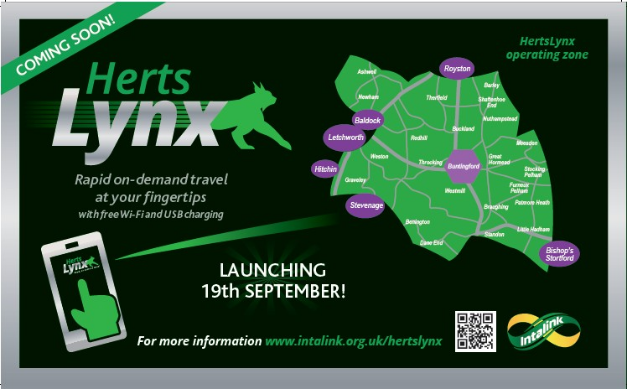
Figure 1: HertsLynx ‘coming soon’ publicity graphic
The pre-launch campaign ran from August to mid-September, ahead of a 19 September launch date, comprising:
- billboards and ad-vans displaying the ‘Coming Soon’ concept in strategic locations across the operating zone
- promotional ‘roadshows’ over 2 weeks, where the team showcased the vehicles and engaged with residents
- a leaflet drop to all residents within the operating zone
- an official press release
- advertisements in the press and online
- engagement on social media
- engagement with local and district councils and schools
A promotional video was also created
Post-launch
Numerous marketing campaigns have been launched using a variety of communication methods.
Roadshows have a been a staple of the marketing campaigns, targeting the service’s ‘Key Hub Towns’, and have proved popular. Team members attend each town throughout the summer and promote the service with leaflets and printed user guides. They allow the HertsLynx team to have direct interaction with the public and answer any questions or concerns they may have. There has been a direct correlation between the frequency of in-person engagement events and increased app registrations. On most occasions, a bus is taken along to showcase the vehicle and attract more engagement from residents.
Passenger satisfaction surveys are used regularly to obtain feedback from HertsLynx users. They are promoted through Hertfordshire County Council’s corporate communications and social media channels. The surveys also provide an opportunity to increase awareness of the service to residents who may not have used it before.
When there is a change to the service, users of the service are emailed via the GOV.Notify system. Users can also be informed of upcoming promotions and events, subject to their marketing preferences. The HertsLynx and Intalink websites are used to share news and articles about the service. In-app notifications send out urgent messages or direct customers to campaigns.
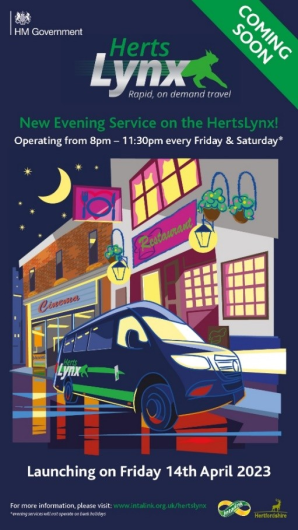
Data from digital marketing can be used to understand the reach and benefits of each marketing approach – for example, a Facebook post promoting the service in 2022 obtained the following engagement:
- 52083 impressions
- 849 engagements
- 1.6% engagement rate (per impression)
- 396 post link clicks
A further promotional video was also produced.
Stage 4: Reviewing and sustaining
This section looks at reviewing a DRT service after launch to ensure it is meeting its aims. It considers how data and feedback can help and identifies areas that may need adjustment for the service to reach its potential. Potential changes may include stopping places, the area of operation, or even switching to a fixed route where this has become the most viable option. It also emphasises the need for ongoing targeted marketing.
Even with the tools available to help plan the initial DRT service, and community engagement, it is unlikely that the scheme as launched will be exactly right. In some cases, this may be because there is no existing service and the journeys people make turn out to be quite different from those it had been expected they would make.
Experience from the RMF trials has shown that providing a DRT service can uncover new demand that could not be anticipated as the journey was not one that could previously have been made. Demand may be more, or indeed less, than expected in certain areas at times of day. Areas beyond the designated operating zone may want to benefit from the service. Some stops may need to be added or removed. All these factors demonstrate that a scheme requires constant reassessment to function at its best. Some local authorities are now at the stage of retendering as their initial contract expires and feel able to specify better in the tender what they now require.
Using data
Digital DRT schemes are capable of generating significant volumes of data. This can give local authorities far more information about travel patterns and demand in their area than they would have had before. While some of this can be used to monitor services in real time, it can also help authorities to understand who is using the service and how. It is not only important that authorities can access this data, but that they have the capacity and capability to interpret it and react to it. Patterns of demand can emerge early in a scheme’s life. Some changes can be made relatively quickly, for example, altered deployment of vehicles and positioning of virtual stops.
The volume of data may feel forbidding to some authorities, especially if they have not operated a DRT scheme before. They may find it useful to identify and focus on some key metrics which give a clear indication of how the scheme is performing and where adjustments might be needed.
Cost
Authorities will need to determine a cost measure for monitoring how a scheme is performing against its budget. A simple measure is cost per passenger journey. This can vary significantly. Ideally, the cost per passenger journey should fall over time as the scheme becomes busier, aggregation improves and the level of empty running reduces.
Call centre
Experience from the RMF and other schemes indicates that while the number of bookings taken by phone may initially be high, it falls away over time. Authorities may wish to track this trend and consider how they can encourage increased app usage. New users may value the ability to talk to an assistant as they get used to booking their journey but this engagement can also enable staff to demonstrate how the app can be used to book further journeys.
Social value
Local authorities may decide to calculate and attribute a social value to the scheme. The work done on the social value of bus services and published through the Bus Centre of Excellence will be of use here.
Review points should be built into the contract with the providers to ensure the scheme is reaching its targets. It may be that progress is in line with expectations, but the data should be reviewed to look for areas of success that can be developed further, lessons that can be learned, and any areas requiring improvement. Authorities should consider:
- what changes in land use are taking place – for example, a new housing development or new employment site
- whether changes are being made to local bus services that may require adjustments to the DRT service as a consequence
One important question may be to ask whether the stopping places are in the best place for people to use them, and whether virtual stops can be removed or new ones added. Authorities should also consider running a user survey to gauge passenger satisfaction.
Drivers can also be a good source of information about how the service is working. They can use their operating experience to feedback on matters such as the suitability of stopping places, unmet needs and areas for improvement. Some operators of DRT have found it useful to establish regular meetings with drivers to capture this.
Clear patterns may emerge as bookings aggregate and people settle into a pattern of travel. Local authorities may wish to consider registering some journeys as fixed where the pattern is particularly clear – for example, where the service allows home to school transport or there is an obvious peak-time commuter demand to a railway station. Information about the most popular virtual stops could inform the establishment of fixed stops over time. Another approach is to move towards a semi-fixed service which runs regular timetabled journeys but allows a degree of variation from the route.
Other areas that the authority may want to keep under review are operating hours and fares. Data may show that there are times when the service is not being well used and resources could potentially be reallocated. For example, a single vehicle may be all that is necessary at certain times and the resource released could be used to run the service later into the evening. Fares should be kept under review to ensure that the right balance is being struck between encouraging use and supporting the costs of the service so it remains sustainable.
While a scheme can be changed quickly, passengers may be deterred from using the service if changes are made too frequently and they become confused about what is and isn’t possible. Users need to remain clear about what the service offers. Any changes need to be clearly communicated and out-of-date publicity material removed.
Measuring success
As noted in stage 1, there is no single commonly held set of metrics by which to gauge success. Various metrics exist including:
- the empty running ratio - the number of miles the vehicle travels without passengers versus the mileage with passengers
- number of passenger journeys
- level of aggregation - number of passengers being carried at any single time
- cost per passenger
Where the DRT scheme is operating as a flexible bus service, the local authority will want to assure themselves that the 20-minute pick-up window set out in legislation is being met. Details are contained in section 7, part 3 of the Schedule to The Public Service Vehicles (Registration of Local Services) (Amendment) (England and Wales) Regulations 2004. Failure to meet the standard could potentially lead to enforcement action being taken by the Traffic Commissioners.
There are other potential measurements too, including the number of people living or working within an area served by DRT: this could translate into a measure of people able to access the service. Some local authorities have looked into developing their own metrics, including assessing the benefit cost ratio. East Sussex have calculated a BCR of over 3 (see case study). Other potential metrics include the level of subsidy per passenger journey.
Flexible bus services – enlarging the zone
Where the scheme is being delivered as a flexible bus service, changes within the zone of operation can be made at the discretion of the local authority. However, enlarging the operational zone of a flexible bus service requires a variation of the registration. In addition to the 28 days pre-notification period, 42 days’ notice needs to be given of the change (14 days where the service is operated under a section 22 community bus permit). Authorities should refer to the guide to registering and operating local bus services in England and Wales - GOV.UK. When increasing the zone of operation, care should be taken to ensure that service levels can be maintained and that the available resources are not being spread too thinly.
Changes in an enhanced partnership or franchised area
Where fixed service variation dates are established as part of an enhanced partnership (for example, coordinating changes to bus services with twice yearly rail timetable revision dates), they may wish to exempt or set an increased number of dates for flexible services so that DRT’s ability to adapt quickly is not compromised.
Revised franchising guidance will be published in the coming months.
Remarketing
As we saw in the ‘launching’ section, marketing the service is crucial and needs to be an ongoing process. For example, where a service carries students to colleges, further promotional activity at the start of new terms can attract additional passengers. A service that can appeal to tourists might benefit from promotional activity during the holiday season. Ticket promotions to encourage group travel may help to improve aggregation. One approach could be to target lapsed users with reduced price tickets to encourage them to try the service again.
A review of data could indicate that particular demographics, sectors or areas are underrepresented in using the service. This evidence can be used to identify barriers to using the service and where a proactive approach to marketing might be targeted.
Fixed route viability
Some trials have demonstrated that, owing to the increased knowledge about passenger demand from DRT and it re-establishing a public transport habit, a fixed route service has become viable. The service in effect acts as a catalyst for bus use and unlocks data about passenger demand that might otherwise have remained hidden. New housing developments may increase the population density and change the demand for services. Based on the evidence, local authorities may want to consider whether a fixed route model has become better suited to future needs. They will need to consider how easy it is to exit from a contract or whether they can redeploy the resources to another area.
Individual circumstances will determine whether a fixed route service becomes a better option, but interrogation of data will help with this. Factors to take into account include:
- clear flows of passengers between specific points
- clustering of journey departure times
- changes in workplace, education or housing
- changes in cost per passenger
However, it may be that the continued flexibility and scope of a DRT service is preferred to ensure that a service remains available to the greatest number of local residents.
Changing providers
Another factor to consider is the need to re-let contracts periodically. The market for DRT is a competitive one, with new products emerging that may not have been available when the initial contract was let. Dissatisfaction with the provider, changes to the scheme’s scope or simply a more competitive bid at renewal may lead the local authority to decide to change suppliers of one or more parts of the scheme.
There are few examples currently of schemes changing provider but this is likely to become more common over time. Local authorities will need to think about how such a change can be carried out with the minimum impact to passengers and what happens to existing data – for example, who owns and continues to have access to historical data.
In some cases, there has been a hiatus in the service for a few days while a changeover of vehicle operator takes place. Passengers may need to get used to a new app and have to re-enter personal data. The characteristics of the service may also change with the use of different algorithms. The evidence base for this is limited but growing and we hope to expand on this in future.
Assessing and adapting - West of England Combined Authority (WECA)
WECA started off with 2 large zones covering the north and the south of the area - with an additional smaller future of transport funded zone around the north of Bristol.
Such large zone sizes meant passengers were often making long journeys and aggregation was difficult. Consequently, there were many unfulfilled bookings and some passenger and local resident dissatisfaction.
WECA reviewed their system and made substantial changes. This included splitting the operating area into multiple zones rather than just the initial 2. This led to increased aggregation rates, higher booking fulfilment rates and improved customer satisfaction. They also changed the set-up for part of the area, whereby the tech provider was contracted to provide the software, vehicles and drivers.
This involved switching to using private hire vehicles (PHVs) for part of their service. They initially did this in the Future Transport Zone area, before extending the approach more widely. Some PSVs are retained, primarily to transport school children.
The software provider has been overseeing the switch in the former northern zone, using PHV vehicles and operating under section 12 of the Transport Act using a special restricted operator’s licence (SROL). Using an SROL also enables these vehicles to stop at bus stop clearways where they might otherwise be restricted.
WECA has found that this approach allows the number of vehicles to be better matched to demand.
These adjustments demonstrate the need for local authorities to be able to assess whether a scheme has met its objectives, how it is performing and whether changes are needed.
Key points
-
Decide on metrics to help determine whether a scheme is meeting its aims.
-
Use the available data to inform decisions.
-
Think about how the scheme could be improved, be it through changes to fares, area of operation etc.
-
Listen to passengers’ views.
-
Consider whether any remarketing is appropriate.
Acknowledgments and feedback
We would like to express our gratitude to all those who have contributed to the development of this guidance including software providers and local authorities. Our particular thanks to the local authorities in the DRT Advisory Group, whose willingness to share knowledge, information and template examplars, partake in group and individual discussions and review content, has been so important to the development of the guidance.
The guidance will be updated periodically to take account of further research, legislative and technological changes and user feedback.
Comments on this guidance should be sent to drt@dft.gov.uk.
Legal status of guidance
This guidance is not a definitive statement of the law. Any decisions made by a local authority remain a matter for that authority. It is not statutory guidance and the law takes precedence. The department is not responsible for interpreting the law – that is a matter for the courts – and authorities will need to seek their own legal advice on issues that are particularly relevant to them. It should be read in conjunction with other guidance on matters such as franchising, enhanced partnerships, accessibility and community transport.