Data investment in the UK, 2024
Published 31 March 2026

© Crown copyright 2026
This publication is licensed under the terms of the Open Government Licence v3.0 except where otherwise stated. To view this licence, visit nationalarchives.gov.uk/doc/open-government-licence/version/3 or write to the Information Policy Team, The National Archives, Kew, London TW9 4DU, or email: psi@nationalarchives.gov.uk.
Where we have identified any third party copyright information you will need to obtain permission from the copyright holders concerned.
This publication is available at https://www.gov.uk/government/publications/data-investment-in-the-uk-2024/data-investment-in-the-uk-2024
Executive summary
This report estimates the total value of data investment in the UK economy in 2024, covering the time series from 2009 to 2024. It builds on previous work to estimate data investment in both the market and non-market sectors between 2012 and 2020 in Data, intangible capital, and productivity: literature review, theoretical framework and empirical evidence on the UK. The report estimates a time series for data investment in the public sector for the first time.
Key Findings
- Total data investment in the UK economy is estimated at £287 – 303 billion in 2024, equivalent to approximately 11 – 12% of UK Gross Value Added (GVA)
- Total data investment has grown from 9 – 10% of GVA in 2009 to 11 – 12% in 2024
- Total data investment has grown in real terms from £157 – 178 billion in 2009 to £287 – 303 billion in 2024, a compound annual growth rate between 3.6 – 4.1% per year
- The Information and Communication (J), Professional, Scientific and Technical (M) and Manufacturing (C) industries account for about 45% of total investment , this does not vary much year on year
- Data investment in the public sector is estimated at £47 – 48 billion in 2024, representing 16% of total data investment and 2% of UK GVA
- Data investment in the public sector has lagged data investment in the broader economy slightly, with a compound annual growth rate between 2.8 – 4.0% per year between 2009 and 2024, this can be divided into two periods: 2009 to 2018 where it grew 0 – 1.3% per year, and 2019 to 2024 where it grew 8.5 – 9.3% per year
- Data investment in the public sector is dominated by Public Administration and Defence (O), Education (P), and Health and Social Work (Q), which together account for around 84% of public sector data investment, growing from about 76% in 2009
- Data investment is less impacted by economic downturns than other forms of investment, which tend to be reduced
1 Introduction
The value of data investment in the UK economy is indicative of the strength of the data-driven market in the UK (The UK Data Driven Market, 2024). Increasing the domestic share of data investment in the UK is also crucial for leveraging data to boost productivity (Data, intangible capital, and productivity: literature review, theoretical framework and empirical evidence on the UK, 2024). Understanding changes in data investment in the UK over time is also a useful benchmark to understand whether access to data and data skills across the UK are changing.
This report continues the approach outlined in Data, intangible capital, and productivity: literature review, theoretical framework and empirical evidence on the UK, (2024) to estimate the total value of data investment in the UK in 2024 (the most recent year the relevant information is available for). It also estimates the value of data investment at an industry level and, for the first time, estimates the specific amount of data investment in the UK public sector over time. This builds on similar work in the DSIT Value of public sector data estimate that provided an estimate for public sector data investment of about £30 billion per year. For further details about the methodology see appendix A.
To maintain consistency with previous work this report will sometimes refer to the market and non-market sectors. For this purpose, the non-market sector is defined as industries Real Estate (L), Public administration and defence (O), Education (P), Human health and social work (Q), Activities of households as employers (T).[footnote 1] When this report refers to the public sector it is referring not to the non-market sector but specifically to employment in public sector organisations. For an example see figure 6 which highlights the spread of data investment across industries and the public sector. Similarly, any reference to the private sector will include portions of the non-market sector that are not public sector. For instance, most universities and independent schools in the Education (P) industry.
The report is structured as follows. In section 2 the background to valuing data investment is discussed. Section 3 provides estimates of the total value of data investment in the UK and in the market and non-market sectors. Section 4 looks specifically at the contribution of the public sector to data investment in the UK. Section 5 presents results in terms of Gross Fixed Capital Investment (GFCF) in the UK economy. Section 6 presents results in terms of Gross Value Added (GVA) to the UK economy. Section 7 presents results in relation to the UK Modern Industrial Strategy 2025 key sectors. Finally, section 8 presents some high-level conclusions based on these estimates.
2 Background
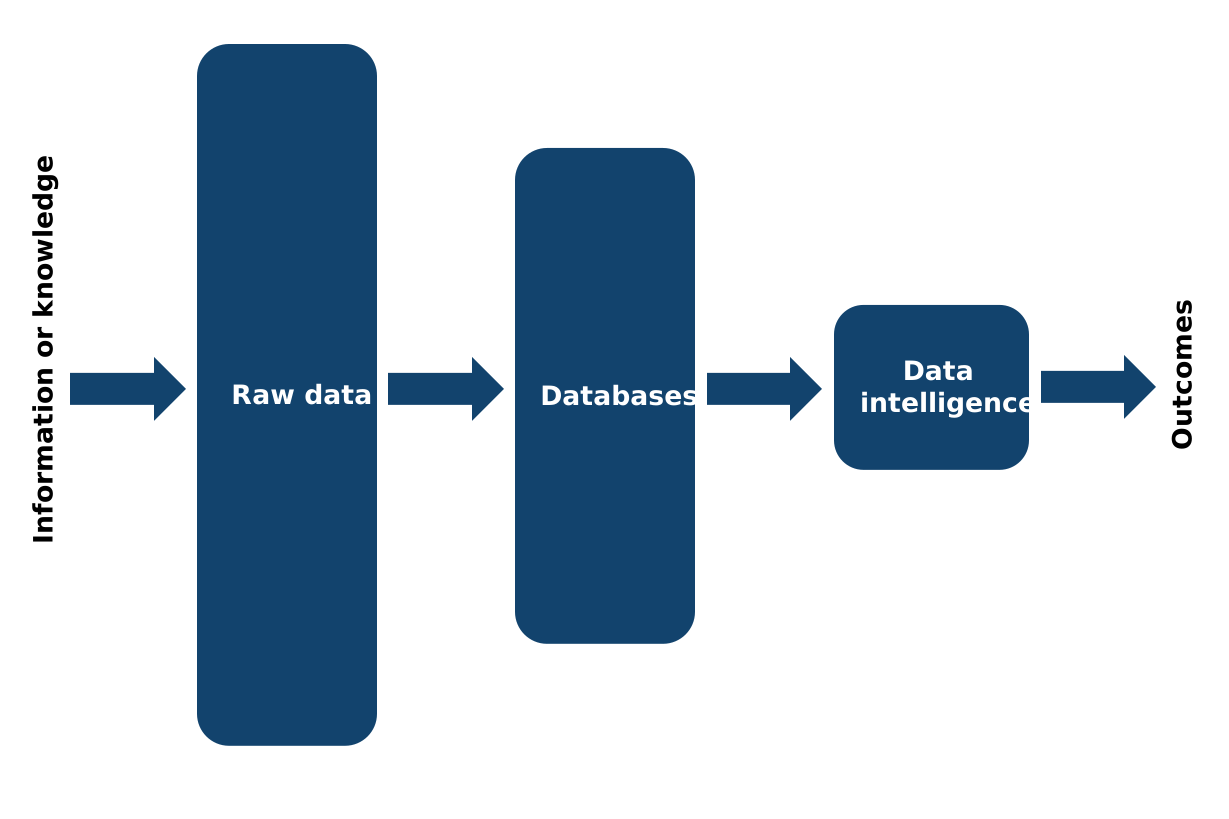
Business’ data investment can be divided into three types of data asset – raw data, databases and data intelligence. Raw data are data that have been collected, either manually or automatically, but not organised in any way. For example, the results of a customer survey or feedback, website traffic data, or data from machine sensors. This can be transformed into databases. Databases are data that are organised and tidied so that they can be analysed or more easily joined with other data. For example, an Excel spreadsheet containing rows and columns of survey data, or a database. This can then be transformed into data intelligence (or analysis). Data intelligence are the insights from data that can be used to inform business outcomes. For example, the percentage of customers who bought a particular product after seeing advertising, or a chart showing changes in supply and demand of warehouse stock. The business outcomes that might arise from such data intelligence include better decision-making, business efficiencies, or the development of new products and services.
This concept of raw data, databases and data intelligence is called the data value chain, and you can see a visual representation in figure 1. It is possible for businesses to monetise the data assets they create at any stage of the data value chain, and businesses may purchase any of these assets too. In general, the value of data assets increases as you transform them from raw data to databases and to data intelligence.
Figure 1: the data value chain
From an economic and business perspective each of these types of data asset have value, and it is the value of whole chain that is relevant to this report.
The published series of national accounts capture part of this data value chain in the economy. Elements currently missing from national accounts include raw data, and some data intelligence. Table 1 highlights how various intangible investment relate to data and which are captured in national accounts. It is a scheme outlined in Data, Intangible Capital and Productivity, 2024.
Table 1: Intangible investment, major categories and asset types
| Investment by asset type | Category of data | Is it captured in national accounts? |
|---|---|---|
| Raw data | Digitized information | No |
| Software | Digitized information | Yes |
| Databases | Digitized information | Yes |
| Research and development (R&D) | Innovative property | Yes |
| Mineral exploration | Innovative property | Yes |
| Artistic, entertainment and literary originals | Innovative property | Yes |
| Attributed designs (industrial) | Innovative property | No |
| Financial product development | Innovative property | No |
| Brand and market research | Economic competencies | No |
| Business process and organisational practices | Economic competencies | No |
| Employer-provided training | Economic competencies | No |
There are various methods for valuing data (e.g. Coyle and Manley, 2024, What is the Value of Data? A review of empirical methods). The most straightforward way to estimate the portion of data investment that is not captured in national accounts is to use a sum of costs approach. The sum of costs approach is used because most businesses are using data created by themselves in house. This is calculated using estimates of the amount of time employees (and sole traders) in occupations related to data asset creation spend creating data assets, combined with data on how much it costs businesses to employ them and how many people there are in such occupations.
It is possible to estimate the portion of data investment that can be attributed specifically to the public sector by using the same calculation as above, but only including those who are employed, or work in, the public sector.
For the purposes of this report, data investment is defined to encompass the categories listed in table 1, above.
In practical terms this means data investment includes, from national accounts:
- Purchased software and databases
- R&D (purchased and in-house)
- Mineral exploration (purchased and in-house)
- Artistic, entertainment and literary originals (purchased and in-house)
From time spent in-house creating data assets in relevant occupations:
- Creation of raw data (excluding R&D occupations in R&D sector)
- Creation of databases (excluding R&D occupations in R&D sector)
- Creation of data intelligence (excluding R&D occupations in R&D sector)
This report uses data on wages and employment from the ONS Annual Survey of Hours and Earnings and data on time spent by employees on data asset creation from the DSIT Business data use and productivity study (wave 1) to estimate this data investment. Intellectual Property Products that are measured directly in national accounts, such as purchased software and databases and Research and Development (R&D), are included directly in the sum of costs. These are in addition to the estimates from time spent creating data assets. To avoid double counting some R&D occupations are excluded from the estimates based on time spent creating data assets.
To make the estimates of in-house creation of data assets consistent with national accounts blow-up factors are used to account for intermediate consumption, taxes and subsides that are not otherwise captured in the sum of costs approach.
One limitation of the current analysis is that the estimates of time spent of data-related tasks were collected through a single snapshot in the 2022 – 2023 Business data use and productivity study (wave 1). Ideally these would be extended both forward and backward in time so that data creation is not overestimated in the past and, potentially, underestimated in the future.
The sum of costs approach will not capture efficiencies such as automation or the use of AI. These would correspond to a reduction in the (cost-based) value of data investment. Such efficiencies are likely to change the composition of the work force and the types of data assets being created. For instance, more time being spent on creating data intelligence. This contributes further to the need to measure time spent on in-house data asset creation at a future date.
More information on the methodology and limitations can be found in appendices A Methodology and B Limitations and caveats. A list of all the occupations included in the analysis can be found in appendix C Lists of data-related occupations and time use factors.
3 Total data investment in the UK
Total data investment across the UK economy in 2024 is estimated at £287 – 303 billion (11-12% GVA) in nominal prices for 2024. There has been 70 – 82% real terms growth from 2009 to 2024. This is equivalent to a real terms compound annual growth rate between 3.6 – 4.1% per year.
Ranges in estimates were calculated by using two different estimates of the time employees in data-related occupations spend creating data assets. The lower end of the range is based on baseline assumptions from Data, Intangible Capital and Productivity, 2024. The upper end of the range is based on survey estimates from the DSIT Business data use and productivity study (wave 1).
Approximately 85% of data investment in the UK is generated through in-house creation of data assets in business, the remaining 15% is purchased. This assumes that approximately three quarters of R&D investment is generated in house and this is combined with the estimates for in-house data asset creation calculated through the sum of costs approach.[footnote 2]
Table 2 and figure 2 show the breakdown of investment across different industries in the UK (as defined by the 2007 Standard Industrial Classification codes). Figure 2 highlights which industries are considered part of the market and non-market sectors. The non-market sector is made up of Real Estate (L), Public administration and defence (O), Education (P), Human health and social work (Q), Activities of households as employers (T).[footnote 1]
Table 2: Data investment in the UK in 2024, by industry, nominal prices
| Industry | Data investment (£ million) |
|---|---|
| Agriculture, Forestry, Fishing (A) | 360 - 440 |
| Mining, Energy, Water (B D E) | 8,400 - 8,600 |
| Manufacturing (C) | 47,000 - 48,000 |
| Construction (F) | 11,000 - 11,000 |
| Wholesale and retail; repair of motor vehicles (G) | 21,000 - 24,000 |
| Transportation and storage (H) | 7,400 - 7,400 |
| Accommodation and food services (I) | 1,500 - 1,800 |
| Information and communication (J) | 40,000 - 46,000 |
| Financial and insurance (K) | 27,000 - 27,000 |
| Real estate (L) | 2,800 - 3,100 |
| Professional, scientific, technical (M) | 42,000 - 43,000 |
| Administrative and support services (N) | 11,000 - 13,000 |
| Public administration and defence (O) | 21,000 - 21,000 |
| Education (P) | 26,000 - 27,000 |
| Human health and social work (Q) | 12,000 - 14,000 |
| Arts, entertainment and recreation (R) | 3,800 - 4,100 |
| Other service activities (S) | 4,100 - 4,300 |
| Activities of households as employers (T) | 6.7 - 21 |
| Market sector | 220,000 - 240,000 |
| Non-market sector | 61,000 - 64,000 |
| Total | 290,000 - 300,000 |
Notes: Industries and sectors may not sum to total due to rounding. Total here differs from table 3 due to rounding differences.
Figure 2: Data investment in the UK in 2024, by industry, nominal prices
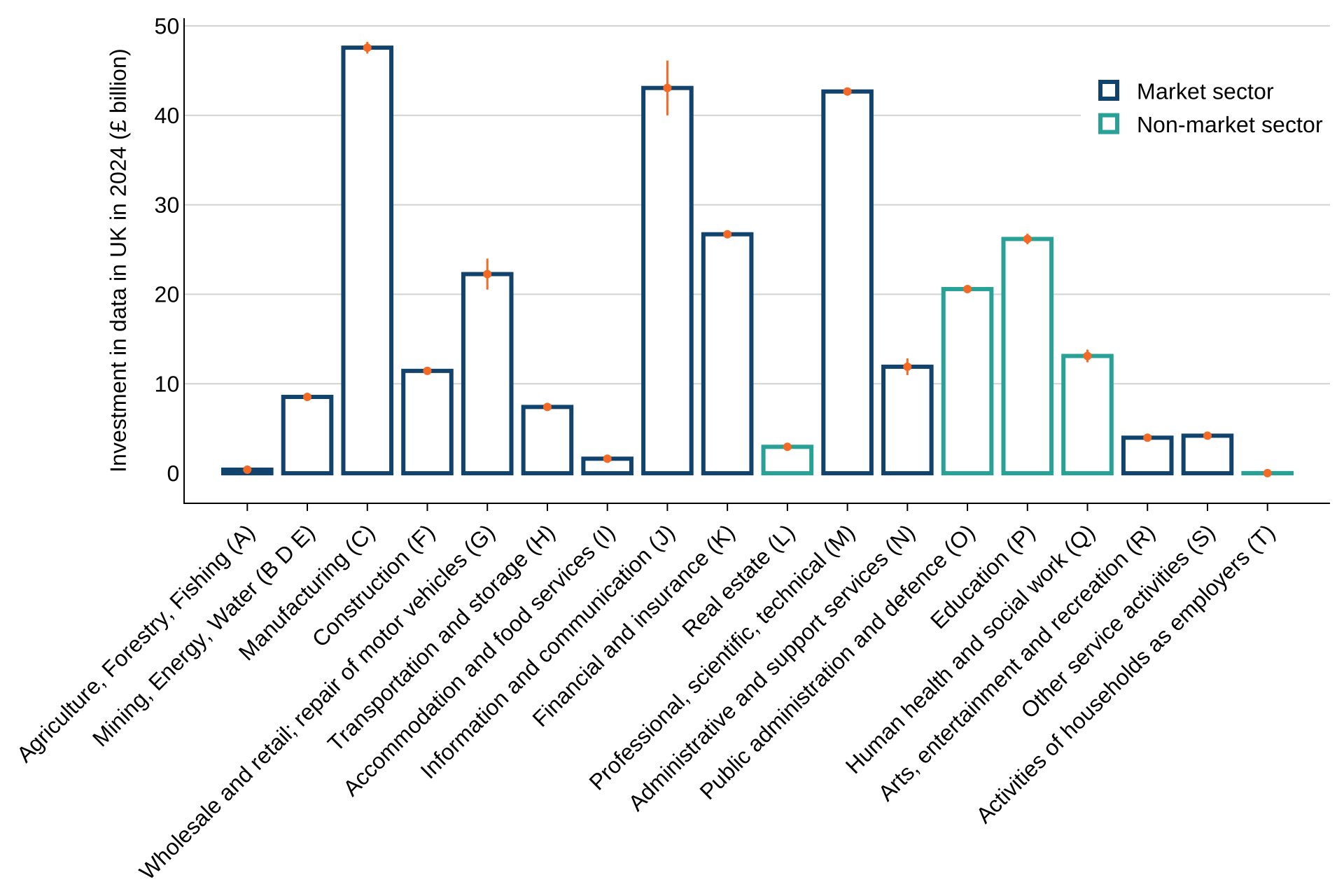
Note: estimates presented are mid-points of ranges in table 2, with orange markers indicating ranges
The Information and communication (J), Professional, scientific, technical (M) and Manufacturing (C) industries contribute the most to data investment across the economy (about 45% of the total investment). This is true across all years included in the estimates presented in this report.
The specific value estimated for each industry is dependent on the list of occupations included in the estimates (see appendix C Lists of data-related occupations and time use factors for all the roles included). It is possible that this leads to an underestimate of value for certain industries if some relevant occupations are missed. For instance, it is possible that many more roles in the Human health and social work (Q) industry are involved in recording and updating medical records than is currently captured and this would be a key component of the valuable data captured within that industry.
Table 3 and figure 3 show how data investment has changed over time since 2009.
Table 3: Data investment in the UK since 2009, nominal prices
| Year | Market (£ billion) | Non-market (£ billion) | Total (£ billion) |
|---|---|---|---|
| 2009 | 102 - 113 | 25 - 29 | 127 - 142 |
| 2010 | 103 - 114 | 28 - 32 | 131 - 145 |
| 2011 | 114 - 120 | 30 - 34 | 144 - 154 |
| 2012 | 118 - 125 | 30 - 33 | 148 - 159 |
| 2013 | 123 - 131 | 31 - 35 | 154 - 166 |
| 2014 | 129 - 138 | 33 - 36 | 162 - 174 |
| 2015 | 132 - 141 | 34 - 37 | 166 - 178 |
| 2016 | 140 - 150 | 35 - 38 | 174 - 187 |
| 2017 | 147 - 158 | 36 - 39 | 183 - 197 |
| 2018 | 154 - 166 | 38 - 42 | 193 - 208 |
| 2019 | 163 - 175 | 40 - 43 | 204 - 218 |
| 2020 | 170 - 180 | 43 - 46 | 212 - 226 |
| 2021 | 185 - 195 | 48 - 50 | 233 - 245 |
| 2022 | 197 - 207 | 51 - 54 | 249 - 262 |
| 2023 | 221 - 234 | 59 - 62 | 280 - 297 |
| 2024 | 225 - 239 | 61 - 64 | 287 - 303 |
Figure 3: Data investment in the UK since 2009, nominal prices
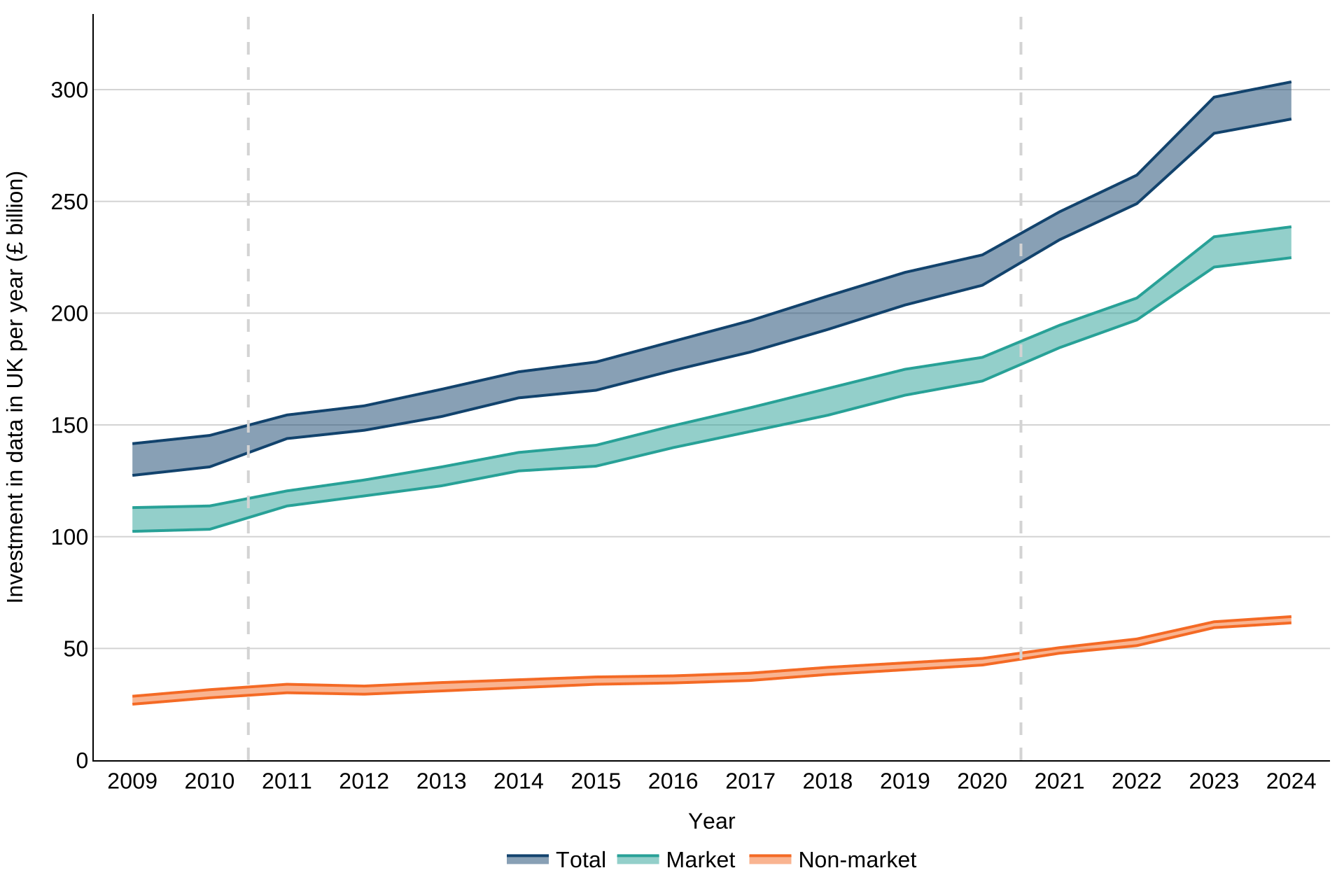
Note: vertical dashed lines indicate when standard occupational classification codes changed, for implications of this see appendix B Limitations and caveats
Figure 3 shows that the non-market sector is a relatively consistent 20 – 22% of the total value of data investment per year. This is a somewhat higher share than measured in Data, intangible capital, and productivity: literature review, theoretical framework and empirical evidence on the UK, (2024). The difference is likely due to changes in estimates of intellectual property products in national accounts (Business investment in the UK revisions in Blue Book, 2025). There appears to be a growth in investment with time. Using published ONS deflators for intangible assets up to 2018 (Deflators for intangible assets, UK: 1997 to 2018) and implied or estimated deflators for 2019 to 2024 it is possible to look at the real terms growth between 2009 and 2024. These are shown in table 4 and figure 4, below. See appendix A.1 Calculating current prices for more details on the methodology.
Table 4: Data investment in the UK, 2009 – 2024, 2024 constant prices
| Year | Market (£ billion, 2024 prices) | Non-market (£ billion, 2024 prices) | Total (£ billion, 2024 prices) |
|---|---|---|---|
| 2009 | 126 - 142 | 32 - 37 | 157 - 178 |
| 2010 | 127 - 142 | 35 - 40 | 162 - 182 |
| 2011 | 139 - 149 | 38 - 43 | 177 - 192 |
| 2012 | 145 - 156 | 37 - 42 | 181 - 197 |
| 2013 | 150 - 163 | 39 - 44 | 189 - 206 |
| 2014 | 159 - 171 | 41 - 45 | 200 - 216 |
| 2015 | 162 - 175 | 42 - 47 | 204 - 222 |
| 2016 | 171 - 184 | 43 - 47 | 213 - 231 |
| 2017 | 177 - 191 | 43 - 48 | 220 - 239 |
| 2018 | 183 - 198 | 46 - 50 | 228 - 248 |
| 2019 | 188 - 203 | 47 - 51 | 234 - 253 |
| 2020 | 190 - 204 | 48 - 52 | 239 - 256 |
| 2021 | 202 - 215 | 53 - 56 | 256 - 271 |
| 2022 | 207 - 219 | 54 - 57 | 262 - 277 |
| 2023 | 224 - 238 | 60 - 63 | 284 - 302 |
| 2024 | 225 - 239 | 61 - 64 | 287 - 303 |
Figure 4: Data investment in the UK, 2009 – 2024, 2024 constant prices
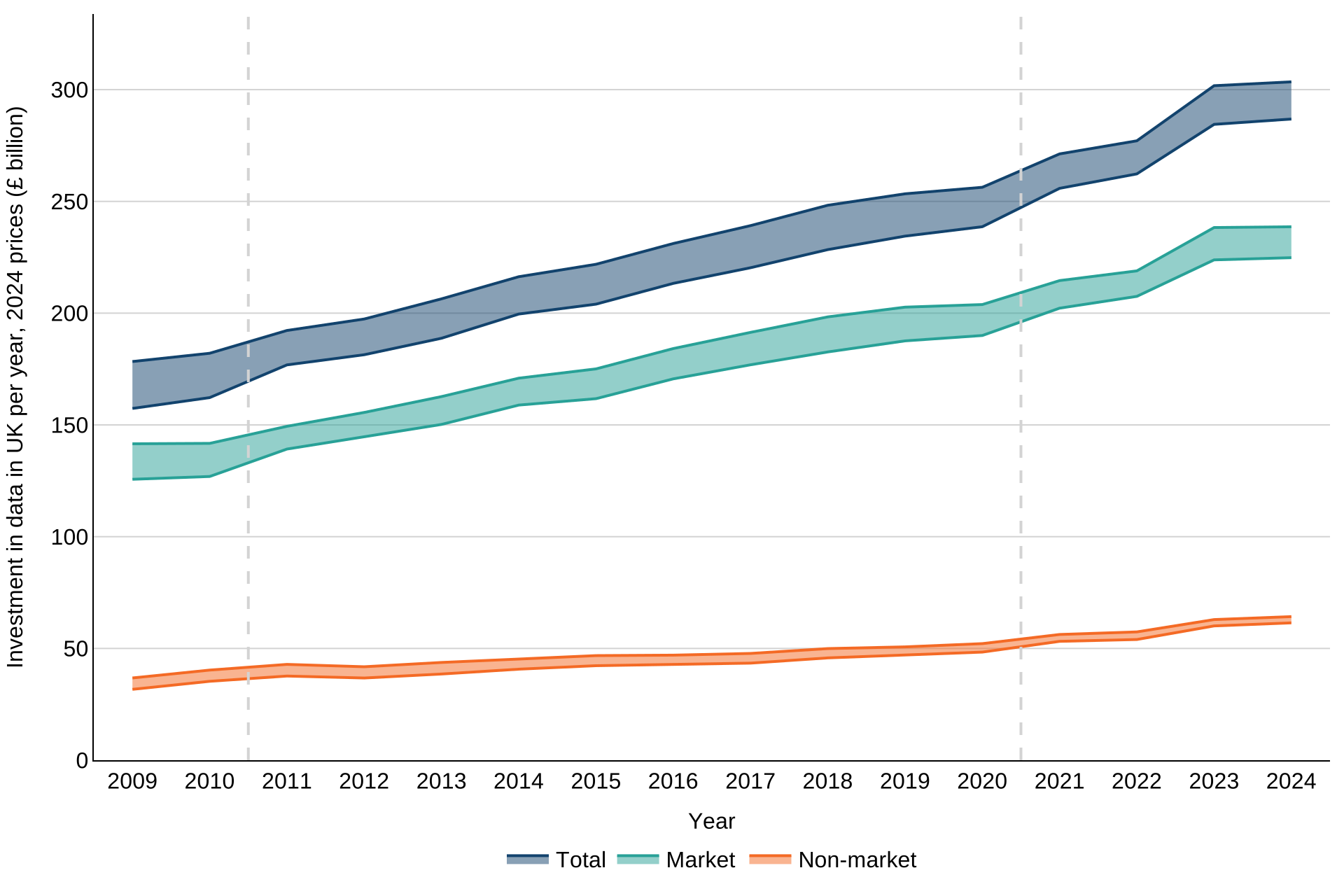
Note: vertical dashed lines indicate when standard occupational classification codes changed, for implications of this see appendix B Limitations and caveats
Table 4 and figure 4 show there has been 70 – 82% real terms growth from 2009 to 2024 in total data investment in the UK – a compound annual growth rate between 3.6 – 4.1% per year. There has been similar growth (69 – 79%) in the market sector over the same period. The non-market sector has grown between 75 – 94% in real terms over the same period. Section 5 Data investment as a portion of total UK investment and Section 6 Data investment as a portion of UK GVA will provide some estimate of growth relative to broader investment and economic output.
This report relies on the standard occupational classification (SOC) system designed by ONS. It should be noted that this classification system changed between 2010 and 2011 (from SOC 2000 to 2010) and between 2020 and 2021 (from SOC 2010 to 2020). Relevant occupations are listed in appendix C Lists of data-related occupations and time use factors. Changes between SOC codes could lead to some discontinuity in the time series at these points points if a revised set of relevant occupations is used for each classification period. To avoid this, occupations were mapped from SOC 2010 to SOC 2000 and 2020 using look up tables published by ONS (Relationship between SOC 2010 and SOC 2000, Relationship between SOC 2010 and SOC 2020). Mapping ensures a smooth transition across SOC changes. The disadvantage of this approach is that it assumes tasks and roles are similar in newly created (or lost) occupations. This is less likely to be true as job roles evolve.
It is possible to look at the change in real terms data investment at the industry level, as seen in figure 5 below.
Figure 5: Data investment in the UK by industry, 2009 – 2024, 2024 constant prices
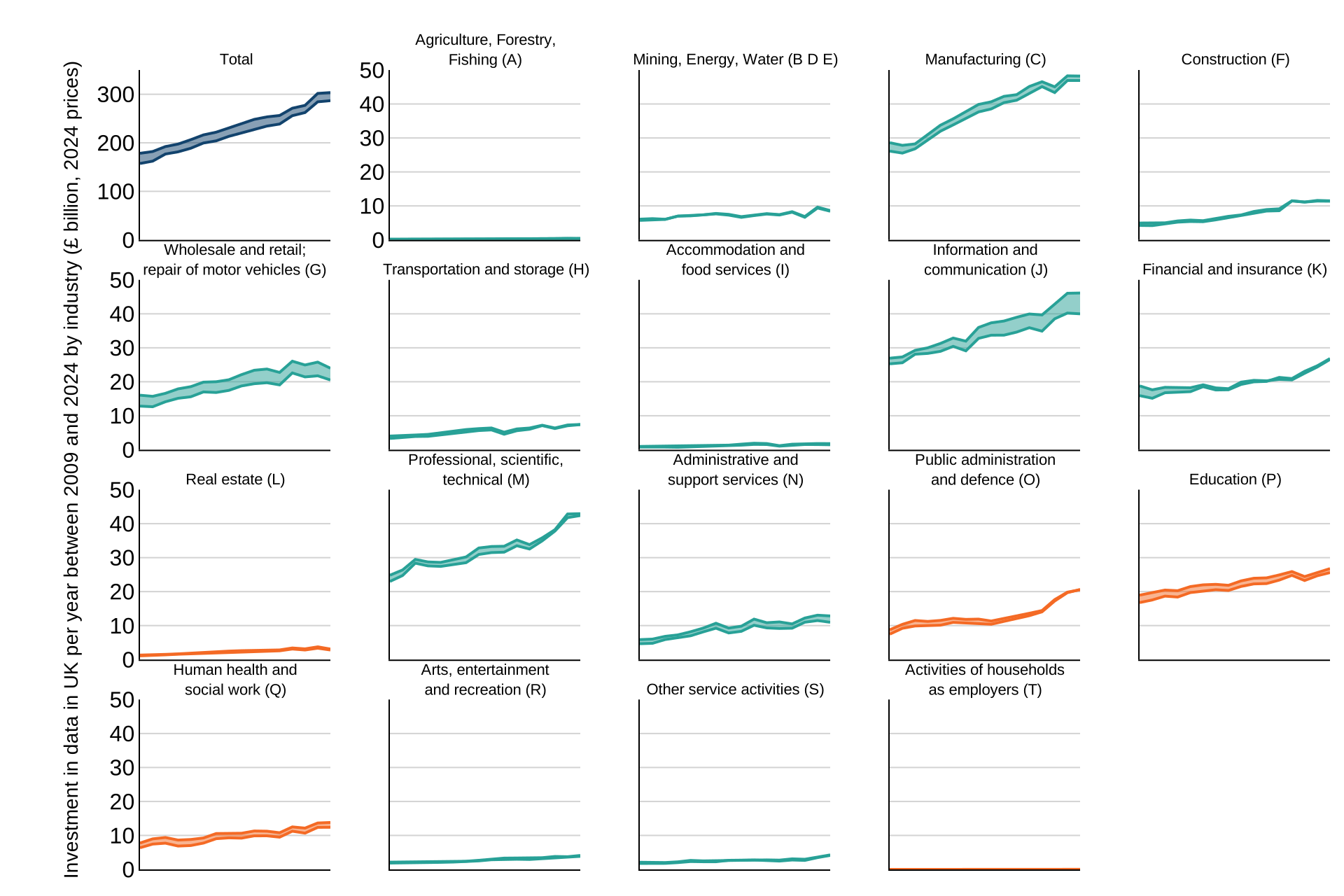
Note: estimates presented are based on upper limits, data are colour coded in the following way to aid visualisation – dark blue is total investment, light blue are industries in the market sector and orange are industries in the non-market sector – Real Estate (L), Public administration and defence (O), Education (P), Human health and social work (Q), Activities of households as employers (T).
There has been real terms growth in data investment across all industries. The growth is not evident in some industries presented in figure 5 because the overall level of investment is starting at a low level. A greater discussion of industry level growth can be found in section 6 Data investment as a portion of UK GVA.
4 Data investment in the public sector
Using the same approach as outlined in section 2 Background it is possible to estimate data investment in the public sector. Data investment in the UK public sector in 2024 is estimated at £47 – 48 billion (about 16% of total data investment and 2% GVA) in nominal prices for 2024. Real terms growth in data investment in the public sector from 2009 to 2024 is between 52 – 79%. This is equivalent to a compound annual growth rate between 2.8 to 4.0% per year. See appendix A Methodology for limitations of using the sum of costs approach to calculate estimates for the public sector.
The DSIT Value of public sector data estimate provides an alternative estimate of data investment in the public sector. It is slightly lower, estimating that the public sector invests £30 billion per year in data. It uses a similar sum of costs approach to this research, but relies upon specific estimates of time spent creating data assets in the public sector (ONS, 2024, Time use in the public sector, Great Britain). It also relies on published public sector employment and salary estimates. It includes more public sector professions in its time use calculations, but time use estimates are averaged across the public sector. It does not include blow-up factors to scale the result to be consistent with national accounts outputs. It does not include investment in intellectual property products (IPP) from national accounts. Some of these differences seem to average out at the economy-wide scale. If you exclude the IPP investment from the calculation of data investment here, it reduces the estimate to £31 – 32 billion, which is consistent with the estimate in the DSIT Value of public sector data estimate.
Figure 6, below, shows the breakdown of investment across different industries in the UK (as defined by the 2007 Standard Industrial Classification codes). The public sector contribution is calculated by considering public sector workers (see appendix A Methodology). Most of these workers will be in traditional non-market sector industries such as Public administration and defence (O), but some will be in market-sector industries such as Professional, scientific, technical (M).
Figure 6: Data investment in the UK public sector in 2024, by industry, nominal prices
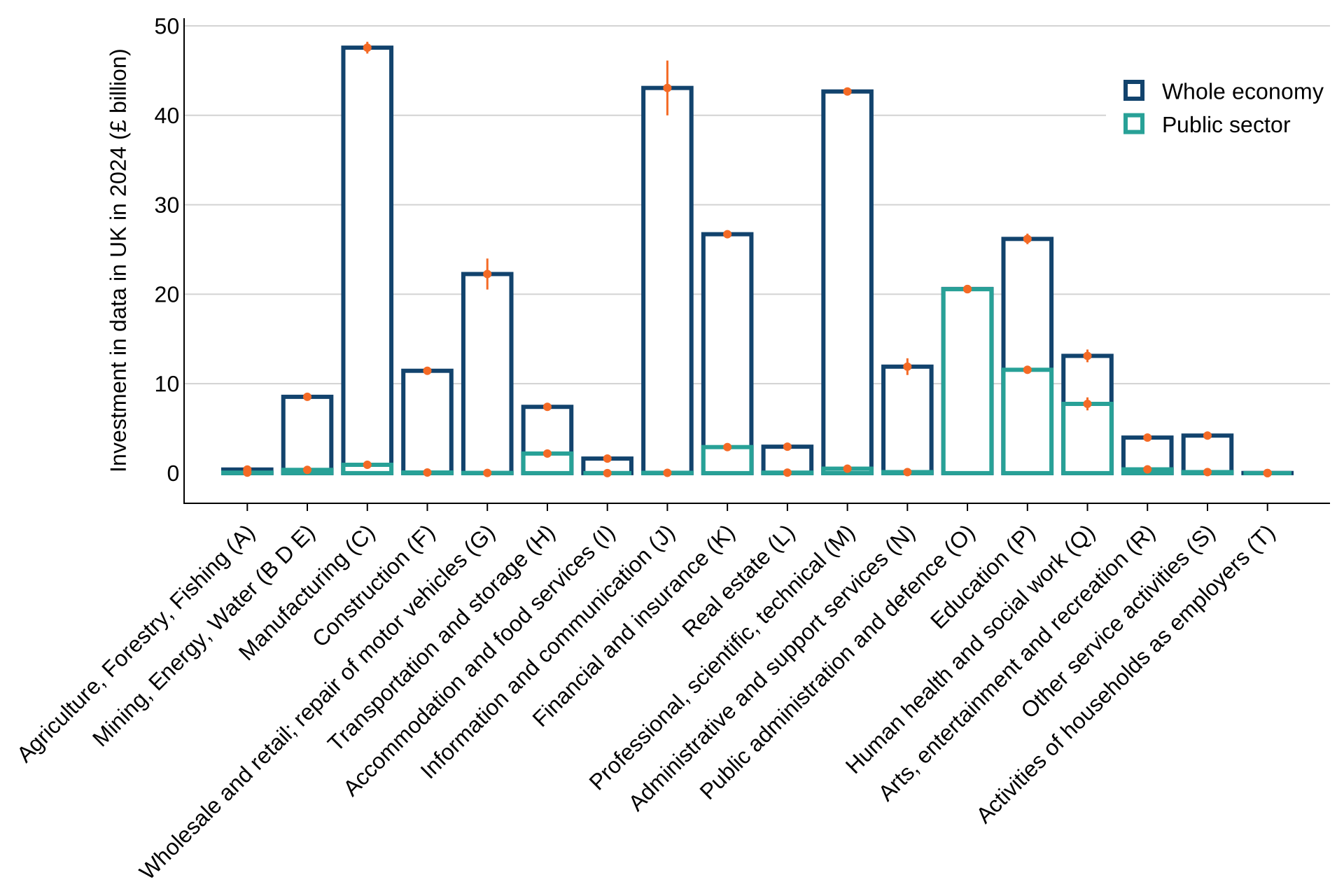
Note: estimates presented are mid-points of ranges, with orange markers indicating the ranges
As expected, data investment in the public sector is dominated by those industries most associated with the public sector, including Public administration and defence (O), Education (P) and Human health and social work (Q). For instance, about 84% of the total investment, with Public administration and defence (O) contributing about 43% alone. These have risen from 76% and 27%, respectively, since 2009. Note though, the comment in Section 3 Total data investment in data in the UK about the potential for certain industries to be underestimated if not all the relevant data-related occupations are included. The significant proportion of the Education (P) industry that is not public sector can be accounted for by universities and independent schools, which are not usually considered part of the public sector.
Table 5 and figure 7 shows how data investment has changed over time since 2009.
Table 5: Investment in data in the UK public sector since 2009, nominal prices
| Year | £ billion | % total investment |
|---|---|---|
| 2009 | 21 - 25 | 17% |
| 2010 | 23 - 27 | 18% |
| 2011 | 25 - 28 | 18% |
| 2012 | 23 - 26 | 16% |
| 2013 | 24 - 26 | 16% |
| 2014 | 23 - 26 | 15% |
| 2015 | 24 - 26 | 15% |
| 2016 | 24 - 26 | 14% |
| 2017 | 24 - 26 | 13% |
| 2018 | 25 - 26 | 13% |
| 2019 | 26 - 27 | 13% |
| 2020 | 29 - 30 | 14% |
| 2021 | 34 - 34 | 14% |
| 2022 | 36 - 37 | 14% |
| 2023 | 43 - 44 | 15% |
| 2024 | 47 - 48 | 16% |
Figure 7: Data investment in the UK public sector since 2009, nominal prices
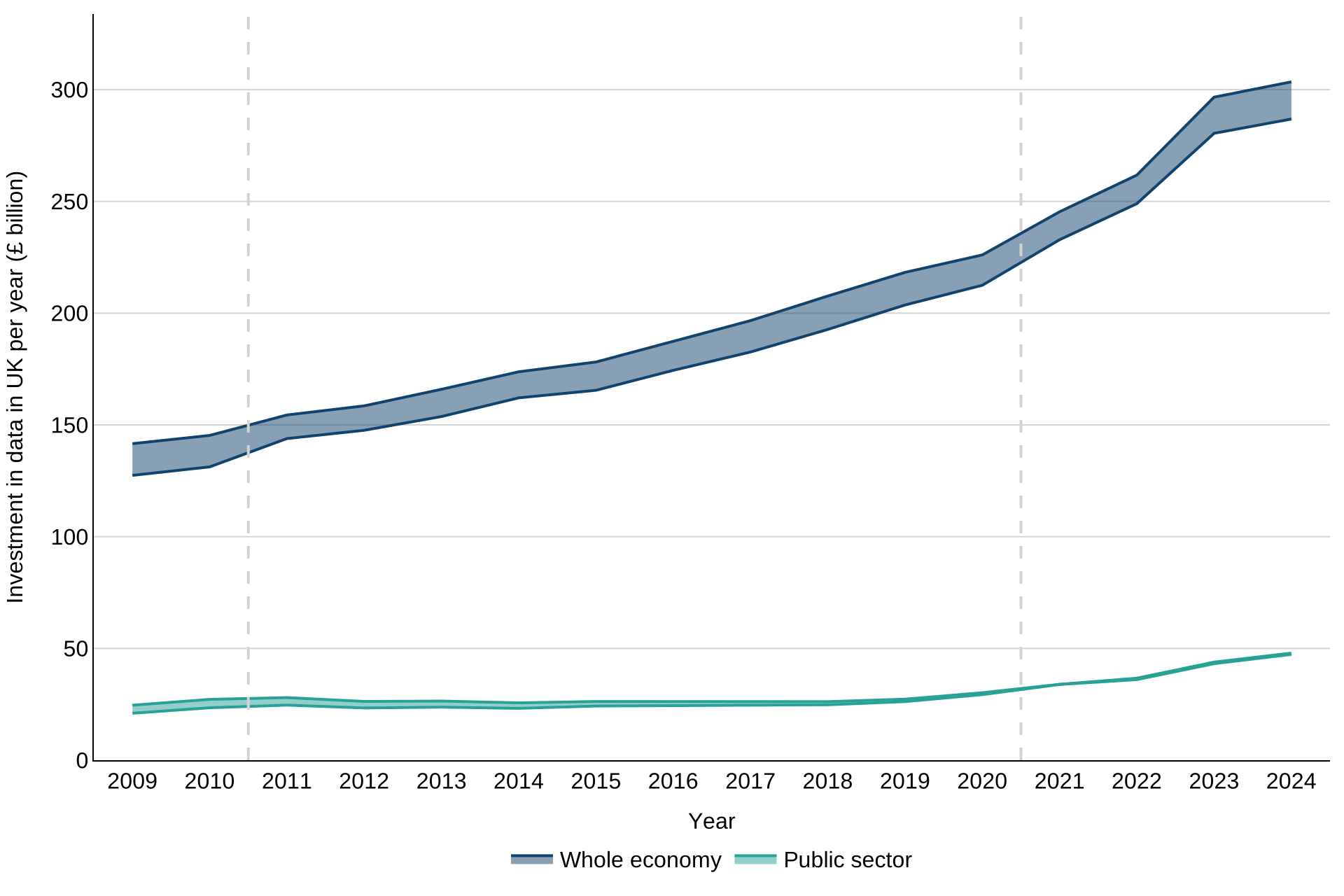
Note: vertical dashed lines indicate when standard occupational classification codes changed, for implications of this see appendix B Limitations and caveats
Similarly to table 4 and figure 4 for the whole UK economy, it is possible to assess whether there has been growth in real terms in the public sector, using the same deflators. Data investment in the public sector between 2009 and 2024 in 2024 prices, is shown in table 6 and figure 8, below.
Table 6: Data investment in the UK public sector, 2009 – 2024, 2024 constant prices
| Year | £ billion, 2024 prices | % total investment |
|---|---|---|
| 2009 | 26 - 32 | 17% |
| 2010 | 29 - 35 | 19% |
| 2011 | 31 - 35 | 18% |
| 2012 | 29 - 33 | 16% |
| 2013 | 29 - 33 | 16% |
| 2014 | 29 - 32 | 15% |
| 2015 | 30 - 33 | 15% |
| 2016 | 30 - 33 | 14% |
| 2017 | 30 - 32 | 13% |
| 2018 | 30 - 32 | 13% |
| 2019 | 30 - 32 | 13% |
| 2020 | 33 - 35 | 14% |
| 2021 | 37 - 38 | 14% |
| 2022 | 38 - 39 | 14% |
| 2023 | 44 - 45 | 15% |
| 2024 | 47 - 48 | 16% |
Figure 8: Data investment in the UK public sector, 2009 – 2024, 2024 constant prices

Note: vertical dashed lines indicate when standard occupational classification codes changed, for implications of this see appendix B Limitations and caveats
Table 6 and figure 8 suggest data investment in the public sector from 2009 to 2018 was stagnant, but with growth picking up from 2019 onward. The compound annual growth rate from 2009 to 2018 was between 0 – 1.3% per year, whilst from 2019 to 2024 it was between 8.5 – 9.3% per year. Over the full period from 2009 to 2024, real terms growth in data investment in the public is between 52 – 79%. This is equivalent to a compound annual growth rate between 2.8 – 4.0% per year. We see also from table 6 it represented a shrinking portion of total data investment in real terms until around 2019 when it started to grow again. When combined with the fact that total data investment has grown over the same period (see table 4). This suggests that data investment in the public sector had not kept pace with data investment in the wider economy, but there are signs that it has been catching up in recent years.
5 Data investment as a portion of total UK investment
A useful measure of investment across the UK economy is Gross Fixed Capital Formation (GFCF). It measures the net capital expenditure – acquisitions minus disposals – on fixed assets by producers over a period, including both tangible assets like machinery and buildings and intangible assets such as software and Research and Development (R&D). Using ONS annual gross fixed capital formation by industry and asset and gross fixed capital formation by sector and asset it is possible to calculate data investment as a portion of GFCF up to 2023. It is also possible to look at public sector-specific GFCF. 2023 is the latest year for which GFCF data has been published in the appropriate breakdowns.
As with national accounts more broadly (see section 2 Background) GFCF may not capture all data investment. GFCF typically misses the same assets as those listed as missing from national accounts in table 1. This is also seen in the industry level comparisons later in this section where the value of data investment calculated for a given industry may be greater than that industry’s GFCF. It is, nonetheless, instructive to compare data investment to overall GFCF. In 2023 the split of investment, as measured by GFCF, was 80% private sector versus 20% public sector. Total data investment across the UK economy in 2023 is estimated at 59 – 62 %GFCF. Data investment in the public sector in 2023 is estimated at about 45 – 46 % public sector GFCF (about 9% total GFCF).
Table 7 and figures 9 and 10 provide estimates of data investment across the whole economy and for the public sector compared to GFCF.
Table 7: Data investment in the UK since 2009 compared to GFCF
| Year | Total data investment / total GFCF | Public sector / total GFCF | Private sector / private sector GFCF | Public sector / public sector GFCF |
|---|---|---|---|---|
| 2009 | 51 - 57% | 8 - 10% | 56 - 62% | 34 - 40% |
| 2010 | 51 - 56% | 9 - 11% | 55 - 60% | 39 - 45% |
| 2011 | 55 - 59% | 9 - 11% | 58 - 62% | 43 - 49% |
| 2012 | 55 - 59% | 9 - 10% | 57 - 61% | 44 - 49% |
| 2013 | 54 - 58% | 8 - 9% | 56 - 60% | 46 - 52% |
| 2014 | 53 - 56% | 8% | 56 - 59% | 39 - 43% |
| 2015 | 50 - 54% | 7 - 8% | 52 - 56% | 40 - 43% |
| 2016 | 49 - 53% | 7% | 51 - 54% | 40 - 43% |
| 2017 | 48 - 52% | 6 - 7% | 50 - 54% | 37 - 39% |
| 2018 | 50 - 54% | 6 - 7% | 52 - 56% | 39 - 41% |
| 2019 | 50 - 54% | 6 - 7% | 52 - 56% | 39 - 40% |
| 2020 | 58 - 61% | 8% | 62 - 66% | 41 - 43% |
| 2021 | 58 - 61% | 8% | 61 - 65% | 44% |
| 2022 | 55 - 58% | 8% | 58 - 61% | 43% |
| 2023 | 59 - 62% | 9% | 62 - 66% | 45 - 46% |
Note: GFCF as a measure of total investment captures some but not all data investment, which means data investment compared to total investment will be a little smaller than percentages presented in table 7.
Figure 9: Data investment in the UK since 2009 compared to GFCF
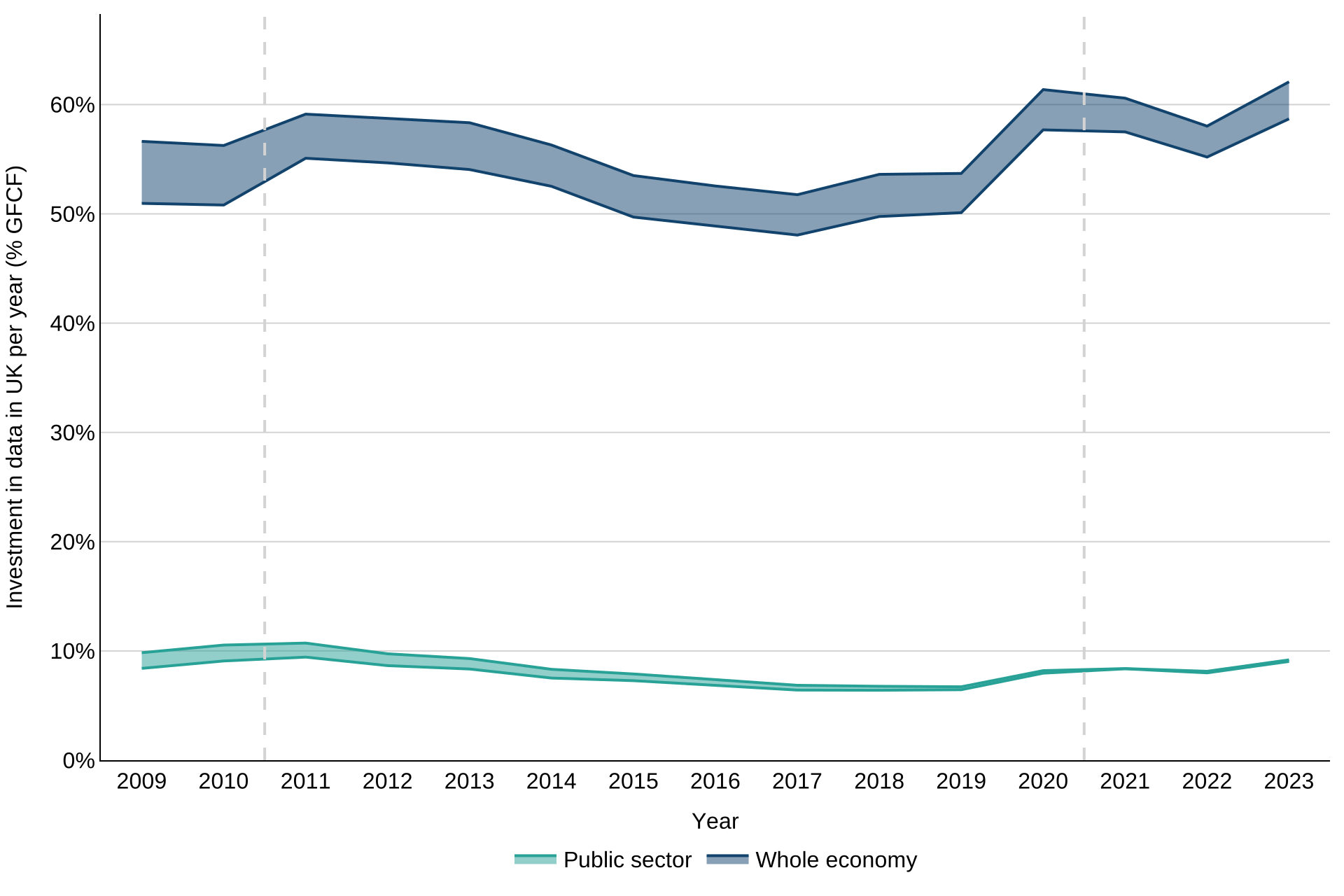
Note: vertical dashed lines indicate when standard occupational classification codes changed, for implications of this see appendix B Limitations and caveats
Figure 10: Private and public sector data investment in the UK since 2009 compared to private and public sector GFCF

Note: vertical dashed lines indicate when standard occupational classification codes changed, for implications of this see appendix B Limitations and caveats
The data show there has been very little sustained growth in data investment as a portion of overall investment both across the whole economy and in the public sector specifically. There is a potential peak in data investment as a portion of overall investment around 2020. This coincides with the COVID-19 pandemic, when other forms tangible investment decreased, leading to a relative increase in intangible investment like data.
Table 7 and figure 10 show that compared to investment in the private sector, the public sector has consistently invested less as a portion of its total investment. Data investment in the private sector ranges from 50 – 66% of all private sector investment. Whereas data investment in the public sector ranges from 34 – 52% of all public sector investment between the years 2009 to 2023 (as captured by GFCF). This should be considered against the landscape of broader evidence of low investment in the UK compared to other economies in the G7 (e.g. Alayande and Coyle, 2023, Investment in the UK: Longer Term Trends). The relative increase in data investment in the public sector compared to overall public sector investment between the years 2009 and 2017 is due to government austerity measures. The reduction in broader investment during years of government austerity, without a corresponding decline in data asset creation explains this peak. This is unsurprising given most data investment is created in-house, unlike other forms of investment.
Looking at investment at the industry level provides further evidence that GFCF is not necessarily good at capturing all intangible investment related to data. This can be seen by the variety of variation, in percentage terms, of data investment at the industry level compared to industry level GFCF. For example, from 360% in finance and insurance (K) to 8% in Mining, Energy, Water (B, D, E) in 2023 . This is expected given the discussion in the section 2 Background of what elements of the data value chain are currently captured in national accounts.
6 Data investment as a portion of UK GVA
Using ONS Gross Domestic Product (GDP) quarterly national accounts time series it is possible to calculate investment as a portion of UK Gross Value Added (GVA). Total data investment across the UK economy in 2024 is estimated at 11 – 12% GVA (or 10-11% UK GDP). Data investment in the public sector in 2024 is estimated at about 2% GVA (or 2% GDP).
Table 8 and figure 11 provide estimates of data investment across the whole economy and for the public sector in terms of percentage of GVA.
Table 8: Data investment in the UK since 2009, as a percentage of GVA
| Year | Whole economy (%GVA) | Public sector (%GVA) |
|---|---|---|
| 2009 | 9 - 10% | 1 - 2% |
| 2010 | 9 - 10% | 2% |
| 2011 | 10 % | 2% |
| 2012 | 10 % | 2% |
| 2013 | 10% | 1 - 2% |
| 2014 | 10% | 1 - 2% |
| 2015 | 10% | 1 - 2% |
| 2016 | 10% | 1% |
| 2017 | 10 - 11% | 1% |
| 2018 | 10 - 11% | 1% |
| 2019 | 10 - 11% | 1% |
| 2020 | 11 - 12% | 2% |
| 2021 | 11 - 12% | 2% |
| 2022 | 11% | 2% |
| 2023 | 11 - 12% | 2% |
| 2024 | 11 - 12% | 2% |
Figure 11: Data investment in the UK since 2009, as a percentage of GVA
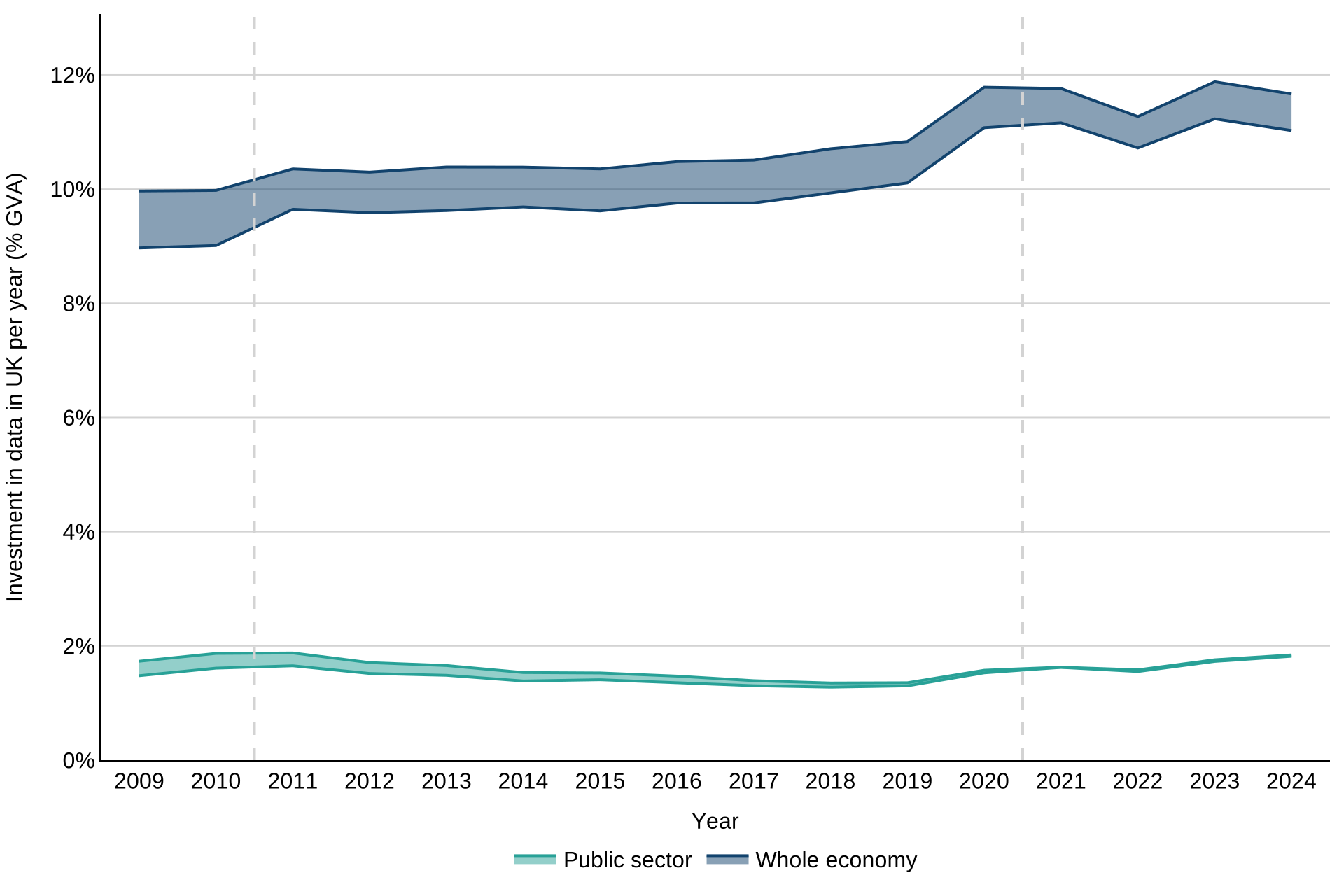
Note: vertical dashed lines indicate when standard occupational classification codes changed, for implications of this see appendix B Limitations and caveats
There has been a small increase in data investment in the UK economy, in terms of percentage of GVA, between 2009 and 2024 (an increase of between 1.7 to 2.1 percentage points). This represents a growth of 17 – 23% as a portion of GVA over that period. This suggests that data has been gently growing as an output in the economy over this period.
If we look at data investment in the public sector we see a different picture. There is a prolonged period of stagnation, followed by potential signs of recent growth. There has been a smaller increase in data investment in the public sector, in terms of percentage of GVA, between 2009 and 2024 (an increase of between 0.1 to 0.3 percentage points). This represents growth of 6 – 23% over that period, with most growth happening in the last two years. This suggests data investment in the public sector is being outpaced by data investment in the rest of the economy, despite real terms growth in data investment, though the gap has narrowed in more recent years. This is consistent with the broader picture discussed about in real terms prices and as a percentage of overall investment.
It should be noted that as this analysis is based on a sum of costs approach, the relative stagnation of data investment in the public sector could occur if public sector wage growth was significantly below private sector wage growth over the same period. Examination of median earnings in the public and private sectors suggest that this unlikely to account for the difference because wage growth was not that dissimilar (ONS Employee earnings in the UK: 2025). The growth in data investment in the public sector investment during this period matches trends in total managed expenditure in the public sector (HMT Public Spending Statistics). Over the same period, public sector net investment, in nominal prices, has stayed relatively flat (ONS Public sector net investment, excluding public sector banks).
As also highlighted in figures 9 and 10 when discussing investment in terms of GFCF, in figure 11 there is a peak in investment as a percentage of GVA in 2020. It is also possible to see a potential reduction in data investment as a percentage of GVA between 2009 and 2010. Both these peaks are likely due to downturns in the UK economy. During 2020 – 2021 the UK economy was strongly impacted by COVID-19. During 2008 – 2009 the UK economy was strongly impacted by the global financial crisis. The impact of both downturns has been more than two years each, but these particular years capture most of the fall in investment (ONS Business investment in the UK). The temporary rise in data investment as a percentage of GVA during these downturns suggests that data investment fell less relative to other forms of business investment. This is consistent with findings presented in Data, intangible capital, and productivity: literature review, theoretical framework and empirical evidence on the UK that suggest investments in intangibles, such as data, are resilient during periods of economic downturn.
The report Data, intangible capital, and productivity: literature review, theoretical framework and empirical evidence on the UK highlights the strong connection between data investment and the potential productivity gains this can create across the economy. The level of data investment in the UK economy places it ahead of many other economies. It suggests that its economy is already benefiting from productivity gains due to data use in businesses, but that more investment could still boost this further (Data, Intangible Capital, and Productivity). The fact that general investment in terms of GVA is growing faster than data investment, specifically, highlights the chance of the UK falling behind data investment in other countries.
It is also possible to look at variation in data investment as a portion of GVA at the industry level up until 2023, using ONS Regional gross value added (balanced) by industry. The results of this can be seen in figure 12, below.
Figure 12: Data investment in the UK by industry, 2009 – 2023, as a percentage of GVA
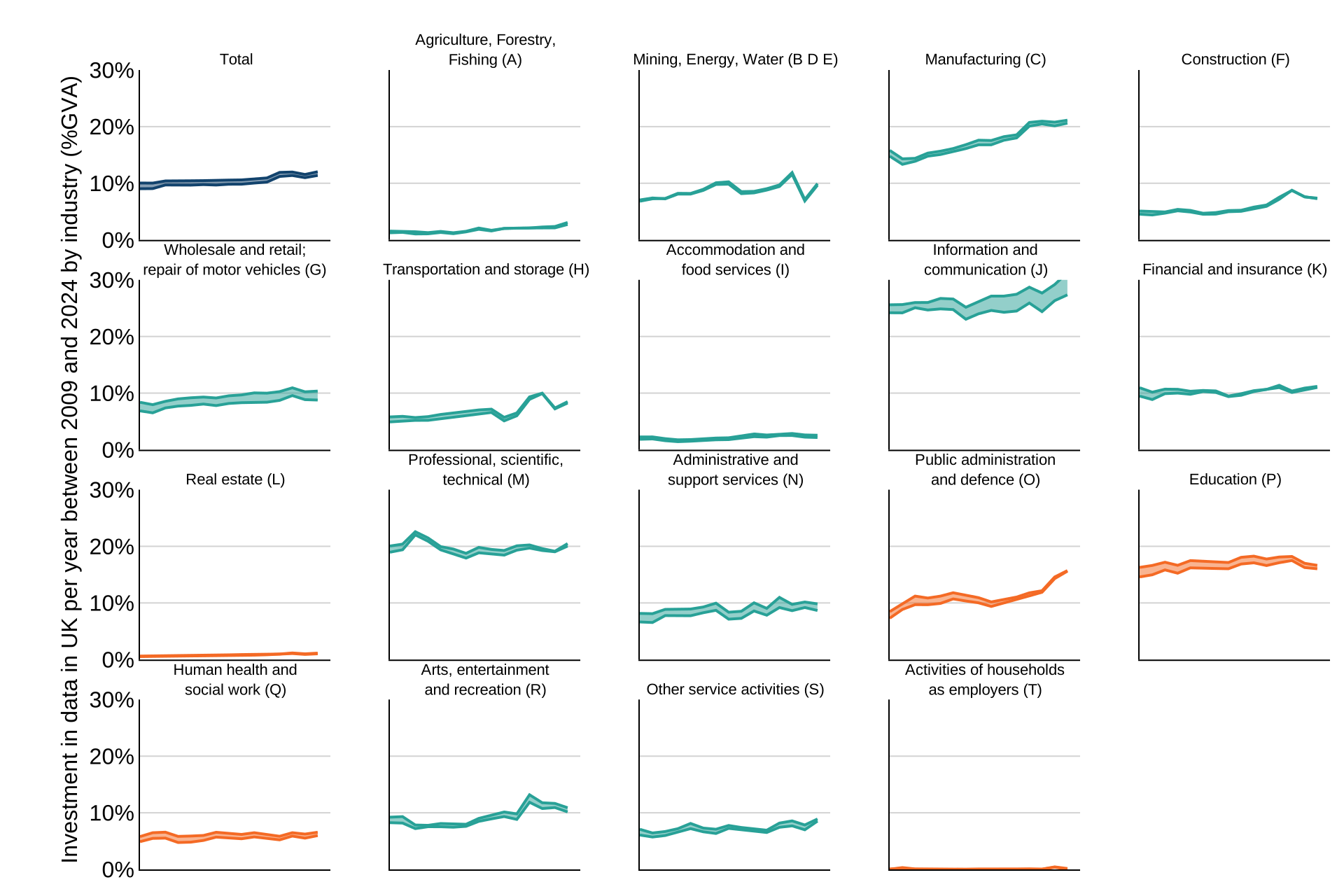
Note: dark blue is total investment, light blue are industries in the market sector and orange are industries in the non-market sector – Real Estate (L), Public administration and defence (O), Education (P), Human health and social work (Q), Activities of households as employers (T).
By comparing figures 5 and 12, we see the direction of growth in real terms data investment within industries tracks similar trends of growth in data investment as a portion of GVA. The Agriculture, Forestry, Fishing (A), Transportation and storage (H) and Construction (F) industries have seen the most growth in data investment relative to output as measured by GVA. The noteworthy exceptions are the Professional, scientific, technical (M) and Finance and insurance (K) industries, where data investment as a percentage of GVA has relatively flat, whilst real terms data investment has grown. This potentially reflects a more significant growth in output in those industries that has outpaced data investment. This may reflect longstanding data maturity in these industries relative to others.
7 Data investment in the Industrial Strategy key sectors
In June 2025 the government published the UK’s Modern Industrial Strategy 2025. In the strategy they identify eight key sectors (called the IS-8):
- Advanced Manufacturing
- Clean Energy Industries
- Creative Industries
- Defence
- Digital and Technology
- Financial Services
- Life Sciences
- Professional and Business Services
These are highly productive, innovative and exporting sectors. Given the importance of these sectors to future government policy development, it is useful to try and estimate data investment in these sectors. As set out in the Industrial Strategy Technical Annex, these sectors are not easy to define. The Industrial Strategy therefore used a mixed approach to defining sectors, with the identified Standard Industrial Classification (SIC) codes described in the Industrial Strategy Sector Definitions List.
The sum of costs approach can be applied to these sectors using a SIC code approach. However, the values are likely to be underestimates. Firstly, as the SIC system does not always align with or capture the full detail of the IS-8. This is particularly the case for the Clean Energy Industries and Defence, which are not well represented by SIC. Secondly, the purchased component of data investment captured in national accounts is only available at the division level SIC code (2-digit level), whereas some of the sector definitions require the granularity of 3-, 4- and 5-digit levels. Components of data investment from national accounts are only included when there is a complete match at the division level SIC code. This also applies to estimates of GVA in these sectors used in the tables and figures below.
Table 9 and figure 13 below show the breakdown of investment across the different IS-8 key sectors in the UK for 2023 (the most recent year the data is available for) in terms of percentage output in that sector (as measured by GVA).
Table 9: Data investment in the UK in 2023, by IS-8 sector, as a percentage of GVA for that sector
| Industry Strategy key sector | Data investment (% sector GVA) |
|---|---|
| Advanced Manufacturing | 25% - 26% |
| Clean Energy Industries | * |
| Creative Industries | 65% - 76% |
| Defence | * |
| Digital and Technologies | 40% - 44% |
| Financial Services | 11% |
| Life Sciences | 30% |
| Professional and Business Services | 23% - 23% |
| All IS-8 sectors | 21% - 22% |
| Whole economy | 11% - 12% |
Notes: IS-8 sectors have overlapping sectoral definitions therefore data investment in individual sectors will sum to more than the total data investment across all IS-8 sectors. * it is not possible to estimate the value of data investment in the Clean Energy Industries or Defence because these sectors are not well-defined by division-level SIC codes
Figure 13: Data investment in the UK in 2023, by IS-8, as a percentage of GVA for that sector
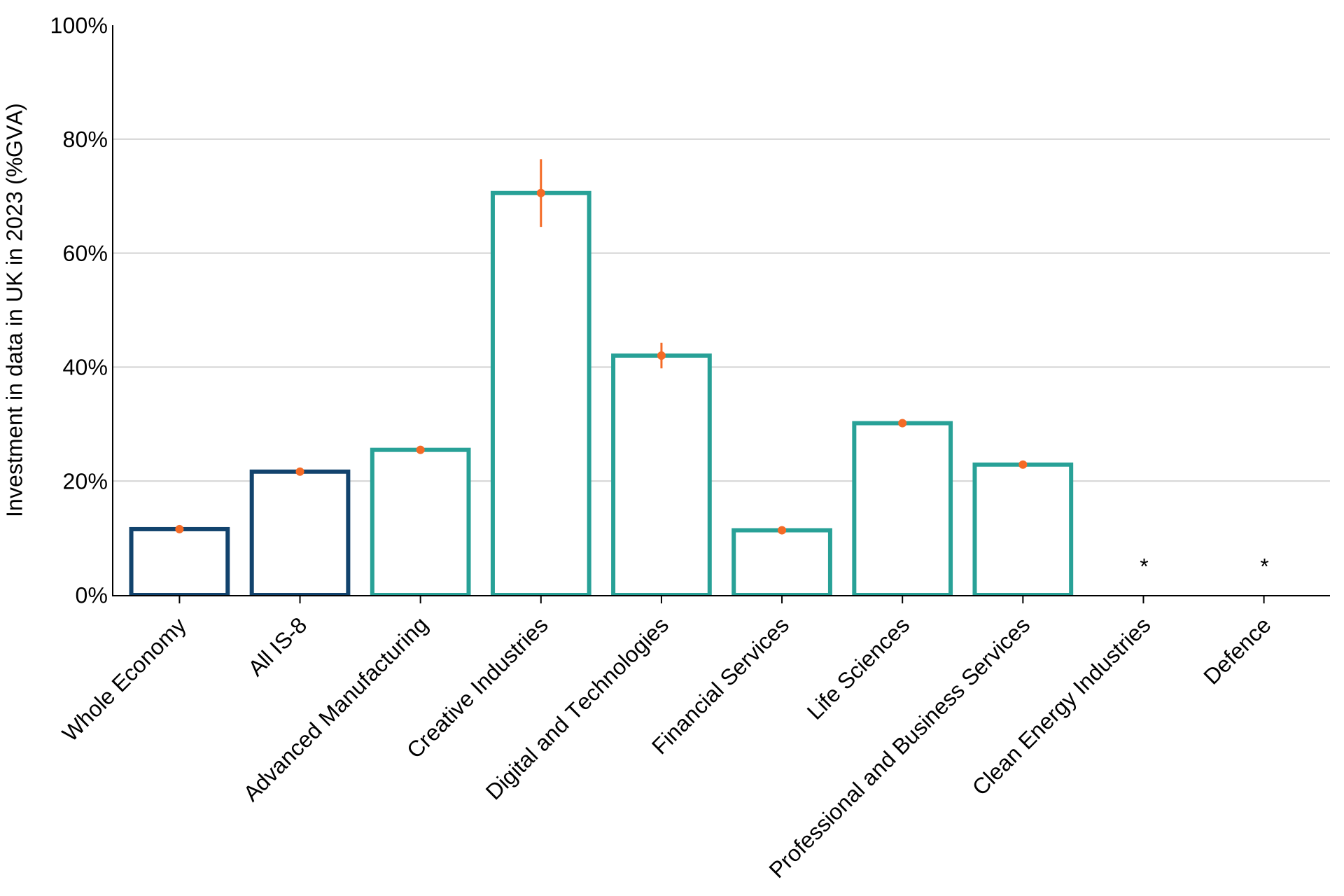
Notes: IS-8 sectors have overlapping sectoral definitions therefore data investment in individual sectors will sum to more than the total data investment across all IS-8 sectors. * it is not possible to estimate the value of data investment in the Clean Energy Industries or Defence because these sectors are not well-defined by division-level SIC codes. Estimates presented are mid-points of ranges in table 9, with orange markers indicating ranges
Table 9 and figure 13 show that the IS-8 sectors invest more in data than the general economy. IS-8 sectors invested twice as much as a percentage of GVA compared to the whole economy. The distribution of investment between the sectors appears varied, but as caveated above, this may reflect difficulty in defining some frontier elements of the sectors well. The Creative Industries have a particularly high level of data investment relative to their output. This is due, in part, to the definition of data intelligence encompassing artistic, entertainment and literary originals. They are also input intensive industries, such as studio hire and post-production services, meaning there is a reasonable amount of intermediate consumption that reduces measured GVA. This is important given that data investment is measured based on a sum of costs related to time spent creating assets. Furthermore, a lot of output in this area does not contribute to UK GVA (for instance if productions are foreign-owned). The DCMS Economic Estimates: Regional GVA – Technical and quality assurance report notes that GVA measurements in these industries are often volatile.
Further work is required to establish whether differences in data investment between Industrial Strategy key sectors represent genuine differences in investment or whether the roles in those sectors and industries that are generating in-house data assets are not captured well by the list of occupations currently included in the analysis (see appendix C Lists of data-related occupations and time use factors). Similarly, the extent to which these sectors are well defined by SIC codes will contribute to relative differences. The estimates presented can be considered lower estimates of the extent of data investment in these sectors.
8 Conclusions
This report provides a comprehensive estimate of data investment in the UK economy for 2024, building on previous methodologies and expanding the scope to include public sector contributions. The findings suggest that data investment remains a significant and growing component of the UK’s economic landscape, accounting for 11 – 12% of GVA across the economy. Data investment within the public sector, specifically, accounts for about 2% of GVA. Evidence suggests there was little growth in data investment within the public sector up until 2019, stronger growth since then.
Data investment has shown consistent growth since 2009, with total nominal values rising from £127 – 142 billion in 2009 to £287–303 billion in 2024 (£157 – 178 billion in 2009 to £287 – 303 billion in 2024 in real terms – a compound annual growth rate between 3.6 – 4.1% per year). This growth is particularly pronounced in industries such as Information and Communication, Professional, Scientific and Technical Services, and Manufacturing, which together account for about 45% of total data investment. The picture for data investment in the public sector is rather different. Public sector data accounts for about 15% of total data investment and about 2% of GVA. Data investment in the public sector has also grown rising from £21 – 25 billion in 2009 to £47 – 48 billion in 2024 in nominal terms and from £26 – 32 billion in 2009 to £47 – 48 billion in 2024 in real terms. This is equivalent to a compound annual growth rate between 2.8 – 4.0% per year.
The potential resilience of data investment during economic downturns—such as the 2008 global financial crisis and the COVID-19 pandemic—highlights its strategic importance.
It is important to acknowledge the limitations in the current methodology, particularly the reliance on the sum-of-costs approach, which may not fully capture the value of data assets created through automation or in occupations not currently included in the analysis. This could lead to underestimates in sectors such as Human Health and Social Work, where data-related activities are pervasive but not always captured in roles traditionally associated with data collection.
Looking ahead, aligning occupational classifications more closely with evolving data roles and improving time-use data could enhance the accuracy of future estimates. Undertaking a regional analysis of data investment could also highlight whether data investment is clustered in any way, or whether it tracks innovation clusters in the UK.
Overall, the findings reinforce the link between increasing data investment and productivity, as well as its role in economic resilience. These insights are valuable for policymakers aiming to support the UK’s data-driven economy and ensure that data investment continues to deliver tangible benefits across sectors.
References
Alayande, A and Coyle D. 2023. Investment in the UK: Longer Term Trends. Working Paper No. 040, The Productivity Institute
Corrado. C, Hulten, C and Sichel, D. 2009. Intangible capital and U.S. economic growth. Review of Income and Wealth, 55, 661-685
Corrado, C and others. 2024. Data, Intangible Capital, and Productivity. In: Basu, S. and others. ed. Technology, Productivity, and Economic Growth, March 17-18, 2002, Washington, DC. University of Chicago Press
Coyle, D and Manley, A. 2024. What is the Value of Data? A review of empirical methods. Journal of Economic Surveys, 38, 1317-1337
DBT. 2025a. The UK’s Modern Industrial Strategy 2025, 10 September 2025 release
DBT. 2025b. Industrial Strategy Sector Definitions List, 26 November 2025 release
DCMS. 2023. DCMS Economic Estimates: Regional GVA – Technical and quality assurance report, 17 October 2025 release
DSIT. 2024a. Business data use and productivity study (wave 1), Data, intangible capital, and productivity: literature review, theoretical framework and empirical evidence on the UK, 3 October 2024 release
DSIT. 2024b. The UK Data Driven Market, 26 March 2024 release
DSIT. 2025. Value of public sector data estimate, 24 October 2025 release
Goodridge, P, Haskel, J and Wallis, G. 2016. UK Intangible Investment and Growth: New Measures of UK investment in knowledge assets and intellectual property rights. Intellectual Property Office Research Paper 2016/03
HMT. 2025. Public Spending Statistics, 18 December 2025 release
Martin, J., Nakamura, L. & Soloveichik, R. 2024. Types of capital and their measurement. Economic Statistics Centre of Excellence Discussion Paper 2024 14
ONS. 2016. Relationship between SOC 2010 and SOC 2000
ONS. 2021a. Deflators for intangible assets, UK: 1997 to 2018, 20 August 2021 release
ONS. 2021b. Relationship between SOC 2010 and SOC 2020
ONS. 2022. Business enterprise research and development, UK, 22 November 2022 release
ONS. 2024. Time use in the public sector, Great Britain, 21 October 2024 release
ONS. 2025a. Annual gross fixed capital formation by industry and asset, 31 October 2025 release
ONS. 2025b. Business investment in the UK, 30 June 2025 release
ONS. 2025c. Business investment in the UK revisions in Blue Book, 2025, 31 October 2025 release
ONS. 2025d. Business investment time series, 22 December 2025 release
ONS. 2025e. Employee earnings in the UK: 2025, 23 October 2025 release
ONS. 2025f. Employment in research and development occupations by nationality, SOC 20 classification, 2021 to 2024, 27 June 2025 release
ONS. 2025g. GDP quarterly national accounts time series, 22 December 2025 release
ONS. 2025h. Gross fixed capital formation by sector and asset, 22 December 2025 release
ONS. 2025i. Investment in intangible assets in the UK: 2023, 2 December 2025 release
ONS. 2025j. Public sector net investment, excluding public sector banks, 19 December 2025 release
ONS. 2025k. Regional gross value added (balanced) by industry, 17 April 2025 release
Appendix
A Methodology
This report estimates how much the UK invests in data by combining official statistics and recent business surveys that capture areas not currently measured.
The methodology follows that outlined more fully in Data, intangible capital, and productivity: literature review, theoretical framework and empirical evidence on the UK.
The analysis starts with data already included in national accounts—such as spending on software and databases, research and development, mineral exploration and artistic originals. These are taken from the ONS Business investment time series, except when calculating investment in the IS-8 sectors, which use the ONS Investment in intangible assets in the UK (2023). The latter is used for IS-8 sectors because they provide investment breakdowns by SIC 2007 division codes, rather than industries. To provide a more complete picture the value of data created in-house by businesses and the public sector is estimated. This includes things like collecting raw data, building databases, and generating insights from data. Care is taken, where possible, not to double count investment. For instance, only purchased investment on software and databases are taken from national accounts, the remainder of investment in databases is calculated from the in-house sum of costs. In addition to avoid double counting of research and development (R&D) investment, R&D occupations in SIC 2007 division 72 (Scientific research and development) are excluded from the time use sum of costs component, instead R&D investment is taken directly from national accounts. A list of R&D occupations can be found in appendix D Lists of Research and Development occupations.
To reiterate the logic behind the summation of investment that avoids double-counting the following are added together across all industries and sectors in the economy.
From national accounts:
- Purchased software and databases
- R&D (purchased and in-house)
- Mineral exploration (purchased and in-house)
- Artistic, entertainment and literary originals (purchased and in-house)
From time spent in-house creating data assets in relevant occupations:
- Creation of raw data (excluding R&D occupations in R&D sector)
- Creation of databases (excluding R&D occupations in R&D sector)
- Creation of data intelligence (excluding R&D occupations in R&D sector)
Mineral exploration and Artistic, entertainment and literary originals are not explicitly excluded from the in-house data asset creation calculations because the list of data-related occupations does not conceptually overlap with these activities in the same way that R&D occupations do (see appendix C Lists of data-related occupations and time use factors). In any case, Mineral exploration and Artistic, entertainment and literary originals combined make up only 3% of total data investment.
To estimate in-house data asset creation it is necessary to combine:
- The types of jobs involved in creating data
- How much time people in those jobs spend working with data
- How much they are paid
- How many people are doing this work
The list of occupations involved in creating data is taken from Data, Intangible Capital, and Productivity and listed below in appendix C Lists of data-related occupations and time use factors. The time people in those occupations spend working with data is taken from two sources. Lower estimates are taken from baselines estimates presented in Data, Intangible Capital, and Productivity. Upper estimates are taken from the Business data use and productivity study (wave 1) survey. Data on pay is taken from the ONS Annual Survey of Hours and Earnings. Data on the number of people in data-related occupations is also taken from the ONS Annual Survey of Hours and Earnings.
For the public sector, we apply the same approach but focus only on public sector workers, as identified in the ONS Annual Survey of Hours and Earnings. Note that public sector estimates may not be as reliable as estimates for the private sector. The assumptions that underpin the sum of costs method, used for intangible assets produced in house, may not hold for the public sector. In particular that there are constant returns to scale, no monopoly power and a capital supply that is flexible enough to meet demand (Martin and others 2024). In other words, that an organisation wouldn’t spend more on an asset than they expect to benefit from it. But the public sector is not a competitive market and non-monetary benefits are hard to capture compared to the cost of production. Furthermore, the time use estimates used are based mainly on responses from the private sector and it is possible that these could vary substantially between the public and private sectors.
Over the period of interest there have been a few changes in the way occupations are classified, including the 2000, 2010 and 2020 Standard Occupational Classifications (SOCs). For consistency with the original list of occupations based on the 2010 classification, these occupations were mapped to the 2000 and 2020 classifications using look up tables published by ONS.
This method gives us a fuller picture of the UK’s data investment—across industries, over time, and including both market and non-market sectors.
See appendix B Limitations and caveats for more on the assumptions in this report.
A.1 Calculating current prices
Using published ONS deflators for intangible assets up to 2018 (Deflators for intangible assets, UK: 1997 to 2018) it is possible to look at the real terms growth between 2009 and 2018. Our time series extends to 2024, so it is necessary to extend the deflator time series to calculate current prices beyond 2018 (also referred to as real prices). For the assets listed in table 1 that are part of national accounts, the ratio of current prices to chained volume measures published in ONS Annual gross fixed capital formation by industry and asset, October 2025, can be used to calculate implied deflators. For uncapitalised intangible assets (those not in national accounts) estimates for the deflators are constructed using the method outlined in Corrado, Hulten and Sichel (2009) Intangible capital and U.S. economic growth, and updated for the UK context in Goodridge, P, Haskel, J and Wallis, G. 2016. UK Intangible Investment and Growth: New Measures of UK investment in knowledge assets and intellectual property rights.
B Limitations and caveats
While robust at the macroeconomic level, the sum-of-costs approach may underestimate the full value of data due to:
- Exclusion of automation and AI-driven efficiencies
- Limited granularity in time-use data
- Potential underrepresentation of certain occupations
- Discontinuities from SOC code transitions
It is possible for the sum of costs to overestimate value, for instance during a period of recession or an investment bubble for a new technology. Considering investment across longer time periods, or across larger portions of the economy help combat this risk as we expect incidents where there is a realised loss to be counterbalanced by incidents where there is a realised gain above cost.
The method is also sensitive to factors changing the sum of costs that are unrelated to intrinsic changes in the value of data. For instance, significant changes overall employment or salaries.
The other major limitation of this analysis relates to when the estimates of time spent on data-related tasks were made. Currently these come from a single snapshot from a 2022 – 2023 business survey. In any given occupation it is to be expected that ten years ago they might be spending a different amount of time creating data assets than today. Or, for instance, spending as much time on data asset creation overall, but due to things like automation can spend less time creating databases and more time creating data intelligence. It is likely this balance will also change in the future, particularly as AI tools transform the workplace.
The current implementation relies on blow-up factors reported in Data, intangible capital, and productivity: literature review, theoretical framework and empirical evidence on the UK which are based on US supply and use tables. These blow-up factors adjust the compensation of employees to account for intermediate consumption, taxes and subsidies that are not otherwise captured in the sum of costs approach, but are present in national accounts. It would be helpful to estimate UK specific blow-up factors in future reports.
The standard occupational classification (SOC) system designed by ONS, on which this report relies, changed between 2010 and 2011 (from SOC 2000 to 2010) and between 2020 and 2021 (from SOC 2010 to 2020). This could lead to some discontinuity in the time series at these points if a revised set of relevant occupations is used for each classification period. To avoid this, occupations were mapped from SOC 2010 (as listed in appendix C Lists of data-related occupations and time use factors) to SOC 2000 and 2020 using look up tables published by ONS (Relationship between SOC 2010 and SOC 2000, Relationship between SOC 2010 and SOC 2020). Mapping ensures a smooth transition across SOC changes. The disadvantage of this approach is that it assumes tasks and roles are similar in newly created (or lost) occupations. This is less likely to be true as job roles evolve.
Despite these limitations, the methodology provides a consistent and scalable framework for assessing data investment across the UK economy.
C Lists of data-related occupations and time use factors
Here we present lists of occupations, as defined by Standard Occupational Classifications (SOCs), that are related to the creation of data assets and the time spent in each occupation creating the three different types of data asset, raw data, databases and data intelligence, as well as time spent creating software. In the tables below time estimates are all daily percentages of time where 0 is 0% and 1 is 100%. Time estimates are presented are:
- Lower estimates based on Data, Intangible Capital, and Productivity, labelled as baseline
- Upper estimates based on Business data use and productivity study (wave 1) , labelled as wave 1 survey
Only time spend on raw data, database or data intelligence creation was included in the analysis. That is, further time spent on software creation was not included.
Table C.1: Occupations related to and time spent on data asset creation (SOC 2010)
| SOC 2010 | SOC 2010 description | Raw data (baseline) | Databases (baseline) | Data intelligence (baseline) | Software (baseline) | Raw data (wave 1 survey) | Databases (wave 1 survey) | Data intelligence (wave 1 survey) | Software (wave 1 survey) |
|---|---|---|---|---|---|---|---|---|---|
| 1132 | Marketing and sales directors | 0 | 0.1 | 0 | 0 | 0.1 | 0.1 | 0.12 | 0.04 |
| 1134 | Advertising and public relations directors | 0 | 0.1 | 0 | 0 | 0.1 | 0.1 | 0.12 | 0.04 |
| 1136 | Information technology and telecommunications directors | 0.1 | 0.1 | 0.1 | 0 | 0.1 | 0.1 | 0.12 | 0.04 |
| 2111 | Chemical scientists | 0.1 | 0.4 | 0 | 0 | 0.14 | 0.09 | 0.17 | 0.08 |
| 2112 | Biological scientists and biochemists | 0.1 | 0.25 | 0 | 0 | 0.14 | 0.09 | 0.17 | 0.08 |
| 2113 | Physical scientists | 0.1 | 0.4 | 0 | 0 | 0.14 | 0.09 | 0.17 | 0.08 |
| 2114 | Social and humanities scientists | 0 | 0.1 | 0 | 0 | 0.14 | 0.09 | 0.17 | 0.08 |
| 2119 | Natural and social science professionals n.e.c. | 0.1 | 0.25 | 0 | 0 | 0.14 | 0.09 | 0.17 | 0.08 |
| 2121 | Civil engineers | 0.1 | 0.25 | 0 | 0 | 0.14 | 0.09 | 0.17 | 0.08 |
| 2122 | Mechanical engineers | 0.1 | 0.25 | 0 | 0 | 0.14 | 0.09 | 0.17 | 0.08 |
| 2123 | Electrical engineers | 0.1 | 0.4 | 0 | 0 | 0.14 | 0.09 | 0.17 | 0.08 |
| 2124 | Electronics engineers | 0.1 | 0.45 | 0 | 0 | 0.14 | 0.09 | 0.17 | 0.08 |
| 2126 | Design and development engineers | 0.1 | 0.25 | 0 | 0 | 0.14 | 0.09 | 0.17 | 0.08 |
| 2127 | Production and process engineers | 0.1 | 0.25 | 0 | 0 | 0.14 | 0.09 | 0.17 | 0.08 |
| 2129 | Engineering professionals n.e.c. | 0.1 | 0.25 | 0 | 0 | 0.14 | 0.09 | 0.17 | 0.08 |
| 2133 | IT specialist managers | 0.2 | 0.2 | 0.2 | 0.2 | 0.19 | 0.11 | 0.12 | 0.09 |
| 2134 | IT project and programme managers | 0.2 | 0.2 | 0.2 | 0.2 | 0.19 | 0.11 | 0.12 | 0.09 |
| 2135 | IT business analysts, architects and systems designers | 0.1 | 0 | 0.1 | 0.5 | 0.19 | 0.11 | 0.12 | 0.09 |
| 2136 | Programmers and software development professionals | 0 | 0 | 0.1 | 0.5 | 0.19 | 0.11 | 0.12 | 0.09 |
| 2137 | Web design and development professionals | 0 | 0 | 0.1 | 0.5 | 0.19 | 0.11 | 0.12 | 0.09 |
| 2139 | Information technology and telecommunications professionals n.e.c. | 0.2 | 0.2 | 0.2 | 0.2 | 0.19 | 0.11 | 0.12 | 0.09 |
| 2141 | Conservation professionals | 0.1 | 0.25 | 0 | 0 | 0.14 | 0.09 | 0.17 | 0.08 |
| 2142 | Environment professionals | 0.1 | 0.25 | 0 | 0 | 0.14 | 0.09 | 0.17 | 0.08 |
| 2150 | Research and development managers | 0 | 0.1 | 0 | 0 | 0.14 | 0.09 | 0.17 | 0.08 |
| 2213 | Pharmacists | 0 | 0 | 0 | 0 | - | - | - | - |
| 2216 | Veterinarians | 0 | 0 | 0 | 0 | - | - | - | - |
| 2217 | Medical radiographers | 0.2 | 0 | 0 | 0 | 0.07 | 0.17 | 0.2 | 0.01 |
| 2421 | Chartered and certified accountants | 0.1 | 0.25 | 0 | 0 | 0.14 | 0.13 | 0.12 | 0.04 |
| 2423 | Management consultants and business analysts | 0.2 | 0.2 | 0.2 | 0 | 0.14 | 0.13 | 0.12 | 0.04 |
| 2424 | Business and financial project management professionals | 0.2 | 0.2 | 0.2 | 0 | 0.14 | 0.13 | 0.12 | 0.04 |
| 2425 | Actuaries, economists and statisticians | 0.1 | 0.25 | 0 | 0 | 0.14 | 0.13 | 0.12 | 0.04 |
| 2426 | Business and related research professionals | 0.1 | 0.1 | 0.1 | 0 | 0.14 | 0.13 | 0.12 | 0.04 |
| 2429 | Business, research and administrative professionals n.e.c. | 0.1 | 0.1 | 0.1 | 0 | 0.14 | 0.13 | 0.12 | 0.04 |
| 2431 | Architects | 0.4 | 0.1 | 0 | 0 | - | - | - | - |
| 2433 | Quantity surveyors | 0.1 | 0.25 | 0 | 0 | - | - | - | - |
| 2435 | Chartered architectural technologists | 0.4 | 0.1 | 0 | 0 | - | - | - | - |
| 2452 | Archivists and curators | 0.2 | 0 | 0 | 0 | 0.08 | 0.03 | 0.02 | 0.02 |
| 2461 | Quality control and planning engineers | 0.1 | 0.25 | 0 | 0 | 0.08 | 0.03 | 0.02 | 0.02 |
| 2462 | Quality assurance and regulatory professionals | 0.2 | 0.2 | 0.2 | 0 | 0.08 | 0.03 | 0.02 | 0.02 |
| 2463 | Environmental health professionals | 0.2 | 0.2 | 0 | 0 | 0.08 | 0.03 | 0.02 | 0.02 |
| 2473 | Advertising accounts managers and creative directors | 0.2 | 0.3 | 0 | 0 | 0.08 | 0.03 | 0.02 | 0.02 |
| 3111 | Laboratory technicians | 0.2 | 0.1 | 0 | 0 | 0.11 | 0.06 | 0.09 | 0.1 |
| 3112 | Electrical and electronics technicians | 0.1 | 0.25 | 0 | 0 | 0.11 | 0.06 | 0.09 | 0.1 |
| 3113 | Engineering technicians | 0.2 | 0.1 | 0 | 0 | 0.11 | 0.06 | 0.09 | 0.1 |
| 3114 | Building and civil engineering technicians | 0.2 | 0.1 | 0 | 0 | 0.11 | 0.06 | 0.09 | 0.1 |
| 3115 | Quality assurance technicians | 0.2 | 0 | 0 | 0 | 0.11 | 0.06 | 0.09 | 0.1 |
| 3116 | Planning, process and production technicians | 0.2 | 0.1 | 0 | 0 | 0.11 | 0.06 | 0.09 | 0.1 |
| 3119 | Science, engineering and production technicians n.e.c. | 0.2 | 0.1 | 0 | 0 | 0.11 | 0.06 | 0.09 | 0.1 |
| 3121 | Architectural and town planning technicians | 0.1 | 0 | 0 | 0 | 0.11 | 0.06 | 0.09 | 0.1 |
| 3122 | Draughtspersons | 0.1 | 0 | 0 | 0 | 0.11 | 0.06 | 0.09 | 0.1 |
| 3422 | Product, clothing and related designers | 0.1 | 0.1 | 0 | 0 | - | - | - | - |
| 3531 | Estimators, valuers and assessors | 0.1 | 0.25 | 0 | 0 | 0.13 | 0.11 | 0.07 | 0.03 |
| 3532 | Brokers | 0.1 | 0.1 | 0 | 0 | 0.13 | 0.11 | 0.07 | 0.03 |
| 3534 | Finance and investment analysts and advisers | 0.1 | 0.25 | 0 | 0 | 0.13 | 0.11 | 0.07 | 0.03 |
| 3535 | Taxation experts | 0.1 | 0.25 | 0 | 0 | 0.13 | 0.11 | 0.07 | 0.03 |
| 3536 | Importers and exporters | 0.1 | 0.1 | 0 | 0 | 0.13 | 0.11 | 0.07 | 0.03 |
| 3537 | Financial and accounting technicians | 0.1 | 0.25 | 0 | 0 | 0.13 | 0.11 | 0.07 | 0.03 |
| 3538 | Financial accounts managers | 0.1 | 0.25 | 0 | 0 | 0.13 | 0.11 | 0.07 | 0.03 |
| 3539 | Business and related associate professionals n.e.c. | 0.1 | 0.4 | 0 | 0 | 0.13 | 0.11 | 0.07 | 0.03 |
| 3542 | Business sales executives | 0.1 | 0.1 | 0 | 0 | 0.13 | 0.11 | 0.07 | 0.03 |
| 3543 | Marketing associate professionals | 0.2 | 0.3 | 0 | 0 | 0.13 | 0.11 | 0.07 | 0.03 |
| 3545 | Sales accounts and business development managers | 0.1 | 0.1 | 0 | 0 | 0.13 | 0.11 | 0.07 | 0.03 |
| 3550 | Conservation and environmental associate professionals | 0.1 | 0 | 0 | 0 | 0.13 | 0.11 | 0.07 | 0.03 |
| 3562 | Human resources and industrial relations officers | 0 | 0.1 | 0 | 0 | 0.13 | 0.11 | 0.07 | 0.03 |
| 3563 | Vocational and industrial trainers and instructors | 0 | 0.1 | 0 | 0 | 0.13 | 0.11 | 0.07 | 0.03 |
| 3564 | Careers advisers and vocational guidance specialists | 0 | 0.1 | 0 | 0 | 0.13 | 0.11 | 0.07 | 0.03 |
| 3565 | Inspectors of standards and regulations | 0 | 0 | 0 | 0 | - | - | - | - |
| 3567 | Health and safety officers | 0.1 | 0 | 0 | 0 | 0.13 | 0.11 | 0.07 | 0.03 |
| 4113 | Local government administrative occupations | 0.05 | 0 | 0 | 0 | 0.1 | 0.11 | 0.07 | 0.04 |
| 4114 | Officers of non-governmental organisations | 0.05 | 0 | 0 | 0 | 0.1 | 0.11 | 0.07 | 0.04 |
| 4121 | Credit controllers | 0.1 | 0.4 | 0 | 0 | 0.1 | 0.11 | 0.07 | 0.04 |
| 4122 | Book-keepers, payroll managers and wages clerks | 0.2 | 0 | 0 | 0 | 0.1 | 0.11 | 0.07 | 0.04 |
| 4123 | Bank and post office clerks | 0.1 | 0 | 0 | 0 | 0.1 | 0.11 | 0.07 | 0.04 |
| 4124 | Finance officers | 0.2 | 0 | 0 | 0 | 0.1 | 0.11 | 0.07 | 0.04 |
| 4131 | Records clerks and assistants | 0.05 | 0 | 0 | 0 | 0.1 | 0.11 | 0.07 | 0.04 |
| 4132 | Pensions and insurance clerks and assistants | 0.1 | 0 | 0 | 0 | 0.1 | 0.11 | 0.07 | 0.04 |
| 4134 | Transport and distribution clerks and assistants | 0.05 | 0 | 0 | 0 | 0.1 | 0.11 | 0.07 | 0.04 |
| 4135 | Library clerks and assistants | 0.1 | 0 | 0 | 0 | 0.1 | 0.11 | 0.07 | 0.04 |
| 4138 | Human resources administrative occupations | 0.1 | 0 | 0 | 0 | 0.1 | 0.11 | 0.07 | 0.04 |
| 4217 | Typists and related keyboard occupations | 0.8 | 0 | 0 | 0 | 0.1 | 0.11 | 0.07 | 0.04 |
| 7211 | Call and contact centre occupations | 0.05 | 0 | 0 | 0 | 0.1 | 0.11 | 0.07 | 0.04 |
| 7215 | Market research interviewers | 0.05 | 0 | 0 | 0 | 0.1 | 0.11 | 0.07 | 0.04 |
D Lists of Research and Development occupations
The research and development (R&D) occupations defined by ONS in the SOC 2020 classification system can be found in Employment in research and development occupations by nationality, SOC 20 classification, 2021 to 2024. Equivalent lists for SOC 2000 and SOC 2010 can be compiled by comparison of this list to the lists of occupations in those classification systems and the lists of tables ONS provides to convert between them (Relationship between SOC 2010 and SOC 2000, Relationship between SOC 2010 and SOC 2020).
Table D.1 Research and development occupations (SOC 2000)
| SOC 2000 | SOC 2000 description |
|---|---|
| 2111 | Chemists |
| 2112 | Biological scientists and biochemists |
| 2113 | Physicists, geologists and meteorologists |
| 2121 | Civil engineers |
| 2122 | Mechanical engineers |
| 2123 | Electrical engineers |
| 2124 | Electronics engineers |
| 2125 | Chemical engineers |
| 2126 | Design and development engineers |
| 2127 | Production and process engineers |
| 2128 | Planning and quality control engineers |
| 2129 | Engineering professionals n.e.c. |
| 2132 | Software professionals |
| 2311 | Higher education teaching professionals |
| 2321 | Scientific researchers |
| 2322 | Social science researchers |
| 2329 | Researchers n.e.c. |
| 2423 | Management consultants, actuaries, economists and statisticians |
| 3111 | Laboratory technicians |
| 3112 | Electrical/electronics technicians |
| 3113 | Engineering technicians |
| 3114 | Building and civil engineering technicians |
| 3115 | Quality assurance technicians |
| 3119 | Science, engineering and production technicians n.e.c. |
Table D2.2 Research and development occupations (SOC 2010)
| SOC 2010 | SOC 2010 description |
|---|---|
| 2111 | Chemical scientists |
| 2112 | Biological scientists and biochemists |
| 2113 | Physical scientists |
| 2114 | Social and humanities scientists |
| 2119 | Natural and social science professionals n.e.c. |
| 2121 | Civil engineers |
| 2122 | Mechanical engineers |
| 2123 | Electrical engineers |
| 2124 | Electronics engineers |
| 2126 | Design and development engineers |
| 2127 | Production and process engineers |
| 2129 | Engineering professionals n.e.c. |
| 2135 | IT business analysts, architects and systems designers |
| 2136 | Programmers and software development professionals |
| 2139 | Information technology and telecommunications professionals n.e.c. |
| 2150 | Research and development managers |
| 2311 | Higher education teaching professionals |
| 2425 | Actuaries, economists and statisticians |
| 2426 | Business and related research professionals |
| 2429 | Business, research and administrative professionals n.e.c. |
| 2461 | Quality control and planning engineers |
| 3111 | Laboratory technicians |
| 3112 | Electrical and electronics technicians |
| 3113 | Engineering technicians |
| 3114 | Building and civil engineering technicians |
| 3115 | Quality assurance technicians |
| 3116 | Planning, process and production technicians |
| 3119 | Science, engineering and production technicians n.e.c. |
Table D.3 Research and development occupations (SOC 2020)
| SOC 2020 | SOC 2020 description |
|---|---|
| 2111 | Chemical scientists |
| 2112 | Biological scientists |
| 2113 | Biochemists and biomedical scientists |
| 2114 | Physical scientists |
| 2115 | Social and humanities scientists |
| 2119 | Natural and social science professionals n.e.c. |
| 2121 | Civil engineers |
| 2122 | Mechanical engineers |
| 2123 | Electrical engineers |
| 2124 | Electronics engineers |
| 2125 | Production and process engineers |
| 2126 | Aerospace engineers |
| 2127 | Engineering project managers and project engineers |
| 2129 | Engineering professionals n.e.c. |
| 2133 | IT business analysts, architects and systems designers |
| 2134 | Programmers and software development professionals |
| 2135 | Cyber security professionals |
| 2136 | IT quality and testing professionals |
| 2137 | IT network professionals |
| 2139 | Information technology professionals n.e.c. |
| 2161 | Research and development (R&D) managers |
| 2162 | Other researchers, unspecified discipline |
| 2311 | Higher education teaching professionals |
| 2433 | Actuaries, economists and statisticians |
| 2434 | Business and related research professionals |
| 2439 | Business, research and administrative professionals n.e.c. |
| 2481 | Quality control and planning engineers |
| 3111 | Laboratory technicians |
| 3112 | Electrical and electronics technicians |
| 3113 | Engineering technicians |
| 3114 | Building and civil engineering technicians |
| 3115 | Quality assurance technicians |
| 3116 | Planning, process and production technicians |
| 3119 | Science, engineering and production technicians n.e.c. |
-
Practice varies as to whether Real Estate (L) should be considered part of the market or non-market sector. The industry has both market and non-market components. Owner-occupied housing and subsidized or public housing are not exchanged in the market. Effectively it can be considered as generating income through rent extraction rather than productive activity based on privileged access to a finite resource (land), so income is not generated as the result of market competition. There is also heavy state involvement through zoning laws, tax incentives, mortgage guarantees and public infrastructure investment. Further, much of the value in real estate is imputed or appraised, not discovered through transparent market exchange. The original study Data, intangible capital, and productivity: literature review, theoretical framework and empirical evidence on the UK, 2024 included Real Estate (L) in the non-market sector, this classification has been continued in this report for consistency. ↩ ↩2
-
The assumption that three quarters of R&D is also generated in house, rather than purchased is based on the value of ‘intramural’ compared to ‘extramural’ R&D expenditure in 2020, as published in the ONS Business enterprise research and development, UK dataset released on 22 November 2022, as this information is not directly recorded in current national accounts. ↩