Creating tailored climate scenarios: a crib sheet for decision-useful scenario analysis
Published 6 November 2026

© Crown copyright 2026
This publication is licensed under the terms of the Open Government Licence v3.0 except where otherwise stated. To view this licence, visit nationalarchives.gov.uk/doc/open-government-licence/version/3 or write to the Information Policy Team, The National Archives, Kew, London TW9 4DU, or email: psi@nationalarchives.gov.uk.
Where we have identified any third party copyright information you will need to obtain permission from the copyright holders concerned.
This publication is available at https://www.gov.uk/government/publications/creating-tailored-climate-scenarios/creating-tailored-climate-scenarios-a-crib-sheet-for-decision-useful-scenario-analysis
Climate scenario analysis is only as useful as the scenarios you choose. This practical, step-by-step guide helps you select and tailor climate scenarios that work for your organisation. This guide can help you set appropriate scenarios for risk management, strategy, business planning, adaptation planning, and investment and policy appraisals.
This guide is particularly relevant for public sector bodies using scenario analysis to meet Task Force on Climate-related Financial Disclosure (TCFD)-aligned climate reporting requirements, as it draws heavily on the TCFD-aligned disclosure application guidance published by HMT (“application guidance”).
Setting decision-useful scenarios
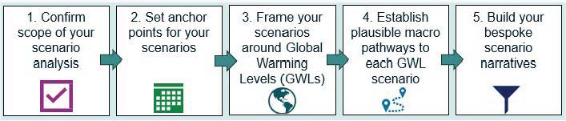
To get started we have set out a simple 5 step process below. Scenario analysis is iterative, not a one-off exercise, and the application guidance recommends that you update your scenario analysis at least every 5 years. The risks from the shift to a low-carbon economy (sometimes called transition risks) may need more frequent review, potentially every 1 to 2 years, as policy and market conditions change. Return to the first step whenever there is a significant change to your organisation’s risk profile, operations or the underlying assumptions in your scenarios.
Credit: GAD
1. Confirm scope of your scenario analysis
Before setting any scenarios, confirm what you are required to do
Ask 3 questions:
-
Has your organisation assessed whether climate is a principal risk (or a significant component of one)?
-
Are you subject to any sector-specific TCFD supplementary guidance (for example, energy, transport, insurance)?
-
Is your organisation responsible for decisions or assets beyond the mid-century (for example, do you operate, manage or regulate long-life assets or infrastructure, do you deliver essential public services, or do you set longer-term policy)?
Your answers will define your minimum obligations under the application guidance. Document them and use them to inform the scenarios you set and the scope of scenario analysis you undertake.
2. Set anchor points for your scenarios
Anchor your scenario timeframes to reference periods as required
Anchor points, also called reference periods, are the timeframes you use to assess climate-related risks in your scenario analysis. They are not the same as your business planning cycles. Climate scenario analysis looks further ahead than most business planning cycles.
Under the application guidance you must select 3 anchor points in total. It helps if these points are comparable with those used by other public sector bodies and aligned to key milestones in climate policy.
-
Near-term: you should choose your own near-term anchor point based on your organisation’s operational and strategic context, as well as the transition risks you may face. The 2030s is one example of a near-term anchor point as it aligns with UK climate policy targets and often matches existing planning cycles.
-
Mid-term / long-term (2050s): the 2050s is mandatory for all organisations. This aligns with the UK’s statutory Net Zero target and key international climate commitments.
-
End-of-century (2080-2100): this is mandatory where your organisation is likely to be significantly impacted by climate change over extended time horizons.
To reach 3 anchor points in total:
-
If the end-of-century period requirement applies to you: select 1 near-term anchor point plus the 2050s and 2080-2100.
-
If end-of-century requirement does not apply to you: select 2 additional anchor points plus the 2050s.
Consider using a range of years rather than a single year to help capture variability in the underlying climate data and to reflect that most risks do not crystallise at a single point in time.
Near-term and mid-century anchor points matter most for transition risks, because policy, technology and markets can shift quickly. End of century matters most for risks arising from direct impacts of a changing climate, such as flooding, heat stress, and sea level rise. These physical risks build slowly but become more severe as warming increases, and are especially important for long-lived assets, place-based responsibilities and long-term service delivery.
3. Frame your scenarios around Global Warming Levels
Use Global Warming Levels (GWLs) as the backbone of your scenario set
The Global Warming Level (GWL) is the increase in the world’s average temperature (in degrees) relative to pre-industrial levels. Using GWLs provides a simple, consistent way to describe different climate futures. They are not forecasts. Instead, they are plausible pathways you can use to test how resilient your organisation would be under different degrees of warming.
The default approach is to select scenarios based around GWLs aligned with the Climate Change Risk Assessment methodology used by the Climate Change Committee (CCC) to assess the risks and opportunities that climate change poses to the UK. The CCC recommends that organisations plan for 2°C of warming and prepare for the possibility of 4°C. These two levels map directly to the TCFD recommended disclosure requirement (within the Strategy pillar) to consider temperature outcomes “including a 2°C or lower scenario”.
Your default set of climate scenarios should therefore be:
| Scenario | GWL by 2100 | What it could represent |
|---|---|---|
| Low warming | around 2°C | UK and most other countries deliver rapid and sustained global emissions reductions, broadly consistent with delivery of current climate commitments and strengthened action over time. |
| High warming | around 4°C | UK reaches Net Zero broadly as planned, but global mitigation is limited or delayed and emissions remain high elsewhere. |
Using 2 scenarios is the minimum requirement. You may also consider exploring scenarios with alternative warming levels where this would give you decision-useful information.
4. Establish plausible macro pathways to each GWL scenario
Every scenario set must include at least one pathway aligned with the government’s current legislated Net Zero target and existing published strategy
A pathway describes how the world reaches a particular GWL. It captures how policy, technology and markets evolve over time, not just the end-state temperature outcome. To help frame this macro context, GWLs can be linked to global reference scenario families (for example the IPCC RCPs and SSP–RCPs). Further detail on using these global reference scenarios is provided in the Appendix. Using these pathways to outline potential global impacts in line with your chosen scenarios helps you build narratives that are internally consistent. This enables you to develop scenarios that are plausible, coherent and credible.
For UK public sector bodies, the application guidance makes clear that scenario analysis should be grounded in the UK’s context. UK Net Zero by 2050 is a legal target and your scenarios should include a baseline assumption that this target is met irrespective of the global position. The purpose of transition scenarios is therefore to explore what the UK’s route to Net Zero could look like for your organisation. This includes what it means for your risks and decisions, for example reputational pressures, delivery risks, and the costs of adapting operations and assets.
However, the pathway to Net Zero is uncertain. Your scenarios can explore alternative pathways to test whether transition is orderly (steady, predictable change) or disorderly (abrupt, disruptive change). One plausible disorderly pathway is a late transition: the UK still reaches Net Zero by 2050, but a large share of policy action and investment is compressed into the final decade, creating sharper shocks to regulation, energy prices, input costs and delivery capacity. The application guidance highlights this as a scenario worth considering given current progress on mitigation.
A 4°C GWL does not imply the UK has abandoned Net Zero. It can reflect a world in which the UK reaches Net Zero broadly as planned, but action elsewhere is delayed or insufficient. GWLs are driven by global emissions. The UK accounts for only a small share of the total, so UK progress alone does not determine the global temperature outcome.
Alternative transition scenarios, such as shortfall or delayed delivery of the UK Net Zero by 2050 target, can be explored but must include clear caveats. The intention should be to test outcomes under different assumptions. These scenarios explored are therefore not predictions, commitments, or statements of future government decisions and policies.
5. Build your bespoke scenario narratives
Anchor your scenario timeframes to reference periods as required. Turn global pathways into stories that are specific to your organisation
Global reference scenarios can provide a credible macro framing, but they are too broad to reflect your organisation’s assets, locations, services, supply chains and policy responsibilities. To make them decision-useful, we recommend you keep the core messages from the reference scenarios, align them with relevant UK Net Zero plans, and translate them into bespoke narratives for your organisation.
Bespoke narratives should capture for each scenario:
-
Key policy, regulatory, technological and market developments relevant to your organisation, and the timeframes over which they may take effect
-
Links between physical climate hazards (such as increased precipitation and rising average temperatures) and financial and operational impacts on specific services, assets and places
-
Key vulnerabilities, thresholds and critical dependencies
For public sector organisations, narratives should also consider how climate change affects the effectiveness and outcomes of your policies and programmes. This is a direct requirement in the application guidance.
Scenario narratives should reflect your role in shaping the transition (e.g. policy, regulation and funding) as this affects both your exposure and mitigations. Where your organisation has committed to a more ambitious Net Zero target than the government’s 2050 target you should also reflect this in your scenarios.
The narratives should be built incorporating knowledge from across the organisation, not just the sustainability team. Narratives should be clear and enable finance, operations, strategy and policy teams to engage with them and use them consistently.
Once your scenarios are set, the next steps can include using them in your climate-related risk analysis, embedding them in your risk management framework, and reporting against them in line with your disclosure requirements. The application guidance encourages organisations to start qualitatively before moving to quantitative analysis as capability matures.
The Government Actuary’s Department (GAD) can help you develop climate scenarios, including building bespoke narratives tailored to your organisation. Get in touch to find out how GAD can support you: Climate.Change@gad.gov.uk.
Appendix – Understanding key global reference scenarios
This appendix explains the main global climate reference scenarios used in climate-related risk analysis. If you want to build your understanding further, GAD developed a Civil Service Learning course on Climate-Related Risk Management and Reporting.
Types of global climate reference scenarios
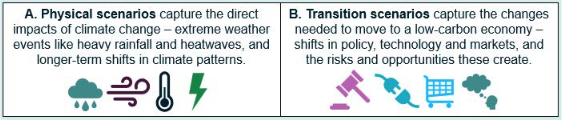
Effective climate scenario analysis covers 2 distinct types of uncertainty:
Credit: GAD
These 2 types can be analysed separately. However, some providers offer both physical and transition scenarios, and it is possible to combine them when building bespoke narratives.
A. Physical and combined scenarios (IPCC)
The Intergovernmental Panel on Climate Change (IPCC) assesses and uses widely adopted global climate reference scenarios. Climate projections consistent with these scenarios are produced by many climate models through the Coupled Model Intercomparison Project (CMIP).
RCPs – what the climate does
RCPs (Representative Concentration Pathways) describe future levels of greenhouse gases in the atmosphere and how much of the Sun’s energy the Earth keeps, rather than loses back to space. The RCP number (2.6, 4.5, 6.0 or 8.5) refers to the level of extra heat trapped by 2100. The higher the RCP, the higher the temperature outcome.
RCPs tell you about the potential scale of climate change due to greenhouse gas concentrations. They say nothing about the society or economy that produced those emissions.
Use RCPs when you need physical climate projections (such as for temperature, rainfall, sea level, extreme weather hazards). For example, if your scope considers long-term physical risk to coastal assets, RCP 8.5 tests how those assets perform under a high-warming, high sea-level-rise future.
SSPs - how the world gets there
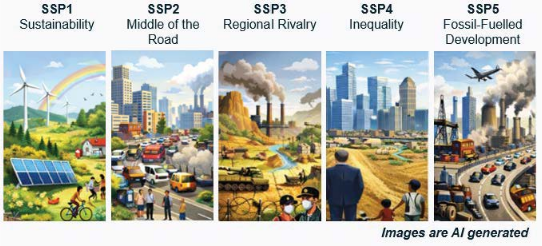
SSPs (Shared Socioeconomic Pathways) are five broad world narratives (SSP1–SSP5). They describe how society, technology, policy and economies might develop. Each tells a different story about population, energy demand and ambition for tackling climate change.
SSPs help explain why emissions could be higher or lower in the future. They do not, by themselves, tell you how hot the world will get.
Credit: GAD
Combining them: SSPx-y
In the IPCC’s 6th Assessment Report, the RCPs and SSPs are joined together. A scenario written as SSP2-4.5 means: the SSP2 world story (middle-of-the-road development), combined with an RCP number of 4.5 (a moderate emissions level). This gives a full picture, both the physical outcome and the social context.
Use SSPs (and SSPx-y) when you need socio‑economic context alongside physical climate change. For example, if your scope considers supply chain risk, SSP3-7.0 captures a world of high emissions, inequality and regional conflict and would give your scenario a more realistic backdrop than physical hazards alone.
Mapping IPCC scenarios to Global Warming Level scenarios
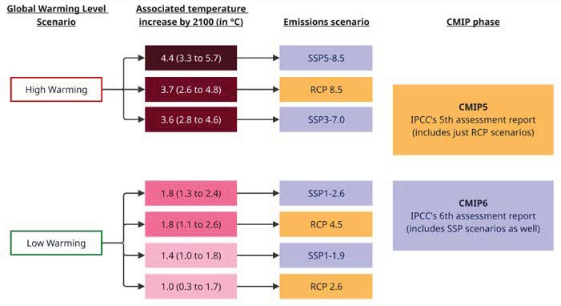
The table below shows how common IPCC scenarios map to the Global Warming Level (GWL) scenarios.
Credit: GAD
Note: temperature projections carry ranges. For example, SSP5-8.5 projects 4.4°C, alongside a range of 3.3 to 5.7°C by 2100.
B. Transition risk scenarios
A wide range of transition risk scenarios are available, designed for different purposes and users. Below we summarise two widely used transition scenario providers.
-
NGFS - The Network for Greening the Financial System produces scenarios for financial risk analysis which are widely used by central banks and regulators. Their scenarios range from orderly transitions to highly disruptive ones. However, they have been criticised for underestimating certain risks so output should be viewed with caution when underpinning decisions.
-
IEA - The International Energy Agency produces scenarios that start with a temperature target and model the energy and economic changes needed to reach it. They are especially useful for understanding how energy systems, technology and policy might shift. They are most widely used for energy-intensive sectors.