Contracts for Difference and Capacity Market scheme update 2025 (accessible webpage)
Published 17 December 2025

© Crown copyright 2025
This publication is licensed under the terms of the Open Government Licence v3.0 except where otherwise stated. To view this licence, visit nationalarchives.gov.uk/doc/open-government-licence/version/3 or write to the Information Policy Team, The National Archives, Kew, London TW9 4DU, or email: psi@nationalarchives.gov.uk.
Where we have identified any third party copyright information you will need to obtain permission from the copyright holders concerned.
This publication is available at https://www.gov.uk/government/publications/contracts-for-difference-and-capacity-market-scheme-update-2025/contracts-for-difference-and-capacity-market-scheme-update-2025-accessible-webpage
Presented to Parliament pursuant to Section 5(4) of the Energy Act 2013
House of Commons (HC) paper number: HC 1590
Ordered by the House of Commons to be printed on 17 December 2025
© Crown copyright 2025
Any enquiries regarding this publication should be sent to us at capacity.market@energysecurity.gov.uk.
ISBN 978-1-5286-6143-0
E03514573
Executive summary
1. This is the 13th annual update outlining the progress made on policy mechanisms implemented under the Electricity Market Reform programme, which closed in 2015. The key mechanisms are the Contracts for Difference (CfD) scheme and the Capacity Market. Together they are designed to incentivise the investment required in the UK’s energy infrastructure and to deliver low carbon and reliable energy supplies, while minimising costs to consumers.
2. This document sets out the headline achievements over the past 12 months in the following areas:
- The Contracts for Difference scheme, enabling investment in low-carbon electricity generation.
- The Capacity Market, ensuring sufficient electricity capacity to meet peak demand.
- The Electricity Demand Reduction pilot, designed to provide financial support to organisations to deliver electricity capacity savings at peak time.
- The Emissions Performance Standard, ensuring new fossil fuel-fired electricity generation contributes to electricity security in a manner consistent with decarbonisation objectives.
Key progress since the 2024 update
Contracts for Difference
3. The government consulted in February 2025 on a number of reforms to the CfD scheme to support cost-effective delivery of Clean Power 2030. Following that consultation, the government decided to go ahead with the following changes from AR7:
- To offer 20-year CPI-indexed contracts for fixed-bottom and floating offshore wind, onshore wind, repowered onshore wind, remote island wind, and solar PV.
- To relax eligibility requirements relating to planning consent, allowing mature fixed-bottom offshore wind projects to apply for a CfD while awaiting full planning consent.
- To legislate for Secretary of State to see anonymised bid information before setting a final budget for that technology. In AR7 this would apply to fixed-bottom offshore wind only.
- These changes to the CfD have supported the government’s wider objectives of moving towards energy independence and protecting households from volatile fossil fuel prices.
Capacity Market
4. Following auctions held in March, the Capacity Market secured 43.1GW of electricity capacity for the 2028/29 Delivery year and an additional 7.9GW of electricity capacity for the 2025/26 Delivery year.
5. Rule changes to support auction liquidity were prioritised following the CM Phase 2 consultation in early 2024. These changes were implemented in time for Prequalification in August 2024, for auctions that took place in March 2025.
6. The CM Phase 2 Policy Update outlined the intention to implement the remaining policies as soon as possible and so were put in place for Prequalification in July 2025, for auctions taking place in early 2026.
7. In October 2025, the Government also published a consultation and Call for Evidence, seeking views on changes to the CM that aim to retain flexible capacity required to maintain security of electricity supply in the short-term and support the conversion of unabated gas plants to low carbon technology.
8. In November 2025, the Government published a consultation seeking views on an urgent change to the CM Rules to remove the provisions which allow for New Build Capacity Market Units (CMUs) or Demand Side Response (DSR) CMUs to change the location of a Generating Unit or DSR CMU Component after Prequalification. This consultation aimed to provide greater assurances that CMUs represent genuine New Build capacity at the point of Application, which can contribute to GB security of supply. It also aimed to better reflect the intent of the Capacity Market and ensure that projects are viable at the point of Prequalification.
Electricity Demand Reduction
9. There have been no notable developments in 2025 regarding the Electricity Demand Reduction pilot.
Emissions Performance Standard
10. There have been no notable developments in 2025 with regards to the Emissions Performance Standard (EPS), so the position remains as stated in the 2022 report. [footnote 1]
11. The government conducted a five-year review of the regulation in 2019 as required by the Energy Act 2013 which was carried out by Department for Business, Energy and Industrial Strategy officials. A call for evidence exercise was used to ask questions on the performance of the EPS in achieving its objectives, whether its objectives were still appropriate and whether any issues had arisen in its operation. A total of twenty-seven responses were received. Additionally, government reviewed plants built since implementation and obtained feedback from the Environment Agency.
12. The overwhelming majority of stakeholders indicated support for the EPS. The review found that the EPS has, to date, been successful as a regulatory backstop, reinforcing existing planning policy. No unintended consequences were identified through the review.
Contracts for Difference (CfD) Scheme
| Deliverable | Achieved | When |
|---|---|---|
| Allocation Round 7 (AR7) | ||
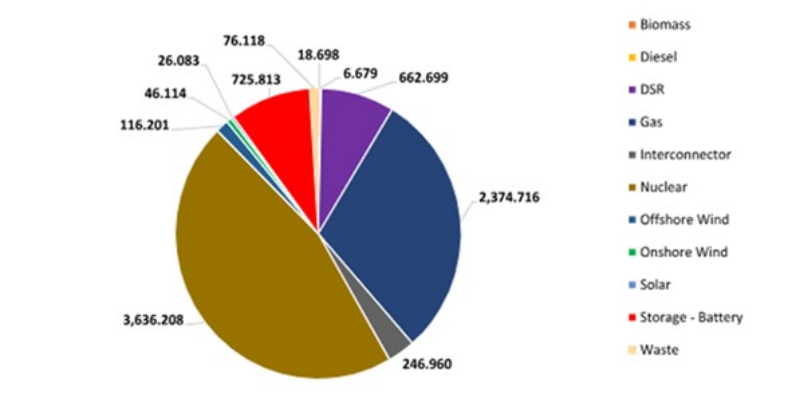
| Government publishes consultation on further reforms to AR7 | Yes | February 2025 |
| Government publishes response to legislative proposals for further reforms to the CfD Scheme for AR7 | Yes | May 2025 |
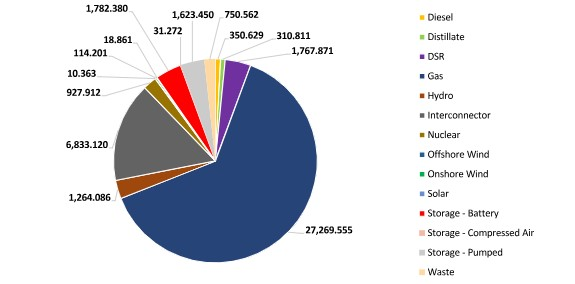
| Government lays Statutory Instrument to change the approach to budget-setting for AR7 | Yes | June 2025 |
| The secondary legislation to change the approach to budget-setting for AR7 came into effect | Yes | July 2025 |
| The Government publishes - Response to policy proposals for further reforms to the CfD scheme for AR7 - CfD statutory notices including, Contract Allocation Framework, Standard Terms and Conditions, and the AR7 administrative strike prices. |
Yes | July 2025 |
| Government publishes the AR7 budget for offshore wind (OFW) and floating offshore wind (FLOW) | Yes | October 2025 |
| Government publishes the AR7 budget for non-OFW technologies | Yes | December 2025 |
| The AR7 results for OFW and FLOW to be announced | January 2026 | |
| The AR7 results for non-OFW technologies to be announced | February 2026 | |
| Allocation Round 8 (AR8) | ||
| The Government publishes the Clean Industry Bonus consultation on regulatory reforms for Allocation Round 8 | Yes | August 2025 |
| The Government publishes AR8 Supply Chain Plan Guidance for Solar | Yes | October 2025 |
Introduction
13. The CfD scheme is the government’s main mechanism for supporting new low carbon electricity generation projects in Great Britain. Contracts are awarded in a series of competitive, pay-as-clear auctions, with the lowest price bids being successful, which drives efficiency and cost reduction.
14. CfDs give greater certainty and stability of revenues to electricity generators by reducing their exposure to volatile wholesale prices, while protecting consumers from paying for higher costs when electricity prices are high.
15. CfD contracts are managed by the Low Carbon Contracts Company (LCCC), a government-owned company. Information on the CfD projects managed by the LCCC is published on their CfD Register [footnote 2].
AR7 Reforms
16. The changes we have made for AR7 balance the need for significant renewables deployment to deliver the benefits of a low-cost clean power system, whilst minimising costs to consumers.
17. The government has implemented 20-year CPI-indexed contracts from AR7 for fixed-bottom and floating offshore wind, onshore wind, repowered onshore wind, remote island wind, and solar PV. This will help to rebalance costs and benefits of the energy transition and boost investor confidence in an increasingly competitive and uncertain market.
18. The government has relaxed eligibility requirements to allow fixed-bottom offshore wind projects to apply for a CfD while awaiting full planning consent. The primary rationale for this change is to open the auction to more projects, improving competitive tension. Improved competition should deliver better outcomes for consumers as we aim to scale up renewable deployment, by incentivising developers to bid at their minimum viable price.
19. The government has legislated to allow the Secretary of State to see anonymised bid information before setting the final budget for that technology. In AR7 this would apply to fixed-bottom offshore wind only. The Secretary of State may increase the budget for offshore wind following sight of bids, if it presents good value for money for consumers.
20. The changes to the CfD support the wider objective of moving towards energy independence and protecting households from volatile fossil fuel prices – the ultimate benefit from delivering clean power by 2030.
Allocation Round 7 Progress (AR7)
Auction Parameters – published 24 July 2025
21. The Administration strike prices (ASPs) are as follows: offshore wind £113/MWh, solar £75/MWh, and onshore wind is £92/MWh. We have updated ASP figures to 2024 prices, where previous CfD publications used 2012 figures. [footnote 3]
22. There are four pots, Pot 1 for established technologies, Pot 2 for emerging technologies, Pot 3 for offshore wind, and Pot 4 for floating offshore wind. This separate pot structure allowed offshore wind technologies to proceed to auction sooner where there were no appeals, as is typically the case.
23. Delivery years have followed on from those offered in AR6, but in light of severe supply chain pressures and longer project lead-in times for the fixed-bottom offshore wind sector, we extended an additional delivery year to this technology class. For AR7, the Pot 1 delivery years are 2027/28 and 2028/29. Pot 2 delivery years: 2028/29. Pot 3 delivery years: 2028/29, 2029/30, 2030/31. Pot 4 delivery years: 2028/29 and 2029/30. This approach will be reviewed in AR8.
24. Separate clearing prices have been applied for Offshore Wind projects in Pot 3, based on whether projects’ grid connections are in England/ Wales or Scotland. This change was intended to address marked discrepancies in network charges across GB, mitigating the risk of unfair compensation while maintaining a competitive overall auction pot.
AR7 budgets
25. On 27 October the budgets for offshore wind and floating offshore wind for AR7 were published.
26. A total budget of £900 million has been made available for fixed-bottom offshore wind, which is an increase on the previous (AR6) initial budget for offshore wind, when comparing on a like for like basis. This is the initial budget for offshore wind; the government has the ability to view unsuccessful bids and adjust the budget later, if it is good value for consumers.
27. A total budget of £180 million has been made available for floating offshore wind, with this budget, we aim to secure Test & Demonstration projects that will be of vital importance to the development of the floating offshore wind in the UK.
28. On 08 December, the budgets for non-offshore wind technologies were published.
29. A total budget of £295m has been made available for Pot 1 established technologies (Solar PV and Onshore Wind).
30. A total budget £15m has been made available for Pot 2 emerging technologies (Tidal).
31. We expect the budgets and competitive bidding to drive a value for money outcome for billpayers.
Results
32. Results for offshore and floating offshore wind will be published on 14 January 2026.
33. Results for non-offshore wind will be published between 6-9 February 2026.
CfD Clean Industry Bonus
34. The CfD Clean Industry Bonus aims to help accelerate the deployment of low carbon electricity generation, specifically offshore/floating offshore wind, by addressing some of the recent supply chain challenges identified by the industry. Legislation introducing the scheme came into effect in June 2024.
35. The Bonus is a competitive scheme that provides extra revenue support to offshore wind applicants if they choose to invest in a more sustainable supply chain.
36. Provisional AR7 CIB results were released to applicants in the summer, with high levels of supply chain support allocated. Results will depend on the final results of the AR7 CfD allocation round.
37. A consultation on reforms to the CIB for AR8 onwards was issued this summer, with a government response due in Q1 2026. It will set out whether the government can expand the scheme to Onshore Wind, and whether to add conditionalities on fair work and investment in skills.
Capacity Market
Table 1. Deliverables achieved in the Capacity Market during 2025
| Deliverable | Achieved | When |
|---|---|---|
| T-1 and T-4 auctions successfully secured capacity out to 2028/29 | Yes | March 2025 |
| Capacity Market: proposals to maintain security of supply and enable flexible capacity to decarbonise (Summary of responses to consultation) | Yes | May 2025 |
| Consultation outcome: Capacity Market: Proposals to modernise Rules and improve participation and delivery assurance of consumer led flexibility – government response | Yes | June 2025 |
| Secretary of State confirms Capacity Market parameters in letter to NESO | Yes | July 2025 |
| Publication of Capacity Market Frequently Asked Questions: 2025 | Yes | July 2025 |
| Open consultation: Open letter on new technologies in the Capacity Market, 2025 | Yes | September 2025 |
| Open call for evidence: Capacity Market: Hydrogen to Power and Interconnectors | Yes | October 2025 |
| Open consultation: Capacity Market: Proposed changes for Prequalification 2026 | Yes | October 2025 |
| Consumer-led flexibility in the Capacity Market (Summary of responses to the December 2024 Call for Evidence) | Yes | October 2025 |
| Consultation: Amending Change of Address Rules in the Capacity Market | Yes | November 2025 |
| Proposals regarding locational changes of Capacity Market Units | Yes | November 2025 |
| Prequalification Results Day for the T-1 auctions to be held in March 2026 | Yes | November 2025 |
Introduction
38. The purpose of the Capacity Market is to ensure security of Great Britain’s electricity supply at least cost to consumers. It does this by providing capacity providers with the right incentives to be on the system and to deliver electricity when it is needed. The Capacity Market ensures there is sufficient reliable capacity available during periods of electricity system stress, for example during cold, still periods with high electricity demand and low wind generation.
39. Eligible capacity providers bid into a competitive Capacity Market auction to receive Capacity Market Agreements. Successful capacity providers receive payments to ensure their capacity is available to meet demand at times of system stress. These capacity payments incentivise the necessary investment to maintain and refurbish existing capacity, and to finance new capacity where necessary. Capacity providers face penalties if they fail to deliver capacity when requested during a system stress event.
40. The Capacity Market provides incentives for all forms of capacity, including generation, storage, consumer-led flexibility and interconnection that can contribute to security of supply. Government is currently consulting on a proposal to introduce a Multiple Price Capacity Market (MPCM) from the 2026 Prequalification window which will create a higher price cap for New Build CMUs that are dispatchable and enduring. This will not have any impact on the eligibility or price cap for all other types of capacity. With the exception of capacity providers in receipt of support from other specific policy measures, all types of technology are able to participate in the Capacity Market provided they can demonstrate sufficient technical performance to contribute to security of supply and provided they comply with the Capacity Market’s emissions limits. [footnote 4]
Capacity Auctions
41. Each year, an assessment is made of the required electricity capacity to meet the expected level of peak demand in four years’ time. Capacity auctions are held one (T-1) and four (T- 4) years ahead of the delivery year when capacity must be provided, giving investors certainty over part of the future revenues they will receive. Existing Generating capacity competes against Prospective Generating capacity, CLF delivered through Demand Side Response (DSR), and interconnectors, with the auction procuring the mix of capacity which provides best value for consumers.
42. Capacity Auctions were held in March 2025. There was a T-1 auction for delivery in 2025/26, and a T-4 auction for delivery in 2028/29.
T-1 Auction results for 2025/26
43. The one year ahead, T-1 Capacity Market Auction for delivery next winter (2025/26) concluded on 12 March 2025 and secured 7.9GW of de-rated capacity at a clearing price of £20/kW per year. A total of 9.1GW of de-rated capacity entered the auction, of which 86.8% received Capacity Market agreements (Figure 1).
44. The majority of capacity procured in this auction comes from Existing Generating Capacity Market Units (CMUs) at 6.3 GW. These are CMUs that export electricity to the grid such as nuclear, gas, and batteries. Additionally, there is 0.7 GW of New Build Generating CMU capacity, mainly from new-build battery storage units. There is 0.2 GW of capacity from a single New Build Interconnector. There is 0.5 GW of capacity from Unproven DSR, which is DSR that has not yet passed a DSR test to confirm its components, and an additional 0.2GW of Proven DSR Capacity.
Figure 1. T-1 Auction results breakdown of Capacity Agreements awarded by Primary Fuel Type for the 2025/26 Delivery Year (MW)
Source: National Energy System Operator Final Auction Report (2025 [footnote 5])
T-4 Auction results for 2027/28
45. The T-4 auction for delivery in 2028/29 concluded on 11 March 2025 and secured 43.1GW of de-rated capacity at a clearing price of £60/kW per year. A total of 44.7GW of de-rated capacity entered the auction, of which 96.4% received capacity agreements for delivery (Figure 2).
46. 44.7GW of capacity entered the auction, of which 43.1GW secured a Capacity Agreement at a clearing price of £60/kW/year. Unabated gas is the most common primary fuel type of capacity secured, securing 27.3GW. The auction also procured 0.9GW of nuclear, 1.8GW of battery storage, 1.8GW of Demand Side Response (DSR), 1.6GW of pumped-hydro storage, 6.8GW of interconnectors, and 2.9GW from other technologies (including wind, solar, and energy from waste).
47. The auction procured 29.4GW from Existing Generating Capacity Market Units (CMUs), 2.1GW from New Build Generating CMUs (including 1.8GW of new-build battery capacity), and 1.4GW CMUs that have secured multi-year agreements to refurbish their units. The auction also procured 6.6GW of Interconnector capacity. There is 1.5 GW of capacity from Unproven DSR, which is DSR that has not yet passed a DSR test to confirm its components, and an additional 0.3GW of Proven DSR Capacity.
Figure 2. T-4 Auction results breakdown of Capacity Agreements awarded by fuel type for the 2028/29 Delivery Year (de-rated capacity)
Source: National Energy System Operator Final Auction Report (2025)
Changes to the Capacity Market Rules and Regulations
48. Changes over the last year in the CM have been made to strengthen security of supply and accelerate investment in low carbon technologies.
49. The CM Phase 2 Policy Update [footnote 6] outlined the intention to implement the remaining Phase 2 policies that were not immediately progressed after the General Election. The following changes are to be put into effect as soon as possible, via changes to the CM Rules and Regulations, and will be in place for the July 2025 Capacity Market pre-qualification window, ahead of the 2026 auction:
- Amendments to timelines for post-stress event activities to improve administrative arrangements.
- Amending Rules on what can be captured as part of refurbishment programmes.
- Reducing administrative barriers to Demand Side Response and other low carbon technologies competing in the CM.
- Enabling low carbon technologies with lower capital expenditure requirements to access longer term contracts.
- Supporting low-carbon projects with longer build times to access support from the CM, vital for supporting the refurbishment of some large pumped hydro capacity.
- Publishing emissions data on a publicly available register.
- Implementing a low carbon definition for declared units.
50. The previous government invited stakeholder feedback in relation to Demand Side Response (DSR) technologies’ position in the CM in its Phase 2 consultation (October - December 2023). The government has considered feedback received from that consultation and intends to further explore with stakeholders DSR technologies’ participation and integration in the CM.
Capacity Market: Proposals to maintain security of supply and enable flexible capacity to decarbonise
51. While low-carbon technologies are scaling up, we will continue to need existing dispatchable capacity, including unabated gas, to ensure security of supply. The running hours of gas generators have already significantly reduced, and we expect that the amount of unabated gas we need will continue to decline as we deploy more low-carbon technologies. We intend to ensure that gas plants can decarbonise once low-carbon flexible technologies are available.
52. Between 15 October and 10 December 2024, the government consulted and ran a call for evidence on proposed changes to the Capacity Market (CM) to maintain security of supply and enable flexible capacity to decarbonise. The consultation received 41 responses, including from generators and developers, trade bodies, academia, non-governmental organisations (NGOs), think tanks, and energy delivery bodies. Most respondents were broadly content with the proposals, whilst others provided useful feedback.
53. In May 2025, we published the government response to the consultation on proposals to maintain security of supply and enable flexible capacity to decarbonise. The summary of responses set out respondents’ views on the following areas covered in the consultation:
- Making it easier for plants to access multi-year CM agreement, providing greater revenue certainty and encouraging the type of investment ageing plants need to extend the operating life of the plant. This is important to mitigate short-term risks to electricity security.
- Providing assurance that all substantially refurbishing or new combustion power plants participating in the next CM auction have a credible plan to decarbonise before they become operational, either through converting hydrogen firing or installing carbon capture equipment.
- Introducing a pathway for unabated gas plants with multi-year CM agreements to exit the CM and transfer to the Dispatchable Power Agreement, enabling decarbonisation through conversion to power carbon capture, usage and storage (CCUS).
54. It also set out how the government’s thinking has evolved in response to the feedback and actions the government will be taking.
55. As a result, the government plans to:
- Lower the capital expenditure (capex) threshold for ‘refurbishing’ three-year CM agreements to £65/kW for Capacity Market Units (CMUs) prequalifying in 2025, to support the economic case for investment to extend the life of ageing plants. In subsequent years, the capex threshold will be adjusted in line with inflation.
- Ensure that all substantially refurbishing or new combustion power plants participating in the 2026 T-4 CM auction (for the 2029/30 delivery year) commit to having a credible plan in place to decarbonise, either through converting to H2P or to power CCUS. The decarbonisation plan must be in place before they become operational.
- Introduce an exit pathway (“managed exit”) to enable the decarbonisation of unabated gas by allowing multi-year CM agreement holders to leave without penalty and transfer to a Dispatchable Power Agreement (DPA), enabling conversion to power CCUS. This pathway is subject to the Capacity Provider becoming party to a DPA, subject to Transport and Storage (T&S) capacity, value for money and affordability.
56. Between December 2024 and February 2025, the government consulted on proposals to reform the Capacity Market. Seeking views and evidence on consumer-led flexibility within the CM and the Capacity Market 10 Year Review. The consultation focused on:
- Rules Modernisation changes, proposals to ensure the continued accessibility and modernisation of the CM by proposing policy clarifications and CM Rule amendments and revocation.
- Consumer-led flexibility changes, as delivered via a Demand Side Response (DSR) within the CM, proposals to reduce administrative requirements falling on CM participants and CM Delivery Bodies whilst maintaining delivery assurance for DSR within the CM.
57. The proposals received broad support from respondents. Additional feedback was shared on further considerations and alternative solutions to some of the proposals. The government has introduced CM Rules and Regulations to implement the proposals, as set out in the consultation, ahead of the CM Prequalification window in 2025.
Low Carbon Contracts Company (LCCC) and Electricity Settlements Company (ESC)
58. LCCC and ESC are responsible for helping government to deliver key elements of the Contracts for Difference and Capacity Market schemes, respectively.
59. LCCC, as counterparty to the CfD, is responsible for managing contracts with low-carbon electricity generators under the CfD scheme, forecasting and collecting the Supplier Obligation Levy that funds CfD payments, and ensuring accurate settlement of CfD payments.
60. The ESC is responsible for all financial transactions relating to the Capacity Market, including managing capacity payments, credit cover, penalties, and volume reallocation.
61. Both the LCCC and ESC are companies limited by shares and wholly owned by the Secretary of State for the Department of Energy Security and Net Zero. The companies became operational on 1 August 2014 and operate within two main frameworks: the Energy Act 2013 (and the relevant regulations made under the Act) and the corporate and company law frameworks.
62. In the past year, there have been a number of highlights across the CfD and Capacity Market schemes. These include:
- Implementing automation of key processes making participation easier across the CfD and Capacity Market.
- Being a key partner to DESNZ on contract design for new schemes and to shape key aspects of a fundamental electricity markets review.
- Supporting stakeholders on the requirements of new scheme contracts.
- The number of components in the CM scheme grow at an asset level, from 600 in 2020 to over 305,000 in 2025. We expect to exceed over 1.5m as early as 2026.
- The number of Capacity Agreements has grown from 633 in 2020 to 1238 in 2025.
- Delivery Assurance initiatives and automation ESC has put in place have allowed processes to scale with the scheme growth, such as pre-Delivery Year setup and regular scheme participation monitoring, and automated Satisfactory Performance Day and Extended Performance testing.
63. Over the course of the financial year, The Electricity Settlements Company handled Capacity Payments totalling £1,246.0m for 52.6GW of capacity for Delivery Year 2023/24 and £975.8m* for 53.1GW of capacity for delivery year 2024/25.
*Payments for the final two months of DY2024/25 have yet to be made.
National Energy System Operator
64. National Energy System Operator (NESO)16 continues to play a fundamental role in aiding the CM and CfD schemes through its role as the Electricity Market Reform Delivery Body (DB). For the CM, the DB is responsible for running pre-qualification assessment, disputes management, auctions and ongoing agreement management for the CfD scheme, the DB has the same scope of responsibilities as in the CM, excluding ongoing contract management.
65. The DB successfully completed their processes for the CfD Allocation Round 6(AR6) in September 2024. AR7 opened on 7th August 2025, which means it has not yet concluded and so the outcomes will be covered in next year’s report. However, in 2025, the DB has:
- Proactively identified improvements to the operation of the scheme and worked collaboratively with DESNZ to design and implement them, alongside other changes DESNZ identified to better achieve their policy goals.
- Supported the rules drafting process for the Allocation Framework and implemented these rules into the auction system and business processes in advance of the round opening.
- Updated customer guidance, auction scenario video tutorials and webinars on the CfD application, allocation and auction processes; and
- Maintained a customer relationship management tool, with approximately 92.7% of 546 queries received from customers since January 2025 being resolved within a defined service level agreement period of 5 working days.
66. For the CM, the DB successfully delivered key activities in relation to the auctions and agreement management, including:
- Ran the 2024/25 Auctions that procured a total capacity of 51.04 GW across 915 CM Agreements:
- 7.94GW across 246 CM Agreements for Delivery Year 2025/26
- 43.1GW across 669 CM Agreements for Delivery Year 2028/29.
- Maintained a customer relationship management tool, with 93% of 2,070 queries received from customers since January 2025 being resolved within 5 working days;
- Managed 4,055 active CM Agreements with 99.8% of 2,832 submissions reviewed and actioned within SLA.
- Worked closely with DESNZ to draft and consult on amendments to the Capacity Market Rules for 2025 delivery and implemented them in the IT Portal and associated processes to ensure a smooth transition for customers;
- Actively participated in Ofgem’s CM Advisory Group, which was established to improve effective functioning of the CM by reviewing and testing Rule change proposals and providing advice to Ofgem to support their decision making; and
- Continued to enhance modelling in line with recommendations in the Panel of Technical Experts’ 2024 report, with delivery in the Electricity Capacity Report 2025.
-
GOV.UK: Contracts for Difference and Capacity Market scheme update 2022). ↩
-
Low Carbon Contracts Company: CfD Register. ↩
-
GOV.UK: CfD Allocation Round 7 (AR7): Pot and Price Notice. ↩
-
NESO: Auction Results. ↩