Connect to Work Early Insights report
Published 26 November 2026

© Crown copyright 2026
This publication is licensed under the terms of the Open Government Licence v3.0 except where otherwise stated. To view this licence, visit nationalarchives.gov.uk/doc/open-government-licence/version/3 or write to the Information Policy Team, The National Archives, Kew, London TW9 4DU, or email: psi@nationalarchives.gov.uk.
Where we have identified any third party copyright information you will need to obtain permission from the copyright holders concerned.
This publication is available at https://www.gov.uk/government/publications/connect-to-work-early-insights-report/connect-to-work-national-evaluation
Department for Work and Pensions (DWP) research report number 1168
A report of research carried out by the National Centre for Social Research, Frontier Economics, Institute for Fiscal Studies, and the Centre for Regional, Economic and Social Research (Sheffield Hallam University) on behalf of the DWP.
Views expressed in this report are not necessarily those of DWP or any other government department.
Crown copyright 2026.
You may re-use this information (not including logos) free of charge in any format or medium, under the terms of the Open Government Licence. To view this licence, visit Open Government Licence or write to:
Information Policy Team,
The National Archives,
Kew,
London
TW9 4DU
or email psi@nationalarchives.gov.uk.
If you would like to know more about DWP research, email socialresearch@dwp.gov.uk.
First published November 2026.
ISBN: 978-1-80786-095-0.
Executive summary
This report presents insights from phase 1 of the Evaluation of Connect to Work, which ran from November 2025 and was completed in May 2026. This initial phase of the evaluation aimed to collect early data on the set-up and delivery of Connect to Work. It also aimed to finalise aspects of the design of the remainder of the evaluation.
Connect to Work is a large programme of supported employment for disabled people, people with long-term health conditions, and a range of disadvantaged groups. It uses 2 evidence-based fidelity models of Supported Employment: Individual Placement and Support (IPS), and the Supported Employment Quality Framework (SEQF). It aims to support people into work, and to support people who are already working to remain in employment.
The programme is being funded through grants from DWP. In most areas it is delivered by clusters of local authorities or combined authorities referred to as ‘Accountable Bodies’ (ABs), while 7 Established Mayoral Strategic Authorities (EMSAs) (covering 10 Connect to Work ABs areas) are receiving their Connect to Work funding through integrated settlements. While IPS and SEQF are both strictly defined interventions, ABs and EMSAs have varying degrees of control over how the support is delivered locally.
The evaluation of Connect to Work will assess:
-
the impact on outcomes such as sustained employment, earnings, and health and wellbeing
-
why and how these impacts have occurred
-
whether the programme was an effective use of resources
-
how the programme has been implemented and what can be learned for the future
About the integrated settlement areas
The West Midlands Combined Authority (WMCA) and Greater Manchester Combined Authority (GMCA) received their Connect to Work funding through integrated settlements from 2025 to 2026. From 2026 to 2027, this has grown by a further 5 EMSAs receiving Connect to Work funding through integrated settlements, expanding to Liverpool City Region Combined Authority, North East Combined Authority, South Yorkshire Mayoral Combined Authority, West Yorkshire Combined Authority and the Greater London Authority (covering 4 original Connect to Work ABs).
As a condition of receiving their Connect to Work funding through an integrated settlement, all EMSAs, except for GMCA, are required to deliver evidence-based supported employment to the same target groups as the national Connect to Work programme with outcomes frameworks aligned to the national programme. Whilst there are additional flexibilities available through the integrated settlement, this means that delivery in 6 of the 7 EMSAs receiving Connect to Work funding in their integrated settlement are compatible with the national evaluation of Connect to Work.
About phase 1
The aim of phase 1 has been to learn about the initial setup and delivery of Connect to Work, and to collect all the necessary information to finalise, as much as possible, key aspects of the design of the rest of the evaluation. Specifically, phase 1 has had 4 main aims:
- To understand commonalities and differences in how ABs have designed and set up Connect to Work.
- To understand early experiences of staff and participants in ABs where services are already live.
- To fully articulate a theory of how and why Connect to Work is expected to contribute to its intended outcomes, which will form the basis of the remainder of the evaluation.
- To understand the data landscape around Connect to Work and how that can be used in the evaluation.
A full summary of phase 1 activities is provided in Chapter 2, but broadly, phase 1 has involved 4 main activity areas, in line with its 4 main aims:
- Reviewing and analysing the Connect to Work delivery plans produced by 47 ABs. The results are presented in Chapter 3.
- Conducting qualitative fieldwork in 4 ABs, including: staff responsible for overseeing delivery; employment specialists who deliver the service; Connect to Work participants; and non-participants who dropped out of the service. The findings from this fieldwork are presented in Chapter 4.
- Reviewing programme documentation; interviewing DWP staff and stakeholders; drafting a series of theories of change (ToCs) and contribution claims; and conducting ToC and contribution claim workshops with stakeholders. The results of this work are presented in Chapter 5 and Annex A.
- Working with DWP to review multiple data sources, including Management Information (MI) collected by ABs and administrative data held centrally by DWP and HM Revenue and Customs (HMRC), as well as engaging with DWP on data sharing and access arrangements. A summary of our current understanding, information gaps and next steps, is presented in Chapter 6.
A key part of the evaluation going forward will be a large-scale survey of participants and non-participants. Phase 1 has therefore also included extensive development work for this survey, including assessing the suitability of programme MI as a sample source, and questionnaire development. As of June 2026, this work is ongoing, so less detail is provided about it in this report.
Key findings from the review of delivery plans and the phase 1 qualitative fieldwork
Key findings from the review of delivery plans and early qualitative fieldwork are summarised below, focusing mainly on those findings that could have implications for the design of the remainder of the evaluation. These early findings are tentative as local delivery experiences were explored with 4 ABs, representing a small proportion of the programme. They provide early, indicative insights which may not be representative of the whole programme and will be explored further in later phases of the evaluation.
Connect to Work is a departure from previous employment support programmes
A core objective when designing Connect to Work was to reach people who are economically inactive who have not been well served by previous DWP employment programmes. As part of this, Connect to Work is voluntary, unlike work-related activity requirements for some benefit claimants.
Although supported employment models like IPS and SEQF already have relatively strong evidence bases, the design of Connect to Work was a departure from previous supported employment delivery in a few ways: first, the scale is far larger than any previous implementation; and second, Connect to Work is testing supported employment with a far broader population than previous attempts, including a wide range of disadvantaged groups.
The rationale for the national-funding with local-delivery model was that ABs would be better placed to engage economically inactive people in their areas, helping to reach people not already in touch with DWP and the benefits system. Local delivery was intended to support better cross-service integration, for example between employment and health services.
Despite strict fidelity models, local areas are tailoring their approach
Both supported employment delivery models (IPS and SEQF) are well established and prescriptive about what the intervention must involve. Delivery will be regularly assessed to ensure it is in line with these models, a process called ‘fidelity assurance’. DWP have set the target groups for the programme in advance. As a result, some ABs have a limited choice of suppliers with the skills to deliver Connect to Work because there are relatively few suitable providers rather than any restrictions in the programme design. delivery leads (staff currently employed in a role with oversight over Connect to Work local delivery, working with DWP) consequently felt the extent to which the programme could be locally tailored was limited. Some employment specialists, who deliver Connect to Work directly to participants, also felt the delivery model could be too rigid to adapt to certain participants’ needs.
Despite this, ABs have managed to tailor their approach in various ways. They used evidence on local needs to inform priority groups and service locations, and the balance of IPS vs. SEQF delivery. Many areas made use of existing partnerships between services and in some cases, they embedded delivery within existing local services like skills hubs. In general, delivery leads felt that local delivery enabled more strategic decision making and coordination.
Our review of delivery plans showed that most were blending in-house delivery with commissioned services, but some were delivering entirely in-house and some were entirely commissioning out. Some were setting up single services covering their entire geography whereas others had different services in different areas. Some were using a single provider, but most were using multiple providers.
A key rationale for local delivery was that it would better enable integration between services. Despite this, delivery plans were highly variable in the level of detail they provided about integration plans. Delivery leads felt that integration with health services had generally progressed more slowly than initially expected and viewed full integration as a longer-term goal.
There have been some early challenges in reaching the right participant mix
Employment specialists generally felt that Connect to Work was reaching the right participants. This included people with a range of different disabilities and health conditions, as well as people with other eligible disadvantages. In interviews, participants in the programme were generally motivated to engage, and wanted to find work.
Despite this, the early evidence suggests there may have been some early challenges in reaching the intended participants. Delivery leads and employment specialists both felt there has been a greater than intended proportion of participants signposted from Jobcentre Plus (JCP). Some participants in this cohort struggled to distinguish between Connect to Work and the kind of mandatory work-related activities they had been required to complete by JCP work coaches in the past. As a result, some participants did not fully understand that participation in Connect to Work was voluntary. This was also apparent in interviews with participants themselves: participants’ perception that the programme was mandatory led to low levels of motivation to engage. In addition, those with recent experience of mandatory work-related activity also tended to have lower support needs and may not have required intensive long-term support like Connect to Work.
Conversely, staff felt there were some participants being referred who were too unwell to engage with the programme. This was sometimes difficult to assess at the initial eligibility and suitability stages, due to the fluctuating nature of participants’ health, and only became clearer later.
Delivery leads and employment specialists felt that some disadvantaged groups were not being successfully recruited into the programme: in particular, veterans and ex-service personnel, and refugees. In some areas, employment specialists felt there was no clear local strategy to reach these groups.
The onboarding process is complex and variable
Eligibility and suitability criteria are consistent across the programme, although some aspects involve a degree of judgement, such as motivation to find work. In some areas, triage staff or administrators were responsible for initial formal eligibility checks, whereas employment specialists made judgements about suitability over one or more subsequent sessions, based on more informal conversations.
Employment specialists felt that the administrative burden of onboarding could be intense, with similar questions being used multiple times across encounters which could be frustrating for all parties and a barrier to building rapport and trust.
Between being signposted to Connect to Work and settling into sustained engagement with an employment specialist, there were many points at which participants could drop out. Employment specialists felt that most dropouts occurred relatively early in the process, before more intensive support had started. Some participants found work independently shortly after being introduced to the programme, others lost motivation or felt the programme was not suitable for them after they had learned more.
Employment specialists are still learning how best to deliver the in-work pathway
Unlike the out-of-work (OOW) pathway, the in-work retention support (IWRS) pathway of Connect to Work is newer and more unfamiliar to those delivering services. Employment specialists viewed the IWRS support offer positively, although they felt they had less relevant experience to draw on and found it harder to deliver than the OOW pathway.
Employment specialists found that the most challenging aspect of the IWRS pathway was having difficult conversations with employers. In some cases, self-referring participants had not informed their employers about Connect to Work, which could lead to tension, especially when participants had difficult relationships with their employers. Employment specialists did not always feel well equipped to manage these scenarios and support Connect to Work participants in this context.
Despite these challenges, participants on the IWRS pathway described largely positive experiences.
There have also been challenges engaging with employers
Positive initial engagement with employers was mostly concentrated among those who were already engaged with local initiatives. Delivery leads felt that broadening out employer engagement was a key priority as the programme matures.
Employment specialists experienced several challenges. The broader shift towards online recruitment and the use of recruitment agencies limited opportunities for face-to-face interaction and relationship building with employers. Employment specialists have targets for employer engagement, and some felt this was overly time consuming and taking them away from direct participant support, which they saw as their core role.
In some areas, multiple Connect to Work providers had been targeting the same employers, causing frustration and a reputational risk to the programme. Some ABs had set up customer relationship management systems to track employer engagement and prevent duplication, with these systems also being used across other programmes like WorkWell.
Development of the Connect to Work programme theory
Due to the scale and complexity of Connect to Work, we have developed 4 ‘nested’ ToCs, reflecting the way the programme operates at 3 different levels.
There are 2 individual-level ToCs: one for OOW participants, and one for IWRS participants. There is an organisational-level ToC focused on the role of employers. And there is a broader systems-level ToC focused on service integration and sustainment. These ToCs will provide a shared reference point across the rest of the evaluation, informing data collection, management, and analysis.
The ToCs will also form the basis of a theory-based impact evaluation of Connect to Work. To enable this, the ToCs have been further translated into a series of 8 contribution claims. These claims set out clear, concise, and testable explanations of how Connect to Work is expected to contribute to outcomes through specific sequences of activities and mechanisms.
The individual-level ToCs have been translated into 4 contribution claims, focusing on (1) how OOW participants are supported to enter and sustain employment; (2) how IWRS participants are supported to stay in work and progress; (3) how both participant groups achieve improvements in health and wellbeing; and (4) how participation can lead to increased stability (such as financial security or housing) through integrated and holistic support.
The organisational-level ToC has been translated into 2 contribution claims, focusing on (5) how employer participation in Connect to Work leads to improvements in workforce outcomes, such as reduced staff turnover and improved productivity; and (6) how participation leads to a wider improvement in inclusive recruitment and workplace practices.
The systems-level ToC has been translated into 2 contribution claims, focusing on (7) how Connect to Work supports better integration of local systems, collaboration, and joint-working; and (8) how the programme leads to sustainable long-term supported employment capacity across local areas.
Findings from the review of data sources
Phase 1 has involved initial reviews of 2 main categories of data: programme data that describes participation in Connect to Work, and administrative data that captures key outcomes. Programme data includes both MI collected by ABs, and the Provider Referral and Payments system (PRaP). Administrative data includes the Registration and Population Interaction Database (RAPID) which combines DWP and HMRC records, and the Employment Characteristics Dataset (ECD) which contains information on individual employment spells.
The MI will be crucial but is still in transition. The MI captures participant characteristics and activity from the ‘Expression of Interest’ (EOI) form participants must complete, through to the initial meeting with an employment specialist, and into ongoing supported employment.
RAPID and the ECD are well understood conceptually and offer strong outcome measurement. RAPID supports monthly tracking of employment and benefit receipt and will enable the evaluation to look at sustained employment outcomes and earnings. Earnings are only available annually and RAPID lacks job or employer detail, so ECD will be needed for employer-related analysis.
Key outstanding unknowns
There are 2 key unknowns as of the end of phase 1:
The viability of the Referred Non-Starters design remains unclear
The core design for the quantitative impact evaluation, at least for health and well-being outcomes, is likely to involve including so-called ‘Referred Non-Starters’ (RNSs) in the survey, so that this group can be used as a comparison group for Connect to Work participants, enabling us to estimate counterfactual outcomes.
The qualitative data collection has shown that there are several points in the onboarding process that a participant can drop out, and there are several reasons that a participant can choose to drop out. This means that there are different groups who could potentially be considered RNSs, some of whom may provide a better comparison to participants than others.
We also do not know, regardless of which definition we proceed with, how many RNSs there are likely to be. Without this information, we cannot determine whether the RNS approach to estimating the counterfactual is viable.
The range, scale and diversity of service integration remain unclear
An important part of the process and theory-based impact evaluations will be detailed case study fieldwork in a selection of ABs. This selection will be informed by a typology of ABs, which will in part be based on an understanding of the extent and nature of service integration within ABs.
The review of delivery plans and the qualitative data collection shows that integration plans are not yet fully developed, and the true nature and scale of service integration (especially with health services) is likely to take time to emerge.
Next steps
A detailed overview of the plans and recommendations for the remainder of the evaluation are presented in Chapter 6. The primary objectives for the early parts of Phase 2 are to resolve the above unknowns by undertaking the following activities:
Ongoing scoping of programme MI
We anticipate receiving the first batch of programme MI in the early part of Phase 2. By interrogating this data, we will understand which definitions of RNSs can be operationalised within the MI.
We anticipate working with DWP to produce a series of hypothetical non-starters and exploring which of these can be identified in the MI.
Running a survey pilot
During phase 1 we proposed that a survey pilot would be beneficial. As of August 2026, this is scheduled for January 2027.
The pilot will enable us to test the viability of the RNS approach. We will be able to compare how RNS status (as identified in the MI) relates to participants’ self-reported experiences. We will be able to test the response rate among RNSs and test the effectiveness of different strategies to maximise response.
The pilot will also test the availability and accuracy of contact details in the MI, assess questionnaire length across modes, and assess the proportion of participants who opt-in to recontact.
Additional scoping work to develop a typology of local delivery models.
We will work with DWP to secure access to some additional sources of live information about ABs’ delivery of Connect to Work. We will also meet with DWP operational staff to fill outstanding gaps in our understanding.
From this, we will develop an initial typology, including a dimension that captures the degree of local service integration. We may then reassess the typology at a later date once integration is further progressed and we have richer data from ABs.
1. Introduction
1.1. Background to Connect to Work
Connect to Work is a large programme of local supported employment for disabled people, people with long-term health conditions and disadvantaged groups. The programme was launched in April 2025 and will run until March 2030. Connect to Work is a key part of the government’s strategy to reduce high levels of economic inactivity and expand opportunity by supporting people to start, stay and succeed in employment.
The programme deploys 2 evidence-based fidelity models of supported employment: Individual Placement and Support (IPS), which integrates employment support with health care and wider services; and the SEQF which provides more intensive support, does not have integration as the core principle and has traditionally supported people with autism and learning disabilities. Delivery will be underpinned by IPS and SEQF reviews which will assess how services align to the core principles of supported employment.
Connect to Work aims to support disabled people, people with health conditions, and those with more complex barriers to work who are outside and inside the labour market. It is a voluntary programme, and participants must be deemed both eligible and suitable for the provision. To be eligible for the provision, participants must have a disability or long-term health condition, as defined in the Equality Act 2010 or the Social Model of Disability or be part of a specified disadvantaged group. The in-scope disadvantaged groups include:
- someone who is currently serving a community service, or someone who has completed a custodial or community sentence
- a carer or ex-carer
- a homeless person
- a former member of HM Armed Forces (AF), a member of HM AF reserves, or a partner of current or former Armed Forces personnel
- a person for whom a drug or alcohol dependency, including a history of dependency, presents a significant barrier to employment
- a care experienced young person or a care leaver
- a refugee or resettled Afghan
- someone on the Ukrainian scheme
- a victim or survivor of domestic abuse
- a young person identified as being involved or at risk of being involved in serious violence
- a victim of modern slavery
It is worth noting that there is a distinction within disadvantaged groups between those underrepresented in the labour market and those that will have complex barriers to work. For example, veterans as a whole are not underrepresented in the labour market but there are some ex-armed forces veterans who will have complex barriers to work and may therefore benefit from the Connect to Work programme.
Participants who meet the eligibility criteria and are motivated to work and engage with Connect to Work need to meet at least one of the employment situation suitability criteria:
- being economically inactive or unemployed (due to their disability, long term health condition or disadvantages, the participant requires comprehensive tailored employment support and has not been in employment for at least 6 months)
- being employed but at risk of dropping out of work (due to their disability, long term health condition or disadvantages the participant struggles to sustain work)
- maintaining work (due to their disability, long term health condition or disadvantages the participant has never been in employment or struggles to retain jobs)
Additionally, participants also need to meet at least one of the ‘would benefit from Connect to Work’ suitability criteria:
-
comprehensive tailored help: someone is unlikely to be able to move into or retain paid work without very frequent, comprehensive and tailored support above and beyond standard provision
-
adaptability: someone has struggled or may struggle with learning new skills or adapting to new environments due to their disability, long term health condition or disadvantages
-
integration: someone needs employment support that is integrated with support for their other needs, for example health services, probation, social care
-
job role and workplace: someone needs employer flexibility to tailor the role and/or workplace to support with their disadvantages or disability or health condition
-
sustained work: someone requires or will require significant support to retain work over and above standard reasonable accommodations
The Connect to Work programme is being funded through grants from DWP and delivered by ABs. ABs may be local authorities, combined authorities or clusters of local authorities, but the term ‘Accountable Body’ refers specifically to the lead authority and grant recipient responsible for overseeing the implementation of Connect to Work across a defined delivery area. ABs determine how the support is delivered locally, in line with local priorities. They work closely with DWP who provide implementation support for both ABs and their delivery partners where ABs are commissioning services. To access Connect to Work funding, all ABs submitted a delivery plan, setting out how they intended to implement and deliver their local Connect to Work offer.
1.2. Delivery areas
Connect to Work is being delivered across all of England and Wales through 49 delivery areas. The majority of these areas will deliver Connect to Work under a grant from DWP. The West Midlands Combined Authority and Greater Manchester Combined Authority have received their Connect to Work funding through Integrated Settlements from 2025 to 2026. From 2026 to 2027, this has grown to 7 EMSAs receiving Connect to Work funding through integrated settlements, expanding to Liverpool City Region Combined Authority, North East Combined Authority, South Yorkshire Mayoral Combined Authority, West Yorkshire Combined Authority and the Greater London Authority (covering 4 original Connect to Work ABs).
As a condition of receiving their Connect to Work funding through an integrated settlement, all EMSAs, except for GMCA, are required to deliver evidence-based supported employment to the same target groups as the national Connect to Work programme with outcomes frameworks aligned to the national programme. Whilst there are additional flexibilities available through the integrated settlement, this means that delivery in 6 of the 7 EMSAs receiving Connect to Work funding in their Integrated settlement are compatible with the national evaluation of Connect to Work.
The full requirements of integrated settlement areas are separate to this grant guidance and are set out on GOV.UK.
1.3. Key aims of the evaluation
The evaluation has 3 key aims:
-
To understand the impact of Connect to Work on a range of outcomes including sustained employment, earnings, and health and wellbeing (including which causal factors have contributed to any outcomes and how specific contexts and mechanisms have influenced these).
-
To understand whether delivering Connect to Work is an effective use of resources and identify the benefits and costs of Connect to Work for participants, the Exchequer, and society.
-
To understand how Connect to Work has been implemented across the delivery areas, including identifying barriers and enablers to achieving outcomes and key learning for future delivery.
1.4. Updated evaluation questions
Tables 1 to 3 below set out the updated evaluation questions for the evaluation and identify which data collection will be drawn on to answer each evaluation question.
Table 1: impact evaluation questions
| Research question | Theory Based Evaluation | Quantitative Impact Evaluation |
|---|---|---|
| EQ1: What was the impact of Connect to Work on sustained employment, earnings, health, and wellbeing outcomes for each of the out-of-work and in-work retention participant cohorts? | Used | Used |
| EQ2: What was the impact of each of the individual placement and SEQF support models on core participant outcomes? | Not used | Used |
| EQ3: What was the impact of Connect to Work on core participant outcomes for participant groups defined by disability/health and disadvantaged group characteristics, and how and why did impact vary between participant groups? | Used | Used |
| EQ4: What was the impact of Connect to Work on core participant outcomes in different geographic areas (for example regions, Connect to Work local authority (LA) clusters, upper-tier LAs) and why did impact vary between areas? | Used | Used |
| EQ5: What difference to core participant outcomes did higher/lower fidelity of provision (for example in different sites) make to the supported employment models and/or specific aspects of the models/fidelity criteria? | Used | Used |
| EQ6: To what extent did the Connect to Work theory of change explain observed changes in outcomes, across participant, employer and system outcomes? | Used | Not used |
| EQ7: What specific causal factors related to Connect to Work influenced outcomes, and how and why? | Used | Not used |
| EQ8: How did context influence core participant outcomes? What type of support was effective, for whom, and under what circumstances? | Used | Not used |
| EQ9: How did context influence wider systems outcomes? | Used | Not used |
| EQ10: To what extent did the programme result in any unintended consequences and why? | Used | Not used |
Table 2: Value for Money evaluation questions
| Research question |
|---|
| EQ11: What were the benefits and costs of each of Connect to Work out-of-work and in-work retention support for participants, the exchequer and society? Did the benefits outweigh the costs for each of out-of-work and in-work retention support? |
| EQ12: How did the benefits and costs of Connect to Work, and the relationship between benefits and costs, vary between the IPS and SEQF models of support? |
| EQ13: How did the benefits and costs of Connect to Work, and the relationship between benefits and costs, vary between participant groups? These groups may include disabled people/people with long-term health conditions, disadvantaged groups, participants in receipt of specific DWP benefits, and participants in different geographic areas. |
| EQ14: What was the cost per participant of delivering each of Connect to Work out-of-work and in-work retention support, and each of the IPS and SEQF models? |
| EQ15: Were the specific elements of the Connect to Work service design a cost-effective use of resource? This may include design features such as participant extensions, the offer of on and off the job support and the dual model approach. |
| EQ16: What changes would have improved the cost-effectiveness of the Connect to Work service? |
Table 3: process evaluation questions
| Research question | Qualitative (participants/ non-participants) data collection | Qualitative (staff/ stakeholders) data collection | Qualitative (employers) data collection | Participant survey | Employment specialist survey | Systems mapping workshops |
|---|---|---|---|---|---|---|
| EQ17: Was Connect to Work delivered in line with the policy design and why/why not? | Used | Used | Used | Used | Used | Used |
| EQ18: To the extent that delivery was not in line with design, how was delivery modified? | Not used | Used | Not used | Not used | Not used | Not used |
| EQ19: What aspects of (a) the policy design and (b) the delivery of the policy worked well/less well for each of Connect to Work participants, AB/delivery partner staff and wider local stakeholders, and why? | Used | Used | Used | Used | Used | Used |
| EQ20: How could the delivery of Connect to Work and future programmes be improved based on lessons learned from Connect to Work? | Used | Used | Used | Used | Used | Used |
| EQ21: How did context and external factors influence the delivery of Connect to Work? | Not used | Used | Not used | Not used | Not used | Not used |
| EQ22: What worked well and less well in the implementation/roll out of Connect to Work? How and why has implementation varied between and within delivery areas? | Not used | Used | Used | Not used | Used | Used |
| EQ23: Was there sufficient delivery capacity (provider organisations, LA and provider staff) across Connect to Work clusters and why/why not? How did demand for this support compare to supply? | Not used | Used | Not used | Not used | Not used | Not used |
| EQ24: How did AB/delivery areas in receipt of Connect to Work grants organise and (if applicable) procure local delivery? What worked well/less well with different approaches? | Not used | Used | Not used | Not used | Not used | Not used |
| EQ25: To what extent did AB/delivery partner staff have the capability to deliver? What has influenced capability and how did AB/delivery partners ensure that staff capability was developed/maintained? | Not used | Used | Not used | Not used | Used | Not used |
| EQ26: How were each of (a) implementation support and (b) fidelity reviews delivered and received? What worked well/less well and why? | Not used | Used | Not used | Not used | Used | Not used |
| EQ27: What motivated potential participants to submit ‘Expressions of Interest’ forms? | Used | Not used | Not used | Used | Not used | Not used |
| EQ28: What steps were followed by AB and delivery partners for (a) generating ‘Expressions of Interest’, via marketing, third-party supporting organisations and Job-centre Plus and (b) the referral process? | Not used | Used | Not used | Not used | Not used | Not used |
| EQ29: What routes for identifying and recruiting participants worked well/less well and for which groups? To what extent and how did supporting organisations (including in primary and community health care) engage with recruiting participants? What helped and hindered this? | Used | Used | Used | Used | Not used | Used |
| EQ30: How were the eligibility and suitability criteria applied, and how and why did the criteria work well/less well? | Not used | Used | Not used | Not used | Not used | Not used |
| EQ31: Who was recruited to start the programme, what were the characteristics of those recruited, and how did these characteristics differ from non-participants? | Not used | Not used | Not used | Used | Not used | Not used |
| EQ32: To what extent did Connect to Work reach all segments of the target population and why/why not? | Used | Used | Not used | Used | Not used | Not used |
| EQ33: What worked well/less well in securing participant engagement with Connect to Work support throughout the journey? | Used | Used | Not used | Not used | Not used | Not used |
| EQ34: How did employment specialists provide support to each of (a) out-of-work and (b) in-work retention participants as applicable at each stage of the 5-stage supported employment model? What worked well/less well? | Not used | Used | Not used | Used | Used | Not used |
| EQ35: To what extent and how did employment specialists tailor and personalise support, including where relevant for participants in specific health condition groups (for example, people with musculoskeletal conditions), specific disadvantaged groups and people with complex and multiple barriers to work? | Not used | Used | Not used | Not used | Used | Not used |
| EQ36: How did employment specialists provide self-employment support to participants requiring this type of support within each of the out-of-work and in-work retention cohorts? | Not used | Used | Not used | Not used | Not used | Not used |
| EQ37: How did the delivery of support compare to the supported employment models? How did delivery vary between and within the IPS and SEQF models of Connect to Work support and why? | Not used | Used | Not used | Used | Used | Not used |
| EQ38: How did ABs and delivery partners engage employers with Connect to Work? What worked well/less well in actions taken to engage employers, and why? | Not used | Used | Used | Not used | Not used | Not used |
| EQ39: How did employers experience the delivery of the Connect to Work service (for each of the out-of-work and in-work retention cohorts)? How did employers respond to the service at different stages of the journey, for example job matching and on and off the job support? What worked well/less well from an employer perspective? | Not used | Not used | Used | Not used | Not used | Not used |
| EQ40: To what extent and in what ways did Connect to Work participants receive relevant support from their employer during their Connect to Work journey? How did Connect to Work enable this? | Used | Used | Used | Not used | Not used | Not used |
| EQ41: How and to what extent was integration with health services and wider sources of support (for example probation, social care) achieved, specifically as part of the IPS model? What worked well/less well in delivering integrated support? | Not used | Used | Not used | Not used | Not used | Used |
| EQ42: How did ABs and delivery area members position and join up employment support via Connect to Work within the organisation and delivery of wider local support and services? To what extent and in what ways did this improve the service? | Not used | Used | Not used | Not used | Not used | Used |
1.5. Structure of the evaluation
The evaluation has 4 phases which structure fieldwork, analysis and evaluation outputs. The 4 phases are:
- Phase 1: rapid mobilisation (November 2025 to May 2026)
- Phase 2: building up data collection and finalising evaluation design (June 2026 to September 2027)
- Phase 3: core data collection and ongoing findings (October 2027 to December 2030)
- Phase 4: final analysis and reporting (December 2030 to October 2031)
Within the phases are 4 distinct work packages:
- Work Package 1: Theory Based Evaluation (TBE)
- Work Package 2: quantitative impact and Value for Money (VfM) evaluations
- Work Package 3: survey data collection
- Work Package 4: process evaluation, qualitative fieldwork and case studies
All work packages will be guided by the overarching TBE. The programme ToCs (set out in Chapter 5) provide a shared framework for understanding how the programme is intended to work at the participant, employer and systems levels. All data collection (including qualitative interviews, case studies, and surveys) will be designed in line with the ToCs. Evidence generated across data collection techniques will be brought together and used to assess contribution claims, the hypotheses which set out how Connect to Work is expected to contribute to outcomes, and to examine variation in how these claims operate across contexts using Context–Mechanism–Outcome (CMO) configurations (these concepts are explained in more detail in Chapter 6).
An overview of the evaluation design is shown in Table 4.
Table 4: overview of the evaluation
| Name | Dates | Work Package 1: Theory Based Evaluation | Work Package 2: Quantitative impact and Value for Money evaluations | Work Package 3: Survey data collection | Work Package 4: Process evaluation, qualitative fieldwork and case studies | Output | |
|---|---|---|---|---|---|---|---|
| Phase 1 | Rapid mobilisation | Nov 2025 to May 2026 | Reviewing and refining the ToC, developing Contribution claims, exploratory interviews with DWP | Exploring data availability and access | Design and development of participant survey including cognitive testing | Review of Delivery Plans; early fieldwork in 4 clusters | Revised theory of change Early insights report |
| Phase 2 | Building up data collection and finalising evaluation design | Jun 2026 to September 2027 | Initial analysis and first contribution workshop | Scoping evaluation design options | Pilot participant survey fieldwork Mainstage participant survey launch | Qualitative fieldwork in 12 clusters, selection and finalisation of case studies and initial case study fieldwork, first systems mapping workshops | Typology of delivery approaches Interim report Quantitative impact and Value for Money evaluation plan |
| Phase 3 | Core data collection and ongoing findings | October 2027 to Dec 2030 | Updated analysis and further contribution workshops | Main analysis phase | Interim and endline surveys launch Survey of employment specialists | Qualitative fieldwork in 20 clusters, fieldwork in case study areas, second systems mapping workshops | Developing findings presentations |
| Phase 4 | Final analysis and reporting | Dec 2030 to Oct 2031 | Final synthesis | Updated analysis | Fieldwork ends | Fieldwork ends | Final reports |
1.6. Aims of the early insights report
This early insights report sets out activities undertaken in phase 1 of the evaluation. It summarises key insights gained from our review of delivery plans and initial qualitative fieldwork. It also sets out scoping activities undertaken across all work packages, and implications for the design of the remainder of the evaluation (phases 2 to 4).
Chapters 2 and 3 provide an overview of phase 1 activities and key insights from our review of Connect to Work delivery plans. The report then sets out early insights from qualitative fieldwork (Chapter 4), the updated programme ToCs (Chapter 5), followed by the key recommendations for the evaluation design (Chapter 6). The report also sets out timelines for the evaluation (Chapter 7), and planned outputs (Chapter 8).
2. Overview of phase 1
Phase 1 of the evaluation was designed as an initial scoping stage to learn about the initial set-up and delivery of Connect to Work, and to collect all the necessary information to finalise, as much as possible, key aspects of the design of the rest of the evaluation. The following chapter provides an overview of phase 1 activities across our 4 work packages.
2.1. Work Package 1: Theory Based Evaluation
Phase 1 of the TBE has focused on developing and refining the programme theory that will underpin the evaluation. This work provides the analytical framework for understanding how Connect to Work is expected to contribute to outcomes, for whom, and under what conditions, recognising the programme’s scale, locally led delivery model and the diversity of participant groups and delivery contexts.
The TBE approach uses ToCs and contribution claims as core tools. The ToCs set out how Connect to Work is expected to work, linking programme activities to outcomes through underlying mechanisms, and making explicit the assumptions and risks that shape delivery. Contribution claims translate these ToCs into a set of clear, testable hypotheses about how Connect to Work is expected to contribute to change, which will be examined and refined as evidence is gathered over the course of the evaluation.
Phase 1 activity has focused on developing and refining these tools. This has included:
- reviewing Connect to Work programme documentation, delivery guidance and relevant evidence on supported employment to develop an initial understanding of the programme’s intended design and its distinctive features
- undertaking 8 exploratory interviews with DWP staff and wider stakeholders to clarify programme objectives, priorities and areas of uncertainty, and to build an early shared understanding of how Connect to Work is expected to work in practice
- reviewing and refining a set of draft, nested ToCs reflecting Connect to Work delivery at different levels, including:
- out of work participant pathways
- in work participant pathways
- employer level change
- service integration and sustainment at a system level
- identifying and articulating the key assumptions and risks underpinning each ToC, making explicit the conditions required for Connect to Work to operate as intended and where there are potential risks to delivery or outcomes
- translating the ToCs into a set of draft contribution claims, setting out specific hypotheses about how Connect to Work is expected to contribute to various out-comes
- convening 2 stakeholder workshops with DWP and other stakeholders, focused on exploring different pathways, mechanisms and assumptions within the programme theory, and beginning to surface the contextual factors most likely to influence how causal pathways operate, with learning informing refinement of the ToCs and contribution claims
The resulting ToCs and contribution claims represent the first iteration of Connect to Work’s programme theory. They provide a shared framework for guiding data collection, integration and analysis across the evaluation, and will be tested and refined in subsequent phases as further qualitative and quantitative evidence is gathered (set out in Chapter 6 and Annex A).
2.2. Work Package 2: quantitative impact evaluation and Value for Money
Phase 1 of the quantitative impact and VfM evaluations has included: scoping of the quasi-experimental impact evaluation methodology; input into the longitudinal survey design; data scoping and access arrangements; and early development of the VfM framework.
Scoping the Quasi-Experimental Design (QED) methodology
A central activity during phase 1 has been to scope the methodological approach for the QED evaluation. The core challenge is constructing a credible counterfactual, that is estimating what would have happened to Connect to Work participants in the absence of the programme, given that Connect to Work is voluntary, locally administered, and has a complex referral and onboarding process.
Drawing on the evaluation team’s experience and informed by early intelligence from the qualitative fieldwork and data scoping described elsewhere in this report, we developed a shortlist of 4 candidate approaches and presented these to DWP for discussion. These are:
- a doubly robust Difference-in-Differences (DiDs) using RNSs
- staggered DiDs exploiting geographic roll-out
- Assessor Leniency Instrumental Variable (ALIV)
- exploiting cross-area differences in referral practices
More detail on these 4 candidate approaches is discussed in section 6.3.
For each option, we have assessed the conditions required for credibility, reviewed what is currently known about whether those conditions are likely to hold, and identified the further analytical and intelligence-gathering steps needed to reach a decision. The final choice will be informed by the composition analysis and preliminary data exploration planned for the coming months.
Feeding into survey design
We worked throughout phase 1 to ensure that the longitudinal survey design supports the requirements of the impact and VfM evaluations. This has involved 2 main areas of input.
First, we reviewed the baseline survey questionnaire to ensure it captures the covariates and outcome measures needed for the QED. This included identifying variables essential for propensity score matching and the RNS control group definition (such as employment history, health conditions, and disadvantage markers), as well as measures needed for heterogeneity analysis and the VfM assessment (including the EQ-5D-5L for health-related quality of life). We also ensured additional items on job search intensity, workplace accommodations, and duration of health conditions were included.
Second, we worked closely on the survey sampling strategy, particularly the timing of the baseline survey invitations relative to the referral and onboarding process. A key design tension is between issuing the baseline as early as possible (to capture pre-treatment outcomes and minimise contamination) and waiting long enough to reliably classify individuals as programme starters or non-starters. We reviewed the proposed sampling variables and MI data delivery schedule and discussed how the non-starter classification could be refined through follow-up MI extracts at one and 2 months after initial extraction.
Data scoping and access
During phase 1, we undertook a review of the data sources available to support the impact and VfM evaluations and engaged with DWP on the arrangements needed to access them. This work has established a baseline understanding of what data we expect to have and where the main gaps and risks lie.
We reviewed 3 principal data sources:
- MI data
- PRaP system data
- administrative data held centrally by DWP and HMRC, accessed through the RAPID and ECD platforms
Early Value for Money scoping
Alongside the QED methodology work, we have begun scoping the approach to the VfM evaluation. The VfM assessment will take the form of a Social Cost-Benefit Analysis (SCBA) conducted in accordance with HM Treasury Green Book standards reporting Net Present Value and Benefit-Cost Ratios. More detail is discussed in section 6.3.
2.3. Work Package 3: survey
Work Package 3 includes a longitudinal survey with Connect to Work participants and referred non‑starters, and a separate one‑off survey with employment specialists. Phase 1 activity focused on designing and setting up the longitudinal participant survey, which will provide a key source of evidence for the evaluation and the only robust quantitative data on health and wellbeing outcomes.
The longitudinal survey will follow Connect to Work starters and referred non‑starters over 3 waves: a baseline survey shortly after programme start or referral, an interim survey around 4 months later, and an endline survey around 12 months after baseline. Participants who complete the baseline survey will be invited to take part in later waves. The survey will run for around 4 years, with sample issued on a rolling basis. The survey will be mainly online, but participants will also be able to complete the survey by telephone or request an in‑person interview.
Phase 1 activities to date have included: reviewing design options and exploring data availability for sampling; development of the baseline survey questionnaire and cognitive testing; development of participant materials; obtaining ethical approval; and set-up of survey and sample systems in preparation for the pilot (which will take place in January 2027).
Work to date has shown that data availability for sampling is more limited than originally anticipated (see Section 6.5). The pilot will assess the impact of this on sampling and response rates and inform any refinements to the survey approach.
2.4. Work Package 4: process evaluation, qualitative data collection and case studies
Phase 1 involved a review of Connect to Workdelivery plans and subsequent scoping work for a typology of delivery approaches which will inform later case study selection. It has also involved initial qualitative fieldwork with delivery leads and employment specialists in 4 delivery areas to explore early experiences of delivery, as well as interviews with Connect to Work participants and non-participants.
We undertook analysis of 47 Connect Delivery Plans. Data was systematically captured in an extraction tool which contained 49 variables organised into 5 broad categories: partnership information; geography of delivery area; delivery and governance; labour market context; and targeting and engagement. The variables comprised a mixture of quantitative data (for example beneficiary target numbers), qualitative data (for example referral organisations/initiatives) and categorical data limited to a certain number of predefined categories (for example programme delivery scale). The extraction tool is a dynamic document which will be updated as the evaluation progresses. Key findings from this analysis are presented in Chapter 3.
Online interviews with delivery leads and employment specialists were conducted within 4 areas which had already started delivering Connect to Work. ABs were selected to ensure a geographic spread, and a mix of service delivery modes. We conducted one delivery lead interview per area, with staff currently employed in a role with oversight over Connect to Work delivery, working with DWP. Interviews aimed to gain early insights into local programme design, set-up implementation, referral generation, and partnership working. Interviews were conducted with 4 to 8 employment specialists in 3 of these areas. These interviews aimed to gain insight into recruitment into the role, experiences of training and onboarding, and early experiences of delivery.
Online interviews with 37 Connect to Work participants and non-participants. Connect to Work participants included those who were current (n=32) or former (n=1) Connect to Work participants and non-participants (those who were eligible for Connect to Work but had not started the programme) (n=4). Interviews aimed to understand experiences of early delivery of the Connect to Work programme including motivations for taking part, experiences of referral, onboarding, and experiences of supported employment delivery. Interviews with non-participants explored experiences of the onboarding process and reasons for not continuing.
3. Review of delivery plans
The evaluation team analysed Connect to Work delivery plans alongside more recent and live information on programme delivery provided by DWP (for example, lists of commissioned and in-house providers). This data was recorded in a spreadsheet (extraction tool) and organised under 49 variables within 5 broad themes:
- partnership information
- geography of delivery area
- delivery and governance
- labour market context
- targeting and engagement
The extraction tool is a dynamic dataset that will be updated as further information on delivery becomes available. Key insights from delivery plans are presented in Section 3.1.
3.1. Key thematic insights from delivery plans
This section presents findings based on a review of 47 delivery plans, focusing on commonalities, differences and points of interest in delivery method, delivery scale, provider, approach to integration and target group.
In summary, the predominance of mixed models (a mix of in-house and commissioned delivery) shows that delivery areas have taken advantage of commissioning flexibilities while variations in the geographical scale of delivery across areas reflect the place-based approach of Connect to Work. Service integration is a key feature of the programme, but some delivery plans included less detail about how this would be achieved specifically in each local area, making comparison more difficult to assess.
Delivery method
Connect to Work is being delivered in one of 3 ways:
- in-house: delivered entirely by an AB and/or other delivery area members
- commissioned: delivered entirely by external providers commissioned by the AB
- mixed: a mix of in-house and commissioned delivery
Analysis shows that mixed delivery dominates and the same pattern holds for both the SEQF and IPS elements:
- overall: mixed (34) was the most common delivery method, followed by Commissioned (9) and In-house (4)
- SEQF: mixed was the most common method (22), followed by Commissioned (14) and In-house (11)
- IPS: mixed was the most common method (25), followed by Commissioned (14) and In-house (8)
Delivery scale
The delivery scale of Connect to Work or elements within it (that is, SEQF or IPS) can be categorised in 3 ways:
- regional: programme or element (SEQF or IPS) is delivered by a single lead organisation (in-house or commissioned) across the entire delivery area
- local: programme or element (SEQF or IPS) is delivered separately by 2 or more organisations (in-house or commissioned) in different areas within the delivery area
- regional and local: different programme elements are delivered at different scales (for example IPS is delivered regionally, while SEQF is delivered as separate local programmes)
Analysis shows significant variation in delivery scale across areas: local only (20) and regional only (16) were the most common delivery scales, followed by regional and local (11).
Further notable aspects of delivery scale included:
- Some delivery areas were distinct in broadly adopting a regional approach to delivery except for a single local authority. For example, an AB in London commissioned a single provider in 5 of the 6 boroughs, but the sixth borough will deliver the programme in-house.
- ABs in South West England placed particular emphasis on highly localised delivery in deprived areas with target lower super output areas and wards.
- rurality shaped one AB’s approach in North West England, which adopted a ‘Core, Spoke, and Satellite’ model. The Core Hubs are located in densely populated areas while Spokes will extend services to surrounding communities, and Satellites will reach rural residents.
Provider
Nearly all areas adopted a multi-provider approach. Only 4 commissioned a single provider for all provision including ABs in London, the South East, the South West, and the North West.
Integration
Integrated support across services is central to the Connect to Work model. However, reported detail on integration was highly variable in delivery plans, making it difficult to assess the full range of approaches. The evaluation team requested further information from DWP on how integration is being implemented across delivery areas, ahead of Phase 2.
Most plans outlined intentions to embed Connect to Work within a mix of primary/secondary health services, community/voluntary organisations, and statutory services, although partners were not always named. More developed plans included:
- An AB in North West England emphasised embedding employment specialists as part of multi-disciplinary teams from Day 1 of IPS delivery, building on established relationships between local authority delivery partners and community-based organisations and providers.
- An AB in Yorkshire and the Humber established formal systems roles comprising: a systems steward function at area level to drive change across the work and health systems; and a System Service Manager (SSM) in each local authority level to build capacity among service providers and address gaps in service integration.
Target groups
Eligible target groups are clearly specified within programme guidance but there remains flexibility for locally tailored approaches. For example, one AB in London identified different target groups for each borough (for example women and the Bengali/Somali community in one, and young people with care experience at risk of violence in another). Many plans did not specify approaches to targeting, however, and more detail will be provided by DWP to the evaluation team as it becomes available.
Overarching reflections
The analysis of delivery plans highlighted several key themes and lines of enquiry for the evaluation:
- Delivery model:
- The mixed delivery model dominated, reflecting a desire to balance local experience to deliver in house with the need to commission additional specialist provision externally. This model may offer advantages in building an integrated model around complementary strengths, but also requires effective coordination and management to mitigate the potential risks of more complex contractual arrangements and governance structures.
- The limited use of single provider models indicated a preference for plural delivery approaches, suggesting most areas prioritised breadth of provision over simplicity. Again, this will increase the need for effective coordination and management of providers.
- The choice of wholly in-house delivery was likely to reflect existing organisational capacity based on prior experience of delivering employment support and a preference for rapid programme mobilisation given the longer lead-in times for commissioned provision. This may confer advantages such as quicker generation of initial referrals and greater confidence in staff capabilities, although in-house teams clearly need to have the breadth of expertise required to deliver the full range of support to target groups.
- Delivery scale:
- Fully or nearly fully regional models may benefit from economies of scale and simpler commissioning and delivery arrangements. This needs to be balanced against the advantages of more localised delivery to better tailor provision to local labour markets and priority groups.
- Geography/rurality clearly matters with active steps to address issues with accessibility in more rural delivery areas.
3.2. Typology of Connect to Work delivery approaches
The evaluation will develop a typology of the 47 Connect to Work delivery areas drawing on 3 sources:
- analysis of the 47 Connect to Work delivery plans
- additional information provided by DWP on delivery areas and approaches
- secondary data sources (Annual Population Survey/Office for National Statistics (ONS)) used for population estimates, labour market analysis and rural-urban classifications of local authorities
The typology will support selection of 6 to 8 case study areas in Phase 2 of the evaluation to ensure an appropriate mix of delivery areas by characteristics including the delivery model, wider labour market context, geographical-administrative features (for example rural-urban mix, number of local authorities), and level/maturity of systems integration.
It is important that the typology reflects the core aims of Connect to Work and underlying ToC while capturing local variation to generate a small number of meaningful delivery area categories. We have identified 5 themes of interest, with the rationale as follows:
- delivery approach: captures local variation in delivery methods and scale as key aspects of Connect to Work over which ABs have discretion and flexibility
- labour market conditions: reflects an important contextual factor which shapes both the nature of local need and employment outcomes
- geographical context: factors such as population size, number of local authorities and urban-rural composition inform the opportunities and challenges in developing effective, integrated and locally tailored approaches
- target groups: recognises local variation in identifying and targeting priority groups and, potentially, corresponding levels of difficulty in engaging and generating positive outcomes for participants
- integration: fidelity to IPS and SEQF criteria ensures some standardisation of minimum levels of integration, but exploring scope for local variation within local delivery models (for example in the choice of partner services and the precise nature and degree of maturity of integration) is key to selecting case study areas, especially to support systems mapping activities
The first stage of developing a typology was to map potential underpinning variables from the extraction tool against the 5 themes of interest to assess fit and the robustness of data for each variable. This exercise indicated that only 2 themes had variables for which underlying data is currently sufficiently robust for use in typology development (‘labour market conditions’ and ‘geographical context’). The remaining 3 themes (‘delivery approach’, ‘target groups’ and ‘integration’) lacked robust and comparable data.
During the early stages of Phase 2, the evaluation team will work with DWP to source the data required. Once this data is available, the second stage of typology development will be to test construction using different combinations of themes and corresponding variables to inform typology development. For example, one option is to create a typology based on 3 themes: labour market conditions (as a key place-based contextual factor shaping outcomes); integration (as a core feature of Connect to Work and critical theme of interest for comparative case study work); and delivery method (as a central aspect of local flexibility). This could generate a 3-part typology (for example one delivery area category might be High Challenge Labour Market – Commissioned Delivery – High Level of Integration).
Case study selection will proceed once the typology has been finalised and all 47 areas have been assigned to the categories generated. There are a number of sampling strategies for selecting cases at this point:
- maximum variation sampling: cases selected from each category
- ‘typical’ or ‘extreme’ case sampling: cases selected based on whether they are broadly representative within categories or outliers in some way (for example most or least challenging labour market context)
- critical case sampling: cases selected as they illustrate a key aspect of the programme (for example, the level of service integration (high or low))
Sampling will generate a shortlist of potential case study areas (for example 10 to 12) which will be discussed with DWP to allow knowledge of local areas and key areas of key policy interest (for example where there are innovations around systems integrations) to further inform the final selection of 6 to 8 areas.
4. Early insights from qualitative fieldwork
This chapter provides early insights from qualitative fieldwork with Connect to Work staff, stakeholders, participants and non-participants. It draws on:
- 8 interviews with DWP policy staff and members of DWP’s expert advisory group
- 4 interviews with Delivery leads within 4 ABs
- 17 interviews with employment specialists within 3 ABs
- 37 interviews with current and former Connect to Work participants and non-participants (those who had dropped out of the programme) across 8 delivery areas, recruited via DWP management information
The chapter explores the rationale for the design of Connect to Work nationally and locally, before discussing early qualitative findings on experiences of both delivering and receiving the programme. These early findings are tentative as local delivery experiences were explored with 4 ABs, representing a small proportion of the programme. They provide early, indicative insights which may not be representative of the whole programme and will be explored further in later phases of the evaluation.
4.1. Rationale for and design of Connect to Work nationally
Interviews were conducted with DWP policy staff and members of DWP’s expert advisory group to explore the rationale for the design and set-up of Connect to Work programme and the delivery model.
DWP stakeholders described Connect to Work as being primarily designed to reach people who were economically inactive and not well targeted by previous DWP employment programmes. They highlighted the voluntary nature of the Connect to Work programme and its separation from benefit conditionality. The aim was to work with people to understand their employment goals and support them to find work that aligned with these. The national case for Connect to Work was underpinned by a strong evidence base for the benefit of supported employment models.
DWP stakeholders identified several ways in which Connect to Work differed from previous supported employment provision in the UK:
- Connect to Work is a national programme with a local-led model
- the emphasis within the programme on working with employers
- the combination of 2 models of supported employment IPS and the SEQF which had not previously been brought together within a single national programme
- the inclusion of wider disadvantaged groups who may not be captured in the core customer group for IPS or SEQF
- the higher unit cost of the programme, which was seen as a deliberate design choice to provide both IPS and SEQF offers, ensure reduced caseloads, and provide a higher quality of delivery
DWP stakeholders discussed the rationale for the local-led delivery model of Connect to Work, describing how the decision for ABs to lead delivery reflected evidence about how best to engage economically inactive groups. They felt that local leadership was more likely than national delivery to build trust in the programme and allow the programme to reach people not in touch with the benefits system. They emphasised the importance of delivery being rooted ‘in place’ and led by organisations with existing local relationships and understanding of local contexts. They also noted concerns that a visible association with DWP could deter participation due to the perception that DWP employment programmes are tied to benefit conditionality. DWP stakeholders explained that larger delivery areas, rather than individual local authorities, were chosen following expert advice that this scale would support capacity building and joined up working on employment and health.
4.2. Rationale for and design of Connect to Work locally
The rationale for the design of Connect to Work at a local level was explored in interviews with Delivery leads in 4 ABs. Delivery leads described 4 key elements which influenced how local services were set up and designed:
- evidence about, and understanding of, local needs
- engagement with DWP and local partners
- local government priorities and wider employment and health initiatives
- existing local partnerships, networks, and expertise
Examining evidence on local needs was often the starting point for ABs developing local Delivery Plans. ABs drew on existing data (for example data on economic inactivity, employment, health) and in some cases collected further data through impact assessments. This process helped areas to identify particular groups or locations with higher levels of need, and informed decisions about the balance of IPS and SEQF provision, target groups, and where services should be based geographically. This process also informed decisions about delivery targets for services.
Engagement with DWP and local partners also played a key role in shaping programme design. Delivery leads described ongoing discussions with DWP and local partners about shared priorities and for local partners, their capacity to deliver services. This engagement played a key role in decisions about programme design which fed into local delivery plans. For combined authorities, early engagement with local authorities was particularly important in shaping delivery arrangements.
Local delivery leads highlighted how Connect to Work was designed to align with existing local priorities and wider initiatives. In some areas, delivery was embedded within established local structures such as skills hubs which already had local employment strategies and target groups which aligned with DWP priorities for Connect to Work. Some local authorities already had experience delivering or commissioning IPS services. Delivery leads described Connect to Work as therefore building on and complementing existing provision rather than duplicating it.
Existing local networks, partnerships and expertise informed how ABs chose to design their Connect to Work offer and commission services. Through earlier strategies and initiatives, many areas had established partnerships across employment, wellbeing, and support for disadvantaged groups. This understanding of local support systems informed decisions about how to structure the Connect to Work offer locally. For example, in one AB there are multiple Connect to Work delivery providers within the service, each focused on one specific group (for example those experiencing, or at risk of homelessness, or those over 50 with caring responsibilities). The delivery lead described how this approach maximised existing relationships that council teams and Voluntary, Community and Social Enterprise (VCSE) organisations had with specific cohorts. In this case, the AB felt that this approach would be most successful in reaching those less engaged with wider services and the benefits system. Other ABs placed greater emphasis on supported employment expertise, with one area deciding to offer SEQF through local authorities due to a strong track record of previously delivering SEQF in-house, compared to IPS which was commissioned externally.
In general, delivery leads felt that local-led delivery enabled more strategic decision making and greater co-ordination across programmes and allowed them to benefit from existing local partnerships and expertise. Some areas described work to align Connect to Work delivery with wider initiatives such as the Get Britain Working Trailblazers, Health and Growth Accelerators, and other local employment and health support. This alignment work included developing joined up triage arrangements and improving information sharing between delivery teams.
A real priority for this year is… how do we work better with the [Integrated Care Board] and have that joined up approach between the Trailblazers, Connect to Work, and the Health and Growth Accelerator
- Delivery lead
However, delivery leads felt that the prescriptive nature of the supported employment delivery models limited how much they could adapt local Connect to Work delivery and highlighted that target groups had already been set by DWP, limiting their ability in some cases to focus on other communities of interest (regardless of whether they were already in one of the target groups), such as those in particular geographical locations. Some areas also felt they had limited choice with delivery and commissioning due to there being a small pool of organisations locally who had delivered IPS or SEQF previously and had the expertise to deliver Connect to Work.
4.3. Identifying and recruiting Connect to Work participants
Connect to Work introduction channels
This section explores how participants first engaged with Connect to Work, drawing on interviews with participants and delivery staff.
JCP was a common introduction source for Connect to Work participants. Delivery leads and employment specialists highlighted that in early delivery there was a greater proportion of people being recruited via JCP than originally expected.
Other employment support programmes were another key source of introduction. Participants were directed to Connect to Work from other supported employment provision programmes. Like JCP, these programmes were well established locally and shared a focus on moving people closer to employment. In some cases, participants were redirected from other programmes when Connect to Work was considered a better fit for their needs.
Another group of participants reported that they were introduced to Connect to Work through health services including GPs and mental health services or third sector organisations. Employment specialists reported that some areas had trialled GP drop-in sessions to support recruitment. Employment specialists felt these approaches had mixed success; although these approaches allowed them to reach a wider group who may benefit, some people did not want to engage with employment services whilst visiting services for health reasons.
Delivery staff reported ongoing work to use data to analyse reach and support effective recruitment, including identifying gaps in representation within early delivery. Whilst some ABs had not yet taken steps to address these gaps, others discussed collaborations with disability job coaches, charities, disadvantaged group representatives, and local health boards to support recruitment of specific underrepresented groups.
Another group of participants found out about the programme through their own activities (for example when searching online for information about local jobs or employment support). Delivery staff felt that over time self-referrals had increased as awareness of the programme grew.
After potential participants were introduced to Connect to Work, they were invited to submit an EOI form.
Assessing eligibility and suitability
This section explores how eligibility and suitability criteria are applied in practice. It considers how assessments are carried out and employment specialists’ experiences of applying these criteria, including key challenges.
To be eligible for Connect to Work, participants must have a disability or long-term health condition, as defined in the Equality Act 2010 or the Social Model of Disability, or be part of a specified disadvantaged group. In addition to these eligibility criteria, participants must be considered suitable based on their employment situation, the potential to benefit from the programme, and motivation to work and/or stay in work. Assessment of eligibility and suitability happens at multiple points. In some areas, dedicated triage staff or administrators are responsible for initial formal eligibility checks, and employment specialists then make judgements about suitability over one or more subsequent sessions, based on more informal conversations.
Employment specialists were asked about their experiences with assessing eligibility and suitability criteria. They described becoming more confident with the process over time and felt they had a clearer sense of what questions to ask and how to check participants’ certainty about wanting to work. In general, they felt programme participants were happy to take part in the screening process and willing to engage in discussions about work.
Administrative support helped streamline eligibility assessments and free up employment specialists’ time. In many areas, the fact that triage staff or programme co-ordinators or administrators completed formal eligibility checks (the ‘pre-screen’), reduced the burden on employment specialists and allowed them to focus on relationship building in the initial meeting. Employment specialists felt this division of labour improved both efficiency and participant experience. Over early weeks and months of delivery, recruitment processes also became clearer and more structured.
Employment specialists emphasised the importance of creating a comfortable environment and building rapport during early conversations with potential Connect to Work participants. They described how creating safe environments encouraged people to discuss their health conditions and related barriers to work, without probing traumatic experiences. The focus remained on barriers to work rather than personal histories, which employment specialists felt supported trust and openness. Building rapport quickly was seen as central to assessing suitability for the programme.
Flexibility through informal appointments further supported effective recruitment. Employment specialists could meet participants up to 3 times before formal enrolment, allowing individuals time to reflect on whether Connect to Work was right for them. This also enabled employment specialists to redirect people to other services (for example mental health support) if they felt employment support was not yet appropriate. Gentle, non-intrusive exploration was reported to be particularly helpful for neurodiverse participants.
Despite these positives, employment specialists also identified some challenges in assessing eligibility and suitability. Paperwork was a common concern, with eligibility assessments described as ‘heavy’ and needing to be broken up so that it was manageable for participants. Employment specialists also felt that the pre-screening and the initial meeting could feel repetitive because similar questions were being asked multiple times. They felt this increased staff workload, could sometimes frustrate participants, and could hinder rapport-building. Employment specialists interviewed from across the sample of ABs felt the checklist-like approach was not always appropriate for participants with needs such as learning disabilities and could feel overly clinical rather than open and conversational.
You feel as though you have to apologise and say, I’m sorry, this is another question asking the same thing, basically
- Employment specialist
Fluctuating participant motivation also complicated suitability assessments. Stakeholders reported that anxiety, health fluctuations and other internal barriers could reduce motivation to participate in the programme and move into employment over time. This made it harder to judge readiness for supported employment at a single point in time.
Recruiting the ‘right’ participants
This section looks at whether Connect to Work is reaching the intended participants, including staff perspectives on recruitment and emerging challenges in reaching specific groups.
Employment specialists generally felt that Connect to Work was reaching the people it was intended to support, across both the OOW and IWRS pathways. They felt that Connect to Work was reaching those who met the eligibility and suitability criteria and had high levels of needs well supported by the supported employment models. This included individuals with both mental and physical health conditions, and people with learning disabilities. They also reported working with those who were part of the additional disadvantaged groups including offenders and ex offenders, people with alcohol or drug issues, including those in treatment, and people experiencing homelessness.
At the same time, employment specialist and delivery leads identified several emerging underrepresented groups, which they were aiming to improve reach to. Veterans, ex-service personnel and refugees were reportedly rarely referred during early delivery and in some areas, staff felt there was a lack of a clear strategy to reach some cohorts.
In some cases, staff also reported that Connect to Work was offering support to participants who were not ‘right’ for the programme. This included:
-
Participants who were too unwell to engage with the programme and employment. This was sometimes difficult to assess at the eligibility and suitability stage due to the fluctuating nature of many participants’ health. However, employment specialists reported adjusting the support offer in some cases, focusing more on stabilisation and confidence-building in the early stages, rather than rapid progression into employment.
-
Participants who believed that the programme was mandatory, similar to other employment schemes tied to benefit conditionality. These participants had generally been referred by the JCP. Although they were willing to take part, these participants were less motivated or engaged as they had not initially understood that the programme was voluntary. Employment specialists consequently needed to spend additional time reassuring participants and clarifying expectations of participation.
-
Participants with lower support needs who did not necessarily require the intensive, long-term approach offered through supported employment and may have been able to find or retain employment independently or with lighter-touch support. Employment specialists reported that this often only became clear after participants had already started receiving support, raising concerns that time and resources were being used to support individuals who did not require intensive support, rather than those with more complex needs.
Employment specialists suggested that some of these challenges reflected misunderstandings among wider stakeholders involved in signposting people to the programme, as well as challenges conducting initial eligibility and suitability checks, particularly where needs were complex or fluctuating. For example, employment specialists reported an instance where a local JCP had signposted all neurodivergent people they had contact with to the programme, or all those on probation, despite some not meeting eligibility and suitability criteria.
Participant disengagement with Connect to Work
This section explores participant disengagement from Connect to Work, focusing on when and why it occurs and drawing on employment specialists’ and a small number of non-participants, perspectives on the factors contributing to disengagement.
Employment specialists agreed that most disengagement occurred very early in the onboarding process. This was usually during the initial contact stage, before substantive support had begun.
Employment specialists identified a range of reasons why participants discontinued at this early stage. Some participants found work shortly after introduction to the programme, while others lost motivation or felt the programme was not suitable once they had received more information. In other cases, participants lost interest in paid work after changes to their circumstances, for example, an employment specialist reported one participant who became disengaged after starting to receive Personal Independence Payment (PIP) (though we did not speak with the participant to confirm this was the reason for their disengagement).
Additionally, employment specialists noted that the pace of introduction to the programme sometimes contributed to participant disengagement. Some participants moved through the eligibility and suitability checks quickly and were not ready to begin the programme immediately, for example some people were in the process of completing volunteering work, which they needed to finish before engaging, and others wanted to ‘be on the system’ in order to hold a place on the programme, but were not yet ready to engage. Participants suggested they were not given the option to pause or delay the start, which limited their flexibility for those who needed more time to prepare.
Interviews with a small number of non-participants broadly reflected these findings. Some said the initial mode of contact, usually by phone, did not meet their mental health needs (due to anxiety over speaking on the phone) and that alternative methods would have been more suitable (for example, email or text). Others reported being told they were ineligible for Connect to Work and were referred to a different employment support service instead.
4.4. Experiences of delivering Connect to Work
Interviews with delivery leads and employment specialists explored early experiences of setting up and delivering Connect to Work services.
Early experiences of set-up
Delivery leads in 4 areas were asked to reflect on experiences of set-up, including working with DWP and local partners, commissioning delivery (where applicable), recruiting staff, and establishing local partnerships to support signposting to the programme, and integration with health settings.
Working with DWP
Delivery leads described DWP support as helpful during the early stages of set‑up and felt that guidance documents and webinars about the grant process and programme delivery were useful. In particular, delivery leads appreciated the assignment of a dedicated regional engagement lead which they felt provided a clear point of contact and allowed them to receive quick responses to questions when needed.
However, delivery leads also described challenges with the delivery plan approval process. This was seen as demanding and more complex than expected, involving multiple panels and input from different DWP teams. In some cases, delivery leads felt feedback from different teams was fragmented or contradictory, and that some reviewers asked questions which they felt reflected a lack of understanding of local government working (for example, commissioning processes). These issues led to delays to the launch of services in some areas. However, delivery leads reported that DWP had been responsive to feedback and the process became more manageable once regional engagement leads were assigned as they were able to coordinate communication.
Commissioning delivery services
Where ABs commissioned services, delivery leads described drawing on existing local government procurement, legal and commissioning infrastructure. Several areas held market engagement events to inform potential providers about the Connect to Work programme and provide more information about the supported employment models. ABs felt there was a good level of engagement with market engagement activities, with one area reporting an in-person event attended by around 80 organisations, including both small local VCSE organisations and larger national providers. Delivery leads felt this approach supported the development of higher quality bids and encouraged collaboration between organisations.
ABs generally viewed commissioning positively, with most delivery leads reporting that they were able to secure providers with appropriate experience and capacity. However, they highlighted 2 main challenges. First, providers’ understanding of supported employment varied, and in one area this led to delays where additional support was needed to help providers meet DWP expectations.
Others hadn’t really done [supported employment] before and were quite new to it. … That meant that they were the ones who went live a bit later because it took them a bit more time to get to grips with what supported employment was.
- Delivery lead
Late changes to DWP funding arrangements, including the timing of announcing year one spending caps, required some ABs to revisit delivery plans with providers and their costing, which also added to workload and slowed mobilisation.
Staff recruitment
Delivery leads described mixed experiences of recruiting staff to deliver Connect to Work. Recruitment was generally seen as manageable, particularly where staff transferred from previous employment support initiatives that had ended, which reduced onboarding time. However, training was still required for staff to move from more general employment support to supported employment (SEQF/IPS).
Recruiting team leaders (who manage teams of employment specialists) was described as more challenging. Delivery leads felt this reflected the need for specific experience managing supported employment services, alongside the demanding nature of the role. These challenges were more pronounced in areas without prior experience of delivering supported employment, where fewer local candidates had the required skills and experience.
Establishing local partnerships and health integration
A key part of setting up Connect to Work services was establishing local partnerships and health integration. Delivery leads felt this was key to the successful delivery of supported employment and described a range of approaches. Many areas aimed to create a ‘one front door’ approach, drawing on existing relationships with health boards, social work teams, youth services and local charities to signpost potential participants to Connect to Work. ABs described practical onboarding and awareness raising activities, such as sharing Connect to Work marketing materials with GP surgeries. These arrangements were quicker to establish in areas with previous experience of supported employment or similar work and health initiatives.
At a strategic level, some areas reported efforts to strengthen integration with health partners. For example, one combined authority described seconding an individual from the integrated care board into the team overseeing Connect to Work and other programmes. Despite these initiatives, delivery leads generally felt that health integration had progressed more slowly than expected and viewed full integration as a longer‑term goal. Some felt the mobilisation and set-up period for Connect to Work was too short to establish effective integration, reflecting that meaningful partnership working with health services required time to develop.
Integration takes a long time to do well. It’s not something that you can just do overnight or within a month’s mobilisation period.
- Delivery lead
Early experiences of supported employment delivery
This section draws on interviews with delivery leads and employment specialists. Employment specialists who took part in interviews had varying levels of experience with the programme. Their time in the role ranged from a few weeks to over a year, meaning that some could reflect in detail on delivery, while others were in the early stages of the programme, with limited involvement in employer engagement. Despite this variation, all employment specialists had prior experience delivering employment support through similar programmes, including the Work and Health Programme and services run by local VCSEs, often previously working with disabled people or disadvantaged groups. Interviews explored their experiences of working with Connect to Work participants, early engagement with local employers, and reflections on the OOW and IWRS pathways.
Working with Connect to Work participants
Employment specialists described 3 key challenges they faced when engaging with participants; engaging with participants when their support needs were unclear, participant attitudes and behaviours, and practical barriers related to travel and accessibility.
A key challenge employment specialists identified was supporting participants with complex or unmet needs, particularly where their support needs were unclear. This was more pronounced where communication was difficult. Employment specialists explained that obtaining an official diagnosis, such as for mental health conditions or learning disabilities, could be a lengthy process. As a result, support often needed to be provided before a diagnosis was in place, making it harder to tailor support to participants’ specific needs. One employment specialist felt these challenges were compounded by participants’ own uncertainty about their needs.
Sometimes…people don’t realise what the support needs are themselves. For instance…there’s a couple of young people we are working with haven’t been diagnosed for some things and they’re currently waiting. So that’s causing some issues for those people because they’re obviously struggling to come to terms with why they do certain things and feel certain ways and they’re in the process of trying to get this diagnosis, but it’s a long, it’s a long process that. So, we’re having to deal with some of the issues before it’s been diagnosed.
- Employment specialist
Relatedly, participant attitudes and behaviours sometimes affected delivery. One employment specialist reported experiencing racism and sexism from people they were supporting. Others noted that frustration with limited job opportunities and slow employment outcomes reduced some participants’ engagement with the programme and could result in them losing trust in the programme or their employment specialist.
Employment specialists working in rural areas faced additional practical barriers to supporting participants. Travel and accessibility issues could hinder both engagement with the programme. For example, when meetings were taking place in person, some reported difficulties finding locations for meetings which were accessible to both the employment specialist and participants.
Employer engagement approaches
ABs engaged employers across both the OOW and IWRS pathways through a combination of existing networks and new relationships. They built on established employer partnerships developed through previous programmes and local council engagement activities, such as job fairs. In addition, employment specialists developed new employer links through proactive job search activity for individual participants. Employment specialists worked with employers to secure suitable roles, arrange workplace accommodations and provide in work support. This ongoing support helped ensure placements were well matched to participants’ needs and strengths.
Employment specialists also emphasised the importance of engaging employers who can offer inclusive employment. Rather than approaching employers indiscriminately, they felt successful outcomes depended on identifying those that were disability‑friendly and accessible. They found employers to generally be receptive to Connect to Work and supportive of inclusive recruitment and reasonable accommodations.
Information gathered through ongoing employer engagement was considered important for improving job matching and securing employment for participants. Employment specialists highlighted the value of understanding employers’ recruitment processes, expectations and workplace requirements. They described sharing this information with colleagues to support wider service delivery and better prepare participants for specific roles.
Engaging with some employers…trying to get into things and finding out the recruitment processes, what they’re looking for in somebody, finding out more about things overall, which I found very useful, which has been good for me, the information to pass on to my colleagues and the information to pass on to the participant as well, so they’ve got a bit of a heads up on things.
- Employment specialist
Barriers to employer engagement
Delivery staff highlighted several barriers to employer engagement. ABs felt engagement was often concentrated among employers already involved in local initiatives and employment programmes, rather than new employers. Barriers included:
- the shift towards online recruitment and the increased use of recruitment agencies
- strict employer engagement targets
- a lack of skills and training among delivery staff to engage employers
- multiple Connect to Work providers targeting the same employers
- barriers linked to local labour market conditions
The shift towards online recruitment and the increased use of recruitment agencies reduced opportunities for face‑to‑face contact and direct communication with employers. Employment specialists felt this limited their ability to understand employer needs and build relationships to support those on the programme.
Capacity pressures also affected delivery. Employment specialists described employer engagement as time-consuming and not always aligned with what they saw as their core role of providing direct participant support. Some felt that the emphasis on employer engagement reduced the time available for intensive support, which is also required under supported employment models.
Employment specialists felt that employer engagement requirements (set for employment specialists by local services) could be overly rigid, with expectations around face‑to‑face engagement and fixed monthly targets, which they found difficult to meet alongside participant support responsibilities.
Some employment specialists felt they lacked the skills or training needed to develop effective relationships with employers.
…we’re expected to do 6 employer engagements a week, which is fine. But I found out the other day that if you’re off on leave, you’re still expected to hit your KPIs for that month. So, for example, if I was off for 2 weeks in April, at the end of April, I would have to do like 4 weeks’ worth of work in the first 2 weeks…
- Employment specialist
In some ABs, multiple Connect to Work providers in the same AB were targeting the same employers. Employment specialists felt this duplication could lead to employer frustration and engagement fatigue and posed reputational risks for the programme. One employment specialist described employer engagement activity as ‘repetitive, time consuming, poorly coordinated’. In response, some ABs had introduced customer relationship management systems to track employer engagement and reduce duplication. In some areas, these systems were also used across wider programmes, such as WorkWell, to support coordination across the delivery area.
Employment specialists working in rural areas described additional barriers linked to local labour market conditions. They reported that a smaller employer base, seasonal work patterns, high unemployment and financial pressures on employers reduced both job opportunities for participants and employers’ capacity to engage with the programme. As a result, some employers in rural areas were hesitant to recruit disabled people, despite being offered training and support through the programme, because they perceived this as carrying additional risk. One employment specialist noted that this was particularly the case for seasonal employers, which are more common in rural areas.
We live on the seaside. So, any roles are usually seasonal contracts and employers aren’t always disability confident and…you say someone’s neurodiverse and they panic straight away, even though I’ll go in and I’ll offer employment training and support. I think sometimes people are just too scared.
- Employment specialist
Delivery leads identified employer engagement as a key priority and expected wider engagement to develop as the programme became more established locally.
We quite often preach to the converted, so we’ve got the skills pledge… people who engage and really, you know, employers that are proactive. But there’s, that’s probably, I don’t know, 1% of employers if that, and it’s getting that message out to the other ones and that’s going to be the key challenge.
- Delivery lead
Experiences of supported employment models
Employment specialists were asked to reflect on their experiences delivering IPS and SEQF. For many, the supported employment models were familiar from previous roles, including similar paperwork, vocational profiling and job matching approaches. This familiarity supported a relatively smooth transition into delivery, and caseloads were generally viewed as manageable.
However, employment specialists delivering IPS raised concerns about the limited flexibility of the model. Some described the model as ‘too rigid’ to respond to participants’ diverse needs. For example, one employment specialist described supporting participants with experiences of homelessness, who were motivated to find work, but who were not yet in a position to take up employment because their housing situation had not yet been resolved. In these cases, the employment specialist reported that the rapid job search element of IPS was not always feasible in practice, as participants could not realistically enter work until their circumstances were more stable. This highlighted a tension with the IPS model’s emphasis on rapid job search, as delivery needed to respond to participants’ immediate circumstances as well as employment goals. Concerns were also raised about strict performance targets from ABs, and high administrative demands, which reduced time available for direct participant support.
I think the only other thing that maybe not goes against but is almost in conflict with IPS…when we’ve taken some people on…who have a motivation to want to get into work, they just physically haven’t been in a position where they could work if an opportunity came up until the housing was sorted…So in terms of that rapid job search, sometimes I’m restricted from doing that for the participant, but that’s just because of their personal circumstances, it’s not down to their motivation or not being able to find the opportunity
- Employment specialist
Employment specialists using the SEQF model also reported challenges, particularly around the model meeting participant needs. For instance, one employment specialist questioned how well it works for disadvantaged groups beyond those for whom it was originally designed for (jobseekers who are neurodivergent or have learning difficulties). They highlighted that in some situations, such as working with people experiencing homelessness, it may not be appropriate to use the full SEQF approach and suggested that some individuals may not need the same level or type of structured support. They also felt the model could treat participants as though they all needed support in the same way. As this employment specialist delivered SEQF only, it was not clear whether they had similar views about IPS or supported employment more broadly, or whether they had considered IPS for participants with support needs that were not well suited for SEQF. Another employment specialist reported working with their team manager to adapt the vocational profiling approach to become more strengths based and better aligned with participant needs within the SEQF framework.
In-work vs. out-of-work support
Employment specialists were asked about their experiences delivering supported employment on both the OOW pathway (12 months) and the IWRS pathway (4 months).
Employment specialists felt that OOW support, particularly curriculum vitae (CV) and job search assistance, helped participants build confidence, maintain engagement, and increase motivation to find work over time. However, they described tension between participants’ expectations of immediate job outcomes and the programme’s more gradual, step-by-step approach. One employment specialist explained that participants often wanted to find work quickly and became frustrated with the structured process. Despite this, the slower approach was felt to allow time to identify participants’ skills, barriers and preferences, which sometimes led employment specialists and programme participants to agree revised employment goals.
Employment specialists also viewed the in work support offer positively and felt it contributed to sustained employment outcomes. It was described as a newer and more distinctive element of the Connect to Work programme compared with other employment support services and was often a more unfamiliar approach. Although employment specialists understood the core elements of in work support, including vocational profiling and identifying reasonable accommodations, some felt they lacked the skills and training needed to deliver it effectively, particularly in relation to managing relationships with employers.
In addition, delivering in work support placed practical demands on employment specialists. Providing this support often involved travel, employer visits and workplace observations alongside caseloads of up to 20 participants. Employment specialists felt that these competing demands made it difficult to balance in work support with other responsibilities. Employment specialists also highlighted challenges in managing communication between employers and participants. This was particularly the case where self-referring IWRS participants had not informed their employer that they had contacted the programme for in work support. In these situations, employment specialists reported that employers could be sceptical about the programme, which made it harder to work collaboratively with both employers and participants, especially where relationships were already strained.
Time pressures were further increased by the shorter duration of the IWRS pathway. Employment specialists noted that in-work retention support was typically limited to 4 months, compared with up to a year for OOW support. Despite these constraints, specialists reported that feedback from both participants and employers involved in in-work retention support was generally positive.
4.5. Experiences of participating in Connect to Work
The following section sets out participants’ experiences of joining and engaging with Connect to Work, starting with motivations for joining the programme, experiences of expressing interest and screening through to the initial meeting and their participation in the programme. It explores participants’ relationships with their employment specialists and their experiences of supported employment.
Motivations for joining the programme
Overall, OOW participants reported broadly similar motivations for joining Connect to Work. Many participants described wanting to secure employment after a period of unemployment, and to improve their job prospects in the context of increasing financial pressures. The length of, and reasons for unemployment varied. Recent job losses were linked to redundancy, dismissal or health-related exits, while longer-term unemployment was often associated with ongoing health conditions or caring responsibilities. Participants also described disrupted or limited work histories. Some had experienced career interruptions due to caring responsibilities or bereavement. Others had little or no previous work experience, for example participants with learning disabilities or health conditions that had acted as barriers to work, or young people with additional needs, often reflecting limited access to early work experience despite completing education.
Participants on the IWRS pathway reported motivations for joining the programme that reflected similar underlying barriers to those OOW. Most described experiencing ongoing difficulties in sustaining employment, often linked to their disability or health condition. These included challenges managing workplace relationships, coping with job demands, and securing appropriate accommodations. Many had experienced repeated work breakdowns and viewed Connect to Work as a source of ongoing support to help them remain in employment. In this context, the programme was also seen as a means of strengthening communication with employers, particularly for those who felt unable to advocate for themselves alone.
Participants were also motivated by the nature of the support Connect to Work offered, particularly the opportunity for sustained contact with an employment specialist. They were attracted by the prospect of building an ongoing relationship with someone who could advocate on their behalf and provide support tailored to their individual circumstances. This was particularly important for those who had felt overlooked or who had felt they had not received the extent of support they would have liked in previous employment programmes.
Beyond employment, some participants joined the programme for wider personal reasons. These included wanting a greater sense of purpose, wanting to leave the house more often, and improving their mental health, wellbeing and confidence. Participants described having anxiety about returning to work, shaped by low confidence and negative experiences of previous employment support and wanted support to overcome this. They felt that regular, sustained contact with an employment specialist would be able to address these concerns.
Experiences of expressing interest and being screened for Connect to Work
Participants described the early stages of joining the Connect to Work service as clear and manageable. Participants either completed the initial EOI themselves or had support to complete it, for example from a family member or from a support organisation that signposted them. Participants found the EOI process clear and easy to navigate. Reasons for needing to complete the EOI form with someone else’s support included limited digital skills or access to technology. A further group of participants did not complete the application themselves, as the organisation that had signposted them to the programme submitted it on their behalf. These participants understood that Connect to Work would contact them directly and said this step was clearly communicated.
Participants described subsequent screening for the programme as clear and straightforward, and felt that initial contact moved quickly to discussion of next steps. This screening call usually took place very quickly after applying online, however some participants described having to contact the programme directly to arrange the call. Other participants attended a Connect to Work office for their screening. Both those who were screened in-person and online found the experience straightforward and felt it was easy to answer questions they were asked.
Participants reported receiving clear communication about their eligibility to participate in the programme following screening, although this was communicated to them in different ways. Some participants recalled being told directly over the phone that they were eligible. Others said eligibility had not been explicitly stated, but they assumed they were eligible once discussions began during the screening about arranging their first meeting.
Participants described feeling positive following both the EOI and screening stages which made them feel hopeful about participating in the programme. In particular, participants felt these early interactions demonstrated to them that the support was personalised and responsive to their circumstances. They also described feeling reassured that someone was ‘on their side’, particularly when they learned that support would continue once they moved into work.
It was quite good, a bit exciting because it was something new, but it was overall, I would say, a good experience, yeah
- Connect to Work participant
Participants were asked about the information they received about the programme during the screening process. Some participants felt well informed about the programme (for example, its structure and what it would involve), while others said they had received limited detail. Where information was limited, participants said they would have benefited from clearer explanations earlier, particularly about the length and structure of the programme.
Limited access to digital devices and reliable connectivity created challenges for some participants when applying online and completing the screening process. For example, one participant did not have access to a computer and therefore had to go to a local library to complete the online form. They relied on support from a librarian to use the computer, which added an extra step to the process. Similarly, some participants experienced poor phone reception at home, which made it harder to take part in screening calls. In these cases, participants suggested that in-person screening would be a more accessible alternative.
Experiences of the initial meeting
The initial meeting takes place before individuals are officially onboarded onto the programme, and is intended to confirm eligibility, determine suitability, assess participants’ needs, and agree how they will engage with the programme, including identifying the most appropriate support model and next steps. In practice, participants described this meeting involving discussions about their previous work experience, their employment goals, and their readiness to move into or remain in work. They also reported being asked about their motivation to work and, in some cases, agreeing initial actions or areas for support that would shape subsequent engagement with the programme.
Participants’ experiences of the initial meeting were shaped by the clarity of communication they received in advance. Where employment specialists communicated clearly about meeting times, locations and who participants would be meeting, participants felt more prepared for the meeting. Follow-up texts and emails reinforced this information and reduced uncertainty and anxiety. Knowing what would happen during the first meeting was seen as helpful for setting expectations.
They explained everything nice and clearly and they seemed genuinely eager to help.
- Connect to Work participant
Participants reported that meetings were held in locations that were convenient and easy for them to access, including libraries, coffee shops, offices close to participants’ homes, and, in some cases, participants’ own homes. Participants valued these options because they reduced travel time, cost and stress, and for those who drove, locations were straightforward to reach and did not require additional adjustments. Participants described helpful accommodations made by employment specialists to support accessibility. This included moving the meeting location closer to a participant’s home so they could avoid paying for bus travel or providing a bus pass to support attendance.
Experiences of working with employment specialists
Supportive and approachable interactions with employment specialists played a central role in building participants’ confidence and motivation to engage with the programme. Participants felt that employment specialists explained information clearly and took time to ensure participants understood their options. This interpersonal approach helped participants feel comfortable discussing their circumstances. Participants reported that they left meetings feeling more confident, motivated and empowered. Participants contrasted this experience with previous interactions with JCP or other DWP employment support, which they felt were less personalised to their own circumstances.
I’ve experienced other programmes that haven’t been like this, where you’ve sort of just been asked what you want to do and then just loads of random jobs being thrown at you without really being asked what you want to do or being asked what you want to do and then not being listened to…the expectations I had [about the programme] was to have a bit more support and not being just being more of being treated as a person rather than a number… So my expectations have been met…
- Connect to Work participant
Participants reported that employment specialists reassured them that they could overcome barriers to work and helped them feel more positive about their skills and personal strengths. This encouragement contributed to increased confidence over time.
You know, these things build my confidence, going good. Whenever I have a conversation with my work coach, it builds every time. She’s really positive with me, says I’m doing really good, and makes me feel good.
- Connect to Work participant
Participants also described receiving sensitive emotional support from employment specialists during periods of low mood. Participants valued being listened to and supported when experiencing depression, anxiety or trauma. Employment specialists’ calm and positive manner helped these participants feel safe discussing difficulties and reinforced trust in the relationship. This emotional support further strengthened participants’ engagement and motivation to move towards work.
The strength of relationships built between participants and employment specialists was underpinned by the consistency of ongoing support. Where participants had regular contact with the same employment specialist, this supported trust and engagement over time. By contrast, when participants had a change in employment specialist, relationships felt harder to establish and maintain, particularly when participants had already built a strong relationship with an initial employment specialist. In these cases, participants described needing to re-explain their circumstances, which disrupted progress and reduced their confidence.
Disabled participants described feeling mostly understood while also feeling that employment specialists did not always fully grasp the wider impact of their disability, even when needs were explained in more detail. Similarly, participants who were parents and carers also felt that the programme could have been more understanding of their circumstances. They highlighted the limited time available to them due to caring responsibilities and felt this was not always fully recognised.
Joining a back‑to‑work scheme is not as straightforward as perhaps they [DWP] think it is [for parents].
- Connect to Work participant
Despite generally positive experiences, some participants identified challenges in how meetings and support were structured and delivered. Some participants suggested that employment specialists could take a more structured approach to meetings. These participants preferred employment specialists to plan sessions more clearly and identify priorities, rather than expecting participants to lead discussions themselves. They felt that greater structure would have enhanced focus and progress. Some participants also felt that the settings used for meetings did not always allow for private or confidential conversations. These participants raised concerns about privacy during meetings, particularly when meetings took place in public or semi-public locations. In these settings, some felt nervous that others might overhear sensitive conversations.
Experiences of supported employment (OOW pathway)
Participants on the OOW pathway were asked about their experiences receiving IPS or SEQF. They highlighted a wide range of activities that directly supported their progression towards work. These included vocational profiling, CV editing, interview preparation and job searching and applying with support from their employment specialist. Participants described several positive outcomes linked to this practical support including increased confidence, motivation, and greater positivity about finding work. Some participants described how they felt able to write better job applications and felt prepared for job interviews, which increased their confidence. Participants contrasted this with experiences on other programmes, which they felt offered more limited support.
Participants described a range of structural barriers that had made it harder to search for and apply for jobs. These included limited transport options, particularly in rural areas, low digital skills, and restricted access to the internet or suitable equipment for online applications. In practice, these barriers made it difficult for some participants to engage with job search activities independently, particularly where applications relied on online systems. Participants described how employment specialists helped to mitigate these challenges, for example by identifying more accessible roles and supporting them to search and apply for jobs. Participants had mixed views on the extent to which support was tailored to participant needs. Some participants described receiving support that took account of their disabilities and personal circumstances. For example, one participant with a long-term physical health condition reported that their employment specialist identified job roles for them which were less physically demanding. Participants contrasted this with previous programmes they had been involved with which they felt suggested unsuitable roles without listening to their preferences.
I’ve experienced other programmes that haven’t been like this, where you’ve been asked what you want to do and then loads of random jobs are thrown at you without really being listened to
- Connect to Work participant
In contrast, other participants felt that support was less well tailored to their preferences or abilities. These participants reported being encouraged to pursue jobs they did not want or that were unrealistic, including roles they felt were too far away geographically. For example, one participant described being repeatedly encouraged to consider dog walking roles, despite feeling that their autism made this unviable, due to difficulties understanding and planning walking routes.
Whilst participants felt that the programme met their needs in terms of support, advice and encouragement, some emphasised that their needs would not feel fully met until they secured employment. Some participants believed that the programme had promised them a job, which led to frustration when this did not materialise at the speed they expected. One participant reflected that while the programme was supportive, it could not guarantee employment:
[It] works, it’s good, it’s supportive, but it doesn’t do the one thing that it needs to do, which is to help people into employment.
- Connect to Work participant, about 3 to 4 months into the programme
Despite this frustration, participants expressing this view also acknowledged that support from the programme had improved their chances of finding work.
Some participants felt the programme could not support all their needs. These participants suggested that signposting to external training and education opportunities could strengthen their outcomes on the programme, for example, IT (information technology) skills courses or English language courses for non-native speakers. These participants believed this would increase their chances of success on the programme and address what they perceived to be their barriers to work.
Similarly, some participants attributed difficulties finding work to wider labour market conditions rather than shortcomings of the programme itself. Participants described a lack of suitable vacancies, high levels of competition, and repeated unsuccessful applications despite sustained effort. Some also felt they had experienced age based or disability related discrimination. Participants felt that these factors limited the extent to which the programme could support them into employment, regardless of the quality of support received.
Experiences of supported employment (IWRS pathway)
Participants on the IWRS pathway described working with employment specialists to reflect on their skills and employment experiences, including exploring whether their current role was suitable and identifying alternative options where needed. This included discussions around job fit, workplace challenges, and previous employment experiences. Participants reported that this support helped them better understand their needs and preferences and identify longer term career goals. Participants also described employment specialists taking a constructive and, at times, challenging role in these discussions by questioning participants’ perceptions of their skills and experiences, helping them reflect on their responses to workplace situations, and encouraging them to reconsider negative beliefs about their capabilities.
IWRS participants identified employer engagement as a central feature of the programme. Employment specialists supported interactions with employers, including attending workplace meetings to communicate participants’ needs and facilitate discussions. Participants described this as helping to reduce stress and improve clarity, particularly where communication with employers had previously been challenging.
[Connect to Work is an] independent body that was, I suppose, recognised by DWP that would have some credibility in terms of negotiating with my employer
- Connect to Work participant
In some cases, employment specialists also provided practical support in preparing communications with employers, such as drafting emails or discussing how to raise issues, which helped participants feel more confident advocating for their needs.
Participants also valued the ongoing nature of support, particularly the ability to access help if issues arose after the initial engagement. Knowing that support would continue over time was described as increasing confidence in their ability to remain in work.
4.6. Implications of early qualitative insights for the design of the survey and Quasi-Experimental Design (QED)
The early insights on the introduction, screening and onboarding process described in this chapter have implications for the design of the longitudinal survey and the quasi-experimental impact evaluation.
First, the findings on reasons for non-participation are directly relevant to the credibility of the baseline QED approach, which uses RNS as the comparison group for estimating programme impact. The qualitative evidence suggests that reasons for not starting are varied: some individuals found work independently, some lost motivation, and some experienced changes in circumstances such as worsening health. The mix of these reasons matters for the evaluation, because the RNS approach is most credible when the reasons for non-starting are unrelated to individuals’ potential outcomes in the absence of the programme. The finding that some non-starts appear to reflect changes in motivation or health, factors that could also affect later employment and wellbeing outcomes, underlines the importance of the composition analysis we will conduct of MI and admin data in Phase 2, to assess how comparable starters and non-starters are on observable characteristics and pre-treatment trajectories.
Second, the finding that JCP may be a more prominent introduction source in early delivery than originally intended, with some participants initially misunderstanding the programme as mandatory (related to their benefit conditionality requirements), has implications for how we interpret the voluntary nature of programme participation. If a proportion of participants experience starting the programme as quasi-mandatory, this matters for interpreting estimated treatment effects in 2 ways: it shifts the composition of starters towards individuals who are less self-selected on motivation than those who seek out the programme voluntarily. This may weaken engagement, since participants who feel compelled to attend can engage less actively with support (consistent with the finding above that such participants were less motivated or engaged). The estimated effect would then reflect a different population, and a different intensity of take-up, than a purely voluntary programme. To address this, we will control for the channel of introduction (for example, a dummy variable for JCP referral) in the analysis.
Finally, the qualitative insights on the introduction pathways and the mix of recruitment channels across areas are relevant to the survey sampling strategy. The baseline survey needs to be issued early enough to capture pre-treatment outcomes but late enough to reliably classify individuals as starters or non-starters. The evidence that most disengagement occurs very early in the onboarding process, before substantive support begins, supports the approach of allowing a short window after referral before classifying non-starters, which the survey team has built into the MI data delivery schedule through the follow-up extracts at one and 2 months after initial extraction.
5. Connect to Work theory of change
This chapter presents the overarching ToC for Connect to Work, alongside a summary of the associated contribution claims developed through phase 1 of the evaluation. The overarching ToC provides a high-level representation of how Connect to Work is expected to operate across participants, employers and local systems, and how these elements combine to contribute to employment, wellbeing and wider outcomes and impacts over time.
The overarching ToC is intended as a summary model. It brings together the core components of the programme, including the participant journey, employer engagement, integrated and holistic support, and the system-level conditions that enable delivery and longer-term service integration and sustainment. It focuses on the key activities and outputs, and how these are expected to link to short-term, intermediary and longer-term outcomes and impacts.
The overarching ToC is supported by a set of more detailed, nested ToCs, which articulate how Connect to Work is expected to operate at different levels of the programme (presented in Annex A). These include ToCs for OOW participants, IWRS participants, employers, and service integration and sustainment. These nested ToCs provide a more granular account of the participant and employer journeys, including the specific mechanisms through which programme activities and outputs are expected to lead to short-term, intermediary and longer-term outcomes. They also set out the key assumptions and risks underpinning these pathways, and how variation in delivery and context may influence how outcomes are achieved in practice.
Building on these detailed ToCs, the programme theory has been translated into a set of 8 contribution claims, which set out clear, concise and testable explanations of how Connect to Work is expected to contribute to its intended outcomes. The development of these claims has been informed by the phase 1 evidence base, including the review of delivery plans, qualitative fieldwork, programme documentation and stakeholder engagement. In particular, the nested ToCs have played a central role in identifying the key causal pathways and mechanisms that underpin each claim and in shaping how these pathways can be tested through the evaluation.
The full narrative for the nested ToCs, related assumptions and detailed contribution claims, can be found in Annex A.
5.1. Overarching theory of change
The overarching ToC sets out how Connect to Work is expected to support participants to enter, remain in, and progress in suitable employment, and how this is enabled by employer engagement, integrated and holistic support, and wider system conditions. The model is presented in Figure 1 below and is followed by a narrative describing the various elements of the model.
Figure 1: Overarching Connect to Work Theory of Change Model
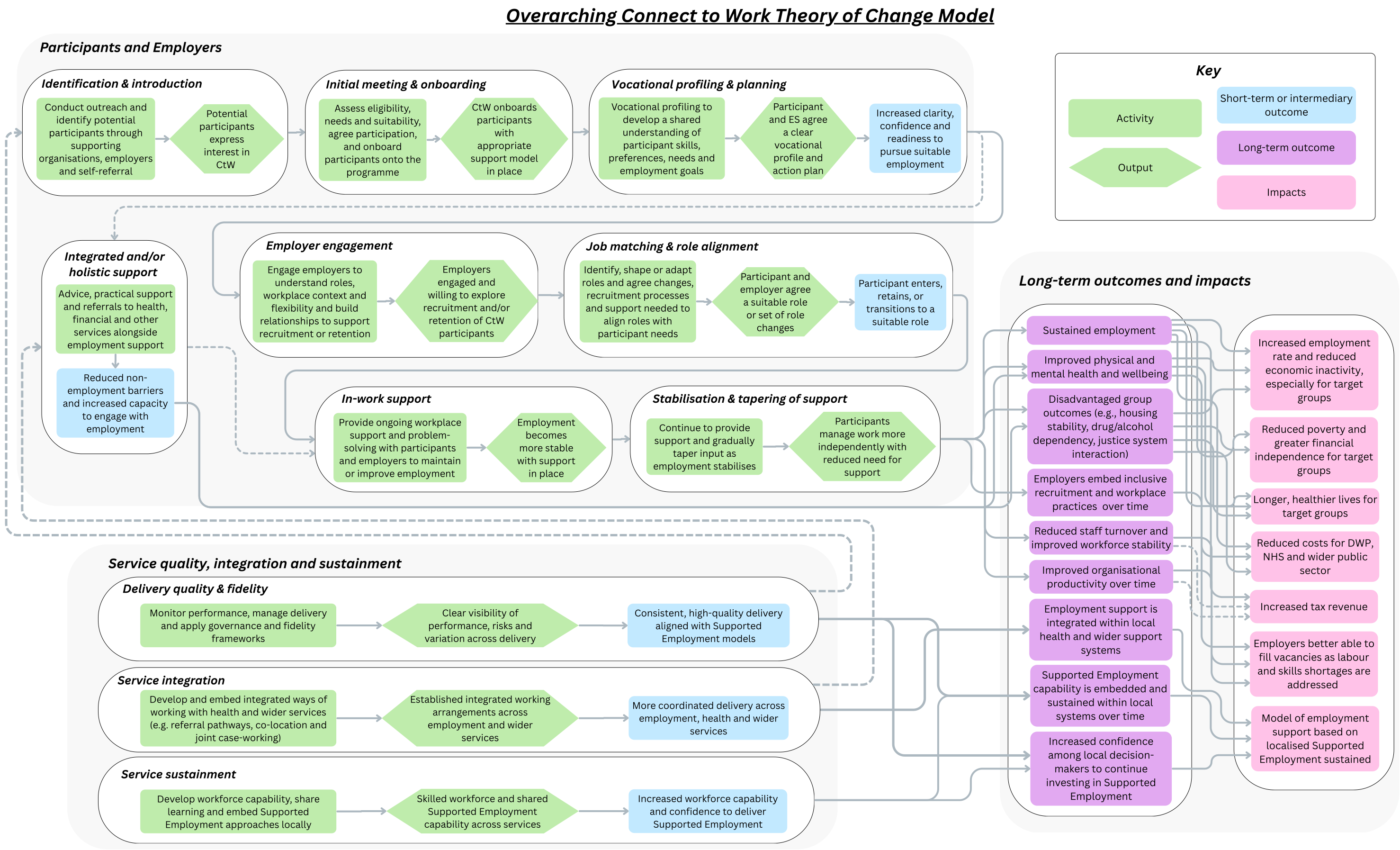
Figure 1 shows the overarching Connect to Work ToC model. It presents a series of activities, outputs, short-term outcomes, intermediary outcomes, long-term outcomes and impacts and how they interrelate. The model has 2 main sections. The participant and employer section shows the different stages of the programme journey, including: identification and introduction; initial meeting and onboarding; vocational profiling and planning; employer engagement; job matching and role alignment; in-work support; and stabilisation and tapering of support. Alongside this, the service quality, integration and sustainment section of the diagram covers: delivery quality and fidelity; service integration; and service sustainment. These 2 sections are then connected to the final part of the diagram, which outlines the long-term outcomes and impacts of the programme. The narrative below explains each of these elements and the relationships between them in more detail.
Participant journey and employer engagement
The model begins with identification and introduction, where individuals are made aware of Connect to Work through outreach, engagement with supporting organisations, employers and self-referral routes. At this stage, individuals are signposted to the programme and supported to express interest. This stage is expected to support engagement from individuals who may not otherwise access support.
This is followed by an initial meeting and onboarding, where eligibility, needs and suitability are assessed, participation is agreed, and individuals are onboarded onto the programme with an appropriate support model (IPS / SEQF) in place. This stage is expected to establish the basis for sustained engagement and a consistent relationship with an employment specialist.
The focus then shifts to vocational profiling and planning, where participants work with an employment specialist to develop a shared understanding of their skills, needs, preferences and employment goals. Through this process, participants are expected to develop a clearer understanding of their capabilities and employment options. This is expected to lead to the short-term outcome of increased clarity, confidence and readiness to pursue suitable employment.
Building on this, the model highlights the role of employers in enabling suitable employment outcomes. Employer engagement focuses on understanding roles, workplace context and flexibility, and engaging employers who are willing to support recruitment or retention. This is expected to result in employers being more willing to explore recruitment or retention of Connect to Work participants.
This is followed by job matching and role alignment, where roles are identified, shaped or adapted, and changes, recruitment processes and support are agreed to align roles with participant needs. For participants who are OOW, this includes support to secure and enter suitable roles. For those already in work, this may involve accommodations to an existing role or transitions to more suitable employment. These activities are expected to lead to the intermediary outcome of participants entering, retaining, or transitioning to suitable roles, with job fit and expectations more clearly established.
Following entry into employment or stabilisation within an existing role, the focus moves to ongoing workplace support and problem-solving to help participants and employers manage challenges and sustain employment. This is expected to contribute to the short-term outcome of increased stability in employment, with support in place to address emerging issues.
This is followed by stabilisation and tapering of support, where support continues but is gradually reduced as employment stabilises. Through this process, participants are expected to develop increased confidence and capability to manage work independently, leading to the short-term outcome of reduced reliance on support and more self-managed employment.
Integrated and holistic support
Alongside the core employment focused elements of the ToC, Connect to Work also provides holistic and enabling support, which can operate at different points in a participant’s journey depending on individual needs and circumstances. This support recognises that, for some participants, challenges outside of work, such as health, housing, financial insecurity or caring responsibilities, can undermine engagement with employment or destabilise progress, even where the job itself is suitable. In these cases, employment specialists are expected to work in coordination with health, housing, financial or other local services to help address wider sources of instability. For participants supported through IPS, coordination with health services forms an integral part of the model, rather than an additional or separate element of support.
Rather than forming a separate pathway, holistic support is expected to operate in support of the core employment journey, particularly for participants with multiple or intersecting needs where employment may need to be supported by wider interventions to remain stable. This support is expected to operate alongside employment, consistent with supported employment principles that prioritise entry into work with support continuing in parallel. This aspect of Connect to Work is expected to be particularly important for participants with more complex or intersecting needs, especially those in DWP’s target ‘disadvantaged groups’, and will be explored further through the development of CMO configurations to understand how and why it contributes to outcomes for different groups.
Service quality, integration and sustainment
The model also reflects the system-level elements of Connect to Work, which both support the effective delivery of the programme and contribute to system-level outcomes over time. These elements capture how delivery is managed, how services work together in practice, and how supported employment capability is developed and sustained within local systems.
Delivery quality and fidelity focus on monitoring performance, managing delivery and applying governance and fidelity frameworks. These activities are expected to provide visibility of performance, risks and variation across delivery, and to contribute to the short-term outcome of improved consistency and quality of delivery aligned with supported employment models. Over time, this is expected to support more reliable and consistent delivery of supported employment approaches.
Service integration focuses on developing and embedding integrated ways of working with health and wider services, including referral pathways, co-location and joint case-working. These activities are expected to contribute to the short-term outcome of more coordinated delivery across employment, health and wider services, reflecting increasing alignment between services in practice. Over time, this is expected to support the integration of employment support within local health and wider support systems.
Service sustainment focuses on building workforce capability, sharing learning and embedding supported employment approaches locally. These activities are expected to contribute to the short-term outcome of increased workforce capability and confidence to deliver supported employment, supporting more consistent and effective delivery. Over time, this is expected to support the embedding and sustainment of supported employment capability within local systems.
These system-level elements are expected to operate alongside and in interaction with participant and employer pathways, shaping how support is delivered in practice. For example, delivery quality and fidelity are expected to influence how participants are engaged, assessed and supported from the earliest stages of the model, while service integration is expected to shape how integrated and holistic support is coordinated alongside employment support.
Outcomes and impacts
Through these combined pathways, Connect to Work is expected to contribute to longer-term outcomes and impacts for participants, employers and systems.
For participants, the primary outcome is sustained employment, reflecting the central goal of supported employment. Sustained employment is not treated as a simple continuation of earlier job retention, but as the outcome of a cumulative process in which suitable work, effective early support, growing confidence and reduced reliance on intensive intervention interact over time. Where employment is suitable and stability has been established, participants are expected to develop increased confidence and capability to manage work independently, supporting the sustainment of employment over time.
Alongside this, integrated and holistic support delivered alongside employment activity is expected to help address wider sources of instability, reducing competing pressures and enabling participants to engage with and sustain progress in work despite complex or changing circumstances.
Over time, sustained employment is expected to contribute to wider outcomes, including improved productivity, progression or earnings, and positive effects on health and wellbeing, particularly where work is manageable and supported. For some participants, particularly those with more complex or intersecting needs, this may also contribute to improvements in wider life circumstances, such as financial security, housing stability or other aspects of life affected by sustained engagement with employment. These outcomes are not assumed to occur automatically for all participants, but are most likely where work is suitable, support is effective, and participants are able to manage ongoing challenges with increasing independence.
For employers, outcomes include more inclusive recruitment and workplace practices, improved workforce stability, and improved organisational productivity. By supporting better job fit, early problem-solving and ongoing support, Connect to Work is expected to reduce the risk of job breakdown and staff turnover, contributing to more stable and productive workforces over time.
At the system level, longer-term outcomes include the integration of employment support within local systems, sustained supported employment capability, and continued investment in supported employment approaches. These changes are expected to support more coordinated, consistent and sustainable delivery of employment support, and to embed supported employment as a routine part of local service provision.
These outcomes are expected to contribute to wider impacts, including increased employment and reduced economic inactivity, improved financial independence, and longer and healthier lives. Increased employment and earnings are expected to contribute to higher tax revenues and reduced reliance on benefits, while improvements in health and wellbeing may reduce demand on health and other public services over time.
5.2. Contribution claims
The contribution claims set out the key pathways through which Connect to Work is expected to contribute to outcomes across participants, employers and systems. Each claim provides a focused explanation of how programme activities and outputs are expected to lead to outcomes through particular mechanisms and sequences of change.
The claims are derived from the nested ToCs and reflect the most important causal pathways identified across participant, employer and system-level models. They provide a structured way of examining how Connect to Work is expected to operate in practice and where its contribution to outcomes is most likely to occur.
Each of the 8 contribution claims are summarised below. A more detailed narrative for each claim and accompanying diagrams can be found in Annex A.
Participant-level claims
Claim 1: supporting entry into and sustainment of suitable employment (out‑of‑work participants)
Connect to Work is expected to support OOW participants to enter suitable employment by prioritising job fit, early engagement and ongoing personalised support. Through vocational profiling, employer engagement and tailored job matching, participants are expected to develop a clearer understanding of their skills, needs and preferences, and to feel more confident that suitable employment is achievable.
Following entry into work, ongoing support is expected to help participants manage early challenges and stabilise in their roles. As stability is established, participants are expected to build confidence and independence, reducing reliance on intensive support and contributing to sustained employment over time, with potential for progression or increased earnings where conditions allow.
Claim 2: stabilising and sustaining employment (in‑work participants)
Connect to Work is expected to support IWRS participants to remain in or move into suitable employment by addressing risks to job stability at an early stage. Through IWRS vocational profiling, workplace problem-solving and employer engagement, participants are expected to gain clarity about their situation and increased confidence that challenges can be addressed.
Where appropriate, adjustments, accommodations or transitions into more suitable roles are expected to improve job fit and reduce the risk of job loss. Over time, participants are expected to develop greater autonomy and capability to manage work demands, supporting sustained employment and creating opportunities for progression.
Claim 3: improving health and wellbeing through employment
Connect to Work is expected to contribute to improved health and wellbeing by supporting participants to enter and remain in work that is suitable, supported and manageable. Early engagement and support are expected to reduce anxiety and increase confidence, helping participants to feel more prepared to engage with employment.
As participants enter and stabilise in work, employment is expected to provide financial security, routine and social connection. Where work is well matched and supported, these factors are expected to contribute to improvements in mental and physical wellbeing over time, although these outcomes are not assumed to occur for all participants.
Claim 4: supporting stability through integrated and holistic support
Connect to Work is expected to support participants with complex or intersecting needs by providing integrated and holistic support alongside employment support. Through the identification of non-employment needs and coordination with wider services, this approach is expected to reduce barriers that could otherwise disrupt engagement with work.
By addressing these needs in parallel with employment activity, participants are expected to be better able to enter and remain in work despite ongoing challenges. Over time, reduced instability and fewer crisis-driven interruptions are expected to support sustained engagement with employment and improved wellbeing outcomes.
Employer-level claims
Claim 5: supporting employment stability and workforce outcomes
Connect to Work is expected to support employers to achieve more stable workforce outcomes by providing early engagement, ongoing support and timely responses to workplace challenges. Through role matching, recruitment support and early problem-solving, employers are expected to feel more confident in recruiting and retaining participants.
As employment progresses, ongoing support is expected to help employers address issues before they escalate, reducing the likelihood of job breakdown. Over time, this is expected to contribute to reduced staff turnover, improved workforce stability and, in some cases, increased productivity.
Claim 6: supporting inclusive recruitment and workplace practices
Connect to Work is expected to support more inclusive recruitment and workplace practices by reducing perceived risks and increasing employer confidence. Through supported recruitment and retention activity, employers are expected to develop a better understanding of how to accommodate participants’ needs in practice.
As employers gain experience, inclusive approaches are expected to become more familiar and manageable. Over time, these practices may become embedded within organisations, supporting access to a wider and more diverse talent pool and strengthening inclusive employment practices.
Service integration and sustainment systems-level claims
Claim 7: integrating supported employment with wider services
Connect to Work is expected to support the integration of supported employment with local health and wider support services through joint working, co-location and coordinated delivery. These approaches are expected to enable more joined-up responses to participants’ employment, health and wider needs, reducing fragmentation between services and improving coordination in practice.
Through repeated collaboration, services are expected to become more aligned in how they work together, with employment increasingly considered alongside health and other support needs. Over time, this is expected to contribute to more established and sustained ways of working across services, supporting the delivery of employment support as part of a broader system of local provision.
Claim 8: sustaining supported employment delivery
Connect to Work is expected to support the long-term sustainability of supported employment by building workforce capability and embedding effective practice within local systems. Through training, supervision and shared learning, delivery staff are expected to develop greater confidence and capability.
As this capability is strengthened and demonstrated over time, confidence among partners and decision-makers is expected to increase. This is expected to support continued investment in supported employment and the sustainment of delivery beyond the lifetime of the programme.
6. Key recommendations for the evaluation design
6.1. Overview of the evaluation approach
The evaluation is structured into 4 work packages (WPs); a theory based evaluation (WP1); a quantitative impact and VfM evaluation (WP2); survey data collection (WP3); and process evaluation, qualitative fieldwork and case studies (WP4).
We will fully integrate each evaluation work package, bringing all components together under the theory based evaluation. Insights from the process evaluation (including qualitative and survey fieldwork), and quantitative impact findings will be synthesised to reach overarching conclusions about what impacts have been achieved, for whom, through which mechanisms, and under what conditions. This will provide an overarching analytical structure for the evaluation.
The evaluation design was originally described at a high-level in the evaluation team’s initial proposal. Relatively few changes to the evaluation have been made:
- some additional options were added to the list of possible designs for the quantitative impact evaluation, which will continue to be explored in Phase 2
- the decision was made to run a pilot of the participant and non-participant survey, given substantial uncertainties around the sample and the response
The following sections set out the approach to each of the work packages. The final section sets out the key outstanding decisions about the evaluation design that will be made in Phase 2.
6.2. Theory Based Evaluation
The TBE provides the overarching analytical framework for the Connect to Work evaluation. It brings together evidence from across the qualitative, survey, quantitative and VfM strands to assess whether, how and under what conditions Connect to Work is contributing to outcomes for participants, employers and local systems.
Phase 1 of the evaluation has focused on developing and refining this framework. This has involved articulating Connect to Work’s programme theory through a set of ToCs and associated contribution claims, clarifying key causal pathways, and identifying assumptions, risks and areas of uncertainty that will shape how outcomes emerge in practice. This early theory‑building work provides a structured foundation for causal analysis across subsequent phases of the evaluation.
The approach set out below broadly follows the design described in the original proposal, but has been refined in light of phase 1 learning. In particular, phase 1 has helped to strengthen articulation of Connect to Work’s distinctive features, clarify how supported employment operates across different participant groups and delivery contexts, and highlight the importance of understanding variation across locally led delivery models.
Overview of the theory‑based evaluation approach
The Connect to Work TBE design combines 3 complementary approaches: Contribution Analysis, Realist Evaluation, and Process Tracing. Together, these approaches are well suited to evaluating Connect to Work as a large‑scale, complex programme delivered through diverse local systems and alongside other employment, health and welfare interventions.
Contribution Analysis forms the core of the approach. Rather than seeking to attribute outcomes solely to Connect to Work, Contribution Analysis focuses on assessing the strength and credibility of Connect to Work’s contribution to observed outcomes, recognising that employment, health and wellbeing outcomes are shaped by multiple interacting influences. This is particularly appropriate for Connect to Work, given its locally led design and the wider system contexts in which it operates.
In practice, the Contribution Analysis involves:
- articulating programme theory through the Connect to Work ToCs
- translating this theory into a set of explicit contribution claims
- testing, refining and assessing these claims against evidence drawn from multiple sources over time
For Connect to Work, contribution claims act as evolving hypotheses rather than fixed statements of impact. Each claim sets out:
- the activities and forms of support expected to occur in practice
- the mechanisms through which those activities are expected to contribute to change
- the outcomes Connect to Work is expected to contribute to
- the assumptions and conditions that need to hold for the pathway to operate as intended
Alongside Contribution Analysis, the evaluation draws on elements of Realist Evaluation, reflecting the expectation that Connect to Work will not operate in the same way, or with the same effects, across all areas or participant groups. The realist component focuses on understanding how contextual conditions shape whether and how programme activities trigger particular mechanisms, and how this contributes to variation in outcomes.
This will be explored through the development and use of CMO configurations, which examine:
- how features of local systems, delivery arrangements, labour markets and/or participant circumstances shape experiences
- how these contextual conditions influence the mechanisms triggered by Connect to Work activity (for example confidence, trust, problem‑solving or coordination)
- how outcomes emerge differently depending on how these mechanisms operate in context
Finally, Process Tracing will be used selectively to strengthen causal inference for particular contribution claims where greater analytical rigour is required. Process Tracing provides a systematic way of assessing the extent to which the available evidence supports or challenges specific causal explanations, and of examining alternative explanations.
Used together, these approaches will enable the evaluation to assess Connect to Work’s contribution to outcomes in a way that is robust, transparent and appropriate for the programme’s complexity, while remaining explicit about uncertainty and limits in the evidence.
Delivering the theory‑based evaluation in practice
This section summarises how the TBE will be delivered across Phases 2 to 4, focusing on how theory‑based analysis will be used to structure learning, assess contribution claims, and inform interpretation of evidence across the evaluation.
Phase 2: building and structuring evidence against the programme theory
In Phase 2, the focus of the TBE will be on building and structuring the evidence base to support later assessment and refinement of the contribution claims developed in phase 1. Evidence generated across the evaluation will be brought together and considered alongside the programme theory, helping to inform understanding of how emerging findings align with, or raise questions about, the ToCs and contribution claims.
Key activities will include:
- systematically mapping emerging evidence against the elements of the contribution claims, including activities, mechanisms, outcomes, assumptions and potential alternative explanations
- reviewing where evidence appears to support, partially support or challenge different aspects of the programme theory
- identifying areas of uncertainty and evidence gaps where further investigation is required
This process will focus on organising and synthesising evidence, rather than testing or assessing claims at this stage. It will ensure that evidence from across qualitative, survey and quantitative strands is captured in a consistent and transparent way, supporting later analytical stages.
In parallel, Phase 2 analysis will begin to inform the iterative development of draft CMO configurations, drawing on patterns observed in how Connect to Work appears to operate across different delivery contexts and participant groups. These will be refined further as additional evidence is gathered in later phases. At this stage, we will also explore Process Tracing tests, beginning to identify which tests are most appropriate and the criteria that will be applied to those tests (see Section 6.6 for further detail on Process Tracing).
Phase 3: deepening analysis, filling evidence gaps and strengthening causal explanations
Phase 3 will focus on building on the evidence and learning from earlier phases, bringing together evidence from Phases 1 and 2 alongside new evidence collected during Phase 3 to strengthen understanding of how Connect to Work contributes to outcomes.
During this phase:
- evidence collected during Phases 1 and 2 will be revisited in relation to the ToCs and contribution claims, drawing on an expanded body of qualitative and quantitative data
- additional data collection will be used to address specific uncertainties, particularly where evidence on mechanisms, assumptions or delivery conditions remains partial or uneven, and incorporating analysis of evidence against identified and emerging CMOs
- Process Tracing tests will be applied selectively to contribution claims where there is greater uncertainty, or where strengthening causal inference would add particular value for policy learning
During Phase 3, we will undertake an initial structured assessment of the contribution claims, drawing on the expanded evidence base developed across Phases 1 and 2 and early Phase 3 data collection. By situating this assessment within Phase 3, we are able to incorporate a broader and more developed range of evidence than would be possible at an earlier stage. This will provide a more robust basis for assessing the extent to which the contribution claims are supported, where evidence is more limited or mixed, and where there are gaps or areas of uncertainty. Importantly, the timing of this initial assessment within Phase 3 allows for further rounds of data collection and analysis after the assessment has taken place, ensuring that any gaps or uncertainties identified can be addressed and incorporated into later stages of the evaluation.
This assessment will:
- bring together evidence mapped during Phase 2 against each contribution claim
- consider the extent to which evidence provides support for different elements of the causal pathways (activities, mechanisms, outcomes and assumptions)
- identify areas where further evidence is required or where the programme theory may need to be refined
The initial assessment will be based on a structured review of the available evidence against key criteria, including:
- strength of evidence: the extent to which findings are supported by consistent evidence across different data sources, stakeholders and methods
- completeness: the extent to which the full causal pathway is evidenced, including consideration of assumptions and potential alternative explanations
- plausibility: the extent to which the available evidence supports the logic of the contribution claim and whether expected mechanisms appear to operate in practice
A contribution workshop with DWP and other stakeholders will be held at this stage. This workshop will be used to review and sense-check the initial assessment of the contribution claims, explore how emerging findings are understood across stakeholders, and identify priorities for further data collection and analysis.
Following the initial assessment, ongoing analysis in Phase 3 will focus on strengthening causal explanations and addressing gaps identified. This will include:
- refining and further testing the contribution claims where necessary
- incorporating additional evidence from later rounds of qualitative fieldwork, survey data and administrative data
- further developing and refining CMO configurations to better understand how outcomes vary across contexts, participant groups and delivery models
CMO configurations developed in Phase 2 will be explored, tested and refined in light of the expanded evidence base, supporting a more detailed understanding of how contextual conditions shape the mechanisms through which Connect to Work contributes to outcomes.
At the end of Phase 3, we will undertake a final structured assessment of the contribution claims, drawing on the full body of available evidence from Phases 1 to 3. This will build on and update the initial assessment, incorporating additional evidence and refined analysis.
Each assessment will set out:
- the overall level of confidence in the contribution claim (high, medium or low)
- how and why outcomes occurred (or did not), including which mechanisms were triggered and key assumptions that did or did not hold
- the conditions under which Connect to Work activities were more or less effective, including relevant enablers and barriers
- where contribution appears contingent on context or where alternative explanations cannot be fully ruled out
A final contribution workshop with DWP and other stakeholders will be held at this stage to review and sense-check the final assessments, consider remaining uncertainties; and ensure that conclusions reflect a shared understanding of how Connect to Work has contributed to outcomes in practice.
These final assessments will provide a comprehensive account of Connect to Work’s contribution to outcomes and will form the basis for the synthesis in Phase 4.
Phase 4: final synthesis and contribution narrative
In Phase 4, we will undertake a synthesis of the theory‑based evaluation findings to produce summative conclusions on the contribution of Connect to Work to outcomes.
This phase will build directly on the contribution claim assessments developed in Phase 3. It will draw on these completed assessments, alongside the wider evaluation evidence, to produce a clear and plausible contribution narrative of the extent to which, how, and why Connect to Work programme outcomes and impacts were achieved.
The synthesis will focus on:
- bringing together findings across the contribution claims to explain how Connect to Work has operated in practice
- explaining which mechanisms have been most important in driving outcomes, and how these vary across contexts and participant groups
- identifying key enablers and barriers shaping delivery and outcomes
- setting out where evidence is strong, where it is mixed, and where uncertainty remains
Findings from this synthesis will be used to answer the evaluation’s core research questions. This will involve drawing together evidence on impacts, mechanisms, implementation and system change to provide a clear and structured account of Connect to Work’s overall contribution to outcomes.
The synthesis will also inform practical recommendations for policy and delivery. These will be based on evidence of what has worked well, for whom, and under what conditions, as well as identifying areas where delivery could be strengthened or refined.
Taken together, this phase will provide a clear, evidence‑based account of how Connect to Work contributes to outcomes, including the conditions under which its contribution appears strongest or more limited.
6.3. Quasi-Experimental Design (QED) and Value for Money (VfM)
This section provides an overview of the evaluation team’s plan for the QED and VfM analysis for Connect to Work at the end of phase 1. It reflects work carried out during phase 1, including initial review of programme documentation, early engagement with DWP on data availability, and a scoping discussion on the QED strategy. The full impact evaluation plan will be developed during Phase 2, once we have access to MI and administrative data and have been able to carry out the composition analysis and feasibility testing described below.
QED objectives and the counterfactual challenge
The primary goal of the QED is to provide robust accountability for the Connect to Work investment and to inform future decisions regarding Connect to Work and related policies. The core analytical challenge is estimating the counterfactual: what would have happened to participants had they not received support through the programme. Given the voluntary nature of Connect to Work, simple comparisons between participants and non-participants are insufficient due to self-selection bias. People who choose to engage with the programme are likely to differ systematically from those who do not, in ways that also affect their employment and health outcomes. The evaluation therefore requires quasi-experimental methods to construct credible comparison groups.
The outcomes of interest span employment and earnings (including job entry, sustained employment, and earnings progression), benefit receipt (movements on and off benefits and across benefit categories), and health and wellbeing (measured through the participant survey). The additionality estimates produced by the QED will feed into the VfM analysis.
Programme geography and integrated settlements
Connect to Work is delivered across England and Wales. The geographic scope of Connect to Work is not uniform, and this has direct implications for the design of the quantitative evaluation. The programme is being funded through grants from DWP and in most areas it is delivered by clusters of local authorities or combined authorities referred to as ABs. Seven EMSAs (covering 10 Connect to Work AB areas) are receiving their Connect to Work funding through integrated settlements. The WMCA and GMCA received their Connect to Work funding through integrated settlements from 2025 to 2026. From 2026 to 2027, this has grown by a further 5 EMSAs receiving Connect to Work funding through integrated settlements, expanding to Liverpool City Region Combined Authority, North East Combined Authority, South Yorkshire Mayoral Combined Authority, West Yorkshire Combined Authority and the Greater London Authority (covering 4 original Connect to Work ABs).
As a condition of receiving their Connect to Work funding through an integrated settlement, all EMSAs, except for GMCA, are required to deliver evidence-based supported employment to the same target groups as the national Connect to Work programme with outcomes frameworks aligned to the national programme. Whilst there are additional flexibilities available through the integrated settlement, this means that delivery in 6 of the 7 EMSAs receiving Connect to Work funding in their integrated settlement are compatible with the national evaluation of Connect to Work. We therefore expect delivery to be largely comparable across the grant-funded programme and integrated settlement areas (excluding in GMCA), while recognising that integrated settlement areas retain some flexibility, for example in how cohorts are split and which groups are treated as eligible, that we will need to take into account in the analysis. As MI data will not be available for GMCA over the main evaluation period, we will not be able to identify RNS within GMCA for the purposes of the QED comparison group, and GMCA participants will not be included in the survey sample.
These arrangements matter for the QED design in several ways. MI and PRaP data coverage will not extend to areas that are outside the grant-funded programme and do not participate in its data collection systems. If delivery changes in further Mayoral Strategic Authorities (MSAs) due to integrated settlements arrangements, the pool of areas contributing to the survey and QED analysis may shrink. And for areas that receive integrated settlement funding, identifying who is receiving what support, and distinguishing Connect to Work-equivalent provision from other employment support, may be difficult, particularly where funding is pooled across programmes. We return to the specific implications for each identification strategy below.
Approach to scoping the preferred QED methodology
The scoping phase for the QED will continue into Phase 2 of the evaluation. The scoping work has identified 4 candidate identification strategies, which differ in the comparison group they use and the assumptions they require. Each is summarised in the subsections that follow. The evaluation will test the feasibility of each strategy during Phase 2 and select a preferred approach, potentially using multiple strategies as complements and robustness checks. The preferred approach could be a single strategy applied to both survey and administrative outcomes, or it could involve one strategy for survey outcomes and a different one for administrative outcomes, depending on what the data and diagnostics support.
The remaining scoping work will draw on 3 main inputs:
- First, analysis of MI and PRaP data, once access is confirmed, to examine the composition of the treated population and the RNS group, to assess the extent of variation in assessor behaviour and referral practices, and to establish the precise timeline of programme roll-out across delivery areas.
- Second, analysis of administrative data from RAPID and ECD, carried out initially through secondments to DWP, to examine pre-treatment trends in employment, earnings, and benefits for potential treatment and control groups, and to test the feasibility of identifying likely Connect to Work participants in non-live areas.
- Third, continued engagement with emerging process evaluation findings, DWP, and ABs, to understand operational features of the programme, such as the assessor’s role and the allocation process, that bear directly on the identifying assumptions for some of the strategies.
The timeline for this scoping work is subject to some uncertainty, primarily around when data access will be granted. DWP secondments for RAPID and ECD access were agreed in principle in phase 1 and will start in Phase 2. MI data access depends on the strategic data solution, the timing of which is not yet confirmed. Subject to data access, we expect to carry out the main feasibility analysis during 2026, with the aim of producing a detailed QED evaluation plan by Q2 2027. If data access is significantly delayed, the scoping timeline will need to be revised accordingly.
For each strategy described below, we set out the method, the conditions that would need to hold for it to produce credible estimates, what we currently know about whether those conditions are likely to be met, and the specific checks we will carry out during Phase 2 to test feasibility.
Identification strategies under consideration
Option 1: doubly robust difference-in-difference using Referred-Non-Starters
What the method involves
This is the baseline approach and likely to be the only feasible strategy for survey-based outcomes (health, wellbeing, and soft outcomes), since RNS are the only non-participant group we can practically survey. The method compares the change in outcomes over time between Connect to Work participants and individuals who were referred to the programme but did not start. It combines inverse probability weighting (to rebalance observable characteristics between the 2 groups) with outcome modelling in a doubly robust framework. The doubly robust property means that the impact estimate remains unbiased if either the propensity score model or the outcome regression model is correctly specified.
Conditions for credibility
The key conditions are:
- that we can consistently identify meaningful non-starters
- that there is a sufficient number of RNS, including within key subgroups
- that starters and RNS show similar pre-treatment trends in earnings and benefits (the parallel trends assumption)
- that there is sufficient overlap in observable characteristics between the 2 groups to support weighting without relying on extreme weights
A particular concern is that non-participation may reflect active choices that are correlated with outcomes. For instance, if people who decline to participate do so because they have found work or because they face more severe barriers.
What is known at the end of phase 1
The process evaluation has begun to produce evidence on why people do not start the programme after being referred (see Chapter 4). In Phase 2 we will use the MI and PRaP data to quantify the size of the RNS group and examine its composition. We do not yet have the data to test parallel trends or common support.
What we will do to test feasibility
Using MI and PRaP data, we will examine the volume and composition of non-starters, develop a classification that distinguishes meaningful non-starters from administrative closures, and assign deemed start dates. Using RAPID, we will test whether starters and RNS show similar pre-treatment trends in earnings and benefits, and assess common support by estimating propensity scores and examining the distribution of weights. We will also draw on findings from the process evaluation on reasons for non-participation to inform the interpretation of any residual selection concerns.
Geographic considerations
GMCA will not contribute to this strategy, since it is not delivering Connect to Work. WMCA is expected to participate (and follow the same PRaP-based data collection), as they will be delivering supported employment, so in principle they can contribute to the RNS analysis. Because integrated settlement areas retain some flexibility (for example in cohort splits and eligible groups), we will first confirm that RNS can be identified on a consistent basis across areas before pooling. Separately, and as a substantive question in its own right, we will examine whether programme impacts differ between grant-funded and integrated settlement areas as part of the heterogeneity analysis. More EMSAs moved to receive Connect to Work funding via an integrated settlement in 2026 to 2027, which again will need consideration in terms of comparability.
Option 2: staggered difference-in-differences exploiting geographic roll-out
What the method involves
Connect to Work is being rolled out across delivery areas at different times and speeds, with a planned build-up from initial go-live during 2025 to peak annual starts of around 100,000 by 2027 to 2028. This staggered roll-out could be exploited to use future participants in areas where the programme is not yet live as a comparison group for current participants in live areas. The method involves building a model that predicts Connect to Work participation in live areas using administrative data, running that model on both live and not-yet-live areas to identify ‘likely’ participants, and then comparing outcomes between the 2 groups. The employment and benefit effects would be scaled by the differential in Connect to Work take-up to estimate the per-participant effect.
This approach has potential advantages over the RNS comparison. Eligibility in a non-live area is less likely to reflect motivation to engage than being referred but not starting, and comparator individuals have not had an opportunity to take up the programme, reducing concerns about active non-participation. Staggered designs also allow stronger diagnostics, including event-study checks of pre-trends and dynamic treatment effects.
Conditions for credibility
The key conditions are:
- that we can reliably identify likely Connect to Work participants in non-live areas from administrative data (for example, by flagging disability benefit claimants without conditionality requirements)
- that there is sufficient variation in roll-out timing across delivery areas to provide a meaningful comparison window
- that treated and not-yet-treated eligible groups exhibit similar pre-trends in earnings and benefits
- that there is no significant cross-area contamination, such as referrals across delivery area boundaries, that would blur the distinction between treated and untreated areas
What is known at the end of phase 1
Early indications from the process evaluation suggest that a relatively high proportion of areas had technically not started delivery in the early months of the programme. However, as the programme matures, the comparison window during which some areas are live and others are not will narrow, and eventually the staggered design will no longer be viable once all areas are operational. The move of further MSAs to integrated settlements from 2026 to 2027 could affect the staggered design in 2 ways: it may remove some areas from the analysis pool if they cease to provide comparable data, but it could also create new variation if the transition to integrated settlements changes the timing or nature of delivery in those areas.
What we will do to test feasibility
Working with DWP, we will establish the precise roll-out timeline, including actual go-live dates and ramp-up speeds for each delivery area. Using RAPID, we will test whether we can identify a population of likely Connect to Work participants in non-live areas using observable benefit and employment histories, and whether treated and not-yet-treated eligible groups show similar pre-trends. We will also examine whether there is evidence of cross-area referral patterns that could contaminate the comparison.
Geographic considerations
A further question is whether areas outside the grant-funded Connect to Work programme could serve as comparison areas for the staggered DiD or as standalone comparators using administrative data.
One candidate is GMCA, which does not deliver Connect to Work, but instead delivered an extension to its Individual Placement and Support in Primary Care (IPSPC) provision in 2025 to 2026 and it is moving to a new delivery model in 2026 to 2027. In principle, eligible individuals in Greater Manchester who are not receiving employment support could form part of a comparison group. However, there are significant practical obstacles. GMCA’s programme differs from Connect to Work in design, eligibility, and delivery model, making it unclear whether eligible individuals in Greater Manchester represent a valid counterfactual for Connect to Work participants elsewhere. We would need individual-level administrative data covering GMCA’s programme to identify who is receiving support and who is not, and it is not yet established whether GMCA would be willing or able to share such data. Moreover, GMCA alone is unlikely to provide a sufficiently large or diverse comparison population to serve as a standalone comparator.
A second candidate is Scotland, where Connect to Work does not operate. Since RAPID covers everyone with a National Insurance record across the UK, employment, earnings, and benefit outcomes can be observed for Scottish residents on the same basis as for Connect to Work participants in England and Wales. Scotland has the advantage that there is no Connect to Work-equivalent programme funded through the same DWP spending commitment, which in principle provides a clearer treatment contrast than GMCA, where a closely related form of supported employment is being delivered.
While neither GMCA nor Scotland can be ruled out as comparison areas, we do not consider either to be a primary strategy at this stage. Both present a version of the same challenge: the eligible population in those areas is receiving some form of employment support, and the policy and institutional context differs from the Connect to Work delivery areas in ways that could complicate the interpretation of any estimated treatment effect. We will assess the feasibility of both options during Phase 2 as part of the RAPID analysis, focusing in particular on whether comparable eligible populations can be identified and whether pre-trends are sufficiently aligned. If either proves viable, it would most likely serve as a supplementary robustness check rather than as the primary identification strategy.
Option 3: Assessor Leniency Instrumental Variable (ALIV)
What the method involves
This strategy exploits systematic differences in acceptance rates across the assessors who conduct initial meetings with potential participants. If individuals are allocated to assessors in a manner that is effectively random, conditional on observable characteristics, then variation in assessor leniency creates exogenous variation in access to Connect to Work. This can be used as an instrumental variable to estimate the causal effect of the programme for those individuals whose participation is affected by which assessor they see. If its assumptions hold, the ALIV approach can address unobserved selection bias that remains problematic under the RNS comparison, making it closer to an experimental design. It would also provide a valuable robustness check against the DiD-based estimates.
Conditions for credibility
The leniency design rests on several identifying assumptions.
- Exclusion restriction: allocation to a given assessor must not affect outcomes via any mechanism other than the chance of acceptance or rejection.
- Random assignment condition: conditional on controls, assignment to a given assessor must be as good as random – that is, uncorrelated with unobservable factors that affect outcomes. This requires that certain types of potential participants are not systematically sorted to certain assessors.
- Meaningful variation in acceptance rates across assessors: there need to be some systematically stricter assessors and some systematically weaker assessors.
- Average monotonicity: for each applicant, the pool of assessors who would accept them have to be on average more lenient (as measured based on the assessors’ acceptance rate of other applicants) than the assessors who would reject them.
What is known at the end of phase 1
Our initial assessment has identified concerns about 2 of the conditions above. On the exclusion restriction, early findings from the process evaluation suggest that in many ABs the assessor at the initial meeting is an employment specialist who also delivers elements of the intervention. If so, the assessor would influence participant outcomes not only through the acceptance decision but also through the quality and nature of ongoing support, which would violate the exclusion restriction. We will continue to gather information on the assessor’s role through the process evaluation; it may be the case that in some ABs the assessment and delivery roles are separated, which would allow the design to be implemented for a subset of areas. We will also explore whether it is possible to utilise variation in acceptance rates across assessors at the pre-screen check which occurs before the initial meeting and is typically carried out by a different assessor. This will depend on whether we can access identifiers for the initial assessor who carries out the pre-screen check.
On the requirement that there is meaningful variation in acceptance rates across assessors, initial analysis of the monitoring data suggests that few people who are referred are deemed ineligible at the assessment stage, implying a high overall acceptance rate. A uniformly high acceptance rate makes meaningful variation in leniency less likely. However, this analysis is based on data from a small number of ABs, and the picture may differ once the full MI data is available.
On the random assignment condition
The existing qualitative evaluation evidence suggests this assumption could be problematic. We heard from some ABs that they were operating separate services for different types of claimants, with different employment specialists meeting with people across the different services. This would violate our assumption of random assignment across assessors. If we pursue the ALIV approach, we will explore potential ways to deal with this violation including restricting our analysis to sub-populations of the same type of claimant (where random assignment may be more plausible) or excluding certain ABs from our main analysis.
What we will do to test feasibility
We will assess feasibility through a structured sequence of checks, starting with a review of the qualitative evaluation results relevant to our key assumptions and proceeding to progressively more demanding data tests. Before accessing the data, we will review delivery plans, write-ups from interviews with ABs, and initial monitoring data summaries to establish the process for allocation to an assessor, what the assessor’s role is beyond the initial meeting, and whether we might expect meaningful variation among assessors. If this institutional review is sufficiently encouraging, we will then carry out a series of data-based checks in order, stopping early if results at any stage are unpromising.
These checks include:
- establishing the extent of variation in acceptance rates across assessors
- assessing whether the set of assessors is stable over time
- estimating the effective sample size (number of applicants minus number of assessors) and the number of applicants per assessor
- constructing leave-one-out leniency scores for each assessor; testing whether assessors with similar leniency scores accept participants with similar observable characteristics
- estimating the characteristics of compliers to assess external validity
- conducting formal monotonicity tests
If we proceed to estimation, we will use the Unbiased Jackknife Instrumental Variables Estimator (Kolesár, 2013), which is purpose-made for leniency designs and compatible with relatively weak instruments. The choice of standard errors will depend on the amount of variation in leniency and whether assignment to assessors is clustered.
Option 4: cross-area differences in referral practices
What the method involves
This approach exploits variation in referral practices across ABs. Some areas rely more heavily on JCP referrals, while others draw more on community or health service routes. By comparing outcomes for a group of benefit claimants who are likely to be referred from a Jobcentre in areas with high versus low shares of Jobcentre referrals, the evaluation can estimate the effect of being referred to Connect to Work on this particular subgroup. The underlying logic is similar to a natural experiment: if the share of Jobcentre referrals varies across areas for reasons unrelated to participant characteristics, then individuals in high-referral areas are more likely to be exposed to Connect to Work than observably similar individuals in low-referral areas, and the difference in their outcomes can be attributed to the programme.
This method has the advantage of being usable throughout the programme’s lifetime, not just during the roll-out period, and it allows a placebo test that separates the effect of being referred to Connect to Work from the effect of actually participating. The main limitations are that it can only estimate effects for a subgroup of individuals (likely those recruited from Jobcentres who claim health-related benefits) and a subgroup of areas, which may not be representative of the broader programme. Due to these limitations, this approach is currently our lowest priority of the 4 proposed approaches. However, we will revise this initial assessment following our scoping analysis.
Conditions for credibility
The key conditions are:
- that there is sufficient and persistent variation in the share of Jobcentre referrals across ABs
- that this variation is not driven by differences in the characteristics of the eligible population across areas (or can be adequately controlled for)
- that there are no spill over effects of Connect to Work on non-participants within the same area that would confound the comparison, for example, if Connect to Work improved the quality of competitor job applicants and made it harder for non-participants to find work
What is known at the end of phase 1
Early MI data suggests that referral sources do vary across areas, but we have not yet been able to assess whether this variation is sufficiently large and stable, or whether it is correlated with area-level characteristics that could confound the estimates.
What we will do to test feasibility
Using MI data, we will quantify the variation in Jobcentre referral shares across ABs and assess its stability over time. Using RAPID, we will identify a population of benefit claimants likely to be referred from Jobcentres and test whether those in high- versus low-referral areas show similar pre-trends in employment and benefits. We will also carry out the placebo test, checking whether the method detects an effect of Connect to Work referral on groups who should not be affected, as a diagnostic for whether the design is capturing genuine programme effects or area-level confounds.
Survey and administrative outcomes
The identification constraints differ between survey-based and administrative outcomes. For outcomes we can only measure through the survey including health and wellbeing the only feasible non-participant comparison group is RNS, since we cannot practically survey the wider eligible-but-not-referred population. This means that the RNS-based doubly robust DiD is the required specification for survey outcomes. For administrative outcomes – employment, earnings, and benefit receipt measured through RAPID and HMRC data – the evaluation has more flexibility. All 4 candidate strategies are potentially viable for administrative outcomes, and the team will select the most robust feasible approach during Phase 2.
It is worth noting that the distinction between survey and administrative outcomes also intersects with the Integrated Settlement geography. GMCA participants will not be included in the survey. WMCA’s inclusion in the survey will be determined by whether there is a viable process for getting contact details from participants. By contrast, administrative data from RAPID and ECD cover all areas with National Insurance records regardless of their Connect to Work funding arrangements. This means that integrated settlement areas could in principle contribute to strategies based purely on administrative data, such as the staggered DiD or the cross-area referral practice design, even if they do not participate in the MI and survey data collection, provided their eligible populations can be identified and the nature of the support they receive is sufficiently understood.
VfM analysis
The VfM analysis will combine a SCBA as the primary method with cost-effectiveness analysis where outcomes cannot be robustly monetised. The SCBA will adhere to HM Treasury Green Book standards and report net present value and benefit-cost ratios. The key outcome categories to be valued are participant-level earnings gains, health improvements (valued through Quality-Adjusted Life Years (QALYs)), and exchequer benefits including tax receipts and welfare savings. Cost-effectiveness metrics will include cost per job entry, cost per unit improvement in wellbeing, and potentially cost per reduced GP visit where survey data allows.
The VfM model will be developed iteratively. During Phase 2, we will confirm data access and develop a preliminary model architecture to agree assumptions, additionality factors, and discount rates. Interim findings are expected in 2028, with a final update incorporating long-term impact data up to 5 years from participation planned for 2030 to 2031.
How the quantitative impact evaluation design has evolved since the proposal
Since the submission of the original evaluation proposal, the scoping work carried out during phase 1 has led to several developments in the planned approach to the QED and VfM analysis. This subsection summarises the main areas where our thinking evolved in light of the evidence gathered so far:
- First, the shortlist of candidate identification strategies has been expanded. The proposal identified 3 approaches: (i) a doubly robust DiD using RNS, (ii) a staggered DiD exploiting geographic variation in roll-out, and, conditionally on data availability, (iii) an ALIV design. During phase 1, a fourth option has been added: a design exploiting cross-area differences in referral practices, which uses variation in the share of JCP referrals across ABs to estimate the effect of being referred to Connect to Work on a subgroup of benefit claimants. This approach has the advantage of being usable throughout the programme’s lifetime, not only during the roll-out period, though it is currently the lowest priority of the 4 options given its limitations in terms of external validity.
- Second, our confidence in the feasibility of the Assessor Leniency IV approach has reduced. The proposal treated this as a plausible option contingent on obtaining data on assessor identity. Phase 1 intelligence from the qualitative fieldwork and discussions with delivery leads has identified significant obstacles. At the initial meeting stage, the employment specialist who conducts the assessment typically also delivers ongoing support to the participant, meaning the assessor could influence outcomes through the quality of subsequent support as well as through the acceptance decision, a violation of the exclusion restriction. Early evidence also suggests a uniformly high acceptance rate at the assessment stage, which limits the scope for meaningful variation in leniency across assessors. We are continuing to explore whether variation at the pre-screen stage could offer an alternative, but our current assessment is that the ALIV approach faces substantial feasibility challenges that were not anticipated at the proposal stage.
- Third, the outlook for the Staggered DiD has become less certain. The proposal anticipated that geographic variation in roll-out speed would provide a strong basis for identifying comparison groups from administrative data and described the doubly robust staggered DiD as the most likely preferred approach. Early evidence suggests that while there was meaningful variation in go-live timing during the initial months of the programme, this comparison window is narrowing as more areas become operational. Whether sufficient staggering remains to support a credible design is an empirical question that will be tested once we have access to the detailed roll-out timeline and administrative data.
- Fourth, the geographic scope of the evaluation has become more complex than the proposal envisaged. During phase 1, it has become clear that GMCA will not participate in the quasi-experimental evaluation or provide MI data, and that a further 5 ESMAs are expected to move to integrated settlements from 2026 to 2027, with uncertain implications for their continued participation in the evaluation and data provision. This report now includes a discussion, not present in the proposal, of whether areas outside the grant-funded programme, specifically GMCA and Scotland, could serve as comparison areas for the administrative data strategies. Our current view is that neither represents a primary strategy given differences in policy context and programme design, but both remain under consideration as supplementary robustness checks.
6.4. Process evaluation
The process evaluation will run in parallel to the TBE and QED/ VfM. It aims to understand:
- how Connect to Work is being implemented across delivery areas
- barriers and enablers to areas achieving outcomes at the participant, service and system level
- how local contexts have influenced delivery approaches, successes and barriers
- how services have adapted their approach in response to emerging challenges or learning
Phase 1 of the process evaluation focused on eliciting early insights from initial implementation of the programme across a smaller number of ABs where delivery had started earlier. This involved gaining a better understanding of local delivery including: the set-up of local services, assessing eligibility and suitability, delivery capacity and partnership working.
Phase 2 will build on this, broadening fieldwork to a wider 12 clusters in addition to 6 to 8 case study areas. Interviews will be conducted with key stakeholders and participants and systems mapping workshops will take place in case study areas to gain a more extensive perspective on how Connect to Work is embedded in varied local areas, entry points for participants, systemic barriers to desired outcomes, and stakeholder spheres of influence.
Phase 3 will involve further fieldwork in 20 clusters and continued fieldwork in case study areas. This fieldwork will have a greater focus on outcomes and aim to fill any evidence gaps in the data set. Longitudinal interviews with programme participants would also take place at 2 time points during Phase 3. These interviews will explore changes in service use over time, medium- and longer-term outcomes, and the sustainability of outcomes.
6.5. Data collection plan
Survey data collection
An overview of the planned survey data collection is set out in Table 6. Assuming sample data (MI, PRaP) will be available by end-November 2026, pilot fieldwork will start in January 2027, lasting approximately 4 weeks. Recommendations from the pilot will be provided to DWP to feed into mainstage survey development, planned to launch in May 2027. The interim survey will launch approximately 4 months later, with development work commencing late 2027. The endline survey with the pilot sample will take place 12 months after the baseline survey pilot, that is commencing January 2028. The survey of employment specialists will take place in early 2028, with development work commencing late summer 2027.
Table 6: overview of survey data collection
| Survey element | Survey participants | Survey length and format | Key aims | Timings |
|---|---|---|---|---|
| Pilot | Connect to Work starters and RNSs | 25 to 30 min web-CATI (Computer-Assisted Telephone Interviewing) survey | Inform design and implementation of mainstage surveys | January 2027 |
| Baseline survey | Connect to Work starters and RNSs | 25 to 30 min web-CATI survey | Capture key outcomes and experiences of Connect to Work at start of programme / time of referral | May 2027 to December 2029 |
| Interim survey | Connect to Work starters and RNSs | 25 to 30 min web-CATI survey | Capture experiences and outcomes around 4 to 6 months after programme start or time of referral | September 2027 to April 2030 |
| Endline survey | Connect to Work starters and RNSs | 25 to 30 min web-CATI survey | Capture experiences and outcomes at end of Connect to Work programme. 12 months after time of referral | January 2028 to December 2030 |
| Employment specialist survey | Staff involved in delivering Connect to Work | To be confirmed | Capture views and experiences of delivering Connect to Work | Early 2028 |
The pilot of the baseline survey with Connect to Work starters and non-starters will inform key design decisions for the mainstage longitudinal survey with participants. A pilot of the survey was not part of the original survey design. The decision to include a pilot was made to address the identified risks associated with the uncertainties around data availability, and the potential lack of details in the data available for survey sampling and recruitment. Key aims of the pilot will be to 1) inform the mainstage sampling approach, 2) inform the mainstage response maximisation strategy (including contact strategy and incentives approach), 3) assess the questionnaire (length, quality of items, suitability of answer categories). Achieving enough RNSs is a key design consideration, as RNSs are expected to be a smaller group and to be less likely to take part in the survey than starters. Given the centrality of this group to the evaluation design, the pilot will have particular focus on this group. This will include identifying effective strategies for maximising response (for example via sampling and targeted response maximisation efforts) and assessing the feasibility of obtaining sufficient numbers for the planned analysis.
Qualitative data collection plan
An overview of planned qualitative fieldwork, which will inform both the TBE and process evaluation across Phases 2 to 4, is set out in Table 7 below. Fieldwork will take place online or in-person based on evaluation and participant needs.
Table 7: overview of Phase 2 and 3 qualitative data collection
| Participants | Non-participants | Employment specialists | Other delivery staff (delivery leads, team leads, triage staff) | Employers | Case studies (6 to 8 areas) | |
|---|---|---|---|---|---|---|
| Phase 2 (June 2026 to September 2027) | 47 interviews (32 out-of-work, 15 in-work) in 12 delivery areas | 16 interviews (8 out-of-work, 8 in-work) in 12 delivery areas | 25 employment staff interviews in 12 delivery areas | 15 interviews with other delivery staff in 12 delivery areas | 10 interviews | 40 participant interviews (5 per area) First systems mapping workshop (1 per area) |
| Phase 3 (October 2027 to December 2030) | 55 interviews (38 out-of-work, 17 in-work) in 20 delivery areas | 29 interviews (17 out-of-work, 12 in-work) in 20 delivery areas | 42 Employment staff interviews in 20 delivery areas | 25 interviews with other delivery staff in 20 delivery areas | 10 interviews | 40 longitudinal interviews (at 2 time points) Second systems mapping workshop (1 per area) Employment specialist focus groups (1 per area) |
Phase 2 qualitative data collection (June 2026 to September 2027)
In Phase 2, qualitative data collection will take place in 6 to 8 case study areas and a further 12 clusters. Case study areas will be selected based on a typology of delivery approaches, as set out in Chapter 3. Once case study areas are selected, a further 12 clusters will be selected based on achieving a geographic spread and a mix of service delivery modes. Phase 2 will include the following elements:
- Fieldwork with Connect to Work participants and non-participants: these interviews will continue to focus on experiences and understanding of the programme, and early experiences of outcomes (if applicable). Topic guides will be flexible and tailored to key subgroups.
- Interviews with key stakeholders: we will expand the range of stakeholders interviewed to include other Connect to Work staff (such as team leads and staff involved in triage and eligibility screening) and employers, along with employment specialists. Interviews with employment specialists will focus on local delivery context (such as capacity and capability); views and experiences of delivery (including eligibility, onboarding, and support); and successes and challenges. Interviews with delivery leads and team managers will explore governance and supervision issues as well as perceptions of staff capability and capacity. Interviews with employers will explore their engagement with Connect to Work, views of the support offered, and perceptions of outcomes.
- First longitudinal interviews with Connect to Work participants in case study areas: we will conduct initial interviews with 40 participants in case study areas (27 with those on the OOW pathway and 13 on the IWRS pathway). These initial interviews will use a similar topic guide to the non-longitudinal interviews and follow-up interviews (at 2 time points) will be conducted in Phase 3.
- First systems mapping workshops in case study areas (1 per area, 16 participants per workshop, about 3 hours): the aim of the first workshop will be to map the current local systems in each area. Preparatory work (drawing on evaluation data, the ToC, key local documents, and a self-completion template for key commissioning and delivery organisations) will be used to draft a systems map for validation and development during the workshop. Workshop time will explore the entry points for participants, systemic barriers to desired outcomes, and stakeholder spheres of influence. This will generate a systems map for each area and, through post-workshop analysis, a maturity framework to understand and compare the extent and nature of integration across case study areas. We will include a diverse range of stakeholders in each workshop which could include employers; members of relevant commissioning and strategic bodies (for example Integrated Care Boards, Jobcentre Plus); VCSE organisations focusing on specific subgroups; prison work coaches; rehabilitation centres; and domestic abuse refuges, amongst others.
Phase 3 qualitative data collection (October 2027 to Dec 2030)
In Phase 3, qualitative data collection will continue in the 6 to 8 selected case study areas and a further 20 clusters. The 20 clusters will be selected from areas which have not yet been explored in phase 1 and 2. Phase 3 will include the following elements:
- Interviews with key stakeholders and Connect to Work participants and non-participants: these will cover similar topics to Phase 2 with a greater emphasis (if appropriate) on outcomes and filling any evidence gaps in the data set.
- Longitudinal interviews with Connect to Work participants in case study areas: we will conduct follow-up interviews at 2 time points during Phase 3 with 40 participants from case study areas, re-engaging them at key points on their support journeys. These interviews will explore changes in service use over time, medium- and longer-term outcomes, and the sustainability of outcomes.
- Second systems mapping workshops in case study areas (one per area): we will revisit local system maps, supplemented by evaluation data collected between workshops, to identify elements that have changed (or not) and elicit insights about how the programme and other contextual factors have contributed.
- Focus groups with employment specialists in case study areas (one per area, 8 participants per group): These will build on insights from depth interviews by exploring in greater depth local contextual factors, their impact on delivery, and views on what has worked well and less well.
6.6. Remaining decisions to be made
WP1: Theory Based Evaluation
CMO configurations
CMO configurations will be developed in subsequent phases of the evaluation. They will be used to move beyond high‑level causal pathways and explore in more detail how Connect to Work operates in practice, focusing on how and why similar forms of support lead to different outcomes across areas, delivery models and participant groups.
Our approach to developing CMOs will draw on evidence gathered across the evaluation to systematically compare how support is delivered and experienced in different contexts, and to identify patterns in how outcomes emerge. On this basis, draft CMO configurations will be developed by linking observed patterns in outcomes to the contextual conditions and underlying mechanisms associated with them. Specifically, this will involve:
- identifying points within the ToCs where outcomes appear to diverge across contexts
- exploring how local delivery arrangements, partnerships, labour markets and participant circumstances shape how support operates
- explaining how these contextual factors influence the mechanisms through which Connect to Work contributes to outcomes
These CMOs will then be explored and refined through further analysis and qualitative fieldwork, including case study areas, to test how they operate in practice and strengthen understanding of how and why outcomes differ across contexts.
The use of CMO configurations is expected to be particularly important for understanding features that are distinctive to Connect to Work, including its delivery across a wide range of disadvantaged participant groups and its locally led delivery model. CMO configurations will enable the evaluation to explore how variation in local design, partnerships and labour market conditions interacts with the needs and circumstances of different participant groups, and how these factors shape the mechanisms through which Connect to Work contributes to outcomes. In this way, they will provide a more nuanced understanding of how the programme operates across diverse contexts and where its approach appears to be most effective.
Process Tracing tests
Process Tracing tests will be developed in subsequent phases of the evaluation. They will be used to strengthen understanding of causal relationships by examining the evidence for and against specific contribution claims and alternative explanations. This is likely to be particularly useful where there is uncertainty about how outcomes have been generated, where multiple plausible explanations exist, and where understanding whether and how particular mechanisms have operated will add value to the overall theory-based analysis.
A decision will be taken about which Process Tracing tests to use and the criteria that will be applied to those tests. The main types of Process Tracing test are:
- Hoop tests assess whether a claim meets a basic requirement. If the expected evidence is absent, the claim is difficult to sustain; if the evidence is present, the claim remains possible but is not confirmed.
- Smoking gun tests identify evidence that would strongly support a claim if it is present. Its absence does not necessarily weaken the claim.
- Doubly decisive tests identify evidence that would both strongly support a claim and rule out alternative explanations.
- Straw in the wind tests identify weaker evidence that can increase or reduce confidence in a claim, without being conclusive on its own.
The criteria for these tests will need to be agreed in advance, including what evidence would count as passing or failing a test and what threshold will be used to interpret the strength of that evidence. Establishing these criteria early will also help inform data collection planning by identifying the kinds of evidence needed to assess specific claims and alternative explanations. This will be important for ensuring a transparent and consistent approach to Process Tracing in TBE analysis.
WP2: QED and VfM evaluations
The evaluation team is undertaking an extensive scoping phase to determine the preferred QED strategy. As described in section 6.3, 4 candidate approaches have been shortlisted, and the key decisions on which to pursue will be made between now and the delivery of the detailed QED evaluation plan in early 2027. The suitability of each approach depends on a number of factors that can only be resolved through empirical analysis and continued intelligence-gathering. These include:
- The volume and composition of the RNS group, which is the only feasible comparison group for survey-based outcomes and the baseline comparator for admin-data outcomes. The composition analysis, comparing the observable characteristics and pre-treatment trajectories of starters and non-starters, will be a critical input into assessing whether the RNS approach can deliver credible impact estimates, or whether the differences between the 2 groups are too large to be addressed through matching and weighting alone.
- How individuals are allocated to the officers who conduct the initial suitability assessment, which determines the feasibility of the ALIV approach. Early qualitative evidence suggests that assignment practices vary across areas, and that roles, timing and modes of assessment differ between and within ABs. The evaluation team will continue gathering intelligence on this through the Phase 2 qualitative fieldwork, alongside checking whether the assessor identifiers are recorded in the MI data.
- The degree of geographic variation in the timing and pace of Connect to Work roll-out, which underlies the Staggered DiD approach. The move of several areas to integrated settlements introduces additional complexity, as these areas may diverge in how they deliver employment support, potentially limiting their comparability with standard Connect to Work delivery areas.
- The feasibility and governance arrangements for accessing HMRC and DWP administrative data, which are essential for the primary impact analysis on employment, earnings and benefit outcomes. The 2-stage access model agreed in principle with DWP (initial exploratory analysis via secondment, followed by more detailed work under formal data sharing agreements) means that the timeline for the scoping work is partly dependent on when data access is secured.
- On VfM, the remaining decisions relate primarily to the detailed specification of the SCBA model, including the assumptions around additionality (deadweight, displacement), discount rates, and the approach to valuing health improvements through QALYs. These will be developed iteratively during Phase 2, with a preliminary model architecture to be agreed with DWP ahead of the interim findings expected in 2028.
The output of this scoping work will be a detailed QED Evaluation Plan, expected in early 2027, specifying the preferred approach (or combination of approaches for survey and admin outcomes), comparator group definitions, estimation strategy and a disaggregation and reporting strategy identifying the priority subgroup analyses that are both policy-relevant and feasible.
WP3: survey data collection
Uncertainty remains around the availability and format of MI and PRaP variables. Initial review of pilot sample data, once received, will inform the sampling approach for the survey pilot. The pilot will, in turn, inform the detailed design of the mainstage longitudinal participant surveys.
The final design and contact approach for the survey of professionals will be developed in discussion with DWP and ABs.
WP4: process evaluation, qualitative fieldwork and case studies
Six to eight ABs will be selected as case studies in Phase 2, based on a typology of delivery approaches (as set out in Chapter 3). Case studies will be selected in discussion with DWP.
7. Timetable
Figure 2 below presents the timetable for Phase 2 to 4 of the evaluation over the years 2026 to 2031. The table shows when the research strands and activities for each WP are planned to take place, alongside general research management activities and outputs. This includes WP1 for the theory-based evaluation; WP2 for the quasi-experimental design and value-for-money evaluation; WP3 for the survey strand; and WP4 for the process evaluation, qualitative fieldwork and case studies.
Figure 2: Connect to Work evaluation timetable (Phases 2 to 4)
| Workstream | Activity | Start Quarter | End Quarter | Milestone Pattern |
|---|---|---|---|---|
| General | Research Ethics Committee | 2026 Q3 | 2029 Q2 | One-off reviews at 2026 Q3, 2027 Q4, 2029 Q2 |
| General | Experts by experience panel | 2027 Q1 | 2031 Q4 | Regular touchpoints approximately every 2 quarters (2027 Q1, Q3; 2028 Q1, Q3; 2029 Q1, Q3; 2030 Q1, Q3; 2031 Q1, Q3-Q4) |
| WP1: TBE | Initial analysis | 2027 Q3 | 2027 Q3 | Single analysis period |
| WP1: TBE | Updated analysis | 2030 Q3 | 2030 Q4 | Single update period |
| WP1: TBE | Identify CMOs and criteria for PT tests | 2027 Q3 | 2028 Q3 | Initial work in 2027 Q3 followed by main activity in 2028 Q2-Q3 |
| WP1: TBE | Assessment 1 | 2028 Q2 | 2028 Q3 | Continuous activity |
| WP1: TBE | Assessment 2 | 2030 Q3 | 2030 Q4 | Continuous activity |
| WP1: TBE | Contribution workshops | 2028 Q3 | 2030 Q4 | Workshops at 2028 Q3 and 2030 Q4 |
| WP1: TBE | Final synthesis | 2031 Q1 | 2031 Q3 | Continuous activity |
| WP2: QED and VfM | Confirming data availability and access | 2026 Q4 | 2026 Q4 | Single milestone |
| WP2: QED and VfM | Composition analysis | 2027 Q1 | 2027 Q2 | Continuous activity |
| WP2: QED and VfM | Scoping and refining evaluation approach | 2027 Q1 | 2027 Q3 | Continuous activity |
| WP2: QED and VfM | Main analysis | 2028 Q3 | 2028 Q4 | Continuous activity |
| WP2: QED and VfM | Analysis extension and update | 2031 Q2 | 2031 Q3 | Continuous activity |
| WP3: Surveys | Design and setup of pilot survey | 2026 Q2 | 2026 Q4 | Continuous activity |
| WP3: Surveys | Pilot survey | 2026 Q4 | 2026 Q4 | Single survey wave |
| WP3: Surveys | Baseline survey | 2027 Q2 | 2030 Q1 | Continuous fieldwork and reporting |
| WP3: Surveys | Interim survey: development and setup | 2027 Q3 | 2028 Q4 | Two-stage development spanning survey waves |
| WP3: Surveys | Interim survey: fieldwork | 2028 Q2 | 2030 Q3 | Extended fieldwork period |
| WP3: Surveys | Endline survey: development and setup | 2028 Q2 | 2028 Q3 | Continuous activity |
| WP3: Surveys | Endline survey: fieldwork | 2028 Q3 | 2030 Q4 | Extended fieldwork period |
| WP3: Surveys | Survey of employment specialists: development | 2027 Q4 | 2028 Q3 | Development phase with pause between stages |
| WP3: Surveys | Survey of employment specialists: fieldwork | 2028 Q1 | 2028 Q3 | Continuous fieldwork |
| WP4: Process evaluation, qualitative fieldwork and case studies | Participant interviews | 2028 Q1 | 2030 Q2 | Interview rounds at 2028 Q1, 2028 Q4, 2029 Q3, 2030 Q2 |
| WP4: Process evaluation, qualitative fieldwork and case studies | Longitudinal participant interviews | 2027 Q1 | 2030 Q4 | Initial phase in 2027 followed by further longitudinal rounds in 2028-2030 |
| WP4: Process evaluation, qualitative fieldwork and case studies | Non-participant interviews | 2027 Q1 | 2030 Q2 | Recurring interview waves at key evaluation points |
| WP4: Process evaluation, qualitative fieldwork and case studies | Delivery staff interviews | 2027 Q1 | 2030 Q2 | Recurring interview waves at key evaluation points |
| WP4: Process evaluation, qualitative fieldwork and case studies | Employment specialist focus groups | 2028 Q4 | 2029 Q2 | One continuous focus-group programme |
| WP4: Process evaluation, qualitative fieldwork and case studies | Employer interviews | 2027 Q2 | 2030 Q2 | Interview rounds in 2027, 2028 and 2030 |
| WP4: Process evaluation, qualitative fieldwork and case studies | Systems mapping workshops | 2027 Q1 | 2030 Q2 | Initial workshops in 2027, follow-up workshop in 2030 |
| Reporting | QED and VfM evaluation framework | 2027 Q2 | 2027 Q2 | Single deliverable |
| Reporting | Interim report | 2027 Q3 | 2027 Q3 | Single deliverable |
| Reporting | Developing findings presentations | 2028 Q3 | 2030 Q3 | Presentation updates at 2028 Q3, 2029 Q3 and 2030 Q3 |
| Reporting | Rolling survey reporting | 2027 Q1 | 2030 Q4 | Continuous reporting throughout survey period |
| Reporting | Final reports | 2031 Q1 | 2031 Q3 | Continuous report drafting and publication |
8. Outputs
Figure 3 below sets out the key outputs for each phase of the evaluation.
Figure 3: key outputs for each phase of the evaluation
| Phase | Key outputs |
|---|---|
| Phase 2 | Quantitative Impact Evaluation and VfM evaluation plans (Q 2 2027). These will draw on the data scoping work, the composition analysis, and work to scope and refine the evaluation approach. They will set out in detail our proposed methodologies for the QED and VfM evaluations. |
| Phase 2 | Interim report (September 2027). This will draw on initial survey data collection in addition to all the Phase 2 qualitative fieldwork. It will provide detailed insights into Connect to Work implementation and early outcomes as the programme begins to reach its full scale. This report will also include draft CMO configurations to be explored and refined through subsequent phases. |
| Phase 3 | Rolling survey reporting (monthly from survey in summer 2027). We will provide ongoing insights from the survey data as it is collected, using our in-house automated reporting capabilities. At the core of this system are quality-controlled process scripts that will generate tables and charts which are automatically refreshed. In addition to tables and charts, the system can provide concise, auto-generated commentary highlighting significant findings and notable trends. |
| Phase 3 | Developing Findings Presentations 1, 2 and 3 (Q3 2028, 2029, and 2030). The first of these presentations will provide an update to the interim report, focusing on new and emerging findings as more data is collected, as well as the findings from the initial TBE assessments. The second will include the first round of analysis from the QED and VfM evaluations. The third will provide further updates based on ongoing data collection. |
| Phase 4 | Final Reports (Q3 2031). These will present final findings from all work packages and will be based on all the data collected as part of the evaluation. We will work with DWP to agree the format and structure of these reports. We could produce separate reports for each work package, with a single overarching summary report. Or we could produce a short summary report, a detailed findings report, and a separate technical report. The reports will provide a comprehensive synthesis, with clear and direct answers to each evaluation question and the results of our final contribution assessment of all evidence, and CMO analysis. |
Annex A: theories of change and contribution claims
This annex presents the nested ToCs, assumptions and contribution claims developed to underpin the TBE of Connect to Work. Together, these provide a structured account of how Connect to Work is expected to contribute to outcomes at participant, employer and system levels, reflecting the programme’s operation across different levels of the intervention.
The annex includes:
- participant-level ToCs for out-of-work and in-work retention support participants, together with the associated assumptions, risks and contribution claims (Section A.1)
- the employer-level ToC, assumptions and contribution claims, focused on inclusive recruitment, retention and organisational change (Section A.2)
- the service integration and sustainment ToC, assumptions and contribution claims, focused on delivery quality and fidelity, integration with health and wider services, and the longer-term sustainability of supported employment capability within local systems (Section A.3)
The ToCs set out the activities, outputs, mechanisms and outcomes through which Connect to Work is expected to contribute to change. The accompanying assumptions and risks identify the conditions that need to be in place for these pathways to operate as intended, while the contribution claims provide a set of testable hypotheses that describe the principal causal pathways that will be explored through the evaluation.
The ToCs and contribution claims should be viewed as working theories rather than definitive statements of how change occurs. They provide the framework through which evidence will be gathered and interpreted throughout the evaluation to assess the extent to which Connect to Work contributes to observed outcomes and how these outcomes vary across contexts.
A.1. Participant-level ToCs and contribution claims
This section presents the 2 participant‑level ToC models for Connect to Work and the associated contribution claims. These ToCs set out the intended causal logic through which Connect to Work is expected to support participants to enter work, remain in work, and improve their health and wellbeing and life stability (including financial security and wider life circumstances such as housing and personal circumstances) over time.
Reflecting the fact that Connect to Work supports people from different starting points in relation to employment, the participant theory is structured around 2 distinct ToCs:
- participants who are out of work at the point of entry to the programme
- participants who are already in work but at risk of job loss
While both models are grounded in the same supported employment principles and delivered through IPS and SEQF, they describe different causal processes reflecting different starting points, decision points and mechanisms of change. A list of key assumptions and associated risks is provided following the narrative of each model.
Although these participant-level ToCs focus on the experiences and mechanisms operating at the individual level, they do not assume that employment outcomes are determined solely by individual characteristics, choices or responses to support. Participants’ experiences are also shaped by wider structural and contextual factors, including labour market conditions, employer practices, the availability of local services and support, health and social inequalities, and broader economic and policy contexts. These wider influences are reflected throughout the assumptions, risks and contribution claims and will be explored further through the evaluation’s focus on context and CMO configurations.
The second half of Section A.1 then sets out 4 participant‑level contribution claims. These are hypotheses drawn directly from the participant‑level ToCs, describing in greater detail how Connect to Work is expected to contribute to participants’:
- employment outcomes
- improvements in health and wellbeing
- increased stability (for example, financial security and wider life circumstances) through integrated and holistic support
A cross‑cutting assumption underpinning both participant ToCs is that Connect to Work is delivered with sufficient quality and fidelity to the IPS and SEQF approaches on which the programme is based. While local adaptation is expected and reflected throughout the ToCs, the pathways to outcomes assume that the core principles of supported employment are implemented in practice. The extent to which fidelity is achieved across different local contexts, and how variation in fidelity relates to outcomes, represents an important area for exploration within the evaluation.
A.1.1. Out‑of‑work participants ToC model
The OOW participant ToC sets out how Connect to Work is expected to support people who are not currently in employment to enter and sustain suitable work. It describes a supported transition into competitive employment, grounded in IPS and SEQF principles and characterised by early engagement, vocational profiling, personalised job matching based on participants’ strengths, preferences and needs, ongoing individualised in-work support, and the development of consistent, trust-based relationships with a named employment specialist.
The model brings together the activities, outputs, mechanisms and outcomes participants are expected to experience through the programme, outlining the participant journey through:
- identification and introduction, helping potential participants become aware of Connect to Work and supporting informed and voluntary entry into the programme
- initial meeting, onboarding and vocational profiling to establish eligibility and suitability, develop a shared understanding of participants’ strengths, preferences and support needs, and identify what suitable employment may look like for the individual
- employer engagement and job matching to identify, shape or develop suitable employment opportunities and secure a strong fit between participants and roles
- early in‑work support to help participants settle into employment, address emerging issues and establish stability in work
- stabilisation and tapering of support, drawing increasingly on natural workplace supports and trusted relationships as participants become more established in work; and holistic and enabling support alongside the core employment journey, where wider health, wellbeing or practical needs need to be addressed to sustain progress
Connect to Work support for out‑of‑work participants is typically delivered over a defined support period, generally up to 12 months (with flexibility for extension in exceptional circumstances), and the stages within the ToC reflect how participants progress through that journey over time.
The OOW participant ToC model (Figure A.1) and accompanying narrative, organised around the phases of the participant journey, can be found below.
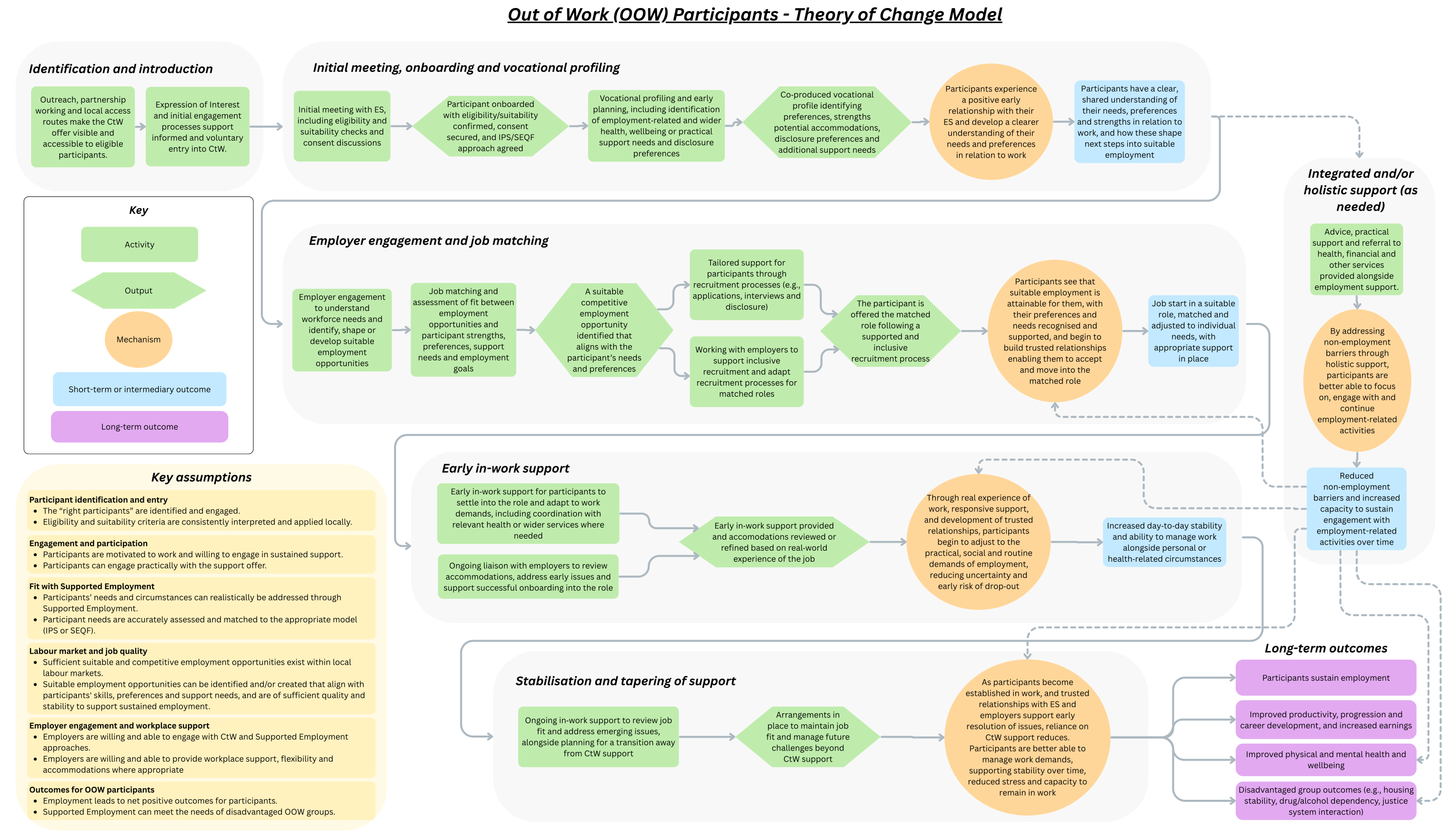
Figure A.1 shows the Connect to Work Theory of Change model for out-of-work participants. It presents the activities, outputs, mechanisms and outcomes through which participants are expected to enter and sustain suitable employment, and how they interrelate. The participant journey includes: identification and introduction; initial meeting, onboarding and vocational profiling; employer engagement and job matching; early in-work support; and stabilisation and tapering of support. Alongside this journey, holistic and enabling support addresses wider health, personal and practical needs that may affect participants’ ability to engage with and sustain employment. These elements connect to longer-term outcomes, including sustained employment, improved opportunities for progression or increased earnings, and improvements in health, wellbeing and wider life circumstances. The narrative below explains each of these elements and the relationships between them in more detail.
Identification and introduction
The model begins with identification and introduction, which captures how potential participants become aware of and are introduced to Connect to Work through local access routes. These routes are expected to include outreach, partnership working and engagement through local organisations, helping to make the Connect to Work offer visible and accessible to individuals who may not be engaged with mainstream employment services, enabling Connect to Work to reach populations that may otherwise remain outside the system. Potential participants may become aware of Connect to Work through a range of locally determined routes, for example, through health services, council-run services, community centres/organisations, VCSE organisations, or self‑referral.
At this point, potential participants are introduced to the Connect to Work offer and supported to consider whether participation may be appropriate and beneficial for them. EOI and these initial engagement processes are intended to support informed and voluntary participation, ensuring individuals have a clear understanding of the programme and what participation may involve before moving into more formal assessment and onboarding activities.
Initial meeting, onboarding and vocational profiling
Following EOI, the focus shifts to initial meeting, onboarding and vocational profiling. Participants have an initial meeting with a named employment specialist, establishing a consistent point of contact and through which a supportive working relationship is expected to begin to develop. During this initial meeting, participants’ eligibility and suitability for Connect to Work are considered, consent is discussed, and the most appropriate supported employment approach (IPS or SEQF) is identified based on participants’ needs and circumstances. Once eligibility and suitability have been confirmed, consent has been obtained, and an appropriate approach has been agreed, participants are formally onboarded onto the programme.
Through this early engagement, participants are supported to develop a shared understanding of their work history, skills, preferences, aspirations and support needs with the employment specialist. This includes exploration of participants’ disclosure preferences and discussion of how information about support needs may (or may not) be shared with employers, alongside identification of any potential accommodations or additional support needs. This relationship is expected to play an important role in building trust, maintaining engagement, and supporting participants through challenges and subsequent stages of the pathway.
Activities at this point then typically include:
- exploration of participants’ work history, skills, strengths, interests, preferences and employment goals through vocational profiling
- discussion of health‑related needs and wider personal or practical barriers
- exploration of disclosure preferences and discussion of how information about support needs may (or may not) be shared with employers
- identification of potential accommodations and additional support needs
- early planning around what suitable employment is likely to look like for the individual
Through this process, participants are expected to gain greater clarity about their strengths, preferences and support needs in relation to work, alongside reassurance that work is achievable with appropriate support. Together, these activities contribute to a co‑produced vocational profile, helping participants and employment specialists develop a shared understanding of what suitable employment looks like for the individual and how support should be tailored to their needs and goals. Increased confidence and motivation to pursue employment are expected to emerge as important early outcomes.
Employer engagement and job matching
Building on vocational profiling, the model moves into employer engagement and job matching, which together describe how suitable competitive employment opportunities are identified, shaped or developed, and then secured and entered through recruitment processes. This part of the model reflects the supported employment principle that job quality, fit and employer engagement are central to achieving sustainable outcomes (both employment and health and wellbeing outcomes).
Employer engagement is expected to occur before, and alongside, job matching, so that employment specialists can understand employer workforce needs and identify opportunities that may not yet be visible through formal vacancies. This may include identifying hidden vacancies, shaping existing roles, or developing suitable opportunities where appropriate, while maintaining the principle that participants enter competitive, sustainable employment.
Activities at this point may include:
- engaging employers to understand workforce and recruitment needs, identify suitable opportunities, including hidden vacancies where relevant, and explore where roles could be shaped or developed to align with participant strengths, preferences and support needs; job matching and assessment of fit between employment opportunities and participant strengths, preferences, support needs and employment goals, including role analysis where this is needed to understand job demands, working environments and expectations
- supporting participants to consider, pursue and apply for roles that align with their vocational profile and preferences
- working with employers and participants to support inclusive recruitment processes, interviews, work trials and/or onboarding where appropriate
As this work progresses, a shared understanding is expected to develop between the participant, employment specialist and employer about whether a particular role represents a good fit for the participant’s strengths, preferences, support needs and employment goals with the right support in place. This alignment helps participants feel more confident about taking up work and helps employers feel clearer about how to support the participant effectively. Where employer engagement occurs, early collaboration between the participant, employer and employment specialist may also help establish trusting working relationships and clear channels of communication that support ongoing problem-solving and workplace support once employment begins.
Suitable job fit is expected to be central to successful and sustained employment outcomes. The objective is not simply to identify any available opportunity, but to identify or develop opportunities that align with participants’ strengths, preferences, support needs and employment goals, while also meeting employer workforce needs. Stronger alignment between participant and role is expected to contribute to employment entry, job stability, wellbeing and longer-term sustainment.
Where recruitment is successful, this pathway is expected to lead to the intermediate outcome of a job start in a suitable role, with expectations clarified and accommodations agreed in advance. At this point, participants are expected to not only enter employment, but to do so with a clearer sense of what the role involves and reassurance that support is available as they transition into work.
Early in‑work support
Following entry into employment, the ToC highlights the importance of early in work support, recognising the period immediately after job start as a critical point for sustaining work. For participants who have never been in work, or who have been out of work for some time, this transition can involve uncertainty as they adapt to new routines, expectations and workplace environments.
During this period, support typically includes:
- regular, proactive contact with the employment specialist building on an established relationship to support participants through early challenges in work
- practical problem solving as participants adjust to tasks, routines or workplace relationships
- review and refinement of agreed accommodations
- liaison with employers where needed
This early support is expected to help participants feel more confident meeting role requirements, reduce anxiety about work, and support constructive responses to challenges as they emerge. Early outcomes at this stage include greater stability in work, as routines develop and confidence increases.
Stabilisation and tapering of support
As participants become more established in their role, the focus of support is expected to shift from intensive early problem solving towards consolidation and reduced intensity. At this stage, support is expected to increasingly draw on natural workplace supports, relationships and routines, with employment specialist involvement gradually reducing as participants become more established and confident in their role. Existing trusted relationships between participants, employers and employment specialists may continue to support communication and early resolution of issues where required.
Typically, at this stage:
- work routines are more predictable
- participants feel more confident managing day to day demands independently
- employment becomes more secure and less reliant on intensive external intervention
As work becomes more familiar and manageable, participants are expected to develop greater confidence in their ability to cope with challenges, apply strategies they have learned during earlier support, and seek help appropriately when needed. This growing sense of control, predictability and capability allows for employment to become self-sustaining rather than dependent on continuous intervention. In this way, the tapering of support reflects increasing stability, including greater consistency in employment and reduced risk of disruption (for example, reduced absences from work and more settled routines), and improved ability to manage work alongside other aspects of daily life. This is expected to help bridge the transition from early stabilisation in work to sustained employment over time, rather than marking an abrupt end to support.
Holistic and enabling support alongside the employment journey
Alongside the core employment focused elements of the ToC, Connect to Work also provides holistic and enabling support, which can operate at different points in a participant’s journey depending on individual needs and circumstances. This support recognises that, for some participants, challenges outside of work, such as health, housing, financial insecurity or caring responsibilities, can undermine engagement with employment or destabilise progress, even where the job itself is suitable. In these cases, employment specialists are expected to work in coordination with health, housing, financial or other local services to help address wider sources of instability. For participants supported through IPS, coordination with health services forms an integral part of the model, rather than an additional or separate element of support.
This additional support may:
- be introduced early, intensified during periods of instability, or revisited later as circumstances change
- help reduce competing pressures that could disrupt progress in work
- act as an enabling condition, supporting participants to engage effectively with employment support and sustain progress
Rather than forming a separate pathway, holistic support is expected to operate in support of the core employment journey, particularly for participants with multiple or intersecting needs where employment may need to be supported by wider interventions to remain stable. This support is expected to operate alongside employment, consistent with supported employment principles that prioritise entry into work with support continuing in parallel.
This aspect of Connect to Work is expected to be particularly important for participants with more complex or intersecting needs, especially those in DWP’s target ‘disadvantaged groups’, and will be explored further through the development of CMO configurations to understand how and why it contributes to outcomes for different groups.
Longer‑term outcomes
The longer‑term outcomes set out in the OOW participant ToC focus primarily on sustained employment, reflecting the central goal of supported employment (SE). Sustained employment is not treated as a simple continuation of earlier job retention, but as the outcome of a cumulative process in which suitable work, effective early support, growing confidence and reduced reliance on intensive intervention interact over time.
Over time, sustained employment may also lead to wider benefits, including improved productivity, progression or earnings, positive effects on health and wellbeing, and possibly for some groups improvements in other life circumstances (for example, housing stability, drug and alcohol dependency/ treatment, and/or justice system interactions). The core outcomes are not assumed to occur automatically for all participants, but are most likely where work is suitable, stability has been established, and participants feel confident in their ability to manage challenges independently or seek support appropriately when needed.
A.1.2. Assumptions and risks underpinning the OOW participant ToC
The OOW participant ToC is underpinned by several key assumptions concerning who Connect to Work reaches, how participants engage with the offer, and the conditions under which supported employment is expected to lead to positive outcomes. Where these assumptions do not hold, there are risks to the effectiveness of the ToC model described above.
Participant identification and entry
The ToC assumes that Connect to Work reaches the ‘right’ participants, people who are out of work and face significant barriers to employment, meaning they are unlikely to enter or sustain work without longer‑term, intensive SE support, and who are motivated to work and willing to engage with sustained support. It also assumes that eligibility and suitability criteria are applied consistently across local areas, so access to Connect to Work reflects need rather than convenience.
If these assumptions do not hold, there is a risk that participants with lower support needs are over-represented, or that people who would benefit most from Connect to Work are not reached. This can weaken the plausibility of the ToC and reduce the likelihood of achieving sustained outcomes.
Engagement and participation
The ToC assumes that participants are motivated to work and willing to engage in sustained, relationship based support over time. It also assumes that participants can engage practically with the support offer, including maintaining contact with employment specialists, participating in vocational profiling, and engaging with employers and recruitment processes.
Where motivation is fragile, expectations are misaligned, or practical barriers such as transport, digital access or unstable living circumstances limit engagement, there is a risk of early disengagement or interrupted progress through the pathway.
Fit with supported employment
A central assumption of the model is that participants’ needs and circumstances can realistically be addressed through a supported employment approach. This includes the assumption that supported employment is an appropriate intervention for participants at the point they enter the programme, and that employment specialists can assess participants’ needs accurately and match individuals to the appropriate model (IPS or SEQF) and level of support.
If participant needs are mis-assessed, if supported employment is not the most appropriate intervention for their needs and circumstances at that point in time, or if individuals are placed in a model that does not align with the intensity or type of support required, there is a risk of poor job fit, weaker early in work support, and an increased likelihood of disengagement, job disruption, or job loss.
Delivery capability and capacity
The ToC assumes that ABs, delivery partners and employment specialists have the capability, capacity and resources required to deliver supported employment with sufficient quality and fidelity. This includes the ability to assess participant needs appropriately, match participants to the most suitable model and level of support, engage employers effectively, and provide ongoing support over time.
Where capability, capacity or resources are insufficient, there is a risk that participants do not receive support that is aligned with their needs, reducing the effectiveness of the supported employment approach.
Sequencing of employment and holistic support
The ToC assumes that Connect to Work does not require non‑employment needs (such as health, housing or financial issues) to be resolved before employment support begins. Consistent with supported employment principles, holistic and wider support is expected to operate alongside and in parallel with employment activity, strengthening sustainment and longer‑term outcomes rather than determining readiness or eligibility for work.
Where holistic support is treated as a prerequisite for employment activity, there is a risk that delivery drifts away from the SE, delaying entry to work and weakening alignment with supported employment principles.
Labour market opportunities and job quality
The ToC assumes that Connect to Work can identify and/or create suitable competitive employment opportunities within local labour markets, and that sufficient opportunities exist that align with participants’ skills, preferences and support needs. It further assumes that these opportunities are of sufficient quality and stability to support sustained employment.
Risks arise where local labour markets offer limited suitable opportunities, where opportunities are insecure or short-term, or where participants struggle to access roles that provide an appropriate match between their needs and job demands. In these circumstances, even well-delivered support may struggle to lead to sustained employment.
Employer engagement and workplace support
The ToC assumes that employers are willing and able to engage with Connect to Work and supported employment approaches, including working with employment specialists on recruitment, workplace support, flexibility, accommodations and ongoing problem-solving where appropriate.
Risks arise where employers are unwilling or unable to engage with Connect to Work, where organisational constraints limit flexibility or workplace support, or where employer expectations are misaligned with participant needs. In these circumstances, suitable job matches may be harder to secure and sustain. Although participants would continue to receive support from their employment specialist, opportunities for employer-led accommodations, workplace problem-solving and tailored workplace support may be more limited.
Outcomes for out‑of‑work participants
Finally, the ToC assumes that entering employment leads to net positive outcomes for participants, and that Connect to Work can meet the needs of disadvantaged out of work groups included within the programme. This assumes that work is suitable, supported and stable enough to contribute to improved outcomes over time.
Where employment is poorly matched, insufficiently supported, or where wider sources of instability remain unaddressed, there is a risk that work does not lead to improved outcomes and may, in some cases, exacerbate stress or insecurity rather than reduce it.
A.1.3. In-work retention support participants ToC model
The IWRS participant ToC sets out how Connect to Work is expected to support people who are already in employment but at risk of job loss, to retain suitable work or to move into a more suitable role if their current job cannot be sustained. It focuses on early intervention, workplace problem solving and in work retention support, grounded in SE principles and delivered through IPS and SEQF, with support delivered through a consistent, trust-based relationship with a named employment specialist.
The model brings together the activities, outputs, mechanisms and outcomes IWRS participants are expected to experience through the programme, outlining how support operates from the point of signposting through to stabilisation and sustainment. In particular, the model emphasises:
- early identification and understanding of the issues putting employment at risk
- active workplace problem solving and employer engagement to improve job fit and stability
- support to secure and settle into a more suitable role where retention is not viable
- holistic and enabling support alongside employment, where wider issues need to be addressed to sustain work over time
Connect to Work support for IWRS participants is typically delivered over a shorter period than OOW participants, generally up to 4 months (with flexibility for extension in exceptional circumstances).
The IWRS participant ToC model (Figure A.2) and accompanying narrative, organised around the phases of the participant journey, are set out below.
Figure A.2: In-Work Retention Support Participant Theory of Change Model
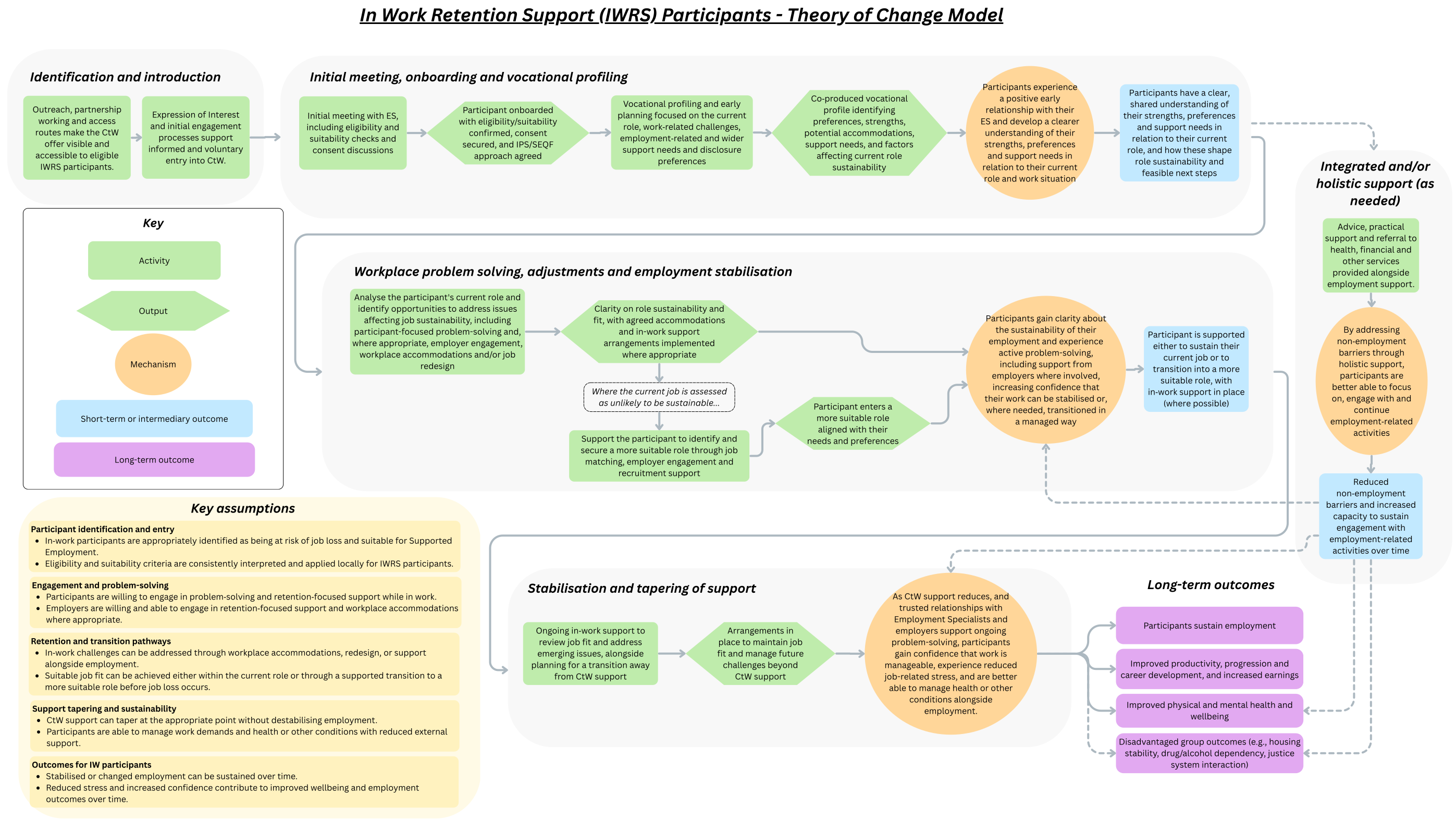
Figure A.2 shows the Connect to Work ToC model for in-work retention support participants. It presents how programme activities and support are expected to contribute to participants on the in-work strand remaining in suitable employment. The pathway includes identification and introduction; initial meeting, onboarding and vocational profiling; workplace problem-solving, adjustments and employment stabilisation; and stabilisation and tapering of support. Alongside this pathway, integrated and holistic support addresses wider needs that may affect participants’ ability to remain in work. These elements connect to longer-term outcomes, including sustained employment; improved productivity, progression and career development and earnings; improvements in health and wellbeing; and improvements in barriers to employment. The narrative below explains each of these elements and the relationships between them in more detail.
Identification and introduction
For IWRS participants, the model also begins with identification and introduction, which captures how people who are already in work but at risk of job loss become aware of and are introduced to Connect to Work through local access routes. These routes are expected to include outreach, partnership working and engagement through local organisations, helping to make the Connect to Work offer visible and accessible to individuals who may benefit from in‑work retention support. Potential participants may become aware of Connect to Work through a range of locally determined routes, for example through employers, health services, council-run services, VCSE organisations, community organisations, or self‑referral.
At this point, potential participants are introduced to the Connect to Work offer and supported to consider whether participation may be appropriate and beneficial for them. Expression of Interest and initial engagement processes are intended to support informed and voluntary participation, ensuring individuals have a clear understanding of the programme and what participation may involve before moving into more formal assessment and onboarding activities. This early engagement aims to provide reassurance that employment difficulties are taken seriously and that support is available to address them before job loss occurs, creating the conditions for timely and preventative intervention once formal support begins.
Initial meeting, onboarding and vocational profiling
Following EOI and initial engagement, the focus shifts to initial meeting, onboarding and vocational profiling. Participants have an initial meeting with a named employment specialist, establishing a consistent point of contact and through which a supportive working relationship is expected to begin to develop. During this initial meeting, participants’ eligibility and suitability for Connect to Work are considered, consent is discussed, and the most appropriate supported employment approach (IPS or SEQF) is identified based on participants’ needs and circumstances. Once eligibility and suitability have been confirmed, consent has been obtained, and an appropriate approach has been agreed, participants are formally onboarded onto the programme.
Through this early engagement, participants are supported to develop a shared understanding of their current role, work-related challenges, strengths, preferences and support needs with the employment specialist. This includes exploration of previous disclosure decisions and discussion of how information about support needs may (or may not) be shared with employers, alongside identification of potential workplace accommodations and additional support needs. This relationship is expected to play an important role in building trust, supporting open discussion of sensitive workplace issues, maintaining engagement, and supporting participants through subsequent stages of the pathway.
Activities at this point typically include:
- exploration of the participant’s current role, work history and employment situation through vocational profiling
- exploration of health-related needs, performance issues or interpersonal difficulties affecting work
- discussion of previous disclosure decisions, current workplace awareness of support needs and/or involvement in Connect to Work, and preferences regarding future disclosure
- identification of potential workplace accommodations and additional support needs
- clarification of what aspects of the current role are and are not sustainable
Together, these activities contribute to a co-produced vocational profile identifying participants’ strengths, preferences, disclosure preferences, potential accommodations, support needs, and factors affecting current role sustainability.
Through this process, participants are expected to gain greater clarity about their strengths, preferences and support needs in relation to their current role and work situation, alongside reassurance that employment difficulties can be addressed or managed with support. Participants and employment specialists develop a shared understanding of how these factors shape role sustainability and feasible next steps, whether through stabilisation of the current role or consideration of alternative employment where appropriate. Reduced uncertainty and increased confidence that employment can be stabilised, either in the current role or through change, emerge as important early outcomes.
Workplace problem solving, accommodations and employment stabilisation
Building on engagement and in‑work vocational profiling, this stage focuses on workplace problem‑solving and accommodations to reduce the risk of job loss and support employment to become more stable and manageable.
Activities at this point typically include:
- analysing the demands of the participant’s current role and identifying sources of mismatch between job requirements and the participant’s needs, capabilities or circumstances
- working with employers to agree workplace accommodations, job redesign or additional workplace support where appropriate and aligned with participants preferences regarding disclosure and employer involvement
- supporting constructive conversations between participants and employers, drawing on the established relationship with the employment specialist to help clarify expectations, communication or working relationships where needed
Where problem‑solving and accommodations are sufficient, this is expected to lead to improved job fit, reduced stress and a lower immediate risk of job loss. Participants are expected to gain greater clarity about what is manageable in their role and increased confidence that difficulties can be addressed with support. Where the role is assessed as an unsuitable match, the model explicitly supports proactive decision‑making about alternatives and transition into a more suitable role. In these cases, employment specialists work with participants to identify and secure opportunities that provide a stronger fit with their strengths, preferences, support needs and employment goals, before employment ends where possible. This is framed as employment stabilisation rather than failure to retain the original job.
Whether stability is achieved through accommodations in the existing role or transition to a more suitable role, participants are expected to experience active problem‑solving and increased confidence that employment can be stabilised in a managed way. This is expected to lead to the key intermediate outcome of retained or re‑secured suitable employment, with a reduced immediate risk of job loss and improved confidence in managing ongoing work demands.
Stabilisation and tapering of support
As employment becomes more stable, the ToC shifts towards stabilisation and tapering of support. This reflects a move away from intensive problem solving during periods of heightened risk towards consolidation, with employment specialist involvement reducing in frequency where appropriate.
Typically, at this stage:
- workplace demands and expectations are better understood and more predictable
- arrangements to support job fit and manage future challenges are established and embedded
- participants feel more confident managing work demands alongside health or personal circumstances
Ongoing in-work support continues to review job fit, address emerging issues and support planning for a transition away from Connect to Work support. As support reduces, participants and employment specialists work to ensure that arrangements are in place to maintain job fit and respond to future challenges beyond the period of formal support. Support is expected to increasingly draw on established workplace relationships, workplace arrangements and other natural supports as reliance on Connect to Work reduces.
As Connect to Work support reduces, and trusted relationships with employment specialists and employers support ongoing problem-solving and confidence-building, participants are expected to gain greater confidence that work is manageable and sustainable. Participants are expected to become better able to manage work demands and wider health or personal circumstances, experience reduced job-related stress, and apply strategies developed during earlier support more independently. As a result, employment is expected to become more secure and less dependent on continuous external intervention.
In this way, stabilisation and tapering reflect increasing confidence, predictability and capability, and are expected to support the transition from reduced risk of job loss to sustained, suitable employment over time, whether in the same role or following a supported move into a more appropriate one.
Holistic and enabling support alongside the employment journey
As with the out‑of‑work model, the in‑work ToC includes holistic and enabling support alongside core employment activity. This reflects the shared assumption that factors outside of work can affect employment outcomes, even where support is focused on a specific job or workplace issue.
For some in‑work participants, issues such as health, financial pressure, housing insecurity or caring responsibilities can intensify difficulties at work or limit the effectiveness of workplace accommodations alone. Where needed, employment specialists coordinate with health, housing, financial or other local services to help address these wider pressures and support participants to manage work alongside other responsibilities.
This support may be introduced early, intensified during periods of instability, or revisited as circumstances change. As with the out‑of‑work model, holistic support does not form a separate pathway. Instead, it operates alongside employment support and is expected to reinforce workplace problem‑solving and help ensure that stability achieved through accommodations, retention or job change can be maintained over time.
Longer‑term outcomes
The longer-term outcomes for in work retention support participants focus primarily on sustained, suitable employment, whether through retention in the original role or through a supported move into a more appropriate one. Sustained employment is expected to be the result of early intervention, improved job fit, and growing participant capability, rather than simply remaining in work by default.
Where employment is stabilised, participants are expected to experience:
- greater confidence in managing work demands
- reduced risk of recurrent job crises or job loss
- improved sense of security and accomplishment at work
Over time, sustained employment may also lead to wider outcomes such as improved productivity, progression or earnings, and positive effects on health and wellbeing. As with the OOW model, we expect these outcomes are most likely to occur where employment is suitable, adequately supported, and aligned with participants’ needs and circumstances.
A.1.4. Assumptions and risks underpinning the IWRS participant ToC
The IWRS participant ToC is underpinned by a set of key assumptions about how in‑work participants are identified, how they engage with support, how employers respond, and the conditions under which workplace problem‑solving and accommodations are expected to lead to sustained employment. As with the OOW ToC, where these assumptions do not hold, there are identifiable risks to the effectiveness of the pathways described in the model above.
Participant identification and entry
The ToC assumes that IWRS participants are appropriately identified as being at risk of job loss and that the Connect to Work intervention is timely enough to prevent unnecessary exits from work. It also assumes that eligibility and suitability criteria are interpreted and applied consistently across local areas for in‑work participants, including a shared understanding of what constitutes being ‘at risk’ and suitable for SE.
If IWRS participants are signposted too late, once job loss has already become inevitable, or if local interpretations vary widely, there is a risk that opportunities for early intervention are missed.
Engagement and problem‑solving
The ToC assumes that in‑work participants are able and willing to engage in problem‑solving while in employment, including discussing workplace challenges, reflecting on job fit, and participating in employer‑facing support where appropriate. This includes a willingness to engage honestly with their employment specialist about issues that may be sensitive or difficult to disclose. The model also assumes that employers are willing and able to engage in retention‑focused support, including conversations about accommodations, job redesign or changed ways of working.
In practice, some participants may not have previously shared information about their health, needs or circumstances with their employer, and/or may feel unable or unwilling to do so. In these cases, Connect to Work can still provide support through participant‑focused problem‑solving, confidence‑building and planning, although the scope for direct employer engagement may be more limited. This requires careful navigation by the employment specialist, drawing on the established relationship to support participants to consider disclosure where appropriate, while respecting individual preferences and maintaining trust.
Where participants are reluctant to engage, for example due to fear of stigma or job loss, or where employers are resistant to involvement, there is a risk that underlying issues remain unresolved and continue to undermine job stability.
Retention and transition pathways
A central assumption of the model is that in‑work challenges can be addressed through accommodations, redesign, support alongside employment, leading to improved job fit and reduced risk of job loss. The ToC also assumes that where roles are unsuitable, supported job‑to‑job transitions can be initiated early, before employment ends, and are viewed as proactive stabilisation rather than failure.
Risks arise where employers are unable or unwilling to implement accommodations, where job redesign is constrained by organisational or operational demands, or where alternative suitable roles are not available within the local labour market. In these situations, job loss may still occur despite timely and well‑delivered support.
Sequencing of employment and holistic support
The ToC assumes that holistic or wider support operates alongside, rather than prior to, in-work employment support. Consistent with supported employment principles, Connect to Work is expected to address employment risks directly while coordinating wider support where needed to strengthen job stability and sustainment over time.
Where holistic support is treated as a prerequisite for retention focused or in work employment support, there is a risk that delivery drifts away from supported employment principles, delaying intervention and weakening the programme’s ability to prevent avoidable job loss.
Support tapering and sustainability
The model assumes that Connect to Work support can taper at the appropriate point without destabilising employment, and that participants are able to manage work demands alongside health or other conditions with reduced external support once stability is achieved. In practice, this transition is supported through the development of practical strategies, agreed actions and learning developed during earlier support, which participants can draw on as they continue in work.
If support tapers too early, or if participants’ confidence and coping capacity are overestimated, there is a renewed risk of job loss. Conversely, prolonged intensive support where it is no longer needed may be inefficient and could undermine participants’ sense of autonomy.
Outcomes for IWRS participants
Finally, the ToC assumes that stabilised or changed employment can be sustained over time, and that reduced stress and increased confidence contribute to improved productivity, progression and wellbeing for in‑work participants.
Risks to these outcomes arise where employment remains of poor quality, stressors are not adequately addressed, or wider sources of instability, such as health issues, financial pressures or other challenging life circumstances persist. In such cases, employment may be retained in the short term but fail to deliver longer‑term benefits for participants.
A.1.5. Participant-level contribution claims
The participant-level contribution claims sit beneath the ToCs set out above and explore specific causal pathways in greater detail. This sub-section sets out 4 draft participant level contribution claims, which together reflect the main ways Connect to Work is expected to support participants over time:
- supporting entry into and sustainment of suitable employment (out‑of‑work participants)
- stabilising and sustaining employment (in‑work retention support participants)
- improving health and wellbeing through employment
- supporting stability through integrated and holistic support
Each claim below is presented as a short narrative explaining the logic of the pathway, alongside a diagram that sets out the full sequence of activities, mechanisms and outcomes. The claims are treated as working hypotheses that will be tested and refined over the course of the evaluation as evidence is gathered.
Claim 1: supporting entry into and sustainment of suitable employment (out‑of‑work participants)
Connect to Work is expected to contribute to sustained employment for OOW participants by supporting a transition into suitable competitive employment that prioritises suitable job fit, ongoing and personalised support from an employment specialist, and early stabilisation in work rather than rapid placement alone.
Through early engagement, vocational profiling and proactive employer engagement, participants are expected to develop a clearer understanding of their skills, needs, preferences and options, and feel reassured that entering work is achievable with ongoing support. A trusting, person centred relationship with an employment specialist is expected to help reduce uncertainty and anxiety about work and build confidence to pursue suitable roles.
Employment specialists are expected to work with employers to identify, shape, or develop suitable competitive employment opportunities, including hidden vacancies where appropriate, that align with participant strengths, preferences, support needs and employment goals. Where employment is secured, support does not stop at job entry but actively accompanies participants through the transition into work and is expected to help address emerging issues early and support conversations about expectations, disclosure and workplace support.
As participants experience early stability in the role and feel supported to manage workplace demands, they are expected to grow in confidence and autonomy, to enable them to manage their day to day work more independently and feel less reliant on intensive employment specialist support over time. This gradual process of stabilisation is expected to support sustained employment and may create the conditions for longer term outcomes such as progression or increased earnings where appropriate (though sustained employment is the primary employment outcome for this claim and for Connect to Work more broadly). Suitable job fit is expected to be central to this pathway, contributing not only to employment entry but also to stability, wellbeing and longer-term sustainment.
Figure A.3 below sets out the contribution claim for the outcome on entering and sustaining suitable employment (OOW group).
Figure A.3: contribution claim for entering and sustaining suitable employment (OOW group)
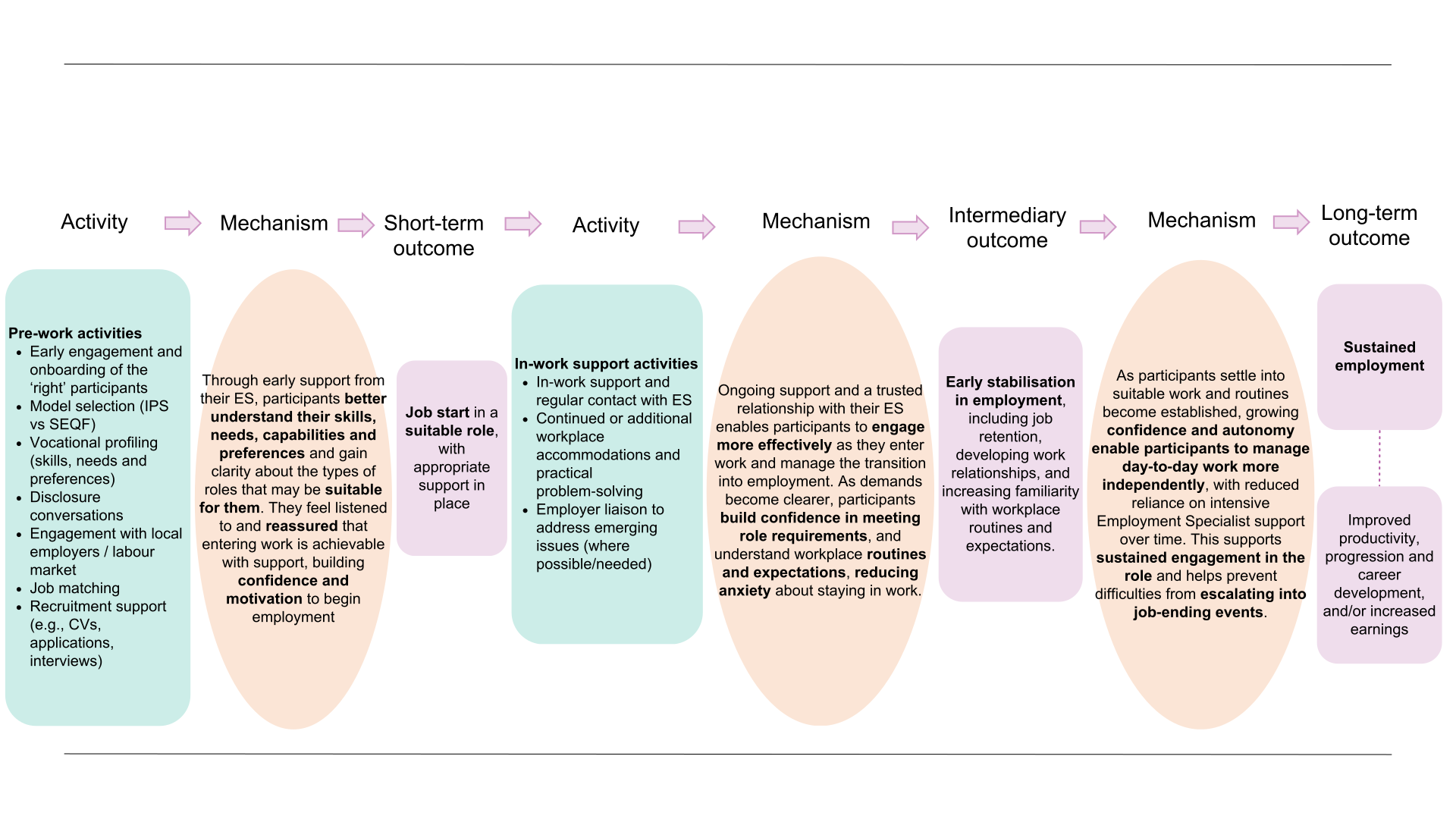
Figure A.3 sets out the contribution claim for entering and sustaining suitable employment for the out-of-work participant group. It outlines a series of steps showing how activities are expected to translate into long-term outcomes. These steps include pre-work activities; a mechanism related to better understanding of skills, needs, capabilities and preferences; a short-term outcome of finding a suitable role; in-work support activities; a mechanism related to increased engagement and confidence; an intermediary outcome of early stabilisation of employment; a final mechanism related to increased autonomy and independence; and long-term outcomes on sustained employment and improved productivity and career development.
Claim 2: stabilising and sustaining employment (in‑work participants)
Connect to Work is expected to contribute to sustained employment for in work retention support participants by reducing the risk of job loss through early intervention, workplace problem solving and, where necessary, supported transitions into more suitable roles. The focus is on stabilising employment situations before difficulties escalate, rather than responding only once job loss is imminent.
Through early engagement, in work vocational profiling and employer contact where possible, participants are expected to gain clarity and reassurance about their work situation and the support available. At a point of heightened risk, trusted, person centred relationships with an employment specialist are expected to help participants make sense of what is happening at work, better understand their needs and possible accommodations, and reduce anxiety about job loss. This early support is expected to build confidence that current difficulties can be addressed with support, or that alternative options can be explored where necessary.
Employment specialists are expected to work with participants to understand and make sense of job demands, pressures and interpersonal challenges, and to identify practical ways to reduce risk and improve fit. This may include work focused coaching and practical problem solving (with participants and employers where possible), refinement of workplace accommodations, role redesign, and employer engagement or role matching where the current role cannot be sustained. Where the current role cannot be sustained, supported transition into a more suitable role before employment ends is treated as a positive stabilisation outcome rather than a failure of retention.
Participants are expected to build confidence and autonomy and become better able to manage day to day work demands and pressures independently, respond constructively to challenges as they arise, and apply their skills more consistently. This is expected to reduce the risk of difficulties escalating into job ending events and creates scope for additional responsibilities or progression where appropriate. Over time, this is expected to support sustained employment and longer term outcomes such as improved productivity, progression or increased earnings, where conditions allow.
Figure A.4 below sets out the contribution claim for the outcome on supporting job retention and progression (IWRS group).
Figure A.4: contribution claim for supporting job retention and progression (IWRS)
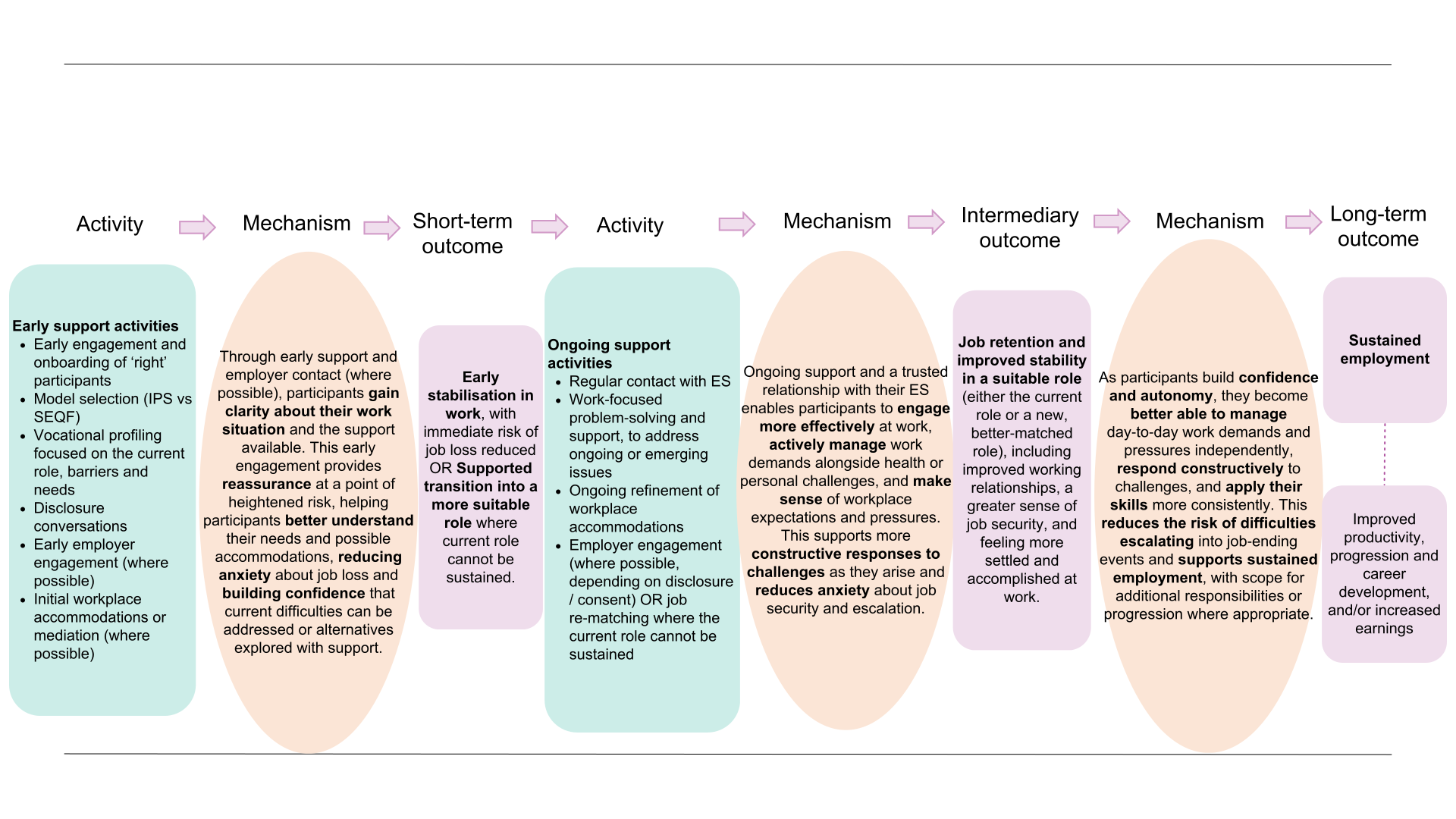
Figure A.4 sets out the contribution claim for supporting job retention and progression in-work retention support participant group. It outlines a series of steps showing how activities are expected to translate into long-term outcomes. These steps include early support activities; a mechanism related to gaining clarity and reassurance about their position; a short-term outcome of early stabilisation and reduced risk of job loss; activities around ongoing support; a mechanism related to improved engagement and management of work demands alongside challenges; an intermediary outcome of job retention and improved job stability; a mechanism related to confidence and autonomy; and long-term outcomes of sustained employment, improved productivity and career development.
Claim 3: improving health and wellbeing through employment
Connect to Work is expected to contribute to improved health and wellbeing by supporting people to enter and remain in work in ways that are suitable, supported and manageable, recognising that wellbeing gains are expected to be staged, conditional and shaped by how work is experienced.
Through early support, participants are expected to gain a clearer understanding of their needs and feel listened to and supported, reducing anxiety and perceived risk associated with entering work. This early reassurance is expected to increase feelings of control, confidence and self‑esteem, and helps participants develop clearer expectations about what kinds of roles and support would enable them to enter work safely in ways that reflect their health, wellbeing and personal circumstances. These early changes may support improvements in mental wellbeing even before employment begins.
As participants enter suitable roles with appropriate support in place, early experiences of work may lead to reduced financial stress and provide greater routine, structure and social connection. When work is manageable rather than overwhelming, these factors are expected to help participants adjust to working life alongside health or personal circumstances, reducing stress and supporting early improvements in mental and physical wellbeing. These gains are expected to contribute to early stabilisation across work and daily life, including reduced financial strain, reduced stress and less instability.
Where early stabilisation is sustained, participants are expected to build confidence, self‑esteem and coping capacity over time. Reduced exposure to stress, alongside ongoing material security, routine and social connection, are expected to help protect mental and physical wellbeing, support the management of work alongside health and personal needs, and enable healthier routines and choices to be maintained over time. In this way, suitable and supported work may contribute to longer‑term improvements in mental and physical health and wellbeing.
Figure A.5 below sets out the contribution claim for the outcome on work leading to improved health and wellbeing.
Figure A.5: contribution claim for work leading to improved health and wellbeing
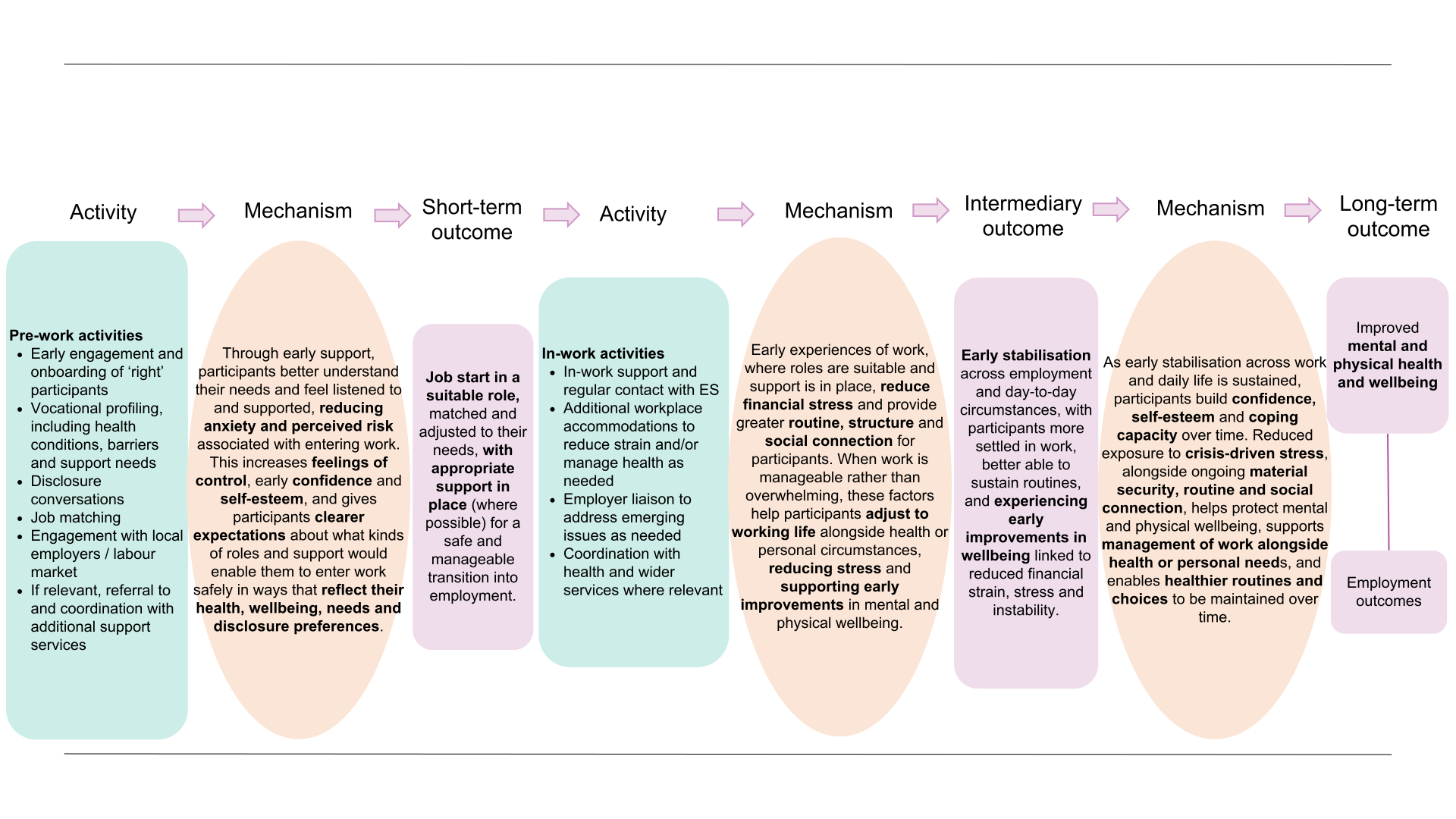
Figure A.5 sets out the contribution claim for improving health and wellbeing through employment for both the out-of-work and in-work retention support participant groups. It outlines a series of steps showing how activities are expected to translate into long-term outcomes. These steps include pre-work activities; a mechanism related to reduced anxiety and increased confidence; a short-term outcome of a job start in a suitable role and feeling more prepared to engage with employment; in-work support activities; mechanisms related to increased financial security, routine and social connection; an intermediary outcome of early stabilisation in day-to-day circumstances; a final mechanism related to increased self-esteem and material security; and long-term outcomes of improved mental and physical wellbeing.
Claim 4: supporting stability through integrated and holistic support
Connect to Work is also expected to contribute to improved employment and wellbeing outcomes for participants with multiple or intersecting needs through integrated holistic support delivered alongside ongoing employment support. Consistent with supported employment principles, this support is not intended to precede or gate entry to work, but to operate concurrently with employment activity. This approach recognises that participants may enter or remain in work while managing complex and changing circumstances, and that employment outcomes are strengthened when wider sources of instability are addressed in parallel.
Through early engagement activities, employment specialists are expected to identify non‑employment needs that may create pressure or risk of disruption to work, including issues related to health, housing, finances or access to other services. This identification is expected to take place alongside vocational engagement and job‑focused activity, rather than as a prerequisite for employment support. These needs are identified and referrals are made to relevant support services while employment support continues. This approach is expected to help reduce crisis‑driven instability without delaying engagement in work. As a result, participants can enter, and/or remain in, employment despite ongoing complexity, with immediate pressures from intersecting needs reduced in parallel to prevent disruption to work.
Ongoing coordination between employment specialists, health services and wider support is expected to continue as participants remain in employment. Responsive accommodation of support is expected to reduce disruption and stress linked to health, personal or practical challenges, limiting repeated crises and supporting sustained engagement with work despite ongoing complexity.
Over time, fewer crisis‑driven interruptions are expected to create a more manageable context in which participants can continue working. Reduced cumulative stress may support greater coping capacity and stability in daily life, helping protect mental and physical wellbeing and enabling work to be managed more sustainably alongside health and personal circumstances. In this way, integrated and coordinated support is expected to strengthen employment and wellbeing outcomes for participants facing multiple or intersecting disadvantages.
Figure A.6 below sets out the contribution claim for the outcome on integrated triage, referral and holistic support.
Figure A.6: contribution claim for integrated and coordinated holistic support
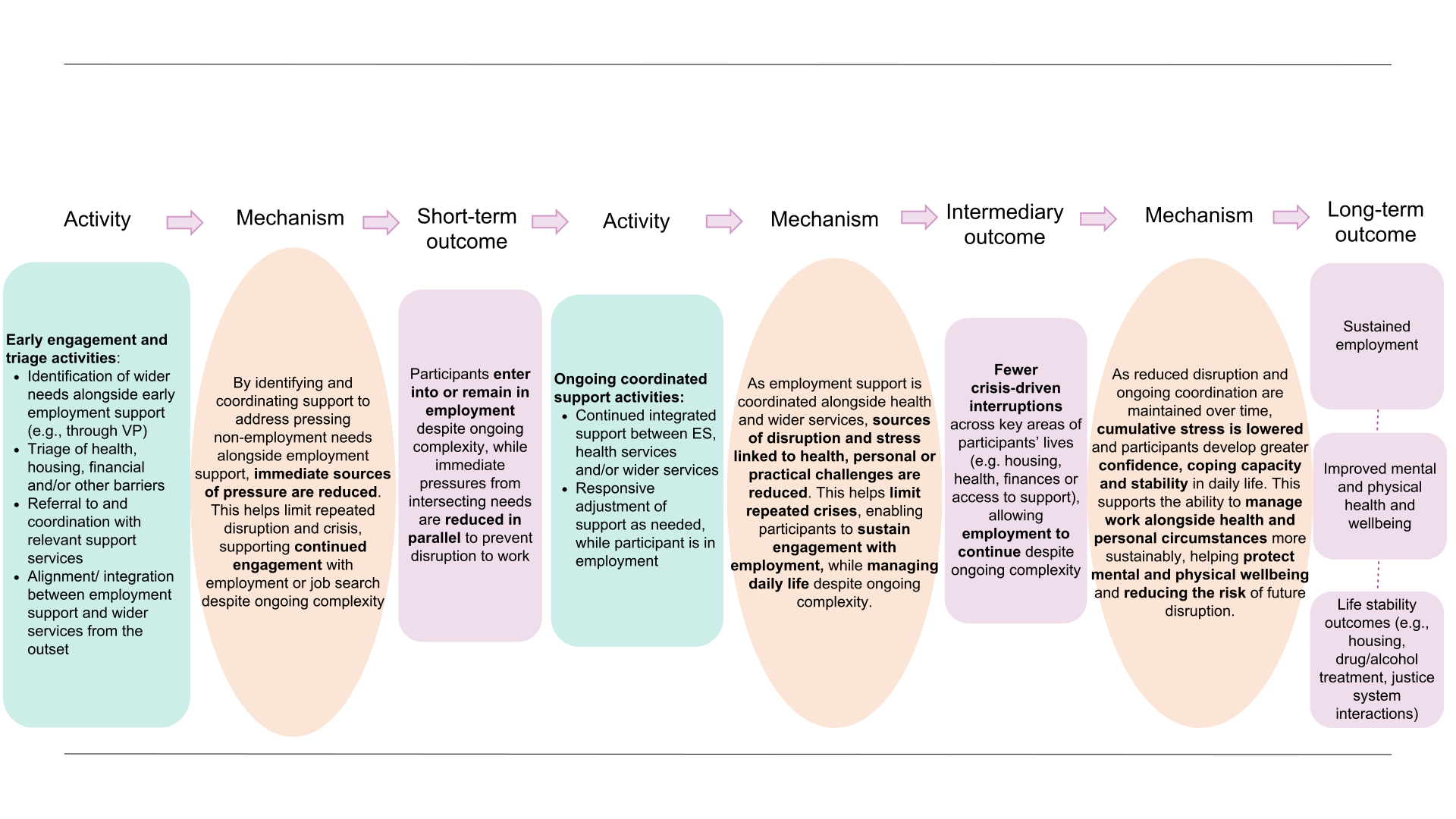
Figure A.6 sets out the contribution claim for supporting stability through integrated and coordinated holistic support for participants with multiple or intersecting needs. It outlines a series of steps showing how activities are expected to translate into long-term outcomes, alongside ongoing employment support. These steps include early engagement and triage activities; a mechanism related to reduced crisis-driven instability and immediate pressures; a short-term outcome of participants entering or remaining in employment despite ongoing complexity; activities around ongoing coordination between employment specialists, health services and wider support; a mechanism related to reduced disruption and stress; an intermediary outcome of fewer crisis-driven interruptions and sustained engagement with work; a final mechanism related to greater coping capacity and stability in daily life; and long-term outcomes of sustained employment and improved health and wellbeing.
A.2. Employer-level ToC and contribution claims
This section presents the employer-level ToC for Connect to Work and the associated employer focused contribution claims. Together, these set out how Connect to Work is expected to influence employer practice through engagement with the programme, and how this contributes to outcomes for employers over time.
The section focuses on employer‑level outcomes associated with participation in Connect to Work, including:
- more inclusive recruitment and workplace practices
- increased confidence to accommodate employees’ needs
- improved management of workplace challenges and reduced risk of job breakdown
- longer‑term organisational outcomes such as reduced staff turnover, improved productivity and strengthened inclusive employment practice
A.2.1. Employer-level ToC model
The employer level ToC sets out how Connect to Work is expected to support employers as they engage with programme participants and develop more inclusive recruitment and workplace practices over time. It describes an employer journey through engagement with Connect to Work, characterised by early relationship building, practical support with recruitment or retention, and ongoing problem solving to sustain employment.
The model brings together the activities, outputs, mechanisms and outcomes employers are expected to experience through the programme, outlining the employer journey through:
- employer identification and early engagement, as employers become aware of Connect to Work, initial relationships are established, and a pool of employers willing to engage is developed
- employer engagement, inclusive recruitment and early retention support, as employers work with employment specialists on recruitment or retention activity across the OOW and IWRS pathways
- ongoing employer support and problem‑solving, with continued input to review and adapt workplace supports and address emerging issues as employment progresses
- sustained practices and organisational change, where learning from employment activity contributes to more routine inclusive recruitment and workplace practice over time, beyond Connect to Work
The employer level ToC model (Figure A.7) and accompanying narrative, organised around these stages of the employer journey, are set out below.
Figure A.7: Employer Theory of Change Model
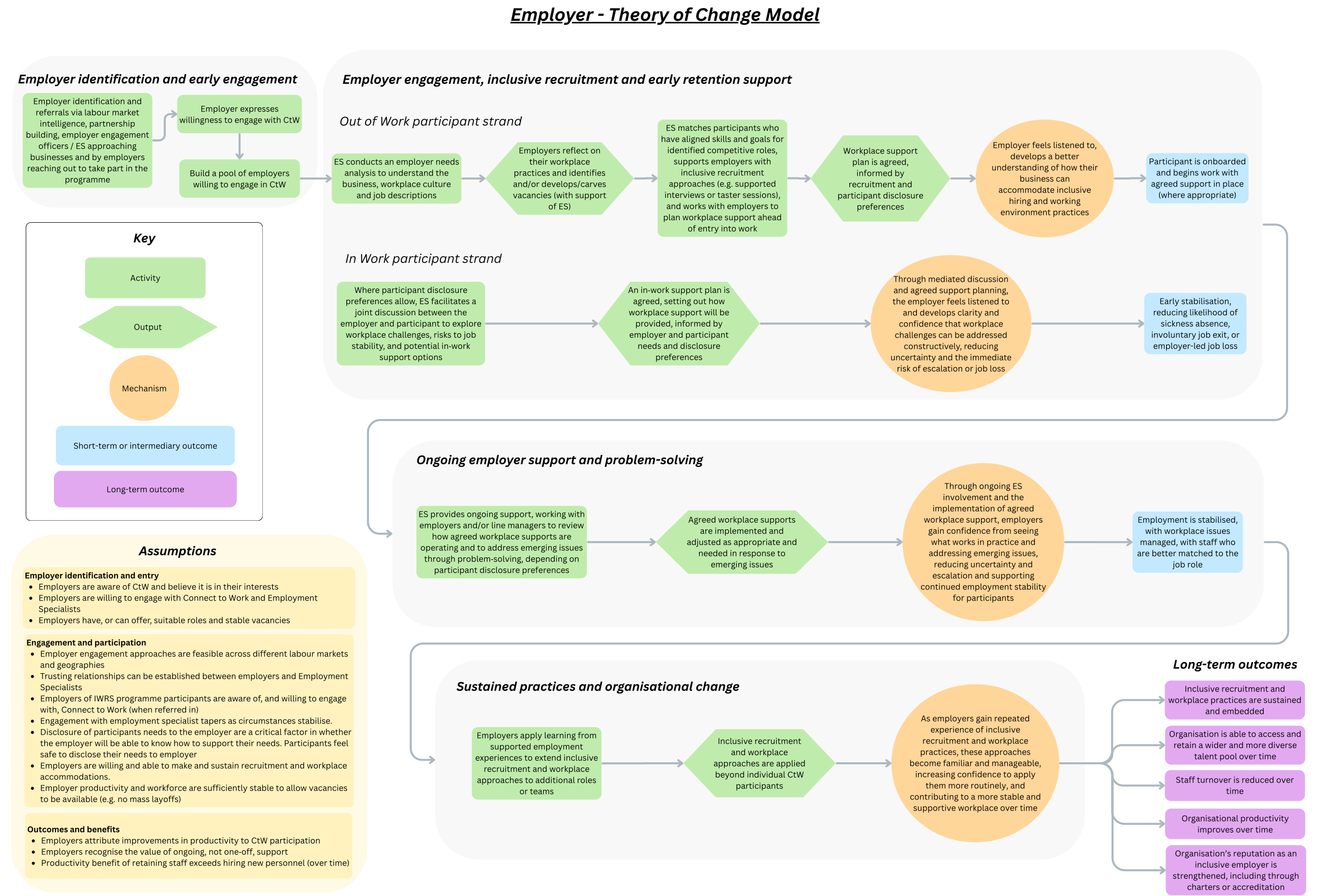
Figure A.7 shows the employer-level Connect to Work ToC model. It presents a series of activities, outputs, mechanisms, short-term or intermediary outcomes and long-term outcomes, and how they interrelate. The diagram is organised into 4 phases: employer identification and early engagement; employer engagement, inclusive recruitment and early retention support; ongoing employer support and problem-solving; and sustained practices and organisational change. Within the second phase, separate strands outline employer engagement and support for out-of-work and in-work participants. These strands connect to ongoing support and problem-solving, followed by the wider application of inclusive recruitment and workplace practices beyond individual Connect to Work participants. The final part of the diagram outlines the expected long-term outcomes, including sustained inclusive practices, access to a wider and more diverse talent pool, reduced staff turnover, improved organisational productivity and a strengthened reputation as an inclusive employer. The diagram also sets out the assumptions underpinning these pathways. The narrative below explains each of these elements and the relationships between them in more detail.
Employer identification and early engagement
For employers, the ToC begins with employer identification and early engagement, capturing how employers become aware of and engage with Connect to Work ahead of any specific recruitment or retention activity. Employers are expected to be identified through a range of local routes, including labour market intelligence, partnership working, employer engagement activity led by employment specialists or dedicated employer engagement officers, or through employers independently reaching out to take part in the programme after hearing about it through other means (such as word of mouth or online).
Early engagement focuses on establishing relationships with employers willing to explore flexible and inclusive approaches to recruitment or retention. The focus is on establishing initial contact, building awareness of the Connect to Work offer, and gauging employer interest and openness to engagement. This early phase is expected to support the development of a pool of employers willing to explore working with Connect to Work.
Where employers express interest, the ToC expects engagement to become more formalised through ongoing contact with employment specialists. This marks the transition from pre‑engagement into more active employer engagement within the ToC, where deeper discussion of roles, workplace context and support needs and goals can begin in subsequent stages.
Employer engagement, inclusive recruitment and early retention support
Once employers move beyond pre‑engagement, the ToC shifts into active employer engagement, inclusive recruitment and early retention support. At this stage, employers are expected to work more closely with Connect to Work and an employment specialist (or more than one employment specialist), and engagement becomes more focused on roles, workplace context and how recruitment or retention could work in practice. This stage includes both OOW and IWRS participant pathways, reflecting different starting points and risks, but a shared emphasis on role fit, early problem solving and the practical management of employment challenges.
Throughout this and subsequent phases, employment specialists may work with employers in a range of ways to support successful recruitment, retention and longer-term workplace inclusion. This may include supporting employers to understand workforce and recruitment needs, identify suitable candidates, plan workplace support and onboarding arrangements, and develop more inclusive recruitment and employment practices. Employment specialists may also signpost employers to relevant local services, networks, guidance or sources of expertise that can support inclusive recruitment, workplace support and retention. The nature and focus of this support varies across the out-of-work and in-work pathways, reflecting different starting points and employer needs, as discussed in detail below.
Out‑of‑work participants
For OOW participants, the ToC expects employer engagement to focus on understanding roles, fit and workplace context ahead of recruitment. Employment specialists are expected to work with employers to develop a clearer picture of job requirements, workplace culture and operational expectations. This includes exploring how roles are structured, which elements are essential, and where flexibility or accommodations may be possible in practice. The employment specialist should also conduct an analysis of what the employers’ needs are. This would involve listening to them to understand their workforce to identify recruitment and labour needs, as well as hidden vacancies and possibilities for job carving of new roles (and not just existing roles).
Employers are expected to reflect on their existing workplace practices and identify where roles can be made more flexible to accommodate the needs and goals of the staff they want to hire. Where suitable competitive roles are identified, employment specialists are expected to match participants with aligned skills and goals, and support employers to use inclusive and accessible recruitment approaches, such as supported interviews or taster sessions. Recruitment is treated as a 2 way process, supporting employers to articulate requirements clearly while supporting participants to understand expectations and workplace norms.
Recruitment discussions are then expected to be used to inform early planning for workplace support. This may include adjusting duties, supervision, communication or onboarding arrangements. For OOW participants, this may lead to an agreed workplace support plan in place ahead of the participant starting work.
The nature and extent of employer engagement may vary depending on participants’ preferences about sharing information with employers. Consistent with supported employment principles, discussions about workplace support, accommodations and onboarding arrangements are participant-led, with participants deciding whether and how much information they wish to share with employers. Employment specialists are expected to support employers and participants to navigate these conversations in a way that supports successful recruitment and job sustainment while respecting participant choice.
Through this process, employers are expected to develop greater clarity about the practical steps needed to recruit, onboard and support participants in work and feel more confident that participant needs and goals can be managed with support. This may reduce uncertainty associated with recruitment and supports participants to be onboarded and begin work with agreed support in place.
In‑work retention support participants
For IWRS participants, employer engagement focuses on understanding the current role and the factors putting participant’s employment at risk. Employment specialists are expected to facilitate joint discussions between the employer and participant to explore workplace challenges, risks to job stability and potential in work support options. This mediated approach is expected to support early problem solving by clarifying expectations, constraints and pressures before issues escalate.
Discussions are used to inform planning for in work support, which may include adjusting duties, changes to supervision or communication arrangements, or other practical workplace supports. At this stage, an agreed in-work support plan may be put in place to guide how support will operate within the workplace.
The extent to which employment specialists can engage employers in detailed planning, workplace problem solving and accommodation planning depends partly on whether participants are willing for employers to be aware of their involvement in Connect to Work, and on the information the participant chooses to disclose to the employer about their needs and circumstances. Where participants choose to make employers aware of their Connect to Work involvement and/or disclose relevant information about their support needs, employer engagement may be more tailored and proactive. Where employer awareness or disclosure is limited or not possible, support may rely more heavily on participant-focused planning, coaching and problem-solving, with fewer opportunities for employer-led accommodations or workplace changes. Employer engagement may focus on more general workplace accommodations and/or communication and early problem‑solving, with variation in how support is delivered. Disclosure conversations are ongoing and participant-led and may evolve over time as trust develops and employment progresses.
Through this stage, employers are expected to gain greater clarity about the challenges affecting the role and increased confidence that issues can be addressed with support. For IWRS participants, this is expected to lead to early stabilisation in work, with reduced likelihood of sickness absence or involuntary job exit.
Ongoing employer support and problem‑solving
Following entry into work for OOW participants, and early stabilisation for IWRS participants, the ToC moves into a phase of ongoing employer support and problem solving. At this stage, employment specialists are expected to continue to work with employers and/or line managers to review how agreed workplace supports are operating in practice. The focus shifts from planning and early intervention towards supporting employment to remain stable and manageable over time, recognising that workplace demands, relationships and participant circumstances may change.
Activities at this point typically include:
- reviewing how agreed workplace supports and accommodations are functioning in day to day delivery
- responding to emerging issues through problem solving with employers and line managers
- supporting employers to adjust supports where needed to prevent difficulties from escalating.
Through this process, agreed workplace supports are expected to be implemented and adapted as necessary in response to changes in the role, the workplace or participant circumstances. Employment specialist involvement should remain visible but may reduce in intensity as employment becomes more predictable and less crisis driven.
Over time, employers are expected to gain confidence from seeing what works in practice and from addressing emerging issues before they escalate. Knowing that support remains available may provide reassurance and reduce uncertainty when challenges arise. This is expected to support continued employment stability for participants, whether through maintaining the existing role or, where required, through a move into a more suitable role within the organisation.
As a result, employment is expected to be stabilised, for example greater consistency in attendance and reduced disruption from sickness absence or unresolved workplace issues, more settled teams and personnel within the organisation, and improved ability for the organisation to deliver day to day demands, with workplace issues managed and staff are better matched to their job role.
Sustained practices and organisational change
As employment remains stable over time and employers accumulate experience of recruitment and retention supported through Connect to Work, the ToC shifts towards sustained practices and organisational change. This phase reflects a move beyond managing individual placements towards changes in how inclusive recruitment and workplace practices are understood and taken forward within the organisation.
Through repeated experience of inclusive recruitment and workplace practices, employers are expected to become more familiar with how these approaches work in practice. Over time, inclusive accommodations, flexible responses and early problem solving are expected to become more manageable and less exceptional, increasing employer confidence to apply similar approaches again where appropriate. As confidence grows, employers may begin to apply learning from supported employment activity to additional roles or teams, particularly where earlier experiences have contributed to greater stability or retention. Where employers perceive these experiences as positive and manageable, they may be more willing to apply similar approaches in future recruitment and retention activity, creating the conditions for wider changes in organisational practice over time.
At this stage, inclusive recruitment and workplace practices are expected to be maintained and applied beyond individual Connect to Work participants through more routine application as part of everyday management, with reduced need for active problem solving or external intervention. This is expected to establish the conditions under which longer term organisational outcomes can develop.
Longer‑term outcomes
Where inclusive recruitment and workplace practices are implemented over time, longer term outcomes for employers may emerge. These focus on changes at organisational and workforce level.
Longer term outcomes may include:
- inclusive recruitment and workplace practices being sustained and embedded as part of normal organisational practice
- organisations being able to access and retain a wider and more diverse talent pool over time
- staff turnover reducing over time as workplace challenges are addressed earlier and more consistently rather than leading to exit
- organisational productivity improving over time as disruption associated with un-managed issues and churn is reduced
- organisations’ reputations as inclusive employers being strengthened, including through engagement with charters, accreditation or employer networks where relevant
As with participant outcomes, these longer term outcomes are not assumed to occur automatically or uniformly. They are understood as cumulative effects of sustained practice over time and may vary depending on organisational context and the extent to which inclusive approaches continue to be applied beyond individual supported placements.
A.2.2. Assumptions and risks underpinning the employer ToC
The employer ToC is underpinned by a set of key assumptions about how employers are identified and introduced to the programme, how they engage throughout the programme, how employers respond to changes in circumstances with the participant or their organisation, and how employers perceive their experience of being involved in the programme. If these assumptions do not hold, there are identifiable risks to the effectiveness of the pathways described in the ToC.
Employers are willing to engage with Connect to Work and employment specialists
The ToC assumes employers are open to engaging with Connect to Work and see it as credible and relevant to them for either recruiting OOW participants or to support IWRS participants at risk of job loss. This assumes that employers recognise a need for support, for example where they are experiencing challenges with recruitment, staff turnover, sickness absence, or retention, and therefore see engagement with Connect to Work as offering practical value to their organisation. It also assumes employers are willing to interact with employment specialists as intermediaries.
If this assumption does not hold, the programme will face difficulty onboarding employers leading to low responsiveness, or employer disengagement would limit access to suitable roles, weakening recruitment and retention pathways. Engagement may be particularly challenging where employers perceive Connect to Work as time consuming, risky (in relation to Connect to Work cohorts), or misaligned with business priorities. For IWRS participants, a lack of employer awareness or willingness to engage may limit opportunities for workplace problem-solving, accommodations and retention-focused support, weakening the mechanisms through which Connect to Work is expected to reduce the risk of job loss.
Employers of IW participants are aware of, and willing to engage with, Connect to Work
The in work retention support pathway assumes employers are aware of Connect to Work involvement and prepared to engage in conversations about accommodations, retention or job redesign. For the pathway and outcomes to be realised for the employer as described in the ToC there is an assumption that the employer would need to have engaged with the programme and know what it is aiming to achieve for the participant, particularly in relation to outcomes around implementing and embedding inclusive recruitment and retention practices more widely within their organisation.
If in work retention support participants enter Connect to Work without employer knowledge, this could limit their engagement, and weakening retention mechanisms.
Employers have, or can offer, suitable roles and stable vacancies
Employer-level outcomes assume there are sufficient vacancies or roles that can be filled, redesigned or retained through SE.
If there are significant business pressures, recruitment freezes, short term contracts, or high productivity demands, this may reduce the availability or stability of suitable roles, undermining sustained employment outcomes. In addition, in some industries or roles, job requirements may be relatively fixed (for example, due to operational, safety or service delivery constraints), limiting the extent to which roles can be adapted to meet the needs of some participants.
Trusting relationships can be established between employers and employment specialists
The ToC assumes employers trust employment specialists’ judgement, advice and role, and view them as credible partners who can support them to manage workplace challenges and the expectations associated with supporting participants (for example, accommodations, flexibility or ongoing engagement), rather than someone who is there to judge them and their workplace.
If trust fails to develop to sufficient levels, or is damaged following setbacks (for example participant absence, performance concerns, or disclosure issues), this risks reducing employer willingness to continue engagement with the programme.
Employers are willing to make and sustain workplace accommodations
The pathway assumes employers are willing and able to accept accommodations within their organisation such as job redesign, flexibility and ongoing problem solving as part of supporting participants in work. It assumes that employers have sufficient flexibility within organisational policies, procedures and management structures to make and sustain these accommodations in practice.
Employers may view accommodations as burdensome, temporary, or incompatible with productivity pressures, and in some cases may be constrained by organisational policies or centrally determined processes (particularly within large or multi-site employers), increasing the risk of job loss or early exit. In cases where this happens, there is a risk that accommodations given (if any) would not be sufficient to meet the participants’ needs and lead to disengagement with work.
Employers recognise the value of ongoing, not one‑off, support
The ToC assumes employers understand that supported employment involves continued engagement beyond initial hiring or return to work.
If employers disengage once the participant is in work and do not anticipate future problem-solving needs, this risks the ability for the participant to receive the support they need in the medium term.
Employers are receptive to learning and behaviour change beyond individual cases
Employer level claims assume that positive experience with Connect to Work can influence wider recruitment, retention or workplace practices over time.
There is a potential risk that internal business culture, human resources policies, leadership attitudes, or commercial pressures prevent learning from individual cases being translated into broader inclusive practices.
Employers attribute positive outcomes to Connect to Work support
The ToC assumes employers can recognise improvements in performance, attendance or retention as being linked to Connect to Work involvement.
Employers may attribute improvements to individual effort or internal management rather than Connect to Work support, limiting reinforcement, advocacy or continued use of the service.
Employer engagement approaches are feasible across different labour markets and geographies
The model assumes employment specialists can engage employers effectively across urban, rural and sector specific labour markets.
In rural or dispersed areas, travel constraints and limited opportunities for in person engagement reduce relationship building and trust, particularly where face to face contact is perceived as important. In addition, in some areas labour markets may be highly seasonal (for example, in coastal or tourism dependent areas), creating fluctuations in the availability and quality of suitable roles and affecting the feasibility and timing of employer engagement.
Employer expectations align with participant capabilities and supported employment approaches
Employer level mechanisms assume expectations around productivity, pace and reliability can be met whilst meeting participant needs and SE models.
There is a potential risk where organisation pressures lead employers to prefer ‘job ready’ workers who require less support, or where organisations hold implicit biases about participants with health conditions or other disadvantages, increasing the likelihood of mismatch and early exits.
A.2.3. Employer-level contribution claims
The employer level contribution claims sit beneath the employer-level ToC set out above and explore specific causal pathways in greater detail. This sub-section sets out 2 draft employer level contribution claims, which together reflect the main ways Connect to Work is expected to influence employer behaviour, practice and workforce outcomes over time:
- supporting employment stability and workforce outcomes, reducing the likelihood of job breakdown and contributing over time to reduced staff turnover and improved productivity
- supporting inclusive recruitment and workplace practices, enabling broader changes in employer behaviour, confidence and approaches to recruitment and retention beyond individual Connect to Work participants
Each claim is presented as a short narrative explaining the logic of the pathway, alongside a diagram that sets out the full sequence of activities, mechanisms and outcomes. As with the participant level claims, these employer contribution claims are treated as working hypotheses that will be tested and refined over the course of the evaluation as evidence is gathered.
Claim 5: Supporting employment stability and workforce outcomes
Connect to Work is expected to contribute to improved workforce outcomes for employers and greater employment stability within employer settings by supporting early engagement, ongoing problem‑solving and timely responses to workplace challenges. By helping employers address issues before they escalate, Connect to Work is expected to reduce the likelihood that employment situations break down and create conditions that may support reduced staff turnover and improved productivity over time.
Through early engagement and pre‑employment or early retention activity, employers work with employment specialists at points where recruitment or retention may feel uncertain or risky. For out‑of‑work participants, this includes role analysis and matching to support entry into work, including identifying where flexibility may reduce early risk. For in‑work participants, early joint discussions focus on understanding role pressures, work goals and risks to job stability.
At this stage, employers are expected to develop trust in the employment specialist and confidence that support will be available to help manage emerging challenges, reducing uncertainty and perceived risk ahead of job entry or early stabilisation. This is expected to enable employers to proceed with recruitment or to continue employment in situations where, without support, there may be a higher risk of withdrawal or exit.
Once employment is underway or stabilised, employers are expected to receive ongoing support from the employment specialist to identify and respond early to emerging workplace issues, refining supports or ways of working where needed to maintain employment stability. Responding to workplace issues early is expected to enable employers to address challenges before they escalate, making job breakdowns or unplanned exits less likely and limiting disruption to ongoing work.
Over time, where employment stability is maintained and job endings are avoided, employers may experience reduced staff turnover and less disruption associated with repeated recruitment. In some organisational contexts, reduced disruption associated with instability and repeated recruitment may also support improvements in productivity, workforce continuity and performance, helping employers manage their workforce more efficiently. This may also help employers retain a more diverse workforce over time.
Figure A.8. below sets out the contribution claim for the outcome on employment stability and workforce outcomes.
Figure A.8: contribution claim for employment stability and workforce outcomes
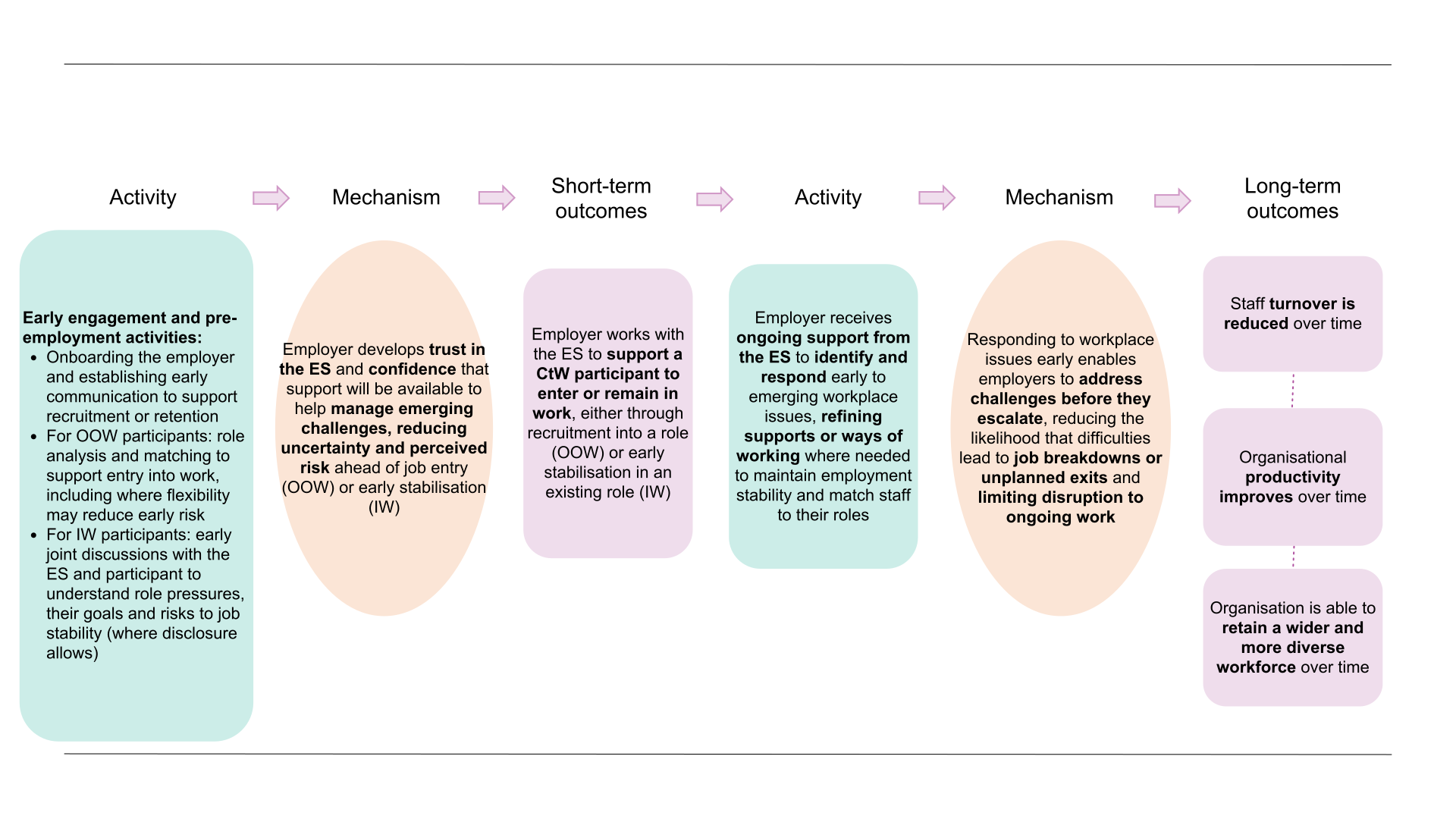
Figure A.8 sets out the contribution claim for supporting employment stability and workforce outcomes for employers. It outlines a series of steps showing how activities are expected to translate into long-term outcomes. These steps include early engagement and pre-employment activities; a mechanism related to employers developing trust in the employment specialist and confidence that support will be available to manage emerging challenges, reducing uncertainty and perceived risk; a short-term outcome of employers working with the employment specialist to support participants to enter or remain in work; activities around ongoing support to identify and respond early to workplace issues and refine support or ways of working; a mechanism related to addressing challenges before they escalate, reducing the likelihood of job breakdowns or unplanned exits and limiting disruption to ongoing work; and long-term outcomes of reduced staff turnover, improved organisational productivity and retention of a wider and more diverse workforce
Claim 6: supporting inclusive recruitment and workplace practices
Connect to Work is expected to contribute to sustained inclusive recruitment and workplace practices among employers by reducing uncertainty and perceived risk associated with recruitment and retention, and by supporting employers to build confidence in applying flexible and inclusive approaches in practice in their workplace, beyond use with individual Connect to Work participants.
Through early engagement and pre‑employment or early retention activity, employers are expected to explore how recruitment or retention could work with Connect to Work support. For OOW participants, this includes role analysis, matching and identifying where flexibility or accommodations may be possible. For IWRS participants, early joint discussions with the employer, participant and employment specialist focus on understanding role pressures, their goals and potential support options to reduce the risk of sickness absence, involuntary job exit or employer-led job loss.
At this stage, employers are expected to develop trust in the employment specialist(s) and gain confidence that inclusive recruitment or retention can work in practice with support, reducing uncertainty and perceived risk. This is expected to enable employers to work with the employment specialist to support a Connect to Work participant to enter or remain in work, either through recruitment into a role or early stabilisation within an existing role.
Where entry or early stabilisation is achieved, employers are expected to continue to receive ongoing support from the employment specialist to implement and review inclusive workplace practices and agreed supports, using early experience to refine supports and ways of working where needed. As employers gain experience of applying inclusive workplace practices in practice, these approaches are expected to become more familiar and manageable. Over time, confidence to apply similar approaches again is expected to grow, and flexibility and early problem‑solving are increasingly treated as part of normal practice rather than as exceptions. This learning may extend beyond individual Connect to Work cases, influencing how employers approach recruitment, retention and workforce management more broadly.
In the longer term, where inclusive recruitment and workplace practices are applied repeatedly and sustained, these approaches may become embedded as part of normal organisational practice. This can support more consistent use of inclusive approaches, enabling employers to access and retain a wider and more diverse talent pool over time and strengthen organisational reputation as an inclusive employer.
Figure A.9 below sets out the Contribution Claim for the outcome on inclusive recruitment and workplace practices.
Figure A.9: contribution claim for inclusive recruitment and workplace practices
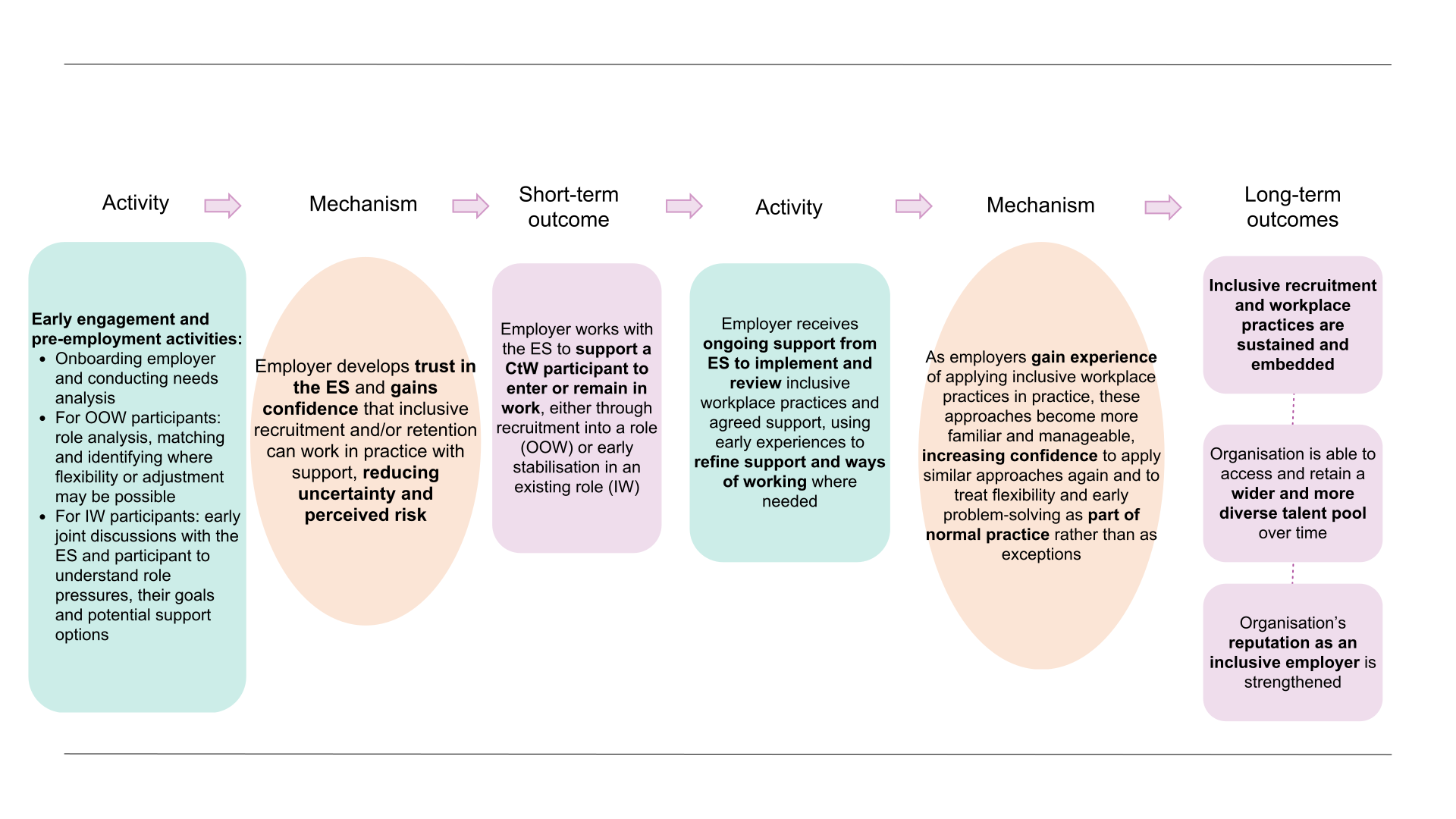
Figure A.9 sets out the contribution claim for supporting inclusive recruitment and workplace practices among employers. It outlines a series of steps showing how activities are expected to translate into long-term outcomes. These steps include early engagement and pre-employment activities; a mechanism related to employers developing trust in the employment specialist and confidence that inclusive recruitment and retention can work in practice with support, reducing uncertainty and perceived risk; a short-term outcome of employers working with the employment specialist to support participants to enter or remain in work; activities around ongoing support to implement and review inclusive workplace practices and refine support and ways of working; a mechanism related to employers gaining experience and confidence in applying inclusive approaches, with flexibility and early problem-solving becoming part of normal practice; and long-term outcomes of sustained and embedded inclusive recruitment and workplace practices, access to and retention of a wider and more diverse talent pool, and a strengthened reputation as an inclusive employer.
A.3. Service integration and sustainment ToC and contribution claims
This section focuses on how Connect to Work operates at programme and the local system level to support consistent delivery, effective integration, and longer term sustainability. Rather than looking at individual participant or employer experiences, this section considers the wider arrangements that shape how Connect to Work functions in practice across areas and over time.
The section brings together a system-level ToC, focused on service integration and sustainment, and contribution claims that describe how Connect to Work is expected to support:
- effective joint working with local health and wider support services
- the longer term sustainability of supported employment capability beyond individual roles, providers or programme cycles
A.3.1. Service integration and sustainment ToC model
The service integration and sustainment ToC sets out how Connect to Work is expected to work within local systems over time, and the conditions needed for delivery to be effective and sustained. Unlike the participant and employer focused ToCs, this model does not describe a journey. Instead, it brings together 3 linked functions that operate alongside one another to support delivery.
These functions describe how Connect to Work:
- maintains delivery quality and fidelity across different providers and local areas
- works alongside local health, social care and wider support services
- supports the development and embedding of supported employment capability to enable continuity over time
Together, these functions describe the system‑level conditions that help ensure employer outcomes, such as clearer routes into support, more consistent advice, and greater confidence in managing workplace issues, can be delivered consistently and sustained over time. The service integration and sustainment ToC model (Figure A.10) and its accompanying narrative are set out below.
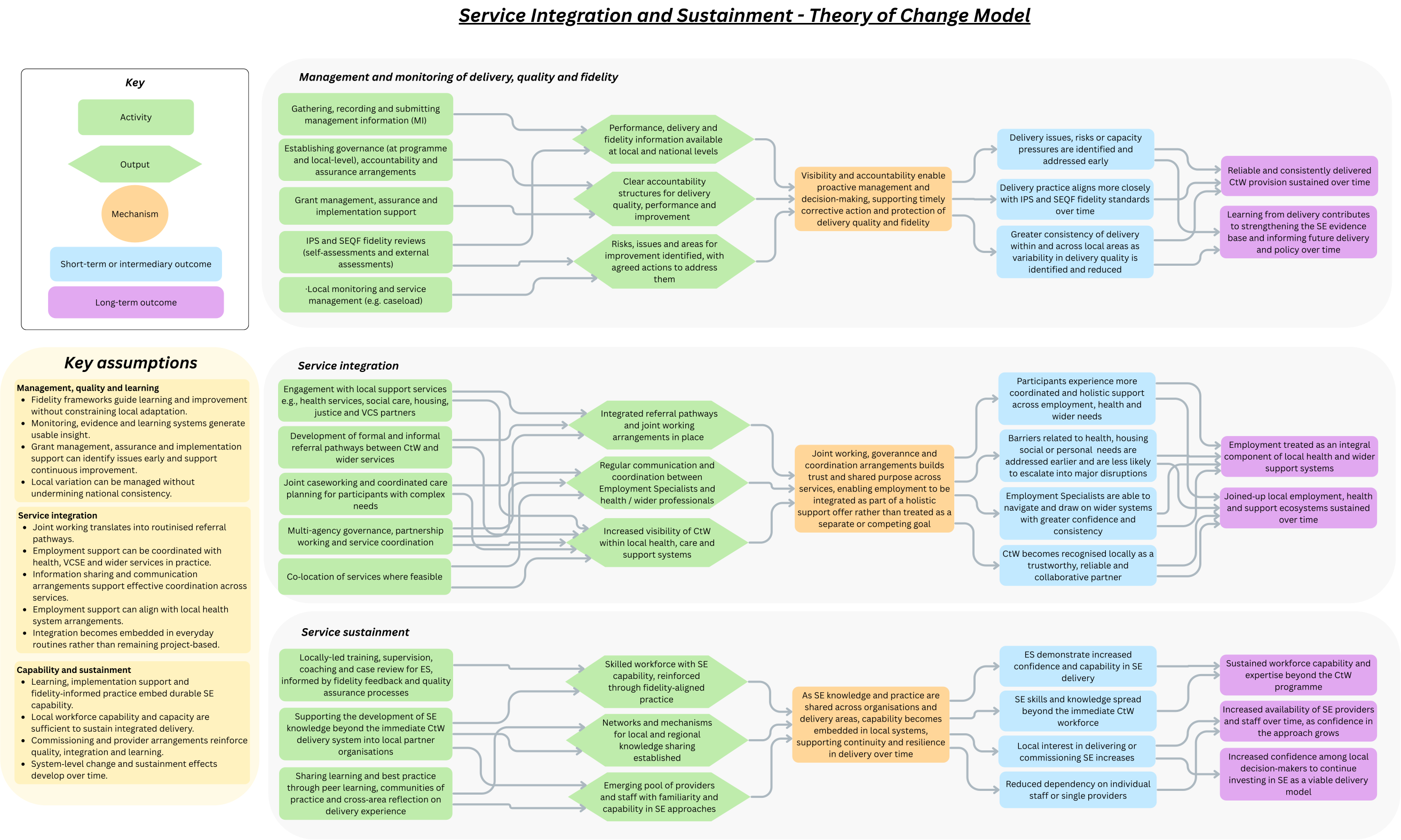
Figure A.10 shows the service integration and sustainment systems-level Connect to Work Theory of Change model. It presents a series of activities, outputs, mechanisms, short-term or intermediary outcomes and long-term outcomes, and how they interrelate. The diagram is organised into 3 sections: management and monitoring of delivery, quality and fidelity; service integration; and service sustainment. The first section outlines how monitoring, governance, implementation support and fidelity reviews are expected to support more consistent delivery and generate learning to inform future delivery and policy. The second section shows how referral pathways, joint working and coordination with health and wider services are expected to support more holistic provision and embed employment support within local systems. The third section outlines how training, supervision and shared learning are expected to build supported employment capability, strengthen local delivery capacity and support continued investment beyond the programme. Each section connects to expected long-term outcomes, alongside the key assumptions underpinning these pathways. The narrative below explains each of these elements and the relationships between them in more detail.
Management and monitoring of delivery, quality and fidelity
This function focuses on how Connect to Work is expected to maintain consistent delivery quality and fidelity across a locally delivered programme. It captures the programme‑level and local arrangements that are designed to enable delivery performance to be monitored, understood and actively managed over time.
Key activities include:
- gathering, recording and submitting MI
- establishing governance, assurance and escalation arrangements, at both the programme level (for example, grant oversight, assurance and escalation arrangements) and the local-level (for example, local governance, partnership management and coordination arrangements to support delivery and integration with health and wider services)
- ongoing grant management, assurance and implementation support from DWP and delivery partners, including regular review meetings, one-to-one implementation support (for example, through regional engagement leads), challenge and support processes, and performance monitoring
- IPS and SEQF fidelity reviews and associated feedback
- local service management, including issue identification and responsive action
Programme level governance and oversight support visibility, assurance and performance management across Connect to Work, while local governance and partnership arrangements provide the structures through which delivery partners, health services and wider stakeholders coordinate activity, address barriers and support integration in practice.
Through these activities, information about delivery performance, variation and risk is expected to be made visible. Regular review meetings, one-to-one implementation support, grant management arrangements and assurance processes provide opportunities to identify emerging issues, understand their causes and agree corrective actions. These ongoing support and challenge mechanisms help keep delivery on track, enabling emerging risks, delivery issues or capacity pressures to be identified early and addressed before they escalate or undermine delivery quality. Learning generated through grant management, fidelity reviews and implementation support may also be shared through wider peer-learning mechanisms and communities of practice, supporting continuous improvement across delivery areas.
The core mechanism within this function is that visibility, accountability, support and challenge should enable proactive management and decision‑making, supporting timely corrective action and the protection of delivery quality and fidelity. Where this works well, delivery practice is expected to align more closely with IPS and SEQF standards, unwarranted variation across and within local areas is reduced, and Connect to Work is delivered more consistently and reliably. Over time, this is expected to contribute to reliable and consistently delivered Connect to Work provision and to strengthening the supported employment evidence base by generating learning about what works in practice at scale.
Service integration
This function focuses on how Connect to Work is expected to integrate employment support with local health, social care and wider support services in practice. It reflects the recognition that employment outcomes are more likely to be achieved and sustained when employment is coordinated with support to address health, housing, financial and/or social needs where relevant.
Key activities include:
- engagement with local health services, social care, housing, justice and VCSE partners
- development of formal and informal referral pathways
- joint case-working for participants with more complex or intersecting needs
- local partnership governance, strategic coordination and joint planning across employment, health and wider support services
- co‑location of services where feasible
These activities are expected to support ongoing joint working between employment specialists and staff from partner organisations. Regular communication, shared problem‑solving and mutual understanding are expected to develop over time, moving beyond simple referral arrangements. Governance and coordination arrangements provide the structures through which joint working can be sustained, priorities aligned and barriers to integration addressed over time. Joint working can build trust and shared purpose across services, enabling employment to be treated as an integral part of holistic support rather than as a separate or competing goal. As a result, employment specialists may be better able to navigate and draw on wider systems and partner services may increasingly recognise Connect to Work as a reliable and collaborative partner.
Where this function operates effectively, participants are expected to experience more coordinated support across employment, health and wider needs, and barriers that could disrupt progress in work are expected to be addressed earlier and more constructively. This would allow employers to benefit from the knowledge of employment specialists who are better able to draw on wider services to address barriers for their employees (such as health, housing, financial stress or other instabilities). This could reduce workplace disruption, make retention support more effective, and give employers greater confidence that support sits beyond the workplace alone.
Over time, this is expected to contribute to longer‑term outcomes in which employment is routinely valued as part of local support ecosystems and joined‑up ways of working are sustained beyond individual cases.
Service sustainment
The third function focuses on how supported employment capability can be embedded within local systems so that delivery can continue effectively over time. This function recognises that sustainment depends not only on funding or programme structures, but on the development and diffusion of skills, knowledge and confidence across people, organisations and places.
Key activities include:
- locally led training (led by ABs or local authorities), supervision, coaching and case review for employment specialists, informed by fidelity feedback and quality assurance processes
- supporting the development and spread of supported employment knowledge and understanding beyond the immediate Connect to Work delivery system into local partner organisations
- sharing learning and best practice across delivery areas through peer learning, communities of practice and cross‑area reflection on delivery experience
These activities are expected to generate outputs such as a skilled workforce with supported employment capability reinforced through fidelity‑aligned practice, networks and mechanisms for local and regional knowledge sharing, and a wider range of organisations and practitioners with familiarity and foundational capability in supported employment approaches. Supported employment knowledge and practice are expected to be shared across organisations and delivery areas, and capability is expected to become embedded in local systems, supporting continuity and resilience in delivery over time.
Where this function works well, employment specialists are expected to demonstrate increased confidence and capability in delivery, and supported employment skills and knowledge are expected to spread beyond the immediate Connect to Work workforce. Over the longer term, this is expected to contribute to increased confidence among local decision‑makers to continue investing in supported employment as a viable delivery model, and to increased availability of providers and practitioners with supported employment capability as confidence in the approach grows.
A.3.2. Assumptions and risks underpinning the service integration and sustainment ToC
The service integration and sustainment ToC rests on a set of assumptions about how Connect to Work operates within wider delivery, partnership and commissioning systems, and the conditions under which integration and sustainment are expected to develop over time. As with the other ToCs, if these assumptions do not hold, there are risks to the effectiveness of the system‑level mechanisms described above and to the plausibility of the associated contribution claims.
Service integration and referral into Connect to Work
The ToC assumes that joint working between employment services, health services, VCSE organisations and community partners results in functional and routinised access or signposting pathways into Connect to Work. Collaboration is expected to move beyond informal relationships or single gateways, enabling consistent identification and referral of people who are appropriate for supported employment across local areas.
If joint working does not translate into routinised practice, referral pathways may remain informal or person‑dependent. This risks continued over‑reliance on a narrow set of referral routes, limits reach into the intended population and weakens the plausibility of participant‑level impact.
Coordination with health, VCSE and wider support services
A core assumption of this ToC is that Connect to Work delivery can be effectively coordinated with health, VCSE and wider community services once participants are engaged. This includes joint working, shared problem‑solving and, where feasible, co‑location, allowing employment support to operate alongside wider support for people with complex or intersecting needs.
Where coordination remains ad hoc or dependent on individual relationships, support may become fragmented. This can slow or limit responses to non‑employment barriers and reduce the effectiveness of employment‑first approaches, making participant progress more fragile.
Information sharing and data sharing for integration
The ToC assumes that information sharing, data sharing and communication arrangements enable Connect to Work delivery partners and wider services to coordinate support effectively while meeting relevant legal, ethical and governance requirements. Appropriate information flows are expected to support timely signposting and referral activity, joint working, case coordination and shared understanding of participant needs where relevant.
Where information cannot be shared appropriately, systems are poorly connected, or communication between services is inconsistent, support may become fragmented. This may slow coordination, increase reliance on informal relationships, reduce opportunities for integrated support and weaken the effectiveness of service integration.
Alignment with local health system arrangements
The ToC assumes that employment support can be practically aligned with local health system arrangements, including service footprints and governance structures, to support timely access to health related interventions and smoother coordination between employment and health services.
Misalignment between AB boundaries and health system geographies creates risks of delays, unclear responsibilities and uneven access to health support, particularly for participants with more complex or ongoing health needs.
Local capability, workforce capacity and delivery conditions
The system‑level ToC assumes that local areas can recruit, retain and manage a skilled supported employment workforce, and that staff and managers have sufficient capacity to engage in integration activities alongside core delivery, including relationship‑building, joint case‑working and reflective practice.
Workforce shortages, high turnover, mixed caseloads or limited management capacity risk deprioritising integration and learning activity. This can undermine fidelity, consistency and the longer‑term sustainment of supported employment practice.
Fidelity, quality and learning alongside local adaptation
The ToC assumes that fidelity to IPS and SEQF can be maintained alongside local adaptation in delivery arrangements. Fidelity frameworks are expected to support learning and continuous improvement, rather than operating primarily as compliance tools, enabling shared understanding of effective practice while allowing for local context.
Delivery pressures, commissioning choices or local preferences may lead to drift from intended models over time. Where this occurs, effectiveness may be reduced, comparability weakened and confidence in supported employment as a reliable delivery approach undermined.
Delivery support, assurance and improvement capability
The ToC assumes that those responsible for grant management, assurance and implementation support have the capability, capacity and contextual understanding required to identify delivery issues early and provide effective, tailored support to improve delivery quality and performance. Ongoing review meetings, implementation support, assurance processes and fidelity feedback are expected to support continuous improvement by helping local areas understand challenges, identify solutions and implement corrective action where needed.
Where support is insufficiently tailored, timely or responsive to local circumstances, opportunities to address emerging delivery challenges and improve delivery quality may be missed. This may reduce the effectiveness of performance management, fidelity improvement and continuous learning processes.
Embedding integration and practice over time
This ToC assumes that integrated ways of working become embedded within organisational routines, governance and partnership arrangements, and professional practice over time, rather than remaining dependent on individual relationships, specific projects or Connect to Work funding. Repeated joint working, shared problem-solving, multi-agency governance and coordination arrangements, and the visibility of supported employment delivery are expected to support employment becoming recognised as a routine component of holistic support across local systems. Over time, this may shape organisational routines, professional expectations and everyday decision-making across a range of services.
If integration remains project‑based, time‑limited or reliant on individual relationships, there is a risk that integrated practices unravel when key staff leave or programme funding ends, limiting longer‑term system change.
Commissioning, provider arrangements and sustainment
The ToC assumes that commissioning and provider arrangements reinforce integration, quality and learning, including the selection and retention of organisations with appropriate supported employment capability and willingness to engage in partnership working. Sustained commissioning and investment are expected to follow from demonstrated quality, credibility and system confidence.
Where commissioning decisions prioritise scale, cost or speed over supported employment capability and integration, there is a risk that quality is diluted, integration weakened, and long‑term sustainability reduced.
Learning, evidence and time required for system change
Finally, the ToC assumes that monitoring, fidelity review and learning systems generate usable insight to inform continuous improvement and future service design, including across both out‑of‑work and in‑work pathways. It also assumes that integration and sustainment effects develop over time rather than immediately.
Evidence gaps, weak feedback loops or evaluation timelines focused mainly on early implementation signals risk under‑recognising longer‑term system change and may undermine sustainment before it has fully developed.
A.3.3. Service integration and sustainment contribution claims
The service integration and sustainment contribution claims sit beneath the system‑level ToC set out above and explore specific causal pathways in more detail. This sub-section sets out 2 draft system‑level contribution claims, which together reflect how Connect to Work is expected to operate within and be sustained through local systems over time:
- integrating supported employment into wider local services
- sustaining supported employment delivery over time
Each claim is presented as a short narrative explaining the logic of the pathway, alongside a diagram that sets out the full sequence of activities, mechanisms and outcomes. As with the participant and employer‑level claims, these are treated as working hypotheses that will be tested and refined over the course of the evaluation as evidence is gathered.
Claim 7: integrating supported employment with wider services
Connect to Work is expected to contribute to the integration of supported employment within local health and wider support systems by enabling practical joint‑working arrangements between employment support and other wider services. Integration is not assumed to result from referral pathways or agreements alone, but from repeated collaboration that shapes how services work together in practice.
Through coordinated delivery, employment specialists are expected to work alongside local health, social care, housing, justice and VCSE services. This includes the use of formal and informal referral pathways, joint case‑working for participants with more complex or intersecting needs, multi-agency governance and coordination arrangements, and co‑location or close working arrangements where feasible. These arrangements are expected to support regular contact and shared problem‑solving, enabling more coordinated responses to participants’ employment, health and practical needs and reducing fragmentation between services.
Over time, repeated integrated working, supported by governance and coordination arrangements, is expected to strengthen relationships and build trust and develop shared understanding across services. Employment is increasingly expected to be understood and acted on as a core component of holistic support rather than a separate or competing intervention, with expectations, routines and everyday decision‑making beginning to shift. In the longer term, this is expected to support employment support becoming embedded as a routine and expected component of local health and wider support systems, reflected most clearly in everyday delivery practice.
Figure A.11 below sets out the contribution claim for the outcome on integrating supported employment into wider services.
Figure A.11: contribution claim for integrating supported employment into wider services
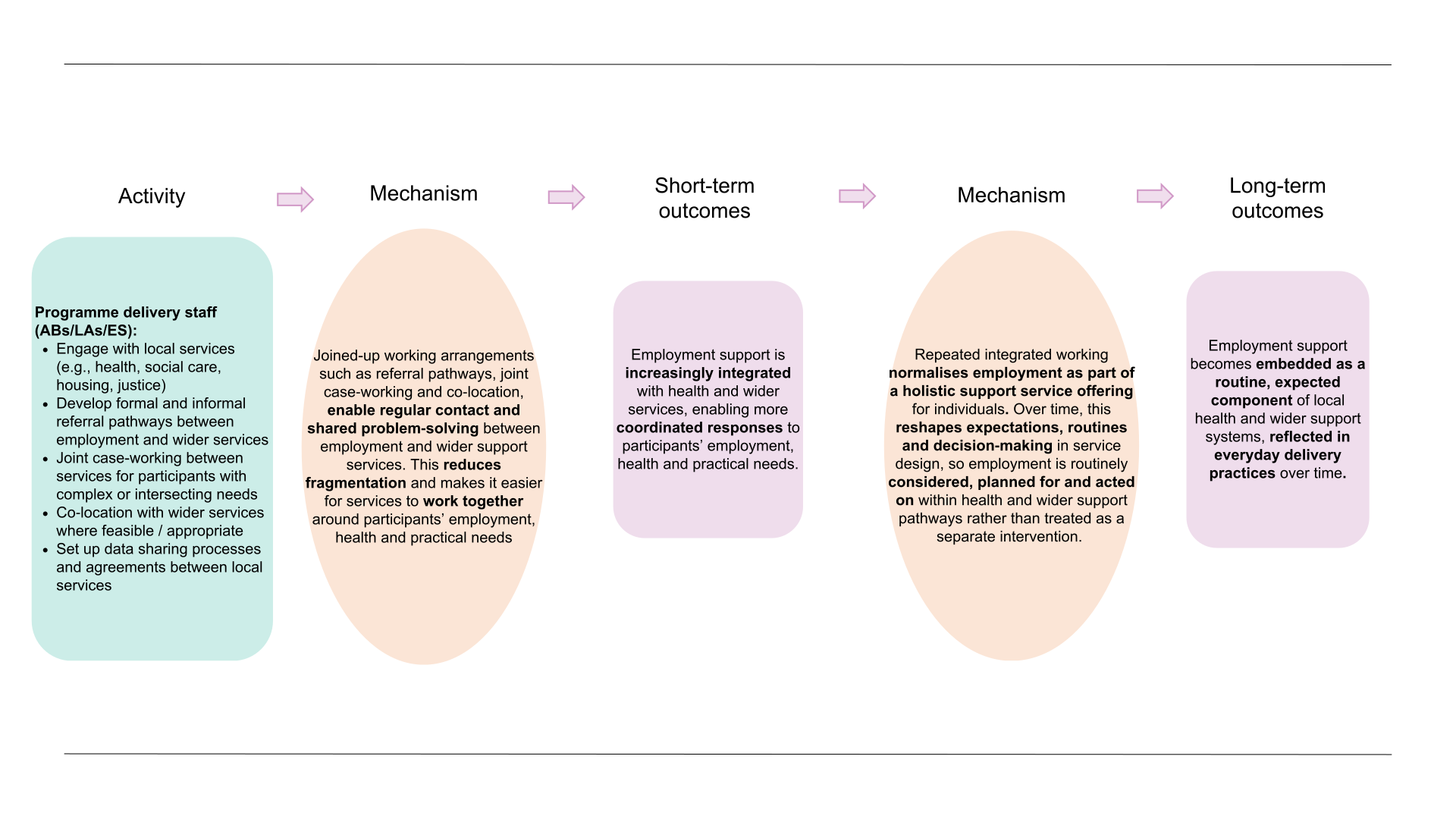
Figure A.11 sets out the contribution claim for integrating supported employment with wider services. It outlines a series of steps showing how activities are expected to translate into long-term outcomes. These steps include programme delivery activities, including engagement with local services, development of referral pathways, joint case-working, co-location where feasible and appropriate, and establishment of data-sharing arrangements; a mechanism related to joined-up working enabling regular contact and shared problem-solving, reducing fragmentation and making it easier for services to work together around participants’ needs; a short-term outcome of employment support becoming increasingly integrated with health and wider services, enabling more coordinated responses to participants’ employment, health and practical needs; a mechanism related to repeated integrated working normalising employment as part of holistic support and reshaping expectations, routines and decision-making; and a long-term outcome of employment support becoming embedded as a routine, expected component of local health and wider support systems, reflected in everyday delivery practices over time.
Claim 8: sustaining supported employment delivery
Connect to Work is expected to contribute to the long‑term sustainability of supported employment delivery by supporting the development and embedding of supported employment capability within local systems. Sustainable delivery is understood to depend on shared knowledge, confidence and credibility, rather than on programme structures alone.
Locally led training, supervision, coaching and case review are expected to support employment specialists to reflect on practice and apply learning in context, informed by fidelity feedback and quality assurance processes. Structured sharing of learning across delivery areas and partners, including communities of practice, peer learning, and implementation support for delivery organisations (such as supported employment implementation specialist and regional engagement lead support) together with fidelity review feedback and service‑level action planning, is expected to enable learning to be shared, reinforced and applied across teams and organisations.
Through these activities, supported employment capability is expected to be strengthened in practice, reflected in more consistent and higher‑quality delivery, greater practitioner confidence, and clearer alignment with recognised standards. As this capability is demonstrated over time, trust and confidence are expected to be built among partners and local decision‑makers, creating the conditions for supported employment delivery to be sustained beyond Connect to Work.
In the longer term, supported employment delivery is expected to be sustained locally beyond Connect to Work, underpinned by established workforce capability and increased confidence among local decision‑makers to continue commissioning and investment, with a provider landscape able to continue and adapt supported employment practice over time.
Figure A.12 below sets out the Contribution Claim for the outcome on creating a sustainable Supported employment programme.
Figure A.12: contribution claim for creating a sustainable supported employment programme
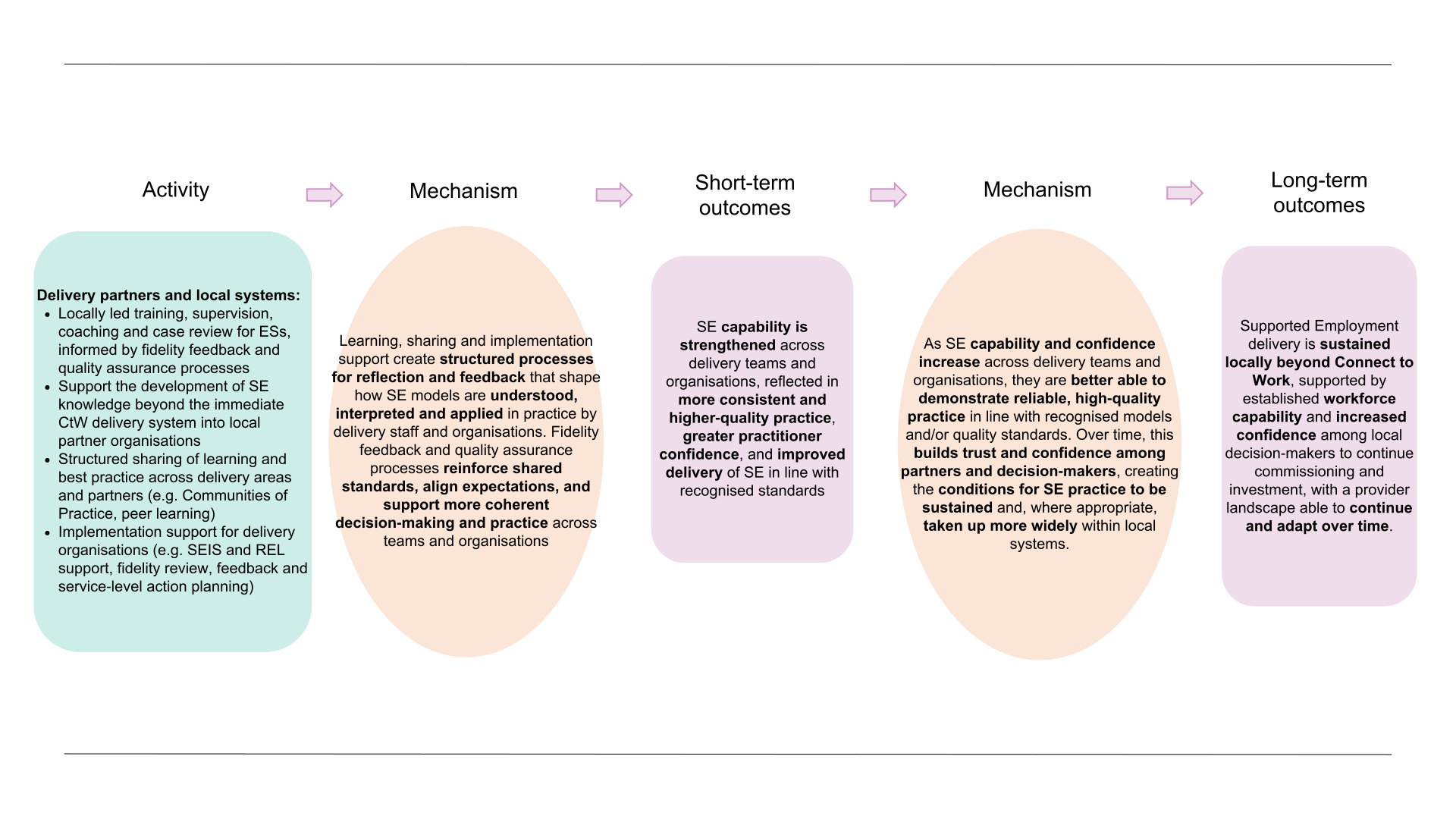
Figure A.12 sets out the contribution claim for sustaining supported employment delivery within local systems. It outlines a series of steps showing how activities are expected to translate into long-term outcomes. These steps include activities around locally led training, supervision, coaching and case review, supported employment knowledge within local partner organisations, sharing learning and best practice, and providing implementation support; a mechanism related to structured reflection and feedback shaping how supported employment models are understood and applied, reinforcing shared standards, aligning expectations and supporting more coherent decision-making and practice; short-term outcomes of strengthened supported employment capability, more consistent and higher-quality practice, greater practitioner confidence and improved delivery in line with recognised standards; a mechanism related to increased capability and confidence enabling reliable, high-quality practice, building trust among partners and decision-makers and creating conditions for practice to be sustained and, where appropriate, taken up more widely; and a long-term outcome of supported employment delivery being sustained locally beyond Connect to Work, supported by established workforce capability, continued commissioning and investment, and providers able to continue and adapt over time.