Strengthening protections against combined discrimination
Published 29 October 2026

© Crown copyright 2026
This publication is licensed under the terms of the Open Government Licence v3.0 except where otherwise stated. To view this licence, visit nationalarchives.gov.uk/doc/open-government-licence/version/3 or write to the Information Policy Team, The National Archives, Kew, London TW9 4DU, or email: psi@nationalarchives.gov.uk.
Where we have identified any third party copyright information you will need to obtain permission from the copyright holders concerned.
This publication is available at https://www.gov.uk/government/publications/combined-discrimination-research-into-prevalence-and-experiences/strengthening-protections-against-combined-discrimination
1. Executive summary
This research explores the prevalence and experiences of combined discrimination, or discrimination experienced based on a combination of grounds that interact with each other in a way that produces distinct and specific discrimination.
Section 14 of the Equality Act 2010 is a legal provision for bringing a claim of direct combined discrimination, on the basis of a combination of 2 protected characteristics. However, it has not been commenced, which means that it cannot be used. Instead, individuals experiencing combined discrimination need to find other ways to bring forward legal claims. These can include choosing a single protected characteristic for which to take a case forward, taking multiple single characteristic claims forward for one or more acts of discrimination, or choosing an alternative legal route such as the Public Sector Equality Duty (PSED). The government is concerned that the current legislative framework does not provide adequate protection for people who experience discrimination based on a combination of grounds, and has therefore committed to strengthening protections against combined discrimination.
This research aims to provide a deeper understanding of instances and experiences of combined discrimination, and of seeking redress in the current context. It also considers challenges and opportunities around commencing section 14 of the Equality Act 2010, alongside consideration of the practicalities. However, this research does not make policy recommendations.
This research suggests that between 12% and 16% of discrimination claims and complaints feature more than one protected characteristic, and that between 2% and 6% feature combined discrimination where the different protected characteristics interact with each other to produce distinct discrimination. While direct discrimination remains the most common, cases of harassment and indirect discrimination are also prevalent.
Combined discrimination can already give rise to liability under the Equality Act 2010’s direct discrimination provision, because it is not necessary for any one protected characteristic to have been the sole or primary cause of discriminatory conduct: it only needs to have been an effective cause (a significant influence or non-trivial cause). This allows for multiple protected characteristics to have been the cause of an unlawful act of discrimination without one characteristic undermining another.
Claimants who experience combined discrimination however, are typically advised to lead with their strongest claim and take forward a case on the basis of a single characteristic.[footnote 1] Some claimants feel able to highlight the interaction of other protected characteristics through the narrative of their claim under this approach, providing some intersectional appreciation, noting however that some support organisations advise against introducing this complexity. In addition, many claimants are actively trying to reflect the intersectional experience of discrimination in legal terms through other means, such as by bringing multiple claims involving multiple protected characteristics or by choosing an alternative legal route, such as the Public Sector Equality Duty (PSED) or a claim under human rights law.
Lived experience accounts underscore the emotional and psychological toll of experiencing and challenging combined discrimination. People with lived experience of combined discrimination report often struggling to identify which part of their identity caused the unfair treatment. This ambiguity leads to self-doubt and fear of not being believed. Challenges to seeking redress include difficulties linking lived experiences of discrimination to legal grounds, procedural and evidentiary challenges, particularly without legal representation, and broader difficulties in navigating the process, including fear of retaliation, lack of accessible support, cost, and discouragement from employers or peers.These challenges can be particularly acute for those with intersecting vulnerabilities such as insecure immigration status, caring responsibilities, or socioeconomic disadvantage.
While many of these challenges, particularly regarding navigating the grievance and internal processes, would be faced in any discrimination case, the difficulty of linking experiences to legal grounds and evidencing these grounds may be exacerbated in cases of combined discrimination.
Commencing section 14 could potentially provide a clearer legal route for addressing direct combined discrimination on the basis of 2 protected characteristics, in a way which better reflects the lived experience of claimants and strengthens their ability to evidence their claims. Its scope remains narrow, however, excluding indirect discrimination and harassment, and claims based on more than 2 protected characteristics, which this research has identified as prevalent. If section 14 were to be commenced in its current form, it is possible that some claimants with a stronger indirect discrimination or harassment claim may choose to focus on a claim of direct discrimination to more accurately reflect their intersectional experience. This would bring a weaker claim overall.
Section 14 could also bring potential risks of added complexity and procedural challenges, for example with claimants bringing both combined and single-ground claims, facing conflicting legal tests for different protected characteristics within one combined claim, and challenges with finding appropriate comparators. If it were to be commenced, it must be supported by robust efforts to provide clear guidance for all relevant parties, to mitigate some of the risks identified. Commencing section 14 alone is unlikely to resolve the deeper structural and procedural barriers identified throughout this research. Without sufficient support, awareness, and cultural change, claimants may continue to struggle to achieve redress, regardless of legislative changes.
2. Introduction
This research would not have been possible without the support from over 25 support organisations. The research team would like to express their gratitude to all of the organisations who contributed by sharing their views, sharing data and case studies where available and supporting with recruitment for lived experience research across their networks. With particular thanks to the following organisations for their valuable research and contributions which have been instrumental in shaping our findings:
- Advisory, Conciliation and Arbitration Service (Acas)
- Chartered Management Institute (CMI)
- Coram’s Children Charity
- Employment Lawyer Association
- Equality Advisory and Support Service (EASS)
- Leigh Day
- Race Equality Foundation
- Unison Union
- West of England Centre for Inclusive Living
See the appendix for the full list of organisations who have supported this research.
2.1 Context
2.1.1 Combined discrimination
This research understands combined or intersectional discrimination to mean:
“Combined or intersectional discrimination takes place when discrimination occurs based on a combination of grounds that interact with each other in a way that produces distinct and specific discrimination.”[footnote 2]
For example, combined discrimination takes place when an individual is discriminated against for being an older woman, rather than for her age or her sex alone.
This is different from:
- additive multiple discrimination, where discrimination occurs on multiple grounds on the same occasion, but each of the grounds can be identified independently
- sequential multiple discrimination, where discrimination occurs on multiple grounds on separate, successive occasions
See the appendix for further definitions.
2.1.2 Current legislative protections against combined discrimination
Section 14 of the Equality Act 2010 is a legal provision for bringing a claim of direct combined discrimination. However, it has not been commenced, which means that it cannot be used.
Combined discrimination can already give rise to liability under the Equality Act 2010’s direct discrimination provision, because any one protected characteristic does not need to have been the sole or primary cause of discriminatory conduct for that conduct to be unlawful. The protected characteristic only needs to have been a significant influence or non-trivial cause of the conduct. This allows for multiple characteristics to have been causal, including in combination. As such, individuals experiencing combined discrimination can bring one or several claims of discrimination based on individual grounds.[footnote 3]
The government is concerned that the current legislative framework does not provide adequate protection for people who experience discrimination based on a combination of grounds. It has committed to strengthening protections against combined discrimination and is exploring commencing section 14 as a means to address this. Section 14 would provide protection against direct discrimination on the basis of 2 of the following protected characteristics:
- age
- disability
- gender reassignment
- race
- religion or belief
- sex
- sexual orientation
This research aims to provide a deeper understanding of instances and experiences of combined discrimination, and of seeking redress, in the current context. It also highlights challenges and opportunities around commencing section 14 of the Equality Act 2010, and consideration of the practicalities. However, this research does not make policy recommendations.
2.2 Research questions
This paper seeks to answer the following questions:
-
What is the prevalence of discrimination complaints or claims made on the basis of more than one protected characteristic?
-
What are barriers in seeking redress in instances of combined discrimination, and what is the experience of seeking this redress?
-
What is the experience of employers and service providers in responding to claims and preventing future claims?
-
What is the experience of support organisations in addressing instances of combined discrimination or supporting those seeking legal redress?
-
In what ways have claims been taken forward?
From this, it also wants to find out:
- What conclusions can be taken from the outcomes of such claims?
- Would the commencement of section 14 have allowed more of these claims to be made, or made the claims taken forward in other ways easier?
- How could any adverse consequences in the commencement of section 14, if identified, be mitigated?
2.3 What socio-legal and lived experience research can tell you
To answer these questions, researchers have brought together socio-legal and lived experience research. This combines a broad exploration of the impact of the law in its current context with deep insights on the lived experience of individuals.
The following table sets out how each research method is used to answer the questions.
| Research question | Socio-legal research | Lived experience research |
| 1. Prevalence | Statistical assessment of prevalence and patterns of multiple discrimination and potential combined discrimination cases[footnote 4] | Validation of trends based on insights from interviews with support organisations |
| 2. Barriers and experiences | Identification of barriers through case analysis | Real-life insights from interviews with people with lived experience |
| 3. Experience of employers and service providers | Not applicable | Real-life insights from interviews with employers and service providers |
| 4. Experience of support organisations | Not applicable | Real-life insights from interviews with support organisations |
| 5. How claims are taken forward | Assessment of how claims have been taken forward through case analysis | Insights into the existing process and interviewees’ thoughts on the challenges and opportunities around commencing section 14. |
2.4 Methodology
This research took place between March and June 2025 by The PSC, on behalf of the Office for Equality and Opportunity in the Cabinet Office.
2.4.1 Socio-legal research
Algorithmic classification of 4,311 legal cases from the 3 years between 4 March 2022 and 4 March 2025 available through the British and Irish Legal Information Institute (BAILII) with mention of “discrimination” or “protected characteristic” to identify the prevalence of multiple discrimination. Details on inclusion and exclusion criteria are set out in appendix 9.1. Automated text analysis was used to identify the protected characteristics and type of discrimination (whether direct, indirect, harassment, or victimisation) involved in each case, with manual verification of the algorithm’s accuracy.
This algorithmic classification of BAILII was supported by forum analysis including classification of 175 posts from Reddit’s LegalAdviceUK subforum and 51 posts from Mumsnet’s Legal Matters subforum from the 3 years between 4 March 2022 and 4 March 2025. These forums were chosen because they have specific UK legal advice subforums, and because together they provided a diverse range of users across age and gender.
This classification was also supported by data provided by the Chartered Management Institute and EASS. Judgement was then used on a smaller sample of cases featuring multiple discrimination to identify the proportion of these cases which featured combined discrimination. See appendix 9.1 for more detail.
Systematic analysis of 60 case studies of combined discrimination, across formal legal claims and informal complaints or reports. These were selected to ensure diversity across different sectors, types of discrimination (direct, indirect, harassment, and victimisation), protected characteristics and geographies. They include published legal case studies from the legal database BAILII, published ombudsman complaints, informal complaints or reports provided as anonymous case studies by partner organisations, and anonymised forum posts. This mix ensured that the research was not unduly biased towards individuals who have successfully brought a claim, but also considered upstream barriers in the experience of discrimination.
As there is no current way to bring a combined discrimination case, these case studies were identified and selected based on researchers’ judgement that the description of the experience of the claimant or complainant, in the legal claim or informal report, featured discrimination on the basis of 2 or more grounds which interacted with each other to produce the experience of discrimination, as per the definition used in this research. See appendix 9.2 for more detail.
Where case study analysis is used in this report to evidence a point, the case study is referred to as [F##] for formal case studies, and [IF##] for informal case studies.
2.4.2 Lived experience research
This research included interviews with 3 categories of people:
- individuals with lived experience of combined discrimination
- employers, service providers, and other potential respondents to combined discrimination claims
- individuals who support those who have experienced discrimination across various touchpoints – this includes helpline advisors, lawyers, conciliators, and charities who work with specific groups of people
To ensure the research reached a wide and diverse range of people, recruitment took place by:
- working with over 25 partner organisations to make use of their networks – see appendix 9.4 for a list of organisations involved in this work
- “snow-ball” recruitment, which involved asking every individual involved in the research to pass on communications to their networks, whether professional, or friends and family
All potential interviewees were invited to complete a brief questionnaire to understand their eligibility for the research, summarising their experiences. They were asked for their accessibility requirements and invited to a structured interview with a researcher. Interviews lasted 60 minutes, and were transcribed. Transcripts were analysed phenomenologically[footnote 5] and thematically.
Eligibility for the research was considered differently for the 3 categories of participants. For the first, potential interviewees who indicated that they had experienced discrimination on the basis of more than one protected characteristic were considered eligible to take part in the interviews. After interviews, researchers then made a judgement about whether the experience described by the interviewee could be considered combined discrimination (as opposed to clearly sequential discrimination, for example). Researchers took an inclusive approach, including all interviews in which interviewees felt an intersection of their protected characteristics had played a role in their experience. For the second and third categories, eligibility was assessed based on the participant’s employer and role.
To ensure appropriate data protection, transcripts were anonymised to prevent any direct or indirect identification, and no personal identifiable information was shared outside the immediate research team. All identifiable information on research participants will be deleted after the end of the research project. Interviewees were asked to sign consent forms to take part in the research.
Researchers conducted 47 interviews:
17 were with people with lived experience of discrimination on the basis of more than one protected characteristic including combined discrimination. These were to understand:
- their experiences of discrimination
- the actions taken by people in response to their experience, both internally and externally to their organisation
- the barriers to or challenges of seeking legal redress
16 interviews were with employers and service providers. These were to understand:
- views and understanding of combined discrimination
- the mitigations in place to prevent discrimination
- the process for responding to claims
- challenges in the existing legal process
- their view on how things might change if section 14 were commenced
14 interviews were with people who support claimants (and claim respondents) navigate the process of seeking legal redress, including lawyers, conciliators, and helpline advisors. These were to understand:
- the nature of claims being seen in recent years, particularly those claims which involve combined discrimination or other types of multiple discrimination
- current approaches to responding to claims that reference more than one protected characteristic
- validation of claimant and respondent findings
Where a lived experience interview is used in this report to evidence a point, the interview is referred to as [LE###].
2.5 Limitations
Both socio-legal research and lived experience research come with limitations.
2.5.1 Limitations of socio-legal research
Uncertainty in prevalence estimates: Estimates of prevalence made in this report rely heavily on algorithmic classification of 4,311 legal cases which reference discrimination in the British and Irish Legal Information Institute (BAILII) database.[footnote 6] This has limitations, both in the choice of BAILII as a database and in the methodology based on keyword classification.
BAILII does not provide full coverage of court and tribunal decisions. It includes only those that have been published, meaning many first-instance and some appeal decisions are not available in the database. As a result, the research sample is skewed towards decisions that have been selected for publication and provided to BAILII – typically those considered legally significant, of public interest, or carrying precedential value.
This methodology relies on keyword classification which is an imperfect way to identify which protected characteristics are relevant to a case. There is therefore a degree of uncertainty in this paper’s estimations of prevalence. Note that manual verification, combined with comparison with other sources of data, mitigate some of this limitation. For detail on how uncertainty was quantified, please see “Algorithmic classification methodology in detail” in the appendix.
Based on this research, it is likely that people experiencing discrimination on the basis of multiple protected characteristics may be advised to, or choose to pursue a claim of discrimination on the basis of only one characteristic in court. This suggests that the estimate of legal cases featuring more than one protected characteristic may underestimate the scale of multiple, and therefore combined, discrimination.
Gaps in information: Legal cases analysed as part of the socio-legal research do not always contain the claimant’s voice and description of their experience. It is therefore not always possible to identify the ways in which a grounds based claim has or has not reflected a person’s lived experience. In some potentially combined cases, claimants may strategically choose to focus on one protected characteristic. In other cases, one or more claims may be struck out early. Potential combined cases in which a second protected characteristic is not recorded in the judgement will therefore not be identifiable from publicly available information.
Sampling: The research looked at public legal cases from a legal database, and anonymised case studies of informal complaints or reports. While the legal database used contains a large number of cases, it does not present all cases, particularly those that do not make it to court. Likewise, the choice of informal case studies reflects to some extent the data available. Lastly, the methodology requires a judgement in assessing whether a case study includes combined discrimination, in a context where there is sometimes incomplete information. This is particularly the case in informal case studies. While this inclusive approach allows the research to consider a broad variety of cases across the grievance process, this limitation should be noted.
2.5.2 Limitations of lived experience research
Subjectivity and bias: As the research asks individuals to recount their personal experiences and views, there is a level of participant bias in which personal memories and accounts can be selective or distorted. There is also a level of judgement required to assess whether the experience constitutes combined discrimination. The interpretation of information shared can be influenced by the researcher’s own background, assumptions, and worldview, resulting in researcher bias. Participant bias is unavoidable with lived experience research, but researchers have included summaries of each experience to provide further context (see appendix, section 5). To mitigate against researcher bias, each interview followed structured discussion guides.
Sample size: The sample size is limited across each stakeholder category, as is often the case in phenomenological research. This research therefore reveals experiences and interpretations of discrimination and of seeking redress, but should not in itself be relied on to assess prevalence or patterns of discrimination and may not be representative of the views and experiences of the wider population.
Sampling: Interviewees were reached through partner organisations, and self-referred to the research through submitting their information through a form. The sample therefore is biased towards individuals who have engaged with support organisations or have sought redress in some way. To mitigate this as much as possible, the research engaged with a wide range of organisations, including those who support vulnerable groups. The research used a “snowball” sampling approach, asking individuals who engage in the research to pass on communications to their networks, to reach as wide a range of people as possible. While this has helped cast a wide net with regards to the recruitment of individuals, it remains the case that the sample may not fully represent the most seldom-heard groups.
Limitations have been included for transparency, but it is the belief of researchers that bringing together the insights from the socio-legal and lived experience research mitigates some of the limitations identified.
3. Prevalence of combined discrimination complaints or claims
3.1 Prevalence of discrimination on the basis of multiple protected characteristics
3.1.1 Estimates from legal database analysis
The following table shows the estimated percentage of the 4,311 legal discrimination cases analysed from the legal database BAILII which involve 2 or more and 3 or more protected characteristics. This estimate is based on keyword analysis.
Uncertainty bounds on these figures are set out in the table. For more detail on how these estimates were arrived at please see “Algorithmic classification methodology in detail” in the appendix. See limitations of this methodology in 2.5.1 Limitations of socio-legal research.
| Estimate | Upper bound (80% confidence) | Lower bound (80% confidence) | |
| Percentage of discrimination cases involving 2 or more protected characteristics | 13.9% | 15.5% | 12.2% |
| Percentage of discrimination cases involving 3 or more protected characteristics | 2.3% | 3.0% | 1.5% |
3.1.2 Estimates from additional sources
The following table shows further indicative evidence regarding the frequency of discrimination involving 2 or more protected characteristics. It sets out the estimated percentage of discrimination reports which involve 2 or more and 3 or more protected characteristics from forum analysis, data provided by the Equality Advisory and Support Service (EASS) and from a survey of employers, conducted by the Chartered Management Institute (CMI) with their networks.
| Estimate from analysis of 218 forum posts | Survey of more than 1,200 employers (CMI) | One year of EASS data | |
| Percentage of discrimination reports involving 2 or more protected characteristics | 11.2% | 27% | 17% |
| Percentage of discrimination reports involving 3 or more protected characteristics | 1.5% | N/A | N/A |
There are several reasons these figures would be expected to differ from one another.
The forum results are likely to capture an individual’s reflections early on in their journey. Lower values may be linked to difficulties in fully understanding or articulating reasons behind an experience of discrimination, which is a challenge identified through the lived experience research. However, this figure carries higher uncertainty as the categorisation was carried out through automation with lower degree of verification, and the sample is likely to not be fully representative as it will be skewed by forum demographics.
The EASS data includes cases where a second protected characteristic was identified without necessarily being connected to the experience, which makes the 17% a likely overestimate. EASS often interacts with an individual early in their journey, as they look to understand their experiences and obtain guidance on next steps. An individual who describes experiencing discrimination on the basis of multiple protected characteristics to EASS may choose to pursue a claim of discrimination on the basis of only one characteristic in court, or not at all. This could explain the lower proportion of legal cases featuring more than one protected characteristic, compared with informal complaints and reports.
The CMI survey results capture the perspectives of managers across CMI’s networks in response to questions about whether they have received discrimination reports, and whether these were on the basis of more than one ground. These managers are likely to have a range of experience of handling discrimination cases and understanding of combined discrimination. This is based on anecdotal cases or their own personal experiences which may or may not have made it to a formal claim, potentially explaining the higher estimate.
Lower sample sizes of these sources should be kept in mind. Weighting all 4 sources based on sample size and variance and applying 80% confidence intervals gives us an estimated 12% to 16% prevalence of discrimination involving 2 or more protected characteristics. Note that, as set out in section 2.5 Limitations, this may be an underestimate as this figure relies strongly on BAILII figures, and claimants experiencing discrimination on the basis of multiple protected characteristics may pursue a claim of discrimination on the basis of only one characteristic in court without mentioning other relevant protected characteristics in their formal claims.
3.1.3 Overall estimates of prevalence of combined discrimination
Not all cases which refer to more than one protected characteristic are instances of combined discrimination. Some could be cases of additive multiple discrimination, for example.
To estimate the likely prevalence of combined discrimination, the research team carried out a manual assessment of 70 cases from the legal database BAILII, randomly selected from the 914 classified as involving multiple protected characteristics. Researchers assessed 20% of those to be instances of combined discrimination, a further 57% as uncertain due to insufficient information, and 23% to not be instances of combined discrimination. This large number of uncertain cases is likely due to the fact that intersectionality is not currently relevant to the legal proceedings and is therefore less likely to be discussed and documented.
If it is assumed that up to half of these uncertain cases could be combined discrimination.[footnote 7] This brings prevalence to 20% to 49% of total multiple discrimination cases, and to 2 to 7.5% of total discrimination cases.
This also mirrors the split identified in previous research into prevalence of combined discrimination, the 2009 Citizens Advice Bureau report into potential intersectional discrimination cases (52% combined discrimination vs 48% other types of multiple discrimination).
Anecdotally, this aligns to EASS analysis of over 3,000 calls in the fourth quarter of 2024. This identified 2.1% of cases involving at least 2 protected characteristics in the experience of combined discrimination.
Note that there are risks of underestimation due to the way that claimants experiencing combined discrimination may choose to put claims forward.
3.2 Prevalence of different types of discrimination
The following table shows how many of the 914 discrimination cases identified as involving 2 or more protected characteristics on the legal database explicitly mention each type of discrimination. This identification is based on keyword analysis. See the appendix for more detail.
| Discrimination type | Number of cases | Percentage of cases |
| Direct | 504 | 55.1% |
| Indirect | 217 | 23.7% |
| Harassment | 489 | 53.5% |
| Victimisation | 362 | 39.6% |
Over half the cases refer to more than just one type of discrimination (57%), which is why the totals in the table add up to more than 100%. There is a higher proportion of cases with 2 or more characteristics which refer to more than one type of discrimination, compared to cases with only one protected characteristic.
| Type of case | Percentage of cases which refer to more than one type of discrimination |
| Cases with one protected characteristic | 18% |
| Cases with more than one protected characteristic | 57% |
Not all the instances of multiple discrimination included in the table are instances of combined discrimination. A case is included as a discrimination type (for example, harassment) if it mentions that type in any context, and not only if the discrimination type is the subject of a claim. There is a level of uncertainty surrounding the figures set out above. See the appendix for more detail.
Main finding
Multiple discrimination is likely to include different types of discrimination. Direct discrimination remains the most commonly reported.
3.3 Particular combinations of protected characteristics
This table shows the most frequent combinations of protected characteristics identified in automated classification of 914 legal cases on the legal database BAILII.
| Protected characteristics | Estimated percentage of total cases of multiple discrimination |
| Disability and race | 16.4% |
| Race and sex | 12.5% |
| Disability and sex | 9.5% |
| Age and disability | 9.4% |
| Race and religion | 6.5% |
| Disability and race and sex | 5.9% |
| Age and race | 5.6% |
| Age and sex | 4.7% |
| Age and race and sex | 2.7% |
| Disability and religion | 2.2% |
| Other | 24.6% |
3.3.1 Insights from interviews with support organisations
Interviews with support organisations anecdotally supported the estimated prevalence of potential combined discrimination from the socio-legal research:
“I would say, for 15 to 20% of cases we get through to the helpline, there is a second characteristic identified. Whether that correlates to combined discrimination though, I couldn’t say” [LE004].
The 14 support organisations were asked which combinations of protected characteristics they see most often, from those cases that reference more than one. Anecdotal responses included:
| Combination of protected characteristic | Count |
| Race and sex, particularly stereotypes such as “angry Black woman”, women of different nationality, and cases of harassment | 9 |
| Sex and disability, including women going through menopause (sometimes also combining age, sex, and disability) | 5 |
| Sex and age, including women going through menopause | 3 |
| Race and religion or belief, including men from ethnic minority backgrounds who wear long beards for religious reasons | 2 |
| Race and disability, particularly in education where the intersection of being Black and having unidentified or unmet special educational needs (SEN) makes exclusion more likely: “I think it is harder for [children] that may have more than one protected characteristic to fit into that world and there are no allowances made for that” [LE099] | 2 |
| Sex and religious beliefs, particularly stereotypes around women wearing headscarves, which can also include race as another characteristic | 2 |
Interviewees highlighted the challenges around understanding prevalence of combined discrimination. In the context of section 14 not being commenced, organisations are often not collecting data on the number of cases [LE004, LE022]:
“I haven’t had or don’t have sufficient grasp on this or the tools to actually analyse whether something that presents as discrimination in regard to one protected characteristic is actually about more than one” [LE022].
3.4 Influence of factors beyond protected characteristics
Sometimes, protected characteristics intersect with non-protected characteristics in an experience of discrimination. Supporting organisations identified several factors which intersect with protected characteristics.
The most common factor identified was the socioeconomic status of individuals [LE004, LE010, LE015, LE017 LE022, LE035, LE050, LE084, LE087, LE099, LE103 F10, F14, IF3, IF7, IF11]. This was where people felt they have faced discriminatory or unfavourable treatment on this basis. This could manifest in the educational background of an individual, in terms of the type of school they attended, for example [084].
“But it certainly feels as if there might be circumstances where somebody feels, because of their social status, they received less good treatment or were passed over for promotion or somebody else was promoted in their place” [LE010]
“Assumptions are made about the way in which people may deserve the pay that they have because of their social background” [LE022].
This could also manifest through discrimination against someone because of their accent, which is not directly covered by the protected characteristic of race, but can intersect with it [LE103]. Some support organisations also reflected how the most vulnerable were often subject to discrimination on the basis of a number of compounding factors, for example being in social housing or temporary accommodation [LE015, LE099]:
“I think a version of combined discrimination is if you were a family in that situation and perhaps you don’t have English as a first language or you are living in temporary accommodation. So there are additional socioeconomic factors.” [LE099].
While ethnic origin and nationality are covered by the definition of race as a protected characteristic, support organisations noted that for some individuals, this intersected with their immigration status in an experience of unfavourable treatment [LE006, LE015, LE017, LE035, LE051]:
“Feelings that employers treat people badly because of their immigration status, and it’s very difficult for them to do anything about it.” [LE006]. This could manifest in employers treating employees less favourably due to their immigration status, knowing employees were less likely to challenge the treatment as their ability to remain in the country was linked to their job. This often intersected with racial discrimination:
“The visa status is the core of where the treatment is kind of stemming from. But sometimes there is an overlap there, like a lot of clients in the social care sector that we see, for example, are members of racialised communities and they experience racial discrimination on a daily basis.” [LE015].
The care sector was mentioned specifically by several support organisations as a sector in which poor treatment on the basis of immigration status occurred [LE006, LE015, LE035, LE051]. In addition to influencing experiences of discrimination, immigration status also acts as an additional barrier for individuals seeking redress in that migrants can have a poorer understanding of their rights or where to find support to challenge their treatment [015], be afraid of losing their visa by speaking out [LE006, LE017], or face language barriers when navigating the process [LE015].
Other factors raised by a smaller proportion of support organisations included discrimination against those who had been or are victims or survivors of domestic violence, intersecting with sex discrimination [LE022, LE087]:
“I’ve definitely seen women who have been experiencing domestic abuse who are then discriminated against. But it’s not explicitly covered by sex.” [LE087] It was also noted that discriminatory treatment may be particularly triggering for those with a history of abuse [F20].
Another factor which could also intersect with sex discrimination was caring responsibilities or being an unpaid carer [LE004, LE006, LE022, LE051]:
“I think it’s employers not recognising how vital [caring responsibilities] are to that individual and then not having that specific duty there to make allocations for them” [004]
and:
“we are going to be more dependent on carers as time goes on.”
One example given was the fact that organisations are increasingly reviewing their flexible working policies since covid, mandating more people to return to the office. Changes to flexible working policies could disproportionately affect people with caring responsibilities [LE006, F33, F36].
Main findings
Bringing together a range of sources has resulted in researchers estimating a prevalence of combined discrimination of between 2% and 6% of cases, noting that this may be an underestimate due to the way that claimants experiencing combined discrimination choose to take claims forward.
The most common combinations of protected characteristics referenced are disability and race, race and sex, disability and sex, with these combinations identified in both socio-legal and lived experience research.
Qualitative engagement also identified additional factors that people may feel intersect with protected characteristics in an experience of discrimination, particularly socioeconomic and immigration status.
4. Understanding the current process for bringing claims
Combined discrimination can already give rise to liability under the Equality Act 2010’s direct discrimination provisions. This is because it is not necessary for any one protected characteristic to have been the sole or primary cause of discriminatory conduct for that conduct to be unlawful. The protected characteristic only needs to have been a significant influence or non-trivial cause of the conduct. This allows for multiple characteristics to have been causal in combination.
This section explores how claimants have managed to bring claims forward when experiencing combined discrimination.
4.1 Ways that claims are taken forward
Analysis of case studies as part of the socio-legal research indicate that claimants who are likely to have experienced combined discrimination can be categorised into 3 groups based on how they took forward their claim.
Group 1: Claimants who file a claim on the grounds of one protected characteristic
In 9 out of 11 case studies falling within this group, the decision to bring a claim on the grounds of a single rather than multiple protected characteristic appears to have been a conscious and intentional choice made by the claimant(s). In 2 cases, there were limitations arising from the statutory definition of protected characteristics under the Equality Act 2010 [F16, F36].
In 7 cases, the claimants appear to have made a strategic decision to focus on what they considered their strongest claim, likely aiming to maximise their chances of success and reduce procedural complexity [F3, F8, F12, F18, F29, F32, F40]. Some focus solely on this strongest claim [F3, F8, F18, F32], whereas others lead with this claim while mentioning other factors in the narrative [F12, F29, F40]. In F29, for instance, a claimant who explicitly stated that she believed that her age had been a relevant factor in her treatment, and whose internal grievance includes age discrimination, brought forward a claim based solely on disability.
In 2 other case studies, the choice to file a claim based on only one protected characteristic seems to have stemmed from a limited understanding of the legal framework at the time of filling out the claim form and/or an evolving understanding of the nature of the reported experience.
In F9, for example, a mother of children from a Mixed White and Black Caribbean ethnic background reported being isolated and treated differently to other team members, undermined in her role, and inadequately supported with her mental health issues. Her initial claim focused on disability, and she later attempted – unsuccessfully – to add associative race discrimination. While not explicitly stated, it appears possible that the claimant may not have been aware of the protections related to associative discrimination when she first filed the claim.
In F11, a claimant who reported discrimination and harassment in connection with early menopause symptoms felt that certain comments and treatment she received amounted to age discrimination. She applied to amend her disability-based claim to include details that had not been part of the original claim form. The application was refused on the basis that it would require time and cost to address this new claim, that it was out of time, and that her stated reasoning – that she had believed the claim form should focus on the discrimination related to dismissal rather than covering wider issues encountered during her employment – did not constitute a sufficient explanation for the omission.
Group 2: Claimants who file a claim on the grounds of multiple protected characteristics
With 25 out of 41 cases falling within this category, claims brought on the grounds of multiple protected characteristics represent the largest group in the sample. These case studies frequently involve lengthy lists of claims. While many claimants appear to take this approach in an effort to reflect the complexity of their lived experience, it often results in additional challenges for pleading the case. Courts and tribunals sometimes describe such claims as confusing or in need of clarification [F1, F6, F10], and, in some cases, judges and case managers intervene at preliminary stages to help articulate the legal basis of the claim more clearly [F10, F12].
It is not uncommon for individual grounds to be struck out or dismissed due to unclear pleading or insufficient supporting evidence [F2, F5]. For example, in F2, a surgeon brought an Employment Tribunal claim making complaints of direct discrimination based on race and religion against the Medical Practitioner’s Tribunal. The religious discrimination element of the claim was dismissed at an early stage on the basis that it was not well founded.
In 4 case studies, claimants who initially filed a claim on the grounds of more than one protected characteristic later applied to amend their claims to add a third or even a fourth characteristic [F4, F10, F21, F23]. These applications were not always initially successful [F4, F23] and, in some instances, led to appeals which succeeded [F4]. In F4, for instance, a Romany Gypsy woman with 2 severely disabled adult sons applied to amend her claim of indirect discrimination on the grounds of disability and age to also include race. While the application was dismissed by the High Court, it was ultimately successful on appeal. The ability to incorporate race in the claim, along with the crucial support of 4 advocacy groups acting as interveners, was a decisive factor in her ultimately winning the case.
Some claimants in this group were able to put forward comparators in a way which reflected their intersectional experience, for example putting forward a comparator who shared none of the relevant protected characteristics [F2]. For one claimant alleging age and race discrimination, the Tribunal accepted comparators taking into consideration only one of the protected characteristics at a time, allowing individual age and race discrimination claims to be disproven [F13].
Group 3: Claimants who pursue a different legal route
Claimants in this group bring alternative claims, such as breach of PSED or a claim under human rights law. In these case studies, claimants often focus on failures in process rather than the substantive experience of discrimination in terms of treatment and outcome [F14, F37]. These types of cases are often procedurally complex and depend on experienced representation, which can be hard to find and expensive.
This route is common for claims relating to education and public functions and services, and claims are often related to structural patterns of inequality [F14, F15, F17, F37, F40]. In F17, for example, a young man with multiple disabilities applied for a judicial review of an amendment to Universal Credit Regulations on multiple grounds, including a breach of the PSED, after facing exclusion for not having a prior determination of “limited capability for work” despite facing additional living costs arising from his disabilities while being in higher education. In F14, also described in section 5.3.4.4, a mother of a child from a Black Caribbean ethnic background with special educational needs (SEN) alleged a breach of PSED after her son was permanently excluded by his school before his GCSEs, arguing that the school failed to adequately support her son’s SEN needs and treated him unfairly in light of his race, disability, and broader social context.
The table below shows the breakdown of each group of claimants in our sample of 41 formal legal cases.
| Group 1 only: one protected characteristic | Group 2 only: multiple protected characteristics | Group 3 only: a different legal route | Groups 1 and 3 | Groups 2 and 3 |
| 8 | 22 | 5 | 3 | 3 |
Note that these figures can give limited insight into the overall distribution of claimants who have experienced combined discrimination between these 3 groups. This is because some Group 1 claims in which claimants focus on only one protected characteristic will have no mention of any additional protected characteristic, even if relevant to the experience. Such cases have little representation in our sample as they are challenging to identify as potential combined discrimination claims without additional data. The sample is not designed to be proportionally representative of all combined discrimination cases due to the purposive selection of cases to be included.
4.2 How claimants are advised to take claims forward
Support organisations were asked how they currently advise individuals looking to take forward a case of discrimination on the basis of more than one protected characteristic.
The most common approach was advising individuals to choose a protected characteristic and lead with their strongest claim, as is the case for claimants in Group 1 above [LE004, LE010, LE022, LE051, LE087, LE091, LE093]:
“So run with the claim that you’re going to win, because if you’ve got 2 days in the tribunal, don’t dilute your winnable case by running 11 claims that are going to lose, because you are more likely to lose your winner” [LE093]
“Normally there’s a primary concern and then a secondary almost.” [LE051]
This was validated by people considering taking legal action, with some saying if they were to hypothetically pursue a case, they would lead with their strongest claim or the one that was easiest to prove and add in “supporting examples” based on other protected characteristics [LE008]:
“So it shouldn’t just be the one, but if I need to start off with one and then bring in those correlating aspects, I think being able to do that would be really beneficial.” [LE008]
This was also seen in people who had taken legal action, who started off bringing a claim with 2 protected characteristics, but ended up bringing one [LE040, LE045].
Example 1 [LE040]: Started by bringing 2 claims, one for sex and one for maternity or pregnancy but ended up focusing on sex based on the probability of success.
Example 2 [LE045]: Started by bringing claims for sex and race and ended up focusing on sex:
“So what I’ve been advised is that we will go under the protected act of sex and then we will deal with the race. Yeah, because they say it’s better to have one protected characteristic than 2.” and “So initially it was for both, but what my lawyer is saying is that it works better to have one and then you can highlight the racism within those situations.” [LE045]
Some claimants or potential claimants suggested that they might be able to highlight the effect of other protected characteristics in their experience despite bringing a single claim [LE008, LE045].
Some support organisations said they would encourage individuals to raise multiple claims if the cases are strong enough to meet the success criteria required [LE006, LE084] as this also presents an alternative if a claim based on one characteristic is not successful:
“I have usually been able to separate them out and so put in a race discrimination and put in a sex discrimination claim” [LE006]
A smaller number of interviewees explored the option of referencing more than one protected characteristic in a single claim [LE010]:
“You do quite often find that sometimes you don’t quite know why somebody’s experienced the discrimination that they have. And it might be that you put them in as an alternative.”
“And then it’s for the court or tribunal to decide.” [LE010]
However, others contradicted this, noting the challenge around conflicting legal tests, especially for any cases including disability [LE004, LE084]:
“If you try to bring in another protective characteristic under that claim, it would be difficult for it to slot in because it doesn’t get shown in the same way” [LE004].
Main findings
Claimants typically get advised to take forward a case on the basis of a single characteristic, leading with their strongest claim. Some feel able to highlight the interaction of other protected characteristics under this approach, providing some intersectional appreciation. For some support organisations, however, referencing more than one protected characteristic in one claim introduces too much complexity.
Many claimants are actively trying to reflect the intersectional experience of discrimination in legal terms through other means, by bringing multiple claims involving multiple protected characteristics or by choosing an alternative legal route, such as PSED or a claim under human rights law. Many claimants who try to bring claims that reflect their experience of combined discrimination face significant challenges in the process, as long lists of claims are deemed confusing by courts, and alternative legal routes can be procedurally complex.
5. Understanding the experience of combined discrimination
This section brings together findings from the socio-legal and lived experience research to explore experiences of combined discrimination.
5.1 Experiences of people with lived experience of combined discrimination
5.1.1 Understanding the experience of discrimination
The most common challenge reported in experiences of combined discrimination was understanding why individuals are being treated in this way when such treatment could be due to multiple elements of their identity [LE008, LE024, LE025, LE029, LE069].
“It’s difficult to decipher which is which, because it comes hand in hand. It comes as a package for me” and “I can’t fit into a box” [LE069].
“We all know that we don’t exist as just one thing, we are the sum of our protected characteristics. We are the sum of our privileges and lack thereof” and “It’s just naive to say that discrimination happens only in one way. I guess I know that’s for legal purposes and for things to be as clear and to have no margin for error. But really that’s not reflecting the real world.” [LE029].
This resulted in individuals invalidating their own experience or being concerned that they were not going to be believed or taken seriously if they chose to raise a concern [LE016, LE024, LE029, LE069]. This was often exacerbated by individuals feeling that employers and service providers did not have a strong understanding of the intersection of different protected characteristics [LE014], a sentiment echoed by representatives from support organisations [LE099] and demonstrated across the sample of employers and service providers interviewed.
Across the sample of 17 people, experiences of combined discrimination were often described as a feeling of having been discriminated against because of stereotypes involving more than one protected characteristic, for example women wearing headscarves:
“I’m an Asian female with a bit of intelligence and a bit of confidence basically. You know, that seems to not sit right with people” and “with the headscarf comes, “well actually she should be shy” and, you know, “her demeanor should be very reserved””. [LE069].
Additionally, the example of an ‘angry Black woman’ was highlighted by support organisations. [LE004].
Support organisations also discussed another manifestation of combined discrimination, where individuals were treated worse than others because of a protected characteristic when asking for reasonable adjustments (noting that this could be combined or additive discrimination). For example, someone not receiving the same reasonable adjustments for a disability because of their race:
“You might get an example where somebody might say I needed this reasonable adjustment and it wasn’t made because of my ethnicity.” [LE010].
5.1.2 Motivations for seeking redress
Researchers asked people with lived experience of combined discrimination if they had sought redress or had considered seeking legal redress. For those who had, motivations included wanting recognition and acknowledgement of wrongdoing [LE014] or wanting to ensure how they were treated will not happen to anyone else:
“What I want is a resolution going forward within the organisation, because there’s too many gaps, too many loose loopholes, too many failures.” [LE045].
Others talked about being inspired by other cases reported in the media, such as the Women Against State Pension Inequality:
“it just made me realise that you have to stand up for yourself, when things don’t seem right.” [LE041].
5.2 The effect of combined discrimination on those involved
5.2.1 The effect on individuals
Several claimants and complainants in the socio-legal case studies referred to feelings of humiliation as a result of the treatment they received [IF1, F19, F20, F23]. Several also reported the development or exacerbation of mental health conditions as a result of the discriminatory treatment they faced [IF2, IF9, IF16, F9, F10, F14, F20, F31].
Several of the interviewees in the lived experience research reported self-doubt as a result of the treatment, related to the difficulties in identifying and understanding the experience of discrimination [LE002, LE029, LE055]:
“Part of me was really thinking before coming to this interview, do I even qualify for this, do I get to speak here? Are my stories valid?” [LE002]
While this self-doubt is also likely to occur in people who experience single discrimination, the particular challenges faced in understanding and identifying combined discrimination may exacerbate this feeling.
When going through internal processes and seeking legal redress, several claimants and complainants discussed the emotional toll of navigating the process [LE014, LE025, LE043, LE045, LE055, LE059, LE069, LE090]. This often resulted in the onset or exacerbation of mental health difficulties:
“And it really started to impact my mental health. And then that subsequently impacted my physical health and caused a lot of flare ups.” [LE090]
Some interviewees outlined how they had to take sick leave [LE014, LE025, LE043, LE055]:
“I could have come back to work if you made it a safe working place, but it was a hostile environment” [LE043].
Claimants’ mental states were often reportedly made worse by having to revisit emotionally difficult or traumatic events in the legal process [F5, F23]. Sometimes, accommodations were made to make this process easier for the claimant. This included the option to take regular breaks, or witnesses agreeing not to be present while the claimant gave evidence [F24].
5.2.2 The effect on a person’s relationships
Following their experiences, interviewees described a lack of trust and being disillusioned with workplace culture [LE043, LE055]. They also reported frustrations around what they felt was the performative nature of policies and procedures which allows discrimination to happen in the first place [LE008, LE014, LE043, LE045]:
“They’re just tick box exercises […] because they don’t really care” [LE043].
While this frustration is likely to occur in single discrimination cases, the fact that employers generally reported not having specific policies for combined discrimination [LE049, LE084] may exacerbate this feeling.
When individuals did decide to navigate the internal grievance or legal process, some employees spoke about ongoing tensions with their employer:
“What I don’t like is people being nice to your face and then doing the dirty behind the scenes, which is what was happening” [LE043].
People also talked about the effect on relationships with colleagues, including not knowing who is aware of the case:
“It’s awkward, and uncomfortable. Wondering who knows” [LE040].
After seeking redress, some interviewees felt frustrated that the people involved in the discrimination were not being held accountable [LE016], and there was a lack of meaningful change following a grievance or claim, for example when a potential respondent or comparator had left the organisation [LE041]:
“the overall effect wasn’t to see massive change […] why are you punishing me and telling me you’ve asked us to step in too many times?” [LE016]
5.3 Barriers to seeking redress
Claimants experienced barriers that discouraged them from taking any legal action resulting in them dropping out of the process of seeking redress. Some barriers are specific to experiences of combined discrimination, while others might be exacerbated by it. Many, however, are barriers faced more generally in discrimination cases.
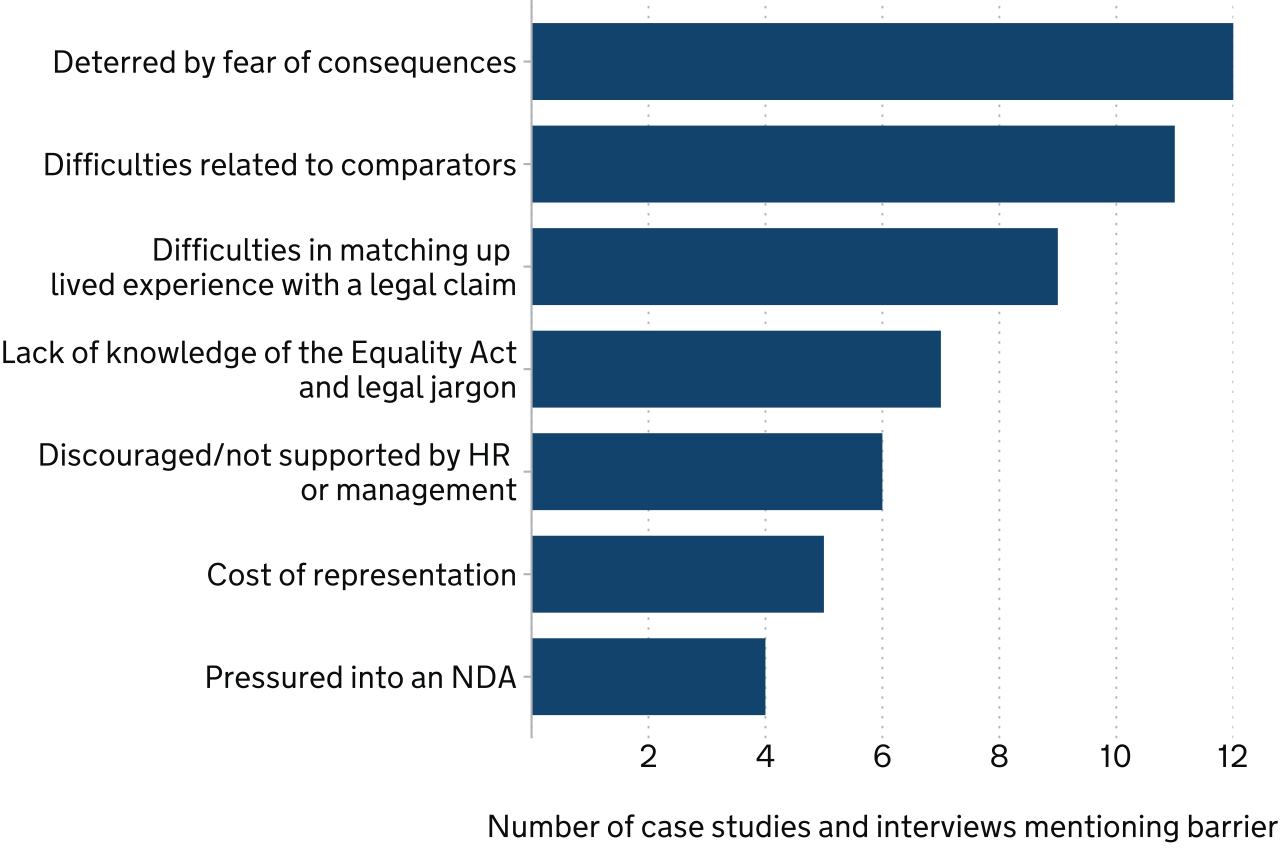
Some of the most common barriers cited in the case studies and lived experience interviews are set out below. Note that this view reflects the limitations of the research sample.
Illustrative view of common barriers faced when seeking redress
5.3.1 Barriers prior to seeking legal redress
The first barrier faced by individuals is the challenge of addressing intersectional complaints informally. Respondents such as landlords, small employers, councils or associations often seem to lack the tools and training to address intersectional vulnerabilities present in internal complaints of combined discrimination. As such, some respondents delay or do not respond to complaints at all [IF3, IF12, IF13].
There is a lack of knowledge of legal terminology, demonstrated in some of the informal case studies from the socio-legal research. Many complainants hoping to raise a claim or complaint are not familiar with the Equality Act language. This can influence whether they are taken seriously when seeking redress [IF8, IF12]. This was echoed in the lived experience research, reflecting the difficulty in matching up a sense of wrongdoing or unfairness with complex legal jargon [LE041, LE045].
Another barrier to people seeking redress was individuals reporting being deterred by their own experiences or factors external to themselves. Interviewees talked about being concerned by the potential consequences of making a complaint or seeking legal redress [LE016, LE025, LE040, LE041, LE043, LE055, LE059, LE079, LE090]. These included the breakdown of relationships, worse treatment, or other possible victimisation such as limits to career progression for being seen as a troublemaker (noting that interviewees did not explicitly identify this as possible victimisation):
“They threaten you with covering costs and that you will lose your job even if you win. If you don’t win, you lose your job. If you win, you lose your job. So people pretty much have to sit and accept it” [LE059].
Interviewees also described being put off by friends and colleagues [LE029, LE059]:
“People have shared experiences with me when they’ve [taken a case forward]…And even with the success stories, the single line that connects all of these stories is that it has been very lonely and very hard and very uncertain” [LE029].
For discrimination claims within employment specifically, interviewees talked about HR or management telling them how difficult the process is likely to be or about the effect on those around them [LE055, LE059, LE079]:
“I was emotionally blackmailed against taking them to court.” [LE055]
“I was told verbally from the chief executive to my head, to drop it, or I wouldn’t have a job.” [LE059].
If an individual does decide to seek redress, another potential hurdle is effectively identifying where to go for support and finding individuals with the right expertise to advise them. Many did not know which organisations they could turn to for support when asked [LE008, LE024] which likely contributes to the feeling of isolation associated with navigating the legal process.
When people did find support sources, they were sometimes disappointed by their limited capacity to provide guidance or advocacy:
“They [support organisations] are increasingly running down their services because they’re not getting sufficient funding and they’re used very much as a plaster for all of this” [LE099].
In the current state, there is then a mismatch between the expectations of individuals and what these services are able to provide.
For those who had engaged with someone outside of their organisation, a number of challenges were outlined. For example, individuals voiced frustrations when working through the early conciliation stage. They felt this was a tick-box exercise or that they were being put off from taking their case through to tribunal:
“…they play their part, yes. But it’s almost like a full stop, sorry to say, because it’s meeting the requirements of the legalities before you refer it to the tribunal” [LE045]
“If it’s gonna be like this, then I don’t want to go through with a tribunal” [LE050]
Others reflected on the challenges of sourcing a solicitor, needing to work through a number of options and having difficulty finding individuals who are most appropriate to help [LE024, LE045]:
“I just looked up disability lawyers and it comes up with obviously thousands of results from Google. And I don’t know what I’m meant to be looking for.” [024].
Once they had found a solicitor to work with, they did not always feel that this support was helpful [LE045]. There were also generally negative experiences with union support, with some voicing frustrations about the support the union representatives could offer or their impartiality and independence from their organisation [LE014, LE025, LE045]:
“You can pay a membership for years and years, and when push comes to shove, the support isn’t there.” [LE045].
Interview 029: Feeling like experiences were invalid, leading to inaction
While working in the UK charity sector, a young Greek woman felt that she experienced persistent indirect combined discrimination linked to her age, gender, and migrant identity. She often questioned whether her experiences “counted” as discrimination, describing the insidious nature of the discrimination as something that ‘chips away’ at your sense of self, leaving you unsure whether to name it or dismiss it. Later, when acting as union representative for the charity, she witnessed what she describes as stark disparities in how women, particularly those who were older, foreign, or disabled, were treated in processes like consultations and disciplinary hearings. These experiences confirmed her belief of how deeply rooted and intersecting these inequities are.
Despite this awareness, she never formally challenged the discrimination she personally faced. She internalised much of it, questioning whether she had the right to speak up, and was deeply affected by what she describes as a broader culture of silence. She felt she had been “gaslighting” herself, questioning whether she had a right to be interviewed as part of this research. Legal action felt daunting, uncertain, and emotionally exhausting, something that required levels of support she could not guarantee, deterring her even before she understood that there was no legal route to bring a combined discrimination claim. Even as a union representative, she believed formal processes offered little certainty or comfort, reinforcing her reluctance to pursue that route herself. She also emphasised how difficult it is to act when you have been conditioned to minimise your experiences and fear retaliation.
She stresses the need for accessible legal education, earlier awareness of rights, and systems that recognise complex, intersecting discrimination, not just clear-cut cases.
This interview illustrates the emotional and psychological barriers to taking action, particularly for those facing combined forms of discrimination. Lack of knowledge, self-doubt, and a culture where discrimination, including combined discrimination, is not talked about, can make people feel they have no valid claim.
5.3.2 Barriers in the legal process
5.3.2.1 Articulating a legal claim
For those who do decide to pursue legal action, the separation of claims into distinct legal grounds often does not correspond with claimants’ lived experience. In cases of potential combined discrimination, the requirement to bring multiple claims often means that claimants bring long lists of claims involving multiple protected characteristics and types of discrimination. This makes it particularly time-consuming and complicated for claimants to causally link the facts to the legal grounds. This can be exacerbated by different factors in individuals’ experiences of discrimination, including:
- ongoing and sometimes intensifying patterns of exclusion [F5, F7, F23]
- less favourable treatment which cannot be easily linked to a single protected characteristic due to the claimant’s intersectional identity [F20, F29, F37]
- the presence of combined stereotyping [F2, F19, F20, F25]
Claimants’ interpretation of the discriminatory experience often evolves over time. What may initially appear to them as an incident of unfair treatment related to one protected characteristic may, on reflection or further advice, be understood as involving multiple, intersecting aspects of their identity. However, the current grounds-based model of discrimination law requires claimants to link the treatment they experienced to specific protected characteristics from the outset. This can make it difficult to capture the complexity of how discrimination and disadvantage is perceived and experienced, particularly when that understanding develops over the course of the grievance or legal process [F4, F5, F11].
Claimants’ evolving understanding and perception of discrimination sometimes give rise to questions of whether an application to amend a claim constitutes a relabelling of a claim – that is, whether it merely applies a different label on the same core facts and should therefore generally be allowed unless strong reasons suggest otherwise. In case study F19, a Muslim claimant from a Pakistani ethnic background sought to amend a legal claim of unfair dismissal and victimisation to explicitly include direct discrimination and harassment on the grounds of race and religion, which had been implied in the narrative of the initial claim but had not been formally pleaded. His application to amend the claim was refused by the Employment Tribunal, which focused narrowly on the pleadings and argued that the amendment was substantially different and should therefore not be considered relabelling. This decision was later overturned on appeal, the Employment Appeal Tribunal finding that the Employment Tribunal had failed to properly balance the injustice or hardship of allowing versus refusing the amendment.
Claimants often struggle to understand the relevant legal tests and to navigate the technical legal requirements for establishing a case, especially during periods of stress. This is evident in the frequent need for extensive case management observed across the case studies [F1, F6, F10, F12, F21, F25]. While this challenge is not limited to discrimination claims involving multiple protected characteristics, it can be more acute for claimants from intersectional backgrounds who may find it harder to decide which boxes to tick on the claim form. This is also evidenced by lived experience interviews [LE008, LE033, LE050, LE069], particularly in employment claims with ET1 forms that lacked legal precision.
“It was less to do with the information and more to do with the delivery” and “I wrote ‘I believe’ and ‘I think’. If I’d known how much weight this form would have then I would have approached it very differently.” [LE050].
To navigate complex form completion, more people are using Artificial Intelligence like Chat GPT to complete required forms and communicate their case [LE041]:
“AI has been a brilliant friend to me in all this” [LE041].
Employers and service providers also highlighted how they had seen increased usage of Chat GPT, outlining how it was evident when this had been used [LE049, LE095, LE104].
5.3.2.2 Evidencing the claim
The difficulty in translating lived experience into a grounds-based claim links into challenges reaching the evidentiary threshold. In the context of direct discrimination, claimants often struggle to establish their case, particularly when it comes to finding a suitable comparator in materially similar circumstances [F2, F5, F26, F28] and meeting the evidentiary threshold for each claim [F22, F31]. These difficulties are especially acute where claimants describe a pattern of exclusion or less favourable treatment that has developed over time, rather than a single, clear-cut incident [F1, F6, F7, F8, F10].
This challenge is often compounded by procedural barriers such as the strict application of time limits. At the time of this research, most Employment Tribunal claims, for example, normally had to be submitted within 3 months (less one day) of the alleged discriminatory act, unless the tribunal considered it just and equitable to allow an extension. This rule could disadvantage individuals who experienced discrimination as part of a long-term pattern or who only came to recognise the discriminatory nature of their treatment over time. In several case studies, claimants attempted to include aspects of their experience in the claim which, the court decided, could not be considered because they were out of time [F5, F9, F10, F24]. From October 2026, the time limit for bringing a claim of discrimination is being extended from 3 months to 6 months through the Employment Rights Act.
In many cases, challenges related to time limits are connected to debates on whether the reported experience is related to a continuing act [F5, F10, F19, F24, F25]. A continuing act refers to a situation where discriminatory treatment or conduct happens repeatedly or continuously over a period of time, rather than as a single isolated incident. If the claimant successfully establishes that their claim involves a continuing act, the time limit may start from the last act in the series rather than the first. This allows the claimant to bring a claim based on the cumulative effect of the conduct. Combining multiple incidents in this way can help to build a stronger evidential case by demonstrating how repeated or sustained behaviour contributed to a hostile or discriminatory environment, and it reduces the risk that isolated incidents are seen as minor or unrelated.
Proving a continuing act is often a significant challenge for claimants bringing claims based on multiple protected characteristics.
For example, in F10, a Muslim woman from a Pakistani ethnic background working as a residential children’s carer reported discrimination and harassment based on her race and religion by multiple colleagues, culminating in unfair dismissal. Specific allegations included sexual harassment, racially and religiously discriminatory comments, including comments about “her hijab matching the curtains”, as well as a general atmospheres of hostility towards her due to her religion and ethnicity. Most of the alleged incidents occurred before the critical date for filing discrimination claims under the Equality Act 2010. The claimant argued that these discriminatory acts formed a continuing pattern of conduct, justifying an extension of the statutory time limit. At a preliminary hearing, the Employment Tribunal struck out some claims as out of time and lacking reasonable prospects of success, while allowing others to proceed. The judge emphasised that the claimant bore the burden to prove conduct extending over time and to persuade the tribunal to allow late claims. This case study highlights the unique legal challenges faced by claimants whose intersecting identities. Here, sex, race, and religion are inseparable in their experience, as well as the evidentiary limitations they face in establishing their case.
There are also challenges in meeting the legal tests. For example, many who try to bring a disability-related discrimination claim struggle to meet the legal test for disability under the Equality Act 2010, especially in cases involving episodic, fluctuating and invisible conditions such as menopause [F28, F29, F30] or mental health challenges [F11, F19, F28]. Some claimants succeed on appeal, which suggests that lower courts or tribunals may misapply or interpret the legal test too narrowly [F28]. In menopause-related claims, claimants sometimes struggle to prove that HR and managers were aware of the symptoms, having only discussed them informally [F30]. Note that this challenge, although significant, is not specific to combined discrimination.
These challenges were reflected in the lived experience research, where people with lived experience of combined discrimination also discussed difficulties with proving they experienced discrimination, often feeling that their experiences were insidious and hard to prove [LE008, LE029, LE043, LE055, LE069]:
“It’s always ‘Are you sure?’ or ‘maybe they didn’t mean it that way’.” [LE008]
“It was so subtle in the beginning, I didn’t highlight it as discrimination until it got to the point where it was so overt and other people were made to feel uncomfortable with how he was treating me” [LE055].
5.3.2.3 Navigating the legal process
Many claimants experienced challenges in navigating the legal process, noting that these challenges are not specific to combined discrimination.
One common challenge in navigating the legal system raised in lived experience interviews is the cost of representation [LE024, LE043, LE050, LE059, LE069]. This was compounded by the lack of free legal support available, particularly in employment cases which are no longer covered under legal aid. For example, one individual cancelled their preliminary hearing because they could not fund a solicitor [LE043]. Concerns around cost are often exacerbated by concerns about facing an employer with more resources and funds to fight a legal case. One person described wanting to avoid a “David and Goliath” situation [LE033].
The cost often results in people trying to navigate the legal process unrepresented [LE041, LE045, LE087], which exacerbates a number of challenges within the legal system identified here:
“Even the tribunal says that you can represent yourself. OK, But you have got to have that time and energy and that mindset to represent yourself. And an understanding of the legalities is needed.” [LE045].
Claimants without legal representation early on in the process and no prior experience with litigation are often at a disadvantage [F1, F19, F21]. The case studies showed that individuals representing themselves could often exhibit procedural misunderstandings or struggle to present adequate evidence at the correct time [F6, F21, F27]. Claimants’ understanding of legal requirements can improve over time [F10], but procedural rules often restrict the amendment of claims or the introduction of additional evidence at later stages [F4, F11, F13]. This challenge was reflected in the lived experience interviews, particularly around the use of technical jargon:
“But it uses such technical jargon, and I’m sure it’s designed that way to actually baffle you” [LE041].
Challenges with legal requirements and language may be compounded as claimants experience high levels of distress or discomfort throughout the process, particularly those with mental health challenges. They may struggle to bring claims on time, or to provide all relevant details on initial claim forms. Attempts to amend claims to add additional grounds and protected characteristics were common in the case studies [F4, F9, F10, F19, F21, F23]. Systemic difficulties accessing diagnoses promptly can prevent claimants from providing sufficient evidence of their mental health challenges to justify changes to their claims [F9, F10].
Based on the challenges above, many interviewees felt it was easier to leave a job than raise concerns [LE008, LE016, LE025, LE033, LE043, LE059, LE079, LE090]:
“I would say to anybody, don’t do what I did. Don’t stay, just go.” [LE059].
Interviewees felt that these barriers may also make individuals more susceptible to accept settlements and sign non-disclosure agreements (NDAs), based on pressures from claim respondents to settle things informally [LE014, LE043, LE045, LE059]. While this is a resolution, it limits the accountability for claim respondents and prevents claimants from talking about their experiences:
“So it’s almost as if the respondent in that situation can then push again. Do you know what I mean? It’s almost like they’re forcing my hand.” [LE045]
5.3.3 Barriers specific to different discrimination types
The barriers claimants experience when trying to prove harassment claims are similar to the barriers people face when bringing a direct discrimination claim. Legally claimants only have to show that the experience is ‘related to’ their protected characteristic and not ‘because of’. However, they often struggle to separate harassment claims into distinct legal grounds based on individual characteristics as the distinction often does not correspond with claimants’ lived experience. [F5, F6, F10, F11, F12, F23, F24, F28, F31].
There are also overlaps with the barriers experienced by claimants bringing indirect discrimination claims. Indirect discrimination claims must identify a provision, criterion or practice that puts a group at a particular disadvantage, which can be difficult when the disadvantage arises from intersecting characteristics. Claimants in this group often have to fragment the claim in ways which do not correspond with their unique intersectional disadvantage [F4, F33, F35]. Some choose to strategically focus on a single protected characteristic even though a combination seems relevant to the disadvantage [F34, F41]. Some pursue other routes than a discrimination claim to shed light on their intersectional experience [F14, F15, F17, F37, F40].
The victimisation claims considered in the case study analysis are secondary to the discrimination claims considered as they occur when a claimant feels they are being treated less favourably as a result of having been involved in a discrimination complaint, so there are similar barriers at play. Some claimants attempt to add victimisation after filing the claim and this comes with additional procedural challenges [F9, F23].
5.3.4 Sector-specific barriers
5.3.4.1 Employment
Individuals face significant barriers when navigating an organisation’s internal grievance process before taking legal action. For some, having to engage with their employer is enough of a deterrence:
“Apparently the first step should be an open discussion and challenge to the employer. But who’s gonna do that, you know?” [LE029].
This is especially the case if an individual’s complaints would be raised to a person or department contributing towards the discriminatory treatment [IF12]. This might also be compounded by employers reporting not having specific policies for combined discrimination [LE049, LE084], noting however that they did not think the process for responding to a claim of combined discrimination would be significantly different compared to a claim of single discrimination
Individuals also face a number of challenges around the process itself including delays in grievance processes. Complainants may spend time waiting for a response that never comes, and consequently risk running out of time to bring claims to a tribunal [IF7, IF9]. The experience of waiting for a response and not hearing back may be anxiety-inducing, particularly for claimants with mental health conditions, and those who have experienced distress as a result of their treatment [IF9]. Some felt that delays were intentional on the part of their employer:
“But they had delayed it for so long that unfortunately I missed the deadline” [LE090].
Lived experience interviews also highlighted negative experiences in the internal grievance process which included employers not engaging in the process [LE014, LE025, LE041, LE045, LE069, LE090] or complaints being disregarded or not listened to:
“It just fell on deaf ears” [LE041]
“They had ground me down so much with, like, the bureaucracy, with them all banding together […] when you’re seen as the troublemaker” [LE090].
Some interviewees also talked about a lack of independence or impartiality in the grievance process. Examples included witnesses being heard for the employer but not the employee [LE014], the review being done by in-house staff [LE069], or internal processes not being followed [LE014, LE055]. Sometimes, interviewees talked about no tangible action or change coming from the grievance, making them question the point of going through the process [LE041, LE043, LE045, LE055]:
“And I just thought, why have you put me through this? When you’re not going to uphold anything” [LE043]
“My complaint was never uplifted, never acknowledged” [LE055].
Smaller organisations seemed to have more challenges around grievance processes. They often did not have a dedicated HR department, or were developing a process reactively as an organisation grew:
“So in my early career with the company, it was actually me that wrote those processes.” [LE055].
The barriers to seeking legal redress were higher for some specific groups, including those on zero-hour contracts [LE008, LE033, LE051], who felt like it made more sense to leave:
“It could just be a high turnover and just like turn it and burn it. You know, if you don’t want to do it, someone else will.” [LE008].
Barriers are also high for agency staff of self-employed individuals, who may be discouraged from pursuing legal action by support organisations who advise that they have little chance of success [IF5], or may take a claim to court only to be told protections do not apply to them as non-employees [F38].
Note that these challenges are not specific to combined discrimination. However, some challenges around grievance processes might be compounded by the fact that employers typically did not have specific consideration of combined discrimination in their policies.
Interview 069: Barriers within the internal processes
>
While working for over a decade in a mental health organisation originally focused on ethnic minority communities, a Muslim woman from an Asian ethnic background believes she was discriminated against due to her race, religion, and sex. Despite describing long tenure, a strong work ethic, and taking on additional voluntary shifts, she was suspended and eventually dismissed following a disciplinary process after she closed the mental health service she worked in early. One of her colleagues, who was White and had been reported earlier for similar actions, was never suspended and continued working until her resignation. She believes her race, religion, and sex (a combination which is immediately visible through the headscarf she wears) contributed to her differential treatment and eventual dismissal, which caused mental health deterioration and financial hardship.
>
She attempted to challenge her treatment through internal grievance and legal routes, but encountered barriers. Her grievance was sidelined during disciplinary proceedings, despite repeated union efforts to prioritise it. The grievance hearing occurred only after her dismissal and her grievance was largely dismissed. She felt that her efforts to seek redress were undermined when all of her emails containing important evidence were erased from her company email. She described the entire process as emotionally exhausting and stacked against her from the start. She is now pursuing an employment tribunal claim.
>
She believes employers should not be allowed to pre-determine outcomes or erase records, and that legal processes should better account for intersecting identities. Without structural safeguards and accountability, she argues, workers are left to navigate complex, emotionally draining systems with little chance of redress.
>
This experience highlights how internal grievance processes can feel exhausting and opaque for employees, and how difficult it can be to evidence discrimination claims. The interviewee emphasised the importance of fair procedures and transparent evidence handling.
5.3.4.2 Housing
The case analysis reveals that combined discrimination claims in the housing sector are rare in published case law, suggesting that such claims are either infrequently litigated or often dismissed or resolved without a published judgment. Unlike in the employment sector, discrimination claims under the Equality Act relating to housing must be brought in the County Court, which tends to involve more expensive and procedurally complex proceedings.
The Housing Ombudsman Service offers a non-legal route to resolve disputes between tenants or leaseholders and social landlords, as well as some private landlords. However, it does not have the jurisdiction to determine whether discrimination has occurred, focusing instead on procedural fairness in how landlords handle repairs, tenancies, and complaints.
The analysis of 2 Housing Ombudsman decisions [IF2, IF3] and one Scottish Sheriff Court decision [F18] indicates that evidentiary challenges in the grievance process appear even greater in housing than in the employment sector. Even where landlords have other tenants, claimants are unlikely to have access to evidence of less favourable treatment. Disability-related claims tend to be more straightforward, with comparatively better chances of success in both legal and non-legal forums.
In IF3, the complainant, a disabled mother of young children from a racial minority, reported that she believed that the landlord’s failure to address safety hazards and delays in repairs were racially motivated. This claim was not investigated by the Ombudsman due to jurisdictional limitations. Had the complainant decided to pursue legal action, the interviews with support organisations suggest that she would likely have been advised to frame her claim around her disability. This pattern is supported by F18, in which the claimant – a mother of 2 and former refugee from Somalia living with a psychotic disorder – chose to focus her defence against eviction on her disability rather than on an intersection of multiple aspects of her identity.
Protections against combined discrimination are highly relevant in contexts where intersecting vulnerabilities shape tenants’ lived experiences. This is particularly significant in social housing, where tenants often face a pronounced power imbalance and limited ability to relocate, making them especially dependent on the fairness of their housing provider. Section 14 could potentially play a helpful role in improving people’s protection against combined discrimination in this sector, but its practical effect is currently limited by the limited accessibility of county court proceedings and the fact that the more accessible ombudsman service lacks the jurisdiction to make findings on discrimination.
To realise the protective potential of section 14 in housing, it is likely that any commencement would require accompanying reforms, such as expanding the mandate of less legalistic redress mechanisms such as the Housing Ombudsman and improving access to justice in the County Court system, for example through cost reductions, simplified procedures, or specialist housing discrimination support. Strengthening claimant’s ability to obtain relevant information could also be an important consideration, for example through a mechanism akin to the former statutory discrimination questionnaire (see 7.3.4).
5.3.4.3 Public functions and services
Similar to the housing sector, combined discrimination claims falling into the public functions and services sector are less prevalent in published case law than employment claims. There are 3 case studies in the formal sample related to public functions and services [F16, F17, F40] and 7 in the informal sample [IF1, IF4, IF8, IF10, IF11, IF15, IF16]. Two out of these 7 informal cases are decisions by the Parliamentary and Health Service Ombudsman [IF1, IF16]. Four of these 10 cases overlap with other sectors such as housing and education.
Unlike employment claims which are usually heard in Employment Tribunals, claims against public bodies for discrimination under the Equality Act can be pursued through the County Court or, in the context of more complex claims or judicial review, the High Court.
As in housing-related claims, these types of legal proceedings tend to be more procedurally complex, lengthy and costly than Employment Tribunal claims. Complainants experiencing discrimination by public service providers also have the option of raising a complaint with the Parliamentary and Health Service Ombudsman. This independent body handles complaints that have not been resolved by the NHS in England and UK government departments. Like the Housing Ombudsman, this service does not make findings directly on matters of discrimination, but focuses on service failures and whether providers have followed proper guidance.
Case studies in the informal sample indicate that claimants experiencing combined discrimination in this area often do not feel heard in early stages of the grievance process, either because they feel they are not being taken seriously by those handling the complaint, or due to perceived institutional bias [IF1, IF4, IF8, IF11].
In IF11, a male domestic abuse survivor living with mental health-related disabilities, with rent arrears and at risk of homelessness, described being excluded from support services. He attributed this exclusion to being a man seeking mental health support and a male domestic abuse survivor. He reported being laughed at by charity staff and dismissed by local authority workers, which contributed to a sense of stigma and systemic neglect. He believed that support would have been more accessible had he been a woman. According to the complainant, neighbouring boroughs provided services for male victims, but his local authority did not. Such examples point to a lack of awareness about the nature and consequences of intersectional discrimination, which may result in gendered gaps in victim support. Explicit statutory protection for combined discrimination, such as the combination of gender and disability as illustrated in this case, could have a positive trickle-down effect, leading to improved institutional practices and greater awareness among service providers of how intersecting characteristics shape individuals’ access to support.
When it comes to legal proceedings, claimants have sought to challenge exclusionary practices in the provision of public services by invoking the Public Sector Equality Duty (PSED) or bringing claims under human rights law, either alongside or instead of a substantive discrimination claim. In F40, for example, a female asylum seeker with limited English, and a history of severe trauma, hearing impairment and epilepsy (joined by a charity supporting refugee women) challenged her detention at an immigration removal centre on several grounds, including breach of the PSED and sex discrimination claims under sections 13 and 19 of the Equality Act 2010. Unlike male detainees, who were held in a less remote location, women at this removal centre were denied access to in-person legal advice, relying instead on telephone or video calls. The claimant argued that this arrangement, compounded by her disabilities and trauma-related needs, severely hindered her ability to obtain legal advice and access to justice. The multilayered construction of the claim – with 5 grounds including the PSED and substantive sex discrimination claims – appears to reflect an attempt to capture the intersecting nature of the claimant’s disadvantage. Ultimately, the court dismissed the claims, finding no unlawful discrimination and holding that remote legal provision was adequate.
This case illustrates both the potential and the limits of existing legal frameworks: while the PSED can prompt scrutiny of systemic disadvantage, it requires only that public authorities ‘have due regard’ to equality, rather than imposing a duty to achieve substantive equality. It also differs from indirect discrimination claims, which – as Lady Hale explained in Naeem v The Secretary of State for Justice [2017] UKSC 27 – “assumes equality of treatment” in that “the [provision, criterion, or practice] is applied indiscriminately to all”, but “aims to achieve a level playing field” and to address “hidden barriers which are not easy to anticipate or to spot” if they cannot be justified. Had section 14 of the Equality Act 2010 been in force and had it been extended to cover indirect discrimination, the claimant might have been able to frame her experience explicitly as one of combined discrimination based on sex and disability, potentially offering a more straightforward route to address the compounded disadvantage she faced.
5.3.4.4 Education
Most combined discrimination claims relating to statutory education appearing in published case law concern school exclusions. Once a child or young person has been excluded, parents and carers have the right to request a review of the governing board’s decision not to reinstate a pupil after exclusion. The review is done by an independent review panel (IRP), set up by the council or the academy trust responsible for the school. While the IRP cannot change the decision or reinstate the pupil, it can either uphold the decision, recommend that the governing body reconsiders the decision, or quash the decision and direct the governing body to reconsider it.
IRPs can consider allegations of discrimination, but do not have the legal authority to determine definitively whether discrimination has taken place. In some cases, schools can use their powers of “off-site direction” to remove pupils again after successful challenges at the IRP stage. This occurred in one case study in the informal sample [IF20], where a Black schoolboy with SEN and ADHD was labelled “aggressive” and excluded following an incident. His exclusion was successfully challenged as a SEN expert identified that he had been experiencing a meltdown. After the decision, the school exercised its off-site direction powers to remove him again.
| There are 5 cases relating to statutory education in the formal sample of the research [F3, F14, F15, F32, F37], with 2 involving the same claimant [F14, F15 | . The informal sample includes 2 case studies relating to statutory education [IF19, IF20]. Across both samples, there is one case study concerning a sixth form exclusion [IF15] and 2 relating to higher education [IF9, F17]. Cases F15, F17 and F37 overlap with the public functions and services sector, raising issues such as access to legal aid, eligibility for universal credit, and local authorities’ treatment of young people with an education, health and care plan. |
As in claims relating to public functions and services, many education-related discrimination claims reaching the courts invoke the PSED or bring claims under human rights law. An illustrative example is F14, in which a mother of a child from a Black Caribbean ethnic background with SEN described a pattern of exclusion culminating in her son’s permanent exclusion shortly before his GCSEs, following 2 violent incidents. She argued that the school failed to adequately support her son’s SEN needs and treated him unfairly in light of his race, disability, and broader social context (for example, his caring responsibilities towards younger siblings).
Although the claimant’s narrative points to discriminatory experiences based on race and disability, the claimant did not bring a substantive discrimination claim but rather alleged a breach of the PSED. The claimant’s counsel explicitly invoked intersectionality, citing the statistical overrepresentation of boys from Black Caribbean ethnic backgrounds, and pupils with SEN in exclusion data, as well as significant adverse effects of permanent exclusion, raising broader systemic concerns such as the “school to prison pipeline”.
The absence of an explicit statutory framework for combined discrimination claims may have led the claimant and her legal team to focus on the PSED pathway, which emphasises procedural justice rather than substantive discrimination. The claimant was ultimately unsuccessful, with a decisive factor being the proportionality of the PSED duty relative to the school’s resources, as well as the lack of a legal consistent requirement for governing boards to produce written evidence that they have properly considered the PSED before excluding a child.
The lived experience and socio-legal research revealed further challenges in seeking redress in the education sector, noting these are not specific to combined discrimination.
Supporting organisations emphasised the difficulties for families navigating the Independent Review Panel and judicial review without legal representation, as this is not currently covered by legal aid. This means that they often drop out of the process [LE099]:
“To be asking your average parents to start grappling with judicial review…That’s ridiculous and nonsensical” [LE099].
Legal action may also not feel like a priority for complainants affected by exclusions, whose primary focus is returning to full-time education as quickly as possible so as to not suffer additional disadvantage [IF15]. Support organisations also observed disillusion or loss of trust in the system from families, which often manifests in not challenging things further [LE099].
Legal representatives from higher education providers also reflected on challenges in seeking redress [LE096, LE104]. These included the lack of a free legal route to challenge experiences of discrimination, meaning students may have to navigate the county court system. One respondent suggested that they have to:
“take their chances in a fully costed regime… and what student has that kind of money?” [LE096]
This process also takes a significant amount of time. Most undergraduates study for 3 years and it can take over 2 years to navigate the legal process:
“half your career as a student” [LE096].
As in other areas, interviewees reflected on the complexity of the law:
“It’s tricky enough as a lawyer […] to find your way around the court processes. It’s really daunting as a student “ [LE096].
Ultimately, this means that it is rare for students to engage in this process:
“So it’s difficult to navigate. It’s costly, it’s time consuming. All those things which you know for an average young adult is not going to be something that they can properly engage with regardless of what the complaints are” [LE096].
Another challenge was raised around knowing who to reach out to for support, as the Office of the Independent Adjudicator, which is often the first point of call, cannot make recommendations around discrimination [LE096, LE104].
5.3.4.5 Associations
Across this research, only one case study was an alleged instance of combined discrimination perpetrated by an association.[footnote 8] This reflects the significant challenge of finding formal or informal combined discrimination case studies of claimants pursuing redress against associations. The low prevalence may suggest a lack of awareness of the possibility of pursuing claims against associations, lack of confidence that such claims are likely to be successful, or limited incentives to go through the process.
5.3.5 Additional contextual factors
Some factors, as well as intersecting with protected characteristics in experiences of discrimination, (as is set out in section 3.3), may also act as barriers to seeking redress.
The challenge of high costs of legal representation is likely to affect individuals with lower socioeconomic status more, by causing further financial strain or resulting in individuals having to navigate the system representing themselves. This is exacerbated by the non-eligibility of certain cases for legal aid, for example employment and SEN tribunals.
A number of support organisations highlighted an additional barrier to seeking legal redress around immigration status and repercussions around visas [LE006, LE015, LE017, LE035, LE051, LE093], in that migrants can have a poorer understanding of their rights or where to find support to challenge their treatment [015], be afraid of losing their visa by speaking out [LE006, LE017], or face language barriers when navigating the process [LE015]. This was particularly seen in industries such as health and care [LE006, LE051] and in areas of low paid work such as construction and nurseries [LE051].
There are additional hurdles for people who speak English as a second language or people with lower literacy levels. This makes it more challenging for claimants to understand their legal rights and whether they have a claim. It also makes representing their own experience in court or in an internal complaint more difficult [F5, F8]. This was emphasised by a solicitor working in education with different ethnic minority groups, such as the Gypsy or Irish Traveller groups [LE099], noting that lower literacy levels often limited individuals’ ability to engage with the system.
Main findings
People with lived experience of combined discrimination report often struggling to identify which part of their identity caused the unfair treatment. This ambiguity leads to self-doubt and fear of not being believed. Many report effects on their mental health, including distress, humiliation, and the exacerbation of existing conditions. Experiences of discrimination also negatively affect trust in colleagues and institutions, with policies viewed as performative, and claimants and complainants feeling frustrated by a lack of accountability or meaningful change.
Challenges to seeking redress include difficulties linking lived experiences of discrimination to legal grounds, procedural and evidentiary challenges, particularly without legal representation, and broader difficulties in navigating the process, including fear of retaliation, lack of accessible support, cost, and discouragement from employers or peers.
To mitigate some of these challenges such as navigating complex form completion, interviewees noted that more people are using AI services like Chat GPT to complete required forms and communicate their case.
While some of these challenges would be faced in any discrimination case, others, such as the difficulty of linking experiences to legal grounds and evidencing these grounds, are particularly acute in cases of combined discrimination.
6. Insights from employers and service providers
6.1 The experience of having a claim made against them
This research was conducted in parallel with research into pay discrimination. Employers and service providers’ experiences of having a pay claim or a combined discrimination claim would be fairly similar, so both types of claims were discussed in the same interview. As a result, many of the overall findings presented here have also been included in the pay discrimination report.
Interviewees included representatives from employers including managers, HR professionals and in-house legal support, and service providers in higher education.
6.1.1 The nature of claims seen
Interviewees noted that they were seeing more cases with multiple protected characteristics and an increasing complexity of cases. Some noted that it seemed that individuals were adding more protected characteristics or instances of discrimination to “bolster” their chances of success [LE049, LE052, LE057, LE095, LE096, LE097]:
“So I think that sometimes things get thrown in to see if they can find anything more” [LE049]
“just bolstering and saying look, if this isn’t enough, if this wasn’t egregious enough, then this also happened to me, so you better do something about the first item” [LE096]
This was supported to some extent by support organisations [LE035, LE093], emphasising that it is often down to a lack of understanding or a lack of access to legal advice when raising a claim:
“They desperately lack the knowledge in relation to how a claim is calculated and awarded and the specific guidance” [LE052]
One interviewee reflected that potential claim respondents do not necessarily have the awareness or understanding to identify intersectionality [LE084]:
“I don’t think there is a lot of understanding from the employers that I speak to of the intersections between protected characteristics and maybe people can take a bit too much of a blinkered approach” [084]
Employers and service providers also reflected on the number of claims going through to legal action, with interviewees hypothesising an increasing claims culture in recent years [LE049, LE057, LE094, LE095]:
“I don’t know whether we’ve seen a cultural change or an increasing claims culture.” [LE049]
“We’re becoming a litigation environment, like the US” [LE095]
6.1.2 Responding to claims referencing more than one protected characteristic
Across interviews with employers and service providers, no one noted significant differences between the process for responding to a claim for one protected characteristic compared to claims that reference multiple characteristics. A small number of interviewees said this might increase the time taken to respond to cases [LE096] or that it would require more care and attention [LE106].
For all types of cases, employers emphasised a desire to settle cases outside of court where possible, either by reaching an informal resolution or settling [LE049, LE052, LE067, LE086, LE094, LE095, LE101, LE103, LE104, LE105, LE106]. This was attributed to the reputational risk of going to employment tribunal [LE067, LE086] and the cost associated with responding to claims [LE049, LE067, LE103, LE06]:
“It’s probably more cost effective to pay somebody off or exit them from the business with a bit of a package than address it all internally.” [LE103]
Some potential claim respondents also highlighted the desire to settle to avoid additional stress on both parties [LE103, LE104, 106]:
“I think there was a myth out there. That’s like you’re signing [a settlement] to silence them. But actually it’s the rounded benefit that you’re putting somebody through this process that then all trust and like relationships are broken down.” [LE103].
Interviewees felt that many cases could have been avoided by encouraging potential claim respondents to be more inclusive and by more proactively having difficult conversations with potential claimants, particularly about protected characteristics [LE094, LE101, LE104, LE105].
6.1.3 General challenges in responding to claims
Employers and service providers reflected that there was a small number of cases coming through that reference more than one protected characteristic, and that the response to these claims is no different to the process for responding to one. It is not surprising that potential claim respondents did not provide any specific challenges around this. However, they did reflect on more general challenges in the current legal process. These are largely focused around employer experiences.
Mirroring the findings from potential claimants and complainants, one challenge experienced by both parties is having to follow the internal grievance process and exhaust all options internally before raising a legal claim. Among claim respondents, interviewees highlighted how this process is resource-intensive and time-consuming, voicing frustrations around the duplication in steps between internal and external processes [LE049, LE095, LE101, LE103, LE104, LE106]:
“It takes an exorbitant amount of time, effort and money to go through the internal process” [LE095].
This is sometimes made more difficult if employees are on sick leave during this time [LE057, LE103]. Interviewees also talked about the reliance on staff availability for this process [LE096].
Once a case had gone beyond the organisation, employers raised a number of challenges in responding to a claim effectively. The first challenge encountered is often the quality of the information provided by the claimants. Some ET1 forms were felt to be too vague, leading to claim respondents asking for more information on particular events, while others have too much detail that is not of relevance to the case [LE049, LE095, LE097]:
“We don’t really know the nature of it because the form completed was so poor” [LE049]
“We spend a lot of time trying to guess what they are trying to complain about” [095]
Something that has helped with this recently is the increasing usage of AI to complete required forms [LE049, LE095]. Some employers also discussed challenges in employees not disclosing protected characteristics such as non-visible disabilities until later down the line, for example to add to a broader claim of discrimination [095, 097].
The limited information available in claim forms can be made more difficult by logistical challenges in the current process, particularly around court engagement with claim respondents:
“If we’ve got questions in relation to what’s raised, we will be chasing the court. And it just goes into a void and we do not get responses for months and months” [LE052]
“They say email us, you won’t get a response for months” [LE097]
Interviewees also raised cancellation of court dates due to judge availability and overbooking:
“We turned up at court and were told it was cancelled due to no judges being available” [LE052].
Some interviewees supported the experience of early conciliation as a tick box exercise [LE049, LE052, LE095]:
“It feels a bit of a tick box exercise” and “Sometimes in terms of issuing the certificate, because obviously they can’t take a view, they can’t have their say, they don’t know who’s right or wrong. So all they can really be is the go between.” [LE049]
“[Early conciliation] is something that claimants do because they have to, it’s not necessarily because they want to resolve anything…It’s just because it needs to be monitored and recorded for the ET1 [form]” [LE095].
Claim respondents reported worries about the costs of responding to legal claims [LE049, LE067, LE097]. This is partly due to the length of time that cases go on for, with some potential respondents having court cases booked in for 2027 [LE052, LE106] or waiting 2 years for a court date:
“So the cost to get to that point because of the backlog on the tribunal system is massive” [LE049]
Some discussed how previous cases had lasted for multiple years [LE097].
These frustrations were heightened due to the low probability of recovering any costs from the process [LE049, LE086, LE095]:
“So even if we get to that point and then win, we haven’t won because we’ve probably still spent like 60-70 grand. It’s ridiculous” [LE049]
This was a particular concern for those in education in which institutions are under significant budgetary and cost cutting pressures [LE097].
6.1.4 Effect on the relationship with a potential respondent
Potential claim respondents discussed an increase in the number of claims that name specific individuals, causing additional stress to managers [LE052, LE095, LE097]. One employer discussed a recent instance in which 5 individuals were named, with one manager resigning as a result:
“They’re so scared and obviously we say don’t worry, we will cover you, but it’s scary” [LE095].
Another raised the stress caused to the manager:
“We’ve had people ask if they’re going to have to sell the house and all sorts.” [LE097].
The interviewee then reflected on the longer term effect of this, for example people not wanting to be managers:
“We can train them. But who wants to manage people if you are going to be subjected to claims in the future? [LE095]
Interviewees also discussed negative effects for remaining team members, who experience additional stress [LE067, LE095], particularly when picking up additional work to cover claimants who may have left the organisation or gone off sick. Interviewees in employment emphasised that most people who raise claims have left the organisation, which is an indicator of the state of the relationship [LE049, LE084, LE094]. If an individual does decide to remain in an organisation, this is felt to be difficult for both parties [LE095, LE097]:
“The trust is affected too, because it’s not just as simple as raising a concern and addressing it” [LE095]
Concerns include worry that any interactions that take place with an individual following a claim will be added to a case.
6.2 Mitigation against future claims
The lived experience research identified 2 main ways in which potential claim respondents mitigate against future claims – having strong but adaptable policies and training members of staff to reduce any bias and raise awareness of potential discrimination.
6.2.1 Policies and procedures
Most employers outlined extensive EDI policies and processes available to employees to raise concerns [LE052, LE095, LE094]. In unionised environments such as education, it was noted that unions identify additional focus areas for institutions to consider, supporting the development of more preventative approaches but noting that this results in additional requirements to meet [LE097].
However, no interview mentioned a specific policy for combined discrimination, with some noting that this may have been referenced in other EDI policies [LE049, LE084]:
“No, we don’t do anything different, really. So I’m trying to think of what we could even do. I don’t really know if I understand enough to” [LE049]
“I’m not seeing any policies that cover the intersection. I’m seeing more on social mobility than I am on an intersection between protected characteristics.” [LE084].
While employers did not have policies in place, a number of interviewees emphasised the adaptability and responsiveness of their policies to changes in legislation and to claims made against them [LE049, LE067, LE094, LE096, LE097]. Interviewees discussed continuous improvement approaches or annual reviews of policy:
“We will try and look to see where we can, you know, improve our internal processes whether it’s more training for our HR people to be able to teach managers or whether it is like I say the unconscious bias, that’s what we got really scrutinised for” [LE097].
To ensure policies are as well thought out as possible, some interviewees talked about bringing in external legal support to navigate particularly complex areas [094]. As a result, if section 14 was to be commenced, potential respondents are likely to adapt their policies in response where needed.
While having the policies in place is a necessary first step, some interviewees reflected on the effectiveness of policy to mitigate against future claims. They particularly reflected on how widely understood policies were and how many individuals engaged with them. For example, one interviewee noted they were aware of the policy, but they had not read it themselves [LE073]. Others noted a potentially performative element to policies, as they are developed to ‘cover’ organisations from the risk of future claims, but are not in themselves sufficient [LE052, LE096, LE103]. In addition, policies are only successful if they are enforced and individuals are held to account. One interviewee outlined how people who have been called out for negative behaviour have not been held accountable:
“And I know he’s had several complaints made against him and nothing seems to have happened. So that makes me think that our systems aren’t as robust as they need to be.” [073]
Some interviewees reflected that challenging discriminatory treatment may be more difficult for outsourced workers, and their claims and concerns may be taken less seriously:
“[contractors] have then made a complaint and maybe it hasn’t gone any further because they aren’t part of the organisation, so it feels like it doesn’t matter, they’re not an employee.” [073]
This also applied to zero-hour contracts and those in insecure employment [084, 051]. These sentiments were echoed by a labour provider [105] who described the ‘grey area’ of when and how policies apply to agency or temporary staff. They described that the labour providers pay wages and are therefore responsible, but they would hope that clients (employers) are also enforcing their own internal policies to protect against discrimination.
6.2.1 Training
There were mixed experiences of and views on training across interviewees. Some recognised training as a critical component to mitigating against future claims, especially for managers [LE094]. Others felt that the current equality, diversity, and inclusion training on offer was quite performative [LE073, LE101]:
“I don’t rate them because they’re very much tick box exercises that everyone just gets through as quickly as possible to say, yes, I’ve ticked all the boxes, blah, blah, blah” [LE073]
“We do that for 2 hours and then we don’t touch it for 2 years” [LE101].
Some felt that training was not focused on what could be most useful, or that they were told ‘what to do’ but not ‘why to do it’:
“If someone is off sick and we are doing the return to work interviews, I have to ask them if it’s menopause related but I don’t know why I ask that […] I’d like training on that” [LE101].
One person also reflected on the level of engagement with available courses, especially if it is not mandated for people to complete it [LE097].
When asked about what guidance or training could be given to support potential claim respondents, specifically around combined discrimination, one interviewee was aware that there were likely to be existing resources but that:
“the main theme might be that I don’t know what I don’t know” [049]
6.3 Attitudes towards enforcement and redress
Employers and service providers provided limited insight on attitudes to enforcement and redress outside the challenges in the current process. However, there was acknowledgement that businesses are ultimately motivated by profit. As such, there must be mechanisms to hold them to account and ensure they are:
“doing the right thing, even when no-one is looking” [LE101]
Views on what more can be done around enforcement, from across all lived experience interview types, are outlined in section 7.3 of this report.
Main findings
Employers and service providers reported seeing an increase in the complexity of cases brought against them in recent years, for example that often reference more than one protected characteristic or different types of discrimination (for example, whistleblowing). The approach to handling these cases was not thought to differ from the processes for responding to claims that reference one protected characteristic.
Responding to claims was perceived as time-consuming, costly, and logistically challenging, with vague claim forms or claim forms with irrelevant detail, delays in court responses, and emotional strain on individual managers named in claims.
While most organisations have equality and inclusion policies and provide training to prevent discrimination and mitigate future claims, these are often seen as performative or poorly understood.
Employers reported not having policies specific to combined discrimination, but a number emphasised the adaptability and responsiveness of their policies to changes in legislation, suggesting that if section 14 were to be commenced they would be likely to adapt their policies in response where needed.
7. Strengthening protections against combined discrimination
This research has found benefits, limitations, and risks of commencing section 14. These are set out below. It presents this evidence but does not make policy recommendations.
7.1 Benefits of commencing section 14
The case study analysis has identified a number of potential benefits to commencing section 14. These benefits were supported and supplemented by the lived experience research. The 4 most common benefits as identified through formal cases are illustrated in chart x below.
7.1.1 More accurately reflecting and articulating real life challenges
Enabling people to take forward combined claims would more accurately reflect a claimants’ lived experience and their real life challenges, either by capturing combined stereotyping [F12, F14, F37] or by capturing compounded disadvantage [F14, F40].
A few case studies illustrating this point are related to religious attire.
For example, in F12, a claimant working in health care argued that she was treated less favourably than others due to her religion when she was challenged about not rolling up her sleeves in what she considered a non-clinical area. She reported an aggressive tone and manner of the interaction about her sleeves, which, she argued, among other things, created a hostile environment based on her religion. The day after the incident, the claimant sent an email to the respondent in which she described the encounter from her perspective and stated that she believed she had been racially profiled. Nonetheless, she focused her claim on the basis of religion and did not bring any legal claims related to race or sex. Under the current statutory regime, she was required to separate her lived experience of being a hijab-wearing woman covering her arms for religious reasons into individual grounds, and, upon taking legal action, she decided to focus on what she presumably considered the strongest ground, namely her religion. The ability to bring forward a combined discrimination claim could have allowed her to articulate the incident and reported treatment in a way that more closely reflected the complexity of her lived experience as a Muslim woman.
Another example [F14] involved a child from a Black Caribbean ethnic background with special educational needs, who experienced a pattern of exclusion culminating in a permanent exclusion following 2 violent incidents. The child’s mother argued that the school failed to adequately support her son’s special educational needs and treated him unfairly in light of his race, disability, and social context (for example, caring responsibilities), and brought forward statistical disparities to argue that the school neglected to consider how being a disabled Black boy shaped his exclusion risk and experience. They decided to bring forward a claim for failure to comply with the PSED rather than a discrimination claim. The ability to bring forward a combined discrimination claim could have allowed the claimant to focus on the discrimination experienced while also closely reflecting the compounded disadvantage of being a disabled Black boy.
The ability to more accurately recognise combined stereotyping or to prove a disadvantage were 2 of the most common potential benefits emerging from the analysis of formal case studies.
Potential benefits of commencing section 14, according to formal case studies
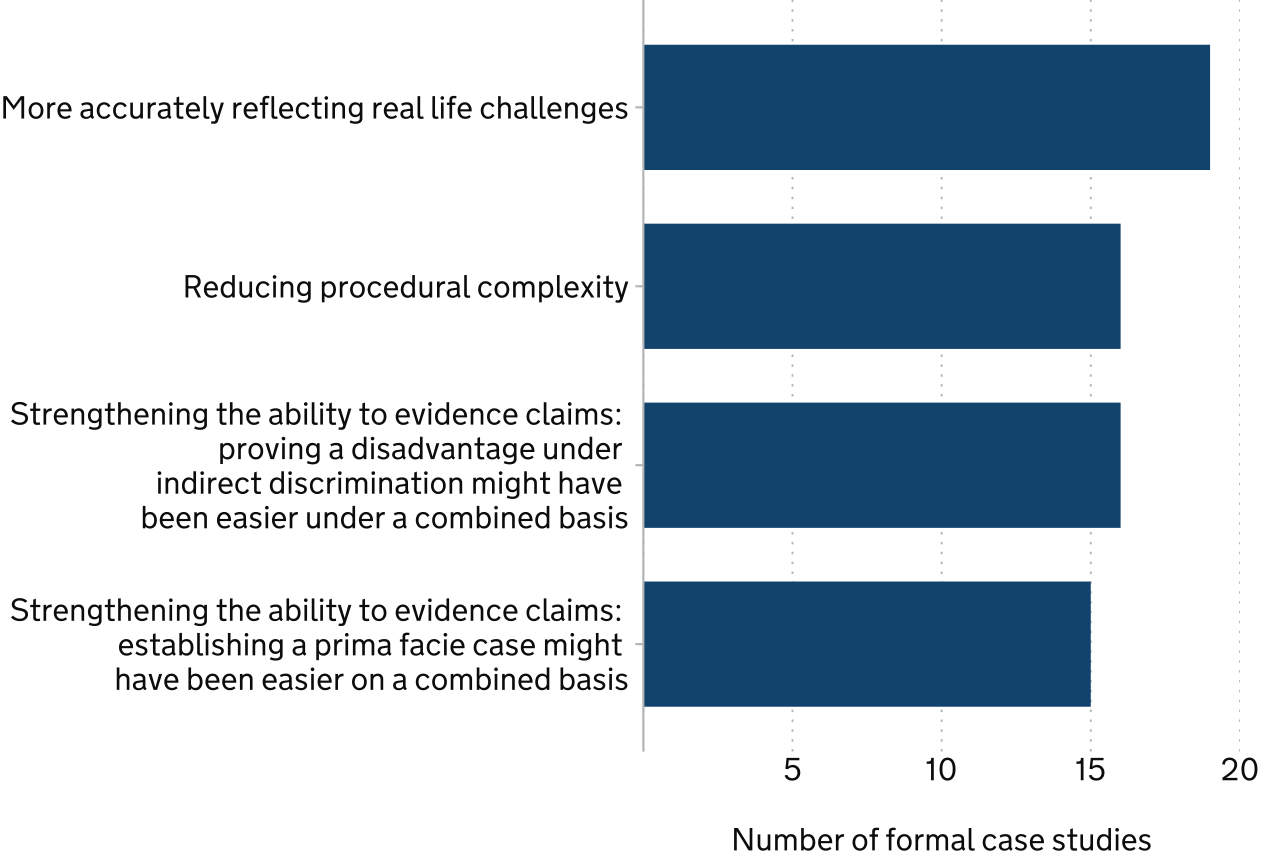
This finding was echoed in lived experience interviews [LE003, LE029, LE059, LE069, LE096] where concerns were raised that existing legislation does not allow understanding of the full picture around discrimination:
“Being able to take a combined discrimination case would benefit people, especially if they can talk about bullying, harassment, that would paint that picture of someone’s real life experience.” [LE059]
“That would help quite a bit in terms of understanding the sort of the interplay between [protected characteristics] because they’re not siloed.” [LE096].
7.1.2 Strengthening the ability to evidence claims
By enabling better reflection of the lived experiences of claimants, section 14 could strengthen a claimant’s ability to argue that a pattern of discriminatory treatment constitutes a continuing act, therefore mitigating challenges surrounding time limits, and strengthen their ability to meet evidentiary thresholds [F5, F19, F24, F22, F25]. This would address a significant barrier to seeking redress outlined as part of this research.
Being able to bring a combined case could make it easier for claimants to link the facts of their experience to a legal claim, and to substantiate them with evidence [F6, F10, F12]. It could prevent respondents from putting forward different comparators to disprove different single-ground claims [F13]. It could therefore provide an additional safety net [LE004, LE007, LE086, LE087] for claimants in proving discriminatory treatment:
“You do get people falling through the cracks. Neither race nor disability, but it’s like our race and sex or disability and sex. It’s the combination of the two” [LE007].
Section 14 could strengthen protection and ensure that the system works for the most vulnerable in society [LE099].
7.1.3 Raising awareness of combined discrimination
One of the most common challenges identified by this research is a difficulty with understanding and identifying treatment as combined discrimination. This challenge was raised in the lived experience research [LE008, LE024, LE025, LE029, LE069] and suggested by very limited mention of combined discrimination by potential claimants in informal case studies [none but IF7, IF13, IF14].
Having awareness of a potential route to challenge discrimination on the basis of a combination of protected characteristics could empower more people to identify and call out this treatment [LE006, LE007, LE009]: “It might open people’s idea up to the fact that they might have more rights because of that” [006]. Options to achieve this goal include guidance which raises awareness of combined discrimination and clarifies how combined discrimination claims can be brought.
7.1.4 Reducing procedural complexity
Combined discrimination claims could also, in the longer term, reduce procedural complexity by reducing the need for extensive case management as claimants may more easily translate their experience into one single legal claim, and may require fewer amendments over the course of the claim [F4, F5, F10, F12, F19, F27]. However, until the use of section 14 is embedded, there is likely to be an increase in procedural complexity as judges and practitioners become familiar with its parameters. See 7.3.1 for more detail.
Note that combined discrimination claims can currently be pleaded as separate heads within a single ET1 claim form. These are distinct sections applying the law to the facts. For example: Head 1: Direct Race Discrimination (applying the facts to why an individual was treated less favorably because of their race), Head 2: Direct Sex Discrimination (applying the facts to why an individual was treated less favorably because of their sex).
7.1.5 Increasing accountability
This research also reveals that potential respondents to claims do not necessarily have the awareness or understanding to identify intersectionality, nor policies in place to specifically address and prevent it [LE049, LE084]. For potential claim respondents, commencing section 14 could therefore increase visibility and accountability for employers and service providers, pushing them to think about intersectionality and how this can compound disadvantage:
“It holds employers to account in ways that they aren’t currently aware or got their mind on” [084]
7.2 Limitations of commencing section 14
7.2.1 Limited scope of section 14
Section 14 in its current uncommenced form limits the formal legal recognition of combined discrimination to experiences involving direct discrimination and a combination of 2 protected characteristics (‘dual discrimination’). The findings in this report indicate that claims of indirect discrimination and harassment are present in a significant number of combined claims and that a significant number of combined claims involve more than 2 protected characteristics.
Moreover, as Lady Hale said in Naeem v Secretary of State for Justice [2017] UKSC 27, indirect discrimination aims at achieving a level playing field, where people sharing a particular protected characteristic are not subjected to requirements which many of them cannot meet and which cannot be shown to be justified. This concern is particularly relevant in cases which involve a combination of multiple vulnerabilities.
For section 14 to be fully effective in addressing the lived realities of combined discrimination, its scope would therefore ideally be extended beyond 2 characteristics and expanded to include indirect discrimination and harassment. Otherwise, it risks preventing those experiencing combined discrimination on the basis of 3 or more characteristics (12% to 17% of reports of multiple discrimination), and those experiencing non-direct combined discrimination (roughly 45% of reports of multiple discrimination) from reflecting their lived experience.
7.2.2 Section 14 not addressing significant challenges
In many cases of combined discrimination, if section 14 were commenced, claimants would continue to face significant challenges in meeting the evidentiary threshold and navigating procedural barriers [F5, F8]. The grounds-based model in discrimination law will still restrict a holistic framing of the discrimination. This finding was supported by lived experience interviews [LE017, LE084, LE086, LE093]:
“I don’t know what changes that a judge could make, or legislation could make, to make that easier because ultimately, the difficulties are the same in terms of proof, putting forward their cases.” [LE017]
The commencement of section 14 may even enhance the complexity of procedural barriers in the – see 7.3 for more detail.
This research outlined a number of routes that can already be taken for people to seek redress, with individuals from support services questioning the need for the commencement of section 14 [LE003, LE004, LE006, LE091, LE086, LE049]:
“I know there’s some cynicism amongst some of my more experienced colleagues in the employment law world as to how that’s going to actually work in practice and whether it’s actually needed” [LE006]
A number of interviewees shared the reflection that the most effective change would be ensuring appropriate support is in place to help people navigate the existing system and access the existing legislation to challenge discriminatory treatment [LE003, LE022, LE086, LE093, LE010, LE015, LE017, LE087, LE099]. Section 14 in isolation would not address the structural inequality in legal awareness and access to support structures [F6, F15].
“I don’t think the current regime is ineffective in terms of the legislation, it is more that the support is ineffective” [LE086]
“It’s great that these things are being levelled up, but if there’s not the right advice, there’s not the right enforcement. You know, if people don’t feel empowered to take their cases on, then the potential for positive impact of this legislation is ultimately hindered.” [LE015]
“[Challenges people face are] extremely complex and multidimensional. It’s not going to be resolved by a magic wand and a piece of legislation which automatically puts things right… rather than tick-box, long, protracted procedures of reporting and analysing” [LE022]
Suggestions from lived experience about other ways to improve the existing system are outlined in section 7.3 of this report.
7.2.3 Other
A further consideration is around identifying the level of compensation that would match the unfavourable treatment:
“What is the appropriate level of damages for injury to feelings doesn’t work on the basis of totting up how many types of discrimination you managed to get into the claim.” [LE010]
7.3 Potential risks of commencing section 14
7.3.1 Risks of adding complexity to an already complex system
Some interviewees spoken to were concerned that commencing section 14 would make the process even more difficult to navigate, especially for individuals representing themselves [LE006, LE022]:
“It worries me because the rules around claim forms and time limits are so strict on claimants.” [LE006]
“I think it’s just really important that whoever is taking this and looking at this just bear in mind how complex this is for your average person to access at all.” [LE006]
Commencing section 14 might introduce complexity with regards to conflicting legal tests for different protected characteristics, especially for any cases including disability, for example [LE004, LE084]:
“If you try to bring in another protective characteristic under that claim, it would be difficult for it to slot in because it doesn’t get shown in the same way” [LE004]
A claimant would potentially have to meet different standards for justification within one claim.
The process could also be made more complex with regards to finding a suitable comparator, with hypothetical comparators being of limited use for establishing a case. It is important to consider how section 14 would affect the available pool of comparators for claimants experiencing combined discrimination and to reflect on the application of section 23 for section 14 claims.[footnote 9]
7.3.2 Burden on employers and service providers
While the commencement of section 14 is unlikely to lead to entirely new categories of claims, it would introduce a statutory mechanism for recognising combined discrimination. This may require employers and service providers to adjust how they understand and respond to discrimination complaints, particularly as no potential respondents in the sample said they currently had a dedicated policy for combined discrimination.
These adjustments may involve costs, especially in the short term. However, they also offer an opportunity to raise awareness of how discrimination can operate across multiple dimensions, and to develop more inclusive and effective processes for preventing and responding to such complaints.
There could also be challenges around the levels of compensation respondents may need to pay [LE004, LE087, LE091] which could expose employers and service providers to more risk:
“Could we get to a world where if an employer is found to discriminate against an employee on the basis of various different characteristics, does that mean the compensation or the liability should be larger because the harm is more severe?” [LE087]
7.3.3 Risk of claimants trying to bring the wrong type of claim
Case study analysis indicated that claimants can sometimes fill out claim forms in a way that does not accurately reflect the claim they’re trying to bring [F1, F19, F21]. If section 14 was commenced, some claimants may not be aware of the definition of combined discrimination when filling out a claim form and may try to bring both a combined claim and a single-ground claim.
Others may pursue a combined discrimination claim where the underlying issue does not meet the legal criteria, for instance, where the experience is more accurately understood as additive or sequential rather than intersecting discrimination. In these cases, taking a combined discrimination claim rather than focusing on the strongest of the single protected characteristic claims might weaken a claimant’s chances of redress. Some claimants might also choose to take a combined discrimination case where one of the characteristics does not fall within the definition under the Equality Act. This could be where a condition does not meet the statutory threshold for disability, for example.
These scenarios could increase the need for early and active case management and may, in some cases, negatively affect the claimant’s chances of success if the legal basis for the claim is not correctly framed.
7.3.4 Risk of claimants choosing to bring weaker claims
If section 14 is commenced in its current form, claimants will only be able to bring combined claims in relation to direct discrimination. The lived experience research indicates that those who have experienced combined discrimination may strongly value the opportunity for the intersectional nature of their lived experience to be accurately represented in their claim. It’s possible that some claimants who experience combined discrimination may have a stronger indirect or harassment claim, but may choose to focus on a claim of direct discrimination as it more accurately reflects their intersectional experience.
7.3.5 Risk of procedural challenges
Some interviewees have raised concerns that commencing section 14 could complicate litigation. It could potentially “muddy the waters” or lead to inconsistent rulings and an additional burden on courts, particularly during the initial phase of implementation [LE006, LE022, LE035, LE086, LE087]:
“In reality, it probably will open more questions and Pandora’s box” [LE022]
There may be increased demands on case management as courts and tribunals adjust to the new legal category and as judges and practitioners become familiar with its parameters [087]. This is likely to add to an already high burden on courts, regarding how claims should be framed, whether and when additional grounds can be added, or which comparators are appropriate.
7.3.6 Mitigations to identified risks
To mitigate some of these risks, targeted guidance with illustrative examples as well as updated claim forms could accompany a potential commencement of section 14. This may be used as an opportunity to improve the claim form so that claimants provide appropriate information. It should be noted that improved guidance on bringing claims with illustrative examples would also be helpful if section 14 was not commenced.
Training and clear instructions for advice providers and support services would be equally important, as these actors often assist claimants in formulating their legal claims. For example, an interviewee from the potential claim respondent sample reflected on how they were eager to do the right thing, but they were waiting on the release of guidance, particularly around new legislative change:
“There’s no one to tell us if we’re right and wrong until you get to a judge.” and “I think the time spent on the guidance should be as much time spent on the legislation to make sure the guidance is as foolproof as it could be” [LE097]
Mediation and improved early conciliation mechanisms may help to resolve and/or clarify disputes at an earlier stage, reducing the burden on tribunals. Note that concerns around early conciliation feeling like a “tick-box” exercise would need to be addressed for this to be effective.
Finally, tribunals themselves may require updated presidential guidance[footnote 10] and training to manage combined discrimination claims efficiently and consistently.
Main findings
Section 14 could strengthen claimants’ ability to bring claims of direct discrimination and enable a more accurate legal articulation of their lived experience, by more accurately recognising combined stereotyping or facilitating the proving of compounded disadvantage. However, there are potential difficulties with conflicting legal tests for different protected characteristics and potential challenges with identifying appropriate comparators.
The current scope of section 14 only covers direct discrimination on the basis of 2 protected characteristics. This research shows that combined discrimination can occur in other forms, suggesting that section 14 would be likely to be more effective if its scope were extended to cover more than 2 protected characteristics as well as indirect discrimination and harassment. > Several of the barriers identified in this report, particularly those arising at the early stages of the complaint process or stemming from contextual factors, would not be addressed by commencing section 14 alone. In fact, some support organisations think that legislation would not significantly improve a claimant’s ability to seek redress given these barriers, and that improved support to claimants is needed instead. > Improved guidance on bringing discrimination claims on the grounds of more than one protected characteristic accompanied by illustrative examples would be helpful regardless of whether section 14 was commenced or not. > Commencing section 14 could risk adding complexity to an already complex system, bringing procedural challenges and increased demands on case management during the initial phase of implementation, and bringing the difficulties described above with regards to comparators and conflicting legal tests. There are also risks that claimants may choose to bring the wrong type, or weaker claims in an attempt to reflect their experience. > Additional measures to support the commencement of section 14 would be necessary to mitigate potential risks for claimants. If section 14 is commenced, it should be ensured that training and guidance provided is sufficiently accessible, actionable and targeted to enable claimants to bring the strongest possible version of their claims.
7.3 Other steps to remove barriers to redress
This research identified a number of suggestions across all interviews on what could be done differently in the system to better support individuals experiencing combined discrimination and discrimination more broadly:
7.3.1 Education and training
More education and training available to employers and service providers [LE004, LE007, LE014, LE017, LE022, LE035, LE067, LE084, LE087, LE091, LE093, LE094, LE095, LE097, LE101, LE105], noting that this should be viewed as as much of a priority as other training such as health and safety [LE087].
The following topics were suggested:
-
unconscious bias, and how people with multiple protected characteristics are already at a disadvantage
-
specific training on disabilities, especially ‘non-visible disabilities’ such as ADHD and dyslexia [LE024]
“It’s really understanding that the employee who may feel discriminated against is already in the negative because of the system that is in place essentially” [LE008]
More education to individuals regarding their rights and the routes to support when seeking legal redress [LE024, LE029, LE033, LE035, LE051, LE067, LE093, LE103, LE104], in schools or in employer inductions [LE051].
Increased guidance on existing routes for support for people experiencing discrimination and signposting to these services [LE016, LE045, LE103], ensuring guidance is given in an accessible way [LE033, LE057, LE097, LE103]:
“Organisations like Acas are great, but unless you know it’s there, you don’t know it’s there” [LE103]
Development and distribution of more guidance on settlements and NDAs, to arm individuals on the effects of these [LE014, LE043].
More of an open or ongoing discussion between employers who want to get it right and stakeholders such as enforcement agencies, Unions and other support organisations [LE006, LE022].
7.3.2 Requirements for employers and service providers
Mandation of training for managers, particularly around having difficult conversations, line management, and policies and processes in place within an organisation, as well as making sure these policies are accessible to those who will be using them [LE017, LE040, LE094, LE095, LE101]:
“People management itself is a skill. So all managers need to be equipped to deal with different situations” [LE094] and senior leadership [LE106]
More transparency from employers [LE010, LE022, LE051, LE059, LE087], for example around the number of settlements they are involved in to increase accountability [LE087].
Exploring further opportunities to embed awareness and recognition of combined discrimination, for example through requirements for workforce monitoring and action planning.
Further enforcement of employers not doing the right thing, in the form of inspections and fines [LE006, LE007, LE010, LE015, LE022, LE045, LE051, LE084, LE086, LE087, LE091, LE093, LE099, LE103]. This could take the form of establishing an independent body to push for more accountability of employers [LE045] or increasing the reach or influence of existing bodies [LE087, LE096]:
“If they can disengage […] they’re going to” [LE006]
“having the EHRC being able to look at things on an employer by employer basis would remove some of that tension” [LE022]
7.3.3 Other suggestions
Exploring the expansion of free legal support [LE055, LE093, LE099]:
“So it’s about funding the people to do the work to get the structures in place and there’s no funding.” [093].
Providing earlier support, for example in completing ET1 forms or providing emotional support to those experiencing discrimination [LE045, LE050, LE059, LE084]. This could be enhanced by more support for specific groups to ensure equal access to the existing legal system:
“If these protections are only seen for people who’ve got a certain amount of money or can understand the system, they therefore become worthless for everybody else” [LE099]
Improvements to the current legal process:
- encouraging more early discussion and increasing opportunities around mediation [LE041, LE049, LE059, LE095, LE096]:
“At the end of the day, this is about people talking to each other” [LE095]
“Is there something or more that can be done legally to try and resolve the issue before going to tribunal, which reduces the costs?” [LE059]
-
for education, make universities subject to the first tier tribunal (Special Educational Needs and Disability)[footnote 11] [LE096]
-
increasing the time limits for bringing claims to employment tribunals so employees have more time to work with employers through internal processes [LE070]
-
reducing the time taken for a case to go through the tribunal [LE049] and addressing the tribunal backlog [LE052, LE097]
-
exploring the strengthening of the PSED
-
improving access to justice in the county court system, for example through cost reductions, simplified procedures, or specialist discrimination support
Sector-specific considerations:
- for education, extend the powers of the Office of the Independent Adjudicator to handle discrimination [LE096, LE104]:
“It’s sort of just paying lip service at the moment” [096]
-
make universities subject to Education, Health and Care Plans[footnote 12] [096]
-
exploring reforms to the mandates of the Housing Ombudsman and Parliamentary and Health Service Ombudsman services
7.3.4 Spotlight opportunity: potential re-introduction of the statutory discrimination questionnaire procedure
This research found that high evidentiary burdens represent a significant and recurring barrier for claimants. Responses to complaints and disclosure of relevant information often come late in the process [F6, IF17], if at all [F26, IF6, IF7, IF9], exacerbating procedural and legal challenges. Although claimants theoretically have a right to request information from employers and service providers through an informal question-and-answer process before initiating a formal grievance, this mechanism was rarely mentioned by participants in interviews and case studies. This suggests limited awareness or use in practice.
Some support organisations expressed interest in reintroducing a formal procedure with a clear enforcement mechanism similar to the statutory discrimination questionnaire previously provided for in section 138 of the Equality Act. Given the evidentiary challenges documented in this report, reintroducing a more structured process would likely assist claimants in understanding the basis of their treatment earlier and in making informed decisions about how to proceed.
A more targeted investigation would be valuable to assess how such a mechanism might operate in practice and what kinds of procedural safeguards would be necessary to ensure fairness for all parties. These could include clear expectations around timing, a duty to respond, and the possibility of drawing adverse inferences where no adequate response is given.
Main findings
Other steps to remove barriers to redress for those experiencing combined discrimination include improved education of employers and service providers, for instance regarding combined discrimination, mandatory training for managers, and improved guidance on routes to support for individuals experiencing discrimination.
Some support organisations also expressed interest in reintroducing a formal procedure with a clear enforcement mechanism similar to the statutory discrimination questionnaire previously provided for in section 138 of the Equality Act, as this would likely assist claimants in understanding the basis of their treatment earlier and in making informed decisions about how to proceed.
8. Recap of insights and concluding remarks
This research has sought to understand the prevalence of combined discrimination complaints or claims, understand how claims are currently being taken forward, and explore the barriers in seeking redress.
This research suggests that between 12% and 16% of discrimination claims and complaints feature more than one protected characteristic, and that between 2% and 6% feature combined discrimination.[footnote 13] These experiences of combined discrimination are not simply additive, but intersect in ways that produce distinct discrimination faced by individuals. While direct discrimination remains the most common, cases of harassment and indirect discrimination are also prevalent.
Claimants who have experienced combined discrimination typically get advised to take forward a case on the basis of a single characteristic, leading with their strongest claim.[footnote 14] However, many claimants are actively trying to reflect the intersectional experience of discrimination in legal terms through other means, by bringing multiple claims involving multiple protected characteristics or by choosing an alternative legal route, such as PSED or a claim under human rights law. Many claimants who try to bring claims that reflect their experience of combined discrimination face challenges in the process, as long lists of claims often require extensive case management and alternative legal routes can be procedurally complex.
Lived experience accounts underscore the emotional and psychological toll of experiencing and challenging combined discrimination. People with lived experience of combined discrimination report often struggling to identify which part of their identity caused the unfair treatment. This ambiguity leads to self-doubt and fear of not being believed. Participants described feelings of being misunderstood or pressured into accepting informal resolutions, such as settlements coupled with non-disclosure agreements, which limit transparency and accountability.
Challenges to seeking redress include difficulties linking lived experiences of discrimination to legal grounds, procedural and evidentiary challenges, particularly without legal representation, and broader difficulties in navigating the process, including fear of retaliation, lack of accessible support, cost, and discouragement from employers or peers.These challenges can be particularly acute for those with intersecting vulnerabilities such as insecure immigration status, caring responsibilities, or socioeconomic disadvantage.
While many of these challenges, particularly regarding navigating the grievance and internal processes, would be faced in any discrimination case, the difficulty of linking experiences to legal grounds and evidencing these grounds may be exacerbated in cases of combined discrimination.
Employers and service providers reported seeing an increase in the complexity of cases brought against them in recent years, for example referencing more than one protected characteristic. They generally reported not having policies specific to combined discrimination, and often lacked understanding of intersectionality and its practical implications in the workplace or service delivery. A small number of organisations talked about policies or procedures being changed in response to the claims they see or legal cases that arise [049, 067, 094], and suggested policies may be adapted should section 14 be commenced.
Section 14 could bring benefits in terms of providing formal legal recognition for combined discrimination claims, thereby empowering people’s ability to articulate and evidence them, while also raising awareness about combined discrimination among employers and service providers. Limitations remain, however, with the current draft only applying to direct discrimination and dual characteristics, excluding indirect discrimination and harassment, which are prevalent in many of the combined claims outlined here. If section 14 were to be commenced in its current form, it is possible that some claimants with a stronger indirect discrimination or harassment claim may, instead of taking these claims forward, choose to focus on a section 14 claim of direct discrimination because it would more accurately reflect their intersectional experience. The result would be that they would bring a weaker claim.
Section 14 could also bring potential risks of added complexity and procedural challenges, particularly surrounding claimants bringing both combined and single-ground claims, conflicting legal tests for different protected characteristics, and challenges with finding appropriate comparators. If it were to be commenced, it must be supported by robust efforts to provide clear guidance for all relevant parties, ensuring that the tools exist not only to use the legislation, but to understand when and how it applies, to mitigate some of these risks.
Moreover, commencing section 14 alone is unlikely to resolve the deeper structural and procedural barriers identified throughout this research. Without sufficient support, awareness, and cultural change, claimants may continue to struggle to achieve redress, regardless of legislative changes.
-
Note that it is possible that claimants would still be advised to lead with their strongest single-ground claim were section 14 to be commenced, particularly initially as judges and practitioners become familiar with its parameters. ↩
-
Protecting Minority Rights: A practical guide to developing comprehensive anti-discrimination legislation, co-published by the UN and the Equal Rights Trust, 2023 ↩
-
Although this rationale was not explicitly discussed in this research, support organisations recognised that there were ways for claimants to put claims forward – see section 4 for more detail. ↩
-
Noting that judgement has been used to identify cases. See section 3. Prevalence of combined discrimination complaints or claims for more detail. ↩
-
Literally, phenomenology is the study of “phenomena”: appearances of things, or things as they appear in our experience, or the ways we experience things, thus the meanings things have in our experience. ↩
-
The database only includes courts or tribunals with jurisdiction in England and Wales, Scotland, Northern Ireland, or UK-wide ↩
-
This mirrors at a high-level the split between cases which were assessed to be combined discrimination (47%), and the cases which were assessed not to be combined discrimination (53%), when looking at the total cases for which a judgement could be made. ↩
-
A group of 25 members or more which regulates admissions using rules and a selection process (see appendix section 6 for definitions). ↩
-
Section 23 of the Equality Act 2010 covers comparison of circumstances when providing evidence for a discrimination claim. On section 14, it currently states that on a comparison of cases there must be no material difference between the circumstances relating to each case. ↩
-
Guidance issued by presidents of the Employment Tribunals to support employment tribunal proceedings. ↩
-
The Tribunal currently responsible for handling appeals against local authority decisions regarding special educational needs ↩
-
An education, health and care (EHC) plan is for children and young people aged up to 25 who need more support than is available through special educational needs support. EHC plans identify educational, health and social needs and set out the additional support to meet those needs. ↩
-
Noting that, as set out in section 2.5 Limitations, this may be an underestimate as claimants experiencing discrimination on the basis of multiple protected characteristics may be advised to, or choose to pursue a claim of discrimination on the basis of only one characteristic in court and may not mention other relevant protected characteristics in their formal claims or complaints. ↩
-
Noting that it is possible that claimants would still be advised to lead with their strongest single-ground claim were section 14 to be commenced, as judges and practitioners become familiar with its parameters. ↩