Cladding remediation unit costs: analysis of high-rise and mid-rise non-ACM buildings
Published 19 December 2025
Applies to England

© Crown copyright 2025
This publication is licensed under the terms of the Open Government Licence v3.0 except where otherwise stated. To view this licence, visit nationalarchives.gov.uk/doc/open-government-licence/version/3 or write to the Information Policy Team, The National Archives, Kew, London TW9 4DU, or email: psi@nationalarchives.gov.uk.
Where we have identified any third party copyright information you will need to obtain permission from the copyright holders concerned.
This publication is available at https://www.gov.uk/government/publications/cladding-remediation-unit-costs-2025-analysis-of-non-acm-buildings/cladding-remediation-unit-costs-analysis-of-high-rise-and-mid-rise-non-acm-buildings
Introduction
This release publishes the annual update on unit costs, defined as cost per m2 of cladding remediated. It builds on the December 2024 publication, expanding the cost data from high-rise (18m+) non-ACM buildings and adding a new data set from mid-rise (11-18m) non-ACM buildings. It provides information on the mean unit cost, analysis against area remediated (m2), and an elemental unit cost breakdown into key cost categories, from which an understanding of significant cost drivers can be achieved.
The purpose of this release is therefore to:
- inform building applicants and their cost consultants as to the expected range of market price levels they could expect when remediating their building;
- in doing so, strengthen their hand in achieving value for money through negotiation with the remediation supply chain;
- support new entrants to the remediation supply chain by increasing their understanding of remediation costs and cost drivers; and
- inform the public on the unit costs of remediation.
The cost data in this release supports applicants and their cost consultants in predicting remediating costs and provides contractors with additional information to refine and evidence their estimates. Since the 2024 publication, applicants and their cost consultants have started to use this data to justify project costs in their applications for grant funding. We will continue engaging with building owner applicants, industry cost consultants and suppliers to confirm its usefulness and identify further valuable aspects for inclusion in future releases.
In presenting this data it is important to highlight that unit costs across construction portfolios tend to naturally vary due to factors such as building location, building access, cladding type, area of remediation and the scope of works. Unit costs will therefore also vary over time given the average profile of buildings (for example the m2 of cladding needing to be remediated) which are added to the dataset may well be different to the average profile of the earliest projects. Nonetheless, the release of unit cost data can still provide a valuable guide concerning whether an individual project should tend towards the mean or be recognised legitimately as an outlier. This data will therefore be used by MHCLG to benchmark the costs put forward by applicants for grant approval, and it is expected that in most cases costs will be in line with the dataset. Outliers will attract additional scrutiny, interrogation and challenge before any approval can be given.
This data does not remove the obligation that applicants have to ensure value for money. Competitive tendering remains the expectation, and this data is designed to help the applicant during that process.
Headlines
For this data release the cost data is from projects that have had funding approved between 2020 and June 2025. The mean cost of remediation (when excluding outliers) is £1,843 per m2 cladding remediated and the expected cost range is between £743 and £2,943 per m2 (Q2 2025 prices).
Whilst building location, height and other factors do have an impact, the strongest determinant of unit cost is the area of cladding that is being remediated. Buildings with smaller areas of remediation have a higher unit cost than projects with larger areas of remediation. As a result we are able to combine the high-rise and mid-rise data sets to provide an overall set of results driven by cladding area remediated.
Unit costs range from a mean of £2,656 per m2 (2024 publication: £2,386) cladding remediated for buildings with less than 500m2 cladding remediated, down to £1,318 (2024: £1,194) for buildings with more than 5000m2 of cladding remediated. This is typically due to economies of scale, where remediating larger cladding areas is more cost efficient than smaller cladding areas.
The largest single elemental cost is the removal and replacement of cladding (43% of the total cost, 2024: 44%), with an expected cost range of £373 to £1,299 per m2. The range is due to variance in the scope of works, which can range from remediating part of the cladding to replacing the complete facade and structural fixings. An increase in the scope of works will also have a knock-on effect of increasing the amount of professional fees, contractors’ preliminaries (site establishment and running costs) and overheads and profits (OH&P).
Through comparison with the 2024 publication (Q2 2024 prices) and this publication (Q2 2025 prices) annual changes in unit cost can be obtained. The average change in unit cost for like for like cladding areas is +8.0%, 5.6% above general construction price inflation.
The dataset changes between the 2024 and 2025 publications have increased the weight of projects significantly towards those approved since January 2024, through the inclusion of data from the Cladding Safety Scheme (CSS). We have also observed a set of cost drivers which would particularly impact remediation in the past 1 to 2 years. These mostly one-off impacts, along with the change in weighting of projects across years, has resulted in the difference to the prior publication.
The cost drivers observed , including one-off impacts, are:
- General construction inflation (BCIS Tender Price Index) is based on the whole construction market which includes all construction activity. Remediation is a subset of this activity and is particularly exposed to the higher-than-average cost increases affecting work on existing buildings. The following points demonstrate these impacts.
- Following the Building Safety Act 2022, high-risk building works (18m+) including remediation projects are now subject to enhanced safety scrutiny at both the design and construction stages. Applicants must demonstrate how their designs comply with building regulations through the BSR’s gateway process.
This represents a relatively recent and significant shift in building safety regulation and may require markets to account for increased levels of design needed to achieve regulatory approval in their upfront pricing.
- Employers National Insurance increase in April 2025 is now factored into costs.
We continue to monitor these, and any other factors resulting in cost changes and seek to mitigate increases whenever possible.
Furthermore, the cost data presented is specific to cladding remediation projects and not readily comparable to data from other sectors whether within the public or private sector. Cladding remediation projects:
- progress multiple trades concurrently, attracting higher preliminaries and professional fees,
- often perform works while residents continue to occupy the building,
- can have specific costs such as invasive surveys, alternative resident parking and access, and legal fees for dealing with commercial leaseholders / tenants.
Background
As a result of government action, all residential buildings above 11 metres in England now have a pathway to fix unsafe cladding, through either a taxpayer-funded scheme or developer-funded scheme. Where developers or building owners are not currently funding cladding remediation, the government has committed £5.1 billion to ensure that people are safe and feel safe in their homes.
Four remediation schemes are underway:
- The Private Sector & Social Sector ACM Cladding Remediation Funds: which have been open since 2018 and cover buildings with the most dangerous type of cladding like that on Grenfell.
- The Building Safety Fund (BSF): first opened in 2020 for buildings over 18 metres with other forms of unsafe cladding.
- The Cladding Safety Scheme (CSS): launched in July 2023, helps to fix buildings between 11 and 18 metres tall, and is accepting new applications for buildings over 18 metres.
- Developers have now assumed direct responsibility for remediating all life-critical fire safety defects in more than 2,000 buildings.
In 2024 we reached the point where a highly representative and comprehensive data set from the BSF was available for cladding remediation projects, which was analysed to create a comprehensive cost per m2 of cladding remediated benchmark and made publicly available.
This data provides insights for building owner applicants and their cost consultants, who benefit from a programme-wide view and a better understanding of outlying projects and cost drivers. This also enhances our ability to assess the value for money represented by each individual project.
This publication provides an updated set of benchmarks using the latest available data. The BSF (18m+) dataset has been updated up to June 2025 and new data from the CSS (18m+ and 11-18m) has been added, including projects with funding approvals between February 2024 and June 2025.
All cost data has been adjusted by inflation indices to be in line with price levels in June 2025. It should be noted that during the period 2020 to 2025 the remediation market has been maturing within a changing market context. The efficiency of remediation delivery will have been subject to market effects caused by external factors such as geopolitical events and fluctuations in the availability of materials. Government has sought to help minimise the impact of these factors, while also supporting the introduction of PAS 9980 to ensure the fire risk assessment of external wall systems is both proportionate and consistent in terms of remediation outcomes.
To Note
There are several important points to note prior to reviewing, analysing, or using the data in this data release:
1. All project cost figures are from the funding awarded to individual projects as part of the Building Safety Fund and Cladding Safety Scheme. The data in this data release is therefore a mix of high-rise (18m+) and mid-rise (11-18m) non-ACM buildings.
2. All unit cost figures shown in this release exclude:
a. VAT, as this is considered a percentage uplift on various cost items, and not all items are eligible for VAT.
b. Contractor contingencies and any variations to the original cost of works, as projects are still ongoing and therefore variations and contractor contingencies could still be raised and realised.
3. 498 projects have been analysed for this data release, where costs were approved by MHCLG or Homes England between November 2020 and June 2025. The Building Cost Information Service (BCIS) Tender Price Index (TPI) has been used to normalise costs; all costs have been adjusted accordingly to be in line with price levels at June 2025.
4. Results have been separated out by cladding remediation area groups (e.g. 500m2 to 1000m2) so that changes in cost outcomes related to remediation area can be observed.
5. Outlying projects have been removed from the analysis (except where stated). Outliers were identified using the 1.5x interquartile range method (costs above the 75th percentile plus 1.5x the interquartile range, or costs below the 25th percentile less 1.5x the interquartile range). Outliers were identified for each area grouping separately.
6. Outliers are due to various factors (e.g. difficult access or complex cladding makeup) and have been removed to give a more representative analysis.
7. This release documents the range of expected costs. The range is defined as the mean cost plus or minus 1 Standard Deviation (all values calculated with outliers excluded).
8. Professional fees include eligible costs such as Design, Project Management, Cost Consultancy and Legal fees.
9. Preventative fire mitigation measures implemented by the remediation portfolio, such as Waking Watch Fire alarm installation and upgrades, front door upgrades etc., are excluded from the cost data.
10. This data is a significant sample size and covers a representative period such that insights and trends can be considered reliable. It has been quality assured and analysed in accordance with recognised industry-standard practice.
11. The projects analysed as part of this dataset are a mix of the CAN assessment approach and the FRAEW (Fire Risk Assessment of External Walls) approach.
12. This publication relates to grant funded work in England.
Unit Cost Overview
Through analysis of 498 high-rise applications, the mean cost and expected range of cost per m2 of remediation has been calculated (excluding VAT, contractor contingencies and variations). The results are shown Table 1.
Table 1: Mean cost per m2 cladding remediated excluding VAT, Contractor Contingencies and Variations. This includes the expected cost range (mean cost plus/minus 1 Standard Deviation, excluding outliers).
| Number of Projects Analysed | Mean cost per m2 - outliers included | Mean cost per m2 - outliers excluded | Expected range of cost per m2 |
|---|---|---|---|
| 498 | £2,077 | £1,843 | £743 - £2,943 |
Remediation Area
The overall unit cost per m2 can be viewed by area of cladding remediated to analyse the effect the area of cladding has on the unit cost. Analysis has shown that the area of cladding coverage is the biggest general determinant of cost per m2, with buildings with smaller areas of remediation having a higher unit cost than projects with larger areas of remediation. Building height was not found to be a predictor of unit cost in the 18m+ buildings, however a small cost difference was observed in access costs between 18m+ and 11-18m buildings.
Figure 1 shows the mean cost and expected range (excluding outliers) against the area of cladding remediated.
Figure 1: Projects with lower cladding areas remediated have higher and more varied unit costs
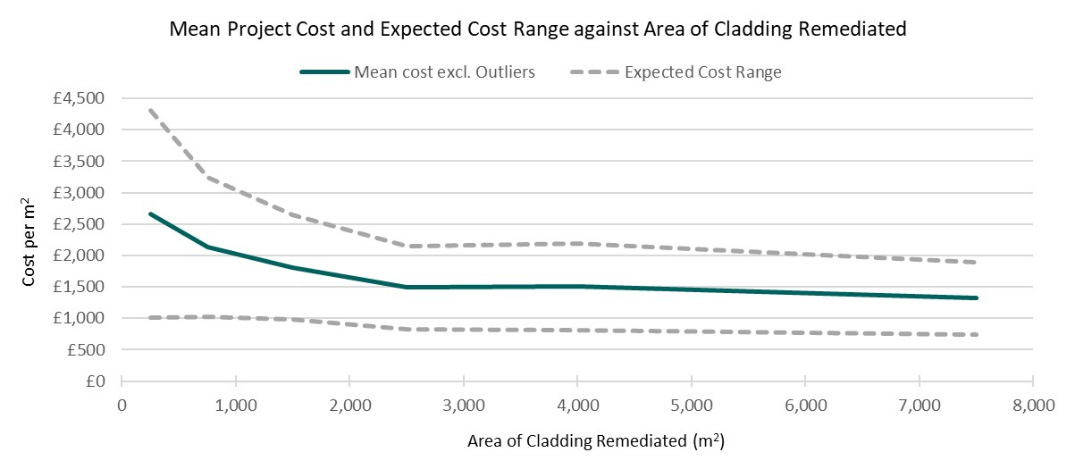
Projects with less than 500m2 of cladding have the highest mean cost per m2 of cladding remediated at £2,656 per m2, with between £1,009 and £4,303 per m2 considered the expected range. Projects with buildings with more than 5000m2 of cladding have the lowest mean cost per m2 at £1,318 with between £743 and £1,892 as the expected range.
Table 2: Mean cost per m2 cladding remediated by area of cladding, including the expected cost range (mean cost plus/minus 1 Standard Deviation, excluding outliers).
| Area of Cladding Remediated | No. of Projects Analysed | Mean cost – outliers included | Mean cost – outliers excluded | Expected range of cost |
|---|---|---|---|---|
| All projects | 498 | £2,077 | £1,843 | £743 - £2,943 |
| Less than 500m | 92 | £3,485 | £2,656 | £1,009 - £4,303 |
| 500-1000m | 76 | £2,304 | £2,141 | £1,031 - £3,250 |
| 1000-2000m | 109 | £1,919 | £1,814 | £984 - £2,644 |
| 2000-3000m | 73 | £1,527 | £1,491 | £827 - £2,155 |
| 3000-5000m | 79 | £1,544 | £1,504 | £811 - £2,197 |
| 5000m+ | 69 | £1,390 | £1,318 | £743 - £1,892 |
In addition, buildings with higher cladding areas remediated not only have a lower cost per m2 but also have a smaller cost range than those applications with less cladding coverage. This is because there is less variability in the project scope in higher area projects and exceptional cost items have lesser percentage impacts due to larger overall costs.
Elemental Unit Cost
The cost per m2 of cladding remediated can split on an elemental basis. The figure below shows the proportion of spend on each cost element. This data is the result of the aggregation and averaging of 498 projects with buildings of varying cladding coverages.
The cost of removing and replacing the cladding makes up the greatest proportion of spend (43% on average). This is primarily driven by the complexity of the cladding makeup. This is followed by Main Contractor’s Preliminaries (17%) and Access (12%), on average.
Figure 2: Spend on each cost element, including proportion of total cost. Removal/replacement of cladding makes up the greatest proportion of spend.
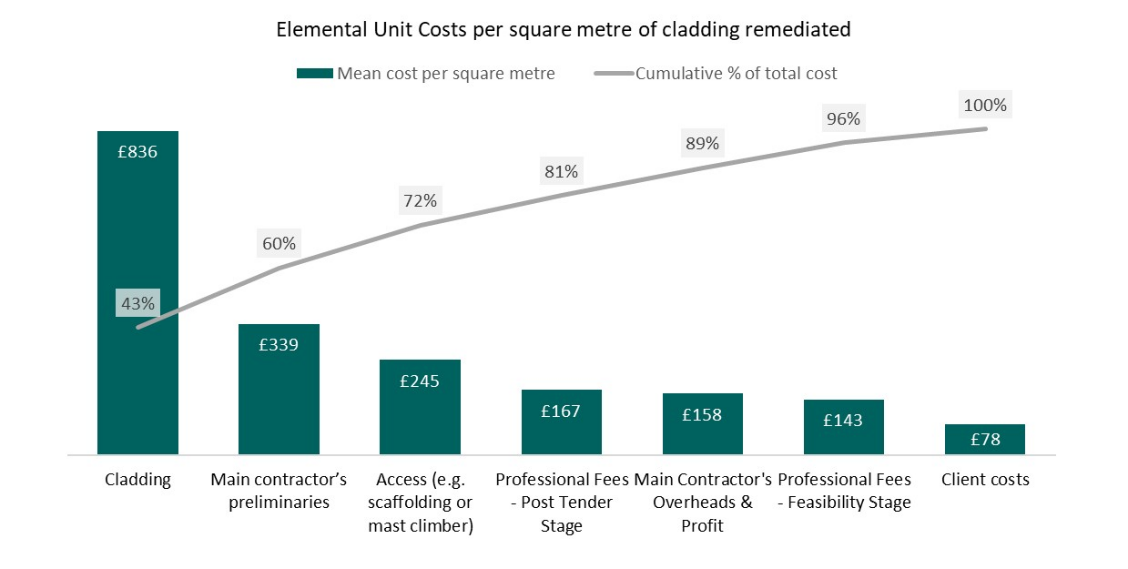
Each element can be viewed individually against the area of cladding remediated. An example is shown below for the Removal/Replacement of Cladding cost element.
Table 3: The mean cost per m2 for removal/replacement of cladding, with the expected cost range (mean cost plus/minus 1 Standard Deviation, excluding outliers).
| Area of Cladding Remediated | No. of Projects Analysed | Mean cost – outliers included | Mean cost – outliers excluded | Expected range of cost |
|---|---|---|---|---|
| All projects | 498 | £910 | £836 | £373 - £1,299 |
| Less than 500m | 92 | £1,251 | £1,045 | £349 - £1,742 |
| 500-1000m | 76 | £984 | £907 | £451 - £1,362 |
| 1000-2000m | 109 | £872 | £833 | £429 - £1,237 |
| 2000-3000m | 73 | £754 | £728 | £417 - £1,039 |
| 3000-5000m | 79 | £790 | £762 | £406 - £1,118 |
| 5000m+ | 69 | £739 | £703 | £400 - £1,006 |
Data for the other cost elements can be found in the supplementary tables referred to at the bottom of this publication.
How this data can be used
By applicants to the Building Safety Fund and the Cladding Safety Scheme, their cost consultants and cladding remediation contractors
This data allows better estimation of the cost of an individual project, to:
- empower applicants and their cost consultants in their negotiations with remediation contractors as part of the competitive tendering process,
- give additional data to contractors to support their cost estimates,
- enable preparation of more data-driven pre-tender cost plans when applying for pre-tender services funding; and
- support assessment of taxpayer value for money.
By MHCLG
The data will be used to:
- better understand the estimated cost of projects applying to the remediation funds, and to provide a benchmark as to what the overall cost range of individual projects should be,
- ensure that the level of funding provided is reasonable and in line with public funding guidelines; and
- engage with the remediation market to ensure the data meets their needs and expectations.
Accompanying Tables
See the accompanying management information tables.
The tables provide data on:
- The overall cost per m2 of cladding remediated for high-rise and mid-rise non-ACM buildings by area of cladding remediated.
- The elemental cost per m2 of cladding remediated for high-rise and mid-rise non-ACM buildings by area of cladding remediated. This data is broken down into key cost categories, including access, professional fees, contractors’ preliminaries and cost of cladding.
Further Releases
Further data will be released at periodic intervals to provide an updated dataset including high-rise (18m+) and mid-rise (11-18m) buildings.