Child Poverty Strategy: Monitoring and Evaluation Framework
Published 5 December 2025

© Crown copyright 2025
This publication is licensed under the terms of the Open Government Licence v3.0 except where otherwise stated. To view this licence, visit nationalarchives.gov.uk/doc/open-government-licence/version/3 or write to the Information Policy Team, The National Archives, Kew, London TW9 4DU, or email: psi@nationalarchives.gov.uk.
Where we have identified any third party copyright information you will need to obtain permission from the copyright holders concerned.
This publication is available at https://www.gov.uk/government/publications/child-poverty-strategy-monitoring-and-evaluation-framework/child-poverty-strategy-monitoring-and-evaluation-framework
Executive Summary
The Child Poverty Strategy will deliver long term sustainable change across the UK over the next decade. It builds on action underway across tiers of government and sectors, respecting and complementing anti-poverty work in nations, regions and localities. It represents an ambitious programme of activity across government to tackle the immediate crisis as well as addressing child poverty’s structural drivers.
This Framework outlines how we will understand whether the Strategy is on track, setting out our high-level approach to monitoring and evaluation.
In designing the approach, we are guided by the core principles of:
- tracking progress of the Strategy towards its goals
- a continued commitment to building the evidence base on what works and for whom
Both will inform delivery and future investment decisions throughout the Strategy’s ten-year lifespan to continue to target interventions most effectively on tackling child poverty.
The plans we set out here are purposefully high-level to outline the overarching Framework alongside the Strategy. Our approach to monitoring and evaluation will need to evolve and adapt as the Strategy must, reflecting the dynamic nature of child poverty and the broader social and economic factors that influence it.
We will follow up with more detail in our baseline report in Summer 2026, reflecting the further development of these plans and including updated findings from the latest poverty statistics publications.
Approach to Monitoring and Evaluation
Tackling child poverty is a complex problem with no single solution. The Strategy brings together a wide range of initiatives that cut across policy domains, delivery systems and geographical boundaries.
To capture this complexity, within the UK Government we will monitor and evaluate at three key levels:
-
Strategy level – cross-cutting view of whether child poverty has reduced
-
Driver level – more in-depth focus on what is driving observed changes
-
Policy level – which policies are contributing to observed changes
Each level will be supported by a comprehensive programme of analytical work, underpinned by a robust overarching Theory of Change (ToC). The programme of work will build on the successful approach we have taken to collaboratively develop the Strategy up to this point. We will work closely with local, regional, national, private, and third sector partners, to both develop and inform our approach.
We will collaborate across central government and with devolved governments to support and complement existing monitoring and evaluation plans. This will include understanding the impact of specific policies on child poverty alongside any wider benefits and collating relevant findings to inform the Strategy wide reporting. We will also carefully consider how to reflect regional variations in the drivers of child poverty, where measures are specific or powers are devolved.
A crucial part of our approach is the continued emphasis on including and hearing directly from children and families, to ensure a wide range of voices are considered when evaluating the Strategy’s successes and areas for development. We will also continue to be guided by independent analytical expertise to provide vital scrutiny and challenge as we further develop our plans, and as we deliver and report on the Strategy.
Theory of Change (ToC) Logic Model
Our approach to monitoring and evaluation will be guided by a robust ToC. A ToC helps to simplify complex problems and demonstrate how and why a set of actions are expected to bring about lasting change. By mapping the intended outcomes and the pathways to achieve them, it acts as a tool to track progress, test assumptions, and understand the factors driving change.
The foundations of our ToC are built on a strong and wide-ranging evidence base, including hearing directly from children, young people, families, and the people and organisations who support them. It also draws on a broad mix of research and data to understand the deeper, structural causes of child poverty in the UK. This work has helped us identify the key drivers of poverty and shaped both the Strategy itself and the thinking behind our ToC.
This stylised ToC sets out a high-level vision for the Strategy. It illustrates how the measures outlined in the Strategy (Inputs), intend to address the key drivers of child poverty (Drivers), what this is expected to achieve (Outcomes), and links to long-term goals (Impacts). It also highlights the importance of considering the wider context such as other policy changes or changes in social, economic or environmental factors which could also influence child poverty outcomes.
We have focused on outcomes rather than activities in this ToC. This reflects the long-term nature of the Strategy. Over its 10-year lifespan, specific actions may change, but the outcomes we are working towards remain central. This approach allows the ToC to remain relevant and flexible as the Strategy evolves.
To make the model easier to understand, we’ve grouped outcomes into four broad areas of change. These areas reflect the key things that need to happen to reduce child poverty in a meaningful and lasting way.
We will continue to develop this ToC in more detail alongside our monitoring and evaluation approach and will provide further detail in the baseline report. We intend for the ToC to be used as a live tool to guide what we measure and how we measure it. It will support us to identify the most important questions for evaluation, and inform areas for future policy development.
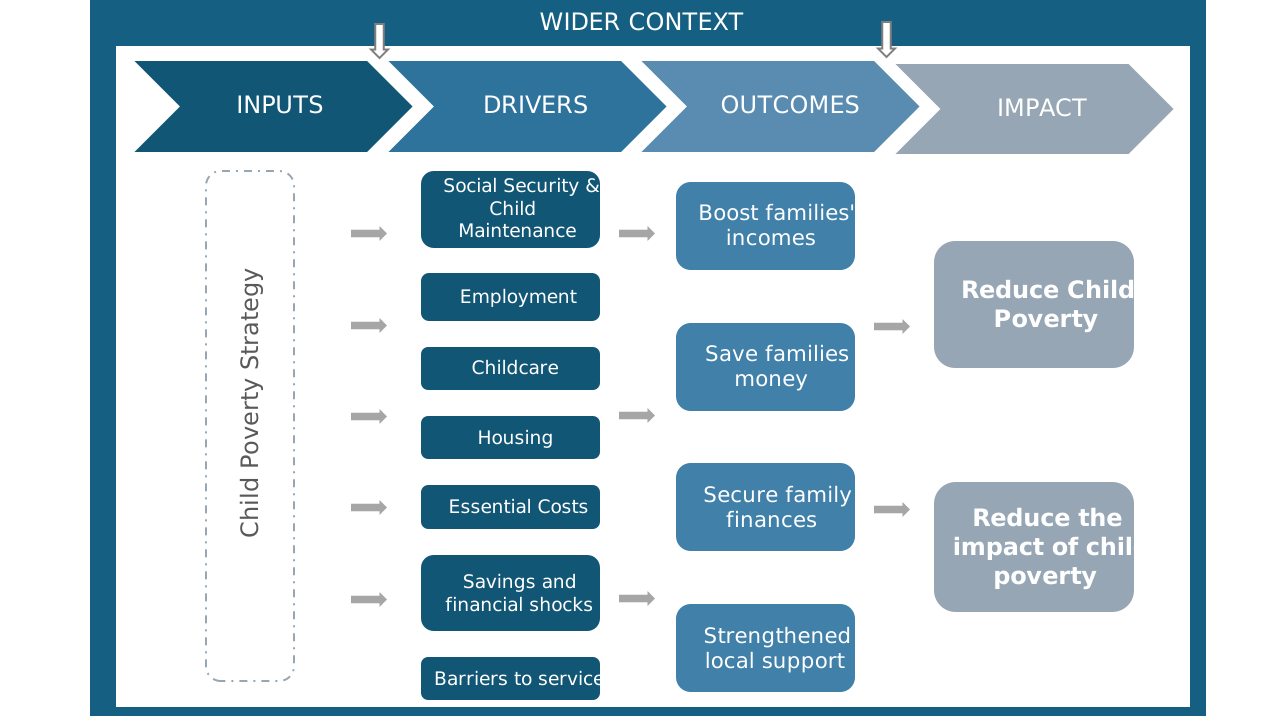
The image shows four key stages: inputs, drivers, outcomes, and impact, arranged in a vertical sequence to represent a theory of change for reducing child poverty. The columns show more detail under the four interconnected stages. Under Inputs is the Child Poverty Strategy. Under the Drivers of poverty are the themes of social security and child maintenance, housing, employment, essential costs, childcare, savings and financial shocks and barriers to services. Under Outcomes are increased family income, saving families money, securing family finances and strengthening local support. Under Impact is reducing child poverty and reducing the impact of child poverty.
Strategy Level Evaluation
The strategy-level evaluation will look at overall child poverty in the UK. It will bring together evidence and analysis from the underlying levels to establish how the full range of interventions interact and contribute to overall outcomes. This means not only identifying trends in child poverty over time but also seeking to assess the extent to which these trends are associated with actions taken within the Strategy as a whole.
Central to this is understanding the day-to-day realities of families in poverty, or at risk of falling into poverty. The evaluation will explore whether families feel any material improvements in their living standards, and whether these improvements are sustained and meaningful. It will consider how life has changed for children and their caregivers, and whether the Strategy has made a tangible difference to their wellbeing, opportunities, and resilience.
In addition to assessing outcomes, the strategy-level evaluation will examine how the Strategy has been implemented and delivered as a whole. Where possible, it will explore which factors have contributed to observed changes in child poverty and experiences of poverty, and whether there are any unforeseen barriers that have limited the Strategy’s effectiveness. This includes understanding how different components of the Strategy have interacted, how it’s been delivered across government and in local areas, and where policies could be improved or better targeted in future.
Across all levels it will be important to understand how trends and experiences vary across different types of families, places, and communities, recognising that poverty and the levers to address poverty are varied and specific.
Together, the strategy-level evaluation will provide a joined-up narrative of the Child Poverty Strategy’s impact and delivery. It will combine quantitative analysis, qualitative insight, and stakeholder engagement to build a robust picture of progress and areas for improvement.
As such, work at this level will seek to address the following evaluation questions, understanding if and how this varies across the UK and for different types of families:
-
Have child poverty trends and levels changed since the introduction of the Strategy? How, where, and to what extent has the Strategy contributed to any change?
-
Have the experiences of children and families in poverty changed since the introduction of the Strategy? How, where, and to what extent has the Strategy contributed to any change?
-
Has the Strategy been delivered and implemented as planned?
Analysis Plans
We will use the Strategy’s two headline metrics to monitor the progress towards the goal of the Strategy. The first is overall child poverty, using the leading measure of relative low income after housing costs (AHC). Relative low income is a widely used and internationally recognised income measure of poverty and reflects changing living standards over time. This is measured based on how much income a household has after deducting taxes paid and their housing costs. The method used makes adjustments for the number and ages of people in the household (to account for different levels of need across households) and then calculates what this income amount is for the average household (using the median). Anyone living in a household with less than 60% of that amount is classed as being in relative low income after housing costs.
The second is a newly developed measure of deep material poverty, based on material deprivation, which reflects our commitment to addressing deeper child poverty. It asks families whether they can afford 13 items identified by the public as the most essential items covering basic needs such as food, heating and housing. If a family is lacking 4 or more of those items for financial reasons, they are judged to be in deep material poverty. The items and threshold will not change over the course of the 10-year strategy so this definition of the metric is fixed. Whether a family can afford items is affected by much more than just income, such as the cost of items, their overall financial situation and the support they receive locally. This measure is able to reflect this broader set of issues which this Strategy has committed to tackle and improve.
Taking these two metrics together reflects the Strategy’s focus on a comprehensive range of interventions to tackle the drivers and root causes of child poverty. The latest available statistics are financial year ending (FYE) 2024. The relative low income estimates were published in the Department for Work and Pensions’ Household Below Average Income Publication (HBAI) in March 2025 and the deep material poverty estimates have been published alongside the Strategy as an ad-hoc statistic.
To complement the headline metrics at the strategy-level we are exploring complementary strands of qualitative research with children and their families. This will provide additional evidence on factors which have contributed to any positive, or negative, changes felt to material living standards and the multi-dimensional lived experiences of poverty.
Driver Level Evaluation
Below the strategy level of the evaluation is the driver level, which encompasses those factors that shape whether children and their families are likely to experience poverty and their experience of poverty, such as income, housing, employment, childcare, and access to services.
By investigating what’s happening to the drivers of poverty, we can better understand the factors behind any observed changes in the headline metrics at the strategy level. We can also start to identify which parts of the Child Poverty Strategy are having an impact, and where more attention might be needed over the 10-year span of the Strategy. This will help us build a clearer picture of what’s working more or less well, and what needs to change to make a real difference for children and families.
In addition to tracking changes over time, this part of the evaluation will explore how the impacts and experiences of poverty drivers may be experienced differently. For example, lone parents, larger families, ethnic minority households, and families with disabled members often face distinct challenges, requiring distinct solutions. Poverty is also shaped by local conditions such as housing markets, job availability, and access to services, meaning it is experienced differently across the country. We will assess how the UK wide Strategy has supported local areas to take action, and to what extent child poverty priorities have been embedded into wider local strategies.
Ahead of the baseline report we will further develop evaluation questions at the driver level. These will focus on:
-
What progress has been made in tackling the key drivers of child poverty, due to both Strategy and wider activity?
-
For which groups has progress been made? Does this vary by geography, family type and demographic characteristics?
Analysis plans
We are scoping potential strands of work to address questions at the driver level. These include:
-
Child Poverty Strategy Indicators - We are developing quantitative indicators to monitor progress on the key drivers of child poverty and address related driver-level questions. We will contextualise these with wider qualitative and secondary analysis, and consider the longer-term trends to support our understanding of what is contributing to observed changes in the Strategy level headline metrics.
-
Stakeholder insights – Ongoing evidence building with support from teams cross-government, devolved governments and external experts with subject expertise, to stay abreast of the latest evidence on key trends, drivers, and issues relating to child poverty.
-
Learning at a local level – We will work with English Local Authorities to understand what works locally, this may include producing case studies for a sample of different types of local authorities as well as creating or utilising existing fora for sharing learning on effective practice. We will also work with devolved governments to consider how to capture best practice at a local level across the nations.
-
Additional strategy-level insights – The qualitative research being developed at the Strategy level will additionally investigate specific questions at the driver level where relevant.
Policy Level Evaluation
Policy level analysis focuses on the relative contribution of individual interventions within the Strategy, and wider where relevant, on tackling child poverty and its drivers. It will look at how specific measures are delivered, their outputs, and their reach. This activity will be conducted by the teams and departments delivering the interventions through their own monitoring and evaluation activities, including a range of mixed methods and evaluation approaches as appropriate. We will work with these teams to ensure the impacts of their interventions on child poverty are considered in a consistent way, where appropriate and proportionate.
This will include considering questions covering:
-
Who is accessing or utilising the programme or intervention? Are they receiving the full support on offer? Are certain groups more or less engaged and why?
-
Has the policy been implemented as intended? Have there been any barriers to implementation?
-
Have the expected outputs and outcomes of the policy been realised? Have there been any unintended consequences? Have there been any wider reported benefits?
-
How do the outputs and outcomes contribute to any observed changes in the headline metrics and child poverty drivers?
Reporting and Delivery
The monitoring and delivery plans of many of the constituent elements of the Strategy and the overall governance structure to support the Strategy’s implementation are under development. To that end we will publish a baseline report in Summer 2026, with annual reporting thereafter, reflecting the further development of plans and sharing more detail from what we have set out here. This will also include updated findings from the latest poverty statistics publications, incorporating planned enhancements to the HBAI statistics[footnote 1] to be published in March 2026, and insights from new statistics currently under development[footnote 2] as part of the DWP Statistical Work Programme. These will provide timelier and localised insights against the relative low income (AHC) headline metric.
-
There are several planned developments to the Family Resources Survey data for 2024 to 2025 survey year. This includes: plans to integrate DWP administrative data and linked to this, reviewing the reference date for the absolute low-income measure in HBAI. For more details please see: Family Resources Survey: release strategy - GOV.UK ↩
-
DWP is proposing to develop a measure of low income for families in receipt of Universal Credit (UC). The measure would be produced from UC administrative data and cover numbers and percentages of UC families in low income. Additionally, there are plans to publish a paper on developing After Housing Costs measures of local area child poverty statistics. Further information is available at: Households below average income (HBAI) statistics - GOV.UK ↩